GRASS & SILAGE


![]()


By Glen Barclay News & Online Reporter

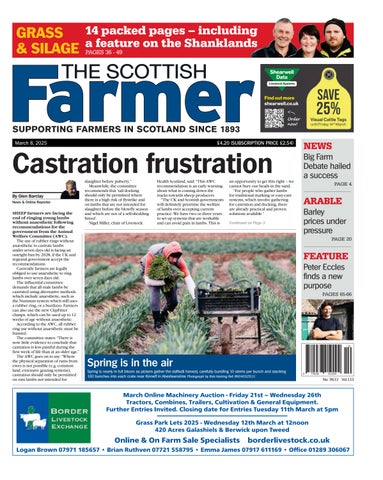
SHEEP farmers are facing the end of ringing young lambs without anaesthetic following recommendations for the government from the Animal Welfare Committee (AWC).
The use of rubber rings without anaesthetic to castrate lambs under seven days old is facing an outright ban by 2028, if the UK and regional government accept the recommendations.
Currently farmers are legally obliged to use anaesthetic to ring lambs over seven days old.
The influential committee demands that all male lambs be castrated using alternative methods which include anaesthetic, such as the Numnuts system which still uses a rubber ring, or a burdizzo. Farmers can also use the new ClipFitter clamps, which can be used up to 12 weeks of age without anaesthetic.
According to the AWC, all rubber ring use without anaesthetic must be banned.
The committee states: “There is now little evidence to conclude that castration is less painful during the first week of life than at an older age.”
The AWC goes on to say: “Where the physical separation of rams from ewes is not possible (e.g. common land, extensive grazing systems), castration should only be permitted on ram lambs not intended for
slaughter before puberty.”
Meanwhile, the committee recommends that ‘tail docking should only be permitted where there is a high risk of flystrike and on lambs that are not intended for slaughter before the blowfly season and which are not of a self-shedding breed’.
Nigel Miller, chair of Livestock
Health Scotland, said: “This AWC recommendation is an early warning about what is coming down the tracks towards sheep producers.
“The UK and Scottish governments will definitely prioritise the welfare of lambs over accepting current practice. We have two or three years to set up systems that are workable and can avoid pain in lambs. This is
an opportunity to get this right – we cannot bury our heads in the sand.
“For people who gather lambs for traditional marking or easy-care systems, which involve gathering for castration and docking, there are already practical and proven solutions available.”
Continued on Page 3


By Glen Barclay News & Online Reporter g.barclay@thesf.co.uk

THE iconic Young Farmers Centre at the Royal Highland Showground has been deemed unfit for use following recent safety inspections.
The Scottish Association of Young Farmers Clubs (SAYFC) has confirmed that the building, a landmark since 1969, will no longer be available for use.
This news, which came as a shock, has shifted the association’s immediate focus to their ‘Big Build’ campaign, which aims to raise funds for a new, purpose-built centre.
The decision to close the current facility is a blow to the SAYFC, which had anticipated continuing to use the building this year, especially with the Royal Highland Show just around the corner.
The Young Farmers Centre has been central to the show for decades, housing a variety of events, competitions, and social activities. SAYFC had hoped to
use the familiar space for their activities this year. However, the safety concerns now mean they must look to alternative solutions.
SAYFC national chair, Ally Brunton, expressed the association’s disappointment but stressed that the focus remains firmly on the future.
"Although this news is a blow to the association, we’ve been fortunate to have the support of the Royal Highland & Agricultural Society of Scotland and the organisers of the Royal Highland Show," said Brunton.
James Logan, chair of RHASS, said: “SAYFC plays a crucial role in helping to support the next generation of farmers and those across the rural sectors and we know that those who benefit from their support and services value them greatly.
"It’s so important that
organisations like SAYFC have a platform at ag-events like the show to help empower young people across the country and so we are thrilled that we’ve been able to work with the team to help find them a suitable location to talk about their vibrant work."
Brunton concluded: "They have quickly helped us secure an alternative base for our activities this year, including a marquee to host our competitions and events.
"We will ensure that Young Farmers’ competitions, including arts and crafts, will have a home at the show."
For the 2025 Royal Highland Show, Young Farmers will operate from a marquee located behind Ingliston House, a space traditionally used for the president’s marquee.
This change ensures Young Farmers will remain at the heart
Continued from Front Cover
“Castrating smaller lambs looks to be more difficult, as it is a challenge to apply anaesthetic to young sheep. Work is being done to assess whether products such as ClipFitter could be a viable solution.
“It is also important to note that there are recommendations to fund vets for training and provide equipment for small producers.”
Meanwhile a recent report by Professor Cathy Dwyer, commissioned by Defra, highlights significant evidence showing that the use of rubber rings, even on lambs under a week old, causes considerable pain and distress, leading to growing calls for alternatives.
In light of these findings, the Scottish farming minister, Jim Fairlie, has voiced his support for shifting away from traditional castration methods in favour of less painful alternatives.
Speaking at a demonstration day at SRUC Oatridge Mr Fairlie said: “There is a huge difference between rubber ring castration and using devices like the ClipFitter. It’s not entirely painfree, but the difference is night and day.”
Professor Dwyer’s report supports this shift, noting that while rubber rings have been a standard method for castration and tail docking, the pain caused is undeniable. Despite attempts to create less painful methods, such
as rubber rings impregnated with pain relief, these have not proven effective.
The introduction of the ClipFitter, which applies a biodegradable clip to desensitise the area, has been shown to significantly reduce pain compared to rubber rings.
NFU Scotland’s animal health and welfare policy manager, Penny Middleton, emphasised that progress on this issue has been frustratingly slow. She pointed to the Animal Welfare Committee’s (AWC) report, which stated that the lack of progress in addressing the 2008 recommendations is largely due to government inaction.
“AWC believes government failures to provide incentive, or a requirement to change, and their failure to drive and support the development of alternatives has enabled inaction,” Ms Middleton said.
AWC endorses its previous view that ‘castration and tail docking, as currently practised, causes welfare harm that includes immediate and ongoing pain'.
The AWC’s frustration extends to the legislative delay on the issue. Ms Middleton added: “AWC believes the Government can no longer justify current castration and tail docking practices and must amend legislation in line with current scientific knowledge.
“The devolved administrations should simplify legislation and,
given the movement of sheep across GB, align legislation across regions.”
She called for the government to act swiftly, proposing that amended legislation should be in place by 2028 at the latest.
The evidence suggests that using alternatives like the ClipFitter or Numnuts can lead to faster recovery and reduced discomfort, with lambs treated in this way displaying fewer signs of pain and abnormal posture. These device, although not without their challenges, offer a promising direction for improving animal welfare standards in the industry.
For Mr Fairlie, the potential for reducing animal suffering, along with the environmental benefits of biodegradable alternatives, make a strong case for phasing out rubber rings. “Rather than having all these rubber rings lying around, biodegradable options provide a huge difference for both the animals and the environment,” he added.
When asked by The Scottish Farmer for a definitive timeline of any legislative changes, a Scottish Government spokesperson replied: “No decision to change the legal requirements for lamb castration has been taken.
“It is vital that the Scottish Government hears from farmers, animal welfare experts and industry bodies before making a formal decision on the Animal Welfare Committee’s recommendations.”
of the event, with easy access for members and visitors to view competition entries and engage with the association’s activities.
While the closure of the existing Young Farmers Centre marks the end of an era, SAYFC is focused on moving forward with plans for the new building.
The demolition of the current facility will begin in the summer, with the new centre set to be completed by the 2026 SAYFC AGM in April.
To help fund the £1 million project, SAYFC is asking for support from the Young Farmers community and the wider agricultural sector.
A donation page has been set up, with fundraising efforts already underway.
As part of the campaign, SAYFC will display a donor’s board in the new centre, acknowledging donations over £200.
The new centre will ensure Young Farmers across Scotland have a dedicated space for events, competitions, and socialising for years to come.
A man has been reported to the Procurator Fiscal after deliberately blocking the entrance to a badgers sett near Alford.
A Police Scotland spokesperson said: "Around 12.25pm on Tuesday, January 21, 2025, we received a report of a badger sett being disturbed in the Alford area.
"Following enquiries, a 39-yearold man was issued with a Recorded Police Warning."
No charges were brought.
Both badgers and their setts are protected under the Protection of Badgers Act 1992 as amended by the Wildlife and Natural Environment (Scotland) Act 2011.
Offences under the Act include:
■Wilfully taking, injuring or killing a badger
■Cruelty to a badger
■Intentional or reckless interference with a badger sett
■Sale or possession of a badger
■Marking or ringing of a badger
Interfering with a badger sett includes:
■Damaging or destroying a sett or any part of it
■Obstructing access to a sett
■Disturbing a badger while it is in a sett
■Causing or allowing a dog to enter a badger sett

An estimated crowd of 10,000 people once again flocked to the streets in London this week in the Pancake Day rally to protest against the UK Government’s proposed changes to inheritance tax