60 years of rock
310
only item of clothing, except that they didn’t wear them on their feet). In collaboration with the local television station, Cadena 100, they organised Imaginarock, a national competition in which Ibizan groups like Statuas (who won it in 1995) and Belcebú Toys, runners-up in 1998, took part. Then at island level, Sargantana Rock became an open door to the promotion of new musicians, in an event with several dates building up to the great final, normally held at Las Dalias because it was the most suitable venue. The prize was recording a disc, a dream come true for groups who were starting off. The growing local scene was also a hive of activity, thanks to programming like Nadal Jove, another of the initiatives once supported by the Administration, but that disappeared without an alternative a few years later when the tap of official grants was turned off. Although many bands didn’t survive more than a year or two, and in fact today only Peter Colours is still working, from that hotbed of groups has arisen an endless list of long-lived musicians: David Serra, Joan Barbel and Kiko Barrenengoa, currently in Fameliars but with a host of collaborations under way in mainland Spain and Mallorca in the most experimental scenario. Paco Fernández, flamenco and dance Paco Fernández, at the time crowned with a bushy head of hair, was already playing his special music in Sant Carles at the turn of the millennium, on his way to that evolution that was to make him a musician of world stature, when he had the idea of combining the guitar with ‘down tempo’, before it occurred to anyone to put a name to the genre - perhaps you’ll recognise ‘flamenco chill’. But his name was not alone on posters from the late 1990s on for his performances here: it was accompanied by José Padilla, his ally of the time at Las Dalias, who won international recognition for writing the soundtrack to sunsets, with multimillion sales. The relationship between the two has lasted for years, although only Fernández is still faithful to his summer programming in Las Dalias, always surrounded by musicians of exceptional stature to support his guitar playing, with Eva Redondo, Dr. Gwon, Juanma Redondo and Elvis Ferrera as his most stable group. Although its terrain seemed to tend towards rock, everything has been heard in the Sant Carles venue. The flamenco heritage of Las Dalias has been present from the start and has evolved with the passage of time, with the performances of Sal Flamenco, Alma Gitana, Paco Romero, Calima, guitarist Marcial and Funkalé, whose sound explored fusion in a natural and relaxed mood. And not just flamenco, jazz is also heard, with the No Tan Big Band, the origin of the Eivissa Jazz Big Band, with Óscar Giménez, Santi Bofill and other island musicians who were members of one the first wind groups on Ibiza, and including the Jazz Club with Gresely, Dennis Herman and Edu García. There was even a night when the resident rockers set out to play soul. And they took it so seriously that Dan Jiménez, Gresely, Jorge Ortiz, Miguel Fears and Cristóbal Mascaró all came out to play with matching elegant dark suits. Even ‘house’ had its moment, well into the 2000s, with several sessions by dj Soldado and David Moreno. Similarly, the garden has hosted the eastern dance of Nur Banu, Zorah and Zinue, the flamenco of Eva Redondo, and even the tan·
go and mantras of Nina Hagen, in her most mystical phase. And the extraordinary appearance of the Molukan Moods Orchestra, a group from the Philippines who offered to perform one night and filled the hall, to the surprise of Juanito, who recalls it as a “fantastic” night. Like Tatamka, who in spite of its African name was a ska and pachanga band from Granada. As was also the case with Danza del Bongo, a group from Equatorial Guinea, and a band from Ghana for whose members Juanito had to get visas, moving heaven and earth. Later they prolonger their stay on the island instead of returning to Africa, and this brought him “a real headache”, he confesses. In 2003 Las Dalias was chosen by the Hell’s Angels, before they were pursued by the police through half Europe, for a motorbike meet that filled Ibiza’s roads with spectacular Harleys. The accompanying music was not so important, but there was a lot of rock&roll. Around the venue they organised bikers’ games, group routes and acrobatics, while inside, beer and girls flowed freely, with mud fights and striptease on top of the bar’s boxes of Coca Cola. Fortunately, no-one really came to any harm and the experience was repeated for a couple of years, increasingly attracting a public who had nothing to do with two wheels. Two years later, Javier Vargas paid tribute to his friendship with Juanito and Las Dalias in an unforgettable concert in the most pure Vargas Blues Band style, with Manolo Díaz at his side, among other great musicians. It was one of his last outdoor recitals on the island, under a starry night in which classics of the genre could be heard. Vargas, as was already a tradition in this island oasis, premiered his umpteenth record before a public who cheered this warrior of the guitar from the first beat. Then in Sant Carles a young Argentine girl rocker had settled – she already had a lot of baggage on the other side of the Atlantic, and a fresh force that brought spectators to their feet. Marian Pellegrino, famous for this and for her phase with Lucila Cueva (a play on feminist words, because ‘Pellegrino’ is a fighter (‘peleona’) even without the guitar), formed a small musical trio as basic as assembling a drummer (Christian Roig, most times), a bassist, and taking everything else on her shoulders to do versions, from her loudest soul to the most recent rock songs. Her potency on stage and her charisma did the rest, amongst a public faithful to her bravado. Even today she’s still wandering around the island, but without renouncing her Argentine band, with which she meets up regularly. In 2008, the venue found itself once more full of good intentions and dreams that ended up going nowhere, when the most important thing failed: the public. Again there was an influential person involved, in this case Andy Taylor, the ultra-famous ex-guitarist of Duran Duran, who fled like a soul fleeing from the devil of fame, in the days when the ‘new romantics’ filled the radios with the cloying music intoned by his colleague Simon Lebon and Spandau Ballet. And took refuge on an island whose apathy towards the famous was legendary. But he didn’t flee from music. At home here, he has gone on working all these years. They say he suffered a certain audience phobia, but Christina González maintains that his allergy if any was only to large concert halls full of howling adolescents: “He’s
60 years of rock
311
The Theatre Trust
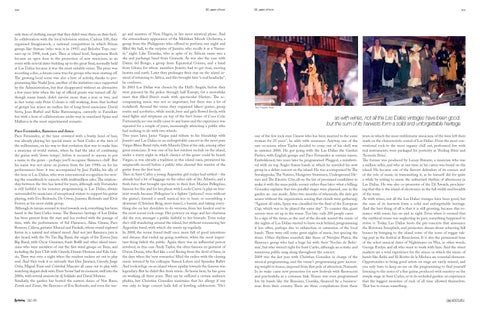
as with wines, not all the Las Dalias vintages have been good, but the sum of its harvests form a solid and unforgettable heritage one of the few rock stars I know who has been married to the same woman for 25 years”, he adds with assurance. Anyway, one of the rare occasions when Taylor decided to come out of his shell was in summer 2006. He got going with the Las Dalias the Garden Parties, with English groups and Paco Fernández as curtain raisers. Emboldened, two years later he programmed Plugged, a minifestival with six top Anglo-Saxon bands in which he unveiled his new group in a debut concert on the island. He was accompanied by The Sneakypeeks, The Natives, Hungover Stuntmen, Underground Heroes and The Electric City, all on the list of presumed candidates to make it with the mass public sooner rather than later: what a billing. González explains that two parallel stages were planned, one in the garden an one inside. After two months of rehearsals, the date got nearer without the organisation sensing that clouds were gathering: “Against all odds, Spain was classified for the final of the European Cup, which was to be played the same day”. To counter this, giant screens were set up in the venue. Too late: only 200 people came. In a sign of the times, as the end of the decade neared the music of the nights of Las Dalias started to leave rock behind, programming it less often, perhaps due to exhaustion or saturation of the local bands. There were still some great nights of music, but spacing the doses. Other rhythms sounded, like those of Navajita Plateá, the flamenco group who had a huge hit with their ‘Noches de Bohemia’, but who weren’t right for Sant Carles, although an ecstatic and numerous public sang along throughout the concert. 2009 was the last year with Christian González in charge of the musical programming, and the venue’s programming gave increasing weight to trance, imposed from that pole of attraction, Namasté. In its wake came new promoters for new festivals with fluorescent and psychodelia as a common link. Trance was even programmed live by bands like the Russians, Goatika, financed by a businessman from their country. There are three compilations from these
years in which the most emblematic musicians of the time left their mark on the characteristic sound of Las Dalias. From the most conventional rock to the most organic chill out, performed live with real instruments, were packaged for posterity as ‘Feeling Ibiza’ and ‘Acoustic Ibiza’. The former was produced by Lenny Ibizarre, a musician who was a million seller, and who at one time in his career was based on the island. He became one of the fiercest defenders of its essence and of the role of music in transmitting it, as he himself did for quite a while by setting to music the unhurried rhythm of afternoons in Las Dalias. He was also co-promoter of the Dj Awards, proclaiming that this is the island of electronics in the full width and breadth of the term. As with wines, not all the Las Dalias vintages have been good, but the sum of its harvests form a solid and unforgettable heritage. And the best thing of all is that it is still growing, because this romance with music has no end in sight. Even when it seemed that the mythical venue was neglecting its past, something happened to revive it. Today, Las Dalias hosts the pre-concerts that announce the Rototom Sunsplash, and promoters dream about achieving full houses by bringing to the island some of the icons of reggae taking part in the festival at Benicàssim. It is also the permanent base of the select musical dates of Nightmares on Wax, in other words, George Evelyn and all who want to work with him. And the street markets are a total experience for the senses in which the music of bands like Azibi and El Rostro de la Medusa are essential elements. Opportunities to bring good artists on stage are rarely missed, and you only have to keep an eye on the programming to find yourself listening to the notes of a fine guitar, produced with mastery on the simple stage in Sant Carles, or in its secluded garden: an experience that the biggest monsters of rock of all time allowed themselves. That has to mean something.