The fortification of Denmark after “Overlord” : June - December 1944
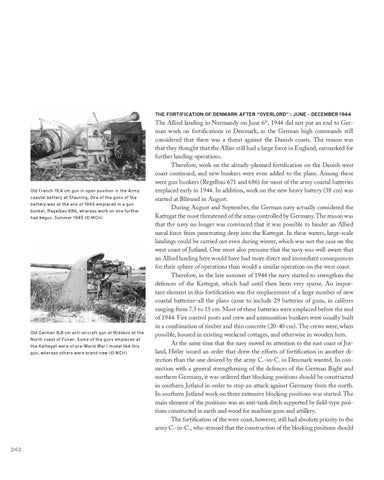
Old French 19,4 cm gun in open position in the Army coastal battery at Stauning. One of the guns of the battery was at the end of 1944 emplaced in a gun bunker, Regelbau 686, whereas work on one further had begun. Summer 1945 (© MCH)
Old German 8,8 cm anti-aircraft gun at Midskov at the North coast of Funen. Some of the guns emplaced at the Kattegat were of pre-World War I model like this gun, whereas others were brand-new (© MCH)
The Allied landing in Normandy on June 6th, 1944 did not put an end to German work on fortifications in Denmark, as the German high commands still considered that there was a threat against the Danish coasts. The reason was that they thought that the Allies still had a large force in England, earmarked for further landing operations. Therefore, work on the already-planned fortification on the Danish west coast continued, and new bunkers were even added to the plans. Among these were gun bunkers (Regelbau 671 and 686) for most of the army coastal batteries emplaced early in 1944. In addition, work on the new heavy battery (38 cm) was started at Blåvand in August. During August and September, the German navy actually considered the Kattegat the most threatened of the areas controlled by Germany. The reason was that the navy no longer was convinced that it was possible to hinder an Allied naval force from penetrating deep into the Kattegat. In these waters, large-scale landings could be carried out even during winter, which was not the case on the west coast of Jutland. One must also presume that the navy was well aware that an Allied landing here would have had more direct and immediate consequences for their sphere of operations than would a similar operation on the west coast. Therefore, in the late summer of 1944 the navy started to strengthen the defences of the Kattegat, which had until then been very sparse. An important element in this fortification was the emplacement of a large number of new coastal batteries–all the plans came to include 29 batteries of guns, in calibres ranging from 7.5 to 15 cm. Most of these batteries were emplaced before the end of 1944. Fire control posts and crew and ammunition bunkers were usually built in a combination of timber and thin concrete (20-40 cm). The crews were, when possible, housed in existing weekend cottages, and otherwise in wooden huts. At the same time that the navy moved its attention to the east coast of Jutland, Hitler issued an order that drew the efforts of fortification in another direction than the one desired by the army C.-in-C. in Denmark wanted. In connection with a general strengthening of the defences of the German Bight and northern Germany, it was ordered that blocking positions should be constructed in southern Jutland in order to stop an attack against Germany from the north. In southern Jutland work on three extensive blocking positions was started. The main element of the positions was an anti-tank ditch supported by field-type positions constructed in earth and wood for machine guns and artillery. The fortification of the west coast, however, still had absolute priority to the army C.-in-C., who stressed that the construction of the blocking positions should
242
AW 228-261 DK.indd 242
15-12-2005 11:29:46