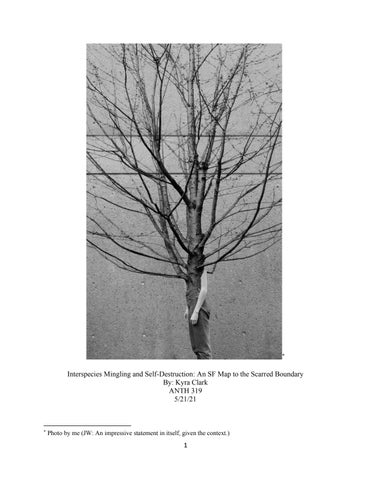
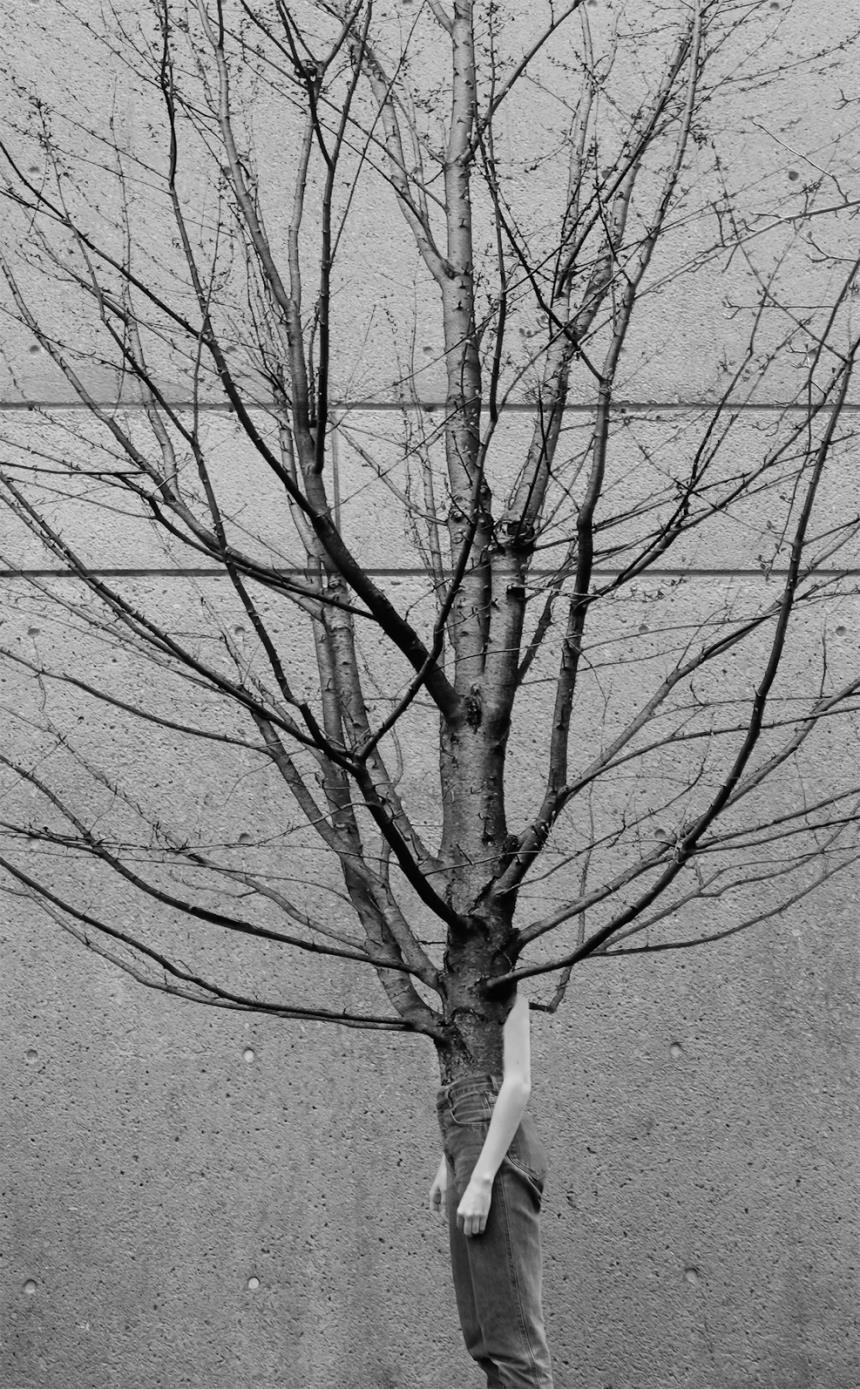
In “Staying with the Trouble: Making Kin in the Chthulucene”, Donna Haraway advises her audience that “it matters what stories we use to tell other stories with; it matters what concepts we think to think other concepts with”.1 This advice, although somewhat enigmatic at first blush, is actually quite revelatory when exploring the scarred, uncertain, and often unsettling, boundaries between the living and non-living parts of the world we inhabit. Everyday language – as used, for example, in journalism, blogs and podcasts – as well as the parlance of science are wanting in their ability to communicate our most profound thoughts about the nature of our humanity and what separates us from the inert, non-living things that surround us. Religion provides us with some ways to access these topics but it typically does so by imposing an anthropomorphic, intelligent design on the universe. By contrast, science/speculative fiction and fantasy (used herein under the acronym “SF”), particularly as translated into the visual medium of film and television, lends itself to deep and open-ended explorations of geontological topics.2 3 SF provides us with a safe space of sorts where we can ponder our role relative to the non-living milieu from which we came and to which we are destined to return. Within the realm of SF, the subgenre that focuses on the human capacity for self-destruction, the paradoxical part of us that makes us both human and yet compels us to cross the scarred boundary into the non-living realm, provides some of the richest source material and context for analyzing and conversing about the hard to reach aspects of geontology.
1Haraway, Donna J. Staying with the Trouble: Making Kin in the Chthulucene. Durham: Duke UP, 2016.Print. P. 12
2 Ibid, P. 2
3 Povinelli, Elizabeth A. Geontologies: A Requiem to Late Liberalism. Durham: Duke UP, 2016. Print.
In many respects, SF movies and television, serve like Ursula K. Le Guin’s carrier bag practice, allow the viewer to collect bits and bobs of geontological ideas like acorns in our cheeks.4
It is reasonable to ask what about SF that lends itself to conversations and deep introspection about our humanity and our capacity, as living creatures, to self-destruct on an individual and group level In thinking about the dichotomy of life and death presented by the toxic worlds we have created, isn’t it a bit self-indulgent to delve into imaginary worlds? Shouldn’t we be focusing our attention on the so-called “here and now” in tackling our fundamental existential questions by using the trusted tools of science and empirical research, and the medium of nonfiction, rather than distracting ourselves with the pretend world of science fiction and fantasy? The answer, I believe, is emphatically “no” – unlike the empirical sciences, SF provides us with an avenue to explore the boundary of life and non-life because, by its nature, it makes us “kin” and allow us to think, as Donna Haraway would say, “tentacularly,” that is to say in many directions, andatdifferentangles,at thesame time
5 WithSFwecanimaginebordersasfluid (ornonexistent), and we can have the freedom to redefine what constitutes life, death and existence. The realm of non-fiction/science, by comparison, is consumed with, and limited by, the quest for evidence and empirical data. What non-fiction/science misses entirely is that the most important revelations about ourselves and our world are not readily observed or neatly subject to dissection by the empirical method. The very way in which we separate our modes of thinking and expression into the somewhat arbitrary categories of “fiction” and “non-fiction” is an odd construct, similar to the arbitrary way we sort the “living” and “non-living” aspects of our physical environment into pre-
4 Haraway, Donna J. Staying with the Trouble: Making Kin in the Chthulucene. Durham: Duke UP, 2016.Print. P. 118
5 Ibid, p.31
conceived boxes. The fiction/non-fiction border is, itself, akin to what Elizabeth Povinelli’s refers to as a “scarred region” of human existence. 6
When Donna Haraway discusses kinship and sympoiesis, her message is simple: “nothing makes itself”.7 Of course, neoliberalism would tell us otherwise: you just have to work hard and you will succeed! You just have to pull yourself up by your bootstraps! You have to step on others to survive the capitalocene, we are taught. But, rather than seeing ourselves as competitors in a game of survival, it also possible to see that we are connected, tentacularly, in web-like structures (perhaps spun by the Pimoa Cthulu).8 “Tentacular” beings (such as octopuses and spiders) whose motions convey simultaneous similarities and differences across space, time and dimensions. This is reminiscent of Povinelli’s exploration of Tjipel, the river that is also a woman, a man, a habitat, and a home. Haraway tells us that “Kin are unfamiliar (outside what we thought was family or gens), uncanny haunting, active”.9 Tjipel has human kin despite being an aquatic entity; they rely on her and she on them, and therefor they are like one. The geontological threat to Her existence relies on using a settler-colonial mindset of what is bios and what is geos to separate them, unkin them, create a false sense of autopoiesis.10 SF narratives often do the work of imagining a world without a geontological mindset or at least a world in which that mindset is being challenged by Gaia and her human actors.
Donna Haraway, Adriana Petryna and Elizabeth Povinelli, through anthropological, feminist and anti-colonial explorations of being and “becoming with” have forged new pathways
6 Povinelli, Elizabeth A. Geontologies: A Requiem to Late Liberalism. Durham: Duke UP, 2016. Print. P. 38
7 Haraway, Donna J. Staying with the Trouble: Making Kin in the Chthulucene. Durham: Duke UP, 2016.Print., P. 58
8 Ibid. P. 32
9 Ibid, P. 103
10 Povinelli, Elizabeth A. Geontologies: A Requiem to Late Liberalism. Durham: Duke UP, 2016. Print. P. 93
through which we can imagine interspecific ways of living. Povinelli and Haraway (and even Petryna, whose ethnography is deeply entangled in medicine) share a common view that science is not the exclusive, or the most fruitful, way through which toxic sovereignties can be understood, and eventually decomposed. Povinelli and Haraway emphasize, in their own separate ways, the process that Haraway might call “becoming-with” (and what ideological norms you must reject to reach a place of becoming-with).11 Interspecific existence is predicated on refocusing our frameworks of intelligence to be inclusive of non-human life. This is a challenging task, and often impossible to do when operating within anthropocentric fields of logic that humans so often do. SFgivesus thepermission tosuspendanthropocentriclogic. Furthermore,SFallowsus to examine toxicsovereigntiesas they relate, conceptually,tohumaninstinct:toxicity asthe afterbirthordirect consequence of what it means to be human.
The 2018 film Annihilation, directed by Alex Garland, is one example of how geontological themes may be explored through a SF lens. The movie begins with Lena, who is a biologist, explaining to her students the way in which cancer cells replicate and destroy healthy cells in the human body. It is an early introduction of a central theme of the movie: selfdestruction. We learn early on in the movie that Lena has intentionally (or, at least, thoughtlessly) damaged her relationship with her husband Kane, perhaps irretrievably, by having an affair with a colleague while Kane, a soldier, is away from home on a secret military mission. While on this mission Kane and his other team members have gone missing and it is not clear where they went andiftheywillever return.KaneunexpectedlyshowsupathishomewithLena,seemingly looking like the Kane of old but physically affected and made ill by whatever he encountered on his mission. Lena learns that Kane’s mission was to explore a phenomenon known as the “Shimmer”
11 Haraway, Donna J. Staying with the Trouble: Making Kin in the Chthulucene. Durham: Duke UP, 2016.Print. P.12
adjacent to an area referred to as “Area X” (reminiscent of the zone of exclusion around Chernobyl). The Shimmer is a rainbow-colored wall of light, beyond which lies a mysterious zone -- where the conventional rules of science do not apply -- that Kane and his team entered and met their fate, with Kane the only apparent survivor. The Shimmer appears to be of extraterrestrial origin, emanating from a meteor that collided with Earth (much like the radiation emanating from Chernobyl). Racked by guilt from her lack of faithfulness to Kane during his absence and longing to understand the illness plaguing Kane as a result to his exposure to the world beyond the Shimmer, Lena goes to Area X determined to enter the Shimmer and see for herself what her husband experienced in the world behind this strange envelopment.12
When she arrives at Area X, Lenna encounters Dr. Ventress, a psychologist working at the forward base that is part of Area X. Lena confesses to Ventress that she feels compelled to enter the Shimmer, even though it may be, in effect, a suicide mission Ventress challenges Lena’s motivation for entering the Shimmer by ascribing to it a self-destructive act on Lena’s part.
Ventress tells Lena:
Then, as a psychologist, I think you are confusing suicide with self-destruction. Almost none of us commit suicide, and almost of all of us self-destruct. In some way, in some part of our lives. We drink, or we smoke, or destabilize the good job, or happy marriage. But these aren’t decisions, they’re impulses.
Ventress is both diagnosing Lena and, at the same time, describing a key feature of the human condition, namely the paradox that a core element of what make us “alive” is the instinct, almost at the DNA level, to destroy ourselves and others. In this way, the toxic environments we create, such as the desert that Elizabeth Povinelli refers to or the zone of exclusion surrounding Chernobyl that Petryna writes about, are either of human origin or are affected by human interaction and beckon us, individually and as species, to the non-living status from which we arose. The
12 Garland, Alex, director. Annihilation. Paramount Pictures, 2018. 00:53:52-00:54:29
interesting question posed by Garland, however, is whether this perverse drive toward selfdestruction can also in some sense be a creative act.
Ventress (as team leader), Lena and three other women enter the Shimmer to accomplish what Kane and his crew could not: figure out what lies behind the Shimmer and what it portends for humanity. Their mission has an urgent quality to it because the Shimmer is expanding in size and, like the cancer cells that Lena is seen discussing at the opening of the movie, it threatens to envelop the entire planet over time. Each of the five women on this ill-fated mission are confronting death in different ways: Ventress has terminal cancer and is resigned to dying; Lena is dealing with the trauma that her husband Kane is gravely ill from his mission; and may die; Cass Sheppard, an anthropologist, is mourning the loss of her daughter; Anya Thorenson is a paramedic who, by the nature of her profession, constantly stands at the threshold of life/death; and Josie Radek is a shy physicist with self-harming tendencies, who becomes way more alive in the Shimmer than she ever was outside of it. It seems hardly accidental that there are only women on this follow-up mission; it suggests that the all-male team that preceded them failed in some elemental way and that it would perhaps take the qualities of being a woman – particularly the creative potential of women– to unlock the mystery of the land behind the Shimmer. Beyond the boundary of the Shimmer, Ventress, Lena and the rest of the team experience a strange and exotic world where life has not been eliminated but, instead, radically transformed. It is reminiscent of what scientists discovered in the zone of exclusion around Chernobyl after the reactor accident: rather than finding a barren moonscape or desert in which no life can exist, they found a place where life thrived in Pripyat and beyond in the absence of humans. However, as exotic and interesting as world beyond the Shimmer is, it is also fundamentally a dangerous one. Not only are these women faced with the dangers posed by a variety of hybridized creatures,
including chimeric versions of crocodiles and bears created by the strange and invisible forces at work around them, they must confront the fears and self-destructive loathing characteristic of the human condition. Perhaps it is the isolation of the land beyond the Shimmer (the Shimmer’s distortive properties make communications with the “outside world” impossible) or the otherworldliness of this place (where time and place seem radically changed and the natural laws of science and physics do not apply) that drives these five women mad in a way or, perhaps more precisely, accentuates what makes them human, namely their instinct for self-destruction.
Only Ventress and Lena make it the end of the journey: a lighthouse, wrought with symbolism, located where the meteor landed and where the source of the Shimmer lies. Ventress is seen there changing into a kaleidoscope of light as she encounters the source of the Shimmer. Lena, by contrast, is confronted with her doppelganger, who mimics her every move. When she tries to punch the creature, it punches back, only harder. She realizes that is futile for her to fight what is, in essence, her mirror image. In this way, the movie eschews the typical archetypes of action SF movies – where the hero overcomes it adversary by ‘outfighting them’ . By doing so, Garlandembraces thephilosophyofUrsula K.LeGuin's The Carrier Bag Theory of Fiction Ursula K. Le Guin who says that she likes novels because “…instead of heroes they have people in them”.13 In the Shimmer, standard Marvel movie-fare heroics are beside the point because there is nothing to actually fight. The journey into the world beyond the Shimmer is a one of survival and of confronting the bounds of one’s existence and one’s instincts for self-destruction. Rather than finding aliens at the end of the journey, what Lena discovers is a prismatic place, one that is able to mutate bios so that it becomes one with geos, or one with other forms of bios.14 She
13 Le Guin, Ursula K. The Carrier Bag Theory of Fiction. Ignota Books, 1986
14 Povinelli, Elizabeth A. Geontologies: A Requiem to Late Liberalism. Durham: Duke UP, 2016. Print.
“defeats” her clone by holding a phosphorous grenade an causing her clone to set fire to itself by pulling the pin on the grenade.
The film is framed by an interrogation of Lena by a scientist who is trying, in the desperate way that empiricists pursue things they cannot understand, to make sense of Lena’s and Kane’s emergence from the Shimmer and what it portends for humanity. The scientist fears that the Shimmer is rewriting the DNA of everything it encounters, much like a cancer cell, and that it threatens humanity. Lena responds to her interrogator sharply by saying “it wasn’t destroying, it was changing everything. It was making something new”.15 She and Kane are not their old selves, but are rather an amalgam of the Shimmer “virus” and what they once were – a new form of creation, that perhaps only a woman and a biologist could fundamentally understand. In other words, the Shimmer bonded the virus of geos and the human bios in an act that profoundly illustrates Povinelli’s view of life, folding back into non-life. Annihilation reveals to us that reevolution cannot be born from the settler-colonial framework of knowledge/life/non-life that we constantly attempt to apply, re-work, re-apply to the same situations, despite repeatedly failing in our results. Perhaps re-evolution is not something within human potential. Of course, presenting newly-formed Lena as a new, and potentially wiser, version of humanity, provides the movie with a satisfying ending to viewers who are invested in having Lena, the protagonist, achieve a positive outcome. But the roots of acknowledging sympoiesis as an evolutionary necessity are palpable.
Another example of visual SF providing fertile ground for conversations about the relationship between life and non-life is the Netflix original series, “The OA” (co-created by Brit Marling and Zal Batmanglij), which developed a small but intense cult following over its twoseason run. A central theme of this series is how “near death experiences” or NDEs blur the line
15 Garland, Alex, director. Annihilation. Paramount Pictures, 2018. 01:44:58-01:45:07
between life and death as we know it. NDEs, by their very nature, are occurrences that exist, if at all, at Povinelli’s scarred boundary between life and death and are suggestive that this boundary may be multi-directional. At the beginning of the story, the OA’s main character, a mysterious young woman by the name Prairie Johnson, is depicted as living in the Midwest with her adopted parents after a prolonged absence. Prairie was missing for seven years and then, like Kane from Annihilation, arrives back at home out of nowhere with more questions than answers. Adding to the sense of mystery, Prairie was blind when she was left home and is fully sighted upon her return. We learn over time that Prairie has a fantastical back story, as well as possible “interdimensional” side stories, told in some cases, both figuratively and literally, in tentacular fashion. 16
Prairie’s “origin story” is that she was born and lived as a child in Russia as Nina Azarov, the only daughter of a loving and attentive single father Her father is quite wealthy and she lives a life of comfort and luxury. But her life is turned upside down (literally), when the school bus she is riding on falls off a bridge into a frozen lake; the accident was the result of sabotage by a Russian crime organization that wished to send a message to Nina’s father and the other families with children on the bus. Nina escapes from the submerged bus but seemingly “dies” in the frozen water. Nina is returned to the world of the living when a “Khatun” (an angel-like apparition) saves her but takes her vision to spare her from the terrible things she will see in the future In order to protect her from future attempts on her life, her father sends the blind Nina to the United States where she is adopted by the elderly and childless Johnson family who name her Prairie. Prairie is well cared for by the Johnsons but she nonetheless misses her father terribly. When she is twentyone years old, based on a premonition, she travels to New York to find her father only to be
kidnapped by a man referred to as “Dr. Percy/Hap” who is studying people who have had NDEs. He invites Prairie/Nina to join him but ends up imprisoning her (along with a group of four other young people who have had NDEs) in a bizarre and sadistic effort to induce NDEs for purposes of studying them and harnessing their potential power. In this way, Hap is playing the role of the capitalist in the capitalocene who is trying to make a profit at the boundary of life and death. As despicable as he is, however, Hap appreciates that there is an odd, creative potential when mixing life with death. Like Annihilation, this creative potential is fraught with peril but both Annihilation and The OA make the case for the proposition that the “end of human life” is not necessarily an end but also a portal to a new beginning that defies the conventional logic of science and our modern understanding of how the world works.
While in captivity with her four fellow captives, Prairie/Nina and the others devise the socalled “five movements,” drawn from their collective NDEs, which when done correctly can protect people from harm. After she is freed from captivity, Prairie/Nina teaches the five movements to a group of local misfits who are able to harness the energy from their collective choreographed dance to prevent a mass shooting at a local high school (the only victim of the shooting is, ironically, Prairie/Nina, who “dies” only to be transported to another version of herself in another universe in a multiverse in Season 2). The five movements, which have a spiritual quality to them, are fundamentally a communal action, which underscores the point that human “success” at the boundary of life and death requires collective initiative as much as it does individual effort.
In Season 2, Prairie/Nina is now back to being full-on Nina, who is living a life of luxury in San Francisco. It is in this season that we see Haraway’s “tentacular” thinking visualized in its more vivid form. In Season 2, Episode 4, entitled “Syzygy,” we are presented with a scene where
Nina enters a club where she is clearly supposed to perform some task, but is confused about what she is supposed to do (remember, she is really “Season 1 Nina” living in Season 2’s Nina’s body). She walks down a long, illuminated hallway toward a singular chair and is restrained, by two men speaking Russian, in the chair with straps. A curtain falls: she is exposed to an audience. Another curtain falls and reveals a massive tank behind her, housing a gigantic octopus (his name: Old Night). Because of the restraints, she cannot turn to look at him. A tentacle reaches out, ensnaring her right arm. Another reaches out, capturing her left arm. Then, all of a sudden, she hears his voice: she has a telepathic connection with him. He speaks to her and she then relays the message to the audience. Old Night then offers to show Nina her “true nature” by killing her for 37 seconds. She consents to Old Night’s offer.17
The entirety of the OA is a complicated riddle, that is born from the reseeding of other SF narratives. There is a constant effort to compost beings. The previously mentioned choreographic sequences that allow for inter-dimensional travel are only made possible by those who have had an NDE, ingesting living beings, swallowing them whole and therefore absorbing their knowledge and becoming cross-specific, in their NDE sequences. Old Night is a very literal representation of the idea that not only has the geontopolitical muted the voices of indigenous people, but it has denied the opportunity for interspecific knowledge-sharing. We are not functioning like mycelium, because we cut ourselves off. Old Night refers to Nina as his “medium”, a vessel for oceanic, tentacular, sticky and wildly psychic knowledge. This scene, however, centers the human (not that the 16-ft telepathic octopus doesn't absolutely steal the show, but that it takes place in the theater, a human environment, and Old Night is confined to a small tank), but as Haraway might argue, part of embracing the cthulucene is decentering human importance.
17 “SYZYGY.” The OA: Chapter 2, written by Brit Marling, Zal Batmanglij and Dominic Orlando, directed by Zal Batmanglij, Plan B Entertainment, 2019
In Season 2, Episode 5, “The Medium and the Engineer, ” Nina and another character, Karim, explore an old house in the Nob Hill neighborhood of San Francisco (another SF?), that mysteriously ages young people. The house presents another riddle. Nina and Karim are separated by the guiles of the anthropomorphic house, and Nina climbs out of a window onto the limb of a tree. She crawls along it, slowly, following a whispering voice that calls her name: OA, Nina, Come to me. Then, she falls: caught by tree roots, she is suspended in space. The roots are illuminated and the mycorrizhal network (also known as the wood-wide web) has come to life.18 Like the octopus, it wraps it’s tentacular arms around her. The voice speaks to her again, saying: “we have been calling to you from inside the earth for many years”. When she says that she didn't hear them, they respond that they have been talking to her through the wind. “Didn’t you feel it pulling you? Calling your name?”. The dialogue between them continues, and then the voice says “No tree survives alone in the forest. When one tree falls ill, we all send food. For if one tree dies, the canopy is broken. Then all suffer the weather and pestilence that flood in. You will not survive on your own”.19 This brings us to the most urgent point of this SF tale, which is that the fallacy of autopoiesis underpins toxics sovereignties. Nina will not survive on her own in her inter dimensional traveling quest, but we, too, will not survive on our own. Povinelli, in discussing Tjipel’s multi-faceted being, states that her changes, her “morphological mutations did not kill her. Quite the contrary. They allowed her to persist in a different form”.20
What do Annihilation and The OA reveal about geontological themes, about the inner workings of toxic sovereignties that conventional science and non-fiction cannot? First, that the
18 Wohlleben, P., & Billinghurst, J. (2018). The hidden life of trees: the illustrated edition. Vancouver: David Suzuki Institute.
19
“The Medium and the Engineer.” The OA: Chapter 2, written by Brit Marling, Damien Ober and Henry Bean, directed by Zal Batmanglij, Plan B Entertainment, 2019. 00:28:34-00:29:56
20 Povinelli, Elizabeth A. Geontologies: A Requiem to Late Liberalism. Durham: Duke UP, 2016. Print. P. 94
definition of what is “living” and what is “non-living” is not as clear as we might like it to be. Although it may be understandably easier from a cognitive perspective, on a day-to-day basis, to accept what constitutes life and non-life based on established modern “scientific categories,” the edges of our consciousness are often interrupted by events and versions of reality that do not neatly fit into these categories. Take, for example, the scientific approach to whether a “virus” is living or not. By most conventional scientific standards, viruses are not living things because, among other things, they cannot grow or make their own energy. But, given our recent collective experience with the COVID-19 pandemic, which has claimed millions of lives globally, is this a distinction without meaning? Wouldn’t it be more constructive to have a more nuanced way of viewing our world, where what is living and what is not occupies a spectrum, much like the indexing of human conditions that is portrayed in post-Chernobyl disaster Ukraine? By according less value to non-life, we are missing the critical ways in which non-life – radiation, global warming from consumption of fossil fuels, the ways in which modern prosthetics and artificially intelligent technology are supplementing and mixing with human biology – are impacting human life, in lasting and irretrievable ways. SF, unburdened by the limits of science and non-fiction, is open to exploring this spectrum and the ways in which life and non-life co-exist in a symbiotic way.
Second, SF fully grasps the human impulse toward self-destruction, which is a primary driver of the toxic sovereignties we have created for ourselves. Although we can try to understand our headlong dive into possible extinction through the social sciences, for example through macroeconomics or psychology, SF allows us to confront this human-most of impulses in ways that make it easy to comprehend and adapted to our own experiences. For example, in Annihilation, although the Shimmer is an event not of human origin, the human instinct for self-
destruction is seen in a variety of other small and big ways, inclThding Lena’s decision to wound her marriage by committing an adulterous affair, Josie Radek who engages in self-mutilation or the teams of humans entering the Shimmer with full knowledge that they may not return. Also, the viral world behind the Shimmer can be seen as a metaphor for the toxic worlds we have created for ourselves such as Chernobyl and other areas of our modern world poisoned by our human instinct to satisfy short-term desires at the risk of self-destruction on a human species scale. SF does not ascribe a particular reason humans are inclined to do this but one can suspect that at least one explanation is that our individual mortality, and our obsession with it, creates a strange and simultaneous attraction and repulsion to what it means to be “non-living”.
Third, the SF discussed herein raises the interesting, and perhaps troubling, specter that self-destruction can be, in its own way, a creative event. Rather than seeing bios and geos as separate and distinct systems, we can see how – like the carefully choreographed Five Movements in the OA – life and non-life are like the Earth’s tectonic plates, where life is subsumed by nonlife, and vice versa, only to emerge later in a new and varied thing. If we embrace the possibility and inevitability of this relationship between bios and geos, we can find the language and the way of coping with the toxic world in our future. This is not to dismiss the toxicity that we have collectively created for ourselves, but rather an effort to develop an intellectual and emotional register for seeing ourselves for who we are and where we fit into the broader scheme of the universe.
In the end, SF is what it is billed to be, namely a form of escapism. But the escape it achieves is not from reality but from the strictures of science/non-fiction and the ways in which science/non-fiction do not allow us room to have the possible broadest conversations about life and death. Perhaps if we saw ourselves as ultimately a component in a larger system, some of
which is inhabited by the characteristics of bios and some of which has the attributes of geos, we would take a different approach to our environment and our tendency toward destruction. Although some might see this as a backward step, as an embrace of superstition and fantasy at a time when we should be “crunching the numbers” on things like climate change, SF opens ourselves up to the fundamental existential questions of our time and provides us with a range of exotic, creative and unconventional views on how we might begin answering these questions for ourselves and posterity.
Wonderful work here, Kyra! This is a spirited and deeply insightful exploration of the potential of SF as social work for engaging with a more sympoetic future, one that does not shy away from the seeming inevitable need for this work to happen given the conditions of life “on a damaged planet,” as Tsing might put it. There’s perhaps a bit too much summary – the section on Annihilation, in particular, is a bit long on plot and short on your own analytical voice, but you do return to your key conceptual points throughout, and I found that your analysis of the OA found that balance more effectively. And the ideas and the writing here is, throughout, rich, insightful, and deeply engaged with the questions we’ve been thinking through all semester. Really, really, really well done, in short!
Paper: 33/35
Course Grade: A+
Works Cited:
1. Garland, Alex, director. Annihilation. Paramount Pictures, 2018.
2. Haraway, Donna J. Staying with the Trouble: Making Kin in the Chthulucene. Durham: Duke UP, 2016.Print.
3. Le Guin, Ursula K. The Carrier Bag Theory of Fiction. Ignota Books, 1986
4. Povinelli, Elizabeth A. Geontologies: A Requiem to Late Liberalism. Durham: Duke UP, 2016.
5. Wohlleben, P., & Billinghurst, J. (2018). The hidden life of trees: the illustrated edition. Vancouver: David Suzuki Institute.
6. The OA. Created by Brit Marling and Zal Batmanglij, Plan B Entertainment, 2016-2019
a. “The Medium and the Engineer.” The OA: Chapter 2, written by Brit Marling, Damien Ober and Henry Bean, directed by Zal Batmanglij, Plan B Entertainment, 2019.
b. “SYZYGY.” The OA: Chapter 2, written by Brit Marling, Zal Batmanglij and Dominic Orlando, directed by Zal Batmanglij, Plan B Entertainment, 2019