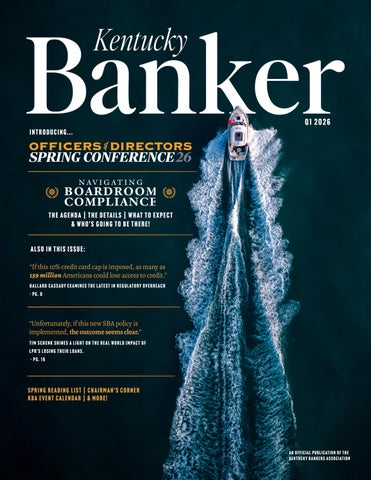
Kentucky Banker Magazine - Q1 2026

Page 1


The AGENDA | The DETAILS | WHAT TO EXPECT & WHO’S GOING TO BE THERE!

ALSO IN THIS ISSUE:

“If this 10% credit card cap is imposed, as many as 159 million Americans could lose access to credit.”

Ballard Cassady examines the latest in regulatory overreach - PG. 8

“Unfortunately, if this new SBA policy is implemented, the outcome seems clear.”

TIM SCHENK shines a light on the real world impact of LPR’s losing their loans. - PG. 16

SPRING READING LIST | CHAIRMAN’s CORNER KBA EVENT CALENDAR | & MORE!

We Know Banks

WHO WE ARE: The KBA is a nonprofit trade association that has been providing legislative, legal, compliance and educational services to its member institutions since 1891. KBA's directors and staff work together with its members to make the financial services industry a more effective and successful place to work. The strength of the KBA is bankers unifying as an industry to speak as one voice.

WHAT WE DO: The purpose of the Kentucky Bankers Association is to provide effective advocacy for the financial services industry both in Kentucky and on a national level; to serve as a reliable and responsive source of information and education about areas of interest to the industry; and to provide a catalyst and forum for collective industry action. The KBA does this in 4 ways:

1. Government relations & industry advocacy

2. Information interchange

3. Education

4. Products and services

KENTUCKY BANKERS ASSOCIATION

600 West Main Street, Suite 400 Louisville, Kentucky 40202

KENTUCKY BANKER is the official bi-monthly magazine of the Kentucky Bankers Association (KBA). No part of this magazine may be reproduced without express written permission from the KBA. The KBA is not responsible for opinions expressed by outside contributors published in KENTUCKY BANKER. The KBA reserves the right to publish submissions at the discretion of the KENTUCKY BANKER editorial team. For more information, or to submit an article, pictures or pass on a story lead, contact Matt Simpson, Managing Editor, at msimpson@kybanks.com

Visit us online at KYBanks.com

Ballard W. Cassady Jr. President & CEO bcassady@kybanks.com

Michel Buchheister IT Specialists mbuchheister@kybanks.com

McKenzie Caldwell Staff Accountant mcaldwell@kybanks.com

Cass Cassady Director of Events ccassady@kybanks.com

Amanda Cole Coordinator Bank Performance Report acole@kybanks.com

Miriam Cole Executive Assistant Office Manager mcole@kybanks.com

John P. Cooper Legislative Solutions jcooper@kybanks.com

Paula Cross Education Coordinator pcross@kybanks.com

Casey Guernsey Enrollment and Billing Specialist cguernsey@kybanks.com

Jamie Hampton Education Coordinator jhampton@kybanks.com

Tamuna Loladze Chief Operating Officer HOPE of the Midwest tloladze@hopeofthemidwest.

Michelle Madison IT Manager mmadison@kybanks.com

Brandon Maggard Account Representative KenBanc Insurance bmaggard@kybanks.com

Chuck Maggard President & CEO KenBanc Insurance cmaggard@kybanks.com

Lisa Mattingly Director of Sales & Service KBA Benefit Solutions lmattingly@kybanks.com

Tammy Nichols Finance Officer HOPE of the Midwest tnichols@hopeofthemidwest.com

Selina Parrish Director of Membership sparrish@kybanks.com

Katie Rajchel, CPA Accounting Manager krajchel@kybanks.com

Timothy Schenk General Counsel tschenk@kybanks.com

Jennifer Schlierf Sales Support KBA Insurance Solutions jschlierf@kybanks.com

Matt Simpson Communications Director msimpson@kybanks.com

Jessie Southworth Director of Education jsouthworth@kybanks.com

Matt Vance, CPA Chief Financial Officer mvance@kybanks.com

Billie Wade, CPA Executive Director HOPE of the Midwest bwade@hopeofthemidwest.com

Audrey Whitaker Insurance Services Coordinator awhitaker@kybanks.com

2025-2026 OFFICERS & BOARD

CHAIRMAN

W. Lee Scheben, President, Heritage Bank, Inc., Burlington

VICE CHAIRMAN

J. Jason Hawkins, President/CEO, 1st United Bank & Trust Co., Madisonville

TREASURER

Alex Cook , President & CEO, Hearthside Bank, Middlesboro

GROUP REPRESENTATIVES

Represents Group 1

Michael Radcliffe, CEO/CCO, Community Financial Services Bank

Represents Group 2

Douglas E. Lawson, President & COO, Field & Main Bank, Henderson

Represents Group 3

Logan Pichel, President & CEO, Republic Bank & Trust Company

Represents Group 4

Brandon Fogle, Market President, South Central Bank, Inc., Elizabethtown

Represents Group 5

David Hertz, President/CEO, The Farmers Bank of Milton, Milton

Represents Group 6

Robert Miles, President & CEO Peoples Bank of Lebanon

Represents Group 7

Lucas Shepherd, CEO First National Bank of Manchester

Represents Group 8

Lonnie Foley, President & CEO Peoples Bank of KY, Inc., Flemingsburg

PAST CHAIRMAN

April R. Perry, Chairman & CEO, Kentucky Farmers Bank Corporation

KBA PRESIDENT & CEO

Ballard W. Cassady, Jr., President & CEO Kentucky Bankers Association

Represents Group 9

James Ayers, Regional Manager First State Bank, Inez

THRIFT REPRESENTATIVE

Glenn Meyers, Executive VP, Citizens Federal Savings & Loan Assoc., Covington

BANK SIZE REPRESENTATIVES

Represents Banks w/ Assets of $1B+

Tucker Ballinger, President/CEO, Forcht Bank, Lexington

Represents Banks w/ Assets of >$1B & at least $200M

Frank B. Wilson, President & CEO Wilson & Muir Bank & Trust Company

KBA BENEFITS TRUST

REPRESENTATIVE

W. Fred Brashear, II, President & CEO Hyden Citizens Bank

Banker Kentucky

THANK YOU TO OUR ADVERTISERS AND CONTRIBUTORS

Bank Performance Report

Deluxe FHLB Cincinnati

First Horizon

ImageQuest

Independent Correspondent Bankers’ Bank, Inc.

K4 Architectures & Design

KenBanc

Morgan & Pottinger

OCCH

ServisFirst Strunk

Deluxe does more than print checks.

Deluxe is here to help build and grow your brand in ways that strengthen customer relationships and your financial institution’s true potential. Improve your customer experience, elevate operations and maximize profit potential. Contact Deluxe today to find out how.

Checks

Personal & Business Checks

Cash Management & Supply eChecks Official Checks & Forms

Data-Driven Marketing

Data-Driven Marketing

Digital Referral & Acquisition Banker’s Dashboard MyCorporation

Promotional

Promo & Apparel

Giveaways, Gifts & Recognition

Commercial Printing Print & Mail

Payments

Deluxe Receivables+ Suite Lockbox+, eLockbox+ & RDC

Deluxe Payment Exchange+

Deluxe Merchant Services

Get your bank to be at its branding best.

Contact Dean DiMidio, Regional Client Manager at dean.dimidio@deluxe.com, or 814.883.0355

Budget Season, Big Bills, and the Long Game Ahead

As I write, the snow has finally melted and we’re getting our first taste of spring. While things are warming up outside, Frankfort is still hot with nearly 1,000 bills filed. Since this is a budget year, most are being slow-rolled or flat-out ignored. Tim, John, and Ballard have been keeping a close eye on the ones that could impact our industry; things like crypto kiosks, credit card interchange, appraisals, and historical tax credits. Our big push is still going after credit unions taking public deposits. A lot of these bills will sit dormant until the very end of the session, so stay tuned as I’m sure there’s plenty more to come.

On the federal side… well, things have actually cooled down. The housing bill passed, but some of our expected relief on CTRs and SARs got stripped out along the way. The FDIC deposit insurance limit has gone nowhere, and the proposed 10% cap on credit card interest is getting some press but no real push yet. One item that is starting to heat up is the “skinny” master Fed account issue — and in all likelihood, neither side will be happy, with litigation sure to follow. As we all know, Washington’s memory is about a nanosecond long, and they can’t seem to stay focused on any one topic for too long. Oh, how we long for the days when deals were made after hours over a good bourbon.

New Year, New Opportunities, and New Problems

Would you have it any other way? I can tell you my answer, and it’s yes, I would. Just once, I’d like to start a new year without legislative initiatives coming after us, with regulatory common sense taking hold (although, admittedly, it’s getting much better), and with Washington being “out of cycle” on elections. But, as my wife says, “that’s the life I signed up for.” She is right, as usual.

But — and it’s a big but... that’s not the life YOU signed up for! Bankers across the Commonwealth signed up to help their communities: the individuals, as well as the businesses, to grow and prosper. To help the charities and high school sports... all those precious things, large and small, that make a community what it is in the Commonwealth.

“With friends like these...”

I have been writing since August 2025 about the ‘hyper speed’ with which the Genius Act passed Congress. This bill introduces stablecoin to the U.S. and our financial mainframe, along with all the dangers that will follow. They will try to do a market structure bill in the Senate that “cleans up” this illconceived Genius Act.

For bankers, this legislation represents an opportunity to close a critical loophole that would allow stablecoin issuers and affiliates to offer yield-like rewards, clearly undermining the intention of the Genius Act’s ban on issuers paying interest.

Meetings are taking place weekly at the White House as officials work toward a solution. The threat to the banking sector is significant, and failure to address the loophole could drive billions of dollars in deposits out of banks, with severe downstream effects on local lending and economic growth.

Meanwhile, the Office of the Comptroller of the Currency (OCC) is preparing to broadly issue limited charters, which would allow fintech firms to offer stablecoins and access the Federal Reserve’s payment infrastructure.

The Small Business Administration issued a procedural notice that would take away the 5% investment rule for long-term legal

immigrants (how they get away with that I’ll never know) under the 7(a) and 504 loans.

The White House wants to put a 10% cap on credit card interest. We all know... rather, people outside of Washington know... that will take credit away from a whole lot of people. If this cap is imposed, as many as 159 million Americans could lose access to credit.

The Deposit Insurance Fund (DIF) needs renovating, and the first shot out of the cannon was to offer $20 million coverage on business accounts, then changed to $10 million because… well, I don’t know why. Eventually, it slowed down enough to inject a little sanity and common sense into the process by using the Emergency Troubled Asset program (ETAG). ETAG would cover all deposits when there is a threat of bank failure and deposit runs for a small period of time, giving the FDIC and Treasury time to resolve the problem. After the resolution, coverage then goes back to the $250,000, indexed to inflation. This would be the most commonsense way to do it... but our industry and Congress are split on it for obvious reasons. It’s too simple.

And on and on it goes with the attacks on our industry. Keep in mind, this comes from people who professed to be our friends! I’m daggone sure I don’t need any enemies with friends like this!

On the state level, we are battling smaller issues, but they are just as damning as those in Washington. Credit unions continue to fight for the right to take public deposits. They don’t pay income taxes, of course, but have no problem taking deposits of other people’s income taxes. I guess they have other football stadiums to name. You can’t make this stuff up!

There are at least 10 other pieces of legislation that would have some effect on how banks operate. Luckily, our legislative team of Capital Link, McCarthy Solutions, and KBA’s General Counsel Timothy Schenk has their fingers on the pulse, and the trigger, on your behalf. They are working diligently with bill authors to try to fix these problems. The battle rages on.

If this 10% credit card cap is imposed, as many as 159 million Americans could lose access to credit. “ “

So, what do we have to look forward to? Well, the Genius Act doesn’t take effect until July, so maybe through the market structure bill we can get it cleaned up, while adding some strong guardrails to stablecoin. The deposit insurance conversation will probably fade into the sunset since we are in an election cycle, and I would assume eventually the SBA comes to its senses on the 7(a) program. The credit card “gimmick” will show itself to be very foolish and probably go the way of the buggy whip as well.

At times like these, I’m always amazed at how regulatory agencies respond after a natural disaster. They come out and announce they’re lightening the regulatory burden for banks in affected areas until recovery is complete. To me, that’s very telling. They already know that if left to operate without massive government interference, banks will not only get their communities back up and running, but help their customers prosper and their communities grow.

Yet as soon as the cleanup is done, here they come again to slow down progress to a bureaucratic crawl.

But remember, when bankers come together to elevate issues that matter, our voices carry significant weight. In these policy debates, the response from our industry has changed the momentum. We’ll have to wait and see if the outcome is better.

All this to say, the KBA is working night and day (literally) to protect your ability to do what YOU signed up for: to serve your community and customers.

Director of Education, Kentucky Bankers Association

Succession, Governance, and What’s Ahead: Introducing Spring Conference 2026

Boardroom compliance is top of mind for banking’s senior leadership, officers, and directors. The topics chosen for this year’s Spring Conference were selected to ensure both senior management and board members walk away with the essential knowledge needed to navigate today’s challenging banking environment.

To no surprise, this year’s topics tackle succession and leadership: two themes that go hand in hand as the torch passes from one generation to the next. With our industry facing what many call the “looming retirement cliff,” we’re confident you’ll leave Spring Conference with new ways to navigate the path forward in your career.

We’re also tackling corporate governance and commercial real estate loans. While loans are generally the riskiest asset on the balance sheet, commercial real estate loans carry even greater exposure. We want to help you navigate these complexities so your institution can make sound decisions from the top down, starting at the board level.

But we’re not stopping at what’s relevant today. Bankers can’t afford to stay complacent—they must keep their eyes on the horizon, monitoring for new regulatory requirements before they arrive. We want to help you navigate the challenges of today and tomorrow. And that’s our biggest goal for this year’s Spring Conference.

So please register online today and join us for the Officers & Directors Spring Conference on April 19–21 in the historic heart of downtown Louisville, Kentucky!

Why Attend the Officers & Directors Spring Conference?

1. Unpack the latest in regulatory compliance

2. Prepare your institution for tomorrow’s challenges

3. Earn continuing education credits

4. Network with fellow banking professionals

5. Demonstrate your commitment to compliance

Introducing Mike Oster

We’re thrilled to welcome keynote speaker Mike Oster to this year’s Spring Conference. A Brigadier General in the South Dakota Army National Guard, Mike is a combat veteran who served in both Operation Iraqi Freedom and Operation Enduring Freedom. Beyond his military career, he’s led a Fortune 500 team, served as an elected official, and built multiple successful businesses from the ground up. He holds a Master’s degree in Industrial Management from South Dakota State University and is a graduate of the United States Army War College.

Mike’s opening session, “Elevate Your Leadership: Leading on Purpose with Passion,” tackles a question every banker faces: how do you lead effectively when the stakes are high and the landscape is constantly shifting? His answer is to lead with purpose, empathy, and influence rather than authority. It’s a message that resonates whether you’re in the C-suite or supporting your team from behind the scenes.

Jessie Southworth

Registration is now open! To book your hotel, sign up for golf, or view the latest agenda details, visit us at KBASpringConference.com

Sunday, April 19

2:00–3:00 pm Registration and Refreshments with Exhibitors

3:00–4:00 pm Elevate Your Leadership: Leading on Purpose with Passion

Mike Oster

4:00–5:00 pm Director Responsibilities and CRE Issues

Ken Pennington, Kentucky Department of Financial Institutions

5:00–6:30 pm

Monday, April 20

Cocktail Reception –Olmstead Prefunction Dinner on Your Own

7:00–8:00 am Breakfast

8:00–9:00 am Navigating Succession

Charlie Riggs, St. Louis Federal Reserve

9:00–10:00 am Washington Legislative Update

Blake Earley, SVP Congressional Relations and BankPac, American Bankers Association

10:00–10:15 am Break

10:15–11:15 am Today’s FDIC Speaker TBD

1:00 pm Golf Tournament –Champions Pointe

6:00–7:00 pm

Reception with Exhibitors –Olmstead Prefunction

7:00–9:00 pm Banquet – Olmstead

Tuesday, April 21

7:00–8:00 am Breakfast

8:00–9:00 am Corporate and Risk Governance

Chris Blau, Assistant Deputy Comptroller, Office of the Comptroller of the Currency

9:00–10:00 am Session 7 – TBD

10:00–10:15 am Refreshment Break

10:15–11:15 am Session 8 – TBD

11:15 am–12:15 pm Fireside Chat

Eric Wood

Tim Schenk

12:30–3:00 pm Leadership Division Meeting

*Agenda subject to change

WHO SHOULD ATTEND?

The Officers & Directors Spring Conference is designed for leaders ready to face today’s compliance and regulatory requirements head-on.

Board Members

Gain essential compliance training and certifications to meet regulatory expectations.

CEOs & Senior Management

Elevate your leadership team with insights into essential topics such as succession planning, commercial real estate, and corporate governance.

Why This Year Matters

Last year, we made a big change to the way we programmed our Spring Conference. For the first time ever, we provided an event carefully curated for your board of directors and officers, introducing a one-stop shop to equip them with the knowledge they need and are, in fact, required by regulators to possess.

Those same prudential regulators have told us they are coming down with even more expectations for your Officers & Directors in 2026. The time to prepare is NOW.

More than just another networking event, we’re packing this agenda with high value keynote speakers who can help your Officers & Directors navigate the rough waters of regulatory expectations.

The Omni, Louisville, KY

The Omni Louisville Hotel is one of the best stays in the city... modern, comfortable, and conveniently located in the heart of downtown. You’re steps from Whiskey Row, Museum Row, and some of Louisville’s best dining, with plenty of space to meet, learn, and unwind.

Sounds like a perfect spot for a board retreat, right?

Board & Officer

Training That Counts

At the conclusion of Spring Conference, attendees will receive a Certificate of Completion to present to regulators and will also be eligible for continuing education credits.

Introducing Eric Wood Pro Football Player The Voice of the Bills

Eric Wood is a former NFL center, Pro Bowl selection, and proud Cincinnati native who played nine seasons with the Buffalo Bills. A first-round draft pick (28th overall, 2009) out of the University of Louisville, Wood was a four-year starter for the Cardinals and a twotime First-Team All-Big East honoree who also earned Academic All-Big East recognition.

During his NFL career, Wood started 120 games, earned a Pro Bowl nod in 2015, and was nominated for the prestigious Walter Payton NFL Man of the Year Award. He retired following the 2017 season — a year in which he played every offensive snap — after a career-ending neck injury.

Since stepping away from the field, Wood has remained a prominent voice in professional football as the color commentator and analyst on the Buffalo Bills Radio Network and host of the Centered on Buffalo podcast. He was also a columnist for The Athletic and was named a community ambassador for the Louisville Kings of the United Football League in 2025. Wood was inducted into the Kentucky Pro Football Hall of Fame in 2020. His philanthropic work includes founding The Evan Wood Fund at John R. Oishei Children’s Hospital — named in honor of his late brother — and serving on the board of Kids Cancer Alliance.

You thought it wouldn’t happen to you. But now you’re hemorrhaging trust, time, and money.

When Can Bankers Get Back to the Business of Banking?

On February 6, 2026, the Small Business Administration announced that, “Effective March 1, 2026…the narrow exception that allowed a Borrower to have up to 5% ownership held by foreign nationals, or U.S. Citizens, U.S. Nationals, or Legal Permanent Residents (LPRs) whose Principal Residents was outside of the United States, its territories, or possessions” is rescinded. “Further, and beginning with the Effective Date of this Notice, Legal Permanent Residents (LPRs) will not be eligible to own any percentage interest in an Applicant Borrower/Borrower, OC, or EPC.”

In summary, anyone not born in the United States, even those who pay taxes and are legal citizens, is no longer eligible for 7(a) loans. The news sent shockwaves through SBA lenders throughout the United States.

One lender told me that up to 20% of their loan portfolio could be impacted. The Chairman of one bank noted to me that his prominent business, owned in part by a legal U.S. resident family member who was not born in the United States, is no longer eligible for 7(a) financing that has been a critical component of his funding structure.

Even getting past the initial shock of its impact on new loans, the trickle-down effect is even scarier. What happens to the 7(a) loans for LPRs that are typically renewed at maturity? What happens if another agency such as the USDA adopts a similar policy? The repercussions for critical LPR-owned businesses, their communities, and the U.S. economy are not de minimis.

To be clear, this is not a political statement. However, for years, banks have been subjected to regulations based on political objectives that shift with administration change as a

means of implementing policies that have nothing to do with credit quality, safety and soundness, or banks serving their communities.

Under previous agency leadership, banks were forced to implement now-rescinded policies on topics such as ESG, leaving banks scrambling to implement the mandated policies and then facing criticism for adopting agency policies after they are rescinded; a lose-lose for banks and the communities they serve.

Congress and bank regulatory agencies have worked hard to remove reputational risk from examinations, protecting banks from the fallout of social policies that are irrelevant to the business of banking. However, this policy is a step in the wrong direction — a rule that on its face appears to have more to do with extending a social policy than with safe and sound lending.

Policies like these have left banks in the untenable position of defending against “debanking” — a nebulous concept that is nothing more than a “catch-all” to go after banks for implementing regulatory mandates that fall out of favor with administration change.

Banks are forced to tell their customers they no longer have access to 7(a) loans on the basis of national origin, fulfilling plaintiffs’ lawyers’ dreams of filing swaths of discrimination claims against banks despite banks playing no part in policy change.

I have spent my entire career representing and working in banks. While the number of banks I have represented is well into three digits, not once have I heard a banker or bank board discuss, much less implement, social policies of their own

accord. Conversely, I can recall hundreds, if not thousands, of conversations with bankers and bank boards discussing how to maximize resources to serve their communities — the business of banking.

While I hope this policy is rescinded by the time this is published, I am disappointed to see that banks are left in the crosshairs of yet another mandate, one that bankers will ultimately bear the brunt of criticism for as they figure out new avenues to serve their customers.

However, hope is not lost. Bankers are resilient. Throughout my career, I have seen banks weather literal and figurative storms to serve their customers and communities. I am confident this will be no different.

Anyone who knows me knows I love coaching baseball. This year we had practice shirts printed with the letters F.I.O. on the back, which stands for “figure it out.” It means when adversity hits, find a way to get the job done — an important lesson for young men. I can think of no better example of F.I.O. than bankers, who despite the challenges that come their way, and regardless of the type of challenge, always figure it out. I have no doubt that despite the complexity of this new challenge, banks and their bankers will “figure it out” to ensure their customers and communities continue to thrive.

If you’re anything like me, you’re ready for spring. After the festive cheer of the holidays gives way to short, dreary days, not to mention the constant stream of winter weather alerts, I think it’s a safe bet that most of us are ready for some sunshine. What better to do while we await the return of the sun than some (pre-)spring reading?

I’ve been fortunate to write about books within these pages for a few years now. This month, instead of the traditional book review, I’m recommending something that I look forward to every year: annual shareholder letters. While the universe of shareholder letters is large, I’m going to highlight the three that I read (and often reread) every year. I think every community banker and community bank board member could benefit from the insights and leadership lessons that are found in the annual letters of Berkshire Hathaway, JPMorgan Chase, and Amazon.

Berkshire Hathaway

I will admit from the outset that this is my favorite. Warren Buffett’s annual letter is much more than a corporate update — it’s essentially a decades-long conversation about intelligent capital allocation, management philosophy, and rational behavior.

Year after year, Buffett returns to the same principles:

• The importance of maintaining ample liquidity.

• The dangers of leverage and how it can threaten survival.

• The importance of not doing anything that doesn’t adequately compensate you for the risk involved.

• The power in admitting mistakes, learning from them, and moving on (but never forgetting).

• The importance of thinking long term — while most executives think in quarters, Buffett thinks in decades.

For those of us serving on ALCO, evaluating a security portfolio, discussing dividend policy, assessing growth goals or concentration percentages, the contents of Buffett’s letter will always be timely.

To underscore the popularity of these letters, entire books have been written by pulling out the same topics across the decades and compiling them in a way that makes it read as if it were written in one setting. A nearly 1000-page tome was published last year that includes 60 years of letters. However, all the letters from 1977 through last year are available for free on the company’s website, berkshirehathaway. com. If I were to recommend three for the community banker or business owner, they would be:

• The 1977 letter, a classic on the impact of inflation and the importance of distinguishing accounting results from economic reality.

• The 1991 letter, which discusses the Salomon crisis after the Treasury bidding scandal, making the point that culture and reputation are much more important than earnings.

• The 2008 letter, written in the middle of the financial crisis, which discusses liquidity, fear, and long-term opportunity.

The Berkshire letter is typically released on the last Saturday in February. This year, it will have a new author, as Buffett stepped down as CEO at the end of last year and is being succeeded by Greg Abel.

JPMorgan Chase

While Buffett’s recurring theme is capital allocation, JPMorgan Chase and current CEO Jamie Dimon’s recurring theme is institutional resilience.

At over $4 trillion in assets, JPMorgan is a behemoth that operates on a global scale. Yet the discipline reflected in its annual letter is highly relevant to community banks. Dimon typically addresses credit risk, capital buffers, operational controls, cybersecurity, regulatory pressure, and geopolitical uncertainty — issues that impact even the smallest bank.

After the “London Whale” loss in 2012, Dimon wrote candidly about internal failures and corrective action. During the pandemic, he discussed stress testing under severe scenarios. In recent years, he

Assistant Vice President / Regional Retail Manager / Kentucky Market / First State Bank

has emphasized structural volatility — inflation, geopolitical fragmentation, and the unpredictability of global capital flows.

For community bankers, the lesson to learn from Dimon’s letters is the importance of preparation, regardless of institutional size. He frequently writes about maintaining a “fortress balance sheet.” That’s easily translated on a smaller scale to the importance of conservative loan to deposit ratios, realistic stress testing, and guardrails on duration risk in investments.

Dimon, like Buffett, also writes extensively about culture, talent, and ethical standards. In community banking, reputation is everything, and trust that is built over decades can erode overnight. Maintaining a disciplined risk culture protects much more than earnings — it protects franchise value. Dimon discusses risk culture at length in almost every letter.

Dimon’s letter is usually released the first week of April. I’m interested to see if he expands on stablecoin this year, as the WSJ recently reported on a heated exchange he had with the CEO of Coinbase.

Amazon

This one may seem a little unusual, but I believe there is much to learn from the Amazon shareholder letters.

Jeff Bezos’s early letters, in particular the 1997 “Day 1” letter, are among the clearest statements of long-term orientation in modern business. From the beginning, Amazon made the decision to prioritize long-term free cash flow and market leadership over short-term reported earnings. That decision drew wide criticism but built extraordinary value over time.

Bezos’s letters challenge many instincts found in the business world. Among those are the ideas that we need to defer technology upgrades for as long as possible to preserve capital and to treat leadership development as an expense rather than an investment. He distinguishes between short-term optics and long-term value creation. There are limits, of course, to how many of his ideas a highly regulated industry like banking can implement, but one question that he often speaks to transcends the regulatory environment: are we intentionally developing the next generation of leaders?

Bezos’s final letter as CEO was published in 2021 as part of the 2020 annual report. Since that time the letters have been written by the current CEO, Andy Jassy. Jassy’s letters are good reads as well, emphasizing operational efficiency on top of the long-term thinking that Bezos is known for. Like the JPMorgan letter, Amazon’s is typically released in April.

Guess what else happens in April? The Kentucky Bankers Association’s Spring Conference. Hopefully the sun is shining in downtown Louisville April 19–21. I hope to see you there.

Onward & Upward

Central Bank Chairman, President, and CEO Luther Deaton, Jr. is pleased to announce the following promotions: Michael Burns joins Central Bank as Vice President, Personal Trust Officer; Danny Murphy joins Central Bank as Vice President, Personal Trust Officer; Danny Purvis’s promotion to Financial Reporting Analyst, Officer; Jess Rayann to Commercial Real Estate Specialist, Officer; Rob Wessel to Senior Vice President, Commercial Insurance Officer-Manager; Don Yaden to Senior Vice President, Personal Insurance Officer-Manager.

Mark A. Gooch, Chairman, President and CEO of Community Trust Bancorp, Inc., is pleased to announce that Zachary Thacker has been promoted to the position of Tug Valley Market President of Community Trust Bank, Inc.

Farmers National Bank is pleased to announce the appointment of Kandice Engle-Gray to its Board of Directors, effective January 1, 2026. Ms. Engle-Gray accepted the appointment to both the Board of Directors of Farmers National Bank and its holding company, Lebanon Bancshares, Inc., according to the Bank’s Chairman and CEO George B. Spragens.

The Murray Bank is proud to announce that Zoe Braboy, Security Operations Specialist, has been named The Murray Bank’s Employee of the Quarter

Have a promotion or branch news you want to see featured? Email us at marketing@kybanks.com

in recognition of her outstanding performance, dedication, and positive impact on the organization. Zoe has been a valued member of The Murray Bank team for more than four years, where she plays a critical role in maintaining the security and integrity of the bank’s operations. Her attention to detail, professionalism, and commitment to excellence make her an essential part of the bank’s success. The Murray Bank is also pleased to announce that Colton Trexler and Haden Scruggs have been named Part-Time Employees of the Quarter in recognition of their outstanding performance, dedication, and contributions to the bank and the community. Colton Trexler has served as a Junior Credit Analyst at The Murray Bank for nine months. His commitment to excellence and collaborative approach have made him a valued member of the team. Haden Scruggs has been with The Murray Bank for six months and also serves as a Junior Credit Analyst. He is recognized for his professionalism, strong work ethic, and positive contributions to the credit team.

Republic Bank & Trust Company (“Republic” or the “Bank”) is proud to announce the promotion of Brad Comer to Chief Investment Officer. “Brad is an invaluable member of the Republic Bank family, and I’m incredibly proud of the work he has done over the past two decades,” said

Logan Pichel, President and CEO, Republic Bank. “Brad embodies the values and standards of our organization, and my team and I are looking forward to working closely with him as he steps into this new role.”

The Peoples Bank President & CEO, Terry L. Bunnell would like to announce Jaycie Harper has joined The Peoples Bank as a Loan Officer. She brings a background in community banking, with experience spanning teller services, customer relationship support, and loan operations. Her background has provided her with a strong understanding of branch operations, customer needs, and loan processing support, allowing her to effectively serve both customers and internal teams. She is a great addition to our organization, and we are excited to welcome her to the team.

Farmers National Bank is excited to announce the launch of new Integrated Teller Machines (ITMs) in Marion County, providing customers with more convenience and flexibility at the drive-thru. When you tap the screen, a friendly local teller pops up live – not from a distant call center, but from the office on Main Street, Lebanon.

Customers may make a deposit, pay a loan, can chat, cash a check, transfer funds, or just say hello because, after all, they are the same familiar tellers FNB customers know and love!

Michael Burns Jess Rayann
Don Yaden Danny Murphy
Rob Wessel Zackary Thatcher
Kandice Engle-Gray
Trexler & Scruggs Zoe Braboy
Brad Comer
Jaycie Harper FNB ITMs in Marion County

Happy 25 Years!

Citizens Bank of Cumberland County, Burkesville Kentucky is proud to announce the significant milestone of celebrating 25 years as Cumberland County’s only locally owned, hometown bank. For a quarter of a century, we have been dedicated to the citizens of Cumberland and surrounding counties by providing exceptional service, driving innovation and building communities. This journey marked by unwavering commitment to our values and customers has transformed us from our humble beginnings into the successful, predominate financial institution we are today.

FNB Bank is proud to announce that they have donated over $87,000 back to Mayfield, Graves County, Trigg County, and Marshall County Schools through their Spirit Debit Card Program in 2025. Most recently, FNB’s 4th quarter (2025) donation resulted in over $22,000 to the participating schools. FNB Bank is also proud to announce that they have donated $1,500 back to Marshall County Schools through their Spirit Debit Card Program. These donations to the school systems are a result of FNB’s 4th quarter 2025 Spirit Debit Card Program.

Spirit in Action!
Ribbon Cutting!
160th Anniversary!
The United Citizens Bank is proud to announce a new Owenton branch that opened January 30 in Campbellsburg!
Wilson & Muir Bank & Trust Co. is proud to announce their 16oth anniversary!

Spotlight On: New Associate Members

BankerBounty, Vestavia Hills, AL

BankersBounty was developed to help community banks by offering a platform the bank can use to generate referrals in real time with 100% of the employees.

Contact: Randy Goggans, CEO

NBID, LLC, New York, NY

National Bank InterDeposit Company (NBID) is a reciprocal deposit network. Banks that join receive a membership interest and gain access to offer millions in aggregate insurance across network banks to attract, retain & manage deposits. Contact: Anthony J. Karalekas, Head of Business Development & Partnerships

Sones & White Consulting, Ridgeland, MS

Sones & White Consulting provides comprehensive CDFI consulting services to community banks across the country. They submit CDFI Fund grant applications and help clients obtain grant awards. Contact: Ben Sones, CEO

CLASS A ASSOCIATE MEMBER APPLICATION

Atlantic Community Bankers Bank, (ACBB), Camp Hill, PA

Founded in 1983, ACBB is governed by community financial institutions. We exist to serve them by advocating for our industry, providing services to drive efficiency and profitability, and extending institutions’ internal resources with those of a trusted partner. ACBB provides correspondent banking services ranging from using our technology to streamline operations, to consulting on overall strategy, as well as risk and compliance. ACB also provides commercial lending opportunities and acts as an extension of a community banks team to provide support where they may be shorthanded. Contact: Brad Adkins

Pacific Coast Bankers Bank (PCBB), Walnut Creek, CA

Pacific Coast Bankers Bank (PCBB) offers Fed fund liquidity lines of credit, interest rate swaps, loan participations purchased, interactive payments and advisory services. Contact Heath Finn

In Memoriam: David Martin Hornback

December 9, 1943 – November 21, 2025

Resolution Recognizing the Service and Life of David Martin Hornback

WHEREAS, it is with profound sadness that the Board of Directors at The Murray Bank and BancKentucky, Inc. acknowledge the passing of David Martin Hornback, a valued member of TheMurrayBank family from nearly its very beginning, faithfully serving as a Loan Officer for many years, concluding his career as Senior Vice President; and

WHEREAS, David Martin Hornback played a meaningful role in shaping the culture and character of The Murray Bank, not only through his professional contributions, but through the way he treated every person he encountered with kindness, respect, and genuine care; and

WHEREAS, David Martin Hornback possessed a rare gift for making others feel valued, always taking time to ask about family, share a warm smile, and offer one of his signature, unforgettable hugs; and

WHEREAS, David Martin Hornback helped make countless dreams possible within our community by guiding individuals and families through some of life’s most important moments, often making their very first loan with patience, understanding, and encouragement; and

WHEREAS, David Martin Hornback was more than a coworker he was a trusted friend, a mentor to many, and a daily source of positivity whose presence brightened the lives of all who worked alongside him;

THEREFORE, BE IT RESOLVED, that The Murray Bank and BancKentucky, Inc officially expresses its profound gratitude and appreciation for the invaluable contributions made by David Martin Hornback as an employee of The Murray Bank.

BE IT FURTHER RESOLVED, that this resolution shall be entered into the permanent minutes of The Murray Bank, this the 16th day of December, 2025 and shall further be delivered to the family of David Martin Hornback, and executed by the directors of the company and a copy be sent and published in the Kentucky Banker, the publication of the Kentucky Bankers Association.

VP, Relationship Manager rosejm@fhlbcin com 513-324-2789

Montez Shugars

AVP, Relationship Manager shugarsmk@fhlbcin com 513-852-7693

Exploding Check Fraud

The title of this article is taken from a recent webinar offered by the KBA. These three words are an apt description of what banks, particularly community banks, are facing today. FINCEN recently reported that SARs filed on check fraud increased by nearly 500% over five years, while the number of checks written today is only 20% of what it was 30 years ago.

Kentucky took a significant step to protect community banks when it passed the most recent amendments to the UCC. The amendments included non-uniform language to allow banks that must sue to collect on presentment warranties, most often from money center banks, to collect reasonable attorneys’ fees in addition to the face amount of the check, interest, and costs. Banks that previously ignored presentment warranty claims from Kentucky’s community banks on altered checks are now more frequently and timely paying those claims.

But there is much more to do. Check fraud was the beginning of the crisis. The fraudsters are increasingly moving into wire fraud that usually involves larger numbers. This development has banks talking about “payment fraud” as opposed to only check fraud.

Technology and the crooks are always ahead of the law but amendments to UCC Articles 3 (negotiable instruments), 4 (bank deposits and collections), and 4A (funds transfers) are

on the way. The last significant amendments to these UCC Articles were in 1990.

The Uniform Commercial Code is a joint product of the Uniform Law Commission and the American Law Institute. As chair of the ULC’s UCC Committee, I began advocating over a year ago for a study/ drafting committee to amend Articles 3, 4, and 4A to better deal with payment fraud. In January, the governing bodies of the ULC and ALI approved the appointment of a committee that is now being formed.

Those of us involved in the effort to amend the UCC know we must coordinate with the FRB in updating Reg. CC. An example is the last amendments to Reg. CC, effective January 1, 2019, allocate the loss for altered checks to the depository bank, and on counterfeit checks to the drawee bank. The rationale being the depository bank, in the age of check truncation, is the only bank that sees the paper check, and the drawee bank has the responsibility of ensuring the check bears an authorized drawer’s signature. But neither Reg. CC nor the UCC now deal with a real check that has been fully washed.

Possible Revisions to the UCC include:

• A clear definition of altered and counterfeit checks.

• Standardization of how to make a presentment warranty claim on a

depository bank for an altered check (possibly a model form).

• Setting a reasonable time to respond to properly submitted alteration claims.

• Giving a payor bank a specific period to recredit a depositor’s account for a prima facie valid claim of an improperly paid check.

• Incentives for depository and drawee banks to use commercially reasonable fraud detection software.

• Use of attorneys’ fees to incentivize banks to comply with statutory obligations.

• Special rules for mobile deposits (through which much fraud takes place).

The obligations of a receiving bank on a funds transfer when there is a material mismatch between the name on the transfer and the name on the account.

You are on the front lines of the fight to combat payment fraud. I solicit your suggestions as we undertake this significant effort to bring the law up to speed with exploding check (and wire) fraud.

Banking Meets Drive-Thru: K4 Architecture Delivers a Multi-Tenant Branch in Maysville

K4 Architecture + Design partnered with First State Bank on a new retail branch facility in Maysville, Kentucky—an 8,000-square-foot, bank-owned building that also includes tenant space for Dunkin’ Donuts and Verizon.

A key design consideration was the shared public interface between First State Bank and Dunkin’ Donuts. Inside the building, a shared lobby space required careful coordination to balance accessibility, security, and brand identity. An overhead roll-up gate allows Dunkin’ Donuts to operate during non-banking hours while maintaining separation and security for the bank. K4 also designed independent egress paths for each tenant to ensure proper circulation, life safety, and code compliance when the bank is closed.

The site planning and drive-thru configuration further reflect the project’s complexity. The drive-thru was designed to accommodate both banking and food-service operations within a single circulation system. Dunkin’ Donuts utilizes the first drive-thru lane with a pass-through window for its customers, while the outer two lanes serve First State Bank’s drive-thru and ATM operations. This shared yet clearly delineated layout supports efficient traffic

flow while preserving convenience and operational clarity for both brands.

The new branch offers a welcoming fullservice lobby, private lending offices, and a state-of-the-art conference room with advanced media capabilities—supporting seamless staff and customer interactions. Additional amenities include a 24/7 ATM and a double-lane drive-thru to enhance convenience and accessibility for the community.

First State Bank’s expansion into Maysville reinforces their commitment to strong local

Client Testimonial

“K4 Architecture + Design has long been a respected firm in our region, and their support of local trade groups in Ohio and Kentucky speaks volumes. Our Maysville branch has quickly become one of our most sought-after locations — I have tellers requesting transfers there. Jeff Klump and the K4 team were professional, creative, and willing to think outside the box from start to finish.”

Announcing the 135th Annual KBA Convention!

HOSTED AT THE MAYFLOWER HOTEL

WASHINGTON, D.C.

SEPTEMBER 19 - 21, 2026 YOU SPOKE, WE LISTENED!

Mark your calendars for the 2026 Annual KBA Convention! You wanted a more streamlined schedule for maximum impact in less time. We’re making sure every session is laser-focused, every speaker essential, and every hour packed with value…all in the heart of our nation’s capital.

Save the date! The new era of KBA events begins now.

2026 COURSE CATALOG At A Glance...

Deep Dive Into Examination Findings Seminar

March 4, 2026 | $395

Origin Hotel | 4174 Rowan, Lexington, KY

This one-day program provides an in-depth analysis of common examination errors, helping participants identify root causes, associated risks, and regulatory guidance. Attendees will explore two to three common exam issues then dive into regulatory expectation and best practices related to address those issues. Topics vary annually and will be published on the website one to two months before the event.

Consumer & Commercial Loan Seminar

March 31 - April 2, 2026 | $975

Unified Technologies Training Room |11500 Blankenbaker Access, Louisville, KY

Once a lending decision is made, the next step is documentation and closing. This three-day course covers the essential requirements for securing the bank’s position on consumer and commercial loans. Participants will learn the five-step loan documentation process—identifying the borrower, documenting collateral, evidencing the debt, attaching collateral, and perfecting the security interest—along with key compliance requirements under Regulations B and Z. The program also provides a deep dive into commercial loan documentation, including the purpose of each document, the loan closing process, and the rules for perfecting security interests under Article 9 of the UCC and beyond.

Internal Audit Seminar

April 1, 2026 | $395

Kentucky Society of CPAs | 1735 Alliant Avenue, Louisville, KY

With constant changes occurring within the areas of legislative reform, regulatory expectations, accounting guidance, economic impact, technology applications and cybersecurity risks, there is now a constant demand on banks to improve their risk management and internal audit programs. The need to focus on key risk assessment principles, complemented by a comprehensive focus on development of audit plans, is instrumental in building a successful internal audit program. This seminar will focus on what’s particularly important in building your internal audit program, particularly one that matures and maps a risk-based focus to the most critical threats to your bank.

Officers & Directors Spring Conference

April 19 - 21, 2026 | $675 Omni Louisville Hotel | 400 S. 2nd Street, Louisville, KY

A game-changer for your Board of Directors. Officers and Directors Spring Conference is delivers essential training to equip your board for today’s regulatory demands while earning a certificate ensuring they are committed to compliance. This year topics include the Community Reinvestment Act, commercial real estate, closely held banks and corporate governance, legislative update, and more. Give your leadership the knowledge they need—and the credentials to prove it. Visit us at kbaspringconference.com for more info

Probank/Forvis Mazars Compliance Conference

April 20 - 23, 2026 | Early Bird Registration - $2295 | Pricing after February 1 - $2595 | Double Tree Suites | 2601 Richmond Road, Lexington, KY

Navigating the Regulatory Landscape! Have you found it difficult to keep up with the regulatory landscape and perhaps wondering “What’s going on”? Do you find it difficult to navigate all the changes and how those may impact your operations? Join ProBank Education Services at our Spring Regulatory Compliance Conference in Lexington, Kentucky from April 20-23, 2026. We will delve into the changes to help you navigate the compliance focus areas for your organization and answer those questions.Our team will help you to innovate your compliance program and adapt your leadership approach to build your organization’s success. Our four-day conference is focused on the latest in deposits, BSA, and lending compliance topics.

Consumer Lending School

May 4 - 7, 2026 | $1,045

Unified Technologies Training Room 11500 Blankenbaker Access Drive, Louisville, KY

Introduces the consumer lending process from initial application to closing and documentation, featuring seven sessions over four days. Encompasses a thorough understanding of consumer lending regulations and the consumer credit policy, the application process, investigating and evaluating consumer loan applications to arrive at the decision-making process, underwriting small business borrowers, consumer loan documentation, and lending to special customers. Participants will learn the “TION” method of consumer lending and explore methodologies to thoroughly accomplish successful consumer underwriting through both lectures and case studies.

General Banking School

May 31 - June 5, 2026 | Year 1 $1,850 Year 2 $1,975 |Campbell House 1375 South Broadway Road, Lexington, KY

The General Banking School (GBS) is a two-year program for bankers ready for advanced training. It bridges concepts and real-world application, equipping professionals with skills for career growth and national graduate banking programs. The curriculum includes classroom sessions and BankExec, a hands-on bank management simulation. Between years, attendees complete Intersession Exercises, applying research to real banking challenges.

Regulators Forum

June 24, 2026 - WKU Knicely Conference Center, Bowling Green, KY

June 25, 2026 - Hyatt Regency Downtown, Lexington, KY

$180

Join this exclusive forum to hear directly from regulators as they discuss hot topics, examination priorities, and future regulatory expectations. This panel presentation offers a unique opportunity to address your questions and concerns while gaining insights into areas of intense review from both a safety and soundness and compliance perspective. Regulatory agencies in attendance include the Office of the Comptroller of the Currency (OCC), Federal Deposit Insurance Corporation (FDIC), Federal Reserve Bank (Fed), and the Kentucky Department of Financial Institutions (DFI).

Security Seminar

July 8, 2026 | $395

Origin Hotel | 4174 Rowan, Lexington, KY

Security incidences affect every bank, regardless of the size. This course provides critical knowledge to safeguard your bank against security incidences. Gain the skills of complying with the Bank Protection Act, understand crime prevention through environmental design, skills for verbal de-escalation, situational awareness, physically protecting your information (GLBA requirements), analyze what should be included in a physical security annual report and physical security branch/ ATM Risk Assessment.

Pathways to Success

July 8 - 9, 2026 | $325

Origin Hotel | 4174 Rowan, Lexington, KY

Designed to equip bankers with the skills necessary to take the next step in their career. This conference provides a combination of leadership and banking skillset that provide attendees with valuable skills that they can take back to their institution. This year topics include: leadership, fraud awareness, using AI to make tasks more efficient, and more. Registration to this event also allows attendees to attend other events within the leadership division for a complementary registration so that attendees can walk away with much more then this one day conference.

Women in Banking

July 27 - 28, 2026 | $525

Marriott Griffin Gate | 1800 Newtown Pike, Lexington, KY

The Women in Banking Conference is a dynamic event designed to foster networking, collaboration, and empowerment among banking professionals. It provides a supportive environment where women and men in the industry can connect, share insights, and strengthen their professional networks. Join us this year as we welcome Holly Hoffman, CBS Survivor Nicaragua.

Fraud Academy

August 18 - 20, 2026 | $895

Hyatt Regency | 401 W. High Street, Lexington, KY

Fraud Academy is a pioneering program equipping bankers with the skills to detect and combat fraud. Featuring insights from experts in the law enforcement and the financial industry, this program provides a comprehensive education in fraud prevention. Covering over 18 types of fraud, including check fraud, elder fraud, and cybercrimes, the curriculum introduces effective prevention tools to minimize losses and protect your institution. Attend in person or virtually, engage in interactive Q&A sessions, and earn a certification of completion. Learn more at kbafraudacademy.com

The 136th Annual KBA Convention

September 19 - 21, 2026

The Mayflower | 1127 Connecticut Ave NW, Washington, DC

Our annual convention comes to Washington, DC, in the heart of our nations capital. Stay tuned for more info at kbaconvention.com - this is one you’re not going to want to miss.

Turn static files into dynamic content formats.

Create a flipbook