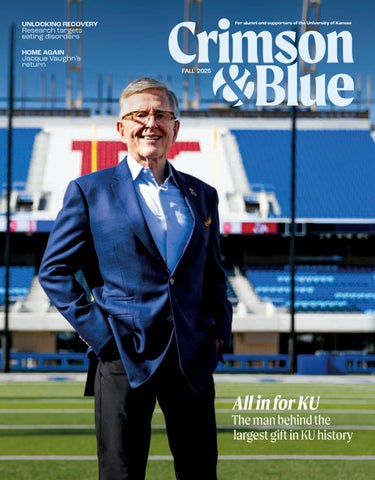
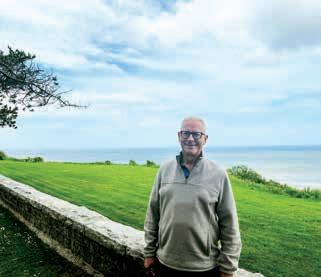
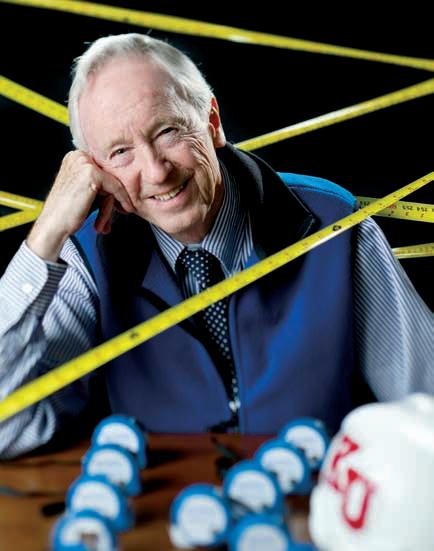
in for KU The man behind the largest gift in KU history
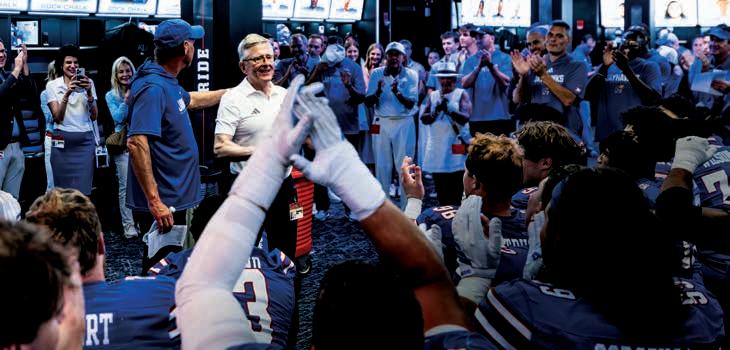
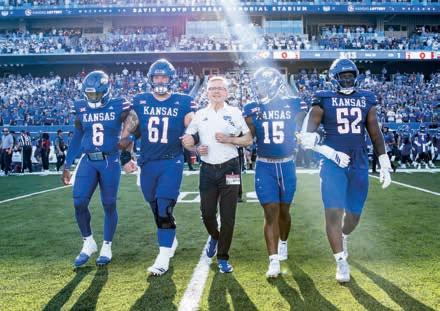
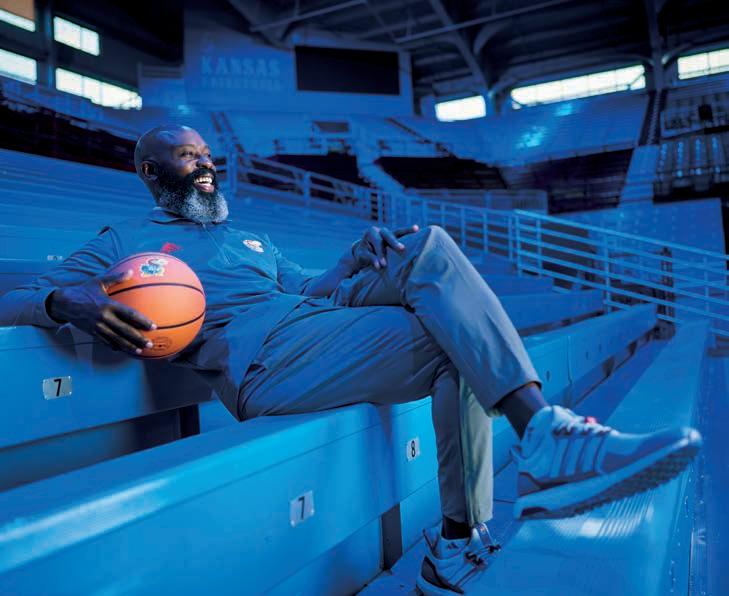
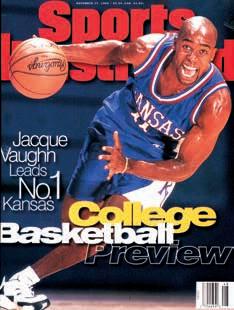
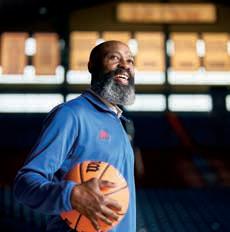
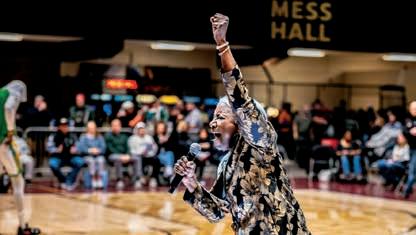
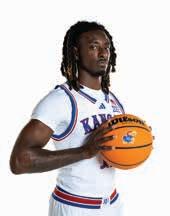
Jacque Vaughn’s return
FALL 2025
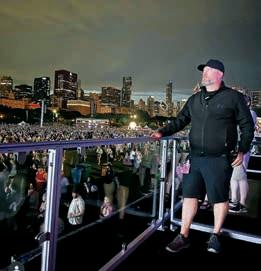
Jen Halvorson, j’16, was among the 174 skydivers whose stunning airborne synchronization on Aug. 22 near Chicago set the world record for the largest head-down vertical skydiving formation. Halvorson, who lives in Minnesota, has been skydiving for 11 years and has logged more than 1,000 jumps.
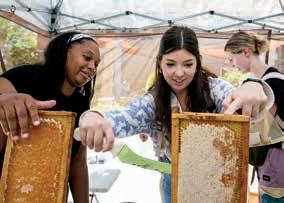
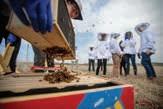
The KU Medical Center Botanic Gardens held its third annual honey harvest Aug. 22, where more than 200 attendees enjoyed hands-on instruction from professional beekeepers and could take home some of the sweet returns. Sarah Norris, community gardens program manager at the medical center, estimates the day’s honey haul topped 100 pounds. KU Medical Center has 10 active beehives across its Kansas City campus.
Kansan of the Year
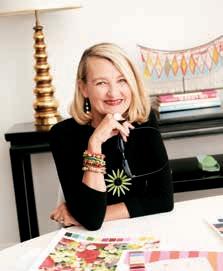
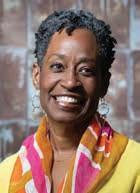
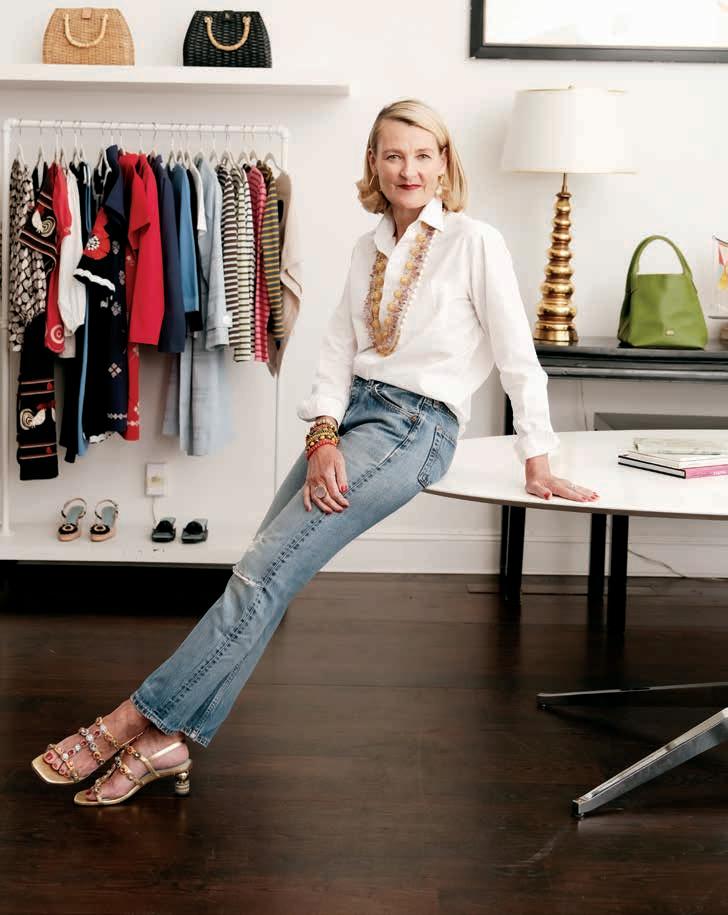
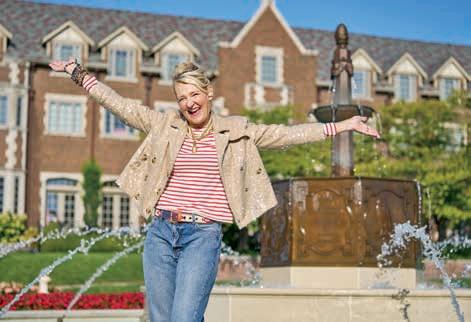
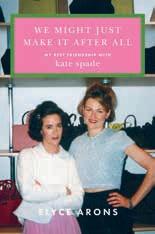
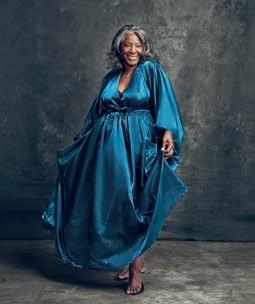
Fashion entrepreneur Elyce Cox Arons, ’85, is the 2025 Kansan of the Year, an honor bestowed by the Kansas Society of Washington, D.C. Arons is co-founder of Kate Spade and co-founder and CEO of Frances Valentine, both companies she built with her best friend, Katy Brosnahan Spade, ’85. Read more about Arons on page 58.
Kansas City-based author Angela Cervantes, c’93, wrote the companion book for the newest American Girl doll, Raquel Reyes, who is also the brand’s 2026 Girl of the Year. Raquel hails from Kansas City, and through Raquel’s diary, Cervantes shares the 10-yearold’s rich heritage and heartwarming adventures. Doll-ightful
High-flying feat
The Long Game
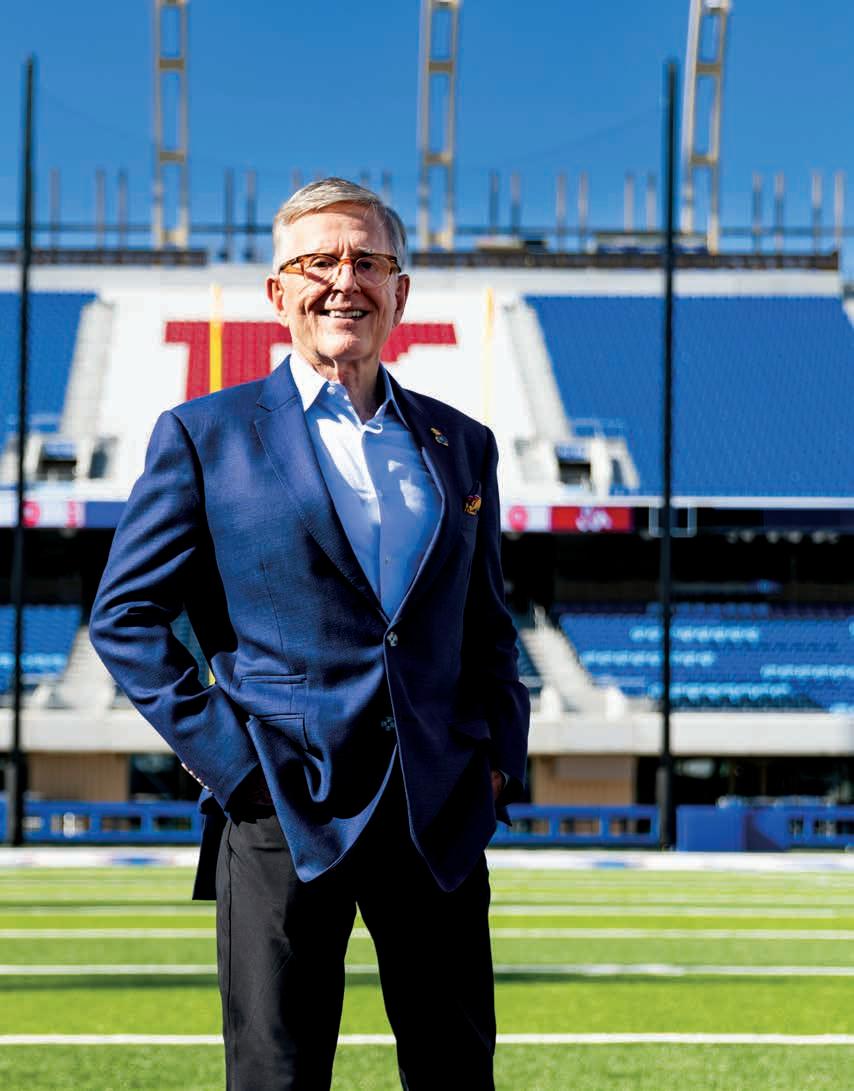
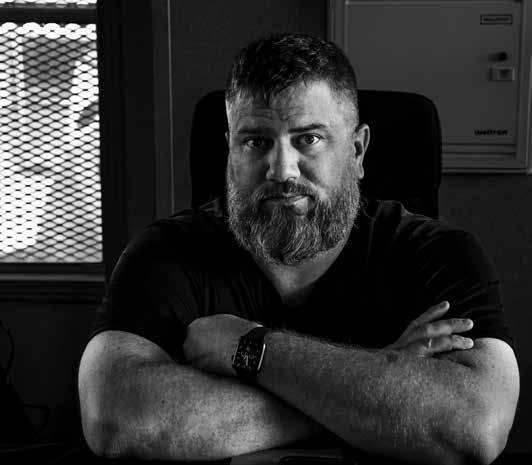
With a history-making gift to KU, philanthropist David Booth is employing the insights that helped revolutionize the investment world to fundamentally remake the university that made him. by Chris Lazzarino
A new KU research center is rewriting the book on the diagnosis and treatment of eating disorders. by Christina Knott
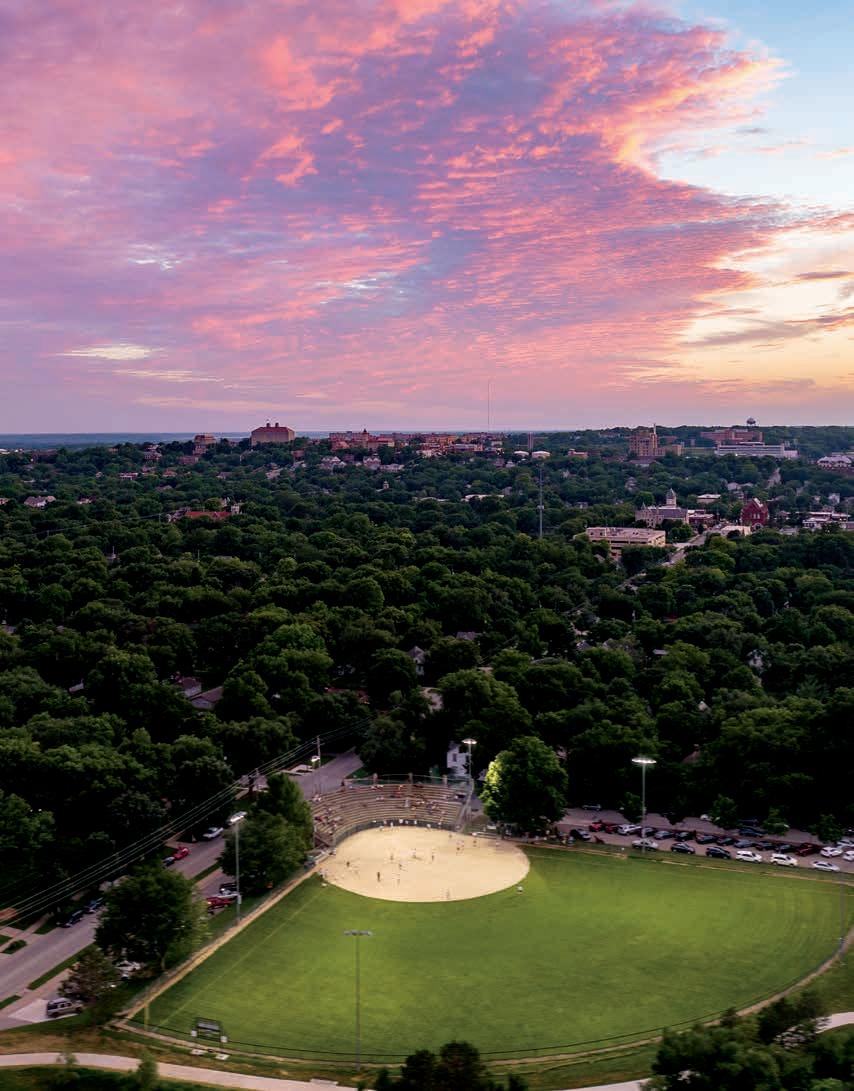
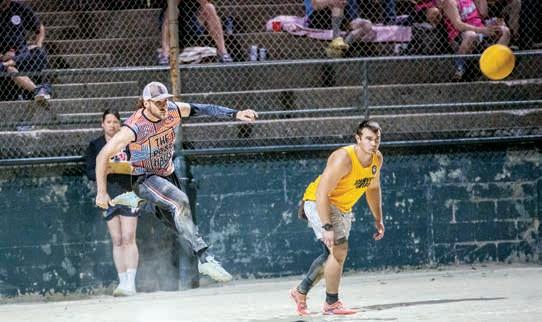
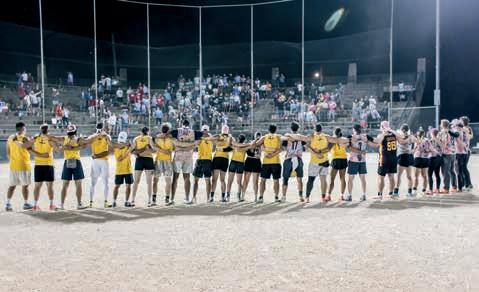
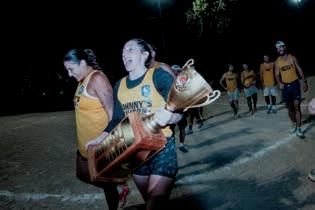
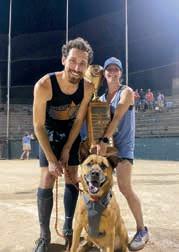
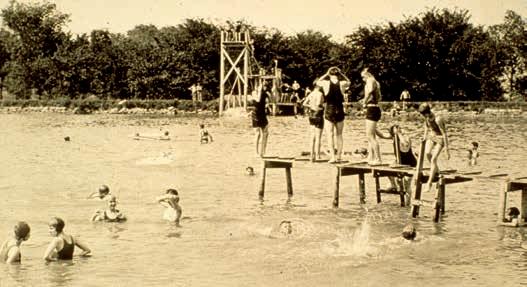
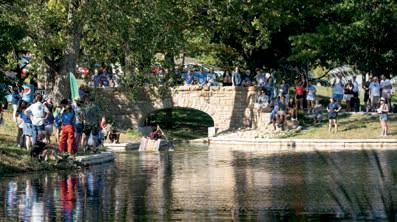
50 Sundays in the Park
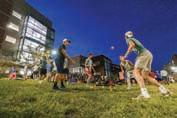
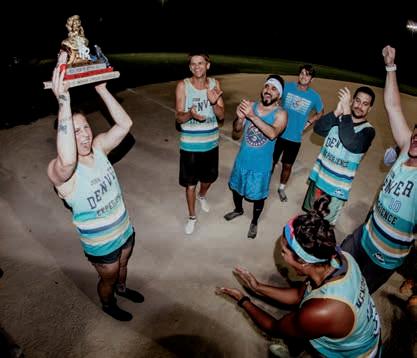
When it comes to having fun while doing good, Lawrence’s adult kickball players—many of them Jayhawks—are in a league of their own. by
Megan Hirt
Dogs make everything better. So we made their food better.
Jayhawks,
As you open Crimson & Blue, I hope you experience the same feeling I did, and one that runs deep in every corner of this university: When Jayhawks unite, extraordinary things happen. This new publication invites us to celebrate those moments, big and small, that define the spirit of KU and the people who carry it forward. It is meant not only to inform, but to remind us of who we are as a community, as One KU.
This inaugural issue does exactly that. At its heart is a story about David Booth, whose name has become synonymous with transformational giving at KU. Many know David for his extraordinary investments in the future of our university and our student-athletes. But this feature takes us beyond those headlines, offering a portrait of a Jayhawk whose life and values were shaped here on Mount Oread. It is a powerful reminder that giving, at its best, is not about transactions—it’s about legacy, and about the lives touched for generations to come.
You’ll also read about our pioneering researchers at the Life Span Institute and the CARE Center who are tackling eating disorders with compassion, determination and scientific rigor. Their work is rewriting what we know about treatment and transforming opportunities for recovery. These kinds of breakthroughs illustrate KU’s mission at its finest: advancing knowledge to improve lives everywhere.
Closer to home, you’ll find a story that reminds us how community can be both joyful and deeply impactful. Born from a shared love of play, the Kaw Valley Kickball League has grown into a movement dedicated to enriching the Lawrence community. It’s a testament that Jayhawks don’t just stay connected to one another; they find ways to lift the communities they love.
Throughout this issue you’ll experience the voices and journeys that speak to the essence of KU. Alumna Elyce Arons reminds us of the entrepreneurial spark that began on our campus and grew to have a global impact. Jacque Vaughn’s reflections illustrate that the Jayhawk spirit is not only enduring but guiding, even decades after graduation. From a study abroad story spanning 50 years to the generosity driving our KU Cancer Center and new entrepreneurship hub, every page affirms the reach and resonance of this place we call home.
As I reflect on these themes, one word rises above the rest: connection. Connection between past and present, campus and community, research and discovery, donor and dreamer, Jayhawk and Jayhawk. That is the essence of KU. These stories demonstrate that the University of Kansas is not simply an institution; it’s a living network of people whose shared commitment and creativity continue to change lives.
It is a privilege to serve as your chancellor. I hope Crimson & Blue inspires you to take pride in the remarkable journey we share and to see yourself reflected in these Jayhawk stories. Thank you for your dedication, your passion and your trust in KU.
Rock Chalk!
Douglas A. Girod, M.D. Chancellor The University of Kansas
VOLUME 123, NO. 3 / FALL 2025 crimsonandblue.org
PUBLISHERS
KU Alumni
KU Endowment
The University of Kansas
FOR KU ALUMNI
Megan Hirt, c’08, j’08
Managing Editor
Steven Hill Associate Editor
Chris Lazzarino, j’86
Associate Editor
FOR KU ENDOWMENT
Daryl Bell, f’07
Assistant Vice President for Marketing and Brand Communications
Michelle Strickland, j’92
Content Director
ART DIRECTOR
Chris Millspaugh, f’97
CONTRIBUTING DESIGNERS
Sarah Meiers, f’05
Janella Williams
PHOTOGRAPHERS
Steve Puppe, j’98
Dan Storey
MARKETING
Mary Padilla, j’88
Ryan Camenzind, j’17
Alissa Bourneuf, j’07
Kate Neuner
ADVERTISING SALES
Brett Leonard, d’09
Andrew Trites, d’20
Established in 1902 as The Graduate Magazine and published as Kansas Alumni magazine from 1963 to 2025.
Crimson & Blue magazine is published twice per year, in fall and spring. For subscription information, go to crimsonandblue.org.
Office of publication: 1266 Oread Avenue, Lawrence, KS 66045-3100.
Publishers’ note
KU Alumni, KU Endowment and the University of Kansas are proud to introduce KU’s new flagship publication, Crimson & Blue magazine.
Built on the strong foundations of Kansas Alumni and KU Giving, this new magazine is designed to deepen your connection to the programs, people and purpose that make KU extraordinary.
Each issue will feature inspiring stories of KU alumni making an impact worldwide, updates on University priorities and strategic initiatives, powerful examples of philanthropy driving student and faculty success, and insightful perspectives on KU’s transformative influence in Kansas, the nation and beyond.
More than just a publication, Crimson & Blue is a bridge to your enduring relationship with KU. We hope you’ll feel a
MENTOR A CURRENT STUDENT
KU’s vast network of alumni can be an asset to current students as they look to take their next steps. Join the more than 16,000 alumni, students, faculty and staff on KU Mentoring+, the University’s platform for mentoring, networking and community building, to support fellow Jayhawks through career advice and connections. Learn more and join at mentoring.ku.edu
renewed sense of pride in the University and the vast community it connects through the stories we share. Your advocacy and support are vital to KU’s continued success, and this magazine is a celebration of that collective impact.
Crimson & Blue will be mailed twice per year to KU Alumni Life Members and donors to KU. You can also explore more stories anytime at crimsonandblue.org.
Finally, we would like to thank the many people who made this inaugural edition possible. They include, but are certainly not limited to, Daryl Bell, Steven Hill, Megan Hirt, Chris Lazzarino, Sarah Meiers, Chris Millspaugh, Steve Puppe, Michelle Strickland and Janella Williams.
We sincerely hope you enjoy the first of many editions of Crimson & Blue.
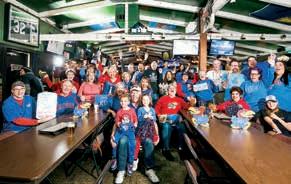
CHEER ON KU WITH FELLOW JAYHAWKS
Official KU Alumni watch parties are organized by volunteers and held across the country during the football and basketball seasons. Go to kualumni.org/watch-parties to find events near you and learn more.
Let us know what you think
Have feedback on Crimson & Blue? An idea for a story for the magazine? Email us at stories@kualumni.org.
Tell us your news
We’d love to spotlight your professional accomplishments in Crimson & Blue. Submit a Class Note at kualumni.org/class-notes to share what you’ve been up to in your career.
KU Vespers on the Road jccc.edu/midwest-trustcenter
Supporting economic development
The School of Business in September announced it has partnered with the Healthy Bourbon County Action Team (HBCAT), a Fort Scott-based nonprofit, to assist entrepreneurs and small business owners in southeast Kansas. The collaboration will connect businesses in the area to student-led consulting services and provide resources to help HBCAT launch its own entrepreneurship and professional development program. Jide Wintoki, dean of the School of Business, says the partnership exemplifies KU’s commitment to fostering economic development throughout Kansas. “Our students get to apply their business expertise to support small but growing companies, with the potential to generate new jobs in the region,” Wintoki says. “It’s a powerful way to strengthen our students’ professional skills while creating meaningful impact in the state.”
Addressing the mental health provider shortage
The School of Social Welfare has received a $2.4 million award through the federal Health Resources & Services Administration to continue its Integrated Health Scholars Program (IHSP) through 2029. The program prepares students to provide integrated health services in high-need, rural Kansas communities. Since 2014, IHSP has supported 305 graduates who now work primarily with rural and underserved populations. According to a 2024 report from Mental Health America, Kansas ranks 37th among all states in mental health workforce availability, with just one mental health provider for every 450 people.
Hello, Hutch!
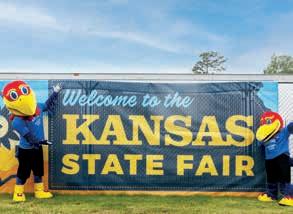
The attractions at this year’s State Fair in Hutchinson had a special crimsonand-blue sparkle. In addition to our mirthful mascots, representatives from numerous University departments were on hand for KU’s Sunflower Sunday on Sept. 14, offering fairgoers free health screenings, interactive presentations and a hearty helping of Jayhawk joy.
By the numbers: KU’s statewide economic impact
A recent analysis by the economic modeling firm
Lightcast quantified KU’s annual statewide economic impact at $7.8 billion. The figure includes KU activity in operations, construction and research, as well as the expenditures of KU startup companies, visitors, students and alumni. The report, published in March, looked at data from fiscal year 2023. Some additional numbers:
$2.5 billion
Income added to the state economy from KU alumni employed in Kansas in fiscal year 2023. More graduates of KU work in Kansas than graduates of any other university.
$2.90
Added tax revenue and public sector savings to the state for every $1 invested in KU.
422,000+
Out-of-state visitors KU attracts to Kansas annually.
54
Active startup businesses powered by KU research or technology. More than half of these are based in Kansas.
- Raed Al-Rajabi, MD Physician Medicine Clinical Oncology
Cancer is a unique journey. And for me and all of my team, the only way to undertake it is together.
To schedule an appointment, call 913-588-1227 or visit KUCancerCenter.org to learn more.
Rock Chalk Review
The world is watching
Rock Chalk Park in mix as host site; city will hop regardless
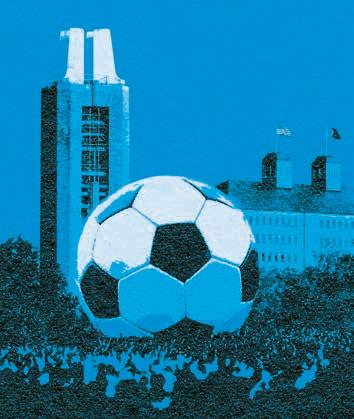
WITH KANSAS CITY set to host six FIFA World Cup matches in summer 2026, leaders across KU, Lawrence and Douglas County are preparing for an unprecedented influx of visitors—and a rare chance to showcase Mount Oread and River City on a massive international stage.
Thanks to his lifelong passion for soccer, Lamar Hunt, founder of the NFL’s Kansas City Chiefs, in the early 1970s designed Arrowhead Stadium with field dimensions suitable for international soccer. FIFA, soccer’s international governing body, rewarded that foresight by awarding Kansas
City four group-stage matches (June 16, 20, 25 and 27), a round-of-32 match (July 3) and—shocking the soccer world—a prestigious quarterfinal (July 11).
Over the tournament’s six weeks, regional planners estimate 650,000 visitors will travel through the Kansas City area, filling hotels and restaurants within a 150mile radius. Just 35 minutes distant, Lawrence is certain to feel an impact every day of the tournament; KU and city officials hope to boost that even further by hosting an international team’s base camp, with training at Rock Chalk Park and hotel rooms and meals at The Oread Lawrence, directly north of KU Alumni’s headquarters at the Jayhawk Welcome Center.
Deputy Athletics Director Jason Booker, d’99, says Rock Chalk Park, which opened in 2014 as the home to KU soccer, softball and track and field, offers amenities attractive to international soccer clubs, including a pristine field newly resodded last summer, multiple locker rooms, training areas, coaches’ offices and the track field that could fill in as a secondary practice pitch. “It may not have been built for this moment,” Booker says, “but it’s perfectly suited for it.”
Five national teams have already toured Rock Chalk Park, and reviews are glowing. “They’ve been blown away,” Booker says. “It’s secluded,
secure, and it checks all the boxes.” Also impressing the visitors, Booker says, are Kansas Athletics’ supplemental services—medical, training, logistics, even laundry—drawn from its experience supporting 16 varsity sports programs.
“This can be a huge boost for the local economy,” Booker says. “Yes, there’ll be some inconveniences, for sure, but we’re going to be part of something that everybody will remember. We’re putting Kansas, and the University, on a global stage.”
Lawrence’s base-camp bid aligns with those from KC’s professional soccer franchises, Sporting Kansas City and the Kansas City Current, creating the possibility that three national teams could train within a 45-minute radius. “That’s incredible,” Booker says. “You’d have six matches next door and three international squads based in the region.”
The Dec. 5 World Cup draw will determine which teams qualify and where they’ll play, and Booker says he’s been told to prepare for a rush of site visits for a month afterward.
“Teams rank their preferred camps based on FIFA standings,” he says. “Some want to be off the beaten path, and Lawrence offers that balance—quiet but connected.”
The city, county and University more than a year ago renewed the unified command structure first created in response to COVID-19.
The top steering committee—which includes Chancellor Doug Girod, city and county administrators, and Lawrence Chamber of Commerce leadership—guides the efforts of numerous working groups, including safety and security, transportation, economic development, housing, and culture and events. KU International Affairs, led by Associate Vice Provost Megan Greene, is conducting “Culture 101” awareness training across the enterprise.
“Even if we’re not a base camp, we’ll see significant spillover from Kansas City,” says Tricia Bergman, associate vice chancellor for economic development. “When Taylor Swift was in Kansas City, Lawrence hotels were booked full for a week. Multiply that by five—that’s the level of activity we expect.”
The local task force Lawrence 2026 is hustling to get the word out about what’s to come so businesses and citizens are not caught off guard. Ruth DeWitt, director of community affairs for Explore Lawrence, notes that all businesses—but especially hotels and restaurants— should ensure their websites are updated. (DeWitt says that with a brief bit of online research, she found one local hotel that advertised itself as a short drive from the Schlit-
terbahn—a Kansas City, Kansas, water park that closed in 2018.)
DeWitt also urges restaurants to consider trimming their menus and begin planning for two months of high-volume sales. Explore Lawrence is ready to provide help in the logistics required to hire and train an influx of hospitality employees, including navigating legal and ethical considerations arising from the long and late shifts sure to come, and all businesses need to be ready to adapt should Lawrence host a team, for instance, from a country where eating late dinners is customary.
“It’s about being welcoming and responsible hosts,” Bergman says. “We want visitors to feel at home, and we want to highlight the wonderful things available in Lawrence and Douglas County.”
Regardless of the details, the pace—and stress—will be high, and officials hope Lawrencians will find extra measures of grace when facing weeks of visitors descending upon the city.
“It’s one thing to get through a graduation weekend. It’s another thing to do that for six weeks in a row,” DeWitt says. “I always hear two sorts of reactions. People are either like, ‘I am out of here!’ or it’s, ‘Put me in the
mix!’ It’s just absolutely night and day.”
If Lawrence is selected as a base camp, plans call for a national team’s entire entourage to stay at The Oread Lawrence, which would be fully booked for the delegation. Daily practices would take place at Rock Chalk Park, on the western edge of town, with team charter flights in and out of nearby Forbes Field in Topeka. “Our proximity to everything—Kansas City, the airports, KU’s resources—is a huge advantage,” DeWitt says.
For KU’s Booker, who has logged four hectic years helping prepare Rock Chalk Park and the entire Kansas Athletics enterprise for site visits, the conclusion feels tantalizingly close, yet remains so far away.
“Kansas City will be hosting six Super Bowls next door. It’s hard to grasp the magnitude of that, but I think we and all of our partners are as organized and prepared as we can be,” Booker says. “Now we’re just ready to find out who’s coming. I get asked about it five, six, seven times a week, and that’s been going on for two years. I always say, ‘We won’t know until January 2026,’ and now that’s almost here. When you plan for something this long, you kind of just want it to get here.”
Booker pauses, then adds with a chuckle, “Be careful of what you wish for, though.”
—Chris Lazzarino
With a high-energy “alchemy” that one day may be “crucial for designing the next generation of machines,” KU physicists working on the particle detector called ALICE at Europe’s subterranean Large Hadron Collider recently reported lead being transformed—ever so briefly—into gold.
Thanks to work led by Daniel Tapia Takaki, professor of physics, the KU scientists developed detectors that not only monitor high-energy proton collisions but also now the “clean collisions” of photons on photons, capable of knocking protons out of a nucleus. Removing protons from lead creates, in order, thallium, mercury and, finally, gold.
“These clean interactions were hard to detect in earlier setups,” Tapia Takaki says. “Our group at KU pioneered new techniques to study them. We built up this expertise years ago when it was not a popular subject.”
Shovels, dirt and hope
Construction underway on new facility that promises to transform cancer care, research in
the region
THE UNIVERSITY OF KANSAS
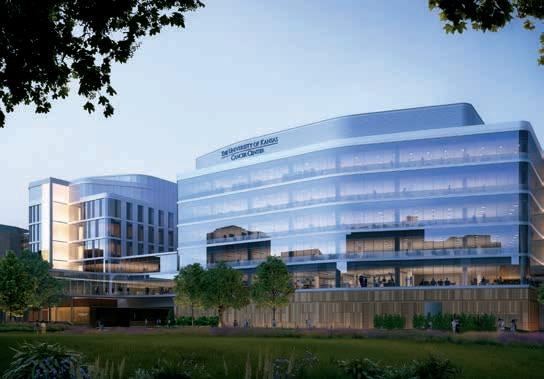
CANCER CENTER on May 23 broke ground on the future site of a new complex that will bring research and patient care into the same location for the first time in the center’s history.
“Today marks a pivotal moment in our efforts to address one of the greatest health challenges of our time: cancer,” Roy Jensen, vice chancellor and director of the KU Cancer Center, said at the groundbreaking ceremony. “With this new center, and the collaboration it enables, we intend to create a global
destination for patient care and research.”
U.S. Sen. Jerry Moran, c’76, l’82, U.S. Rep. Sharice Davids, Gov. Laura Kelly and a host of other dignitaries attended the groundbreaking, which was followed by a celebratory event at KU Medical Center.
The new facility, which will be located on KU Medical Center’s 39th and Rainbow campus in Kansas City, will give patients access to cutting-edge clinical trials and therapies developed on-site.
Physicians and researchers will be able to collaborate in real time on personalized
treatment options and make them available to patients more quickly.
Construction of the new complex should conclude by late fall 2027.
In 2022, the KU Cancer Center was designated as a “comprehensive” cancer center by the National Cancer Institute. This is the highest level of recognition awarded by the NCI and is the gold standard for cancer centers.
The KU Cancer Center is one of only 57 NCI comprehensive centers in the nation.
“We knew that (the comprehensive designation)
An architectural rendering of the new KU Cancer Center complex in Kansas City, scheduled for completion in late fall 2027.
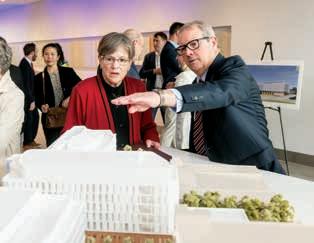
Chancellor Doug Girod (right) shares architectural models for the KU Cancer Center’s new complex with Gov. Laura Kelly following the May 23 groundbreaking.
wasn’t the culmination of our work,” Chancellor Doug Girod said at the groundbreaking. “Rather, it was an important milestone along the way to our next goal—which was to develop the facilities necessary to bring clinical and research capabilities together in the same place to provide better patient care and facilitate the development of new treatments and cures.”
KU Cancer Center’s new complex will support cellular therapy, which uses the body’s own cells to fight each person’s individual cancer with fewer side effects than traditional treatments. It will also house a cellular therapeutics Good Manufacturing Practice (GMP) laboratory that will expedite CAR-T cell therapy, a novel treatment that uses genetically re-engineered immune cells known as T cells to find and destroy cancer.
By bringing a cellular therapeutics GMP labora-
tory in-house, the costs and wait time for the creation of these specialized cells will be reduced. KU Cancer Center is the only cancer center in the region offering all seven FDA-approved CAR-T cell therapies. The newest therapy, dubbed “Triple Threat,” triples the number of molecular targets and is currently under evaluation via a Phase 1, first-in-human clinical trial initiated by KU Cancer Center investigators. The pipeline of potential additional therapies is in the hundreds, providing an exciting future in caring for numerous types of cancers.
“All recovery from this dreaded disease starts with the power of hope,” said Sen. Moran, who addressed the crowd at the groundbreaking. “Today, we celebrate hope.”
—Kristi Birch Birch is assistant editor in the KU Medical Center Office of Communications.
A culmination of giving
Funding from multiple sources—including federal and state funds as well as gifts from private foundations and donors— has made the new KU Cancer Center complex possible.
2023
KU Cancer Center celebrates a $100 million lead gift from the Sunderland Foundation, at the time the largest ever received by KU and The University of Kansas Health System.
U.S. Sen. Jerry Moran, c’76, l’82, secures $43 million in congressionally directed spending to plan and help build research aspects of a new KU Cancer Center facility.
2024
The Kansas Legislature approves and Gov. Laura Kelly signs into law a $75 million matching-grant appropriation for the project.
The Sunderland Foundation provides an additional $25 million gift to support the state of Kansas match.
The Hall Family Foundation, which has a long history of giving to support cancer research, makes a $25 million gift, also in support of the match.
Private donors, foundations and community members provide $25 million in supplemental gifts to complete the state match.
Sen. Moran secures a federal appropriation of $10 million for the KU Cancer Center and another $10 million earmark for acquisition of sophisticated cardiovascular laboratory equipment.
The Cinelli Family Foundation gives $10 million to establish a Good Manufacturing Practice laboratory in the KU Cancer Center’s new building.
2025
The Bloch Family Foundation and Linda Lyon, daughter of Richard and Annette Bloch, provide a $10 million challenge gift to encourage additional giving.
Fundraising efforts continue, as philanthropy is vital to advancing groundbreaking research and recruiting world-class clinicians and scientists. Ongoing initiatives include the Jayhawks Victory Over Cancer campaign, powered by ShotTracker, Kansas Athletics, The V Foundation and KU Cancer Center (v.org/jayhawksvictoryovercancer); and Greeks United, an effort spearheaded by KU alumni and several KU fraternities to raise funds for cancer research at KU Cancer Center (kuendownment.org).
Walking to class near the end of spring semester, then-freshman Maddie Meyer glanced at her student account and saw she still had a few KU Dining Dollars to spend before they expired. The idea came in a flash.
“I thought, ‘I’ll use my extra money to buy food and donate it,’” she recalls. “Then I realized, if I have extra dollars, so does everyone else.”
That spark became Leftovers with Love, a campuswide donation drive that encouraged students to use their leftover KU Dining Dollars to purchase nonperishable food and hygiene items at campus convenience-store outlets before balances disappeared at semester’s end.
Meyer, a business marketing and sports management major from Leawood, didn’t plan on launching a charity initiative
that day. “I told my parents I’d just do it next year,” she says. “They said, ‘No—you see the need, fill it.’ So I did.”
Within a week, the Corbin Hall resident had turned her spontaneous idea into an organized effort. She created flyers, set out donation bins in residence halls across campus, and started spreading the word in classes, on social media and, most successfully, by word of mouth with friends throughout the Greek community and other student organizations. “It all happened so fast,” she says. “At first I thought, ‘What if no one donates?’ Then the bins started overflowing.”
More than 2,000 items poured in—canned goods, shampoo, detergent, toothpaste, snacks—all purchased with Dining Dollars that would have otherwise vanished into the ether. “I was not expecting that at all,” Meyer says. Local media took notice; KU’s student news channel featured Meyer’s story, helping Leftovers with Love go viral around campus.
Donations were split between two local nonprofits: the Ballard Center, which received the food, and the Willow Domestic Violence Center, which received the hygiene products.
Ballard holds special meaning for Meyer. Through her Pi Beta Phi sorority, she volunteers there weekly, helping preschool children with reading, counting and spelling. “Sometimes we just
play with them on the playground,” she says.
That service experience, combined with Leftovers with Love, has shaped Meyer’s sense of purpose at KU.
“I’ve always been service-oriented,” she says. “I went to Catholic school my whole life, and service was a big part of that. KU is a different environment, but this showed me I could take what I’ve learned and apply it here. It’s given me confidence that I can take initiative and do something meaningful.”
She plans to bring Leftovers with Love back this spring with even more coordination among KU Dining and student housing. “It all came together so quickly that I didn’t have time to get official support,” Meyer says. “Now I want to build more structure so it lasts beyond me.”
Her effort didn’t just rescue unused Dining Dollars—it inspired others to think creatively about giving. “Even if two people benefit,” Meyer says, echoing advice from her mom, “that’s still two people better off.”
Looking back, she still sounds surprised at how far a single idea went. “It’s crazy—it just took off,” she says. “It was the most fulfilling thing I’ve ever been part of. Doing something greater than yourself—that’s what it’s all about.”
—Chris Lazzarino
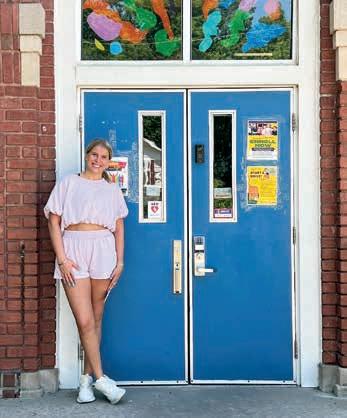
Maddie Meyer outside the Ballard Center in North Lawrence.
GIVING
Big heart from a small town
Inspired by his father—a family practitioner in rural Kansas—alumnus pledges $15 million for School of Medicine scholarships
FOR KU ALUMNUS David Seitz, c’70, the town of Ellsworth, Kansas, isn’t just a hometown—it’s the soil that nurtures the deepest roots of his family tree.
That tree bears the fruit of generations of the Seitz family in Kansas who prioritized the health of their community, from the town’s first pharmacists to David’s mother, a nurse, and his father, the town’s beloved family practice physician.
That legacy of care wove its way through David’s life, and as a researcher, educator and physician himself, he wanted to give more students from Kansas the opportunity to go to medical school. Earlier this year, he and his wife, Katrina, made a $15
million gift commitment to the School of Medicine for scholarships.
The bequest, once realized, will provide the equivalent of 17 full-tuition scholarships for in-state medical students, with preferences for students from Ellsworth and those who plan to go into family practice.
David hopes many of those future doctors will put down roots in a Kansas small town.
“It gives me great satisfaction knowing that KU School of Medicine can continue to train family practitioners and not just big-city specialists, because we’ll always, hopefully, have vibrant small communities. And part of what makes them vibrant is having access to quality health care,” David says.
Leaders in the School of Medicine understand the impact the Seitzes’ gift will have on students and the health of Kansans for years to come.
“We thank David and Katrina Seitz for this generous gift that will light the way for future family physicians in Kansas,” says Akinlolu Ojo, executive dean of the School of Medicine. “It has the potential to be life-changing, not just for the lives of the medical students who receive these scholarships, but also for the communities they will serve in Kansas. Gifts like these illustrate the power we all have to improve the lives and the health of others.”
David’s great-great-grandfather, George Seitz, a German
immigrant, settled in Ellsworth in 1864 when it was still a military fort. Three years later, a small group of settlers incorporated the town. George had learned pharmacy in Germany by apprenticing to an established apothecary, a practice that predated the development of pharmacy curriculums and degrees. George opened Seitz Pharmacy in the new town, and it still serves the residents of Ellsworth today.
“We are who we are because of the roots my family has in that town,” David says.
Three generations of the Seitz family owned the pharmacy, until David’s father, Joseph Seitz, c’44, m’46, took a different path and studied medicine instead of pharmacy. David’s mother, Berenice Payton Seitz, went to Ellsworth School of Nursing at the town’s hospital and worked while Joseph was in school. After earning his undergraduate and medical degrees at KU, Joseph returned to Ellsworth to practice family medicine.
“As a family physician, he just blossomed,” David says. “He was a special person to all the residents in and around Ellsworth.”
Joseph and Berenice Payton Seitz
David took a circuitous path to medicine. He earned a bachelor’s degree in chemistry at KU and a doctorate in organic chemistry at Northwestern University. He was a postdoctoral fellow at Harvard University and an assistant professor of chemistry at Northeastern University. Several years later, he decided to combine organic chemistry and medicine and earned his medical degree, specializing in oncology. He held a leadership position in the oncology division at Eli Lilly, was a professor of medicine at Indiana University and was a co-founder of a small biotechnology company.
“My parents were both very passionate people, and I think that just rubbed off on me,” he says.
To honor and memorialize that passion, David and Katrina established the Joseph and Berenice Seitz Medical Scholarship in 1993, with a preference for students from Ellsworth and those who intend to practice family medicine. To date, the scholarship has assisted 126 medical students with partial scholarships. The recent bequest will expand that scholarship into the largest single scholarship fund at the School of Medicine.
David thinks his father would be pleased with the scholarship’s impact.
“He truly recognized how important it is for people in rural Kansas communities to have direct and timely access to a physician,” he says. “I think it would make him smile.”
—Michelle Strickland
MOUNT OREAD
Tower power
Campanile limestone restored to former glory
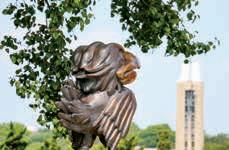
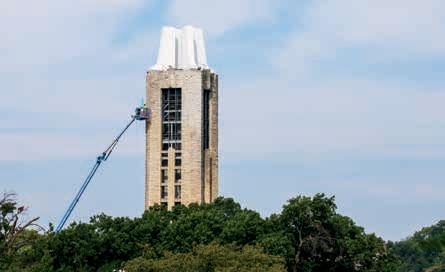
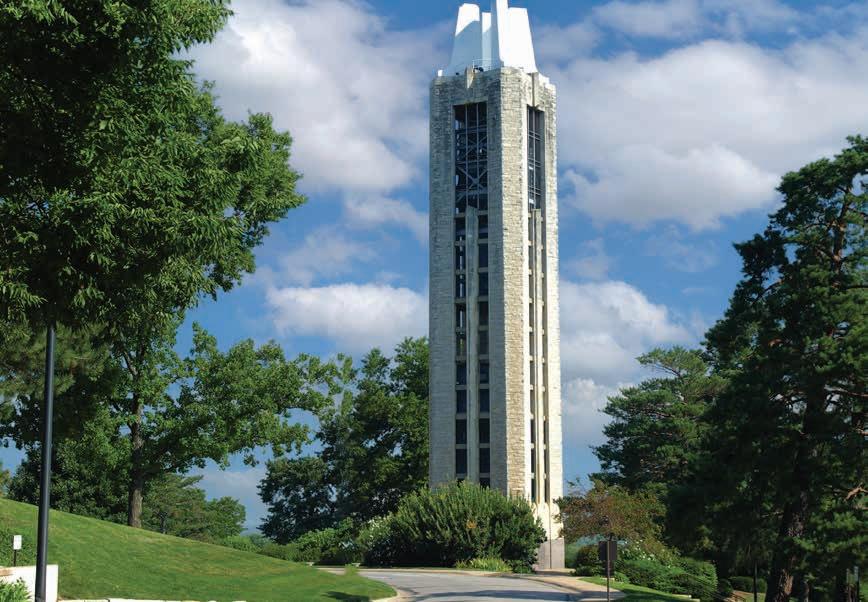
KU’S ICONIC CAMPANILE, the 120-foot limestone bell tower that crowns the Hill as both landmark and memorial, this summer and fall was once again tended by busy stonemasons rising to the sky in lift buckets securely affixed to long hydraulic booms. This year, though, the work extended far beyond recent emergency repairs that removed chunks of stone in danger of sloughing from high overhead.
“We’ve had lifts there once a year for several years,” University Architect Mark Reiske, a’86, said in a September interview, “but we just removed loose stone so it wouldn’t fall on people. We never had the resources to actually fund the work that’s going on now.”
Reiske said the latest renovations—the most extensive Campanile repairs since its
1996 overhaul—involved “a lot of stone replacement” and complete tuckpointing of every masonry joint, all in an effort to ensure the Campanile stands secure for generations to come.
“We’re cutting out every masonry joint, redoing them, replacing all the damaged stone, doing roof repairs, doing repairs to the steel that holds up the bells, and repainting that steel,” Reiske said. “By the time we hit Veterans Day, we should be cleaned up and out of there.”
Dedicated in 1951 to honor Jayhawks who died in World War II, the Campanile and its 53-bell carillon have long been a focal point for both celebration and remembrance. Graduates pass through its doors during Commencement, while the chime of its bells marks the hours across Mount Oread.
Years of Kansas weather, however, have taken their toll. The reliance on emergency repairs was rooted in a lack of money, but that changed when rising interest rates boosted KU’s state-held reserves, generating an influx of “180 funds,” a revenue category available only for building projects.
Annual deferred maintenance allotments, typically about $25 million, can only be spent on “mission-critical” teaching and research buildings. “I can’t spend that money on the Campanile,” Reiske explained. While 180 funds, like deferred maintenance dollars, are used on building repair, they are not limited in project scope.
“We got around $7 million last year in 180 funds, compared to about $500,000 that we’d get in a low-interest period,” he said, “so we
Repairs underway on the Campanile in August.
started doing work on buildings that we can’t spend other state money on. The Campanile was one of them.”
Contractors are replacing roughly 300 square feet of damaged stone, along with the bells’ steel structural supports. Once repairs are complete, the entire tower will be washed and sealed, and the School of Music will refurbish the carillon keyboard and bell cables—a sparkling restoration from base to belfry. The work, Reiske explained, is intricate and painstaking. “The guys are doing incredible work,” he said, “but it takes time.”
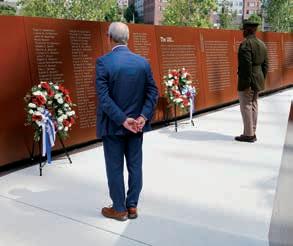
KU on Aug. 29 dedicated its new World War I Memorial Plaza, adjacent to the reimagined David Booth Kansas Memorial Stadium. The alignment of those two sites—the World War I memorial at the base of Campanile Hill and the World War II memorial at its crest—forms what Reiske called “a powerful connection.”
“If you think about the power of having the memorial at the bottom of Campanile Hill, and the memorial on top of Campanile Hill, it’s pretty cool,” he said. “You can stand on the World War I Memorial Plaza and look up to the Campanile—it’s pretty powerful.”
The Campanile, Reiske emphasized, is more than limestone and bells. “For our alumni, the Campanile is a destination memorial,” he said. “This will ensure it remains that way for future generations.”
—Chris Lazzarino
BOOKS
Eye of the storm
A newsman takes stock of 60-year career in topsy-turvy world of broadcast journalism
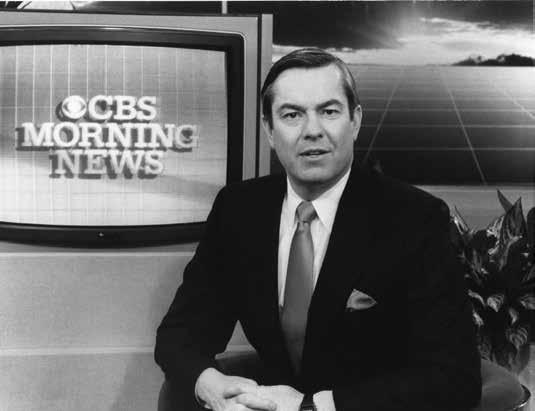
BILL KURTIS displayed a knack for finding himself in the middle of the action well before he began what would become a long, eventful and distinguished career in local and national journalism.
As Kurtis, j’62, recounts early in his memoir, Whirlwind: My Life Reporting the News, he was a high school kid on the way to meet his father when he happened upon a fatal car accident near Independence, where his family lived. The first person to arrive at the scene, he vividly recalls the tragic sight of men, women and children trapped in tangled wreckage, and the imperative to remain calm and do what he could to summon emergency responders and help render aid until they arrived.
“I didn’t know it then, but moments like this would seem to chase me through life,” Kurtis writes. “Moments of sudden, unexpected chaos and tragedy in which I was expected to keep a cool head.”
Kurtis began his broadcast journalism career full time in 1966, landing a job in local TV news at WBBM, Chicago’s CBS affiliate. By then he already had abundant on-air experience, starting with a stint at radio station KIND in Independence when he was 16, and continuing with an announcing spot at the University’s FM station KANU when he was a student in the William Allen White School of Journalism.
While earning a law degree at Washburn University, Kurtis worked as a part-time weath-
erman at Topeka’s WIBW, then the only television station in town. It was there, on June 8, 1966, that Kurtis— called in at the last minute to fill in for the news director, who’d decided to leave early for vacation—found himself breaking into the broadcast of a Kansas City baseball game to warn viewers that a massive tornado was bearing down on the capital city.
During an appearance Sept. 20 at the Kansas Book Festival at Washburn University, where he delivered the keynote address via Zoom a day before his 85th birthday, Kurtis recalled preparing himself to report the dire news that on-the-ground spotters were relaying of a storm with terrifying power: One described the massive funnel cloud as “boiling like an A-bomb mushroom.”
“I realized the next few words I would say would mean life or death,” Kurtis told the standing-room audience. “Why? I had to get them into the shelter. I knew that.”
Kurtis recalled thinking, “Should I cuss? Should I cry?” Instead, he spoke “from the gut and from the heart,” uttering five words that left no doubt about the seriousness of the situation: “For God’s sake, take cover.”
“People have told me,” he said, his voice breaking with emotion at the memory nearly 60 years later, “that’s what did it for them.”
The experience marked a turning point for Kurtis, who at the time was still torn between a career in journalism and a career in law. Discovering the potential of television
news to help save lives (the tornado killed 17 people and injured more than 500, but early warnings from WIBW and other media outlets were credited with helping limit the death toll) convinced Kurtis that journalism was the path he should follow. But after starting a job at WBBM, he soon realized that his law degree—far from incidental— would key his rise through the journalism ranks. Beginning with the sensational trial of Chicago serial killer Richard Speck, Kurtis covered a notable run of high-profile courtroom dramas in quick succession: Speck (1966) and the Chicago Seven (1968), and, after becoming the Los Angeles correspondent for Walter Cronkite’s “CBS Evening News,” Charles Manson (1970) and Angela Davis (1972)—“my fourth trial of the century in six years,” Kurtis writes.
He would go on to report many other major stories, winning two Peabody Awards, several Emmys and, in 1998, the National Citation from the William Allen White Foundation. He documented the last “babylift” from Vietnam that rescued orphaned infants before the fall of Saigon, and landed an exclusive interview with Iva Toguri D’Aquino, the woman known during World War II as Tokyo Rose. After returning to Chicago from Los Angeles, Kurtis co-anchored the nightly newscast that helped transform WBBM into a national model for serious local television journalism, breaking the most consequential story of his career when he followed a tip to expose
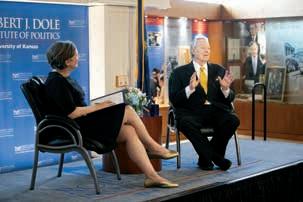
Bill Kurtis at KU’s Dole Institute, where he delivered the 2024 Dole Lecture, and on the CBS
the extensive health problems affecting U.S. troops sickened by the chemical defoliant Agent Orange. His coverage helped lead to congressional hearings, further investigations by other journalists, and, eventually, compensation for 200,000 U.S. veterans of the Vietnam War.
“If you’re lucky enough to be first with a story and tell it well,” Kurtis writes, “your work will become a keystone in a wall upon which truth will grow.” That was true of his reporting on Agent Orange and his efforts to dig up the real story behind the legend of Tokyo Rose, which contributed to President Gerald Ford’s decision to pardon D’Aquino, who had been convicted of treason while living in Chicago after the war. Kurtis and D’Aquino remained close friends until her death, at age 90, in 2006.
“There’s a beautiful harmony to our life stories that only time and perspective can reveal,” Kurtis writes. With the benefit of hindsight, he skillfully traces the common threads that ran through a career that seemed anything but harmonious as he was careening from story to story while balancing the demands of single parenthood after the
death of his first wife, Helen, from breast cancer at 36.
Whirlwind, which University Press of Kansas published in September, is the inaugural title from Plainspoken Books, the press’s new nonfiction trade imprint that focuses on bringing Midwestern stories to a national audience. It’s a fascinating look at life in the trenches during the golden age of network television news and a valuable primer for journalism students today, who face a far more fractured news environment in a profession that is constantly under attack.
“Through it all, I’ve tried to remain committed to the truth that is in front of me on the ground in the moment,” Kurtis writes. “That’s all any reporter really can do.”
Bill Kurtis did it well.
—Steven Hill
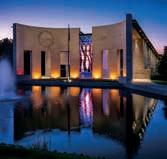
The Robert J. Dole Institute of Politics on KU’s West Campus recently announced that former U.S. Sen. Elizabeth Dole’s Senate papers are now available for research and public access.
The first woman to represent North Carolina in the U.S. Senate, Dole also served as U.S. secretary of transportation, secretary of labor, federal trade commissioner and president of the American Red Cross. Her 2000 campaign for president is described by Dole Institute officials as the first “viable campaign” by a female candidate representing a major political party.
Whirlwind: My Life Reporting the News by Bill Kurtis University Press of Kansas, $33
Morning News (opposite page), which he co-anchored in the 1980s.
Jayhawk Bookshelf
Dinosaur Seed
by Lindsey Yankey
In Lawrence illustrator and author Lindsey Yankey’s newest picture book, Dinosaur Seed, childhood imagination transforms an ordinary rock into a catalyst for adventure, fueling a spirited game that highlights the power of kids’ inventive minds—and kind hearts.
After young Cece gets the dreaded 10-minute warning from Grandpa, she makes the most of her remaining playground time by joining three other kids, Flora, Victor and Wyatt, in examining a new find. Though skeptical Victor insists the object is just a rock, Flora excitedly claims the “seed” will grow into a dinosaur if they plant and water it. All but Victor plunge ahead, cultivating a blossoming fantasy that yields a lava tree, a spooky robot, giant dinosaur bugs and a spaceship that takes them on a trip to the sun. When Flora generously lends Victor her binoculars, his eyes are opened and he joins the fun.
Dinosaur Seed is the third book written and illustrated
by Yankey, f’09. The first, Bluebird, appeared in 2013; the second, Sun and Moon, came out in 2015. Those early works both feature lyrical language and lush, sophisticated illustrations created with advanced techniques, including collage and staining, that Yankey learned while working a student job in Watson Library’s conservation lab, where damaged books are repaired. Dinosaur Seed, intended for readers ages 4 to 7, employs a simpler, more direct illustration style and spare storytelling that’s carried wholly by the delightful dialog of children enthralled by an adventure entirely of their own creation. (Beaming Books, $19)
—Steven Hill
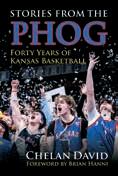
Stories from the Phog by Chelan David, with a foreword by Brian
Hanni
Imagine you’re 10 years old, talking basketball and playing Pac-Man and Galaga with Jayhawk hero David Magley at a local arcade. Chelan David experienced that thrill one memorable day in 1982,
looking up at the 6-foot-8 Magley, c’82, a priceless memory etched in his mind.
“It didn’t get any better: hoops royalty and video games,” David, j’94, writes in the first chapter of his book, Stories from the Phog, a journey through 40 years of KU men’s basketball.
Fast forward to college at KU, when David was “now a peer with the players,” sharing classes with stars Terry Brown, ’92, and Rex Walters, d’93. He complements his experiences by weaving interviews throughout the book, including a conversation with Devonte’ Graham in which the beloved Jayhawk recalls driving to his girlfriend’s house after his Senior Night speech, overcome with emotion knowing he had played his last game in the Allen Fieldhouse.
“(I) stopped outside her house,” Graham, c’18, tells David, “and just started bawling.”
When KU won the 2022 national title game against North Carolina, David, by then a father, was in attendance in New Orleans. After the final buzzer, he realized the magnitude of what had transpired: “The Jayhawks were the national champions. They had just completed the greatest comeback in championship history. I had watched something in person that I had waited my whole life for. And I did it with my daughter.”
As someone who grew up in Lawrence, I felt the chills, and countless more KU basketball fans will, too, reading this book—an author’s love affair with the Jayhawks that has stayed in his heart as a bond with friends, family,
and players and coaches who lived the dream for Jayhawk Nation. (University Press of Kansas, $25)
—David Garfield Garfield, c’88, is a Lawrence freelance writer and sports journalist.
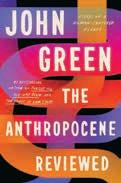
The Anthropocene Reviewed: Essays on a Human-Centered Planet by John Green
The cheeky nature of John Green’s The Anthropocene Reviewed is tipped at the beginning. No, not page one. The very beginning, the copyright page, where Green devotes 156 words to the aesthetic virtues and distinguished lineage of the book’s typeface, name-checking his book’s designer, and referencing the first printing press, 15th-century punch cutter Francesco Griffo, Venetian literary scholar Pietro Bembo, and his own dislike of the “obtuse verbiage and morally charged legalese” that typify more pedestrian copyright pages. He gives the Bembo MT Pro font four and a half stars.
Green is world-famous for his young adult books, including bestsellers Turtles All the Way Down and The Fault in Our Stars. The Anthropocene Reviewed is his first book for adults, and it’s a quirky, engaging, wholly delightful compendium of short essays that ponder and rate—using a five-star scale—facets of human life in the Anthropocene, our current geological epoch in which humanity is the dominant force of planetary change. As evidenced by the chapter titles (Lascaux Cave Paintings, Scratch ’n’ Sniff Stickers, Plague, Kentucky Bluegrass, The World’s Largest Ball of Paint), Green tackles topics high and low with analysis that’s often irreverent, but always thoughtful.
The book, published in 2021, is the 2025-’26 selection for KU Reads, the campuswide common book experience designed to serve “as an entry point to inspire curiosity and generate enthusiasm for scholarly inquiry across disciplines while also providing significant opportunities for the KU community to come together for engaged discussion and discovery, both in the classroom and beyond.” Green visited campus Sept. 2 for a sold-out event at the Lied Center, telling attendees, “Everything is interesting if you pay the right amount of attention to it.” That doesn’t mean ignoring the world’s horrors, Green said. “It means things can be better.”
(Dutton, $20)
—Steven Hill
Hilltop hub
New facility dedicated to entrepreneurship will serve students across academic disciplines
THE SCHOOL OF BUSINESS in spring received a $10 million gift commitment from an anonymous donor that ensures the construction of a new entrepreneurship hub at 1420 Crescent Road, formerly the site of McLain’s Bakery and, previously, Jayhawk Bookstore. The hub’s opening is scheduled for fall 2027.
The dynamic, purpose-driven facility will foster entrepreneurship and innovation and serve all KU students, regardless of their field of study.
The gift supplements the donor’s 2023 lead gift of $50 million to transform business education and research in the School of Business, for a total gift of $60 million. The gift is the largest in the school’s history and provides funds to advance key initiatives for undergraduate student success. In addition to the entrepreneurship program, the gift supports careerfocused opportunities within
the school’s Business Professional Development Program as well as study abroad programming and academic enrichment.
The donor, a longtime KU supporter who is deeply invested in the success of the University, believes in the power of entrepreneurship to create effective ways to solve problems and improve lives.
For the donor, the gift is a catalyst that will hopefully spark broader philanthropic giving from others, aimed at a few goals:
• Equipping students to explore opportunities that revitalize Kansas towns.
• Developing new entrepreneurial opportunities in sectors critical to Kansas, such as health care delivery, energy sustainability and education.
• Preparing graduates to bring entrepreneurial competency into any career.
“The University of Kansas is in the midst of a transformational era, marked by significant advancements across campus—including a stronger, more innovative business school and a new entrepreneur center. We are proud to play a part in the overall progress of the University,” the donor says.
Having a dedicated entrepreneurship facility will position KU competitively with peer institutions. Seventy percent of student participants in entrepreneurship initiatives are currently outside the School of Business. The hub will give them a physical location to congregate, collaborate and create, accelerating learning and building entrepreneurial competency.
“One of the ways KU drives economic growth in Kansas is by ensuring our graduates have the skills and the entrepreneurial ability to
The site of KU’s future entrepreneurship hub, at 1420 Crescent Road, in June.
succeed in their fields,” says Chancellor Doug Girod. “This gift creates a greater KU for all students, with the hub expanding entrepreneurship’s reach and impact.”
The facility will serve as KU’s new home for entrepreneurship cocurricular programs, which currently include The Catalyst, Jayhawk Consulting and RedTire (Redefine Your Retirement). These initiatives give KU students from all disciplines the opportunity to gain hands-on experience, whether by advancing their own ventures with mentor support, offering strategic consulting to regional clients, or helping retiring business owners transition their businesses to the next generation.
“This investment will elevate how the School of Business equips all KU students with the tools and experience to drive innovation,” says Jide Wintoki, dean of the School of Business. “Having this dedicated space marks a significant step forward in our commitment to hands-on, interdisciplinary entrepreneurial education at KU.”
A gift this size, with reach that spans every school and unit across the University, will benefit students for generations, says KU Endowment President Dan Martin, g’93, l’93, EdD’98.
“The future of KU is brighter with the dreams the hub will enable,” Martin says. “We are deeply grateful for the donor’s dedication to the students at KU who will build invaluable entrepreneurship skills that they will carry with them for a lifetime.”
—Michelle Strickland
ATHLETICS
A familiar ring
After 37 years, a KU athlete recovers cherished memento
WHEN MIDDLE-DISTANCE RUNNER
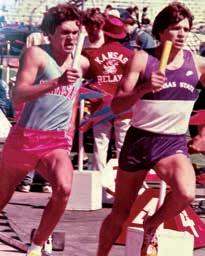
Greg Dalzell was competing for KU, in the 1980s, it was a special time to be a Jayhawk track-and-field athlete. From 1975 to 1983, men’s track and field won seven indoor and seven outdoor Big 8 Conference championships.
Dalzell, b’86, was there for three of those titles, but the third one—the 1983 indoor conference championship— was extra special.
“It was my first really good performance at the conference level,” recalls Dalzell, who was then a sophomore. “I led off a relay in the opening event. We ran really well, and it was great for setting the tone for the rest of the meet. I felt proud being able to contribute to the win.”
A generous alumnus funded commemorative rings for the team, something that hadn’t happened with the two previous championships.
“That and my letter jacket were my most prized possessions,” Dalzell recalls. “I wore that thing like a wedding ring; it never came off.”
Until it did. In 1988, during a late-night ocean swim in Newport, Rhode Island, where he was attending a fraternity brother’s wedding, Dalzell’s prized possession slipped from his finger. He didn’t notice the loss until the next day, as he rushed to return to New York City, where he worked on Wall Street as a currency trader.
“I didn’t know where exactly on the beach I’d lost it, and I had to get back to the city, so I didn’t look for it,” Dalzell recalls. “I was pretty bummed.”
For 37 years, the ring was a misplaced memento of an athletic achievement that grew even more meaningful with the passage of time: That 1983 title, Dalzell notes, is still the
most recent conference championship won by a KU men’s track team. The ring was also an important piece of the Dalzell family’s singular Jayhawk track-and-field legacy. Greg’s father, Art Dalzell, d’55, g’64, was a standout on KU’s 1953 NCAA championship cross-country team and a Big 7 conference champion in the 880. Greg’s daughter, Dorie Dalzell, b’18, also ran for KU, earning All-Big 12 and Indoor Female Freshman Indoor Track Athlete of the Year honors in 2015. All three Dalzells served as team captains, a distinction Greg believes is unique not only to the track-and-field program, but also to KU sports as a whole.
So when he received a call this summer from Trish Powell, KU Alumni’s office coordinator and indispensable problem-solver, Dalzell was understandably taken aback to hear that she had his long-lost ring.
“I think he was shocked,” Powell says, “that someone had found it.”
That someone was Glenn Lawrence, a Rhode Island
COURTESY GREG DALZELL
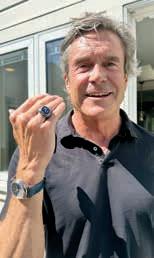
Greg Dalzell (right) was thrilled to recover his Big 8 Conference championship ring, missing since 1988. Left: Dalzell competing for KU at the 1982 Kansas Relays.
State Police retiree and dedicated sports fan whose son competed for the U.S. Military Academy’s trackand-field team at West Point. Lawrence discovered the ring while helping his girlfriend sort through the possessions of a deceased friend, a beachcomber who had enjoyed roaming Ocean State strands with metal detector in hand.
Intrigued, Lawrence used the details carved into the ring, including the year and last name, to fuel some search-engine sleuthing that confirmed Dalzell’s KU connection. He then reached out to KUA, where Powell searched the alumni database to confirm up-to-date contact information existed for Dalzell.
“Trish explained she couldn’t connect me with Greg directly, out of respect for his privacy,” Lawrence says, “but she said, ‘If you mail the ring to me, I’ll make sure he gets it.’”
And she did. Soon after Lawrence’s package containing the ring and a letter to Dalzell arrived at the Adams Alumni Center, Powell shipped it to Dalzell, who now lives in San Francisco—completing a coast-to-coast journey that, fittingly, included a brief layover on Mount Oread, where the ring was first worn with such pride.
“It’s an amazing feeling,” Dalzell says. “I never expected to see the ring again, so to get it back after all this time is really cool. Everyone along the line had to go out of their way to make this happen. It’s just amazing how nice people can be.”
—Steven Hill
Milestones, money & other matters
KU enrollment hit an all-time high for a second consecutive year this fall, reaching 31,169 students—a 1.3% increase over last year’s record of 30,770. The enrollment gain was driven by record retention rates and record numbers of minority, military-affiliated and out-of-state students. The 2025 freshman class of 5,040, a slight drop from last year’s all-time high, is the third largest in University history. Calling this “another special year for the University of Kansas,” Chancellor Doug Girod noted that “our overall enrollment and freshman class numbers confirm talented students from across Kansas and the world continue to see the value of pursuing their education at a leading institution like KU.”
KU Natural History Museum won the Association of Science and Technology Centers’ 2025 Roy L. Shafer Leading Edge Award for its innovative VENOMventure, a mobile escape room that teaches English- and Spanish-speaking families key concepts in evolutionary biology. Deployed as a pop-up at museums and libraries in rural and urban communities, the game was developed by educators at the KU museum and the University of California Museum of Paleontology with funding from a National Institutes of Health Science Education Partnership Award. Teresa MacDonald, PhD’14, associate director of informal science education at the KU Biodiversity Institute and Natural History Museum, accepted the award at ASTC’s annual conference in San Francisco in September.
Chancellor Doug Girod in August was appointed to the NCAA Division I Board of Directors and the NCAA Board of Governors through August 2029. “He is recognized as a national leader and respected voice on policy matters impacting college athletics,” says Big 12 Commissioner Brett Yormark. “The NCAA and the Big 12 will benefit from his leadership as we navigate the evolving world of college athletics.”
Girod, who in 2017 was named KU’s 18th chancellor following decades of leadership at KU Medical Center that stemmed from his career as a prominent head-and-neck surgeon, also serves as board of directors vice chair for the Association of American Universities and chairs the Big 12 Conference board of directors.
Girod’s prominent leadership positions ensure “that the University of Kansas is represented in important policy discussions and has a role in shaping the future of higher education,” says Blake Benson, chair of the Kansas Board of Regents.
Barbara Bichelmeyer on Oct. 14 announced her intention to step down from her roles as provost and executive vice chancellor for the Lawrence and Edwards campuses and, once her replacement is installed, return to teaching and research. Chancellor Doug Girod appointed Bichelmeyer, j’82, c’86, g’88, PhD’92, as provost in February 2020, and within a month she was forced to grapple with campus closures and other pandemic responses. She has since guided KU through other challenges, including what Girod termed “persistent structural budget deficits,” and she shaped and advanced the Lawrence campus’s Jayhawks Rising strategic plan and the 2024 Campus Master Plan.
Girod has launched an internal search for her replacement, with a goal of identifying the next chief academic officer early in the spring semester.
LONG THE
GAME
David Booth’s life of compound interests
by Chris Lazzarino
Photos courtesy of Kansas Athletics
On a bright Saturday in fall 1960, a 13-year-old Boy Scout pinned on an usher’s badge, straightened the slide on his troop’s neckerchief and stepped through the gates of Memorial Stadium, straight into the first chapter of the rest of his life. Sun sparkled off his usher’s badge, and a hum gathered itself into a roar. David Booth—fresh from small-town life in Garnett, newly moved with his family to Lawrence—stood at the lip of a bowl in the stadium that would one day bear his name, a nexus connecting all he knew before to everything yet to come, and learned his first lesson about university life: Community sounds like 47,000 people. b
“I was blown away by all the people in the stands,” Booth says. “I’m feeling the same way now. I’m ready to celebrate with everyone.”
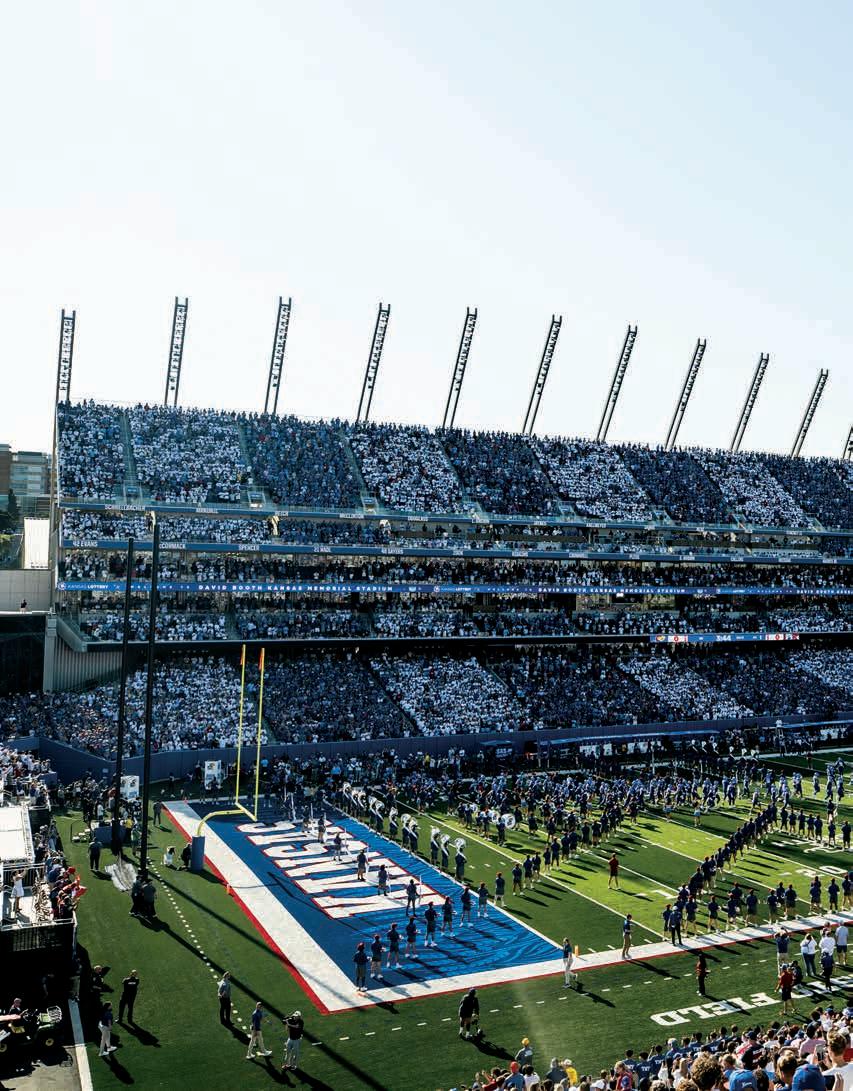
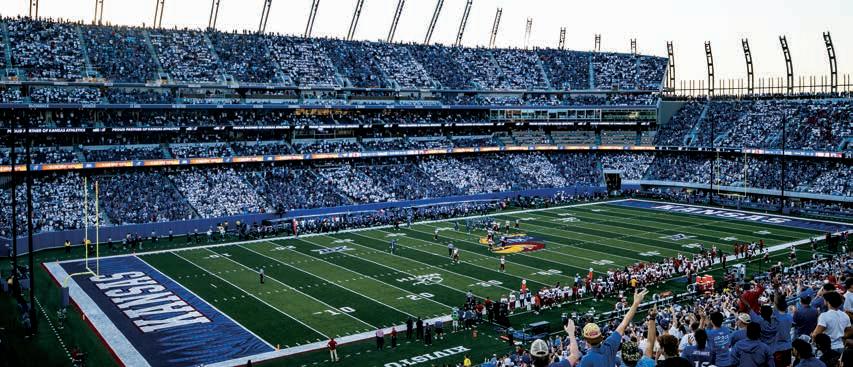
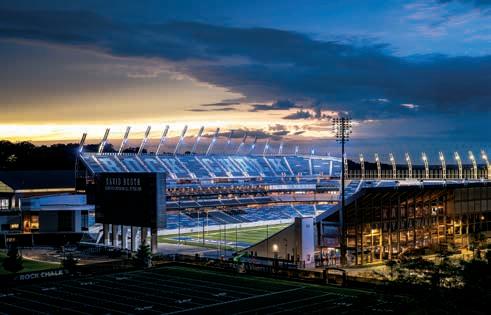
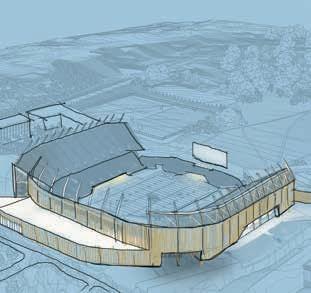
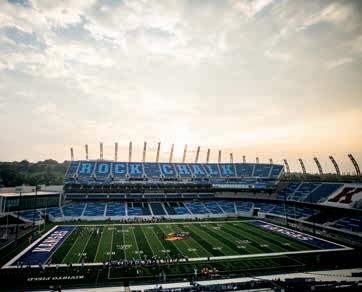
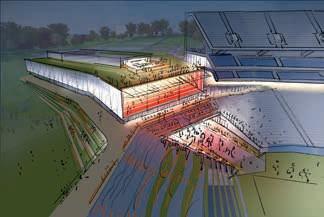
Sixty-five years later, the Boy Scout is a 78-year-old investing pioneer whose name crowns two of KU’s beating hearts: the cathedral on Naismith Drive, where the Booth Family Hall of Athletics fronts Allen Fieldhouse, and, since 2018, the football stadium that Jayhawks now call The Booth. In August, Booth did something that doesn’t happen much in higher education: He moved history. His approximately $300 million commitment—the largest in KU and Kansas Athletics history and among the largest in college sports—pushes the 11th and Mississippi Gateway District into Phase 2, including completion by 2027 of David Booth Kansas Memorial Stadium’s new east stands. The gift also builds a perpetual monetary engine for Kansas Athletics at a time when college sports are rewiring themselves in real time.
Big numbers make big headlines. David Booth, c’68, g’69, is interested in something quieter and, to him, more enduring. “One of life’s greatest privileges is being able to give back to the people and places that gave so much to you,” he says. “Philanthropy, like investing, pays dividends over time. Each gift compounds, creating opportunities not just for today, but for years to come.”
Naismith Drive, a radio, a shoe store
The Booth family’s first Lawrence address—1931 Naismith Drive, a modest home south of Allen Fieldhouse—reads now like a novelist’s wink to destiny. Money was scarce in 1960; fandom was not. The Booths and their
extended eastern Kansas clan had for years gathered around their radios to hear Max Falkenstien, c’47, call games in a voice that felt like a handshake. KU sports were the public square of a university they loved from the outside.
The public version of David Booth’s story—which began circulating among Jayhawks with his family’s first prominent athletics gift, $5 million in 2004 that created the Booth Family Hall of Athletics, which soon expanded with another donation, worth $4 million— had begun in Garnett before shifting 50 miles north to Lawrence, shortly before David began high school. The Booths’ roots, however, are in Lone Elm, population 29 at the time of Booth’s 1946 birth in Lawrence, which was then the site of the nearest hospital.
When Booth’s father, Gil, returned to Lone Elm from South Pacific duty in the Army Air Corps, Uncle Till—“My dad was Gilbert Lee, one brother was Tillman Willis and the other was Wilbur Leroy,” Booth says with a grin. “I mean, we had some names!”—suggested Gil generate income with the family’s new automated corn picker. “It doesn’t sound like much,” Booth says, “but there were very few, and they were very hard to get.”
Booth’s parents, Gilbert and Betty, grew up in Lone Elm during the Great Depression, “when everybody was so poor.” His paternal grandfather one year made $300. Booth’s maternal grandparents ran a grocery and general store in Lone Elm—the structure of which apparently still stands, long abandoned, at First and Main streets. The unincorporated town has allowed the block of decrepit commercial sites to remain, yet also features expansive lawns, unfussy
but well-tended public green spaces, a charming community center and a rambling truck and tractor garage that broadcasts the proprietor’s home phone number on a sun-bleached sign.
A search for work and schools drove the Booth family’s move 15 miles north to Garnett. When Gilbert Booth landed a prime job as a distribution supervisor for the Kansas City Star, they jumped at the chance to move again, this time 50 miles farther north to Lawrence, where they could buy a house close enough to campus so that their three children— Jane, David and Mark—could attend KU without having to pay for room and board. “I didn’t know anybody,” Booth recalls, “and we were all intimidated, because Lawrence then was 40,000, versus the 3,000 where we had come from.”
Booth describes himself as a Forrest Gump character who has unwittingly found himself at the right place, surrounded by the right people, at successive stages in life. At the end of fall semester of his senior year at Lawrence High, Booth sat for a calculus exam that would have earned course credits at KU. “The sickest I’ve ever been was the day I took that test, but there was no deferment. Now or never.” Booth failed. Rather than blame the illness, he blamed himself. “I had a lot of pride wrapped up in my math, and I vowed I would never take math again. This is where the miracle comes in, the fork in the road.”
On the first day of spring semester, teacher Margaret McReynolds saw that her star pupil was no longer enrolled in advanced mathematics. She found Booth’s class schedule in the office, then marched to his classroom, where Booth saw her speaking with the other teacher at the front of the room. When
Booth was summoned to meet Mrs. McReynolds in the hallway, “she said how bad she felt and that she really wanted me back. I said OK, and it worked. It really worked. I passed that test, I ended up focusing on math and economics at KU, and I got an A in every math course I took.”
Booth was 16 when he landed a part-time downtown job at Arensberg’s Shoes, and discovered a classroom with no chalkboards. With the store swamped one Thursday evening—then a traditional night for families from across the region to do their retail shopping on Mass Street—owner Jack Arensberg sent the shy stock boy onto the sales floor to help a woman shop for heels. Neither employee nor customer knew who was more nervous, but Booth learned fast: Look people in the eye, listen before you speak, sell only what lets you like yourself when you go home. Commissions matter less than character. “Be honest,” he says. “Treat people the way you want to be treated. At the end of the day, I wanted to feel good about myself. That was as important as any undergrad course.” Eventually families showed up on Saturdays because the kid who fit their children’s shoes told the truth.
At KU, where he pledged Alpha Kappa Lambda and lived in the chapter house when finances allowed, the ever-curious, always-seeking Booth dreamed of majoring in every subject he studied. He did, however, recognize his talent in mathematics and earned a bachelor’s degree in economics. Where that might take him, Booth had no idea, so he also completed admissions tests for post-
David Booth is a popular host at his vibrant Austin, Texas, home, and thanks to documentarian Errol Morris, you don’t need a dinner invitation to gain insights into the man and his business theories.
“Tune Out the Noise” (available on YouTube) is the prodigious film that resulted after Dimensional Fund Advisors invited Morris to brainstorm snappy commercial spots. When Booth later asked Morris what made him want to commit to a feature-length film about finance, Morris replied, “Because you guys are quirky!”
graduate studies in law and business, then took a summer job as a systems programmer with Royal Dutch Shell in New Orleans, where he awaited word of a draft notice that would, in the very best possible scenario, yank him from academia and halt his career progress for at least two years.
Instead, Booth received word that his draft deferment for higher education had been renewed. Problem was, he was no longer a student, so before the draft board could grasp its error, Booth hustled back to Lawrence to “shop for degrees.” Booth assumed he had only the one-year reprieve before the draft board changed its mind, so two years for a master’s in business administration was out.
In Summerfield Hall, business professor Wiley Mitchell, b’43, g’47, pulled down a thick binder, flipped pages, and discovered a path: operations research. “Two semesters and a summer,” the associate dean told Booth. “It has something to do with math. You’ll like it.”
Booth applied on Thursday, was accepted Friday, and enrolled Monday. He taught computer labs while taking prerequisites, and discovered passions for teaching—perhaps instilled in him by his mother, a longtime public school teacher—and for finance and statistics. With the notion of earning a PhD that would allow him to both remain in school and one day join the KU economics faculty, Booth followed the advice of his finance and statistics professors and, after loading up his Valiant convertible, arrived at the University of Chicago. The fit was perfect; his reasoning, as he discovered before completing a doctorate, was not.
“I learned that teaching is not so much delivering a great lecture— although that is what you want to do—but also about getting the kids to want to learn,” Booth says of the stint as a KU graduate teaching assistant that sparked his interest in becoming a professor. “That extends to business and sales. Instead of trying to push a product down somebody’s throat, you have to help them learn more about what you do and let them figure it out for themselves. A valuable lesson. So, selling shoes and teaching prepared me for life, and, thanks to the academics, of course, KU prepared me for the PhD program at Chicago.”
At Chicago, Booth studied with Eugene Fama—mentor, friend, future Nobel laureate—and swam in a sea where financial economics was being written in real time. “We didn’t have a book,” Booth says. “In class he’d just hand out a new chapter of the one he was writing.” The electricity was exhilarating, and also clarifying. “I didn’t want to be a professor,” Booth realized. “This stuff was so important, and nobody was applying it.”
Chicago gave Booth theory, but his Kansas home bestowed clarity: In the PhD program, he presented papers to giants and discovered that life at the top wasn’t the life he wanted. The epiphany arrived during a Christmas meal in Bronson, south of Lone Elm, celebrated in his grandparents’ home—linoleum floors, no central heat or indoor plumbing, a table heavy with pies and laughter—while he worried about the next seminar. Grasping that none of these people he loved and respected felt the first whiff of worry for the life-of-themind gibberish consuming him, Booth saw that his path was pointing out into the world, not deeper into academia.
“People think I’m trying to say I had a disadvantaged upbringing. Just the opposite. I had a great upbringing. It’s just, we didn’t have a lot of money,”
From chalkboard to spare bedroom
Booth says. “So as we’re sitting there, all the kids and grandkids running in and out and the pies and turkeys and everybody laughing and chuckling, I’m standing there all stressed out. What’s wrong with this picture? Don’t they know I’m in the PhD program at the University of Chicago, being mentored by future Nobel laureates? And suddenly, I get it. It’s just not me. I just want to be happy, and I’m not happy. I have everything set up, the ducks are in a row rowing, I’ve got Gene Fama as a mentor … and that’s when I decided to leave.”
What Booth craved—he realized during his holiday surrounded by a personal tribe of industrious Kansans who valued community, loyalty, hard work— was his own authentic path toward usefulness.
“Life is not about making a prediction and living as though it’s true,” Booth says. “I mean, to an extent you can predict things or cut down on uncertainty, and you want to do that, for sure, but it’s all about coming up with a sensible plan, given the tradeoffs. You just do the best you can, be flexible, pay attention, adapt. If you do that, and you’re focused on making quality decisions, pretty soon you realize, ‘That’s all I can do—make quality decisions.’ Once you accept that, then the next step is to say, ‘Look, I’m going to judge myself not by the outcomes, but by the quality of the decision.’”
Professor Fama recalls Booth as “the best in his class. He was not just an ordinary student. He was very smart, very engaged, and very much into all the work he was doing for me and my classes and for what he was learning. He says everything he knows he learned at Booth—the business school that now has his name on it.” And yet, Fama did not resist his protégé’s instincts to bolt clear of academia’s haven.
Fama, now hailed for championing the elegantly obvious yet world-changing “efficient-market hypothesis,” in 1971 recommended Booth to the financial data pioneer Mac McQuown, who hired Fama’s Chicago superstar to come to San Francisco and join his Wells Fargo Bank team, what might now be described as a “think tank,” then in its earliest stages of exploring real-world investing applications for index funds and testing Fama’s theories about efficient markets. After completing research and algorithms that, among other claims to fame, helped Jack Bogle launch The Vanguard Group, Booth joined the investment bank AG Becker & Co., based in Chicago and New York City, where his most important client was AT&T.
Unlike most of its peers, AT&T, then caretaker of the world’s largest pension fund, was an early adopter of Fama’s research that touted the wisdom of lowrisk, low-fee portfolios based on rock-
steady index funds. What confounded Booth was that AT&T also employed 110 stock-picking fund managers, none of whom were interested in the “small cap” stocks of smaller companies— meaning they’d be selecting from the same equity pool used by Booth’s S&P 500 index fund algorithm that already boasted steady annual gains of about 10%. AT&T’s pension portfolio was competing against itself.
“I had set up the systems for them to run the S&P 500 in-house, so they had the technology in place,” Booth recalls of his fortuitous interplay with his AT&T counterparts. “So I said, ‘Instead of indexing the S&P 500, why don’t we index the portfolios of smaller companies?’ Finally they say, ‘That’s a heck of an idea,’ so I set them up with that, and the idea went viral—although we didn’t say ‘viral’ in those days. Everybody thought, man, that is so cool, and I said, ‘Well, if it’s cool, maybe there’s a business in it.’”
Nearly a half-century after launching the now-iconic Dimensional Fund Advisors, Booth recalls that he, quite frankly, enjoyed his cushy job and paid vacations with the investment bank. “I never wanted to have my own shop,” he insists. But he saw another path emerging, hinting yet again at that destiny thing, so Booth and Chicago classmate Rex Sinquefield quit their jobs and, along with Professor Fama, co-founded Dimensional Fund Advisors in 1981. A spare bedroom in Booth’s Brooklyn
Heights apartment served as the first trading desk. They secured Vanguard to handle the back-office mechanics (“A lot of clicking all the dividends and interest and calculating a net-asset value,” Booth explains) and assembled an independent fund board that reads like a Nobel ledger—Merton Miller, Myron Scholes—and, of course, Fama.
Dimensional’s early pitch, built around concepts that sounded impolite at certain three-martini Manhattan lunches, was stubbornly unromantic: Markets work, costs matter, diversify broadly, execute well, stay tax-aware, lean heavily into the small caps, don’t pretend to predict the future. When applied with monastic discipline, the romance was in the results.
“The DFA folks said, let’s explore this in a systematic way by building well-diversified portfolios of small-cap stocks and trading very little,” says KU’s Gjergji Cici, Koch Professor in Business Economics. “Watch the transaction costs. Charge lower fees. Be very mindful of tax consequences. Don’t waste time picking individual stocks. And they were generating performance that was even better than the market. This was a win-win. Investors were paying lower fees and seeing performance better than most fund managers, and DFA was getting more clients.”
The pitch wasn’t sorcery. It was logic plus execution. Prospective clients were asked to stage their commitments—small tranches, staggered in time—so trust could earn interest. It did. Over four decades, Dimensional
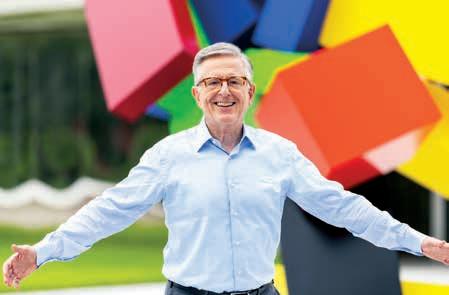
Fund Advisors—now based in Austin, Texas, where Booth lives amid colorful, large-scale art that fills his house and grounds—changed the industry by bridging academic theory with practice in a highly cost-efficient manner. Five scholars who advised the firm later won Nobel Prizes. The point wasn’t stardust; it was method. “You can’t predict the future,” Booth likes to tell people. “You can design for it.”
Design, in his telling, has two halves: science and execution. Medicine has the same split. As do coaching, building a stadium, stewarding a university.
Stadium as thesis
Walk into David Booth Kansas Memorial Stadium today, and you can feel the argument it makes. The renovated west stands opened after a 20-month sprint, with chairbacks and cupholders across the new stadium footprint, world-class concourses, and the kind of ingress and egress that makes families exhale. “No bad seats,” says Director of Athletics Travis Goff, c’03, j’03. University Architect Mark Reiske, a’86, calls it “instantly distinctive”—a place that reads Kansas even without its enormous midfield Jayhawk.
Phase 2 will mirror and extend: new east stands, to start, followed by a hotel, student housing, improved parking, an outdoor event plaza. The project is an engine for both campus and city, designed to hum all week, not just six Saturdays a year. Reiske hopes the lower east stands can be ready for the 2026 season, with the full east side completed
by 2027. The hotel is, for now, targeted for 2027, and housing in 2028. It’s not just a stadium; it’s a neighborhood with a scoreboard.
Booth’s gift is built the same way his firm is: a durable core paired with mechanisms that invite fiscal discipline. It includes a $75 million challenge to coax a community into the boat. “Nobody wants to be first,” he says. “Sometimes you have to stand up so others feel comfortable standing up too.”
Coaches see the leverage. “Two years ago we were thinking, ‘How do we get to where we want to go?’” recalls Hall of Fame coach Bill Self, now in his 23rd year leading the men’s basketball program and nearly as long as the unofficial face of Kansas Athletics. “Now there’s a clear path. The responsibility of that gift is to make sure we work as hard as we ever have to bring other people into the mix, to make sure it’s not a one-man, or one-family, gift. It’s the tip of the spear on what should be a lot more, and I think that will be a driving component in how the athletic department looks at it.” Football coach Lance Leipold, who flew to Austin soon after taking the KU job in spring 2021, says of Booth, “He’s a quality man, obviously. Highly successful, very personable, very welcoming.” Leipold appreciates that Booth’s gift arrives with both runway and expectation. “A gift like this gives us the opportunity to stay strong,” Leipold says, “but we have to keep moving.”
A philosophy of uncertainty
As a thoughtful man who has spent a lifetime teaching what he sees as the truth about markets, Booth speaks in sentences that double as coaching points. We have about a century of quality stock market data, he notes— Depression, world wars, financial crises, pandemics—and across long stretches, stocks returned roughly 10% to 11%. The slick pros do not outguess the market with consistency, and it is impossible to predict before the
Booth (center) on Aug. 23 marched arm in arm with seniors (left to right) Jalon Daniels, Bryce Foster, Justice Finkley and D.J. Withers for the coin flip that hailed the christening of reimagined David Booth Kansas Memorial Stadium. A 31-7 KU victory over Fresno State, in a packed house of 41,525 fans, capped the momentous day in KU football history.
The stirring World War I memorial on Garlinghouse Plaza—designed with input from KU scholars and officials with Kansas City’s National WWI Museum and Memorial—topped the Gateway District’s must-have list for Chancellor Doug Girod (above left), a former Navy officer who feared students and fans may have lost sight of the original stadium’s genesis as a memorial to Jayhawks lost in the Great War. “At that point you either say you’re truly going to have memorials and quit pretending, or you don’t have memorials,” says KU architect Mark Reiske, “and losing sight of those 130 students, faculty and staff wasn’t appropriate. This is first class. It is a destination memorial, and we should all be as proud of this as we are the stadium.”
fact who might. The miracle, if you’re looking for one, is that capitalism can perform as such a superb information machine, a tabulator growing exponentially faster and smarter with every computational advance.
So invest the way the world actually works. Build sensible portfolios, capture the dimensions of compound return, be flexible, cut costs, tune out the noise, and judge yourself by the quality of decisions you can live with.
Philanthropy, for Booth, is the same puzzle in a different box. You cannot forecast a campus to the second decimal place. Instead, you can build capacity. Align leadership. Put resources where they compound—in people, in momentum, in places that become magnets. The stadium is a magnet. So is the idea of KU as a shared project.
“Athletics unites people who may not know anything about an academic department but feel deeply connected to KU,” Booth says. He remembers his parents’ season tickets as their annual social budget, and he deeply appreciates the strangers who stop him in Allen Fieldhouse or cheerfully interrupt his hotel breakfast the morning after the stadium’s Aug. 23 debut. Oh my heavens! I think I just had the best fan experience of my life yesterday! Oh my goodness! Thank you for everything, I appreciate you, and here’s to a great season! Community isn’t a metaphor for Booth. It’s a room you can stand in.
“People have so much pride in KU— the students, the alumni community, people like my parents who never went to KU but were really big KU fans, and you can see the impact it has on people’s lives,” he says. “It’s not about the money or anything else. It’s about taking inventory of how we’ve been blessed. My parents, by moving to Lawrence, teed up the opportunity for me to go to KU, and I was proud to be able to do that. I’m still proud that I went to KU, which enabled me to live life the way I wanted to live it. That’s about as cool as it gets.”
The art part
Ask him what has changed over the past decade, and Booth talks less about blueprints than about trust. Projects drift for human reasons. Projects succeed for human reasons, too. With belief in Chancellor Doug Girod, KU Endowment President Dan Martin, g’93, l’93, EdD’98, and Athletics’ Goff, it was Booth
who first proposed the $300 million gift, shortly after an April 23 Athletics summit at which he’d agreed to provide a smaller, yet still impressive, gift.
“Five days later or so, I’m driving, and I get a call,” Goff says. “It’s David, and I will never, ever forget this. He says, ‘So, Travis, I’ve been thinking about this, and we can do one of two things.’ He said, ‘We can do what we previously talked about,’ which was a brilliant gift that would have been a game-changer, ‘or, here’s this other concept.’ I pull over, trying to scratch out notes, knowing a lot of this stuff is going to fly over my head. I said, ‘David, I’m not the smartest guy, but I think the second one sounds like the better plan.’ He basically says, ‘Yes.’”
Listening happily as Goff recounts the $300 million gift’s origin story, Booth smiles and nods. Yes, KU chose correctly. “It ties,” Booth says, “into the confidence I have in the team.”
The metaphor he reaches for is compounding: small, disciplined inputs, repeated over time, that turn into a thing bigger than any single deposit. The most famous painting in the world traveled with its maker because Leonardo never declared his Mona Lisa finished; resolute stewardship is the art form behind all the other art forms. Stadiums, too, are carried forward by hands that keep showing up.
At 78, the “ole shoe dog” will tell you the calendar concentrates the mind. Estate planning nudged him to consider the difference between what you can do “above ground” and what you leave to be sorted out when you’re not around to
Turner Construction’s
Jason Brown says his entire workforce “showed a real sense of pride on this job. Look at the transformation out here. It’s amazing, and to be able to put this on a résumé, that you had any sort of hand in a project like this, that’s truly an honor for all of us who were involved.”
enjoy it. But the bigger reason is strategic. KU is at a fork in the road, he says, and for the first time in a long while, the pieces align. Leadership. Momentum in football. A project that converts big talk into an address you can visit. That’s when you push.
“Ideas are cheap,” Booth says. “Execution is what’s tough.”
Jason Brown, Turner Construction’s project executive, explains what “tough” looked like on the ground: an active campus; a tight site; just-in-time deliveries; multiple shifts; steel by day and precast by night; a workforce full of fans proud to build the place where their own families will cheer on the ’Hawks. University Architect Reiske proclaims that the stadium “finally gives our fan base what they’ve been longing for, and deserving, for a long time: quality football in an appropriate venue.” Says Booth, “It’s a growth curve.” Start, learn, add, steward, repeat.
Alumni culture isn’t so different from investor behavior; people want to be part of something that works. Booth loves a small number with a big echo: If all alumni each gave $10, that’s $4 million, and $100 is $40 million. But the point is less the amount than the habit. Make the small, disciplined input. Watch it add up. Feel the belonging.
“WE’RE NOT FINISHED. WE’RE NEVER FINISHED. THIS IS THE LAUNCHPAD.”
The man behind the name
Here is the other truth about David Booth: Prestige never quite impressed him the way usefulness did. He is the student who loved every course. The kid who at 5-foot-1 was too small for varsity hoops yet found his way into basketball’s orbit by slipping into the fieldhouse to watch the Jayhawks practice. The young teacher who valued helping students want to learn more than making them memorize. The salesman who learned to tell customers the truth even when the commission dangled. The portfolio manager in the spare bedroom who asked clients to test him a little at a time. The donor who says he’s simply paying back the alma mater that launched him and asking others to do the same, at their own scale, for their own reasons.
“My parents gave back a lot,” he says. “They didn’t have money, but they helped people. That’s what philanthropy is.” He still hears them in the voices that stop him to say thanks. He still hears
Max on the radio. He still hears the inhale of a crowd ready to roar.
So when he walks into The Booth now, he sees the Boy Scout on the concourse and the grandfather smiling at pies in Bronson, the young man sneaking into the fieldhouse to shoot, the middle-aged founder managing a portfolio in a room too small for his ambitions, and the older man who knows that the long game isn’t glamorous. It is consistent. And it works.
“We’re not finished,” he told a crowd at the stadium in August. “We’re never finished. This is the launchpad.” Call it a thesis. Call it a method. Call it the long game, the next first step. The life that taught an industry is still teaching his alma mater: Build with discipline, build with heart, and the good will compound.
Chris Lazzarino, j’86, is associate editor of Crimson & Blue
Jacque Vaughn’s Homecoming
NBA veteran’s career comes full circle as Bill Self’s unexpected hire
by Chris Lazzarino
Bill Self knew the question would sound unusual.
“I’ve got something kind of off the wall, and I want you to think about it,” Self told Jacque Vaughn over the phone. He had just lost longtime assistant coach Norm Roberts to a well-deserved retirement, after 14 seasons at Kansas and 37 years in coaching, opening a space on Self’s bench, and now he was pursuing an idea that, in the hope of keeping it out of the social media rumor mill, Self had yet to share with anyone.
“Norm has been the most loyal guy, we’ve been together forever, but he saw this as a great time to step aside, and when that occurs, there’s obviously a door that opens and opportunity presents itself,” Self said at the June 3 news conference introducing Vaughn as the
Photos by Steve Puppe
newest member of the men’s basketball coaching staff. “I could be wrong, but I think Jacque was a little surprised that I was calling. He said, ‘I’m going to take it to Laura. I’m interested enough for this conversation to continue, and I’ll let you know in a couple of days exactly what I’m thinking.’”
Turning to his newest assistant coach, Self added, “Would that be a fair assessment?”
After a decade with the Brooklyn Nets, Vaughn, b’97, one of the most beloved players in Kansas history, had been living quietly in Paradise Valley, Arizona, spending his days on the golf course, evenings on dinner dates with his wife, Laura DePaolis Vaughn, c’99, and relishing family weekends at the University of Miami with their two sons. He had been an NBA head coach and spent 12 years as a player, and Vaughn had no plans to jump back into the game—at any level.
“I told my agent, ‘I’m just going to let time reveal itself. What happens, happens,’” Vaughn told Crimson & Blue in an interview in his still-spartan office within team headquarters in Wagnon Student-Athlete Center. “That’s kind of how my brain works. I always believe you are where your feet are, and I’ve tried to explain that to our kids when we moved a lot. San Antonio, Orlando, New Jersey, Brooklyn, Atlanta … we’re not going to look beyond where our feet are, so we’re going to enjoy and soak it in and enjoy these memories. We’ve always taken that approach, which I think has been beneficial.”
With the unexpected option to, as Vaughn says, return home, the family huddled. As promised, Vaughn returned Self’s call in a matter of days.
“We’re good,” he told Self. “Tell me more.”
And with that, Kansas basketball gained not just a familiar face but a unique resource: the first former NBA head coach ever to serve as a KU assistant.
“This is exciting for Kansas,” Self said, “but I don’t think you hire somebody because people like him. I think you hire only because he complements what your talents are, and he brings something to us that’s different than what we’ve ever had before. We now have a college assistant coach who was a three-time NBA head coach, who trained Kevin (Durant) and Kyrie (Irving) and all the different guys, and that brings immediate credibility to guys who want to be pros, knowing they’re going to work with somebody who knows firsthand what it’s supposed to look like.”
Indeed, Vaughn represents a rare blend of history and expertise. He remains third on KU’s career assists chart with 804, and his No. 11 jersey hangs in the Allen Fieldhouse rafters. He was the 1996 Big 8 Player of the Year and the 1997 Academic All-American of the Year. After a 776-game NBA playing career that included a championship with the San Antonio Spurs, he shifted seamlessly into coaching, spending two seasons as an assistant under Gregg Popovich in San Antonio before leading the Orlando Magic and twice guiding the Brooklyn Nets.
For a program that thrives on developing NBA talent, Vaughn’s presence is a selling point.
“The great thing is, when I accepted the job, I had probably 20, 25 calls from
legends—including Jerry Sloan, Gregg Popovich, Lon Kruger and Doc Rivers—and he is now immersed in today’s college hoops under Bill Self. “This game, the college game, some of the things are foreign to me,” Vaughn says. “There’s effort in learning, and I’m willing to put in the effort to learn from one of the best coaches to ever do it.”
Vaughn was a junior when he appeared on Sports Illustrated’s memorable cover for the 1996 preview issue. At KU, he played for Hall of Famer Roy Williams; in the NBA, Vaughn was coached by yet more
assistant GMs, GMs, personnel directors across the league, so the direct feedback for our guys will, I think, be beneficial,” Vaughn says. “And then I had the luxury of coaching guys who are top 75 all-time in the NBA, and hopefully I can use that experience to help our guys.”
Yet Vaughn resists reducing his value to résumés or networks. “Players are players,” he says. “The talent level could be different, but you still listen with intent, you’re truthful, you still pull for them and want them to get better. That doesn’t change.”
Vaughn has worked with all-stars and rookies alike, and prides himself on coaching bigs and guards. He points to Nic Claxton, whom he mentored in Brooklyn into a $100 million player, as an example of development done right.
“A lot of the guys who will come to the University of Kansas want to play in the NBA, want to have a life that is associated with basketball in some way, and the last 25-plus years of my life, I’ve walked those same steps, come across some of the questions they’ll have to answer, whether it’s from parents, siblings, friends, agents, management, coaches. I’ve lived that life.
“Deep waters, and sometimes those waters can be treacherous. I have no ulterior motives but to help them.”
Vaughn credits the good fortune of being drafted by the Utah Jazz, where Hall of Fame coach Jerry Sloan led a perennial contender that featured the likes of John Stockton, Karl Malone, Antoine Carr and even Vaughn’s former KU teammate Greg Ostertag, ’95.
“Those guys, they were men, who had kids and who had been paying bills for a long time,” Vaughn says. “Without that veteran leadership, I’m not sure how long I stay in the league. I played for 12 years, and I give a lot of credit to being drafted by Utah and being around a
group of veterans who taught me how to prepare myself as a professional every single day.”
Now Vaughn intends to do the same for the young men wearing his beloved Kansas jersey, and his message packs power in its clarity: “I like to do simple better. There are no shortcuts. I believe in putting in the work, and the results will come from that work.”
Along with his enthusiasm to rejoin the KU basketball family and learn college coaching under Self—“The opportunity to be around a Hall of Famer who has two national championships and is taking our program to a different level really guided my pivot to come back home”—the move to Lawrence is even more rewarding for its impact on the one thing that matters more than basketball: family.
“When you think about it, all the stops we had, the four of us, we always had to get to know the community, how to travel, where to go to eat, where to live,” Vaughn says. “We didn’t have to do that here. We just got reacquainted here. We’ve walked these same streets before.”
The memories flood back: the Los Angeles kid experiencing his first Kansas winter (“Are you kidding me? I thought I had a winter jacket. I’ll never forget that”), walking the Hill to class and down the Hill to graduation, his four years living with Scot Pollard, d’97, in suite 412C of Jayhawker Towers.
“I tell people, once you come here, you feel it’s different than any other university. It’s different than any other quote-unquote college town. And for a kid coming from California to say, ‘I’m
“I TELL PEOPLE, ONCE YOU COME HERE, YOU FEEL IT’S DIFFERENT THAN ANY OTHER UNIVERSITY.”
here in Lawrence, Kansas, and I love it,’ that means something to me, and it always has.”
That perspective will shape Kansas basketball as much as his NBA experience. Vaughn knows today’s players face pressures he didn’t—social media, NIL contracts, even taxes, which he recently helped one of his players navigate. But he also knows the fundamentals haven’t changed: preparation, honesty, teamwork.
“The enthusiasm is back,” he says. “I woke up at 4:30 a.m. the other day, like it was training camp. That’s a good sign.”
For Kansas fans, Vaughn’s return reinforces continuity. His jersey hanging high above Naismith Court is a reminder of his playing days, and his new sideline perch next to Self symbolizes the program’s reach—from Allen Fieldhouse to the NBA and back again.
“We are very, very proud and excited about Jacque coming in,” Self said, “and making us better.”
Three decades after his first days on campus, Jacque Vaughn is home again, ready to help lead the program he once helped define.
“Me coming back, coaching a group that’s playing on the same floor I played on, being able to talk with guys about what my path has been, hopefully guiding them and being a mentor and a coach and someone who is pulling for them more than they’re pulling for themselves … yeah, I think that’s pretty cool.”
Chris Lazzarino, j’86, is associate editor of Crimson & Blue.
Turning ambitions into future achievements.
Commerce Bank celebrates the 2025 William T. Kemper Fellowships for Teaching Excellence recipients, recognized for the pursuit of knowledge and progress. Each professor will be awarded $7,500 to be used at his or her own discretion. Commerce Bank is proud to salute the 2025 Kemper Fellows for their efforts to improve higher education at the University of Kansas.
(L-R) Giselle Anatol, Professor of English and Director of the Hall Center for the Humanities | Jennifer Delgado, Associate Teaching Professor of Physics & Astronomy | Sean Gullickson, Associate Teaching Professor of Spanish & Portuguese | Eileen Hotze, Associate Teaching Professor of Molecular Biosciences | Pamela Keller, Clinical Professor of Law
Access to CARE
A new KU research center is changing the way we talk about eating disorders—and helping a broader range of patients get the treatment they need
by Christina Knott
the pressure for ballet dancers to conform to expectations around weight, athleticism and beauty were thrust into the public eye almost 30 years ago with the death of a 22-year-old dancer in the Boston Ballet, Heidi Guenther.
In 1997, Guenther’s heart stopped while she was vacationing with family. Guenther was not underweight, but had been strictly dieting and taking laxatives, which led to a heart attack. Performers, dance companies and the media debated whether the emphasis on conforming to body standards contributed to Guenther’s death.
And for the first time, the realization that eating disorders could be fatal came into sharp focus for another professional dancer, Kelsie Forbush.
Like Guenther, Forbush had a long résumé. She’d performed at Iowa Dance Theatre and Vine Street Ballet (now Ballet Des Moines) and trained with professionals at Milwaukee Ballet, Ballet Iowa and North Carolina School of the Arts. She was aware of the strict body standards that were part of the discipline of ballet. The drive to stay thin had always seemed harsh, even unhealthy, but never deadly. Until now.
“It really shocked me,” Forbush says. Forbush eventually pivoted away from dance. She thought she’d never find something she could do as well: Dance had been her life. But the shock of what happened to Guenther never quite wore off, and it ended up changing the course of Forbush’s career. In 2014, her journey brought her to KU. Today, she is professor of clinical child psychology and senior scientist at the Life Span Institute, where she is director of
Illustration by Barry Fitzgerald
Photos by Drew Rosdahl
Kelsie Forbush
the new Center for the Advancement of Research on Eating Behaviors (CARE).
In some ways, Guenther’s story typifies the misunderstanding around eating disorders that persists today: namely, the assumptions that behavioral conditions such as anorexia nervosa and bulimia nervosa are rare (and rarely fatal), and that they mainly affect young white women starving for a waifish figure. However, the truth about eating disorders is much more complex and diverse. The National Institute of Mental Health defines eating disorders as severe disturbances in a person’s eating behaviors. Although many people may be concerned about their health, weight or appearance on occasion, some become fixated or obsessed with weight loss, body weight or shape, and controlling food intake. Others may struggle with binge eating, marked by episodes of overeating and a sense of losing control.
Anorexia and bulimia are fairly well known, but the Diagnostic and Statistical Manual of Mental Disorders, Fifth Edition (DSM5)—the standard reference used by clinicians to diagnose mental health conditions—recognizes six additional categories that are less familiar. These include binge eating disorder, avoidant or restrictive food intake disorder, pica, rumination, and other specified feeding and eating disorders (such as purging disorder, night eating syndrome, atypical anorexia nervosa, subthreshold bulimia nervosa and orthorexia).
The “other specified” category can account for nearly half of all cases. Further illustrating the challenges of identification, eating disorders are known to manifest very differently across varied cultures, gender identities and ages. Lack of access to treatment, from rural areas to the military, compounds the problem.
This is partly why, as Forbush explains, recent research on the prevalence of eating disorders suggests cases are undercounted. Far from rare, these conditions may be as common as depression and anxiety.
On this complex foundation, Forbush and a team of researchers aim to build scientifically valid, effective—and inclusive—ways to identify and treat eating disorders at CARE, which in 2024 became one of nine dedicated research centers at the Life Span Institute. A key goal is to expand access to effective treatment no matter where people are, including on campus.
“One thing that breaks my heart is when I have a student who says, ‘I’ve been to treatment four times,’” Forbush says. She has also seen students who’ve been in treatment since their preteen years who, after receiving treatment developed at CARE, show improvement in less time than it takes to complete a single semester of classes.
“This shouldn’t be what happened to them,” Forbush says. “They lost 10 years for this, and they can’t get that time back. We’ve got to bridge that gap so that people can live high-quality lives.”
Standards and stigmas
Eating disorders often peak in early adulthood—the age many people start college or join the military. Anxiety and trauma often associated with dramatic life changes such as these can worsen eating disorders. When food access becomes unpredictable, research shows, disordered behaviors around diet and extreme exercise can feel like a way to regain control.
“There’s a lot of reasons why the military environment is kind of the ‘perfect storm’ for developing an eating disorder,” Forbush says.
Service members are required to make weight twice a year, and weigh-ins are public. Intentional dehydration and extreme use of laxatives may become normalized when exceeding standards by even half a pound can trigger an email to the whole command. Failing isn’t just humiliating—it limits eligibility for orders, impacts promotions and can even end careers.
“There’s also the stigma that you’re the weakest link and that you can’t keep up or be a part of the team,” says Leah Stiles, a retired senior chief petty officer.
Stiles reached out to Forbush in her post-military role as CEO of Sea Waves, a nonprofit she founded to raise awareness of the problem of eating disorders in the military. For Stiles, it’s personal. So much so, she’s given it a name.
“I call it Lucifer. Lucifer living with us. It’s a roommate you just don’t want.”
Stiles developed an eating disorder coping with a turbulent childhood. She thought she’d left it behind when she joined the U.S. Navy, but it resurfaced as she struggled to manage the stress of deployment, stay within unforgiving weight limits and prove that she belonged.
In the military, overwork was rewarded. Her disorder adapted to fit the system, accompanying her through a 20-year career. At one point, she was purging more than five times a day. She ruptured her esophagus. As her body broke, she kept passing inspections because, from the outside, she looked fine: Stiles wasn’t underweight.
Eventually, the three highest-ranking officers on her ship confronted Stiles during a deployment. They had her medevaced to Naval Station Norfolk, the world’s largest naval base. When she arrived, she learned what many people with eating disorders have experienced: Few medical providers have specific training to treat them.
“When I got there, there was not one single eating disorder-informed provider in the entire hospital,” Stiles recalls. “Nobody had gotten more than 15 minutes of formal eating disorder education.”
Both Forbush and a 2019 Government Accountability Office study found that military screening methods fail to identify service members with eating disorders.
“The biggest misconception about eating disorders is generally just around who can have an eating disorder—which is anyone.”
“The current way of screening for eating disorders within the military is to ask potential service members if they have ever had an eating disorder,” Forbush says. “That’s it.”
With a series of research grants, Forbush has helped define new ways to identify eating disorders, by looking first to the experiences of veterans and, now, among active-duty military.
She led research to develop the Eating Pathology Symptoms Inventory (EPSI), which improved the narrow focus of existing assessment tools. Launched in 2013, the 45-item questionnaire, tested among more than 30,000 people, assesses eating disorders among a wide range of ages, genders, body shapes, sexual orientations, socioeconomic statuses and cultures.
Building on her work on EPSI, Forbush created another screening mechanism, the Brief Assessment of Stress and Eating (BASE), 10 questions that identify eating disorders among veterans as well as other populations, such as college students.
On the heels of that success, Forbush won a $4.2 million Department of Defense grant in 2023 to address eating disorders among active-duty military by refining and scaling her screening tool.
To understand the need for more accurate screening tools in the military, where men outnumber women, one must understand the misconceptions about these conditions, says Samiya Rasheed, c’23, c’23, a project coordinator at CARE who oversees veterans and military studies with BASE.
“The biggest misconception about eating disorders is generally just around who can have an eating disorder—which is anyone,” she says.
While the rates of eating disorders are higher among women, men are less likely to receive treatment. That’s why the mortality rate for men is more than double that of women.
“Inevitably, when we ask (the mostly male service members) if they have ever talked about eating disorders within a military context, I have never gotten another answer but, ‘That’s not really something we talk about, even if we do talk about mental health generally,’” Rasheed says.
Screenings are critical because they are the first step toward treatment, a tool that can be used broadly to identify potential health risks before assessing individuals in more comprehensive evaluations.
“You want something brief and easy to give alongside depression screenings and anxiety screenings, right?” Forbush explains. “Think of the questions you’re asked when you go to a doctor.”
But it isn’t enough to ask more questions; clinicians need to ask the right questions. Failure to do so means many people remain trapped, not only putting their health at risk, but also significantly impacting their quality of life.
“We’re really learning,” says Anjali Sharma, c’21, a graduate research assistant at CARE, “that eating disorders don’t discriminate.”
A culture of collaboration
CARE’s group of two dozen clinicians, researchers and students are actively collaborating—and encouraging one another—to better understand how disordered eating develops across many different lived experiences and cultural contexts.
The team environment is something Forbush has worked to build.
“I’ve spent a lot of time thinking about best practices for hiring people, maintaining good work-life balance, and creating a sense of community and cohesion,” she says.
“It’s something I really strive for, and something I enjoy … because I get to create a culture that I want to be a part of. That does take work to cultivate and maintain.”
After her ballet career ended, Forbush found her next steps with encouragement from an undergraduate sociology professor. He had asked her to stay after class to discuss a paper on eating disorders she had written for her final project.
She was anxious that he was going to criticize her work, but he surprised her by instead suggesting she consider a career as a researcher. His words planted an idea that kept coming back to her as she went on to earn her PhD. Now, she hopes to inspire other students in the same way.
“Simple things that we can do as a professor, such as small encouragements,” she says, “can have such a big impact on people.”
The entire CARE team—undergrads and graduate students, project managers and center leaders—meets weekly during the academic year, packing a conference room in the Dole Human Development Center to share ideas for information dissemination, discuss avenues of research, and brainstorm ways to connect to communities.
“The best research, to me, is developed with communities, not on communities,” Forbush says. “So really trying to partner with various groups in the area and nationally is one of our initiatives.”
This culture of mentorship, inclusion and communityengaged research is reflected in the work of Sarah JohnsonMunguia, g’21, a doctoral student and graduate research assistant at the center. Her research explores how culture shapes relationships with food and body image, a key step in improving screening and treatment.
People with an eating disorder don’t necessarily desire the thinnest body possible. Hispanic women she interviewed often preferred thin waists but larger hips and chests. Similarly,
masculine ideals may call for low body fat but large biceps and defined, six-pack abs.
These ideals of physical appearance, self-control and morality around food are passed down in both subtle and explicit ways. They serve as powerful sources of connection, but, paradoxically, can also be sources of division, isolating people from the communities that shaped them.
“I think about how ingrained food is in our culture, and how it’s such a connecting force to other people,”
Johnson-Munguia says. “So, you often lose that connection as you get deeper into an eating disorder.”
The social pressures around food can lead people with eating disorders to avoid spending time with friends and family, wary of comments that they are eating too much or not enough. They may fear losing control of their eating, or they may be so busy with the rituals surrounding their disorder that they just don’t have time.
“You lose your connection to the outer world, and the things that actually matter to you as a person and your values. That can feel really isolating and hard to deal with,”
Johnson-Munguia says.
While eating disorders look different across cultures and genders, there are differences in how these behaviors impact people across identities as well.
Anjali Sharma, the project coordinator, focuses much of her research on eating disorders across the gender spectrum. There’s not a lot of data on how to assess or treat eating disorders in gender-diverse people. But science is starting to catch up.
“For transgender individuals or gender-nonconforming individuals, we see there is this body ideal of being androgynous,” Sharma says. “So, of course, secondary sex characteristics, such as breasts or having hips, can be very dysphoric and can be very triggering.”
Trans individuals experiencing gender dysphoria may try to control their body by restricting food, purging or exercising excessively.
Kelsie Forbush has built a staff of clinicians, researchers and students who can work collaboratively while understanding how disordered eating develops across many life experiences and cultures. “It’s something I enjoy … because I get to create a culture that I want to be a part of,” Forbush says.
According to the National Eating Disorders Association, transgender or nonbinary people are four times more likely than cisgender peers to have an eating disorder, and LGBTQIA people experience higher rates and more severe symptoms of eating disorders on entering treatment, compared with individuals who are heterosexual or cisgender. Assessments and treatment programs often ignore these facts.
“A lot of our treatments and a lot of our assessments and all of that have been made for cisgender individuals,” Sharma says. “And we’ve found that common eating disorder questionnaires perform quite differently, to where it doesn’t detect eating disorder problems as well in transgender and gender-diverse individuals.”
A lifetime of rituals
Matty Spragens grew up being told that the size of their body must be strictly controlled.
Spragens, whose experience typifies the lifelong challenges eating disorders pose, says their mother began embracing diet culture and projecting it in the 1970s, when Spragens was a child. It was the era when Robert Atkins penned his Diet Revolution books and celebrity fruit fasts touted shedding pounds fast.
By kindergarten, Spragens had been drawn in as well. “I was told from a very young age, like the age of 5, that I had inherited ‘fat genes.’” At 6, Spragens was put on the first of many diets.
The experience was taxing, but Spragens, c’96, didn’t see an alternative.
“I lived my entire life just thinking that life sucked,” Spragens says. “That was the way life was. You just had a bad relationship with food and body, and all of those things.”
Spragens came out as queer in 1991 and as trans in 2019. Their eating disorder has looked different over time, but often the behavior associated with it was praised.
“It was always like, ‘Oh, good job. You lost all this weight,’ you know? ‘You look great. Keep doing what you’re doing,’” Spragens says.
By 14, they were skipping lunch, going to basketball practice after school and eating salad for dinner.
“I lost a ton of weight, and everybody was just so proud of me, because I had these ‘fat genes’ that I had to fight. And I was doing it. I was fighting it.”
Spragens didn’t recognize they had an eating disorder until after a dietitian expressed concerns in 2019.
Always athletic, Spragens had taken up weightlifting in their 40s. They used a nutrition coach to stay competitive—and lean—in the weight-class sport. The coach had Spragens log every ounce of food and target specific percentages of protein, carbs and fat.
“I was eating 1,200 calories a day and exercising every day. And like, doing ridiculous things,” Spragens remembers. This included weighing daily, taking photos and reporting all details to the coach.
Spragens remembers questioning others in an online weightlifting forum about whether it was normal to never stop thinking about food. No one ever brought up the topic of eating disorders.
Still, Spragens knew something was wrong.
“I was miserable,” Spragens says. “Miserable. And I just, I woke up one day and I was like, ‘I know I need to stop working with this guy.’ And also, ‘I don’t know how to feed myself.’”
That’s when they went to the dietitian to find advice on a better diet—maybe paleo? Instead, “Within about 20 minutes of talking to me, they said, ‘Um, you’ve got a problem.’”
Spragens didn’t enter treatment right away, but they soon realized managing an eating disorder wasn’t something they could do on their own. A lifetime of rituals refused to disappear.
“If you have run under the radar for so long, the longer you have your eating disorder, the harder it is to reset your mind frame,” Spragens says.
They entered residential treatment for eating disorders. While beneficial, the program wasn’t set up to support someone like them.
“It really catered to young people who are worried about school and life decisions for the future,” Spragens says. “It doesn’t really take into account people who have children and are in various other decades of life.”
The community providers also lacked knowledge about gender-affirming care in the context of eating disorders, according to Spragens, who set about educating the nursing staff.
“I had to really fight to have my pronouns respected,” Spragens recalls.
The experience was beneficial, but health insurance limited the length of the stay. Overall, Spragens needed about 10 in-patient stays over the next six years.
Research gains boost treatment
Because eating disorders are considered a specialized field in psychology, providers have limited training in diagnosis and treatment.
“People are just truly slipping through the cracks, and there’s not enough providers to keep up with demand for services,” Forbush explains.
There are signs this is changing. Forbush recently co-wrote a textbook on abnormal psychology. The other authors, aware of the need for more information on the topic, were eager to include a scientist who specializes in eating disorders in their newest edition.
“In the beginning of their book, eating disorders weren’t in there at all. Then it was a section in the childhood chapter,” Forbush says. “Now it’s its own chapter.”
From 40% to 60% of eating disorders can be classified as “other specified,” Forbush says, which means a person has symptoms that cause clinically significant distress or impairment but do not meet the full criteria for an eating disorder such as anorexia nervosa, bulimia nervosa or binge eating disorder.
Until recently, large epidemiological studies of psychiatric disorders excluded this “other specified” category, which led to eating disorders being underestimated.
“If you exclude the most common eating disorder, you have a distorted idea of the scope and impact of eating disorders,” Forbush says.
She believes eating disorders should be as well understood by therapists as common health problems are understood by primary care doctors.
“If your primary care physician isn’t familiar with Type 2 diabetes,” Forbush explains, “that’s not going to work.”
Of course, eating disorders that go unrecognized also go untreated—contributing to an annual $64.7 billion economic hit from lost productivity and well-being, U.S. health system costs, and related expenses. Despite this, the National Institutes of Health funds eating disorder research at a rate of about 73 cents per person with a disorder, Forbush notes. NIH invests $58.65 per person with autism spectrum disorder and $86.97 per person with schizophrenia.
Angeline Bottera, associate director of CARE, says clinicians can be uncomfortable or unfamiliar with treating eating disorders. Few providers receive training specifically to treat eating disorders, limiting access to care.
Although providers refer individuals to specialists, there are not enough specialists to meet patient needs. As a result, people struggle to find treatment.
Bottera completed her PhD in clinical psychology at the University of Wyoming, where she observed the provider shortage firsthand. If people were unable to access treatment at the university, there were no other options in-state. People drove more than two hours to Denver for treatment.
Angeline Bottera
In West Virgina for her residency, she saw much the same thing, with patients possibly driving hours for outpatient treatment—a problem that extends across much of rural Kansas as well.
Bottera was struck by the magnitude of the shortfall, and the need to develop solutions that address the gaps in treatment. She says CARE is at the forefront of disseminating treatment options to nonspecialty providers.
“That means that our work, which already involves KU students and veterans in the state, has the potential to help Kansans statewide who are in rural and isolated communities. It’s a global impact that is being developed here at KU that can meet those needs.”
To address gaps in treatment options, CARE is developing app-based tools that pair clinicians with resources to improve eating disorder treatment. The apps provide patients with lessons and skills for recovery, along with tools to track their progress. Therapists can monitor clients’ progress through the platforms, supporting wellness and sustained recovery.
Two ongoing projects are the Smart Technology for Anorexia Nervosa Recovery (STAR) app, which supports clinicians in helping patients with anorexia nervosa maintain recovery and prevent relapse into higher levels of care, and the BEST-U (Building Healthy Eating & Self-Esteem Together for University Students) app. Forbush this year received a $715,000 grant from the National Institutes of Health to expand BEST-U’s 11-week program to reach more students and fund training for Watkins Health Center providers to serve as coaches.
Most people with eating disorders are not underweight, and screening measures aren’t capturing these types of eating disorders very well. Sometimes students volunteer thinking they’ll be part of a control group but realize throughout the course of answering questions that they have an unhealthy relationship with food and body image that should be addressed.
“I do think sometimes there might be certain aspects of eating problems that can be normalized in our society,” Forbush says. “It’s sometimes hard to know where that line is between watching your diet, worrying about your body, wanting to be fit—and when it becomes problematic.”
While research and study are the methods, Forbush says, helping people is the ultimate goal of the work.
“We’ve got to bridge that gap between what happens in traditional practice and what happens in our research labs. It cannot be separate.”
“It’s sometimes hard to know where that line is between watching your diet, worrying about your body, wanting to be fit—and when it becomes problematic.”
Breaking free
When eating disorders are treated successfully, people have more time to focus on friends, relationships, hobbies, school, work.
“Eating disorders take up a lot of mental real estate,” Forbush says. “When a person gets treatment, it opens up so many different aspects of life.”
Spragens still feels the frustration of living with an eating disorder for decades. While they are in a good place today, the work to stay healthy doesn’t end.
“I wish,” Spragens says, before pausing to reflect. “I wish a lot of things.”
Looking back, Spragens wishes they’d been able to access care when they were 14.
“At a time when I should have really gotten some help, people were just so amazed at how disciplined I was and how good I looked,” Spragens says. “I think my life could look a lot different than it does now.”
This is part of what has driven Spragens, at 51, to pursue a master’s degree in social work so they can help others with eating disorders.
Spragens strives to remember how far they’ve come. Even small moments feel big.
They can take their child out for ice cream. They can focus better on work and are able to realize when they’re pushing too hard. They’ve gotten into painting. And they feel pride in who they are and being part of a queer community. When Spragens applied to adopt a rescue dog, friend after friend provided references.
“It’s hard when you’re just looking forward and you’re like, ‘I’m just never going to get there, I’m never going to get there, I’m never going to get there.’
“But yet, look at all the things that have happened and changed in my life,” Spragens says. “I think it’s important for people to remember those things about their own experiences.”
Christina Knott, a KU graduate student in digital integrated marketing, is a communications specialist at the Life Span Institute.
A Retired Jayhawk in Paris
A study abroad encore completes a 50-year journey for KU alumnus
by David Day
“J’AI DIT À PARIS, ‘TU AS CHANGÉ.’ ET LA VILLE M’A DIT, ‘TOI AUSSI, TU AS CHANGÉ.’”
Five decades after first participating in KU’s Summer Language Institute in Paris, Stuart Boley returned to the City of Light this summer to reignite his connections with the French language, the people, the culture and himself. “I said to Paris, ‘You have changed,’” says Boley, c’77. “And the city said to me, ‘You also have changed.’”
In the summer of 1975, Boley was a 20-year-old undergraduate student from Lenexa on his first overseas trip. This summer, as a 70-year-old retiree, he again participated in the Summer Language Institute after taking French 110 at KU in fall 2024 as part of a Kansas Board of Regents policy that allows Kansas residents age 60 or older to audit university courses on campus at no charge. Boley (who paid full tuition and fees to participate in the study abroad program this summer) was one of 19 KU students on the five-week trip.
THE SUMMER OF ’75
In the United States in 1975, “One of These Nights” and “Love Will Keep Us Together” topped the music charts, while “Dog Day Afternoon,” “Jaws” and “French Connection II” were popular movies. That summer, Boley was across the Atlantic experiencing
Photos courtesy of Stuart Boley
Parisian culture and daily life. But his raison d’être là—his reason for being there—was the language.
Started in 1958, KU’s Summer Language Institute in Paris is among the oldest continuously running summer academic programs offered by a U.S. university. Having studied French in junior high and high school, Boley continued at KU and saw the study abroad program as an opportunity to practice his language skills and learn about the world.
“I met other students from Nigeria, Holland and Italy,” Boley says. “It was a wonderful experience. It was fun, but tough.”
That experience in Paris and his French language skills would play an important role in a later career opportunity. After graduating from KU, Boley moved to Houston and was hired as an IRS auditor. Three years later, and partly because of his study abroad experience, Boley landed in Paris again, this time for an assignment in the U.S. Embassy. He would spend another six months living in and experiencing Paris as a local with his wife and young child.
THE SUMMER OF ’25
This summer, “Ordinary” and “What I Want” were chart-toppers, and moviegoers were watching “Superman” and “F1.” Boley was in Paris again, experiencing the culture and practicing his rusty French language skills. Older and wiser, Boley was more confident and less intimidated than he was 50 years ago, particularly when speaking to Parisians.
“My skin is tougher than when I was 20. I am less worried about what other people think,” Boley says. “At 20, I was afraid of making mistakes. At 70, I’ve made so many mistakes, a few more won’t matter.”
In returning to Paris, Boley wanted to have a sense of purpose and be immersed in the daily life of the city. While he could have visited as a tourist, the summer institute program helped him connect with the city and people as he had when living there in 1975 and 1980.
“I didn’t want to just see Paris; I wanted to experience it. If you’re looking at the Eiffel Tower, you’re not looking at the people,” he says.
A key part of this trip was the housing arrangement. In 1975, students in the summer institute lived in dorms. Today, students live with host families, which provides more opportunity to experience typical Parisian life. Boley was unsure whether a family would agree to host a nontraditional “senior” student, and he feared he would have to stay in a hotel. Fortunately, he was provided a home with host family Maria and Denis Laloux.
STUDY ABROAD’S ENDURING APPEAL
Experiencing day-to-day life in a foreign country and connecting with locals are among the many rewards of studying abroad. Whether lasting a few weeks, a semester or an academic year, study abroad programs provide students with the opportunity to see and experience international communities and cultures in a way that is rarely possible as a tourist.
Refining their foreign language skills and gaining a more global perspective can also help students as they enter the workforce, as Boley learned in 1980. For that reason, KU places a significant focus on experiential learning—opportunities that take students outside the
classroom and enable them to have hands-on experiences. The University offers more than 165 study abroad programs in more than 70 countries, and nearly 25% of undergraduate students participate.
“It’s a chance for personal renewal,” Boley says. “It’s an amazing opportunity to step out of what you’re doing and do something challenging and wonderful.”
Bruce Hayes, professor and chair of the department of French, Francophone and Italian studies, has been co-directing KU’s Paris Summer Language Institute for more than 20 years along with his colleague, Professor Paul Scott. Hayes directs the five days of touring northwestern France, while Scott oversees a four-week stay in Paris. Both ended up as French scholars and teachers because of their time spent in France when they were younger. Some students naturally may be anxious about taking the leap to study abroad, Hayes says, but those who participate benefit immensely, including through gaining newfound confidence— une nouvelle confiance.
“Nobody ever does study abroad and says, ‘I wish I hadn’t done that,’” Hayes says.
Cost can be a barrier to studying abroad, but KU Study Abroad & Global Engagement can help students navigate the financial challenges. KU Endowment, for example, has more
Boley (back row, left) visited Paris cultural sites such as the Panthéon with Professor Paul Scott and KU students, and also found time to enjoy the City of Light’s vibrant café culture (previous page).
“You also have changed”: Boley at Normandy in 1975, and along the same stretch of coastline in 2025.
than 120 awards and scholarships that support study abroad in 32 academic departments.
THEN AND NOW
Family support for a study abroad experience is important, and Boley’s family looks much different today than it did in 1975. He says his wife, Lisa Boley, and his grown children gave him support and encouragement when he mentioned the idea of participating in the language institute. After nearly 50 years of marriage, Lisa understood why Boley wanted to return to Paris.
“Stuart is independent and adventurous, so the trip did not seem like a huge leap,” she says. “His first trip to Paris with KU Study Abroad was very important in his life, and he has wonderful memories of that experience.”
Study abroad experiences often include side trips to culturally or historically significant places, and the Summer Language Institute in Paris is no exception. Hayes says a trip to Normandy has been part of the program for at least 50 years.
“Students are typically quite moved by the experience of visiting the American Cemetery in Normandy,” Hayes says. “As World War II gets further and further from our collective memory,
students have less and less awareness of what exactly happened.”
Consider that Boley’s first Normandy visit in 1975 was only 30 years after the end of WWII, while 50 years have passed since that trip. With age comes wisdom, and with time comes perspective. In visiting the Normandy American Cemetery on this trip, he reflected on his life over the past 50 years—years the soldiers laid to rest there didn’t have.
“On my first visit, I was about the same age as those who were buried there,” Boley says. “As a 70-year-old, I have a greater appreciation of tragedy and a better understanding of the significance of their sacrifice.”
With a lifetime of perspective and a desire for an authentically local experience, Boley’s approach to study abroad this summer was different from that of his younger self. This summer, he spent much of his time in the relatively quiet Gambetta district frequenting cafés, studying, and simply enjoying life as a 70-year-old college student in Paris.
“This time, I didn’t close down any bars, but I opened some cafés,” Boley says.
“Cette fois-ci, je n’ai fermé aucun bar, mais j’ai ouvert quelques cafés.”
David Day, c’90, g’97, is director of strategic communications in KU’s Office of Public Affairs.
Snapshot: KU Study Abroad
165+ study abroad programs offered, with options for every major.
70+ countries where students can study.
$500,000+ in study abroad scholarships awarded in the 2024-’25 academic year.
Nearly 25% of undergraduate students study abroad.
KU ranks in the top 6% nationally for study abroad participants.
For more information and to support KU’s study abroad programs, go to kuendowment.org/internationalaffairs
Save the Date
CHANGING THE WORLD
one day at a time.
Jayhawks do great things. From research breakthroughs to medical innovations to cultural impact, KU has been the birthplace of world-changing phenomena — and One Day One KU is your chance to be a part of that legacy. With your help, we can continue to do what we do best: cultivate game changers. Save the date and show your support for the University of Kansas and The University of Kansas Health System on April 28-29, 2026, noon to noon CST!
One Day One KU is Tuesday and Wednesday, April 28-29, 2026, noon to noon CST. We’ll see you there!
www.ku.edu/onedayoneku
inthe Park Sundays
In Lawrence’s Kaw Valley Kickball League, a playground pastime is a catalyst for community and a force for good
by Megan Hirt
n a mild night in August, the day after KU football’s season opener and first game in the reimagined David Booth Kansas Memorial Stadium, two more local teams face off under stadium lights just a mile east. Though Monday morning looms, the atmosphere at Municipal Stadium at Hobbs Park is festive, the grandstand abuzz with spectators who’ve gathered for the 9:30 p.m. showdown. On the field, a spirited competition unfolds for the next hour and a half, the action turning on the resounding thunk of a rubber ball booted into the cool air.
It’s the Kaw Valley Kickball League’s 2025 Cup Championship, the culmination of 13 Sundays of play for the co-ed league’s 36 teams. Throughout the day, teams have claimed trophies at three levels of tournament play, and now, the last squads standing are contending for the Cup, KVKL’s top prize. A double play in the top of the ninth inning decides the game, 10-7.
As many in the league—which naturally attracts hundreds of KU alumni—would attest, however, the final numbers on the scoreboard don’t reflect the full reach and rewards of the KVKL experience.
“In one sense, it’s the cheesiest thing ever,” Nick Lerner, c’03, says of Lawrence’s grassroots kickball league for adults, which began in 2002. “And
in another sense, to me, it’s been one of the most important things in my life.”
Lerner met his wife in KVKL in 2005, and as an early member of its board of directors, he has watched the league evolve from a group of Lawrence restaurant and bar employees who convened for a handful of informal kickball matches into a local institution that now boasts more than 600 players and stages more than 200 games every summer. Thanks to kickball’s accessibility and wide appeal—it’s played like baseball—KVKL draws participants of diverse ages, backgrounds and professions, and, in turn, fosters connections among residents whose paths may otherwise never cross.
“There are people from so many different walks of life who get together
because of kickball,” Lerner says, “and it’s not just about the games.”
In its 23 years, the league has also emerged as a powerhouse in giving back to and enriching Lawrence.
“When I saw kickball, it was this organic world of people who were engaged in their community, so it just made sense to tie it into some of our local nonprofits,” says Jacki Becker, c’92, who has played in KVKL since 2004 and led the establishment of its charitable component in 2009. To date, the league has raised more than $130,000 for local nonprofit organizations, including Just Food, the Bert Nash Community Mental Health Center and the Lawrence Humane Society.
“I think KVKL lifts Lawrence up as a community—for health, for charity, for building relationships,” says Becker, who muses on the league’s offbeat charm: “A crowd cheering in a stadium for adults playing a kids’ sport on a Sunday night—it’s uniquely Lawrence, and it just fits.”
HUMBLE BEGINNINGS
In summer 2002, during the relatively slow stretch between Commencement and the start of fall classes, employees of several downtown Lawrence establishments, looking for a novel social outlet, formed what would become the Kaw Valley Kickball League. Lerner, then a manager at the Cheese Shoppe inside Round Corner Drug on Massachusetts Street, says the league was the brainchild of a fellow downtown employee, Natalie Winn, c’05, who circulated flyers at businesses inviting staff to play kickball after their Sunday shifts. Eight teams competed in KVKL’s inaugural season.
“It was ironic—it was a bunch of kids who were not athletic and had no idea what they were doing,” Lerner says of the first year. “It was just a fun way to get together.” He describes early KVKL as a “rogue” league, with games played in open park space without permits or refined rules. “There were no refs, and if there was a close call, we’d have do-overs,” he laughs. “That was the feel of the league.”
Word spread, and by summer 2003, KVKL had expanded to 20 teams. Kelly
Corcoran, j’98, took the helm as commissioner during the league’s fledgling phase, and says the unifying quality of organized kickball quickly stood out.
“It was really a community rallying point, and that sense of community was why the league became such the talk of the town,” says Corcoran, who worked at Love Garden Sounds on Mass Street in the early aughts and today co-owns the record store. “It was our thing, and people found a lot of camaraderie in it. It was just a blast.”
Corcoran guided KVKL for two seasons, but says his greatest contribution was shifting administration of the league from a single person to a board of directors. “I ran the league like a basement punk venue,” Corcoran says. “The board was able to run it like a real organization. They got the permits for the fields and brought some legitimacy. Different hands and personalities came on deck and shaped it into this amazing thing.”
Becker, who served on the board for four years, says game days gradually gained luster. “KJHK came out and did a play-by-play. There were food trucks, and people started to come watch the games,” she says. “It started to become an event.”
Both she and Corcoran cite the league’s first game at Municipal Stadium at Hobbs Park, the 2006 championship, as a turning point. “I remember
thinking, ‘This is incredible,’” Becker says. “The stadium lights were on, and it was so special. I knew then that this was something we could run with.” In 2007, the league instated Game of the Week, a featured contest in the historic stadium that caps every Sunday’s slate of kickball matches.
“Those early days were fascinating,” Lerner, a board member from 2007 to 2013, says of witnessing the league’s progression. “We all knew it was something special, and a lot of us wanted to do what we could to continue to make it happen. We weren’t thinking about it lasting 23 years; we were just passionate about it.”
Their instincts proved ahead of a trend: “Now there are kickball leagues all over the nation, and there are people who travel to play in kickball tournaments. Now it’s a legit sport,” Lerner says. “But it wasn’t back then. And that was part of what was fun about it—the reaction of, ‘You’re playing kickball?’”
A LABOR OF LOVE’
Today’s KVKL retains much of the whimsy and self-governing spirit it was founded on, but with a formalized infrastructure and streamlined operations. The league is now a 501(c)(3) nonprofit, and it has documented rules and a code of conduct for players. The volunteer board of directors handles the logistics, setting game schedules, rent’
ing the fields through Lawrence Parks & Recreation, and overseeing the league’s charitable initiatives.
Elizabeth Karr, b’15, g’21, a current board member, says a culture of cooperation and pitching in defines KVKL. “One of the things that makes this a well-oiled machine is that to be a team in the league, you have responsibilities to the league,” she says. Teams’ duties include providing referees, scoreboard managers and postgame cleanup. Karr notes, however, that many in the KVKL world lend their time and talents beyond what’s required, volunteering for the league’s charity events or for administrative tasks like website maintenance. “There are people who don’t play anymore who still want to be involved and be around kickball,” Karr says. “The league is a labor of love for a lot of people.”
For Karr, who has played in the league since 2016, serving on the board is an opportunity to give back to something that has significantly shaped her life. “KVKL gave me a family in town,
Opposite page: Josh Seybert, e’18, kicks and Michael Linton, e’17, plays catcher during the KVKL Cup Championship Aug. 24 at Municipal Stadium.
Left: Cup contenders and crowd members link up to sing “Take Me Out to the Ball Game” during the seventh-inning stretch.
Right: Megan Engleman (left), b’18, and Kerry McCullough Linton, c’17, j’17, savor their team’s Cup victory, hard-won hardware in hand.
and I’m so grateful for that,” says Karr, who came to KU from rural Lyon County. “It helped me feel like I belong in Lawrence.”
When she met Jimmy Bormolini, b’17, c’17, at a friend’s birthday party in 2017, they not only connected over KVKL, but discovered their teams would be playing each other the next day. “We ended up losing to them pretty bad, like 24-2,” Karr says, remembering the game fondly despite its outcome. She and Bormolini married in 2023.
During her tenure on the board, Jacki Becker championed incorporating charitable efforts into the KVKL enterprise, a concept that has become a cornerstone of the league. Every season, KVKL chooses one or two local nonprofits to receive the proceeds from its variety of fundraising activities, which include a preseason kickball tournament, raffles at Game of the Week and a postseason auction at Liberty Hall.
“This is about people being willing to give $10 or $20 every year—to give what they can,” Becker says of the fundraising approach. “That adds up, and it can really make a difference in our community.”
In 2024, the league donated $16,000 to the Douglas County Special Olympics and $1,100 to Toys for Tots.
Becker was also an early advocate for gender inclusivity in the league, a value now enshrined in its rules: For a 10-player roster, teams may field no more than seven men or seven women.
“Women were kind of sidelined in the early years,” Becker says. “One of my goals was to get what were mostly male teams at the time to truly notice that women can be competitive and can be critical pieces of the game. Today, you can’t win a tournament without having incredible women on your team.”
A former KU swimmer, Becker says KVKL has been a gift in her life. “Kickball got me healthy, active and well with myself, and I’m grateful to KVKL for that,” she says. “Swimming isn’t really a team sport, and KVKL gave me the ability to be a team athlete that I didn’t know I could be. It has been amazing to have that experience.”
She reflects proudly on KVKL’s evolution into the philanthropic, more inclusive organization it is today. “So many of the things that were important to me in those early years are just standard for the league now,” Becker says, “and that means a lot to me.”
KICKBALL FOR ALL
When he arrived in Lawrence in 2010, Farai Rusinga, PhD’17, had never heard of kickball. An accomplished athlete, Rusinga had played soccer for Grinnell College in Iowa, but a kicking-driven game set on a baseball field was unfamiliar turf for the Zimbabwe native.
“I had never played diamond sports before,” says Rusinga, who earned his doctorate in chemistry at KU. “I think I stepped into a baseball field in Zimbabwe for one or two innings when I was
8 years old, so that was what I knew of even baseball or softball.”
Kickball, it turned out, suited him perfectly.
“I always loved playing soccer, but kickball felt like it was a good pace for me now,” says Rusinga, a KVKL player since 2019. “In soccer, once the game starts, there’s no stopping. You’re running all the time. The pace with kickball is more stop-and-go, so there’s a lot more time to talk to people, time to watch my teammates and cheer them on.”
Rusinga says he enjoys the strategy of kickball too, and plans to be part of KVKL well into the future, adding that the people are what he appreciates most. “A lot of my friends in the league are people I never even imagined that I would come across, and they’ve welcomed me,” he says. “They’re my people; it’s my community.”
Kickball as an accessible, lifetime sport is a notion at the heart of KVKL. The league invites all skill levels, and teams’ competitiveness runs the gamut from the tenacious to the laid-back. The four tiers built into the season-wrapping tournament ensure that teams of different competitive stripes can make a bid for a title. In addition to the Cup, KVKL awards the Twain (a bust of Mark Twain, for ninth place), the Plate (a Princess Diana commemorative plate, for 17th place) and the Boot (a gold-painted cleat, for 33rd place), each trophy an item formerly plucked from a kickballer’s personal possessions.
Opposite page: KVKL bonds, from left to right: Jimmy Bormolini, b’17, c’17, Elizabeth Karr, b’15, g’21, and very good boy Hammond celebrate Elizabeth’s team winning the Cup in 2021. Steve Harder, c’04, and Arianna Auxter, who met through KVKL, married in Municipal Stadium on Sept. 18, 2021. Simon Skinner, c’06, g’10, and his son, Magnus, don their matching KVKL jerseys. Magnus cheers on dad and mom, Betsy Pederson Skinner, p’13, PharmD’15, who plays on the team too.
In its customary hospitable fashion, KVKL offers resources for those who’d like to improve their kickball skills. All are welcome at Wednesday evening open practices—held during the season at Municipal Stadium—which provide a no-pressure environment where less experienced players can get instruction from veteran players. Kristin ColahanSederstrom, c’05, first organized the midweek sessions more than a decade ago, and says a skill she acquired at Wednesday practices spawned her favorite kickball memory.
She recalls being up to kick at Game of the Week, two outs, bases loaded, and needing to kick the ball behind first base. “It didn’t go so well, and after that I decided I wanted to become ‘ambikick-strous,’” she laughs, “because kicking to right field is easier with your left foot. So I spent one season of Wednesday nights just learning how to kick with my left foot. The next year, we played in Game of the Week again, and the exact same scenario came up: bases loaded; I was up to kick. I kicked it right where I needed to, scored my runner and got on base. I still kind of get goosebumps from it.”
Since 2012, KVKL has also hosted “Kickball Is for All,” an annual community outreach event that offers an inclusive, supportive space where kickball newcomers can spend an afternoon learning the basics. The league holds the clinic especially for women, transgender and nonbinary players.
Colahan-Sederstrom says “Kickball Is for All” and Wednesday practices can be good trial runs for folks curious about joining KVKL, and the relaxed occasions are among the many ways the league unites simply by breaking the ice.
“Making friends as an adult is so hard,” Colahan-Sederstrom says. “And especially in a college town, it can feel like a revolving door of people who graduate and move all over the country.” KVKL provides the type of casual, consistent setting in which connections can spark and grow, and for ColahanSederstrom, who has played in the league for 14 years, kickball kindled some of her closest friendships. “I can’t imagine my day-to-day life now without people I’ve met through KVKL,” she says. “The people I see and touch base with every week, the people who know my pets and we go to the dog park together—all of those relationships formed from KVKL. It’s enriched my life tenfold.”
COMMON GROUND
Sociologist Ray Oldenburg coined the term “third places” in his 1989 book, The Great Good Place, to refer to public spaces that “host the regular, voluntary,
informal, and happily anticipated gatherings of individuals beyond the realms of home and work.” Oldenburg proposed that these places, which encourage conversation, relaxation and diverse company, are central to community vitality and individual well-being.
The welcoming, recreational setting furnished by KVKL can serve as just such a venue, and, to Seth Sanchez, c’10, kickball answers a growing need for affordable opportunities to socialize.
“It can be difficult to get out and just interact with other people without having to spend a fortune,” says Sanchez, who has played in KVKL since 2008. “Kickball is a free or minimal-cost activity, and when you go out on Sunday, there are hundreds of people you can talk to about a common interest. Right away, you have a touchpoint.”
In addition to being a thread that knits together an eclectic patchwork of locals—players are teachers, attorneys, bartenders, financial planners, personal trainers, firefighters—Sanchez says KVKL is a tie that binds former residents to Lawrence, with games occasionally featuring cameos from past players who’ve moved away but never kicked their affinity for Sunday kickball. Even
Right: Teammates revel in their KVKL tournament triumph that claimed the Twain trophy.
iconic Jayhawks have been known to make an appearance: At a 2024 Game of the Week, KU women’s basketball legend Lynette Woodard, c’81, rolled out the first pitch.
Sanchez says the league’s many affiliated ventures, which include a weekly podcast during the season, further expand the range of folks who can excel and belong in KVKL. “There is such an infrastructure that has been built up over the league’s 20-plus years that is administrative, legal, fundraising, artistic. It makes it a community that allows a lot of people opportunities to showcase skills that are not just athletics, not just who can kick the ball the farthest,” Sanchez says. “Everyone who’s a part of KVKL loves it for a different reason, and everyone can contribute to the league growing and moving forward.”
For Nick Lerner, a self-professed KVKL “old-timer” who has played in every season since the league’s inception, the vibrant, big-hearted world of KVKL is a glittering testament to the vibrant, big-hearted city it calls home, and to the university whose students and alumni help steward it.
“I think the Kaw Valley Kickball League is a representation of what Lawrence is,” Lerner says. “Lawrence is this cool, quirky community, and inside that is this group of quirky people who play kickball. It’s an embodiment of what Lawrence and KU are about— about embracing people, doing things that are different.” Adds Lerner: “At KU, we’re proud of our sports, and I’m also really proud of this kickball league.”
Megan Hirt, c’08, j’08, is managing editor of Crimson & Blue.
Preserving a Lawrence landmark
In its nearly 80 years as a pillar of the East Lawrence neighborhood, Municipal Stadium at 11th and Delaware streets has hosted generations of youth athletes, adult baseball and softball teams, and, since 2007, the Kaw Valley Kickball League’s summer tradition, Game of the Week.
In fall 1946, a petition signed by 1,014 Lawrence residents requesting a modern baseball facility went before the city council. The new baseball field was dedicated on July 9, 1947, and construction of the 1,200-seat grandstand was completed the following year.
According to an article in the Lawrence Daily Journal-World, about 2,000 people packed Municipal Stadium to watch the Lawrence Colts, the city’s semipro baseball team, take on the Kansas City Monarchs on Aug. 6, 1949. The Pittsburgh Pirates came to town to hold a tryout camp at the ballpark in 1967, and before he was a KU football and NFL star, John Hadl, d’68, played youth baseball at Municipal Stadium.
To address time’s toll on the site— cracks and water damage threaten the concrete grandstand’s structural integrity—a group of local organizations in 2024 partnered to launch the Municipal Stadium
at Hobbs Park Legacy Project, an effort to revitalize and preserve the historic venue and the larger park in which it’s located. KVKL is among the partners, alongside the East Lawrence Neighborhood Association, Lawrence Preservation Alliance, Watkins Museum of History, Lawrence Parks & Recreation, Hernly Associates and the Shelley Miller Charitable Trust.
“The stadium is a reflection of American history, a place to play and a source of pride for the community,” says Erin Adams, a longtime KVKL player and one of the volunteers shepherding the Legacy Project. “It needs to be celebrated, and the best way to do that is to preserve it.”
Adams, who grew up in East Lawrence, says the Legacy Project’s first phase is to raise money to cover the cost of research and other legwork necessary to nominate Municipal Stadium to be listed on the National Register of Historic Places. The designation would unlock access to grants and tax credits to go toward the restoration.
The Legacy Project held its most recent fundraiser, a screening of the movie “Field of Dreams,” at Liberty Hall on Oct. 26. Adams says the group plans to host more community events to benefit the project in the months ahead.
To learn more about the Legacy Project, go to kawvalleykickball. com/hobbs-legacy-project
A baseball game at Municipal Stadium circa 1949.
As a true University of Kansas fan, you know Jayhawk pride isn’t a moment — it’s a lifestyle. Complete your gear collection with the official credit card exclusively available at INTRUST Bank, and support KU Alumni with every swipe. From cash back 1 to rewards to building your credit history, 2 explore our card options and find the right fit for you. Visit kucard.com to learn more.
1 Reward points can be redeemed as a cash deposit to a checking or savings account with this Financial Institution only, which will be deposited within seven business days, or as a statement credit to your credit card account, which will be deposited within one to two billing cycles or as a Rewards Card ($25 minimum redemption).
2Late payments or going over the credit limit may damage your credit history.
The creditor and issuer of these cards is Elan Financial Services, pursuant to a license from Visa U.S.A. Inc.
5 Questions with Elyce Arons
Co-founder of Kate Spade and co-founder and CEO of Frances Valentine
by Megan Hirt
Many Jayhawks can credit some of their most meaningful, enduring friendships to the simple serendipity of freshman-year dorm assignments. For Elyce Cox Arons, ’85, and Katy Brosnahan Spade, ’85, meeting in GSP Hall on move-in day in August 1981 marked not only the beginning of a lasting bond, but a pivotal moment in the making of a fashion empire.
After two years at KU, the friends transferred to Arizona State University, where they met Katy’s future husband, Andy Spade. They moved to New York City after graduation, and in 1993, Katy, Elyce, Andy and their friend Pamela Bell co-founded Kate Spade, a line of distinctive, functional handbags that grew into a multibillion-dollar company and a globally beloved brand.
In her memoir, We Might Just Make It After All: My Best Friendship with Kate Spade, published in June, Arons chronicles the pair’s incredible journey from Mount Oread—where they were journalism majors— to creating the Kate Spade company from scratch, witnessing sales of their handbags explode as the brand became a staple of chic, minimalist style, selling the company to Neiman Marcus in 2006, and teaming up again to launch the apparel and accessories brand Frances Valentine in 2016.
Arons’ memoir serves as a firsthand account of entrepreneurial success, a celebration of friendship and its seasons, and a poignant tribute to Spade, who died by suicide in 2018, and her legacy. Arons shares a wealth of vivid, treasured memories of her witty and visionary best friend, including recollections of their days at KU, where their connection first blossomed.
Arons lives in New York City with her husband, Andy, and their three daughters. During her visit to KU in September, she hosted a fireside chat at the Burge Union for the KU community and attended the 100th-anniversary festivities at the Chi Omega sorority house, where she was a member. Arons also sat down with Crimson & Blue to talk about her Kansas roots, college memories and a timeless piece from her GSP closet.
CB: This is your first time back at KU in more than 30 years. What has this experience been like for you?
EA: It’s like coming home. When I walked into Allen Fieldhouse, I felt like I was in church. I got all misty. When I was a student, I had the $25 season pass—that’s how much it was then!—and I went to every game. Visiting GSP, it looks exactly the same on the outside. Driving up to it was just amazing. So much has been renovated on the inside, but the TV room is still where it used to be, and the staircase is still where it used to be, so it felt the same. And then the Chi-O house and Chi-O fountain are just beautiful.
CB: In what ways do you think your Kansas background, growing up on a cattle farm in Sedgwick, contributed to your professional success?
EA: I think it’s the Kansas values I grew up with: hard work,
loyalty, honesty—all the things that make Kansans who they are. Also, growing up on a farm. People who grew up on a farm know that you never stop working. It’s 365 days a year, 24/7. If the cattle get out in the wheat, it doesn’t matter what else is going on, you have to go get them off the wheat. My mother used to say, ‘The cattle don’t know it’s your birthday, they don’t know it’s the weekend, and they don’t know it’s Christmas.’ You had responsibilities every single day, and that laid the foundation in my life of hard work.
Growing up on a farm also makes you very creative. My dad fixed all his own equipment, so we learned that’s just what you do—fix things yourself with what you have available.
I think hard work, which is such a staple of Midwestern people, really matters in a larger city like New York. At Kate Spade, we hired a lot of people from the Midwest—we four founders
Katy Brosnahan Spade (left) and Elyce Cox Arons at KU in 1982. The friends met in GSP Hall on move-in day in 1981.
Opposite page: Arons in her office at Frances Valentine in New York City.
were all from the Midwest—and I think we felt a kinship with other Midwesterners when they’d come apply.
CB: KU is where you and Katy met, which significantly shaped the course of your life. Are there other things from your time as a student here that had a lasting impact?
EA: My whole world opened up at KU. I came from a very small town, and even though I’d traveled with my parents around the United States, I really hadn’t been exposed to much on a dayto-day basis. All the classes I had at KU, I loved. In my English 101 class, the first semester of freshman year, we studied Bob Dylan’s lyrics, and I was just blown away by that. I really got into my women’s history classes, my Shakespeare classes, political science. KU was such a great experience. It opened my eyes to a lot.
CB: If you had to pick an item from your 1981 GSP closet to bring into your modern wardrobe, what would it be?
EA: Just for laughs, I think I’d want my purple parachute pants back! That was a very trendy thing when I was 18. But real-
istically, probably a roll-neck fisherman sweater that I had back then. Someone actually just sent me a photo from here at KU, and I’m wearing the sweater. Somehow, I lost it along the way. Cut to 30-some years later, Katy Spade is cleaning out her closets and has all these bags. She goes, ‘Look through those and see whether there’s anything for the girls or that you want.’ Lo and behold, my fisherman sweater is on the top of the bag! I said, ‘You have had my sweater for the last 30 years? I’ve been looking for this forever!’ We’ve remade that sweater at Frances Valentine and sold out of it, but I want to bring it back again.
CB: What career advice would you most emphasize for current KU students or recent graduates?
EA: Something that has been helpful to me, through my whole life: Be kind to everybody. Create relationships wherever you can. All the connections you make in your life are going to come back around one way or another. You don’t think so, but even if you move across the country, people will pop back up in your life, and they can be helpful to you, or they can not be helpful to you. Always treat people with a lot of respect, and value who they are.
Megan Hirt, c’08, j’08, is managing editor of Crimson & Blue.
We Might Just Make It After All: My Best Friendship with Kate Spade by Elyce Arons Gallery Books, Simon & Schuster, $29
Arons, who was a member of Chi Omega sorority at KU, returned to her former home and its famed fountain during her Sept. 26 visit to campus.
Alumni honored with 2025 Ellsworth Medallion
Two Jayhawks with outstanding records of service to the University received KU Alumni’s Fred Ellsworth Medallion on Sept. 18 at a reception at the Jayhawk Welcome Center. The award, established in 1975, is KU Alumni’s highest honor and commemorates the standard of service set by Ellsworth, a 1922 KU graduate, who led KU Alumni from 1929 to 1963.
Tedde Tasheff, c’78 New York City
TEDDE’S KU LEADERSHIP began during her student years, when she participated in several campus organizations, culminating in her election as student body president from 1976 to 1977, the first woman to hold the office. As a senior, she received KU Alumni’s Agnes Wright Strickland Award for her leadership.
After earning her law degree from Northwestern University, Tedde began her career as an attorney with the Kansas City firm Morrison & Hecker, then served four years as a senior trial counsel at the U.S. Securities and Exchange Commission in New York City. In 1997, she moved to Citigroup, where she guided global consumer litigation as a vice president. Tedde also volunteered for many years to represent refugees seeking political asylum in the U.S. From 2004 until her retirement, she was senior attorney for the National Center for Law and Economic Justice.
Her many volunteer KU roles include the Raymond F. Nichols League Advisory Board of former student leaders and the New York City KU Alumni chapter. She is a KU Alumni Presidents Club donor, and from 2003 to 2010, she served on KU Alumni’s national board of directors, leading the organization as chair from 2008 to 2009. She especially strengthened KU Alumni’s student recruitment programs. She also helped guide the College of Liberal Arts & Sciences as a member of its advisory board from 2014 to 2020, helping shape teaching and research initiatives to support students and faculty.
Tedde and her spouse, Roberta Patterson, have attended numerous alumni events through the years in New York, Lawrence, Kansas City and Tedde’s hometown of Wichita. For KU Endowment, Tedde is a trustee and a member of the development committee, Chancellors Club, Elizabeth Watkins Society, Women Philanthropists for KU and Jayhawk Faithful. Through the years, she has contributed generously to areas throughout KU, including student scholarships and KU Libraries.
William B. Taylor, b’67, g’69 Olathe
THROUGHOUT HIS 35-YEAR CAREER with Ernst & Young, Bill earned a national reputation in the financial services industry, and he has shared his talent and experience to help strengthen the University as well as many other educational, civic and arts organizations.
Bill helped guide the KU Memorial Unions Corporation Board as an alumni representative from 1986 to 1991. He is a KU Alumni Presidents Club donor and served on KU Alumni’s national board of directors from 1993 to 1997. With his wife, Marilyn, Bill was a faithful volunteer and benefactor of the Rock Chalk Ball in Kansas City throughout the event’s long history.
As a devoted School of Business graduate, Bill has remained involved in numerous ways—as a member of the school’s board of advisers and the accounting advisory council, and especially as a benefactor and longtime supporter of the innovative Multicultural Scholars Program, founded more than 30 years ago by Professor Emerita Renate Mai-Dalton. Bill has maintained close ties with alumni who were Multicultural Scholars, and the business school’s support for students from underrepresented groups has served as a model for programs across the University. The business school honored Bill as a Distinguished Alumnus in 2009.
Bill’s ardent belief in the power of higher education led him to co-found Citizens for Higher Education, a network of business and civic leaders who urged Kansas policymakers and legislators to invest in the state’s public universities. For KU Endowment, Bill serves as a trustee and governance committee member. He and Marilyn are longtime members of the Chancellors Club, Elizabeth Watkins Society and Jayhawk Faithful. Their robust record of philanthropy has benefited numerous areas across KU, including support for student scholarships and faculty development in the School of Business and other academic units, KU Study Abroad and Kansas Athletics.
MICHAEL WENTZEL / DAN STOREY
Tasheff Taylor
Networking series for students going strong in third year
CAREER OPPORTUNITY often starts with connection, and at KU, Mocktails & Mingle events offer a setting where those connections can come to life. Co-hosted by KU Alumni and the University Career Center, Mocktails & Mingle is the University’s signature networking program that brings together students, alumni, faculty, staff and local professionals for relaxed, career-focused conversations.
Launched in the 2023-’24 academic year, Mocktails & Mingle saw new levels of growth and collaboration in its second year, with attendance rising from 376 participants to 583, a 55% increase. Surveys showed that each student connected with an average of 4.5 networkers, resulting in more than 1,700 one-on-one conversations between students and alumni and other professionals. More than 20 KU schools, departments and offices serve as official partners for Mocktails & Mingle, helping connect students from across disciplines with alumni and professionals representing a wide range of industries and career stages.
This year’s Mocktails & Mingle series features seven events. Six are aligned with KU’s Student Pathways, a shared advising and career framework that ensures every Jayhawk, regardless of major, finds a place to explore their professional future. An additional event, held Nov. 3, celebrated Jayhawks who are first-generation college students and coincided with the unveiling of KU’s annual “I Am First Too” poster, which recognizes first-generation students, alumni, faculty and staff.
All alumni are invited to join one of the upcoming Mocktails & Mingle gatherings for the spring semester, each hosted at the Jayhawk Welcome Center: Feb. 18, STEM careers; March 11, public service careers; March 25, nonprofit sector careers. Learn more about Mocktails & Mingle at kualumni.org.
Tapestry of traditions
STUDENTS IN THE SCHOOL OF ARCHITECTURE & DESIGN collaborated with artist Megh McClain Knappenberger, f’04, to create the new mural in the Student Leadership Suite at the Adams Alumni Center. Unveiled as part of Commencement festivities last spring, the mural features the alma mater and nods to several staples of life on Mount Oread.
Built on tradition
Jayhawks are shaping the future of campus through design—and paving the way for generations of KU architects
by Anne Tangeman
When it came time for KU and Kansas Athletics to select designers for the new Gateway District and conference center—along with major innovative upgrades for David Booth Kansas Memorial Stadium and the Anderson Family Football Complex—they turned to leaders in sports architecture. They looked for experts with worldclass talent who would deliver unparalleled experiences for fans, student-athletes and the community and fuel facilities that would power the Gateway District as a year-round economic driver for Kansas. They didn’t have to look far. They turned to KU alumni.
School of Architecture & Design graduates have helped shape the majority of NFL stadiums and helped create landmark sports and entertainment venues as varied as the Sphere in Las Vegas and soccer stadiums in Asia, Africa, Australia, Europe and South America. They have established powerhouse firms like Populous and Manica Architecture that lead the way in sports architecture, and
have directed major projects at leading firms like HNTB, Gensler and HOK.
Mahbub Rashid, dean of architecture & design, credits the school’s experiential learning opportunities and long-standing partnerships with firms in the sports sector for cultivating success. The school is also unique in offering a sports and leisure program.
“Our alumni and friends in these fields have created strong partnerships with the school over the years and supported us through sponsoring studios, working with students and providing internships,” Rashid says. “Our students are able to intern with leaders in the field.”
For the Gateway District project, KU selected Multistudio and HNTB, firms with deep KU ties, as co-leads for architectural design. They worked closely with Dimensional Innovations, another firm led by alumni, to generate key signage, wayfinding, donor recognition elements and engaging experiences across the stadium and complex. Initial designs were a collaborative process before each team began different aspects of the massive project.
Multistudio led the first-of-its-kind integration of the conference center and stadium, the concourse design, and work on the new World War I memorial.
HNTB worked on the stadium seating bowl and premium club areas. Numerous KU architecture &
An early conceptual sketch exploring the new stadium’s form and relationship to campus.
design alumni at the firms were involved, as were Jayhawks at Dimensional Innovations and at other companies involved in the build, including Turner Construction, Henderson Engineers and Legends Project Development.
For HNTB’s Robbie Powell, a’18, a senior project designer, working on the Gateway District project was a full-circle moment.
“I’ve enjoyed getting to shape the future of not only the game day experience for Kansas football fans,” Powell says, “but also our campus as a whole.”
Originally from Conway, Arkansas, Powell dreamed of working in sports architecture and chose KU for the fifth-year sports and leisure program option. He interned with HNTB and was hired upon graduation.
“It’s still very meaningful to have achieved that goal, and it’s thanks to the education and support I received throughout my time at KU,” Powell says.
The sports and leisure program, directed by Assistant Professor Gustavo Amaral, has been growing, attracting students from outside the Midwest—and international attention.
KU students recently won the International Association for Sports & Leisure Facilities’ 2025 Students & Young Professionals Award for their 2024 capstone projects. They traveled to Cologne, Germany, in October to accept the prize.
“It’s an international stage for KU,” Amaral says, “and real validation that the way we’re training people resonates beyond our region.”
John Wilkins, a’86, is managing principal at Multistudio’s Lawrence office and its lead on the Gateway District. As a student, he interned at Gould Evans, a firm founded by two KU alumni, and was hired after graduation. The firm later rebranded as Multistudio.
Wilkins has been instrumental in several KU projects, including construction of the DeBruce Center and Slawson and Ritchie halls, and renovations of Snow Hall and Allen Fieldhouse.
“The ability to give back to the university I love and impact the built environment has been the opportunity of a lifetime,” Wilkins says.
Jeff Goode, a’04, design principal at HNTB and a veteran of NFL, MLS, MLB and NCAA stadium and arena projects, designed The Booth’s seating bowl and premium seating and roughed out the initial layout for each level.
“In sports architecture, the seating bowl is the heart and soul of the stadium—and the most complex component in stadium design,” Goode says. “I draw daily on the foundations of design rigor, collaboration and iteration that I learned at KU.”
Through service and philanthropy, alumni and friends are also forging the way for the next generation of Jayhawk architects and designers who will shape communities around the world. Many serve on the school’s Professional Advisory Board, a robust group of more than 40 professionals from diverse fields who help envision the school’s future.
Board members like Tucker Trotter, f’96, CEO of Dimensional Innovations; Earl Santee, a’81, a’82, and fellow co-founders of Populous; and Gino Polizzotto, a’89, of 3RE have provided foundational support and advocated for the school’s Makers’ KUbe—a remarkable 50,000-square-foot building outlined in the school’s Design for Next plan.
“This is a once-in-a-generation project that will set up the school for the next 100 years and set us apart from any other architecture and design school in the country,” Trotter says.
Echoing the celebratory Jayhawk spirit of the Gateway District, the mass timber building will be a KU landmark for creativity and collaboration, with much-needed expanded studio and research spaces. It will connect to Marvin and Chalmers halls and unite students for collaborations across disciplines, echoing the real-world experiences that drive KU graduates’ success.
Anne Tangeman, c’88, is a senior writer at KU Endowment.
An early conceptual
Learn more about the School of Architecture & Design and the KUbe at arcd.ku.edu/design-for-next.
An early conceptual sketch of details echoing the wheatinspired light towers.
Below:
sketch of the field tunnel connection from Anderson Family Football Complex to The Booth.
Alan Poisner
91-year-old racer is walking example of the benefits of exercise
by Steven Hill
AS A PHYSICIAN and a professor of pharmacology at KU Medical Center from 1968 to 2001, Alan Poisner devoted his career to understanding the human body at a microscopic level.
“You might call it basic cellular endocrinology,” Poisner, m’60, says of his research focus. “An advantage of the MD degree is I could go in different directions, whereas PhDs usually focus on one area for their whole career. I worked on all levels of investigation from subcellular to molecular to tissue to whole animal— the whole spectrum.”
Poisner’s research continued even after retirement, and it isn’t over yet. But his life outside the lab has yielded some similarly long-term insights into the human body’s capabilities on a more macro level: For the past four decades, Poisner has been a competitive racewalker, setting records and winning medals in events sanctioned by state, national and international athletic organizations. And now, the 91-yearold Overland Park professor emeritus is often outpacing younger athletes.
Racewalking, which grew out of a British tradition of long-distance competitive walking, was among the original events in the first English Amateur Athletics Association meet in 1888, and it was introduced as an Olympic sport in 1908. Typical distances range from 3000 meters (1.9 miles) to 100 kilometers (62.1 miles).
The only two rules are that competitors must maintain foot contact with the ground at all times and that the leading leg must remain straightened from the point of contact with the ground until the walker’s body passes over it.
The technique takes time to master, because it’s not a natural gait for humans.
“What a lot of people don’t appreciate is the walkers are moving their legs just as fast as the runners,” Poisner notes. “The elite guys now go 200 steps a minute, and that’s just as fast as the runners go. So why is it that the runners get ahead? Their stride is so much longer.”
At the National Senior Games in Iowa in July, Poisner won four medals and set records for the 90-94 age bracket, the fourth age division in which he holds an NSG record. In his first event of the meet—a 5K road race in which he was the only racewalker in a field of more than 300 runners—he took silver in his bracket (finishing behind a runner who set the all-time record) and finished ahead of two dozen younger competitors. A day
later, he won gold in the 90-94 bracket in the “Mile for the Ages” run, racewalking the mile in 11:52, again posting a faster time than many runners in lower age brackets. The following week, he added medals in 1500-meter and 5K racewalks.
Those triumphs followed a gold-medal performance in the 3000-meter walk at the World Masters Athletics Indoor Championships in Florida in March.
Medals and records, while nice, aren’t the only (or even the most important) benefit of racewalking for Poisner, who also helps introduce others to the sport through the Heartland Racewalkers, a Kansas City club he helped found in 1989.
“He’s a natural-born teacher,” says his wife, Sharon Lowenstein Poisner, PhD’83. “He doesn’t lecture; he leads by example, just by being who he is. And he likes giving back.”
Poisner started racewalking at 52. He had played tennis competitively for many years, then got into running in his 40s but sustained an injury that led to a recommendation for back surgery. To avoid surgery, he stopped running “cold turkey,” and the injury healed. He turned to racewalking after Debbi Lawrence, an Olympic racewalker, started a racewalking club in Kansas City. Poisner credits Lawrence and her trainer husband, Don, as well as the club’s “older” walkers—they were then in their 70s and 80s—for helping him
learn the sport. A key influence was Jean Brunnenkant, who began racewalking at 75 and was still competing at 95. “She’s my role model,” Poisner told The New York Times for a story that appeared in The Athletic in July. “She lived to 103.”
Now it’s his turn to be a role model.
“I enjoy it. What I tell everybody when they start, the first thing is don’t hurt yourself. But the second thing I tell people is have fun. If it’s not fun, you’re not going to keep it up. If it’s something where you’re having fun and it helps your body physically and mentally, that’s terrific.”
Citing the growing research consensus that having a strong social network is as important as a healthy diet and an active lifestyle for aging well, Poisner extols the benefits of the relationships he has built through the sport, from the regulars he sees weekly at Heartland Racewalkers to the competitors he’s faced in races across the globe.
“I’ve got friends all over the country and even around the world. Some I’ve known for 20 years. I’m not going to stop now.”
Alan Poisner follows a training plan developed by renowned racewalking coach Dave McGovern, who has presented clinics to the Heartland Racewalkers. Poisner’s weekly regimen includes two days of high-intensity interval training, two days of strength and balance training, one long walk (currently 5 to 6 miles) and “a couple of days of doing absolutely nothing.” He likes to explore new neighborhoods and trails on his outings, citing time outdoors as one of the things he enjoys most about walking.
Evelyn Magley Alumna enriches lives, communities through ‘grassroots’ basketball
by Rachel Burchfield Appling
YES, EVELYN GREER MAGLEY is married to a former KU basketball player, and the sport has been a large part of her life for the better part of their 44 years together. But no, she did not expect to become a trailblazer in basketball herself.
“It’s not like I sat around and said, ‘When I grow up, I’m going to own a men’s professional basketball league,’” says Magley, d’81, d’81, who in 2018 founded The Basketball League (TBL) and is the first Black woman to own a male professional sports league. “I mean, never. It wasn’t something that was on my radar.”
TBL originated from an unlikely place: Magley’s bathroom floor, where she retreated one night, “bawling my eyes out because of different things that were going on in our lives personally.”
To hear her tell it, she talked to God on that bathroom floor: “And I was just really crying out to Him, and I was in a bad place,” she says. “And I heard a very still voice that said, ‘Why are you crying?’” And then, “‘Do you trust Me?’” From there, Magley says, the idea came to start her own basketball league.
She resisted: “‘Start my own league?’ I said. ‘But I’m a retired music teacher!’” The directive didn’t waver. She ran to
wake up her husband, David, c’82, a former commissioner of the National Basketball League of Canada. And the rest, as they say, is history.
“It’s a God-given vision,” Magley says of TBL’s roots. “It is simply using the game of basketball to show love to community.”
The initial vision in those early ideating hours was to “go out into communities, we’ll see the basketball players as being a real person and not just an athlete,” Magley remembers. “We’ll be able to teach life skills.” She and David stayed up until 5 a.m. “I can’t even describe it,” Magley says. “I was so wired.”
From there, she went to the bank with “$20 and a vision.” TBL began with eight teams. Today, seven years since its launch, TBL has 35 teams across the U.S. and Canada, as well as another league, the Basketball Super League, which has a separate season from TBL’s.
“It is a league that offers opportunities for communities that don’t have a pro basketball team in their community,” explains Magley,
who is also the league’s CEO. “And the communities that we’re in, our teams are literally community assets. We’re not the NBA, and we’re not trying to be the NBA. We’re boots on concrete. We are grassroots basketball.”
TBL’s footprint extends coast to coast, with teams based in cities including Halifax, Nova Scotia; Fayetteville, North Carolina; Enid, Oklahoma; Great Falls, Montana; and Long Beach, California.
TBL, at present, is all male. Athletes get paid, and “they get an opportunity to play at the highest level below the G League in America,” Magley adds. In addition to the players, the league creates jobs for numerous other community members, from dancers to statisticians to hospitality workers.
“You have a platform that the community can come together, show their gifts and their talents and their strengths, and bring something to a community that they can participate in and also reap the rewards financially by having streams of revenue that are now going
Evelyn Magley energizes the crowd during a TBL match between the Albany Patroons and the New York Phoenix in Schenectady, New York.
to come into that community,” Magley says.
TBL is headquartered in Indianapolis—where David was Indiana Mr. Basketball in 1978—and Magley knows she’s “definitely in a man’s world in this sport of basketball, being that it’s a men’s pro league,” she says. “And it’s been a real experience.”
Magley is from the Rosedale neighborhood in Kansas City and studied music therapy and music education at KU before becoming a music teacher. Looking back on her KU years, Magley says she “learned music therapy, and I learned a lot about teaching and people and life.”
“When I went to the University of Kansas, it was one of the most remarkable experiences that I think I could have had,” she says. She points to KU’s international population and getting to meet people from so many cultures as a turning point for her.
Among those welcome connections was David, whom she met on a blind date. At the time, he hadn’t
firmly committed to playing basketball at KU and was being recruited by other schools. But he went home to Indiana after that blind date and told his brother that, while he still didn’t know where he was going to school, “I know I just met my wife.” David chose KU, he and Evelyn began dating, and they married right before his senior year.
David is now president of TBL, and the league has a staff of five. Magley says she sees TBL expanding beyond the U.S. and Canada, and eventually adding women’s basketball too.
“You have to have a passion,” Magley says of what keeps her going in her work. “You have to believe; you have to have a reason. For me, that reason has to be beyond me, because if this were about me, I would’ve given up a long time ago.”
“It’s hard, it’s difficult,” she continues, “because you’re going to have to sacrifice a lot of yourself to meet what is required to touch and change lives. You can’t just be about yourself.”
TBL’s tagline is “Where the Spirit of the game lives”— with the “s” on spirit intentionally capitalized, hearkening back to the league’s tear-soaked, bathroom-floor beginning. The motto continues to drive Magley today. “The spirit of the game lives,” she says, “and the spirit of the game is love.”
Appling, j’09, is a freelance writer who contributes regularly to InStyle, Harper’s Bazaar and Forbes.
Tim “Tuba” Smith
Event producer cheers on KU students eager for entertainment careers
by Chris Lazzarino
WHEN TENS OF THOUSANDS of fans stream through the gates at Lollapalooza each summer, few pause to appreciate the intricate choreography that transforms Chicago’s Grant Park into a temporary city—complete with power grids, sanitation systems, emergency operations, artist compounds and a skyline of sound and light. Tim “Tuba” Smith, c’03, sweats every detail so others don’t have to.
As director of festivals and strategic initiatives for C3 Presents, one of the largest live-event production companies in the world, Smith helps orchestrate the moving parts that ultimately make people—as proclaimed in his company’s mission statement—“stand up and cheer.”
“There’s nothing like the energy that comes from a live show,” Smith says from Chicago, where he lives and works when not flying to C3 headquarters in Austin, Texas, or global event sites. “The artists feed off the crowd; the crowd feeds off the artists. It’s a thing of beauty.”
Smith, who got his snappy nickname as a member of the Marching Jayhawks, came to KU from Clay Center as a human biology major, intending to follow his older brother into
optometry. His swerve into live-event production began by happy accident when he stumbled into a Kansas Union job fair and found himself dragooned into an event-production seminar at the Lied Center—where unexpected opportunity rocked his world.
“Vernon Reid, the guitar player from Living Colour, an absolute monster, came through with a project called ‘The Jazz Train,’ and I was literally skipping class because Vernon was there and I wanted to be involved in all those shifts,” Smith recalls. “That’s when I had the epiphany that maybe this is a good point to make a shift.”
Smith switched his major to theatre and film studies and found his calling in the thrill of live production—the lights, the sound, the teamwork and the shared energy that connects artists and audiences. He built a career one show at a time, first with StagePro at the Wakarusa Music Festival, and then as an associate technical director at the Lied Center. When the recession wiped out his next full-time job, he turned to freelance work—“the mercenary game,” as he calls it— which led to contract work with C3 Presents. By 2013, he was on staff full time, helping manage the country’s biggest live festivals, including Lollapalooza, Bonnaroo and Austin City Limits.
With 250 full-time employees, C3 produces about 30 big festivals each year, along with events such as the NFL Draft and FIFA Fan Fest. Smith’s portfolio includes festival oversight,
safety and security planning, and even development of the company’s internal contracting software.
Still, for the global scale of his work, Smith has never forgotten the spark that started it: a student job that opened a world he didn’t know existed. That memory inspired him to create KU LEAP—the Live Event Accessibility Program— which introduces students to the broad range of careers behind the stage lights.
“The crux of it is trying to provide access and opportunity,” Smith says. “Most of the jobs in entertainment aren’t performers or athletes. Obviously there’s the whole technical side of things, but we also have graphic designers, tradesmen, medical professionals. Everything is represented in the entertainment field.”
Twice a year, Smith returns to campus to lead LEAP seminars, open to all interested students and even alumni. He shares his own journey and invites alumni working in production, entertainment or media to do the same. After the spring seminar, attendees are invited to apply for a weeklong, all-expenses-paid immersion at Lollapalooza, shadowing C3 staff and experiencing the festival through a professional lens.
“It’s not about hanging out with the artists—it’s about learning how the whole thing works,” says Smith, who funds both the seminars and immersion program himself, along with his company’s charitable contribution match. “By the end, we want
them to see it through new eyes: Why is the venue laid out this way? How do we keep everyone safe? What does it take to make this city come alive?”
Among the growing list of LEAP alumni now working in the biz is Genesis Garcia, c’23, a native Chicagoan who attended two seminars and the Lollapalooza immersion before landing a coveted gig as Smith’s administrative assistant. “When I went to the festival as a patron, I was always just in awe,” Garcia says. “And then when I was in LEAP, I got to see the background side, and I was amazed. Nobody realizes how hard these people work for eight to nine months to put on a great show.”
Garcia, who worked at KJHK and the Lied Center as a student, credits both LEAP and KU with changing her life. “I took a chance and told
Tuba I wanted a job,” she says. “He took a chance on me, and I’ll be forever thankful, just as I’m forever thankful that I chose KU. I could have gone closer to home, but KU really did change my life. I’m in such a great place right now. I’m so happy with my job, and I really see a future in this career.”
Smith delights in Garcia’s success story, and he’s especially thrilled to keep adding KU alumni to C3’s roster as well as those of production outfits nationwide. He notes with a laugh that when he leaves his number for another industry exec to return his call, he’ll occasionally hear, “‘785? Oh my God, you’re another Kansas person?’ Yes, I am, and we are everywhere. The best people are from Kansas, and I’m happy to keep pouring gas on that fire.”
Former Air Force officer carries passion for inclusion into new role as San Antonio mayor
by Chris Lazzarino
With “eyes on the horizon,” Tuba Smith in summer 2025 launched his search for the “green bananas” that will fill his 2027 festival lineups: “We’re always looking for those bananas—bands that are not quite big yet but will ripen by the time the festival arrives.”
WHEN GINA ORTIZ JONES accepted a prestigious Air Force ROTC college scholarship as a senior at San Antonio’s John Jay High School, she had no idea she was about to sign a document that would shape the rest of her life. To claim the scholarship that would send her to Boston University, she first had to pledge—at 18 years old—that she would not “engage in homosexual behavior.”
“I’ll never forget signing that piece of paper,” says Jones, g’13. “It really shaped my understanding of why you need good leaders—so we don’t have dumb policies in place that, in effect, detract from our ability to tap into the full talent in an organization.”
That was 1998, deep in the era of “Don’t Ask, Don’t Tell.” Two decades later, Jones returned to that same institution— the U.S. Air Force—as its second-highest civilian leader, charged with helping 700,000 military personnel, and their families, know they belonged. And now, in her new role as the 69th mayor of San Antonio, she continues the same mission she began as a teenager: ensuring that opportunity and dignity are within reach for everyone.
Gina Ortiz Jones
Raised by a single mother who emigrated from the Philippines to pursue the American dream, Jones grew up in a city defined by its military roots. “San Antonio is literally ‘Military City USA,’” she says. “At my high school, there were more kids in Junior ROTC than in my graduating class.”
Jones was a junior at Boston University when 9/11 happened; after commissioning upon graduation, she deployed as a closeair-support officer, defending ground troops during Operation Iraqi Freedom. When Jones returned home, she faced another battle: Her mother had been diagnosed with colon cancer, so Jones left active duty to care for her. “Thankfully, she’s cancer-free and a riot,” Jones says with a laugh.
Jones joined the Defense Intelligence Agency in 2008, serving as an adviser on Latin America while still home in San Antonio, then became an inaugural member of the U.S. Africa Command in Stuttgart, Germany, helping establish military oversight of operations across Africa, including support for South Sudan’s vote for independence and operations during the Arab Spring.
In 2012, Jones arrived in Kansas to pursue graduate study through both the Command and General Staff College at Fort Leavenworth—as a civilian, in a program supported by the Army’s Special Operations Command—and at KU, where she earned a master’s in global and international studies and discovered what
became her favorite book: Hannah Arendt’s The Banality of Evil. “It’s so relevant today,” she says. “You’ve got to question the environment that produces folks to understand how things got to where they are. Let me just say, I think it’s very applicable for the time we’re in.”
In 2021, President Joe Biden nominated Jones to serve as undersecretary of the Air Force, and the Senate unanimously confirmed her as the first woman of color to hold the undersecretary post in any branch of the U.S. military. She oversaw a $173 billion budget and helped lead initiatives that fundamentally changed how the Air Force supports its people.
Under her tenure, the Air Force became the only branch to guarantee medical and legal support to service members and families affected by state-level antiLGBTQ+ laws—and to help relocate them if necessary. She changed policies governing pregnant pilots, allowing them to continue flying under medical supervision so they wouldn’t lose flight hours or career momentum.
She even persuaded the Thai Royal Air Force to open its Air Command and Staff College to women.
Each reform carried a consistent theme: readiness through inclusion. “It’s not about checking a box,” she told HuffPost at the time. “It’s about tapping into the full talent of our force.”
When Jones left the Pentagon in 2023, after 12- to 14-hour days tackling what she called “meaty, meaty issues,” she said her next
chapter would “always be related to public service.”
Two years later, voters in her hometown made that promise real, electing her mayor of the country’s seventh-largest city.
“We’re Military City USA, but we’re also the 21stlargest manufacturing-export region in the country, and what does that need to look like in 2045 or 2050? We need to lean into our space manufacturing, our cybersecurity capabilities and our unique advanced manufacturing, which has direct applications for national security.” Jones also champions early childhood education. Her goal: fully fund the “Pre-K 4 SA” initiative, providing high-quality prekindergarten access. “We all know the best investment we can make is early. That foundation changes everything.”
For Jones, leadership has always been personal. Her mother’s journey from university graduate in the Philippines to domestic helper in the United States taught her to view privilege not as entitlement but as obligation.
“My mom reminded us every day that we were lucky—not smart, but lucky—to be born in this country,” she says.
“We had to give back to a nation that gave us so much.”
That conviction has guided every step of her career, from ROTC to combat in Iraq to the halls of the Pentagon and City Hall.
“More people live in San Antonio than in 11 states,” she says. “It’s a real opportunity to do good for a lot of folks and to remind people what good public service looks like at the local level.”
Mayor Gina Ortiz Jones suggests tourists eager to venture beyond the Alamo and River Walk attend the city’s annual rodeo and the 11-day San Antonio Fiesta. She also urges visits to restaurants and cultural sites that helped San Antonio become the only U.S. city honored by UNESCO as both a World Heritage site and City of Gastronomy.
Class Notes
by Megan Hirt
1951
Gene Balloun, b’51, l’54, in June received the 2025 Phil Lewis Medal of Distinction from the Kansas Bar Association, the organization’s highest honor. A retired partner at the law firm Shook, Hardy & Bacon in Kansas City, Gene practiced law for more than 60 years and has completed more than 1,300 pro bono adoptions of foster children. He and his wife, Sheila, founded the Kansas Foster and Adoptive Children Scholarship Fund, which has raised more than $1 million for college scholarships for those who have been in foster care.
1964
Joan Wohlgemuth Musbach, c’64, in June was honored by the National Council for History Education with the 2025 Paul A. Gagnon Prize, which recognizes exceptional scholarship and promotion of history education. Joan taught U.S. history in Missouri’s Ladue School District for 38 years and continues to teach history classes through St. Louis Oasis, a lifelong learning program for older adults. She lives in Kirkwood, Missouri.
1965
Gregs Thomopulos, e’65, chairman emeritus of Stanley Consultants, in May was elected a distinguished member of the American Society of Civil Engineers. He worked at Stanley Consultants for 51 years, eventually leading the company as president, CEO and chairman of the board. Gregs is a KU Endowment trustee. He and his wife, Mettie, live in Iowa City, Iowa.
1967
Robert Thompson, e’67, is retired from a 40-year career in computer science. He and his wife, Susan, live in Spring Hill and have two adult children and five grandchildren. Their grandson, Quintin, is a sophomore in the School of Engineering and a fifth-generation Jayhawk.
1968
Robert Campbell, j’68, teaches ethics in the school of management at the University of California San Diego and is the founding head coach of UCSD’s speech and debate team, which this year won its fifth consecutive Southern California regional championship. He lives in Encinitas.
1969
Jane Waggoner Deschner, c’69, is a mixed-media artist based in Billings, Montana, whose work has been shown in art museums and galleries across the U.S. Her latest immersive installation, “Remember me: A collective narrative in found words and photographs,” was recently displayed at the Museum of Art Fort Collins in Colorado and featured in the online photography journal Lenscratch.
Jerome Kootman, b’69, retired recently from his 56-year career as a CPA. He was managing partner at the firm Israel, Kootman & Co. in Metuchen, New Jersey. He splits his time between Long Beach Island in New Jersey and St. Maarten in the Caribbean.
1970
Kenneth Gaines, d’70, l’76, in April was honored by the School of Law with its 2025 Distinguished Alumni Award. He is professor emeritus of law at the University of South Carolina, where he taught for 45 years.
1972
Nancy Cleveland Asay, f’72, is an Overland Park-based interior designer who specializes in space planning and aging in place. She is finance director for the Missouri West/Kansas chapter of the American Society of Interior Designers.
1974
John Bowman, c’74, l’80, is in his 10th year teaching international energy
SCHOOL CODES
a School of Architecture & Design
b School of Business
c College of Liberal Arts & Sciences
d School of Education & Human Sciences
e School of Engineering
f School of Fine Arts
g Master’s degree
h School of Health Professions
j School of Journalism
l School of Law
m School of Medicine
n School of Nursing
p School of Pharmacy
s School of Social Welfare
u School of Music
AUD Doctor of Audiology
DE Doctor of Engineering
DMA Doctor of Musical Arts
DNAP Doctor of Nursing Anesthesia Practice
DNP Doctor of Nursing Practice
DPT Doctor of Physical Therapy
EdD Doctor of Education
OTD Doctor of Occupational Therapy
PharmD Doctor of Pharmacy
PhD Doctor of Philosophy
SJD Doctor of Juridical Science (no letter) Former student
arbitration at Georgetown University. He is retired from the law firm King & Spalding and serves as an arbitrator, expert and teacher.
1975
Mike McClintick, p’75, has practiced family medicine in Eureka for 45 years. He and his wife, Linda, have four children: Amy McClintick Soetaert, c’99; Scott, c’01; Chad, c’03; and Matthew, c’10.
Richard Yoxall, b’75, retired recently from practicing law. He and his wife, Andrea Groves Yoxall, j’76, live in Lawrence.
1976
Dennis Ellsworth, j’76, in September was inducted into the Missouri Newspaper Hall of Fame and also received the Sunshine Hero Award for his advocacy for open government meetings and records. He was executive editor of the
Hey, Jayhawk!
Scan here to submit your Class Note.
St. Joseph News-Press for more than 18 years and previously worked at newspapers in Kansas, Florida and Texas. Dennis and his wife, Deborah Moore Ellsworth, c’75, are retired in Grain Valley, Missouri.
Paula Martin, c’76, l’81, in April received the 2025 Distinguished Alumni Award from the School of Law. She is retired as a district court judge for Kansas’ 7th Judicial District, in Douglas County, where she served for 25 years.
1977
Annette Stanton, c’77, in June was honored by the Society for Health Psychology, part of the American Psychological Association, with its Nathan W. Perry Jr. Award for Career Service to Health Psychology. She is a distinguished professor at UCLA, where she chaired the psychology department from 2019 to 2024. One of her daughters, Sarah Green Hadley, b’98, is a Jayhawk.
1979
Barney McCoy, j’79, directed and produced the PBS documentary “Running Towards the Fire: A War Correspondent’s Story,” which highlights the experiences of journalist Robert Reuben, who parachuted into Normandy, France, with U.S. troops on D-Day, and other WWII correspondents. Barney is a professor in the college of journalism and mass communications at the University of Nebraska-Lincoln.
Laverne Smith, c’79, a former KU football player and track-and-field athlete, in August was inducted into the Kansas Sports Hall of Fame. As a running back at KU, he set school records for career rushing yards, touchdowns and 100-yard games. Laverne won Big 8 titles in the 100-meter dash and 440-yard relay in 1976, and his 100-meter time of 10.07 seconds remains a KU record.
Clifford Wiley, c’79, l’83, in August was inducted into the Kansas Sports Hall of Fame. A KU track-and-field athlete, Cliff was a 13-time NCAA All-American and a member of KU’s
1977 national championship team in the 4x400 relay. He was a member of the 1980 U.S. Olympic Team and won the 400-meter event at the 1981 Athletics World Cup and 1983 Pan American Games.
1982
Greg Baker, c’82, b’83, is executive vice president and chief lending officer at Branson Bank in Branson, Missouri.
Christine Dillon Bradley, n’82, is retired from the Children’s Hospital Association in Lenexa, where she was director of learning and performance for the association’s Pediatric Learning Solutions program for 24 years.
1983
Frank Tsuru, e’83, in May received the 2025 Distinguished Engineering Service Award from the School of Engineering. He is co-founder and CEO of Momentum Midstream, an oil and gas infrastructure company. He and his wife, Stephanie Skelton Tsuru, h’83, live in Houston.
SumnerOne is a managed service company that makes your document, print, and information technology work together seamlessly.
When you work with us, your team is able to collaborate, create, discuss, and share freely. We bring your biggest ideas to life in print.
What we offer:
• Production Print Solutions
• Large Format Solutions
• Managed Print Services
• Managed Voice Services
• Enterprise Content Management
• Multifunction Printers & Scanners
• Workgroup Printers & Scanners
• Mailing Solutions
No matter what your business needs, we’ve got you covered.
1984
Doug Duncan, c’84, in May was appointed senior vice president and chief information officer at NI Holdings.
Kelly McKinney, e’84, is vice president of emergency management and enterprise resilience at NYU Langone Health in New York City and an adjunct instructor in the school of professional studies at NYU.
1985
Tammy Dodson, j’85, g’91, is an attorney in private practice in Lee’s Summit, Missouri.
John Rau, b’85, in April was promoted to chief operating officer at World Kinect Corp., a global energy management company, where he has worked since 2011.
Andrea Mitchell Walsh, b’85, c’85, in July was inducted into the Minnesota Business Hall of Fame. She is president and CEO of HealthPartners, a Minnesota-based health care system where she has worked for more than three decades. Andrea and her husband, Tim, c’88, have three adult children. Their sons, Mitch, c’12, and Tom, b’14, are Jayhawks.
1986
Jennifer Stone Allen, n’86, is the rector at Trinity Episcopal Church in Lawrence.
Andy Mergenmeier, e’86, in May was named director of pavement and safety engineering at WDM USA, a road surveying and consulting company.
1987
Mark Dwyer, h’87, g’97, in July was named CEO of Cincinnati Rehabilitation Hospital in Blue Ash, Ohio.
Michelle Tyrene Johnson, j’87, in September was awarded the 2025 Vernon Jarrett Medal for Journalistic Excellence, which honors a journalist whose work has made a significant impact on Black life in the U.S. Michelle is senior producer at Louisville Public Media and hosts its “Race Unwrapped” podcast.
Mike Lauer, e’87, is the Association for Manufacturing Technology’s global services director for the Southeast Asia region. He is based in Bangkok.
Mark Perkins, c’87, g’89, in August became CEO of Great Rivers Greenway, a public agency that maintains a network of outdoor spaces in the St. Louis region.
1988
Joe Brashier, DMA’88, in August was named conductor of the Brevard Community Band in Brevard, North Carolina. He is retired as director of bands at Valdosta State University in Georgia, where he worked for 21 years. He and his wife, Susan, a former oboe professor at KU, live in Hendersonville, North Carolina.
Jeff Foster, c’88, is general manager of brand and community partnerships for the Missouri State High School Activities Association.
Michael Reynolds, m’88, retired in June after 30 years practicing ophthalmology in Emporia, where he was a partner at Reynolds and Anliker Eye Physicians and Surgeons.
1989
Karoline Knock Felts, c’89, is associate vice chancellor for advancement services for The University of Texas System, which comprises 13 academic and health institutions.
Scott Kreamer, l’89, in May was elected president of Lawyers for Civil Justice, an advocacy organization focused on improving the procedural
fairness and efficiency of the U.S. civil litigation system. Scott is a trial attorney and managing member at Baker Sterchi Cowden & Rice in the law firm’s Kansas City office. He and his wife, Susan, live in Leawood and have three adult children.
Janée Bryan Mauney, b’89, is a senior sales executive at Wolters Kluwer for the company’s environment, health and safety software, Enablon. She and her husband, Brian, live in the Des Moines, Iowa, area and have a son, Hugo, who is a senior in the School of Engineering, and a daughter, Estelle.
1990
Marshall Clark, c’90, is an investigator with the Texas Department of Insurance.
Mark Garrett, b’90, in May was named chief people officer at Garney, a water and wastewater infrastructure firm based in Kansas City.
Anne Austin Pearce, f’90, is a painter and mixed-media artist whose work is in numerous art museums across the U.S., including the Spencer Museum of Art. Her latest solo exhibition, “Returned to Universe,” debuted at the Walter Maciel Gallery in Los Angeles in May.
Leslie Schaaf Treas, g’90, PhD’06, received the 2025 Alumni Achievement Award from the Penn State college of nursing. After working as a nurse practitioner and clinical researcher, Leslie co-founded ATI Nursing Education, which provides learning and assessment tools for nursing students. She has co-authored multiple nursing textbooks.
1991
Audra Langford Alexander, j’91, is senior vice president of global marketing for the apparel company Jockey.
Mark Brady, m’91, is chief medical officer at AdventHealth’s Lenexa City Center hospital in Lenexa, which opened in July. He has been an anesthesiologist with AdventHealth since 1998.
Nancy Knapp Buese, b’91, is chief financial officer at CRH, a global building materials company.
Lori Mitchell, d’91, is a middle school counselor in the Geary County school district.
Jennifer Remsberg, j’91, is a development coordinator for Wichita Collegiate School.
Lawrence Tsen, m’91, received the 2025 Distinguished Service Award from the Society for Obstetric Anesthesia and Perinatology. He is professor of anesthesia at Harvard Medical School and director of the Human Research Office at Mass General Brigham.
1992
John Fritch, g’92, PhD’94, is provost and vice president for academic affairs at Washburn University in Topeka.
Melissa Alberts Lackey, j’92, in April was named to the St. Louis Titan 100 Hall of Fame, which recognizes the city’s top business leaders. In July she was named enterprise president at Dix & Eaton, a strategic communications and marketing firm. She sold her marketing agency, Standing Partnership, to Dix & Eaton in 2023.
Sushmeeta “Jolly” Nanda, e’92, is founder and CEO of Altheia, a health care analytics and enablement platform. She and her husband, Michael Otto, live in Orono, Minnesota, and have a son, Jayden.
Rochelle Olson, g’92, is an opinion columnist at The Minnesota Star Tribune. She has worked at the newspaper for 25 years.
Shanon Ehmke Reedy, c’92, in June was named dean of communication studies and social sciences at Shoreline Community College in Shoreline, Washington.
Dan Wiley, l’92, in August was elected national commander of the American Legion. A U.S. Air Force veteran, Dan is a retired district court judge for Kansas’ 1st Judicial District, which serves Atchison and Leavenworth counties.
1993
Maurice Duggins, m’93, is chief medical officer at Ascension Via Christi St. Joseph in Wichita and a clinical associate professor in the KU School of Medicine-Wichita.
Brenda Diehl Gasperich, e’93, is a senior project manager at the civil engineering firm Quiddity.
Chad Gunther, b’93, is founder and managing partner at Cottonwood Capital Group in Kansas City.
Joe McClain, c’93, is president of Mack McClain & Associates, a sales agency that serves the plumbing and mechanical industries and has offices in five states.
James Walker, c’93, m’01, is chair and program director of the anesthesiology department in the KU School of Medicine-Wichita. He is also medical director of the neurocritical care unit and stroke center at Ascension Via Christi St. Francis in Wichita.
Ashley Wilson, e’93, g’97, PhD’01, is an adjunct faculty member at Ivy Tech Community College in Indianapolis.
1994
Laura Miles Hibberts, p’94, is a pharmacist at the LMH Health System outpatient pharmacy in Lawrence.
David Manica, a’94, owner and president of Kansas City-based Manica Architecture, is the architect for the Oklahoma City Thunder’s new arena. Construction of the arena is scheduled to begin next year.
Sarah Bangert Randolph, c’94, is principal designer at Minnesota-based Randolph Interior Design. She founded the firm in 2008.
Mark White, g’94, PhD’99, retired in June as executive director of the New Mexico Museum of Art in Santa Fe.
1995
Dana Ault-Riché, PhD’95, is an executive in the biotechnology industry. He has founded six biotech companies and served as CEO for each, most recently Pranas Neuro.
Christi Barb, c’95, is a speech coach and owns Adastra Speech, through which she helps those who’ve learned English as a second language improve their spoken communication skills.
Kyle Beran, PhD’95, is professor and chair of the department of chemistry and biochemistry at Angelo State University in San Angelo, Texas. He is in his sixth and final year as the chief reader for the Advanced Placement Chemistry program, overseeing the scoring of
more than 150,000 AP Chemistry exams submitted annually by U.S. and international high school students.
Kent Qandil, c’95, g’97, is a business development officer at Navy Federal Credit Union. He lives in Vienna, Virginia.
1996
Ron Bailey, c’96, is president of Precision Science, which manufactures pharmaceuticals for the animal health industry. He lives in Phoenix.
Stuart Benkert, g’96, PhD’98, is dean of the college of fine arts and communication at the University of Wisconsin-Stevens Point.
Lorianne Fought, g’96, an agricultural research scientist, is director of business services at Victory Crop Consultants.
Monique Garcia, c’96, in July was named one of the Wichita Business Journal’s 2025 Women in Business honorees. She owns Garcia Group, which works with state and federal agencies to expand access to health care in underserved communities. Monique serves on KU Alumni’s board of directors.
Jason Leiker, c’96, l’01, g’03, in April joined Fox Rothschild as a partner in the litigation department in the law firm’s Kansas City office. He and his wife, Amiee Ford, PharmD’00, live in Prairie Village.
Mitchell McKinney, PhD’96, in July joined the University of Toledo as provost and executive vice president for academic affairs.
Colleen McCain Nelson, j’96, in July was named executive editor of The Dallas Morning News. She previously worked at the newspaper from 2000 to 2012 and was part of the team that won the 2010 Pulitzer Prize for Editorial Writing. She is a member of the Kansas Newspaper Hall of Fame and KU Women’s Hall of Fame.
1997
Dani Hersma Beaver, b’97, is a residential realtor at Parkway Real Estate in Prairie Village.
Kristin Moore Bechard, b’97, g’00, in July was named chief financial officer
and treasurer at the Stowers Institute for Medical Research in Kansas City. She and her husband, Chad, live in Overland Park and have three daughters: Emily, b’24; Molly, a sophomore in the School of Business; and Annie.
Deborah Ferrington, PhD’97, is chief scientific officer at Doheny Eye Institute, a nonprofit ophthalmic research organization based in Pasadena, California. Blake Hodges, j’97, is a senior sales director at InMarket, a platform for brand marketing and analytics.
Drew Hoster, c’97, is consul general of the United States in Hermosillo, Mexico.
Paul Lansdowne, m’97, is an OB-GYN and medical director for physician service excellence at Methodist Mansfield Medical Center in Mansfield, Texas. He and his wife, Cora Erickson Lansdowne, g’97, live in Midlothian, Texas, and have two adult children, Carson and Kellyn.
Ryan Livermore, c’97, in July joined Kansas Joint & Spine Specialists in Wichita as an orthopedic surgeon on the sports medicine team.
William Vinyard, c’97, m’02, is a cosmetic plastic surgeon and founder of the Vinyard Institute of Plastic Surgery in Port St. Lucie, Florida. He is known on social media as the “Singing Plastic Surgeon,” and his TikTok videos of singing to patients to comfort them before surgery have amassed more than 12 million views.
1998
Jeffrey Burns, m’98, g’09, Edward H. Hashinger Professor of Medicine at KU, in July was named University Distinguished Professor of Neurology. He is co-director of the KU Alzheimer’s Disease Research Center and director of the KU Memory Care Clinic.
Tully McCoy, c’98, g’07, is president and CEO of Great Plains Trust Co. in Overland Park. He and his wife, Nicole Schnellbacher McCoy, j’01, live in Prairie Village and have two children, Tully and Rory.
Cori Copilevitz Passer, m’98, is an allergist and immunologist at Allergy & Asthma Care P.A. in Overland Park.
Tisha Ritter, d’98, is a treasury management sales officer at Hills Bank in its Marion, Iowa, office.
David Skarosi, b’98, a U.S. Navy captain, in May assumed command of the USS Gerald R. Ford.
1999
Jason Booker, d’99, in May received the 2025 Distinguished Alumni Award from the School of Education & Human Sciences. He is deputy athletics director for external affairs for Kansas Athletics, where he has worked since 2021.
Danny Cohn, j’99, is president and CEO of the Jewish Federation of St. Louis.
William “Butch” Graham, g’99, a lieutenant general in the U.S. Army, is chief of engineers and commanding general of the U.S. Army Corps of Engineers.
Libby Sigg Hineman, c’99, m’03, practices family medicine and obstetrics at Scott County Hospital in Scott City.
Heath Miller, c’99, is a group account director at the advertising agency Gravity Global.
2000
Diana Krizman Bailey, c’00, is dean of students at Deerfield Elementary School in Lawrence.
Dedra Seibel Curteman, c’00, in August joined the employment law firm Jackson Lewis as of counsel in its Washington, D.C., region office. She previously worked for the U.S. Department of Justice for 15 years, most recently as an assistant U.S. attorney for the District of Columbia.
Denise Hamalainen, e’00, is director of IT procurement and budget at Acuity Insurance.
Ravi Hirekatur, m’00, practices family medicine in the University of Wisconsin health system and is a clinical assistant professor in the university’s school of medicine and public health.
John Rockhold, c’00, is vice president of market engagement at Spotlight Analyst Relations.
Ryan Welch, j’00, in April was named president and CEO of Butterfly Pavilion, a nonprofit invertebrate zoo and research center in Westminster, Colorado.
JOIN THE TRADITION
The Official University of Kansas Ring symbolizes the incomparable KU experience: life-changing years on Mount Oread, where talented professors brought out our best and set us on the path to success, where lifelong friendships took shape and treasured stories began. Our Official Ring connects Jayhawks past, present and future — and reminds us of our cherished home on the Hill. If you recognize the Jayhawk or have heard the Rock Chalk Chant, you know that KU tradition is anything but traditional. Our customs are often unquestionably quirky — and quintessentially KU. When you wear the Official Ring, you commemorate every life-changing memory, milestone and moment that you made on campus and celebrate what it means to be a lifelong Jayhawk. Join in on the tradition and order your Official University of Kansas Ring today. Offer valid now through 12/21/2025* SAVE $
CALL
2001
Jeff Geheb, e’01, g’07, in April was promoted to CEO of VML Enterprise Solutions, a new division of VML. He has worked at the global creative agency for more than 20 years.
Heather Wilhelm Morrison, c’01, m’05, is an OB-GYN with Stormont Vail Health in Topeka.
Janet Pontious, b’01, is an accounting specialist at KU.
David Sanger, m’01, is a physician at Ellinwood Hospital & Clinic in Ellinwood.
Kristine Williams, PhD’01, a nurse gerontologist and professor in the School of Nursing, in July was inducted into the International Nurse Researcher Hall of Fame. Her research focuses on improving nursing care for older adults, particularly in the area of nurse-patient communication.
2002
Joshua Arce, s’02, l’05, is president and CEO of Partnership With Native Americans, a nonprofit that provides services and aid to Native communities in nine states. He is a member of the Prairie Band Potawatomi Nation.
Marla Booher, c’02, is CEO of Medical Provider Resources in Wichita.
Scott Owings, m’02, in June was named dean of the School of Medicine’s Salina campus, where he is also associate professor of family medicine. He is medical director for the acute inpatient rehabilitation unit at Salina Regional Health Center and serves as Saline County deputy coroner.
Christopher White, g’02, PhD’05, is professor of history at Marshall University in Huntington, West Virginia.
2003
Purab Adabala, g’03, in July was named transportation director for the city of Glendale, Arizona. He has worked for the city since 2007.
Eve McGee, g’03, is founder and CEO of McGee KC Consulting in Kansas City, which specializes in grant writing and grant management for social service nonprofits.
Max Rieper, l’03, is director and
counsel in the technology and privacy policy division at MultiState Associates, a government relations firm.
Ryan Schulze, c’03, PhD’09, is chief scientific officer at the biotechnology company Cytotheryx.
Jamie Jones Walsworth, l’03, in June was sworn in as president of the Arkansas Bar Association. She is a partner at the law firm Friday, Eldredge & Clark in Little Rock, where she focuses her practice on complex civil litigation and catastrophic accident cases.
2004
Amanda Wolfe Bertholf, j’04, is director of communications at the American Physiological Society and editor-in-chief of The Physiologist Magazine. She and her husband, Matthew, j’02, live in Kansas City.
Amanda Colgan, m’04, is a pain management physician at LMH Health Pain Specialists in Lawrence.
Melissa Nairn Cox, a’04, is executive vice president and chief operating officer at Ebersoldt + Associates, an architecture firm that specializes in multifamily housing. She and her husband, Nick, a’04, live in St. Louis and have two daughters.
Randy Dorsten, g’04, is vice president of human resources for the Metropolitan Nashville Airport Authority.
Jason Fraser, c’04, is city administrator for Centerville, Iowa, where he lives with his wife, Alison, and their daughter, Abilia.
Mario Gonzalez, f’04, g’06, is a senior user-experience designer at Microsoft.
Sulolit “Raj” Mukherjee, l’04, is CEO of Bodin Advisory, a regulatory consulting practice that advises in the areas of blockchain and cryptocurrency regulations. He is based in Washington, D.C.
Sean Murray, c’04, is senior director of financial systems, marketing and e-commerce at Midwest Tungsten Service, a metal supply company based in Willowbrook, Illinois.
Larkin Evans Walsh, l’04, in September was sworn in as a justice of the Kansas Supreme Court. She was appointed by Gov. Laura Kelly in August and was previously senior counsel at the law firm Stueve Siegel Hanson in Kansas City.
2005
Andrés Bedregal, c’05, in June was named chief financial officer at Santacruz Silver Mining, which operates mineral properties in Latin America.
Tyler Farquharson, b’05, in June was promoted to president and CEO of Granite Ridge Resources, a Dallas-based investor in oil and gas exploration and production.
Erica Staples Fisher, c’05, is senior partnerships manager at Fort Hays State University in Hays.
Anthony Francisco, b’05, in May joined Lukrom, a Phoenix-based real estate investment and lending firm, as director of acquisitions and development.
Jarris Krapcha, j’05, g’13, in March was named the 2025 All-Colorado High School Boys’ Basketball Coach of the Year by The Denver Post. He coaches at Eaglecrest High School in Centennial, where he is a health and physical education teacher, and in March led the Eaglecrest boys’ basketball team to the 6A state title. Jarris and his wife, Elisa Zahn Krapcha, c’05, j’05, g’11, live in Centennial.
Bryson Rexwinkle, b’05, c’05, is vice president of business development at Rapidan Energy Group.
Harold Stewart, c’05, g’07, in July was named Pasco, Washington, city manager.
Jeffrey Ward, c’05, is executive chef and owner of Sable Kitchen + Bar, a French-inspired restaurant that opened in May in East Lawrence.
Sara Zafar, c’05, l’08, in June opened the law firm Campbell Zafar in Wichita, which focuses on family law and alternative dispute resolution. She is president of the Kansas Women Attorneys Association and immediate past president of the Wichita Family Crisis Center board of directors. Sara and her husband, Josh Dutcher, b’13, live in Wichita and have three children.
2006
Philip Denton, f’06, was recently named director of the Vancouver Master Chorale in Vancouver, Washington. He is a choir and theatre teacher at Skyview High School, where he has taught for 19
years, and also teaches at Alki Middle School.
Tricia Prohaska Dillingham, s’06, is a psychiatric-mental health nurse practitioner at CareArc in Emporia.
Jeremy Graber, b’06, l’09, is a partner at Foulston Siefkin in the law firm’s Topeka office. He practices in estate planning and business and tax law. He and his wife, Malinda Slack Graber, j’07, live in Lawrence and have three children.
Amber Hall Hill, c’06, is lead child life specialist at Doctors Hospital of Augusta in Augusta, Georgia. She and her husband, David, have three children, Riley, Peyton and Isaiah.
Sun-Young Ju, g’06, DMA’12, is a pianist and member of the Ho Chi Minh City Ballet Symphony Orchestra and Opera in Vietnam.
Derek Klaus, j’06, is senior vice president of public relations and communications at MMGY Global, a travel and tourism marketing agency. He and his wife, Destiny Deitch Klaus, n’04, live in Overland Park and have two children.
Jessica Arthur Varela, c’06, is head of
the Lower School at Presbyterian School in Houston. She and her husband, Jason, have two children, Jack and Juliette.
Levi Young, m’06, is a plastic surgeon at Advanced Cosmetic Surgery in Leawood.
2007
Willem Anemaat, PhD’07, in May was honored by the School of Engineering with its 2025 Distinguished Engineering Service Award. He is president of DARcorporation, a Lawrence-based aeronautical engineering firm he co-founded with late KU professor Jan Roskam. Using methods from Roskam’s textbooks, Willem developed the Advanced Aircraft Analysis software, which is used widely in aircraft design.
Walter Bleser, g’07, in August joined the engineering and construction firm RailPros as vice president of strategic consulting.
David Charles, a’07, g’13, is a business development executive at Built Solutions, a building materials company. He lives in St. Louis.
Nida Guttridge Dillon, d’07, prac-
tices family medicine at Nextera Healthcare’s Overland Park clinic.
Leena Phadke Fry, l’07, is of counsel at Stinson in the law firm’s Kansas City office. She practices in the firm’s labor, employment and employee benefits division.
Kelly Hipp Haberer, c’07, in February joined Knight Wall Systems as western regional sales manager. She lives in Denver.
Amanda Stolzle Harter, c’07, d’07, DPT’11, in July was named one of the Wichita Business Journal’s 2025 Women in Business honorees. She and her husband, Gabe, DPT’12, own Harter Physical Therapy, which has clinics in Cheney, Clearwater and Goddard.
Amanda Leland, c’07, is assistant general manager for Stanford University’s men’s basketball program.
Monica Sierra-Mayberry, g’07, is director of community behavioral health at the Mattie Rhodes Center, a community development and mental health organization that serves Kansas City. She and her husband, Roger, have three children.
Hey KU Alumni:
Gary Woodland, c’07, a former KU golfer and winner of the 2019 U.S. Open, in September was inducted into the Kansas Athletics Hall of Fame and later that month served as a vice captain for the U.S. Ryder Cup team.
2008
Evan Austin, e’08, g’11, PhD’15, is director of research, resilient systems in the information and data sciences division at Leidos Innovations Center. He and his fiancée, Christina, live in Arlington, Virginia.
Wendy Hartsock, g’08, PhD’10, is a medical science liaison associate director at Novartis, a pharmaceutical company.
Phia Salter, g’08, PhD’10, is associate professor of psychology and neuroscience at Duke University in Durham, North Carolina.
Gorkem Sevinc, e’08, is co-founder and CEO of Qualytics, a data quality platform, and an adjunct assistant professor at Johns Hopkins University. He and his wife, Dotti, live in Annapolis, Maryland, with their dog, Tilly, and cat, Luna.
Sampson Yimer, d’08, was named to Sports Business Journal’s 2025 “Forty Under 40” list. He is executive vice president, global head of partnerships at Momentum Worldwide, a sports and experiential marketing agency based in New York City.
2009
Thayer Bray, f’09, is an artist and founder of Greenhouse Print Space in Kansas City, which offers equipment and workspace for printmakers as well as printmaking classes and workshops. He is director of exhibitions for the Kansas City Artists Coalition.
Ashley Ryan Davis, b’09, in April was named chief revenue officer at REVA, an air medical transportation provider. She and her husband, Taylor, d’09, g’11, live in Dallas and have three sons.
Andreas Graf, c’09, is a methane emissions policy officer for the EU Agency for the Cooperation of Energy Regulators. He lives in Ljubljana, Slovenia.
Ryan McIntosh, c’09, in April joined
the software development company TEQ Connect as vice president of sales.
Erin Monfort, f’09, is operations manager at Veridian Fire Protective Gear, which manufacturers gear for first responders around the world. She lives in Des Moines, Iowa.
Joe Schremmer, c’09, j’09, g’13, l’13, in July was promoted to professor of law at the University of Oklahoma. He is director of the university’s Oil and Gas, Natural Resources, and Energy Law Center.
Lisa Becker Wells, PharmD’09, is vice president of pharmacy at the Community Health Center of Southeast Kansas.
Lindsay Winder, c’09, recently returned to Kansas from Japan, where she worked in marketing for a hobby company for more than 10 years. She is now a marketing account manager at Turnkey Marketing in Overland Park.
2010
Kelly Underwood Blackburn, c’10, is chief finance and internal operations officer at CAST, which researches and
develops educational frameworks for accessible learning. She and her husband, Logan, h’08, g’10, live in Lawrence and have two children.
Jessica Kejr, g’10, is a nutrition access specialist at the Kansas Appleseed Center for Law and Justice.
Tosin Morohunfola, c’10, is an actor, writer and director based in Los Angeles. He has had prominent roles in several feature films and TV shows and stars in director Tyler Perry’s new film “Finding Joy.” Tosin is a frequent collaborator with director and KU Professor Emeritus Kevin Willmott and starred in Willmott’s films “Destination Planet Negro” (2013) and “The 24th” (2020).
Stacy Rachow Rietzke, d’10, g’13, g’14, is principal of Osborne Elementary School. She and her husband, Jess, live in Osborne and have two sons, Grayson and Weston.
2011
Haley Armstrong, DMA’11, in spring was promoted to lieutenant colonel in the U.S. Air Force Reserve. She is associate professor and director of bands at the South Dakota School of Mines and Technology in Rapid City.
Michael Fee, j’11, lives in San Francisco, where he is a principal product marketing manager at Adobe in the software company’s generative AI division.
Shannon Kim Hackett, l’11, in June was named one of Hawaii Business Magazine’s eight Emerging Legal Stars of 2025. She is managing partner at Coates Frey & Hackett, a family law firm in Honolulu.
Amy Hite, DNP’11, is director and professor in the school of nursing at Pittsburg State University.
Laura Vinci O’Neill, j’11, is a partner at the marketing and public relations agency FINN Partners. She leads the company’s New York health earned-media division.
Mathew Shepard, c’11, is senior associate dean for student conduct and community standards at the Massachusetts Institute of Technology. He and his partner live in Boston.
Jonathan Shorman, j’11, is a journalist for the nonprofit news organization Stateline.
PLANNING A
REUNION?
kualumni.org/reunions
2012
Brett Alexander, e’12, is vice president of Industrial Refrigeration Sales in Boerne, Texas.
James Baker, c’12, g’15, is a development analyst at Fulson Housing Group, a Lee’s Summit, Missouri-based organization that develops affordable housing.
Andrew Cha, b’12, lives in Honolulu, where he is an IT specialist at the University of Hawaii Cancer Center.
Casey Cox Combs, c’12, AUD’17, is an audiologist and owns Sound On Audiology in Derby, her hometown. She opened the hearing clinic in July.
Nick Hanna, e’12, l’15, is senior intellectual property associate at the KU Center for Technology Commercialization, where he facilitates the patenting of inventions by KU researchers. Nick lives in Olathe with his wife, Alex, and their daughters, Elizabeth and Madeline.
Mandy Matney, j’12, is a South Carolina-based journalist and podcast host. The Hulu miniseries “Murdaugh: Death in the Family,” which premiered in October, is based on her reporting for the “Murdaugh Murders Podcast.” Actor Brittany Snow portrays Mandy in the series.
Sara Miller, j’12, is a live events and stage show producer based in Los Angeles. Her recent credits include the
Planning a reunion is a rewarding experience that fosters meaningful connections. Bringing together Jayhawks from graduating classes, affinity networks, Greek organizations, residence halls, academic programs, sports, marching band, student organizations and clubs, and more.
Backstreet Boys’ “Into the Millennium” residency at the Sphere in Las Vegas and the 2025 Golden Globes.
Susannah Kangas Rolf, g’12, is a mental health therapist with Lyra Health.
Jessica Sheahon, b’12, g’13, is a director at Apollo Global Management, an investment firm. She and her husband, Sam Summers, live in New York City.
Duane Zlatnik, c’12, in September was inducted into the Topeka-Shawnee County Sports Hall of Fame. He was a three-time Kansas state wrestling champion at Rossville High School and an offensive lineman on the KU football team. He is assistant football and wrestling coach at Washburn Rural High School in Topeka.
2013
Angel Goodrich, c’13, a former KU women’s basketball player, in May was inducted into the National American Indigenous Athletics Hall of Fame. Now a firefighter in Tulsa, Oklahoma, Angel holds the KU women’s basketball record for career assists and played three seasons in the WNBA. She is a member of the United Keetoowah Band of Cherokee Indians.
Alex Hyler, e’13, is a program manager at Teleflex Medical in the company’s sur-
KU Alumni is happy to be a helpful resource as you organize your event.
Simply scan the code, visit our site and fill out the form.
gical device unit. She lives in Cincinnati.
Grady Millikan, g’13, is a business analyst at Under Armour.
Libby Queen, g’13, is director of ceremonies and special events at KU.
Julian Viso, c’13, is a supply chain manager at Mass. Electric Construction Co. in Grapevine, Texas.
Dallas Williams, c’13, directs digital marketing at DesignKC Magazine.
2014
Michael Albers, b’14, b’15, in July was promoted to chief financial officer at The University of Kansas Health System St. Francis Campus in Topeka.
Meshal Alotaibi, e’14, g’17, is an architectural engineer at the Ministry of Electricity, Water and Renewable Energy in Kuwait.
Kaitlynn Nelson Christiansen, c’14, m’18, practices family medicine at Stormont Vail Health’s Manhattan Campus.
Laura Minton, g’14, PhD’21, in August was named director of university art galleries and collections at Wake Forest University in Winston-Salem, North Carolina.
Kate Shelton Shupert, j’14, is a
senior media relations and communications specialist at Mercy, a St. Louis-based health care system. She and her husband, Chris, live in Jackson, Missouri.
Todd Tatum, g’14, is Edmonds, Washington, city administrator.
Amanda Lewis Thompson, b’14, g’19, is owner and president of Coldwell Banker American Home, a real estate company that serves northeast Kansas. She and her husband, Luke, c’03, who is team leader for a residential realtor team, live in Topeka and have two children.
2015
Montana Astorga, c’15, is a clinical site manager for the pharmaceutical and diagnostics company Roche.
Mindy Besaw, PhD’15, is director of the Eskenazi Museum of Art at Indiana University in Bloomington.
Paul Brothers, l’15, in May was elected partner at the Kansas City-based law firm Graves Garrett Greim.
Reid Leonard, b’15, is an associate on the private capital team at Virtus, an insurance brokerage and consulting
firm. He lives in Dallas.
Jackie McCullough Jeschke, c’15, g’18, l’24, is a corporate mergers and acquisitions attorney at Polsinelli in the law firm’s Kansas City office.
Jonathan Wilson, AUD’15, a U.S. Navy lieutenant, is department head of audiology and hearing conservation program manager at Naval Hospital Camp Pendleton in California. In May he was honored by the Military Health System with its Allied Health Leadership Excellence Award.
Ali Zaidi, b’15, e’15, is an area sales manager for Honeywell Aerospace Technologies.
2016
Ernesto Diaz, c’16, m’21, an internal medicine physician, in September joined Newman Regional Health in Emporia.
Becca Levine Graham, c’16, is campaign manager and leads the fundraising team at the Jewish Federation of Greater Kansas City. She and her husband, Ryan, l’20, live in Olathe with their golden retriever, Beau.
Eric Oatts, g’16, lives in New York City, where he is administrative director of the music division at The Juilliard School.
TJ Semke, d’16, is the jackman for the Hendrick Motorsports No. 9 pit crew, which services driver Chase Elliott’s vehicle in the NASCAR Cup Series.
Keeleigh Smith, c’16, lives in Wichita, where she operates her home bakery, Sugar Lab.
Kathleen Watson, l’16, in May was appointed by Gov. Laura Kelly as a district court judge for Kansas’ 18th Judicial District, in Sedgwick County.
Alex Winkler, c’16, m’21, practices family medicine at LMH Health Primary Care in Tonganoxie.
2017
Mason Brightbill, d’17, is sports director at Wichita’s Northwest YMCA.
Amy Brown, a’17, is a senior art director at Saatchi & Saatchi, an advertising and communications company.
Dyllan Landry, m’17, is a general surgeon at Newman Regional Health in Emporia.
Ali Lawson, e’17, is a project manager at JE Dunn Construction in Kansas City.
Abby Stuke, j’17, directs marketing and events for the Lenexa Chamber of Commerce.
2018
Caitlin McKaughan Coats, g’18, is an associate at HKS in the architecture firm’s Washington, D.C., office.
Jean-Jacques Corbier, c’18, a Kansas City-based filmmaker, received the 2024-’25 Teri Rogers Screenwriting Award from ArtsKC for his screenplay “High Value.”
Calleine Harms Dobnikar, l’18, is owner and principal attorney at Inspired Estate Planning in Lee’s Summit, Missouri.
Hannah Hoffman, d’18, is a music therapist and owns Remedies in Rhythm in Alanson, Michigan, which offers music therapy services and adaptive music lessons. She also directs the Northern Michigan Chorale.
Alex McLoon, j’18, is a reporter for KING 5 News in Seattle.
Stephen Muir, b’18, is a business intelligence developer at Concord, a technology consulting firm. He and his wife, Bayley, live in Overland Park.
Dillon Park, g’18, is an architect at Black & Veatch in Kansas City.
Brianna Woods, c’18, is a resident actor at the Dallas Theater Center and has performed in its productions of “A Christmas Carol” and “Waitress.”
2019
Hannah Bettis, j’19, is digital media manager at Westminster University in Salt Lake City.
Natalie Craig, c’19, j’19, in August was promoted to director of international regeneration at Walmart. She works at the company’s Bentonville, Arkansas, headquarters.
Seth Emery, c’19, is a software engineer at Cboe Global Markets.
Hojin Park, g’19, PhD’22, is an assistant professor in the economics department at Sejong University in Seoul, South Korea.
Ethan Tidwell, c’19, is a technical specialist at Benesch in the engineering firm’s Kansas City office.
2020
Wesley Burdiek, m’20, is an assistant professor in the anesthesiology department at the University of Nebraska Medical Center in Omaha.
Tyler Cantrell, c’20, lives in Chattanooga, Tennessee, where he is an air monitoring manager at the Chattanooga-Hamilton County Air Pollution Control Bureau. He and his wife, Cassie, were married in August.
Mia Rubisoff Clark, c’20, is a clinical research associate at IQVIA, a research and technology company that serves the life sciences industry.
Brittany Foster, c’20, is a meteorologist at KMBC 9 News in Kansas City.
Bethany Green, c’20, c’20, lives in Aurora, Colorado, where she is an environmental compliance specialist for the city’s water department.
Allyson Bellner Haney, c’20, is a senior account manager at HMP Global, a marketing and event production company that serves the health care
industry. She works in the company’s psychiatry and senior living divisions. Allyson and her husband, Will, live in East Lansing, Michigan.
Ron Houston, g’20, in May was named president and CEO of INROADS, a nonprofit that offers career development programs for high school and college students.
Jirick Hunter, d’20, is a business operations project manager at Franciscan Missionaries of Our Lady Health System, which serves patients in Louisiana and Mississippi.
Lexi Price, d’20, g’22, in May was promoted to director of operations for KU men’s basketball.
Cooper Rodgers, m’20, is an ophthalmologist with Grin Eye Care and practices throughout Greater Kansas City.
Stacy Scheetz, g’20, is a social worker at AmberMed Clinic in Hoxie and also provides behavioral health services at area schools.
2021
Mack Curry, l’21, is an associate attorney at Morrow Willnauer Church in the law firm’s Kansas City office and serves as judge pro tem in Baldwin City. He and his wife, Kayla Shear Curry, ’19, have three children, Easton, Liliana and Grace.
Paige Habiger, c’21, is senior international student adviser at the University of Missouri-Kansas City.
Alexis Ahlert Hansen, g’21, is a senior geologist at ConocoPhillips in Midland, Texas.
Carly Newcomb Keenan, j’21, is a morning anchor and reporter at KAKE News in Wichita.
Brandon Maier, b’21, is operations manager at Dynamic Logistix, a transportation technology company based in Overland Park.
Steven Wahlberg, a’21, is an assistant project manager at STV, an infrastructure planning and design firm headquartered in New York City. He lives in Yonkers, New York.
2022
Katie McLaughlin Acree, g’22, is a regional conservation coordinator for the Mule Deer Foundation. She lives in Utah.
EVERY SHOT COUNTS.
Support Jayhawks Victory Over Cancer.®
Join KU student-athletes in the fight against cancer by supporting the Jayhawks Victory Over Cancer® campaign. From September 29 through December 31, KU basketball players will use ShotTracker technology to showcase their dedication on the court while inspiring donations that fund lifesaving cancer research through the V Foundation. All funds raised go directly to the KU Cancer Center. Every shot proves their hustle. Every dollar raised fuels hope.
Cori Brungardt, b’22, g’23, is associate manager of global marketing partnerships and media for the NBA. She lives in New York City.
Colby Dutton, l’22, is an associate attorney at Dorsett Johnson & Cisneros in the law firm’s Austin, Texas, office.
Gabriel Johnson, j’22, in June joined WCBD News 2 in Charleston, South Carolina, as a weekend anchor and reporter.
Nicole Mammoser, g’22, is a supply planner at the pharmaceutical company AbbVie.
Morgan Short, p’22, PharmD’24, is a pharmacy manager at Walgreens.
Lydia Solomon, a’22, is an interior designer at LPA, a multidisciplinary design firm. She lives in Santa Ana, California.
Leah Stein, c’22, l’25, is an associate attorney at Shook, Hardy & Bacon in the law firm’s Kansas City office.
Laiken Yerby, b’22, is an accounting specialist at Garmin in Olathe.
2023
Austin Drake, DNAP’23, is a nurse anesthetist at Providence Regional Medical Center in Everett, Washington. He and his wife, Kelsey, have a 2-yearold son, Aiden.
Emma Gustafson, a’23, is a user-experience designer at the software company Adobe in San Francisco.
Senna Hargett, s’23, is a certified nursing assistant at Kansas City Hospice & Palliative Care.
Aaron Harpt, e’23, is a software development engineer at Commerce Bank.
Grace Leu, PhD’23, is assistant professor of education at Washburn University in Topeka.
Carlie Sauntry Seifert, s’23, g’24, is a social work case manager for The University of Kansas Health System’s addiction clinic.
Dania Wahwasuck, c’23, in April was crowned 2025-’26 Miss Indian World at the Gathering of Nations in Albuquerque, New Mexico. She is a member of the Prairie Band Potawatomi Nation and a graduate student at KU.
2024
Emily Almloff, a’24, g’24, g’24, is a health care architect at HFG Architecture in the firm’s Kansas City office.
Tyler Boutte, c’24, in August was named legislative director for Kansas Senate Minority Leader Dinah Sykes.
Isabelle Crater, a’24, is an industrial
designer at Procter & Gamble in the company’s fabric care division.
1:30 PM
Addison Crites, j’24, is public relations director for the city of Great Bend.
Ragib Rafi, PhD’24, is a senior design engineer at Qorvo, a semiconductor company that specializes in wireless and mobile communications.
Theresa Read, c’24, c’24, is a laboratory technician at the pharmaceutical company Merck.
2025
Anna Blumenthal, j’25, is a reporter at Triad Business Journal, which covers Greensboro, Winston-Salem and High Point, North Carolina.
Thomas Burns, b’25, is a risk and financial advisory analyst at Deloitte.
Jacelyn Ketter, j’25, is a public relations coordinator at Braintrust Agency in Las Vegas.
Anna Popp, c’25, teaches art at Great Bend High School. She has painted several community murals throughout Barton County, including in the Great Bend City Auditorium.
Madeline Watson, e’25, is a design engineer at Garmin in Olathe.
Remembering Warren Corman
FORMER UNIVERSITY ARCHITECT Warren Corman, e’50, helped design such Mount Oread icons as Allen Fieldhouse, the Dole Institute of Politics, the Hall Center for the Humanities and the Korean War Memorial, and, early in his 31-year tenure as Kansas Board of Regents staff architect, crushed an absurd plan to build a 26-story classroom and office tower at the current site of Wescoe Hall.
“Well, kid …”—to invoke Corman’s friendly phrase—Crimson & Blue will be honoring its magazine forebear with “From the Archive,” a page highlighting memorable moments in Kansas Alumni ’s long, lively history, and we can think of no cover more appropriate for the first installment than Corman’s. Not only was this image—by photographer Steve Puppe, j’98, and art director Susan Younger, f’91—one of our all-time favorites, but it also allows us the opportunity to honor our dear friend, who was 99 when he died Aug. 28. A finer Jayhawk there never was, nor will be.
From “Measure of a Man” by Chris Lazzarino, Kansas Alumni magazine, issue No. 1, 2011:
With a laugh or a story, a bounce in his step and a passion for life so intense that he literally includes it on his résumé—it’s right there under “Personal,” the last entry on p. 2: “Enjoy life and people very much”—Warren Corman is that rare bird who always makes you glad he found his way into your day, whether it’s to pass a few minutes reminiscing or for a gentle lecture aimed at getting a multimillion-dollar project underway.
“When we were planning the Multidisciplinary Research Building,” recalls Don Steeples, distinguished professor of geology and former senior vice provost for scholarly support, about a $40 million West Campus project from 2005 that had to go up in 15 months, “there were about 20 of us all packed into a construction trailer and voices were getting raised and things were getting pretty tense and Warren says, ‘I was in Okinawa. This is not as bad as that. Let’s get back to work.’
“That’s sort of the magic of Warren, the capability to get everybody on task and keep them there when time is short and conditions are tough.”
To read “Measure of a Man” and other stories from past issues, visit the Kansas Alumni Archive at crimsonandblue.org.
Kicking off a major renovation of KU Natural History Museum’s Panorama, workers in October removed glass panels fronting the beloved 360-degree-view exhibition, temporarily opening a new perspective on one of Mount Oread’s most iconic sites. Phase 1 brings essential infrastructure improvements—including museum-quality glass, HVAC and lighting—that will improve the viewer experience while setting the stage for Phase 2, a restoration of the exhibition’s mounts, landforms and painted backdrops. Learn more at biodiversity.ku.edu/exhibits/panorama.
Photo by Steve Puppe
Welcome back, Potter
POTTER LAKE, a firefighting resource built in 1911 that quickly morphed into a popular swimming hole in its early days, on Sept. 26 officially began its next chapter with a renewal celebration that capped extensive 2024 revitalization work. The festive event also christened a LaunchKU fundraising campaign—jump-started with a gift from Bill, e’72, and Marlene VanGundy Penny, c’71 (bottom right, with Chancellor Doug Girod)—to support ongoing lake beautification efforts.
“This was literally our kids’ playground for the first 10 years of their early lives,” Marlene says. “You can’t mention Potter Lake to anyone who has ever been on the campus without them saying, ‘Oh, yeah, we had our family pictures taken there,’ or, ‘My sister’s husband proposed to her there.’”
1910s 1970s
INTERSECTION PEOPLE IDEAS of At the &
Across campus and beyond, KU Libraries are collaborators and connectors, advancing research, teaching and learning with our team of expert librarians and more than 5.8 million volumes across six locations. Central to the academic success of all Jayhawks, we host nearly half a million visits a year, with Open Education Resources that save students an estimated $1.45 million annually.
We love being the place where curious minds meet and breakthroughs happen.
Your gift to KU Libraries supports every Jayhawk: lib.ku.edu/friends
We are once again honored to be named Kansas and Kansas City’s top hospital by U.S. News & World Report. We are also the only hospital in the region to have any specialties ranked among the top 50 nationwide. At The University of Kansas Hospital, providing world-class care is a privilege we will never take for granted.
To schedule an appointment, call 913-588-1227 or visit KansasHealthSystem.com/StillTheBest.