GREEN TRANSITIONBrief
EDITION: GREEN TRANSITION ABC
As our wise poet Shota Rustaveli said, “A long word is said shortly.” That is the spirit of this Green Transition Brief Series concise, clear, and to the point.
The series is designed as an internal knowledge tool for UNDP Georgia colleagues It offers accessible insights into key concepts, policies, initiatives, good practices, and trends shaping the green transition both globally and within Georgia.
This first edition, “The Green Transition ABC,” introduces the core ideas, context, and drivers of the transition.
The series is prepared under the “Greening the Future” project (GFP), implemented by UNDP Georgia with the financial support of the Government of Denmark, in collaboration with other UNDP projects contributing to Georgia’s green transition agenda.
Green Transition Brief Focal Point: Ketevan Vardosanidze, GFP ketevan.vardosanidze@undp.org
WhyGreenTransition?
We live in a triple planetary crisis comprising climate change, biodiversity loss, and pollution three interlinked environmental emergencies that threaten the stability of Earth’s lifesupport systems and, accordingly, the foundations of human life, health, and wellbeing.
Climate change is driven by the rapid accumulation of greenhouse gases (GHG) in the atmosphere primarily carbon dioxide, methane, and nitrous oxide from burning fossil fuels, deforestation, industrial processes, and unsustainable use of land and other resources. It causes rising global temperatures, which intensify heatwaves, droughts, wildfires, and floods, and accelerate glacier melt and sea-level rise Altered precipitation patterns and shifting seasons undermine agricultural productivity and increase food insecurity.
Biodiversity loss is the rapid decline in the variety and abundance of life on Earth, driven mainly by habitat destruction, deforestation, overexploitation of natural resources, invasive species, and climate change. When ecosystems are degraded or fragmented, they lose their ability to provide essential ecosystem services such as clean water, fertile soil, pollination, carbon sequestration, and disease regulation on which all human life depends.
Pollution from chemicals, plastics, industrial emissions, and untreated effluents contaminates the air we breathe, the water we drink, and the soil that sustains our food systems. According to the World Health Organisation, the combined effects of ambient and household air pollution are linked to around 7 million premature deaths annually, making it one
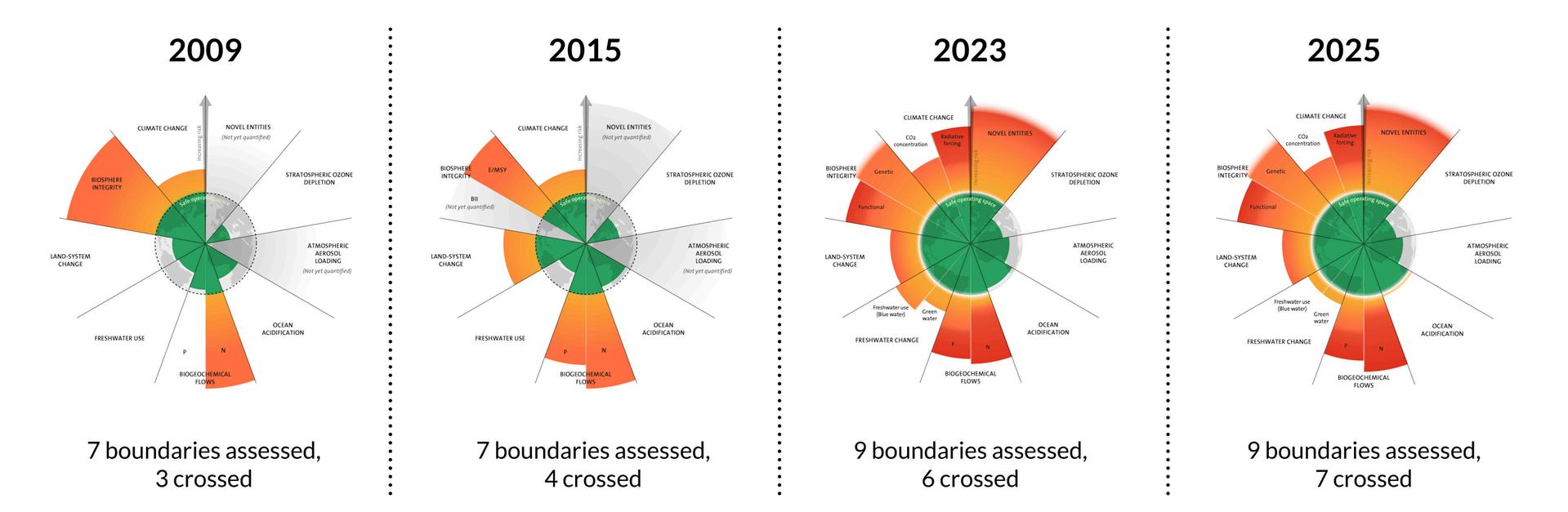
The Planetary Boundaries Framework, proposed by the Stockholm Resilience Centre, identifies nine biophysical limits within which humanity can safely operate. Crossing these boundaries increases the risk of irreversible environmental change
1.Climate change
2 Biosphere integrity (biodiversity loss)
3 Land-system change
4.Freshwater use
5.Biogeochemical flows (nitrogen & phosphorus cycles)
6.Ocean acidification
7 Atmospheric aerosol loading
8 Stratospheric ozone depletion
9.Introduction of novel entities (chemicals, plastics, micro-pollutants)
As of 2025, scientists report that seven of the nine boundaries have been transgressed, signalling that humanity is operating outside a safe operating space for Earth

As underscored by the Intergovernmental Panel on Climate Change (IPCC), one of the most authoritative sources, the science is clear:
“Human activities, principally through emissions of greenhouse gases, have unequivocally caused global warming, with global surface temperature reaching 1.1°C above 1850–1900 in 2011–2020. Global greenhouse gas emissions have continued to increase, with unequal historical and ongoing contributions arising from unsustainable energy use, land use and land-use change, lifestyles and patterns of consumption and production across regions, between and within countries, and among individuals ”
“Widespread and rapid changes in the atmosphere, ocean, cryosphere and biosphere have occurred. Human-caused climate change is already affecting many weather and climate extremes in every region across the globe This has led to widespread adverse impacts and related losses and damages to nature and people.”
“Climate change is a threat to human wellbeing and planetary health. There is a rapidly closing window of opportunity to secure a liveable and sustainable future for all ”
“Rapid and far-reaching transitions across all sectors and systems are necessary to achieve deep and sustained emissions reductions and secure a liveable and sustainable future for all These system transitions involve a significant upscaling of a wide portfolio of mitigation and adaptation options.”
The green transition is our collective response to the triple planetary crisis It refers to the structural transformation of economies, societies, and governance systems toward a sustainable, low-carbon, climate-resilient and resource-efficient model that safeguards both people and the planet It is not only about reducing greenhouse gas emissions or protecting biodiversity it is a systemic change in the way we produce, consume, live, co-exist and govern. The transition involves decarbonising energy and transport, improving resource and waste management, advancing circular economy models, promoting naturebased solutions, clean technology, green finance, and ensuring that no one is left behind in the process.
A just transition is a crucial component and guiding lens of the green shift It ensures that the benefits of the green transition are distributed equitably while minimising hardships for vulnerable populations, especially those directly affected by climate actions such as mitigation measures that transform industries or adaptation measures that reshape livelihoods and local economies (Typical example - when a country phases out coal to reduce emissions, a just transition ensures that affected workers are retrained, communities receive new investments and alternatives.
Globally, numerous international frameworks guide and enable this transformation; however, the Paris Agreement, the 2030 Agenda for Sustainable Development (SDGs), and the European Green Deal (EGD) remain the most influential in shaping the direction.