Alby Botkyrka Architect: Gustaf Lettström Year: 1968-1971 Location: Botkyrka municipality, Stockholm county Client: Contractor: Svenska Riksbyggen
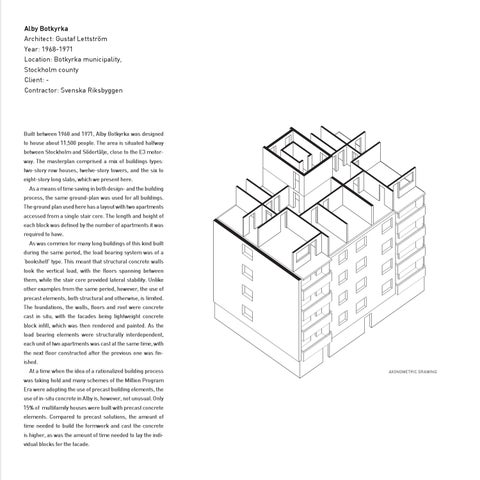
Built between 1968 and 1971, Alby Botkyrka was designed to house about 11,500 people. The area is situated halfway between Stockholm and Södertälje, close to the E3 motorway. The masterplan comprised a mix of buildings types: two-story row houses, twelve-story towers, and the six to eight-story long slabs, which we present here. As a means of time saving in both design- and the building process, the same ground-plan was used for all buildings. The ground plan used here has a layout with two apartments accessed from a single stair core. The length and height of each block was defined by the number of apartments it was required to have. As was common for many long buildings of this kind built during the same period, the load bearing system was of a ‘bookshelf’ type. This meant that structural concrete walls took the vertical load, with the floors spanning between them, while the stair core provided lateral stability. Unlike other examples from the same period, however, the use of precast elements, both structural and otherwise, is limited. The foundations, the walls, floors and roof were concrete cast in situ, with the facades being lightweight concrete block infill, which was then rendered and painted. As the load bearing elements were structurally interdependent, each unit of two apartments was cast at the same time, with the next floor constructed after the previous one was finished. At a time when the idea of a rationalized building process was taking hold and many schemes of the Million Program Era were adopting the use of precast building elements, the use of in-situ concrete in Alby is, however, not unusual. Only 15% of multifamily houses were built with precast concrete elements. Compared to precast solutions, the amount of time needed to build the formwork and cast the concrete is higher, as was the amount of time needed to lay the individual blocks for the facade.
Axonometric drawing