
Johnson City, TN November 2023
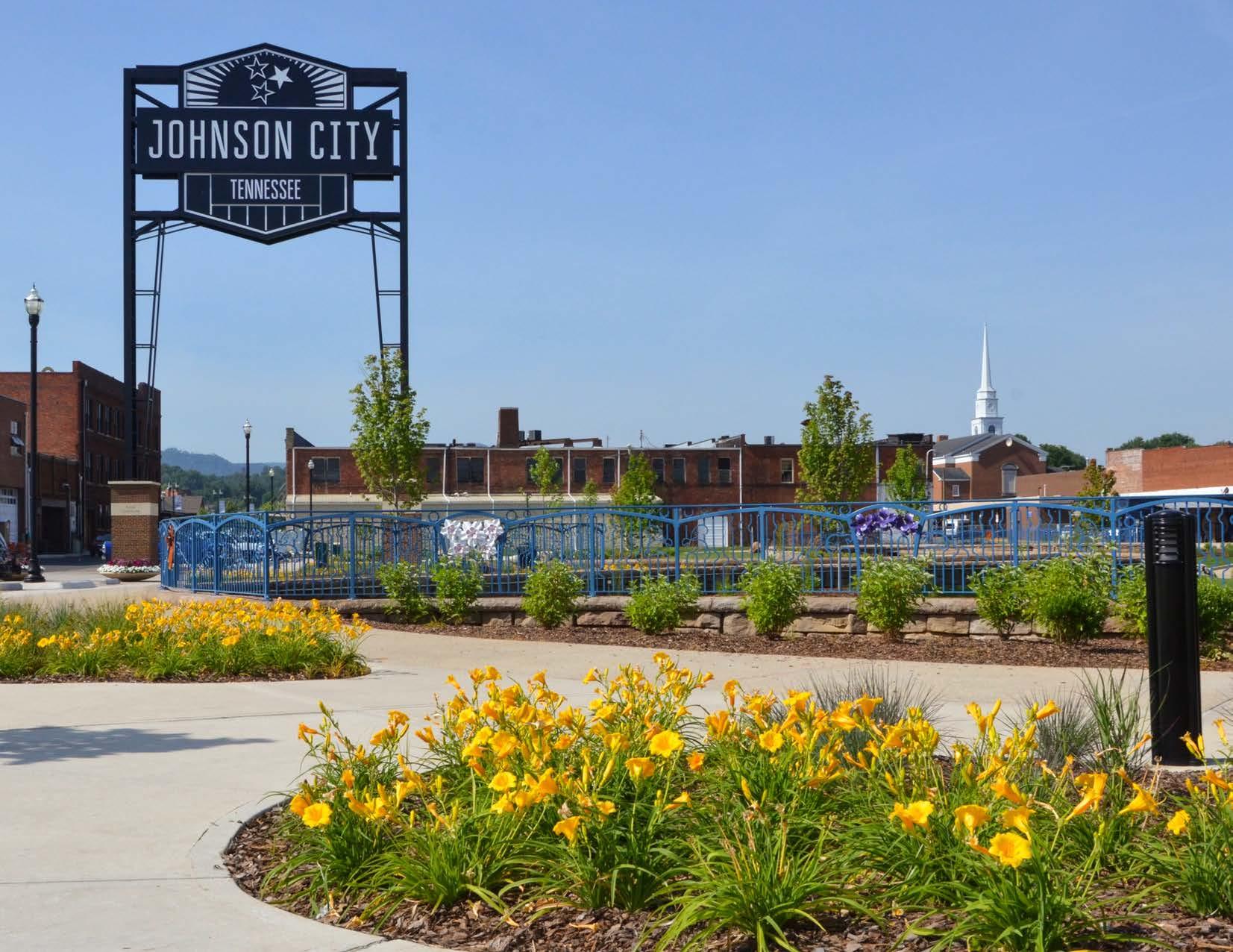
Johnson City’s Growth Management Plan will guide the City’s direction over the next quarter of a century, and so is named “Horizon 2045.” Exploring the possibilities before us, the Horizon 2045 plan will align a new land use strategy with broader community initiatives such as a healthy economy, fiscal responsibility, housing affordability, sense of place, and quality of life. The plan also will review, update, and consolidate previous planning efforts undertaken by the City. Development of this plan utilizes the vision of our community and the expertise of its stakeholders to help ensure that Johnson City grows in a way that is manageable and desirable for all.
Horizon 2045 is the City’s growth management plan, which is a process to:
• Explore how the City wants to grow
• Align that vision with the community’s goals for economic development, housing, quality of life, and more
• Develop the future land use strategy and policy framework
• Focus on implementation to guide the City’s near- and long-term decision-making and investment.
Horizon 2045 will be used as our framework over the next 20+ years to guide decision-making related to a variety of important topics, such as development, investments in infrastructure, zoning, and preservation of community character.
The key outcome of the plan will be the Future Land Use Map, which will guide future growth and development in Johnson City. A series of framework elements will be created to support the land use strategies. These framework elements will touch on topics like:
• Transportation and Mobility
• Economic Development
• Housing
• Infrastructure and Public Services
• Schools
• Recreation and Trails
• Natural Resources and Environmental
• Historic and Cultural Resources
Horizon 2045 will be used as a guide for City staff and elected officials to inform future land use decisions:
CITY STAFF. To align department policies, inform financial decisions, and incrementally decide how to fulfill the community’s vision.
CITY COMMISSION. To guide decisions about growth and development while allowing staff and elected officials evaluate the economic conditions and community preferences.
COMMISSIONS AND COMMITTEES. To promote the community’s vision and encourage consistency in decision making.
Horizon 2045 will be used by a variety of groups with different interests:
BUSINESSES. To understand where the City will focus growth and investment, and identify where concetrated development may occur.
RESIDENTS. To understand the future vision of growth, development, and sustainability.
COMMUNITY LEADERS. To continue working toward the common community goal.
REGIONAL PARTNERS. To streamline cross-jurisdictional recommendations and policy strategies.
During the development of this report various data sources were reviewed and collected, leading to various in methodology and estimates. Kimley-Horn has reviewed these sources to identfiy and provide the most reliable information available.
• Johnson City has seen 13.2% growth in the past decade, and the Study Area has grown 12.3% in the same time period
• Over the next 20 years, the Study Area could add more than 13,000 to 24,000 new residents
• More than 56% of land area (nearly 69,000 acres) in the Study Area is for singlefamily residential use
• Another 25% is used for agricultural purposes
TRANSPORTATION
• The City maintains:
• 9 miles of bikeways
• 319 miles of sidewalks
• 20 miles of trails
• 3 roadways within the study carry more than 30,000 vehicles per day (vpd), including I-26, State of Franklin, and West Market Street
• The Study Area population has grown faster (13.2%) in the past decade than the housing supply (8.8%)
• 48.0% of homes in the Study Area are owner-occupied and 43.2% are renteroccupied; 8.8% are vacant
• The Study Area is home to 2 libraries, 33 community centers, and 23 historic places
• The City-maintained water system includes 2 treatment plants and 951 miles of waterlines
• The City-maintained sewer system includes 3 treatment plants and roughly 762 miles of sewer line
• The Johnson City School District is home to 13 schools and more than 7,500 students
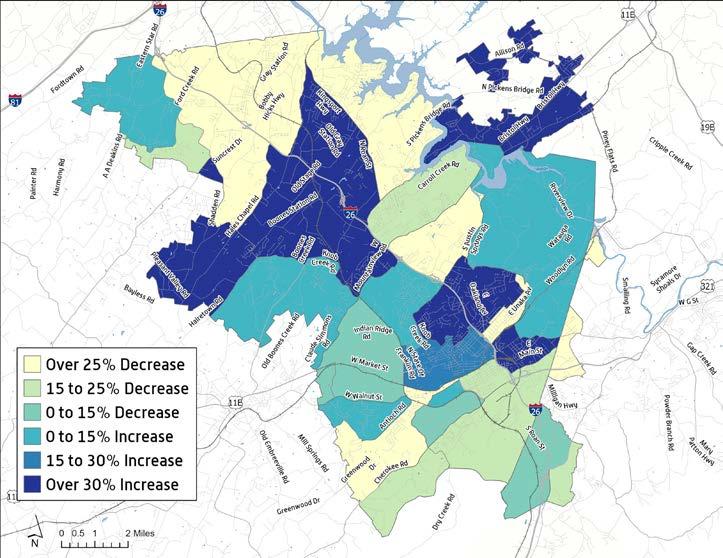
• Multiple census tracts in the Study Area saw more than a 30% increase in school enrollment between 2015 and 2021
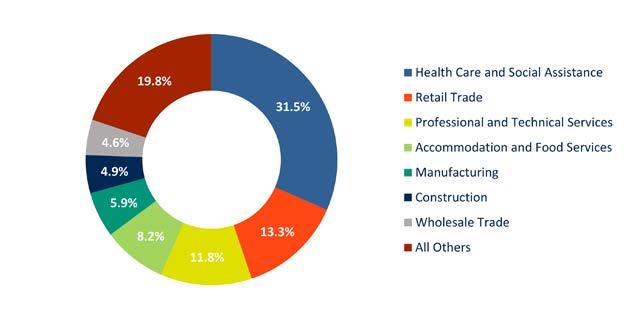
• 31.5% of Study Area workers are employed in the healthcare and social assistance industry
• 5,000 jobs were added in the Johnson City MSA post-pandemic
• The Study Area accounts for more than 70% of the available jobs in the MSA
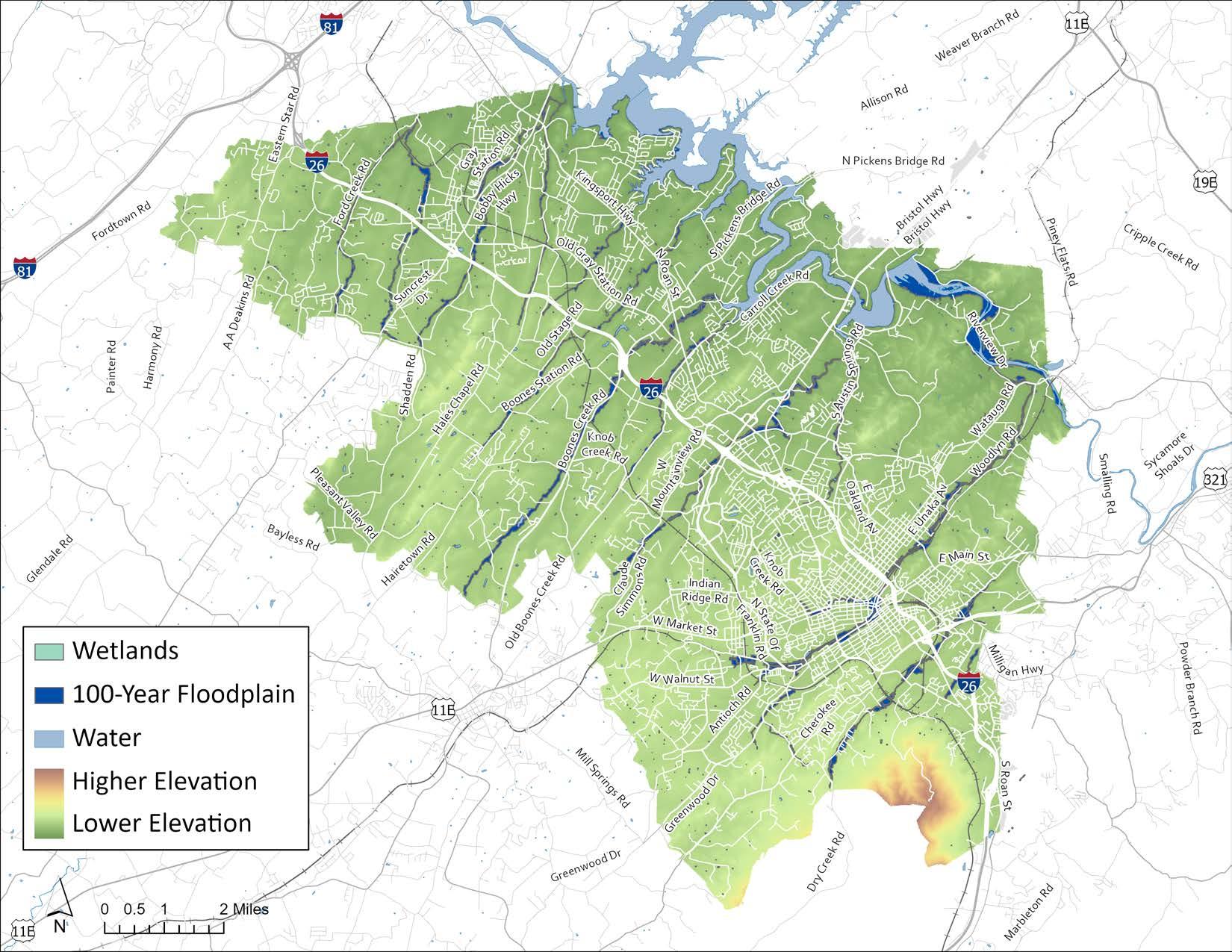
• The Study Area has relatively low elevation compared to the surrounding region
• Floodplains are located throughout the corridor, including in the areas surrounding Boone Lake
Creating a growth management plan takes time. A well-planned document can only be achieved through a deliberate and organized process that balances data and community input to create a plan made for the people it represents. This process is expected to last 16 months and progress through three the three phases shown in the graphic below.
Johnson City is located in eastern Tennessee, and is part of the Johnson City Metropolitan Statistical Area (MSA). The Johnson City MSA includes three counties—Washington, Carter, and Unicoi. Johnson City is mainly located in Washington County, but is also partially within Carter and Sullivan Counties. The City was founded in 1856 as a railroad station called “Johnson’s Depot,” and became a major throughway for visitors and rail commerce.1
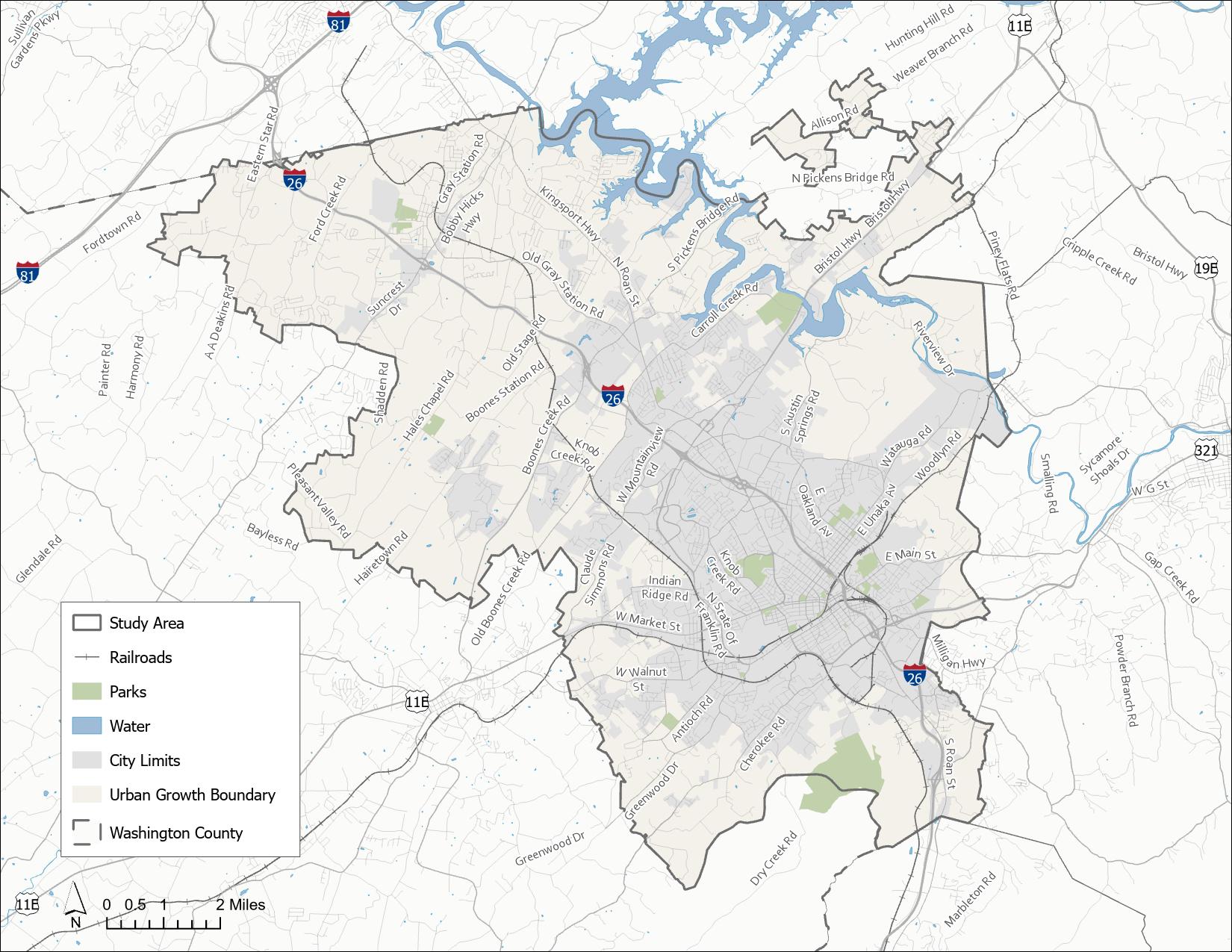
Horizon 2045 focuses not just within the City limits, but extends beyond to incorporate an area called the Urban Growth Boundary. Urban growth boundaries were introduced in the state to help manage city growth. Using the Urban Growth Boundary as our Study Area allows the planning process to incorporate City services that extend beyond City limits, such as water and sewer and solid waste removal. It gives a more comprehensive picture of the areas that influence—and are influenced by—Johnson City.
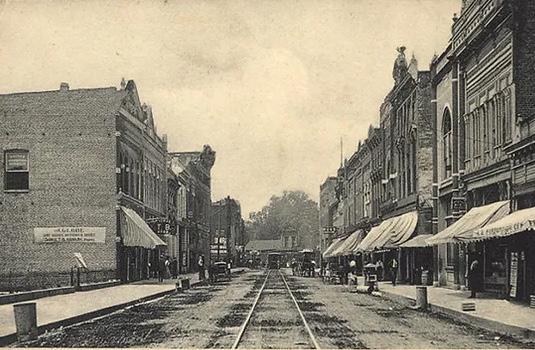

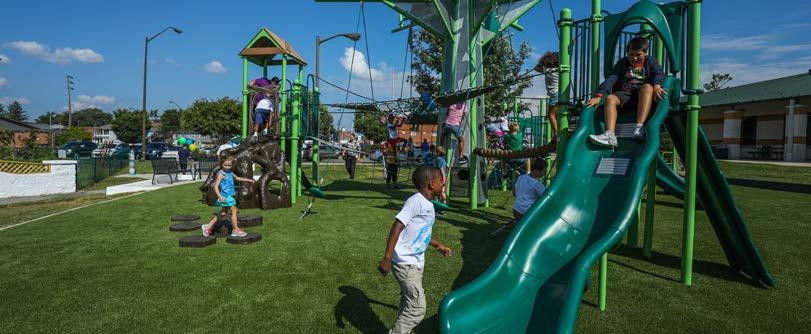
USING THE URBAN GROWTH BOUNDARY AS OUR STUDY AREA ALLOWS THE PLANNING PROCESS TO INCORPORATE CITY SERVICES THAT EXTEND BEYOND CITY LIMITS, SUCH AS WATER AND SEWER AND SOLID WASTE REMOVAL. IT GIVES A MORE COMPREHENSIVE PICTURE OF THE AREAS THAT INFLUENCE—AND ARE INFLUENCED BY— JOHNSON CITY.
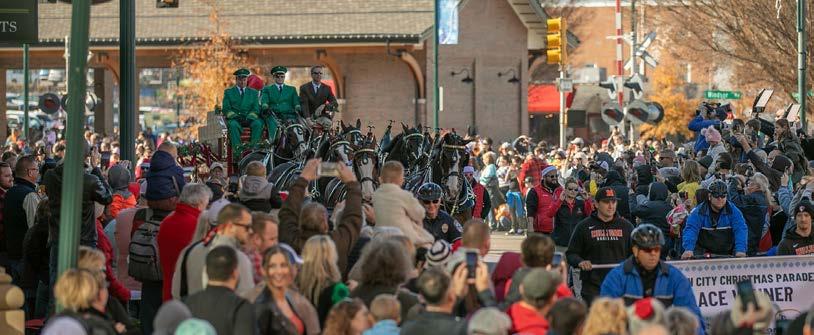
The recommendations and strategies identified in previous planning efforts can be used as the initial building blocks to create a holistic land use strategy for Johnson City. The following section provides an overview of the relevant previous planning documents. Kimley-Horn acknowledges that there are several plans that are currently being completed in the city, including new master plans for schools and parks and recreation. Key fndings from these plans will be incoporated into Horizon 2045 as the process prgresses.
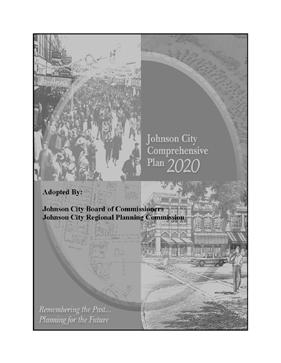
Adopted by the Board of Commissions and the Regional Planning Commission in 2000, the Comprehensive Plan contains a vision, goals, and policies for the City. The Comprehensive Plan provides guidance on land use, transportation, housing, economic development, education, parks and recreation, and utilities through a forecast year of 2020.
Key Takeaways
• Focus on creating a strong and diversified economy
• Maintain a first-class education system through maintenance of schools and redistricting to prevent overcrowding
• Implement a varied regional transportation system
• Revitalize historic Downtown
• Create safe and people-oriented neighborhoods
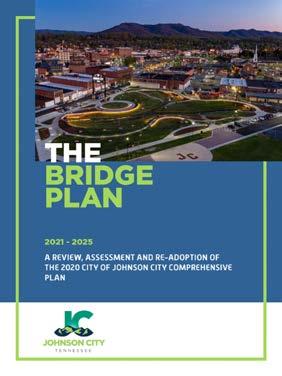
THE BRIDGE PLAN 2021-2025
• Protect the natural and built environment
• Acquire land to develop parks and recreation facilities
• Support the development of a variety of housing types
• Provide high-quality public services with fiscal and technological efficiecy
• Develop a regional transportation system focused on efficiency, accessibility, and connectivity
The Bridge Plan is a review, assessment, and re-adoption of the 2020 City of Johnson City Comprehensive Plan. It was led by the Regional Planning Commission. The plan creates a 5-year extension of the Comprehensive Plan and focuses specifically on the Recommendations section of the original 2020 Comprehensive Plan. Some key modifications to the Recommendations are included below.
Key Modifications
• Urban Growth and Services Element—Introduce “Urban Neighborhood” zoning to promote infill
• Transportation Element—Provide greater accommodations for multimodal transportation
• Economic Development Element—Direct resouces to support local businesses and support tourism
• Housing Element—Clarify housing types in zoning that cause confusion
• Community Facilities Element—Increase coordination between City and JC Public Schools
• Downtown Revitalization Element—Improve pedestrian access to parking structures
• Historic Preservation Element—Encourage public awareness of preservation through social media and events
The Preliminary Housing Needs Assessment was developed in 2022 by the City (in partnership with a consultant) to understand the current market conditions and projected changes that will influence future housing needs. The report provides an overview of presentday housing conditions and outlines demographic, employment, and housing projections to help the City establish housing priorities.
• Promote an adequate and varied housing supply to meet the needs of existing and future residents, regardless of age, race, gender, special needs, and economic status
• Based on average lot size, the City needs roughly 520 acres of residentially zoned land by 2027 to keep up with demand
• Continue incentives to encourage developers to build dwellings for low- to moderate-income families
• Gear the rental market toward meeting the needs of the population who cannot or do not want to own a house
• Recommend the zoning ordinance be regularly evaluated to enensure an adequate amount of land is zoned properly to allow independent/assisted/nursing home living facilities within the City
• Reduce building fees for developments constructed for lowincome families
• Take the lead in encouraging “green” design and construction
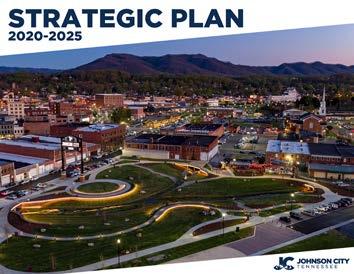
City staff, in partnership with the City Commission, developed the Strategic Plan in 2020. The Strategic Plan relies on input from citizens, businesses, and strategic partners to determine what is most important to the community’s future. Four focus areas were considered, including economic vitality, quality of place, future-ready infrastructure, and excellence in city government.
• Support existing businesses and increase talent retention efforts
• Recruit and attract new businesses with focus on remote workers
• Cultivate a local entrepreneurial ecosystem and prepare our workforce for 21st Century jobs
• Encourage economic development in traditionally underserved areas
• Maintain a resilient economy during challenging times
• Support local businesses through local policies, procedures, and ordinances
• Market the area to outside interests by working with regional partners
• Focus strategies on sectors and populations hardest hit by economic downturns
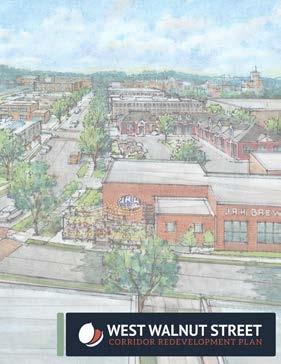
The WWSCRP studies the area bound by State of Franklin to the north, Buffalo Street to the east, University Parkway to the west, and Lynn Street to the south. The West Walnut Street area is near the City’s Downtown and two of the region’s largest employers (ETSU and Mountain Home VA Hospital). This streetscape master plan and corridor study creates a vision for the next 20-30 years.
Key Takeaways
• Major considerations of the plan include access to and from the corridor, stormwater management, utilities, transition to the Tree Streets, and parking shortages
• Orient structures to the street or open space
• Locate public parking along the corridor (strategic public parking areas)
• Establish more greenspace throughout West Walnut Street
• Create a stormwater solution that provides an area to capture unmitigated runoff from western properites and Tree Streets
• Provide a mixture of uses
• Create a bike and pedestrian friendly corridor
• Improve portions of Lynn Street
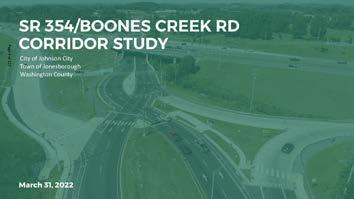
The Boones Creek Corridor Study considers future transportation and land use along Boones Creek Road (SR 354) from North Roan Street (SR 36) to Jackson Highway (SR 34/US 11E). In partnership with a consultant, the City worked with neighboring jurisdictions—including the Town of Jonesborough and Washington County—to complete the corridor study.
Key Takeaways
• Create safe traveling conditions for all modes of transportation
• Support reliable travel and a cohesive user experience
• Preserve natural and aesthetic beauty while accommodating ongoing growth and development
• Focus corridor development where there is existing or planned infrastructure present (e.g., water and sewer service, etc.)
The Fire Station Deployment Study is a 2022 update of the 2018 study and includes an overview of the Johnson City Fire Rescue service area, the current conditions of the Department’s stations, and a projection of the additional fire stations that will be needed to maintain and expand service in the future.
Key Takeaways
• Currently, several areas fall outside the recommended 1.5mile primary coverage area of an engine company
• The study documents the need for three additional fire stations, located in the northwestern portion of the service area
• One of the proposed fire stations is in an area with a railroad track boundary and a single-lane tunnel
• Additional recommendations include adopting a response time standard and adopting the most current fire code
The Public Facilities and Services Plan was developed as part of the 2020 Comprehensive Plan and was approved by the Regional Planning Commission in 2002. It identifies existing and proposed locations and types of water and sewer utiltiies, cultural facilities, libraries, police stations, and other related facilities needed to maintain and grow well as a city.
• Continue maintaining and providing new facilities and services to meet the community’s needs and interests
• Plan and provide public facilities and services cost effectively, consistently with current development, and in anticipation of potential community issues
• Encourage regional cooperation and full use of the existing and available systems
• Safeguard nature
• Provide high-quality water supply and wastewater treatment
• Maintain and replace water and sewer lines, as needed
• Ensure adequate distribution and provide safety and accessibility to all facilities and services
• Provide fully accessible public facilities to all residents and visitors
The Johnson City MTPO 2050 MTP is a federally-required planning document the MTPO completed as part of the federal government’s request for a new MTP every five years. The 2050 MTP outlines the region’s transportation investments over the next 25 years and the region’s vision for transportation. It outlines key transportation needs and establishes goals, objectives, and performance measures.
• Meet and exceed the ten federal planning factors outlined in the Fixing America’s Surve Transportation (FAST) Act
• Meet and exceed the Tennessee Department of Transportation (TDOT) goals and objectives from the 25-Year Long Range Transportation Plan (LRTP)
• Improve safety and security throughout the MTPO area transportation system
• Mitigate traffic congestion along major routes in the MTPO area
• Promote economic growth and livability by enhancing the MTPO area transportation system
• Enhance regional access to and from the MTPO area
Demographic trends show the makeup of the current Study Area population and serve as an indicator of future growth projections. Horizon 2045 must be responsive to future growth in the land use strategy to support the community’s growth for Johnson City. This section analyzes existing demographic conditions in the Study Area, estimates future ones, and compares the City of Johnson City to the Study Area and the Johnson City Metropolitan Statistical Area (MSA).
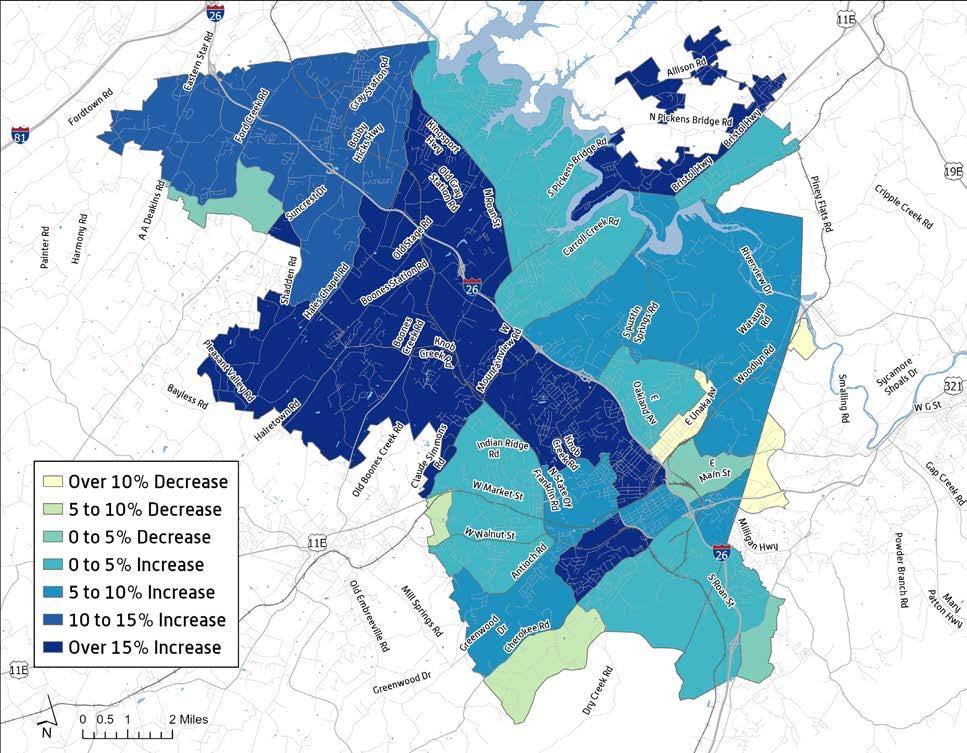
Population in Johnson City has increased by 13.2% since 2010. Growth in the MSA has primarily been concentrated in Washington County, with Carter and Unicoi experiencing slight declines. This results in a comparably slower growth rate for the MSA.
GROWTH (2010-2023) TOTAL POPULATION (2023)
Source: ESRI Business Analyst Online; Kimley-Horn
72,918 100,865
JOHNSON CITY STUDY AREA MSA
209,536
Population Growth, 2010–2023
Source: ESRI Business Analyst Online; Kimley-Horn
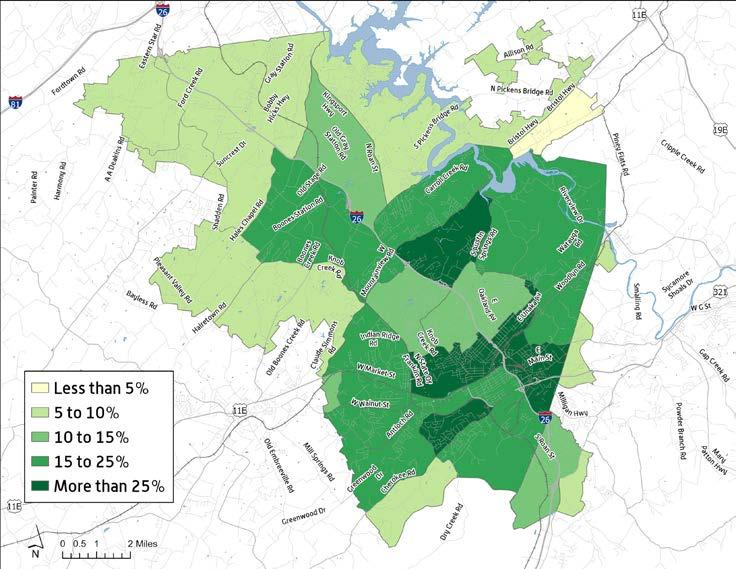
Johnson City is home to a richness of cultures and communities. In the Study Area, more than 17% of residents belong to a minority racial population, compared to 12.5% in the MSA. The United States Census defines race separately from ethnicity. Race is a person’s self-identification with one or more social groups. Ethnicity determines whether a person is of Hispanic origin or not. Race and ethnicity are independent of each other. Both Hispanics and non-Hispanics may report as any race of combination of races. Approximately 6% of the Study Area population identifies as Hispanic. 6% OF
Population by Race (2023)

Source: ESRI Business Analyst Online
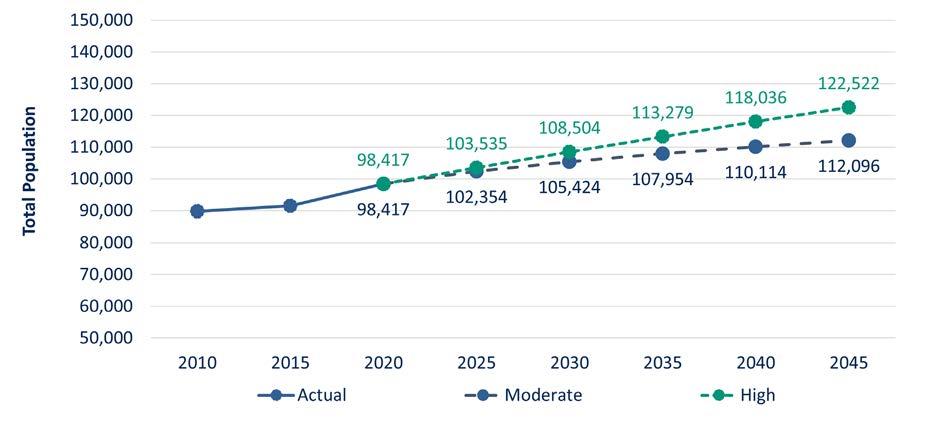
Johnson City is one of the fastest growing municipalities in the region. The Study Area accounts for more than 48% of the population in the MSA and over 74% of the population in Washington County. Over the next 20 years, the Study Area is moderately projected to add roughly 13,600 residents. In the higher growth projection, over 24,100 new residents are estimated.
THE STUDY AREA ACCOUNTS FOR MORE THAN 74% OF THE TOTAL POPULATION IN WASHINGTON COUNTY
Minority Population by Census Tracts (2023)
Source: ESRI Business Analyst Online; Kimley-Horn
Source: Woods and Poole, OSBM, US Census, Kimley-Horn
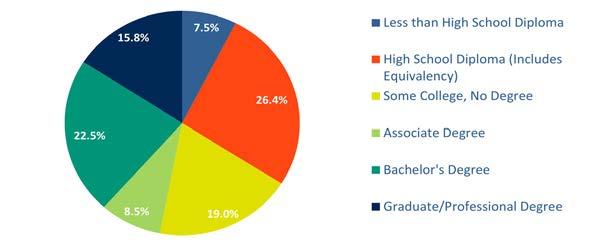
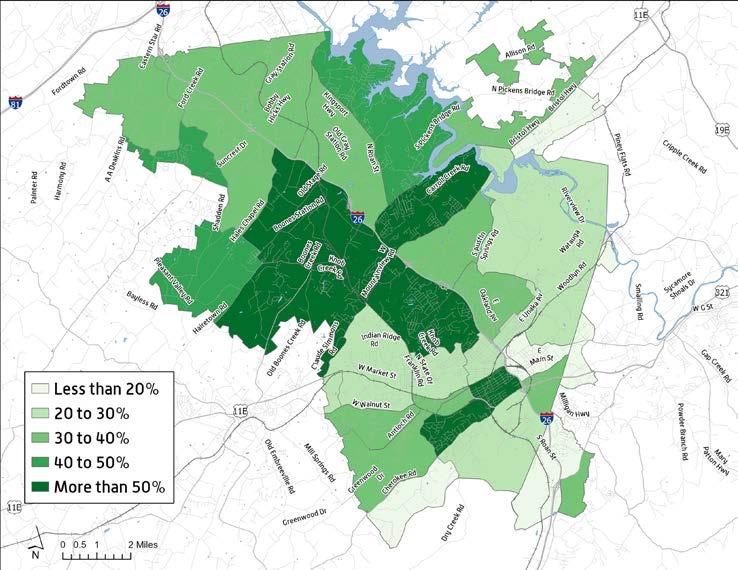
Nearly half (46.8%) of the Study Area population has an Associate Degree or higher. A variety of job types in Johnson City are needed to support the range of education levels and skill sets held by the location population.
Source: ESRI Business Analyst Online
Source: ESRI Business Analyst Online; Kimley-Horn
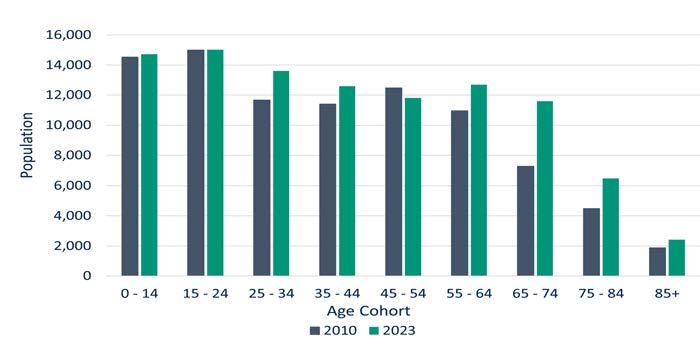
The median age in the Study Area is estimated at 40.4 years, compared to 43.3 for the Johnson City MSA. The Study Area’s older population is growing faster than other age cohorts. Approximately 32.9% of Study Area residents are 55 years or older. The higher proportion of elderly residents is important. Many seniors desire alternate housing options, such as more affordable single-family homes or retirement communities. The largest age cohort group in the the Study Area is residents under the age of 25, representing almost 30% of the population. The needs of a young population to thrive in a city include but are not limited to; access to world-class education facilities, employment prospects, housing options, and spaces for recreation, socializing, and entertainment.
Population by Age Group, 2010-2023
Source: ESRI Business Analyst Online; Kimley-Horn
Source: ESRI Business Analyst Online; Kimley-Horn
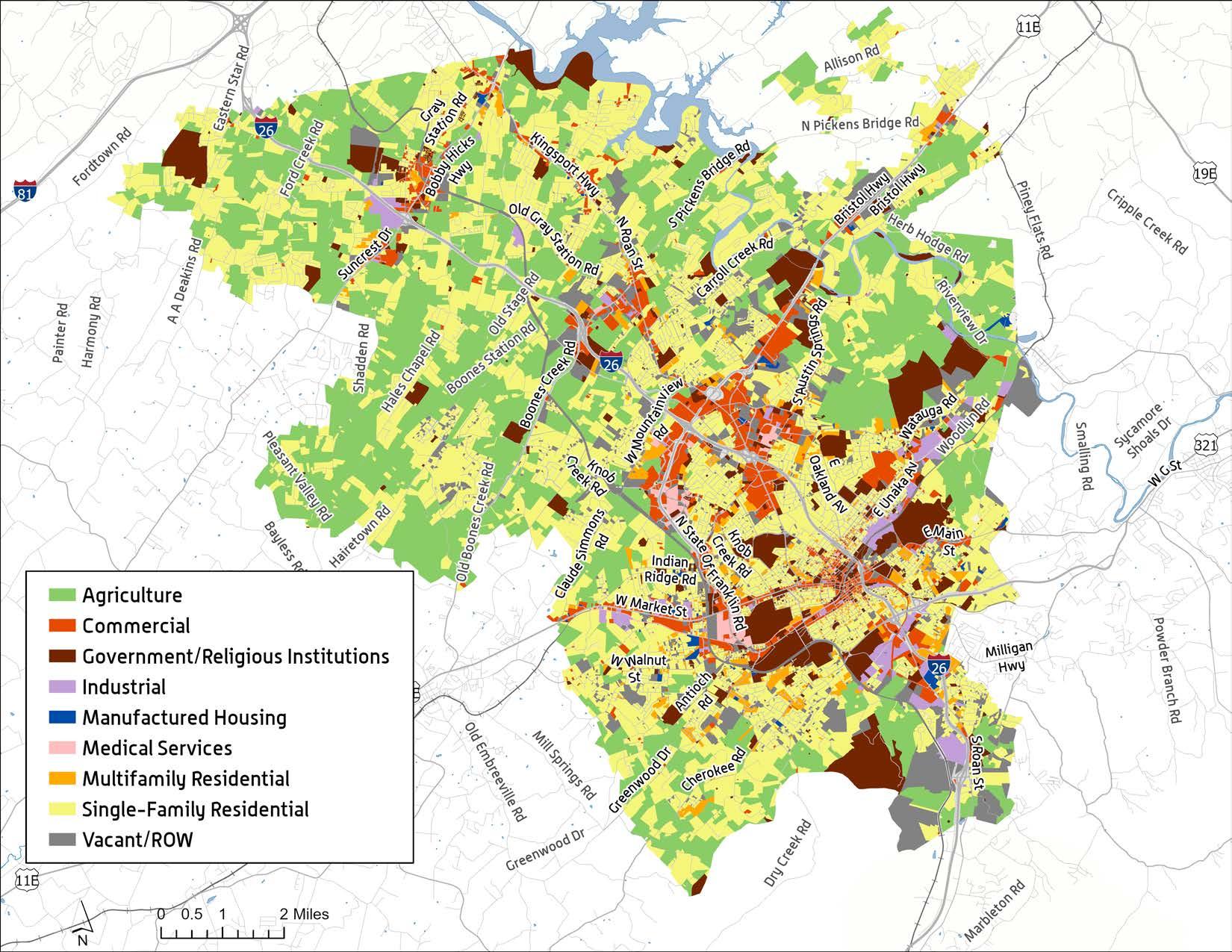
Existing land use paints a picture of the intended purpose of different areas in Johnson City today. Understanding how land is currently used gives us an opportunity to evaluate how these uses support the City’s goals and identify gaps and trends that can be addressed through a revised land use vision and supportive policies.
The Existing Land Use Map on the facing page shows land use in Johnson City today based on the categories below. These use categories are based on surveys conducted for property valuation.
AGRICULTURE | 24.7% | 30,076 acres
Includes all areas used for agricultural purposes, including working farms, grazing land, and forestry.
INDUSTRIAL | 1.0% | 1,163 acres
Land used for manufacturing, warehousing, or transportation and logistics.
COMMERCIAL | 2.6% | 3,185 acres
Land used for retail or wholesale uses, personal services, hotels, restaurants, offices, and other uses.
GOVERNMENTAL\RELIGIOUS INSTITUTIONS | 8.4% | 10,204 acres
Includes government buildings, parks, utilities, schools (public/private), places of worship, and cemeteries. State-owned properties are also included.
HOUSING | 0.2% | 246 acres
Areas occupied by mobile homes, modular homes, or other types of manufactured housing.
MEDICAL SERVICES | 0.3% | 358 acres
Includes areas owned and operated by hospitals, doctor’s offices, nursing facilities, and clinics.
MULTIFAMILY RESIDENTIAL | 1.5% | 1,858 acres
Includes apartments, condominiums, townhomes, and duplexes but do not include manufactured housing.
SINGLE-FAMILY RESIDENTIAL | 56.6% | 68,995 acres
Land occupied by single-residence homes located one per lot.
VACANT/ROW | 4.9% | 5,921 acres
Vacant areas with minimal development, and the right-of-way for roads, railroads, utility easements, and other land occupied by public/private utilities.

Another way to look at the use of land is through its development status, which shows locations that could theoretically be ready for new development. A quantitative analysis of development status was conducted at the parcel level. Each parcel was assigned a status based on assessed values of the buildings, land, and improvement opportunities, as well as on the size of the parcels. The table below provides more detail on the categories and shows the breakdown of the Study Area by acreage and percent of each category. The map at right shows the results of this exercise.
Though the north, western, and eastern areas of the Study Area do have greater land availability, the map shows that undeveloped areas are dispersed throughout the City, meaning there is no single concentration of available land. It is important to note that growth can and will occur in locations identified as Developed. As market conditions change, transportation networks evolve, and neighborhoods shift, redevelopment will occur. This map provides a snapshot based on the most recent data.

How people and goods move throughout Johnson City is a critical part of everyday life. Informed planning considers how land use and the transportation system influence each other. Horizon 2045 takes into account the unique circumstances in Johnson City—in other words, our approach is context-sensitive. The following section explores the existing mobility network, considering vehicular, bicycle, and pedestrian modes of transportation.
Average annual daily traffic (AADT) reflects the average number of vehicles on a roadway each day. Ideally, traffic volumes correspond with the function and design of the roadway. For example, freeways or expressways serve long-distance travel and correspond with higher traffic volumes. By comparison, local neighborhood streets serve short-distance travel and correspond with lower traffic volumes. The AADT helps identify areas and corridors where demand in high. In 2023, several corridors in the Study Area carry more than 15,000 vehicles per day (vpd), including Bristol Highway and I-26.
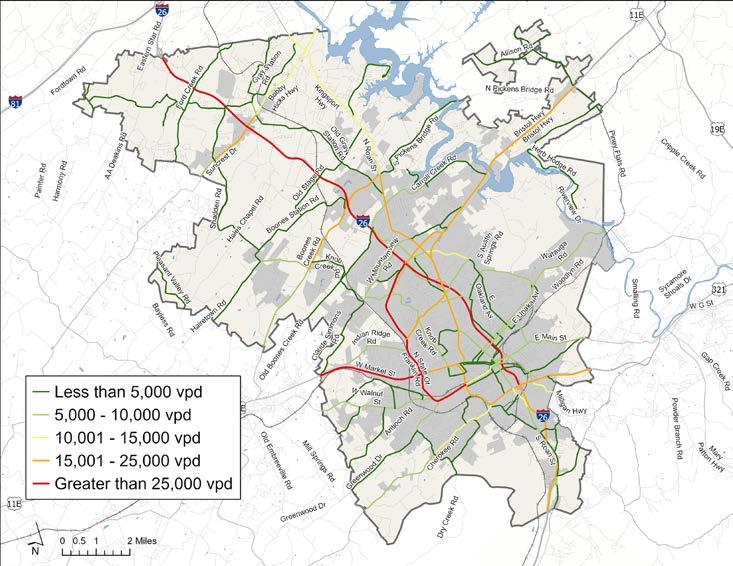
Source: TDOT Traffic Volumes, 2023
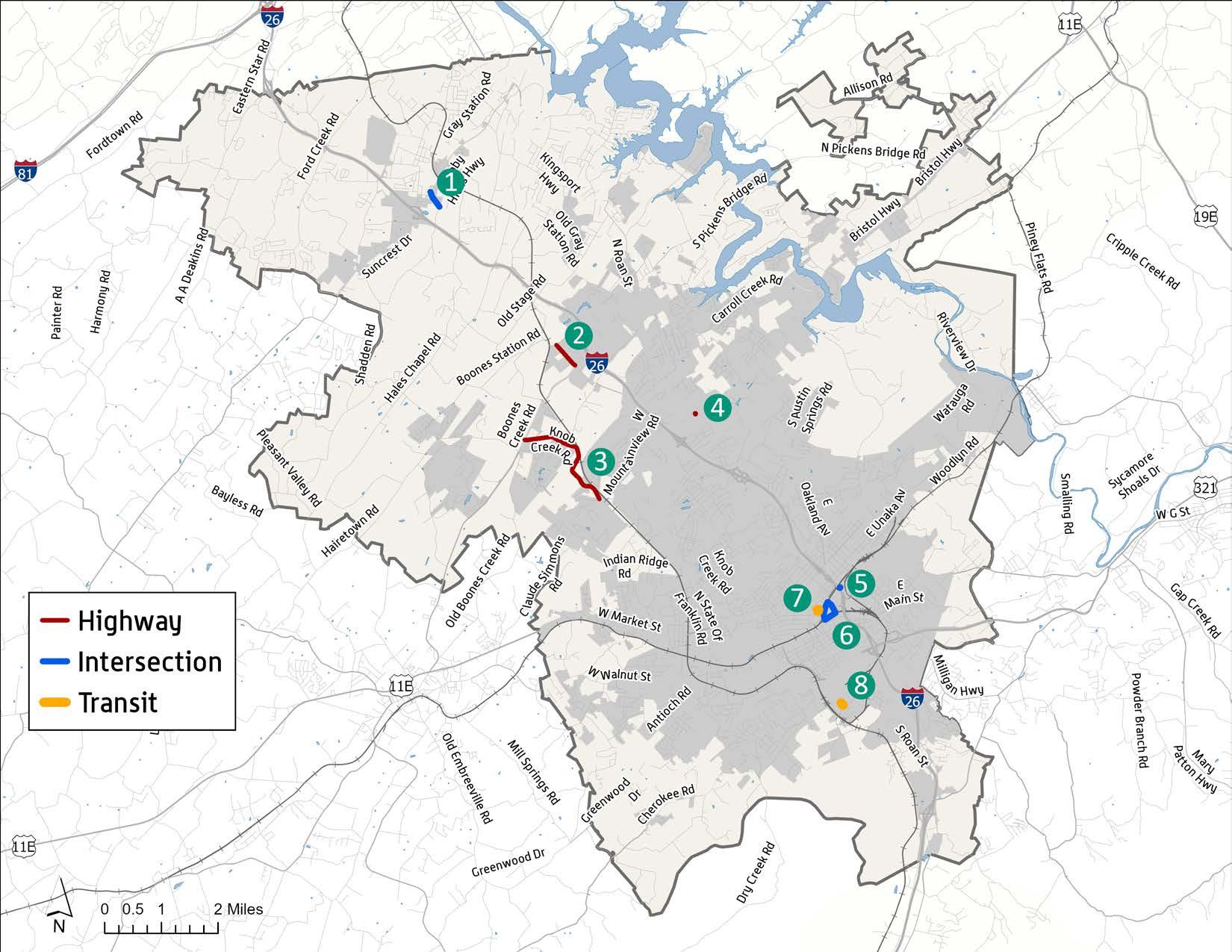
The Johnson City Metropolitan Transportation Planning Organization (JCMTPO) 2023–2026 identifies state-funded projects throughout the JCMTPO’s planning area. The JCGMP Study Area has several funded projects, including roadway improvements, widening projects, intersection redesigns, new traffic signals, and crosswalk improvements. The map to the right shows where these projects are located, and the table below provides more detail about each project.
2023-14; 2023-15
2023-01; 202302; 2023-03; 2023-04; 202305; 2023-06
2023-07; 202308; 2023-09
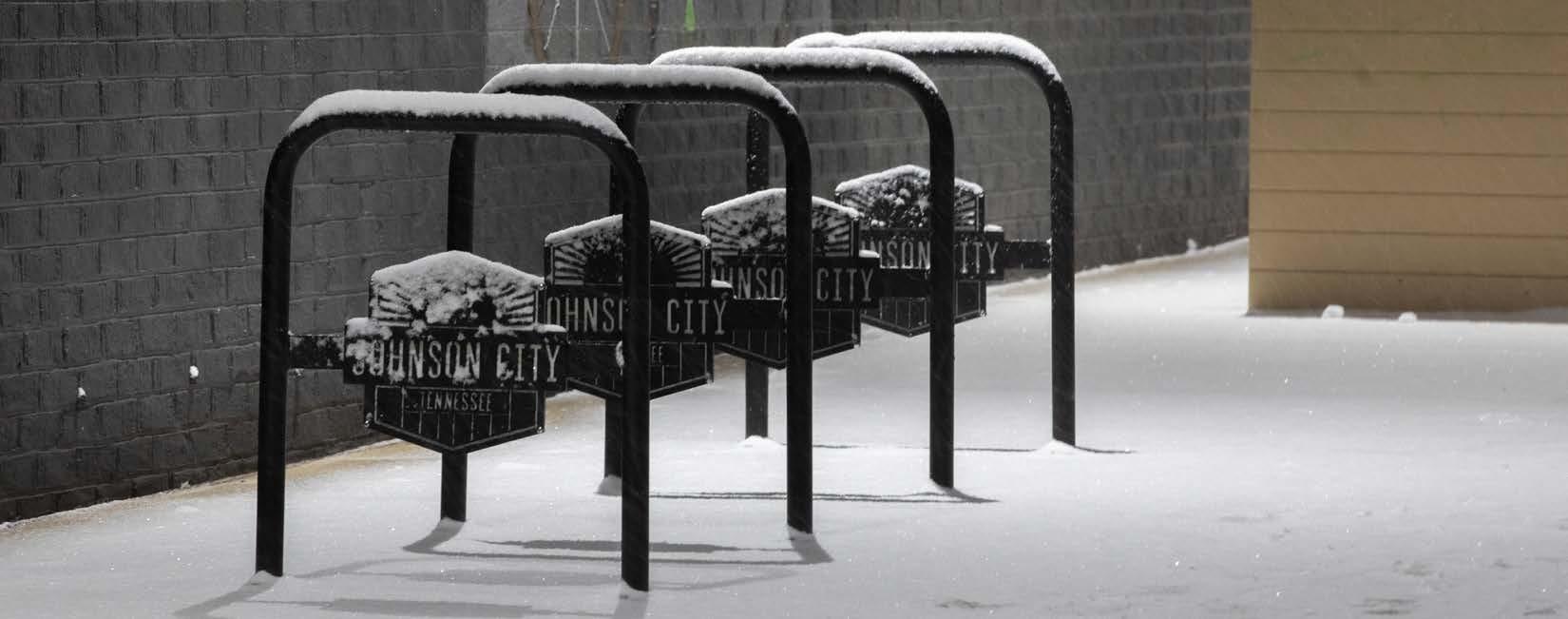
JOHNSON CITY MAINTAINS ROUGHLY 20 MILES OF HIKING AND WALKING TRAILS. THIS IS IN KEEPING WITH THE PARKS AND RECREATION DEPARTMENT’S MISSION TO “INSPIRE HEALTHY AND ACTIVE LIFESTYLES AND CREATE RECREATIONAL OPPORTUNITIES FILLED WITH PEOPLE, PARKS, AND PROGRAMS. 2
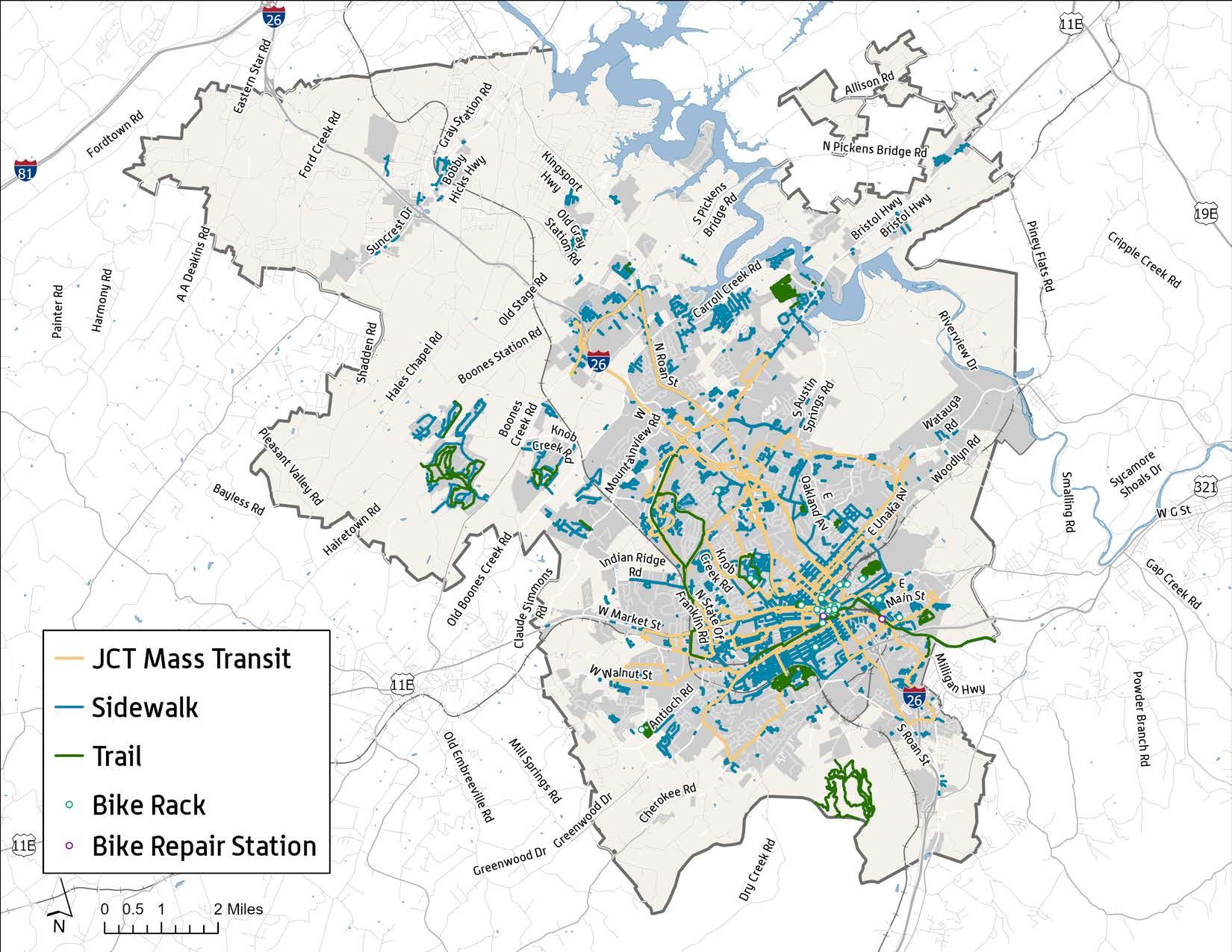
Truly comprehensive transportation networks are multimodal in design, supporting active modes, such as walking and biking, and complimented by a public transportation, or transit, system. The map below shows the existing and planned active transportation and transit facilitates in the area. Having a connective active transportation system that is supported by nearby transit routes and stops encourages additional access to jobs, schools, healthcare, and places of recreation for Johnson City residents and visitors. Horizon 2045 will ensure the alignment of both the physical infrastructure and strategic policy that’s needed to support a multimodal network that’s safe and accessible for all users in the City.
9
319
20
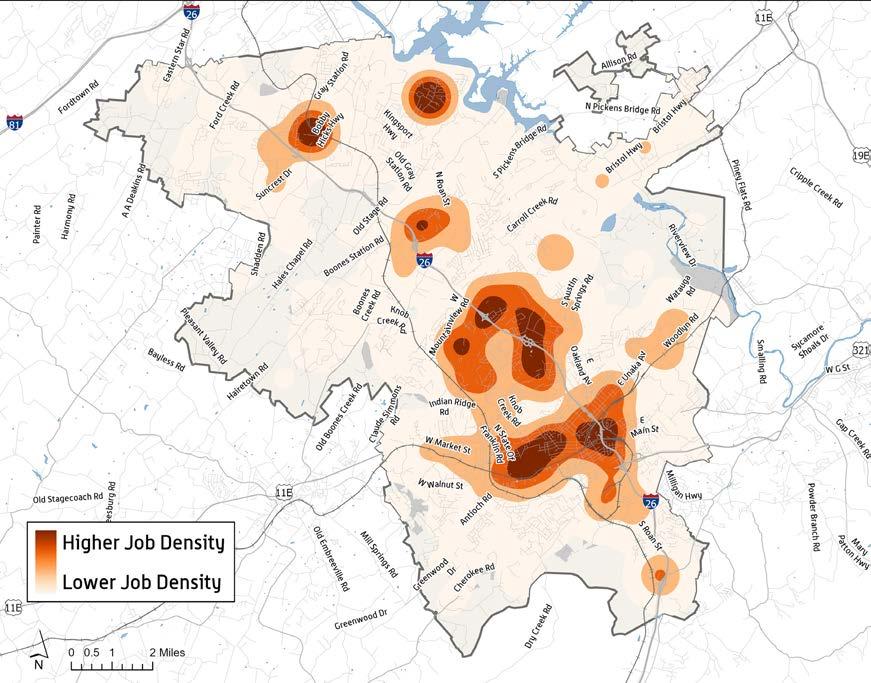
Johnson City contains numerous economic nodes for commerce and employment. Understanding the City’s economic engine helps track and plan investments to drive economic growth where it makes sense. Not all economic activities are appropriate in every area, so being intentional about these activities will help Johnson City meet the needs of all residents.
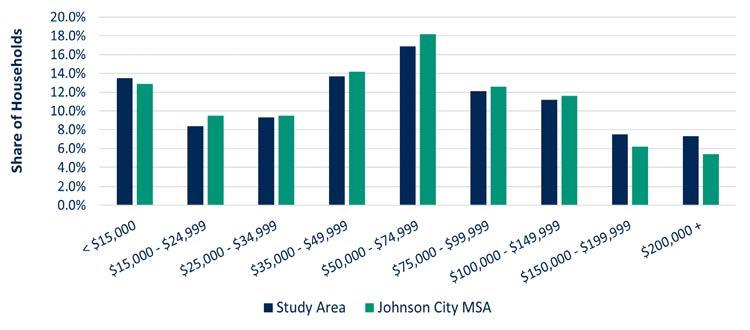
The median household income in Johnson City is roughly comparable to the Study Area and the larger MSA. While households earning between $50,000 and $74,999 annually make up the largest share in both areas, it is important to note that 31.2% of households in the Study Area earn less than $35,000.
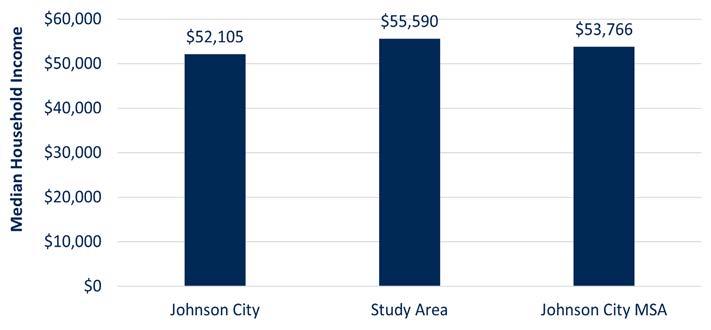
Median household income in the Study Area is expected to grow nearly 16% over the next 5 years, compared to 15% growth in Johnson City. Income growth is only expected to hit 14.4% in the MSA.
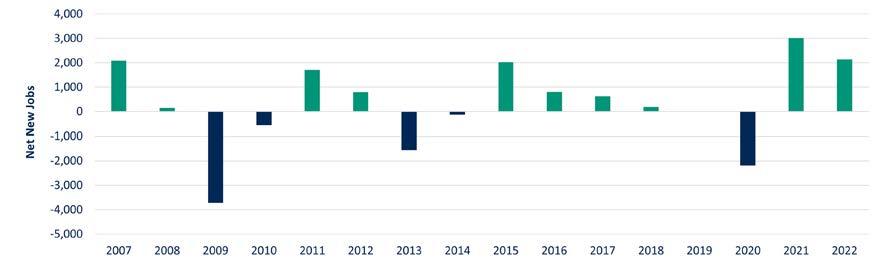
Johnson City is part of a dynamic region that is working to bring new jobs and support existing industry. Following the 2007-2009 Great Recession, the region added an average of 550 jobs per year. Consistent with national trends, the region was impacted by the onset of the COVID-19 pandemic, but experienced rapid recovery in 2021 and 2022, adding more than 5,000 new jobs back into the local economy.
Employment by Sector (2023)
Source: ESRI Business Analyst Online
Source: Jobs4TN.gov
UNEMPLOYMENT
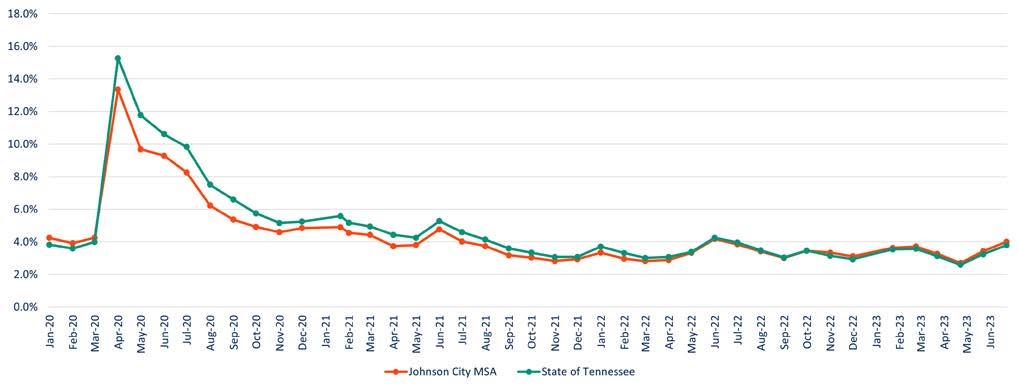
Over the past few years, unemployment in the Johnson City MSA, which includes Johnson City and all of our Study Area, has remained fairly constant— apart from a sharp rise in unemployment due to the COVID-19 pandemic. The MSA trends match the State unemployment trends closely.
5,000
NEW JOBS ADDED POST-PANDEMIC
Source: Jobs4TN.gov
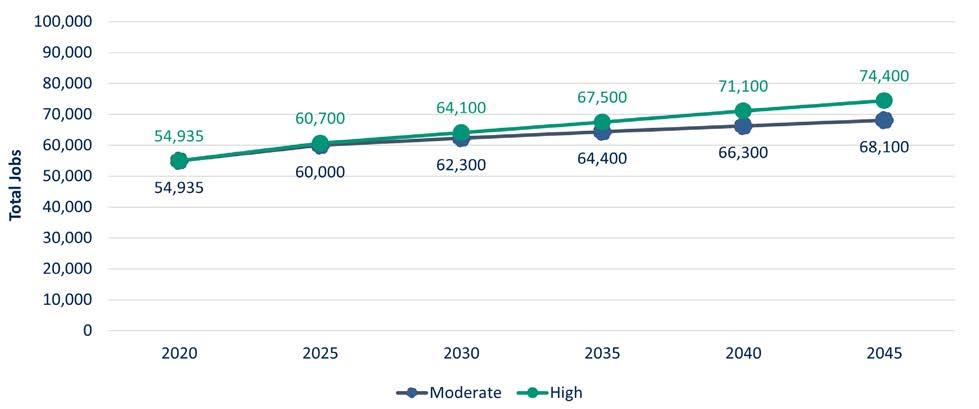
The Study Area accounts for more than 70% of the full-time jobs in the MSA. Over the next 20 years, the Study Area is moderately projected to add roughly 10,000 jobs. In the higher growth projection, 20,000 new jobs are estimated.
Combined, the healhcare and education sectors employ nearly 10,000 people in Washington County. According to Washington County, the major employers (healthcare, education, and otherwise) in the County include:
• Ballad Health
• East Tennessee State University
• Citi Commerce Solution
• American Water Heater Company
• James H. Quillen VA Medical Center
• Washington County School System
• City of Johnson City
• Johnson City School System
• AT&T Mobility
Source: Johnson City Chamber of Commerce

Source: LEHD On The Map
Analyzing the housing supply and market conditions in Johnson City helps align policy and future land use decisions future housing needs. This snapshot of housing in the Study Area shows data from a variety of sources, including the US Census American Commuinty Survey 5-Year Estimates and Washington County.
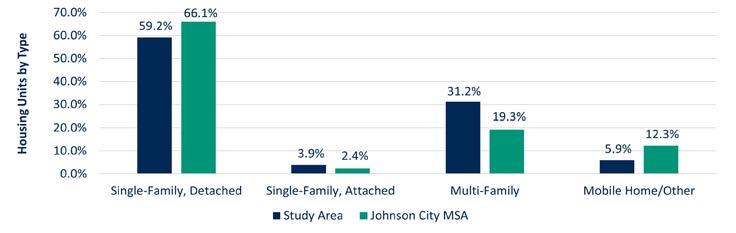
The Study Area’s housing is mostly single-family, detatched homes, comprising nearly 60% of all units. Multifamily comprises more than 30% of units in the Study Area.
Source: US Census; Kimley-Horn
The number of housing units in the Study Area has increased at a faster rate (8.8%) when compared to Johnson City or the larger MSA.
Source: US Census; Kimley-Horn THE STUDY AREA POPULATION HAS GROWN FASTER IN THE PAST DECADE THAN HOUSING.
Housing Unit Growth, 2010 to 2023
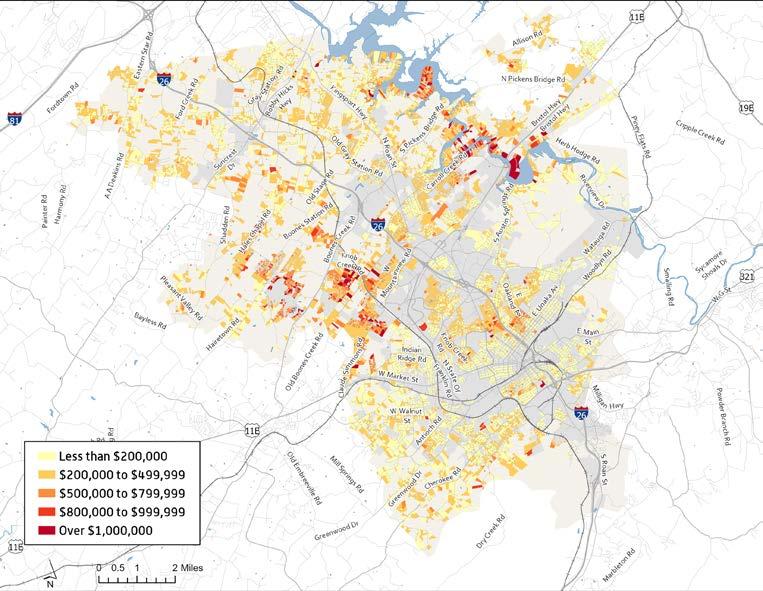
The map below showcases property values of acreage in the Study Area zoned for singlefamily housing. Housing in the Study Area tends to be less expensive farther from Johnson City’s downtown and in areas outside the city limits. Housing located near the lake is also priced higher than housing located away from the lakefront.
Source: Washington County
HOUSEHOLD SIZE (2023)
HOUSING AGE
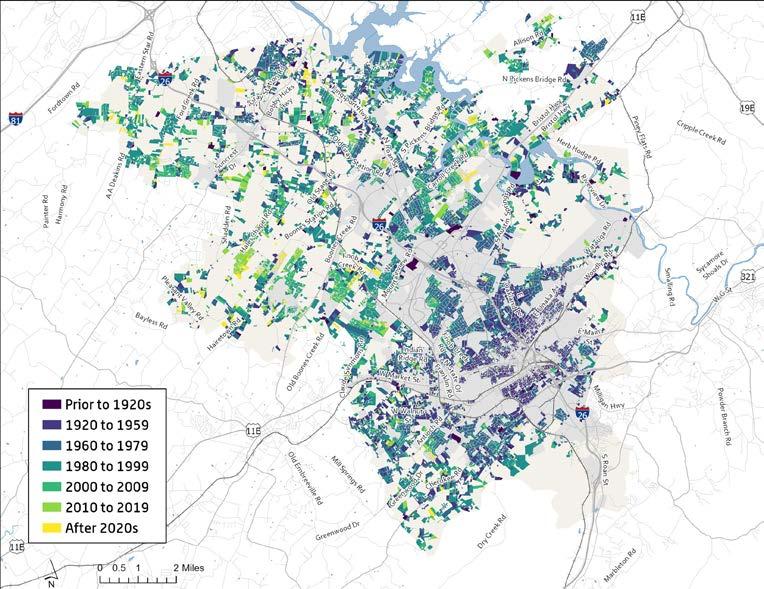
The Study Area has a higher share of houses built after 1990 (42.1%, compared to the MSA (39.9%) and Johnson City (38.2).
Source: US Census; 2017-2021 ACS; Kimley-Horn
FROM 2010 TO 2023, THE VACANCY RATE IN THE STUDY AREA DECREASED 2.4%—ALLUDING TO A LESSENING AVAILABILITY OF HOUSING.

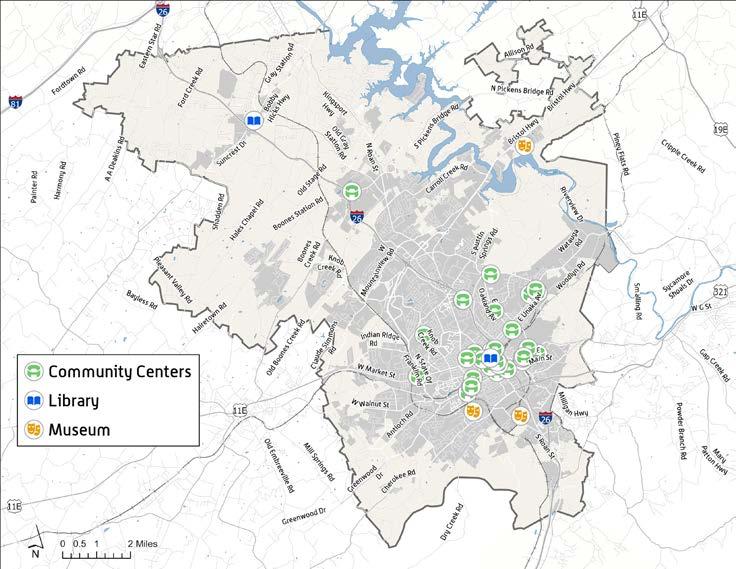
The Study Area is home to 3 libraries—including the Johnson City Public Library, 33 community centers, and the Reece Museum. The Johnson City Public Library is located in Downtown Johnson City and opened to the public in 1999. It houses a physical collection of more than 130,000 books, audiobooks, magazines, and DVDs and circulatesmore than 450,000 items per year to the community.
Source: City of Johnson City
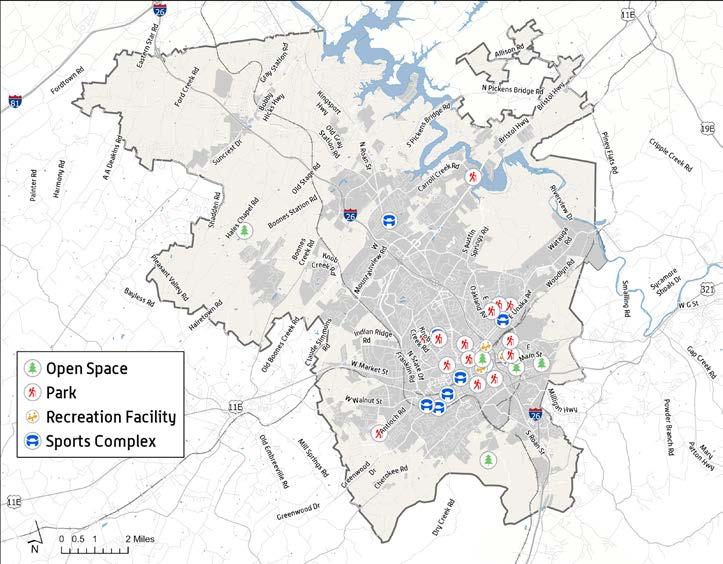
The Study Area includes over 20 parks and open spaces in addition to 5 recreational facilities and 4 sports complexes. Most recreational spaces and parks are located in the heart of Johnson City. These spaces contribute to the city’s quality of life, providing residents and visitors with opportunties for activities and socialization.
Source: City of Johnson City
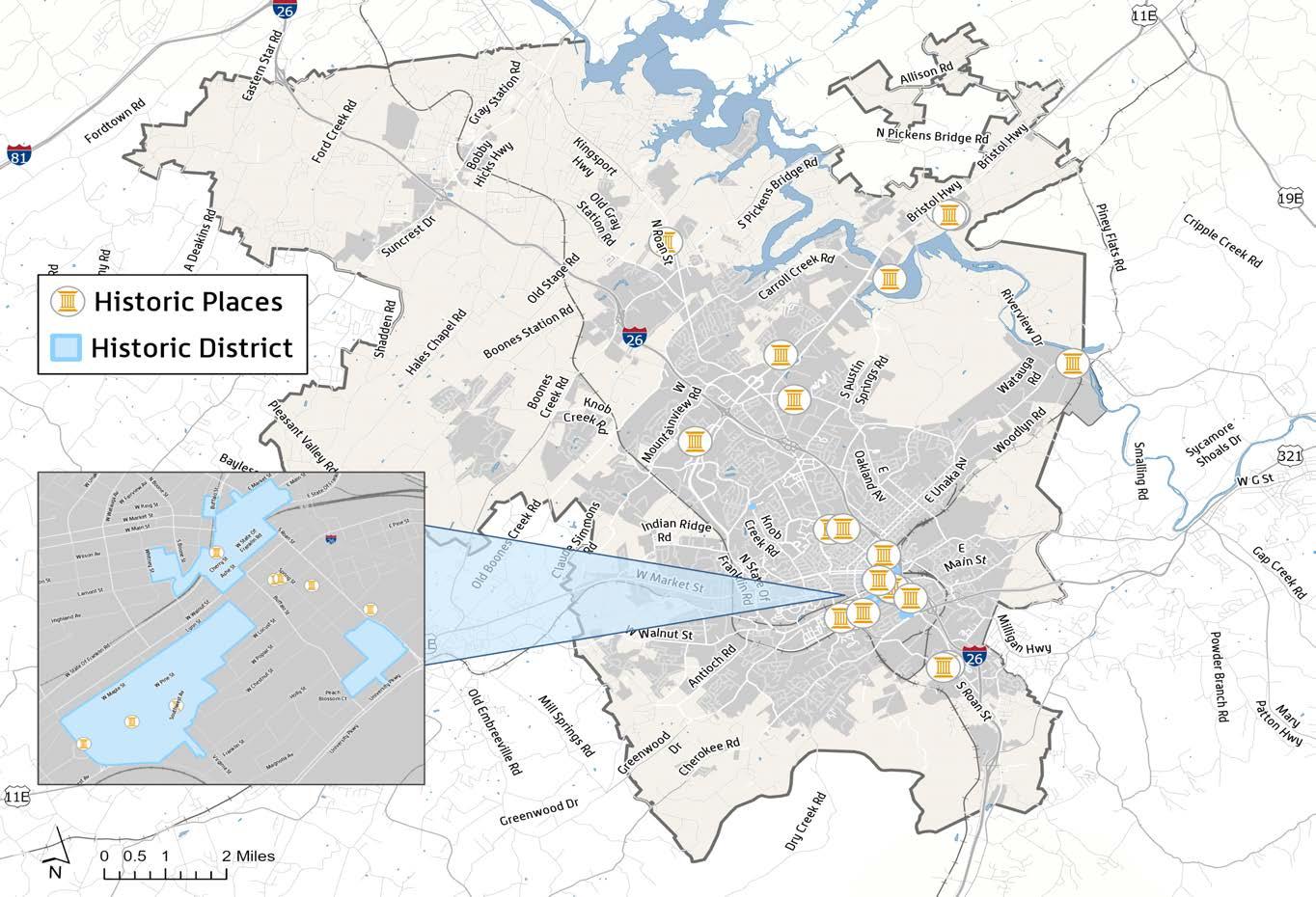
The Study Area includes 23 historic places and four historic districts. The areas are scattered throughout; however, they are concentrated in and around Downtown Johnson City. Sites include homes, farms, and churches.
Source: City of Johnson City
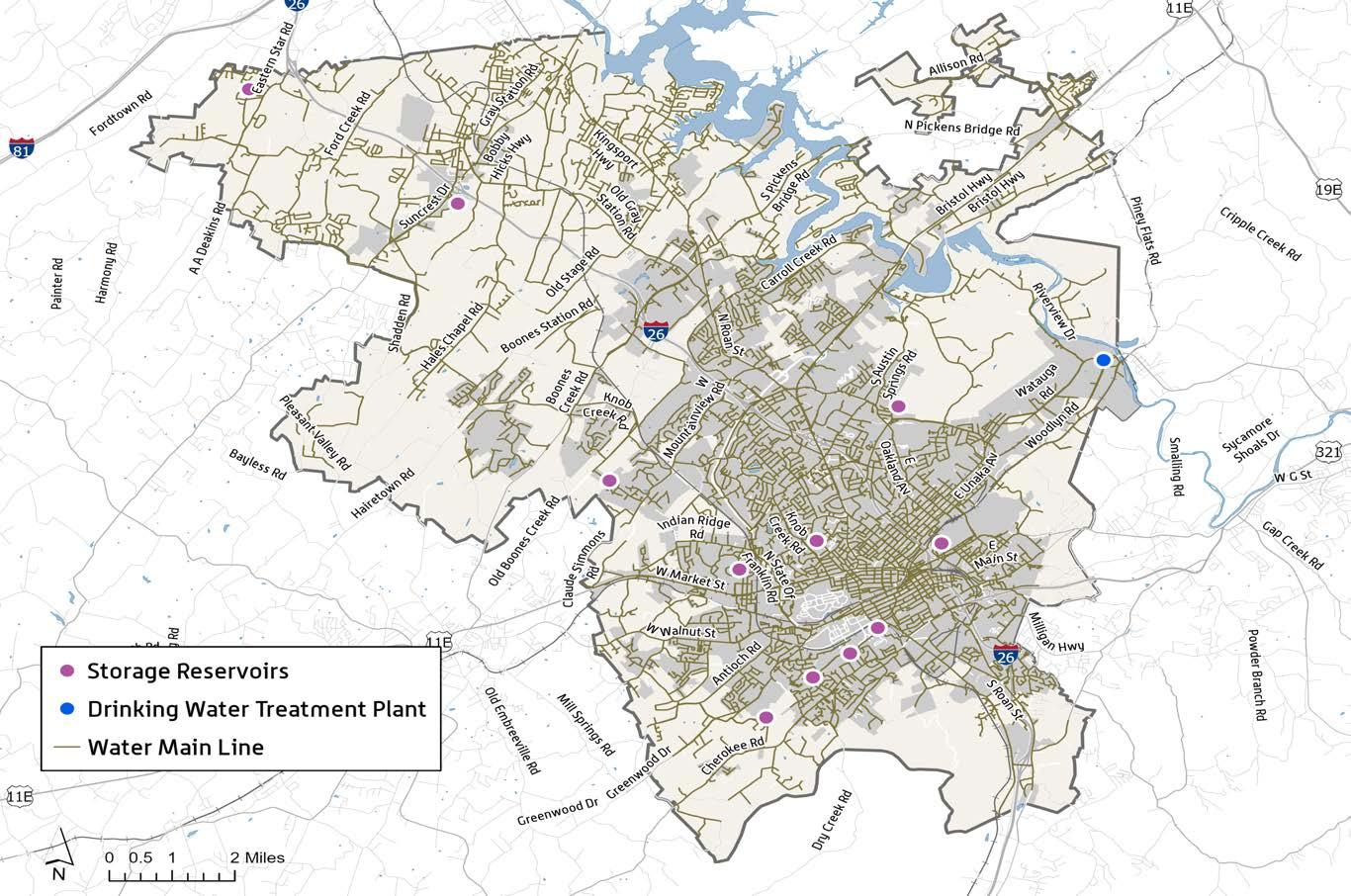
The Johnson City Water and Sewer Department provides water service to residential and nonresidential uses. The system includes two water treatment plants and 951 miles of waterlines. The Department receives water from two sources—Unicoi Springs and the Watauga River, and serves the area within the Johnson City limits and various unincorporated areas within Washington, Carter, Sullivan, and Unicoi Counties.
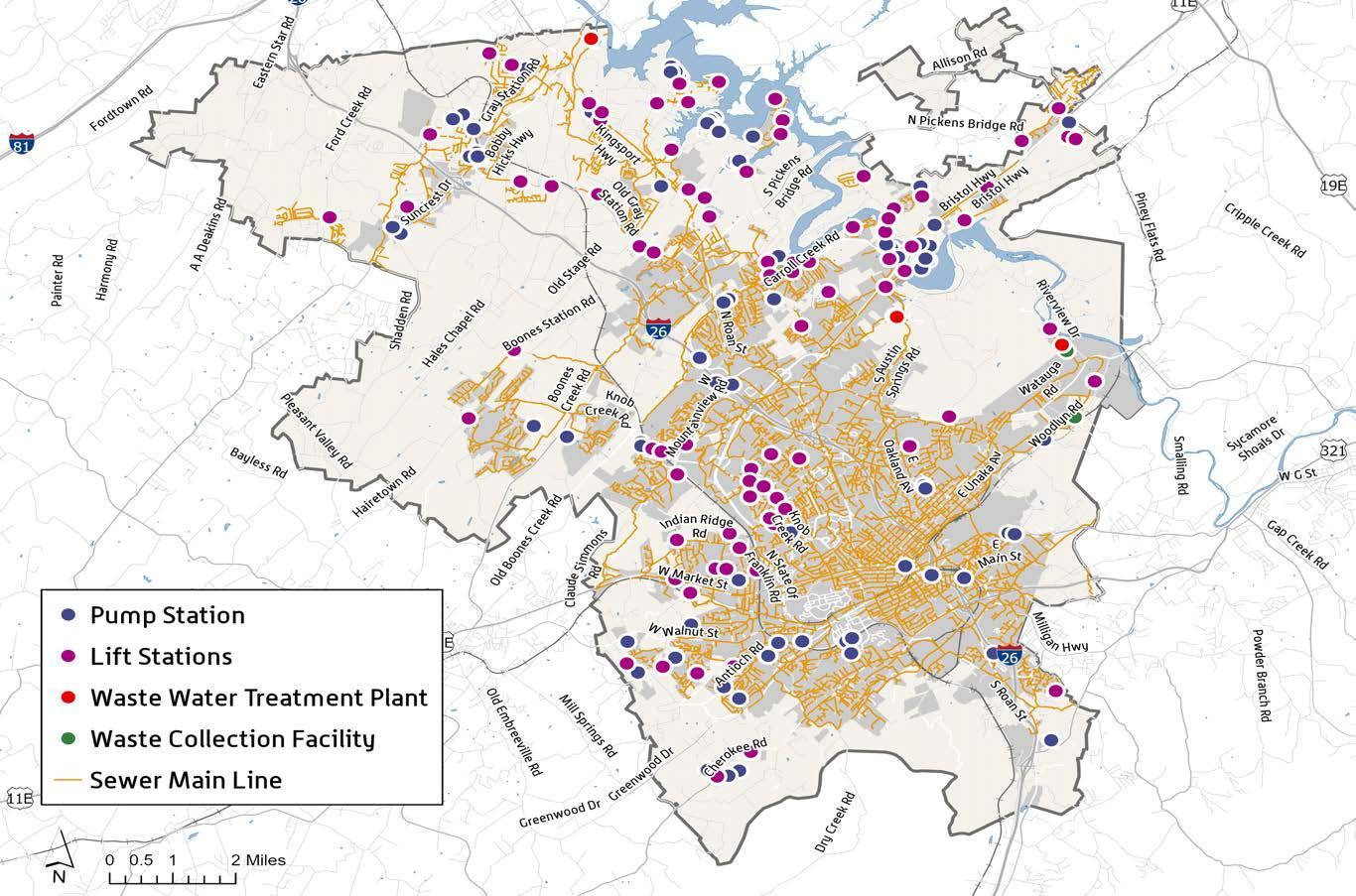
Like the water system, the Water and Sewer Department manages the city’s sewer system, which includes sewer lines, mains, and pump stations. The sewer system serves areas within the Johnson City limits and various unincorporated areas within Washington, Carter, Sullivan, and Unicoi Counties. The total system includes three wastewater treatments plants and roughly 762 miles of sewer line. The majority of the lines within the system are gravity lines, meaning they rely on gravity to move sewage through the system and to pump stations and, ultimately, treatments plants.
Source: City of Johnson City
Education is a fundamental aspect of a thriving community and schools play a crucial role in shaping the future of a community by providing a good education to its residents. In planning for future growth, planners and policy makers should anticipate and understand the infrastructure needs associated with determining addition school facilities or resources that will be required to accomodate population growth.
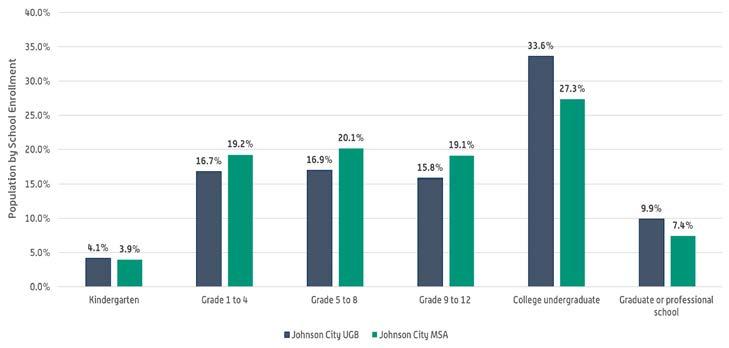
Within the Study Area, 26.4% of the population is enrolled in public or private school, compared to 22.5% in the MSA. Over a third of the residents enrolled in school in the Study Area are college undergraduates and over 50% are in grade school.
Source: ESRI Business Analyst Online

The map below highlights the trends in public school enrollment by census tract in the Study Area. While generally the Study Area is experiencing an increase in public school enrollment, identifying which census tracts are experiencing strong growth in enrollment can assist with determining the future needs of educational facilities.
Source: US Census; Kimley-Horn
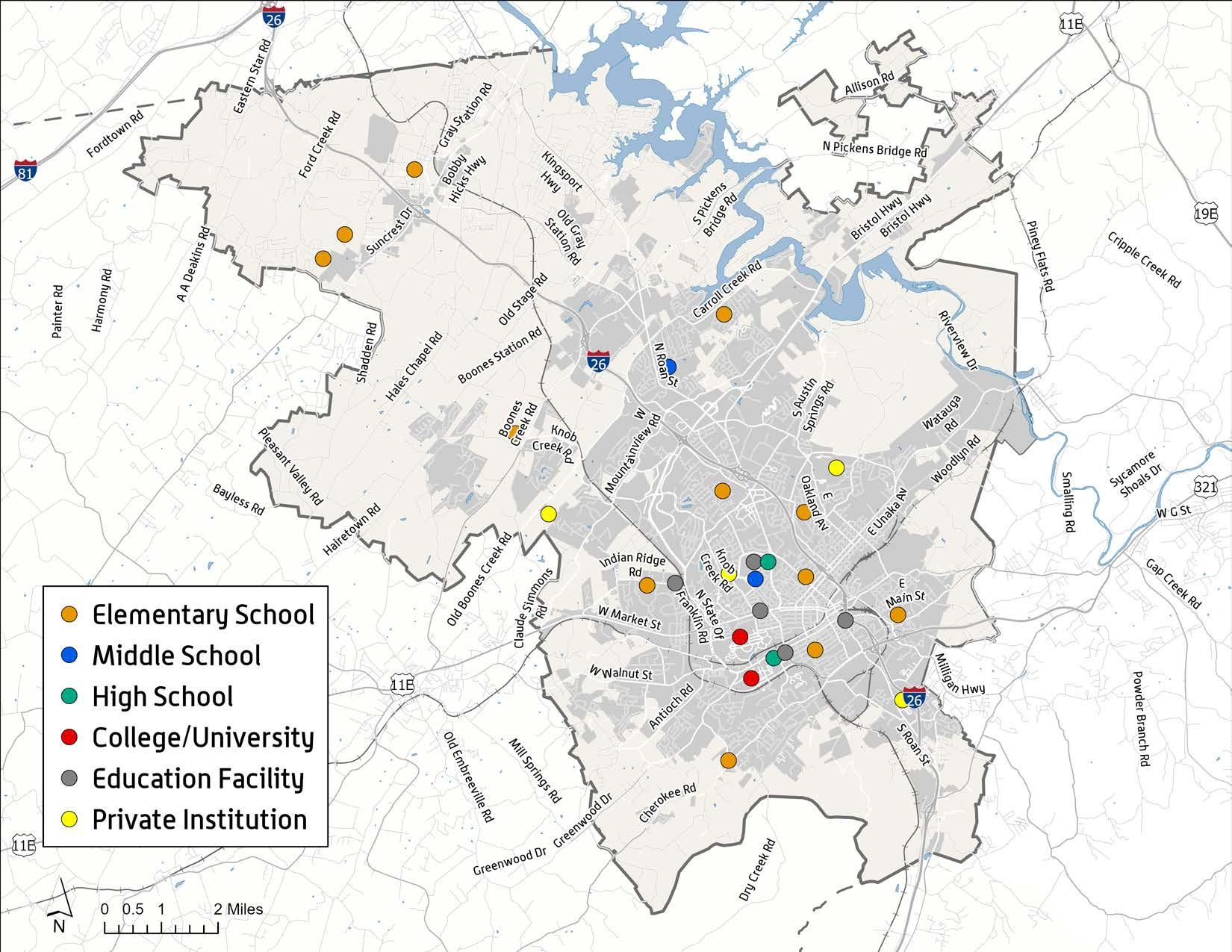
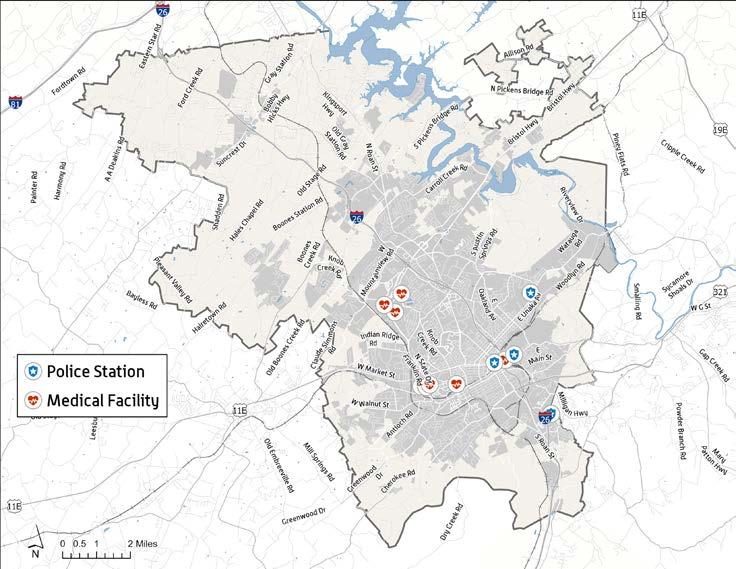
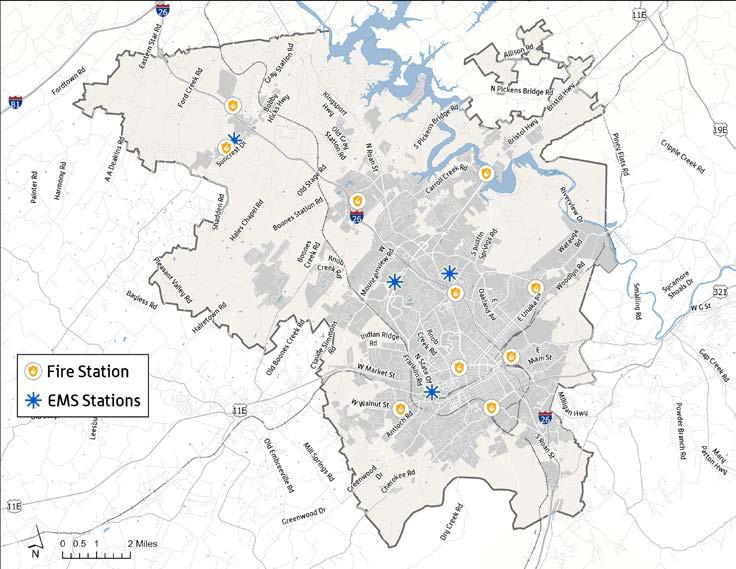
The public services that promote public safety include police, fire, and emergency services. The maps below show where the police, fire, and EMS stations are located throughout the Study Area, in relation to the hospital and medical facilities located in the Study Area.

The Study Area is home to several major water bodies—including Boone Lake and the Watauga River—as well as Buffalo Mountain. Located near the Appalachian Mountains, the elevation ranges from 1,260 to 3,232 feet. The natural environment plays a vital role in shaping the overall character and appeal of Johnson City and preservation involves a collective effort of conservation initiatives, and prioritizing biodiversity.