Kroc Institute for International Peace Studies 2024-25 Year in Review
Dear Friends,
The academic year of 2024-2025 will likely be remembered — at least by me — as the year of abrupt change to the way we go about our work due to new policies emanating from the Trump administration.
The impact of these policies – and the assault –on matters that are at the heart of our work as a peace institute has been immediate and will likely continue to shape our operations in the foreseeable future. Organizations and institutions that the Kroc Institute has partnered with for decades, such as the United States Institute of Peace (USIP), the United States Agency for International Development (USAID) and the Bureau of Conflict and Stabilization Operations at the U.S. Department of State, are either dissolved or under extreme duress. This has had a dampening effect on collaborations, student fellowships, and the well-being of many students - in particular our international students. At a macro level, this change will shape the short- and long-term landscape of job opportunities for our graduates. At a meso level, it has affected our budget as we lost significant federal support for some of our research and policy projects, most notably the Peace Accords Matrix. And academic freedom, particularly in matters related to sensitive topics, is also under pressure given the chilling effect of the Trump administration on higher education throughout the United States.
Despite these challenges, the past academic year was marked by continued research, teaching, outreach and policy work, demonstrating Kroc’s resilience and capacity to pivot, adapt and face the challenge head-on. An example of addressing the challenge took place in April, when we quickly put together a panel in response to the
restructuring of USIP and its sudden office takeover by representatives from the Department of Government Efficiency, also known as DOGE.
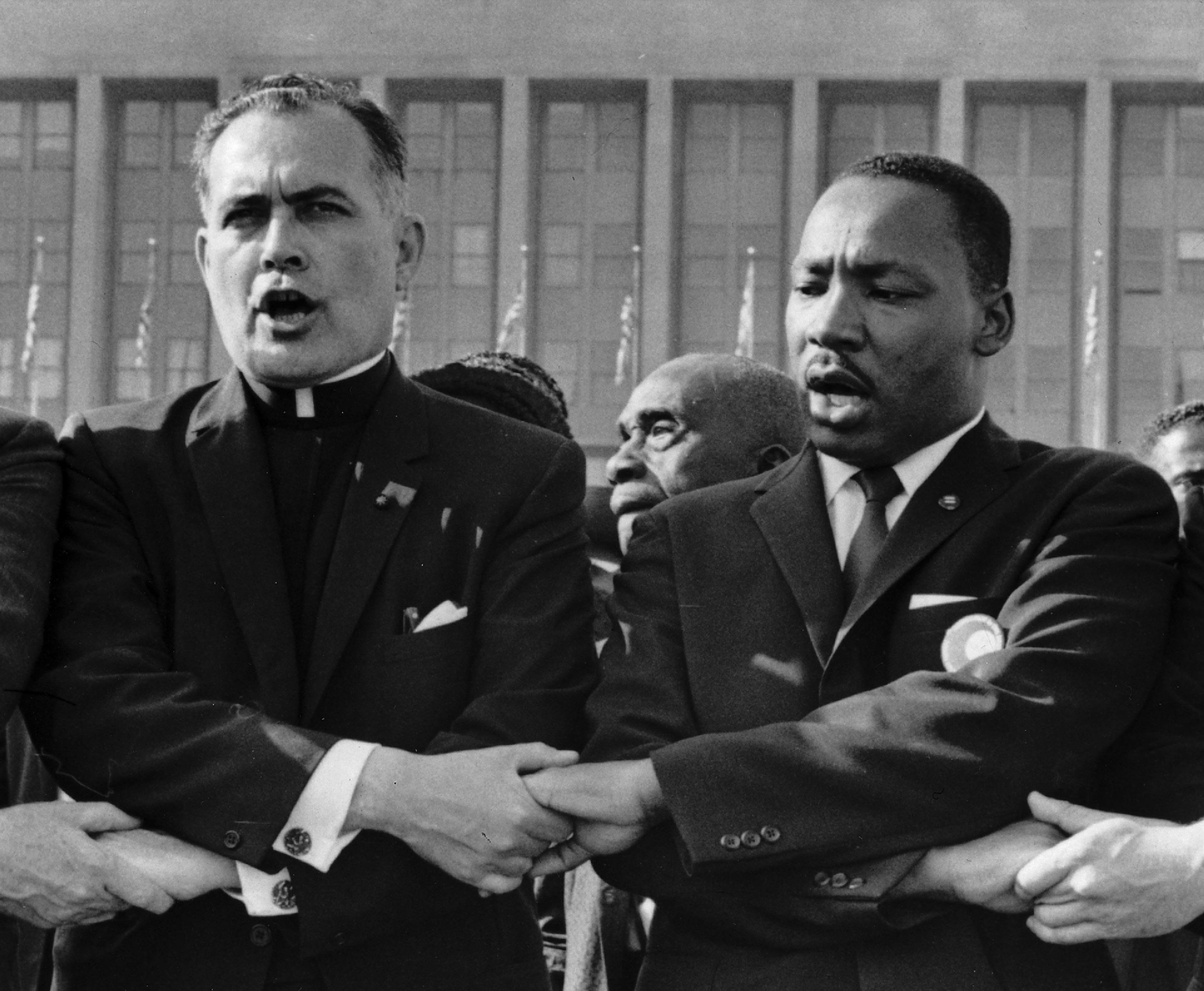
The Kroc Institute’s connection to USIP runs deep – our very own Rev. Theodore M. Hesburgh, C.S.C., founder of our Institute, president emeritus of Notre Dame, and a national voice for civil and human rights, served as a member of USIP’s board of directors from 19912000 and as co-chairman of the USIP Building Campaign. At the facility’s groundbreaking ceremony, Father Hesburgh said, “Amidst all these reliquaries of wars, we are going to commit a temple of peace.”
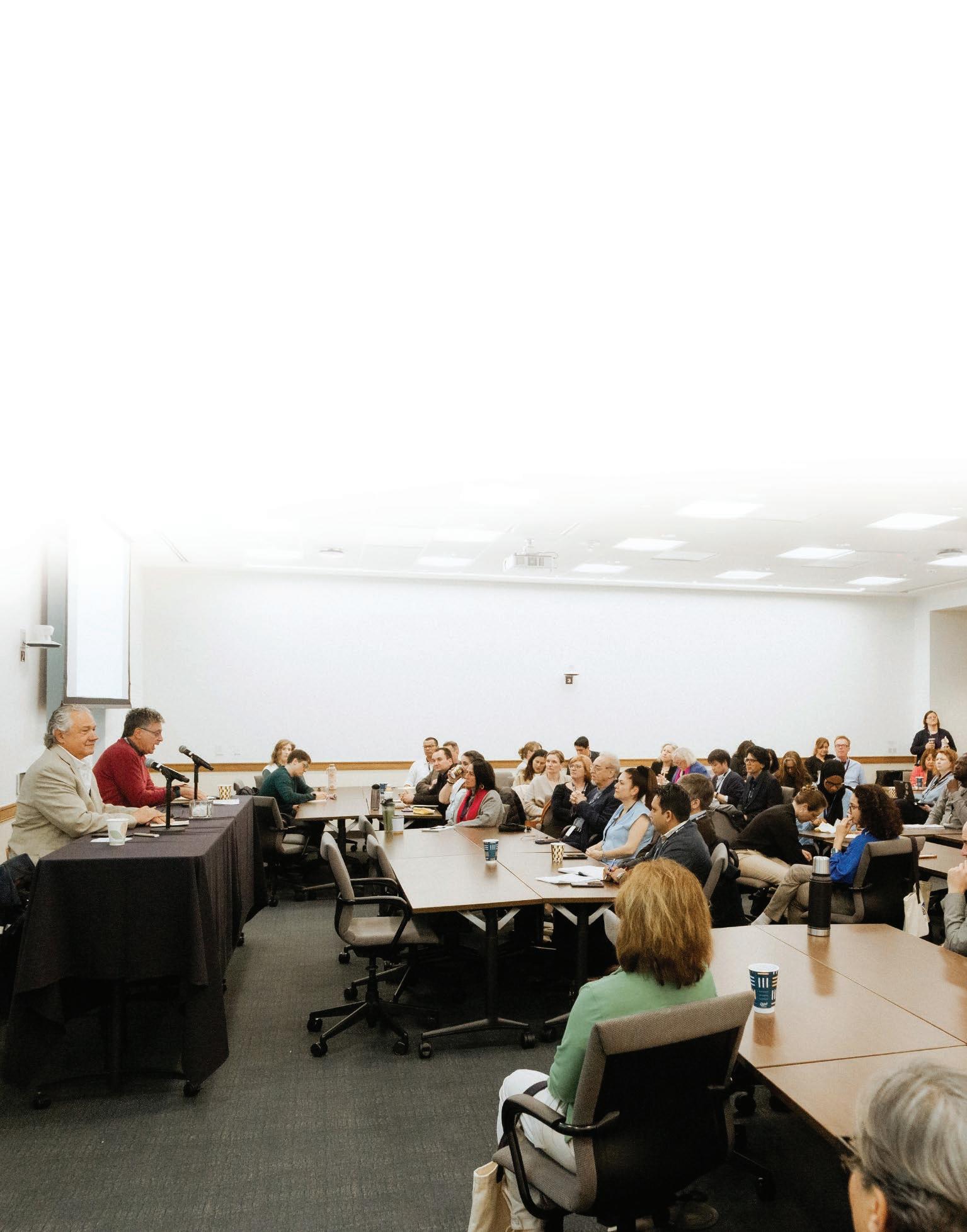
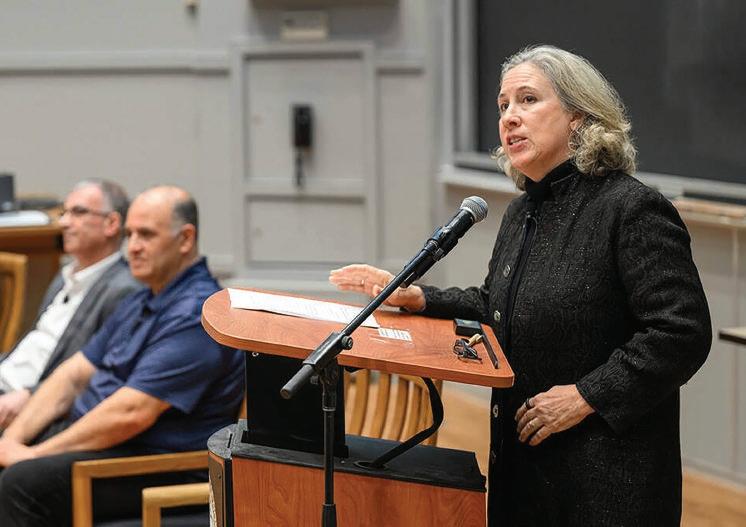
Given this history, the panel discussion was more than simply an event we hosted. Panelists featured were George A. Lopez, Rev. Theodore M. Hesburgh, C.S.C., professor emeritus of peace studies; Lisa Schirch, Richard G. Starmann, Sr. professor of the practice of peace studies; Elizabeth (Liz) Hume, executive director, Alliance for Peacebuilding and Kroc Institute Advisory Board member; Angela Lederach (Ph.D. ’19), assistant professor of peace studies at Chapman University; and Chris Bosley, former director of USIP’s program on violence and extremism. Together, they discussed the history and significance of USIP for peacebuilding around the world, including its influence on the work of the Kroc Institute. More than 300 attendees joined online.
YEA
Two other moments from the past year stand out to me as I write this letter. First, in early April we welcomed an external review committee to campus for two days, whose members followed up with recommendations for consideration for our various programs. We had spent months preparing a selfstudy for the external review, and it was a heavy lift for many of us. The committee members recognized the leadership role that the Institute plays in the field of peace studies, acknowledging our history, reputation and scholarship. They believe we have the stature and capacity to respond to the current political moment and successfully orient research, policy, and practice to benefit and support our peace studies colleagues, near and far. I was humbled by their recommendations and look forward to implementing many of them in the years to come. This was the first external review process I’ve helped lead, and as they generally take place every seven years, it is likely my last.
The second highlight was the relaunch of our longrunning Summer Institute with a new name — the Kroc Institute Strategic Peacebuilding Academy (KISPA) — and a new purpose. This was a heavy lift, as well, co-chaired by Erin B. Corcoran and Kathryn Sawyer Vidrine (Ph.D. ’18), and supported by a dedicated committee of Kroc faculty and staff. The objectives of KI-SPA are twofold: first, each year will focus on a particular theme related to peace studies and the peacebuilding community as a means to teach, learn and expand communities of experts and practitioners. Second, KI-SPA is intended to provide a forum for peacebuilders where the art and memory of peace and justice work can be nourished in a collaborative way, offering opportunities for networking and community building. KI-SPA 2025 focused on peace processes and was a huge success, bringing in about 60 participants for four days of intensive panels, workshops, and presentations
Kroc Institute of International Peace Studies
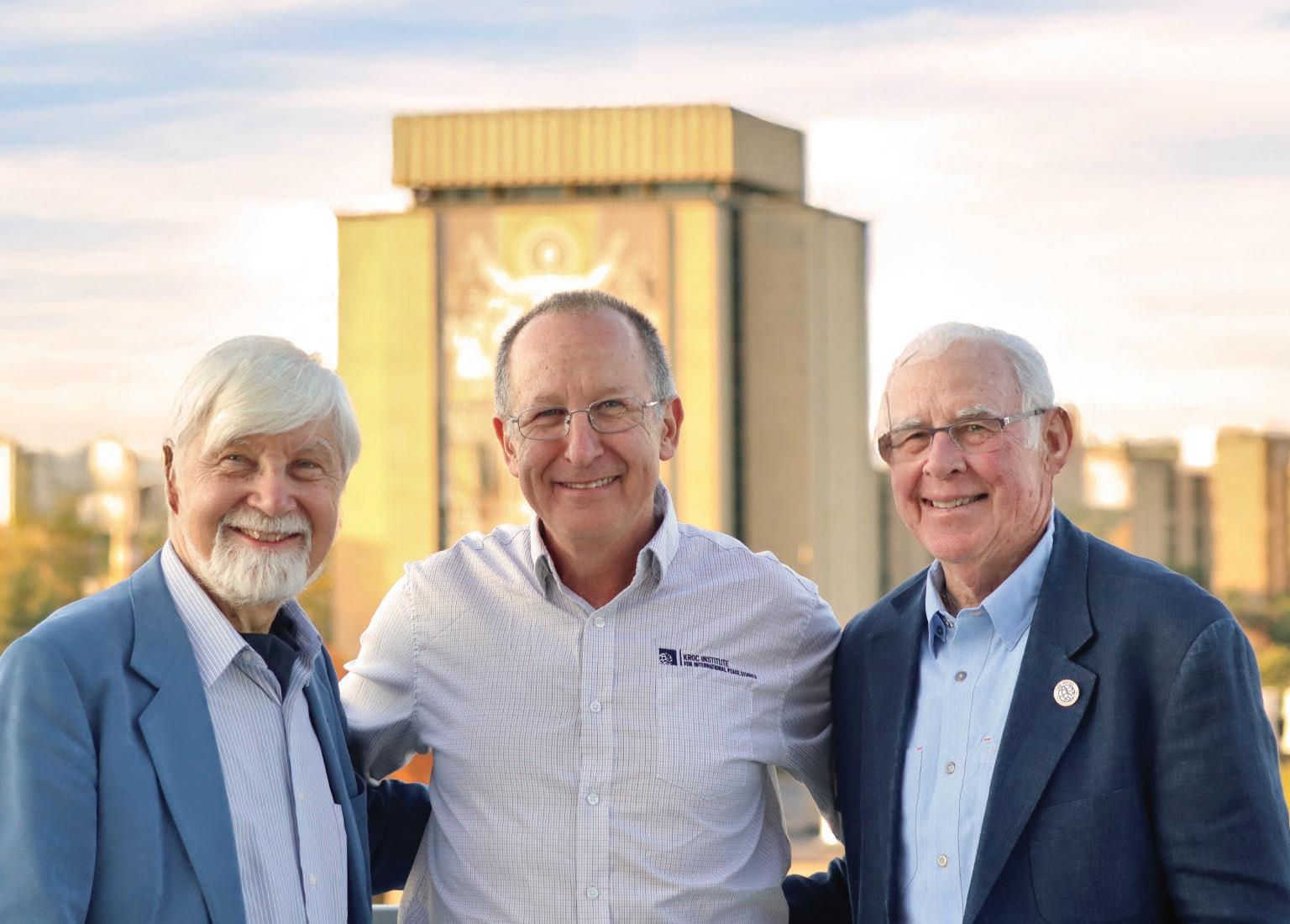
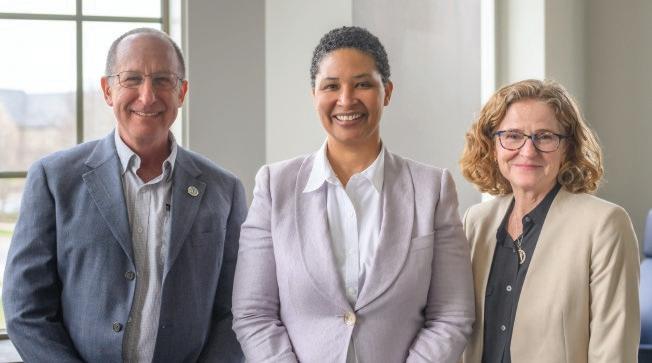
Kroc Institute Advisory Board Members Peter Wallensteen (left) and J. Patrick Danahy (right) flank Kroc Institute Director Asher Kaufman.
on this topic. You can read more on this event inside the report itself. KI-SPA 2026 will focus on “Modes of Healing,” and planning is fully underway, headed by this year’s co-chairs Sawyer Vidrine and Norbert Koppensteiner.
In August, we welcomed Mary Gallagher, the new Marilyn Keough Dean of the Keough School of Global Affairs, of which the Kroc Institute is part. I have enjoyed working with her this past year as she develops her own strategies to elevate the School and align its constitutive units under her leadership.
We also welcomed a couple of new hires internally at the Kroc Institute. Sarah Genz (M.N.A. ’22, B.A. ’21) joined us as the Strategic Peacebuilding program
manager and Elizabet Campos Duarte as the Peace Accords Matrix program coordinator. Meanwhile, Lisa Gallagher, who had been with the Institute since summer 2017, first as the events manager and then as the writer and content specialist, left us to start a new career as a lawyer and is now working as an associate for a law firm in Grand Rapids, Mich.
Regarding our advisory board: We reserve three seats for recent alumni to serve on our board for three-year terms. Monica Montgomery (B.A. ’19) completed her term this past year as the undergraduate alumni representative. She was invited to remain on the board, and I’m delighted to report that she accepted. Meanwhile, Duncan Donahue (B.A. ’19) joined the
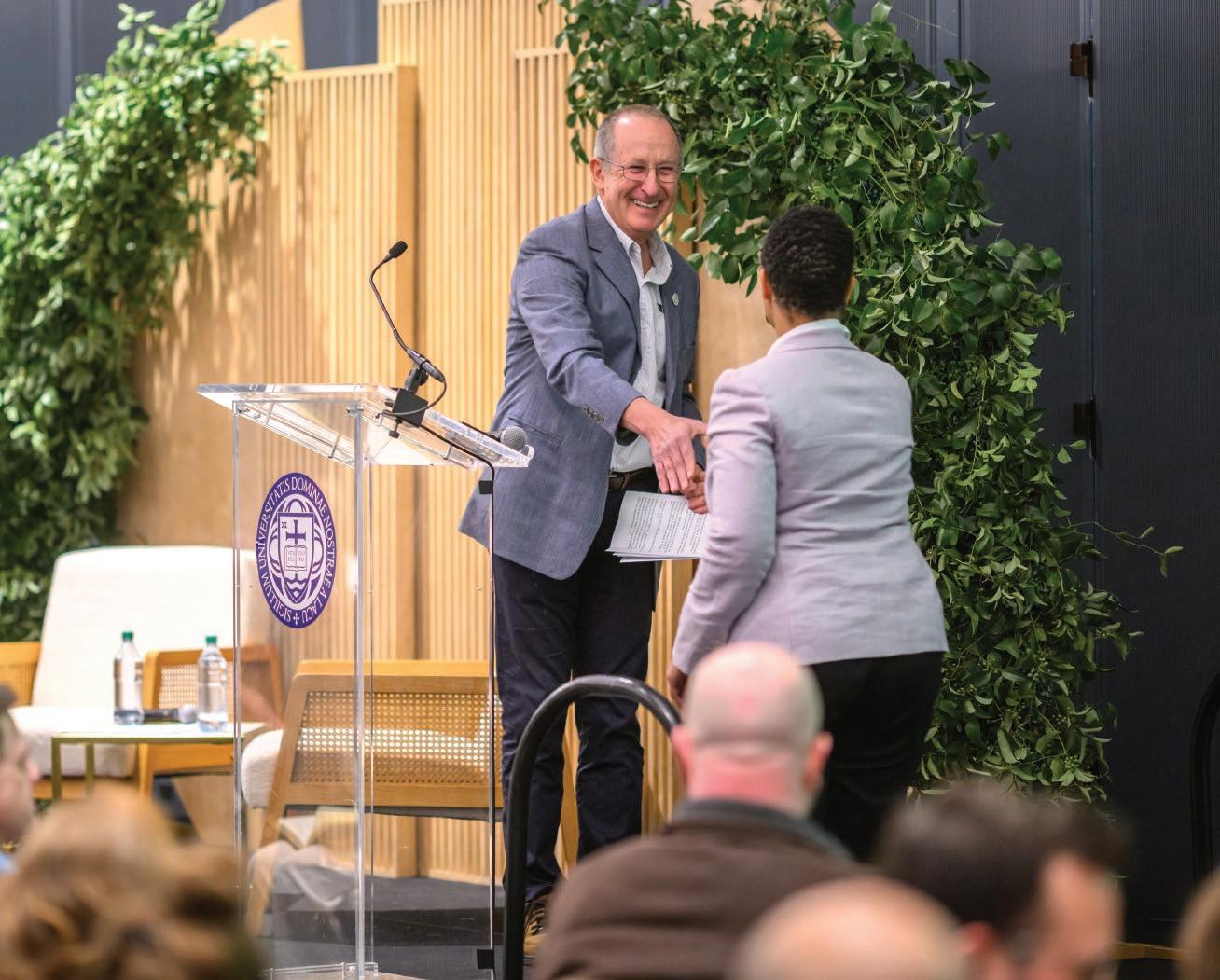
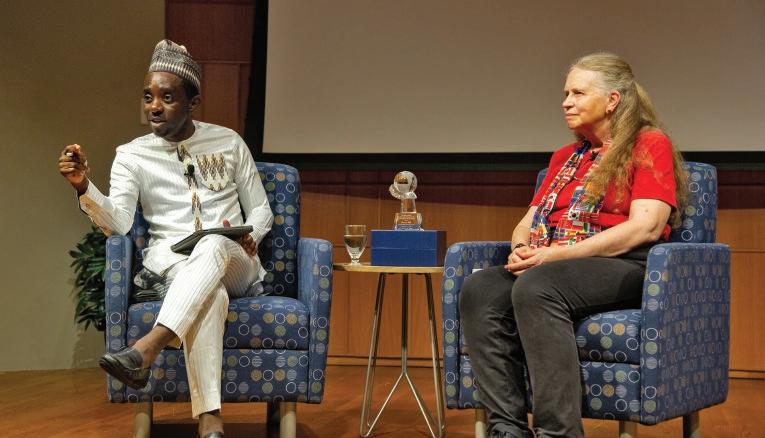
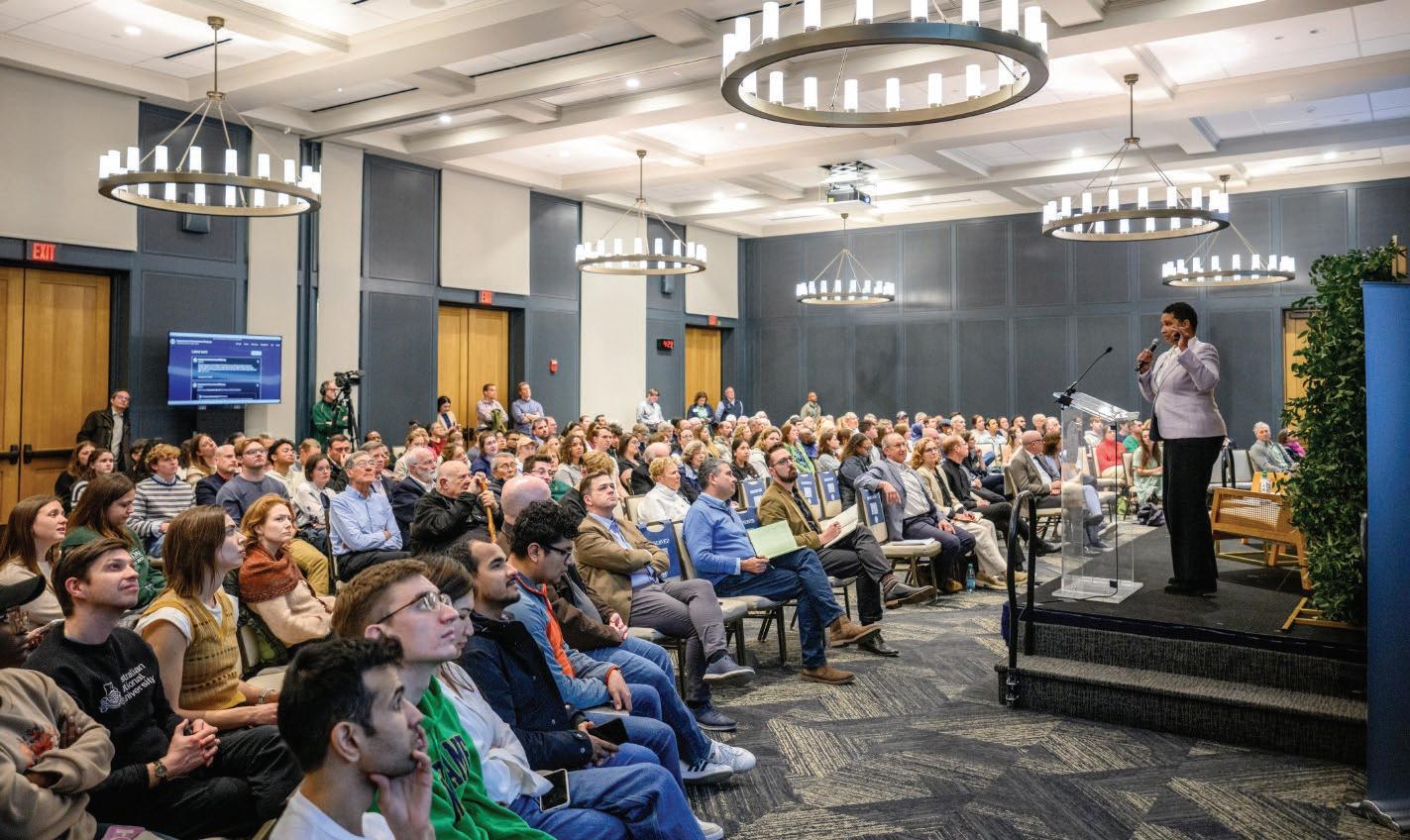
Asher Kaufman welcomes Danielle Allen, the 2025 Hesburgh Lecture featured speaker, to the stage.
board in the young alum role, replacing Monica. His term will conclude in 2028. Uzra Zeya, who you may recall was a board member for a brief moment before the Biden administration recruited her to serve as the Under Secretary of State for Civilian Security, Democracy, and Human Rights, has returned to serve on our board. I continue to be enormously grateful for Paddy Mullen (B.A. ’80), advisory board chair, for her impeccable leadership and generous support of the Institute.
I am writing this note as we are about to start the academic year of 2025-26. In addition to all the “regular” matters that happen at the Kroc Institute, we will have specific projects to attend to this year, such as implementation of initial recommendations from the external review and planning the Kroc Institute’s 40th anniversary, to be celebrated throughout the 2026-27 academic year. You will hear more from me and our team about this exciting and important milestone in the life of the Institute as plans and details begin to take shape.
On we go.
Asher Kaufman John M. Regan, Jr. Director Professor of History and Peace Studies
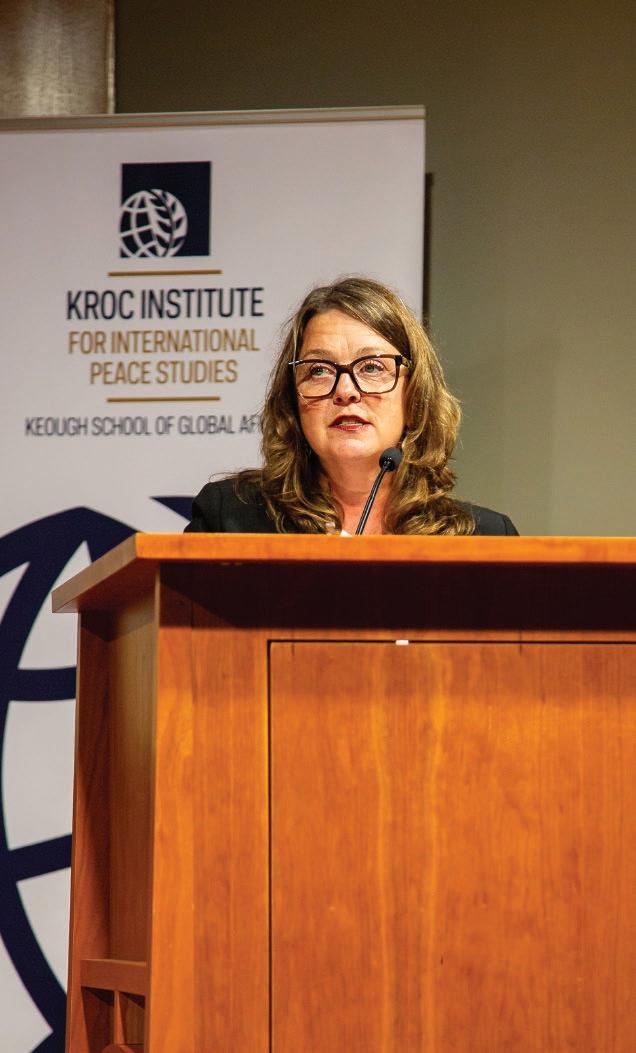
Erin B. Corcoran (left) and Kathryn Sawyer Vidrine (right) co-chaired the 2025 Kroc Institute Strategic Peacebuilding Academy.
A type of global disruption is underway, causing seismic shifts for the field of peace studies.
Support for our research, the type of work greenlighted, budget lines and operational costs, outcomes and more have been scrutinized, changed, and in some cases eliminated by external factors and constituents outside our sphere of influence.
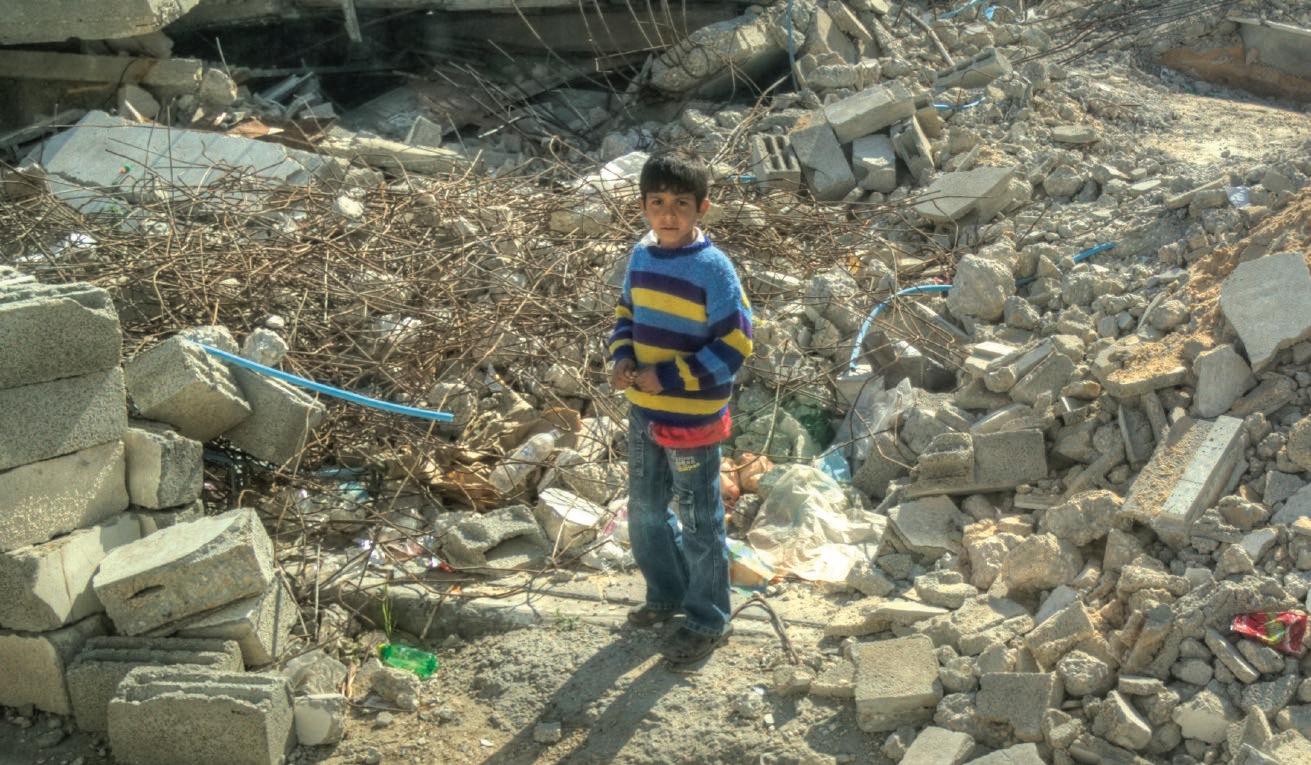
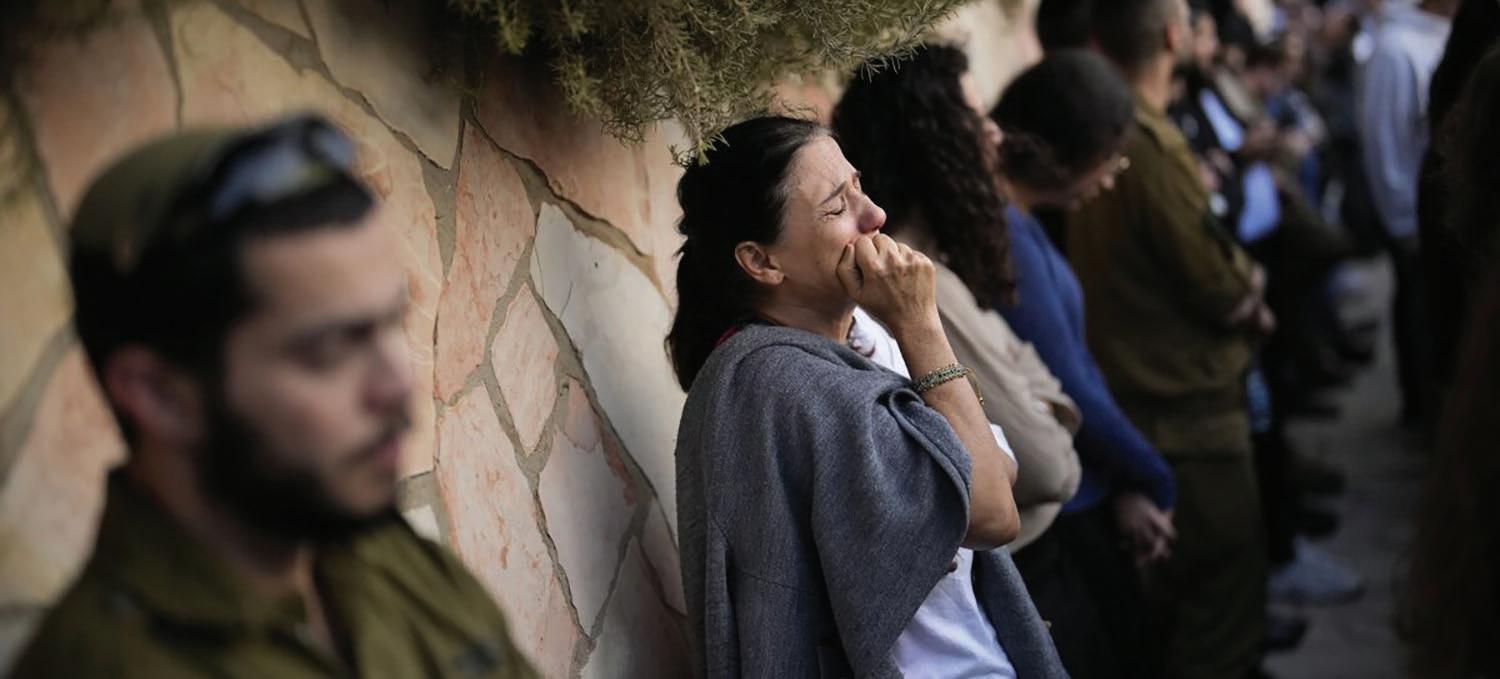
TOP: A young boy stands amidst the ruins of Gaza; BOTTOM: An Israeli woman mourns.
In spite of the chaos, the Kroc Institute for International Peace Studies has grabbed hold of the challenges presented, faced them, and pivoted – creating opportunities instead, to reimagine our work and reframe our output.
On the following pages you’ll read about research, policy and practice efforts underway; outreach with external partners in the field on collaborative peacebuilding projects of all types; our talented faculty and staff whose extraordinary work is noteworthy and honored; and of course, our students and graduates who represent the next generation of peacebuilders and whose skills and compassion are sorely needed in the world – especially now.
We hope to inspire you, the reader, and we call on you for your advocacy. Global disruption invites us to create alliances based on shared purpose, so that together, guided by courage, we can confidently navigate the uncertainty that surrounds us.
Thank you for reading.
7 Kroc Institute of International Peace Studies
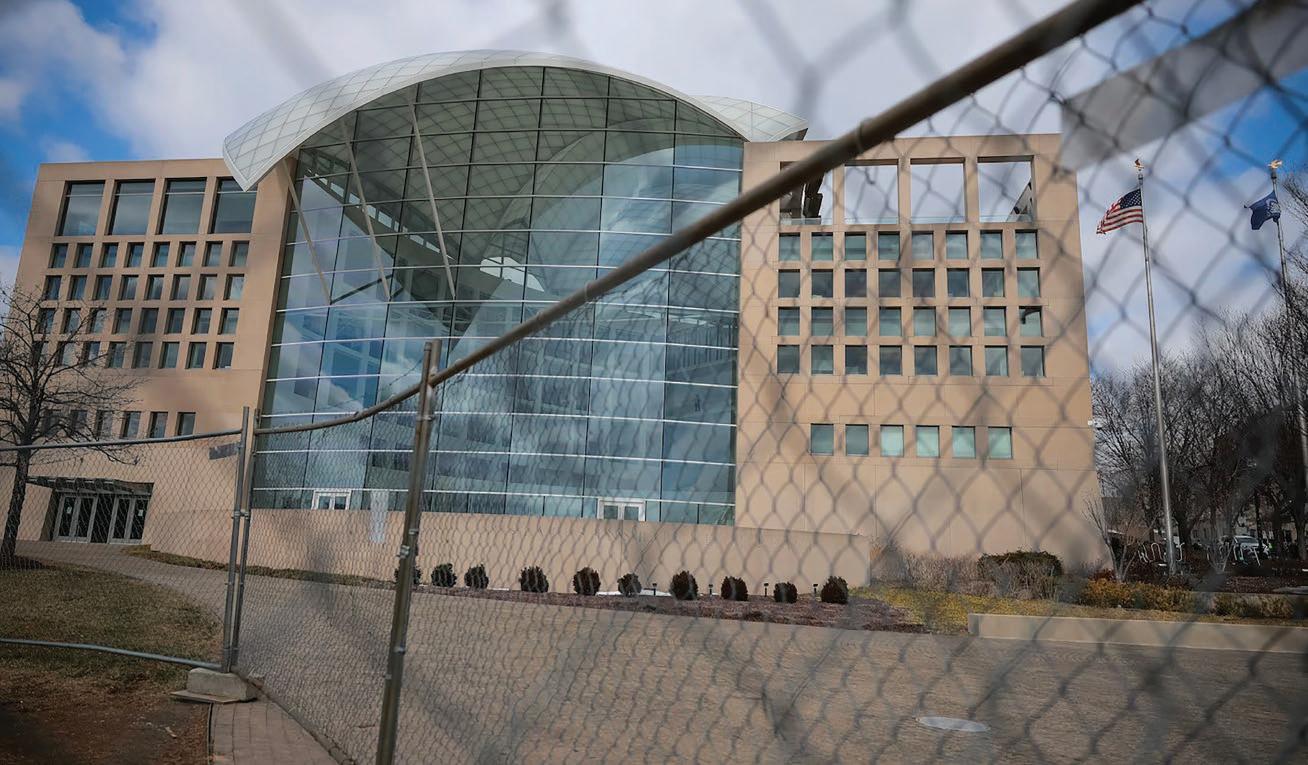
Photo: The U.S. Institute of Peace’s headquarters.
Credit: (Kayla Bartkowski/Getty Images)
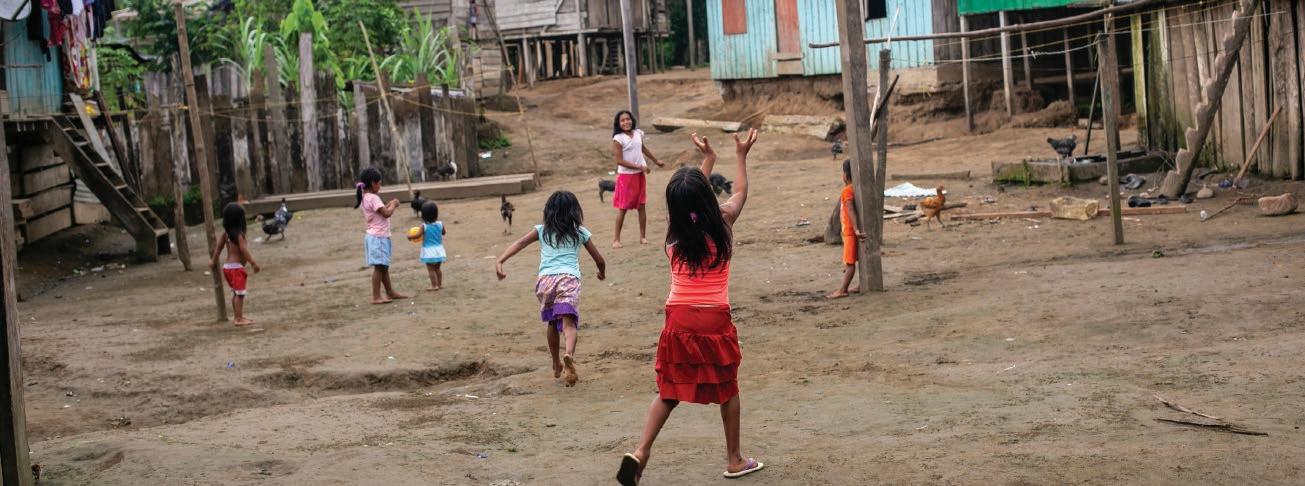
TOP: The shuttered United States Institute of Peace building; BOTTOM: Children at play in rural Colombia.
Inaugural Strategic Peacebuilding Academy, a home run for the Kroc Institute
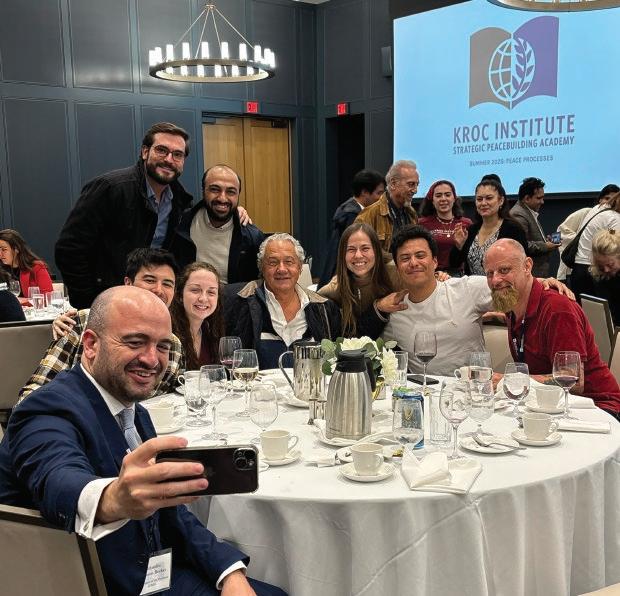
More than 60 participants from around the world visited the University of Notre Dame in late May as part of the Strategic Peacebuilding Academy hosted by the Kroc Institute for International Peace Studies.
With “Peace Processes” as its theme, this year’s Academy brought together researchers, practitioners, and those in the policy world working on peacebuilding issues to foster professional development and relationship-building across sectors. Over the four-day program, facilitators and participants addressed the “before, during, and after” phases of peace agreements using case studies as examples, such as Colombia, the Philippines, Nepal, the Democratic Republic of the Congo, South Sudan, Cyprus, and Afghanistan, among others. In addition to regionally focused sessions, others highlighted thematic and demographic aspects of peace processes.
“It was a thought-provoking and rejuvenating experience,” said Kathryn Sawyer Vidrine (Ph.D. ’18) co-chair of the Academy, who also serves as the assistant director for doctoral studies at the Kroc Institute.
“At a time when peacebuilding efforts are being systematically dismantled and de-funded in many places, it was reassuring for attendees to be reminded that we’re not doing this work alone. Just knowing that was tremendously uplifting.”
Two keynotes bookended the Academy. John Paul Lederach, award-winning scholar-practitioner, author, and professor emeritus of international peacebuilding at the Kroc Institute, offered the opening keynote address. He highlighted his 50-year arc of experience and personal involvement facilitating peace processes, emphasizing interdependencies and the cyclical nature of stages in peace agreements at key moments in a given process. The concluding keynote came from Monica McWilliams, co-founder of the Northern Ireland Women’s Coalition political party and elected as a delegate at the Multi-Party Peace Negotiations, which led to the 1998 Good Friday Peace Agreement. Her remarks provided hope: about how conflicts that once seemed intractable can be overcome.
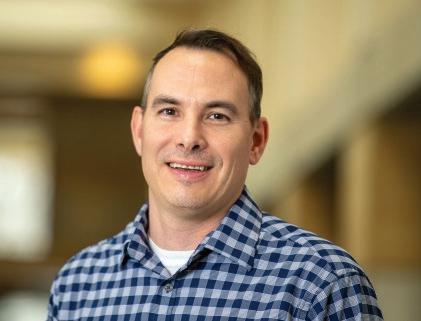
Carolina Serrano Idrovo (M.A. ’17), a research associate with the Peace Accords Matrix, was a participant and speaker at the 2025 Kroc Institute Strategic Peacebuilding Academy.
In between these addresses, the Academy offered nearly 30 panels, breakout and plenary sessions, and work group activities.
“This year’s program provided a needed space for people
come together
as
to
a community and receive support from each other,” said Asher Kaufman.
“Listening to the concluding reflections from participants was gratifying, as was witnessing the Kroc Institute’s convening power and our place in the field – highlighting our strengths in connecting scholarship with policy and practice,” he said.
The Academy was built on the foundation of the Kroc Institute’s long-running Summer Institute. Launched in 2008, the Summer Institute brought together university and college faculty and administrators interested in developing a new peace and justice studies program, or taking their existing peace studies offerings to the next level of design and rigor. When the program was put on hiatus because of the pandemic, the Kroc Institute saw an opportunity to take that time and thoughtfully redesign a summer gathering that would be thematically focused and meet the needs and interests of prospective participants.
“I was impressed by how well organized and diverse the Academy was – from the variety of sessions, to the topics addressed, to the diversity of participants from around the globe,” said Harry Anastasiou, a professor of international peace and conflict studies at Portland State University (Portland, Ore.) who led a breakout session on Cyprus.
Several Kroc Institute programs and faculty played lead roles at this year’s Academy – as panelists, facilitators and moderators, and offering case studies or simulation exercises related to peace processes. Among these were Josefina Echavarría Álvarez and Laurie Nathan, directors of the Peace Accords Matrix and Mediation programs, respectively, and Lisa Schirch, director of the PeaceTech and Polarization Lab, whose expertise includes the use of AI and technology for social cohesion.
The Barometer Initiative team in Colombia, part of the Peace Accords Matrix and tasked with monitoring implementation of the 2016 Colombian peace agreement, was well represented and highlighted their research, policy, practice, and work with civil society throughout the week.
“Each day participants were able to engage in a variety of sessions designed to assist them when faced with pressing issues of peacebuilding and specifically, peace processes,” said Erin B. Corcoran, executive director of the Kroc Institute and co-chair of the Academy.
“I’m very proud of how this program came together, thanks to the dedication of a steering committee and hard-working student volunteers. It was an incredibly successful and rewarding effort,” said Corcoran.
“Modes of Healing” will be the theme of next year’s Academy, to take place May 26-30, 2026 on Notre Dame’s campus. The program will provide space for participants whose peacebuilding work relates to such disciplines as performance and fine arts, memorials and memory, trauma studies, and justice work in local communities.
ABOVE: Academy participants break into small work groups.
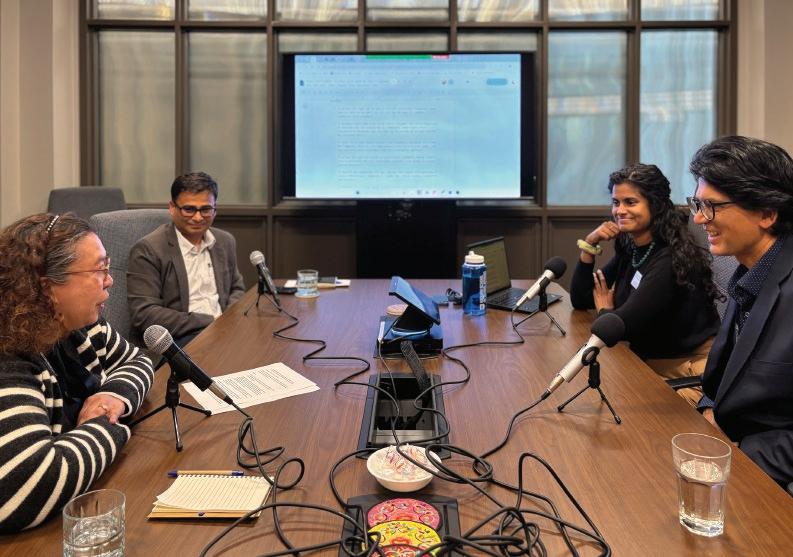
BELOW: Peace Accords Matrix–Mindanao team members join in a podcast while at the Academy.
Keynoter John Paul Lederach
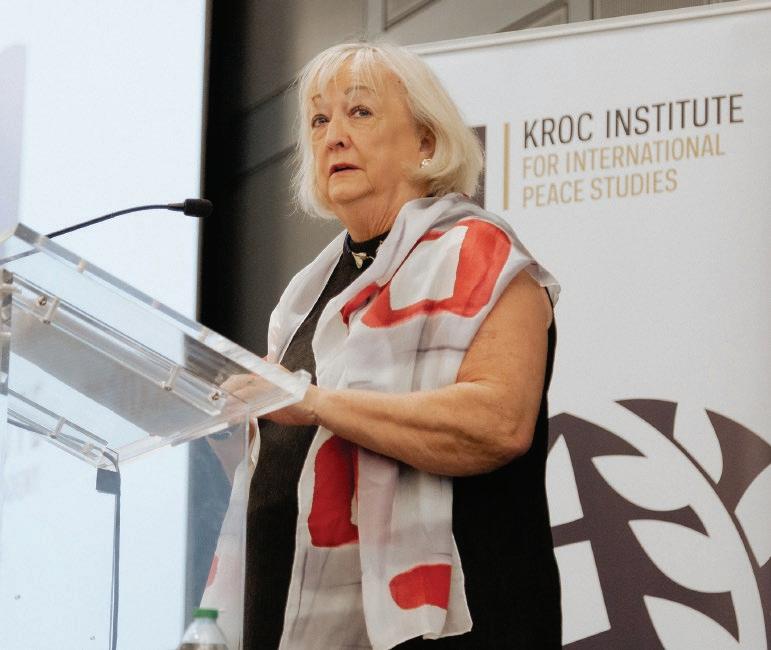
Keynoter Monica McWilliams
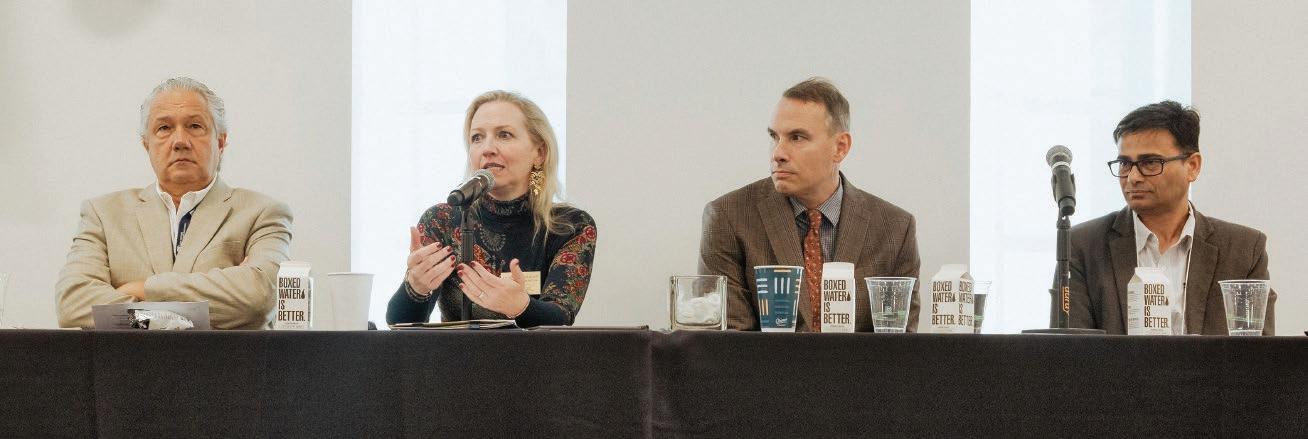
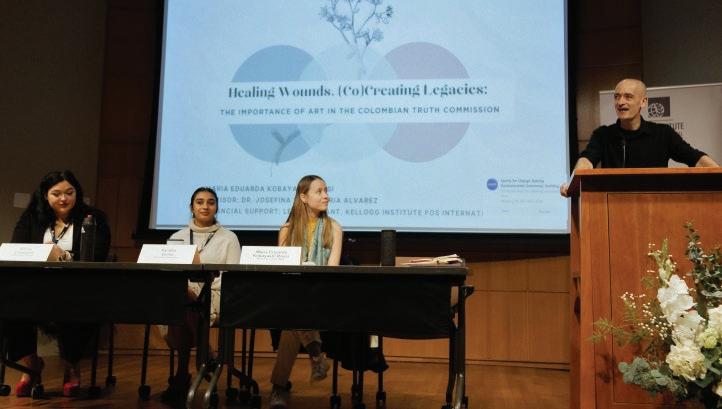
Panelists (from left to right): Francisco Diez, Josefina Echavarría Álvarez, Jason Quinn, and Madhav Joshi.
Fighting for Ukraine’s future: For Khrystyna Kozak, peace studies
offers a path to justice for Ukrainians,
herself included
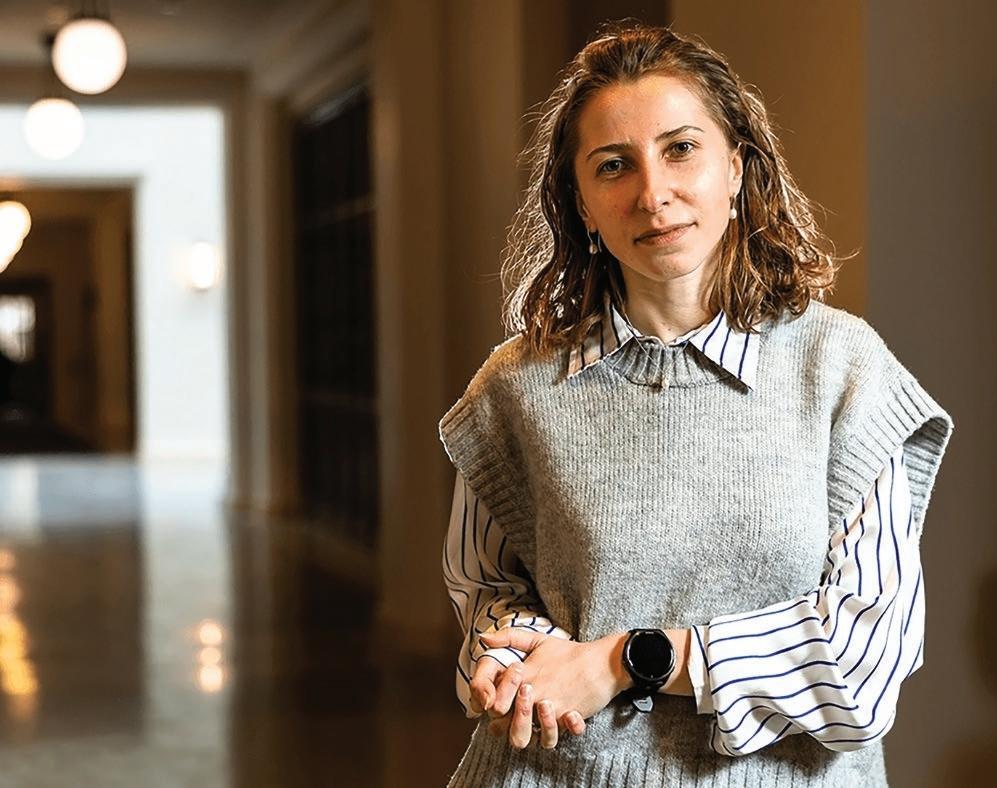
Khrystyna Kozak, a human rights lawyer specializing in displacement, was working for a nongovernmental humanitarian organization in Kyiv, Ukraine, on the morning of February 24, 2022, when Russian forces invaded the country from multiple directions.
As of May 2025, Kozak is now a graduate of the Keough School of Global Affairs’ Master of Global Affairs (MGA) program, having specialized in international peace studies. As part of the requirement for peace studies students through the Kroc Institute for International Peace Studies, Kozak completed a six-month internship in the Netherlands with the Register of Damage for Ukraine in 2024.
One of a handful of Ukrainians working for the register, Kozak was responsible for screening and evaluating claims and evidence submitted via Diia, a government-backed app that she and other Ukrainians use for a variety of state-sponsored functions.
Like most Ukrainians, Kozak views the war in existential terms. “It’s not a war about territory,” she said. “We’re fighting for our identity, for our right to live in our own country, to speak our own language, to not switch to Russian.”
Doctoral candidate Flora Tang honored with 2025 Catherine Mowry LaCugna Award
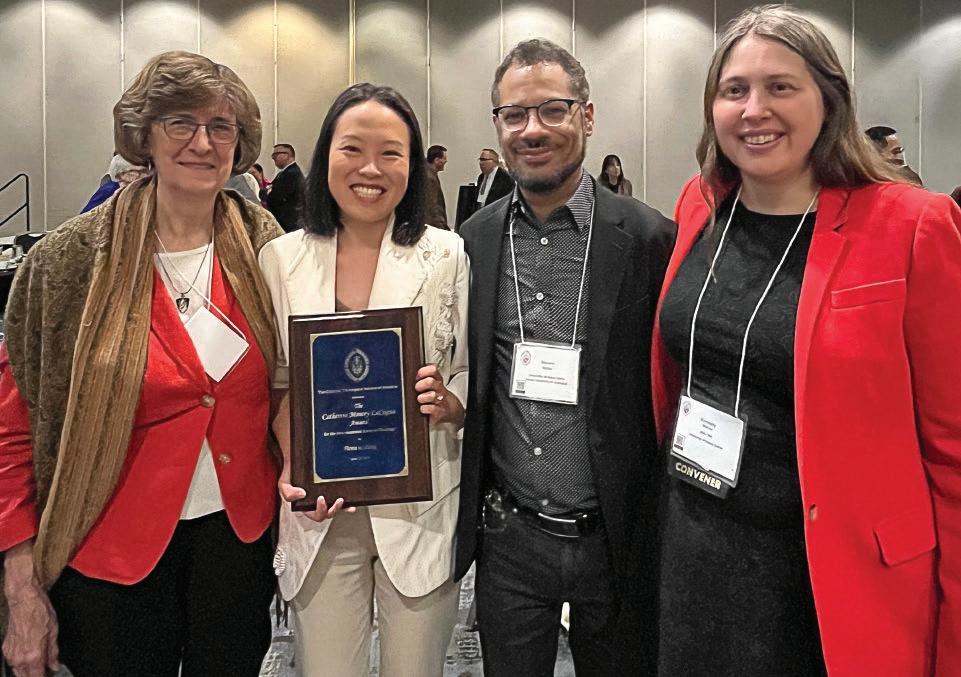
At its annual meeting in June in Portland, Ore., the Catholic Theological Society of America named Flora Tang, a peace studies and theology doctoral candidate at the University of Notre Dame, as the recipient of this year’s prestigious Catherine Mowry LaCugna Award. Named after the late Notre Dame theology professor Catherine Mowry LaCugna, the award celebrates the best academic essay from a new scholar in the field of theology within the Roman Catholic tradition.
“Every now and then, one encounters a scholarly argument that not only engages a particular question convincingly but also profoundly transforms the question itself,” said Rhodora Beaton, this year’s chair of the LaCugna Award Committee and a professor of systematic theology at the Oblate School of Theology in San Antonio.
“The selection committee found Flora’s essay to do just this on the tangled, contested issue of ecclesial sin.”
In her essay “From Ecclesial Sin to Ecclesial Han: Ecclesiology Beyond ‘A Church of Sinners and Saints,’” published in 2024 in Theological Studies, Tang engages
with feminist and decolonial theological critiques. She considers how those wounded by the institutional Catholic Church – including Indigenous populations, colonized populations, and other survivors of direct and structural violence – can be more centered in the contemporary Catholic theological imagination, especially in terms of how Catholic theology considers who is the Church.
“It was an honor and a great joy to have my work be affirmed in this way at the Society’s annual meeting,” said Tang, who celebrated the win with colleagues and peace studies alumni attending the gathering.
Tang is pursuing a joint doctoral degree with the Department of Theology and the Kroc Institute for International Peace Studies, part of the Keough School of Global Affairs at Notre Dame.
She is the recipient of the Louisville Institute Dissertation Fellowship in 2024-2025, the Notebaert Premier Fellowship from 2020-2025, and the John and Judy Scully Fellowship from 2020-2026.
Flora Tang (second from left)
Keough School establishes a new Ph.D. program in international peace studies, housed within the Kroc Institute
Since getting the greenlight from the University to launch a new doctoral program in international peace studies, the Kroc Institute has been busy throughout 2024-25 preparing to welcome its first cohort in fall 2025.
This new Ph.D. program is designed for individuals with professional experience in conflict resolution, education or human rights who wish to integrate their professional backgrounds and interdisciplinary knowledge into their doctoral research. It joins six other long-standing joint doctoral programs administered by the Kroc Institute in partnership with distinct disciplines: peace studies paired with anthropology, history, political science, psychology, sociology, and theology.
“We’ve been thrilled at the interest in the new program,” said Cat Bolten, a professor of anthropology and peace studies and the director of Doctoral Studies at the Kroc Institute, “and we’re delighted to have welcomed a very large cohort this fall for the program’s launch.”
All of the Kroc Institute’s doctoral programs are highly competitive in terms of acceptance. Out of 162 applicants to the new international peace studies program, five were chosen. Additionally, two joint degree students – one in peace studies and anthropology, and one in peace studies and theology –make up the collective fall 2025 cohort.
Finding peace through song: A student’s journey from the classroom to the stage
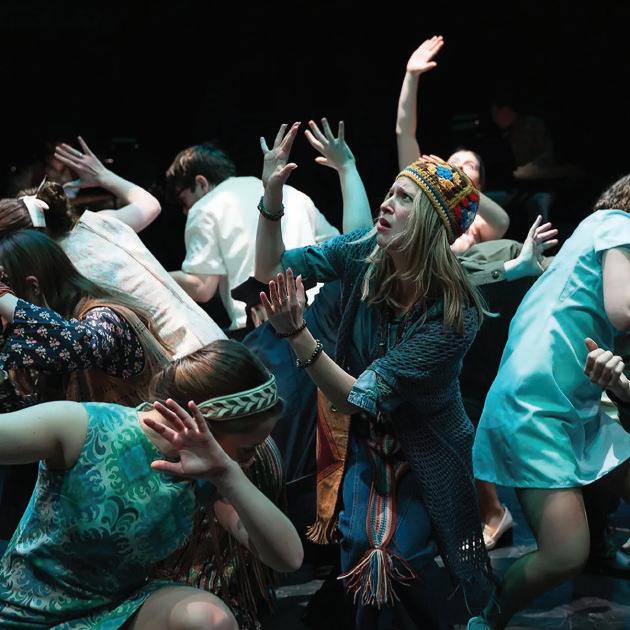
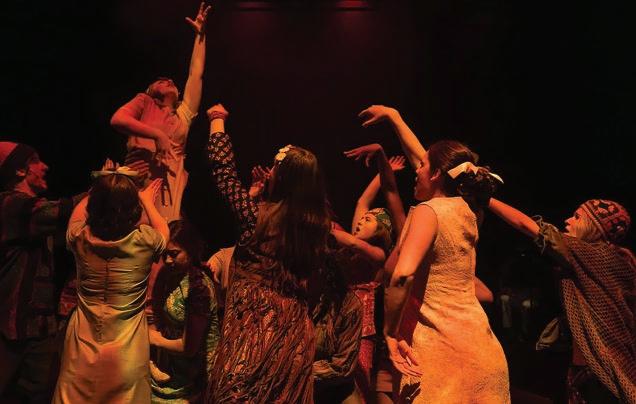
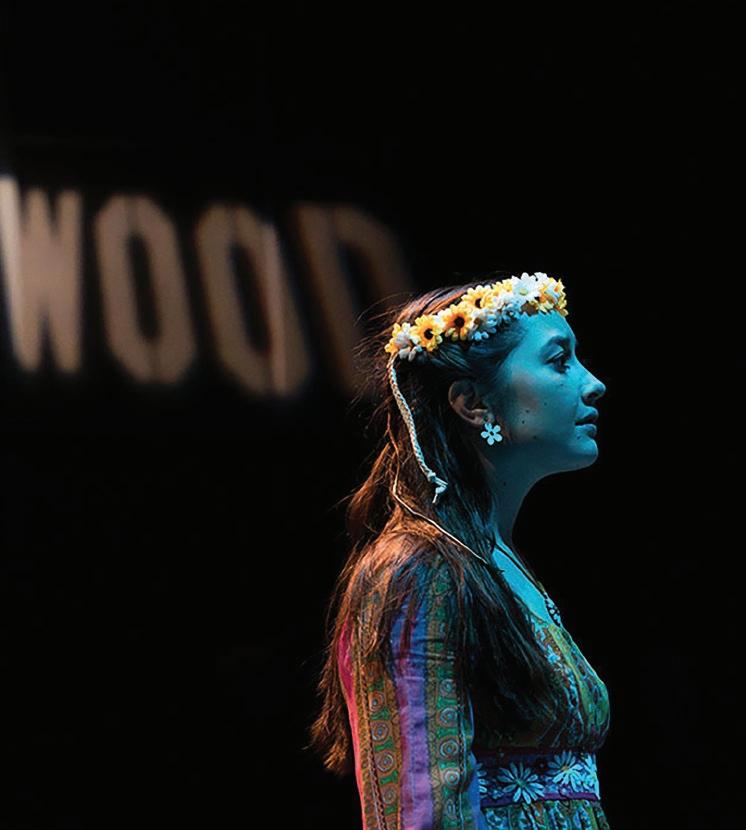
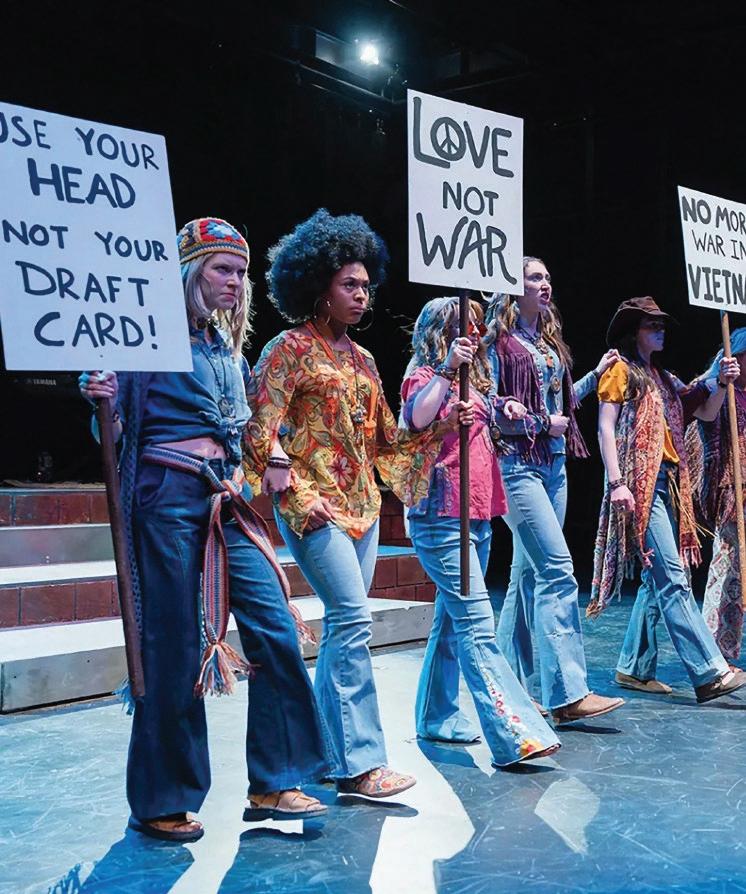
In a unique blend of art and activism, Olivia Seymour (B.A. ’25), a film, television, and theatre major and peace studies minor, recently wrote an original musical, “Heart on Fire,” as part of the University of Notre Dame’s musical theatre program. It premiered at DeBartolo Performing Arts Center early in the spring 2025 semester. Set against the backdrop of the 1960s, Seymour’s story explores sisterhood, social change, and the search for identity.
In this Q&A, she shares how her peace studies education helped shape the themes and spirit of her musical.
Q: Tell us what inspired you to write a musical in the first place.
SEYMOUR : I’ve always loved storytelling and music. I had this idea in my head—a kind of free-spirited, hippie girl—I just couldn’t let it go. I kept following the image and letting it grow into something bigger. The actual drafting of the musical came through my participation in a course called “Writing the Musical,” an elective offered every other year, usually in the fall semester, and designed for musical theater minors. At the end of the semester, we had the option to pitch it to the department, and it ended up being picked for the department show. The following fall semester, I took the same course, except its purpose was dedicated to workshopping my musical. I had 20 peers involved in my piece and workshopping with me to finish the full draft.
Q: What are some of the major themes your musical explores?
SEYMOUR: Sisterhood is at the heart of it—how two sisters see the world differently but still care deeply about each other. It’s also about finding your voice, especially as a young person during a time of upheaval. I tried to weave in themes of protest, personal growth, and hope, without making it feel too heavy. I wanted the audience to leave thinking about how we each respond to conflict in our own way, but also feeling inspired.
Q: How did your peace studies background influence the story you chose to tell?
SEYMOUR: It had a lot to do with it, honestly. I’ve taken courses on nonviolence, conflict resolution, and social movements— and all of that informed the way I built the characters and the world they live in. I really wanted to write something about the state of the world. That’s such a huge part of what we talk about in peace studies—looking at conflict, social justice, and how people find their place in movements for change. I knew I wanted the musical to center on sisters, but I also wanted to root it in a moment in history where people were grappling with a lot of the same questions we ask today: How do we respond to injustice? What does peace really look like? So, I set it in 1966 California, right at the start of the counterculture movement. One sister in the story is more radical and activist-minded, while the other is more hesitant to let go of the way things have always been. That tension—between action and reflection—is something we talk about a lot in peace studies.
Q: What’s next for you after this project?
SEYMOUR: I will be attending NYU to pursue my Master of Fine Arts in musical theatre writing. I love making theater—the shows that really speak to me are the ones that have something to say about the state of the world and where we’re at. Whatever I do, I hope it keeps combining creativity with purpose.
Olivia Seymour’s musical not only showcases her artistic talent but also reflects the spirit of peacebuilding and social consciousness. In blending storytelling with activism, she reminds us that change often starts with the stories we choose to tell.
Tre Goodhue
Tre Goodhue
The Convener
The Afghanistan Program for Peace and Development –informally known as AfPAD at the Kroc Institute – was founded in 2021 with a mission of working closely with individual practitioners, scholars, organizations, and governments to help build lasting peace in Afghanistan. Over the past year, the program has made quiet but significant strides to deliver on this goal.
Shortly after the new year, AfPAD was awarded a two-year grant from the Rockefeller Brothers Fund for $330,000. The grant runs through early 2027 and focuses on the program’s Dialogue and Visioning Initiative, a nonpartisan and decentralized effort led by mediation experts from Afghanistan. Aref Dostyar (M.A. ’16), AfPAD’s director, serves as a coalescer and facilitator for the effort, bringing those inside and outside of Afghanistan into the process to collaboratively shape a shared vision for the country’s peaceful future, and to build the strategy necessary to achieve this.
“Aref continues to have significant opportunities to play major roles in international policy toward Afghanistan –more than any other person I know at Notre Dame,” said Lisa Schirch, Richard G. Starmann Sr., professor of the practice of peace studies. “Aref has positioned Notre Dame as the leading university working on the future of Afghanistan.”
Since late last year, Dostyar has been invited to meet with several high level officials to discuss Afghanistan’s condition and needs, and to share strategy on how to create that peaceful future that drives AfPAD’s mission.
Aref Dostyar
In December, Dostyar and Stephen B. Heintz, president of the Rockefeller Brothers Fund, met with Rosemary DiCarlo, the Under-Secretary-General for Political Affairs at the United Nations. Other high profile meetings have included a gathering in Turkey for Dostyar and numerous Afghan leaders, followed by a visit to the United Kingdom, where he briefed the Foreign, Commonwealth and Development Office, which offers significant attention and funding to Afghanistan.
“Our charge is to mobilize a mass network of Afghans and create the conditions to enable a national dialogue for the country and its future,” said Dostyar. “Right now we don’t have the ability to bring all of the actors together, to talk and establish agreements.”
AfPAD is one of approximately 40 recipients of grant funding from the Rockefeller Brothers Fund related to the needs of Afghanistan. As part of its grant duties for the Dialogue and Visioning Initiative, AfPAD brings together grantees to share knowledge and build alliances. The Initiative features seven co-horts ranging from 12 to 25 members in each group. The cohorts are distinct in terms of their political ideologies, approach to change-making and peacebuilding, and their geographical locations. They represent the private sector, civil society, academia, and political arena.
This work builds off last year’s two-day colloquium in late April 2024, “Generating a Political Process in Afghanistan,” hosted on Notre Dame’s campus and organized by Dostyar in partnership with the United States Institute of Peace and the American Institute of Afghanistan Studies. The gathering attracted nearly 30 Afghan scholars, academics, and practitioners from around the world, who presented their research and papers and engaged in strategy and idea “incubation” with their professional counterparts.
“Our work is a respectful and inclusive process in spite
of the diversity of ideologies and backgrounds,” said Dostyar,
“because our goal is to collectively author a high level vision document that we stand behind, as we try to shape the future of Afghanistan together.”
In November 2025 Dostyar is headed to Muscat, Oman, where he and Mahan Mirza, teaching professor in the Keough School of Global Affairs and executive director of its Ansari Institute for Global Engagement with Religion – will co-host a workshop at the Al-Amana Center, in partnership with the Rockefeller Brothers Fund.
They will be joined by approximately 20 Ulema from Afghanistan – Muslim scholars specializing in Islamic sacred law and theology – to explore the significance of the concept of masleha in Islamic siasa, which can be described as public interests and benefits within the framework of Islamic law in matters of governance and administration. Their feedback will be integrated with that gathered from the co-horts, to seek and promote common ground among Afghanistan’s various communities for the country’s present and future.
“Given the social and political importance of the Ulema, their perspectives are vital in shaping a future path that is both rooted in Islamic principles and responsive to the current needs of the Afghan people,” said Dostyar.
Cultivating hope in a year of chaos
“The advent of a new administration in January and its numerous executive orders have caused drastic upheaval within international development and peacebuilding communities, both in the US and globally,” said Hayner. “This has resulted in job loss and distress for many of our alumni.”
The 2024-25 academic year was one of impact, good and bad, in the world of Anne Hayner. As the Kroc Institute’s associate director of alumni relations, Hayner is responsible for leading outreach efforts with more than 2,000 alumni sprinkled around the world. In light of global and political changes over the past year, Hayner found herself attending to external and internal needs of the Institute and alumni serving in peacebuilding capacities in government, non-governmental organizations, agencies, and businesses.
Association’s “Alumni Career Support Request Form” in March, the University has responded to more than 200 requests for assistance with career consultations, resume reviews, and guidance on the use of IrishCompass, the University’s career networking site.
To assist those impacted, Hayner has partnered with colleagues at the Keough School of Global Affairs, of which the Kroc Institute is part; the Notre Dame Alumni Association; and the University’s Center for Career Development to provide support and resources for affected alumni. In April, the Keough School organized a webinar, “Navigating Career Shifts: Expert Tips for Mid-Career Transitions.” with Caroline Korda Poole, a professional career coach and regular contributor to DevEx Careers. Hayner and McKenna Pencak, the School’s associate director of professional development and alumni engagement, facilitated the event, which attracted more than 100 registrants. Hayner and colleagues at the Notre Dame Alumni Association strategized responses to alumni needs and developed a response form for inquiries requesting career support. Since the launch of the Alumni
“Regularly connecting with our alumni is at the heart of our work,” said Hayner, “so that when a crisis hits, alumni know who to reach out to for support. Our relationships are built on trust.”
Meanwhile, Hayner carried out her “normal” work, “waving the flag” for the Kroc Institute and the Keough School by way of participating in key higher education meetings. For the NAFSA: Association of International Educators, Hayner serves as the founding president of the organization’s International Alumni and Advancement Member Interest Group. In this capacity, she traveled to Cincinnati in November, to host member meetings and attend NAFSA’s regional conference. In May, Hayner participated in the association’s national meeting, held in San Diego. There, she and three colleagues presented the session, “International Alumni and Advancement: Strategies & Best Practices,” as well as hosted additional member meetings.
Anne Hayner
In between these gatherings, Hayner zig-zagged between Chicago and Europe. She attended the annual International Studies Association (ISA) conference in March, which took place in Chicago. The Kroc Institute has historically hosted a reception at the ISA conference, but this year, the Keough School led the charge.Hayner and emeritus faculty member Bob Johansen connected with alumni, students, faculty and former fellows from Notre Dame, as well as colleagues from other institutions.
As soon as the ISA conference wrapped up, Hayner traveled to Rome to join the Notre Dame Alumni Association regional meetings made up of University alumni club members from Europe, the Middle East and Africa. Following this, she visited Geneva, Munich, Berlin and Dublin, where she hosted alumni gatherings and met with 19 additional alumni.
Hayner’s peacebuilding outreach included participation in PeaceCon, the annual conference organized by the Alliance for Peacebuilding (AFP), which took place in Washington, DC, in September 2024, and at which the Kroc Institute and AFP co-hosted a reception at the Keough School’s Washington office. She also led many efforts surrounding the visits to campus by Kroc Institute alumni – The Honorable Chernor Bah (M.A. ’11), minister of Information and Civic Education in Sierra Leone, who received the Kroc Institute’s Distinguished Alumni Award in September; Rosette Muzigo-Morrison (M.A. ’93), who gave a career talk on human rights law when she visited in November; and Fatima Shabodien (M.A. ’94), the Alumni Visiting Research Fellow during the spring 2025 semester.
“The year has been full and most definitely, tumultuous – and it’s cast a spotlight on partnerships and support systems on campus, as many of us have banded together to assist our alumni,” said Hayner. “I’m proud of our collective response – our alumni network is one of our greatest strengths and resources. Our alumni are family.”
Catholic Peacebuilding Network organizes global conference on peacebuilding and mining in Bogotá, Colombia
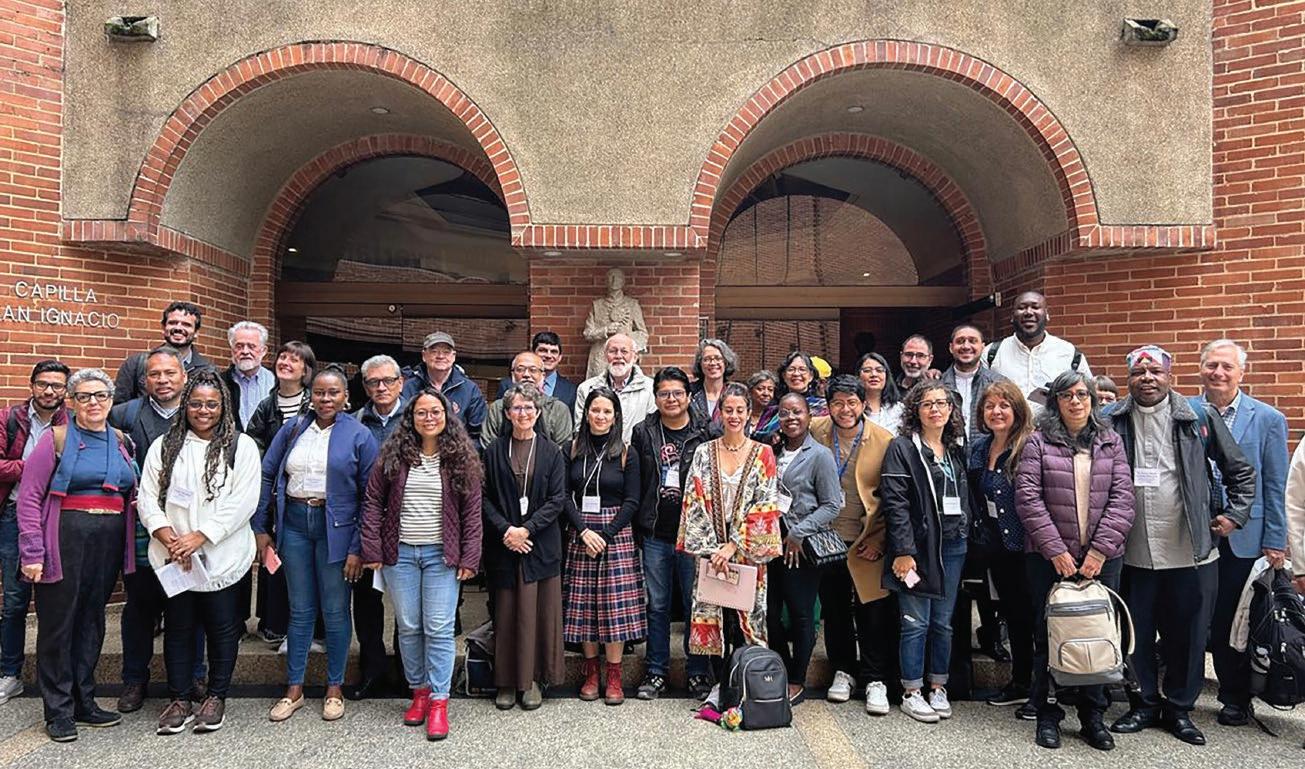
Nearly 60 attendees attended “Peacebuilding, Mining, and Integral Human Development,” a conference organized and led by the Catholic Peacebuilding Network (CPN), whose secretariat is at the Kroc Institute for International Peace Studies at the Keough School of Global Affairs. The event took place in Bogotá, Colombia, June 10-13, and was hosted by Javeriana University and its Alfredo Vásquez Carrizosa Institute for Human Rights and Peacebuilding, and the Colombian Episcopal Conference National Secretariat for Social PastoralCáritas Colombiana.
“The Catholic Church continues to play a major peacebuilding role in a number of the world’s intractable conflicts,” said Caesar A. Montevecchio, assistant director at CPN.
“We’re witnessing how peacebuilding work is becoming increasingly intertwined with issues of resource extraction, environmental violence, and backsliding on peace processes,” he said. “This presents new and complex challenges for achieving sustainable peace.”
The June conference tackled these challenges headon, offering Catholic peacebuilders the opportunity to compare notes on lessons learned and best practices with counterparts from around the world. Mining and
armed conflict, ecology, women’s leadership and the impact of mining on women, youth and employment, the capacity and power of ecclesial networks, the effect of the energy transition, and indigenous rights were among the topics addressed.
The gathering was truly international, with participants representing the Philippines, the United Kingdom, Vatican City, Canada, the United States, Mexico, Guatemala, Colombia, Ecuador, Peru, Brazil, and the Democratic Republic of the Congo.
“Much of the peacebuilding work led by the Catholic community is unheralded, under-resourced, and underanalyzed,” said Gerard F. Powers (M.A. ’88, J.D. ’86), director of the Kroc Institute’s Catholic Peacebuilding Studies and coordinator of CPN.
“Gathering a diverse group of leading Catholic peace builders to assess what works, what doesn’t, and what are good practices enhances the Church’s peacebuilding work. Together, we become more strategic and less reactive to situations that arise.
“That was the purpose of this conference – to foster networking and mutual learning regarding the unique challenges of peacebuilding, mining, and integral human development,” he said.
The conference also contributed to an exciting product underway: a framework document on Catholic engagement on mining and peace that CPN will publish in fall 2025 in collaboration with the Laudato Si’ Research Institute, Campion Hall, University of Oxford; the Holy See Dicastery for Promoting Integral Human Development; and Caritas Internationalis.
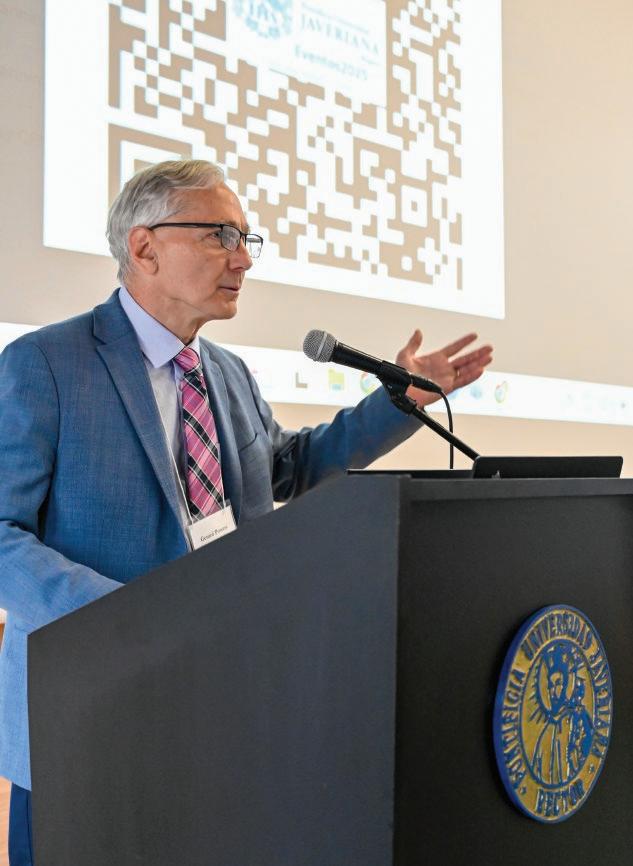
ABOVE: Participants in the “Peacebuilding, Mining, and Integral Human Development” conference.
LEFT: Gerard F. Powers speaks at the conference.
“The document is the result of a year-long consultative process concluding with the June conference, with Catholic actors and others defending communities and the environment in mining contexts across all continents,” said Montevecchio. “It is a privilege to be able to collaborate with the Laudato Si’ Research Institute and the Holy See on this project.”
The network of CPN is global, made up of 24 affiliated partners, including bishops’ conferences, academic institutions, and humanitarian and aid organizations. Its June conference was co-sponsored by the Laudato Si’ Research Institute, Campion Hall, University of Oxford; the University of Notre Dame’s Keough School of Global Affairs and its Kroc Institute for International Peace Studies and McKenna Center for Human Development and Global Business; Pax Christi International; the Southern African Bishops’ Parliamentary Liaison Office; and the Pulte Family Charitable Foundation.
Compassion + Action + Education = Positive Change
Connection, listening, empathy, voice, resolution, understanding…these are words that aptly describe the center of Laurie Nathan’s work as a mediator and as the director of the Kroc Institute’s Mediation Program. His professional focus is aimed at bringing conflict parties together, guiding them so they can sort out conflict in ways that create an amenable, healthy path forward. His work takes him around the world – to Switzerland, where he leads an annual high level mediation course for the United Nations, and to Norway, where he teaches a summer international mediation course for Ph.D. students – as well as to Notre Dame’s wider community of South Bend, where he has offered meditation training for violence prevention officers through the city’s Division of Community Initiatives.
So it was a serendipitous moment when Nathan happened to meet the co-founders of the locally based Connect2bethechange (C2BTC) through his wife at the South Bend Civic Theatre.
“I didn’t know Laurie was a peace studies professor,” said TaKisha Jacobs, who launched C2BTC in 2020 with Loria Perez who works at the Civic Theatre, as does Nathan’s wife, an actor there. “Once we met and learned about each other’s work, Laurie and I decided to get together, to determine how we could collaborate,” she said. “There was a natural affiliation.”
The goal of C2BTC is to decrease gun violence by creating and maintaining a sustainable peer-to-peer environment that encourages youth and young adults in South Bend to seek healing. Through counseling, therapeutic workshops, community service and immersive trips outside the city, participants build new and healthy social, emotional, and behavioral skills.
The nonprofit emerged from loss. Abdul Cross, Jacobs’ son, was just 15 when he died, killed by gun fire after being mistaken for someone else. Meanwhile, Perez lost two of her four sons to gun violence, in 2017 and again in 2020.
“Gun violence not only claims lives but also inflicts profound trauma, fear, anger, and mental health issues,” said Jacobs. “Our organization brings together a dedicated coalition of mothers, therapists, psychologists, teenagers, and young adults to address these challenges.”
The organization partners with other South Bend nonprofits, and Nathan saw opportunity in creating kinship between his mediation program and C2BTC and its network of contacts. He invited Jacobs to speak in his mediation class in the spring 2025 semester; she was excited at the possibility that she could recruit students interested in community outreach. It proved to be the perfect match.
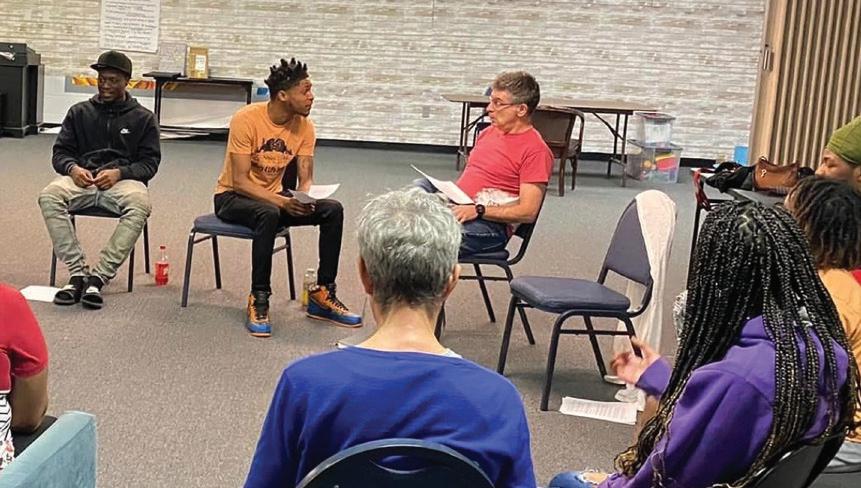
Sara Laine (far left) rehearses for the play.
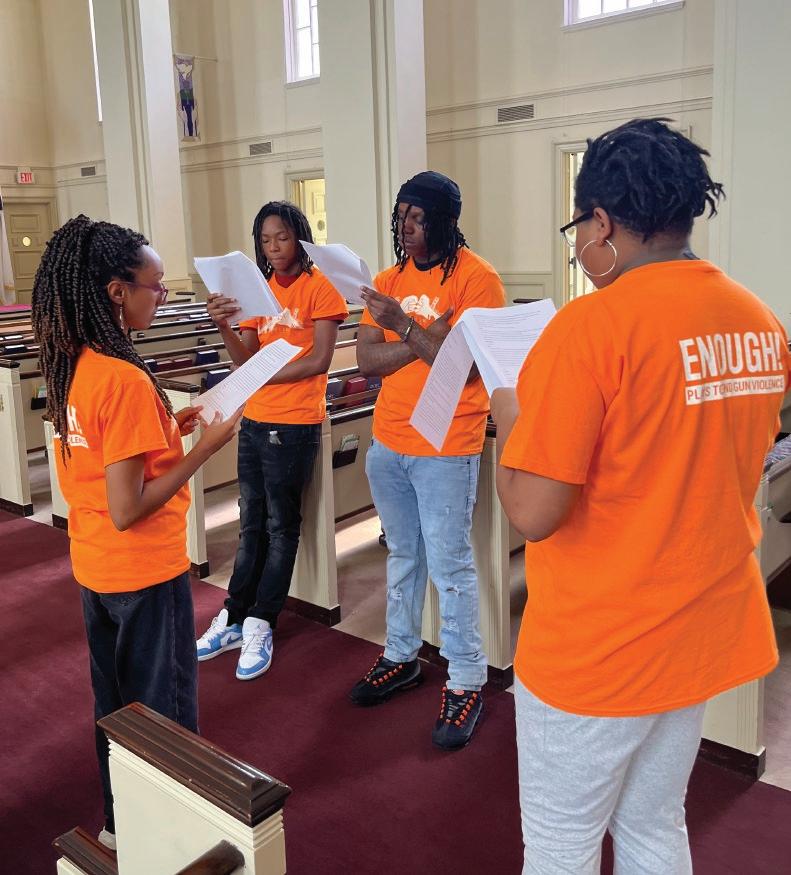
Three students in Nathan’s class – graduating seniors Aria Bossone and Clodagh McEvoy-Johnston, and Sara Laine (MGA ’25) who specialized in international peace studies – volunteered in the “Guns to Gardens” event in late March, a collaboration that included C2BTC and St. Joseph County’s “St. Joe’s Cares,” and took place at First Presbyterian Church in downtown South Bend.
“These are the kinds of opportunities that students can learn so much from,” said Nathan. “They get to think about and apply what they’ve learned in the classroom to a real-world setting. That’s some of the best learning there is – to connect with community leaders and activists in real time, listen and support them.”
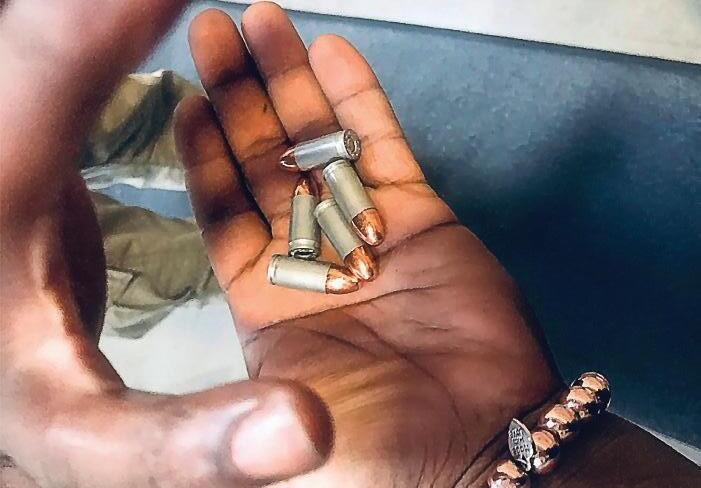
Guns from the South Bend community were collected and disassembled, with bullet casings from the guns beaded into bracelets by volunteers, including Nathan’s students. Inserted within each bracelet is the Isaiah 54:17 biblical verse – a promise of divine protection and vindication for God’s people, stating that no weapon formed against them will prosper, and any accusation against them will be condemned.
Plays and spoken word poetry were written and performed by local high school students, enabling participants to share their personal experience with trauma and loss due to gun violence. Parent cafes – tables with cafe seating – were set up, enabling adults and youth, parents and children, to talk about risk factors, care factors, and behaviors that they can be watchful of, as a means to take care of each other.
“The way TaKisha spoke about the program when she visited our class was so beautiful,” said Laine, who performed in one of the plays. “She centers the program in everything she does; in spite of her personal tragedy, she has taken the loss of her son and transformed it into an inspirational, positive force for the community.”
McEvoy-Johnson enjoyed volunteering, “particularly because I’m interested in grassroots activism, and because making bracelets with other volunteers was just a lot of fun.”
Added Bossone, “We should focus more on South Bend, meaning that students should have the chance to get off campus and integrate with the local community as part of our learning at the university. But we loved having TaKisha come to our class – so much so that we invited her to have a table as part of the student peace conference in April.”
Bossone was one of the co-chairs of the 2025 Notre Dame Student Peace Conference, which takes place each year in the spring semester. Jacobs set up shop at the conference, making bracelets onsite upon request. She raised nearly $2,000 from donations over the twoday event, enabling Jacobs to take her organization’s change agents – youth and young adult community leaders – to Washington, DC. There they met with other nonprofits working with marginalized communities, cultivated their curiosity, and imagined the future they see for themselves.
“The relationships I’ve developed at Notre Dame, in part through Laurie, are opening doors for my organization and helping to strengthen the support system for those in need, in South Bend,” said Jacobs. “ We’re doing this work together, and our connectivity and collaboration is critical to making South Bend a stronger, safer, and healthier place to live.”
LEFT: Bullet casings are strung into bracelets made by volunteers; RIGHT: Laurie Nathan works with C2BTC change agents.
Peace Accords Matrix deepens and expands dataset to assist the work of policymakers, practitioners and scholars
Spring 2025 was pivotal for the Peace Accords Matrix (PAM), a trusted resource for global peace research and home to the largest existing collection of implementation data on intrastate peace agreements (peaceaccords.nd.edu/data).
Two peer-reviewed journal articles, released back-toback in March and April, touted PAM research that was years in the making: release of the full dataset for PAM’s work in Colombia to monitor implementation of the country’s 2016 peace agreement, and the expansion of PAM’s overall implementation dataset, incorporating data on partial agreements and newly established comprehensive ones. Both articles are open-access.
“These journal articles are examples of our evidenceto-action research work,” said Josefina Echavarría Álvarez, director of PAM, which is housed at the Kroc Institute for International Peace Studies, part of the Keough School of Global Affairs at Notre Dame.
“Our research can guide the work of scholars, policymakers and practitioners on the ground who work to end conflicts and save lives. Putting this
evidence in their hands is critical to designing effective policies that will help societies escape the destructive cycles of violence and war.”
COLOMBIA BREAKTHROUGH
Since the signing of the historic 2016 peace agreement in Colombia, PAM has been responsible for the technical verification and monitoring of the agreement’s implementation. This is the first time a university-based research center has played such a direct role in supporting the implementation of a peace accord, and the first time researchers have measured the implementation of one in real time.
In March 2025, in the Journal of World Affairs: Voice of the Global South, the PAM team released the full Colombia dataset, including coding from the beginning of the peace accord implementation process in 2016, through November 2024. This complements the outcomes and analysis of data from the project that has been published regularly since the start of PAM’s work in the country.
“This is a huge stride forward for the project,” said Jason Quinn, research associate professor for PAM and lead author of the journal article.
Edwin Cubillos
Colombia
“Scholars and students now have access to the full data we have been collecting on Colombia. We’re able to provide coding rules for different commitment types as part of the peace accord, as well as implementation scores at various levels of aggregation. What we’ve found is a micro-level relationship between international accompaniment and the implementation levels of specific stipulations of the accord.
“It’s this kind of benchmarking that is helpful for researchers and scholars, and that creates new possibilities for engagement with key decisionmakers,” said Quinn.
EXPANDED DATASET YIELDS FRESH INSIGHTS
In a separate article running in the Journal of Peace Research in April, PAM announced the expansion of its overall implementation dataset, incorporating data on partial peace agreements and newly established comprehensive agreements.
Previously, PAM’s database offered qualitative and quantitative longitudinal data on the implementation of 34 comprehensive peace agreements negotiated between 1989 and 2012. Now, that library has expanded to 42 comprehensive peace accords and 236 partial peace agreements, negotiated between 1989 and 2020 and implemented until 2021.
And with this comes exciting, new potential for PAM.
“Thanks to the growth of this dataset we’ve uncovered findings that can inform the work of negotiators in various global contexts,” said Madhav Joshi, research professor and associate director of PAM and the article’s lead author.
Results show that partial peace agreements offer multiple strategic advantages. They can help negotiating parties consolidate incremental progress; serve as metrics for stakeholders and the international community; allow parties to test specific measures before fully committing to them; and signal a larger commitment to the peace process.
The new study provided a deeper look into how these agreements work, with researchers finding the following:
F A greater number of partial agreements is associated with higher implementation of comprehensive agreements.
F Generally speaking, it is a better strategy to pursue more partial agreements, even if this lengthens negotiations.
F Longer negotiations that do not produce partial agreements are never better than short negotiations.
“These findings suggest that partial peace agreements play an important role in building trust and strengthening relationships between negotiators to help peace processes succeed,” Joshi said.
The study also helped identify additional avenues for future research, which might explore why parties in some processes (but not others) pursue further partial agreements. Future studies could explain why some partial agreements are implemented immediately while others are not, and why only some partial accords reaffirm previous agreements.
“I am so proud of our PAM professors, Jason and Madhav, for their contributions and research,” said Echavarría Álvarez.
“Their collective efforts demonstrate what PAM is capable of: producing data and discoveries that support peace studies research, guide scholars pursuing this type of work, and elevate the likelihood of success for all kinds of peace agreements, worldwide.”
Learn how to support PAM’s efforts by visiting: peaceccords.nd.edu/support
Jason Quinn Josefina Echavarría Álvarez Madhav Joshi
Designing ethical technology to save democracy: Notre Dame researcher unveils policy blueprint to address online misinformation, polarization
Today’s social media environment threatens to rip the fabric of democracy and jeopardize self-governance in the United States and around the world, according to Lisa Schirch, a researcher at the University of Notre Dame. But she has worked with a team of more than two dozen technologists to identify a solution: Building prosocial technology that prioritizes trust, cooperation and problem solving.
Schirch, the Richard G. Starrman, Sr. professor of the practice of peace studies at the Kroc Institute, part of the Keough School of Global Affairs, shared these findings at Notre Dame’s National Convening on Social Media and Democracy, held in May 2025. Her findings are synthesized in a policy blueprint that builds on eight years of research and consultation by the Council on Technology and Social Cohesion, which Schirch cofounded.
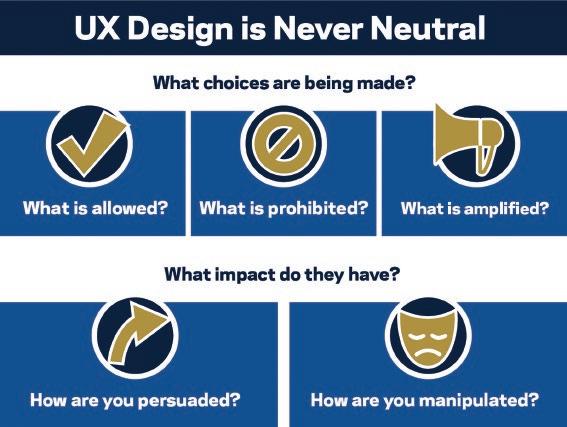
“Digital platforms are not neutral — their design influences human behavior,” Schirch said. “So it’s critical that we address major issues with current designs, which cause the misinformation, polarization and other public discourse issues that we experience on social media and ultimately undermine democracy.”
The gathering attracted government, industry and academic leaders who addressed the need to facilitate policy changes that can potentially redirect social media as a means to foster healthy civic engagement, improve understanding of political issues, build trust in public institutions, bridge divided viewpoints, and transform polarizing conversations.
User experience design choices drive toxic polarization, misinformation
According to Schirch, deliberate design choices prioritize profit at the expense of individual and societal well-being. These choices algorithmically amplify problematic content that preys on users’ fear and anger – and this leads to dire consequences.
“This profit-at-all-costs approach explains why people encounter and ultimately embrace online falsehoods, why they fail to exercise healthy skepticism when targeted by disinformation campaigns, and why they develop negative opinions about people who don’t share their political views,” said Schirch.
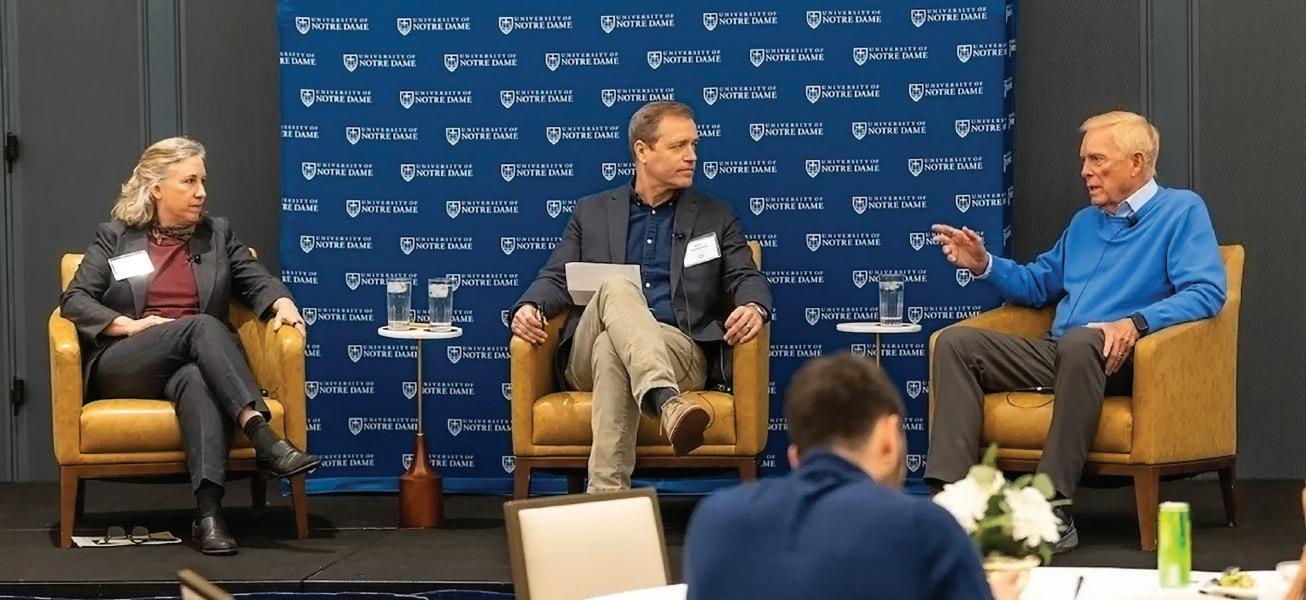
Fellow panelist Dick Gephardt, former U.S. House Majority Leader and co-chair of Issue One’s Council for Responsible Social Media, reinforced the urgency of finding solutions: “We are going to lose this democracy, in my humble opinion, unless we can pull this to a better place.”
Lisa Schirch
Using prosocial technology to strengthen civic engagement
How do policymakers address misinformation and polarization online? How can societies develop technologies that enable citizens to build trust and find common ground?
Schirch’s policy blueprint proposes solutions in three areas:
F Advancing prosocial technology design. Recommendations include implementing a tiered certification system that incentivizes platforms to be more mindful of their impact, and supporting third-party services that help mediate users’ relationships with technology platforms, giving them more control over their data.
F Providing foundational governance for digital platform research. Among the recommendations are requiring democratic oversight of platforms and audits to increase transparency on everything from content moderation to ad targeting to algorithmic recommendations, as well as developing a data standard for prosocial technology metrics.
F Shifting market forces to support prosocial design. Encourage competition by enforcing antitrust and anti-monopoly laws, codifying product liability for adverse effects of technology, and incentivizing and investing in prosocial technology.
The result, Schirch said, can be a more productive, less polarized public discourse that empowers citizens to find areas of agreement across party lines. This encourages collaboration to find workable solutions to major challenges.
Supporting Notre Dame’s broader democracy work
The policy blueprint draws upon Schirch’s earlier research on democracy and technology, which is part of larger University efforts to study and strengthen democracy. And faculty experts from across campus are supporting this work, including researchers from the Lucy Family Institute for Data and Society, the Notre Dame-IBM Technology Ethics Lab, the Rooney Center for the Study of American Democracy and the Kellogg Institute for International Studies, part of the Keough School.
Together, these experts intend to create an interdisciplinary and University-wide foundation for sustaining this work.
“Technology is a tool that can be used to either support or erode democratic institutions and practices, and the choice is up to us,” Schirch said. “Ultimately, I want this work to guide evidence-based solutions that strengthen the health of democracy worldwide.”
The policy blueprint was co-published by three organizations: the Council on Technology and Social Cohesion, which Schirch co-founded; the Peacetech and Polarization Lab that Schirch directs, housed within the Keough School’s Kroc Institute for International Peace Studies; and the Toda Peace Institute, where Schirch is a senior research fellow.
Lisa Schirch participated in a campus panel on social media and democracy along with Nick Penniman (center), founder and CEO of Issue One, and former U.S. House Majority Leader Dick Gephardt (right), co-chair of Issue One’s Council for Responsible Social Media.
News, Initiatives and Signature Events
Kroc
Strategic Peacebuilding 2:0 – An Evolution
The Kroc Institute kicked off a new initiative this year, Strategic Peacebuilding 2:0. Its goal is to reimagine strategic peacebuilding as an evolving, transdisciplinary framework that addresses new developments in peace research in response to contemporary challenges.
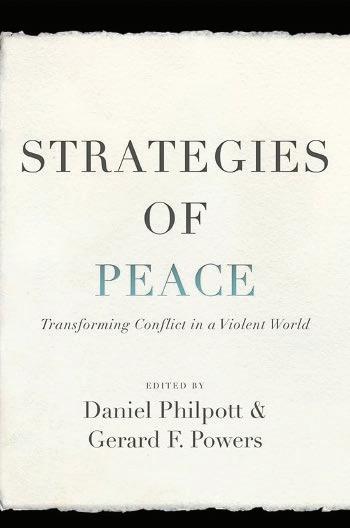
The Initiative is building on the foundation laid by the Kroc Institute’s fielddefining book, Strategies of Peace: Transforming Conflict in a Violent World (Oxford University Press, 2010). One of the Initiative’s first efforts is the collection of nearly 20 essays from Kroc Institute faculty, staff and students, to be published online. Contributors have sought either to define strategic peacebuilding from their perspective, or based on their perception, to describe their pedagogical approach to incorporating it within the classroom.
Institute hosts a
double-header event to celebrate International Day of Peace and its annual Distinguished Alumni Award
Each year the Kroc Institute pays heed to the International Day of Peace (IDOP), established in 1981 by the United Nations General Assembly, by way of an event or panel discussion. The Institute also honors a Notre Dame graduate in peace studies annually with the Distinguished Alumni Award – someone whose career and life exemplifies the ideas of international peacebuilding.
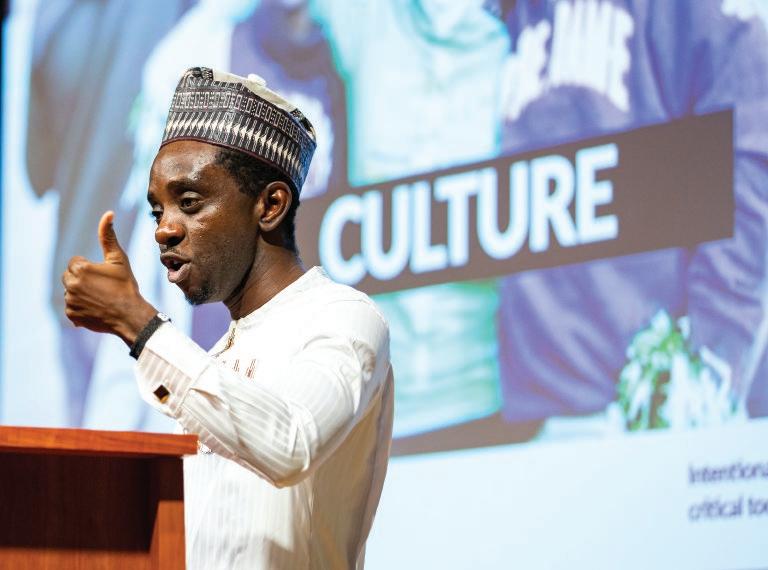
In September 2024 the Institute merged the two celebrations, honoring IDOP with a special presentation from one of its own – The Honorable Chernor Bah (M.A. ’11), Minister of Information and Civic Education in Sierra Leone, who received the Distinguished Alumni Award.
Bah’s presentation, “Intentional National Consciousness as a critical tool for long-term Peacebuilding - A Sierra Leone case study,” addressed his professional trajectory since graduating from Notre Dame with his master’s in peace studies, his current ministerial work with civic education related to cultural renaissance and decolonization, and the mindset shift necessary to rediscover our sense of identity and to see each other’s humanity.
ABOVE: The Honorable Chernor Bah (M.A. ’11)
BELOW: The Honorable Chernor Bah (M.A. ’11) and Anne Hayner.
External Review Committee hosted by the Kroc Institute
The
Every seven years an Institute hosts an external review committee made up of academics from peer institutions in the U.S. and sometimes overseas. The purpose of such visits is to examine the current state of an Institute’s research, teaching and practice from an external perspective, to enhance productivity and uncover opportunities. Spring 2025 marked the Kroc Institute’s external review visit by a three-person committee: Edward Brantmeier from James Madison University in Virginia; Karen Brounéus from Sweden’s Uppsala University; and Darren Kew from the University of San Diego and its Joan B. Kroc School of Peace Studies. Committee members visited the Notre Dame campus, where they met with and interviewed Kroc Institute faculty, staff and students and Keough School and University leadership over a three-day period. The committee recognized the leadership position of the Kroc Institute in the field of peace studies and made suggestions for operational improvement to its educational, research and policy work. In consultation with Mary Gallagher, the Marilyn Keough Dean of the Keough School, Kroc Institute administrators are determining which recommendations to pursue over the next seven years, in partnership with the Keough School and the Office of the Provost.
Honorable Emilce Cuda headlines the
26th Annual Dialogues on Nonviolence, Religion, and Peace
“Sign of the Times: Interdisciplinary Responses to Religious Nationalism, Neofeudalism, and Hope” was the focus of the Kroc Institute’s Dialogues on Nonviolence, Religion, and Peace in March 2025, which marked the event’s 26th year.
The presentation was delivered by The Honorable Emilce Cuda, who serves as Secretary of the Pontifical Commission for Latin America at the Holy See. A renowned international speaker, Cuda has published extensively on social moral theology, democracy and Catholicism in liberal contexts, theology of the people and culture in a Latin American context, economic migration, and the socioenvironmental ecological crisis.
The Dialogues on Nonviolence, Religion, and Peace, which began in 1999, were established through a gift to the Kroc Institute from Mrs. Anne Marie Yoder and her family. Each year, the Kroc Institute invites a leading thinker, writer, scholar, and/or peace advocate to deliver a lecture related to nonviolence, religion, and peace. Following the lecture, audience members join in informal dialogue and discussion with the speaker and each other.
The Honorable Emilce Cuda
Harvard’s
Danielle Allen takes center stage for the Kroc Institute’s 31st Annual Hesburgh Lecture in Ethics and Public Policy
Renowned for her work in the arenas of political philosophy, ethics, and public policy, Harvard University professor and author Danielle Allen was tapped as this year’s speaker for the 31st Annual Hesburgh Lecture in Ethics and Public Policy. The event, which took place in March 2025 and attracted more than 200 attendees, was co-sponsored by the Office of the President and part of the Notre Dame Forum series.
In “Bringing Democracy Back from the Brink: A Strategic Vision and a Call to Action,” Allen presented her thoughts on how Americans can repair the country’s fractured democracy: that the path to health lies in re-building a supermajority of people—of all political ideologies—ready to work together to support constitutional democracy.
Allen was the 2020 winner of the Library of Congress’ Kluge Prize, which recognizes scholarly achievement in disciplines not covered by the Nobel Prize, and received the honor “for her internationally recognized scholarship in political theory and her commitment to improving democratic practice and civics education.”
The annual Hesburgh Lecture in Ethics and Public Policy, established by the Kroc Institute for International Peace Studies in 1995, honors the Rev. Theodore M. Hesburgh, C.S.C., president emeritus of Notre Dame, a global champion of peace and justice, and the founder of the Kroc Institute. Each year a distinguished scholar, policymaker, and/or peace advocate is invited by the Kroc Institute director to deliver a major lecture on an issue related to ethics and public policy in the context of peace and justice.
Asher Kaufman (left) and Mary Gallagher, Marilyn Keough Dean of the Keough School (right), flank featured guest Danielle Allen (center).
“Unified
Paths for Peace:
Empowering Collaborative Peacebuilding,” the theme of this year’s student-led annual peace conference
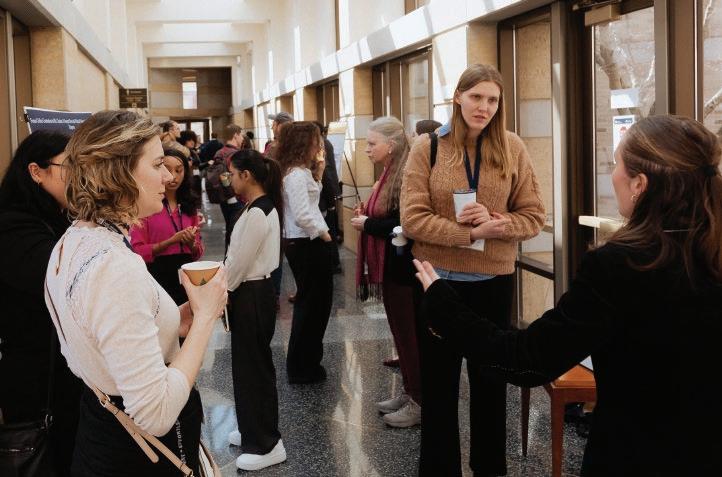
The annual Notre Dame Student Peace Conference attracts undergraduate and graduate students from across the U.S. and abroad who want to change the world and who are committed to rigorous academic work on peacebuilding, social justice, and conflict transformation.
The planning process each year is led by conference leadership fellows, selected in the fall semester through an application process open exclusively to peace studies undergraduates. Over the course of eight months, they work closely with staff and faculty at the Kroc Institute on all aspects of the conference, from concept to event logistics. The conference, which takes place during the spring semester, enables student participants to present original research, showcase innovative practices, and network with peers who share their passion for peace.
This year’s event took place in April and offered a theme that explored how collaboration across scholarly disciplines and areas of practice not only broadens and enriches the field of peace studies, but also unifies peacebuilders behind a common goal. Graduating seniors Aria Bossone (B.A. ’25) and Eva Garces-Foley (B.A. ’25) co-led the 2025 conference, which attracted 166 attendees. Collectively, 31 nations were represented, as well as more than 30 different institutions.
The conference organizers found themselves in the midst of a storm, given the cancellation of one of the keynote addresses by University leadership. Bossone and Garces Foley pivoted and organized a replacement panel, “Democracy, Censorship, and Academic Freedom: How Did We Get Here, and Where Are We Going?,” to address the cancellation and the chilling effect of the Trump administration on free speech and academic freedom on U.S. campuses. Notre Dame professors Pam Butler, Ann Mische, and Atalia Omer participated in the discussion.
One of the many generous gifts that Joan B. Kroc provided to the Kroc Institute was an endowment to fund this conference. As a result of her generosity and the ongoing support of the Kroc Institute, registration is free for any interested student, and materials and meals are provided.
Kroc Institute
hosts annual
“Walk the Walk Week” event, moderated by Dr. Gwendolyn Purifoye
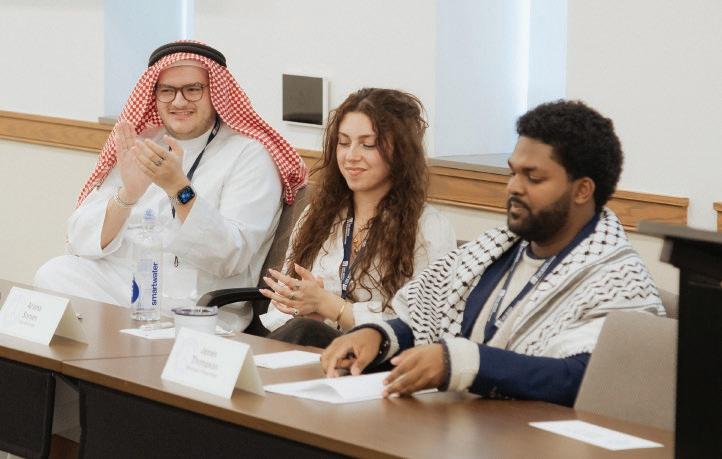
“Heal the Land: Addressing U.S. and Global Racism and Anti-Blackness to Chart Pathways to Peace” was the topic for this year’s panel, part of the University’s annual “Walk the Walk Week” series of events in January.
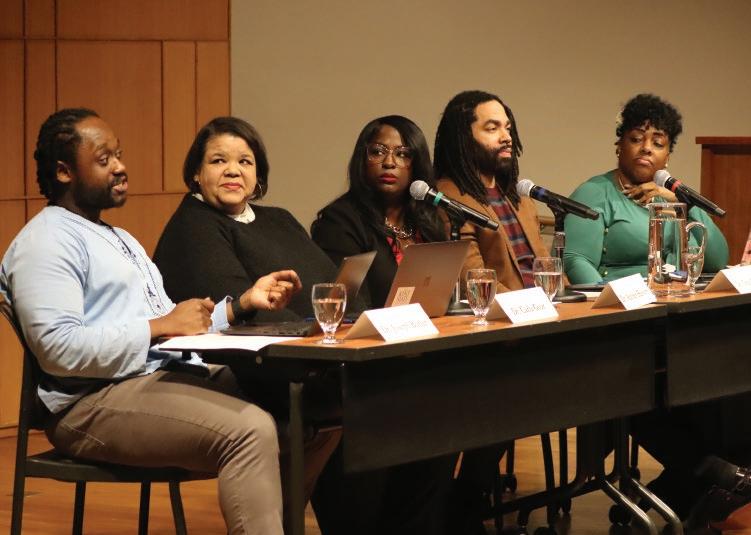
Dr. Gwendolyn Purifoye, assistant professor of racial justice and conflict transformation, offered opening remarks, then turned over the discussion about racial justice and anti-Blackness to panelists who explored the far-reaching impacts of systemic, institutional, and organizational racism. The panel featured Dr. Joseph Butler, assistant dean for Access, Diversity and Inclusion, Princeton University; Dr. Carla Goar, professor in the Department of Sociology and Criminology, Kent State University; Dr. Amber Hewitt, counseling psychologist and racial equity practitioner; and Dr. Greg Wilson, assistant professor of management and public affairs, The Ohio State University.
ABOVE ( from left to right): Joseph Butler, Carla Goar, Amber Hewitt, Greg Wilson, and Gwendolyn Purifoye.
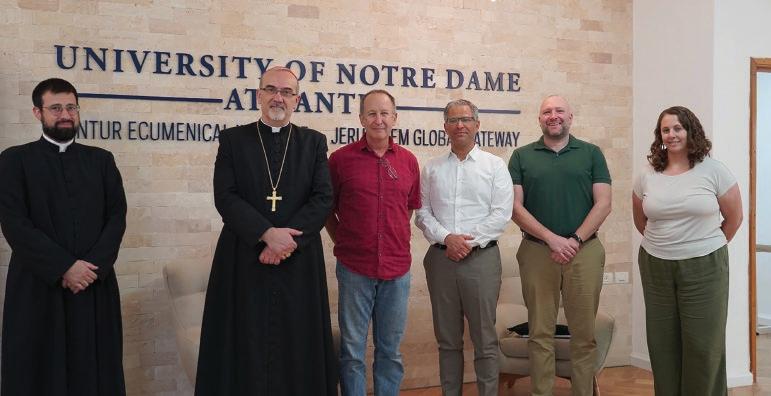
RIGHT (from left to right): Chancellor of the Latin Patriarch of Jerusalem Rev. Davide Meli; Latin Patriarch of Jerusalem His Beatitude Cardinal Pierbattista Pizzaballa; Asher Kaufman; Daniel Schwake, executive director, Notre Dame Jerusalem; Gabriel Mitchell, director of Undergraduate Studies, Notre Dame Jerusalem; and Alyssa Paylor.
Kroc Institute represented in talks about the role of language in conflict zones
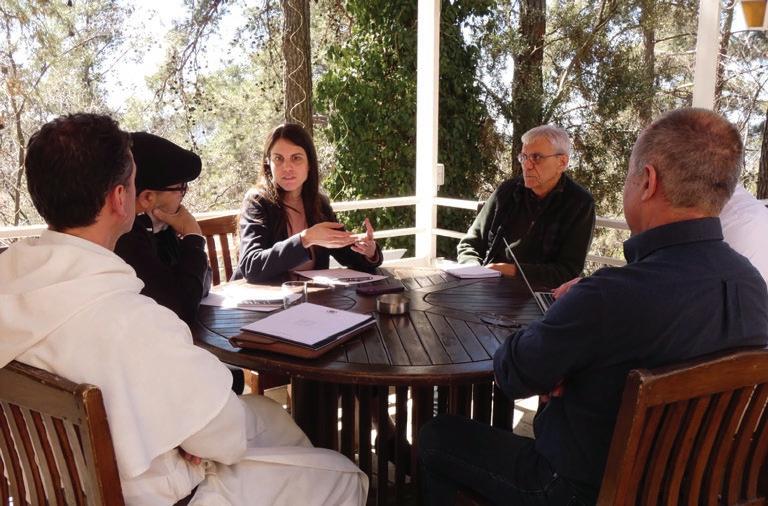
A collaboration with the Latin Patriarch of Jerusalem, His Beatitude Cardinal Pierbattista Pizzaballa, that began in June 2024 continues to bear fruit for the University and many of its units, including the Kroc Institute. In March 2025, Notre Dame Jerusalem convened a workshop – “The Role of Language in the Israeli-Palestinian Conflict” – that included Kroc Institute Director Asher Kaufman, as well as Clemens Sedmak, director of the Nanovic Institute for European Studies, and the Tantur Ecumenical Institute, in addition to the Cardinal. The event was held in the Republic of Cyprus and brought together scholars from the fields of social ethics, memory studies, Middle East history, theology, law, and politics to address the role of language in conflict zones and its impact on conflict transformation, specifically in Israel/Palestine. Also representing the Kroc Institute were Laura Miller-Graff (B.A. ’08), a professor of psychology and peace studies, and Alyssa Paylor (Ph.D. ’25), now a postdoctoral research fellow. The project’s next workshop is planned for December 2025, again in Cyprus.
Visiting Research Fellows join the Kroc Institute throughout the year
Each year, the Kroc Institute hosts a handful of visiting research fellows. Some join the Institute for a semester, while others stay for a full academic year. Over their time with the Institute, they pursue a variety of projects depending on their focus and discipline – independent research, writing books, exhibits or performances, presentations and panels.
Fellows over the 2024-25 academic year were: Liridona Veliu Ashiku (fall 2024); Jessica Doe (née Mehta, Tyner) (academic year 2024-25); Banafsheh Keynoush (academic year 2024-25); Anselm Nwoke (spring 2025), a Kroc Institute-Catholic Relief Services fellow; and Fatima Shabodien (M.A. ’94, spring 2025), the alumni visiting research fellow.
Notre Dame Day 2025 raises funds for Kroc Institute causes
Now in its 12th year, Notre Dame Day 2025 took place April 29 and 30, marking a two-day window when the University’s advocates around the world join together to support their favorite Notre Dame causes.
The Kroc Institute threw the spotlight on two of its programs for this year’s ND Day fundraiser, with all proceeds raised helping to advance both programs:
F The PeaceTech and Polarization Lab, a hub for research to identify and explore digital technologies that support social cohesion, with hands-on help from Notre Dame students; and
F The Peace Accords Matrix program, whose work to monitor the implementation of peace accords in Colombia and the Philippines supports vulnerable communities transition from war to peace.
Two fun-filled days brought in nearly $4,000 for the Kroc Institute and these two programs!
Josefina Echavarría Álvarez, director of the Peace Accords Matrix program.
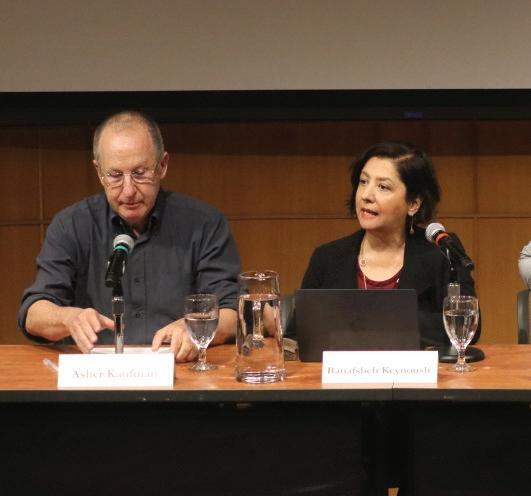
Asher Kaufman and Banafsheh Keynoush.
ABOVE (from left to right): Liridona Veliu Ashiku, Josefina Echavarría Álvarez and Monica McWilliams.
Awards, Grants and Accomplishments
Kroc Institute Research Grants Awarded to Faculty and Faculty Fellows
In 2024–2025, Kroc Institute grants were awarded to:
Richard (Drew) Marcantonio (Ph.D. ’21, M.A. ’18) , assistant professor of environment, peace, and global affairs
PROJECT: “Evaluating the Possibilities of Military Engagement in Regenerative Peacebuilding”
$5,000
Gerard (Jerry) F. Powers (M.A. ’88, J.D. ’86) , professor of the practice; director, Catholic Peacebuilding Studies program; and coordinator, Catholic Peacebuilding Network (CPN)
PROJECT: To translate CPN research into a policyrelevant guidance document, “Catholic Approaches to Mining: Guidelines for Reflection and Planning”
$5,000
Lisa Schirch,
Richard G. Starmann, Sr. professor of the practice of peace studies
PROJECT: For student support to help capture and codify best practices in using deliberative technology in highly polarized contexts
$5,000
Victoria Tin-Bor Hui, associate professor in the Department of Political Science
PROJECT: “Hongkongers in Exile: Resisting Repression from Home Government and Surviving AntiImmigration in Host Country”
$5,000
Kroc Institute Wins Grants and Funding Opportunities
Afghanistan Program for Peace and Development (AfPAD)
Rockefeller Brothers Fund –
$330,000 over two years, to early 2027, to support AfPAD’s Dialogue and Visioning Process initiative with mediation experts from Afghanistan.
Peace Accords Matrix (PAM)
Humanity United –
$203,000 from August 2024 to December 2025, to support the Legacy Project, which seeks to preserve the digital archive of the Colombian Truth Commission.
Faculty Tapped for 2024-2025 University of Notre Dame Research Grants
Learning from the boycotts of the past
Ashley Bohrer, assistant professor of gender and peace studies with the Keough School’s Kroc Institute, was awarded a $100,000 grant that runs through August 2027 in support of a book project, We Don’t Buy It: A Global Study of Boycott in Theory and Practice. Bohrer, who is also a concurrent faculty member in the Gender Studies Program, will conduct archival research to construct a comprehensive history of the theory and outcomes of boycott movements around the world. As boycotts and protests become more common globally, Bohrer’s project will look to the past to inform consumer decision-making in the present.
Evaluating the impact of mediator empathy in conflict resolution
Laurie Nathan, professor of the practice of mediation and director of the Mediation Program at the Keough School’s Kroc Institute, received a one-year $10,000 grant in support of the project, “Exploring the Impact of Mediator Empathy on Conflict Parties’ Receptiveness to Mediation.” Nathan will be joined by Joel Devonshire, a Ph.D. graduate and former postdoctoral fellow, and two Ph.D. students, Ade Okanlawon and Seham Kafafi, to investigate the effects of various levels of mediator empathy on the conflict parties’ willingness to engage in mediation. As success in mediation hinges on the parties’ willingness to accept the mediator and consent to the process, Nathan’s project is particularly concerned with the psychological effects of different mediator approaches.
Faculty Wins Notre Dame Poverty Initiative Grant
Congratulations to Laura Miller-Graff (B.A. ’08), a professor of peace studies and psychology and the director of the William J. Shaw Center for Children and Families! She and Kristin Valentino, a professor of psychology and director of the Veldman Family Psychology Clinic, won a multi-year investment as part of the University’s Poverty Initiative. They will co-lead a project that integrates multiple types of longitudinal data collection into an ongoing study of the effects of housing instability on child maltreatment and intimate partner violence. The three-year grant totals $269,699.
Making the Case for Restorative Justice
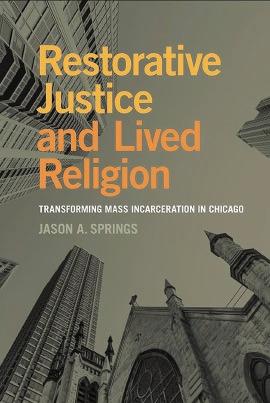
Jason A. Springs, professor of religion, ethics and peace studies, released a book in 2025, Restorative Justice and Lived Religion: Transforming Mass Incarceration in Chicago. In it, Springs argues that restorative justice can challenge and successfully transform systemic injustices inscribed in U.S. mass incarceration. The Kroc Institute hosted a book launch with a panel of scholars and practitioners focused on issues of racial and social justice, who discussed the book’s contribution to further the practice and scholarship on how to resist, build an alternative to, and altogether transform U.S. mass incarceration.
Laurie Nathan
Ashley Bohrer
Jason A. Springs
Laura Miller-Graff
Ph.D. Honors and Accomplishments
Elsa Barron (B.S. ’21) peace studies and political science
Attended the Conference Of Parties (COP) climate negotiations meeting in Baku, Azerbaijan in November 2024, for both research and advocacy purposes. She was quoted in the UK publication Church Times, in her role as co-director of the activist group Christian Climate Observers Program, calling on well-resourced countries that have contributed most to the climate crisis, to provide financial support to countries impacted by climate change.
Razan Bayan – peace studies and history
Published the article, “Muslim youth collective amnesia of US government-inflicted violence against Muslims in the War on Terror” in the journal Ethnicities, discussing the failure of collective memory formation in the United States regarding the atrocities at Abu Ghraib and Guantanamo Bay.
Published a summary of her Ethnicities article on the website of Cage International, a British nongovernmental organization dedicated to exposing injustices relating to the Global War on Terrorism.
Ben Francis – peace studies and political science
Published a piece in Duck of Minerva that offered an indictment of states’ use of climate commitments to advance foreign policy goals, a phenomenon, he argues, that politicizes and undermines the possibility of a just transition to a sustainable world.
Won a $10,000 research award from the Kellogg Institute, part of the Keough School of Global Affairs, to conduct research on environmental justice in Puerto Rico.
Francesca Freeman – peace studies and history
As part of the 2024 Peace and Justice Studies Association conference, presented the paper, “Until We Are All Free: Zionism, Palestinian Liberation, and Intersectionality in the Women’s March.”
Presented a similar paper at the Institute for Critical Zionism Studies Student Workshop in August 2024.
Presented the paper, “US Policy on an International Police Force, 1947-1948,” at the Middle Eastern Studies Association Conference.
Cat Gargano – peace studies and psychology
Was selected as a Fulbright-John Lewis Civil Rights Fellow for the academic year 2024-25, to support her work with migrant communities in Mexico.
Isabel Güiza-Gómez –peace studies and political science
Co-authored the paper, “Land Dispossession Trial: Claim-Making and Judicial Behavior in the Colombian Land Restitution Program,” which she presented at the 2024 La Red para el Estudio de la Economía Política de América Latina (Network for the Study of Latin American Political Economy) conference, and won the Best Paper award.
Julie Hawke – peace studies and sociology
Was one of the authors of “Understanding to Intervene: the Co-Design of Text Classifiers with Peace Practitioners,” published in the journal Data and Policy, which made an innovative argument for participatory approaches to methods of data coding of social media content. Data and Policy is a Cambridge University Press journal.
Co-authored a commentary piece about data science that has been accepted for publication in Data and Policy
Will O’Brien – peace studies and history
As part of the 2024 Peace and Justice Studies Association conference, presented part of his work as a graduate research fellow with the Notre DameIBM Tech Ethics Lab in the paper, “The Analog Ethics Project: Historical lessons for mitigating technological injustices.”
Raege Omar – peace studies and political science
Was accepted as a graduate justice fellow at the Institute for Social Concerns. This has allowed him to work across disciplinary boundaries with graduate students, faculty and leaders across the University, developing new research agendas on the issue of justice.
Joachim Ozonze – peace studies and theology
Was invited to moderate a discussion on “Nonviolence in Action” as part of the Catholic Nonviolence Initiative’s fall 2024 series of panel discussions, a program of Pax Christi International, which is a global movement dedicated to promoting active nonviolence as a core principle of the Gospel.
Was certified as a drug addiction recovery coach by the International Certification & Reciprocity Consortium, enabling him to further integrate practice and research in his study of drug addiction and violence in Nigeria.
Alyssa Paylor – peace studies and anthropology
Organized and chaired the first in a series of research seminars tackling the topic of “US Imperialism in the Middle East.” Sponsored by the Kroc Institute and the Liu Institute for Asia and Asian Studies, also part of the Keough School of Global Affairs, the first talk featured Lisa Bhungalia from the University of MadisonWisconsin, followed by a second presentation from Purdue University’s Kali Rubaii.
Sean Raming – peace studies and history
Published an article, “The 1967 Russell Tribunal and transatlantic anti-war activism,” in the Journal of Transatlantic Studies, offering a timely re-evaluation of the impact of one anti-war protest initiative on public opinion during the Vietnam War era.
Co-authored “Peace from Food: Refugee Kitchens in the U.S.,” which was published in Peace Chronicle, the publication of the Peace and Justice Studies Association, in summer 2024.
Debora Rogo – peace studies and history
Organized and moderated a virtual panel in August 2024 on the current social movement in Kenya with three Notre Dame alumni from Kenya (Sr. Dr. Edelquine Shivachi, and Keough School graduates Nancy Obonyo and Halkano Boru), and in partnership with various campus groups including Pamoja ND Africa Initiative, ND Global, ND East Africa Club, and the African Graduate Club, as well as the Kroc Institute.
Flora Tang – peace studies and theology
Published a reflection on her anti-war activism in the New Ways Ministry, putting into conversation the Catholic Church’s response to the war in Gaza and its stance on LBGTQ+ issues.
Presented a paper, “Diasporic Bodies, Indigenous Land: A Decolonial Ethics of Asian Bodies in Protest,” at the American Academy of Religion conference in November 2024.
Was the recipient of the prestigious Catherine Mowry LaCugna Award by the Catholic Theological Society of America at its annual meeting in June 2025. Named after the late Notre Dame theology professor Catherine Mowry LaCugna, the award celebrates the best academic essay from a new scholar in the field of theology within the Roman Catholic tradition.
Ph.D. alumni news
Helal Mohammed Khan (Ph.D. ’ 24)
peace studies and anthropology
Was awarded the Peace and Justice Studies Association prize for the Best Graduate Thesis in 2024. Khan is an assistant teaching professor at Georgetown University.
Joséphine Lechartre (Ph.D. ’ 24)
peace studies and political science
Was awarded the 2025 Gabriel A. Almond Award presented annually by the American Political Science Association to honor the best doctoral dissertation in the field of comparative politics. Lechartre is doing post-doctoral work at Tulane University.
Kroc Institute of International Peace Studies
Master of Global Affairs, International Peace Studies
Student Honors and Accomplishments
Henri Fabrice Ndayizeye, Hay Mar Khaing and Negalegne Mequanint Mandefiro, who graduated in 2025 from the Master of Global Affairs (MGA) program with specializations in international peace studies, were awarded Keough Launch Fellowships. These fellowships offer up to $6,000 to support short-term, post-graduate practical experience that help jump-start the careers of recent MGA graduates.
Megan Reamy (MGA IPS ’25) was selected as a recipient of the 2025 Hesburgh Global Fellowship. Created in 2019 and awarded by the Keough School of Global Affairs, the Hesburgh Fellowship subsidizes postgraduate employment with organizations that foster human dignity and equality. Reamy will serve as research lead and project manager for the Women’s Circle Project, a research-informed initiative that advocates for better working conditions for female migrant domestic workers. In her new role, Reamy will work remotely from the United States to develop research protocols for projects in Kuwait, Bahrain and Qatar, with periodic travel to these countries to collect data from migrant domestic workers and female employers on experiences of labor, care work, and relationships.
Undergraduate Honors and Accomplishments
Eliza Wells and Aria Bossone were honored with Senior Seminar Essay Awards as part of the 2025 graduation recognition ceremony. Wells received first-place honors for her essay, “Justice Beyond Truth: Reconciling Memories and Legacies of the Algerian War of Independence,” which she wrote in a senior seminar with Professor Jason A. Springs. Bossone received secondplace honors for her paper, “Necrotechnopower: Technological Mechanisms of Death and Power in Palestine,” which she wrote in a senior seminar with Professor Asher Kaufman. The awards are given annually to two graduating peace studies students who have demonstrated excellence in research and academic writing within the field of peace studies.
TOP ROW OF IMAGES (from left to right): Henri Fabrice Ndayizeye, Hay Mar Khaing and Negalegne Mequanint Mandefiro.
MIDDLE IMAGE: Megan Reamy
LEFT: Eliza Wells and Jason A. Springs.
The Senior Award in Peace Studies is given annually to a senior who demonstrates both academic excellence and a strong commitment to peace and justice in the world. Because of the talent and quality of this year’s graduating class, two seniors were chosen for the 2025 honor: Aria Bossone and Eva GarcesFoley. Their time at Notre Dame has been marked by extensive engagement in service, experiential learning, and academic scholarship, as well as a strong commitment to leadership. Both women won Kroc Institute Student Conference Leaders Fellowships, and for eight months they served as co-chairs to organize the 2025 Notre Dame Student Peace Conference, which took place in April 2025.
Upon graduation, both women were among those selected for the 2025-26 Fulbright U.S. Student Program – and each is headed to Madrid, Spain! Both won Fulbright English teaching assistantships; Bossone will spend the coming year working in the writing center at Madrid’s IE University.
Three undergraduate peace studies alumni from the Class of 2024 were also awarded Fulbright English teaching assistantships for the coming year. They are:
Mary Kate Cashman
English teaching assistantship to Kosovo
Juliet Hare
English teaching assistantship to Luxembourg
Juliet Webb
English teaching assistantship to Senegal
In other award-winning news, multiple graduating peace studies seniors were recognized with departmental or University awards during Commencement Weekend:
Sophia Agurcia – Was honored with the Senior Recognition Award in Psychology
Aria Bossone – Won the J. Sinnott Meyers Award and a Citation of Merit Award
Emma Campbell – Was honored with a Citation of Merit Award
Ella Ermshler – Received the Robert Vecchio Leadership Award
Mary Quirk – Was honored with the Margaret Eisch Memorial Prize in Sociology
Olivia Seymour – Received the Film, Television, and Theatre Musical Theatre Award
Eliza Wells – Was honored with the Robert D. Nuner Modern and Classical Language Award
Additionally, Clodagh McEvoy Johnston was a finalist for valedictorian of the Class of 2025 and highlighted in the University’s commencement program.
Finally, current senior Faiza Filali was chosen as an Obama-Chesky Voyager Scholar in fall 2024. The Voyager Scholarship is a two-year leadership development program that offers significant scholarship money and support for students, and aims to build leadership capacity and effectiveness in research. A political science and peace studies major with minors in Korean and the Hesburgh Program in Public Service, Filali was selected as a Voyager Scholar for her strong academic record and commitment to public service. In summer 2025, Filali traveled between South Korea and Japan to research local opinions on nuclear proliferation in support of her senior thesis on the political and societal effects of living in direct proximity to a nuclear state.
Kroc Institute of International Peace Studies
Eva Garces-Foley
Aria Bossone
Ashley Bohrer
Assistant Professor of Gender and Peace Studies
Catherine Bolten Professor of Anthropology and Peace Studies
Erin B. Corcoran
Associate Teaching Professor; Executive Director
Josefina Echavarría Álvarez Professor of the Practice; Director, Peace Accords Matrix
Maira Hayat
Assistant Professor of Environment and Peace Studies
Anne Hayner
Associate Advising Professor; Associate Director for Alumni Relations
Caroline Hughes
Rev. Theodore M. Hesburgh, C.S.C., Chair in Peace Studies; Director of Doctoral Studies
Madhav Joshi
Research Professor; Associate Director, Peace Accords Matrix
Emmanuel Katongole Professor of Theology and Peace Studies
Asher Kaufman
John M. Regan, Jr. Director; Professor of History and Peace Studies
Norbert Koppensteiner
Associate Teaching Professor of Peace Studies; Director of the International Peace Studies Concentration (Master of Global Affairs)
Richard (Drew) Marcantonio (Ph.D. ’21, M.A.’18)
Assistant Professor of Environment, Peace, and Global Affairs
Laura Miller-Graff (B.A. ’08) Professor of Psychology and Peace Studies; Director of Undergraduate Studies
Ann Mische
Associate Professor of Sociology and Peace Studies
Laurie Nathan Professor of the Practice of Mediation; Mediation Program Director
Mary Ellen O’Connell
Robert and Marion Short Professor of Law; Concurrent Professor of International Peace Studies
A. Rashied Omar
Associate Teaching Professor of Islamic Studies and Peacebuilding
Atalia Omer
Professor of Religion, Conflict and Peace Studies
Gerard F. Powers (M.A. ’88, J.D. ’86)
Professor of the Practice; Director, Catholic Peacebuilding Studies; Coordinator, Catholic Peacebuilding Network
Gwendolyn Purifoye
Assistant Professor of Racial Justice and Conflict Transformation
Jason Quinn
Research Associate Professor, Peace Accords Matrix
Lisa Schirch
Richard G. Starmann, Sr. Professor of the Practice of Peace Studies
Jason Springs
Professor of Religion, Ethics and Peace Studies
Rachel Sweet
Assistant Professor of Politics and Global Affairs
Ernesto Verdeja
Associate Professor of Peace Studies and Global Politics
* In addition to 25 core faculty members, there are 59 faculty fellows from across the University that are affiliated with the Kroc Institute.
David Cortright (B.A. ’68)
Professor Emeritus of the Practice
Gary Goertz
Professor Emeritus of Political Science and Peace Studies
Robert C. Johansen
Professor Emeritus of Political Science and Peace Studies
John Paul Lederach
Professor Emeritus of International Peacebuilding
George A. Lopez
Rev. Theodore M. Hesburgh, C.S.C., Professor Emeritus of Peace Studies
Susan St. Ville (B.A. ’85)
Associate Teaching Professor Emeritus
Peter Wallensteen
Richard G. Starmann, Sr. Research
Professor Emeritus of Peace Studies
Jennifer Betz (M.A. ’08, B.A. ’02)
Assistant Director of the International Peace Studies Major (Master of Global Affairs)
Senior Communications and Digital Media Specialist
Laurel Quinn
Associate Director of Operations and Policy, Peace Accords Matrix
Cristian Sáez Flórez (MGA ’21) Research Associate, Peace Accords Matrix
Kathryn Sawyer Vidrine (Ph.D. ’18)
Assistant Director for Doctoral Studies
Carolina Serrano Idrovo (M.A. ’17) Research Associate, Peace Accords Matrix
Dania Straughan (M.A. ’16)
Program Manager, Contending Modernities
Anselm Nwoke KROC INSTITUTE STAFF
Michele Talos
Senior Office Coordinator
Anna Van Overberghe (M.N.A. ’13, B.A. ’99)
Assistant Director for Academic Administration and Undergraduate Studies
Ari Woodworth
Events Coordinator
KROC INSTITUTE ADVISORY BOARD
Philip D. Brady (B.A. ’73)
J. Patrick Danahy (B.A. ’66)
Kelsey Davenport (M.A. ’11)
Garrett FitzGerald (Ph.D. ’20)
Elizabeth Hume
Monica Montgomery (B.A. ’19)
Paddy Mullen (Chair, B.A. ’80)
Elias Omondi Opongo (M.A. ’04)
Steven Pepe (B.A. ’65)
Paul T. Rogalski (B.A. ’80)
John E. Scully, Jr. (B.A. ’64)
Judy Scully
Mike Smith (B.A. ’93)
Richard G. Starmann, Sr.
Safiatou Touray (MGA ’23)
Peter Wallensteen
Uzra Zeya
SCHOLARS IN RESIDENCE
Tim L. Fort (M.A. ’84, B.A. ’80)
Banafsheh Keynoush
Alison Ribeiro de Menezes
VISITING RESEARCH AND ALUMNI FELLOWS
Jessica Doe (née Mehta, Tyner)
Banafsheh Keynoush
Fatima Shabodien (M.A. ’94)
Liridona Veliu Ashiku
CATHOLIC RELIEF SERVICES FELLOW
Investing in Peace: Annual Expenditures
* The MGA IPS program excludes $867,263 transferred to the Keough School for MGA IPS stipends and related expenses.
** The Peace Accords Matrix includes $1,532,703 in expenditures financed by external grants from the U.S. Department of State and Humanity United.
*** Kroc Institute Faculty Research includes $229,869 financed by external grants.
Undergraduate Program in Peace Studies Ph.D. in Peace Studies
Master of Global Affairs, International Peace Studies
Accords Matrix
Visiting Fellows
Investing in Peace: How You Can Help
The Ph.D. program in International Peace Studies trains scholars, practitioners and educators in peace research and practice, as it recognizes the critical role of peace studies expertise to address global challenges. Designed for individuals with academic or professional backgrounds in conflict resolution, human rights, and other peace-related fields, this program enables students to integrate their professional experiences and interdisciplinary knowledge into their doctoral research.
$46,000 per student, per year (includes stipend, healthcare, and research funds)
$8 million to endow a student over six years of study (includes stipend, healthcare, and research funds)
The Master of Global Affairs, International Peace Studies major attracts students from around the world who are committed to lifelong careers in public policy, political change, management of organizations in peace and justice, and conflict transformation. The pursuit of a graduate degree is challenging, and even more so for graduate students with meager, if any, resources when they arrive at the Kroc Institute. While the Institute offers fully-funded scholarships, there are costs that fall outside the financial scope of what the program offers. Please consider supporting our student hardship fund, which allows the Institute to provide financial assistance to students with extenuating circumstances beyond what is covered by the student stipend and other programmatic costs.
$50,000 per student, per year (includes stipend, healthcare and a six-month experiential internship in the field)
$3 million to endow a student over two years of study (includes stipend, healthcare and a six-month experiential internship in the field)
The Peace Accords Matrix (PAM) is a unique source of comparable data on peace agreements that enables scholars and practitioners to compare 51 different themes in comprehensive peace agreements signed since 1989. The 2016 Colombia Peace Accord gives the Kroc Institute primary responsibility for technical verification and monitoring of implementation of the accord through PAM’s Barometer Initiative.
In Mindanao, the Bangsamoro Peace Accord gives the Kroc Institute and Catholic Relief Services primary responsibility for monitoring the implementation of a portion of the accord, called the normalization annex.
PAM Field Unit Operational Fund:
Starting at $100,000
PAM Research Assistant Endowment:
$3 million
PAM Directorship Endowment:
$5 million
PAM Endowment:
$25 million
The Catholic Peacebuilding Network (CPN) is a voluntary network of practitioners and academics, clergy and laity that links 24 bishops’ conferences, academic institutions, development and aid agencies, and Catholic associations. Its priorities are to enhance the study and practice of Catholic peacebuilding in areas struggling with intractable conflict and violence, and build on its longstanding commitment to nuclear disarmament.
$150,000 per year, to support the program
$5 million to endow the program (including staff positions, program and research costs)
Publicity and Outreach
(July 1, 2024 – June 30, 2025)
NUMBER OF WEBSITE NEWS STORIES: 71
ACADEMIC ARTICLE PUBLICATIONS, PUBLICITY IN CONSUMER OUTLETS AND IN NOTRE DAME CHANNELS:
Academic publications: 147
Consumer publications: 530
NUMBER OF EVENTS: 74
SOCIAL MEDIA FOLLOWING ON ALL CHANNELS:
Facebook: 11,131
X (Twitter): 9,169
Instagram: 2,507
LinkedIn: 8,245
YouTube: 2,275
ALUMNI NETWORK
The alumni network is made up of more than 2,000 graduates worldwide. This includes nearly 1,300 graduates from the undergraduate supplementary major or minor in peace studies, with more than 750 alumni from our graduate programs working in 100+ countries around the world.
How it all began
The seeds of the Kroc Institute’s formation were sown when its founder, Rev. Theodore M. Hesburgh, C.S.C., then the president of the University of Notre Dame, delivered a lecture in San Diego, California, in November 1985. There, he urged scientists and religious leaders to work together to halt the nuclear arms race, emphasizing the role of universities in training a new generation of leaders to advocate for this.
Joan B. Kroc, widow of McDonald’s Corp. founder Ray Kroc, was in the audience. Impressed with Fr. Hesburgh’s visionary and practical approach, she offered to help.
She made a $6 million founding gift to establish the Kroc Institute, which Fr. Hesburgh described as “a center for multidisciplinary research and teaching on the critically important questions of peace, justice, and violence in contemporary society.” This gift would be followed by additional contributions from Mrs. Kroc, totaling more than $70 million.
Her generous gifts have enabled the Kroc Institute to advance the field of peace studies and the search for sustainable peace through pivotal educational programs, research, policy, and practice. This has become ever more important in the past year given political changes globally, and particularly in the United States.
Much of the country’s peacebuilding infrastructure is under extreme duress due to the new federal administration and its rollout of policies that chip away at, if not eliminate, long-standing agencies committed to peacebuilding. Given its leadership position in the field of peace studies, the Kroc Institute is presented with a unique opportunity: to clarify the new center point of peace studies scholarship, and reenergize the field to meet the challenges of this political moment.
Rev. Theodore M. Hesburgh, C.S.C. and Martin Luther King Jr.
Joan B. Kroc
EDITORIAL TEAM:
Editor-in-Chief and Lead
Contributing Writers:
CREATIVE:
Visual and Graphics Consultant: Jennifer Lechtanski