The
June 20- August 3, 2022
1
Kaselehlie Press
The
July 20, 2022
Free bi-weekly publication
KASELEHLIE PRESS PO Box 2222 Kolonia, Pohnpei, FM 96941
Kpress@mail.fm
Vol. 22 Issue No. 14
www.kpress.info
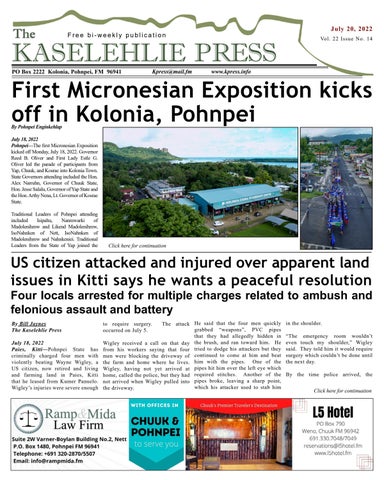
First Micronesian Exposition kicks off in Kolonia, Pohnpei
By Pohnpei Enginkehlap
July 18, 2022 Pohnpei—The first Micronesian Exposition kicked off Monday, July 18, 2022. Governor Reed B. Oliver and First Lady Estle G. Oliver led the parade of participants from Yap, Chuuk, and Kosrae into Kolonia Town. State Governors attending included the Hon. Alex Narruhn, Governor of Chuuk State, Hon. Jesse Salalu, Governor of Yap State and the Hon. Arthy Nena, Lt. Governor of Kosrae State. Traditional Leaders of Pohnpei attending included Isipahu, Nanmwarki of Madolenihmw and Likend Madolenihmw, IsoNahnken of Nett, IsoNahnken of Madolenihmw and Nahnkeniei. Traditional Leaders from the State of Yap joined the
Click here for continuation
US citizen attacked and injured over apparent land issues in Kitti says he wants a peaceful resolution
Four locals arrested for multiple charges related to ambush and felonious assault and battery By Bill Jaynes The Kaselehlie Press July 18, 2022 Paies, Kitti—Pohnpei State has criminally charged four men with violently beating Wayne Wigley, a US citizen, now retired and living and farming land in Paies, Kitti that he leased from Kumer Panuelo. Wigley’s injuries were severe enough
The attack He said that the four men quickly grabbed “weapons”, PVC pipes that they had allegedly hidden in Wigley received a call on that day the brush, and ran toward him. He from his workers saying that four tried to dodge his attackers but they men were blocking the driveway of continued to come at him and beat the farm and home where he lives. him with the pipes. One of the Wigley, having not yet arrived at pipes hit him over the left eye which home, called the police, but they had required stitches. Another of the not arrived when Wigley pulled into pipes broke, leaving a sharp point, which his attacker used to stab him the driveway. to require surgery. occurred on July 5.
in the shoulder. “The emergency room wouldn’t even touch my shoulder,” Wigley said. They told him it would require surgery which couldn’t be done until the next day. By the time police arrived, the Click here for continuation
The
2
June 20- August 3, 2022
Kaselehlie Press
The Federated States of Micronesia mourns the loss of former Japanese Prime Minister Shinzo Abe & re-emphasizes its commitments to a free & open Indo-Pacific FSM Information Services
PALIKIR, Pohnpei—The People & Government of the Federated States of Micronesia (FSM) have a Kizuna (special bond) with the People & Government of Japan, formed over 100 years of people-to-people relations and formal diplomatic relations since August 5th, 1988. A significant minority of Micronesians have blood and romantic ties to Japan and its People, and the Government of Japan has a rich and profound history of providing genuinely meaningful and deeply appreciated development assistance to the FSM, ranging in scope from Japanese International Cooperation Agency (JICA) Volunteers and the development of mathematics curricula and tools to the construction of necessary infrastructure and the donation of passenger-cargo ships. Thus, when the FSM Government became aware of the untimely passing of former Prime Minister Shinzo Abe on July 8th, 2022, the Government felt compelled to declare its sadness and shock, to emphasize the FSM’s support to the People and Government of Japan in this time, and to re-pronounce the Nation’s commitments to a Free & Open Indo-Pacific.
leaders in ensuring that every person he encountered was received with a smile and a handshake. As the longest serving Prime Minister in the political history of Japan, Shinzo Abe had a disproportionate, and highly positive, impact on the lives of Micronesians. The FSM Government is cognizant that former Prime Minister Abe was assassinated while giving a speech to provide his support for a political candidate. In this regard, the FSM Government pronounces its view that this unforgivable incident should not impact the democratic process, and emphasizes our Nation’s own commitment to democracy as the most impactful means of ensuring that the People are represented and heard. The FSM Government is cognizant that former Prime Minister Abe was the original visionary behind the Strategy for a Free & Open Indo-Pacific. In this regard, the FSM Government publicly emphasizes its continued commitment to a Free & Open Indo-Pacific, which is essential for the continued peace, security, and stability of the Pacific in isolation and the World at large.
The FSM Government has previously pronounced its support for Japan to become a permanent member of the United Nations Security Council, which was reiterated at every in-person discussion between President David W. Panuelo and former Prime Minister Shinzo Abe. In this regard, the FSM Government again pronounces its view that Japan, as a democratic country committed to global peace and stability, and a beacon of innovation and leadership, ought to become a permanent member Former Prime Minister Abe was a sincere of a reformed United Nations Security Council. friend to many in the FSM Government, including the contemporary President The People & Government of the FSM extend their and former Presidents of the FSM, as most profound condolences and sympathies to the well as Members of the FSM Congress. People and Government of Japan, and Mrs. Abe and Prime Minister Abe showed a particular her family, during this time of bereavement, and will friendliness to FSM Government recall the memory of former Prime Minister Shinzo officials, regardless of their status or Abe by committing to strengthening the FSM-Japan stature, and was unique among world Kizuna.
The
His Excellency David W. Panuelo, President of the Federated States of Micronesia; The Honorable Shinzo Abe, Prime Minister of Japan (2019)
His Excellency Peter M. Christian, President of the Federated States of Micronesia; The Honorable Shinzo Abe, Prime Minister of Japan (2018)
His Excellency Manny Mori, President of the Federated States of Micronesia; The Honorable Shinzo Abe, Prime Minister of Japan (2013)
THE NEXT ISSUE OF
Kaselehlie Press Your Newspaper for Today and Tomorrow
P. O . B o x 2 2 2 2 P o h n p e i , F M 9 6 9 4 1 ph:(691) 320-6547 e m a i l : K p re s s @ m a i l . f m Bill Jaynes Managing Editor
THE KASELEHLIE PRESS
WILL BE RELEASED ON:
August 03, 2022
Deadline for submission of articles or advertisements for this issue is the end of working hours on:
Monday, August 01, 2022
The
June 20- August 3, 2022
3
Kaselehlie Press
Auditor warns Small Business Court clears man of charges Guarantee and Finance Corporation that he threatened to of dwindling cash standing assassinate the FSM President By Bill Jaynes The Kaselehlie Press
July 16, 2022 Pohnpei—The Pohnpei Office of the Public Auditor last week released an audit of the Small Business Guarantee and Finance Corporation (SBGFC) for the fiscal year ending September 31, 2021, pointing out a dwindling cash standing. It issued the opinion that financial statements reflect the financial status of the SBGFC.
the urgency of the matter caused the board to meet weekly to gauge on the issue that needed By Bill Jaynes The Kaselehlie Press to be resolved.”
It said that checks disbursed were not recorded in a timely basis with delays as long as six months between check issuance and recording. None of the transactions from July to September 2021 had yet been recorded at the start of the audit fieldwork. Certain accounts payable, sundry, and notes receivable transactions were not properly recorded and the accounts were not reconciled The Corporation earned $139,706 in revenues and monitored. as compared to $68,456 earned in FY 2020. SBGFC’s operating expenses totaled Under the first audit exception noted that $169,314, 9 percent lower than the FY 2020 “same as last year, our audit again uncovered figure of $185,248. Net assets increase missing petty cash fund and lack of by $114,847. The loan accounts increase reconciliation.” from a net of $1,120,650 in FY 2020 to $1,647,699 in FY 2021. Auditors said that A change fund of $500 was missing. The Loan one contributing factor for that increase was Manager told auditors that the corporation is that several accounts were paid off but new no longer using a change fund and so they loans were approved and due to the Consumer deposited it back into the bank. However, no Loan Program. one could provide a copy of the deposit slip or any other documentation to support that Auditors cited three audit findings regarding claim. control deficiencies. It also pointed out that the Corporation’s Cash and Cash Equivalent Petty Cash was not properly managed account is fast decreasing every year due to resulting in $284 that is missing. In addition, fund transfers to the loans program accounts, $70 worth of disbursements paid out of the including its new consumer loan program. As petty cash fund were not properly supported. example: There were three instances where meeting allowances paid did not tally with the number · The Bank of Guam account had of the Board Members present at the meeting balances of $454,603 and $205,038 in FYs for which the allowances were supposedly 2019 and 2020, respectively. The balance of earned. that account had decreased to $100,774 by the end of FY 2021. As their second audit exception, auditors · The PDLF account has FY 2019 again found unauthorized payroll advances. and 2020 balance accounts of $415,238 and A particular employee apparently requested $171,172, respectively. At the end of FY approvals of payroll advances to him or 2021, the balance was $5,730. herself. That employee’s payroll advances in · The TCD account was maintained FY 2020 amounted to $1,950 and increased to at $202,00 in FY years 2019 and 2029. It was $3,590 by the end of FY 2021. less than half that amount at $96,322 at the end of FY 2021. SBGFC management responded that payroll advances and also outstanding loans had all The auditor said that a total of $330,252 had been referred to legal counsel for collection been transferred to the Direct Loan Program. purposes. He said that while providing business loans to citizens is within the corporation’s mandate, As the third audit exception, auditors point he needed to bring the rapid decrease in cash to six unresolved audit exceptions. Some accounts to the Board and Management’s of those audit exceptions have had partial attention. resolution, and one in which the Corporation committed to hire a CPA could not be fully The first of the audit exceptions was that implemented due to the COVID-19 pandemic. “Internal control weaknesses resulted in unreliable financial statements and underlying The management response said that SBGFC records and schedules and irregularities”. is going forward with its action plan to recruit a qualified CPA to get the financial records in SBGFC management did not concur with order and to train the staff accountant. In the the finding, saying that it had contracted the meantime, they are utilizing the services of State’s financial advisor. “The importance and the State Financial Advisor.
July 8, 2022 FSM—The FSM Supreme Court this afternoon found Benneth Edmund innocent of multiple crimes related to a social media post that threatened to assassinate FSM President David Panuelo.
David who made the post on August 11, 2021 threatening the FSM President.” The ruling might easily have said that the government could “not even make a prima facie case” that Edmund was the Jaylo David who had posted the threat against the FSM President. The level of evidence required for a prima facie case is much lower than that of evidence beyond a reasonable doubt, the standard required for a conviction. While prima facie evidence was sufficient for the court to find probable cause that Edmund was the person who made the threat, but the probable cause evidence is not evidence beyond a reasonable doubt.
On August 11, 2021, someone operating under the pseudonym, “Jaylo David” posted a clear threat against the President on Facebook. The post came in response to a Presidential press item announcing a requirement that persons or entities who receive funds from the FSM government must provide proof of vaccination as a condition for them to continue to be paid. The person Investigators identified the IP operating on Facebook as “Jaylo address of the computer from which David” wrote: the threat was posted but could only certainly establish that it came from “Mr. President—My Decision, My a computer within the FSM but could Body…And your decision But Not not pinpoint the location or even your Money…You gona need an State nor the true identity of the Jaylo army to protect you from now on… David who posted the threat. You will be assassinate for sure… Mark my word Mr. president… Investigators also interviewed people ‘POHNPEI SAHPW SARAWI’ who were Facebook “friends” with apposite flamingo” the Jaylo David user. They testified about certain details shared by The FSM Department of Justice Jaylo David that matched some of conducted an investigation in an the specific details that could have effort to establish the identity of the applied to Edmund, but the details person purporting to be Jaylo David did not exactly match. and on August 22, 2021 it filed criminal charges against Edmund. The FSM Supreme Court pointed The criminal hearing on the matter out case precedence in which it was didn’t begin until April of 2022. determined that “anyone can create a fictitious account and masquerade “While it was undisputed that the under another person’s name.” threat was posted by someone The Court said that the evidence appearing under the Facebook was insufficient “for a reasonablypseudonym Jaylo David,” the minded trier of fact to base a finding Supreme Court order granting that Mr. Edmund is guilty beyond a motion to acquit said, “and while reasonable doubt.” the Government was able to muster sufficient proof that this court could All who are accused of crimes in the reasonably find beyond a reasonable FSM are presumed to be innocent doubt that Mr. Edmund has himself unless proven to be otherwise beyond used the pseudonym Jaylo David, a reasonable doubt in a court of law. specifically in 2020 and at the Certainly, throughout his ordeal, beginning of 2021, the Government Edmund maintained his innocence. has failed to make a prima facie He has now been cleared of all case that Mr. Edmund was the Jaylo charges.
The
4
...Assault Continued from front page
conspiracy for planning a fight, felonious assault and battery, and disorderly conduct. They additionally charged Kennyboy Poll with assault and battery with a dangerous weapon.
ambush was over, and police transported Wigley to the hospital and also arrested one man. Police later arrested three others after further investigation.
“We blame the government,” Wigley’s attorney said. “Their job is to protect the public (but they) failed big time,” she exclaimed. “Police did nothing for the two previous complaints on criminal trespass. Had Wigley had twice before filed they done their job…,” she said and complaints against his neighbors let that thought trail off. for criminal trespass. Those reports, if filed, were never acted upon. He She also questioned the granting of said that on those occasions his bail to the defendants and blamed the neighbors had threatened him over prosecutor for not having brought in his use of the land, saying that he was the victim so that the Court could trespassing and should go home. On understand the impact of the actions those occasions, he said that he told on him. The terms of the bail include them that he was home, and that he a temporary restraining order. had a lease with the property owner. Until yesterday, Wigley had not Wigley’s attorney said that none of the returned to his new home in Paies, events that occurred on July 5 would Kitti. He said that he had no have happened if the Pohnpei State problems last evening and as we Police had done their jobs earlier. talked on the phone, he was on his “They sent out an investigation team way home again after an appointment after the complaints were filed… with the optometrist in order to get and he (Wigley) asked them to new glasses to replace the ones that please do something about it before were broken on July 5. someone gets hurt…nothing was done; absolutely nothing,” she said. The Pohnpei State Prosecutor told Wigley’s attorney that he had never received either of the prior two complaints. When Wigley and his attorney went to see the police the second time, the officer told them that the people named in the complaint were his relatives. Nothing was done with the second complaint either. The third complaint was made after Wigley was attacked and had been injured. That finally has had action. “The next time they come, they will take me out in a bag instead of an ambulance,” Wigley said by phone this afternoon. “I’m just looking for a peaceful resolution so we can all live together,” Wigley said. “I don’t want this to be blown out of proportion.” Charged in the crime of July 5 were Kenden Poll, Denson Barnabas, Lensper Tom, and Kennyboy Poll. Kenden Poll was charged with assault and battery, assault and battery with a dangerous weapon, felonious assault and battery, and disorderly conduct. Prosecutors charged Barnabas, Tom, and Kennyboy Poll with criminal
mendiolaf@comfsm.fm
June 20- August 3, 2022
Kaselehlie Press
Pohnpei Transportation shows an operating income rather than loss for the first time in several years By Bill Jaynes The Kaselehlie Press July 16, 2022 Pohnpei—The Pohnpei Office of the Public Auditor has released an audit of the Pohnpei Transportation Authority (PTA) for the fiscal year ending September 31, 2021. Though a previous audit called into question the viability of PTA as a continuing concern, no such comment exists in the current audit which shows some improvements, though there is still noted several audit exceptions.
the year by $21,533, whereas, expenses for Petroleum, Oil, and Lubricants increased from $237,529 to $241,943 for the year. The year’s operating income is $122,894, and improvement compared to the $78,521 loss realized during the previous year. Net assets increased by 30 percent over the previous year. Despite the improvements, the amount owed to Pohnpei State Government increased by $11,323 (.68 percent) to $1,663,537.
Auditors found that financial statements fairly represent the financial position, result of The audit cited nine findings: operations and cash flows, though it did point out that compilation of the financial statements • Lack of proper records and was delayed due to lack of proper records and documentation delayed compilation of documentation. financial statements. • $150,000 was expended without proper The operating revenue for the year was planning (this was for the renovation $2,145,494, an increase of 38 percent over of the PTA office. The finding was the the prior fiscal year. Operating expenses result of auditors having found purchases increased by only 24 percent from $1,630,398 for other types of expenses that seemed to $2,022,600. Payroll related costs account unrelated to the renovation but that were for 59 percent of the total operating expense. business expenses.) Supplies and Materials decreased during • Lack of control procedures in the process of petroleum, oil, and lubricants expenses • Internal Control weaknesses in the processing of cash disbursements or payments (The questioned expenses in the office renovation were part of this finding and was more a matter of proper booking of expenses.) • Unauthorized cash collections and use of funds (This was cash collected directly by PTA onsite for products instead booking those receipts through the Department of Treasury and Administration. PTA then used that cash for operating expenses. The practice has since ended but there has not yet been an accounting of collecting and spent cash.) • Non-compliance with PSSR relating to overtime and leaves • Non-compliance with PSSR: Unauthorized Hiring of Personnel • Non-compliance with PTA’s payroll process (There were many missing daily timesheets or timecards and many instances where employees’ daily regular hours did not match the hours in the summary report compiled by the accountant.) • There are eight unresolved findings from prior audits https://www.tci.gov.fm/
Auditors reminded the Board and Management of PTA that auditees are to report monthly to the State Auditor regarding the status of prior year’s audit findings and also of current findings, and that the findings should be resolved on a timely basis.
The
June 20- August 3, 2022
5
Kaselehlie Press
College of Micronesia-FSM
www.comfsm.fm
Yap | Chuuk | Pohnpei | Kosrae
Follow us online:
http://www.comfsm.fm/?q=hr-jobs
http://www.comfsm.fm/?q=hr-jobs
College of Micronesia-FSM
is accredited by the Accrediting Commission for Community and Junior Colleges, Western Association of Schools and Colleges. National Campus P.O. Box 159 Kolonia Pohnpei, FM 96941 Phone: (691)320-2480 Fax: (691)320-2479 E-Mail: national@comfsm.fm
Chuuk Campus P.O. Box 879 Chuuk, FM 96942 Phone: (691)330-2689 Fax: (691)330-2740 E-Mail: chuuk@comfsm.fm
FSM-FMI P.O. Box 1056 Colonia Yap, FM 96943 Phone: (691)350-5244 Fax: (691)350-5245 E-Mail: fmi@comfsm.fm
Kosrae Campus P.O. Box 37 Tofol Kosrae, FM 96944 Phone: (691)370-3191 Fax: (691)370-3193 E-Mail: kosrae@comfsm.fm
Pohnpei Campus P.O. Box 614 Kolonia Pohnpei, FM 96941 Phone: (691)320-3795 Fax: (691)320-3799 E-Mail: pohnpei@comfsm.fm
Yap Campus P.O. Box 286 Colonia Yap, FM 96943 Phone: (691)350-2296/5149 Fax: (691)350-5150 E-Mail: yap@comfsm.fm
The
6
June 20- August 3, 2022
Kaselehlie Press
Habele Awards 54 Tuition Scholarships for 2022-23
US nonprofit continues to expand access to Micronesia’s highest performing private elementary and high schools. Habele July 14, 2022 Colonia, Yap- Fifty-four promising students across Micronesia have been awarded tuition scholarships to attend the nation’s top-performing private elementary and high schools across three Micronesian states. The K12 tuition scholarships are provided by Habele, a US nonprofit serving students and schools across the Federated States of Micronesia (FSM). Established by former Peace Corps Volunteers who lived and taught in the Islands, Habele has been granting tuition assistance to Micronesian students since 2006. "These investments in individual students highlight the deep personal connections between the United States and our allies in the Freely Associated States," observed US Congresswoman Aumua Amata Coleman Radewagen of American Samoa. "Though our governments are united by formal alliances and treaties, it is the personal ties of our peoples, over decades of shared history, that make the relationships truly vibrant. My family lived in Micronesia for almost 17 years, both on Majuro and Saipan and I also lived on Guam while attending the University of Guam, while I have nieces and nephews with Marshallese and Chamorro heritage through marriages of my brothers. As a former Peace Corps employee in the Pacific, I’m also pleased to see the
scholarships were established by former Peace Corps volunteers" The Compact of Free Association (COFA) allows Micronesian students to come to the United States for college, where they are eligible for generous federal grants that pay for their higher education. However, many young people in Micronesia -particularly from lower income families- aren’t able to take advantage of these opportunities because, they don’t complete high school prepared to succeed in American higher education. Habele’s K12 tuition scholarships help place such students at high achieving, independent schools, and on a path towards ultimately obtaining a college degree. Habele Scholars come from villages across the hundreds of islands and atolls that comprise the Federated States of Micronesia. Students from Yap, Chuuk, and Pohnpei, as well as their lagoon and outer islands, will be attending eleven different schools in 2022-23, including Xavier High School, Saint Mary’s, Faith Christian Academy, and SDA Schools in Yap, Chuuk and Pohnpei. The K12 scholarships are entirely funded by donations from individual Americans who support Habele. Most are themselves former Peace Corps Volunteers, civil servants, tourists or contractors who spent time in Micronesia. This is the seventeenth year Habele has awarded merit and needs-based
scholarships, which average between 50 and 75 percent of the total tuition families owe. The nongovernmental organization also provides book donations, support for traditional skills mentorships, and organizes high schoolbased robotics clubs. Habele remains the only US nonprofit exclusively focused on serving students and schools within the Federated States. Among the 54 scholarships awarded are several Memorial Scholarships. These honor the legacy of specific individuals whose life or work “embodied Sheridan Giltamag, a rising junior at Our Lady of the best of the longstanding US-Micronesian partnership.” Mercy Catholic High School in Pohnpei, is one of 54 Introduced this year, the students across the FSM awarded a tuition scholarship by US nonprofit Habele. Martin Yinug Memorial Scholarship, honors the late Chief Justice of the Micronesian Supreme average over the course of last school Court, and his outspoken commitment to year. She and her family have also been public service, rule of law and judiciary involved in WeavingConnections, a independence. Another, the Marshall Habele program to support mentor-based Wees Memorial Scholarship, honors a preservation of traditional weaving US Navy doctor who battled an outbreak skills. of yaws that was ravaging the native population of Federai Island during the “The scholarship indeed helps my parents with tuition obligations at War in the Pacific. OLMCHS in Pohnpei. In addition to the “Being one of the Habele Scholarship financial support, Habele Scholarship recipients for the past two years is has motivated and helped me in many a tremendous honor and a joy,” said ways, which include keeping up with Sheridan Giltamag. A rising junior at Our my grades, spending more time with Lady of Mercy Catholic High School, my school work, and the importance of Miss Giltamag earned a 3.9 grade point education and my future.”
Yap schools lead way in collaborative robotics Habele
July 19, 2022 Yap Catholic High School, the most veteran of participants in the FSM-wide Habele Robotics League, has been promoting robotics to other high schools across Yap State for a decade. This year, the school pioneered a new model for the annual “Yap Robo Day,” a public exhibition in which robotics clubs from across Yap and its Neighboring Islands demonstrate their STEM accomplishments in a series of competitive challenges. In past years, participating schools gathered in a central location for a single afternoon, maneuvering their robots through rounds of timed challenges until a champion emerged. This year, Yap Catholic invited other public
and private high schools to their campus for “Yap Robo Week,” an intensive five-day exercise in training, creative robotics design, and collaboration between staff and students from different schools. Teams pooled spare parts, tools and knowledge over the course of the week to build personalized robots equipped for the final challenge. The final competition was an arena filled with small plastic balls, and baskets of varying heights, each bucket representing different point values. Teams had two and a half minutes to score as many points as possible, by maneuvering their robot to place as many balls as possible in the various buckets. No design restrictions were placed on the size of the robots used, and teams spent the days leading up to the
competition adjusting designs to focus on maximizing scores. When the dust settled on the Yap Robo Day 2022, the champions spot was awarded to Yap Catholic High School, with second place going to Outer Islands High School, and third place to Yap High School. The 2022 Robo Day welcomed a new participant in Pacific Missionary Aviation’s homeschool students, who laid the groundwork for strong performances in competitions to come. This was the final competition for some Yap Catholic students, after years of participation. “With my two years of joining the Robotics club, I have come to learn that you can do so much more when you are in a team, “ says
Click here for continuation
The
June 20- August 3, 2022
Kaselehlie Press
7
8
...FSM Expo Continued from front page traditional leaders of Pohnpei on the stage. Members of the Diplomatic Corps also attended, including H.E. Huang Zheng Chinese Ambassador to FSM, and H.E. Jo Cowley, Australian Ambassador to the FSM. In his welcoming remarks, Governor Oliver thanked the President of the FSM for taking the initiative to create this event and for selecting Pohnpei as the location of the first Micronesian Exposition. He noted that this event, after over two years of a COVID-19 pandemic is a great way to warm up tourism activities. Governor Oliver encouraged the participants to visit as many cultural tourism sites as possible in between events and asked for honest feedback on improving services. Chuuk Governor Hon. Alex Narruhn also delivered welcoming remarks. He noted that this event is long overdue, and reminds us of our rich, unique, culture which he said is the foundation of our identity and strength. Yap Governor, Hon. Jesse Salalu coined a new term for the Expo Kamoraleh, combining Kaselehlie, Mogethin, Ran Anim, and Lenwo. Lt. Governor of Kosrae, Hon. Arthy Nena echoed his fellow Governors calling for all of us to safeguard and promote unity. Officer in Charge of the FSM National Government and Secretary of the Department of Health and Social Affairs, Hon. Marcus Samo provided welcoming remarks on behalf of H.E. David W. Panuelo, President of the FSM who is in Fiji attending the Pacific Island Forum. IsoNahnken of Nett, Salvador Iriarte, provided the final welcoming remarks on behalf of the traditional leaders of Pohnpei. He spoke of the family of the FSM, and unity above all else. The Micronesian Expo will continue throughout the week. Tomorrow is Yap Day, followed by Kosrae and Chuuk on Thursday. Closing ceremonies will be held on Friday, July 22, 2022.
The
June 20- August 3, 2022
Kaselehlie Press
The
June 20- August 3, 2022
Kaselehlie Press
9
The
10
June 20- August 3, 2022
Kaselehlie Press
In Memoriam: The Honorable Jacob Nena FSM Information Services
at Manoa.
PALIKIR, Pohnpei—On July 7th, 2022, the Government of the Federated States of Micronesia (FSM) announced that the Honorable Jacob Nena, former President of the FSM, passed away. The former President was in Sacramento, California, at the time of his passing.
President Nena served as the Deputy District Administrator for Kosrae from 1970 to 1977 and became the first elected Governor for Kosrae State in 1979. President Nena was a member of the Micronesian Political Status and Transition Commission from 1979 to 1981.
Born on October 10th, 1941, in Lelu, Kosrae, President Nena attended the College of Guam between 1964 to 1968 where he graduated with a BA degree in Political Science and minors in English and Economics. In 1972, President Nena graduated with an MA degree in Public Administration and Business Management at the University of Hawaii
In his years as a Senator, President Nena served in the 5th Congress of the FSM and the 6th Congress of the FSM. In the 5th Congress of the FSM, President Nena served on the Health, Education, & Social Affairs Committee, the Judiciary & Governmental Operations Committee, and the External Affairs Committee. In
the 6th Congress of the FSM, President Nena served on the Health, Education, & Social Affairs Committee (as Chair), the Resources & Development Committee, and the External Affairs Committee. Jacob Nena became the fourth Vice President of the FSM from 1991 to 1996, and Acting President from late 1996 to May 1997. On May 8th, 1997, Jacob Nena became the fourth President of the FSM. The FSM National Government recognizes that President Nena dedicated his life to the service of this Nation with unquestionable leadership and integrity. President Nena was committed to a free and sovereign Micronesia, and dedicated the whole of his life to building the
Nation’s prosperity. President Nena exemplified, in his personal and professional life, the FSM’s foreign policy of being a friend to all and an enemy to none, and extending to all peoples and nations peace, friendship, cooperation, and love in our common humanity. His Excellency David W. Panuelo, President of the FSM, has proclaimed a national mourning period in honor of the late former President Jacob Nena. The President’s proclamation may be found here: https://gov.fm/files/ PRESIDENTIAL_PROCLAMATION_ for_Late_President_Jacob_Nena_ signed.pdf
Pacific climate leaders caution media against ‘drowning islands’ narrative Much coverage rife with stereotypes of hopelessness and helplessness, they say East-West Wire July 7, 2022 HONOLULU – At the East-West Center International Media Conference here last week, speakers from the Pacific Islands who are involved in climate change issues took Western media to task for maintaining a “drowning islands” narrative that they say dominates stories on global warming in the region and diminishes efforts to fight and adapt to the environmental crisis. In a keynote address, former Marshall Islands President Hilda Heine said the news media have sharpened the public’s understanding of climate change. However, she cautioned against repeated negative focus on environmental impacts that can “leave the public with an overall sense of powerlessness,” paralyzing people into inaction. Heine called for better coverage of the issues with updated information, science that people can understand, and more discussion related to solutions. “It's one thing to write about rising sea levels,” she said, “but quite something else when you're standing in a garden gone fallow because rising sea levels have fouled the atoll’s freshwater lens.” Narrow framing A similar theme was struck by climate researchers and Pacific Islands
advocates during a conference discussion on shaping a new climate change message. Studies on international media reporting on Pacific Islands climate change found that coverage overall had been marginal but then substantially increased since 2015, according to Victoria Keener, senior research fellow at the East-West Center and the discussion’s moderator. However, she said the dominant narrative of the coverage casts the islands as passive and vulnerable, and the reporting is “framed in colonialism and paternalistic themes.” Shaping a New Climate Change Message in the Pacific Islands panel at the 2022 International Media Conference Tammy Tabe, Oceania research fellow at the East-West Center from the Solomon Islands, said she has encountered media covering environmental impacts in low-lying islands who will visit areas of coastal erosion but not other locations where examples of adaptation and resilience are underway. “The media has that control over what’s magnified in terms of vulnerability in Pacific Island countries, and it often displaces acts of daily resilience in terms of everyday activity that people carry out to adapt and to address a lot of these issues that they face,” she said.
Former Marshall Islands President Hilda Heine addresses the EWC International Media Conference in Honolulu on June 29
Churches. But there is still a lot “that focus on victimhood rather than resilience and resistance” happening, he said. Elevating local voices
Heine reflected on the challenge Pacific Islands peoples face in primarily relying on outsiders to tell their stories, whether about climate change or the dynamics between China and Western powers in the region. “The Anglo ways and China are often the only two sides which matter to the mainstream media Brianna Fruean, a 23-year-old Sāmoan climate activist whose and political discourse,” she said. “The third side, the Pacific’s speech at the 2021 COP26 United Nations climate summit in ʻbig-ocean states,ʻ or BOSS, are often forgotten or relegated to Glasgow drew global attention, is frequently interviewed by the margin.” the press. But she said she is more often asked to describe the impacts of climate change rather than highlight young Pacific One effort to inject more local perspectives into the media is Islanders’ efforts to do something about them. “I feel like a the recent creation of the nonprofit Pacific Media Institute, she lot of the times the media don’t let us be heroes,” Fruean said. said, which among other goals seeks to train Marshall Islanders as effective communicators in print, broadcast, podcasts and Narratives painting the region as lacking agency may already other platforms. With this and other initiatives, Heine said she be shifting as young Pacific Island activists draw attention hopes “we no longer have to rely entirely on the good graces of to positive climate change efforts, said Rev. James Bhagwan others to tell our own stories about climate change and a host of Fiji, the general secretary of the Pacific Conference of of other issues.”
The
June 20- August 3, 2022
11
Kaselehlie Press
www.vitalenergy.fm
...Yap Robotics Continued from page 6
Chastity Minginug, a 2022 graduate of Yap Catholic and Habele Scholar. ”Team work is an essential part when we work together and I believe that Robotics will be a fun experience for everyone if given the chance.” Habele, a US nonprofit enables and equips high schools in the Robo League across all four of the Federated States of Micronesia. Habele was founded by former Peace Corps volunteers who taught in Micronesia. The nonprofit first introduced robotics to Micronesia in 2011. The Habele Robo League provides students in some of the world’s most remote island communities the opportunity for hands on learning and problem solving with today’s technology. Support from the US Government comes through the Office of Insular Affair, which provides technical assistance funding for development projects in Micronesia. Habele’s Robo League is growing the knowledge and skills of future island leaders, and deepening the historic bonds of the US-FSM partnership.
The
12
June 20- August 3, 2022
Kaselehlie Press
Achieving gender equality is everybody’s business – first visit by international committee members to the Pacific a success The Pacific Community 15 July 2022 Suva, Fiji – Two leading global experts on the Convention on the Elimination of All Forms of Discrimination against Women (CEDAW) visited the Pacific region for the first time this week, working with ten Pacific Island governments to help advance work to improve the lives of women and girls in the region. Over three days, Bandana Rana from Nepal and Natasha Stott Despoja from Australia joined around 100 participants for the Pacific Government CEDAW Learning Exchange held from 12–14 July 2022. The government delegates from Cook Islands, Federated States of Micronesia, Fiji, Kiribati, Republic of the Marshall Islands, Papua New Guinea, Samoa, Solomon Islands, Tuvalu and Vanuatu enhanced their skills and knowledge to enable them to better report on and meet their agreed commitment to advance gender equality in the region – something expected of governments after ratification of treaties, such as CEDAW, at least every four years.
strong mechanism, that every state party should feel is an asset for you, to strengthen you, to create that roadmap for you, for equality, peaceful and just society,” shared Ms Rana. The CEDAW committee members heard a range of challenges experienced by Pacific Governments faced during regular reporting from the participants. Among these is finding resources, data and statistics and other information needed to show the progress made towards advancing gender equality. “Gender equality – achieving it is everybody’s business. It’s not up to women, it’s up to all of us. I look forward to working with us all – men, women, boys, girls, non-binary and other people – in order to bring about a world, not just a region, in which gender equality is the norm,” added Ms Stott Despoja.
This exchange included the sharing of experiences, learning and examples of good practices by Pacific governments as well as through civil society organisations (CSOs) engagements – supported by the visiting experts.
During her opening remarks, Heike Alefsen, Regional Representative of the United Nations Human Rights Office of the High Commissioner (OHCHR) Pacific Regional Office said, “ I would like to applaud those Pacific Island states that have been meeting their reporting obligations under CEDAW on time and I hope that through this learning exchange, other countries will be encouraged to submit all overdue reports to the CEDAW Committee and establish national mechanisms for reporting and follow ups to assist in their reporting obligations.”
“To find out where your gaps are, what needs to be done in the next 4 or 5 years - that’s what [the Committee] is doing. This is a clear map, a clear
Ms Rana and Ms Stott Despoja travelled to Fiji to participate in the Learning Exchange, with participants joining the event via in-person ‘learning hubs’ in
their respective countries. “By knowing and using the Convention, governments have a powerful tool to guide their policy-making and legislation to ensure that women can enjoy all of their human rights and fundamental freedoms; and for achieving gender equality. We are pleased to support this regional exchange, and thank SPC and OHCHR for their strong and ongoing partnership in working with Pacific Island Governments, CSOs and communities to promote gender equality,” said Melissa Stutsel, Officer in Charge, UN Women Fiji Multicountry Office. “SPC remains dedicated to supporting member governments with national implementation of their human rights and gender equality commitments, and through this collaboration with
Australian Government donates COVID medical supplies On June 13, Second Secretary Takuro Steele officially handed over a donation of Covid medical supplies valued at AUD110,000 to the Program Director for Public Health and Hospital Emergency Preparedness (PHHEP) Ruotpong Pongliyap. Supplies include 100,000 N95 masks, 4,000 medical gowns, 12 field tents, and 100 pulse oximeters. The supplies will be distributed to each state, and the tents will allow one-stop 'test and treat' centers to be set up in communities to help treat the spread of potential COVID-19 cases. All supplies were delivered by a chartered Australian Government commercial flight that also delivered much needed COVID supplies to RMI. The Australian government continues to support the Federated States of Micronesia and the work of medical professionals at the forefront of the fight against the COVID-19 pandemic, whose efforts are crucial for the lives of the people of the FSM.
our UN counterparts, we hope to see improvements in the lives of women and girls across the Pacific,” stated Miles Young, Director of the Human Rights and Social Development (HRSD) Division of SPC. The Pacific Government CEDAW Learning Exchange is supported by the Pacific Community (SPC), UN Human Rights Office (OHCHR) and UN Women Fiji Multi Country Office (UN Women). SPC’s support includes the Promoting Just, Engaged, Civic-minded and Transparent (PROJECT) Governance partnership between SPC and the United States Agency for International Development (USAID), and the Pacific Women Lead programme funded by Australia.
The
June 20- August 3, 2022
13
Kaselehlie Press
Australia includes Micronesia in this years’ indigenous cultures (NAIDOC) commemoration By Bill Jaynes The Kaselehlie Press July 8, 2022 Palikir, Pohnpei—With a backdrop of Australian and Micronesian indigenous art, this afternoon Australia hosted a celebration of NAIDOC (National Aborigines and Islanders Day Observance Committee) week at the College of Micronesia FSM gymnasium. “NAIDOC is a celebration that takes place every July to celebrate the culture, history, and accomplishments of the Aboriginal and Torres Strait Islanders, the indigenous people of Australia,” said Master of Ceremonies Matthew Holloway, the Deputy Head of Mission of the Australian Embassy. The theme of this year’s NAIDOC celebrations was “Get up! Stand up! Show up!”, which is a call to stand up for aboriginal culture and rights. This year, the Australian Embassy to the FSM chose to share its celebration of its own indigenous cultures by also celebrating the many indigenous cultures of the FSM. Australian Ambassador Jo Cowley spoke on a particular landmark of indigenous culture in Australia—“Uluru”. Uluru and its neighbor, “Kata Tjuta” are considered to be the heart of indigenous culture in Australia. They are known as being the resting place for the ancient spirits of the region, and indigenous cultures in Australia have long “stood up” for their sacred landmarks. Like Pohnpei’s Nan Madol, Uluru is a UNESCO World Heritage site as a living cultural landscape. The Ambassador said that the rich red of the sandstone of Uluru is represented in indigenous art and in the aboriginal flag. Uluru is now the symbol of Torres Strait Islanders and Aboriginal Australians to have more say in the laws and the policies that impact their lives and cultures. In 2007, 250 Aboriginal leaders met at the foot of Uluru to talk about their aspirations. Out of that meeting came the “Uluru Statement from the Heart”. “The Uluru Statement from the heart is a simple, gracious, and passionate document,” Ambassador Cowley said. “It asked for the creation of an indigenous voice to Parliament, and commission to oversee treaty making and truth telling.” “There’s still a little way to go to responding to that statement, and responding to it will require a lot of getting up, standing up, and showing up by all Australians,” she said. “But Australia’s new government, elected just about a month ago is very positive and I feel confident in its getting done.” Augustine Kohler, FSM Acting Director for the Office of Archives, Culture and Historic Preservation next took to the podium. “We
learn from our families how to practice our culture into which we were born,” he said. “This process is called ‘culturalization’…it is an important process in which we participate to continue our culture.” “Another key aspect is human adaptation to our surroundings. Humans far way, who we may have never met may practice similarly to us because of their environment. However, environment is only part of the story. When visitors, whether colonists in the past, or transnational relationships in the 21st century, this engagement involved new information and may be incorporated into our culture. Early visitors to the region of Micronesia described our islands as ‘garbanzo beans from across the ocean’, suggesting that we are a small nation or just a small group of islands. However, our first President stood up for us saying that while we are ‘Micro’, our culture spans across 607 islands and cover more than one million square miles of ocean. It is important to remember, to celebrate this unity over such a large area. We are like a woven mat that is very strong with many fronds come together. The same may be said of our culture.” “…It’s our culture! Preservation begins by each of us participating, knowing our own values for compromising and working with those who supports us for our selfdetermination”, Kohler concluded. Jaap van Hierden, Regional Coordinator of the United Nations Multi-Country Office, next gave a powerful speech on the plight of indigenous people. “Today, there are over 476 million indigenous people living in 90 countries across the world, accounting for 6.2 per cent of the global population,” he said. “Of those, there are more than 5,000 distinct groups. Indigenous people speak an overwhelming majority of the world’s estimated 7,000 languages. “What a diversity! What a wealth,” he exclaimed. “Unfortunately, and throughout history, indigenous people have been decimated by diseases brought from elsewhere. Diseases to which they had no immunity. Unfortunately, indigenous people are nearly three times as likely to be living in extreme poverty. Unfortunately, indigenous people continue to face overwhelming marginalization, discrimination and exclusion. How did we end up here?” he asked. “Greed. Short-sightedness. Stupidity. A human weakness where those in power feel superior and privileged. A colonial history that robbed indigenous people of their lands and territories, of their political and economic autonomy, of their identity. A deep and enduring injustice
that has led to cultures and languages being denigrated and extinguished. An injustice that echoes today through increased encroachment on indigenous peoples’ territories by illegal miners and loggers. An encroachment that has been made possible by lapsed enforcement of environmental protections during the Covid-19 crisis,” he said. “In rectifying past and current injustices, we need to build a new social contract with indigenous peoples. One that restores and honours the rights, dignity and freedoms of those who have been deprived of so much for so long. Central to building this social contract must be genuine dialogue, interaction and willingness to listen. We already have the tools we need to do this, including the UN Declaration on the Rights of Indigenous Peoples; a declaration that considers the right of indigenous people to determine their own identity or membership in accordance with their customs and traditions.” Mr. van Hierden stressed the benefits of restoring and building indigenous, traditional and local knowledge in developing solutions for the future and for mobilizing people and communities around sustainable development. “Let us work together in ending the grievous inequalities of indigenous peoples worldwide, in recognizing the abuse they have endured, and in celebrating their unique and diverse knowledge and wisdom,” he powerfully concluded. The event concluded with a well-done video featuring COM-FSM students talking about the value of their own cultures. The video is not yet available for downloading but when it is, we will add that link to this article.
The
14
June 20- August 3, 2022
Kaselehlie Press
Communique of the 51st Pacific Islands Forum Leaders Meeting Pacific Islands Forum Secretariat July 14, 2022 Suva, Fiji--The Fifty-First (51st) Pacific Islands Forum was held in Suva, Fiji from 11 – 14 July 2022, and was attended by the Heads of State, Government, and Territories of Australia, Federated States of Micronesia, Fiji, New Caledonia, New Zealand, Niue, the Republic of Palau, Papua New Guinea, Samoa, Solomon Islands, Tonga, and Vanuatu. French Polynesia was represented at Vice-president Level, and Tuvalu was represented at Ministerial Level. The Cook Islands was represented by Special Envoy, and Nauru by Presidential Envoy. The Forum Leaders’ Retreat was held at the Pacific Islands Forum Secretariat in Suva, Fiji. 2. The Council of Regional Organisations of the Pacific (CROP) in attendance were: the Pacific Aviation Safety Office (PASO); the Pacific Community (SPC), the Pacific Islands Development Program (PIDP), the Pacific Islands Forum Fisheries Agency (FFA); the Pacific Power Association (PPA); the Pacific Tourism Organisation (SPTO), the Secretariat of the Pacific Regional Environment Programme (SPREP), and the University of the South Pacific (USP). The Asian Development Bank, the Commonwealth Secretariat, the United Nations (UN), the Western and Central Pacific Fisheries Commission (WCPFC), and the World Bank attended as Observers. Forum Leaders also welcomed the opportunity to engage with the broader Forum family, including civil society and the private sector, and looked forward to its engagement with Forum Dialogue Partners. 3. Leaders expressed their deep appreciation to the Honourable Josaia Voreqe Bainimarama, Prime Minister of Fiji, and the Government and people of Fiji, for the warm hospitality extended to their delegations. Leaders commended the preparations and facilitation of the 51st Pacific Islands Forum, which enabled Leaders and participants to hold constructive discussions and contributed to the overall success of the 51st Pacific Islands Forum. 4. Leaders congratulated the Government and the People of Kiribati on the occasion of their 43rd Anniversary of Independence. In relation to the position taken by the Government of Kiribati on the Pacific Islands Forum, Leaders echoed the sentiments conveyed by the Forum Chair that the people and Government
of Kiribati will always be a part of the Blue Pacific Family, and committed to continue to dialogue towards a resolution to restore the unity of the Forum Family. INAUGURAL PIF WOMEN LEADERS’ MEETING 5. Leaders congratulated the Government of Fiji on its successful chairing and convening of the inaugural standing Pacific Islands Forum Women Leaders Meeting on 9 June 2022, which was milestone for the region and is demonstrative of its collective commitment to ensure that regional priorities are considerate of gender-balanced views and perspectives. Leaders welcomed and endorsed the recommendations of the Pacific Islands Forum Women Leaders meeting for the revitalisation of the Pacific Leaders Gender Equality Declaration. CELEBRATING PACIFIC REGIONALISM: 50TH ANNIVERSARY OF THE PACIFIC ISLANDS FORUM 6. As a continuation from the virtual meeting of Forum Leaders held on 6 August 2021, Leaders commemorated the Fiftieth Anniversary of the Pacific Islands Forum, celebrating 50 years of Pacific regionalism and collective action. Leaders acknowledged that although the journey over the past 50 years has not been easy, relations as a Forum family remained strong because of its shared values, culture and tradition. 7. Leaders recalled that since its establishment in 1971, the Pacific Islands Forum has been the catalyst for strengthened regional action especially as a unified regional bloc. Furthermore, Leaders recognised the opportunity of The Blue Pacific Narrative to reinforce the potential of its shared stewardship of the Pacific Ocean and to reaffirm the connections of Pacific peoples with their natural resources, environment, culture and livelihoods. STRATEGIC CONTEXT AND REGIONAL UNITY AND SOLIDARITY 8. Reflecting on 50 years on regionalism, Leaders also highlighted that the Pacific Islands Forum stands at a critical juncture in its history. Leaders acknowledged that many economies and communities across the region continue to contend with a range of social, economic and development challenges, whilst having to continually adapt to the evolving challenges posed by COVID-19, as well as the current climate emergency. These challenges exacerbate
the region’s existing vulnerabilities and dependencies. 9. Leaders noted that the region continues to be a highly contested sphere of interest, in a wider geopolitical setting with external powers seeking to assert their own interests. In the current strategic context, Leaders recognised the importance of remaining unified as a Forum family to address common challenges and to capitalise on key opportunities. Furthermore, Leaders also recognised the importance of regional unity and solidarity in dealing with intensifying geostrategic interest, particularly to ensure the achievement of shared and common objectives. FORUM CHAIR’S REPORT ON THE POLITICAL DIALOGUE MECHANISM 10. Leaders acknowledged with sadness the Republic of Kiribati’s decision to withdraw from the Pacific Islands Forum, and welcomed Kiribati’s willingness to remain open to dialogue to promote Forum unity and emphasise the importance of genuine consultation and engagement, including through the issuance of a collective statement. Leaders further agreed to continue dialogue with the Republic of Kiribati between now and the Special Leaders Meeting, through the good offices of the Forum Chair and Secretary General, and explore options for closer diplomatic engagement, including through the appointment of a dedicated Special Envoy. 11. Leaders recognised the Suva Agreement as a political commitment to reform the Pacific Islands Forum based on the specific reform elements and timelines outlined in the Forum Chair’s Report, and directed Forum Officials to commence the work on the operationalisation of the Suva Agreement through the Transitional Plan as recommended by the Meetings of the Forum Officials Committee and the Forum Foreign Ministers, noting that decisions on the hosting arrangements of the Office of the Pacific Ocean Commissioner and the Sub-Regional Office as well as the appointment of the Pacific Ocean Commissioner are to be finalised by Leaders at their next meeting. Leaders have endorsed the Suva Agreement, and further agreed to leave the Agreement open for signature by the Republic of Kiribati. 12. Consistent with the indicative transition timeline to operationalise the political commitments under the
Suva Agreement, Leaders endorsed the following: (i) 2022 Procedures Governing the Selection and Appointment of the Secretary General; (ii) 2022 Procedures Governing the Selection and Appointment of the Pacific Ocean Commissioner; (iii) The Chairing Arrangements and Forum Troika Charter. 13. Leaders agreed that, for the purposes of regional rotation, Australia will be under the Melanesian sub-grouping and New Zealand will be under the Polynesian sub-grouping. 14. Leaders agreed to convene another Special Leaders Meeting towards the end of the year under Fiji’s Chairmanship to consider and endorse the remaining phases of the Transition Plan. Leaders recognised the importance of ongoing continuity in the transition of the Secretariat leadership in 2024. 15. Leaders acknowledged Secretary General Henry Puna and the Honourable Mark Brown, Prime Minister of the Cook Islands, and the Government of the Cook Islands, for their efforts to resolve the impasse and their commitment to protect the solidarity of the region, and agreed to ensure that the leadership transition was done in a manner that is dignified and seamless. 16. Leaders also acknowledged His Excellency David W. Panuelo, President of the Federated States of Micronesia, and His Excellency Surangel Whipps Jr., President of the Republic of Palau, who, together with the Honourable Fiame Naomi Mata’afa, Prime Minister of Samoa, and the Honourable Mark Brown, Prime Minister of the Cook Islands, took the time to travel to Fiji to attend the Political Dialogue Mechanism on 6 to 7 June 2022 and settle the Suva Agreement. 17. Leaders emphasised the importance of funding certainty and sustainability to Continued on next page
The
June 20- August 3, 2022
15
Kaselehlie Press
...PIF (1) Continued from previous page take forward the political commitments in the long term. Leaders acknowledged with appreciation that Australia and New Zealand would make an initial contribution to operationalising the Suva Agreement, and all Members will make a contribution to ongoing implementation. 2050 STRATEGY FOR THE BLUE PACIFIC CONTINENT 18. Building on from the Suva Agreement, Leaders recognised that their solidarity and shared commitment to work together offered the foundation to take a strategic and long-term approach to Pacific regionalism. 19. Leaders also recognised that inspired political leadership is critical to the success of Pacific regionalism. Leaders also highlighted that it was crucial for all Pacific people to be engaged in the processes of Pacific regionalism as advanced through the 2050 Strategy, to ensure that it was done in a truly inclusive way. 20. Leaders emphasised the importance of economic prosperity and wellbeing to the security of Pacific countries and the need to maximise business to business engagements to realise the potential of Pacific people and their resources. 21. Reflecting on the range of rich and robust dialogues as part of the 51st Pacific Islands Forum Leaders Meeting, and framed around the 2050 Strategy for the Blue Pacific Continent, Leaders discussed: the need for urgent and immediate assistance with vulnerability to debt; a clear pathway for energy security and urgent requirement for decarbonisation of the energy sector towards renewable energy; and the need to address supply chains issues and rising costs of food. 22. Leaders recognised the need for increased investment in their people, with a specific emphasis on education. Leaders also considered the value of strengthening public-private partnerships to leverage greater opportunities – most notably in connectivity, high value agriculture and fisheries, and energy security. 23. Leaders welcomed and endorsed the 2050 Strategy for the Blue Pacific Continent as the overarching blueprint to advance Pacific regionalism for the next three decades, articulating the region’s
long-term vision, values, and key thematic areas and strategic pathways. In taking forward the Strategy, Leaders emphasised that an implementation plan will need to be developed that articulates key priorities and actions, delivery arrangements and resourcing requirements. 24. Leaders reaffirmed the importance of utilising existing regional mechanisms, including the Pacific Islands Forum, for engagement with partners, especially where multiple Pacific Island Countries are concerned, whilst still being respectful of the sovereign right of countries to engage with partners as they consider appropriate. 25. On the issue of regional security, Leaders noted that the 2050 Strategy calls for a flexible and responsive regional security mechanism in place to address traditional and non-traditional security issues in our region. Leaders reaffirmed the concept of regionalism and a family first approach to peace and security. Leaders further noted that the Forum Officials’ Committee has tasked the development of a Security Policy Roadmap and the Pacific Security Outlook Report to support the alignment to the Boe Declaration and the thematic area for Peace and Security in the 2050 Strategy. 26. Leaders tasked Senior Officials to progress this work and report back to Leaders at the 52nd Pacific Islands Forum as part of the implementation of the 2050 Strategy. 27. Leaders agreed for the Forum Chair to write to all Leaders confirming the venue for the Forum Dialogue Partners Meeting later in the year. REVIEW OF REGIONAL ARCHITECTURE 28. Leaders discussed the Review of the Regional Architecture, and recalled their 2019 Communique on the need to ensure that “requisite governance and resourcing arrangements that promote, govern and deepen collective responsibility and accountability to deliver the 2050 Strategy for the Blue Pacific Continent” are in place. 29. Leaders welcomed the commitment of the CROP agencies to strengthen coherence and effective coordination in advocacy and the delivery of regional goods and services. Leaders further welcomed the commitment by CROP agencies to support the development of a comprehensive implementation and monitoring plan for the 2050 Strategy.
To that end, Leaders noted with concern the fact that resource mobilisation is fragmented and competing demands on financing remain key challenges to the achievement of 2050 vision. 30. In this context, and also noting wider geopolitical competition playing out in the region, Leaders highlighted that the effective delivery of the 2050 Strategy for the Blue Pacific Continent would require a fit for purpose “regional architecture”. These include political leadership and collective commitment; the inclusion of all relevant stakeholders; CROP agency governance and resourcing arrangements that enable alignment, effective coordination between regional and international agencies operating in the Pacific to avoid duplication, and development partners to fully align their policy positions and resources to the 2050 Strategy. 31. Accordingly, Leaders agreed to broaden the mandate of the Review to consider: (i) Political Setting: to review political groupings, leadership, collective interests and decision-making and sustained political will; (ii) Institutional processes, systems and mechanisms: to review processes, systems and mechanisms supporting collective decisions, actions and advocacy; (iii) Governance mechanisms: to review mechanisms in place to effect cooperation and coordination between the various regional entities, and their engagement with the Pacific Islands Forum; and (iv) Engagements and Partnerships: to consider how the Forum interacts with international partners and stakeholders to progress regionalism. 32. Leaders tasked officials to proceed according to the expanded mandate and report back to Forum Leaders at the 52nd Pacific Islands Forum Meeting. CLIMATE ACTION: REGIONAL PRIORITIES FOR COP27 33. Leaders reconfirmed that climate change remains the single greatest existential threat facing the Blue Pacific, underscoring the urgency to limit global warming to 1.5 degrees through rapid, deep and sustained reductions in greenhouse gas emissions. In this respect, Leaders declared that the Pacific is facing a Climate Emergency that threatens the livelihoods, security and wellbeing of its people and ecosystems, backed by the latest science and the daily lived realities in Pacific communities. 34. Leaders welcomed the completion of
the Paris Rulebook at COP 26, and called on all Parties to the Paris Agreement to ensure that COP 27 delivers clear progress on turning pledges and commitments into action, consistent with the 1.5 degrees pathway, and urged world leaders, especially the big emitters, to recognise climate change as the single greatest threat to the planet, to commit to achieving net zero emissions by 2050, and to revisit and submit enhanced Nationally Determined Contributions before COP 27. 35. Leaders reaffirmed Members’ commitment to fully implement the Paris Agreement, including a collective aim to achieve carbon neutrality in the Pacific by 2050, and invite development partners to support Forum Island Countries reach this goal. 36. Leaders committed to working together with the COP 27 President Designate leading up to COP 27 to ensure that COP 27 delivers an ambitious outcome that reflects the need to urgently scale-up ambition and implementation to limit global warming to 1.5 degrees above pre-industrial level, enhance efforts by developed country Parties to at least double their collective provision of climate finance for adaptation to developing country Parties from 2019 levels by 2025, advances work on the oceanclimate nexus, and shows meaningful progress with the deliberations on the new collective quantified climate finance goal, the Glasgow Dialogue on funding arrangements for averting, minimising and addressing loss and damage and the operationalisation of the Santiago Network for loss and damage associated with climate change. 37. Leaders reaffirmed their support to the Pacific Islands Forum Missions overseas in their proactive engagements with the international community to support the region’s effort to advocate for stronger climate ambition. Leaders supported the work of the Political Climate Champions to strengthen Forum Island Countries’ strategic engagement at COP 27, including the nomination of a new Champion on Gender and Social Inclusion. 38. Leaders welcomed and fully supported Australia’s renewed commitment to the Forum’s climate change priorities, and welcomed the interest from Australia to host a United Nations Framework Convention on Climate Change Conference of the Parties in partnership with Pacific Continued on next page
The
16
...PIF (2) Continued from previous page
Island countries. ADDRESSING THE THREATS OF CLIMATE CHANGE-RELATED SEA-LEVEL RISE ON MARITIME ZONES, STATEHOOD AND OUR PEOPLE 39. Leaders noted that due to the complexity of the issues of statehood and persons affected by sea-level rise, due consideration of these issues should be guided and informed by applicable principles and norms of international law and relevant international frameworks and standards, and the need for the region to unpack these issues further. 40. Leaders recalled their 2021 landmark Declaration on Preserving Maritime Zones in the face of Climate Changerelated Sea-level rise, and re-emphasised the threats of climate change and sea-level rise as the defining issue that imperils the livelihoods and wellbeing of our peoples and undermines the full realisation of a peaceful, secure and sustainable future for our region. Leaders welcomed and expressed deep appreciation for the international reactions to the Declaration, in particular the formal support by Heads of State and Government of the Alliance of Small Island States, the Climate Vulnerable Forum, the Organisation of African, Caribbean and Pacific States, and the acknowledgement by Commonwealth Heads of Government, and further called on other states and regions to formally support the Declaration, including through adoption of similar practices to create a global norm for preserving maritime zones. 41. Leaders reaffirmed the priority of securing maritime zones against the threats of sea-level rise, which is the defining issue underpinning the full realisation of the Blue Pacific Continent and having regard to the status of maritime boundaries and zones in the region, strongly encouraged the urgent finalisation and conclusion of outstanding zones and boundaries as per Leaders’ commitments and decisions, including in 2019. In this context, Leaders congratulated the governments of Fiji and Solomon Islands in concluding and signing their Maritime Boundary Treaty at the Forum Leaders’ Meeting. 42. Leaders recognised the many impacts of climate change and disaster and their threat to the future of the region’s people
and the statehood of many Pacific nations. 43. Leaders noted that, under its Future Now Project, the Government of Tuvalu has included the preservation of its maritime zones and Statehood as part of its joint communiques on forming diplomatic relations, and noted the invitation by the Government of Tuvalu to sign these communiques with all PIF Members. UN GENERAL ASSEMBLY RESOLUTION FOR AN ADVISORY OPINION ON CLIMATE CHANGE FROM THE INTERNATIONAL COURT OF JUSTICE 44. Leaders commended Vanuatu on its initiative on a pathway to secure a request from the UN General Assembly (UNGA) for an advisory opinion from the International Court of Justice (ICJ) to clarify legal consequences of climate change, noting the urgency of the climate change threat and the need for accelerated global climate action and implementation of the Paris Agreement. 45. Leaders welcomed progress since the initiative was reported to, and noted by, Forum Leaders at their 50th Meeting in Tuvalu in 2019, including progress on ongoing international and regional consultations on the initiative and related legal question(s) to be developed through the UNGA process, and noted that the initiative is consistent with, and complementary to, regional efforts and ambitious actions on climate change to safeguard our people against the adverse effects of climate change, and noting that an ICJ advisory opinion is non-binding but may change the course of current negotiations and boost commitments. 46. Leaders called on the UN General Assembly for a resolution requesting the International Court of Justice to provide an advisory opinion on the obligations of states under international law to protect the rights of present and future generations against the adverse impacts of climate change, and looked forward to close collaboration in the development of the specific question to ensure maximum impact in terms of limiting emissions to 1.5 degrees, including obligations of all major emitters past, present and future. NUCLEAR ISSUES South-Pacific Nuclear Free Zone Treaty 47. Leaders noted the Report of the Secretary General on the Treaty of Rarotonga and other Nuclear Issues, invited non-Party Forum Members to accede to the South Pacific Nuclear Free Zone Treaty, and urged the United States to ratify the Treaty Protocols.
Forum engagement in the decommissioning of the Japan Fukushima Daiichi Nuclear Power Plant 48. Leaders reiterated their strong concerns for the significance of the potential threat of nuclear contamination to the health and security of the Blue Pacific, its people and prospects, and reaffirmed the importance of ensuring international consultation, international law, and independent and verifiable scientific assessments as per the PALM9 Declaration. Ongoing nuclear legacy issues 49. Leaders noted the progress to address the ongoing impacts of nuclear testing through the CROP Taskforce on Nuclear Legacy issues in the Pacific, and the arrangements for a Preliminary Independent Review relating to Nuclear Contamination in the Pacific, including in the Nuclear Test Site at Runit Dome on Runit Island of the Republic of the Marshall Islands, which is expected to commence in the second half of 2022, to provide the evidentiary basis for ongoing Forum advocacy on nuclear legacy issues. UPDATE ON LEADERS’ DECISION TO INCREASE ECONOMIC RETURNS FROM FISHERIES 50. Leaders encouraged Members to continue efforts to stay at the forefront of regional tuna fisheries management, address IUU fishing, and to secure sustainable benefits from tuna resources. In recognising that a socially sustainable fishery that upholds Pacific values is equally as important as ensuring a biologically and economically sustainable fishery, Leaders further encouraged Members to expedite work to improve labour standards for fishing crew as well as continue to address the safety and wellbeing of observers. 51. Leaders, in noting the importance of fisheries and aquaculture to the region for food security, recovery from the impacts of the COVID-19 pandemic, sustainable development, economic resilience, protecting the cultural heritage of the region, and adapting to the impacts of sea-level rise and climate change in the region, stated that the priorities: (i) for coastal fisheries and aquaculture are expanding climate change impact adaptation and mitigation support including developing evidence-based planning, policy and management strategies, and climate smart initiatives for more resilient and sustainable coastal fisheries and aquaculture development; and (ii) for oceanic fisheries are expanding
June 20- August 3, 2022
Kaselehlie Press
climate change impact adaptation and mitigation support including securing and defining offshore fisheries rights, enhancing evidence-based planning, harvest strategies, policy and management strategies, and climate smart initiatives for more economically resilient tuna fisheries. 52. Leaders encouraged all WTO Forum Members to work together to conclude the remaining pillar of the fisheries subsidies negotiations on Overcapacity and Overfishing to protect the sustainability of fish stocks and provide appropriate Special and Differential Treatment for developing and least developing countries. REPORT OF THE FORUM MINISTERAL COMMITTEE TO NEW CALEDONIA OBSERVER REPORT ON NEW CALEDONIA’S 3RD REFERENDUM ON INDEPENDENCE 53. Leaders welcomed the report of the Forum Ministerial Committee to New Caledonia, following its mission to observe the 2021 New Caledonia Referendum on Independence, and supported the Forum’s continued engagement with New Caledonia through established Forum processes. 30TH SMALLER ISLAND STATES LEADERS MEETING 54. Leaders noted the outcome of the 30th Smaller Islands States (SIS) Leaders Meeting that was convened on the 12th of July 2022 in Suva, Fiji. 55. Leaders noted that SIS Leaders had re-asserted the strategic importance of the SIS grouping, as well as their critical role in forewarning the world on the existential threats of the climate crisis, and that SIS Leaders had endorsed in principle a joint approach to SIS ambitions and priorities under the 2050 Strategy for the Blue Pacific Continent. OCEAN CONSERVATION CREDIT INITIATIVE 56. Leaders commended and supported the Government of Niue on its Ocean Conservation Credit initiative as a sustainable financing mechanism, noting the ongoing challenges in accessing climate finance. NEXT FORUM LEADERS MEETING 57. Leaders agreed for the Cook Islands as the host of the 52nd Pacific Islands Forum Leaders and Related Meetings in 2023, the Kingdom of Tonga in 2024, and Solomon Islands in 2025.
The
June 20- August 3, 2022
17
Kaselehlie Press
11 tons of critical relief supplies arrive in Kiribati to support ongoing drought response
UNICEF
July 8, 2022 SUVA/TARAWA – A flight carrying life-saving emergency supplies touched down in Kiribati yesterday, strengthening the critical on-going response to the devastating drought in the country. The Pacific Humanitarian Air Service (PHAS), operated by the United Nations World Food Programme (WFP), transported the supplies on behalf of UNICEF. This delivery includes essential emergency supplies, including first response household water, sanitation, hygiene (WASH) and dignity kits that consist of items such as collapsible water containers, buckets with lids, water purification tablets, and soap. The consignment also includes portable water field testing kits that will allow Kiribati authorities to monitor water quality at both source and household levels. The Government of the Republic of Kiribati had declared a State of Disaster last month due to lasting drought conditions caused by below normal rainfall. So far this year, some areas have recorded less than 2.3 inches of rainfall. Some 119,000 people residing in Kiribati have been affected, including 94,000 people or 79 per cent of the total population in the severely impacted southern islands of the Gilbert Group, which is heavily dependent on rainwater harvesting.
Painful reality our country is experiencing from global inflation Regularly purchased good’s prices had just increased above nine percent in the US in June according to the US Labor Department, hence, what impacts will be like for imported goods coming into the FSM. How much are consumers going to bear with this inflation stuff and what ways will our government(s) be doing to help counter these painful realities?
UNICEF, together with partners, is providing immediate on-the-ground support to the government with the drought forecast to continue at least by the end of the year. UNICEF is working to strongly ensure that children and their families affected by the drought have access to safe drinking water as well as adequate hygiene services to protect them against water-borne diseases.
“The weather and rainfall patterns have become more erratic in Kiribati because of the climate crisis over the past few decades. These kinds of droughts are not new to the country, but have become more frequent, lasting longer and are more intense,” said UNICEF Pacific’s Chief of Kiribati Field Office, Nick Rice Chudeau. “We thank WFP for this timely support, and together with the Government of Kiribati, partners and communities, we will ensure that the most vulnerable, especially children, have access to good water, sanitation, hygiene, and overall health.” This partnership between UNICEF and WFP plays a key part in supporting the ongoing response. It will strengthen the national capacity and build the resilience of communities to cope with the destructive effects of the disaster. “The situation in Kiribati is very worrisome. Climate change has previously driven recurrent droughts in the country, but today the safety and health of the most vulnerable people in Kiribati is under
threat, and on a much more severe scale,” said the Country Director of WFP’s Pacific Multi-Country Office, Alpha Bah. “In these testing times, we are pleased to join forces with our friends at UNICEF to arrange this timely delivery of critical supplies to support the Kiribati Government’s response. We are also grateful to our partners and donors whose support has enabled the Pacific Humanitarian Air Service (PHAS) to deliver vital goods across the Pacific, when commercial air options are not available.” The flight is also transporting pharmaceuticals on behalf of the
Government of Kiribati. WFP’s Pacific Humanitarian Air Service is a part of the greater Pacific Humanitarian Team’s COVID-19 Response Plan – a comprehensive regional response plan that seeks to consolidate efforts by UN agencies, governments, regional and multilateral organizations, NGOs, donors, and development partners. It operates under the Pacific Humanitarian Pathway established by the Pacific Islands Forum and its member countries. With generous funding from the European Union, the Government of Australia and USAID, WFP has so far run 40 flights, transporting a total of 317 tonnes of critical medical cargo across the Pacific region.
Letter to the Editor It seems to be an import issue related on the break out of the war in Ukraine doubled by the surge in global fuel prices. It is a complex issue requiring swift actions from our government(s) as things will only be getting worst. Not to point fingers at anyone or any businesses but just a few months ago a sack of FRC rice cost around $26 and now it costs $38, electricity was less than a dollar per k-watt and now more than $1.20, floor tile was $53 dollars per case and now $80…..well you see the picture. Prices are surging like an unrelenting destructive storm coming our way and there is no way to hide from it. US News: Inflation accelerated more than expected
to a new four-decade high in June as the price of everyday necessities remains painfully high, exacerbating a financial strain for millions of Americans. The Labor Department announced Wednesday that the consumer price index, a broad measure of the price for everyday goods, including gasoline, groceries and rents, rose 9.1% in June from a year ago — the highest inflation recorded in over 40 years. Prices jumped 1.3% in the one-month period from May.2022. So-called core prices, which exclude more volatile measurements of food and energy, climbed 5.9% from the previous year. Core prices also rose 0.7% on a monthly basis – higher than in April and May – suggesting that underlying
inflationary pressures remain strong and widespread. Will there be some form of quick relief strategies being developed, or being considered and or perhaps given? COLA benefit, protection from price gouging, tax breaks, subsidies for farming and fishing? What will the future be like? The consumers want to know what strategies are being considered; after all they are always going to be given the short end of the stick, paying the price w/ their limited incomes.......This is one of those times that we need our leaders to step up and do something fast…….. food for thoughts. Grant Ismael July 18, 2022
The
18
New agreement boosts vital scientific collaboration in the Pacific Pacific Community June 22, 2022 A new agreement between UNESCO’s Intergovernmental Oceanographic Commission (IOC-UNESCO) and the leading scientific and technical organisation in the Pacific region, The Pacific Community (SPC), will boost ocean science collaboration for the world's largest ocean. Covering areas including early warning systems and risk reduction, ocean literacy and capacity development, the agreement will spur action on Pacific ocean science and increase collaboration on the implementation of the UN Decade of ocean science for sustainable development. The agreement was signed at the official Ocean Conference side event held by The Pacific Community (SPC) and the Secretariat of the Pacific Regional Environment Programme (SPREP) and co-organized by IOC-UNESCO where speakers presented Pacific solutions for ocean preservation and reinforced the need for urgent action to maintain ocean health in the face of the triple threats of climate change impacts, biodiversity loss and pollution. Speaking at the side event, the Deputy Director-General of Pacific Community Cameron Driver said, “The UN Decade’s motto is “the science we need for the ocean we want”. This new agreement between SPC and the IOC of UNESCO is a great example of the partnerships we need to deliver that science, increase ocean literacy and strengthen our ocean action. We are delighted to deepen our relationship with the IOC-UNESCO and are proud of they key role SPC plays in reaching the objectives of the UN Ocean Decade in the Pacific”. Vladimir Ryabinin, Executive Secretary
of IOC-UNESCO said, “the Pacific is at the forefront of climate and ocean change. The only way out is action based on knowledge, and knowledge that is codesigned and co-delivered with Pacific expert networks, indigenous communities, and the Governments of the Pacific Community. UNESCO is happy to help move forward toward this objective in the context of the Ocean Decade 2021-2030” The 2022 UN Ocean Conference has seen Pacific leaders highlight the central role the ocean plays in the region for its people and its future. The conference has also heard calls from Pacific scientists to halt ‘parachute science’ and build long-term ocean science capacity in region. Dr, Jerome Aucan, Head of the Pacific Community Centre for Ocean Science (PCCOS) said, “this agreement will streamline ocean science collaboration in the region and enable us to continue to build ocean science capacity in the Pacific”. Under the agreement, an IOC-UNESCO Programme Officer for Disaster Risk Reduction and Tsunami Warning will be hosted at the Pacific Community (SPC), to manage early warning systems for marine hazards, disaster risk reduction and tsunami projects which will be developed as vital resources for one of the world’s most disaster-prone regions. The agreement also strengthens ongoing ocean literacy work in the region aimed at developing and encouraging understanding and study of the ocean in the Pacific. The ocean is the Pacific region’s biggest resource and, with Pacific Island Countries and Territories at the UN Ocean Conference calling for increased investment to maintain ocean health, this agreement strengthens the regions capacity to undertake vital ocean science to ensure a healthy, productive, resilient, and safe ocean for all.
June 20- August 3, 2022
Kaselehlie Press
New Zealand announces 10million in climate financing to secure Pacific food crops for future generations.
Pacific Community July 12, 2022 Suva, Fiji – New Zealand Prime Minister Jacinda Ardern announced NZ10million in new funding to support the Blue Pacific seed bank and genetic resources at the Pacific Community (SPC) Centre for Pacific Crops and Trees (CePaCT).
Pacific countries and territories and serves as a vault for the longevity of Pacific peoples food and crops. SPC Genetic Resources Programme Leader Logotonu Waqainabete said CePaCT’s role is particularly important under the changing climate conditions, to strengthen food and nutrition security in the Pacific.
As the region’s largest seed bank, CePaCT plays a vital role in conserving the Pacific’s plant genetic resources. It works with Pacific farmers to ensure plant genetic diversity as well as identify varieties that are most resilient to pests and diseases, drought, flooding and cyclones, all of which are presenting growing challenges in the Pacific due in part to climate change.
“This funding will enable CePaCT to increase our operational efficiencies, enhance our research capabilities and outreach programs to continue to build the resilience of our agriculture and food systems against climate change and in parallel, ensure that our Pacific people consume a diversity of highly nutritious food,” she said.
“Climate change is a major threat to Pacific agriculture, putting our regions food security at risk. This investment will increase the Pacific’s resilience by ensuring our regions seeds and plant materials are preserved and protected for future generations,” said Prime Minister Ardern during a tour of the CePaCT Lab at SPC in Suva today.
CePaCT is recognised globally as the World Centre for Taro and other aroids and a central hub facilitating access to Pacific diversity.
Genetic resources are vital components to help sustain food and nutritional security, healthy agroecosystems, and build resilience against climate change. CePaCT helps coordinate action to ensure Pacific countries and territories have the seeds, crops, and agricultural diversity and resiliency they need for food and nutritional security now and into the future. “As such the funding will help Pacific farmers to get improved access to the seeds and planting materials that will maintain and hopefully increase their yields despite the impacts of climate change,” said Prime Minister Arden. This work will further strengthen food and nutritional security for and alongside
This strong commitment to partnership between the New Zealand Government and SPC will provide direct support to CePaCT and the Global Crop Diversity Trust. NZ $5 million announced today will go to The Global Crop Diversity Trust, an innovative and sustainable funding mechanism for the world’s plant genebanks. The Trust has an international investment portfolio of over US$350 million, and it uses the annual investment returns to provide funding to genebanks like CePaCT. Pacific Community Director-General Dr Stuart Minchin joined Prime Minister Ardern on her SPC visit, which included a tour of the newly opened molecular laboratory, as well as the tissue culture laboratory. CePaCT’s new molecular laboratory, opened by New Zealand Ambassador for Climate Change Kay Harrison in April this year, allows SPC to offer a pathogen diagnostic and genotyping service to the Pacific.
The
June 20- August 3, 2022
19
Kaselehlie Press
Following Palau’s leadership, FSM to join Alliance of Countries for a Deep-Sea Mining Moratorium; President Panuelo to solicit members of Pacific Islands Forum to oppose deep-sea mining FSM Information Services PALIKIR, Pohnpei—On July 10th, 2022, His Excellency David W. Panuelo—President of the Federated States of Micronesia (FSM)— announced that the Nation will join the Alliance of Countries for a Deep-Sea Mining Moratorium. Originally launched by the Republic of Palau on the margins of the 2nd United Nations Oceans Conference, in partnership with the Deep Sea Conservation Coalition and the World Wildlife Fund, and already joined by the Independent State of Samoa and the Republic of Fiji, the Alliance of Countries for a Deep-Sea Mining Moratorium calls for a moratorium (i.e. a temporary prohibition and/or pause) on the issuance of new deep-sea mining exploration contracts, exploitation contracts, and an adoption of the Mining Code in international waters by the International Seabed Authority. It is the intention of President Panuelo to solicit the support of other Members of the Pacific Islands Forum (PIF), either on the margins of the forthcoming
meeting to be held in Suva, Fiji, or during the PIF Leaders’ Retreat. In this regard, the President would solicit other Pacific Island Countries to pledge to support and implement a moratorium on deep seabed mining, issuing of new exploitation and new exploration contracts, and the adoption of seabed mining regulations for exploitation, until rigorous and transparent impact assessments have been conducted. Such assessments would ensure the environmental, social, cultural, and economic risks of deep seabed mining are comprehensively understood, including how biodiversity loss and species extinction can be prevented. It is the view of the FSM National Government that deep seabed mining should not occur until the precautionary principle, ecosystem approach, and the Polluter Pays principle have been implemented. It is the view of the FSM National Government that deep seabed mining should not occur until policies to ensure the responsible production and use of metals, such as the reduction of demand for primary metals, a transformation to a resource-efficient circular economy, and responsible
terrestrial mining practices, have been developed and implemented. It is the view of the FSM National Government that deep seabed mining should not occur until public consultation mechanisms have been incorporated into all decisionmaking processes related to deep-sea mining, ensuring effective management allowing for independent review and, where relevant, that the free, prior, and informed consent of indigenous peoples is respected, and consent from potentially affected communities is achieved.
benefit from mining activities but feel their direct impacts.”
“Deep-sea mining plausibly offers a genuine pathway for countries (and corporations) to achieve significant wealth while providing essential resources for global development and civilizational enrichment,” President Panuelo said in a statement. “It is equally plausible that deep-sea mining offers a genuine pathway to the systemic collapse of our oceanic ecosystems, resulting in mass starvation and mass environmental destruction, thereby pronouncing the impacts of anthropogenic Climate Change and the instillation of abject economic suffering to peoples and communities who do not
“Micronesia is very proud of its conservation-based commitments, such as the Micronesia Challenge and Blue Prosperity Micronesia. Through these programs, the FSM has committed to protecting a minimum of 30% of our ocean territory, 50% of our coastal marine territory, and 50% of our terrestrial territory by 2030. We have also committed to effectively managing 100% of our ocean territory by 2030. It is unlikely we can effectively manage our ocean territory without being aware of the impacts of deep-sea mining, which I believe is an unsustainable solution.”
“What I relay as plausible is not extreme or even very imaginative. Sea-based oil drilling seemed a good enough idea to those seeking wealth that they did it in the Gulf of Mexico, which never positively impacted the Louisiana fishermen who were not consulted on the work and had no agency in the decision to do it. But they certainly felt the impacts when the Deepwater Horizon spill occurred in 2010.”
Leaders urged to keep culture a development priority
The Pacific Community
15 July 2022 Suva, Fiji – Pacific Island leaders gathered in Suva, Fiji this week to mark the opening of the Na Wekaqu Noqu iYau (My Relationships are my Heritage and Wealth) Multimedia Exhibition and launch of the Pacific Regional Culture Strategy 2022-2032. Organised and hosted by the Pacific Community (SPC), the exhibition commemorates the 50th anniversary of the Festival of Pacific Arts and Culture, while highlighting the value and significance of cultural heritage and indigenous and local knowledge in the framing and implementation of the Pacific Regional Culture Strategy and the 2050 Strategy for the Blue Pacific Continent. The exhibition brought together Pacific leaders, government ministers, cultural custodians and development partners for an evening of Pacific art and culture including live performances, a
photographic exhibition, cultural artifacts and multimedia displays of previous festivals.
in relation to specific development issues including climate change, food security, wellbeing and oceans.
Officiating at the event, Fiji’s President Ratu Wiliame Katonivere urged the leaders to ensure culture remained a priority in development.
SPC Director-General Dr Stuart Minchin said while culture conversations in the past largely focussed on protection or safeguarding of cultural heritage, today the scope had widened with culture now being recognised as an important standalone policy area and a cross-cutting priority issue for development.
“I am of the humble view that it is urgent and crucial as we engage in high-level decision-making that we remember the importance of culture and its contribution to sustainable development. I urge all leaders and decision makers in this space to reflect on the conversations tonight and as you enter into deep conversations about the future you envision for our Blue Pacific Region, that culture remains as a significant development priority and enabler for resilience building and positive developmental growth for our people,” he said. There is increasing recognition of the role that culture plays as a driver and enabler of sustainable development in the Pacific
“This cross-cutting agenda has relevance to our work around social cohesion and stability, economic development, environmental stability and towards building resilient communities. Our ongoing mission as a Pacific Organisation is to interweave science, technology and innovation with cultural wisdom and indigenous knowledge for our region’s collective betterment,” he said. Over the years, the Festival of Pacific Arts and Culture (FestPAC) has evolved and now represents much more than a cultural
celebration. Chair of the Council of Pacific Arts and Culture, Mapuana de Silva, expressed her gratitude to SPC for its ongoing efforts in ensuring culture and Pacific arts remained valued and supported. “For us, the PRCS and FestPAC are more than just symbols of our identity. They offer tangible platforms and opportunities to strengthen, support and harness the benefits of culture mainstreaming and integration, and the due recognition for our invaluable indigenous knowledge systems, our values and our ways of life. The strategy provides a strong development platform to ensure that culture is appropriately considered and reflected in our efforts towards sustainable development,” she said. FestPAC and the Pacific Regional Culture Strategy complement the intention of the 2050 Strategy for the Blue Pacific Continent in its focus on Pacific-led and Pacific-driven development.
The
20
Pacific Partnership kicks off in Palau Joint Region Marianas Public Affairs Office July 12, 2022 KOROR, PALAU – Pacific Partnership 2022 kicked off in Koror, Palau, July 12. Now in its 17th year, Pacific Partnership is the largest annual multinational humanitarian assistance and disaster relief preparedness mission conducted in the Indo-Pacific. In Palau, the Pacific Partnership 2022 (PP22) team, comprised of representatives from Australia, Japan, the United Kingdom, and the United States, will work together with their counterparts on a range of activities and projects, specifically related to humanitarian assistance, disaster relief, and medical exchanges. U.S. Ambassador to Palau John Hennessey-Niland noted that “Pacific Partnership reflects our deep commitment to the people of Palau and the region. We welcome the opportunity to work and learn from one another as we continue to work for a Free and Open Indo-Pacific.” PP22 activities are coordinated with the host nation and are conducted based on Palau’s requirements and requests. Engagements in Palau include medical subject-matter-expert exchanges related to pediatric care, maternity care, neonatal care, intensive and critical care, mental health for military veterans, and physical therapy. “I am excited to begin our mission in Palau and deepen the already strong partnership we share with both Palau and our partner nations,” said Capt. Hank Kim, Pacific Partnership mission commander. “I look forward to sharing experiences and exchanging expertise so we can collectively build skills that will last well after the mission.” As part of PP22, the mission team will conduct missions throughout Oceania and the Western Pacific. For more information about Pacific Partnership and USNS Mercy, visit www.facebook.com/USNSMERCY, www.facebook.com/pacificpartnership, or https://www.msc.usff.navy.mil/ships/ mercy/ .
June 20- August 3, 2022
Kaselehlie Press
To leave no one behind, invest in us, invest in women The Spotlight Initiative
Port Vila - Flora Vano, a Ni-Vanuatu feminist and Country Program Manager of ActionAid Vanuatu (*), briefed Ms. Reem Alsalem the UN Special Rapporteur on violence against women, on local womenled initiatives to prevent violence amid the climate crisis and COVID-19.
of building more resilient communities,” she added.
At the regional level, ActionAid Vanuatu is one of the 14 women-led organisations of the Shifting the Power Coalition (**), a network of more than 100,000 grassroots, intergenerational and inclusive movements in seven Pacific Island Forum countries.
Vanuatu is a seemingly innocuous small island developing country with some of the most pristine coasts, luscious tropical nature, and the most welcoming people, yet the country is also home to some of the world’s highest rates of domestic violence, and the highest at-risk country in the world for natural disasters. The compounding impact of the latter two records, in a context of climate crisis and climate security, is quickly deteriorating women’s livelihoods, and opportunities for a sustainable ecosystem where women can thrive.
“We are supporting access to resources, sharing cross-coalition learning on innovation action and supporting local women’s leadership. Our publications and reports bring attention to how our leaders can use a peace-development and humanitarian nexus approach to achieve inclusive localisation, build resilient and peaceful communities and also ensure equitable access to resources to reach diverse women based on our needs, priorities and aspirations”, said the Coalition’s Regional Manager, Sharon Bhagwan Rolls.
Flora shared some of the findings of the study undertaken by ActionAid Vanuatu and Monash University in 2018 that looked at both the impact of climate change on women in Vanuatu as well as what was needed to drive more gender-responsive approaches to address climate change. She also shared some recommendations stemming from her work on the ground with women in communities.
Leading the way Policymakers are duty-bearers and need to lead the way to: • Develop inclusive and accessible early warning mechanisms for disasters and community-level conflicts, at household and village levels, incorporating women’s knowledge and leadership. • Support women-friendly safe spaces for community participation, and enable the meaningful engagement of women’s community networks and organisations with customary and government policy-making. • Build on existing women’s networks such as Women I TokTok Tugeta Network (WITTT) to connect women from other islands and nationally to support women's leadership on climate change adaptation and response efforts. This includes investing in women-led community-based protection efforts to prevent and respond to violence against women, which intensifies during climate-related disasters and periods of food insecurity. • Invest in services and infrastructures, in most islands there are limited justice services (e.g. police, shelters), and some have no police posts. • Allocate gender-responsive budget and funds targeting women’s organisations, women-led networks, and movement-building groups.
Representation and inclusion “We know that addressing gender inequalities is essential to any genderresponsive approach to climate change. However, the current state of affairs provides women with limited access to decision-making (in Vanuatu there are no women in the national parliament), hence women are often invisible in policymaking”, said Flora Vano. “Without adequate representation of women in these discussions, we are jeopardizing our future, while the disproportionate impact of climate change and disaster on women is ignored. This includes the increased burden of unpaid work and food insecurity, increased rates of gender-based violence, and marginalization of women’s voices and leadership”, continued Flora. “Women’s role in responding to climate security is often overcast and misunderstood, and yet, women’s knowledge, participation, and collective action are crucial to the climate mitigation and adaptation dialogue. Women are already working at the frontline
Human and Community Assets Women need resources to be able to
respond effectively.
Women’s indigenous and traditional knowledge of climate change is a global asset and needs to be linked to scientific knowledge through our modern technology while securing a continuous exchange of information. Such exchange is crucial for sustainable growth and to prevent further harm to the lives of women, young girls, and women with disability. “To eliminate violence against women, girls, and women with disability, the simplest action one can take is to include us, listen to us, walk with us, and invest in us.” concluded Flora. Inclusion and participation are part of the solution, and even more so for women with disabilities. Their vulnerability and increased risk of violence in times of crisis, call for specific actions and solutions that can only be devised with the inclusion of people with disabilities and disability networks. This piece was adapted from a briefing prepared by Flora Vano for Reem Alsalem, the UN Special Rapporteur on violence against women. (*) ActionAid Vanuatu was established in 2015 to support Ni-Vanuatu women’s leadership in response to climate change and disasters. Today they support a collective of 5000 women on 5 islands called the Women I Tok Tok Tugeta (WITTT) network, and coordinate Women Wetem Weta, a womenled early warning and communications system using mobile phone technology, that reaches close to half the population. They also support women with disabilities in voicing their collective needs and rights through the WITTT Sunshine network. WITTT is a grantee of the EU-funded Spotlight Initiative programme to eliminate violence against women and girls. (**) Established in 2016, Shifting the Power Coalition brings together a network of more than 100,000 grassroots, intergenerational and inclusive movements in 7 Pacific Island Forum countries. Drawing on its peacebuilding, communityled activism, Pacific-driven innovation, and humanitarian expertise the Coalition brings attention to Pacific Island women’s collective and personal lived realities and supporting mobilizing emergency response to cyclones and health emergencies including to enhance community-based protection.
The
June 20- August 3, 2022
21
Kaselehlie Press
Marshall Islander selected for highly competitive graduate scholarship Association for Promotion of International Cooperation
July 6, 2022 TOKYO – A National Weather Service officer in the Marshall Islands has been awarded a full-ride scholarship to pursue graduate study at Sophia University’s Graduate School of Global Environmental Studies in Tokyo, Japan. Nover Juria is currently completing his studies in the Social Sciences of Ocean at the University of Hawaii-Manoa. He earlier earned two Associate of Arts degrees from the College of the Marshall Islands. Juria has been with the Marshall’s National Weather Service since 2010. He has completed a number of training programs. Before joining the weather service, Juria was a government budget officer.
costs for students to return home during their breaks to work with their host institutions and mentors. The Scholarship aims to produce professionals who contribute to the development of effective conservation of Micronesia’s biodiversity, climate change adaptation and mitigation, among other environmental issues contributing to the promotion of sustainable livelihoods across the region. The scholars focus on developing leadership and technical skills and/or majors that enhance their ability to carry out work in conservation, climate adaptation and sustainable development in Micronesia. So far, all the student scholars have returned to their home countries and assumed leading positions in the workforce.
Juria is the tenth Micronesian to be awarded the highly competitive scholarship. The graduate scholarship program has supported nine Micronesians at Sophia University. Six have earned master’s degrees in environmental studies, while three are currently graduate students in Tokyo Juria said he has a strong interest in studying how national climate change policy is developed and implemented. In particular, he is interested in studying the National Climate Change Policy Framework. “It’s aim is to foster and guide a national plan of action to address current and short-, medium- and long-term effects of climate change, ensuring to the greatest possible extent that the quality of life of the people of the Marshall Islands and opportunities for sustainable development are not compromised,” he said. The highly competitive scholarship is funded by Sophia University, the Association for Promotion of International Cooperation (APIC), a Tokyo-based private foundation, and the Micronesia Conservation Trust’s ( MCT) Bill Raynor Micronesia Challenge Scholarship (BRMC). APIC, Sophia University and MCT partner to select current professionals from the Micronesia region to pursue graduate level degrees. Sophia University has committed to providing full tuition scholarships, APIC covers travel, room and board and a monthly allowance, and MCT, through the Bill Raynor Micronesia Challenge Scholarship Fund, covers the cost of internships for the scholars, which includes
Romanum groundbreaking Chuuk lagoon The Church of Jesus Christ of Latter-day Saints Romanum Island, in the beautiful Chuuk Lagoon, held a groundbreaking ceremony for a new meetinghouse of The Church of Jesus Christ of Latter-day Saints at 10am on Saturday, July 2, 2022, for the Romanum Branch, established in 1984. Branch President Siramino Walter conducted the groundbreaking ceremony outdoors amongst tropical foliage and an island breeze. The opening song was followed by the invocation given by Kanta Kuss, 2nd counselor. Remarks were presented by Tarsisio Walter. District President Gacayan offered the Dedicatory Prayer. The program concluded with a closing song and a benediction by Brother Joel Joseph. Church leaders, members, and friends were in attendance. Invited guests in the community included Titakus Ran (acting principal Romanum), Kachichuru Ranu (Traditional Chief Romanum), Misael Emmis (associate judge Romanum), Engr Rey Carlos Jr. (Engr Plec Construction), Mari Grace Lunabotan (Accountant Plec Construction), Jhonny Walter (Speaker municipal Romanum), and Fanantin Conrad (President Saint Joseph Parish Romanum). Donned in orange vests and colord helmets, they took
shovels in hand to break ground. Romanum Island, one of the outer islands of Chuuk, is located about 630 miles southeast of Guam. There is a lot of excitement among the members as they look forward to their new meetinghouse. It is expected to be completed in July of 2023. Chuuk is renowned as one of the four “Meccas” of wreck diving. In 1944 the US Navy conducted Operation Hailstone, the largest surface bombing campaign in history, wiping out a Japanese fleet stationed at the island. District President Gacayan shared his feelings of the groundbreaking saying, “We are grateful for a Prophet of God, and we are grateful for his message of hope, his message of healing and message regarding the importance of gratitude. We express our gratitude to God for this beautiful blessing of this new meetinghouse for Romanum Branch.” Nephi states in his first chapter, verse 25, “And he gathereth his children from the four quarters of the earth; and he numbereth his sheep, and they know him; and there shall be one fold and one shepherd; and he shall feed his sheep, and in him they shall find pasture.” God remembers his children in the isles of the sea. Hurrah for Israel!
Statement of the Executive Director on World Population Day-UNFPA Executive Director Dr. Natalia Kanem World Population Day offers a moment to celebrate human progress. Our world, despite its challenges, is one where higher shares of people are educated and live healthier lives than at any previous point in history. Societies that invest in their people, in their rights and choices, have proven time and again that this is the road to the prosperity and peace that everyone wants—and deserves. Let’s keep this fact in mind when, in the next few months, the total number of people in the world tops 8 billion. This milestone will attract much attention and debate, and likely scaremongering over “too many” people. That would be a mistake. Focusing only on population numbers and growth rates often leads to coercive and counterproductive measures and the erosion of human rights, for example, to women being pressured to have children or prevented from doing so. It can deepen already acute inequalities, such as through policies shutting down reproductive health care or denying adequate pensions for the elderly, further
marginalizing the most disenfranchised. The population story is far richer and more nuanced than a single number can capture. There may be more people in the world today, but equally important is the unprecedented demographic diversity we see within the global population. A growing number of countries face population ageing, and roughly two-thirds of the world’s population now live in a country or area with belowreplacement fertility, or fewer than 2.1 births per woman. Others have youthful and growing populations. And more people are on the move, either by choice or driven by crises ranging from conflict to climate change. Understanding these shifts is critical to harnessing opportunities and mitigating potential downsides. People are the solution, not the problem. At UNFPA, we advocate for measuring and anticipating demographic changes. Each country should have the information it requires to meet the needs of diverse population groups and ensure that individuals can realize their full potential. When people have the power
to make informed choices about whether and when to have children, when they can exercise their rights and responsibilities, they can navigate risks and become the foundation of more inclusive, adaptable and sustainable societies. Achieving this demographic resilience starts with a commitment to counting not just numbers of people but also opportunities for progress and barriers that stand in its way. This calls for transforming discriminatory norms that hold individuals and societies back. It leads us to economies that work for all people instead of just a few, and to a fair use of resources so that we can mitigate risks and meet the needs of current and future generations. We are each much more than a number, as is the human family. Numbers matter, but let’s count carefully. A resilient world of 8 billion, a world that upholds individual rights and choices, offers infinite possibilities – possibilities for people, societies and our shared planet to thrive and prosper.
The
22
June 20- August 3, 2022
Kaselehlie Press
POHNPEI PORT AUTHORITY 200 Airport Road P.O. Box 1150, Kolonia, Pohnpei Federated States of Micronesia 96941 Telephone: +691 320 2793 Fax: +691 320 2832 Website: www.ppa.fm
REQUEST FOR QUALIFICATIONS (RFQ)
BOARD OF DIRECTORS Limanman Helgenberger Chairman Quincy Lawrence Vice-Chairman Brandon Tara Secretary Joseph Saimon Member Sihna Lawrence Member Aurelio Joab Member MaryAnn Eperiam Member Zorro D. Donre Acting General Manager
RFQ: 22-04 DATE: July 15, 2022 SUBJECT: CONTRACT TO DEVELOP THE AIRPORT TERMINAL IMPROVEMENT PLAN FOR THE POHNPEI STATE INTERNATIONAL AIRPORT The Pohnpei State Port Authority (PPA) would like to invite interested qualified bidders to submit qualifications to develop a DRAFT TERMINAL LAYOUT, TERMINAL IMPROVEMENT PLAN, NARRATIVE DESCRIPTION, and PLANS & SPECIFICATIONS including an ENGINEER’S ESTIMATE for construction, for the Pohnpei International Airport that PPA has, by law, authority to manage. 1. You are requested to submit qualifications to carry out specific tasks listed above and including in your qualifications, timeline for delivery, list previous experience in developing conceptual designs for airport terminal complexes and list your familiarity with the Pohnpei International Airport. These are the qualifications that will be ranked to make the selection. 2. Please see the Annex 1 for the Terms of Reference using the link below: www.ppa.fm/category/opportunities 3. Queries or questions may be emailed to zorro.donre@ppa.fm or ronald.reyes@ppa.fm 4. PPA reserves the right to accept or reject any Proposal and to annul the solicitation process and reject all Proposals at any time prior to award of contract, without thereby incurring any liability to the affected Bidder(s) or any obligation to inform the affected bidder(s) of the grounds for the Purchaser’s action. 5. Please email your qualifications to zorro.donre@ppa.fm by 5pm Pohnpei time on 19, August, 2022. 6. This letter is not to be construed in any way as an offer to contract with you or your organization.