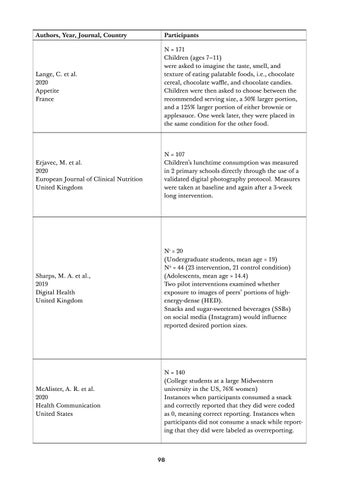
Authors, Year, Journal, Country
Participants
Lange, C. et al. 2020 Appetite France
N = 171 Children (ages 7–11) were asked to imagine the taste, smell, and texture of eating palatable foods, i.e., chocolate cereal, chocolate waffle, and chocolate candies. Children were then asked to choose between the recommended serving size, a 50% larger portion, and a 125% larger portion of either brownie or applesauce. One week later, they were placed in the same condition for the other food.
Erjavec, M. et al. 2020 European Journal of Clinical Nutrition United Kingdom
N = 107 Children’s lunchtime consumption was measured in 2 primary schools directly through the use of a validated digital photography protocol. Measures were taken at baseline and again after a 3-week long intervention.
Sharps, M. A. et al., 2019 Digital Health United Kingdom
Ni = 20 (Undergraduate students, mean age = 19) Nii = 44 (23 intervention, 21 control condition) (Adolescents, mean age = 14.4) Two pilot interventions examined whether exposure to images of peers’ portions of highenergy-dense (HED). Snacks and sugar-sweetened beverages (SSBs) on social media (Instagram) would influence reported desired portion sizes.
McAlister, A. R. et al. 2020 Health Communication United States
N = 140 (College students at a large Midwestern university in the US, 76% women) Instances when participants consumed a snack and correctly reported that they did were coded as 0, meaning correct reporting. Instances when participants did not consume a snack while reporting that they did were labeled as overreporting.
98
Focus area
Key Findings
Priming
Food sensory imagery may be a useful intervention to nudge children towards healthier portion size choices because it reduces the selected portion size of an energy-dense snack without reducing the selected portion size of a healthier snack. The study with the two foods together (brownie, applesauce) revealed that hungrier children (B = 0.03, t (163) = 3.21, p < 0.01) and heavier children (B = 0.04, t (163) = 2.04, p < 0.05) chose significantly larger portions. Moreover, children chose significantly larger portions for brownie than for applesauce (B = −0.37, t (163) = −7.94, p < 0.01). There was no significant interaction between imagery and real conditions (p = 0.65).
Priming
Changes to the choice architecture of dining rooms (e.g., improved presentation and provision of target foods, attractive advertisements, labeling, prompting by staff) resulted in increase in consumption of fruit with the schoolchildren, but their selection of vegetables did not change or even declined. For children who took school lunches (n = 67), both selection and consumption of fruit increased as the result of the intervention (z = −4.692, p < 0.001, 110 r = −0.74 and z = −3.950, p < 0.001, r = −0.48 respectively). No changes were observed in the comparison group (n = 40), who brought their lunch boxes from home.
Priming
Exposure to images of peers’ portions of high-energy-dense (HED) snacks and sugar-sweetened beverages (SSBs) on social media (Instagram) reduced desired portion sizes of HED snacks and SSBs in young adults, but not in adolescents. Intervention 1: there was a significant main effect of time (F (1, 19) = 14.68, p = 0.001, ƞp² = 0.44). Participants reported smaller desired portion sizes of HED snacks and SSBs at intervention end than at baseline. There was no significant food type by time interaction (F (1, 19) = 3.70, p = 0.07, ƞp²= 0.16) on participants’ desired portion sizes of HED snacks and SSBs between baseline and intervention end. Intervention 2: there was no significant main effect of condition (F (1, 41) = 0.92, p = 0.34, ƞp²= 0.02), no significant main effect of time (F (1, 41) = 0.58, p = 0.45, ƞp²= 0.01) and no significant interactions (p > 0.05). Thus, the intervention did not influence participants to reduce their desired portion sizes of HED snacks or SSBs relative to the control condition.
Priming
People sometimes eat greater amounts of preferred foods than they realize when they are multitasking with screen devices. By surrounding oneself with snack-size fruits, vegetables, and nuts in multitasking situations, mindless eating could be a powerful nudge to facilitate greater consumption of preferred foods to combat health concerns. The interaction effect of media use and snack type on over-reporting was not significant, F (3,132) = 1.59, p = 0.194, ηp² = 0.04. However, the interaction effect of media use and snack type on under-reporting was significant, F (3,132) = 2.69, p = 0.049, ηp² = 0.06. 99
Authors, Year, Journal, Country
Participants
McAlister, A. R. et al. (continue)
Instances when participants consumed a snack while reporting they did not, were considered to be underreporting.
Boehm, R. et al. 2020 Public Health Nutrition United States
The data included 332 school days across the 3 schools (The Healthy Choices, Healthy Nudging and Comparison Schools, 282 baseline days; 50 intervention days). The study aimed to compare federally reimbursable school meals served when competitive foods were removed and when marketing and nudging strategies were used in school cafeterias operating the National School Lunch Program (NSLP). The second objective was to determine how marketing and nudging strategies influenced competitive food sales.
Walker, L. A. et al. 2019 Royal Society Open Science United Kingdom
Evidence-based recommendations for public health policy to combat obesity. On average, 26% of UK adults classify as obese double the global average.
Tangari, A. H., Banerjee, S., and Verma, S. 2019 Journal of Business Research United States
Ni =112 Respondents (39% female, mean age = 25) were presented with an ad for a milk product as the healthy product or with an ad for a cola product as the unhealthy product.
100 Ukázka elektronické knihy