The pig and beef tapeworms, Taenia solium and T. saginata, form cysts, which are present in muscle. If man ingests them, the adult worm develops in the gut. The ova may also develop into larval forms, which invade muscle and other tissues, where they form cysts. This condition is known as cysticercosis and may lead to neurological disorders. Undercooked pork may also contain larvae of Trichinella spiralis, which can also invade tissues and cause a febrile illness. The fish tapeworm Diphyllobothrium latum has a wide distribution in a freshwater fish and thus may infect man if the fish are undercooked or eaten raw. Raw fish and crabs are sometimes eaten in the Far East and these may be infected with two species of liver fluke. If the ingredients of a salad have been washed in contaminated water or the crops were grown and irrigated with water from a source colonized by the molluscan hosts of the helminthic worms, then it is possible for infection to occur by this route. The infection is unlikely in countries with well-established water and sewerage systems, but these are rare in many parts of the world. Giardia lamblia infections are usually foodborne, waterborne or spread from person to person. Giardia usually causes acute or subacute diarrhoea, sometimes malabsorption with fatty stools and often abdominal pain and bloating. Transmission of Entamoeba histolytica is foodborne or waterborne. The cysts are highly resistant to chemical disinfectants, including chlorination. Asymptomatic infections are frequent (about 90%). Symptomatic amoebiasis ranges from persistent mild diarrhoea to fulminant dysentery.
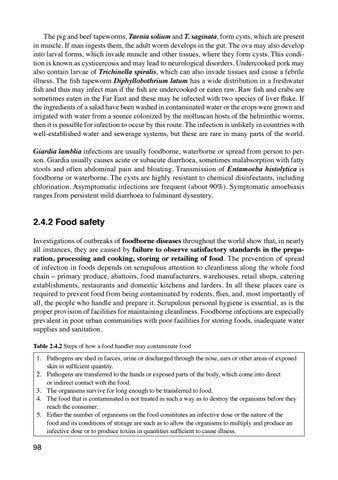
2.4.2 Food safety Investigations of outbreaks of foodborne diseases throughout the world show that, in nearly all instances, they are caused by failure to observe satisfactory standards in the preparation, processing and cooking, storing or retailing of food. The prevention of spread of infection in foods depends on scrupulous attention to cleanliness along the whole food chain – primary produce, abattoirs, food manufacturers, warehouses, retail shops, catering establishments, restaurants and domestic kitchens and larders. In all these places care is required to prevent food from being contaminated by rodents, flies, and, most importantly of all, the people who handle and prepare it. Scrupulous personal hygiene is essential, as is the proper provision of facilities for maintaining cleanliness. Foodborne infections are especially prevalent in poor urban communities with poor facilities for storing foods, inadequate water supplies and sanitation. Table 2.4.2 Steps of how a food handler may contaminate food
1. Pathogens are shed in faeces, urine or discharged through the nose, ears or other areas of exposed skin in sufficient quantity. 2. Pathogens are transferred to the hands or exposed parts of the body, which come into direct or indirect contact with the food. 3. The organisms survive for long enough to be transferred to food. 4. The food that is contaminated is not treated in such a way as to destroy the organisms before they reach the consumer. 5. Either the number of organisms on the food constitutes an infective dose or the nature of the food and its conditions of storage are such as to allow the organisms to multiply and produce an infective dose or to produce toxins in quantities sufficient to cause illness.
98
Ukázka elektronické knihy, UID: KOS271481
As pathogenic organisms may be introduced into the food chain from a variety of sources at different stages, correct application of processing technologies, such as pasteurisation, irradiation, cooking, freezing and pickling at the industrial, retail and domestic levels is important. Surveillance of sporadic cases and outbreaks of foodborne disease should be an integral part of every foodborne disease control programme. Surveillance provides the basic data for (a) determining the predominant foodborne diseases in a community, (b) indicating the principal vehicles of transmission; and (c) identifying the main factors that contribute to the occurrence of outbreaks of foodborne diseases. Table 2.4.3 How to keep the food safe
• Choose foods processed for safety. Some foods may not be safe unless processed, e.g. pasteurized milk as opposed to raw milk. • Cook food thoroughly. Much raw food, notably poultry, meat and unpasteurized milk may be contaminated with pathogens. Thorough cooking will kill these as long as all parts of the food reach at least 70°C. • Eat cooked food as soon as possible. When cooked food cools microbes begin to proliferate. The longer the wait the greater the risk. • Store cooked food carefully. Stored food should be kept either hot (near or above 60°C) or cool (near or below 10°C), especially if stored for more than four hours. Foods for infants should not be stored at all. In an over-burdened refrigerator hot food may not be able to cool quickly enough and if the center remains warm (above 10°C) for too long, microbes quickly proliferate. • Reheat cooked food thoroughly. Reheating is the best protection against microbes that develop during storage. All parts of food must reach at least 70°C. • Avoid contact between raw and cooked food. Cross-contamination can be direct if raw food comes into contact with cooked food; or indirect when an unwashed cutting board/knife, used when it was raw, are used to carve the cooked food. • Wash hands repeatedly. Hands should be washed before and after preparing food, changing the baby, going to the toilet, touching pets etc. After preparing raw food hands should be washed before touching cooked food. • All kitchen surfaces should be kept clean. Every crumb or spot is a potential reservoir for germs. Dish clothes should be changed regularly and boiled if contaminated. • Protect food from insects, rodents and other animals. Store food in tightly sealed containers. • Use pure water. If there is any doubt, water should be boiled before making ice, drinking or adding it to food, especially if used in a meal for a young child.
CHAPTER 2.5 TOXIC SUBSTANCES IN FOOD All human activities, including transportation, affect the quality of the environment and the entire food chain. Foodborne exposure to agricultural, industrial and environmental chemicals concerns public health officials in most countries. In addition, contaminants, residues of veterinary drugs and pesticides, and process contaminants are known to present acute and chronic health hazards and are a worldwide problem. 99
Ukázka elektronické knihy, UID: KOS271481
WHO (World Health Organization) and other authorities – FAO (Food and Agriculture Organization of the United Nations), EFSA (European Food Safety Authority) supervised food safety and quality, cooperate rate with other scientific institutions and use scientific results of research (studies and monitoring) to determine the safe levels of contaminants and residues in the food chain. Food safety must ensure that the food must be safe, must not be harmful to health and without no health risk of food in the daily consumption of a lifetime. In the Czech Republic main authority in foodstuffs of animal origin is State Veterinary Administration, for market network for all foodstuffs is State Agriculture and Food Inspection Authority. Both authorities cooperate. In Europe were established Rapid Alert System for Food and Feed (RASFF) based to consumers, informing rapidly on the occurrence of dangerous contaminants in food, feed and materials in contact with food. Volunteers outside the EU can contribute to this system, too.
2.5.1 Natural food toxicity Many substances are naturally present in food in levels with no adverse effect on human health, but can be dangerous in high concentration, when they are grow or storage under bad conditions (solanine in potatoes and unripe tomatoes, oligosaccharides and fytoestrogenes in legumes, lectins in legumes are haemagglutinins, can be degradated by boiling, cyanogenic glycosides – linamarin in cassava or tapioca, amygdalin in almonds and appricots, etc). Many substances naturally present in raw materials of plant origin can contaminate food (e.g. alkaloids from plants in herbal teas, alkaloids in cereals contaminated by fungi). But this intoxications are very rare.
2.5.1.1 Pyrrolizidine Alkaloids in Food Pyrrolizidine alkaloids are group of natural toxins produced by plants (family Boraginaceae, Asteraceae – Senecio, Colchicaceae – Colchicum e.g.), which may enter the food chain. Some of them are honey-bearing plants, some herbal mixtures (herbal teas) may contain an admixture of these poisonous plants. Several are known to be highly hepatotoxic, have been shown to be carcinogenic in animals. They have been associated with a number diseases of farming animals and with cases of human poisoning following frequent consumption of herbal remedies or honey with high concentration of alkaloids. They can be transmitted through the feed of livestock to other food products such as honey, milk, and eggs.
2.5.1.2 Grayanotoxins and mad honey Several plants of the Ericaceae family, e.g. rhododendrons produce grayanotoxins, also known as andromedotoxin or rhodotoxin. Grayanotoxins can be found in honey called ‘mad honey’ with hallucinogenic properties, produced from the nectar of plants such as Rhododendron ponticum that contains alkaloids. They are poisonous to people (area around the Black Sea, Japan, Nepal, USA). There were famous episodes of intoxication of people consuming toxic honey known from history (Greek, Turkey, near Black Sea). Initial symptoms are excessive salivation, perspiration, vomiting, dizziness, weakness and paresthesia in the 100
Ukázka elektronické knihy