7. Analysis
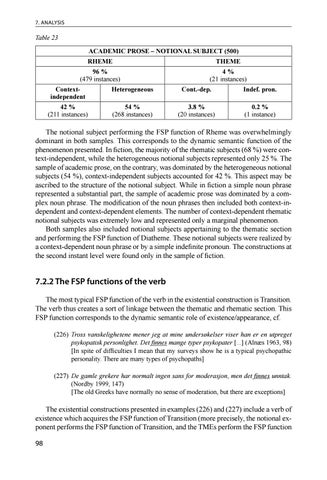
Table 23 ACADEMIC PROSE – NOTIONAL SUBJECT (500) RHEME
THEME
96 % (479 instances)
4 % (21 instances)
Contextindependent
Heterogeneous
Cont.-dep.
Indef. pron.
42 % (211 instances)
54 % (268 instances)
3.8 % (20 instances)
0.2 % (1 instance)
The notional subject performing the FSP function of Rheme was overwhelmingly dominant in both samples. This corresponds to the dynamic semantic function of the phenomenon presented. In fiction, the majority of the rhematic subjects (68 %) were context-independent, while the heterogeneous notional subjects represented only 25 %. The sample of academic prose, on the contrary, was dominated by the heterogeneous notional subjects (54 %), context-independent subjects accounted for 42 %. This aspect may be ascribed to the structure of the notional subject. While in fiction a simple noun phrase represented a substantial part, the sample of academic prose was dominated by a complex noun phrase. The modification of the noun phrases then included both context-independent and context-dependent elements. The number of context-dependent rhematic notional subjects was extremely low and represented only a marginal phenomenon. Both samples also included notional subjects appertaining to the thematic section and performing the FSP function of Diatheme. These notional subjects were realized by a context-dependent noun phrase or by a simple indefinite pronoun. The constructions at the second instant level were found only in the sample of fiction.
7.2.2 The FSP functions of the verb The most typical FSP function of the verb in the existential construction is Transition. The verb thus creates a sort of linkage between the thematic and rhematic section. This FSP function corresponds to the dynamic semantic role of existence/appearance, cf. (226) Tross vanskelighetene mener jeg at mine undersøkelser viser han er en utpreget psykopatisk personlighet. Det finnes mange typer psykopater [...] (Alnæs 1963, 98) [In spite of difficulties I mean that my surveys show he is a typical psychopathic personality. There are many types of psychopaths] (227) De gamle grekere har normalt ingen sans for moderasjon, men det finnes unntak. (Nordby 1999, 147) [The old Greeks have normally no sense of moderation, but there are exceptions]
The existential constructions presented in examples (226) and (227) include a verb of existence which acquires the FSP function of Transition (more precisely, the notional exponent performs the FSP function of Transition, and the TMEs perform the FSP function 98
Ukázka elektronické knihy, UID: KOS259895
7.2 FSP analysis
of Transition proper). It carries a higher degree of CD than the thematic element (here represented by the existential subject det) and simultaneously lower degree of CD than the rhematic elements (here represented by the notional subjects). The analysis confirmed that this dual FSP function (Transition and Transition proper) is really the dominant FSP function of the verb in the existential construction. In fiction, it represented 93.5 % (467 instances out 500) and in academic prose 96 % (479 instances out of 500). In some cases, the notional exponent of the verb may exceed the notional subject in the degree of CD and thus perform the FSP function of Rheme. In other words, the verb combines the FSP functions of Transition proper (realized by the temporal and modal exponents), and Rheme (realized by the notional exponent), cf. examples (220) and (221) above. In example (220) the verb fins combines the two functions mentioned above. The verb finnes in example (221), however, combines the FSP function of Transition proper (TMEs) and Transition (notional exponent), while the function of Rheme is performed by the negative adverbial ikke. Nevertheless, for the purpose of this analysis, the negative adverbial is considered as a part of the verb. That is why these examples are also included in this category. The verb may also become a part of the thematic section, especially when an existential construction is repeated and all the communicative units but one are context-dependent, cf. second instance and example (225) above. Table 24 below summarizes the FSP functions of the verb in the two types of text. Table 24 FSP of Verb FICTION (500 instances)
ACADEMIC PROSE (500 instances)
Trpr/Tr
Trpr/Rh
Theme
Trpr/Tr
Trpr/Rh
93.5 %
6 %
0.5 %
96 %
4 %
In the majority of the existential constructions, the verb performs a dual FSP function (Transition performed by the notional exponent, and Transition proper performed by TMEs). This means that it forms a sort of linkage between the thematic and the rhematic section. This was evident in both samples. Exceptionally, the notional exponent of the verb may acquire the FSP function of Rheme and thus represents the most dynamic unit of the communicative field. The TMEs of the verb perform the FSP function of Transition proper. A thematic verb was registered only in fiction and it is connected with the second instance level. In addition, substantial differences between the two samples were observed in realization forms (cf. 7.1.4).
7.2.3 The FSP functions of adverbials Adverbials (adjuncts, disjuncts and conjuncts) may perform various FSP functions. They may convey a concomitant piece of information and thus create a background for 99
Ukázka elektronické knihy, UID: KOS259895
7. Analysis
the communication. In that case, they appertain to the thematic section and perform the FSP function of Diatheme (DiaTh). This corresponds to the dynamic semantic role of scene. Adverbials can also get close to the Transition and thus become a part of the linkage between the thematic and rhematic parts. These adverbials acquire the FSP function of Transition proper oriented element (TrprO). Finally, adverbials may convey the highest degree of CD in the respective communicative field and thus become the most prominent element. They perform the FSP function of Rheme proper or dynamic semantic role of specification.
7.2.3.1 Diatheme Diathematic adverbials are dominantly realized by adjuncts and may appear in all three positions. Table 25 below displays the distribution of diathematic adverbials in all three positions. In fiction diathematic adverbials occurred in the initial position in 22 % (70 instances), while in academic prose in 41 % (96 instances). In both of the samples, they were most frequently realized by locative adverbials, cf. Table 25 DIATHEME FICTION (315 instances) Initial
Medial
Final
22 % 8 % 70 % (70 instances) (26 instances) (219 instances)
ACADEMIC PROSE (232 instances) Initial
Medial
Final
41 % 18 % 41 % (96 instances) (40 instances) (96 instances)
(228) Ved sekstiden gikk jeg opp i offisersmessen for å få noe mat i meg. Jeg var stiv av tretthet. På bordet, som hadde fått slingrebrettene på, var det té, pletter og kaffetøy. (Bjørneboe 1974, 27) [At six o’clock went I up to the officer’s canteen to get some food. I was stiff of fatigue. On the table that had got frame, was there tea, plates and cups] (229) Den andre typen syntaktiske regler har å gjøre med hvordan fraser og ord stilles sammen til setninger. I følgende setning er det ikke noe i veien med verken ordformene eller frasene [...]. (Kulbrandstad 1998, 4) [The other type of syntactic rules concerns how phrases and words are placed in sentences. In the following sentence is there nothing in the way either with the word forms or phrases]
Examples (228) and (229) demonstrate diathematic locative adjuncts in the initial position. These adjuncts carry only background information and create a sort of scene for the flow of communication. Concerning context-dependence they can be both context-independent, heterogeneous (example (229)), or context-dependent (example 228)). Nevertheless, the communicative unit formed by these adverbials carries a relatively low degree of CD. 100
Ukázka elektronické knihy, UID: KOS259895