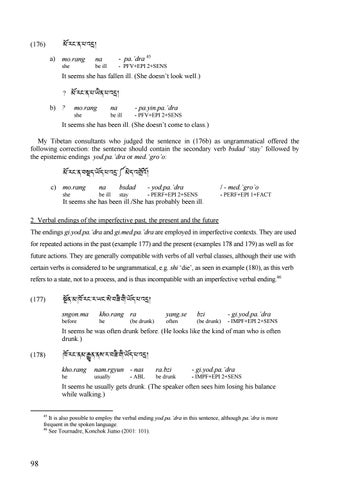
(176)
1}-:$-,-.-8Hk a) mo.rang she
na
- pa.ʼdra 45
be ill
- PFV+EPI 2+SENS
It seems she has fallen ill. (She doesn’t look well.) ? b) ?
1}-:$-,-.-9m,-.-8Hk mo.rang
na
- pa.yin.pa.ʼdra
she
be ill
- PFV+EPI 2+SENS
It seems she has been ill. (She doesn’t come to class.) My Tibetan consultants who judged the sentence in (176b) as ungrammatical offered the following correction: the sentence should contain the secondary verb bsdad ‘stay’ followed by the epistemic endings yod.pa.ʼdra or med.ʼgroʼo:
1}-:$-,-0&+-9}+-.-8H-]1{+-8E}8}k c) mo.rang she
na
bsdad
- yod.pa.ʼdra
/ - med.ʼgroʼo
be ill
stay
- PERF+EPI 2+SENS
- PERF+EPI 1+FACT
It seems she has been ill./She has probably been ill. 2. Verbal endings of the imperfective past, the present and the future The endings gi.yod.pa.ʼdra and gi.med.pa.ʼdra are employed in imperfective contexts. They are used for repeated actions in the past (example 177) and the present (examples 178 and 179) as well as for future actions. They are generally compatible with verbs of all verbal classes, although their use with certain verbs is considered to be ungrammatical, e.g. shi ‘die’, as seen in example (180), as this verb refers to a state, not to a process, and is thus incompatible with an imperfective verbal ending.46 (177)
#},-1-"}-:$-:-9$-={-07m-#m-9}+-.-8Hk sngon.ma
kho.rang ra
yang.se
bzi
- gi.yod.pa.ʼdra
before
he
often
(be drunk)
- IMPF+EPI 2+SENS
(be drunk)
It seems he was often drunk before. (He looks like the kind of man who is often drunk.) (178)
"}-:$-,1-Wv,-,=-:-07m-#m-9}+-.-8Hk kho.rang
nam.rgyun - nas
ra.bzi
- gi.yod.pa.ʼdra
he
usually
be drunk
- IMPF+EPI 2+SENS
- ABL
It seems he usually gets drunk. (The speaker often sees him losing his balance while walking.) 45
It is also possible to employ the verbal ending yod.pa.ʼdra in this sentence, although pa.ʼdra is more frequent in the spoken language. 46 See Tournadre, Konchok Jiatso (2001: 101).
98 Ukázka elektronické knihy, UID: KOS238157