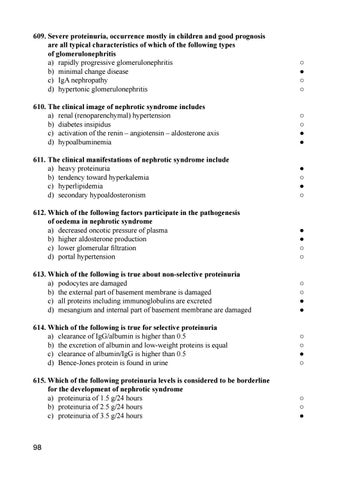
609. Severe proteinuria, occurrence mostly in children and good prognosis are all typical characteristics of which of the following types of glomerulonephritis a) rapidly progressive glomerulonephritis b) minimal change disease c) IgA nephropathy d) hypertonic glomerulonephritis
○ ● ○ ○
610. The clinical image of nephrotic syndrome includes a) renal (renoparenchymal) hypertension b) diabetes insipidus c) activation of the renin – angiotensin – aldosterone axis d) hypoalbuminemia
○ ○ ● ●
611. The clinical manifestations of nephrotic syndrome include a) heavy proteinuria b) tendency toward hyperkalemia c) hyperlipidemia d) secondary hypoaldosteronism
● ○ ● ○
612. Which of the following factors participate in the pathogenesis of oedema in nephrotic syndrome a) decreased oncotic pressure of plasma b) higher aldosterone production c) lower glomerular filtration d) portal hypertension
● ● ○ ○
613. Which of the following is true about non-selective proteinuria a) podocytes are damaged b) the external part of basement membrane is damaged c) all proteins including immunoglobulins are excreted d) mesangium and internal part of basement membrane are damaged
○ ○ ● ●
614. Which of the following is true for selective proteinuria a) clearance of IgG/albumin is higher than 0.5 b) the excretion of albumin and low-weight proteins is equal c) clearance of albumin/IgG is higher than 0.5 d) Bence-Jones protein is found in urine
○ ○ ● ○
615. Which of the following proteinuria levels is considered to be borderline for the development of nephrotic syndrome a) proteinuria of 1.5 g/24 hours b) proteinuria of 2.5 g/24 hours c) proteinuria of 3.5 g/24 hours
○ ○ ●
98
Ukázka elektronické knihy, UID: KOS205727
616. Microscopic evaluation of urine sediment with the use of phase contrast is useful for a) distinguishing between erythrocytes which have passed through glomeruli and erythrocytes which come from lower parts of the urinary tract b) detecting thrombocytes in urine c) detecting fibrin fibres in urine d) distinguishing eosinophil and neutrophil granulocytes
● ○ ○ ○
617. The most intensive hemoglobinuria can be found a) after incompatible blood transfusion b) in thalassemia major c) in paroxysmal nocturnal hemoglobinuria d) in rapidly progressive glomerulonephritis
● ○ ○ ○
618. Acute glomerulonephritis is a disease a) with frequent fatal outcome b) with quick progression, requiring intensive therapy (high doses of corticoids, cytostatics) in order to stabilise the patient c) commonly with good prognosis and functional restitution ad integrum d) infectious
○ ● ○
619. Anuria is defined as a 24-hour urination lower than a) 750 mL b) 500 mL c) 250 mL d) 100 mL (50 mL)
○ ○ ○ ●
620. Complications of pre-renal acute renal failure frequently include a) nephrotic syndrome b) resistant arterial hypertension c) acute tubular necrosis d) glycosuria
○ ○ ● ○
621. In the anuric phase of an acute renal failure, the patient is mainly threatened by a) hypokalemia b) cerebral and pulmonary oedema c) hyperkalemia d) metabolic alkalosis
○ ● ● ○
622. In the oliguric phase of renal failure caused by acute glomerulonephritis, we can expect a) proteinuria, hematuria b) hypokalemia, hyponatremia, water loss c) hyperkalemia, water retention d) signs of uremic intoxication
● ○ ● ●
○
99
Ukázka elektronické knihy, UID: KOS205727
623. In the pre-renal type of renal failure (e. g., in dehydration), the natrium concentration in urine is a) lower than in renal failure caused by primary renal disorders b) higher than in renal failure caused by primary renal disorders c) the same as in renal failure caused by glomerulonephritis d) the same as in isostenuria
● ○ ○ ○
624. Oliguria is defined as a) diuresis lower than 50 mL/24 hours b) diuresis lower than 500 mL/24 hours c) frequent, urgent urination occurring before the physiological capacity of the bladder is reached d) a synonym for urine retention
○ ○
625. Oliguria may be caused by a) intensive vomiting b) acute diarrhea c) septic shock d) acute glomerulonephritis
● ● ● ●
626. Poststreptococcal glomerulonephritis is a type of a) acute glomerulonephritis b) subacute glomerulonephritis c) bacterial inflammation d) rapidly progressive glomerulonephritis
● ○ ○ ○
○ ●
627. Renal failure in hepatorenal syndrome a) is caused by an acute necrosis of renal tubular cells b) is a functional consequence of renal vasoconstriction and lower renal blood flow c) results from changes in the splanchnic and renal circulation and imbalance between vasoconstrictory and vasodilatory mechanisms d) is a type of acute glomerulonephritis
● ○
628. Which of the following disturbances are typical for acute renal failure a) anuria b) oliguria c) polyuria d) paradoxical ischuria
● ● ● ○
629. Frequent causes of a chronic kidney disease can include a) mucoviscidosis b) diabetes insipidus c) chronic glomerulonephritis d) unilateral nephrectomy
○ ○ ● ○
○ ●
100
Ukázka elektronické knihy, UID: KOS205727