98
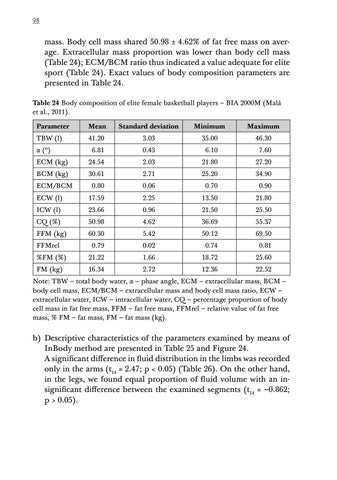
mass. Body cell mass shared 50.98 ± 4.62% of fat free mass on average. Extracellular mass proportion was lower than body cell mass (Table 24); ECM/BCM ratio thus indicated a value adequate for elite sport (Table 24). Exact values of body composition parameters are presented in Table 24. Table 24 Body composition of elite female basketball players – BIA 2000M (Malá et al., 2011). Parameter
Mean
Standard deviation
Minimum
Maximum
TBW (l)
41.20
3.03
35.00
46.30
α (°)
6.81
0.43
6.10
7.60
ECM (kg)
24.54
2.03
21.80
27.20
BCM (kg)
30.61
2.71
25.20
34.90
0.80
0.06
0.70
0.90
ECW (l)
17.59
2.25
13.50
21.80
ICW (l)
23.66
0.96
21.50
25.50
CQ (%)
50.98
4.62
36.69
55.37
FFM (kg)
60.30
5.42
50.12
69.50
0.79
0.02
0.74
0.81
%FM (%)
21.22
1.66
18.72
25.60
FM (kg)
16.34
2.72
12.36
22.52
ECM/BCM
FFMrel
Note: TBW – total body water, α – phase angle, ECM – extracellular mass, BCM – body cell mass, ECM/BCM – extracellular mass and body cell mass ratio, ECW – extracellular water, ICW – intracellular water, CQ – percentage proportion of body cell mass in fat free mass, FFM – fat free mass, FFMrel – relative value of fat free mass, % FM – fat mass, FM – fat mass (kg).
b) Descriptive characteristics of the parameters examined by means of InBody method are presented in Table 25 and Figure 24. A significant difference in fluid distribution in the limbs was recorded only in the arms (t14 = 2.47; p < 0.05) (Table 26). On the other hand, in the legs, we found equal proportion of fluid volume with an insignificant difference between the examined segments (t14 = –0.862; p > 0.05).
Ukázka elektronické knihy, UID: KOS204676
99
Table 25 Body composition in elite female basketball players – Inbody (Malá et al., 2013). Parameter
Minimum
Maximum
Mean
Std. error
Std. deviation
Variance
ICW (l)
25.80
33.10
30.51
0.66
2.55
6.53
ECW (l)
12.00
16.80
14.43
0.41
1.61
2.58
Protein (kg)
10.30
13.20
12.19
0.26
1.01
1.02
BM (kg)
3.34
4.18
3.84
0.07
0.29
0.08
FM (%)
9.10
19.30
13.01
0.70
2.69
7.26
TBW (l)
37.90
49.80
44.93
1.05
4.06
16.47
MM (kg)
48.20
63.10
57.07
1.29
5.00
25.02
FFM (kg)
51.50
67.20
60.96
1.38
5.35
28.62
%FM (%)
13.60
22.70
17.47
0.61
2.37
5.64
RA (l)
2.02
2.88
2.56
0.07
0.27
0.07
LA (l)
2.02
2.85
2.53
0.07
0.27
0.07
T (l)
17.60
22.70
20.67
0.44
1.70
2.88
RL (l)
6.46
9.17
7.74
0.21
0.83
0.69
LL (l)
6.41
9.21
7.75
0.22
0.86
0.75
Note: ICW – intracellular water, ECW – extracellular water, BM – bone mass, FM – fat mass, TBW – total body water, MM – muscle mass, FFM – fat free mass, % FM – percentage of fat mass proportion, RA – fluid volume in the right arm, LA – fluid volume in the left arm, T – fluid volume in the trunk, RL – fluid volume in the right leg, LL – fluid volume in the left leg.
Table 26 The significance of difference in segmental distribution of fluids in elite female basketball players.
Pairs
Mean diff.
Std. deviation
Std. error Mean
95% Confidence interval of the difference Lower
Upper
RA – LA
0.03
0.04
0.01
0.00
0.05
RL – LL
–0.02
0.07
0.02
–0.05
0.02
t
df
Sig. (2-tailed)
2.47*
14
0.03
14
0.40
–0.86
Note: RA – fluid volume in the right arm (l), RL – fluid volume in the right leg (l), LA – fluid volume in the left arm (l), LL – fluid volume in the left leg (l), * – p < 0.05.
Ukázka elektronické knihy, UID: KOS204676
100
Trunk 20.67 ± 1.701 Dominant arm 2.56 ± 0.271
Dominant leg 7.74 ± 0.831
Non-dominant arm 2.53 ± 0.271
Non-dominant leg 7.75 ± 0.861
Figure 24 Segmental distribution of body fluids in elite female basketball players (Malá et al., 2013).
Discussion a) Fat free mass in the tested group amounted to 79% of body mass (Table 24). Carbuhn et al. (2010) measured an absolute value of fat free mass in female basketball players (n = 10, college players, 20 ± 1 years, 180.1 ± 8.9 cm, 76.9 ± 9 kg) 55.8 ± 5.8 kg at the beginning of pre-season. However, in comparison it is necessary to take into account different methods used and comparison of absolute values. Relative values revealed individual differences among the female players; despite this fact, we cannot definitely express a tendency in fat free mass proportion in individual playing positions. The highest relative value of fat free mass (0.81) was recorded in a point guard and a pivot. The lowest value was detected in a wing player (0.74). All players demonstrated relative values of fat free mass at the level of elite athletes due to their regular physical load. When assessing body cell mass, as a main part of fat free mass, we can notice values approaching the recommended 50% in almost all players except of one pivot (36.69%). Comparison with non-published tests of speed and explosive power showed other deficiencies of this player.
Ukázka elektronické knihy, UID: KOS204676