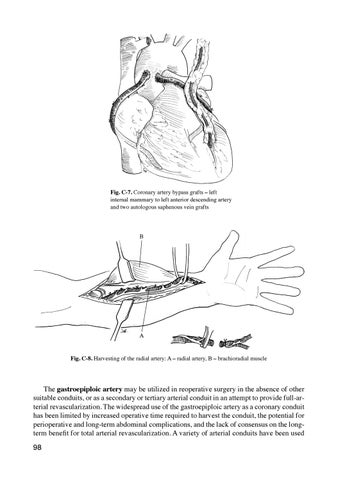
Fig. C-7. Coronary artery bypass grafts – left internal mammary to left anterior descending artery and two autologous saphenous vein grafts
B
A Fig. C-8. Harvesting of the radial artery: A – radial artery, B – brachioradial muscle
The gastroepiploic artery may be utilized in reoperative surgery in the absence of other suitable conduits, or as a secondary or tertiary arterial conduit in an attempt to provide full-arterial revascularization. The widespread use of the gastroepiploic artery as a coronary conduit has been limited by increased operative time required to harvest the conduit, the potential for perioperative and long-term abdominal complications, and the lack of consensus on the longterm benefit for total arterial revascularization. A variety of arterial conduits have been used 98
Ukázka elektronické knihy, UID: KOS203043
in patients in whom no other conduits are available. Anecdotal use of the ulnar, left gastric, splenic, thoracodorsal, and lateral femoral circumflex arteries as coronary graft conduits has been reported in the literature. There has been interest in the past in the use of the inferior epigastric artery as well, and several series have demonstrated encouraging early clinical results with good early patencies. A greater saphenous vein continues to be one of the most commonly used conduits in coronary bypass grafting. Characteristics that have solidified the saphenous vein as a coronary conduit include its ease of harvest, ready availability, versatility, resistance to spasm, and thoroughly studied long-term results. Saphenous vein harvest can be performed with a completely open, bridged (Fig. C-9) or endoscopic technique. Alternative venous conduits such as the lesser saphenous and cephalic veins may be used in the setting of reoperative surgery when no other conduits are available.
Fig. C-9. Harvesting of the great saphenous vein – open and bridged technique
On-Pump versus Off-Pump Surgery During surgery, the heart-lung bypass machine (called “on-pump” surgery) is used, allowing the circulation of blood throughout the rest of the body (Fig. C-10). The heart is arrested and its myocardium protected using a high potassium cardioplegic solution, then the surgeon can perform the bypass procedure on a “still” heart. Off-pump bypass surgery allows surgeons to perform surgery on the heart while it is still beating. The heart-lung machine is not used. The surgeon uses advanced operating equipment to stabilize (hold) portions of the heart and bypass the blocked artery in a highly controlled operative environment. Meanwhile, the rest 99
Ukázka elektronické knihy, UID: KOS203043
of the heart keeps pumping and circulating blood to the body. Off-pump coronary artery bypass surgery may be performed in certain patients with coronary artery disease. With present technology, all arteries on the heart can be bypassed off-pump. It may be ideal for patients who are at increased risk for complications from cardiopulmonary bypass, such as those who have heavy aortic calcification, carotid artery stenosis, prior stroke, or compromised pulmonary or renal function and those in their 70’s or older. The selection of patients who undergo off-pump surgery is made at the time of surgery when the patient’s heart and arteries are evaluated more closely. The results of both on- and off-pump surgeries are excellent. The risk of stroke, heart attack during surgery, and death were similar and low in patients undergoing both on- and off-pump CABG. There were fewer cognitive side effects in the off-pump patients, less renal failure requiring dialysis, less red blood cell usage, and fewer infections of chest incisions in the off-pump patients.
C
A
B
Fig. C-10. The cannulation for the extracorporal circulation: A – a cannula into the distal ascending aorta, B – a double cannula into the right atrium, C – cardioplegy / vent cannula is placed into the aortic root
Minimally Invasive Techniques Minimally invasive coronary artery bypass surgery which is performed from a small anterior thoracotomy is an option for some patients who require a left internal mammary artery bypass graft to the left anterior descending artery. Other minimally invasive surgery techniques include endoscopic or keyhole approaches (also called port-access, thoracoscopic or video-assisted surgery) and robotic-assisted surgery. The benefits of minimally invasive surgery include a smaller incision (3 to 4 inches instead of the 6- to 8-inch incision with 100
Ukázka elektronické knihy, UID: KOS203043