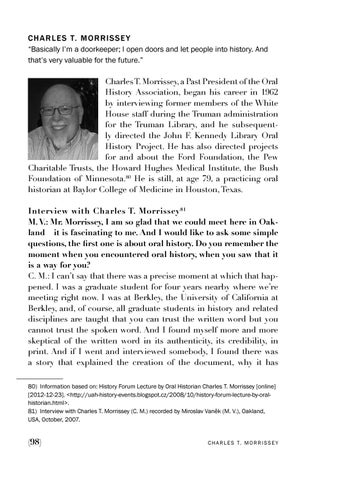
Charles T. Morrissey “Basically I’m a doorkeeper; I open doors and let people into history. And that’s very valuable for the future.”
Charles T. Morrissey, a Past President of the Oral History Association, began his career in 1962 by interviewing former members of the White House staff during the Truman administration for the Truman Library, and he subsequent ly directed the John F. Kennedy Library Oral History Project. He has also directed projects for and about the Ford Foundation, the Pew Charitable Trusts, the Howard Hughes Medical Institute, the Bush Foundation of Minnesota.80 He is still, at age 79, a practicing oral historian at Baylor College of Medicine in Houston, Texas. Interview with Charles T. Morrissey 81 M. V.: Mr. Morrissey, I am so glad that we could meet here in Oakland – it is fascinating to me. And I would like to ask some simple questions, the first one is about oral history. Do you remember the moment when you encountered oral history, when you saw that it is a way for you? C. M.: I can’t say that there was a precise moment at which that hap pened. I was a graduate student for four years nearby where we’re meeting right now. I was at Berkley, the University of California at Berkley, and, of course, all graduate students in history and related disciplines are taught that you can trust the written word but you cannot trust the spoken word. And I found myself more and more skeptical of the written word in its authenticity, its credibility, in print. And if I went and interviewed somebody, I found there was a story that explained the creation of the document, why it has 80) Information based on: History Forum Lecture by Oral Historian Charles T. Morrissey [online] [2012-12-23]. <http://uah-history-events.blogspot.cz/2008/10/history-forum-lecture-by-oralhistorian.html>. 81) Interview with Charles T. Morrissey (C. M.) recorded by Miroslav Vaněk (M. V.), Oakland, USA, October, 2007.
(98)
C harles T. M orrissey
Ukázka elektronické knihy, UID: KOS190531
survived, what significance people have attached to it. And in many cases, the story revised the historian’s sense of what is the signifi cance of this, why does this document exist. So I remember doing an interview within a two-minute walk of where we’re meeting right now with a former member of the U.S. Senate, named William Noland, from California, and his fam ily owned the newspaper, the Oakland Tribune, which was right across the street here. And he had left the Senate in 1958 to run for governor of California, and the governor of California had left the governorship to go to Washington as U.S. Senator. And both of them lost overwhelmingly in that 1958 election. Now the media was reporting that Senator Noland wanted to be governor so he could control the Republican delegation to the 1960 Republican Conven tion, and get the presidential nomination away from Richard Nixon. I interviewed him, and he denied this vigorously. But later, both his children said, “Father was obsessed with his presidential ambitions.” So I thought, here’s an interesting case where, basically, the press was reporting one thing, he was denying it, but other members of his family were affirming it. All of which simply emphasizes how complex historical research is, always much more complex than we anticipate at the outset. And by interviewing several people I was able to deny Noland’s denial, and also deny the paper trail he had created that he really wanted to come back to California because he wanted to be “closer to his family”, the excuse often offered. So out of that came, to me, the very important point, you’re always working with a mix of sources, a paper trail, a spoken memory trail, and you’ve got to get more than one interviewee on record in order to solve the complexity of it. That happened in 1960, that interview, and two years later I was hired and doing oral history interviews for the Harry S. Truman presidential library on people who had worked on the White House staff when Truman was president. Absolutely fascinating interviews on how the Truman administration made so many crucial decisions. And then I was doing that when John F. Ken nedy was assassinated in November of 1963, and it’s hard to believe, but in those days there were only two oral historians in Washington, DC doing oral history, and the other one was Forrest Pogue, who was A boo k of i n terviews
(99)
Ukázka elektronické knihy, UID: KOS190531
committed to doing his multi-volume biography of General George Marshall. So, by default, I became director of the John F. Kennedy Library Oral History Project, and a career was born. It took a while for my head to catch up with the reality that a career was born, but here I am in 2007 still active in the oral history movement. M. V.: Congratulations. You did a lot of work, I see. The other question is about the power of oral history. Where is the power, what is the power of oral history? C. M.: Yes. Always think in multiples, I tell my students. There are several powers, one of which is obvious: it lets neglected people, neg lected by historians, by historical documentation, get into history. So if history is the story of rich and powerful men, it allows poor women to get into the historical record. Secondly, I am convinced that the paper trail is largely a contrivance to cover actuality, not necessarily reveal it. Therefore, when you go into the interview, you can get someone to evoke the context in which the document was created. So you’re constantly playing off the old-fashioned documentary resource that Leopold von Rocka told us was the source of all his tory. With the spoken recollection, which has its frailties – memory plays tricks on all of us – on the other hand, some people can come in and zero in precisely on why something happened the way it did that’s quite contrary than the impression you would get from the paper trail. Those are the two primary ones. I’ll mention third as a self-satisfaction, really, and that is: every oral historian, by asking questions, is co-creating a record, and that record wouldn’t exist if you didn’t exert the initiative to make it happen. So you’re causing something to exist for the future that would not exist if you didn’t help make it exist. And I find that very satisfying as the years go by. Basically I’m a door keeper; I open doors and let people into history. And that’s very valuable for the future. I’m a historian with a strong sense of the future needs of historical knowledge. M. V.: I think that it’s the normal way. We are somewhere at the beginning, maybe, compared to the U.S. and Great Britain. Sometimes we are attacked by conservative historians. They tell us, “Yes, (100)
C harles T. M orrissey
Ukázka elektronické knihy, UID: KOS190531