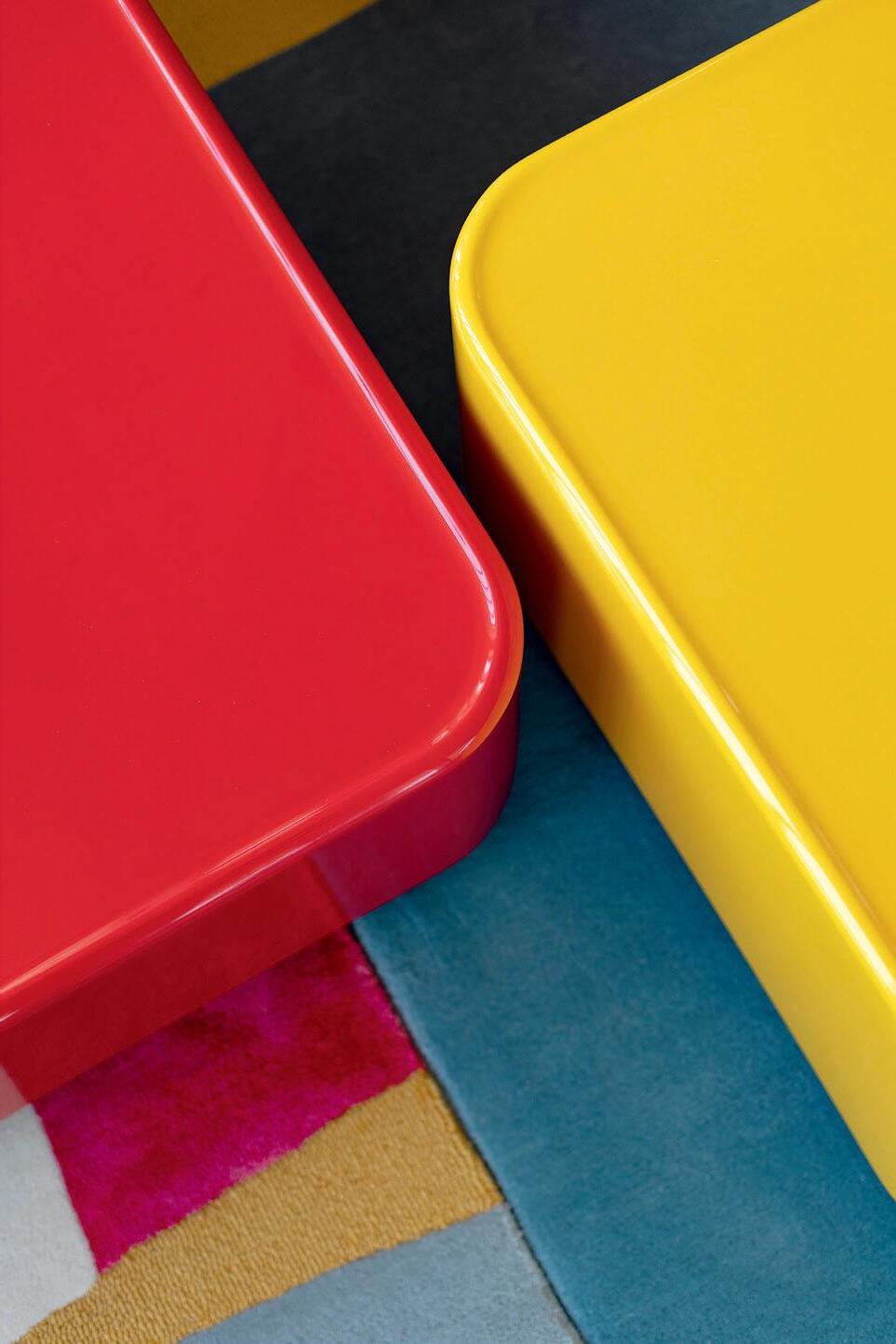
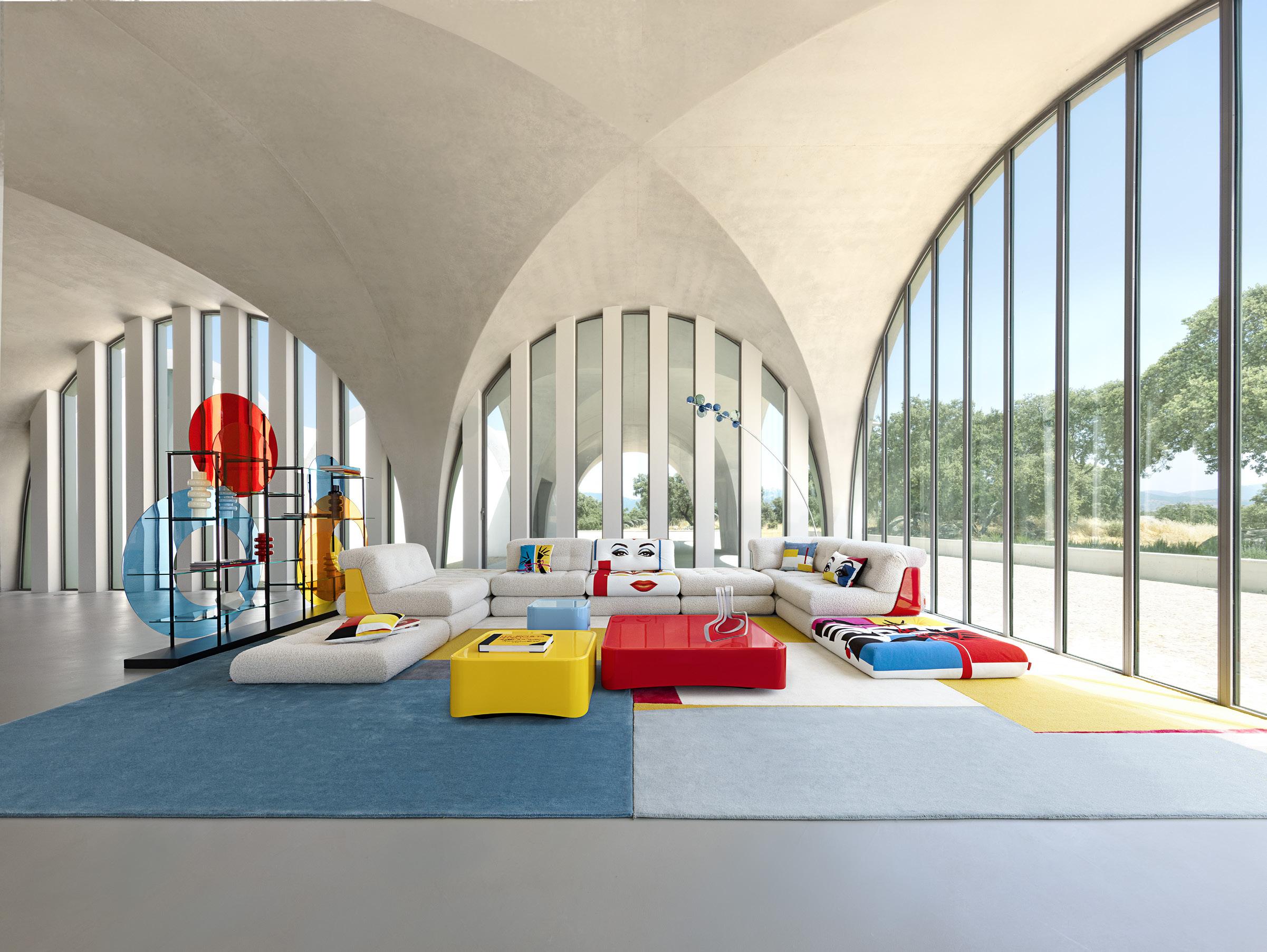
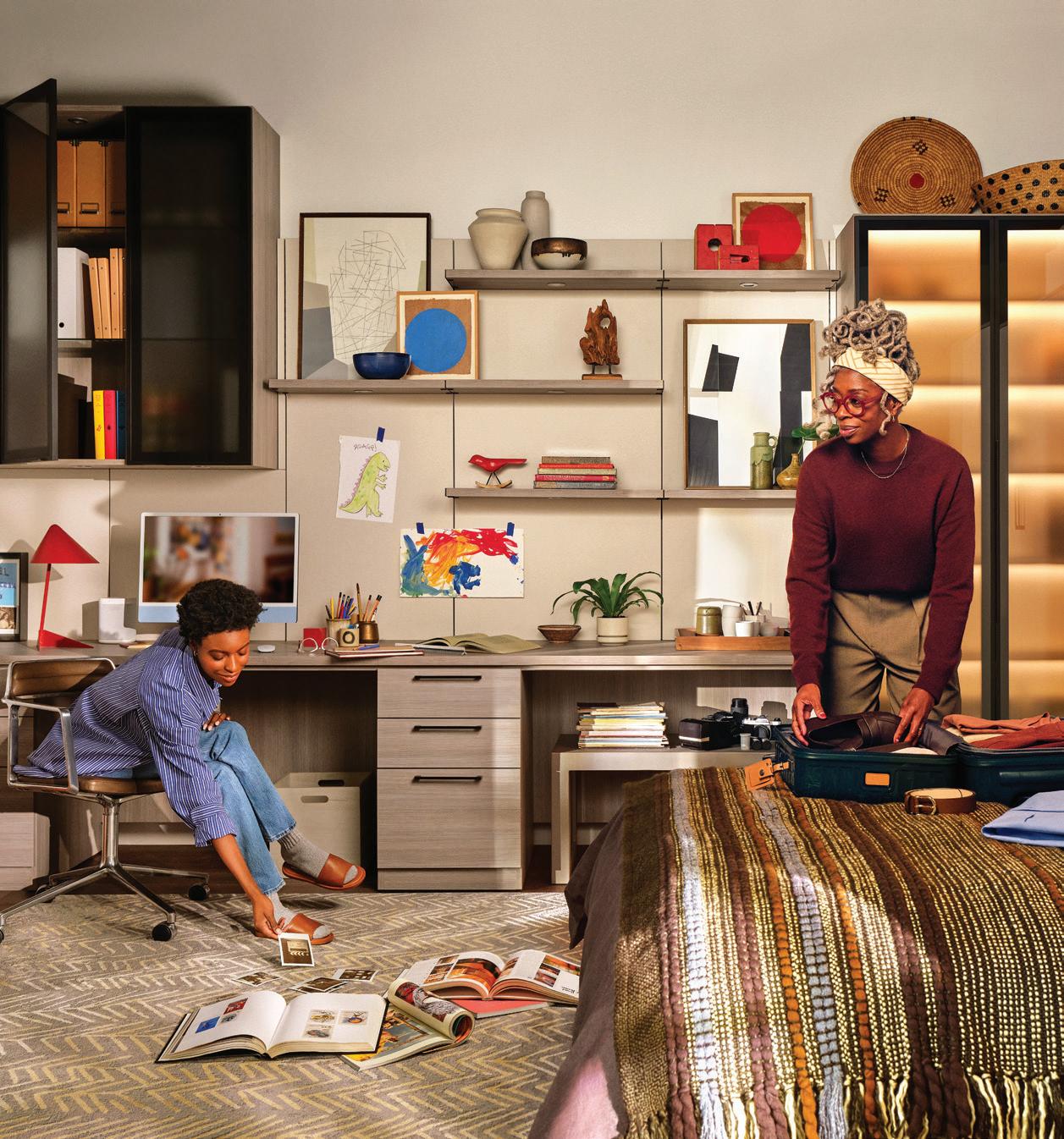
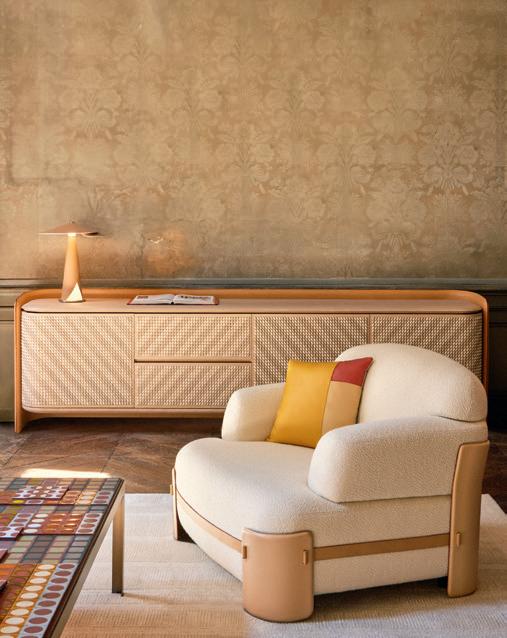
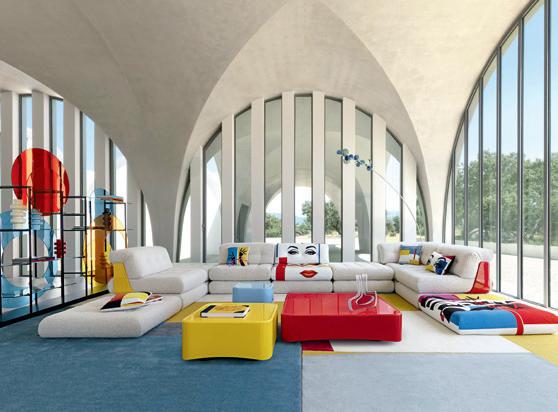
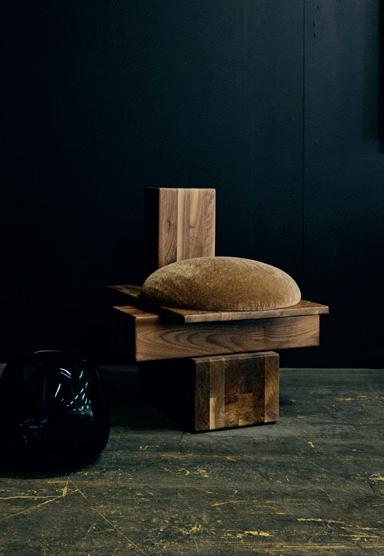
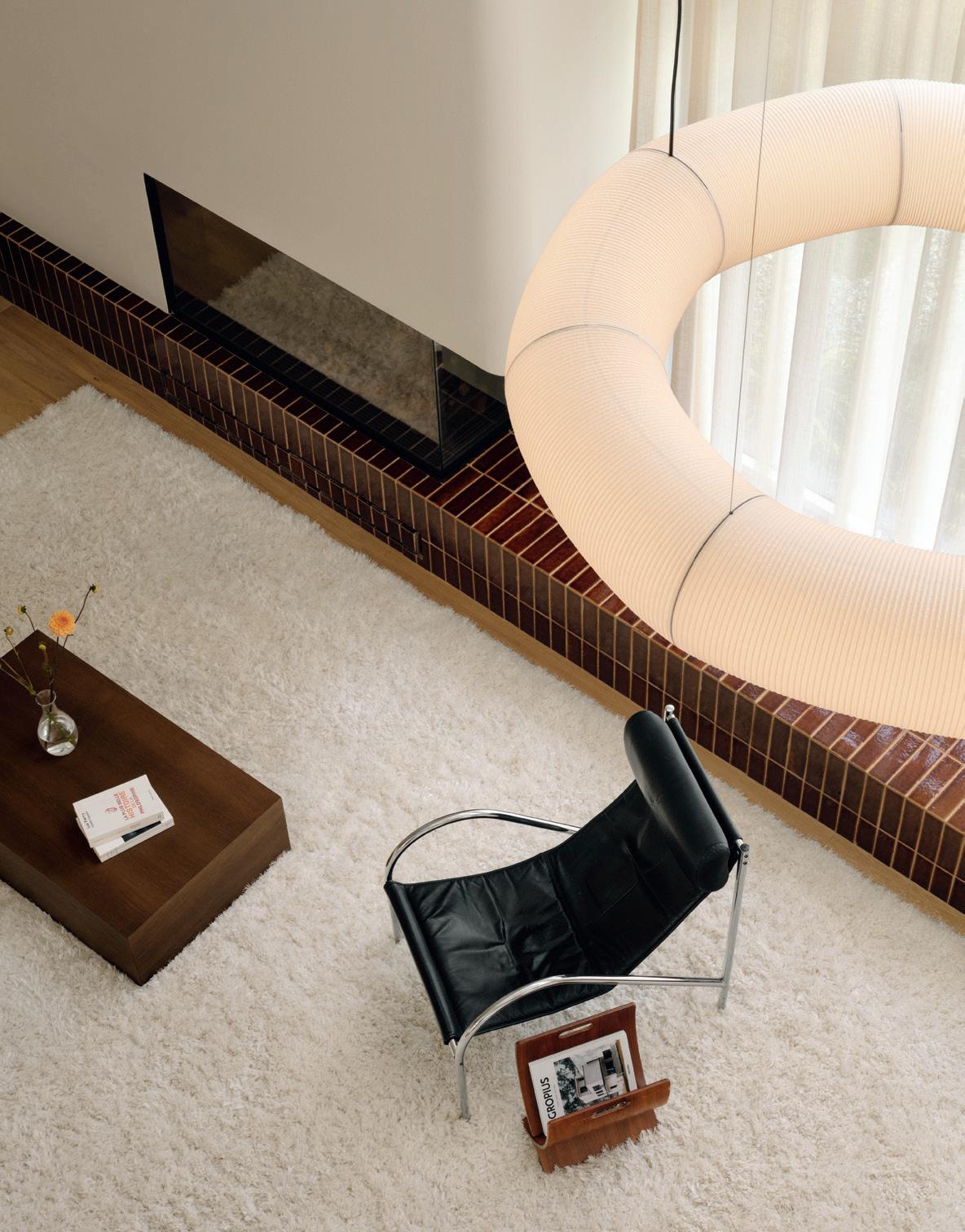
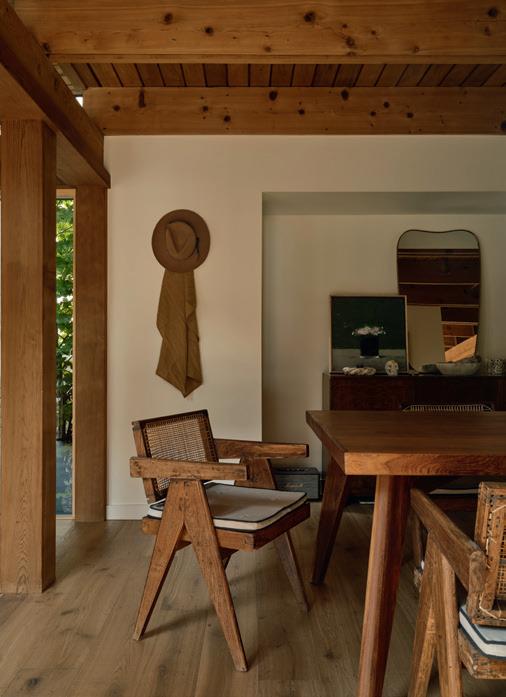
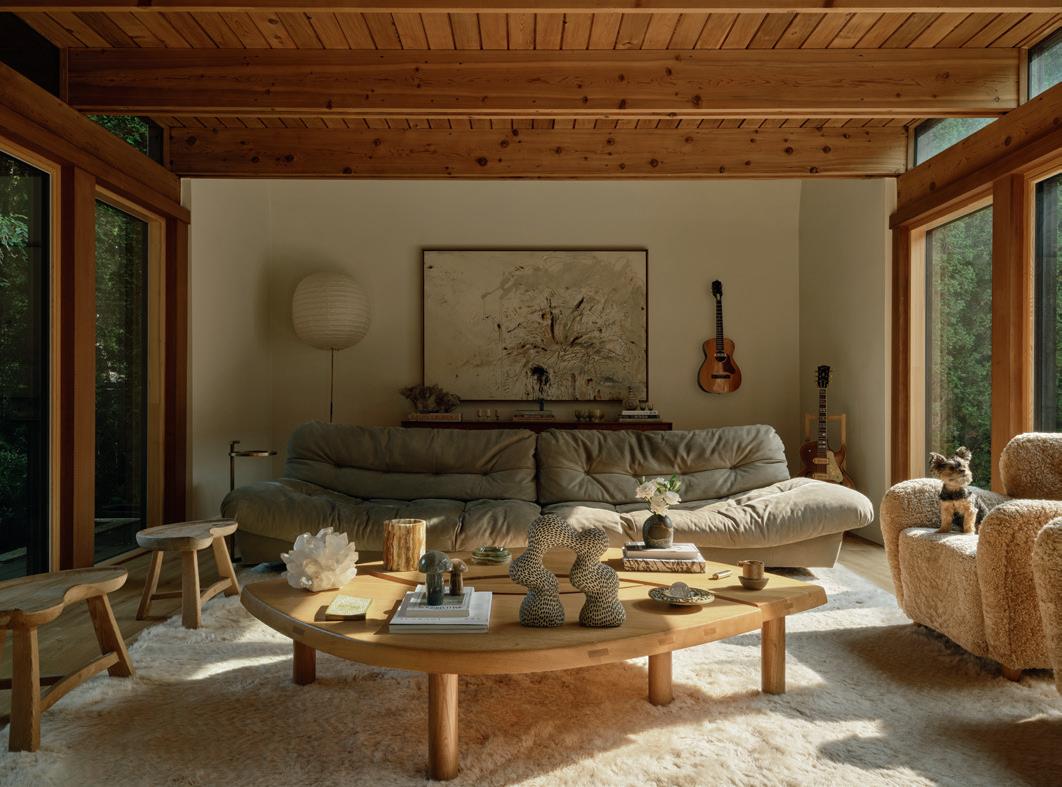
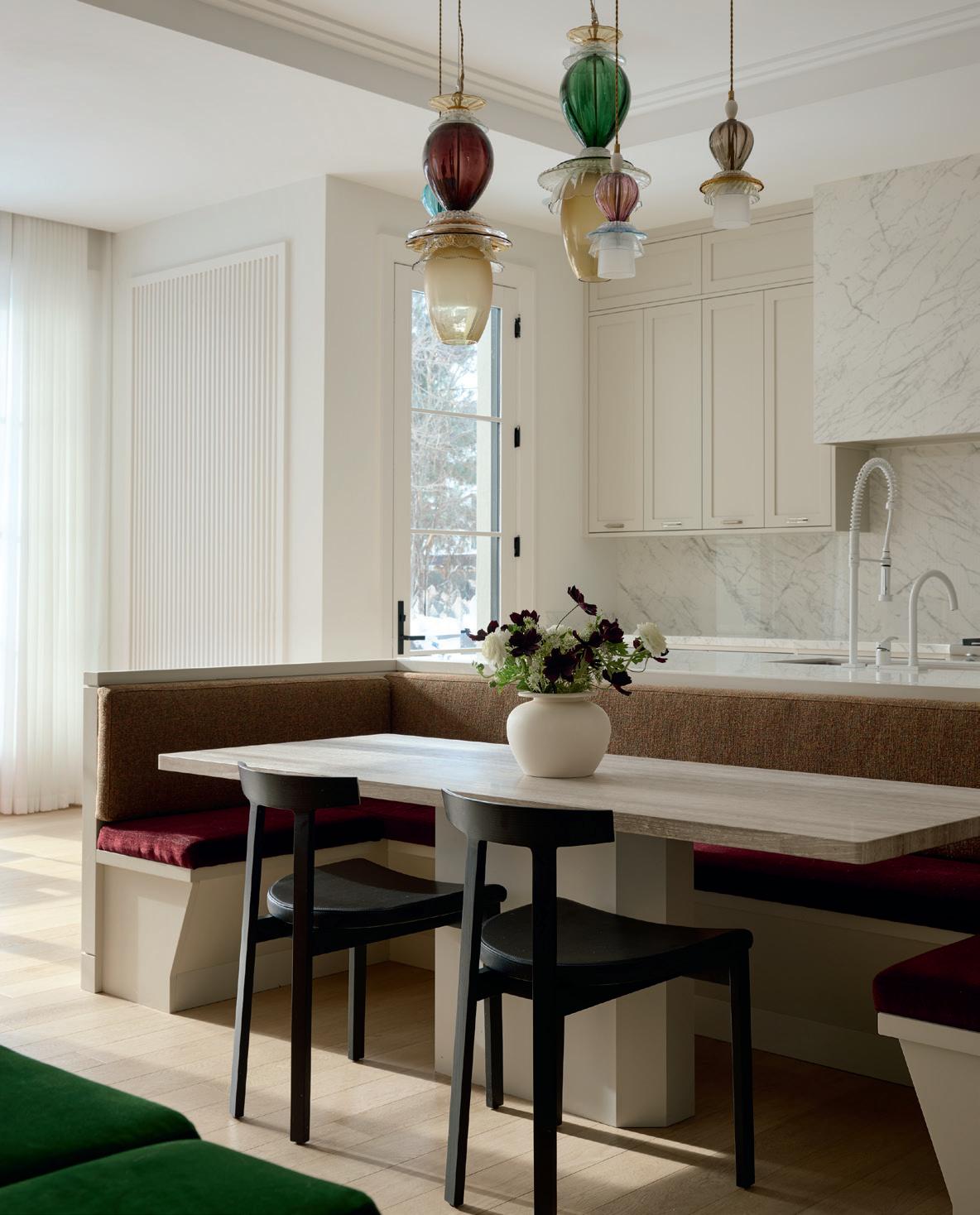
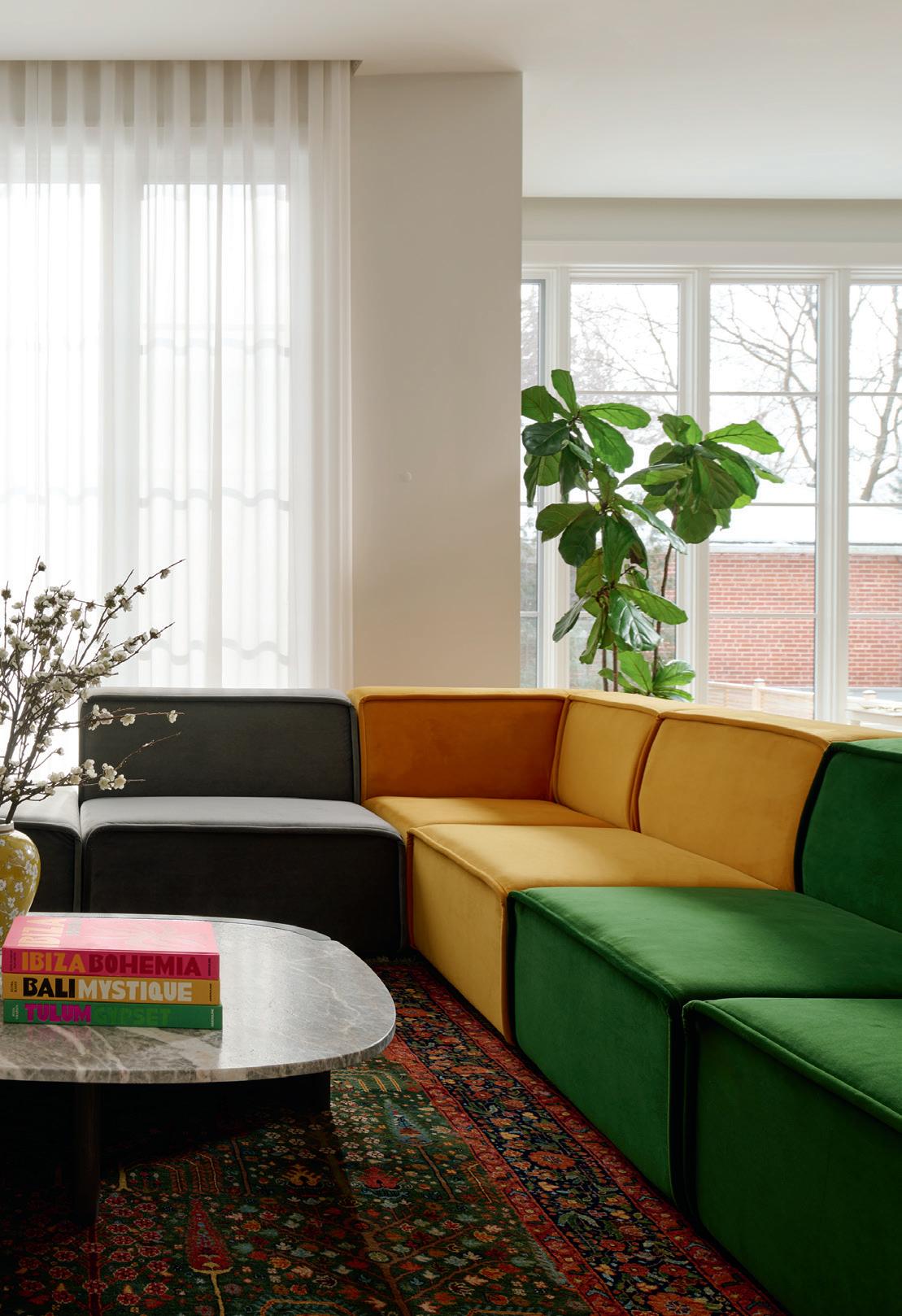
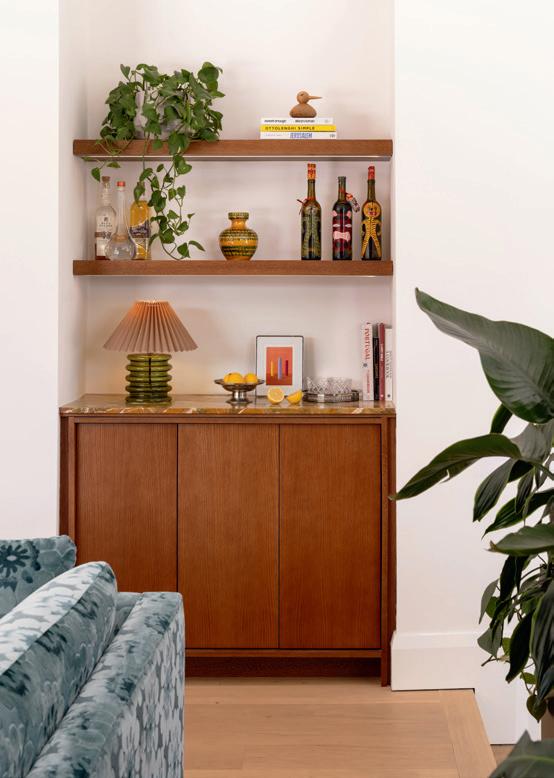
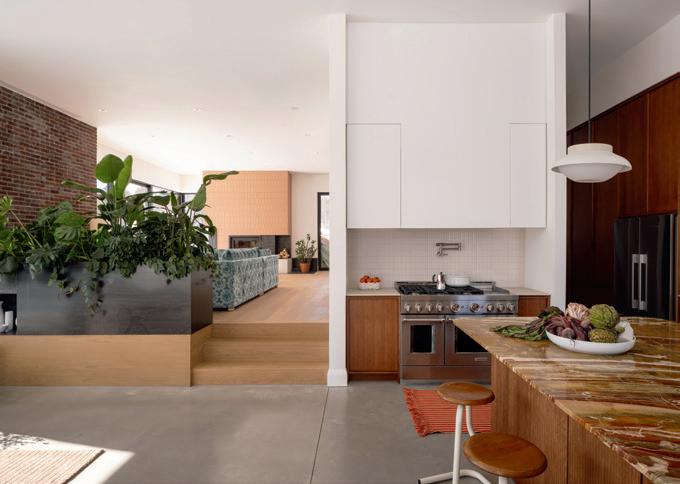
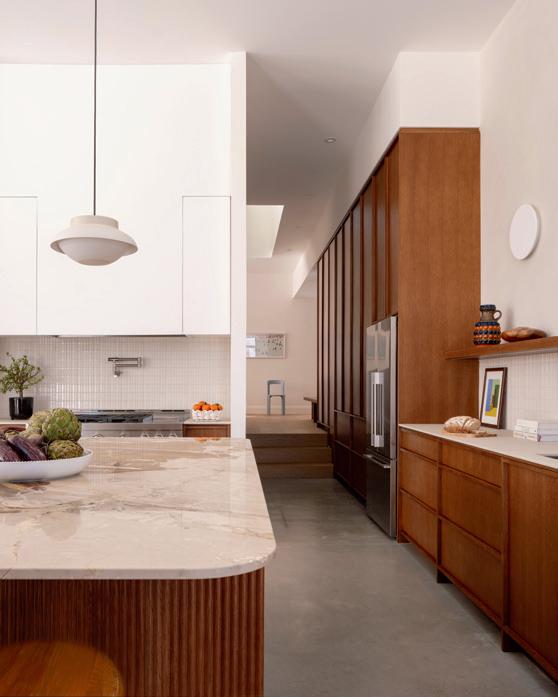
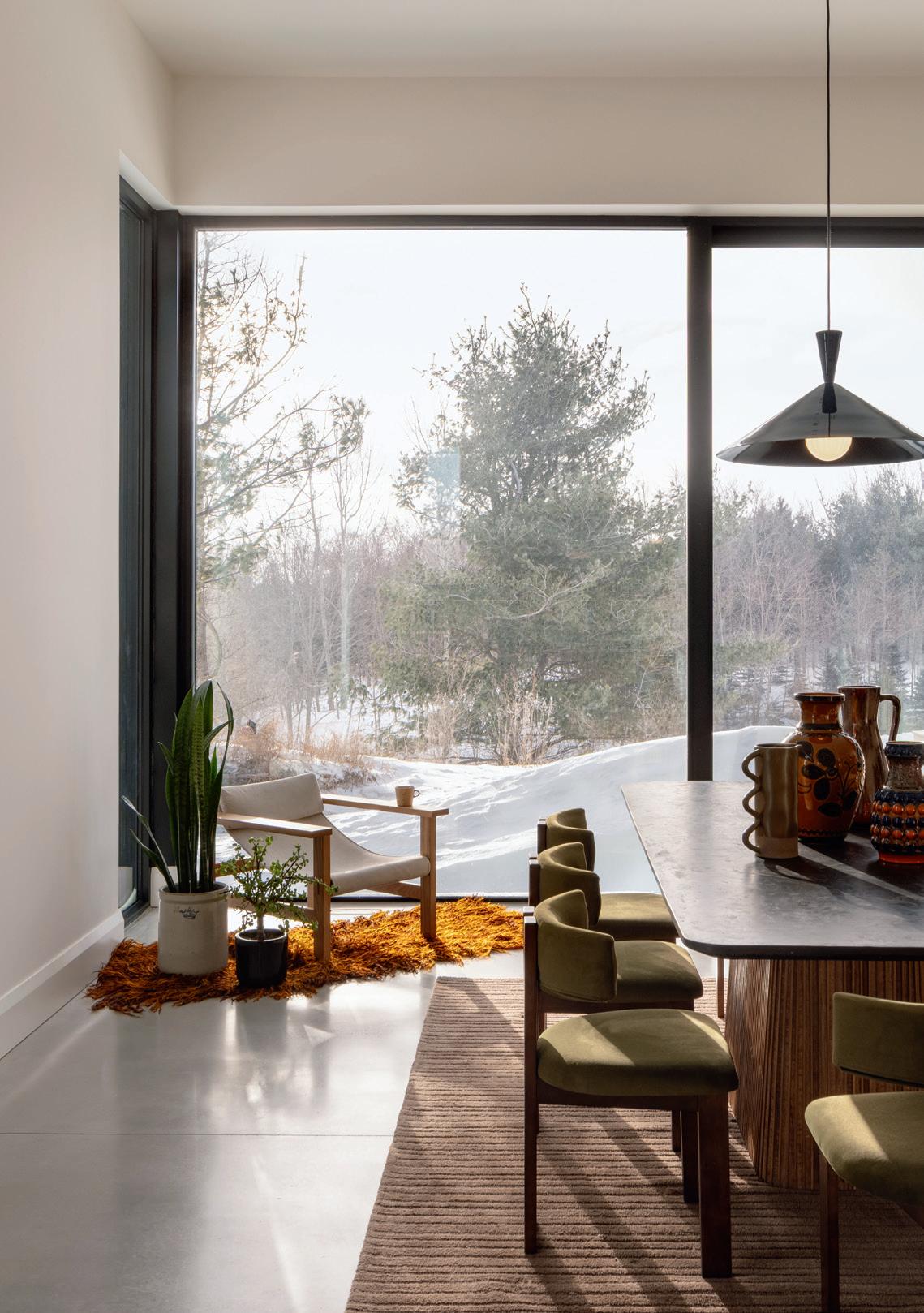
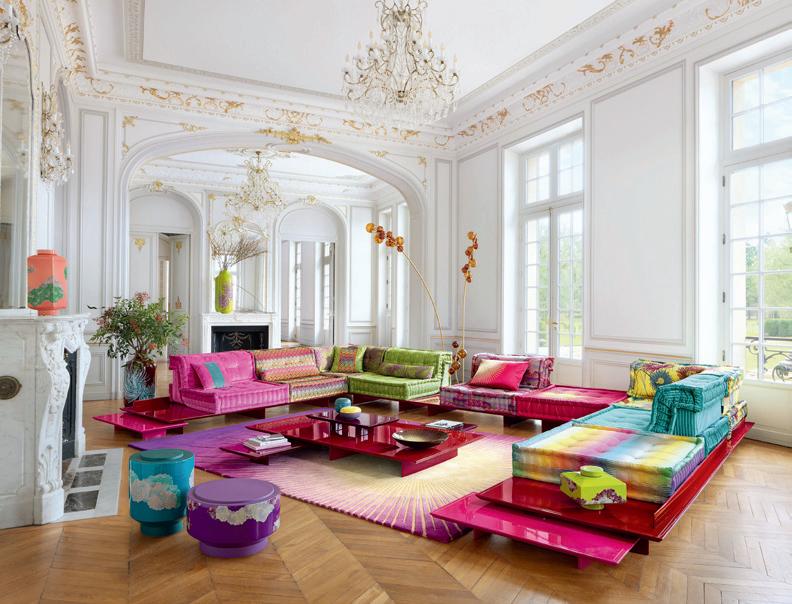
For Pedro Almodóvar, as for Roche Bobois, color is a language, a signature, an emotion – one that has inspired a collaboration and several exclusive designs. The Lounge sofa, designed by Hans Hopfer and reissued specially for this collaboration, is upholstered with images personally selected and adapted by the filmmaker from his own film posters. Halfway between graphic art and design, this collector’s piece is signed by Pedro Almodóvar.
Photos by Flavien Carlod and Baptiste
de La-Hoz.
Create Where You Belong
EXPERTISE
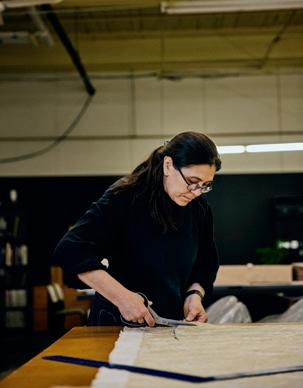
20 Hidden Beauty Behind Dacat Studio, Daniela Tudor crafts bespoke furniture built to stand the test of time. 26 Radical by Design
The rational creativity of designer Jeff Forrest
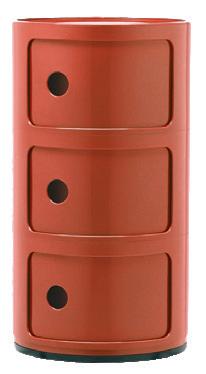
Componibili storage unit, Anna Castelli Ferrieri for Kartell ($307, kartell.com)
40 Treasure Hunt
Expert tips for sourcing the best vintage furniture
46 The House on the Cliff In Vancouver, a couple curates a home filled with meaningful objects.
CANADA
58 A Fresh Start
Born from tragedy, a new home becomes a Toronto family’s sanctuary.
70 Retro Redux
A modern barn blends styles in the hills of Mono, Ontario.
84 The River of Life
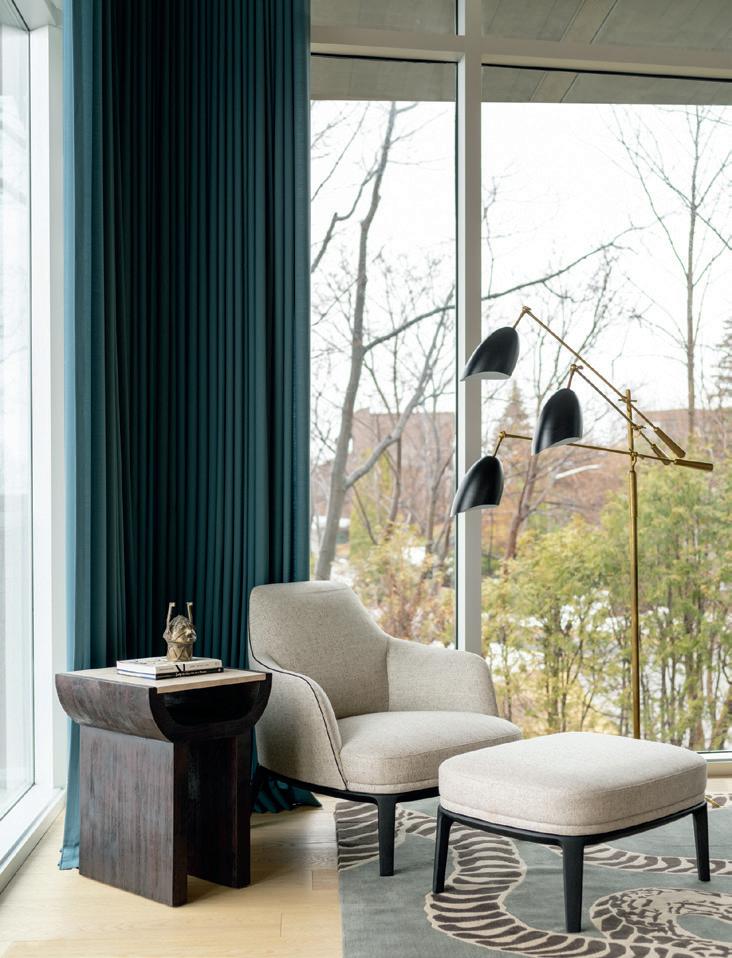
Perched in Quebec, a glass house combines comfort, art and the outdoors.
INSPIRATION
98 Journal from Northern India
On the road with Davin Cowper, founder of Montreal-based rug brand Mark Krebs
107 ELLE Capture
Discover the winning shot from our contest in the Architecture category.
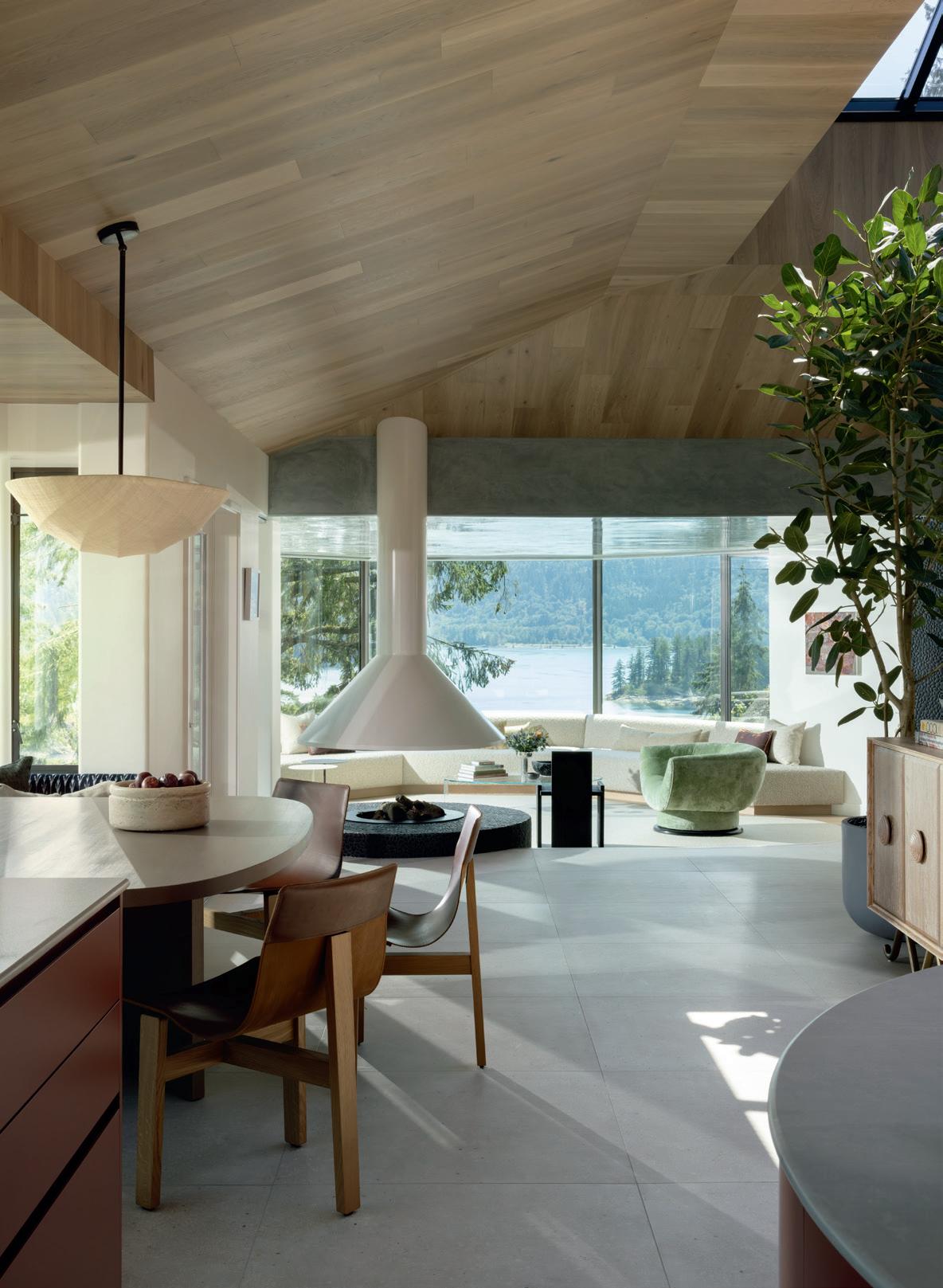
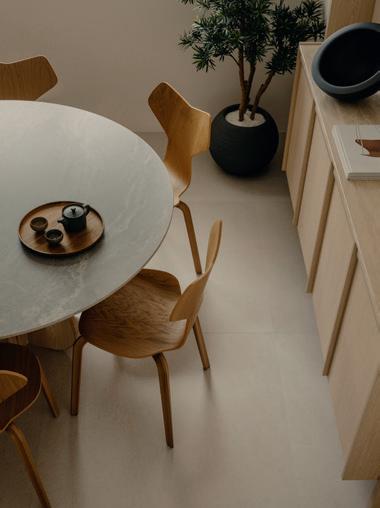
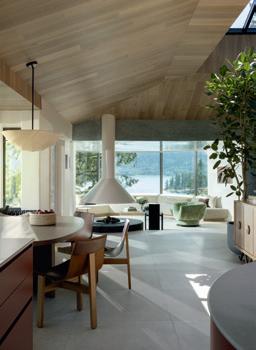
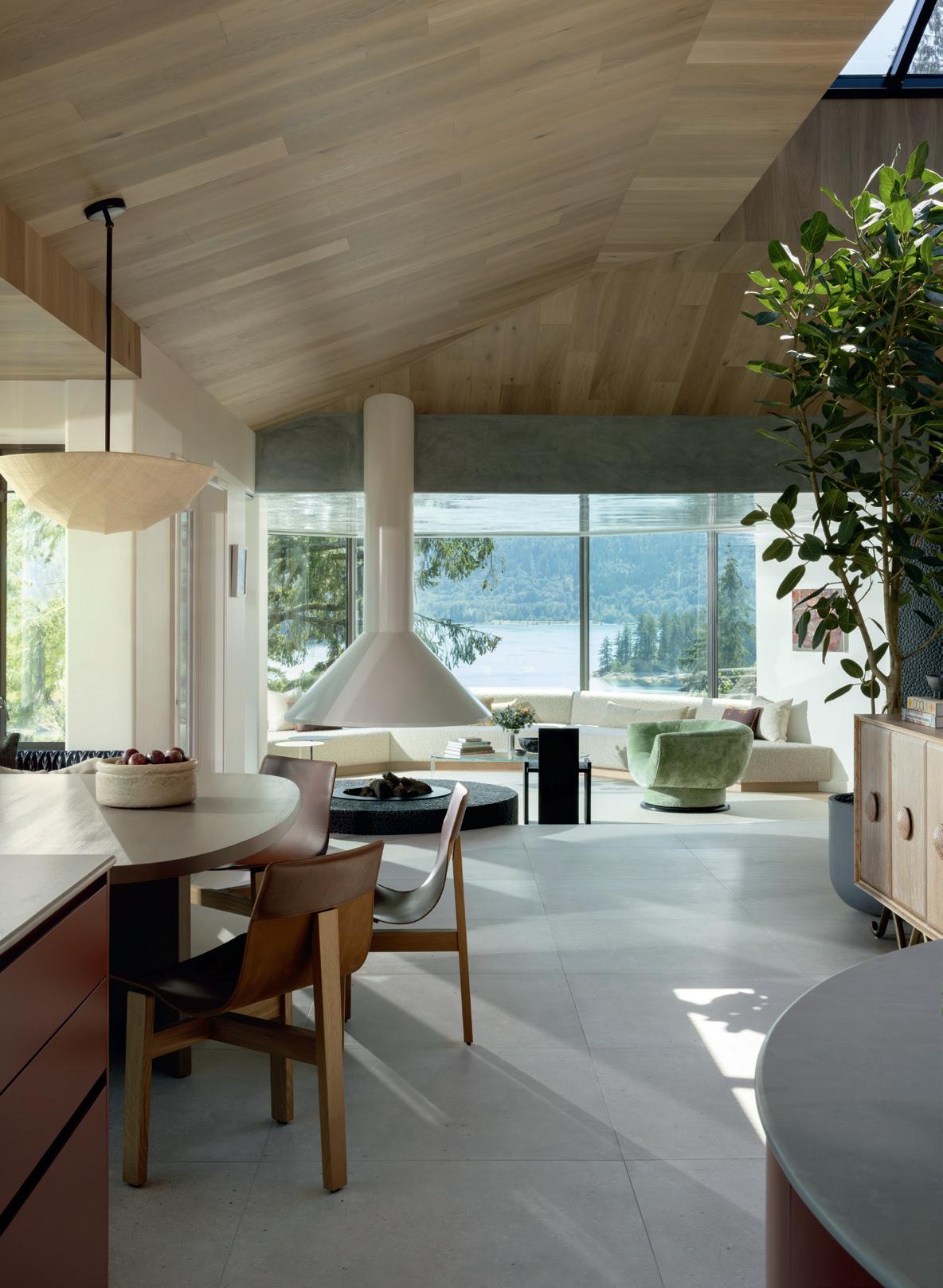
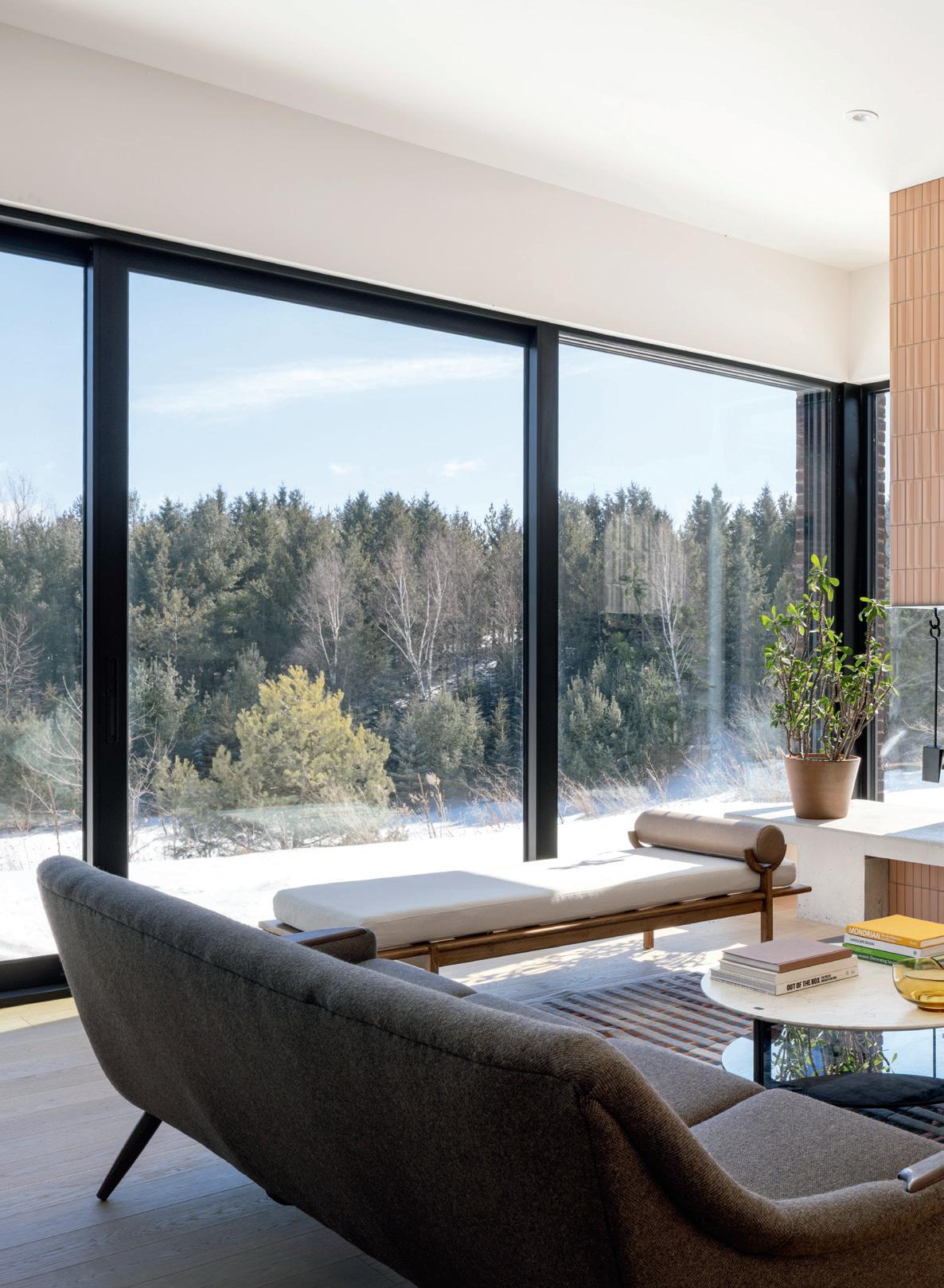
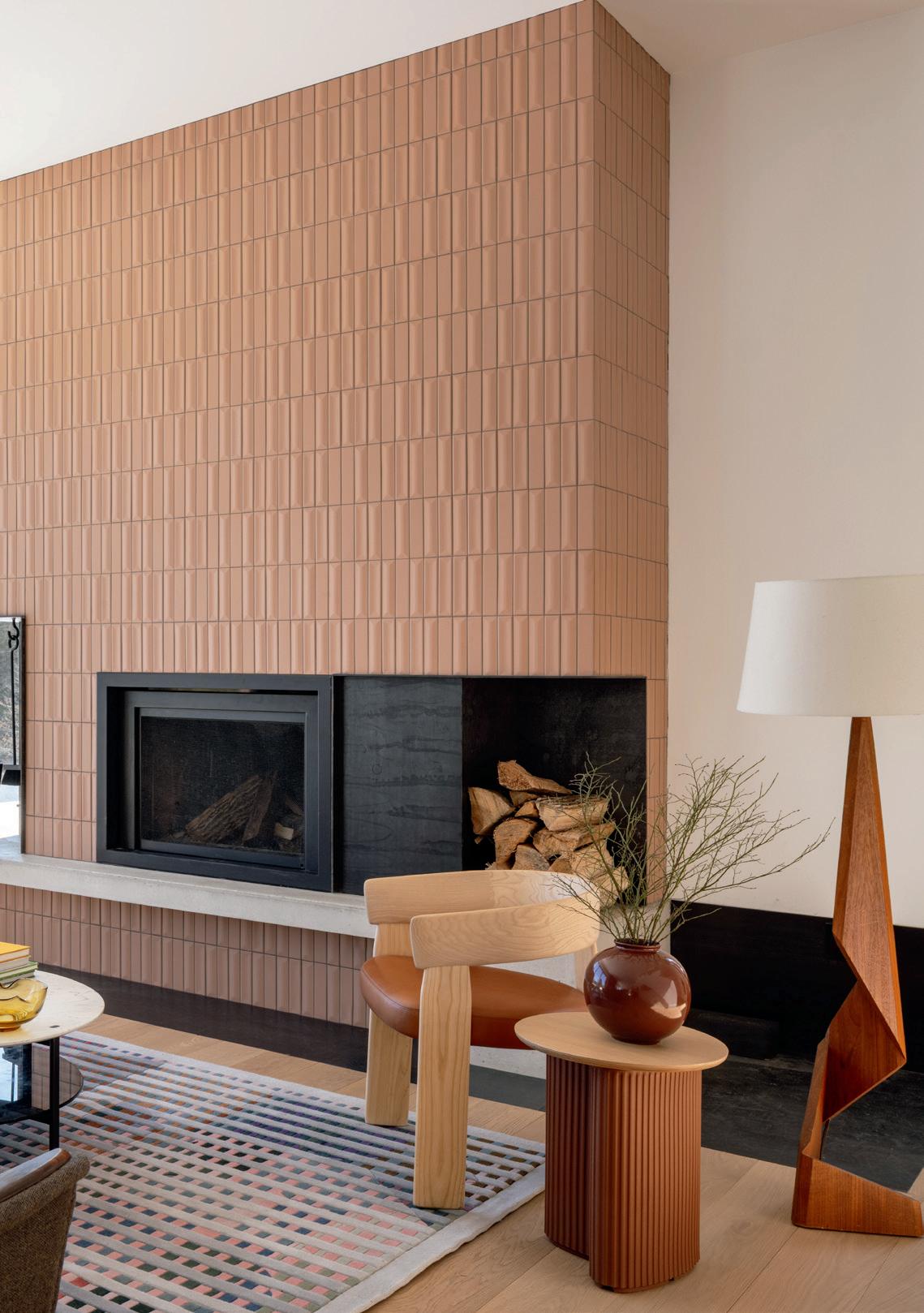
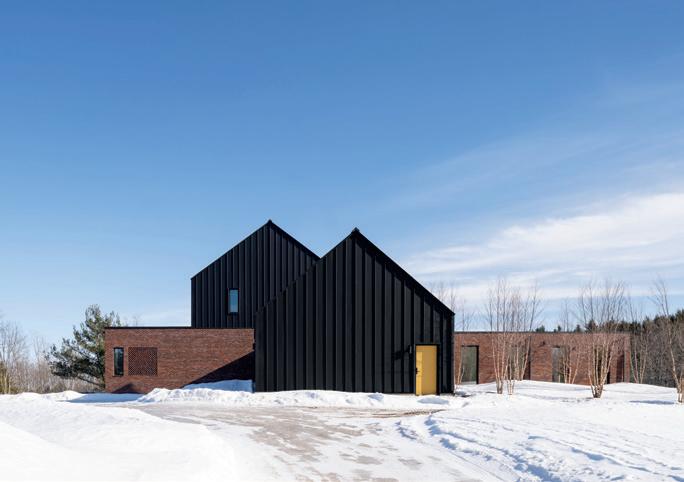
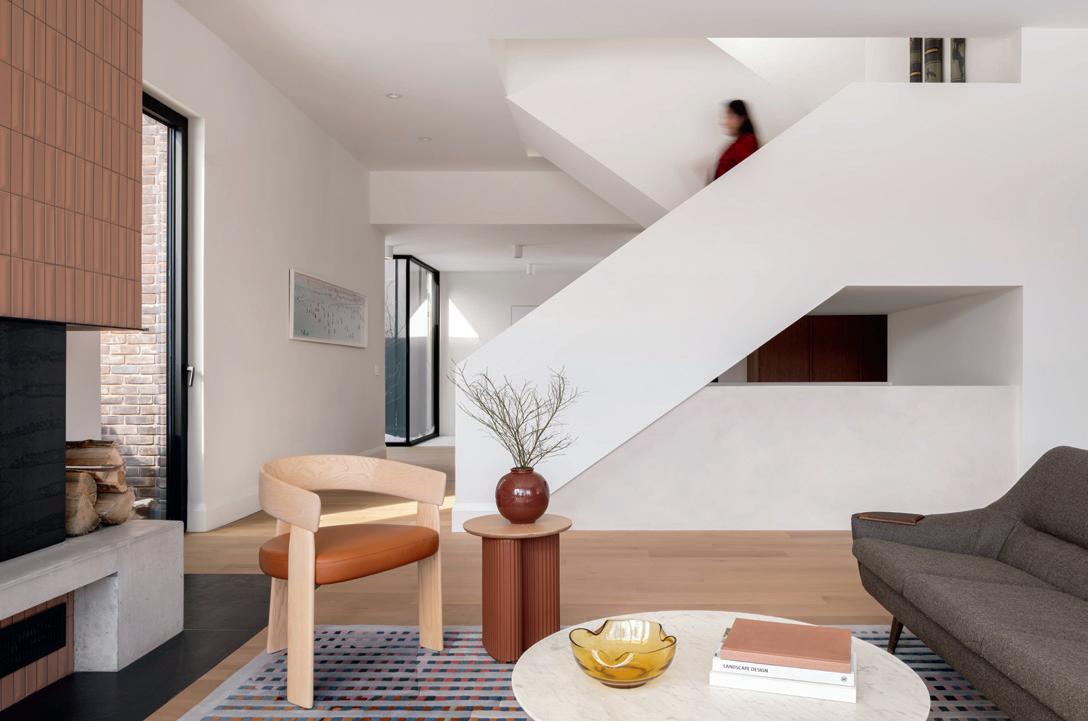
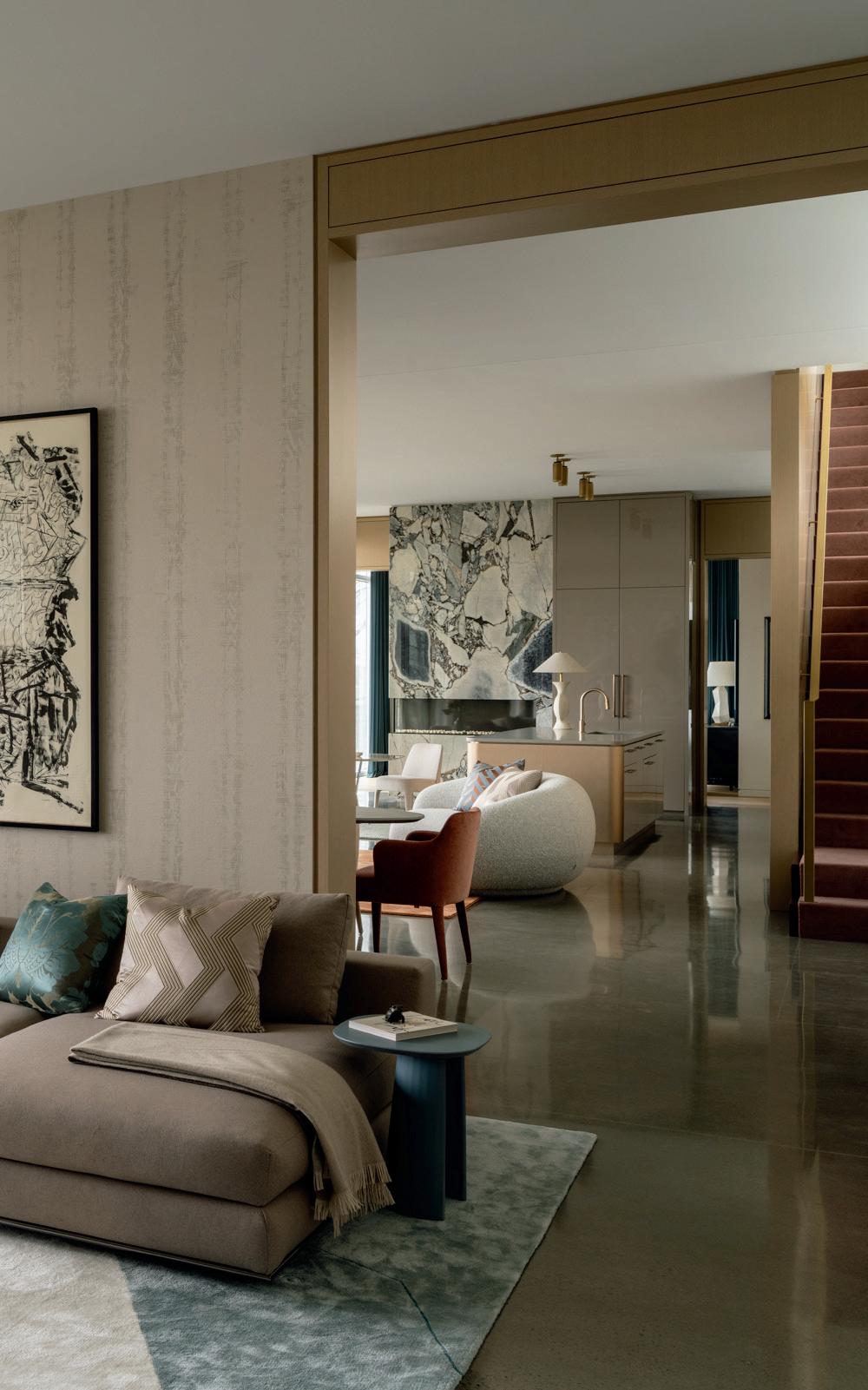
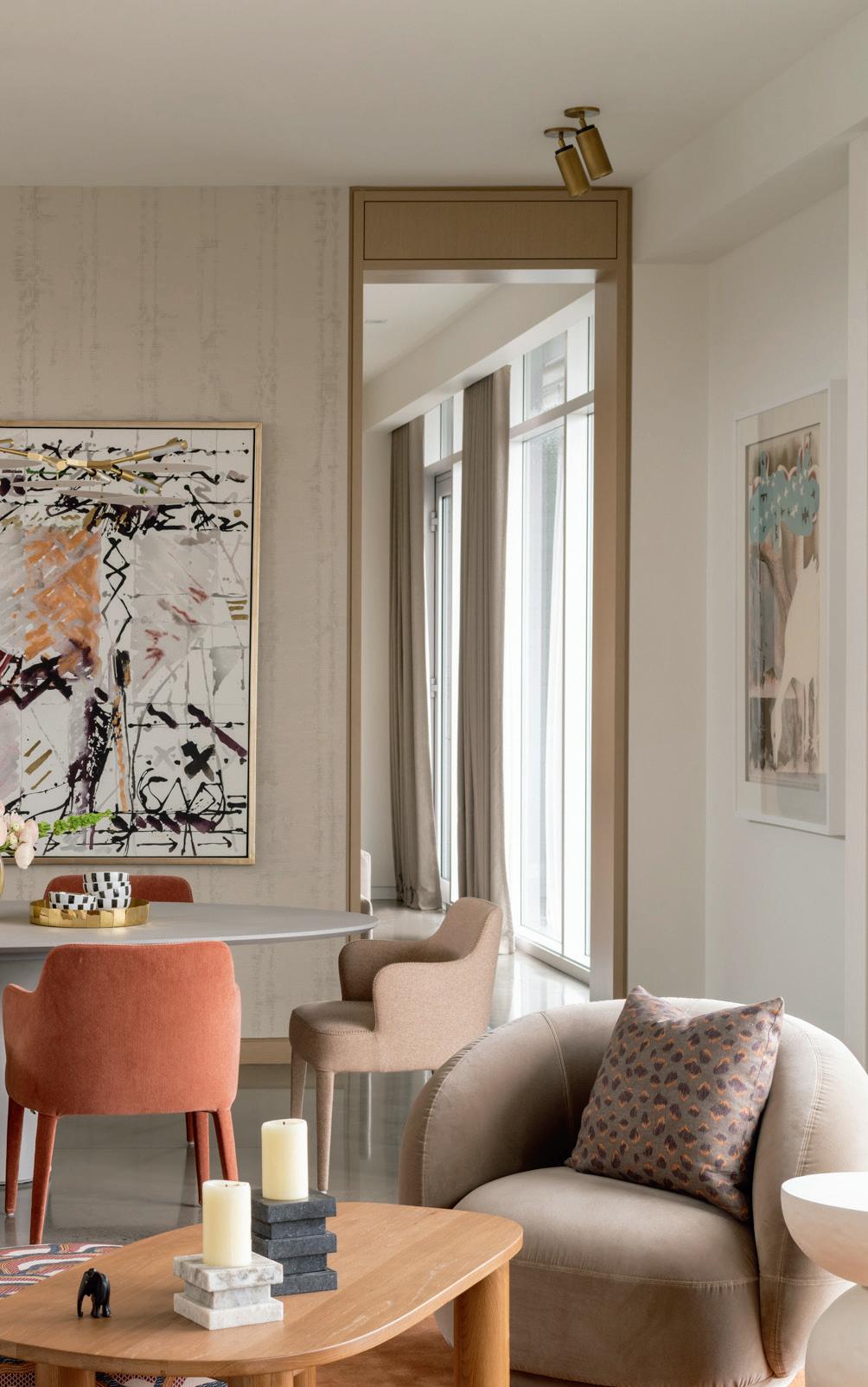
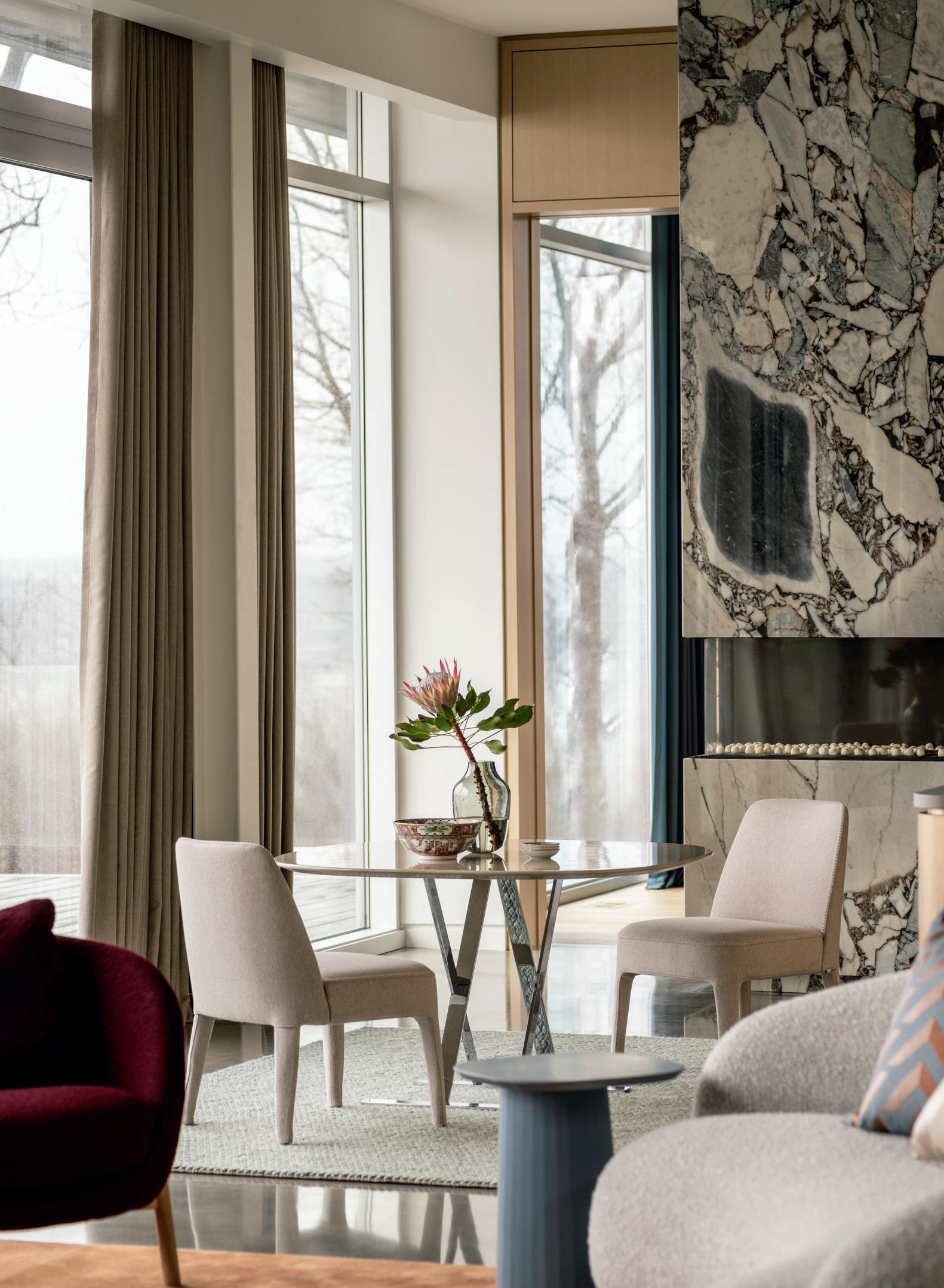
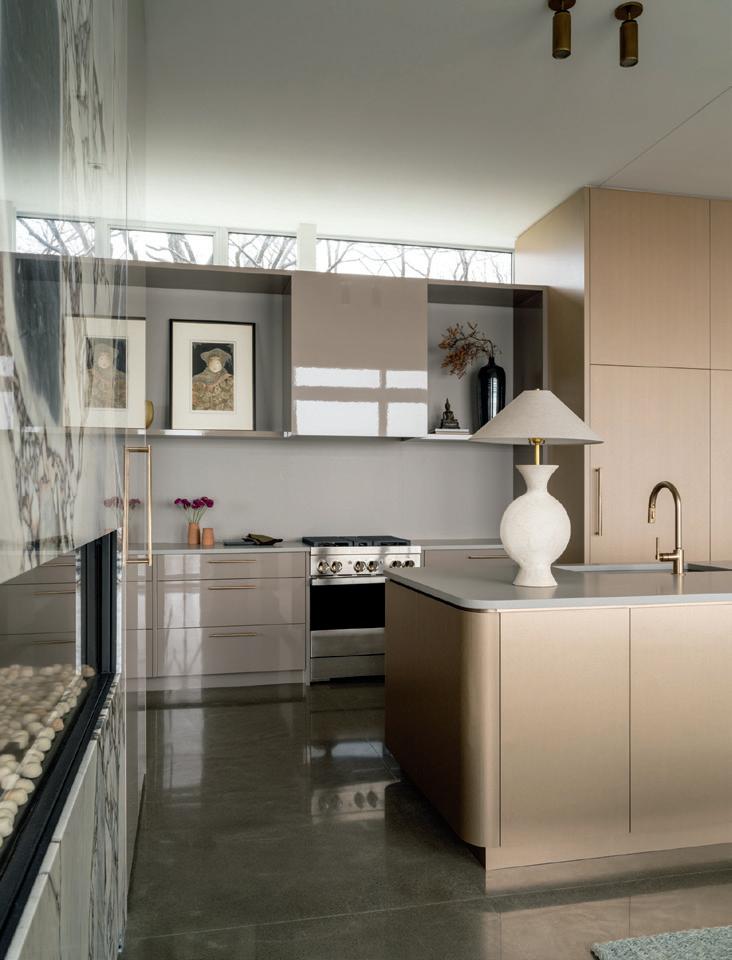
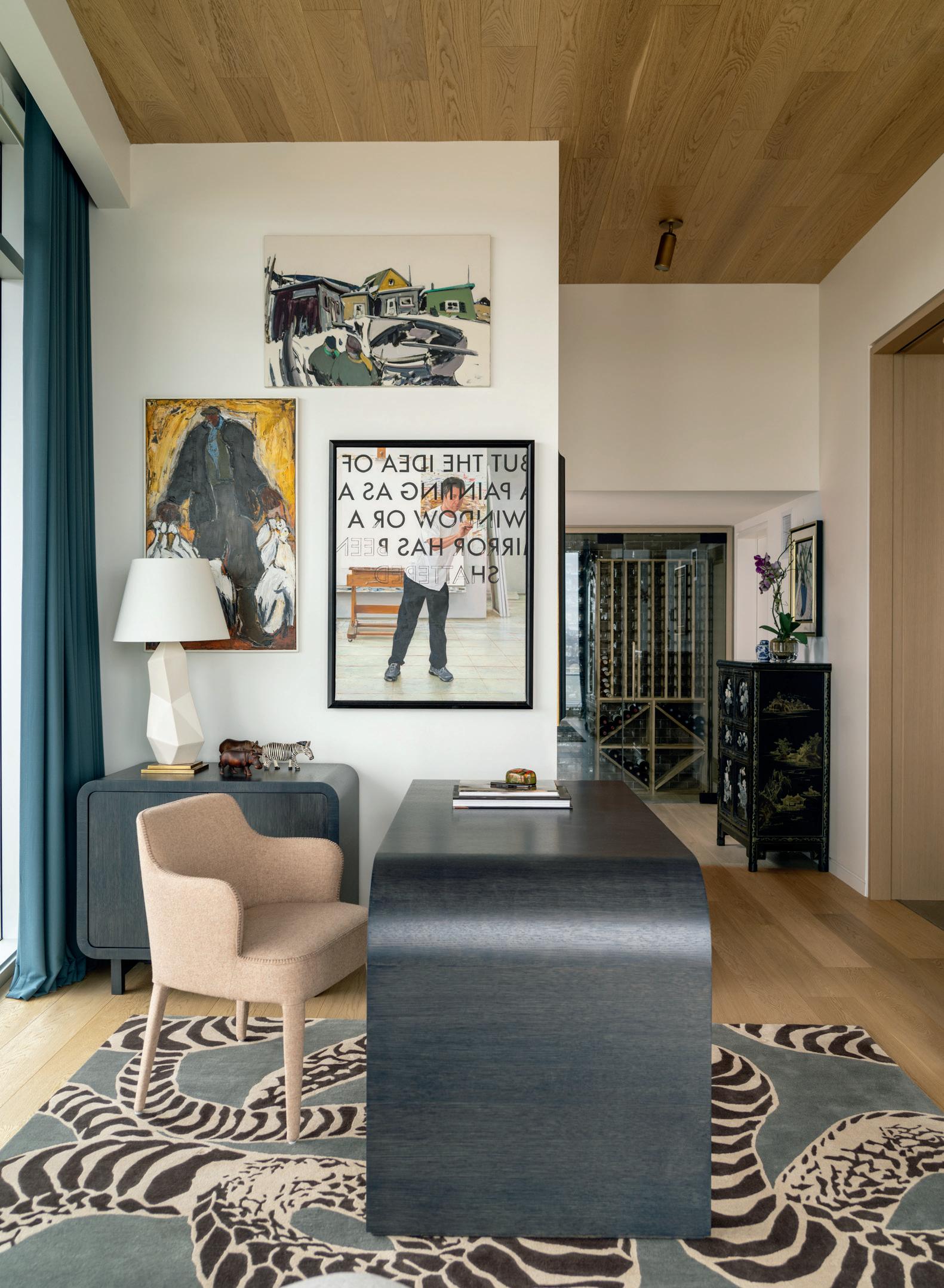
Nature was already an integral part of this home’s setting, nestled in the hills near Vancouver. Interior design firm PlaidFox took care of the rest.
Publisher & Editor — Sophie Banford
Multi-Platform Content Director — Cynthia Quellet Editor-in-Chief — Marouchka Franjulien
Art Director — Annie Lachapelle (Atelier Chinotto) Contributing Editor — Christopher Korchin Digital Content Manager — Melissa Fejtek Contributors
Maude Chauvin, Davin Cowper, Joanna Fox, Muriel Françoise, Violette Létourneau, Alex Lukey, Emmanuelle Martinez, Elisabeth Massicolli, Tara McMullen, Aurélia Morvan, Scott Norsworthy, Ema Peter, André Rider, Luce Roux, Zarya Rubin
ELLE DECORATION® IS USED UNDER LICENCE FROM THE TRADEMARK OWNER, HACHETTE FILIPACCHI PRESSE, A SUBSIDIARY OF LAGARDÈRE SCA
CEO — Constance Benqué / CEO ELLE International Licenses — François Coruzzi
SVP/International Director of ELLE, ELLE DECORATION & ELLE GOURMET — Valéria Bessolo Llopiz
Creative Director of ELLE DECORATION & ELLE GOURMET — Linda Bergmark Marketing Director of ELLE, ELLE DECORATION & ELLE GOURMET — Morgane Rohée Digital Director of ELLE, ELLE DECORATION & ELLE GOURMET — Marine Le Bris Syndication Director — Virginie Dolata / Syndication & Editorial Coordinator for USA & North America — Monique Boniol
Copyrights Manager — Kenza Allal
Pixelle Database Manager — Pascal Iacono
International Ad Sales House — Lagardère Global Advertising
ELLE Decoration Canada is published 2 times per year. Single copy price: $7.99+tax. Full subscription price: Canada, 1 year, $13.99+tax. Digital editions are available on Zinio, Apple News, Press Reader and Ebsco. Printing: TC Transcontinental Printing, 1603 de Montarville Blvd., Boucherville, Quebec, J4B 5Y2. Distributed by Coast to Coast Newsstand Services Ltd. ISSN 2563-9080
Address all correspondence to 995 Rue Wellington, Suite 208, Montreal, Quebec, H3C 1V3. Printed on certified FSC® (Forest Stewardship Council®) paper from well-managed forests and other responsibly managed sources.
The Art of the Table
(fall /winter 2025-26)
It’s often said that beauty is in the details. And that’s certainly true when it comes to a thoughtfully set table. That’s because the art of the table isn’t just about aligning plates or polishing the silverware—it’s more akin to setting a stage for family and friends, creating a subtle choreography between the everyday and the extraordinary.
Personally, I think there’s nothing more welcoming than a well-set, well-stocked table. And sometimes it doesn’t take much to transform a meal into a celebration, from a slightly wrinkled tablecloth to mismatched glasses passed down from our grandmothers, to a bunch of wildflowers purchased at the market or picked by the side of the road. A far cry from the strict rules of the etiquette manuals of years past, the table of today is meant to be lively, inclusive, vibrant—like the people who gather around it.
Sophie Banford, publisher (@sophiebanford)
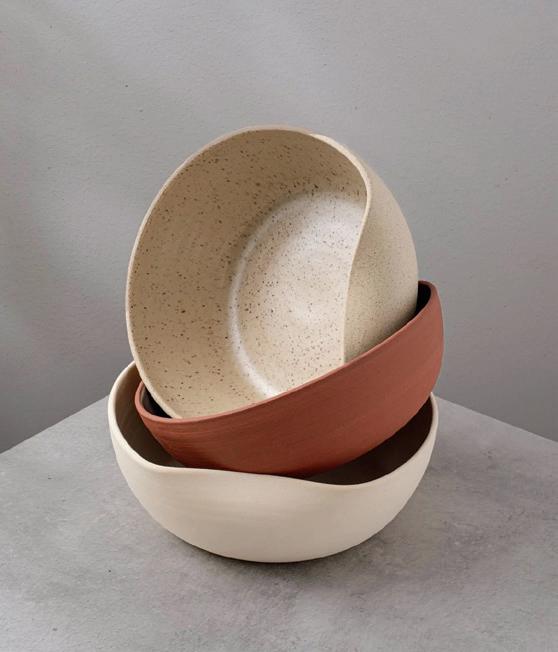
Because we believe in the beauty of local products, our pages have often showcased our favourite finds from Canadian artisans and brands. Like Janaki Larsen’s organically shaped plates, Fable’s sleek glassware, Elise McLauchlan’s hand-turned candlesticks or Marie-Ève Dompierre’s ceramics (see page 38). These objects tell a story: about passionate creators whose work brings added soul to our tables.
Ultimately, the art of the table might be a reminder that sharing a meal is a way of sharing a bit of oneself. In today’s world, where everything moves too fast, taking the time to set the table means choosing to pause, slow down and honour the simple fact of being together.
Happy reading! —
Objects of Desire
We searched, we found , we marvelled. Gaston Bachelard said, “Man is a creation of desire, not a creation of need.” WE AGREE .
By Marouchka Franjulien and Carolyne Parent — Adapted by Zarya Rubin
STILL LIFE
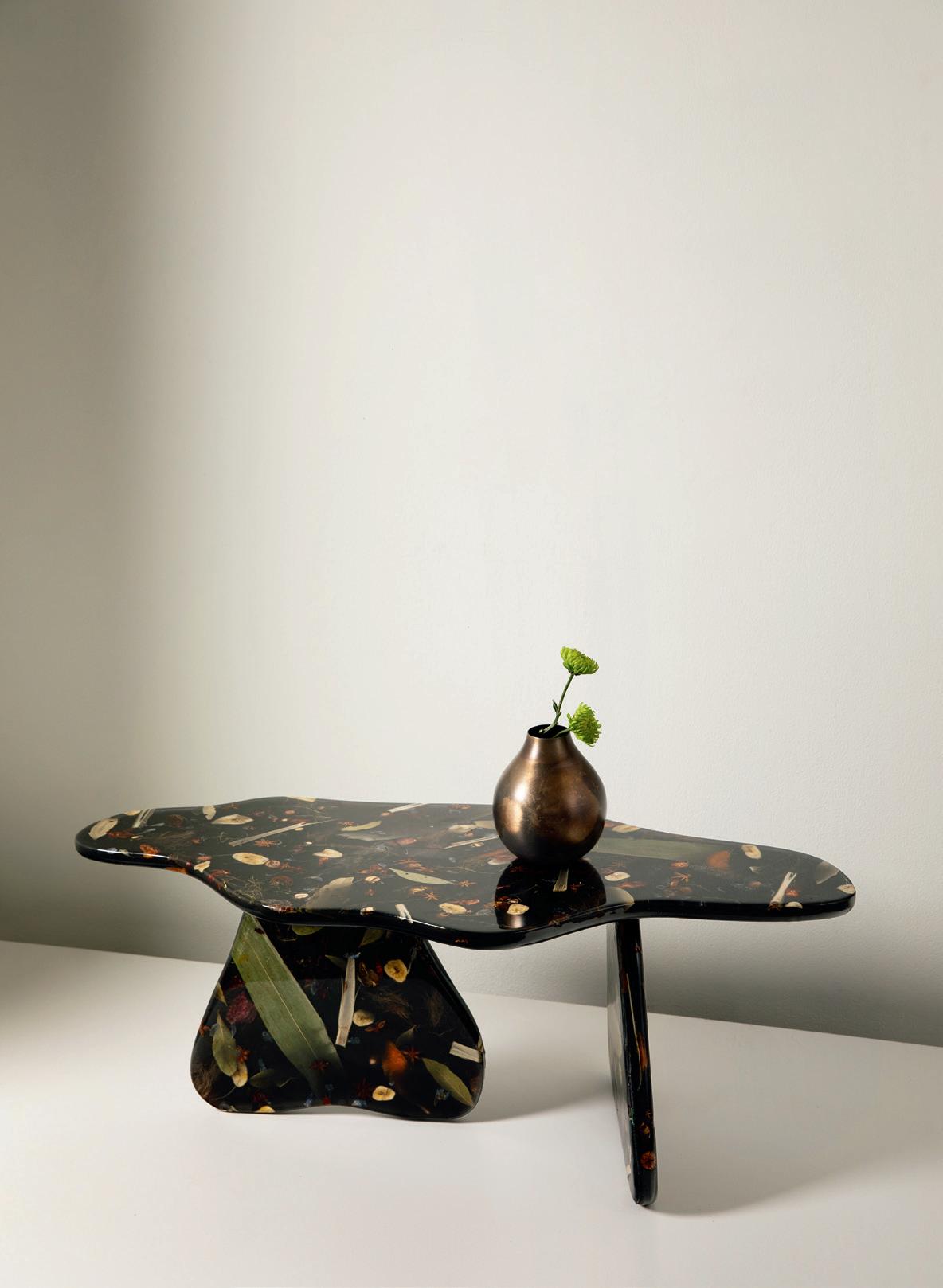
At the helm of Toronto-based Stephanie Angela studio, Stephanie Singh transforms nature’s waste—often in the form of flowers donated by local florists after events—into true works of art. Cast in resin, flowers, leaves and stems, as well as roots, spices and fruits (brought back from Jamaica by her parents, a nod to the designer’s Caribbean heritage) become intriguing objects and furniture. Each piece reminds us of the ephemeral nature of life and the infinite possibilities that emerge when we redefine the concept of waste. — (stephanieangela.com) MF
Photo: Umbra
HANDMADE COLLABORATION
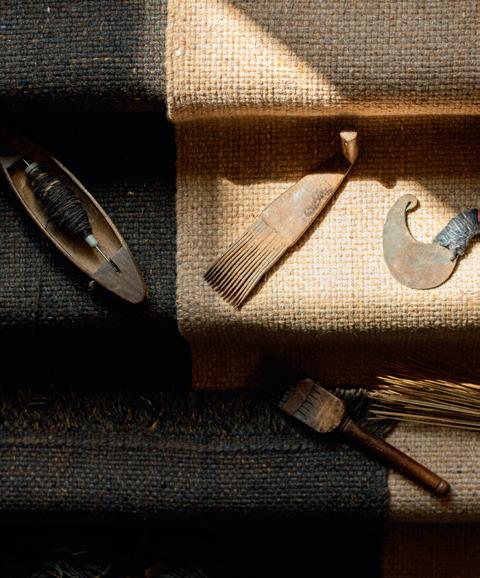
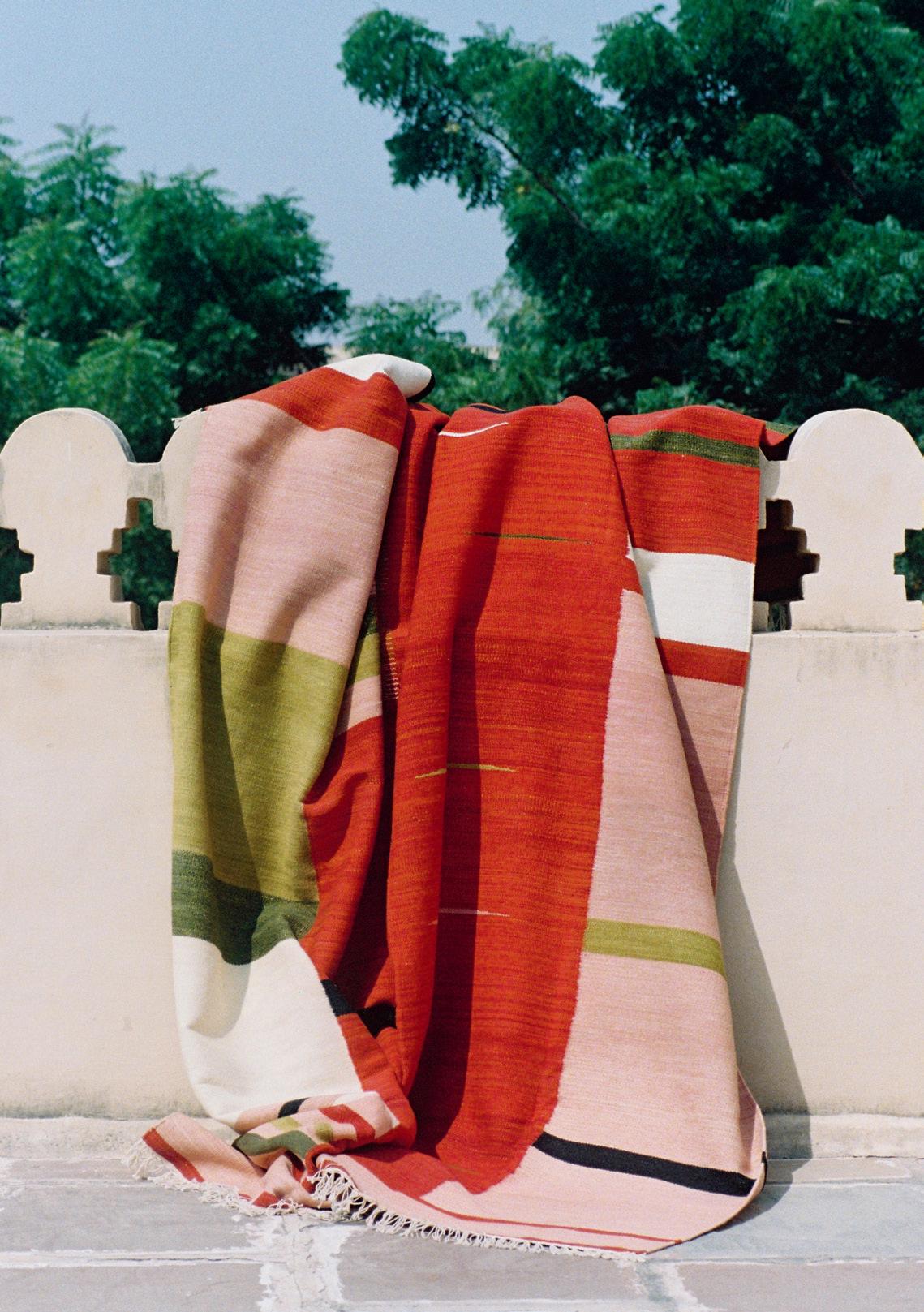
Montreal-based Davin Cowper, who heads up the Mark Krebs rug brand—and who also wrote an inspiring travel diary for this issue (p. 98)—enlisted the expertise of Canadian designer Thom Fougere to create a minimalist rug woven in northern India. Available in Truffle (dark brown) or Shell (beige) as well as several sizes to meet the needs of any space, the sleek product is made of speckled wool, with tiny pops of colour that bring a complex elegance to the design. — (markkrebs.ca and thomfougere.com) MF
BASIC INSTINCT
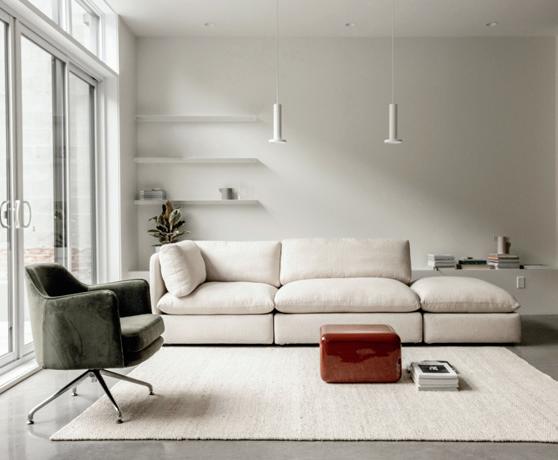
Since 2016 , Élément de Base has been on a mission to make our lives more comfortable with sofas that are a joy to relax and unwind on. Classic or modern in style, each modular creation features fully removable covers, available in a wide range of colours and fabrics. This technical feat not only allows for total customization of the sofa, but also extends its lifespan with an eco-conscious mindset. The collection also includes armchairs, beds, poufs, ottomans, stools, chairs and side tables: essential elements of any space that are anything but basic! — (elementdebase.com) MF
ALL IN GOOD TIME
It’s easier to switch to wintertime when your clock— more poetic than practical—sends you off course. — Mellow clock, Joe Parr for Design House Stockholm ($369, finnishdesignshop.com) MF
MIRROR, MIRROR
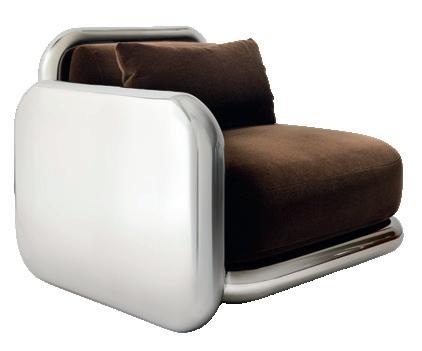
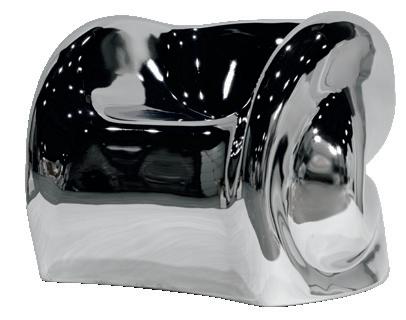
Money can’t buy happiness , but it can definitely spark desire when it’s reflected in exceptional metallic creations. Such is the case with the Alta Metallic Mota and Lido Steel armchairs. The former is by Canadian designer Yury Goncharov; the latter by Editions Paolo Ferrari, the cutting-edge brand of Paolo Ferrari and his Toronto-based interior design firm. Both new models command attention with their raw beauty, sensuous curves and mirrored surfaces that shift with the light and surrounding space. Guaranteed wow factor! — MF
Lido Steel armchair, Editions Paolo Ferrari (price upon request,
Alta Metallic Mota armchair, Yury Goncharov (price upon request, yurygoncharov.com)
FULL TRANSPARENCY
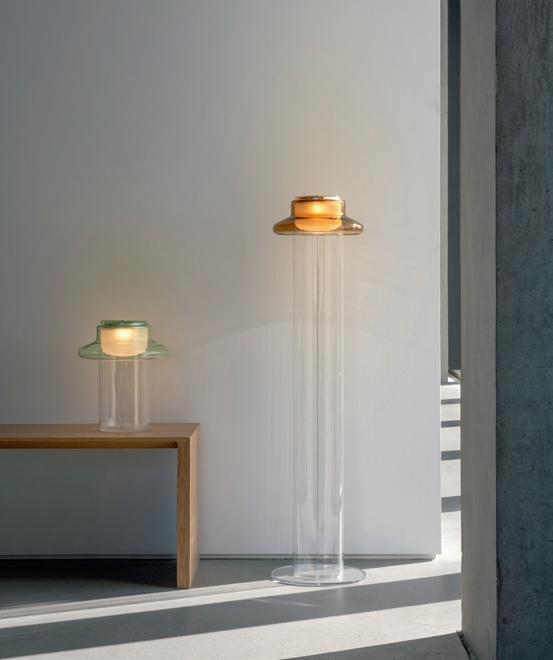
It’s not immediately visible because of its translucence, but once you see it, nothing else seems to matter. It is the new Pace floor lamp, from Vancouver-based lighting studio A-N-D. It features a glass cylinder, a diaphanous dome and a thin cable, which serves as a reminder that this sculptural work also has a practical function. The piece is a study in contrasts; its fragility evokes emotion and makes the lamp incredibly imposing. That’s the hallmark of great design, no? —
Pace floor lamp, Caine Heintzman for A-N-D (price upon request, a-n-d.com) MF
LUXURY INSIDE AND OUT
Louis Vuitton already had a foothold in interior design with its Objets Nomades line: exceptional pieces offered in limited releases, created in collaboration with some of the world’s most influential designers. The luxury label is now bringing its impeccable style to a larger scale with its first home collection, presented during Milan Design Week last April. Imbued with the Parisian brand’s finesse, the furniture and lighting celebrate Louis Vuitton’s rich heritage and exceptional leatherwork. — (ca.louisvuitton.com) MF
ON SET
In Pedro Almodóvar’s cinematic works, the set design, like the colour palette, is an integral part of the narrative. For Roche Bobois, colour is likewise a fundamental component of its DNA. It was only natural for the Spanish filmmaker and the French brand to combine creative forces in an exclusive collection named Cromática. This collaboration offers a reinterpretation of the Bubble sofa, available in four vibrant shades, as well as the Rondo china unit with the door panels featuring Almodóvar’s movie posters, and the Lounge modular sofa, originally designed by Hans Hopfer in 1971—all paying tribute to the filmmaker’s iconic films. These centrepiece elements are complemented by coffee tables, cushions, rugs and a capsule collection, this time with Rossy de Palma. The actress and long-time muse of the filmmaker has designed a surrealist vanity, featuring a mirror shaped like Rossy’s eye, and an armchair, as well as light fixtures, a rug, and a chair with a distinctive, bold aesthetic. Both collaborations are sure to stand out. — (roche-bobois.com) MF
FLOWER POWER
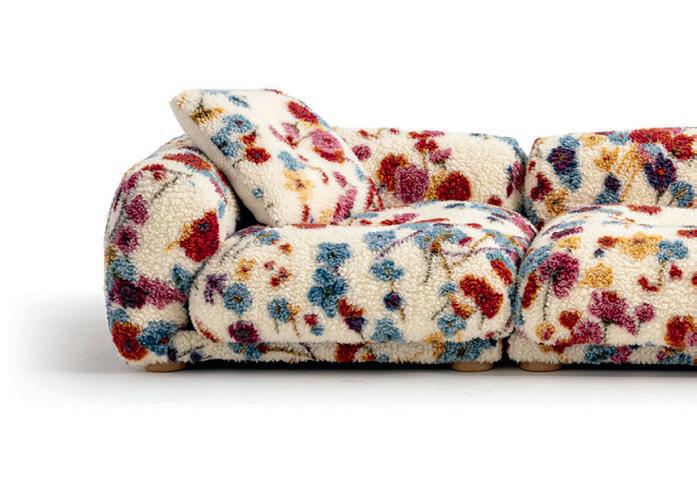
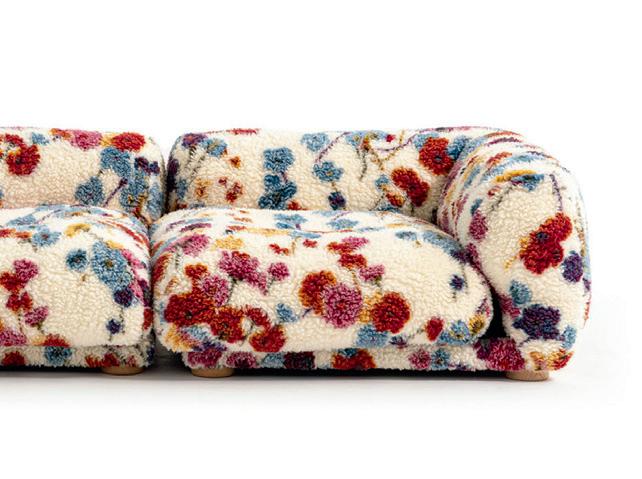
With a softness that pierces the page and a floral pattern that blooms on a custom jacquard wool upholstery, this sofa is the epitome of comfort. Unveiled during Milan Design Week, the creation lends itself to languor and promises to infuse any interior with a healthy dose of hygge. —
Me-Time sofa, García Cumini for Moroso (price upon request, moroso.it) MF
WILD KINGDOM
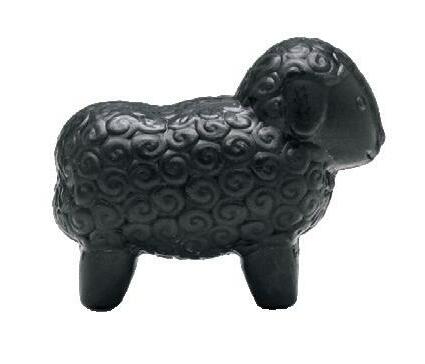
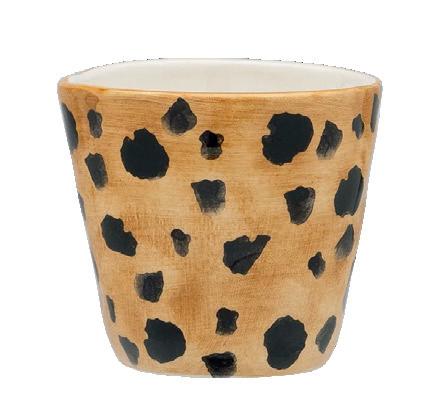
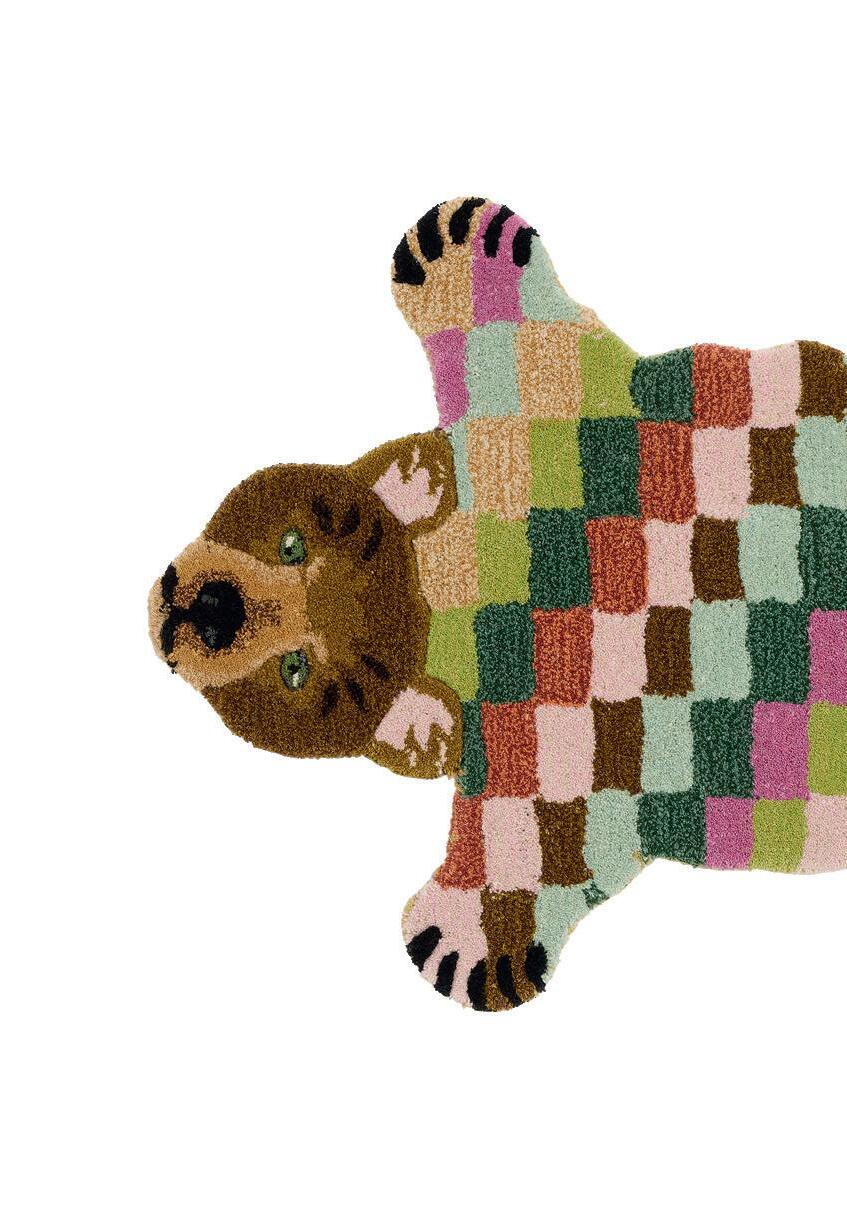
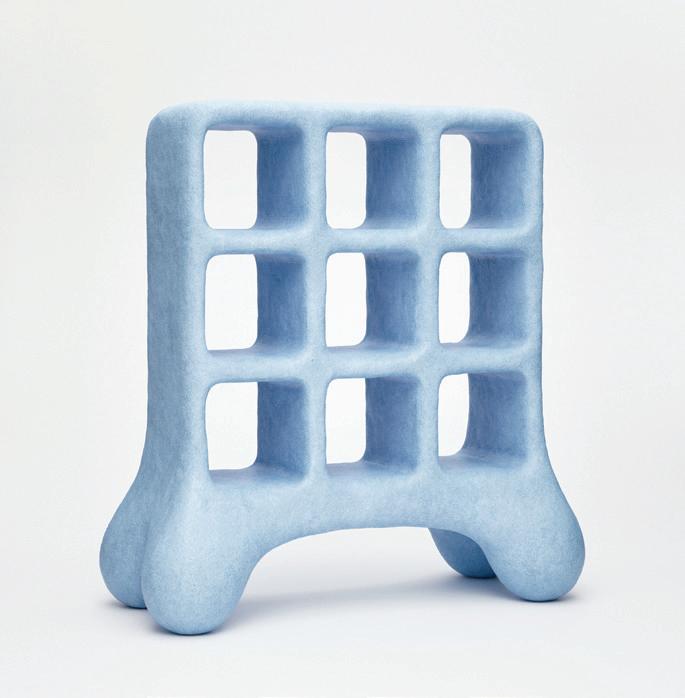
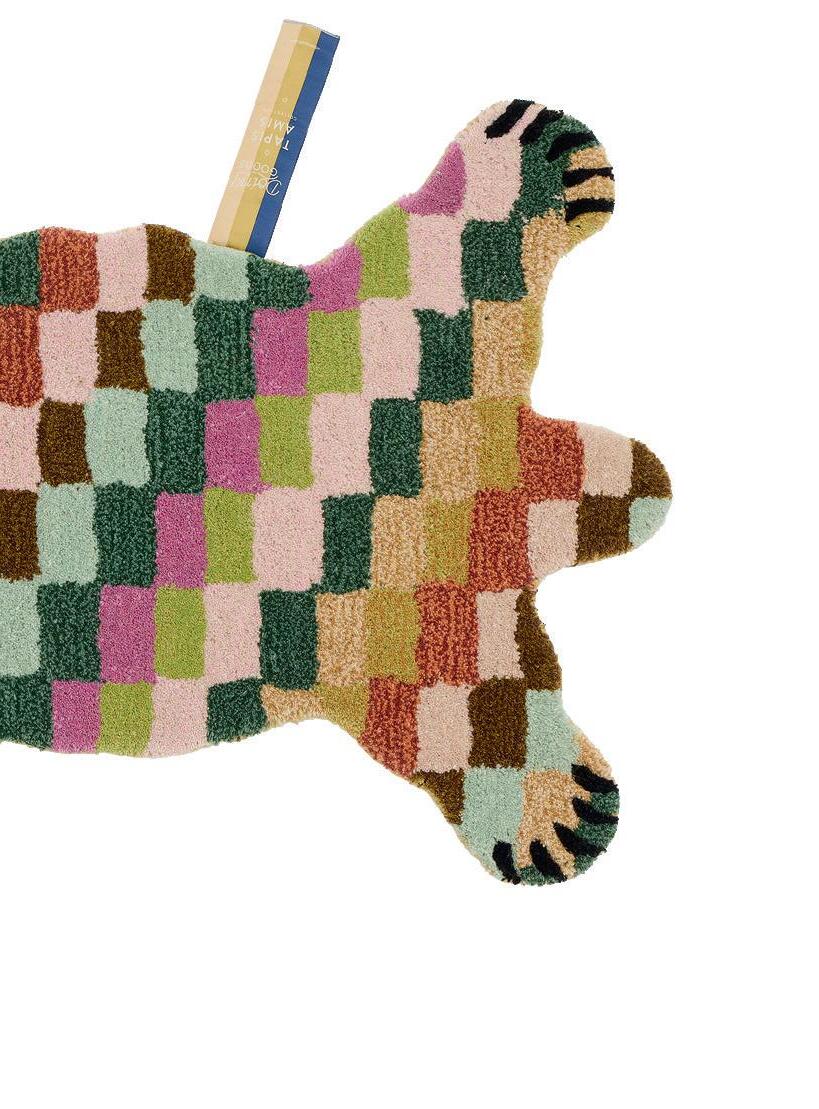
A joyful menagerie slips into the home, with trompe l’oeil effects and bold animal prints. — MF
There’s a charming playfulness in the forms and proportions of this shelf, from the Dreamscape series by Toronto studio Objects & Ideas. Made primarily of papier mâché, it features bold outlines and awakens the senses through the tactile exploration of its generous shapes. — Tessera shelves, Di Tao for Objects & Ideas (price upon request, objectsandideas.com) MF
CHILD’S PLAY
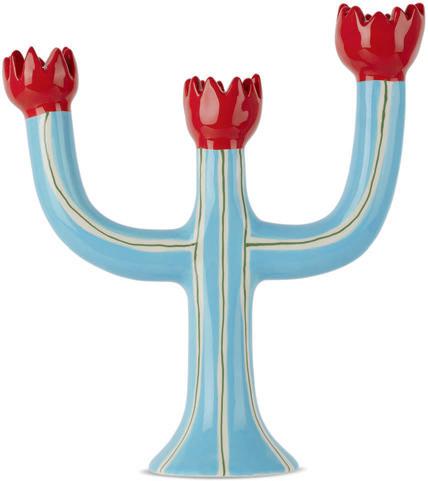
With their naive lines and cheerful colours, these two are made to get along! — MF
[1] — Walk the Line wallpaper, Opposite Wall (from $10, oppositewall.com) / [2] — Tulip candle holder, Laetitia Rouget ($240, ssense.com)
ART IMMERSION
Until January 4, 2026 , head to the Musée national des beaux-arts du Québec in Quebec City to discover the new exhibit dedicated to the last two decades of work by French-American artist Niki de Saint Phalle. This is a unique opportunity to dive into the offbeat, colourful, free-spirited and socially engaged world of this leading figure in contemporary art, who left behind an impressive body of work—including her Nanas, monumental female sculptures that have become iconic representations of her artistic vision. — Niki de Saint Phalle—The 1980s and 1990s: Art Unleashed; mnbaq.org) MF
LIVING
LEGEND
The WASSILY CHAIR : a century of timeless design
By Marouchka Franjulien
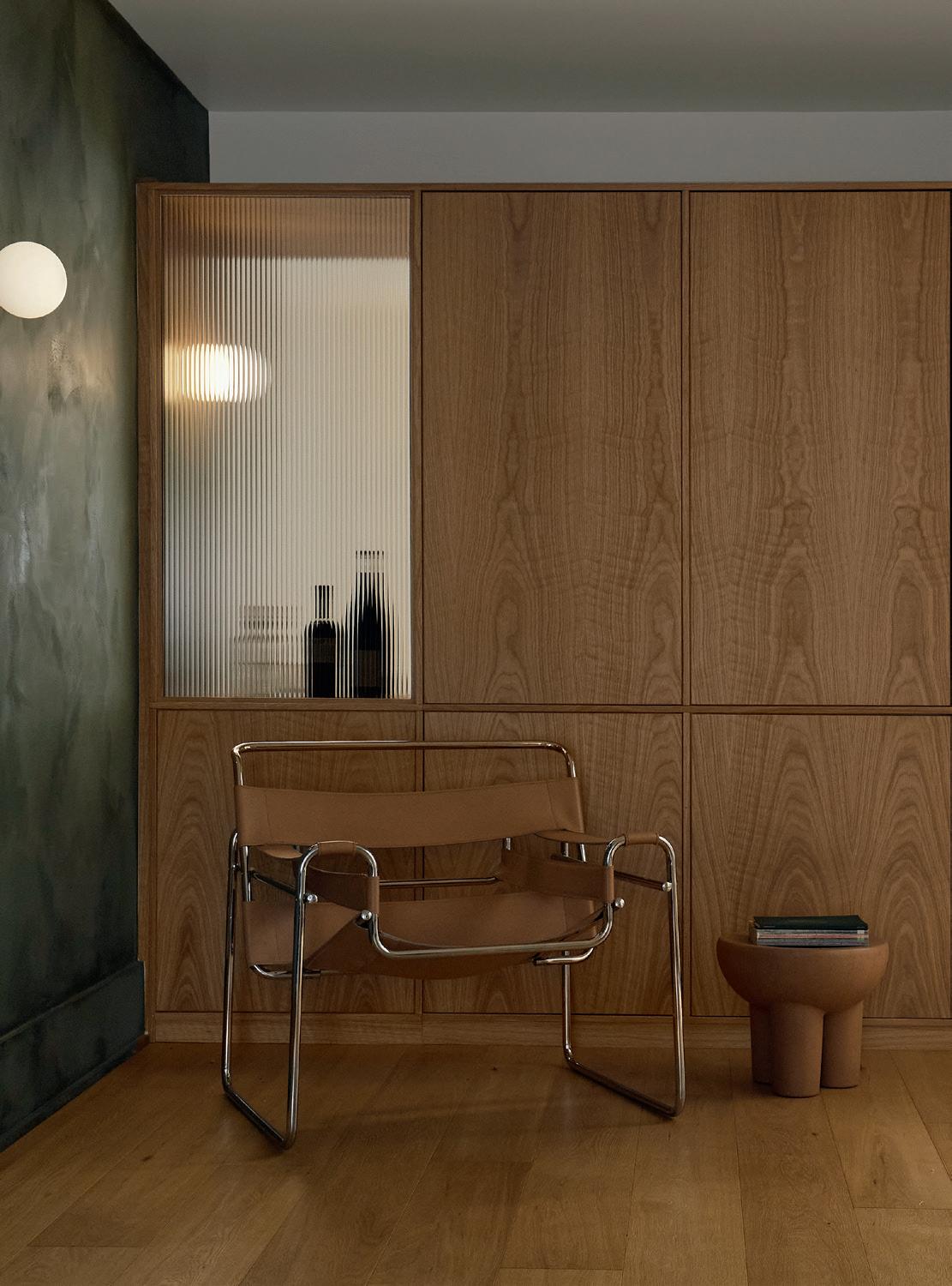
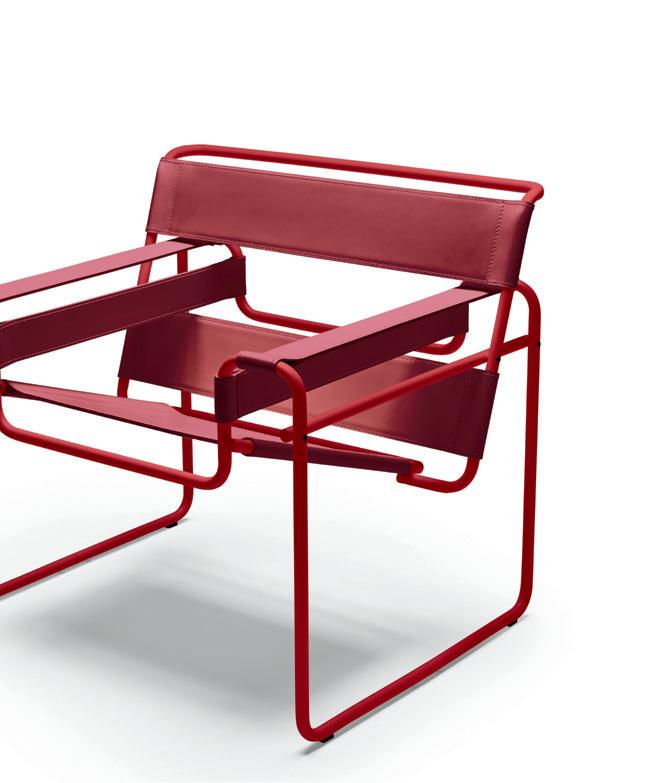
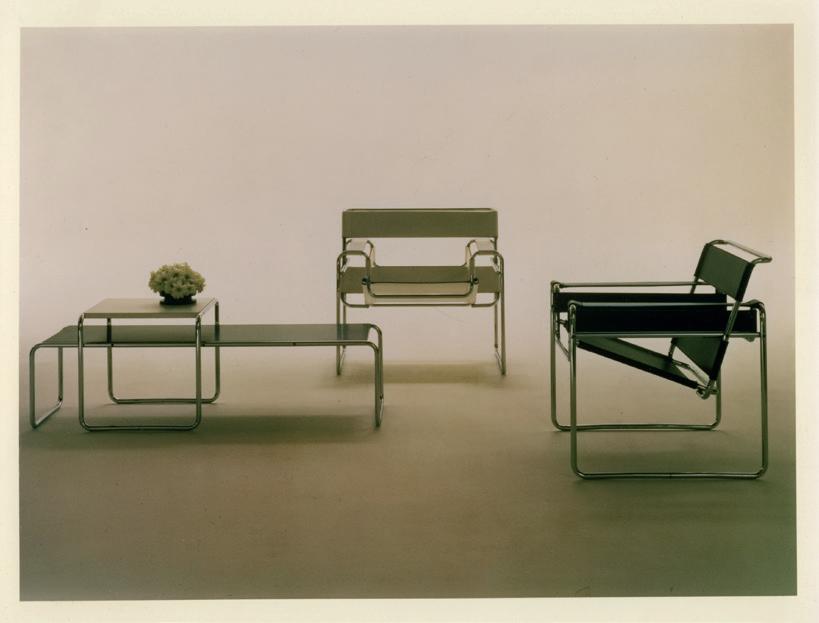
The Wassily chair might never have taken its name from the painter Kandinsky. At first, it was merely referred to as “Model B3”—a name as simple and functional as the clean silhouette that made it famous. Created by Marcel Breuer between 1925 and 1926, this icon is now celebrating 100 years of history, proving once again that time has little to no effect on great design.
Back then, the Hungarian designer—a former student at the Bauhaus in Dessau—led its carpentry workshop. The
German institute, founded by architect Walter Gropius, had only been around for a few years but was already attracting free thinkers and avant-garde artists. Inspired by the handlebars of his Adler bicycle, Breuer came up with the idea of using tubular steel manufactured by the German company Mannesmann, which could be bent without any visible welding. This innovative frame—paired with canvas straps (leather came later)—was both sturdy and light, and, above all, functional, in keeping with the principles guiding the school’s philosophy.
The radical design recalled another famous armchair: Gerrit Rietveld’s Red and Blue chair, which was created around 1918 and also featured an inclined seat and back. But whereas Rietveld focused on wood, Breuer went further with his use of steel—an industrial material, then only reserved for outdoor furniture—which emphasized the austerity and modern spirit of the Model B3.
During a visit to Breuer’s studio, the chair—installed in the Bauhaus lecture hall as early as 1926—caught the eye of one of the school’s eminent professors: painter Vassily Kandinsky, a friend of the designer, who ordered one for his apartment.
Although Breuer initially produced his seat through his company, Standard Möbel, it wasn’t until the 1960s that the design got global recognition. Italian furniture manufacturer Gavina SpA, which held the reproduction rights at the time (before being acquired by Knoll in 1968), heard the anecdote about Kandinsky and decided to rename the chair in honour of one of its earliest owners. The rest, as they say, is history. —
LIFE IN COLOUR
After a long journey through a desert landscape punctuated by shades of sand, taupe or ecru, BRIGHT SHADES are making a comeback. Mustard-yellow walls, emerald sofas, peacockblue cabinets… It’s time to raise the tone .
By Aurélia Morvan — Adapted by Joanna Fox
Photo: Perron Design
Where do you start when your sober, minimalist decor tends to favour beige in all its forms? “Go for a red vase or candle holder and see if you like it,” recommends Katelyn Rempel, founder of Toronto-based interior design firm Studio Sonny, referring to the theory that the presence of a scarlet element instantly enhances the style of a room. As for objects, don’t hesitate to mix different shades. “Opt for accessories that speak to you, and they will go well together,” says the expert.
Sarah Eve Hébert, associate interior designer at the Montreal firm Perron Design, suggests swapping the neutral frames of your paintings for colourful ones. You can also choose chairs and curtains that pop. “It’s hard to make a mistake when you add colour in small steps.”
When choosing paint hues, on the other hand, think big. “I don’t think an accent wall is a good solution,” says Rempel, who prefers to rely on colour drenching, a technique that consists in saturating a space—from the baseboards to the ceiling— in a single shade or a combination of complementary tones. For those who are a little less daring, Hébert advises starting with a slightly tinted base colour, “such as a very pale blue or a white with yellow undertones.” Anything but a true white. “Painting requires little investment, and it’s easy to get started—whether you’re an owner or a tenant.”
If your budget allows, bet on strong pieces such as a sofa, a wool rug or even a colourful sink—which was trendy in the 1960s and back in force this year. “In the past, they came in all kinds of shades and designs,” says Rempel. Pigmented ceramic is also a good solution to bring cheerfulness to your space. Sometimes a moody kitchen just needs a new backsplash to show some personality. So, are you ready to step into technicolor? — (studiosonny.co) (perrondesign.ca)
Caleo pouf, Must ($150, mustsociete.com)
Flowerpot VP9 lamp, Verner Panton by &Tradition ($395, oldfaithfulshop.com)
Welcome to the world of DACAT STUDIO , specializing in custom furniture , where dreams come to life.
By Emmanuelle Martinez — Adapted by Zarya Rubin —
Photography by Maude Chauvin
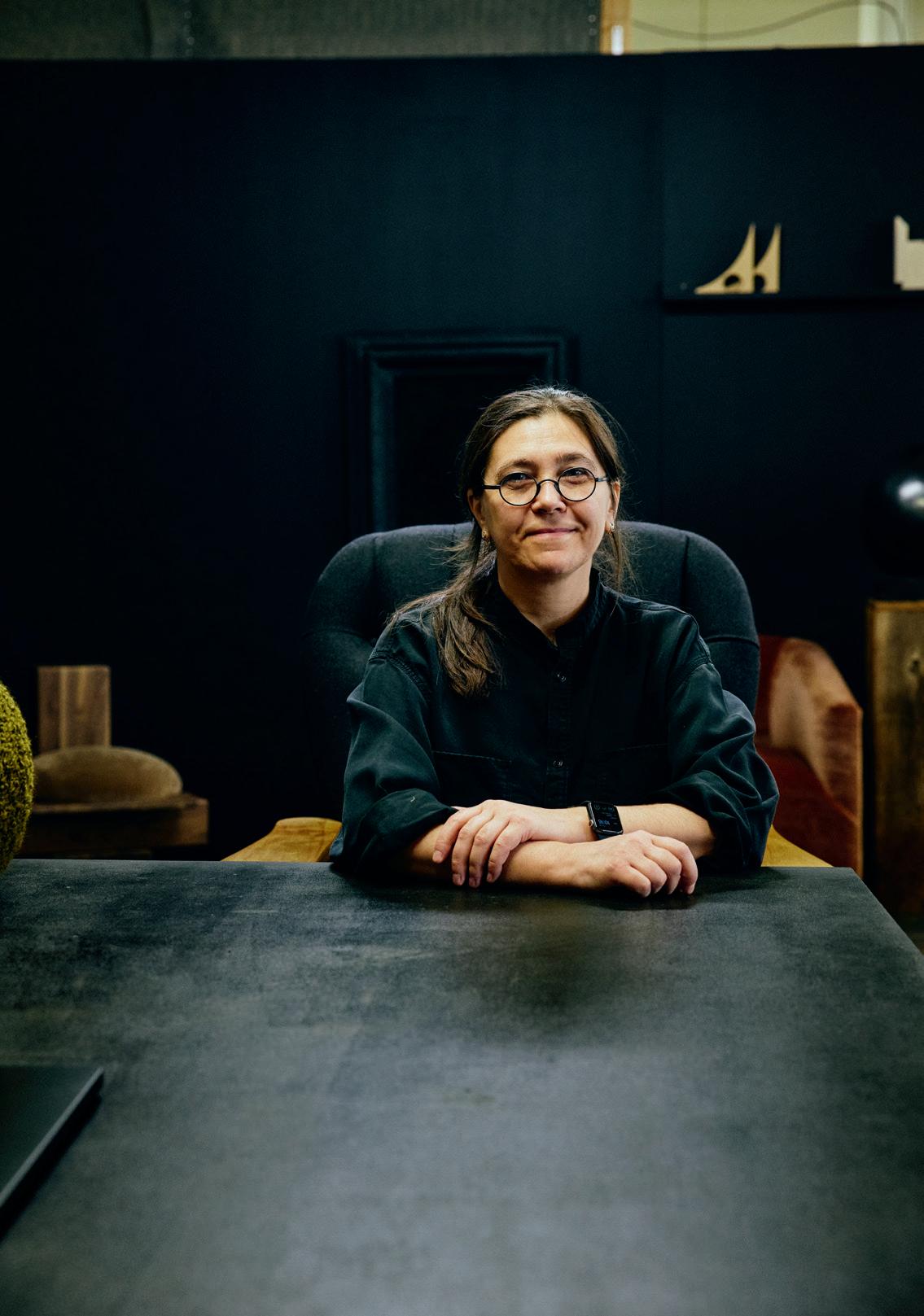
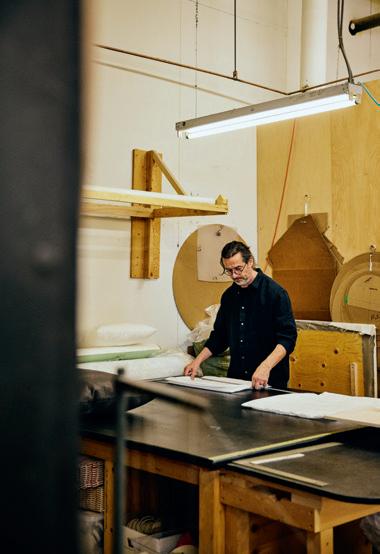
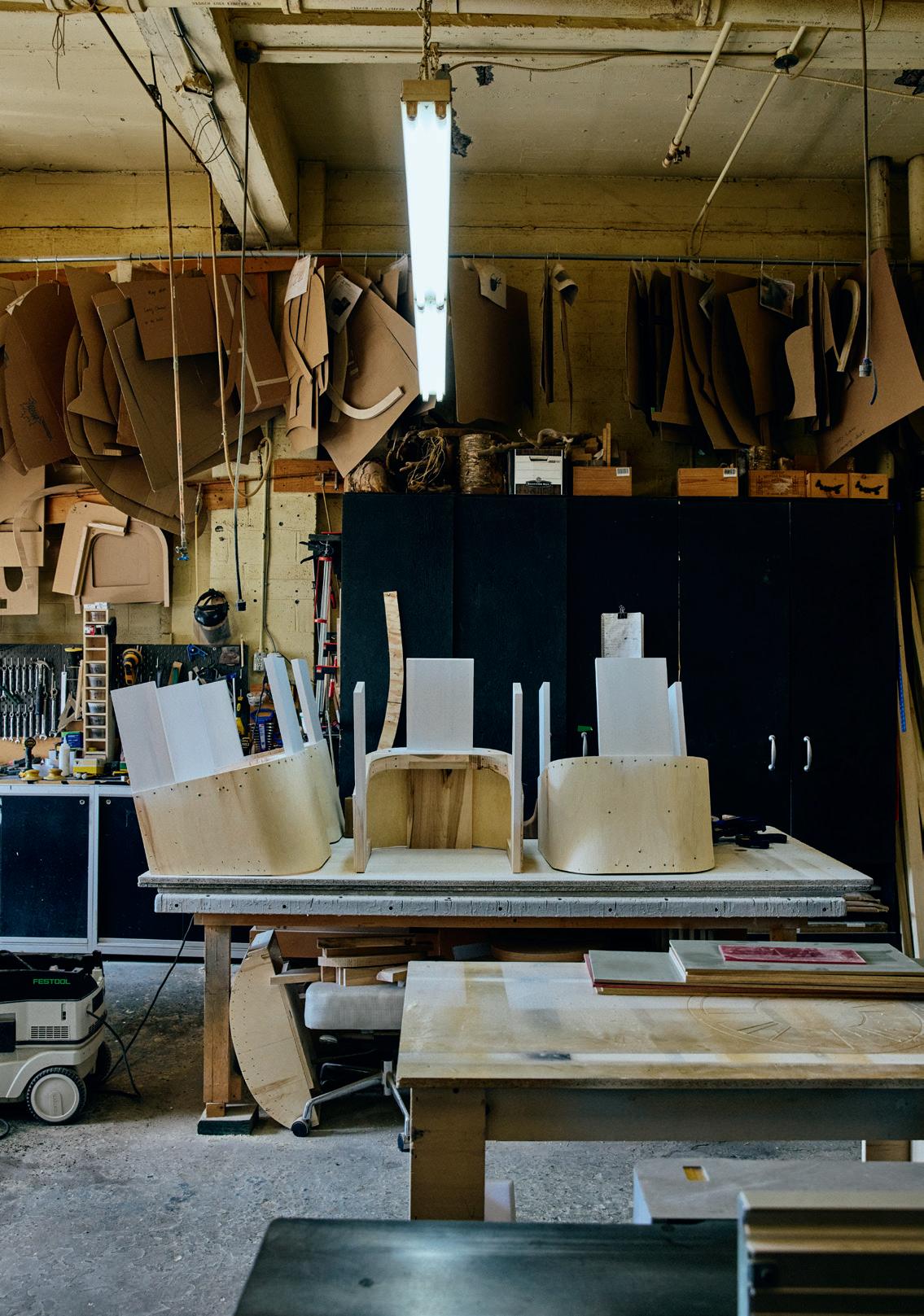
“ I like simple things . And simplicity, for me, is complexity resolved.” Daniela Tudor, who co-founded Dacat Studio in 2014 with her husband, embodies her motto. When she welcomes us into her workshop in Montreal’s Saint-Henri neighbourhood, we quickly become aware of her desire to get down to brass tacks. More accustomed to making furniture than talking about herself, Daniela reflects for a few seconds before getting to the heart of her passion: “I love watching a piece take shape until it reaches its final form, knowing that someone will love it, take care of it and use it with respect—because we put a lot of effort into it.”
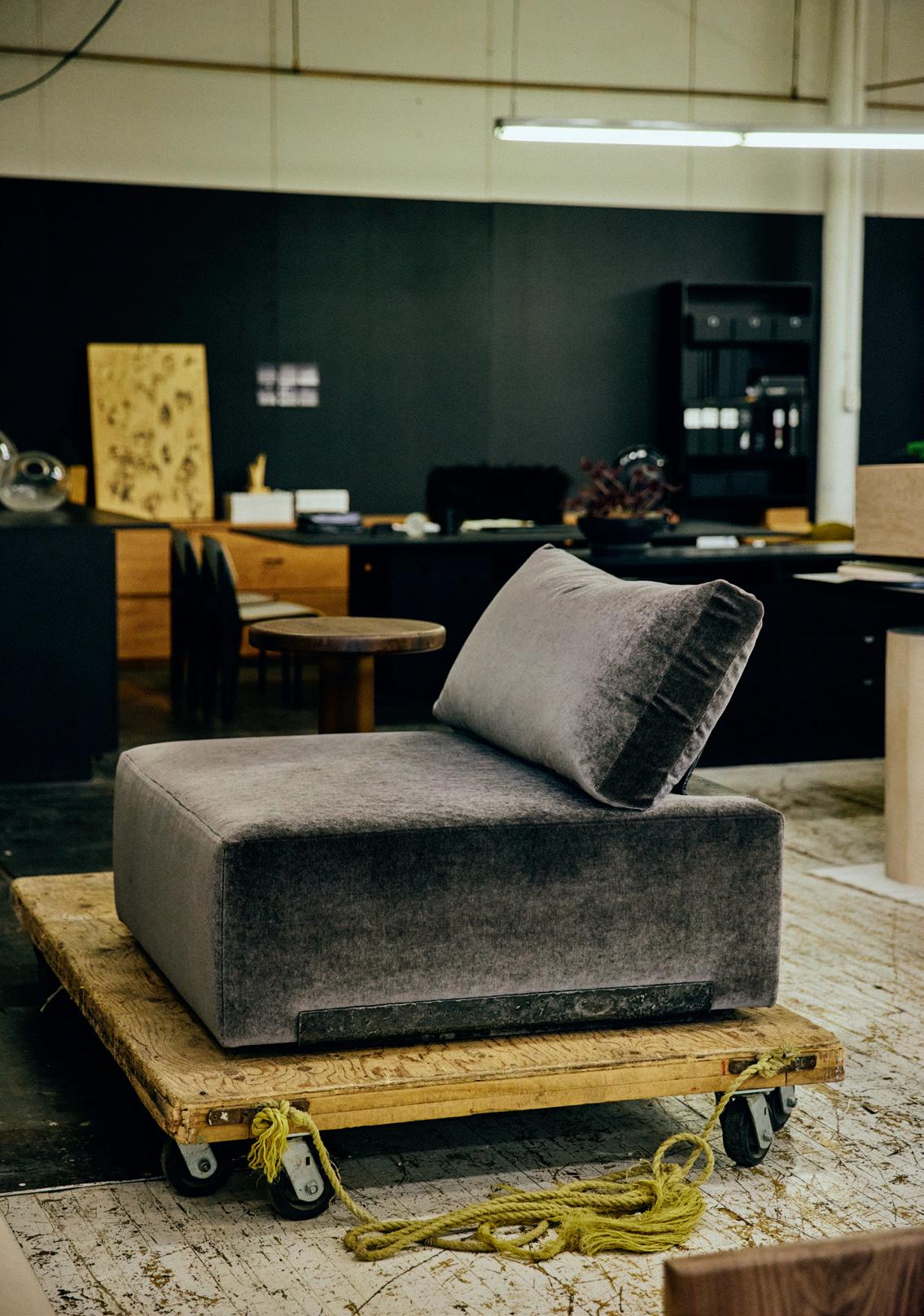
That effort does not go unappreciated. Like the time a client burst into tears over the green velvet sectional sofa they designed for her! In a sea of options and varied prices, where does custom-made make all the difference? “The quality of the materials, the purity of the form, the comfort of the seat, the balance of proportions, the harmony of the whole, the attention to detail: It’s all about refinement and the creation of a truly unique piece.” The studio works primarily on residential projects that are made to order, and the Dacat name is spread by word of mouth, like a secret for those in the know, evoking excellence, reliability and efficiency.
Daniela Tudor is discerning, detail-oriented and something of a perfectionist. Traits that date back to her early years. Her eye was honed in childhood, at an age when one sees the world through a unique lens, guided by experiences that form lasting impressions. “I grew up in Romania. My grandparents weren’t rich, but their home had custom-made furniture, which they kept their entire lives. Their house exuded a certain charm—more enjoyable, more authentic than other people’s homes, where the interiors all began to look the same. It was like a revelation,” she says. At age five or six, while visiting friends, Daniela enjoyed hiding under tables and in cupboards. At the time, dark, mass-produced furniture was popular, but when she looked at it from below and inside, she noticed that, unlike in her grandparents’ home, that’s where the colour stopped. The invisible parts were raw, unfinished, as if they were of no consequence. Even today, the interior matters to Daniela. And this is also where her desire to produce excellence comes from: extending the beauty of perfectly executed work down to the details that only a true lover of design and craftsmanship will be able to see and appreciate. ↦
“We underestimate the extent to which the aesthetics of our environment impact our psyche and our happiness.”
— Daniela Tudor
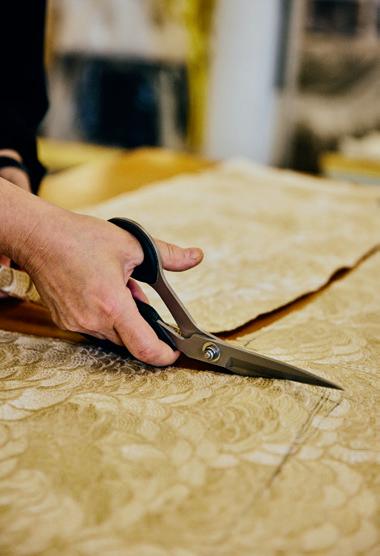
Everything starts with a brief, a short text accompanied by a few inspirational images, to create the design of an object—sometimes in collaboration. The piece is then entirely constructed in the workshop, from structural concept to the finished product. Assisted by her team for the construction of the base, the upholstery and the textile covering, if needed, Daniela takes care of the first crucial step, where her training as a furniture production engineer, her doctorate in wood science and her 30 years of experience form an invaluable combination that leaves no room for doubt. “Creating the structure is my domain. Taking a sketch, translating it into numbers, visualizing the final form—I love that part.”
Ever the craftswoman, the scientist is never far behind. Passionate about research, her first love, Daniela spent years at the University of Toronto studying the alteration of wood pigments by a specific type of fungus; this surprisingly aesthetic pigmentation process helped awaken her creative side. Discussing Dacat’s projects, she affirms her desire to reconnect with experimentation, test new techniques, explore 3D printing and innovate through the use of unconventional materials, such as leather with a unique texture made from an edible mushroom, reishi, which she reveals to us, her eyes sparkling. “It’s all the rage in Europe right now, but I’ve been following the trend closely for 10 years and have secured two exclusive leathers.” Pushing the boundaries of a demanding profession—one that requires endless dedication—is the goal of this visionary woman who won’t back down from any challenge. —
(dacatstudio.com)
“I always aim to strip things down to their essential form. I prioritize elements that draw the gaze in through reflection, without distraction.”
— Daniela Tudor
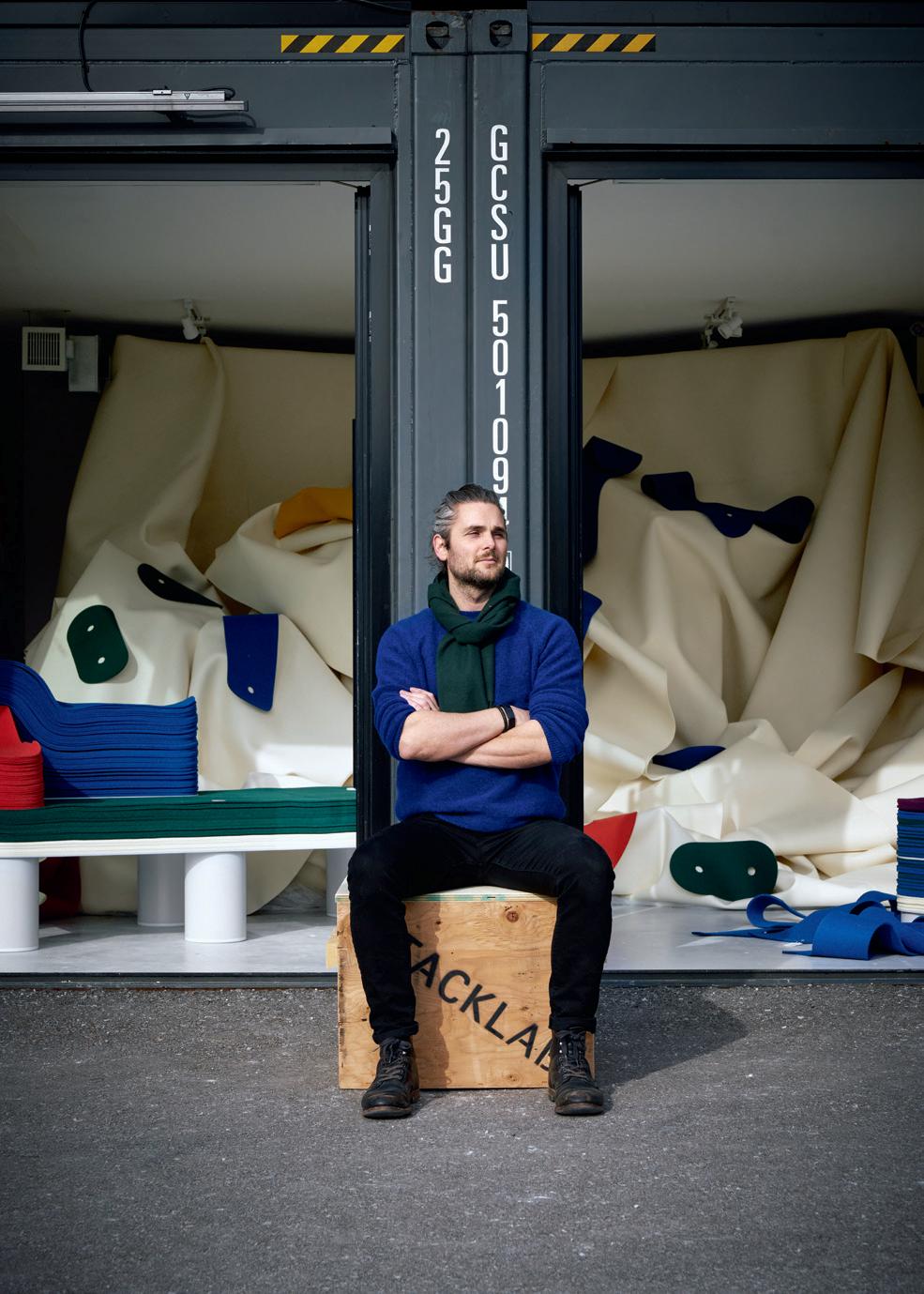
From a distance, you’d think he was some kind of mad scientist. A bleeding-heart environmentalist, or maybe a tormented artist. But don’t let his upcycled creations fool you: JEFF FORREST isn’t who you think he is. Well, not exactly.
By Violette Létourneau — Adapted by Zarya Rubin
RADICAL BY DESIGN
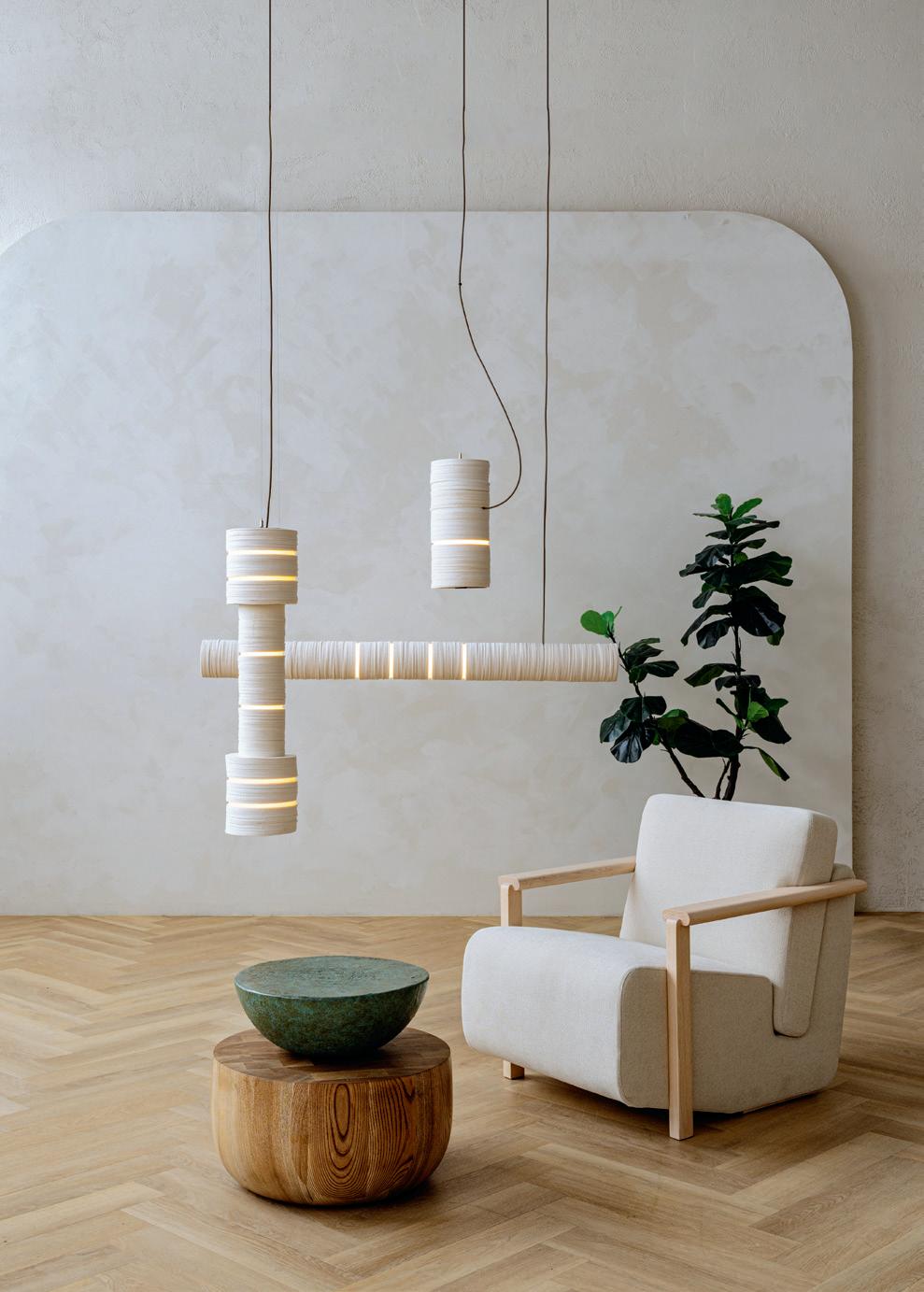
Arcilla Pendant Cluster, Stackabl
Photos: Arash Moallemi (Living Room) / Patrick Biller (Portrait)
“We’re realistic, we know it’s not going to change the world, but it opens up the conversation, on a philosophical and practical level.”
— Jeff Forrest
While he’s a true creative, the founder of the Stacklab studio and the Stackabl brand couldn’t care less about having the soul of an artist—and he doesn’t define himself as one. Jeff Forrest is ambitious, curious, maybe even a little arrogant; he knew how to surround himself with the right people and say yes to the right opportunities at the right time. He’s a creative in the most mathematical sense of the word. If he maintains a conventional definition of beauty, he redefines it in a surprising way when it comes to design. For him, the field has nothing to do with colours and shapes. It’s applied critical thinking, period. The solution to a problem. Jeff believes in a holistic approach to design, a way of thinking that takes into account physical, social, economic, scientific and cultural constraints. He seeks to create something meaningful, he says, to “act with intention and, ideally, intelligence.” This vision is shaped and reinforced by his studies in architecture—training that, he says, teaches one to analyze problems with rigour and objectivity. “That’s the beauty of architecture—it teaches critical thinking, analysis and problem-solving. That’s what interests me about what I do and what we apply every day in the studio.”
The aforementioned studio is Stacklab, which Forrest founded partly by accident and partly through overzealousness. Surrounded by a multidisciplinary team, he designs objects, spaces and systems by combining design, technology and environmentalism, using an experimental and discerning approach. Flash back to his final year of architecture school at the University of Calgary, after a BA in history and biology from Queen’s University. In his last semester there, he took a brief break to go on a motorcycle trip, mostly in the American Rockies, a time to regroup with the intention of a triumphant return to
finish his degree off in style. But he wouldn’t be heading back to Calgary. A call from his friend, Sam Kennedy, founder of Feltro, soon had him riding east across the U.S., on his way to Toronto. There, he started working at an urban sawmill, Canadian Salvaged Timber, at the invitation of Kennedy, with whom he would later start the design side of the business.
Forrest built furniture from reclaimed wood and very quickly made his mark by floating ideas to customers. Many, many ideas… “I ended up getting fired for insubordination. I was ambitious, probably too ambitious for what the company was willing to take on. And I probably lacked tact,” he says with a wry smile. The building’s owner noticed. When he heard the news of his dismissal, he offered him a job as a project architect for his construction company. He would back his ideas. All of his ideas. Carte blanche. And between working as a project architect for his former partner’s construction company, focusing on high-end residential, Jeff was also toiling away evenings and weekends designing furniture.
It was while working in construction and manufacturing furniture that Jeff grew increasingly aware of the level of waste that existed in the sector. But where there’s a problem there’s a solution, and he was determined to find it.
With Canadian Salvaged Timber, he rescued hemlock beams excavated from the Toronto shoreline. After more than a hundred years of absorbing minerals from the soil, they held a striking hue. He offered them to a restaurant as flooring, then transformed the offcuts into tables for a second nearby establishment. Two related projects, one unique material and almost zero waste—nose to tail.
This was the informal birth of Stacklab: Jeff wanted to create furniture and spaces that solve problems. And he wanted to do it in a context that allowed him to constantly ↦
Night City Scape floor lamps, Stackabl × Benoist F. Drut
Photo: Patrick Biller
evolve. He surrounded himself with a team that knew more than he did, bringing together people to brainstorm sustainable solutions.
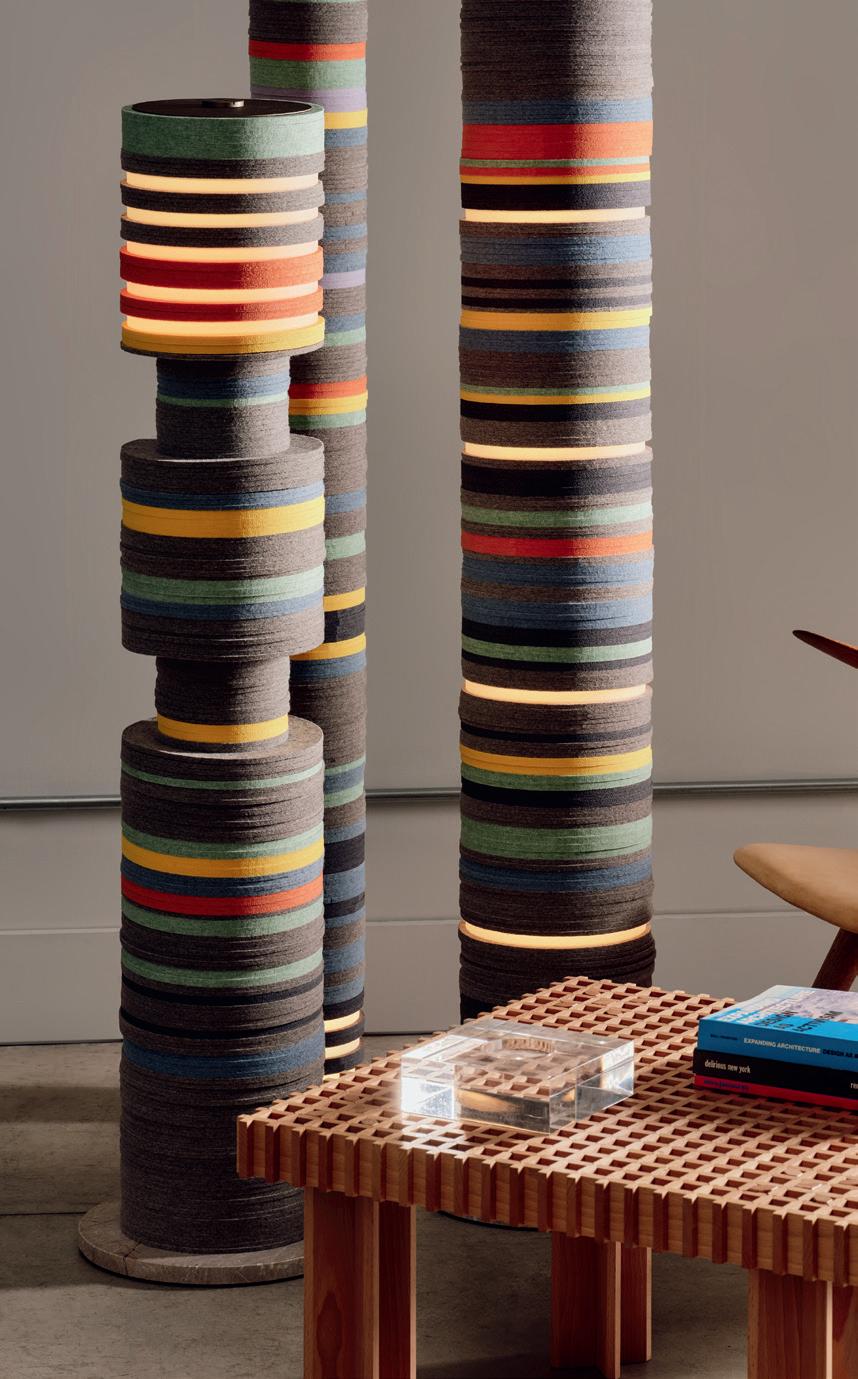
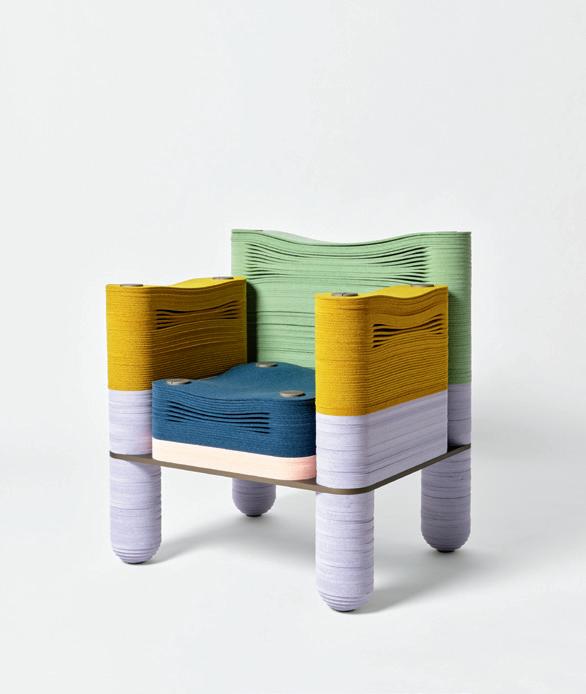
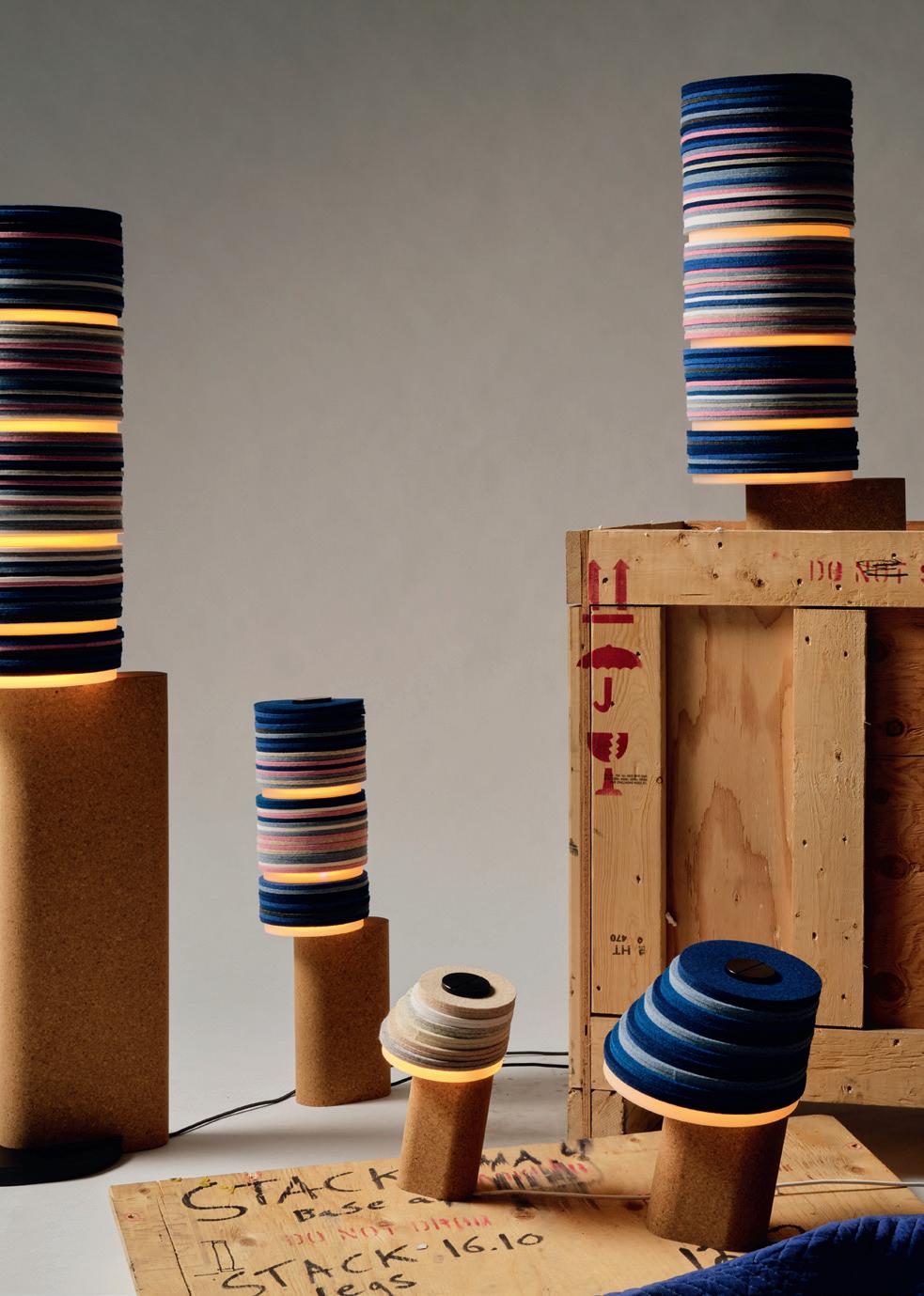
A few years later, Herman Miller published a database cataloguing leftover acoustic textile panels from its production process. James Munroe, former design director at Stacklab and now Jeff’s business partner in Stackabl, immediately saw the potential. He spoke to Jeff, who agreed. James wrote an algorithm to analyze the most common patterns, and together they designed stackable modules from these fabric remnants. The project would become Stackabl: a customizable collection born out of the optimization of an industrial waste stream, launched in collaboration with Maison Gerard. Taking advantage of a detour to Manhattan for an installation, Jeff showed up at this New York gallery specializing in collectible design, in a freshly donned blazer, manufacturing a meeting, to show off his wares. He left with a contract sealed with a handshake.
With its colourful furniture and lighting, Stackabl aimed initially to attract a well-heeled clientele and then branch out to offer a range of products at accessible prices. Mission now accomplished, with lamps starting at US$300 and a customer base that includes commercial, hospitality, institutional and residential clients. Will they achieve their 2020 goal of diverting 500 tons of textile waste from landfills by 2029? It’s a laudable target. Jeff Forrest, meanwhile, continues to show up in the most unexpected places. — (stacklab.ca) (stackabl.shop)
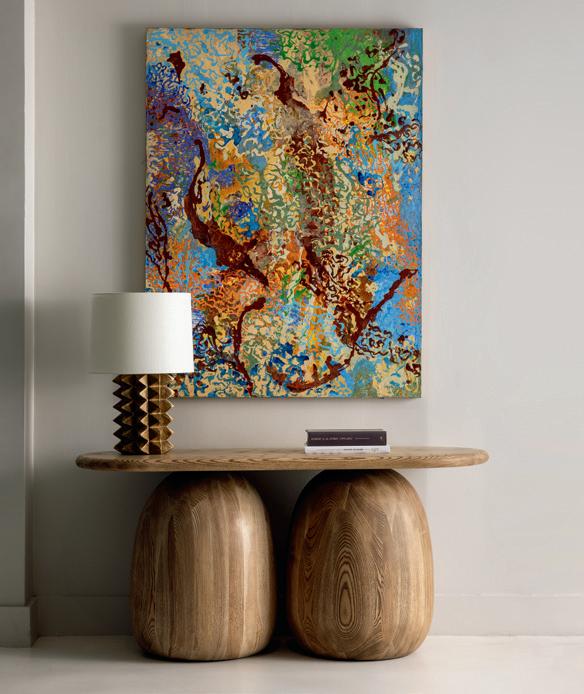
The Ash console, by Stacklab, made from wood impacted by the emerald ash borer beetle.
Opposite page — Shift 46, Tilt 06, Shift 20 and Tilt 11 lamps, Stackabl × Rockwell Group
Photos: Patrick Biller (Chair and Lamps) / Mike Van Tassell (Console)
“I
want the people who use our spaces or own our objects to think differently, to want to do good, or at least to go through life without just skimming over it—to try in some way to make it better.”
— Jeff Forrest
STYLE
Dining in Style (PAGE 34) A guide to choosing your furniture, tableware and cutlery wisely — Treasure Hunt (PAGE 40) Expert tips for sourcing the best vintage furniture
DINING in STYLE
Photos: Studio Meg Cassidy
(Opening Page and Dining Nook) / Kastella (T113
Dining Table)
What should you know before choosing
FURNITURE, TABLEWARE
AND OBJECTS that will elevate your meals and your daily routine? Here’s what to keep in mind .
By Marouchka Franjulien — Adapted by Zarya Rubin
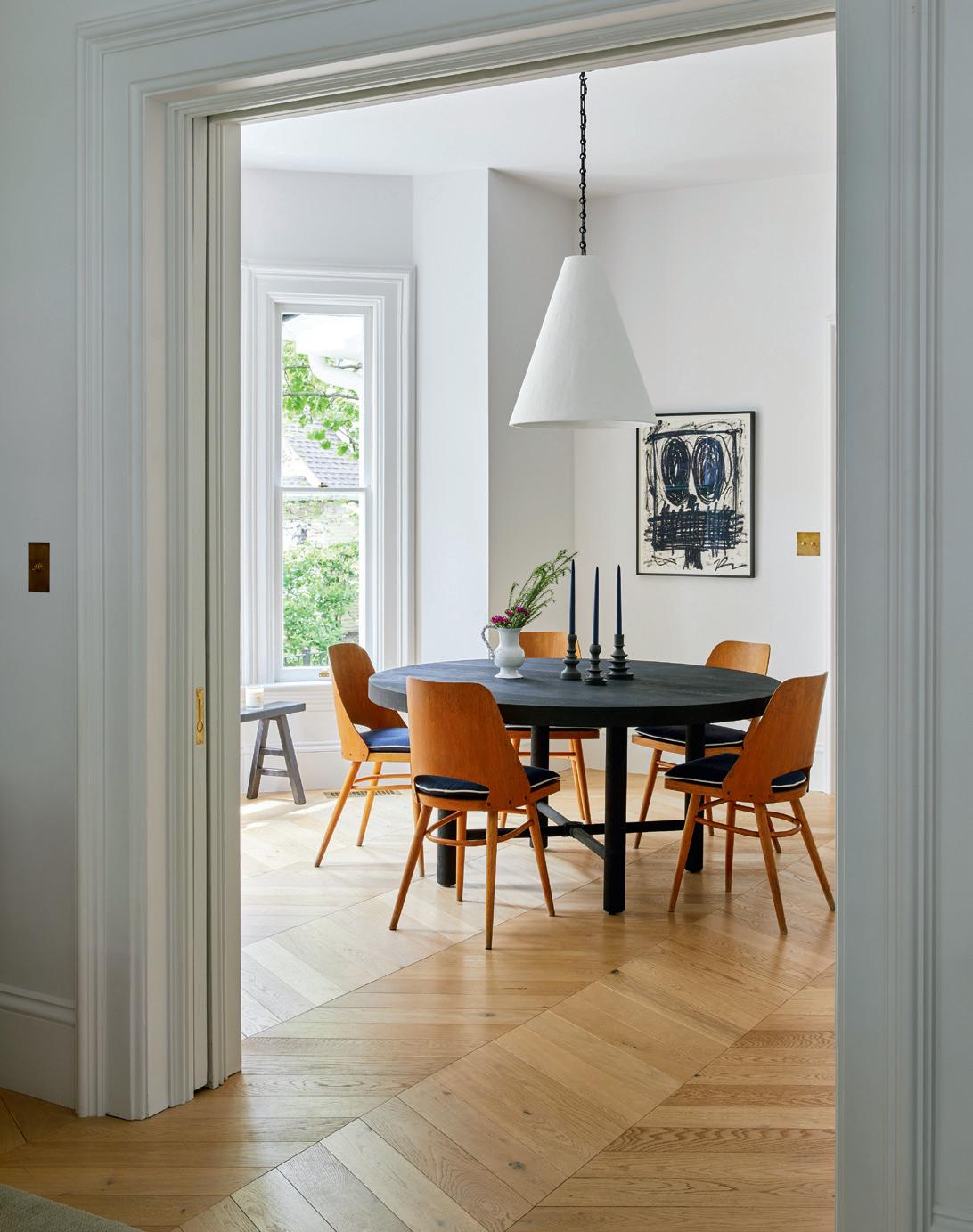
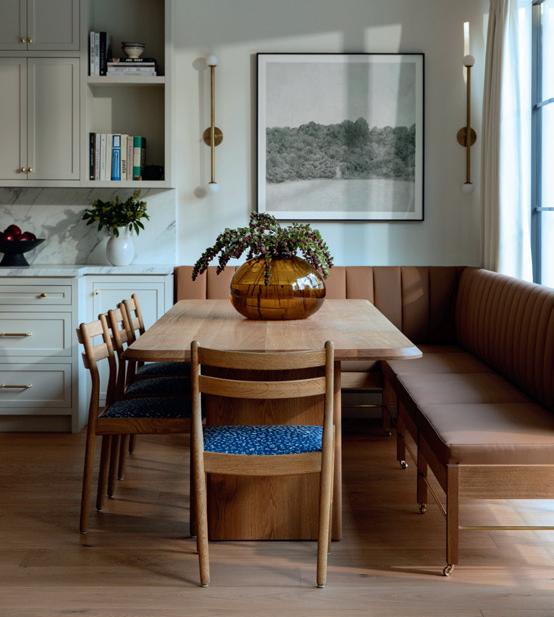
The scene: a Friday evening, 7 p.m. Outside, the wind is blowing, a light rain is falling on the asphalt and the gloomy sky is turning black. With the end of summer comes the desire to spend your evenings indoors. Hibernation is not an option, however: Your dining room—or dining corner—has become the de facto playground for your small and large gatherings, from impromptu dinners to celebrations whose sole purpose is the joy of getting together. To make these moments memorable, you need lively conversation, a healthy appetite… and a certain degree of pragmatism. Hosting is an art that must be cultivated. It all starts with a table surrounded by chairs, a few plates, cutlery and a carefully crafted ambience. To help you navigate the space and learn the tips and tricks of the trade, we called on three experts in the field. —
(1) THE GOLDEN RATIO
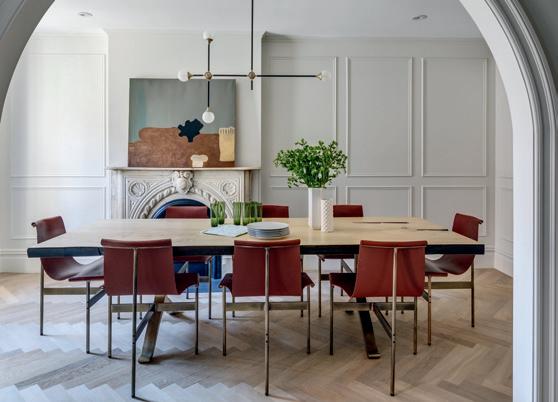
“ Choosing a dining table requires a careful assessment of your needs and the limitations of the space,” says Lysanne St-Laurent, co-founder of the Montreal interior design firm Vives St-Laurent, which she co-directs with Laurence Ouimet-Vives. To start, she recommends measuring the room to determine the available space and ensure smooth circulation once the furniture is in place. “Generally, we recommend leaving 36 to 42 inches [91 to 107 cm] of clearance on each side for optimal comfort.” Don’t hesitate to trace the outline of the table you’re considering on the floor using painter’s tape: “It helps you imagine its real impact,” summarizes St-Laurent.
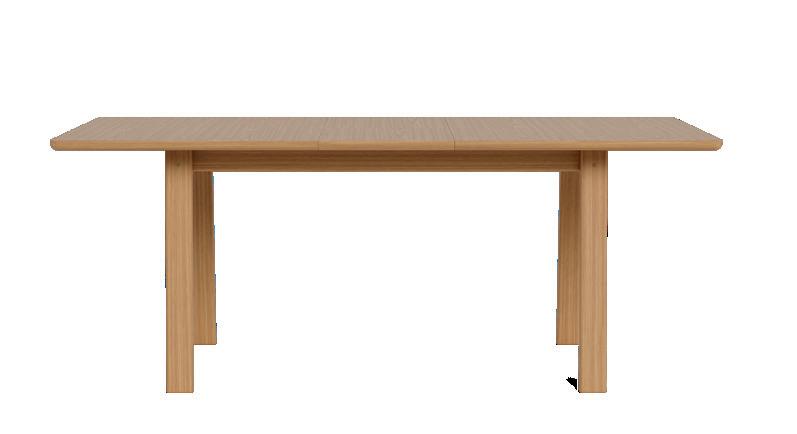
Then consider the size of the table in question. “A round or oval table is best suited to a square or circular room and can create a more intimate feel,” says Meg Cassidy, founder of the Toronto-based studio of the same name. “A rectangular table, on the other hand, is ideal for narrow or long spaces, accommodates larger groups more easily in a more formal setting and offers more surface area if you like to serve a large number of dishes.” It’s also important to consider how many people you’ll be able to seat, both for everyday use and special occasions (an expandable table may be a good choice). The recommended diameter is 48 to 54 inches [122 to 137 cm] for a round table that seats six, and a minimum of 60 inches [152 cm] for an eight-person table. “For a rectangular table, its length generally determines the number of seats available,” adds St-Laurent. “An eight-foot table, for example, can seat eight people: three on each side and one at each end.” — ↦
The choice of materials is ultimately a personal one, dependent on individual style and taste. That said, it’s important to consider everyday realities when thinking about durability and longevity. For clients with young children, Erica Colpitts, who runs Vancouver-based Erica Colpitts Interior Design, suggests an already worn-in antique wood table or a new piece with a heavy wood grain and a matte finish, which helps hide the inevitable scratches and dings. Meg Cassidy also prefers wood, which offers a classic and timeless look. “I love the tactile, warm feeling of the material when your hands and arms brush against the tabletop,” she says, noting that oak offers excellent durability. The wood colour should be chosen as a whole: Do you want a table that matches the floor colour, or do you prefer a strong contrast between the two? “It’s really a matter of preference,” says Cassidy. “For a subtle, clean look, stick with the same tones. A contrasting shade, on the other hand, can give a more polished and unique look.” —
(3) MOOD LIGHTING
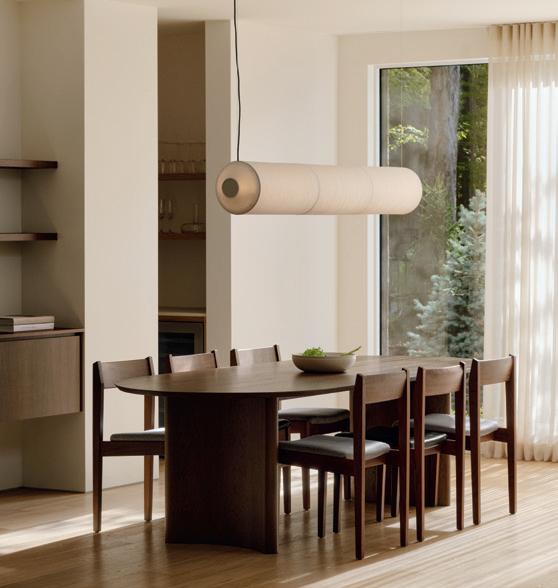
A light fixture can create an intimate vibe while adding personality to the room. “A round pendant is ideal over a round table, while a linear light works well over a rectangular table,” says Cassidy. In the latter case, the interior designer recommends opting for a well-proportioned pendant, one that covers two-thirds of the table’s length. When it comes to installation, the lower part of the light should hover 30 to 36 inches [76 to 91 cm] above the surface of the furniture. “It should be low enough to create an intimate feel, but high enough so it doesn’t block the view.” —
(4) MUSICAL CHAIRS
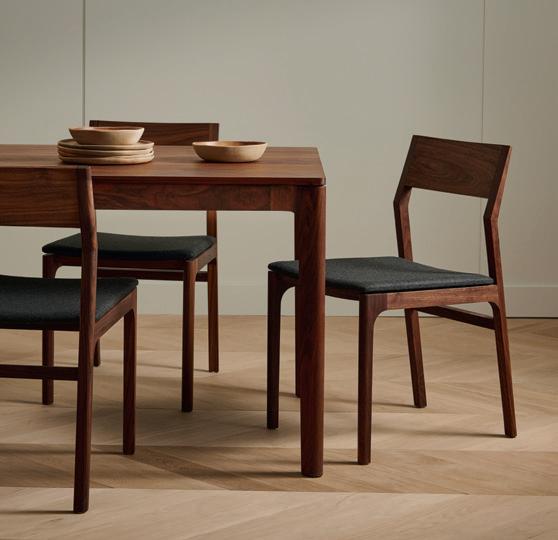
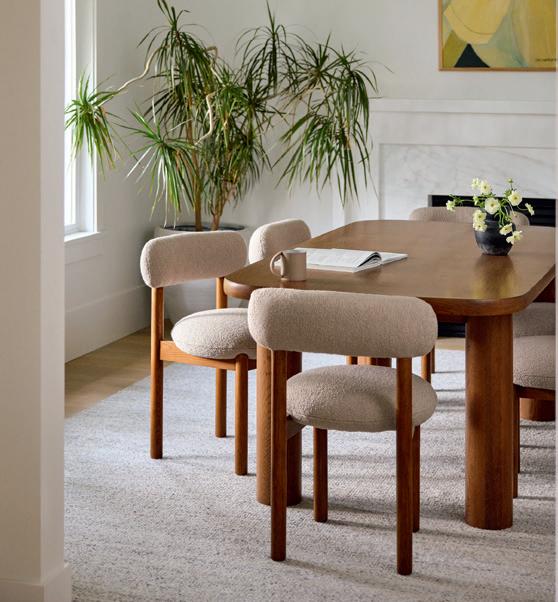
In the 1980s, dining-room sets were all the rage. Today, variety, which adds character, is key. “It is well worth the effort to curate your dining table, chairs and sideboard from different vendors and collections,” says Colpitts, for whom comfort is paramount. “When you’re hosting a dinner party, you want your guests to relax and linger around the table.” Before purchasing chairs, the interior designer advises sitting in them to ensure they’ll accommodate people of different sizes and shapes. “A solid wood chair without padding in the seat or back can be less comfortable,” adds Cassidy. Choose a quality fabric, such as a high-performance synthetic with a linen effect or a naturally high-performance material, such as wool. — Munk chairs, Article ($399 each, article.com)
(5) PLATES AND MORE
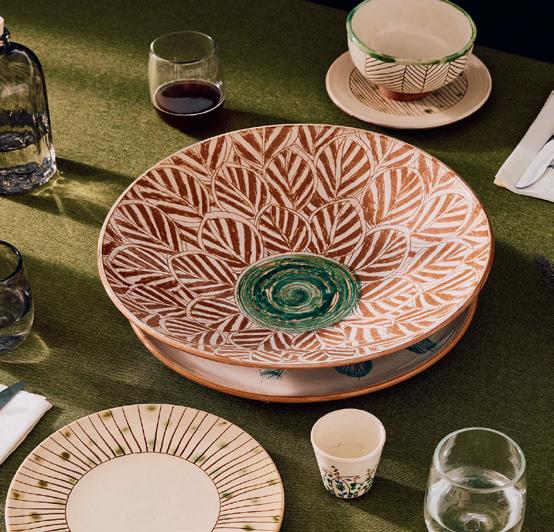
Cassidy owns several dinnerware sets, which she pulls out depending on the type of event or the time of year. “It’s an opportunity to express your personality, and there’s no right or wrong choice,” she says. “That being said, you have to make sure the proportions are right.” One mistake to avoid: choosing plates that are too large, won’t fit properly in the dishwasher, hang over the placemat or touch the dishes in front of them. Grey streaks on white plates are inevitable, but a glazed finish tends to show less wear than a matte finish.
Cutlery, on the other hand, should be functional: “Utensils can feel incredibly awkward if the handle is too long and skinny or the weight distribution is uneven,” says Colpitts, who recommends holding each piece of the set in your hands before purchasing. Cassidy, for her part, advises opting for simple but high-quality utensils that are suitable for all occasions. “We prefer flatware made of solid stainless steel or with a natural finish, rather than a plated or painted finish that tends to chip or rust,” says the expert. “Price is often the deciding factor: If the offer is too good to be true, it probably is.”
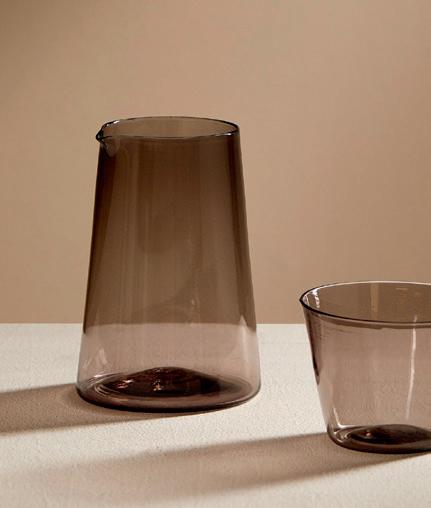
If you like to make the occasional toast, you must choose the right glass. Here, finesse is the key. “Glasses don’t have to be expensive, but the overall experience can be very different if the [material] is too thick,” says Colpitts, who tends to shop for hers at Ikea. — Harvest serving bowl, Anūt Cairo ($354, goodeeworld.com)
(6) GROUND RULES
A rug can add softness and texture and helps visually define a space, which works well in an open-plan living area, such as one where the kitchen and dining room co-exist. “However, it shouldn’t impede the movement of the chairs,” says St-Laurent, who emphasizes the importance of choosing the right size and a low-tomedium-pile thickness. Good to know: The rug should extend at least 24 inches [61 cm] beyond the table on either side so that the chairs don’t tip over when they’re fully pulled out. —
(7) FOCAL POINT
What should you put in the centre of the table once it’s cleared of the evidence of a great evening? Instead of a bouquet of flowers—which wilt quickly— Colpitts prefers potted plants and herbs, which she pairs with tea lights and votive candles. St-Laurent, for her part, opts for a ceramic bowl or tray filled with seasonal fruit, or a glass or ceramic vase that may or may not contain dried branches. Finally, forget about central placement in favour of intentional asymmetry. “I like to place objects off-centre,” says Cassidy. “The dining table is a playground where you can do what you want, and it’s an opportunity to showcase what you love,” for the people you love. Around the table, the pace of everyday life slows down so that the present moment can be enjoyed, conversations flow and memories are made. Take advantage of the opportunity to create a meaningful space by investing in quality furniture and objects that are beautiful, comfortable and functional—and can go the distance. — (ericacolpitts.ca) (megcassidy.com) (vivesstlaurent.com)
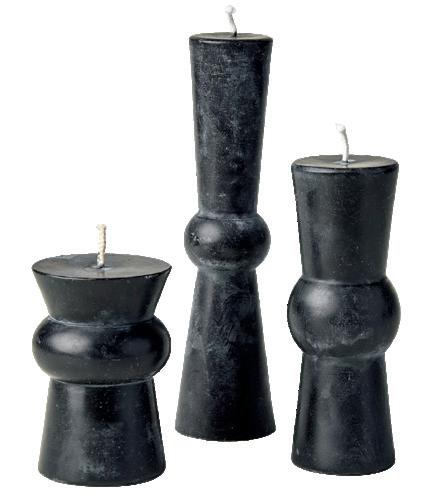
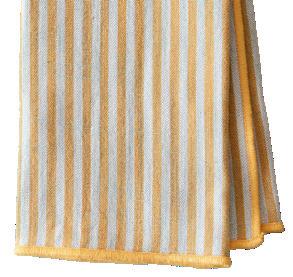
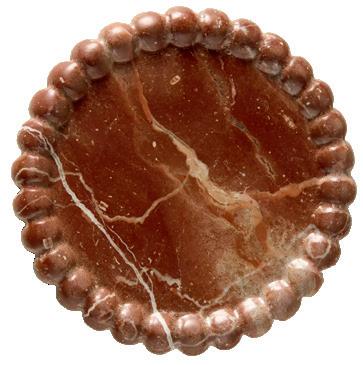
[1] — Carafe and cup set, Silvia Taylor ($115, silviataylor.ca) / [2] — Pivoine 3-2408 pendant light, Luminaire Authentik ($1,050, luminaireauthentik.com) / [3] — Napkin, Zara Home ($20 for two, zarahome.com) / [4] — Spirale service set, L’Objet ($325, l-objet.com) / [5] — Candles, Greentree Home ($55 each, providehome.com) / [6] Coaster, Anthropologie ($32, anthropologie.com) / [7] — Vela table, Cozey ($595, cozey.ca) / [8] — Mineral salad bowls, Dompierre ($120 each, marieevedompierre.com)
SETTING THE TABLE
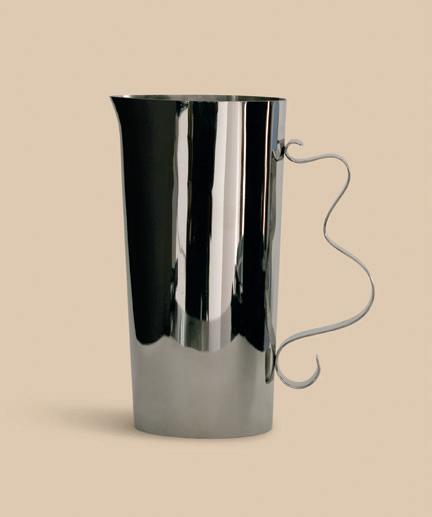
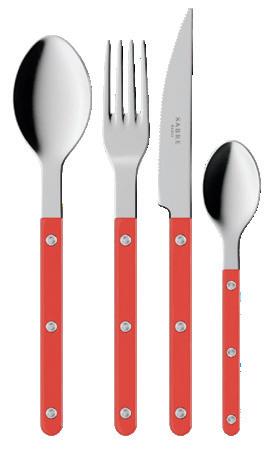
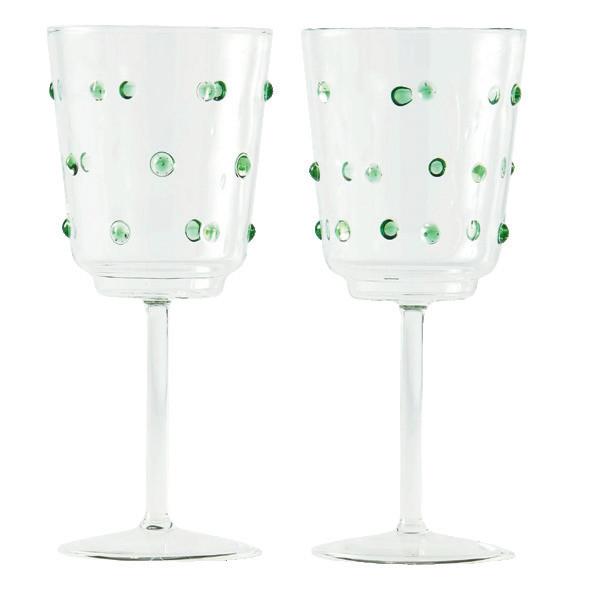
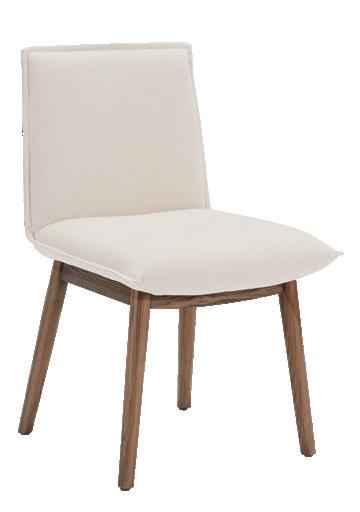
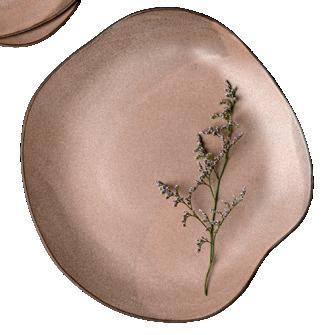
[9] — Squiggle pitcher, Sophie Lou Jacobsen ($335, saltbythecazaproject.com) / [10] Nob wine glasses, Pols Potten ($83 for two, smallable.com) / [11] — Hammond glass, Must ($13, mustsociete.com) / [12] — Bistrot cutlery set, Sabre ($69 per four-piece set, sabre-paris.com) / [13] — Plate, Roxane Charest ($65, roxanecharest.com) / [14] — Twist placemat, Coro Cora ($60, coro-cora.com) / [15] — Talk About dining chair, Sundays ($560, sundays-company.ca) / [16] — Äng vase, Eva Schildt for Klong ($155, mjolk.ca)
Three CANADIAN
VINTAGE
EXPERTS share their tips on spotting retro furniture that’s worth its weight in gold.
By Elisabeth Massicolli — Adapted by Joanna Fox
TREASURE HUNT
Once the domain of savvy collectors and dusty-antique lovers, vintage furniture is now on the rise. According to the latest data, the global second-hand furniture market was valued at US$34 billion (around $46 billion) in 2023 and could reach nearly US$57 billion ($77 billion) by 2030. Brick-andmortar specialty shops are popping up everywhere, and resale platforms like 1stDibs, Chairish and AptDeco are growing in popularity.
No wonder, then, that consumers—especially millennials and Gen Z—are drawn to unique, eco-friendly, durable pieces that are often more affordable than their new counterparts. “In most cases, vintage furniture costs up to 80 percent less, is better made, immediately available and adds character, uniqueness and style to a space,” says Anna Brockway, co-founder of Chairish, a curated online marketplace for high-end vintage home furnishings and art, in an interview with Forbes magazine.
But how do you navigate this vast and saturated world, spot the standout pieces and avoid making rookie mistakes? Three vintage enthusiasts share their pro tips.
BE WELL-PREPARED Before falling head over heels for a piece, a little prep work is essential. “When you’re hunting for something specific, it helps to know its characteristics—materials, finishes, manufacturing techniques typical of the era,” explains Alain Caron, co-founder of Morceau, a Montreal vintage and new-furniture boutique. Some pieces are signed, but original tags or stickers may have disappeared over time. “Just because a piece isn’t signed doesn’t mean it’s not authentic,” he adds. That’s why it’s important to know how to spot clues of origin: a natural patina on the wood, fabric wear, the quality of the joinery and so on.
Tech tools like Google Lens can help identify a model, but nothing replaces experience and a trained eye. “There’s nothing like our hands and eyes to assess the history of a 50or 60-year-old piece,” says Caron. Carlo Colacci, founder of Bonne Choice, a Toronto-based shop and showroom dedicated to rare and contemporary furniture and objects, recommends talking to the seller to learn more about a piece’s background. “Sometimes a small detail can reveal a false attribution,” says the seasoned collector. “But it’s also super interesting to know the story behind a vintage piece—it makes for great anecdotes later!” ↦
LOCAL FAVOURITES
Great gems recommended by our experts:
❶ Maison Singulier, in Montreal (maisonsingulier.com)
❷ Smash Salvage, in Hamilton (smashsalvage.com)
❸ Post Design Collective, in Toronto (postdesigncollective.com)
❹ Le Centerpiece, in Montreal (lecenterpiece.com)
❺ The Found Studio, in Victoria (thefoundstudio.com)
❻ Irie Space, in Vancouver (iriespace.com)
❼ Boutique Eclesia, in Montreal (boutiqueeclesia.com)
TRUST YOUR INSTINCTS Do your homework—but not too much. In the vintage world, every purchase is a delicate balance of preparation and instinct. “If I think too long, I often see pieces slip through my fingers,” says Colacci. “The best ones go fast, and sometimes you just have to jump on them.” Larisa Mancini, co-founder of Shoppe Clover, a luxury vintage furniture boutique in Toronto, agrees. “Our clients often underestimate how rare vintage pieces can be,” she says. “When you find a piece you like, there’s often only one—and you never know when (or if) something similar will come up again.”
Still, be cautious—impulse buying isn’t the goal. A vintage piece only has value if it truly fits your space, needs and budget. “The ideal is to know your criteria and limits, while staying open to surprises,” says Colacci. That mix of instinct and research is part of what makes the vintage hunt so fun—you never really know what you’ll find, and that’s the thrill.
LOVE FROM AFAR The rise of digital platforms has opened up new horizons for vintage enthusiasts, but shopping remotely requires extra caution. “The most common mistake is not checking the dimensions,” Colacci laughs. “In my rush, I’ve ordered pieces that turned out to be tiny—or massive—once they arrived.”
To make a safe choice, it’s best to buy from reputable, specialized dealers who provide detailed descriptions and photos from all angles. Don’t hesitate to ask for more info if needed. “At Morceau, we’re always available to answer customer questions,” says Caron. “We’ll even send videos of the piece on request.” Buying locally also helps establish a direct connection with the seller, who can share more insight, give tailored advice and often negotiate better prices. “Going through a dealer’s own site, rather than a big platform like 1stDibs, often means better service and more transparency,” adds Caron.
A GOOD DEAL In the vintage world, the idea of a “good deal” is subjective, says Mancini. “Sometimes the real find is simply getting your hands on something you’ve been searching for for years, or that holds sentimental value.” Colacci agrees: “What I consider a treasure might leave someone else completely indifferent.”
That said, having a few reference points helps avoid overpaying. “Always keep in mind that international platforms may have inflated prices,” explains Caron. “Locally, you can often find the same pieces for much more reasonable prices.” Colacci even recommends aiming for prices at least 25 percent lower than what’s listed on major resale sites. “The earlier in the resale chain you buy, the better the price,” he says. “Auctions, flea markets and estate sales are great ways to score deals before items hit boutique shelves.”
A SECOND LIFE Is it worth buying a vintage piece that needs a little TLC? According to the three experts, the answer is yes—or rather, yes if you understand the work involved.
“Reupholstery is often straightforward and lets you personalize the piece while staying true to its spirit,” says Colacci. “Replacing the fabric can easily breathe new life into a bench or armchair.” On the other hand, restoring wooden furniture can be trickier. “Veneer, which was heavily used in the 1970s, is especially delicate to work with,” Caron points out. Mancini advises consulting sellers before investing in major restoration work. “We work closely with artisans and can recommend them to clients—and give good advice, too. Every piece deserves a second life, but you need to consider the expertise involved.” Before buying, always assess potential restoration costs—asking a specialist for a quote, for example.
A well-restored vintage piece can last for generations. “You’re investing in objects that, 30 or 40 years from now, will still have value and character,” says Colacci. Especially since, piece for piece, the build quality of vintage furniture often surpasses that of many modern models. With a bit of prep, listening to your instincts and a few good questions, it’s possible to find one-of-a-kind items that will stand the test of time—without ever losing their charm. — (bonne-choice.com) (morceau.ca) (shoppeclover.ca)
HOMES
The House on the Cliff (PAGE 46) In Vancouver, a couple curates a home filled with meaningful objects. — A Fresh Start (PAGE 58) Born from tragedy, a new home becomes a Toronto family’s sanctuary. Retro Redux (PAGE 70) A modern barn blends styles in the hills of Mono, Ontario. — The River of Life (PAGE 84) Perched in Quebec, a glass house combines comfort, art and the outdoors.
The House on the Cliff
When a Toronto couple decided to head for the hills in B.C., the interior design firm PLAIDFOX was called in to help. Their mission: restore a jewel frozen in time, perched high above Deep Cove , a peaceful village on the outskirts of Vancouver.
By Marouchka Franjulien — Adapted by Zarya Rubin — Photography by Ema Peter
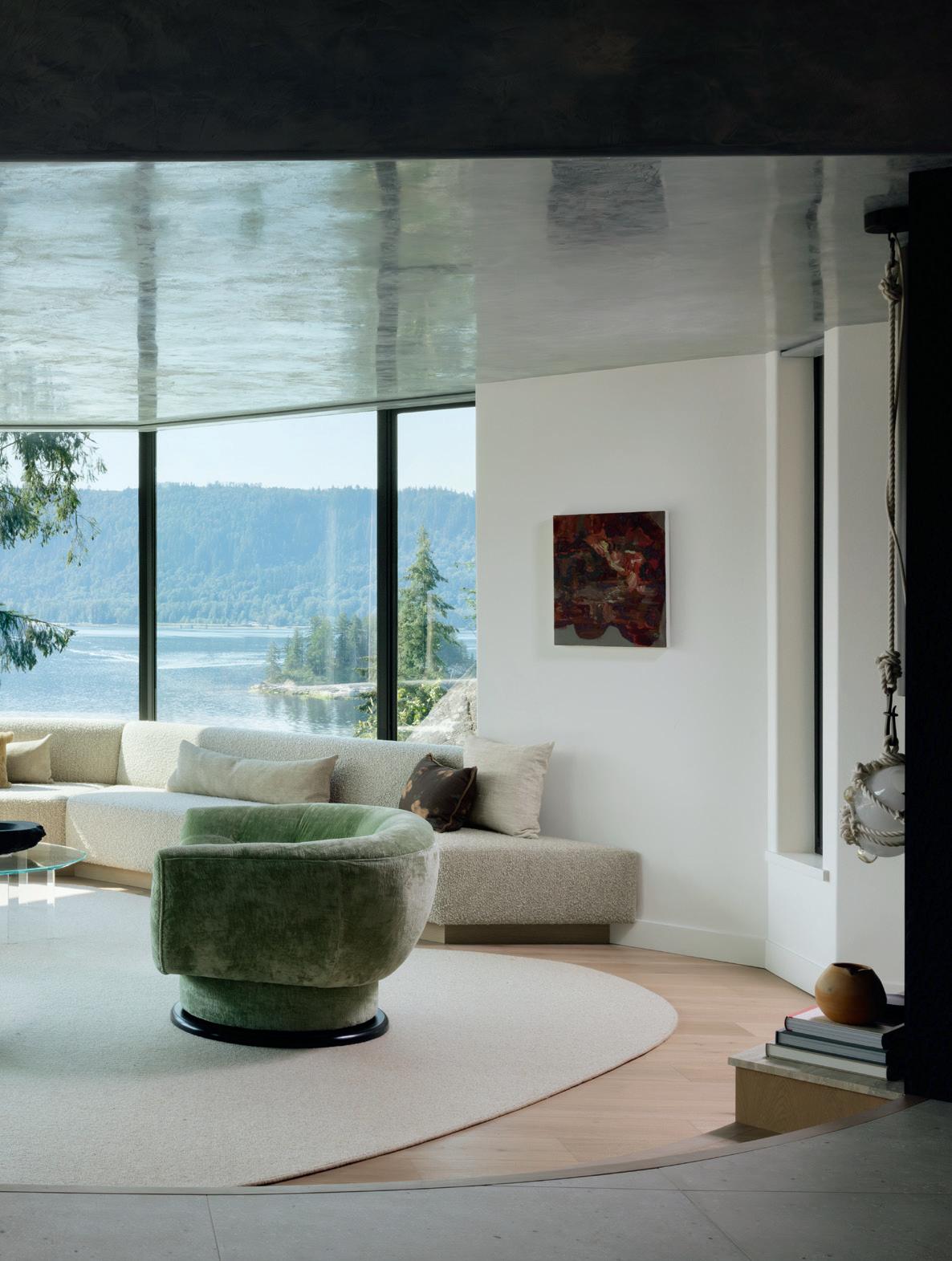
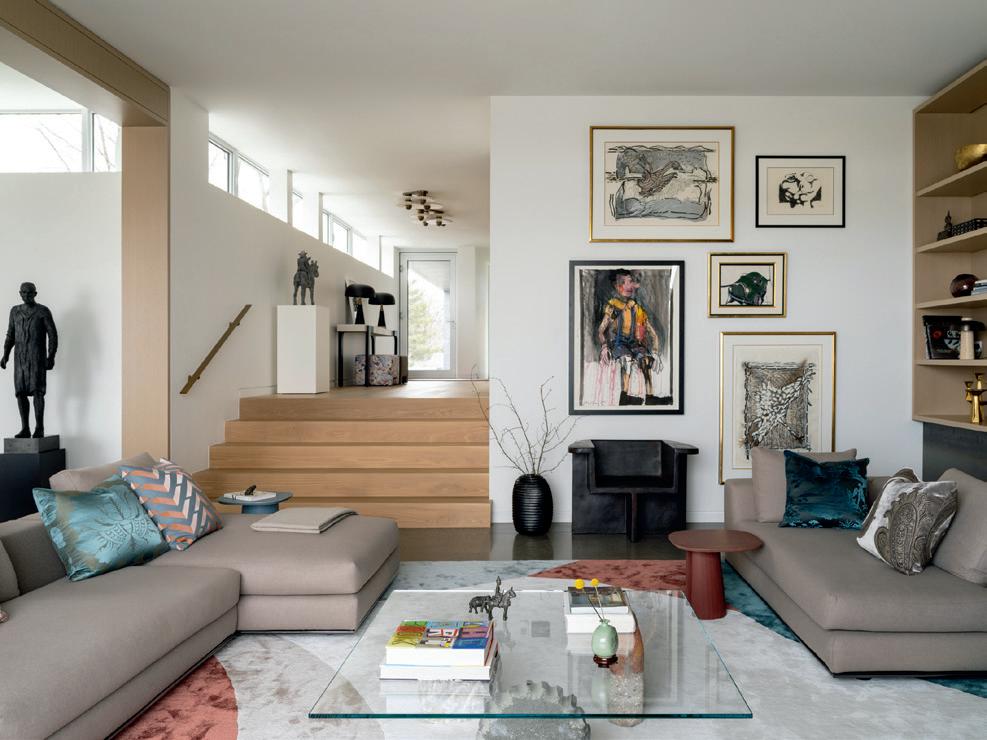
Custom sofa (wdwesterndesigners.com). Lato side table by Luca Nichetto (andtradition.com). Juddas chair and bowls (obakki.com). Taite swivel chair by Adrian Pearsall (rh.com). Kooh-I-Noor Tavoli coffee table by Piero Lissoni (glasitalia.com). Last Waterfall and Unicorn Ignite, oil on canvas by Anne Griffiths (bau-xi.com). Custom Compass rug (burrittfloors.com).
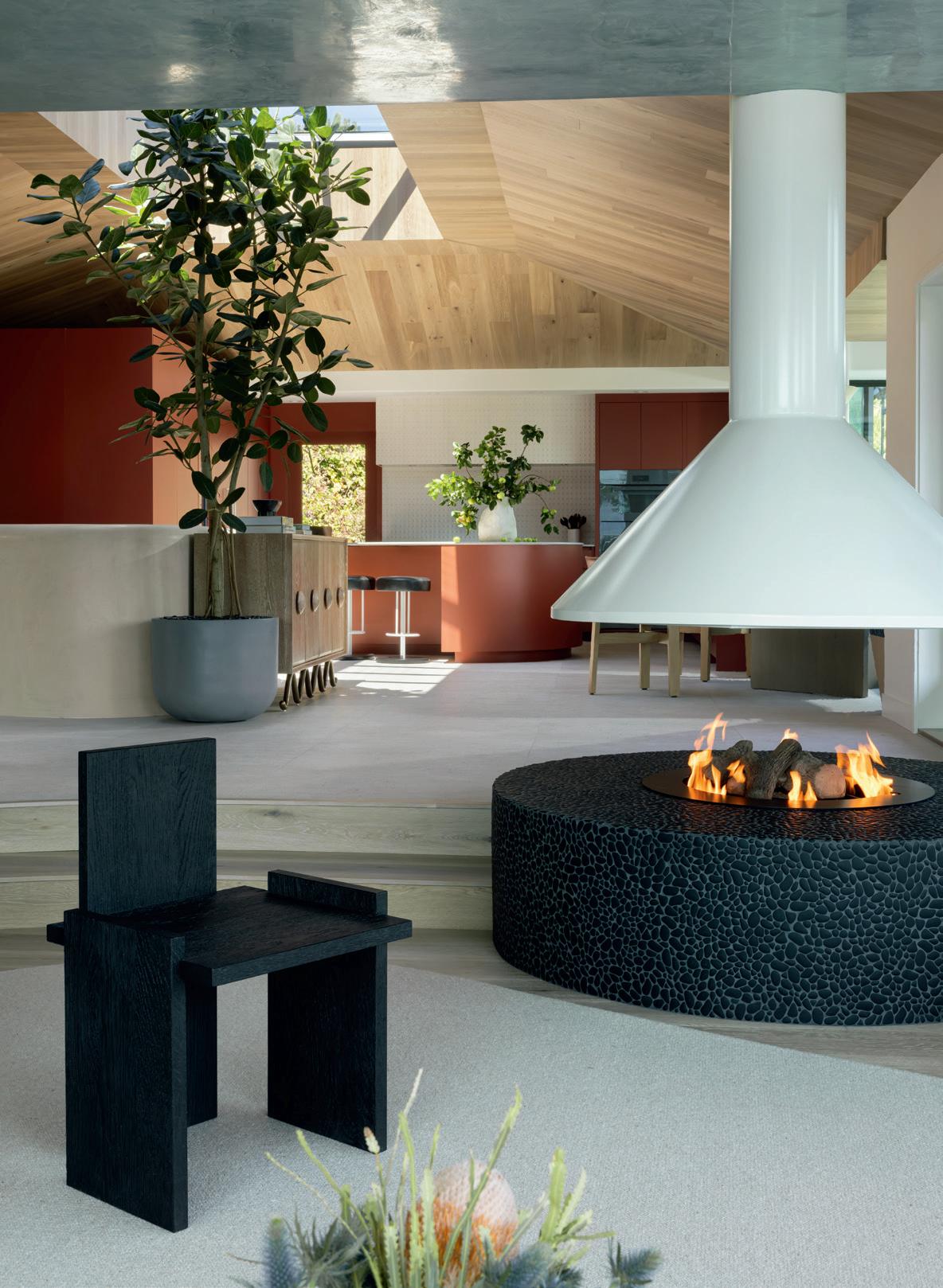
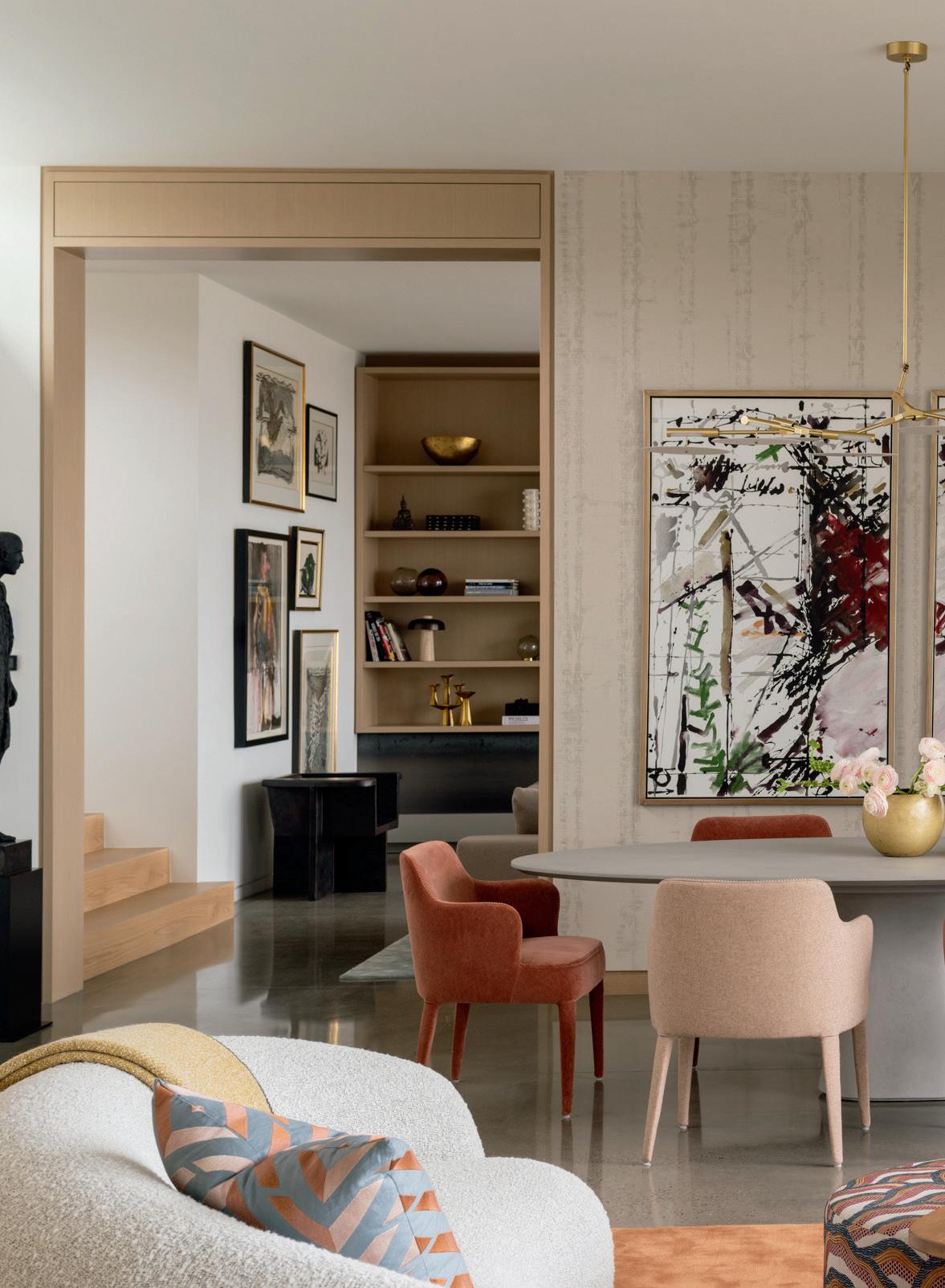
Pium pendant light (pinchdesign.com). Custom dining table (barterdesign.ca). Tre 3 chairs by Angelo Mangiarotti (agapecasa.it). Vintage fruit bowls. Faucet by Jason Wu (brizo.com). Kitchen cabinets are finished in Deep Poinsettia 2091-30 (benjaminmoore.com).
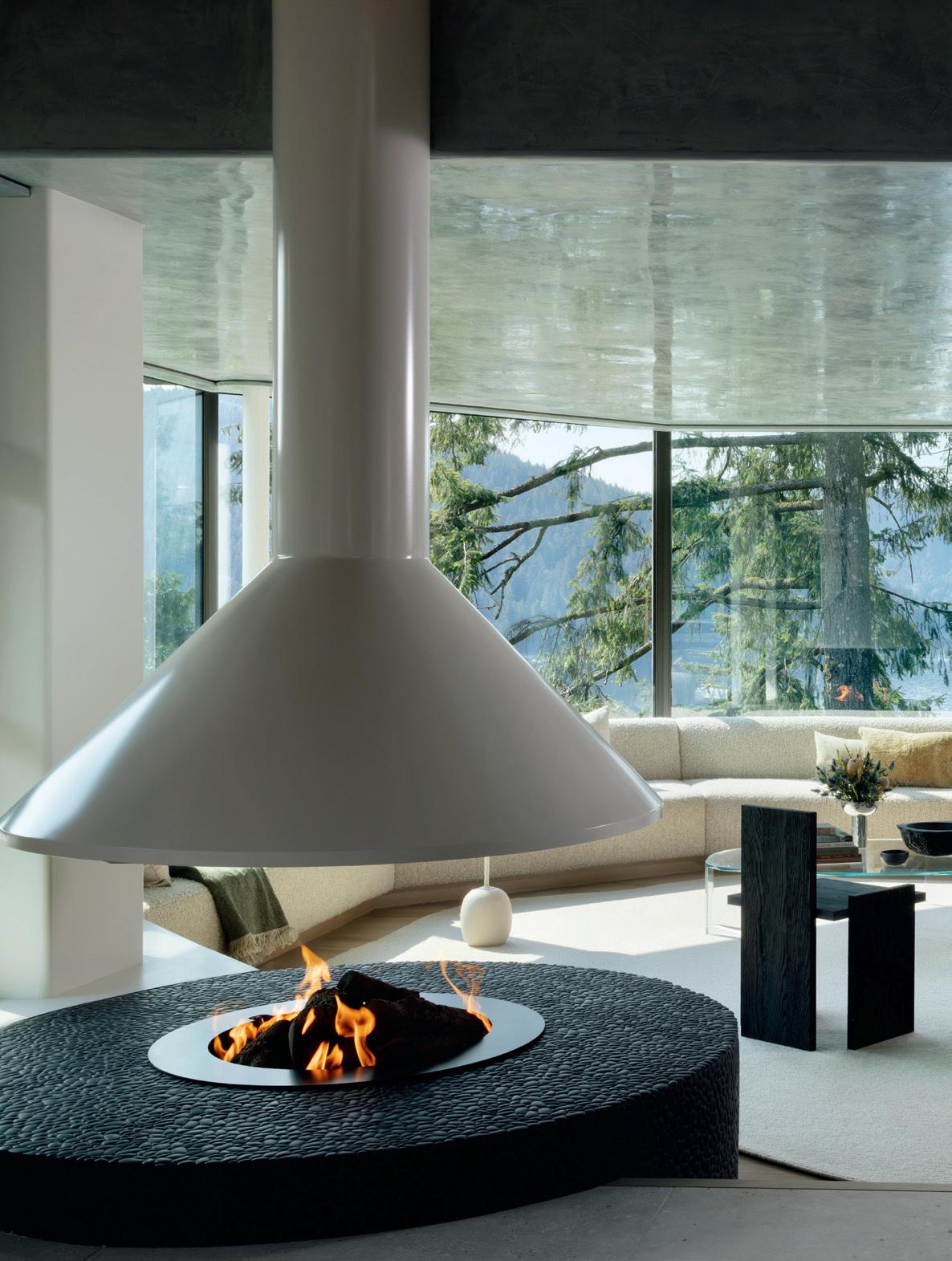
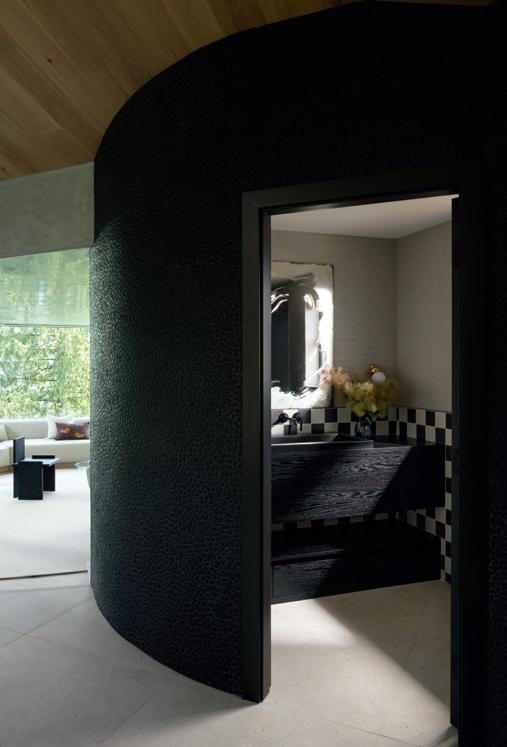
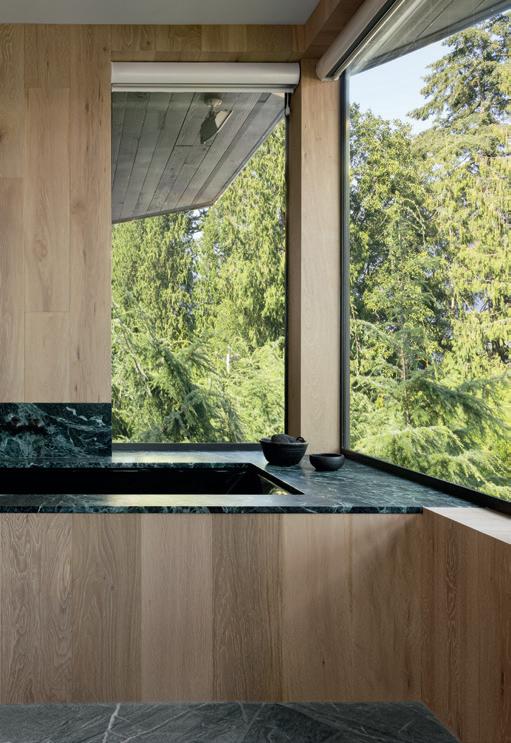
From the living room , nothing obstructs the panoramic mountain view, except for a magnificently misshapen cedar tree. When the sun plays on the water’s surface, the shimmering reflections bounce off the ceiling. You can even catch a glimpse of the boats crossing the inlet, some 100 metres below, on the brilliant blue Venetian plaster. However, the eye is invariably drawn back to the tree’s slender silhouette, then to the landscape stretching along the other shore. In early autumn, green is omnipresent. In this corner of the country, the colours don’t change much. Only in winter do things deviate from the norm, when snow occasionally falls, sprinkling the evergreens that dot the landscape in white. The owners, who dreamed of nature and tranquility, couldn’t have chosen a better spot. Like for many people, the pandemic was the starting point for a radical life change. Tired of the concrete jungle, hustle culture and suffocating city life, the young couple left Toronto and headed for the West Coast. They had friends who lived in Deep Cove, a charming seaside village 30 minutes from downtown Vancouver. The location, which attracts kayakers well into October, is known for its laid-back atmosphere. It didn’t take much for the hemlocks and Douglas firs to replace the cityscape, and to trade in the urban greyness for an evergreen backdrop. ↦
“There are not a ton of colours, but the whole house feels quite colourful.”
— Ben Leavitt
Opposite page — Pium pendant light (pinchdesign.com). Custom dining table (barterdesign.ca). Tre 3 chairs by Angelo Mangiarotti (agapecasa.it). Vintage fruit bowl. Brussels buffet (jonathanadler.com).
Vulca vase (fermliving.com). Vintage fruit bowl. Faucet by Jason Wu (brizo.com). Kitchen cabinets are finished in Deep Poinsettia 2091-30 (benjaminmoore.com).
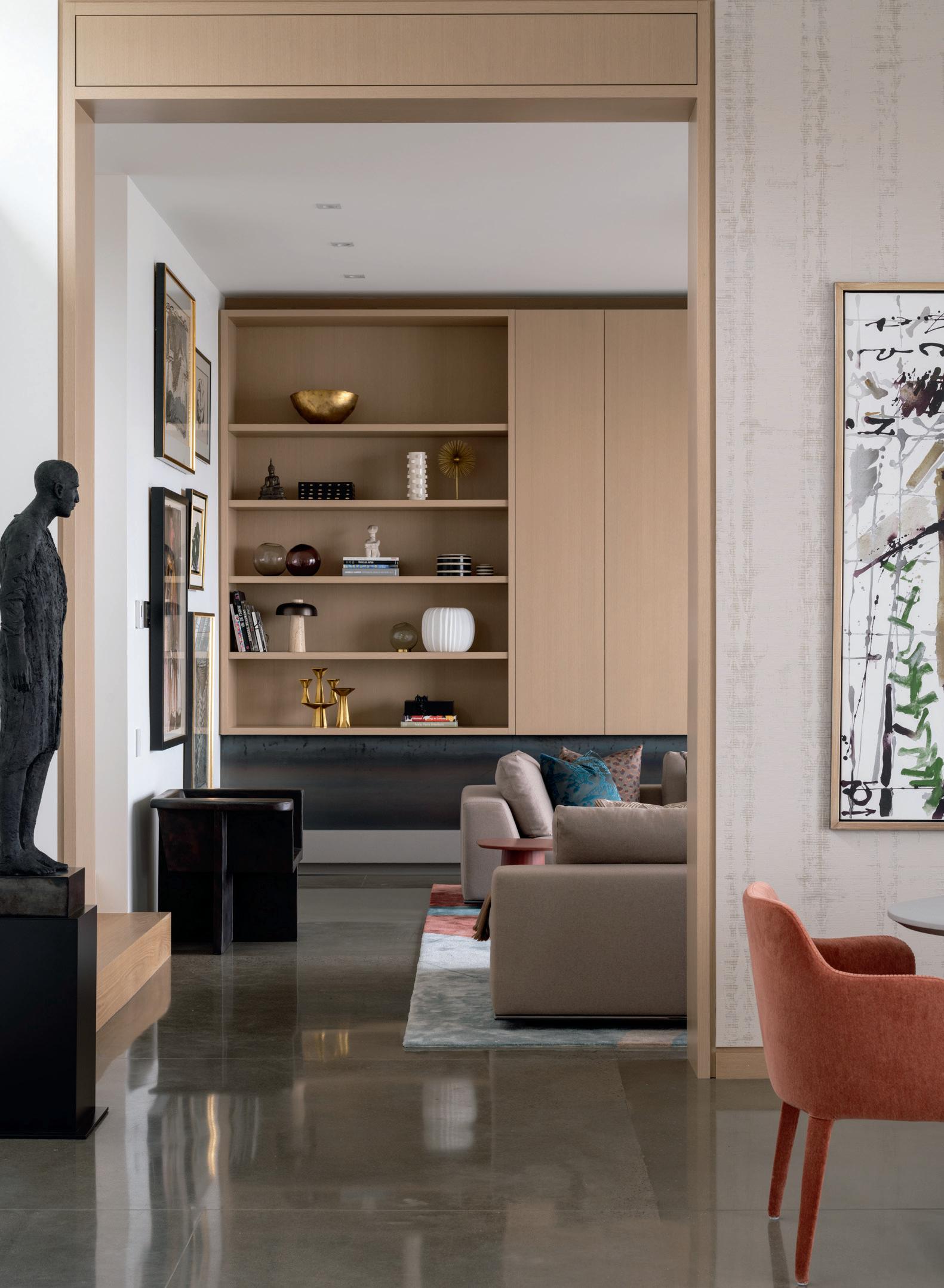
To create their little slice of paradise, the couple—he’s Canadian, she’s Japanese—called on Ben Leavitt and his interior design firm PlaidFox. They chose a house on stilts, built in 1974 on the side of a cliff. Renovated in the 1990s, it had remained in its original state and was in dire need of some TLC. In all, the extensive renovations lasted a year and a half. “In Toronto, the owners had opted for a very minimalist Scandinavian look and now wanted a colourful, energetic, interesting and warm home,” explains Ben Leavitt. Along the coast, the trend is toward immaculate walls and linen as the material of choice, but what’s the point in being like everyone else? The creative director and his team decided therefore to infuse the property with a style that was both modern and nostalgic, with a few nods to the 1970s. “We wanted to give the impression of being somewhere between Vancouver and California,” adds Ben Leavitt. Having previously favoured simplicity over clutter, the couple had very little to bring to the new property. Items included his personal vinyl collection, as well as a few vintage Japanese books that had belonged to her mother, which found their way into the future nursery. For the rest, they had to practically start from scratch. From the outset, they agreed that each carefully chosen piece of furniture or object would be more of a work of art than simply functional. Bringing Gaetano Pesce’s iconic La Mamma armchair down the stairwell
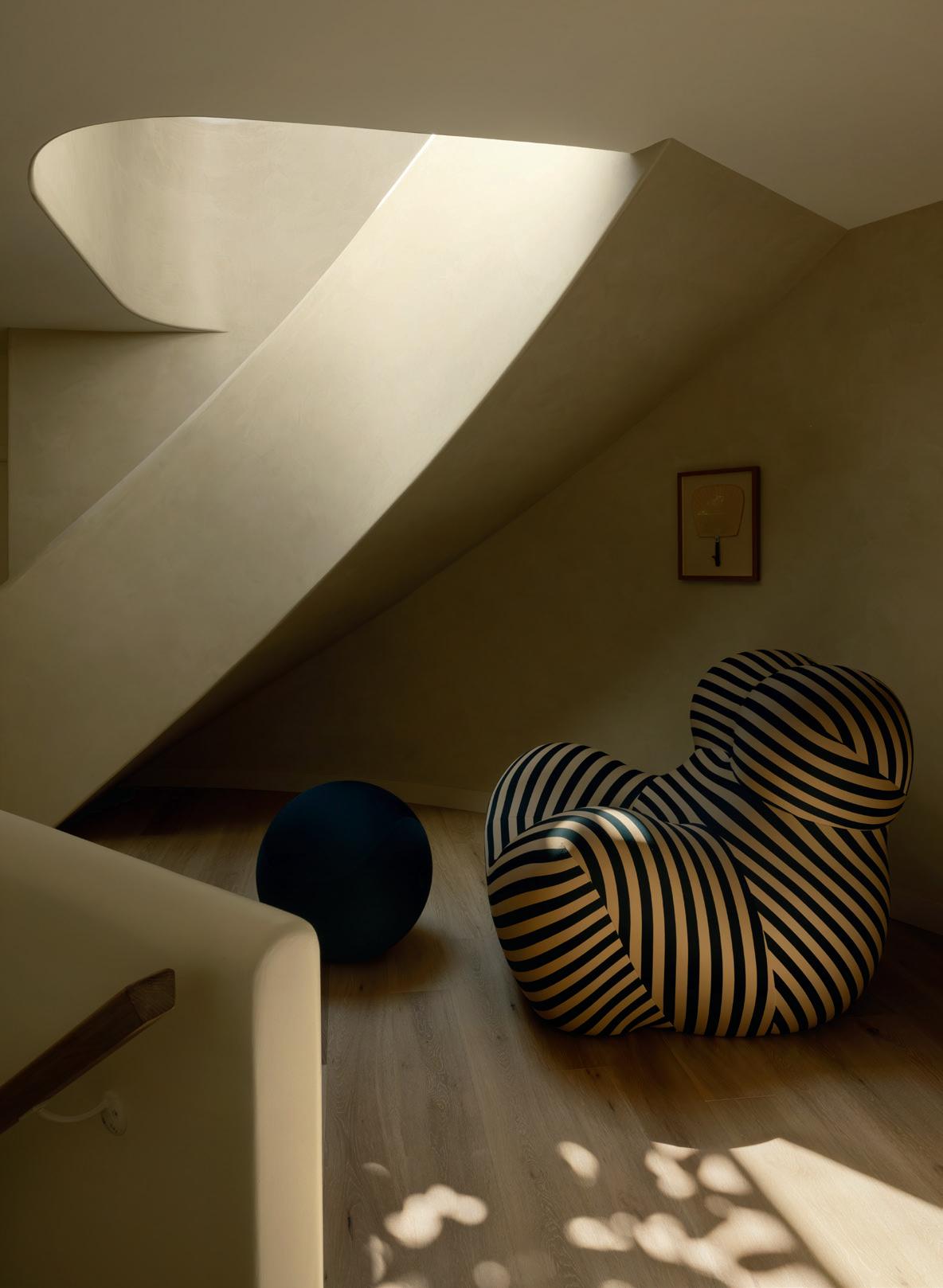
Opposite page — Up 50 chair with ottoman by Gaetano Pesce, a new rendition to celebrate the 50th anniversary of the iconic design (bebitalia.com). Vintage Japanese framed fan.
was no easy feat, but it would have been a shame to deprive the space of it. A metaphor for a feminine body with inviting curves, the chair—an iconic 1960s Italian design—makes you want to curl up in it. That’s the goal. It’s unusual to sit under the stairs, or even want to. After all, the space is a transitional zone, a non-room, a comma, one might say. To change that, the seat in question—with its voluptuous, maternal shape—had to be an experience in itself.
In the living room, they landed on a black brutalist-style chair, which complements a 28-foot-long sofa, framing the hexagonal glass wall. As in the bedroom, the furniture is low so as not to block the view, which is a key part of the decor. The round fireplace, typical of the 1970s, was already there; it just needed to be modernized. When the days get shorter and the fire is lit, the vibe becomes even cozier.
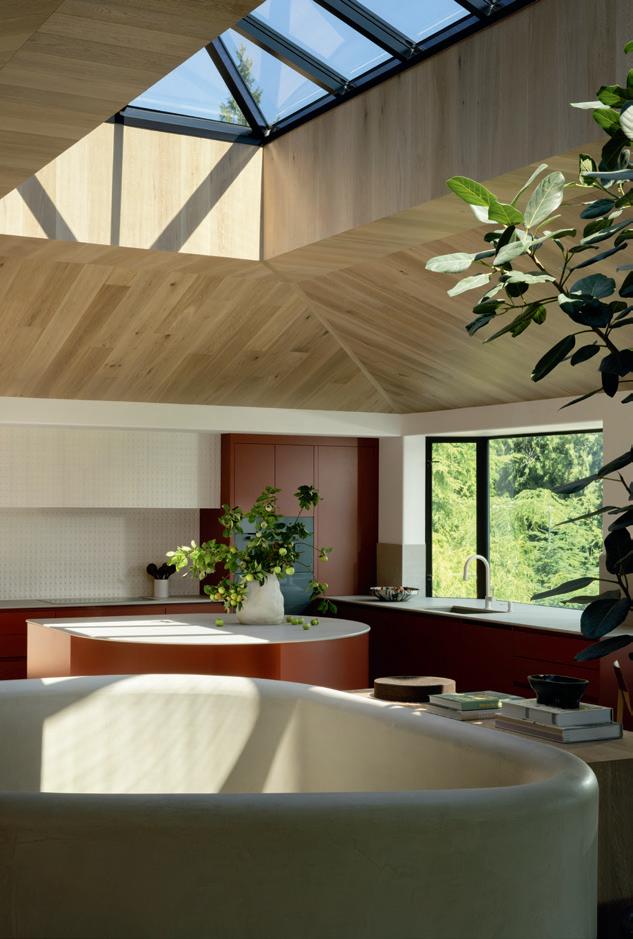
The circular nature of the contours isn’t limited to the fireplace: The rug does some of the heavy lifting, as do the organically shaped dining table and the perfectly round kitchen island. The kitchen posed a few challenges. First, the owners had a long list of specifications, as is often the case, whether in terms of the space’s functionality or the numerous electronics that needed to be concealed. And then there were the irregular rooflines, which made it impossible to raise the cabinets all the way to the ceiling. “We decided to embrace these
“What I love about a renovation is that it’s an 80 percent new idea; the rest you have to work with what is pre-existing.”
— Ben Leavitt
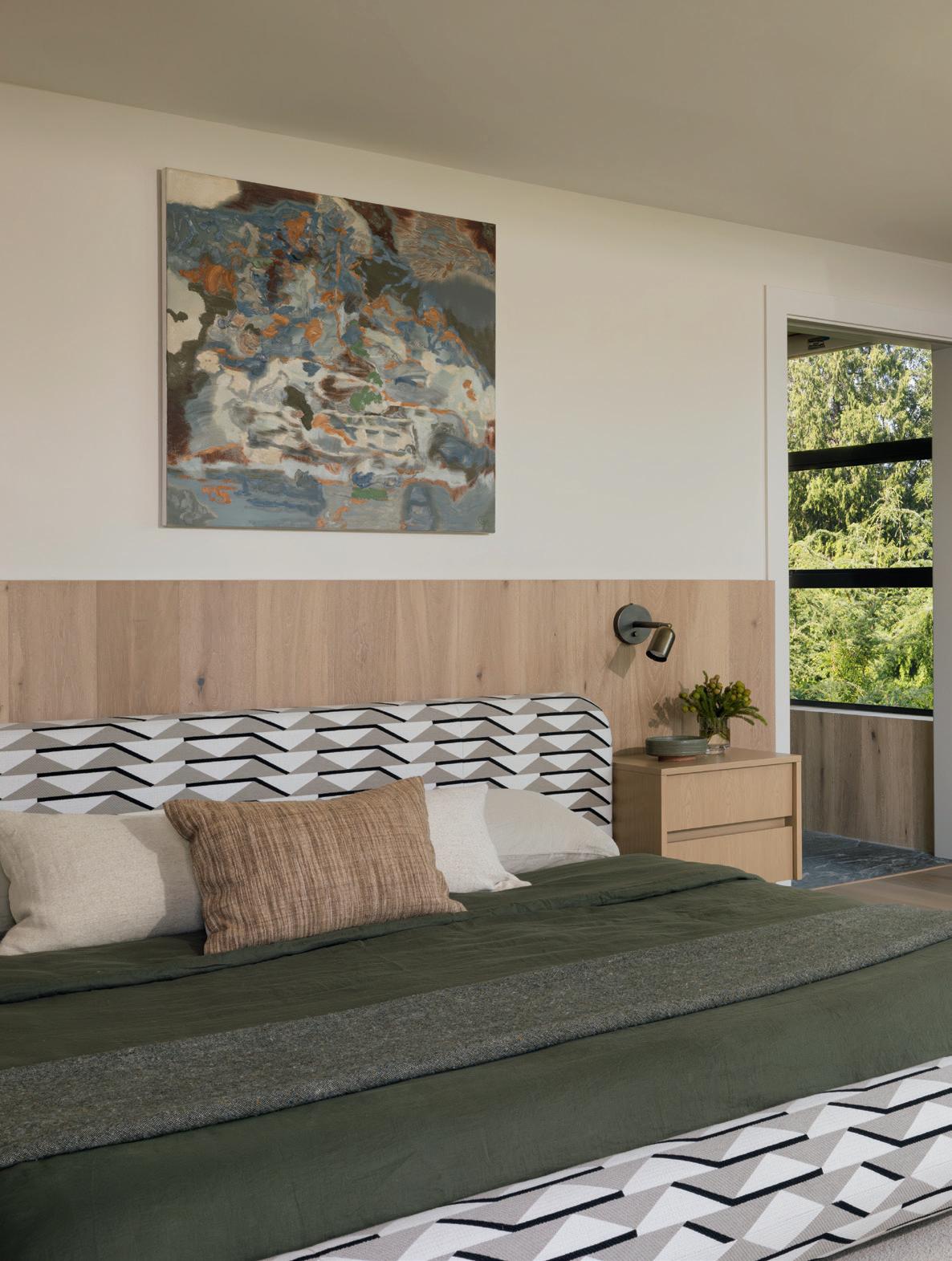
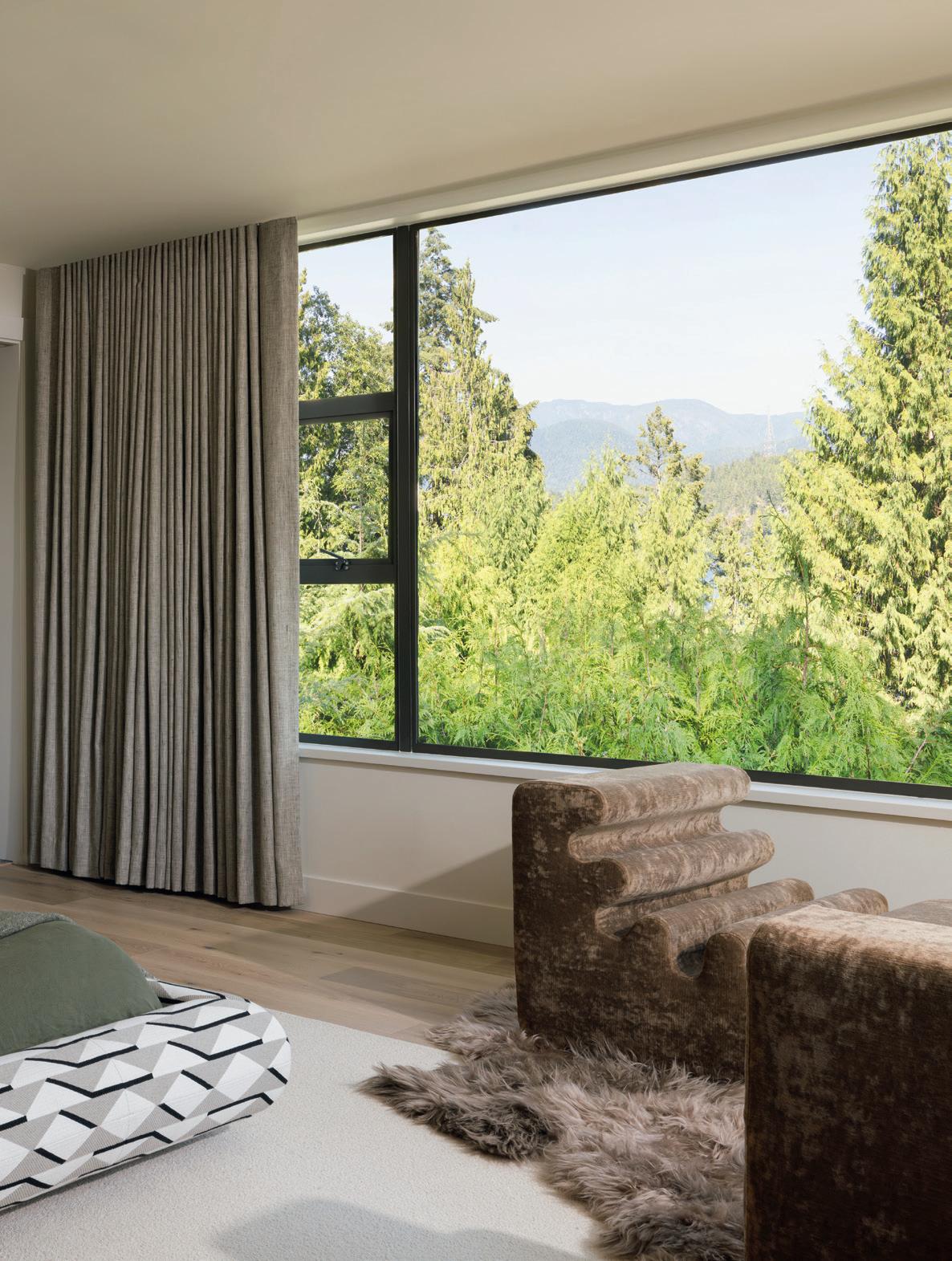
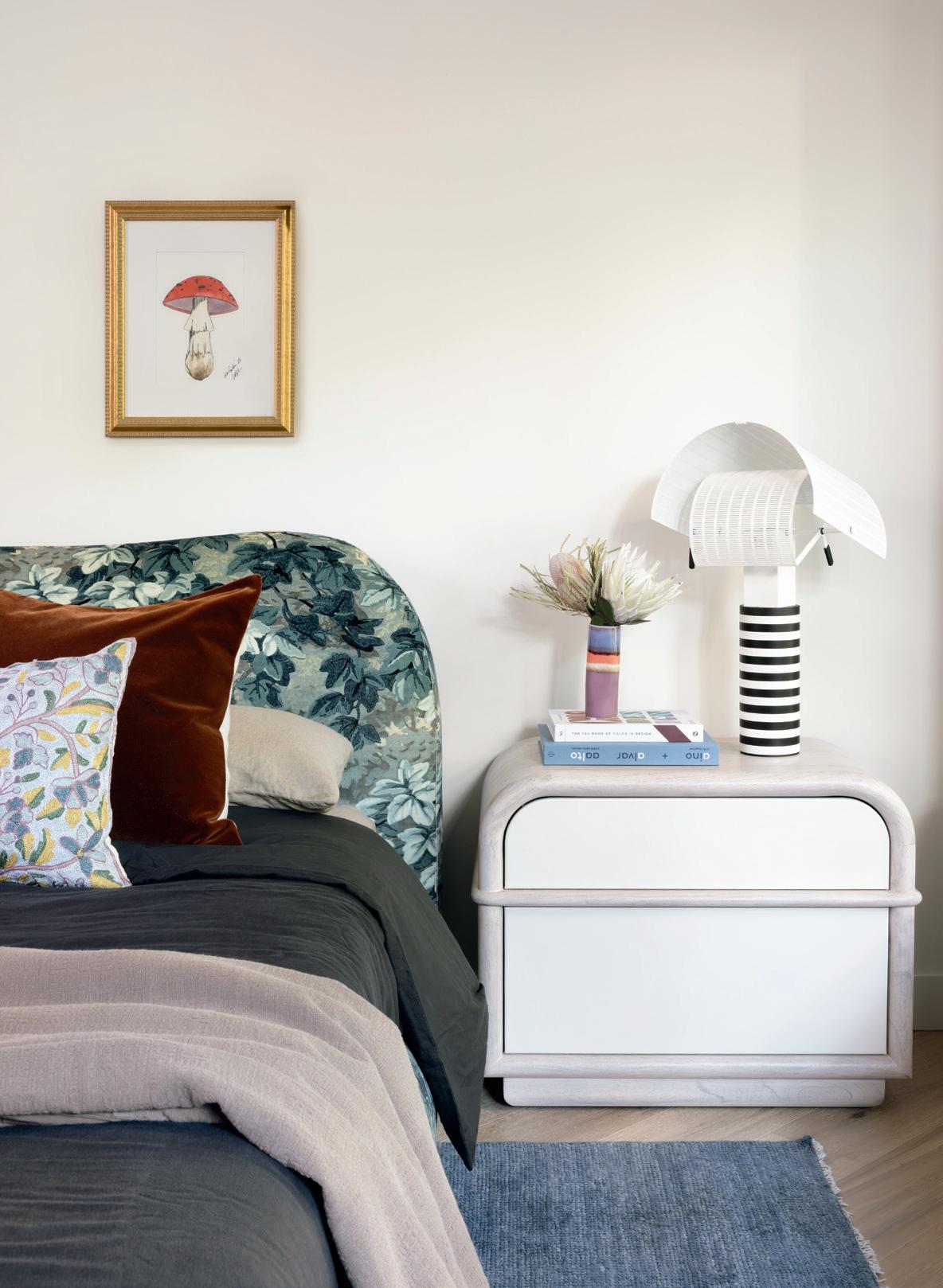
Custom bed (wdwesterndesigners.com), upholstered in Mexique jacquard (pierrefrey.com). Writing Love Notes (in the Cold), oil on linen by Anne Griffiths (bau-xi.com). Custom bedside table by local craftsman Mike Simenchuk. Spot surface mount with stem by In Common With (thefutureperfect.com). Karelia chairs by Liisi Beckmann (zanotta.com), upholstered in Be Mine velvet (jab.de). Custom rug (burrittfloors.com).
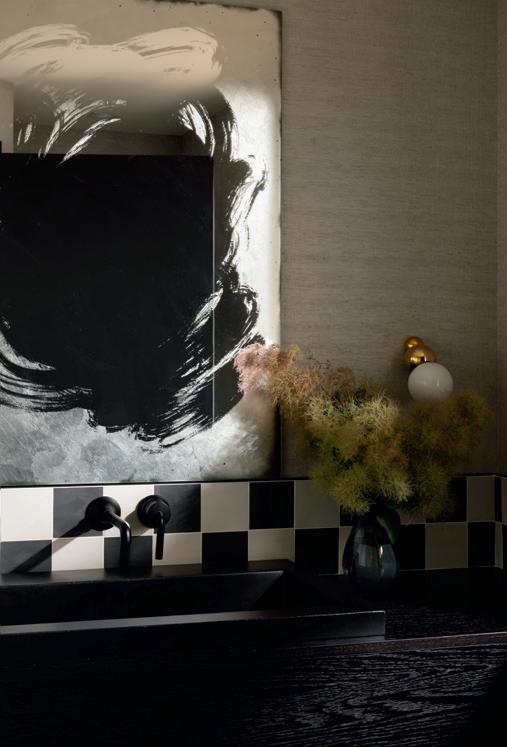
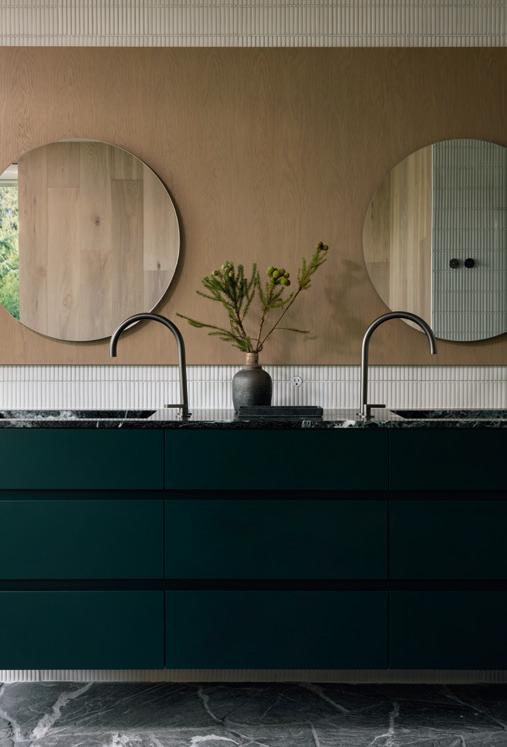
[2] — In the bathroom, Verde Alpi marble brings an elegant sobriety. Bowls (obakki.com).
imperfections and cover them with oak panels,” explains Ben Leavitt. “The result harmonizes perfectly with the kitchen’s colour.” Like a nod to the 1970s, the rust tone energizes the room without clashing.
“One of the first things we do for each project is select fabrics that serve primarily as inspiration,” adds the designer. A mint green and a dark orange were therefore chosen in collaboration with the owners. The two shades guided the project and helped reconcile the different rooms of the house.
As for the round island, which required maximizing the cabinets to compensate for the loss of storage space, it remains the owners’ favourite element today. When they cook, nothing hinders the flow of traffic. The room is well thought out, fluid and uninhibited, just like the rest of the house. Since moving in, the family has grown. It’s not hard to imagine baby toys strewn across the living-room rug. The interior isn’t static: It lives and breathes, brought to life by those who inhabit it. — (plaidfox.com)
Opposite page — In the guest bedroom, Richmond Park upholstery (zoffany.sandersondesigngroup. com) dresses the Diana bed by Ross Cassidy, flanked by the Lobos nightstand by Brett Beldock (cb2.ca). Shogun lamp (artemide.com). Vintage vase. Saga 11 rug (jaipurrugs.com).
“I wanted each room to be a surprise.”
— Ben Leavitt
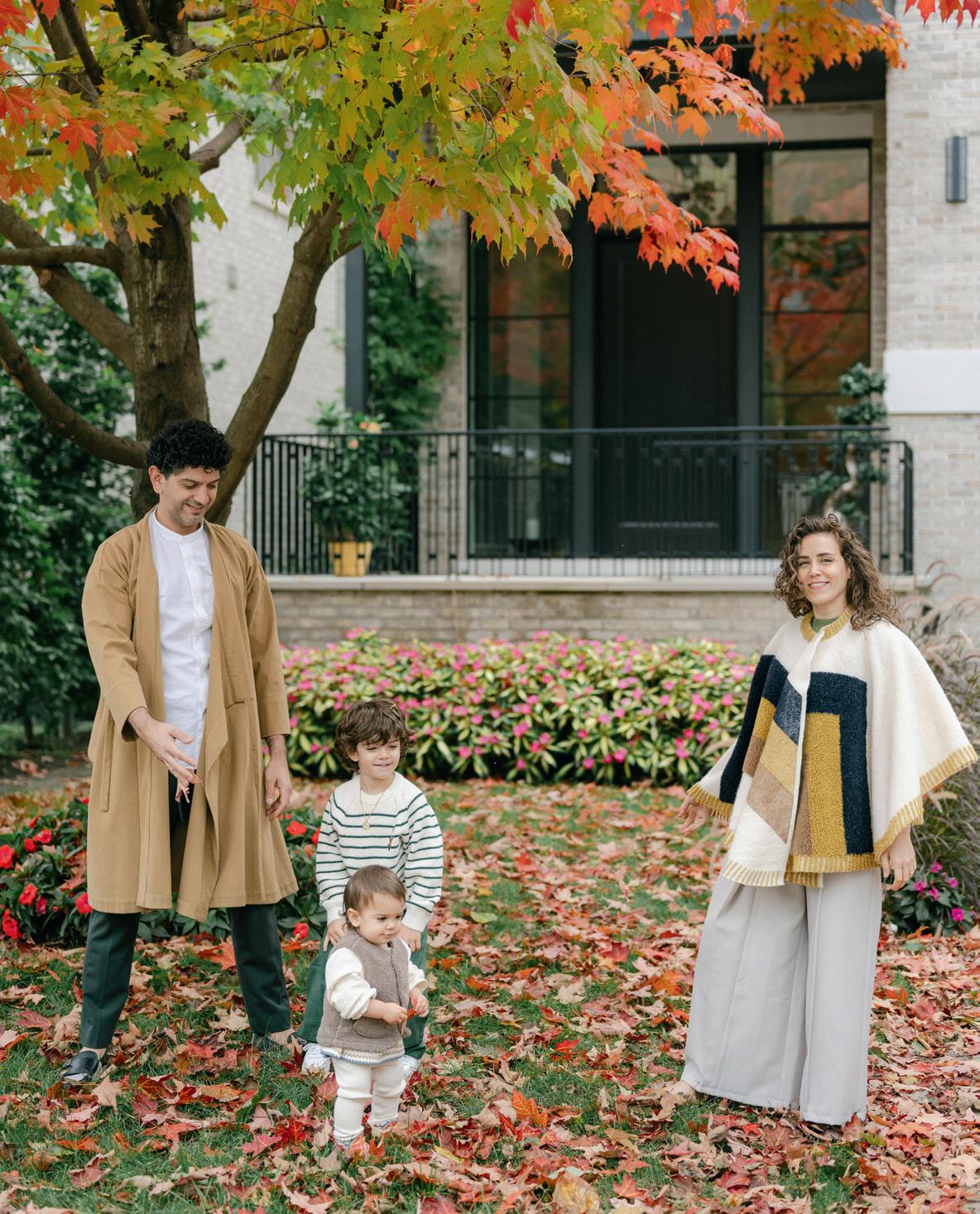
After a fire ravaged their home, MAHSA GHODOOSI AND NAVID ARBABI —heads of the architecture and interior design firm BANANARCH DESIGN STUDIO —saw it as an opportunity to reinvent their lives. Today, they are thoroughly enjoying their 4,000-square-foot family home in Toronto’s leafy North York neighbourhood .
By Marouchka Franjulien — Adapted by Zarya Rubin —
by Alex Lukey and Tara McMullen
A FRESH START
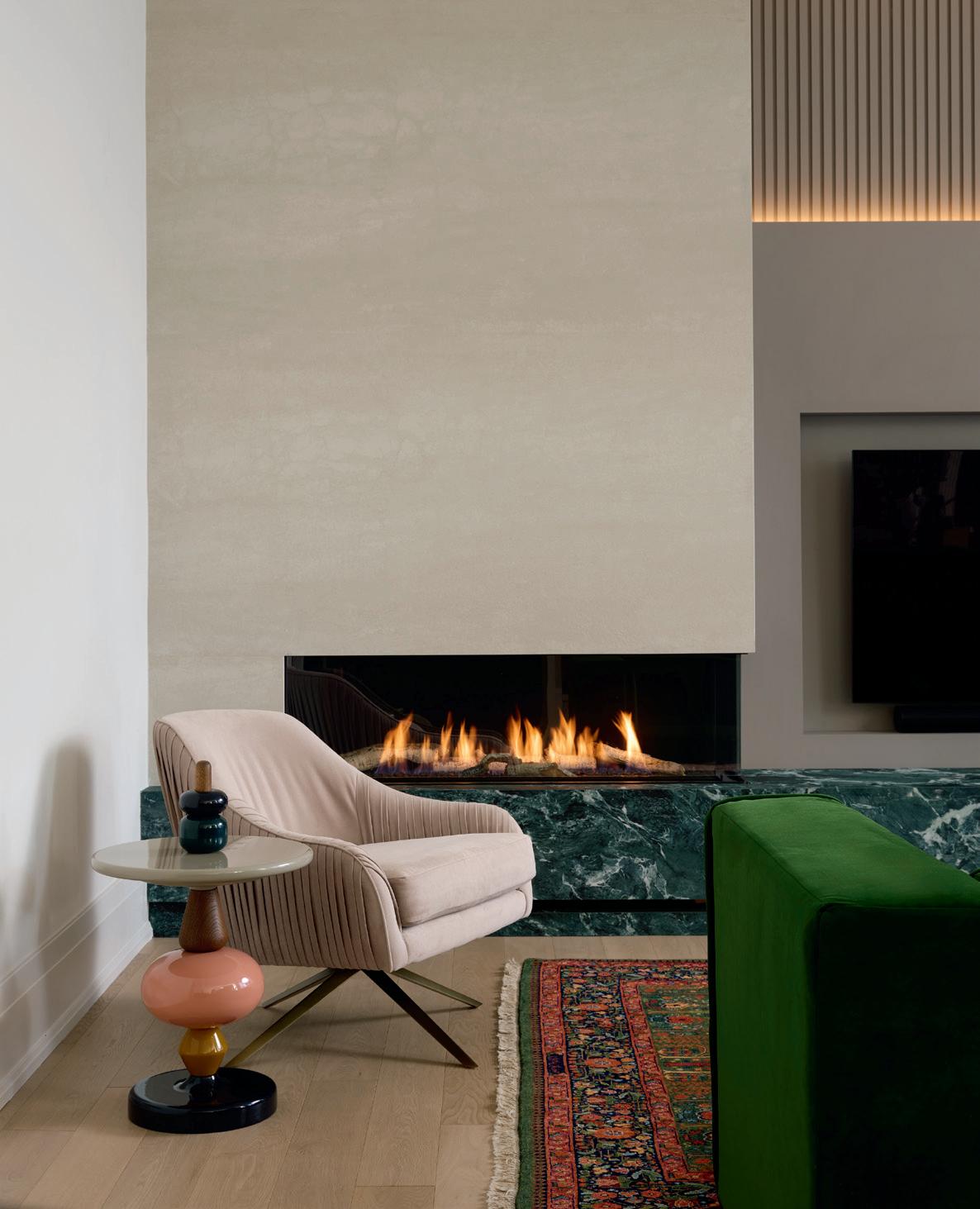
Pleated swivel chair by Roar + Rabbit (westelm.com).
Shuffle MH1 side table by Mia Hamborg for &Tradition (klausn.com). Enclave 48 fireplace (marquisfireplaces.net). Heidarian rug.
Photography
Photos: Tara McMullen (Family) / Alex Lukey (Living Room)
It was a beautiful May afternoon . Mahsa was strolling in downtown Toronto with her husband, Navid, when she suddenly felt the urge to return home. A premonition, maybe. They had left George alone at home. When his owners returned, the shikoku scampered across the garden, barking at the roof. It must have been a squirrel. It wasn’t until Mahsa and Navid saw the flames engulfing the roof that they made the connection. It was already dark, and the fire had had time to spread. Animals have an instinct for this kind of thing. “As I left the house, I grabbed George’s leash and felt a deep sense of calm, a disconnection from the material world,” Navid recalls. In the rush, he only had time to grab an old T-shirt, Mahsa a dressing gown. When the firefighters arrived, the dog greeted them with a wagging tail. “It gave us a whole new perspective on life,” his owner adds. So they had to start from scratch. All that remained was the land, on which the now uninhabitable property stood, a few objects spared from the flames and a new home to be built from the ashes. Above all, the couple wanted to create a warm, airy and bright interior, imbued with timeless elegance. The space had to be designed for the daily needs
of a growing family, for the dinners that fill the house—at Thanksgiving, Mahsa and Navid easily host 45 guests—and the resulting mess. For a life, in other words, that was constantly evolving. “We designed the house to be used, not frozen in time,” Mahsa emphasizes. The couple wanted a large, functional kitchen and subtle materials that were pleasant to the touch and easy to clean. Children tend to get things dirty—it’s a universal truth. Today, five-year-old Soren loves cooking alongside his mom, creating unique ingredient combinations that go surprisingly well together. “He’s really good at it and can tell by taste what’s in a dish,” adds his mother.
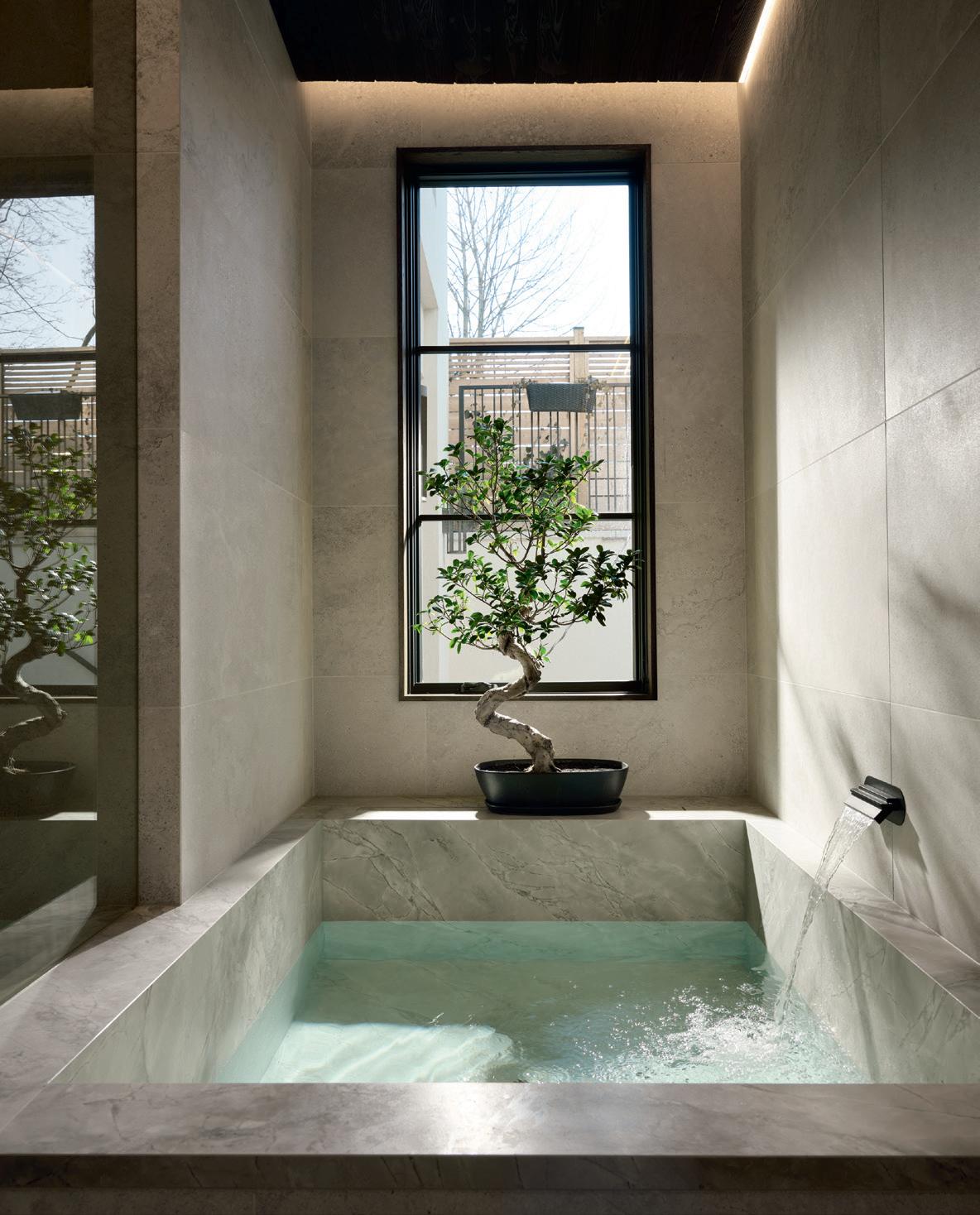
Lighting, both artificial and natural, was also a priority. Perfectly south-facing, the main bedroom wakes up with the sun, which floods the room with light. When interior designers conceptualize their own home, it’s thought through down to the smallest detail. When Navid takes a bath in the Japanese tub, the first rays filter through the bonsai leaves and brush against the water’s surface, creating a soothing play of light and shadow. This is what the Japanese call the komorebi effect.
Mahsa and Navid met at university and fell in love during their freshman year. ↦
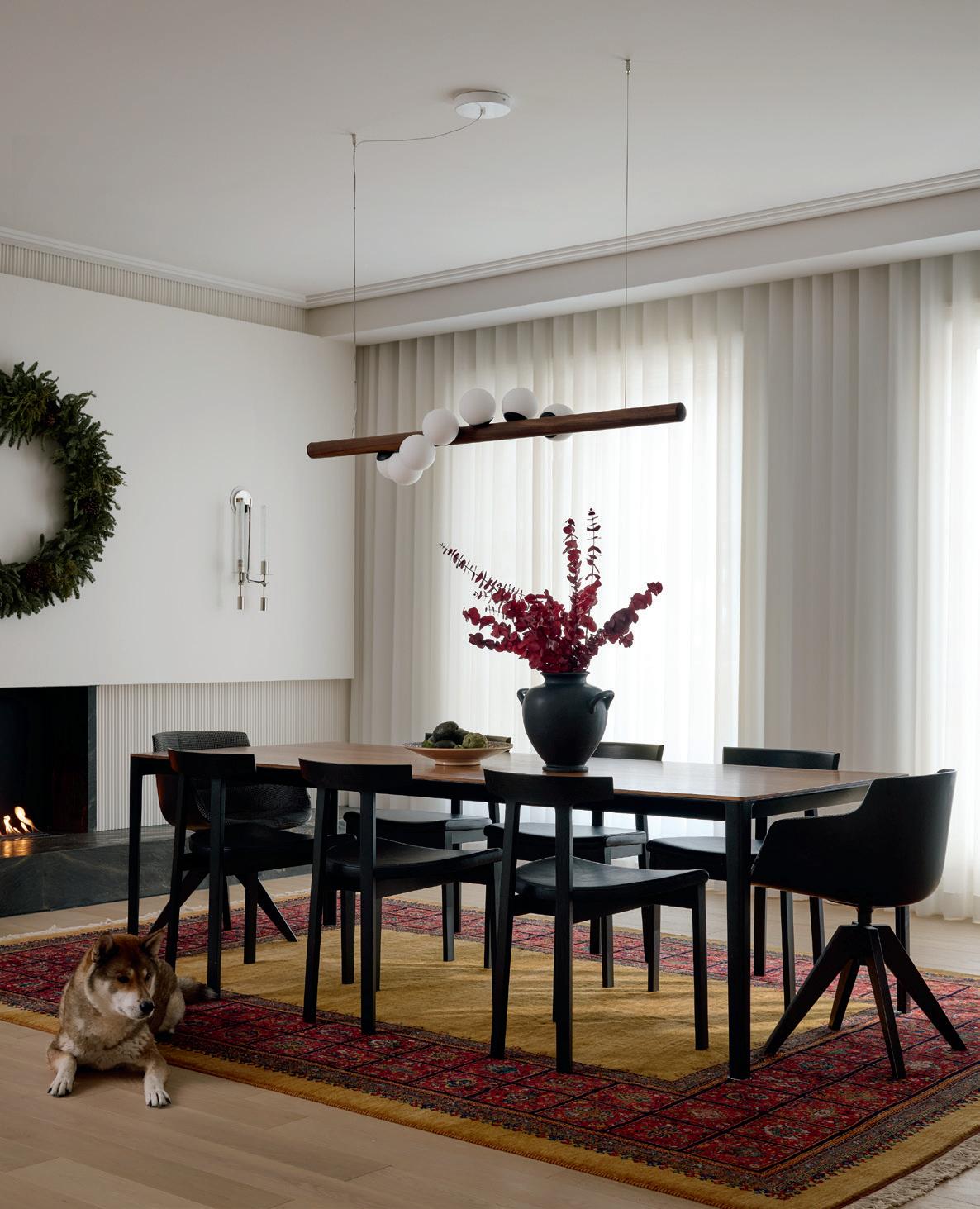
Juliet pendant light (studiokalff.com). Custom tabletop (elegancemarble.ca). Custom table base and banquette base (elegantkitchens.ca).
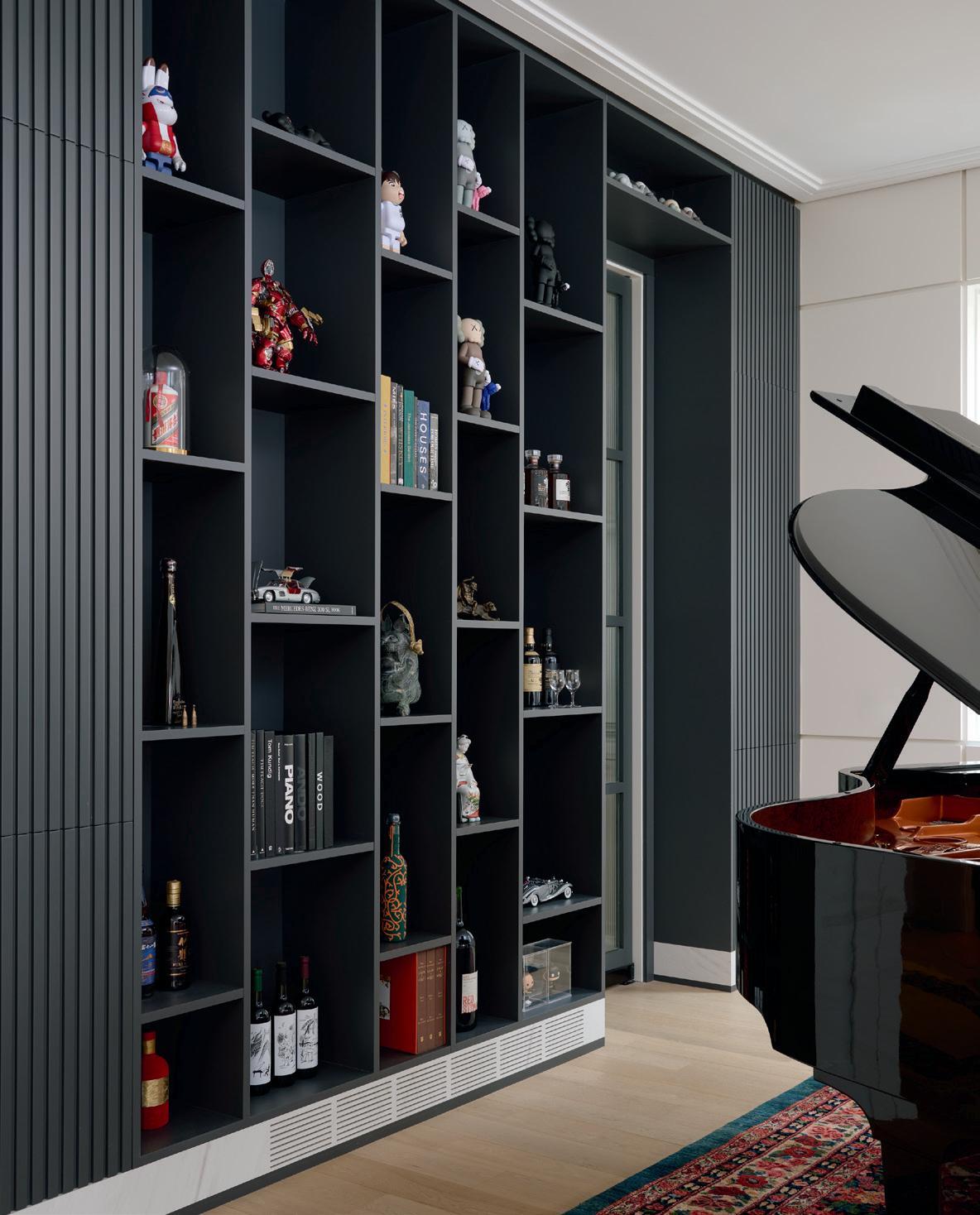
Photos: Tara McMullen (Piano) / Alex Lukey (Bookcase)
The Able dining table (bensen.com) is surrounded by Torii chairs (bensen.com) and two Flow chairs by Jean-Marie Massaud (mdfitalia.com), placed at both ends of the table. Fontanelle double sconce by Jonathan Browning (rh.com). Willow horizontal pendant (hollisandmorris.com). Vase (homesense.ca). Heidarian rug.
Youth and time helped them get to know each other inside and out. “We know our strengths and weaknesses and try to divide the work accordingly,” says Mahsa. She enjoys working on the layout of a room, choosing the colours and textures that will enhance it. Navid, for his part, is particularly gifted with technical details and construction. When one or the other has a specific idea or a strong preference, they trust each other.
Today, the large L-shaped sofa in the living room has become Soren and Serena’s trampoline, when the two kids aren’t busy playing in their secret Lego room in the basement. The youngest was born shortly after the work was completed, like a timely gift to fill the new residence a little more with love. In the summer, Serena loves playing in the garden with George and eating the vegetables and flowers that bloom in the sun. It’s what you do when you’re two years old. When the earth no longer bears any fruit and the weather sends
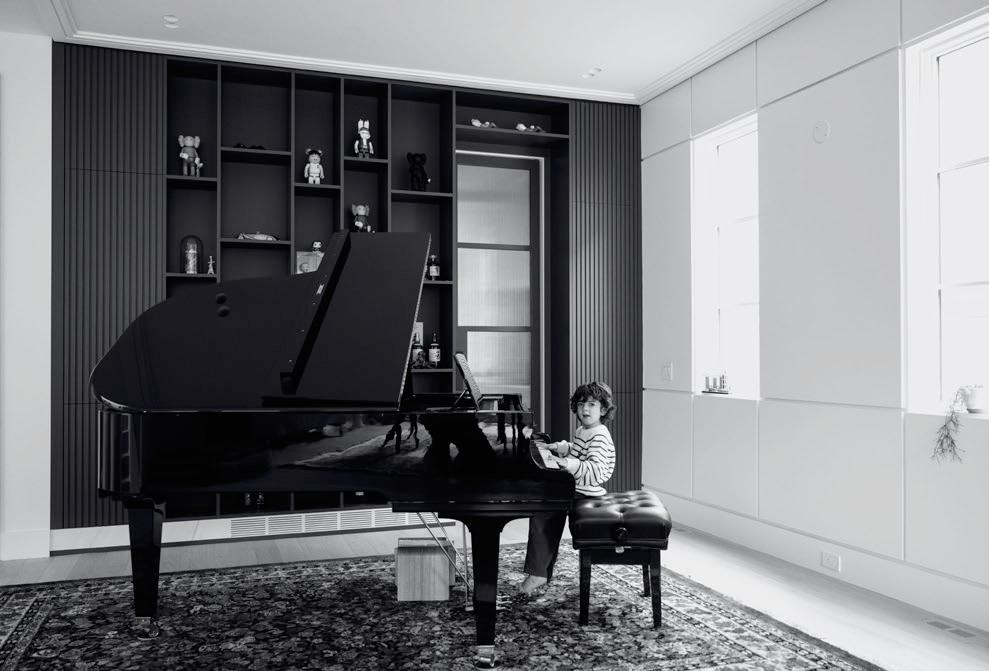
the family indoors, they take refuge around the grand piano. “It brings out everyone’s creativity,” says Mahsa. “It reminds me that in this ever-changing technological world, oldworld creative traditions are still timeless, and it makes the future feel less uncertain.” Notes jostle on the black and white keyboard, and it doesn’t matter if some are off-key. Life is an accumulation of moments and, if you’re lucky, small joys that punctuate the daily grind. Mahsa and Navid marvel today at seeing their children enjoy every corner of the house, far beyond what they could have anticipated when they first put their ideas down on paper. A nook becomes an ideal hiding place for a game of hide-and-seek; the kitchen island transforms into a dance floor. From up there, the merry tyrants feel as if they’re on top of the world. The house, meanwhile, is filled with laughter ricocheting off its walls and breathes in harmony with its owners. — (bananarch.com)
“Infused with airy brightness and grounded in timeless elegance, the home exudes a Zen-like serenity tailored to family life.”
Opposite page — The Japanese bath offers a moment of absolute serenity.
Photos: Alex Lukey
Vintage daybed, lamp and sofa. Ruta ME1967 coffee table by Benjamin Hubert for Andreu World, and Oru SO2271 chair and Bolete Occasional ME1746 side table by Patricia Urquiola for Andreu World (foundedbygarcia.com). Grands Ensembles 2.1 rug by John Monteith (urbanfabric.ca). The fireplace is covered in Vogue Flauti Fs ceramics by Ceramica Vogue (ciot.com).
In Mono, Ontario , a house resembling a modern barn rises from the forested landscape. For this hilltop estate, STUDIO MAGGS reinterpreted local architectural codes and dared to use a delightful blend of styles, both inside and out.
By Muriel Françoise — Adapted by Zarya Rubin — Photography by Scott Norsworthy
RETRO REDUX
[1] — Black metal panels highlight the lines of the vernacular architecture that served as the basis for Studio Maggs’ residential project.
[2] — Vintage sofa, reupholstered by Princess Perfect Upholstery (princessperfect.ca). Ruta ME1967 coffee table by Benjamin Hubert for Andreu World, and Oru SO2271 chair and Bolete Occasional ME1746 side table by Patricia Urquiola for Andreu World (foundedbygarcia.com). Grands Ensembles 2.1 rug by John Monteith (urbanfabric.ca).
[1]
When work began on the wooded lot they acquired in 2020, Mike and Nathalie Silvestre made a point to hop in their van from Toronto every weekend to visit the place where their future home would take root. The pandemic, which suddenly narrowed the horizons for these frequent travellers, made them lose interest in the urban life they had been leading in a condo of some 800 square feet. “We were returning from a road trip to Australia and New Zealand,” says Mike. “We needed to get back to wide-open spaces.” It was during a trek to the countryside, accompanied by their dog, that they came across this vast plot of land for sale, located in a valley a 90-minute drive from the city. They entrusted their childhood friend Jasmine Maggs and her sister Marisa, founders of Studio Maggs, with the task of building a home there which now houses the couple and their two daughters, aged four years and eighteen months.
The idea of a modern barn soon emerged from conversations—a contemporary twist on vernacular architecture. A generous supply of natural light would become part of the space itself. And then came the idea for outdoor showers! “An obsession after a trip to Costa Rica,” explains Mike. The rest took shape thanks to mutual tastes. The owners share the same love of all things retro as the architects. Their space also features a few striking mid-century pieces from the 1950s and ’60s. “We come from a family that is passionate about vintage. When we were little, we followed our parents to flea markets. We love collecting things from the past,” says Jasmine, who scoured online second-hand furniture resale sites for this project. With her sister Marisa, ↦
[3] — Custom sideboard, designed by Studio Maggs.
[4] — Collar pendant light by Sebastian Herkner for Gubi (dwr.com). Paperclip stools (amisco.com).
her partner and accomplice, she fully embraces her penchant for maximalism, channelling it into spaces where comfort meets conviviality.
The plot’s size allowed the architects to create a living space that takes advantage of both length and height. A single-storey building with French doors allows for easy access to the outdoors, where one can take a shower under the stars. This wing, which extends from the house’s entrance, is reserved for the family’s many guests. Mike, a landscaper, can also work there in peace. The family lives primarily in a building built higher up to better enjoy the surrounding view. “The owner wanted to be able to admire the sunrise over the horizon when he woke up,” Marisa says.
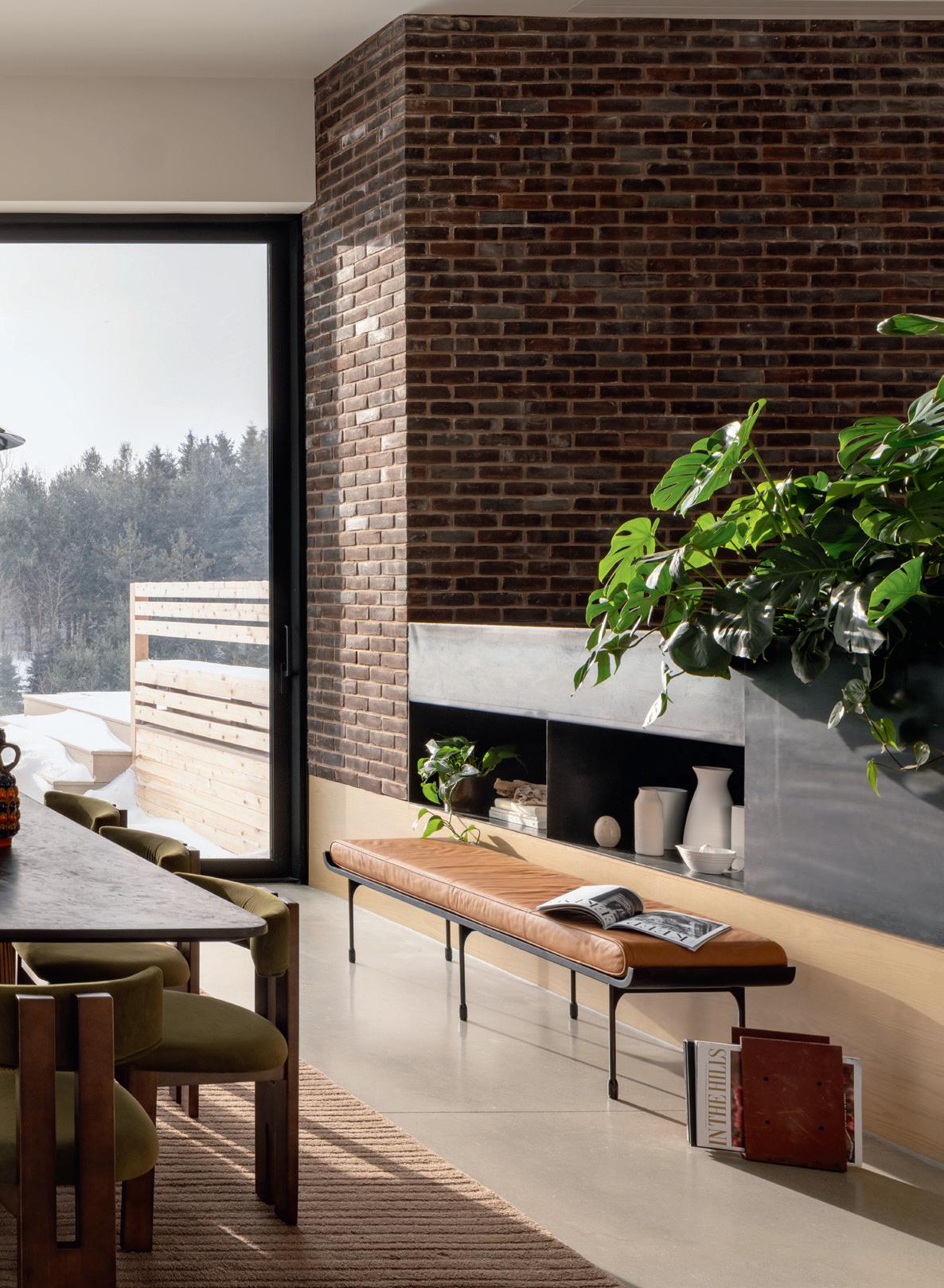
On the ground floor, the family’s desire for a shared lifestyle led them to favour open spaces. A few clever design choices helped structure the area, much like nature shapes the landscape outside. From the dining room, three steps lead to a large kitchen. A sleek steel bench—part planter, part storage—creates a subtle separation between the dining area and a more intimate lounge space. Thoughtfully chosen materials, like the terracotta ceramic used for the fireplace mantel—a nod to 1950s California homes—and an exposed brick wall, help break up the sense of scale in the living area. When furnishing this large home, Jasmine and Marisa avoided preconceived notions. While their passion for mid-century design is on full display throughout the various living spaces, they didn’t shy away from modern accents, such as a chair by Spanish designer Patricia Urquiola for Andreu World. They also enjoyed combining ↦
[1] — The pantry and small appliances are hidden in the hallway storage.
[2] — Collar pendant lights by Sebastian Herkner for Gubi (dwr.com). Paperclip stools (amisco.com). Eclipse wall sconce by Astro Lighting (lightformshop.com).
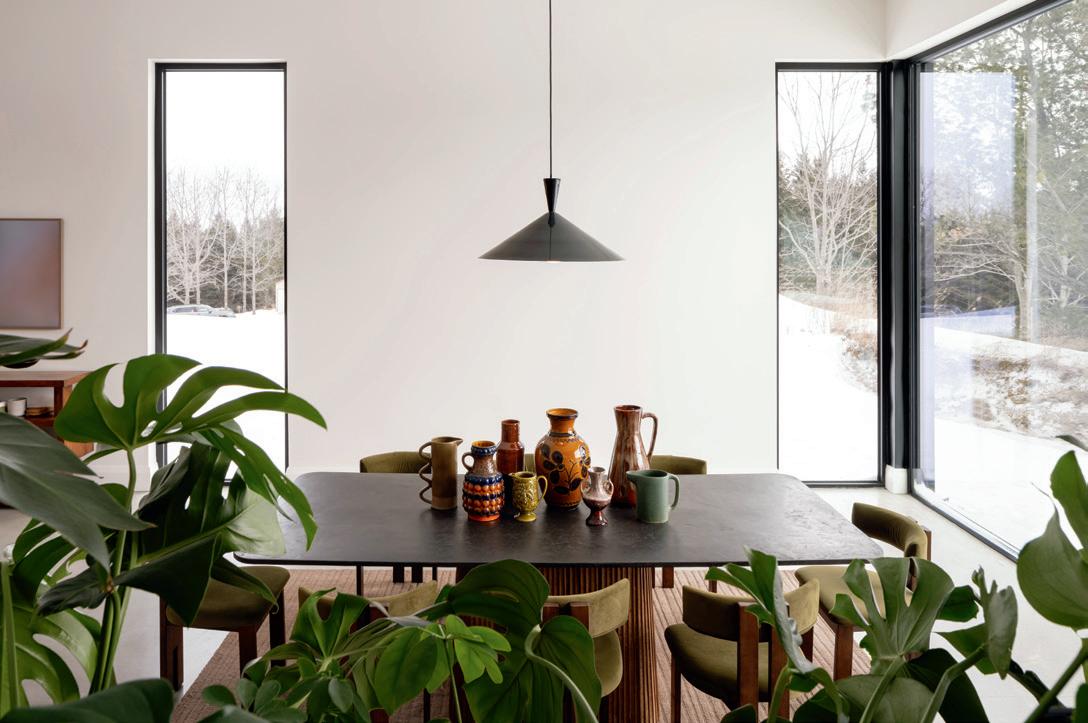
Exposior pendant light by Paul McCobb (cb2.ca). Osaka table (urbanwoodcraft.com). Ceremonie chairs by Athena Calderone (crateandbarrel.ca). Southwest rug (rugsusa.com). Vases (maniera.ca). Juneau bench by Caleb Zipperer (cb2.ca). Annex chaise longue (moeshome.com).
“The material used on large surfaces, such as brick walls or a ceramic fireplace mantel, is a decoration in itself that doesn’t require anything else.”
— Jasmine Maggs
[1] — Exposior pendant light by Paul McCobb (cb2.ca). Osaka table (urbanwoodcraft.com). Ceremonie chairs by Athena Calderone (crateandbarrel.ca). Southwest rug (rugsusa.com). Vases (maniera.ca).
[2] — Custom bench, designed by Studio Maggs in collaboration with Urban Steel Products (urbansteelproducts.com). Ruta ME1902 side table by Benjamin Hubert for Andreu World (foundedbygarcia.com). Vintage sideboard.
Opposite page — In a corner of the dining room, a painting from Arnaud Maggs’ Notification series (arnaudmaggs.com) overlooks an Annex chaise longue (moeshome.com). Arrel speckled rug (rugsusa.com).
[1]
[2]
“Combining different types of wood allows you to customize an interior and make it feel more inviting.”
— Marisa Maggs
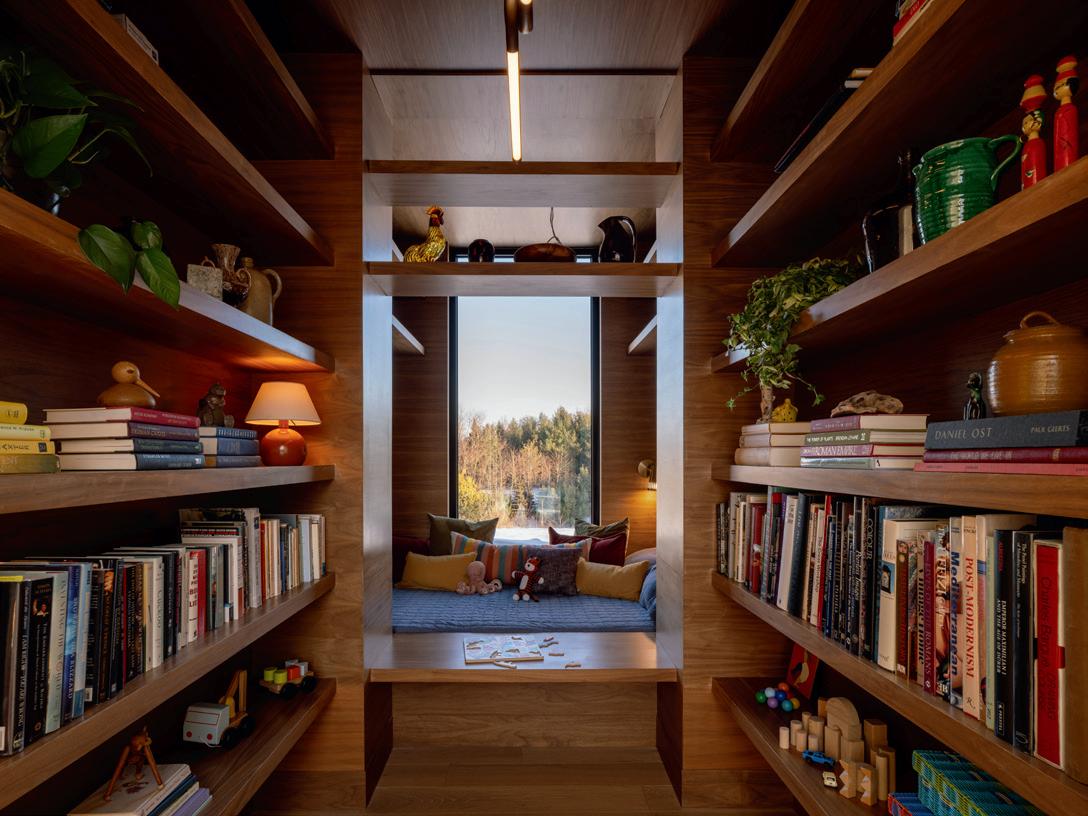
In the guest wing, the custom bookcase was designed by Studio Maggs in collaboration with High Class Finish Carpentry (hcfinishcarpentry.com). Beau Loop pendant light by Justin Crocker (crateandbarrel.ca).
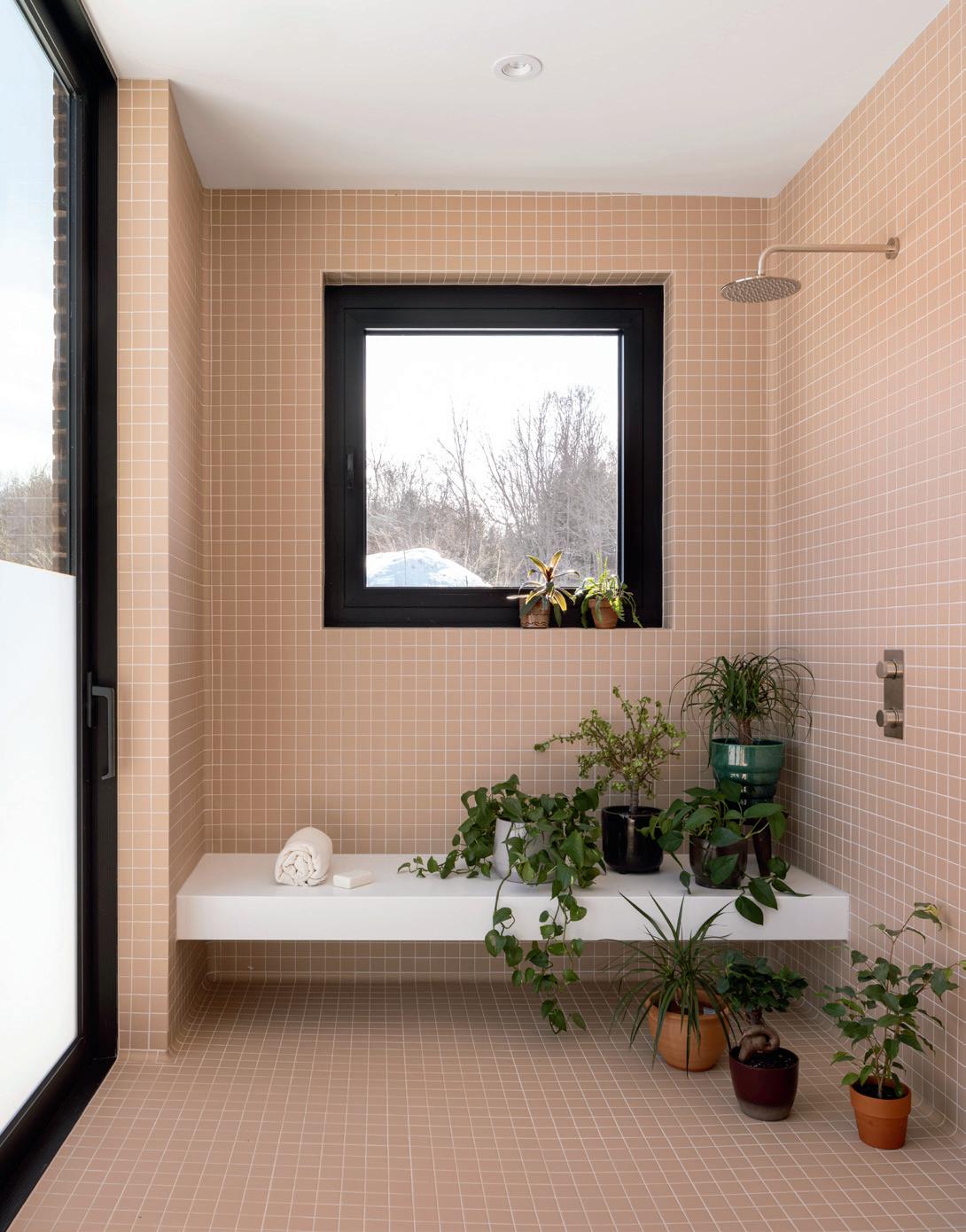
Opposite page — Thanks to a large window, the shower opens onto nature, offering a peaceful connection to the outdoors. Quebec tiles (olympiatile.com). Basic II valve and rain shower head by Phylrich (tapsbath.com).
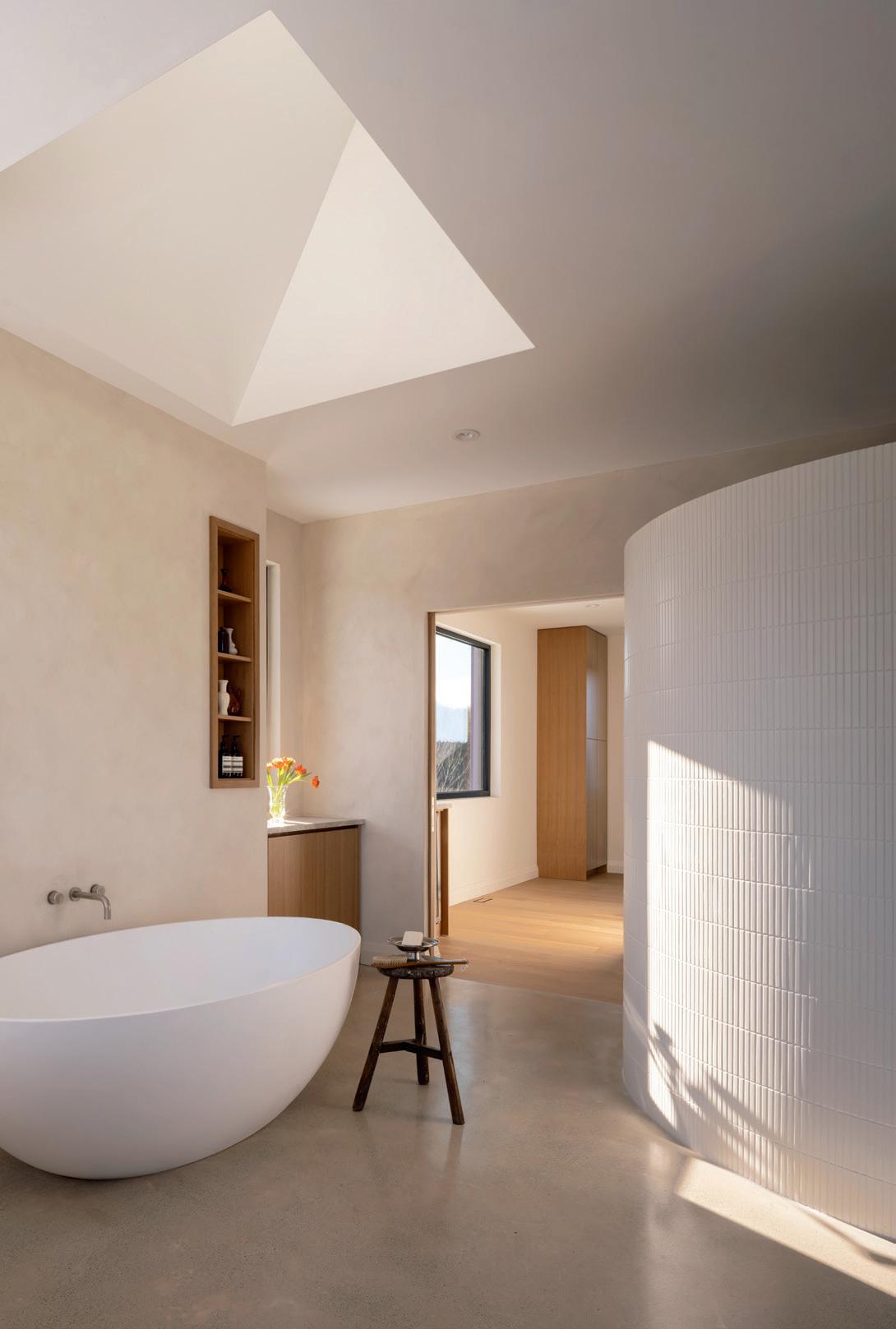
Opposite page — In the family bathroom, the partition is covered in Avenue ceramic (sstileandstone.ca). Solid Surface bathtub (casainc.ca). Vintage stool.
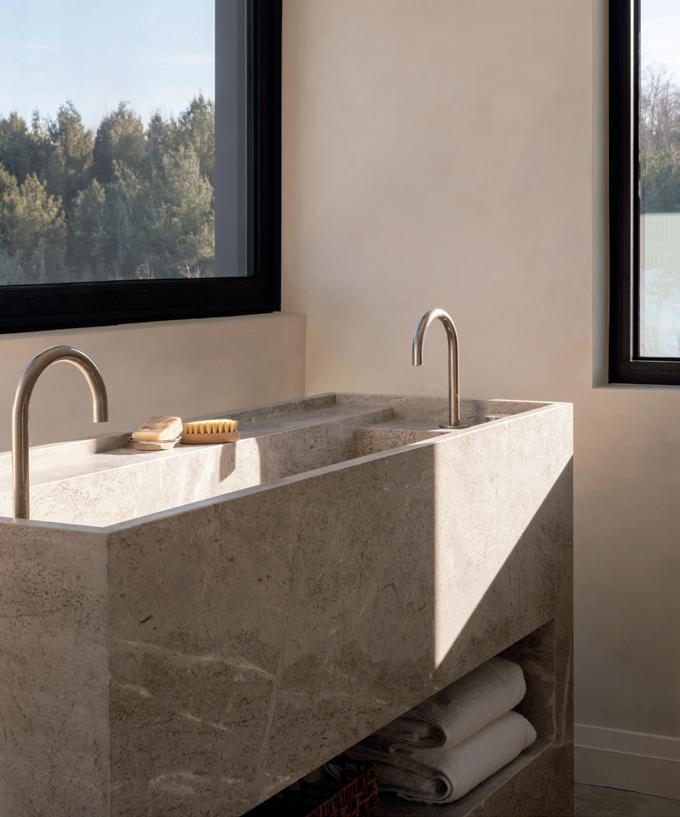
Sink designed by Studio Maggs in collaboration with Surface 1 (@surface1oakville). Appenino marble (stone-tile.com). Circ faucets by Phylrich (tapsbath.com).
several types of wood. “It makes an interior richer and allows you to emphasize quality craftsmanship,” notes Jasmine. The library in the guest wing is another loose interpretation of the usual design rules. A bench, installed at the back of an alcove, leads the way to a quiet retreat to read in peace or rest. You have to step over it to sit down. It has, of course, become the favourite hiding place of the youngest inhabitants! — (studiomaggs.com)
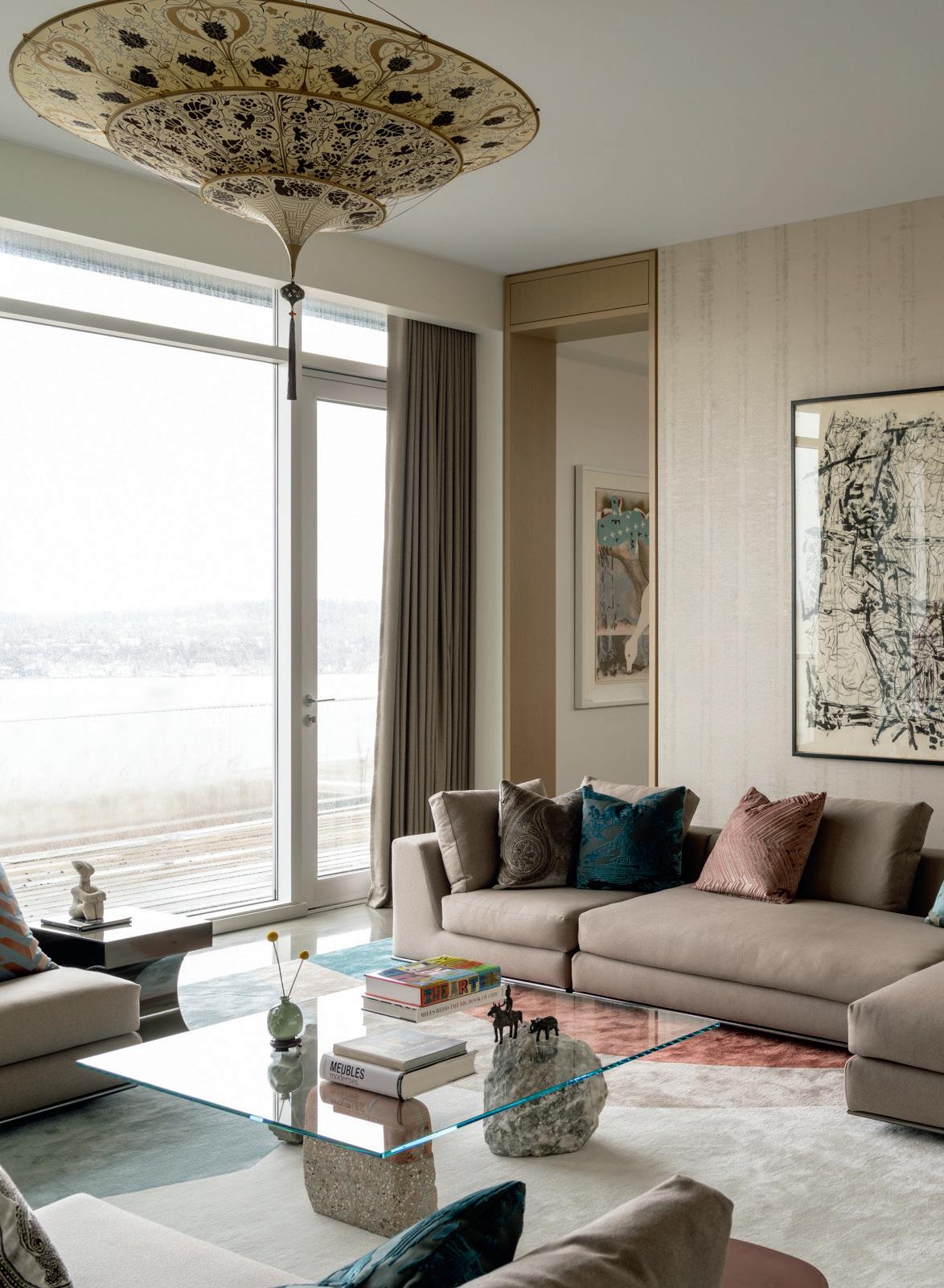
Scheherazade 3 tiers pendant light (fortuny.us). Artwork by Jean Paul Riopelle. Roger sofa by Minotti (latitudenord.com). Coffee table by Forma & Cemento (artemest.com). Custom rug (theredcarpet.ca). Custom curtains (storeurbain.com).
The Glass House in Quebec City is the offspring of two love stories. Dreamed up by the first couple, it was born from the talents of architect PIERRE THIBAULT in the mid-2010s. A few years later, a second duo called on Montreal’s LES ENSEMBLIERS to renovate it.
By Aurélia Morvan — Adapted by Zarya Rubin —
Photography by André Rider
In the midst of the Covid-19 pandemic, the new owners decided to move from their five-storey townhouse in Old Quebec City to the Sillery district, up on a hill overlooking the St. Lawrence River, allowing them to reconnect with the outdoors while better meeting some of the challenges that come with aging.
To fully embrace their home and create a welcoming space, they commissioned Maxime Vandal and Richard Ouellette, co-owners of Les Ensembliers—an architecture firm, design agency and construction company offering high-end turnkey services. The four of them were already well-acquainted. Over the course of a dozen years of “creative friendship,” the architect and the interior designer have reworked several of the couple’s properties. They spent a year helping them search for a new home, until they stumbled upon “this beautiful contemporary glass cube” by Pierre Thibault. “Taking on a landmark like this required a great deal of humility, because from the outset we knew it was extraordinary,” says Vandal.
While the exterior instantly won them over, the clients needed a redesigned and expanded interior to meet their perfect match. Some 800 square feet were added to the existing 3,500 square feet, spread out over two levels. ↦
Roger sofa by Minotti (latitudenord.com). Coffee table and Fusto side table by Forma & Cemento (artemest.com). Brutus armchair by 101 Copenhagen (kelli.shop). Large vase (beigestyle.com). Artworks by Jean Paul Riopelle (top left and bottom right) and Jim Dine (bottom left).
Opposite page — A statue by Belgian artist Hanneke Beaumont (debellefeuille.com) faces the dining room. Febo chair by Maxalto (avant-scene.com).
Branching Disc pendant light by Lindsey Adelman (hollacecluny.ca). Artwork by Jean Paul Riopelle. Podium table and Febo chairs by Maxalto, and Julep sofa and armchair by Tacchini (avant-scene.com). Ottoman and cushions (ensembliers.com). Candlesticks by Atelier Bussière (fermehumminghill.com).
“In today’s market, you have two months to design and two years to build. At Les Ensembliers, we design for 22 months and finish the project two months later.”
Opposite page — The marble (atelierstoneage.com) of the imposing fireplace mimics the shades of the St. Lawrence River in winter. Fusto side table by Forma & Cemento (artemest.com). Table and chairs (own).
In the office, a Malus side table (lemieuxetcie.com) sits next to a Jane armchair and ottoman by Poliform (latitudenord.com). Custom curtains (storeurbain.com). Sommerard triple-arm floor lamp by Aerin (decaltg.com).
The goal for Les Ensembliers was to create a groundfloor living space, all on one level, “without any cul-de-sacs.” A path from the front door leads down to a spacious, sunken living room; the dining room, a lounge area, the discreet kitchen and breakfast nook, along with the office, follow one another in seamless succession. The design needed to honour the grandeur of the space without compromising on coziness.
The upper floor is dedicated to the couple’s suite: It houses the bedroom/living room, the closet, the bathroom and the workout room. An elevator was added to connect the two levels and accommodate the owners’ future mobility needs, in keeping with “the vision of creating a home that could stay with them until the very end.” ↦
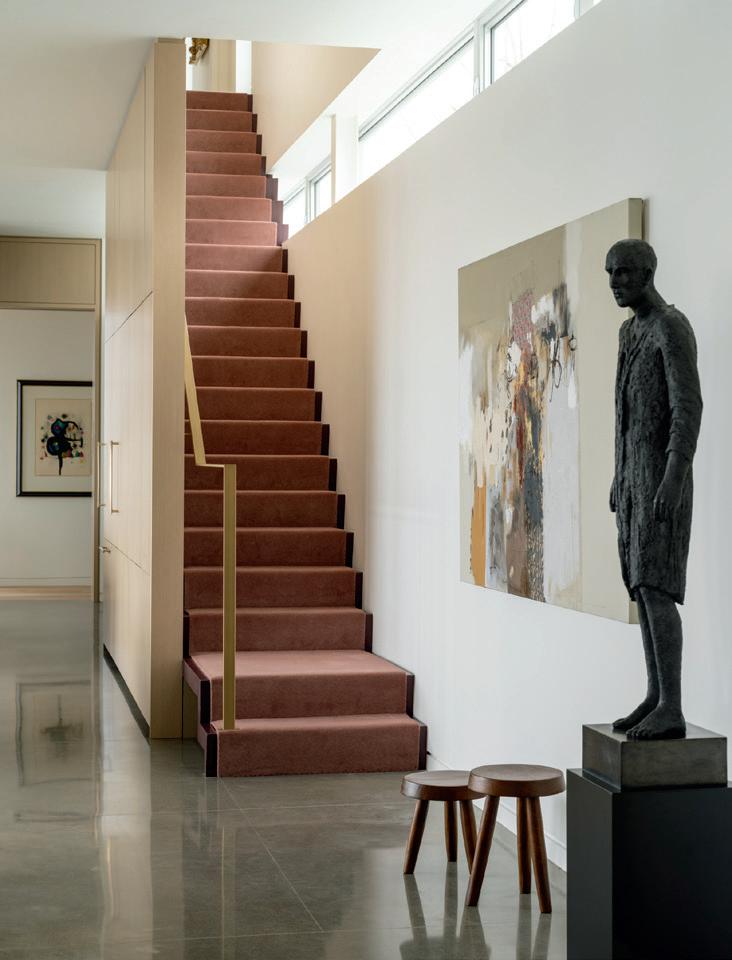
Custom stair runner (theredcarpet.ca). Artwork and sculpture (debellefeuille.com). AML stools (framacph.com).
Opposite page — Tub ceiling lights (luminaireauthentik.com). Wallpaper by Pierre Frey (chintzetcollections.com). Nokori bathtub by BainUltra and Litze faucet by Brizo (batimat.net). Vases and objects (flore.qc.ca).
“A contemporary space doesn’t have to be austere or devoid of warmth.”
— Richard Ouellette
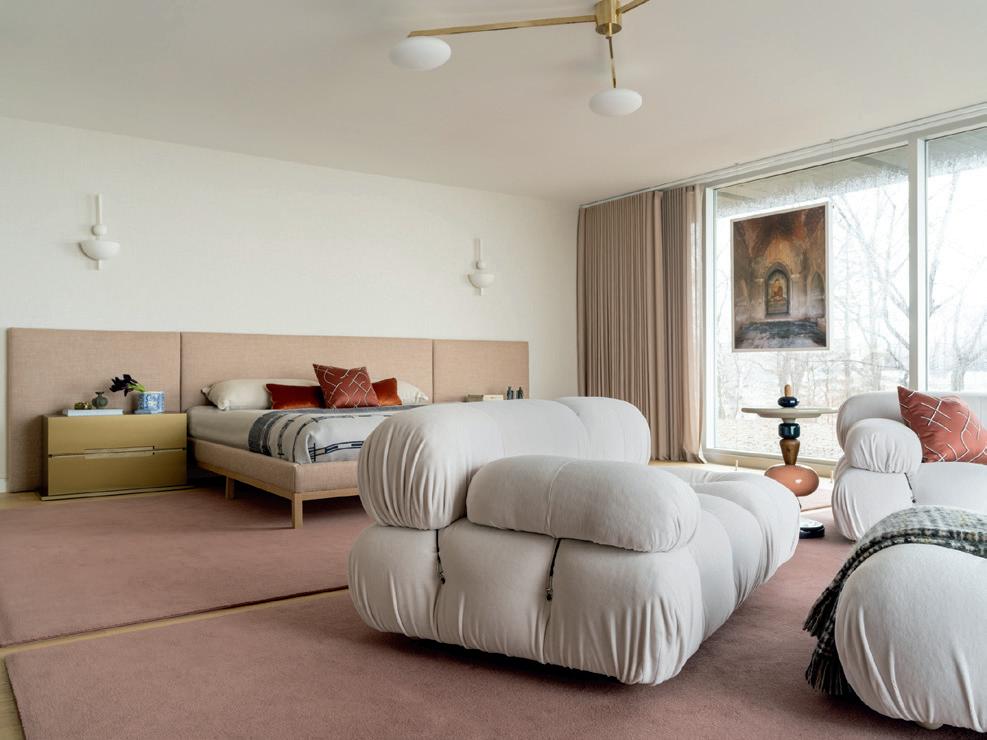
Trio ceiling light (fabioltd.com). Custom bed, nightstand and cushions (ensembliers.com). Bronte wall sconces by Porta Romana (southhillhome.com). Camaleonda sofas by Mario Bellini for B&B Italia (avant-scene.com). Shuffle side table by &Tradition (kelli.shop). Custom curtains (storeurbain.com). Custom rug (theredcarpet.ca).
Art collectors and lovers of prints and bold colours, the owners like to surround themselves with the unexpected. Richard Ouellette opted for an almost entirely custom decor where “nothing is perfectly arranged,” skilfully blending elements of Japanese, Chinese, Italian and New York inspiration. The many curtain panels, a unifying thread throughout, punctuate the spaces and warm the numerous window openings overlooking the river. The view takes care of the rest. —
(ensembliers.com)
INSPIRATION
Journal from Northern India (PAGE 98) On the road with Davin Cowper, founder of Montreal-based rug brand Mark Krebs — ELLE Capture (PAGE 107 ) Discover the winning shot from our contest in the Architecture category.
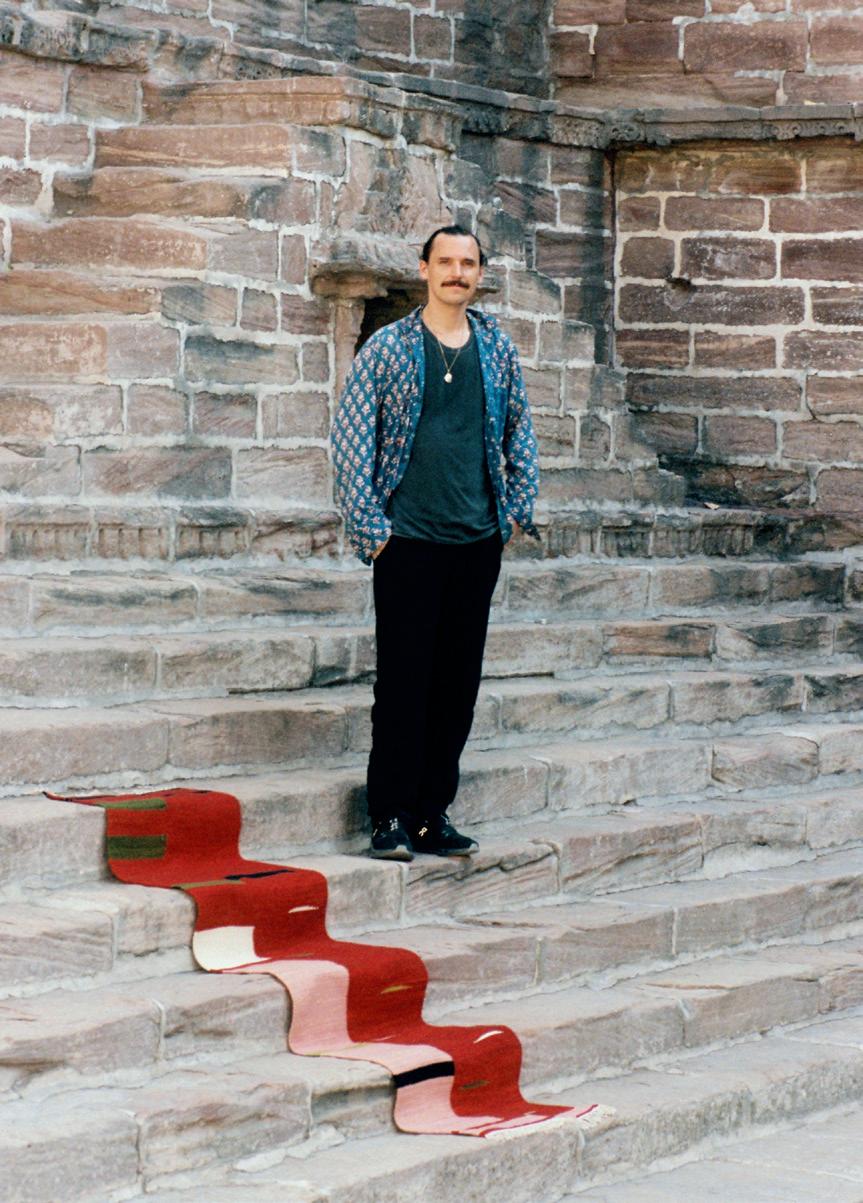
DAVIN COWPER and his Rose Garden runner LI-3
JOURNAL AR-6
NORTHERN INDIA from
Joined by his friend and photographer LUCE ROUX , designer DAVIN COWPER —founder of Montreal-based rug brand Mark Krebs —set out to capture, through words and images, the people, the places and a culture rooted in traditions that weave through his creations. Follow this intimate and evocative journey revealing an ancestral craftsmanship that endures to this day.
By Davin Cowper —
Photography by Luce Roux
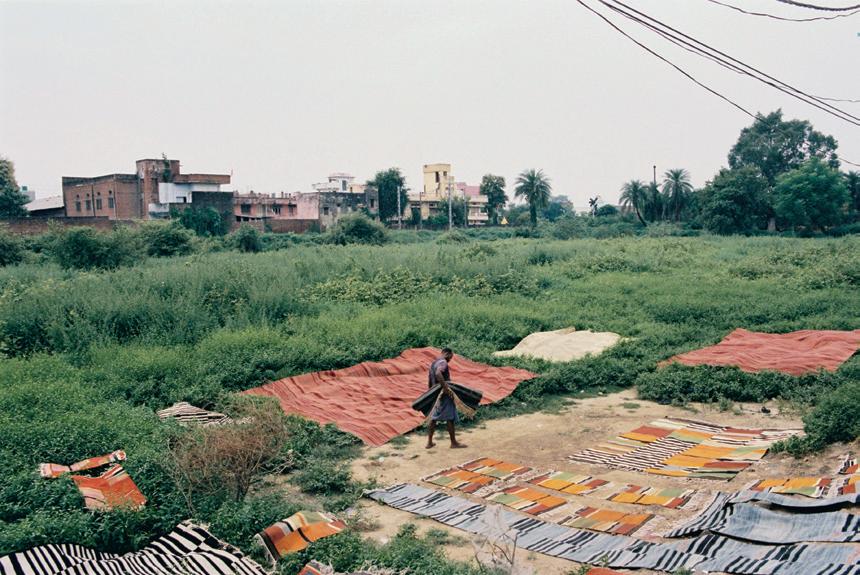
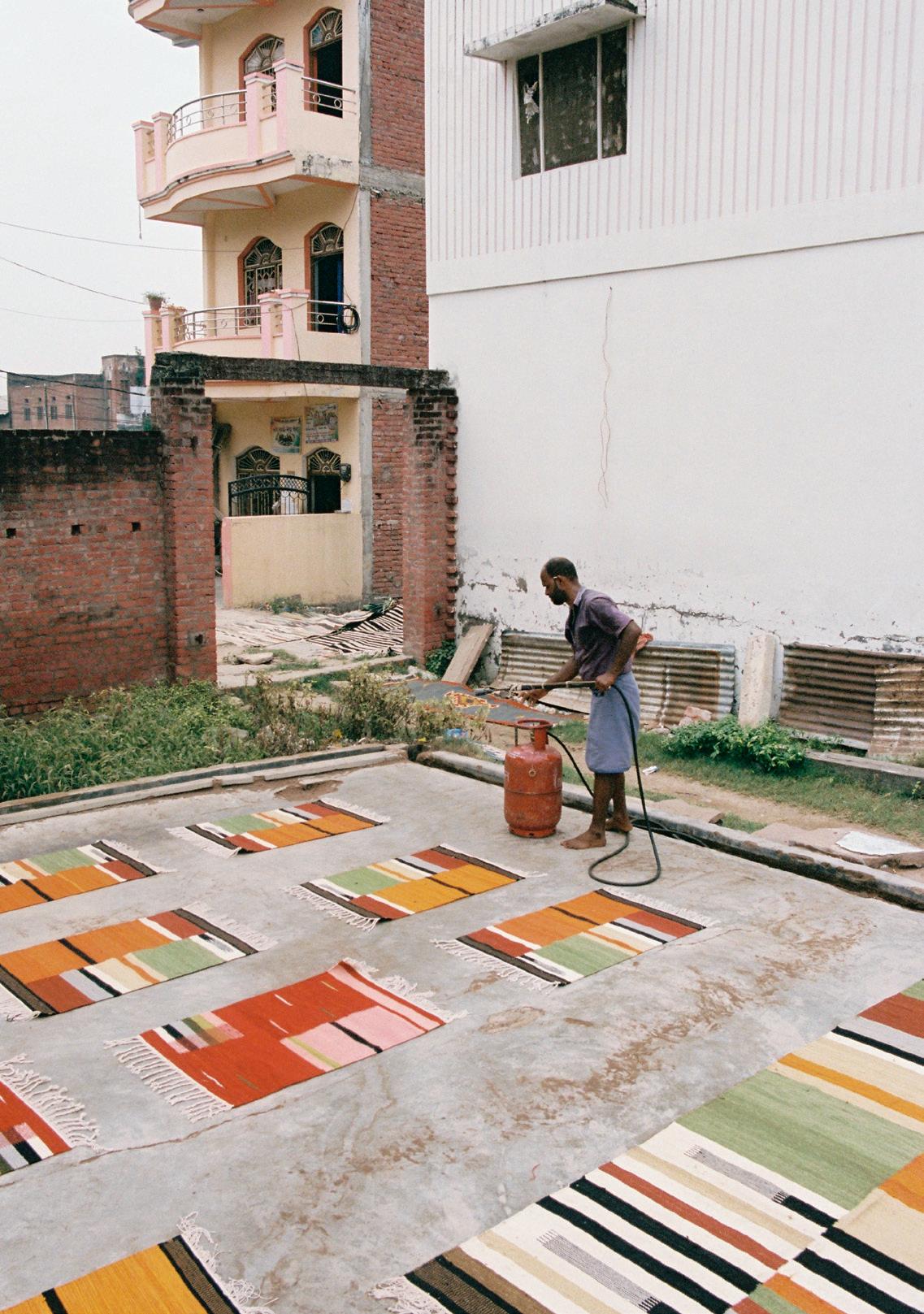
My career has taken me around the world in search of manufacturing partners, whether in Vietnam for ceramics, in China for LED pendant lights or in Java, for wooden case goods. Since founding Mark Krebs, I have focused on designing and producing handmade wool rugs in northern India. This is my fourth sourcing trip to the subcontinent, but this time I am fortunate to travel with my good friend and talented photographer Luce Roux. These trips are more than about just approving samples. They are about understanding how materials behave, refining techniques alongside artisans and immersing myself in the places where craft is deeply embedded in culture. Design isn’t about choosing, it’s about knowing. And you don’t really know a material, a process or a supply chain until you spend time inside it. This is an invitation to see what I see, to rethink what it means to source responsibly and to understand why thoughtful collaboration leads to better, more meaningful design.
BIKANER, RAJASTHAN
BIKANER, RAJASTHAN
— 7 octobre 2024 —
→ October 7, 2024
The trip to Bikaner begins with a seven-hour train ride from Gurgaon, a modern city with upscale arcades and glass skyscrapers. It’s located just below the sprawling capital region of Delhi and is the financial and tech hub of northern India—essentially the opposite of where we are heading.
Luce and I split a first-class cabin with an older Indian woman who sleeps through most of the ride. The city of Bikaner—small by Indian standards—is situated in the northwestern part of the state of Rajasthan and lies within the Thar Desert. It is a sun-baked sprawl of markets with small, tight laneways, pink sandstone forts and palaces sprinkled throughout. Wealthy during the time of the Raj, the city is now considered a bit off the beaten path.
After arriving at the Bikaner train station, we are greeted by my yarn supplier in the city. A middle-aged, portly man dressed in all white, a traditional kurta and pyjama combo. With the late afternoon heat on my neck, I am immediately jealous. The day before, in Gurgaon, I purchased a pair of Western-style black linen trousers, a massive upgrade from my heavy denim
jeans I walk off the plane in, but clearly, I am not shopping in the right bazaars.
To get anywhere within the packed cities of India takes time and patience. Every intersection is an exercise in creative driving and liberal honking. Planning a trip to meet producers and work on new designs is more about planning the hours spent in the back of a car. I shouldn’t complain, however: My suppliers insist I use their vehicle and company driver while I am within their city limits, air conditioning at full blast. Throughout the meeting-packed days, the drivers dissolve into and emerge from the crowded streets at a moment’s notice. Their job seems split between driving me around and joining the endless hangs of middle-aged men sipping chai on each corner. There is a seamlessness to strangers spending time together that I, as a Canadian, have trouble wrapping my head around. It’s not friendliness but an acceptance of each other, blended with a lack of concern for personal space. From afar, these interactions feel both alienating and much more human than strangers interacting back home. In Montreal, my time spent in limbo is usually done in complete isolation. In India, there is no shortage of people to argue with or tell jokes to.
→ October 8, 2024 SC-2
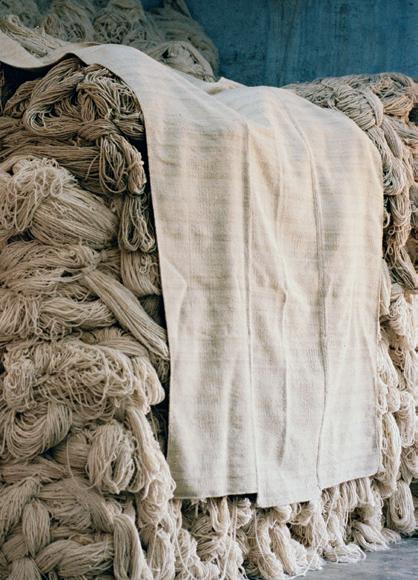
The day starts at a sheep farm in the countryside. One of the farmers pins a sheep down to demonstrate the shearing process with hand-forged scissors. The pinning is a mildly violent action. Although the shearing discomforts the animals, they are overjoyed once released from their heavy wool coat (I would be, too, if I was wearing a wool sweater in a desert). The sheep are Bikaneri Chokhla, a breed developed long ago to have shorter hairs and to be able to withstand the oppressive desert heat. Bikaner has historically been the hub in Indian wool yarn production, exporting their fine yarns across the country. My supplier here has been spinning yarns for generations.
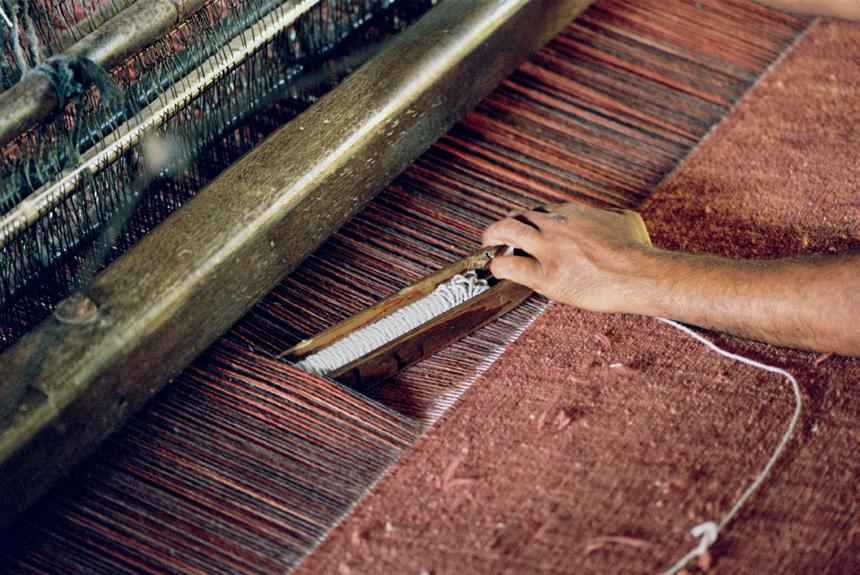
Our next stop is a cotton and melon farm, where he has some business. Cotton makes up a small percentage of my rugs—it’s primarily used as the warp yarn on the looms, providing support for the wool weft. Natural undyed cotton is visible at the ends of some of my rugs as the fringe. This is the warp strings tied in a knot to keep the rug from unravelling.
We stop for lunch at a roadside restaurant with a corrugated steel roof and woven grass walls. We are served the largest roti I have ever seen, dripping in ↦
— 8 octobre 2024 —
ghee. My yarn supplier, born of the Brahmin caste, is fasting from sunrise to sundown over a Hindu holiday. He ensures that we eat too much while he abstains.
We continue with a visit to the yarn factory. The tour of the factory is a deep dive into yarn-making. This is actually my first time seeing every single part of the process, from raw wool to finished yarn.
Luce captures videos and photos with a growing fan club of factory workers trailing her. By the end, she has 10 men following her, which she handles much better than I ever could. She even puts them to work, moving some items around to get the right shots.
As Luce shoots the facility, I break off to finalize new yarns I have been developing for a new collection. It is a spinning technique that blends five fibre colours in a mixture of Bikaner and New Zealand wool. Even with all the emails, photos, illustrations and drawings, nothing speeds up the development of a new design like sitting down with the producer and discussing the project with a sample in hand. In 30 minutes, I can discuss limitations, challenges and problems with a new design—conversations that would take months over the phone and between international FedEx shipments. I can cut through language barriers and cultural assumptions with simple, direct feedback. There is an instantaneous syncing of intent that is incredibly hard to achieve over the internet, regardless of bandwidth.
→ October 9, 2024
LI-5
We wake up early with high hopes and head to a 500-year-old former cemetery and fort complex—now a tourist destination—for our first product shoot. Upon arrival, however, the guards (alleged descendants of those buried on-site) make it clear that we can’t shoot there. We scout the vicinity and find some old structures near an ancient reservoir. Though not ideal, we capture what we can, trying to salvage the morning.
For the second location, we find a small, lesser-known fort with a friendly caretaker. Proudly granting us full access, he declares, “No entrance fees!” Luce sets up and shoots against the fort’s worn walls as the sun climbs, while local women in traditional dress linger nearby, watching the unfolding photoshoot, too shy to talk to us in their limited English.
As two Westerners moving through more rural parts of India, we attract many eyes. Being so obvious anywhere we go—me, over six feet tall, and Luce, a bleached-blonde Frenchwoman—gets uncomfortable. I feel like I’m on a stage. However, this entire trip is framed by watching weavers and workers do their jobs, then documenting them through Luce’s camera. In some ways, I ask them to be on a stage as well. This is where the importance of my work comes in. I’ve been lucky to travel extensively throughout Asia
over the last decade, sourcing and developing products with local partners. The act of working gives me a sense of legitimacy here. If I’m running a photoshoot, touring production facilities or meeting with suppliers, I have a clear reason for being here, on this “stage.” I am not out of my element but playing the part of a businessman, a creative director, a designer, a photographer. Passersby can watch, and while their interpretations of what I’m doing may vary, the general character I play—how I fit within the larger community, region and country—is not vague. I feel like a functioning part of where I am, even if only for a short time, rather than just a voyeur passing through.
By midday, the heat is relentless and I am drenched from moving heavy rugs for the shoot. But Luce powers through until it’s time to return to the airport to catch our next flight—only to discover a five-hour delay. We head back and roam Bikaner’s old town, stopping by a temple as heavy rain begins to fall. We watch as locals are giddy about the rare, out-of-season desert thunderstorm. Before returning to the airport, we stop at a palace turned hotel for afternoon chai, settling in by the marble courtyard as another storm sweeps in. The five-hour delay turns into seven. Multiple flights later, we arrive at our hotel in Varanasi, terribly late and completely spent.
BHADOHI & MIRZAPUR, UTTAR PRADESH
→ October 11, 2024
Varanasi is a city void of time. Rising from the Ganges River, its history violently smashes into the present moment like a car crash, with the inevitable traffic jam backing up in all directions. Its ancient stone temples press up against one-star hotels. Cars honk at horse-drawn carriages. Beggars and holy men walk alongside Japanese tourists with thousand-dollar cameras. Endless groups of Hindus take the steps plunging into the river to wash away their sins. All of this happens just downstream from the bodies of the deceased being cremated on open-air wood fires, their ashes scattered in the Ganges, a tradition all Hindus hope to partake in. Considered one of the most spiritual sites in India, this city is guaranteed to be over-capacity at all hours.
Our day starts with reading the marriage ads in the Hindustan Times while eating dosa at the hotel. Unfortunately, this trip doesn’t allow any time to explore the holy city. We head to the small city of Bhadohi, just outside Varanasi, for our first meeting with one of my rug suppliers. The owner himself, possibly the tallest Indian I’ve ever met, carries a strong presence. Their offering of new weaving techniques ↦
is impressive, and I choose too many rugs to sample and send home with me.
We head to watch the rug-washing process. There, Luce commands a team of rug cleaners, orchestrating each shot until she is satisfied. All my rugs are double-washed: There is an initial yarn washing, followed by a second wash after weaving. This ensures the softest hand feel. The soaps used are all natural, and combined with 100 percent natural rug fibres, this makes wastewater treatment much simpler.
We arrive late in Mirzapur, where our driver scrapes a two-foot section of the van against a concrete column right in front of the hotel concierge. All parties involved decide to ignore what just happened. Luce opts out of dinner after putting in a heroic day of shooting, so I meet another one of my rug suppliers, who is waiting in the lobby. He promptly leads me to the bar at the back of the hotel, where we proceed to drink heavily. Plate after plate of regional dishes arrives at the bar, and after quite a few beers, he announces it is finally time to go to dinner, though I was under the impression that had already happened.
Over our second dinner, not far from the hotel, we exchange stories about our jewellery. He talks about the meaning behind each of his many rings, and I share the history of my grandfather’s medallion around my neck. When I’m in India, I tend to ask a lot of questions about Hindu beliefs, local customs and various superstitions. I usually get vague answers that lead to more questions. The regionality of the religion is hard to comprehend. I feel like an idiot in the dark, grasping for some resemblance of familiarity. Every so often, though, a space forms where local belief resonates. Here, our own superstitions about why we wear our jewellery bridge the spiritual gap.
12 octobre 2024
I am late to breakfast, and the staff’s partial English, mixed with my lingering drinks from last night, makes ordering a coffee difficult. We drive a short distance to my supplier’s home, which also functions as his finishing and shipping facility. We send Luce off to document the burning of loose fibres, rug washing and the kilims on the loom. All the looms are located outside the cities. Weavers typically own their own looms or work on communally owned ones. My suppliers hire weavers as independent contractors who choose their own hours and production volume, many of them also being farmers or mothers.
I spend the day reviewing new designs and discussing various techniques on display in his showroom. Afterward, my supplier and I sit in his office, pretending to be important businesspeople, until Luce finishes her photoshoot. Apparently, the weavers gave her a round of applause as she wrapped up the shoot.
We return to the hotel by 11 p.m., bracing for an early wake-up to catch a 4 a.m. flight to Jodhpur. But my supplier is haggling for a discount on the bill, a back-and-forth that drags on for another 20 minutes. The next morning, I wake up to find that his persistence paid off. In India, everything is up for negotiation.— (markkrebs.ca)
→ October 12, 2024 LI-3 AR-3
ELLE DECORATION EXTRA
FEATURED product from one of our advertisers .
Invite boldness and vibrant colour into your living space with the new Kenzo Takada, Jiku edition of the Mah Jong, designed for Roche Bobois. Entirely made and sewn by hand in European workshops, this modular sofa features unexpected combinations of Parisian fashion with the colours and poetry of Japanese art. Composed of modular elements, seat cushions, straight and corner backrests and lounge-chair units, this sofa offers infinite customizable arrangements. It’s more than seating—it’s elegant craftsmanship and joyful freedom made just for you. —
(roche-bobois.com)
ELLE Capture
Presented by Black’s
Finalist in the ARCHITECTURE category of our ELLE Capture contest, Aparna Rajeev is a trained architect and a student at the Creative School at Toronto Metropolitan University. For her, photography is a way to pause time and tell stories—often in the quiet spaces where form meets feeling.
This candid shot—taken at the Art Gallery of Ontario and praised by both the public vote and the jury—reveals a solitary
figure, framed by layers of architectural elements. Natural light sculpts the space, while a tension emerges between motion and stillness. The composition invites a pause: a moment of reflection on transience, spatial rhythm and the feeling of being suspended between silence and structure. —