Vladimír Popelka
Treatment of calcaneal fractures
Dedication
To my son Vladko who has decided to follow in my footsteps and motivated me in my work, and to my wife Inka for her valuable support.
Vladimír Popelka
Treatment of calcaneal fractures
GRADA Publishing
Notice to readers
All rights reserved. No part of this printed or electronic publication may be reproduced, stored and soled in any form without the prior written permission of the publisher: unauthorized use of this book will be prosecuted.
MUDr. Vladimír Popelka, PhD.
TREATMENT OF CALCANEAL FRACTURES
Author:
MUDr. Vladimír Popelka, PhD.
Translator:
Ludmila Bébarová
Reviewers:
prof. MUDr. Peter Šimko, CSc. prof. MUDr. Milan Kokavec, PhD.
© Grada Publishing, a.s., 2018
1st English edition
Cover Photo © depositphotos.com, 2018
Published by Grada Publishing, a.s., U Pruhonu 22, 170 00 Prague 7, Czech Republic
This is 6835th book of Grada Publishing, a.s.
Previous and foreign edititon of this book: 1st Slovak edition 2017
Printed by Tribun EU s.r.o.
Every effort has been taken to confirm the accuracy of the information presented. Neither the publisher nor the author can be held responsible for errors or for any consequences from the use of the information contained herein, and make no warranty, expressed or implied, with respect to the contents of the publication.
ISBN 978-80-247-4421-6 (pdf)
ISBN 978-80-271-0887-9 (print)
5
Analysis of mechanism of injury in patients operated on in the period of 2007–2014, at the Department of Trauma Surgery of the Slovak Medical University (KÚCH SZU) in Bratislava, Slovakia
5.1 Fracture patterns and the course
5.2
5.3
5.4
9.2.2
9.3.1
12.1.1
12.1.2 Injuries
12.1.3 Choice of an improper operative technique
12.3 Complications
12.5 Compartment syndrome of the foot
12.6 Algoneurodystrophic (Sudeck´s) syndrome
15.3 Intra-articular fractures of the anterior process
15.4
Foreword
A key role in the function of the foot is played by the calcaneus to which the weight of the whole body is transmitted through the talus. With a powerful pull of the Achilles tendon attached to it, the calcaneus acts as a part of the lever arm which sets the foot in motion. In terms of morphology, it is one of the most complex bones of the human body. Anatomical reconstruction of a broken calcaneus is one of the prerequisites for restoration of its important functions.
Operative treatment of calcaneal fractures is both a big challenge and responsibility for all orthopaedic surgeons. One false step in the surgery may have fatal consequences. Sometimes the surgery resembles solving a 3D puzzle where each piece must be accurately positioned, to achieve the correct shape. Understanding the principles of treatment of calcaneal fractures requires long-term efforts, systematic study and ample practical experience.
There is no comprehensive publication in the Slovak literature that would deal with calcaneal fractures. The Czech literature contains two valuable monographs in this field, namely Wondrák: Zlomeniny kosti patní (1964) and Stehlík and Štulík: Zlomeniny patní kosti (2005), which, however, are rather out of date or provide only a one-sided picture of treatment of calcaneal fractures.
The aim of this textbook was to offer surgeons the possibility to find an optimal method of treatment of this injury, as well as to provide medical students with the essential details concerning this issue.
The textbook presents a chronological overview covering anatomy, biomechanics, diagnostics, classifications, followed by clinical chapters on individual operative techniques of treatment of calcaneal fractures. Each chapter reflects my personal clinical experience and views I have acquired during my more than twenty-year career. Based on this experience I have developed my own therapeutic concept which is presented in the conclusion.
I would like to express my gratitude to Professor H. Zwipp and his colleagues for all the knowledge and experience they shared with me during my study stay at the Department of Trauma and Reconstructive Surgery in Dresden, to Professor R. Sanders for valuable consultations, and to Assoc. Professor J. Mentel, Head of the Anatomical Institute of the Faculty of Medicine of the Slovak Medical University in Bratislava for providing me with the possibility of obtaining anatomical specimens of the foot which I used in the textbook.
I also highly appreciate the support and assistance provided by my colleagues from the Department of Trauma Surgery of the Slovak Medical University in Bratislava during individual surgical procedures.
1 INTRODUCTION
Treatment of displaced intra-articular fractures and surgical management of post-traumatic calcaneal deformities are among the most challenging procedures in traumatology and orthopaedic surgery. Already in the past, L. Böhler and R. Watson–Jones considered calcaneal fractures as the most severe and in general insoluble injury to the bones of the human body. Many methods had been developed during the history of treatment of these fractures but none of them had brought satisfactory results.
Actually, no consensus has been reached yet on the optimal method of reduction and fixation of these fractures. Most trauma surgeons dealing with calcaneal fractures had to cope with various pitfalls of numerous operative techniques. On the one hand, percutaneous techniques using Kirschner wires or screws were less invasive, but the constructs were not stable and often resulted in displacement of bone fragments during treatment. On the other hand, accurate open reduction and internal fixation were associated with a risk of wound infection. The current trend in treatment of calcaneal fractures remains geared towards the patientspecific therapeutic concept with the choice of an optimal method in view of the fracture pattern and the patient´s individuality.
However, no matter what method of treatment is used, the main goal is always an anatomical reconstruction of the shape of the calcaneus and the articular surfaces, which is a guarantee of a well-functioning foot.
The basis of a proper treatment is an exact diagnosis and a maximum amount of information about the fracture pattern. The currently most valuable imaging method is CT scanning with 3D reconstruction, showing exactly the course of fracture lines and extent of displacement of fragments. Based on a CT finding, the surgeon classifies the fracture and decides about the method of treatment. Treatment of calcaneal fractures requires a good spatial orientation, with a clear concept for restoration not only of articular surfaces but also of the entire external configuration of the calcaneus. A profound knowledge of biomechanics of the foot and anticipation of the impact of the surgery on other joints and the foot are critical to an effective repair of the calcaneus.
A good result of the treatment requires reconstruction of bones as well as adequate soft tissue management. Soft tissues require delicate manipulation as they can be easily further damaged after the injury. An inconsiderate surgical intervention causing damage to the skin, subcutaneous tissue and other soft structures, as well as improper timing of the surgery often result in severe wound healing complications.
Of no less importance is cooperation with a physiotherapist, particularly in case of operative treatment. Rehabilitation therapy can eliminate sequelae of the injury and support the results of our surgical efforts. Another important issue are socioeconomic aspects of calcaneal fractures. Of 96% of working-age patients in our series, 12% became disabled. A total of 31% of patients had to change their job; duration of treatment and inability to work for more than half a year was recorded in 85% of patients and up to 34% of patients developed permanent sequelae.
2 FUNCTIONAL ANATOMY
The heel bone (calx (Greek), calcaneus, os calcis (Latin)) is the largest tarsal bone and at the same time a highly important anatomical unit of the foot. It projects posteriorly behind the vertical posterior aspect of the lower leg to form the calcaneal tuberosity. Its upper part serves for attachment of a robust calf muscle through the Achilles tendon. The calf muscle pulls up the posterior part of the calcaneus acting as an effective lever in plantar flexion of the entire foot in the ankle joint. This powerful pull is responsible also for certain patterns of calcaneal fractures. It is primarily the type of injury specified by Essex-Lopresti as a tongue type fracture, where the talus hits the central part of the calcaneus and the simultaneous proximal pull of the calf muscle causes rotation of the posterior articular facet and avulsion of the upper part of the posterior calcaneus.(17) At the same time the talus hits the posterior articular facet obliquely. An opposite mechanism is used to reduce this fragment, i.e. rotation of the fragment distally with the foot in extension. The first to reduce a tongue type fracture in this way was Westhues in 1934 and since then this method of reduction has been referred to as the Westhues manoeuvre.(76) In joint-depression type fractures the pull of calf muscle is eliminated by flexion of the foot and the impact force of the talus acts perpendicular or almost perpendicular to the posterior articular facet.(76)
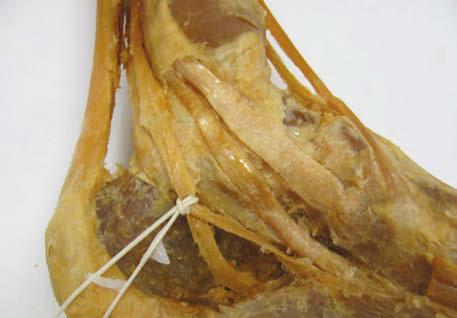
The lateral wall of the calcaneus (Fig. 1) is steep and is formed by a fine cortical bone, “the lateral bulge“, which is one of the thinnest bone structures of the calcaneus. This lateral surface is therefore most commonly damaged in intra-articular calcaneal fractures caused by axial force. Part of the lateral surface of the calcaneus is a small prominence, the peroneal trochlea, which serves together with strong fibrous peroneal tendons sheaths and lateral retinacula as a pulley for these foot stabilizers. The fibularis brevis tendon courses anterior to or above the fibularis longus and inserts on the base of the fifth metatarsal. The fibularis longus tendon goes posterior to the peroneus brevis tendon at the level of the lateral calcaneal wall, then continues under the foot to attach to the medial cuneiform and the base of the first metatarsal. The calcaneofibular ligament runs from the tip of the lateral malleolus toward the calcaneal tuberosity and may get ruptured in fracture-dislocations of the lateral wall. Other stabilizers of the fibular malleolus include the anterior and the posterior talofibular ligaments. (6, 15)
An important structure from the surgical viewpoint is the sural nerve on the lateral surface of the calcaneus. It travels down the lower leg within the subcutaneous tissue, along the lateral border of the Achilles tendon and at the level of the lateral malleolus contours the lateral border of the peroneal tendons. At the level of the fifth metatarsal base, the sural nerve ramifies into its lateral and medial terminal branches. In the extended lateral approach, with the incision passing close to this nerve, caution has to be taken to avoid its damage or entrapment by suture, which may cause unpleasant numbness of the lateral side of the foot or pain in the course of the nerve.
Blood supply to the lateral surface of the calcaneus is provided by the calcaneal branches of the peroneal artery in the posterior part, by the anterior lateral malleolar artery from the anterior tibial artery in the middle part and by the lateral tarsal artery in the anterior part. The three arteries are mutually interconnected forming a chain of anastomozing blood vessels.(7)
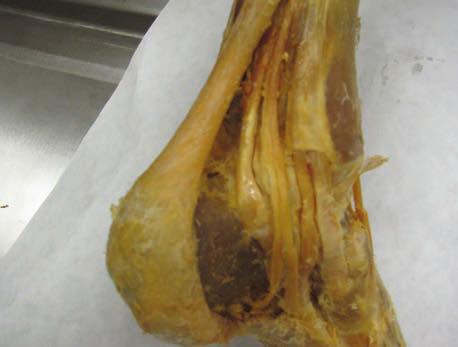
The medial wall of the calcaneus (Fig. 2) is concave and its contour forms the so called Shenton line that can be seen on axial radiographs. Its assessment is important for evaluation of displacement between the tuberosity and sustentacular fragments. Protruding anteromedially is a bony process, the sustentaculum tali. This part of the calcaneus is formed by a strong bone which supports the talar body and serves as a centre of transmission of the body weight to the medial side of the foot. Isolated fractures in this region are rare and are caused only by direct impact force acting on the medial side of the foot (e.g. in motorcycle accidents the sustentaculum gets fractured by the foot hitting the pedal). On the inferior surface of this medial
process is a groove for the tendon of flexor hallucis longus tendon. Unlike other tendons on the medial side of the foot (the tibialis posterior, the flexor digitorum longus), the flexor hallucis longus rests on the medial wall of the calcaneus and in fracture-dislocations in this area and in the area of sustentaculum it gets interposed between the fragments. This is the cause of failure of reduction, requiring revision of the tendon and its release from the medial approach. Only then the fracture is reduced.
1: Lateral wall of the calcaneus, the calcaneofibular ligament and peroneal tendons
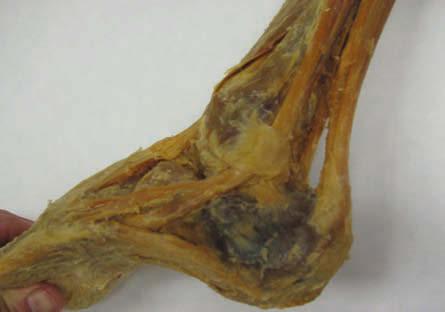
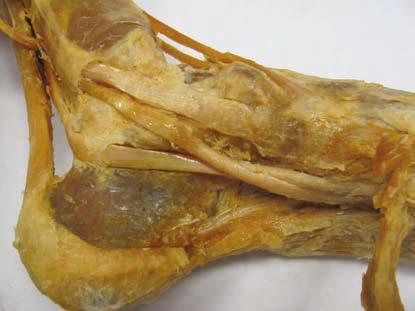
Fig.
Fig. 2: Medial wall of the calcaneus, showing tendons of the tibialis anterior, the flexor hallucis longus, which passes over the flexor digitorum longus
The foot is innervated primarily by the tibial nerve that splits into two branches to supply sensation to the skin on the medial side of the foot and the foot sole. The posterior branch of the tibial nerve gives off the calcaneal branches at different levels.
Blood supply to the foot is provided mainly by the posterior tibial artery (Figs. 3, 4) which passes above the medial side of the calcaneus and at the level of the foot sole it divides into the medial and lateral plantar arteries.(6)
Figs. 3, 4: Important structures on the medial side of the foot (in posterior-anterior direction the flexor hallucis longus, neurovascular bundle, the flexor digitorum longus and the tibialis anterior)