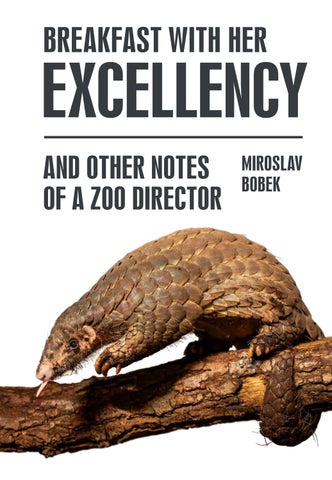
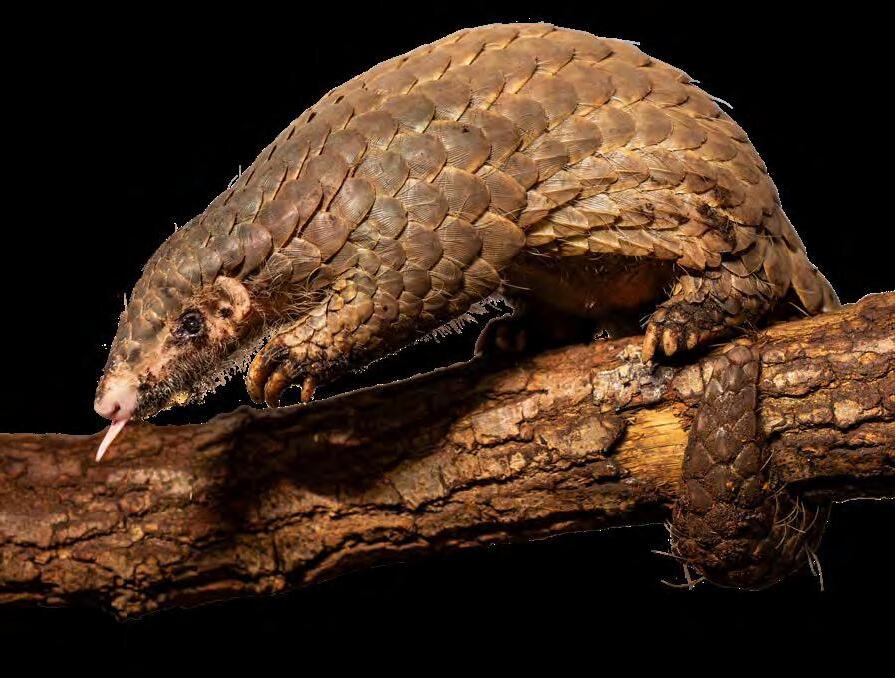
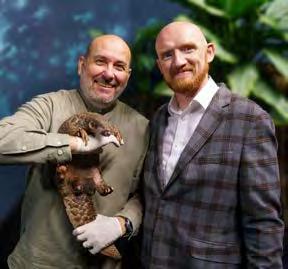
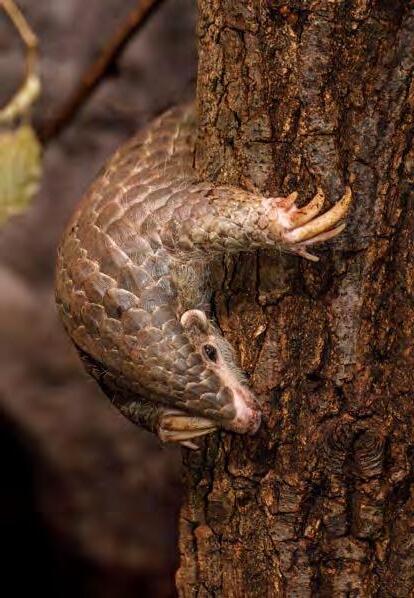
Ambassador to the Czech Republic of the United Kingdom Matt Field during one of his visits to the famous female pangolin Šiška (pronounced [shish-kah], meaning Cone in Czech). Like other guests, His Excellency would visit Her Excellency around the time of her breakfast. Well, breakfast… The pangolins in the Indonesian Jungle House follow a reverse daily routine: their day is a night, and their night is a day. So, technically speaking, from Šiška’s point of view it could be dinner, but at the same time it is her first meal of the day, therefore we call it breakfast.
Preface
“What you do makes a difference, and you have to decide what kind of difference you want to make.” Dr Jane Goodall
I first came to Prague Zoo not as an Ambassador, but as a visitor and parent. Like so many things since we moved to Czechia, it did not disappoint. As a family, we spent a happy day losing ourselves amongst the giant salamanders, capybaras, gharials, kangaroos and gorillas.
Under the leadership of Director Miroslav Bobek, the zoo exemplifies Dr Jane Goodall’s quotation about making a difference. It does so every day, to the lives of the animals that are nurtured in the zoo, the thousands of visitors each year, and all around the world, as each of us tries to follow this great example of conserving and protecting the wonderful world we are lucky enough to live in.
And then there is Šiška. As fans of pangolins, my family and I were delighted to learn that a baby pangolin was expected. Director Bobek has chosen the most perfect title for this book, because Šiška is indeed a true ambassador. Her Excellency is an incredibly effective and persuasive symbol of the outstanding work being done by this and other zoos. And Her Excellency has reminded us of the difference that each of us can make, and the opportunity that lies in front of everyone, to do more to protect, conserve, and champion the natural world around us.
Thank you, Prague Zoo, and thank you, Šiška.
Matt Field, Ambassador to the Czech Republic of the United Kingdom of Great Britain and Northern Ireland
Introduction
In the title of this book, “Her Excellency” refers to the first Chinese pangolin pup bred in Prague Zoo – the famous Šiška. But why “Her Excellency?” Because in the same way as many other animals, she is the ambassador of her species (and in this case even the entire animal order) in the heart of Europe. And why breakfast? Well, because I would visit Šiška and her parents especially during breakfast time.
Just as with the previous selections from my newspaper columns – which I have been writing weekly for fifteen years –so the majority of the chapters in this book Breakfast with Her Excellency also relate in one way or another to Prague Zoo. From time to time, though, I have also written about topics which have no connection with our zoological garden, but which caught my interest. After all, there is always something to wonder about in the animal world, something to learn about, and something to explore!
For understanding my relentless writing habit, followed by the reading of every individual piece, I express my thanks to my wife Klára and to my children Kryštof and Markéta. For help with the preparation of this book I owe a number of colleagues a great deal; namely I would like to thank here Marek Václavík, Filip Mašek, Monika Dolejšová and Jaroslav Šimek. I am grateful to a big supporter of Prague Zoo, His Excellency Matt Field.
I wish you pleasant moments with Breakfast with Her Excellency!
M. B., Prague, November 10, 2024
The Ambassadors of Wild Nature
According to the book of Genesis, Noah’s Ark was 300 cubits long and 50 cubits wide. Converted to today’s units, it measured roughly 135 by 22 metres. Squeezing a pair (or even seven pairs) of every species of animal into it must have been an absolutely impossible task.
Likewise, it is unthinkable that zoological gardens would become the Noah’s Arks that could bring salvation to all endangered animal species. There are too few of them, and they are too small for that. Sure, they have managed to save some species. The shining example may be Przewalski’s horse, which owes its survival to a large extent to our Prague Zoo. But alas, not all who are in need can be saved by zoos. However, zoos can also help in another way, by protecting the endangered species directly in the areas of their occurrence, in situ. Compared to “Noah’s Ark” this approach has at least two substantial advantages. First, it is far better to prevent the extinction of a particular species than to face the challenge of having to laboriously return it back to the wild afterwards (which in some cases is not even possible). Secondly, in situ conservation goes hand in hand with the protection of the environment, which the particular species inhabits, and therefore many, many, other organisms are also protected.
Our effort in Cameroon may be an example of the second approach. The “flagship species” for us there is the western lowland gorilla. However, when we try to reduce poaching
and forest destruction, we are also benefiting so many other species that listing them would take a substantial part of the space I had allotted to this text.
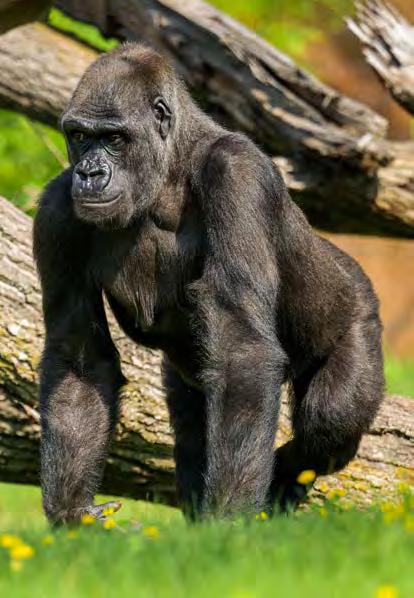
In this sense, the western lowland gorillas in our zoo are a certain kind of ambassadors of wild nature. Thanks to their presence we win over the public to the idea of their protection – and thanks to their presence we also manage to raise funds for work in Cameroon. However, we have a number of such ambassadors in the zoo. Naturally, I must mention pangolins.
Of course, we have to create optimal living conditions for these “ambassadors of wild nature”. It is not only about the space or the appropriate composition of their food, but also about living in natural social groups, being able to breed, and having enough external stimuli. This is done by so-called enrichment, which can take many forms, from hiding treats to complex puzzles.
At the same time, it is extremely important that the presence of these ambassadors is meaningful. They must be seen, we must talk about them, and we must bring them closer to people. The fact that they have names and that we can talk about them as personalities also helps us achieve this. After all, what kind of ambassadors would they be if they remained hidden by anonymity?
We’re Off to Get
Kisumu.
How Do We Transport Duni?
The spring and summer of 2022 were marked by completion of the new gorilla house, the Dja Reserve, and introducing its new inhabitants. Step by step, African brush-tailed porcupines, de Brazza’s monkeys, Gambian pouched rats as well as other species moved in. Only then did the gorillas come. First of all, on Wednesday, June 8, we moved the females Kijivu, Shinda, Kamba, and the young male Ajabu, from the old gorilla house. Then we started our preparations for the arrival of new individuals, the alpha male and the young female, who would form the basis of the next phase of the gorilla breeding in Prague.
The transport of the gorilla male Kisumu from the 300-kilometre-distant Schmiding Zoo in Upper Austria didn’t pose a big challenge. However, we didn’t want to underestimate anything. On Friday, September 9, we went to Schmiding in a small convoy, which included two air-conditioned vans. One of them carried a transport crate in which Kisumu would travel, and the second van was a backup. I must say that Kisumu didn’t endure this journey particularly well, and later his dramatic entry into our new exhibit struck us with terror, but looking back now, everything went as it should have.
◁ In the early days of summer 2022, Kijivu, Shinda, Kamba and young Ajabu started to familiarise themselves with the Dja Reserve outdoor exhibit. Kijivu is in the picture.
On the other hand, the transport of the new female Duni, the daughter of the famous Moja, already had us very worried several weeks ahead.
Since her birth, Duni had lived in Cabárceno, Spain. From there, it is by road seven times farther to Prague than from Austria: 1,580 kilometres as the crow flies. Being transported over such a distance could be very stressful for Duni. We were therefore trying to do everything to transport her as quickly as we could and, if possible, in the constant presence of her keeper. However, this was more complicated to arrange than it might seem at first glance.
The roughly two-thousand-kilometre overland route would have taken us about thirty hours by car, including all the necessary stops. Just as with Kisumu on the journey from Schmiding, Duni’s transport crate would have to be placed in an air-conditioned van. However, the keeper could not be there with her, and they could only make contact during the stops. I would not wish such an ordeal on “our” Duni.
Unfortunately, not even commercial air transportation from Cabárceno was an option. It too would take about thirty hours, Duni would have to be reloaded at airports, and the keeper would not be able to be close to her at all. Renting an entire plane, as we did years ago when we transported Duni’s mother, Moja, to Cabárceno, also proved to be unfeasible.
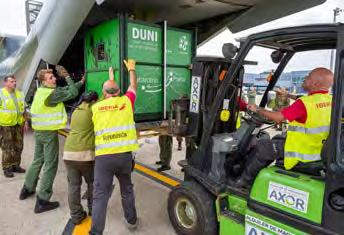
In the end, we found an ideal solution! The loading of Duni started in Cabárceno on Friday, September 16, 2022 after eight in the morning. Weeks ahead, though, the keepers had been training Duni to enter the transport crate, and, as a result, her loading went without complications. She was then driven to the airport in Santander. A CASA army plane, which was returning to the Czech Republic from Zaragoza, was waiting there. The flight from Santander was delayed
by about an hour due to a strike by French air traffic controllers, but that was the only one complication during the journey. The CASA plane landed in Prague-Kbely at 5 pm, and about an hour later Duni stepped out of the transport crate into the background area of our Dja Reserve. She behaved completely calmly. Success!
It was a relief for us – but only for a moment. We were anxiously awaiting to see how Kisumu would react to Duni. At first, they were getting to know each other through the bars, and we were not pleased when Kisumu showed signs of concern. On Monday, September 19, we nevertheless
The loading of a transport crate with Duni into the CASA plane of the Czech Armed Forces in Santander.
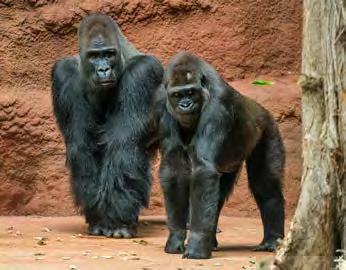
The introduction of Kisumu and Duni went very well. Our fears about a possible squabble, which caused the keepers to stand on high alert, did not come true.
proceeded to connect them. We definitely didn’t expect that it could be that easy. Duni and Kisumu sat down, exploring each other for a while, and since then they have been an almost inseparable couple.
During the time before opening the Dja Reserve, everything had gone very well. In the autumn, though, we still had to connect the Kisumu-Duni couple with Kijivu, Shinda, Kamba and Ajabu…
How a Modern Zoo Is Built
I have had my own builder’s helmet with the Prague Zoo logo for many years now. I wear it when I go to a building site to oversee the progress of the work underway. I particularly enjoyed it during the construction of the new house for the gorillas – the Dja Reserve – which we ceremonially opened to the public on September 28, 2022. And even though these errands often drag out, I spend incomparably much more time in our meetings, where we discuss both the zoo’s overall development and individual projects. I know, it doesn’t sound too attractive, but it makes me happy. The zoo must constantly develop. It is always under construction, it is never finished.
It is often said that every exhibit or house becomes out of date – both technically and morally – after roughly three decades. It can be illustrated better by the elephants’ exhibits rather than those where the gorillas formerly lived or are still living. The first pachyderm’s house built in Troja, Prague, in the 1930s had (including the outside enclosures) an area of one tenth the size of a football pitch, and for a long time was occupied by one elephant, one hippopotamus and one rhinoceros. A writer and an illustrator Ondřej Sekora once published a picture of an elephant as it was running away carrying the house on its back. The second elephant exhibit was
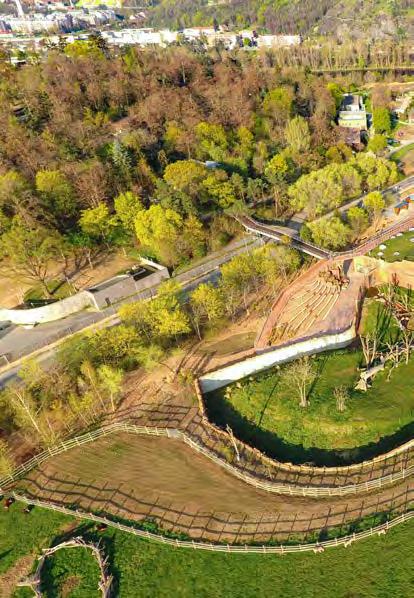
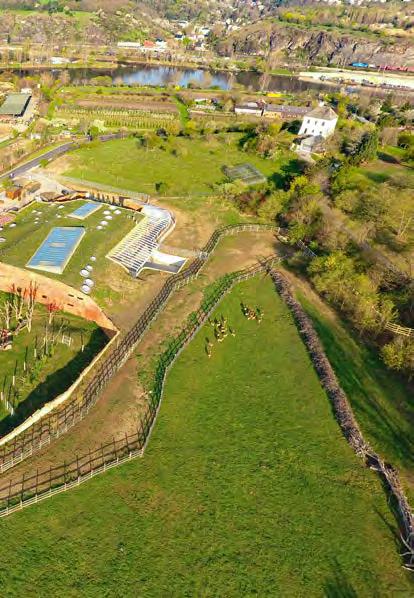
◁ A bird’s-eye view of the Dja Reserve that I took in the spring of 2022 shows how sensitively this complex merges with the countryside.
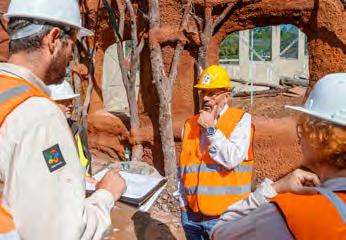
A photo taken on an errand during the completion of the Dja Reserve. The composition of participants illustrates the teamwork during the building process: not only builders are present there, but also zookeepers, gardeners, artists, maintenance staff and others.
built in the 1970s and covered an area of half of a football pitch. At one point it was occupied by seven elephants of all three species, hippopotami, pygmy hippos and also rhinoceri. However, the elephants never successfully reproduced, and in the course of time it had become more and more obvious that it was not a good place for them to live. The Elephant Valley, opened in 2013, is already nearly as large as two football pitches. At the time when this book went to press, there
are six Asian elephants – a male, two old females, two young females and one baby elephant.
We in Prague Zoo are gradually rebuilding or replacing time-expired breeding facilities, though as with the gorillas the aim was not only to provide more space for their family
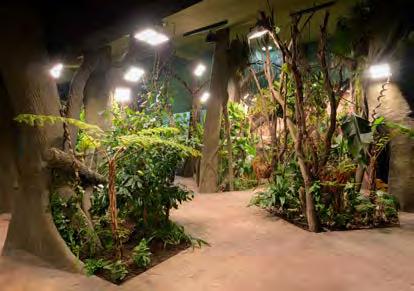
There are 43 LED lights placed in the visitors’ area of the Dja Reserve, which are in operation out of opening hours, enabling the effective photosynthesis of plants. Some are adjustable in position, and after switching them off, the whole system lifts up not to disturb the visitors’ experience.
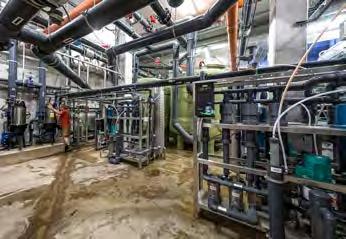
The area where the water for the hippo pools is cleaned resembles a little factory. It includes massive filters, ozonization and UV lamps. Altogether there is one kilometre of pipelines installed.
groups and for visitors but also to eliminate the danger of floods. The male gorilla group can be evacuated from the old gorilla house, placed at the lowest point in the zoo near the Vltava River incomparably more easily than the gorilla family with young ones. Already, in the initial phases or preparations for any new construction project, we discuss with many international experts a large number of questions related both to the conditions for the animals and for running the building itself. The result you can see for yourself. What you mostly cannot see is the behind-the-scenes arrangements and, in particular, the various types of technical equipment. A vast amount of the latter is placed in the Dja Reserve; however, the most demanding, the most expensive and the most capacious of all are pool water filtration
systems in buildings for animals which are tied to water. There is an underground hall full of water tanks, pumps, filters and pipes in our Hippo House enabling you to see the hippos beneath the water’s surface.
The consequence is that equipment for large animals is expensive. And more and more so. Our Elephant Valley with the Hippo House, finished in 2012, cost 20.5 million EUR. In other European countries, including Poland, there were houses and exhibits built for sums greatly exceeding 40 million EUR. However, building facilities for smaller species is nothing trivial or cheap either. You have to deal with their special requirements, which are often complex, as well as with controlling temperature, humidity, lighting and many other things. Sometimes it is difficult to explain this to the general public. They usually imagine their grandma’s budgie in a small cage or a bear in the circus ring. However, in a modern zoo wild animals should live under the best conditions we can provide based on our current knowledge.
Building the zoo is no fun. Before it all starts, things are being discussed, argued for, designed and paperwork is done for years on end. Soon afterwards, a very demanding public tender for construction companies follows. And then, and finally only then, comes the time for the builder’s helmet and making the rounds of the construction site. However, not even the opening of the house or exhibit area, nor all the festive ribbon-cutting, mean for me that everything is finished, and that the building has justified itself. The real test is when a new young animal – an elephant, hippo, gorilla – is finally born.