10
THE LIFE OF AN EXPAT
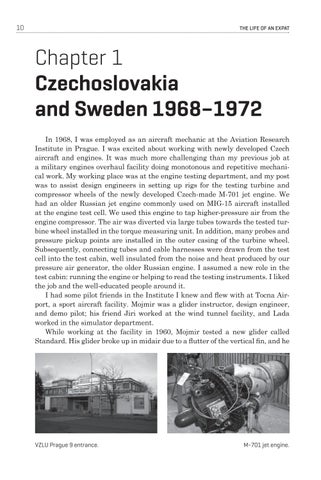
Chapter 1 Czechoslovakia and Sweden 1968–1972 In 1968, I was employed as an aircraft mechanic at the Aviation Research Institute in Prague. I was excited about working with newly developed Czech aircraft and engines. It was much more challenging than my previous job at a military engines overhaul facility doing monotonous and repetitive mechanical work. My working place was at the engine testing department, and my post was to assist design engineers in setting up rigs for the testing turbine and compressor wheels of the newly developed Czech-made M-701 jet engine. We had an older Russian jet engine commonly used on MIG-15 aircraft installed at the engine test cell. We used this engine to tap higher-pressure air from the engine compressor. The air was diverted via large tubes towards the tested turbine wheel installed in the torque measuring unit. In addition, many probes and pressure pickup points are installed in the outer casing of the turbine wheel. Subsequently, connecting tubes and cable harnesses were drawn from the test cell into the test cabin, well insulated from the noise and heat produced by our pressure air generator, the older Russian engine. I assumed a new role in the test cabin: running the engine or helping to read the testing instruments. I liked the job and the well-educated people around it. I had some pilot friends in the Institute I knew and flew with at Tocna Airport, a sport aircraft facility. Mojmir was a glider instructor, design engineer, and demo pilot; his friend Jiri worked at the wind tunnel facility, and Lada worked in the simulator department. While working at the facility in 1960, Mojmir tested a new glider called Standard. His glider broke up in midair due to a flutter of the vertical fin, and he
VZLU Prague 9 entrance.
M-701 jet engine.
11
Chapter 1 Czechoslovakia and Sweden 1968–1972
The Standard glider before the crash.
The Standard glider, after crash, wing remains in the field.
L-29 Dolphin training jet aircraft.
L-39 Albatross
lost both wings while trying a maximum speed with extended air brakes about 500 meters above the airfield. He managed to bail out. While descending on the parachute, he saw the glider fuselage smash down on the airfield and observed the wings spinning in the air. They found them later in the fields some distance from Letnany airfield. The old rescue parachute could not direct the descent, and Mojmir had never jumped. The wind took him over the Aircraft Research facility, where his parachute got caught on the tall lamp post where he remained hanging with his
14
THE LIFE OF AN EXPAT
Pavel V. in Demant glider at Tocna Airport. With my friends at Tocna Airport sitting in Blanik glider.
Finally, I had the honor of glider towing the best Tocna airport glider pilots, Vaclav and Vojta, to a tournament for men in Vrchlabi, Krkonose mountains! I stayed there for the event and towed them back when it ended. At the beginning of August, I paddled the Sazava River with my friend glider pilot Pavel; it was the last memorable event before the Russian occupation. The evening of August 20, 1968, was uneventful. I sat in the local pub with my friend Rudy, drinking beer for a few hours, and returned home. My brother woke me with a stone face the following day, telling me the Russians were there. We had been joking about that possibility, so I did not believe him. He opened the window and told me to look outside. I did, and simultaneously, I heard a distant sound shooting. Looking down at the street, I saw tanks with white stripes painted across the turret. Military exercise was the first thing that came to my mind. One of the tanks left the road, traversed the pavement, crushing the trees, and finally settled in the middle of the park. I knew we were occupied. But, like most of my fellow citizens, I was afraid, confused, and angry. I walked downtown, as no trams or buses were in service. I saw them everywhere: tanks and trucks full of soldiers, and to my surprise, they were more confused than us, looking around with puzzled eyes. Every Czech spoke some school Russian, and we were asking the soldiers a simple question. Why?
Russian Occupation, August 21,1968, Prague.
19
Chapter 1 Czechoslovakia and Sweden 1968–1972
I watched the Swedish countryside passing by, lakes, forests, and rocks until it darkened. The train was supposed to arrive in Orebro at about 20.00, but we were still speeding in the country then. I knew something was wrong, and I went to find the train steward and showed him my ticket. He quickly discovered my problem and that my vocabulary was far below the minimum in any Western European language. He collected my luggage and let me get off the train at the next station in Skovde. The personnel at the train station took care of me and guided me to the next train going to Orebro. Later, I found that if I stayed on the first train, I would end up in Oslo, Norway, and probably would be a Norwegian citizen today. Finally, the train stopped at Orebro station after a short ride, and I saw on the half-open platform the family Rahlen, Gote, Eva, Christina, and Lena waiting. All were cold and worried but happy. I knew I was home.
Orebro and family Rahlen The family lived in a smaller, more comfortable wooden villa with a small garden in Rynninge, on the outskirts of Orebro. I recall my first meal after arrival, consisting of sandwiches that everyone around the table took: sliced bread, salami, ham, and slices from a block of hard cheese. However, it took me a few minutes to master the usage of a Swedish cheese knife. I have learned that Swedish people love to eat sweet bread called limpa sweet mustard and drink milk with their meals. We talked, assisted by Eva, who could still remember some Slovak words after all those years. I was tired and happy when they showed me my room and bed. My first night in Sweden was dreamless. The following day, I went with Eva to the police station to report my decision not to return to the Czech Republic Water tower, Orebro. and ask for asylum.
Orebro castle.
Eva, Christine, and Lena at their home.
57
Chapter 2 Africa, Nigeria 1972–1974
Chapter 2 Africa, Nigeria 1972–1974 Amsterdam Airport was known to me from my previous trip to Schreiner, and after a 30-minute train ride, I was in Den Haag and checked in Scheveningen to hotel Europe. After a few days of arranging formalities, such as visas to Nigeria and signing several documents, I was ready for my African adventure. I was not a Swedish citizen traveling on a Swedish Framlingspass passport, usually issued to stateless people with permanent residence in Sweden. I was driven to Schiphol Airport the following day and boarded a KLM DC-8 bound for Lagos via Madrid.
Scheveningen Den Haag 1972.
Arrival in Lagos The trip took about 8 hours, and we touched down at Ikeja Airport. In those days, the airport facilities consisted of a few old colonial-type hangars and low barracks serving as arrival and departure halls and immigration and customs facilities. It was hot, and no air conditioning in service. I was nervous and hoping someone from Aero Contractors of Nigeria would show up and help me through. The passengers have lined up in front of the immigration. The progress was painstakingly slow as we were continuously bypassed by local people holding many passports and arranging formalities for others who paid them. Later, I learned that a 10-dollar note in the passport could get you through without waiting. The Nigerian officer supervising it all held about a half-meter-long stick, which I thought was the kind of stick usually carried by high-ranking officers in
58
THE LIFE OF AN EXPAT
the British Army. But, at a closer look, and to my surprise, it was a long back scratcher, stick with handle and tip with five little fingers. Once through with my luggage, I saw a tall white guy holding an Aero Contractors of Nigeria sign with my name on it. It was Henk, Dutchman, and the company operations manager. Henk drove me to the company guesthouse outside the Ikeja Airport Hotel. Ikeja is situated outside of Lagos, and back in 1972, it was still a bush town or, rather, a village. For my eyes, it looked exotic: black people, palms, roads lined with small dirty shops selling anything. Nigerian women always had empty hands and carried everything on their heads. It could be anything, from a bucket of water to small items like an orange or umbrella. That is why they always walk straight up and do not bend. It was hot; I was tired and looking forward to seeing my living quarters. It was a colonial-style villa with a garden and few trees; a little grey monkey attached by rope was sitting on one of them. It was Fred, a friendly creature, and he jumped immediately on my shoulder and, with his little hands, started to search through my hair, hoping to find some flees. One could see many halffoot-long black and orange lizards on the ground. At the door, I was greeted by James, our house employee, cook, cleaner, or whatever else was needed.
Ikeja road 1972.
Ikeja Aerocontractors company guest house.
Ikeja domestic Hotel.
View behind the guesthouse.
89
Chapter 3 Indonesia 1974–1977
Chapter 3 Indonesia 1974–1977 Transfer to Indonesia from Nigeria in 1974 was a ticket to paradise! It started in Den Haag at Schreiner Company head office, where I signed a new contract with Dick, the company’s H.R. manager. The man was a close friend of Mr. Schreiner, the owner, and probably the best-known person to all employees. The head office was still in a prominent three or 4-story building on the seafront in Scheveningen that I knew from previous visits. After you entered the building, there was a large hall with an unrestricted view of the glass roof top. The giant globe dominated the middle of the hall. All offices were built in a circle around the arena and interconnected through large balconies and staircases. I do not recall any elevators. I had to visit the Indonesian Embassy with the Schreiner company clerk, apply for a visa, and wait a few days for the permit to be issued. I was still a stateless person with Swedish travel documents only. While waiting for my
Schreiner office at Scheveningen Den Haag 1974.
Abu Dhabi Airport terminal 1974.
Schreiner office during air show 1983.
KLM DC 10 on the apron in Abu Dhabi 1974.
90
THE LIFE OF AN EXPAT
visa, I spent a few days in the hotel, having fun with a few German girls on vacation and exploring Den Haag. After a few days, my visa was ready to collect, and I got a KLM ticket to Jakarta via Abu Dhabi and Singapore. The trip was far too long for my taste, but I had an empty seat beside me and could sleep a little.
Jakarta arrival 1974 In Jakarta, we landed at Kemayoran Airport. When landing, Jakarta appeared to be a giant village of tiny houses with red roofs. In the middle of town, I could see some tall buildings. Unlike my trip to Lagos, nobody was waiting for me. Immigration and customs were reasonably friendly people and acted very fast. I was in Indonesia. The money changer gave me Indonesian Rupiahs, about 400 to 1 USD, so that I could pay for the taxi ride. I had the address to the company guest house in Kemang, and after a wild ride in an old yellow car wreck with a crazy taxi driver, I arrived at the guest house. I stepped into a story bungalow type of house, and the first thing I saw was a large bar full of people, mostly helicopter pilots. I was introduced to Dennis Keys, Tony Bolter, Ted Munday, and technician Ian Murray.
Kemayoran Airport Jakarta.
Jalan Thamrin 1974.
President taxi (mine was a wreck).
The “Seven Up” monument.
Chapter 4 Australia, New Zealand, Tahiti, USA and Sweden
Chapter 4 Australia, New Zealand, Tahiti, USA and Sweden I quit my job for Pelita Air Service/Schreiner in May 1977 and left Indonesia at the beginning of July. I still had one month of paid leave and an airline ticket back to Sweden via Sydney, Auckland, Tahiti, and Los Angeles. My visa to Australia and New Zealand were arranged in Jakarta, and I was ready to go. My new job in Sweden for Sterner Aero in Borlange started on the 1st of September, so I had enough time and money for this long trip. We had a small party in Jakarta the day before departure, and I boarded Qantas Airlines for Sydney the next morning. The flight was uneventful, and I only noticed a complete absence of air hostesses, only stewards on this flight. The immigration and customs clearance went fast, and soon I was sitting in the taxi with a friendly driver, who took me to Hotel Canberra in Kings Cross, recommended to me by John, an Australian pilot flying for Schreiner in Kalimantan. He did not tell me that Kings Cross was a kind of red-light district and that Canberra was a “dry” hotel, meaning no beer was served. Nevertheless, I took it bravely; the next day, I fought my way from the redlight district to more excellent parts of Sydney to see the famous Opera House and look for my Czech friend Boris, whom I met on Celebes, where he worked as a dispatcher for Gulf Oil Company. His name is Boris Dolay, which he acquired in Australia to fit better in local society. The original name was Dolejsi, which
Sydney 1977.
145
146
THE LIFE OF AN EXPAT
was probably difficult for Australians to pronounce. I got his Australian address in Indonesia, which was not difficult to find. After locating the apartment building, I looked at the two doorbell lines. To my surprise, there were no names, only apartment numbers. I asked a man leaving the building if he knew my friend, and he told me to push bell number 16, but nobody answered. A few days to explore Sydney was enough, and not knowing anyone else in town, I decided to stay one more night in my “dry” hotel and flew to Oakland on the North Island the next day. The New Zealand immigration and customs officers were much friendlier than their Australian counterparts. Once again, I spent a few days looking around, but all my Kiwi friends were in Indonesia then, so I cut my trip short and flew to Tahiti.
Tahiti Papeete on Tahiti was my next destination, and after exploring this exotic town, I went to a travel agent to find other options. The travel agent suggested Morea Island, not far away from Papeete. I asked for Club Med, but it was fully booked. So, in Morea, I checked into a lovely bungalow-type hotel and rented a car to explore this small island. I was fascinated by the high and incredibly sharp mountain peaks, greenery, and neat villages. My French was nonexistent then, but mostly Americans and English-speaking Europeans were in the hotel. I swam and paddled on a Tahitian-style canoe with an outboard float and admired the clear water. Biking was another way to spend time, but local dogs did not appreciate bikers. I had to pedal for life on during bike outing as two vicious creatures were snapping at my legs. Finally, I visited Club Med in Morea and regretted not staying there. Back in Papeete, I tried again to book Club Med; this time, I was lucky. They had a vacancy in Bora Bora Club Med, and I booked three weeks. The next day, I was on the way, flying in Fokker 27 aircraft, and after two hours, we landed at an airport based on an island near Bora Bora. The rest of the trip was by boat, and there I was. Bora Bora was a magnificent island surrounded by coral reefs. I saw the beach facing a vast lagoon, with a Moto Tapu palm tree overgrown islet in the middle. The Club Med was built on Bora Bora, small huts on stilts and other Club facilities.
Tahiti,Papetee harbour 1977.
Morea Club Med.
Presenting Nyge Aero Lear 35 to visitors 1993.
First Zlin 242L aircraft in Nykoping Sweden 1993.
375
376
THE LIFE OF AN EXPAT
Ben, Roland and Evert. Ben and Evert were Schreiner managers, Jakarta, 1986.
Czech CAA inspectors at W.P.Beach Airport for helicopter acceptance in 1996.
Driving to Czech Republic in 1994.
Me, Vaclav and Char (my father in-law) in Pisek 1994.
377
378
THE LIFE OF AN EXPAT
Mark and Kim on Bali in 1997.
Kids Club boat trip in Dominican Republic, Punta Cana vacation, 1995.
International School of Prague in Nebusice.
My cousin Martin, technical director at Cassovia Air, standing with the VSZ company‘s Hawker 800 business jet.
379
380
THE LIFE OF AN EXPAT
My father in-law, Char, and brother in-law, Han, visiting archbishop Vlk in Prague 1993.
My father on Charles Bridge in Prague 1985.
My brother Bohumil with Klara and my daughter Caroline in Prague 1986.
Meeting my old friend, glider pilot Lubos, at Tocna Airport 1994.
381
382
THE LIFE OF AN EXPAT
My father‘s summer residence 1986. An old watermill converted into a living summer residence,
My Wedding in The Netherlands, Beek, with Nancy‘s family in September 1987.
Rauytheon Company dinner in Prague with Peter and Doug in 1996.
Steve and Jiri signing the Joint Venture agreement in Prague 1994.
383
Dayak woman from 1974
Vydalo nakladatelství Machart v prosinci 2023 jako svoji 302. publikaci. / Vydání první. Grafická úprava a návrh obálky: Kameel Machart / Jazyková revize textu: autor Použité fotografie: archiv autora ISBN (tištěná kniha): 978-80-7656-080-2 ISBN (e-kniha): 978-80-7656-081-9 www.machart-books.cz
m a ch ar t