
The Officers and Trustees of the Knights Templar Eye Foundation wish to thank all Grand Commanderies that have become either 100% or 200% Life Sponsors within their jurisdiction and to those Grand Commanderies that are actively working towards the 100% goal.
2025 - Louisiana, Minnesota & Florida
2024 – Colorado, Alaska, North Carolina, Washington & South Dakota
2023 – North Dakota, Idaho & Kentucky
2022 – Utah & Maryland
2021 – Iowa, Connecticut & Illinois
2020 – Ohio & Texas
2017 – Virginia
2015 – District of Columbia & Wyoming
2014 – Tennessee & Montana
1996 – South Carolina & Oregon
1995 – Alabama
1994 – New Hampshire
1987 – Georgia
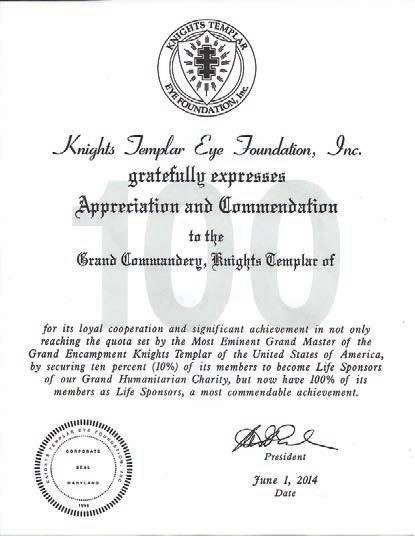
2020 – Texas & Ohio
VOLUME LXXII SPRING 2026
Grand Encampment of Knights Templar of the United States of America

David J. Kussman Grand Master
Jack Harper
Grand Generalissimo & Publisher
ADDRESS CHANGE OR CHANGE IN MEMBERSHIP
Please report all changes in membership to the Grand Recorder:
Lawrence E. Tucker Grand Recorder
Grand Encampment Office
3 Sugar Creek Center Blvd Ste 410 Sugar Land, TX 77478
Phone: (713) 349-8700
Fax: (713) 349-8710
E-mail: larry@gektusa.org
Magazine and correspondence to the editor should be sent in electronic form to the managing editor whose contact information is shown below. All photos or images should be property of the author, or used with permission or under license by the author, unless expressly noted otherwise.
Ben Williams Managing Editor
Laughing Lion 1100 W Littleton Blvd Ste 440 Littleton, CO 80120
Phone: (720) 328-5343
Fax: (720) 328-5297
E-mail: ben@ktmag.org
visit our website at:

ONE well established pilgrimage program with over 40 years of experience.
TWO divisions of this program.
Our Mission: To send credentialed Christian Ministers on a Biblical study and historical / cultural immersion experience who would not have the opportunity otherwise.
PURPOSE: To strengthen Christian ministry by providing an intensive travel and study program for credentialed ministers in the form of a study pilgrimage to the Holy Land. Our experience tells us how much the opportunity to ‘walk where Jesus walked’ can positively affect the preaching, teaching, and spirituality of Christian ministers. It is our plan to immerse the Pilgrim ministers in the land, the sights, the sounds, the history, and the cultures of the Holy Land, past and present.
Travel groups for February/March of 2026 are already booked and preparing for travel.
The registration process is already open for February of 2027. Price will be finalized in the early months of 2027 but registrations can be received by our Registrar based on the anticipated cost.
Group A, Monday, February 1 – Thursday, February 11, 2027
Group B, Monday, February 15 – Thursday, February 25, 2027
IN THE FOOTSTEPS OF JESUS HOLY LAND PILGRIMAGE for Sir Knights, their Ladies, friends, and guests is open to anyone. Each person is responsible for their own fees and expenses related to the pilgrimage. Each person is responsible for being able to manage their own luggage and follow the itinerary. This pilgrimage is an 11day program that covers as much ground as possible in the touring days (we average 5 – 7 miles of walking many days, often uphill or up steps and on uneven surfaces). This opportunity offers to others the chance to participate in a parallel program and have their faith and depth of belief deepen.
We are ready to add to our registrations for this pilgrimage in the fall of 2026.
November 9 – 19, 2026. Check it out now. We will accept up to 45 registrations.
Use this web address or access the Pilgrimage site from the Grand Encampment site.
Sir Knight David J. Kussman, GCT Grand Master of the Grand Encampment of Knights Templar
To the Sir Knights of the Grand Encampment of Knights Templar Greetings in the name of our Lord, Jesus Christ!
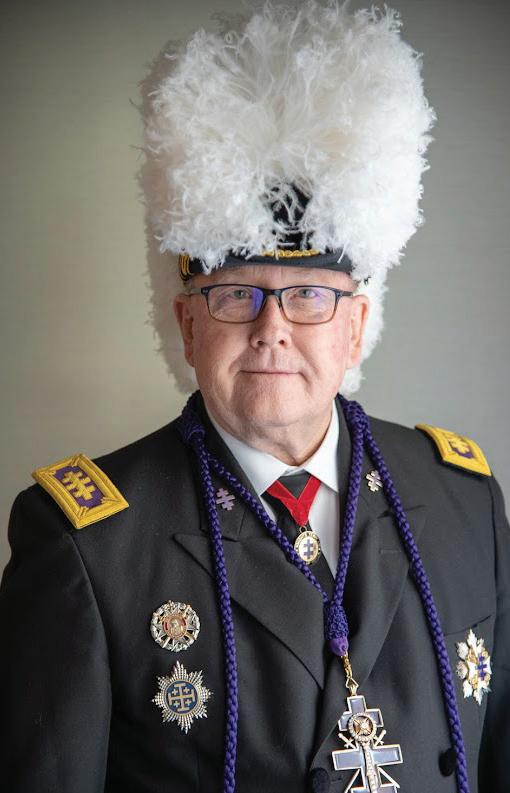
Ihave had the privilege of serving as your Grand Master for several years now. I have had the opportunity to visit commanderies and Grand Commanderies across our nation and witness a situation which, if not addressed soon, will, I believe, eventually end the legacy of our most beautiful Order.
The crisis I am referring too is the diminishing number of members who can confer our Orders in an efficient and competent manner. Many have heard me state that ritual is not what we are, it is what we sell.
The fact that many commanderies can no longer confer our orders, including opening and closing ritual and tactics, has resulted in a lack of confidence, quality, and reputation within their jurisdictions. Senior members who once proudly performed the work beautifully and effectively are rapidly diminishing. Unfortunately, they are not being replaced by competent ritualists.
I have witnessed many members who are willing to settle for incompetent work, citing lack of time, talent, or holding that “it’s just not that important anymore.” I emphatically disagree. Let me share something I read many years ago to help me remind you why our standards are extremely important.
I remembered a story told by Baseball College Hall of Fame coach John Scolions in 1996 at the 52nd annual American Baseball Coaches Association convention. In front of over 4,000 coaches, he walked out on stage with a home plate tied around his neck.
After some opening remarks, the coach asked: “Do we have any Little League coaches out there?” Several hands went up. “Do any of you know how wide home plate is in Little
League?” One quiet voice answered, “Seventeen inches?” “That’s right,” the coach said.
“Now, are there any high school baseball coaches in the room today?” Over a hundred hands shot up. “How wide is home plate in high school?” “Seventeen inches,” someone said. “You’re right!” the coach replied.
“How about college baseball coaches?” Half the room raised their hands. “Well, how wide is home plate in college baseball?”
“Seventeen inches!” everyone yelled out in unison.
“Back in Babe Ruth’s day, how wide was home plate?” Silence hit the room, then someone sheepishly yelled out: “Seventeen inches?”
“That’s right,” the coach said.
The coach changed his focus and asked, “What do you suppose a Major League team’s management would do if a big-league pitcher couldn’t throw a ball over a seventeen-inch plate?”
He paused and the room fell silent.
“They send him down to the minors or fire him!” Filled the void. “But let me tell you what they would never ever do. They would never say, ‘Ah, that’s alright buddy, if you can’t throw a baseball over a seventeen-inch target we’ll make it bigger for you – maybe we’ll widen it to nineteen or twenty inches so it will be easier for you; and if that’s not enough we’ll make it twenty-five inches wide.’”
Scolions then asked the audience, “Here’s a question for each of you. What would you do if your best player consistently showed up late for practice? Or if your team rules forbid facial hair and some of your players showed up on game days unshaven? What about if one of your players got caught drinking after hours the night before a game? Would you hold those players accountable, or would you widen home plate for them to fit their new standard?”
The 4,000 coaches sat quiet as the old coach’s message began to mesmerize them.
Coach Scolions then turned the plate on his chest towards himself and took out a black magic marker to draw something on it. When he finished, he turned the plate around for the crowd to see. He had drawn a simple house complete with a front door and two windows.
He then said, “The problem with most
homes in America today – and with many organizations – is people haven’t created and enforced standards. We no longer teach our children, players, employees, or our members accountability. It’s so much easier for parents, managers, and executive directors to just simply widen the plate!”
There are no consequences when people today fail to meet standards.
“Let’s face it; we’ve lowered standards in education. Has widening the plate helped our schools? We’ve changed the standards in some religions – has widening the plate helped our churches? We have lowered the standards across the government – has widening the plate made our governments better?”
Then he turned the home plate on his chest around to reveal the backside of it again and said, “When we fail to hold ourselves, our children, our players or our employees accountable to any standards our future gets dark.” The backside was completely black.
Coach Scolions’ message could not be clearer. It’s so easy to call a ball a strike. It’s easier to watch a standard be missed than to correct it on the spot. It’s more comfortable to ignore a problem than to fix it.
We all need to personally uphold the standard and correct those that are not meeting it. Not in an angry, righteous manner but, as John Scolinos would do, by holding firm to the standard and prioritizing accountability.
While the message of upholding the standard is perfect for our members, the real message I wanted to convey in telling a modified version of this story was that it applies to every aspect of life.
It’s time we all recommit to our standard and hold ourselves and our members responsible in a professional, Templar way.
Know the standard. Espouse the standard. Live the standard. Enforce the standard.
Don’t Widen the Plate!
David J. Kussman, GCT Grand Master
SK B. Chris Ruli, EPC and Grand Historian of the Grand Commandery of the District of Columbia, presents the official and comprehensive history of the Knights Templar in Washington, D.C.
Presented in a beautiful hardcover format with over 70 illustrations, Ruli’s new work is a must-have for any Sir Knight interested in American Templar history.
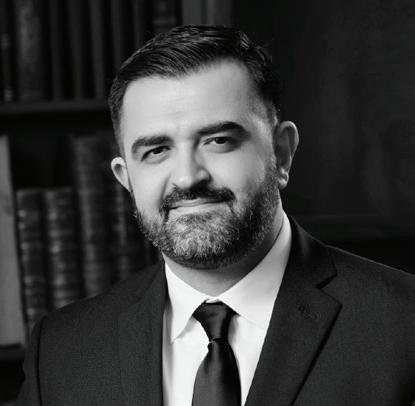

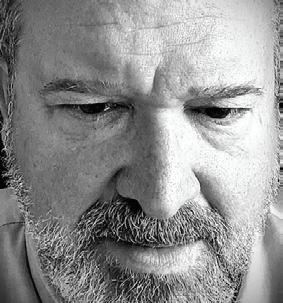
D. Bruce Beardsley is a member of Weston Lodge No. 22 in Littleton, Colorado. His writing focuses on esoteric currents and ancient mystery traditions woven into the fabric of Freemasonry. He explores hidden symbolism, initiatic patterns, and philosophical lineages that connect the Craft to the wisdom of the Hermetic, Platonic, and Near Eastern mystery schools.
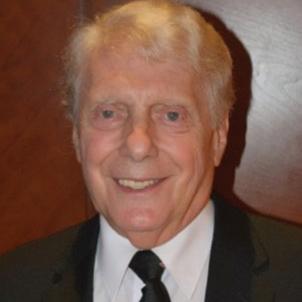
Charles "Chic" Cicero was born in Buffalo, New York. An early love of music, particularly of the saxophone, resulted in Chic’s many years of experience as a lead musician in several jazz, blues, and rock ensembles, working with many famous performers in the music industry. Chic is a member of several Masonic, Martinist, and Rosicrucian organizations. He is a Past Grand Commander of the Grand Commandery of Knights Templar in Florida (2010–2011). He was also a close friend of Dr. Israel Regardie. Having established a Golden Dawn temple in 1977, Chic was one of the key people who helped Regardie resurrect a legitimate, initiatory branch of the Hermetic Order of the Golden Dawn in the United States in the early 1980s.
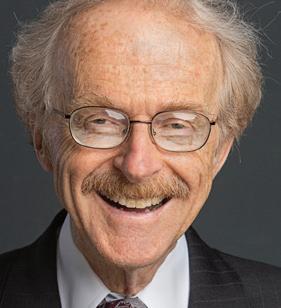
R. Stephen Doan received a Bachelor of Arts in Political Science from the University of California at Los Angeles in 1971, graduating summa cum laude, with highest department honors. He is a member of Phi Beta Kappa. He received his Juris Doctor degree from the UCLA School of Law in 1974. He practices law with his daughter in Rancho Palos Verdes, California, specializing in business and real estate planning, tax and estate planning, and trusts. He was formerly a senior partner of Morrison & Foerster, LLP, an international law firm. Among many Masonic affiliations and offices, he is a Past Grand Master of Masons of California, and a Past Grand Sovereign and the current Grand Recorder of the Red Cross of Constantine.
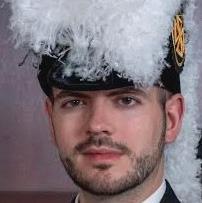
Elijah Mills is the Deputy Grand Commander of the Grand Commandery of D.C. A Past Commander of Columbia Commandery, No. 2 and Potomac Commandery, No. 3 (both of D.C.), he remains active in both the constituent and grand levels of Templary. For his efforts in reorganizing the handbook for new Sir Knights and overseeing the administration and education of new Sir Knights, he was awarded the Knight Templar Cross of Honor (KTCH) in 2018. SK Elijah was raised in 2011 at Beech Grove Lodge, No. 694 in Indiana and is a Past Master of the former Arminius Lodge No. 25. He is a parish administrator for the Episcopal Church.
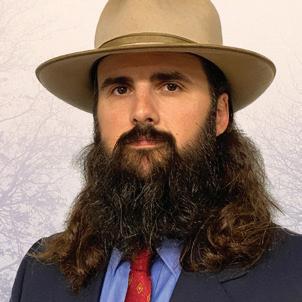
Taylor Nauta is a Past Commander of Plains Commandery No. 11 in Baton Rouge. Formerly a teacher of Anatomy and Physiology and Kinesiology at Medical Training College, he signed a recording contract with Red Stick Records in February of 2022 and is now a full-time, professional, touring singer-songwriter. When he’s not writing or performing, he’s fly fishing somewhere or spending time with his wife, stepson, and twin daughters.
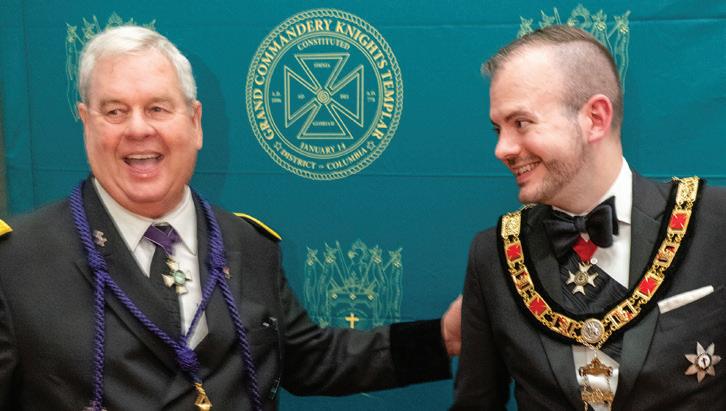
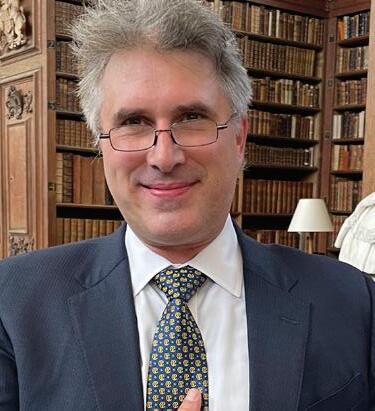
Ben Williams is a Registered Patent Attorney based out of Denver, Colorado. He’s a Past Department Commander for the Northwest Department and has held many Masonic offices in his home state of Colorado. He’s married to his patient and caring wife, Tiffany, a history teacher. They have a daughter, Adelyn, and a beagle, Warwick.



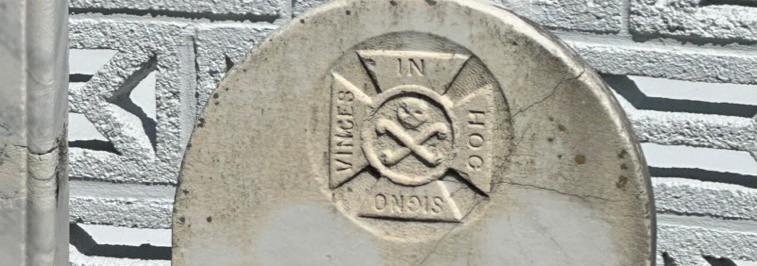
Sometimes, it’s hard not to talk about politics. Especially with all that is going on. We have the injunction against talking politics and religion in Lodge or Commandery for good reason. But there was a time when Masonry was, in fact, exceedingly political.
Consider that the only thirdparty really to rise to prominence in the United States, aside from the Republicans and Democrats, was the Anti-Masonic Party. It’s chief platform? Stopping the Masons from their nefarious in-dealing and nepotism in political preferment.
In many respects, the accusations levied at the Lodge in the nineteenth century are similar to those being levied against Jews today in what appears to be a growing climate of hostility toward Israel – that Masonry comprised a state within a state, with members loyal first to the Fraternity, then to each other, and last to America. This alleged divided loyalty cast suspicion on Masons and their motives.
Part of me wonders if some of the decline in our membership doesn’t stem from an overapplication of this injunction. I’m not advocating for political discussion in Lodge or Commandery – don’t get me wrong – but there was a time when Masons were a bloc to be reckoned with. Like the church (which is not meant to be political either), the Masons’ vote meant something. That’s partly what made the Fraternity a target, no doubt, but, for better or for worse, it probably also attracted members.
The original injunction comes from Anderson’s Constitutions of the Free-Masons. The exact text doesn’t say Masons are not to discuss politics or religion in Lodge, but not “to bring religious or political disputes into the Lodge” (emphasis mine). This is, of course, sensible. But the ability
to discuss comparative religion (as opposed to proselytizing) or political theory (as opposed to stump speeches) in Lodge seems permissible – at least it should be. After all, according to the Fellow Craft degree (as practiced in Colorado), Freemasonry is “so far interwoven with religion as to lay us under obligation to pay that rational homage to the Deity which at once constitutes our duty and our happiness.” We are meant to contemplate religious diversity and political theory. After all, the Lodge is the perfect microcosm for Western society: a form or representative governance inspired by a duty to God and our fellowmen.
Understanding the means of deliberation in assembly is fundamental to the running of the Lodge and also philosophically interesting. It necessarily touches on fairness. Individual liberties are tempered with mind to a majority will or opinion. Yet the minority opinion must always be allowed to be heard. This is fundamental. If Masons are unable to bridge this difference of opinion, how can we expect laymen to do so?
The frame of American government owes much to Enlightenment philosophy and humanism. Modernly, we take it all for granted; it seems obvious. But there was a time when this philosophy was decried as base and dangerous. Chief among its critics, aside from royals across the Europe, was the Church. Pope Leo XIII especially railed against the idea of representative governance and the separation of church and state. And he blamed Masons for a lot of it.
Yet, Western civilization finds its earliest expression in the polis, the Greek city-state sovereignty where all males over the age of 18 were part of the deliberative assembly, the ekklesia. It was this representative sovereignty that fostered eudaimonia – roughly, “flourishing” – to live well (instead
of merely living). This eudaimonia is what arose excellence in pursuit of virtue. It’s not an easy word to translate (readers familiar with Greek might prefer the translation “good spirit” – literally); however, there is something in it about perfecting the soul and living in accordance with a means to that perfection in emulation of Divine laws. This is, obviously, the aim of Masonry. It’s also the aim of politics and religion.
In a manner of speaking, Plato suggested politics is the art of leading people to God. In a polis, the people created the best means of inspiring good in the soul whereby the soul could acquire nous and develop “sight.” There was no singular way to do this. No proven method. The only constant was to create a space wherein the soul could delight in its own discovery.
The only constant was to create an environment to facilitate eudaimonia in its diverse persons that manifested the glory of God within them.
In my mind, the time is ripe for Masons to consider the Constitution of the United States, the Federalist Papers, even the Articles of Confederation and other founding literature of this great nation, alongside the bylaws of the Lodge and the constitution of the Grand Lodge wherein they work. The similarities are worthy of contemplation. The underlying philosophy paramount. Never forget, the United States is very much a Masonic country. It needs us now more than ever.
Ben Williams Editor
by Boondoggle
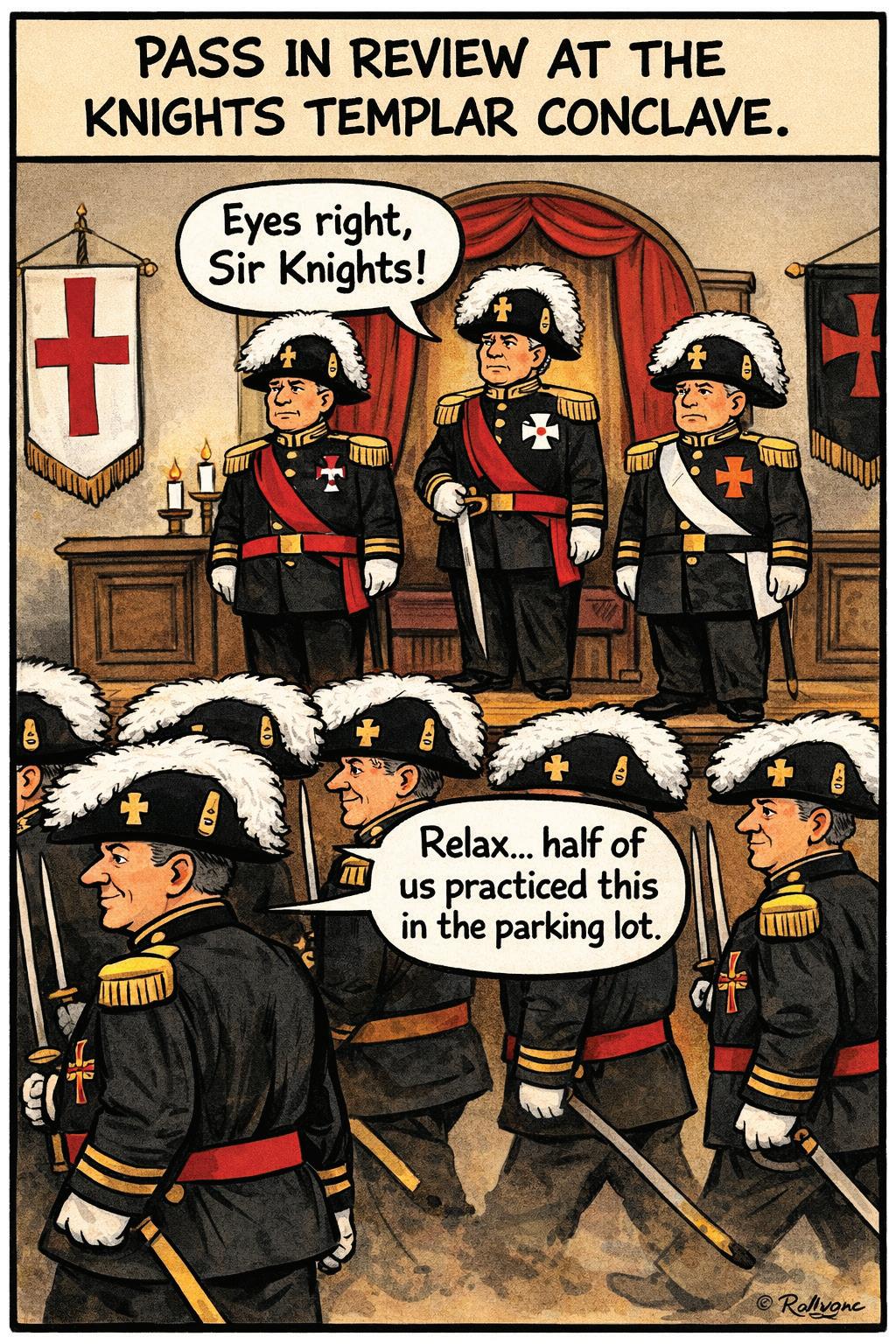
by R. Stephen Doan

Lent runs from Ash Wednesday to Maundy Thursday. These dates of course move with Easter, as Maundy Thursday is the Thursday before Easter. Easter falls on the first Sunday following the first full moon that occurs on or after the day of the vernal equinox, always March 21 (known as the “ecclesiastical equinox”).
Lent lasts forty days, the time Jesus spent in the wilderness after His baptism in the River Jordan by St. John the Baptist. The beginning of the forty days is observed as Ash Wednesday. This year, Lent runs from Wednesday, February 18, to Thursday, April 2. Lent is marked by fasting, both from foods and festivities, and by other acts of penance.
Lent is one of the most ancient and formative seasons of the Christian liturgical year. Its roots lie in the early Church’s preparation of catechumens for baptism at Easter and the penitential practices of believers seeking renewal of faith.
By the fourth century, Lent had largely assumed its familiar forty-day structure, echoing Christ’s forty days of fasting in the wilderness. From its beginning, Lent was understood not merely as a time of abstinence, but as a period of intensified prayer, self-examination, almsgiving, and disciplined ordering of one’s life toward God.
The medieval Order of the Poor Fellow-Soldiers of Christ and of the Temple of Solomon – known as the Knights Templar –observed Lent within this broader Christian tradition, yet with distinctive rigor shaped by monastic discipline and military vocation. As a religious order under vows of poverty, chastity,
and obedience, the Templars followed a Rule influenced by Cistercian monasticism. Lent for a Templar knight involved fasting, abstention from meat on prescribed days, communal prayer, frequent confession, and strict regulation of daily life. Their fasts were not ends in themselves but tools for cultivating obedience, humility, and readiness for sacrifice. Lent also reinforced the Templar ideal of the miles Christi – the soldier of Christ – who disciplined body and will in service to God and neighbor, especially in the defense of pilgrims and the Holy Land.
Yet it is essential to remember that even in the Middle Ages, the Rule allowed for mitigations. Knights weakened by illness, age, or the demands of active service could receive dispensations. This flexibility underscores a crucial principle: Lenten discipline was always ordered toward spiritual formation, not self-destruction. The goal was the integration of prayer, asceticism and duty.
Men today who seek to emulate the Templar tradition face realities vastly different from those of medieval warrior-monks. Modern obligations – employment, marriage, family life, and civic responsibilities – preclude monastic withdrawal or severe fasting regimes. Nonetheless, the spirit of Templar Lenten observance can be authentically honored through intentional adaptation rather than literal imitation.
A contemporary “Templar-inspired” Lent might emphasize three pillars.
First, disciplined prayer: establishing a fixed daily rule, such as morning and evening prayer, Scripture reading, or the Psalms, mirrors
the ordered devotion of the medieval knight.
Second, ascetic restraint: modest fasting, abstaining from excess, limiting digital distractions, or simplifying diet can train self-mastery without impairing vocational responsibilities. Third, service and charity: conscious acts of generosity, protection of the vulnerable, and faithful fulfillment of one’s duties reflect the Templar commitment to sacrificial service.
Above all, Lent in this tradition should cultivate interior fortitude – steadfastness, obedience to conscience, and readiness to serve Christ in the world as it is. In this way, modern men may walk the Lenten road not as reenactors of medieval austerity but as heirs to a living tradition of disciplined Christian knighthood, renewed each year in the light of the Cross and the hope of Easter. KT
by Elijah Mills
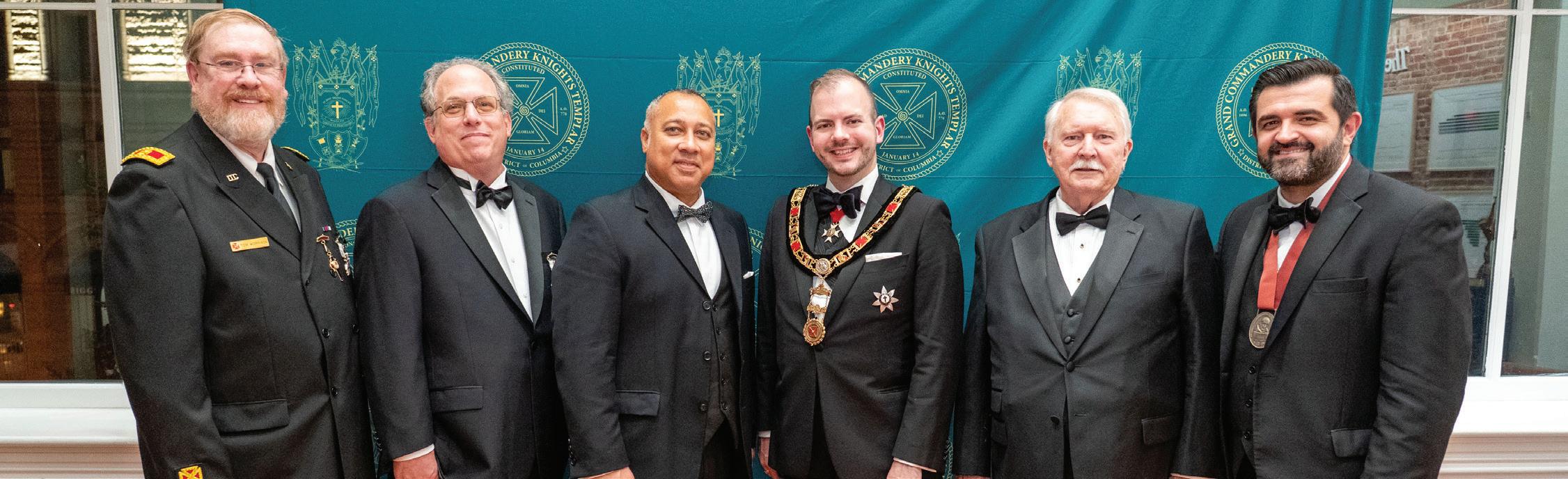
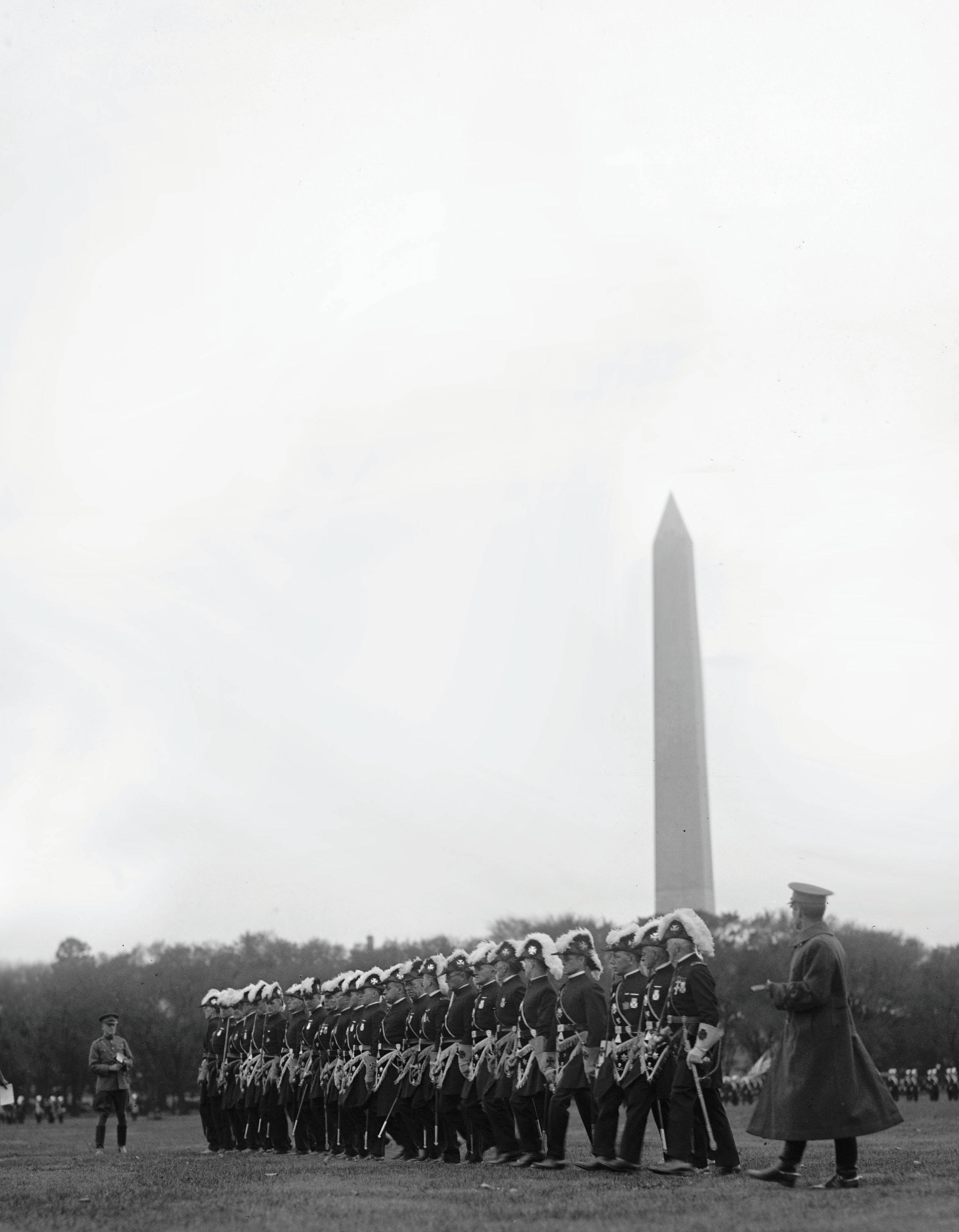
WASHINGTON, D.C. –On September 20 at 7 p.m., dozens of Sir Knights descended upon 901 F Street NW in Washington, D.C., to celebrate the first published history of the Grand Commandery of Knights Templar of the District of Columbia.
Although Templary is in its two hundredth year in the District (and a couple of Commanderies have published their own histories), a formal history for the Grand Commandery of the District of Columbia had not been written.
Prominent Masonic author and Commander of one of the Constituent Commanderies in the jurisdiction of the District of Columbia, B. Chris Ruli, was contracted to write the history.
Throughout the history of the Grand Commandery of the District of Columbia there are plentiful tales of fetes, formal balls, and parades across the nation’s capital. In keeping with this tradition, a book launch was planned. The aim: to make the launch worthy of inclusion in the next history of the Grand Commandery!
An issue arose because the District of Columbia doesn’t have a Grand Lodge building per se (there are offices, but nothing like a historic temple). Some local blue
lodges own buildings in town, but many of them were deemed disadvantageous for the party because of location, size, and parking. A suggestion was made to contact the Gallup Organization since it currently occupies the old Masonic Temple on 901 F St NW, the first home of the Grand Commandery.
Emails were sent, appointments made, tours undertaken, and, thanks to some very kind people at Gallup willing to cut a reasonable rate, essentially for the historical fun of it all, the space was secured.
Aside from the façade, not much of the building’s Masonic past is readily discernible. However, the rooms retained much of the original hardwood flooring and, in the area tapped for the party, original brick is visible (now enclosed in a handsome glass atrium). The cornerstone is still visible below the entry staircase, and the fourth floor –the original home of the Grand Commandery – has that classic, large-asylum space. (When the building was sold, the Grand Commandery moved with other Masonic organizations to bigger and better spaces, until the last traditional Grand Lodge building downtown was sold in 1984. It is now the National Museum of Women in the Arts.)
Invitations were sent, catering and wine ordered, the Department Commander’s attendance confirmed; all that was left was to have the party. Given the mixed attendance of Sir Knights, candidates, and guests, the attire was black tie or Templar uniform. Many elected to wear black tie.
Guests filtered up the elegant staircase, admiring the original architectural details of the historic building. They were greeted by waiters with hors d’oeuvres and champagne. About an hour into the party – and crucially, once both the Department Commander and Grand Recorder had arrived – our author was invited to share some brief remarks. Sir Knight Ruli spoke directly to the historic nature of our organization and inspired us – not just with the sense of the good things we have done – but to remain inspired to do yet greater things in the future.
The remarks augmented the festive mood as drinks and food continued to be served while Sir Knight Ruli signed copies of the book for the guests. Every Sir Knight who was a member of a local Commandery was given a free copy. Additional copies were available for purchase.
The books are bound with a deep green hardcover, with gilded impressions of an historic
seal that we lightly modified to include the Grand Commandery centered on the cover (in place of the now defunct DeMolay Mounted Commandery No. 4). It runs a couple hundred pages and has a wealth of historic images inside showcasing the history of Templary in the nation’s capital. A quality collectible, it was made to match other top tier titles in possession of astute Masonic collectors.
The history of the Grand Commandery of the District of Columbia, from its creation in slightly rocky circumstances to the creation of the Easter Sunrise service that eventually became a Grand Encampment event, brims with events both parochial and national in character. The tales are often inspiring and, aside from the characters being local to the capital, render important lessons for any Grand Commandery. The book charts the rise to the height of Fraternalism to the present state – which looks a lot like the Grand Commandery did in the early years. Reading these accounts, the only reasonable interpretation seems to be that we must choose to be inspired and create, if not more Sir Knights, then better Sir Knights – and the rest will follow. KT
by Ben Williams
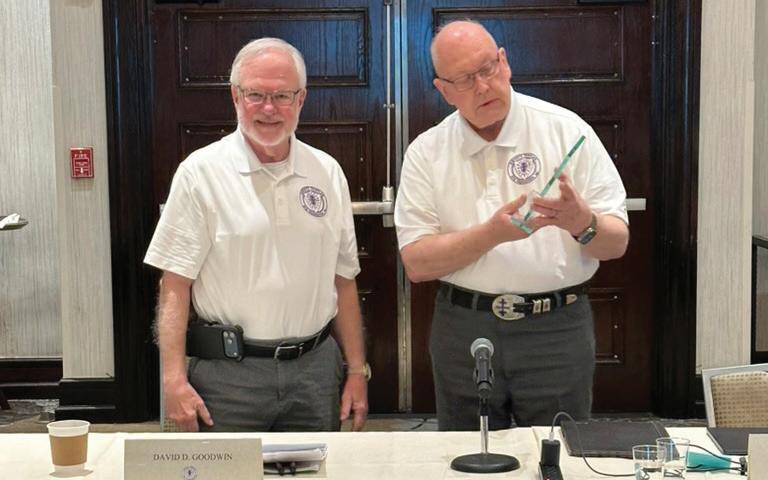
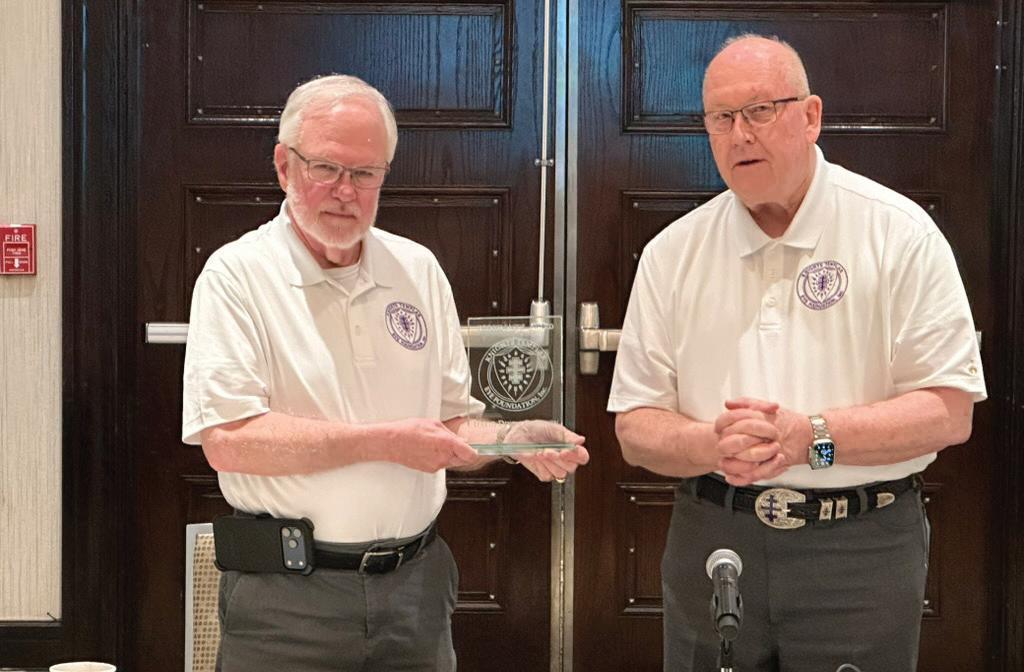
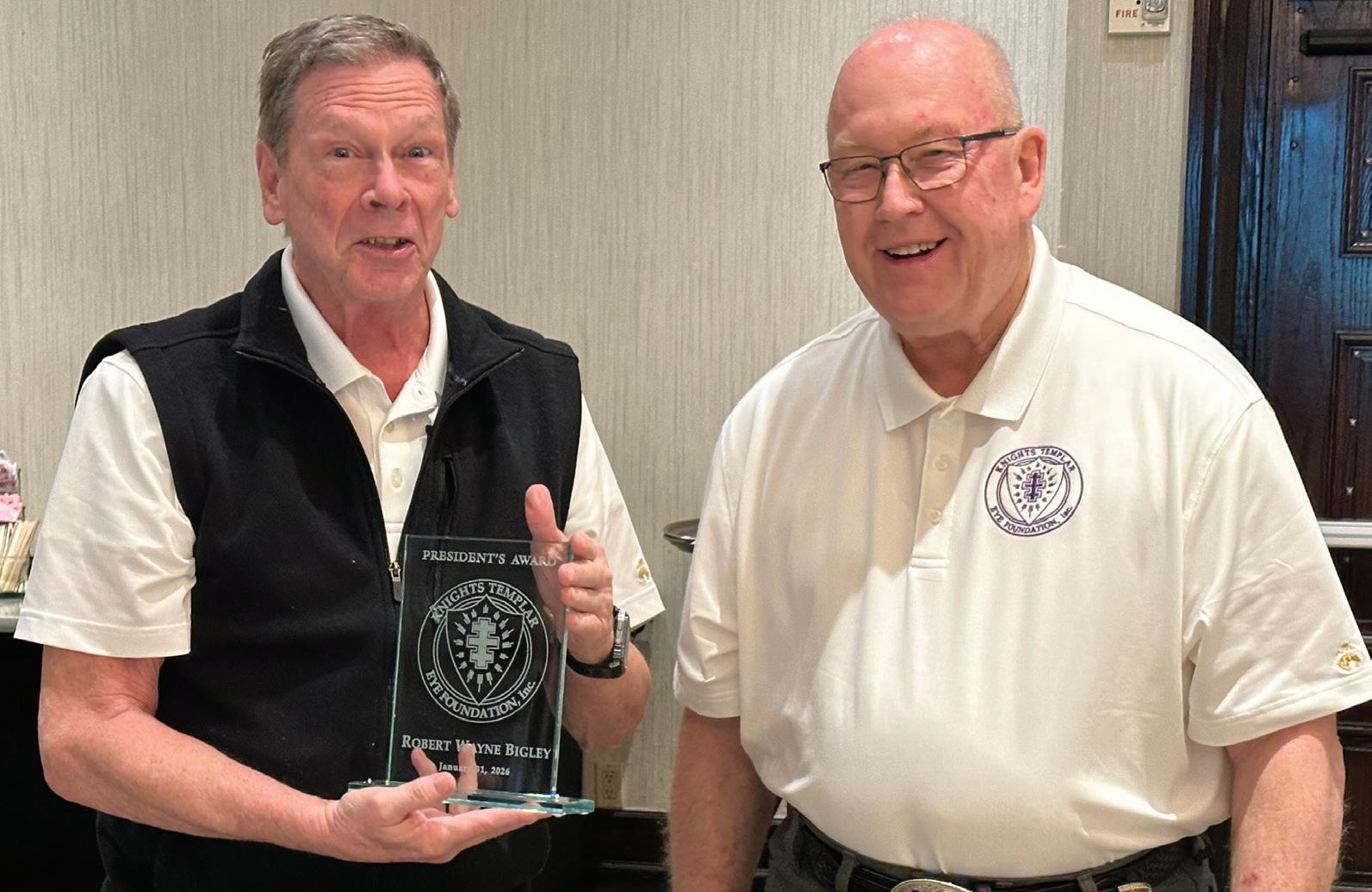
ONTARIO, CA – The first two President’s Awards for Meritorious Service were awarded at the semi-annual board meeting of the Knights Templar Eye Foundation on January 31. The awards went to Sir Knight David Dixon Goodwin, Executive Director of the Knights Templar Eye Foundation, and Knights Templar Eye Foundation Assistant Secretary and Office Administrator, Sir Knight Robert Bigley.
Sir Knight Goodwin received the award for his service as “president of the Eye Foundation, director, and executive director,” Sir Knight Kussman, President of the Foundation and Grand Master of the Grand Encampment, said, for “showing his passion and compassion for the doctors and the directors and the members of the Eye Foundation and our mission.”
Sir Knight Bigley received the award for “his vision, in implementing the efficient well-structured and well-serving philanthropy that it is today,” Kussman said.
The award is brand new, devised to recognize service exclusively to the Knights Templar Eye Foundation. It was implemented by Sir Knights Larry Tucker, Grand Recorder of the Grand Encampment, and Grand Master Kussman because there wasn’t a specific award available to recognize people for service to the Eye Foundation unaffiliated with Templary. Previously, the Companion of the Temple was used for that purpose – but it wasn’t a great fit.
“The President’s Meritorious Service Award serves a better purpose than the Companion of the Temple when awarding doctors or other people that support the Knights Templar Eye Foundation,” Kussman said. “The Companion of the Temple is mainly for people in fraternal relationships. So what do you do with people who are not fraternal? The President’s Meritorious Service
Award is something that is more appropriate for recognition in this capacity.”
The Knights Templar Eye Foundation President’s Award recognizes significant contributions to the foundation’s mission of eradicating pediatric eye disease and supporting vision research. Goodwin, a Past Grand Master of the Grand Encampment, has served on the Eye Foundation board for twenty-three years, serving as President from 2012 to 2015. During his presidency, the Knights Templar Eye Foundation established the first of its endowed professorships, the Knights Templar Eye Foundation, Inc., Professor in Ophthalmology Research at the Mayo Clinic. (There are now seven endowed chairs, at medical schools across the country.) A pharmacist by
trade, Goodwin assisted in developing a close relationship with the American Academy of Ophthalmology and spearheaded several programs over the years, including supporting its ONE Network, an online educational research tool accessible worldwide for eye doctors to share their research, experience, and instruction.
“It’s been an enjoyable time, and I thank the president for his recognition,” he said.
Bigley has served the Eye Foundation for twenty-seven years. He was instrumental in implementing the Masonic Membership Solutions software platform the Grand Encampment uses to maintain its membership and track donations to the Eye Foundation. It’s a complex integration, matching niceties of Masonic memberships with the finances of
the Eye Foundation, a large 501(c) (3) charitable organization.
Bigley first worked for the Grand Encampment from 1970 to 1985 in Chicago, before taking a management role at Epsilon Data Management, a technology and marketing company. Bigley designed and built the first database for the Grand Encampment’s membership, which then comprised 385,000 members.
In 1999, at the retirement of Sir Knight Marvin Selock, Sir Knight William Koon II, thenGrand Master, appointed Bigley to manage the Knights Templar Eye Foundation as Assistant Secretary. “I had technology experience. And I had business experience,” Bigley said. Because of his experience with software developed at Epsilon, Bigley was key in the effort to develop the Grand Encampment’s
Masonic Membership Solutions, now used by several Masonic bodies, including the Allied Masonic Degrees, the Holy Royal Arch Knight Templar Priests, the Societas Rosicruciana In Civitatibus Fœderatis, the Knight Masons, the Beauceant, and most recently, Saint Thomas of Acon.
“It’s not just a membership database,” Bigley said. “It’s a financial database.” The system is designed with top-notch security across multiple tiers to ensure restricted permissions and consistent uptime. Much of the Foundation’s organizational structure today owes its implementation to Bigley and his team. KT
Photos by Ben Williams
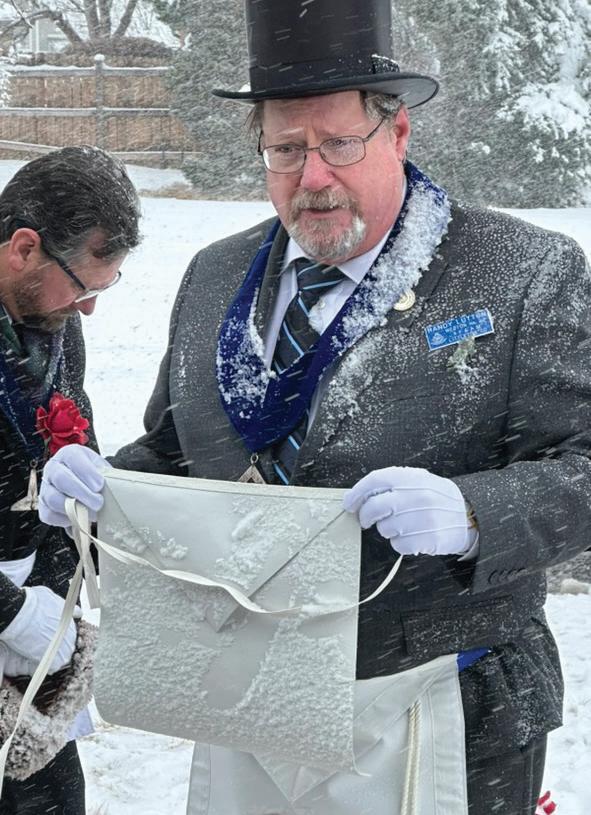
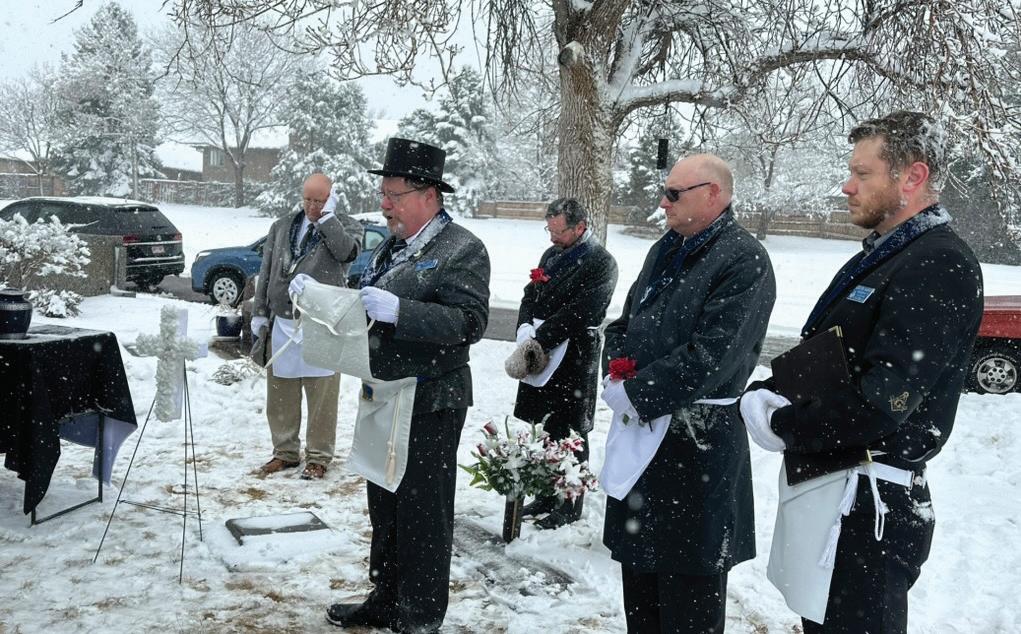
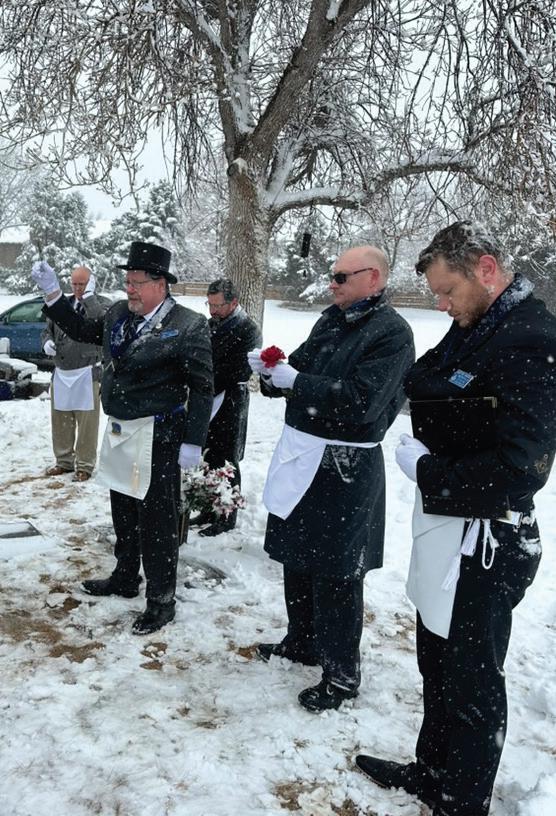
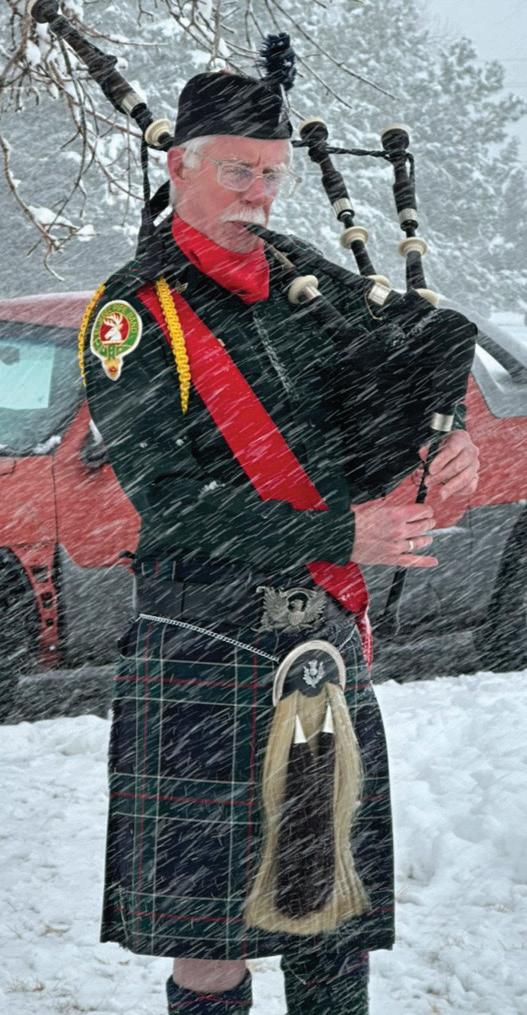
Littleton, CO – Officers of Weston Lodge No. 22 gathered to perform Masonic last rites in a blizzard, March 6.
Despite an unseasonably warm winter, the day of the funeral was beset by snow and winds and freezing temperatures. About six inches of snow accumulated in the city.
“Clearly Bro. Thorndyke is testing us,” Worshipful Brother
by Ben Williams
Randy Lutton, Master of Weston Lodge No. 22, joked to those assembled, referring to the deceased with a smile. “But it is our privilege to perform these ceremonies, no matter what the weather. We are proud to be here today,” he said.
The ceremony concluded with bagpipes, played by Bro. Alex McIntosh. KT
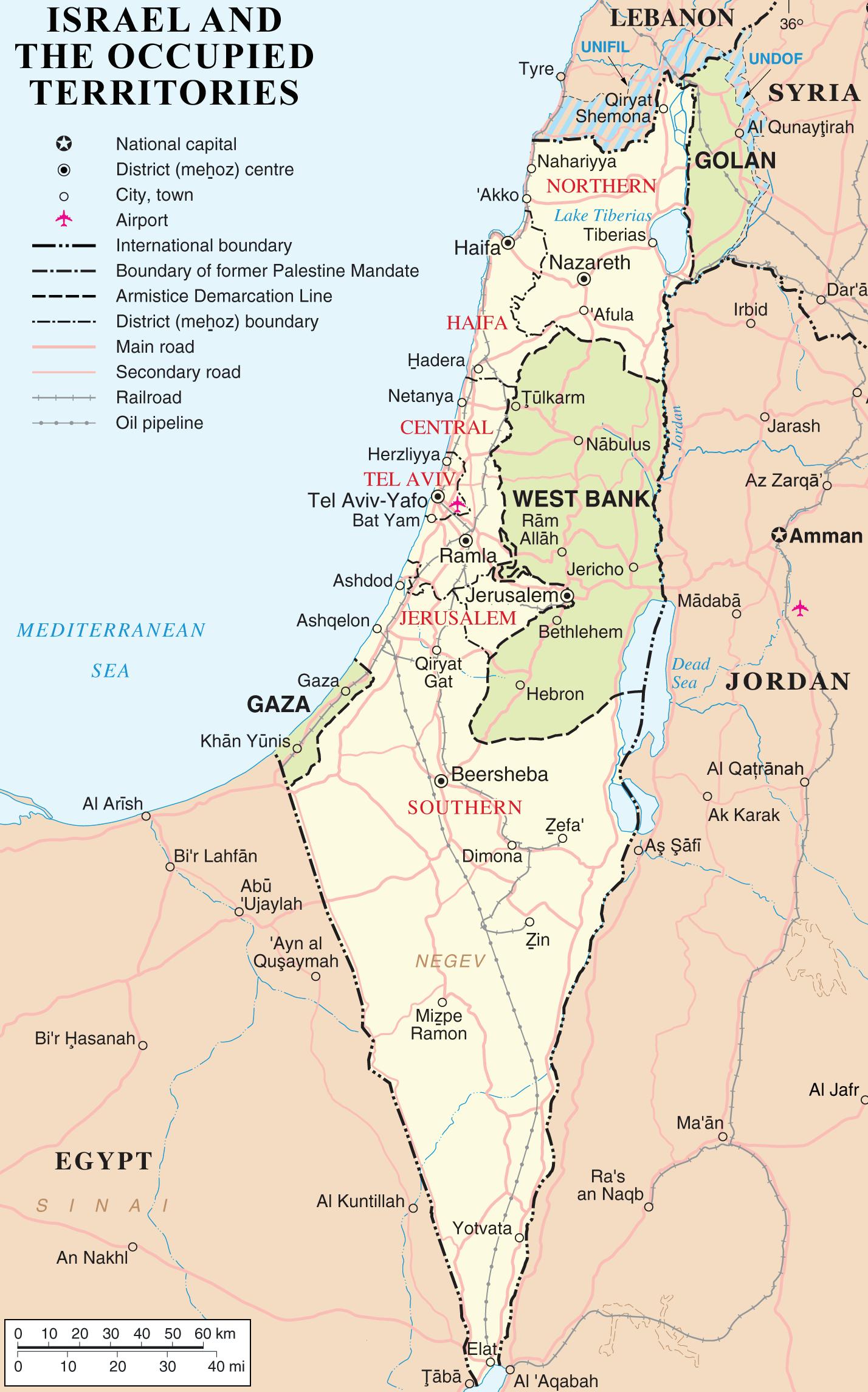
JERUSALEM – Participants in Group B of the Knights Templar Holy Land Pilgrimage had their visit to the Holy Land cut short March 1 as ballistic missiles entered Israeli airspace.
Participants in the Pilgrimage, ministers sponsored by the Grand Encampment to visit the Holy Land and inform their ministry with first-hand experience of some of the holiest sites in Christendom, were at Mount Zion when Iranian counterattacks began.
Delays out of Newark, New Jersey, due to weather had already altered the itinerary, which was meant to run February 23 through March 5. Blizzards stateside prevented the group’s arrival in Jerusalem until the evening of February 27. The next morning, February 28, in a joint operation with Israel, the United States launched airstrikes against Iran under “Epic Fury.” Iran responded almost immediately.
The tour group was quickly reverted to their hotel in Jerusalem, sheltering briefly in designated safe spaces there, Sir Knight Duane Kemerley reported via email.
“Our tour company (Gate 1 Travel) immediately began making alternative arrangements for moving our group toward a safe and efficient trip home,” Kemerley said.
The group rallied to Eliat, in southern Israel, and spent the night. Early the next morning they crossed the border into Egypt.
“After a long bus ride we arrived in Cairo with flight arrangements already made for us to fly directly from Cairo to JFK very early Tuesday morning,” Kemerley said. “Since we had Monday in Cairo, our tour company made arrangements for us to take the group to the Giza Plateau to see the pyramids and
by Ben Williams

the sphinx. A few of us also got the chance to spend a couple of hours at the new Great Egyptian Museum. Amazing!”
“I spent the whole night praying,” Sir Knight David Kussman, Grand Master of the Grand Encampment, said. “I was so stirred up inside because we had people there. But God was magnanimous enough to protect our people and get them home. Our travel team were amazing – the team got us out safe and sound,” he said.
“Much credit goes to Gate 1 Travel for their immediate response to the situation and repositioning us to get safely out of the area and home as soon as physically possible,” Kemerley said. “Our tour guide, Mati Senkman, made sure every detail was in place and unfolding as efficiently as could be . . . . At no time were we in imminent danger and they carefully saw to our needs and repositioned us so very efficiently. It helps us to know for certain that our future pilgrimages are safe, and our team is able to respond to any situation that may arise,” he said.
by D. Bruce Beardsley
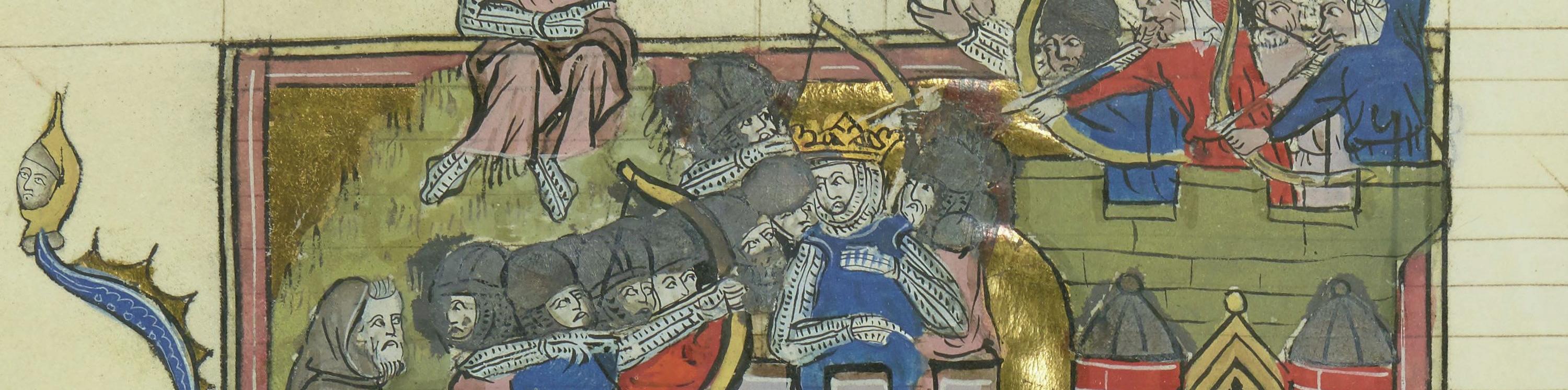
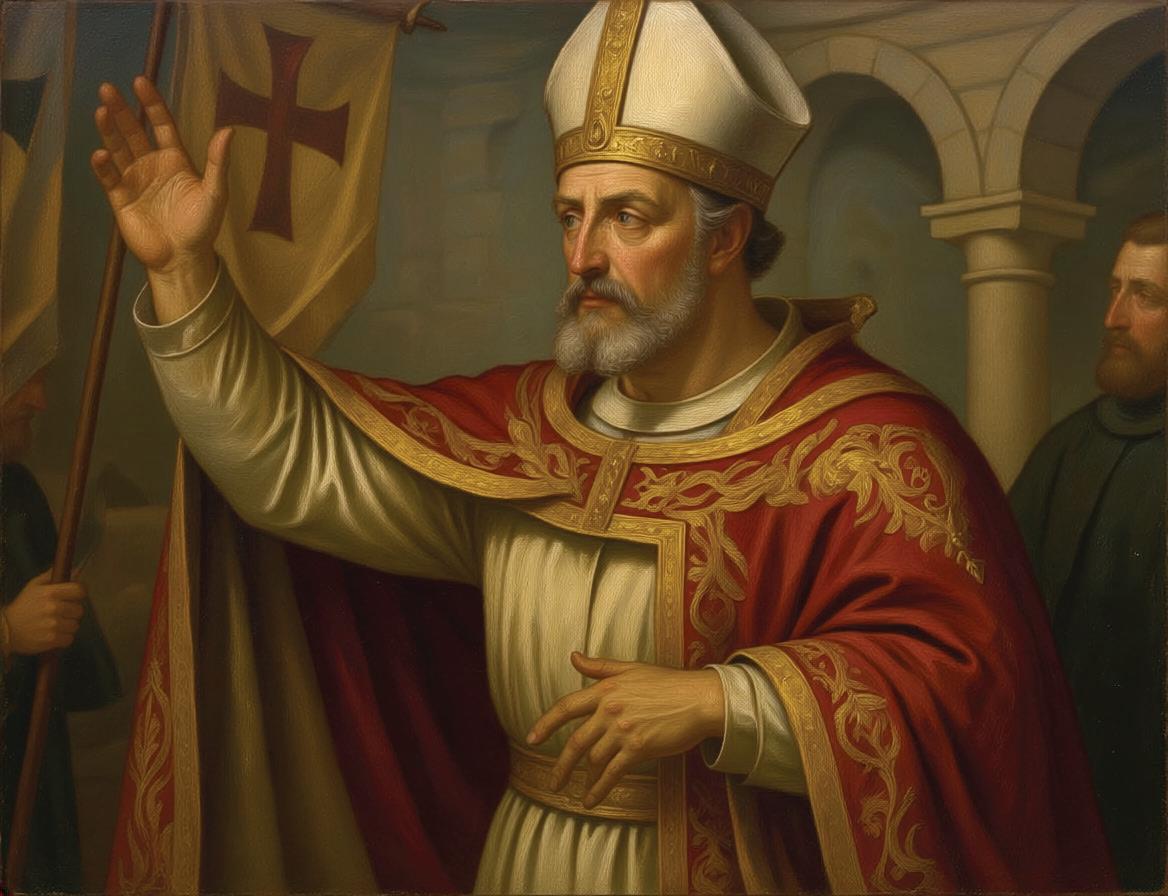
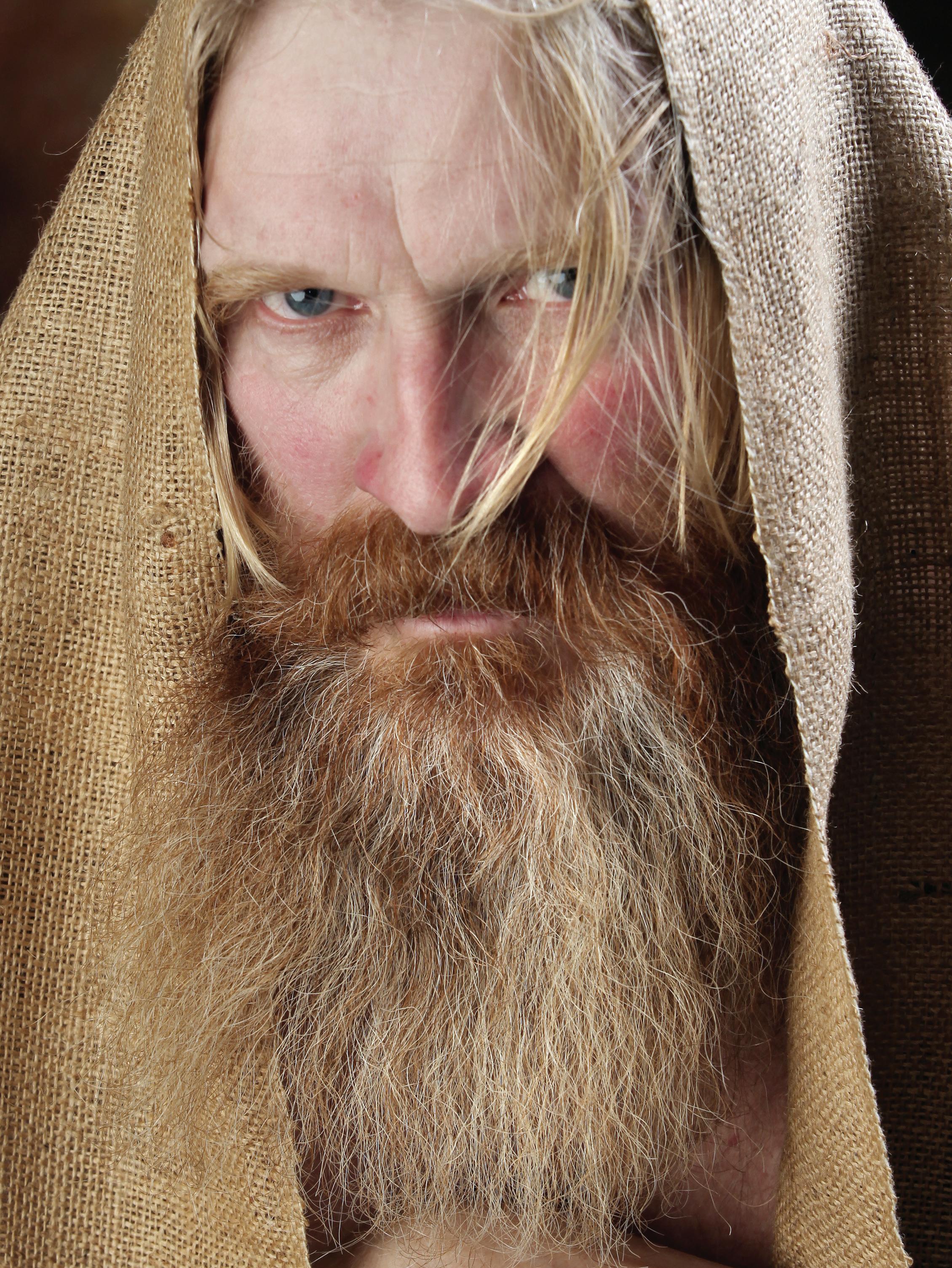
Among the many mysterious figures in Crusading history, few are as puzzling or as fascinating as Peter the Hermit. Unlike the armored princes and mounted barons who fill the stories of the First Crusade, Peter had no noble banner, no ancient family name, and no army of knights. He was a thin, wandering monk, dressed in humble clothes, but driven by a passion so strong that it quickly spread throughout Christendom. Instead of the noise of war drums, he brought the urgent voice of a prophet.
At a time when Europe’s
peasants toiled under heavy feudal burdens, when famine and disease often haunted their lives, and when the hope of deliverance seemed ever distant, Peter offered a message that was electrifying in its simplicity: the road to salvation lay in the liberation of the Holy Sepulcher. To hear him was to believe, and to believe was to act. He spoke in the language of the common folk, not the polished Latin of scholars, and his words reached hearts that the rhetoric of bishops could not touch. Chroniclers describe crowds moved to tears, men and women who tore strips of cloth to stitch makeshift crosses upon their tunics, who vowed to follow this ragged preacher eastward to Jerusalem as though God
Himself had placed the command upon their shoulders.
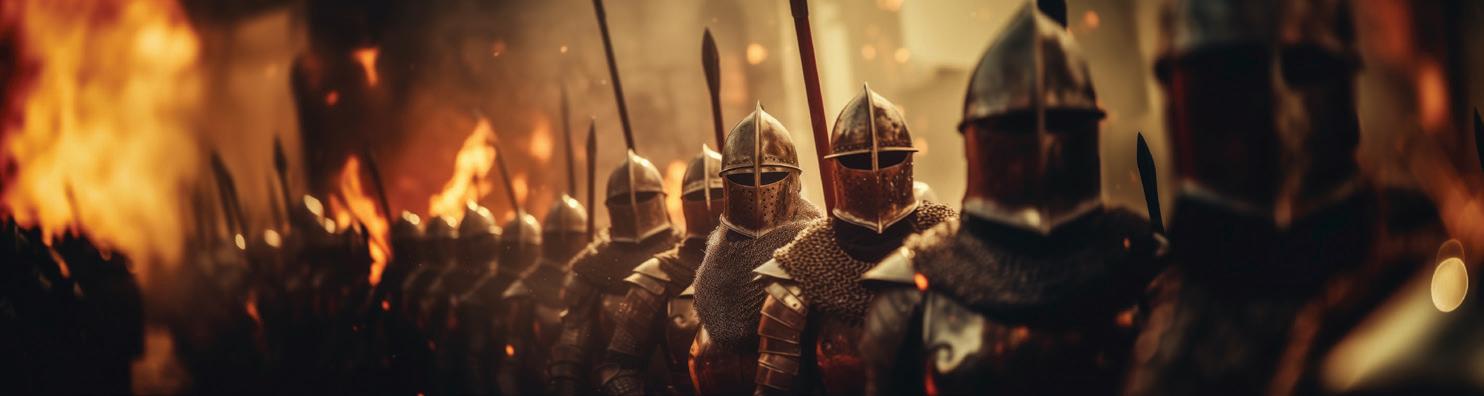
Later generations would celebrate the princes of the First Crusade, such as Bohemond, Godfrey of Bouillon, and Raymond of Toulouse. But before their banners were raised and their armies assembled, it was Peter who first inspired Europe to act. The movement now known as the People’s Crusade was almost entirely his creation. His words stirred crowds; his charisma attracted whole villages; and his vision turned a scattered, struggling people into an army of hopeful pilgrims. Yet there is a contradiction in his story. Peter’s legacy is not just about inspiration. It’s also about chaos and tragedy. The same passion that made his mission so powerful also made it uncontrollable. His followers, lacking leadership, discipline, and supplies, left destruction behind them and eventually met disaster on the plains of Anatolia. What started as a spiritual journey soon became marked by fanaticism, violence, and disaster.
Thinking about Peter the Hermit’s life makes us consider both the good and bad parts of his legacy. On one side, he shows the incredible power of belief and how one person’s voice can inspire thousands and change history. On the other, his story reminds us of the risks of unchecked enthusiasm,
and what can happen when faith loses its balance with discipline and when passion goes too far. In this way, Peter is more than just a figure from the past – he reflects our own spiritual journeys. He challenges us to look at the difference between true devotion and reckless excitement, between a holy purpose and dangerous frenzy. This balance is also at the heart of what defined the Templar knights: passion guided by obedience, enthusiasm controlled by discipline, and faith used to serve justice.
In the autumn of 1095, a turning point in Christian history took place in Clermont, a town in central France. Pope Urban II, respected for both his spiritual leadership and political skill, called together the princes and church leaders of Europe. He was not just acting as the Bishop of Rome, but as someone trying to bring a divided Europe together. For years, the Western Church had struggled with ongoing rivalries among kings, dukes, and bishops. Feudal disputes, corruption, and the memory of a split with the Eastern Church had left Christendom divided. Meanwhile, a more serious crisis was happening in the East. The Byzantine Emperor,
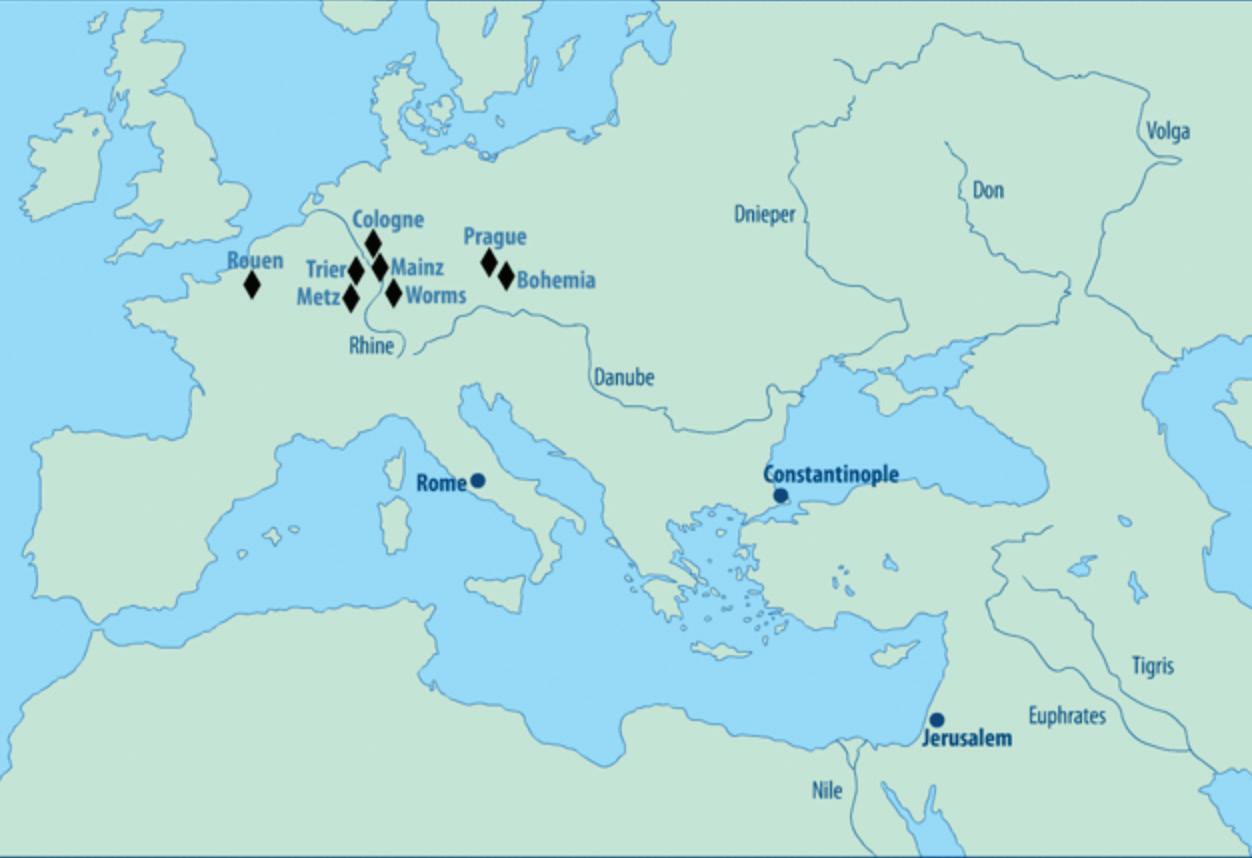
Massacre of Jewish populations, 1096-1102
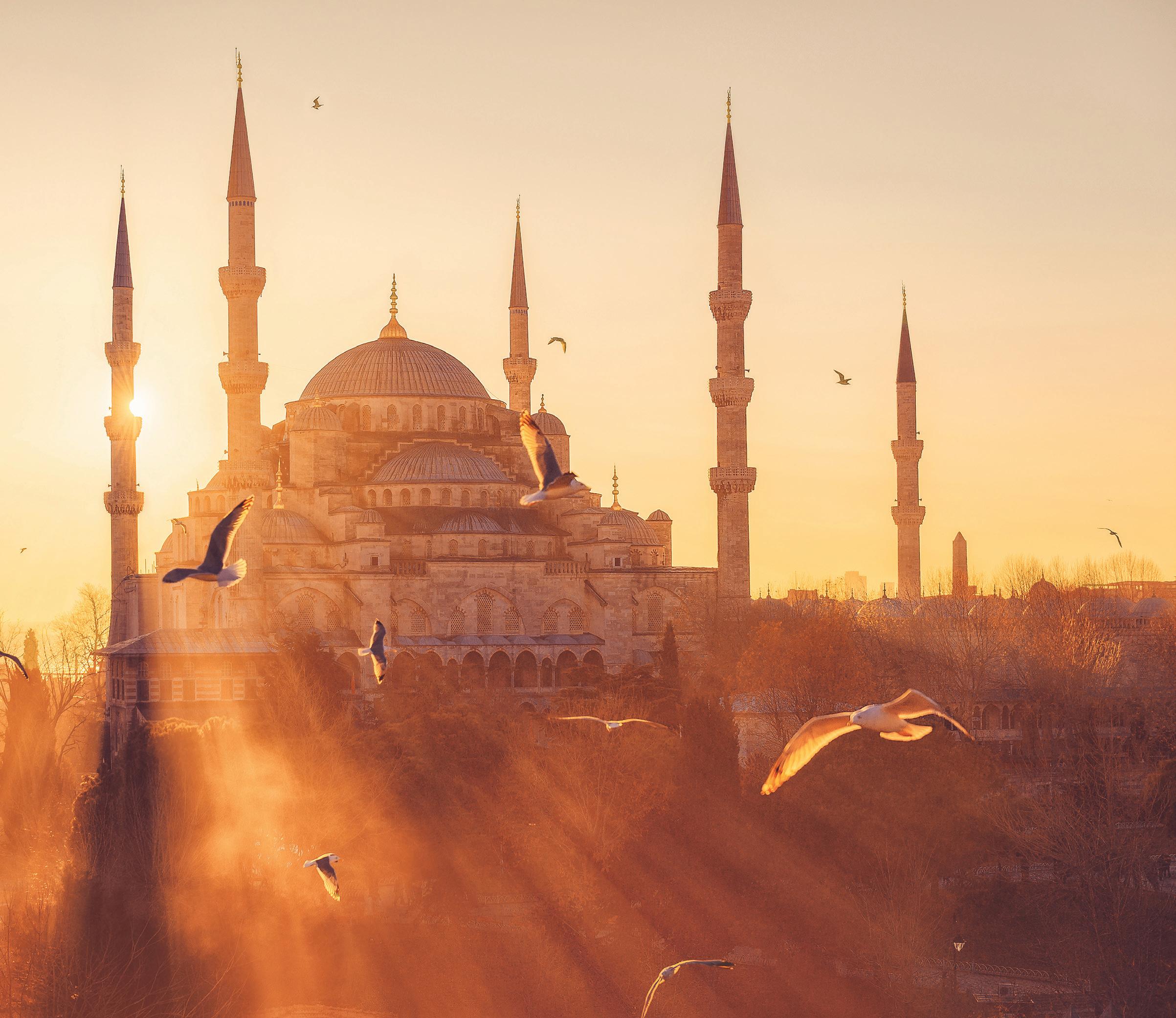
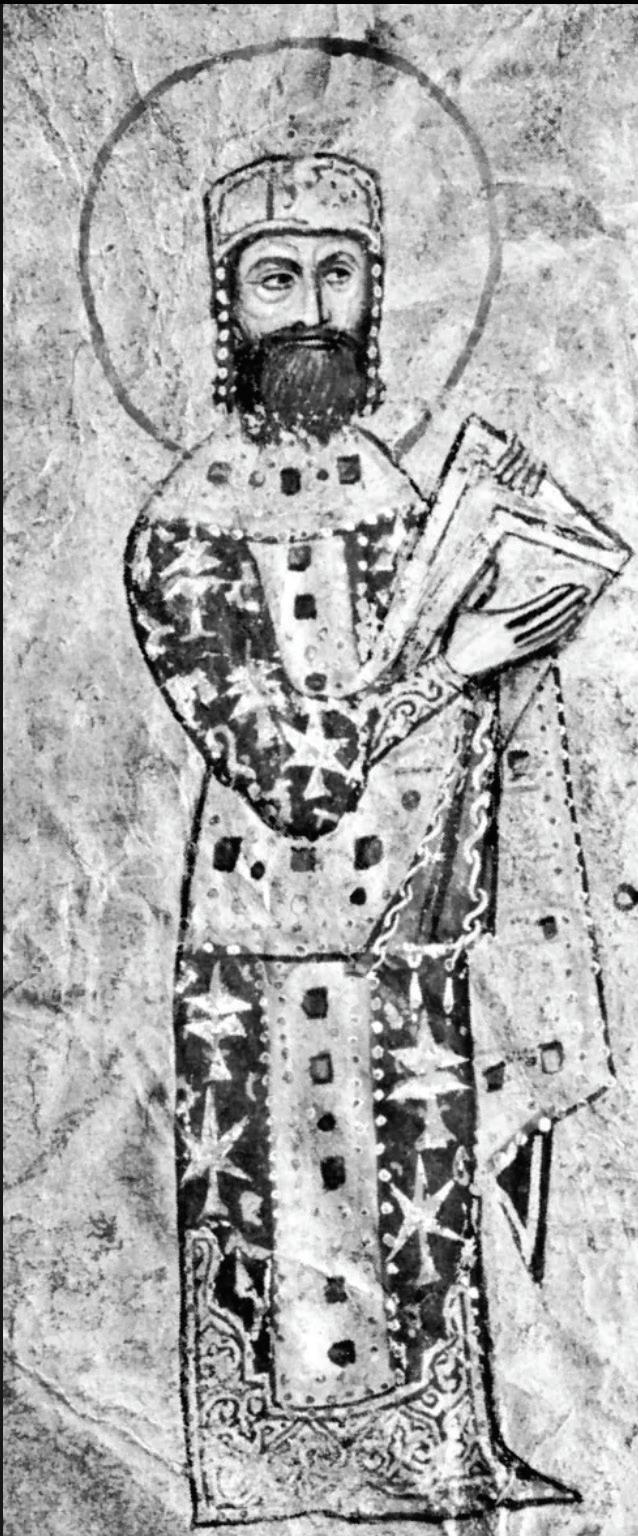
Alexios I Komnenos, saw his empire weakened by the steady advance of the Seljuk Turks. The Eastern stronghold of Christianity, which had protected Constantinople and the holy sites of the Near East, now faced a real threat. In his desperation, Alexios reached out to the West, not for unity or high ideals, but for experienced soldiers who could help defend against the Turkish cavalry.
Urban saw much more in the emperor’s request than just a call for help. To him, it was a sign of opportunity. Instead of simply sending mercenaries to Byzantium, he imagined a large and holy mission: a pilgrimage where people would fight for a righteous cause. This would not be just another group of hired soldiers, but a journey where both knights and peasants could seek forgiveness for their sins and serve God. Jerusalem, the city where Christ suffered and rose again, had been under Muslim control for centuries. Taking it back meant reclaiming not just sacred land, but the core of Christian identity.
When Urban spoke to the crowds at Clermont, his message was powerful. Although historians disagree on his exact words, the meaning was clear: anyone who joined the effort to free Jerusalem would have their sins forgiven.
This was a chance for salvation, not in a monastery or at the end of life, but through the challenges of the journey itself. He called on knights who had often fought other Christians, offering them a way to use their skills for a higher purpose. He also spoke to ordinary people, promising that their struggles and hardships could become a path to spiritual growth.
The crowd’s reaction was immediate and passionate. People shouted, “ Deus vult !” or “God wills it!” And with those words, a powerful idea began to spread. It was not just the nobles and commanders who were moved. Even before the leaders organized their forces, Urban’s message was already reaching villages and farms across France and beyond. The call to crusade spread not just through official announcements, but through preachers who shared the message in towns and marketplaces.
Among these traveling preachers, one person stood out: Peter the Hermit. He did not wait for the nobles to gather their armies or for the Church to make detailed plans. Driven by his strong beliefs and the respect he earned as a wandering preacher, he spoke directly to the poor, the restless, the hungry, and the faithful. He was the one who turned
Urban’s vision into something ordinary people could understand, changing a call from the pope into a movement for everyone.
Peter the Hermit is a mysterious figure, hard to pin down between fact and legend. Chroniclers didn’t see him as a grand warrior or a noble priest, but as a small, wiry man, almost lost in his worn clothes. He rode a scruffy donkey, more fit for hauling goods than leading a holy mission. Still, he made a strong impression. People remembered his intense eyes and the urgency in his voice, as if every word came straight from his soul and struck those who listened.
Most sources say Peter came from Amiens in northern France, a place familiar with hardship. Even before the Crusades, he lived as a wandering penitent and pilgrim. Stories spread that he had traveled to Jerusalem himself, only to be beaten and turned away by the Turks who ruled the city. Whether this story was true or not, it became a key part of how people saw him. To them, Peter wasn’t just a preacher; he was someone who had suffered for his faith

and witnessed the humiliation of Christendom firsthand. This gave him, in their eyes, a special calling: if he had been turned away from Jerusalem once, then surely he was meant to lead others to reclaim it.
Albert of Aachen, an early chronicler, described Peter as a man full of holy energy, walking barefoot across Europe and never slowed by weather or exhaustion, always calling for the liberation of the Holy Sepulcher. His sermons weren’t polished or scholarly, but passionate and direct. He spoke
to farmers, blacksmiths, widows, and orphans – anyone who needed hope. Peter’s message was simple: take up the cross, go to Jerusalem, and your sins will be forgiven. Salvation was no longer something distant or controlled by the Church: it was now something anyone could reach through courage and devotion.
Peter’s real gift wasn’t in fighting or planning, but in making the crusade’s message speak to ordinary people. While Pope Urban’s call inspired nobles and knights,
Peter put it in words the poor could understand. His crusade wasn’t about banners or noble titles, but about peasants, artisans, and outcasts who saw him as a prophet. Whole villages left at his urging. Men made simple crosses from scraps, children followed their parents, believing angels would protect them, and women joined out of faith and hope. For them, Jerusalem wasn’t just a distant city: it was the gateway to heaven, a promise they could almost reach.
Peter’s passionate sermons sparked what became known as the People’s Crusade – a movement unlike anything seen before in medieval times. It wasn’t planned by kings or organized by nobles. Instead, it was a surge of spiritual energy, raw and driven by hope. By spring 1096, tens of thousands of people left their homes to march east, long before Europe’s leaders had even gathered their armies.
They had little food, no money, and no real organization. Still, their belief was so strong that it seemed to make up for everything they lacked.
For these pilgrims, this wasn’t a military campaign but a holy journey, almost like a second Exodus. They truly believed God would provide food for them, that obstacles would disappear, and even that stones could become bread if they were hungry. They remembered the story of Jericho and expected Jerusalem’s walls
to fall at their prayers and songs, just as Jericho’s had. To them, the stories in Scripture were not just old tales but promises about to come true in their own lives.
But as their vast and unwieldy host wound its way across Europe, the harsh reality soon cut through the dream. Supplies ran short, tempers flared, and desperation turned fervor into fanaticism. In the Rhineland, where Jewish communities had long lived on the margins of Christian society, the mob found an outlet for its restless zeal. In cities such as Worms, Mainz, and Cologne, crusading bands descended on synagogues and Jewish quarters with a violence that shocked even contemporaries. They looted homes, forced conversions at sword point, and massacred entire families – men,
innocent and the righteous cause itself.
more than defend it.
women, and children alike. Some Jews resisted fiercely, some took their own lives rather than submit, and others were baptized against their will. Chroniclers describe the horror with words edged in sorrow and shame.
These atrocities remain among the darkest stains on the history of the Crusades, a bitter reminder that holy passion without discipline can easily slide into cruelty, and that zeal ungoverned by justice quickly becomes indistinguishable from barbarity. What had begun as a march of faith was already, before ever reaching the Holy Land, marked with blood. And for the discerning eye, the People’s Crusade stands as a warning: when the flame of devotion burns without the tempering of wisdom, it can consume both the
Even though the People’s Crusade was chaotic, Peter still managed to lead some of his followers east. With his strong personality, acting as both preacher and guide, he got them across Europe, through Hungary, and over the rough paths of the Balkans. Finally, they reached Constantinople, tired and hungry. To the pilgrims, the city must have looked amazing, with its shining walls and grand buildings. But for Emperor Alexios I Komnenos, seeing them brought more worry than comfort.
Alexios had appealed to the West for disciplined mercenaries – professional soldiers who could reinforce his armies against the Seljuk Turks pressing hard upon his borders. Instead, what arrived at his gates was a vast and unwieldy mob: peasants clutching crude wooden crosses, barefoot women leading children, would-be warriors armed with pitchforks and scythes. They sang hymns, begged for food, and camped chaotically outside the city walls. To the emperor and his court, this was not an army but a liability, a wandering multitude that threatened to devour the countryside
Alexios was practical. He gave the pilgrims food and shelter, not just to be kind, but because it was safer to keep them calm than to risk their anger. He soon decided to move them out of Constantinople before they caused more problems. Ships were prepared, and Peter’s followers were sent across the Bosporus into Asia Minor, the land controlled by the Turks they had come to fight.
Once they reached enemy territory, the People’s Crusade’s biggest problems became clear.
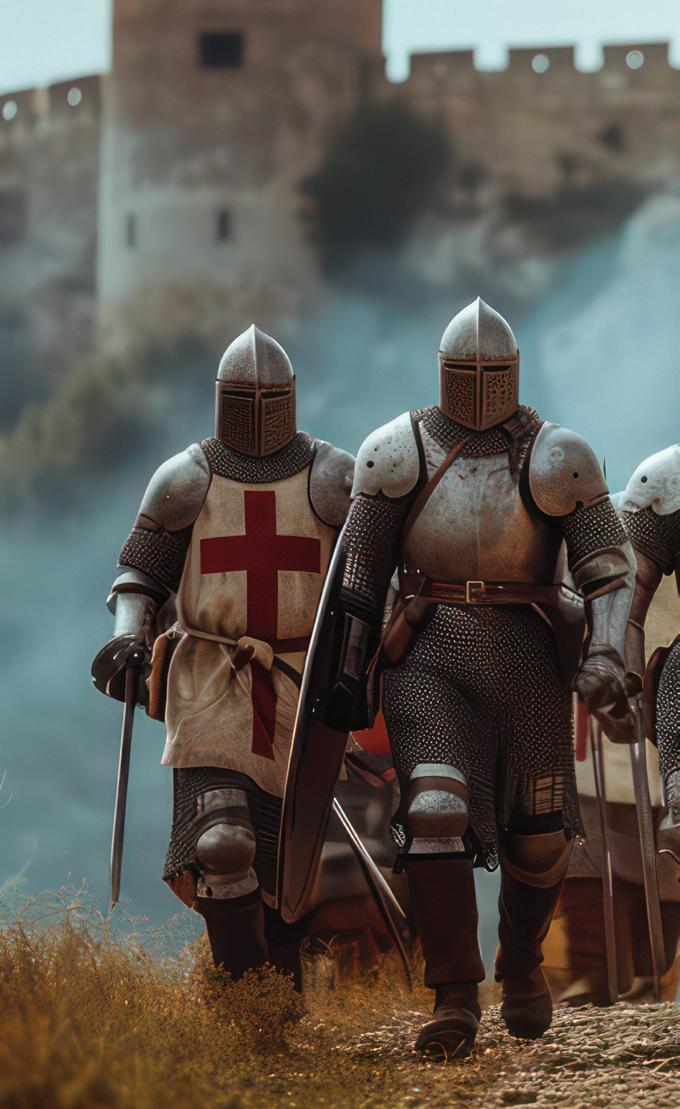
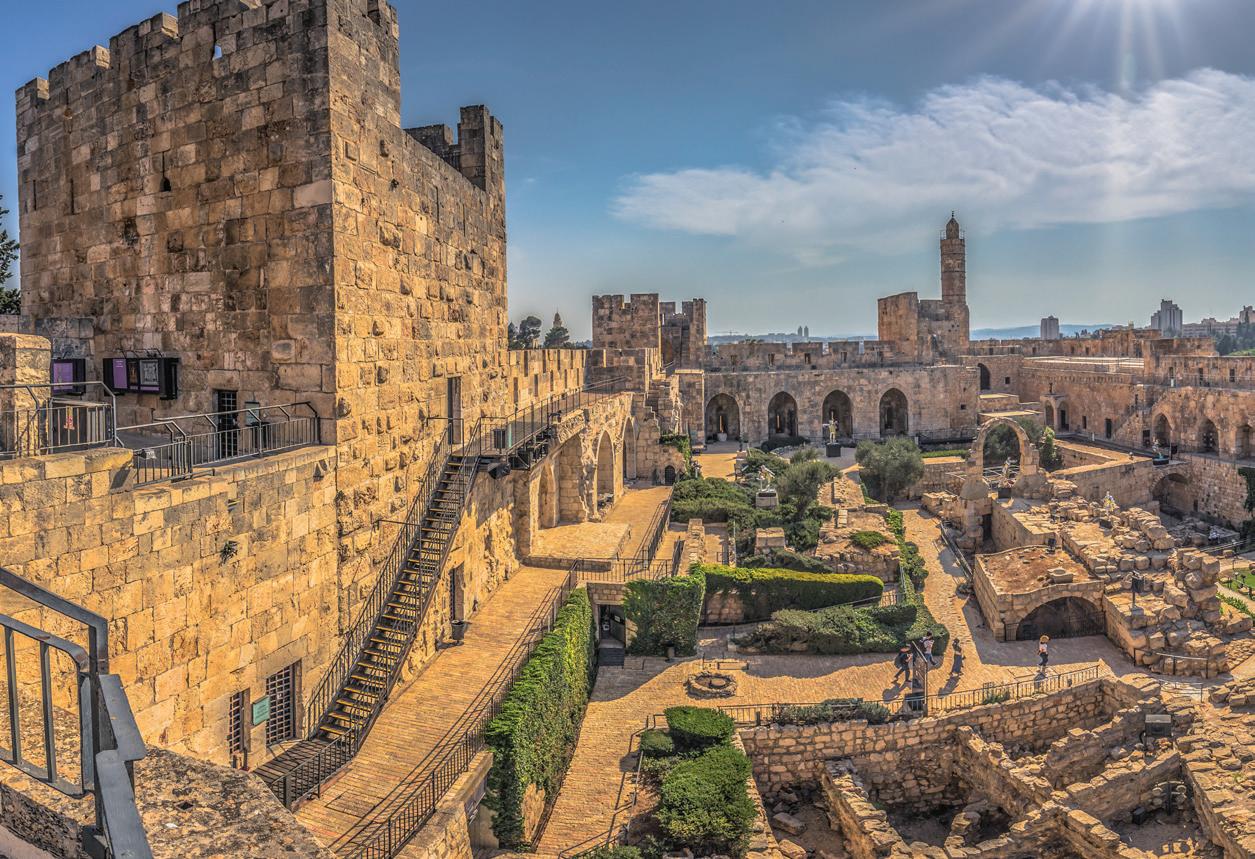
They had no experienced leaders, no steady supplies, and barely any plan. Many believed, perhaps too confidently, that God would help them win. When they heard rumors that Nicaea could be taken, they rushed ahead, sure that miracles like those in Jericho or Gideon’s time would happen for them, too.
But the Seljuk Turks were no passive adversaries. Hardened by years of battle, skilled in swift cavalry maneuvers, and well aware of the pilgrims’ disarray, they set a trap. In October of 1096, near the
small fortress town of Civetot, the Seljuks descended like a storm. The clash was no battle in the proper sense but a massacre. The peasants and pilgrims, untrained and poorly armed, were swept aside with merciless efficiency. Chroniclers write of bodies littering the fields, of cries drowned out by the thunder of hooves and the whistle of arrows. Whole bands were cut down before they could even form ranks.
In the end, almost everyone in the People’s Crusade was killed. Of the tens of thousands who set out for Jerusalem, only a few made it back. Peter himself survived because he was in Constantinople at the time, asking Alexios for help. He lived, but his so-called army was gone, leaving only a sad reminder of what can happen when passion isn’t tempered by wisdom.
Though the People’s Crusade ended in disaster, Peter the Hermit’s story did not conclude there. He would reappear during the First Crusade proper, present at the Siege of Antioch. No longer the leader of armies, he nonethe-
less acted as a spiritual figure, leading prayers, encouraging the faithful, and reminding crusaders of the holiness of their mission. Later accounts suggest that Peter returned to France after the crusading campaigns and founded a monastery at Neufmoutier, where he spent his remaining days in relative obscurity. Whether regarded as prophet or fanatic, his legacy endured. He had shown the world the power of one man’s voice to move multitudes. But he had also shown the danger of zeal unrestrained by wisdom.
For today’s Knight Templar, Peter the Hermit’s story is full of important lessons. His words inspired many to leave their homes and join his cause. But without structure or guidance, that passion soon turned to chaos. The People’s Crusade shows the danger of acting on strong feelings without preparation or discipline. What started with hope and faith ended in confusion and tragedy.
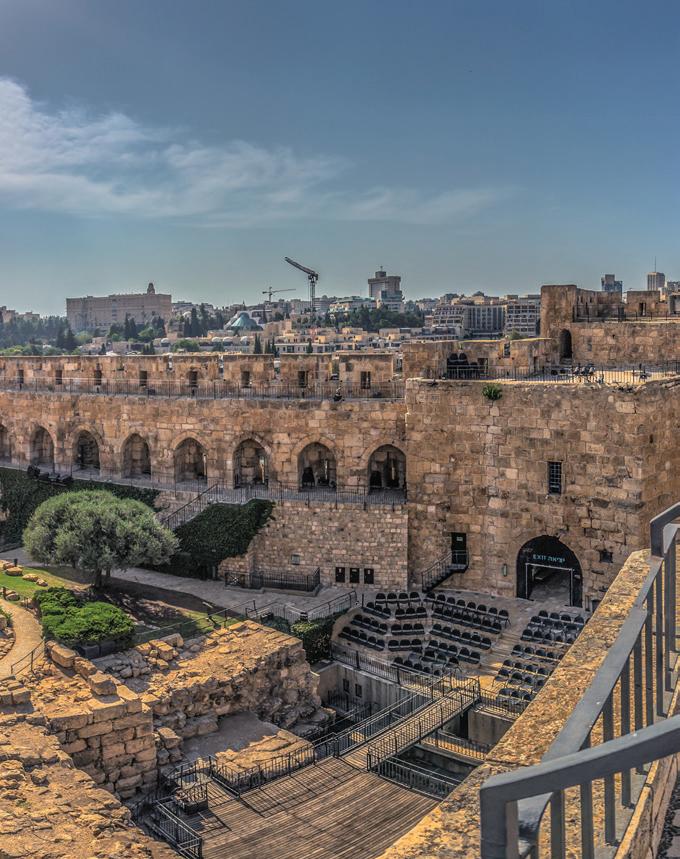
A generation later, the Order of the Temple arose as the correc-
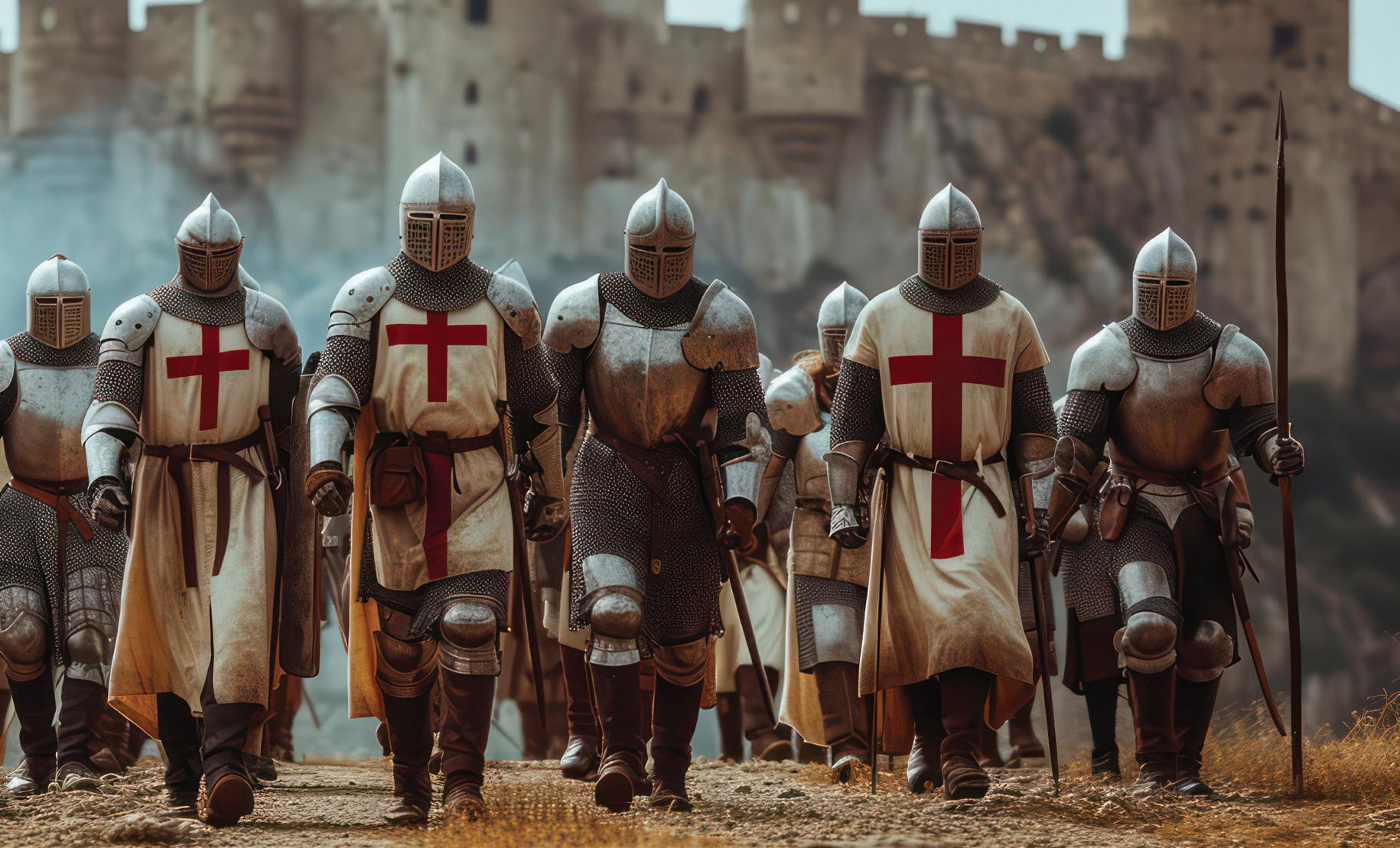
tion to that chaos. Where Peter’s movement surged in disorderly mobs, the Templars marched in disciplined ranks. Where his pilgrims trusted that miracles alone would feed and defend them, the Templars learned to temper faith with strategy, patience, and structure. The Rule of the Temple, given by St. Bernard of Clairvaux and enforced with unwavering rigor, emphasized silence, humility, obedience, and above all, unity. A Templar knight was forbidden to act on his own passions or desires; he was instead bound by sacred oath to the will of God and the order of the brotherhood. His strength lay not in personal fervor but in collective discipline, forged in prayer and battle alike.
The difference between the two movements is clear. The People’s Crusade, though it started with good intentions, ended in violence and poor decisions. The Templars, on the other hand, aimed to turn that same passion into disciplined action that could help rather than harm. While Peter’s followers saw Jerusalem as just a city, the Templars learned to look for a higher goal – a heavenly Jerusalem reached by combining passion with order, justice, and humility. For today’s Knights, the lesson is that uncontrolled passion can destroy, but discipline can turn it into something that guides and inspires.
On a deeper level, Peter the Hermit’s story speaks to us in a way that goes beyond old history books. It connects with the symbols that Freemasons and Templars know well. Peter is more than a wandering preacher; he represents the visionary who brings an urgent message, even if he seems unlikely. But his story also teaches us that vision alone isn’t enough. Strong beliefs, if not controlled, can do harm as well as good. Peter’s failure reminds us that courage needs prudence, faith needs reason, and passion
needs justice.
For us as Freemasons and Knights Templar, this lesson is central to what we do. We remember that the real crusade isn’t fought with weapons, but within ourselves. Like Peter’s followers who aimed for Jerusalem, we also seek a holy city, but ours is inside – a place of peace built on discipline, virtue, and order. Every step we take in our Masonic journey brings us closer to this inner goal, where passion becomes wisdom and strength is used to build, not destroy. Peter’s journey, with all its flaws, gives us both a warning and inspiration: to pursue our own sacred quest with both passion and understanding.
Peter the Hermit’s story is full of contradictions. He wasn’t a king, a general, or a scholar, but his words inspired thousands to leave everything behind and chase a great dream. His vision was strong enough to move people across mountains and rivers in search of the city of God. But that same
vision ended in tragedy and loss. For us as modern Knights Templar and Freemasons, his story isn’t just about failure or history – it’s a reflection. In Peter, we see both the good in faith and the danger of unchecked passion. His life makes us ask ourselves: What does it mean to take up a crusade? What kind of Jerusalem are we really seeking?
As Knights Templar, we know that our banners no longer march to foreign battlefields. The crusade to which we are called is not waged with spear or sword but within the fortress of the human heart. Our Jerusalem is not a city of stone lying beyond deserts and seas, but a city of light that rises in the soul when it is ordered by virtue, tempered by discipline, and illumined by divine truth. It is the eternal temple not made with hands, but built by the Great Architect of the Universe, and raised within each of us.
In this way, Peter the Hermit’s failed crusade becomes a lesson. It shows us that passion without care leads to disaster, that courage without justice can turn cruel, and that faith without reason can become
fanaticism. But it also shows that even one person’s voice can inspire many. Our challenge is to shape that passion into something steady and helpful, not destructive. Every time we take on the role of Knight Templar or pray before the cross, we remember that our biggest struggles are inside ourselves: fighting ignorance, injustice, and vice. The true crusader is the one who conquers himself.
Even though Peter the Hermit’s legacy is marked by failure, it still shines in a unique way. His message still matters today – not as a call to fight, but as a reminder to seek wisdom. It invites us to keep working toward the heavenly Jerusalem, the city of peace and the home of God, which must first be built in the heart of every Knight. KT
Albert of Aachen. Historia Ierosolimitana: History of the Journey to Jerusalem. Translated by Susan Edgington (Oxford: Clarendon Press, 2007).
Chazan, Robert. European Jewry and the First Crusade. (Berkeley: University of California Press, 1987).
France, John. The Crusades and the Expansion of Catholic Christendom, 1000–1714. (New York: Routledge, 2005).
Madden, Thomas F. The New Concise History of the Crusades. (Lanham, MD: Rowman & Littlefield, 2005).
Riley-Smith, Jonathan. The First Crusade and the Idea of Crusading. (Philadelphia: University of Pennsylvania Press, 1986).
Tyerman, Christopher. God’s War: A New History of the Crusades. (Cambridge, MA: Belknap Press, 2006).

AFTER YEARS OF DELAYS THE WORLD'S GREATEST EGYPTIAN MUSEUM OFFICIALLY OPENED TO THE PUBLIC ON NOVEMBER 1, 2026
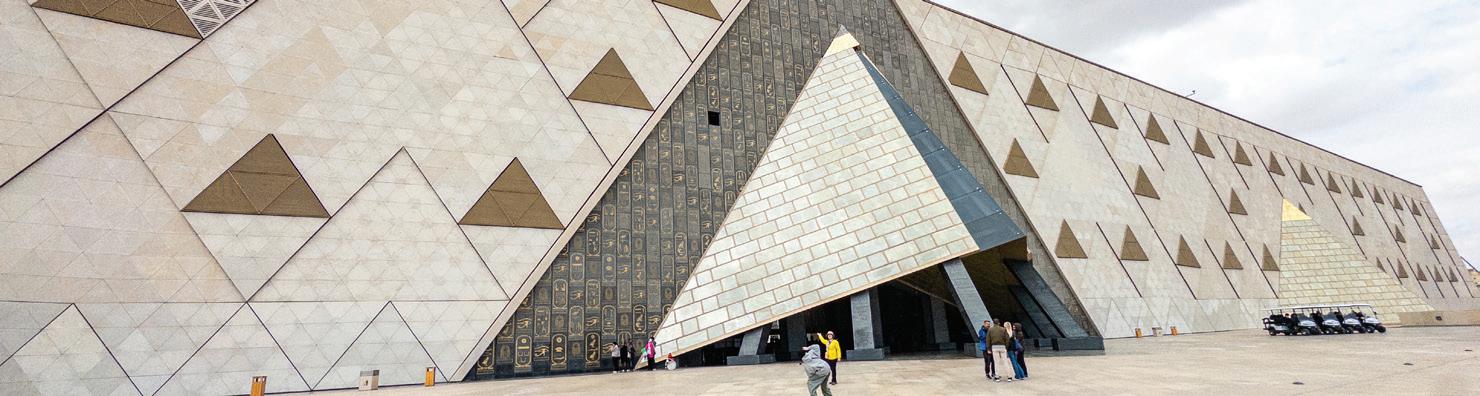
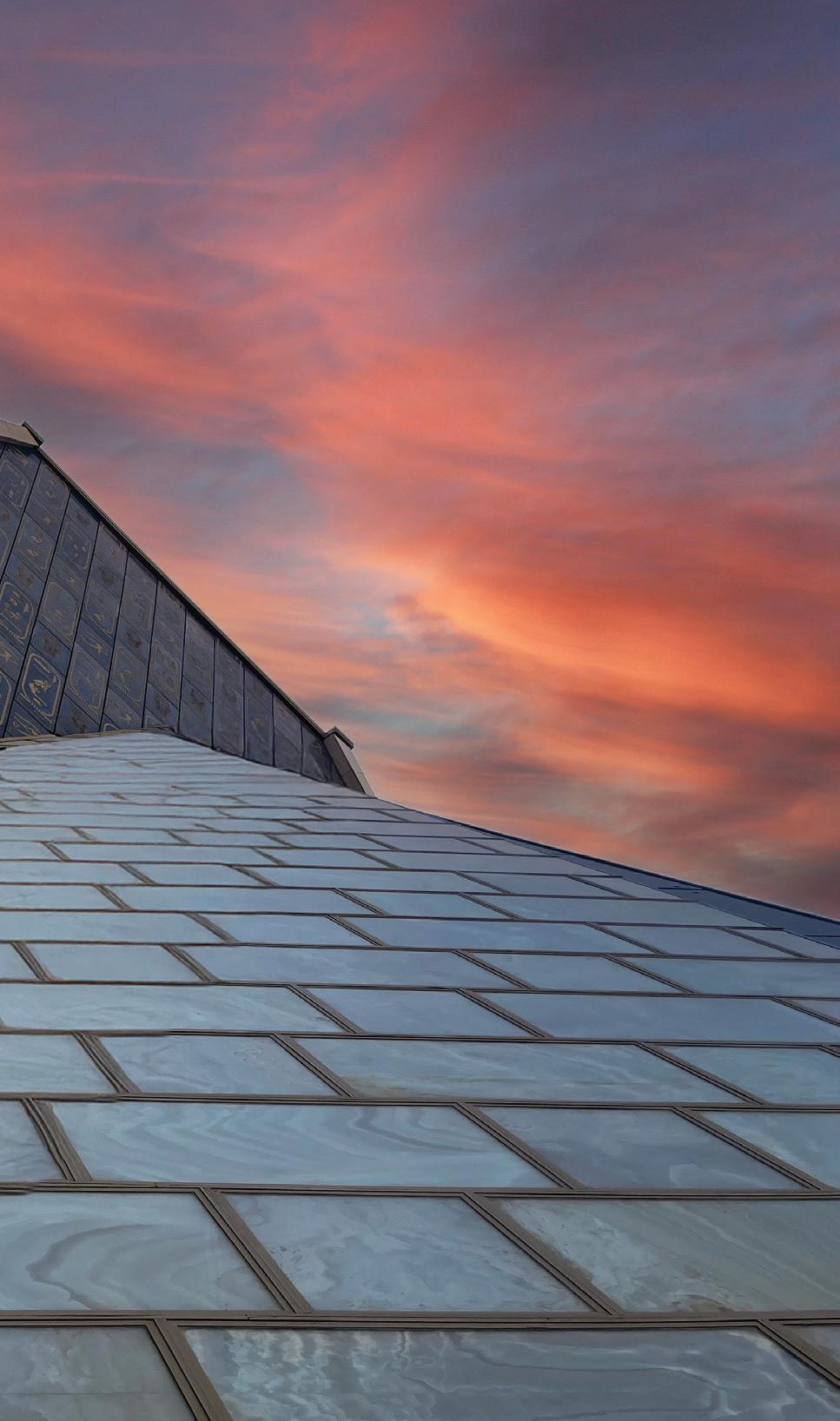
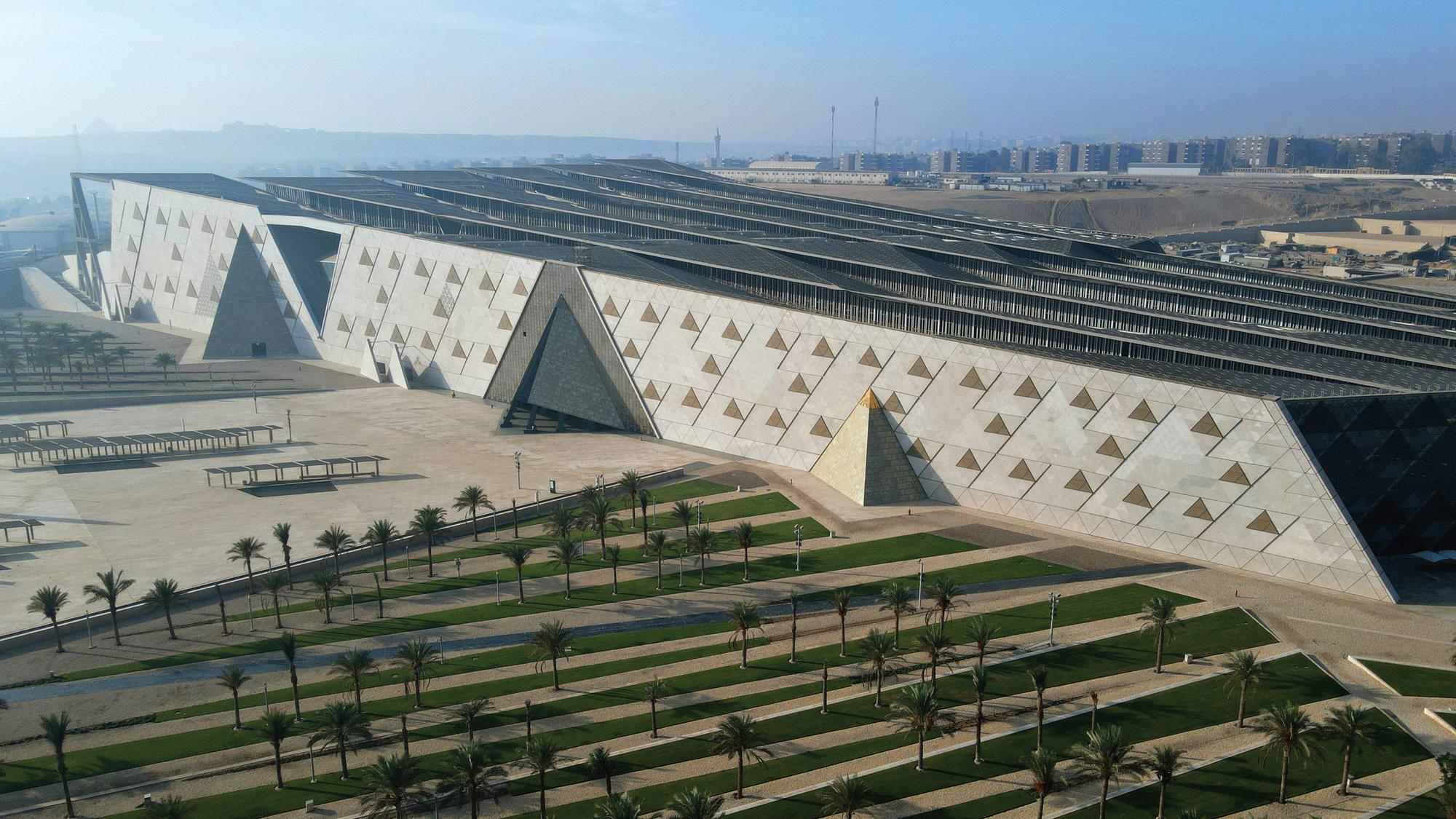
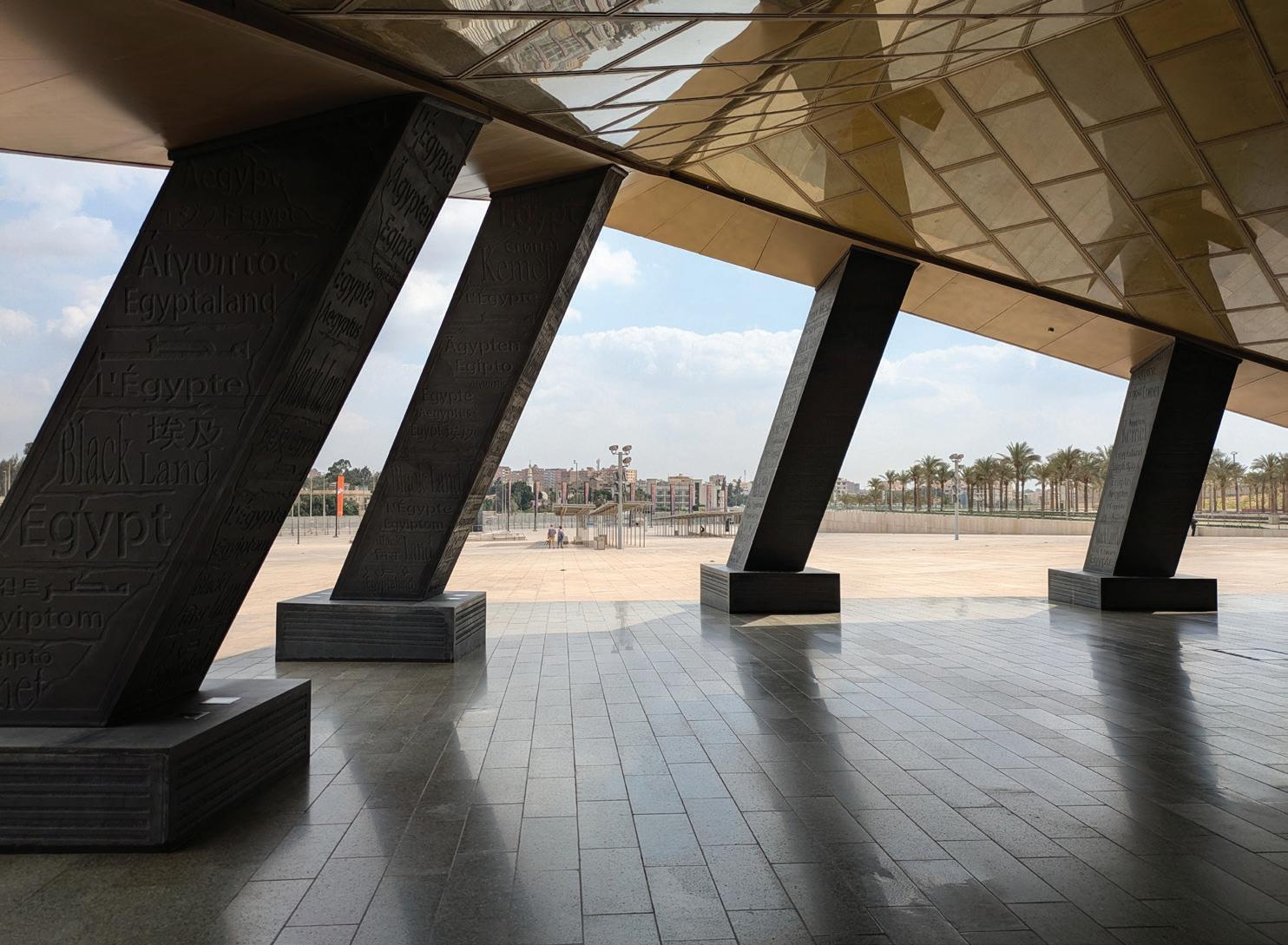
The Grand Egyptian Museum opened Nov. 1, 2025, after years of delays. A masterpiece of modern architecture by Irish firm Heneghan Peng, it straddles over 5 million square-feet along a fifty-meter difference on the plateau between the pyramids of Giza and Cairo. It is the largest museum in the world dedicated to a single civilization. It cost $1.2 billion to complete.
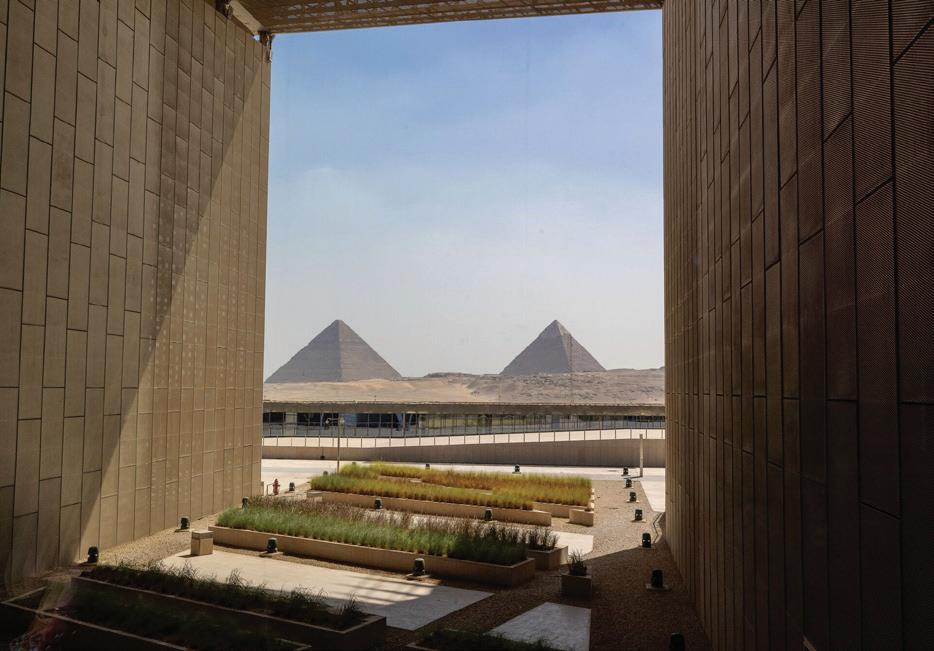
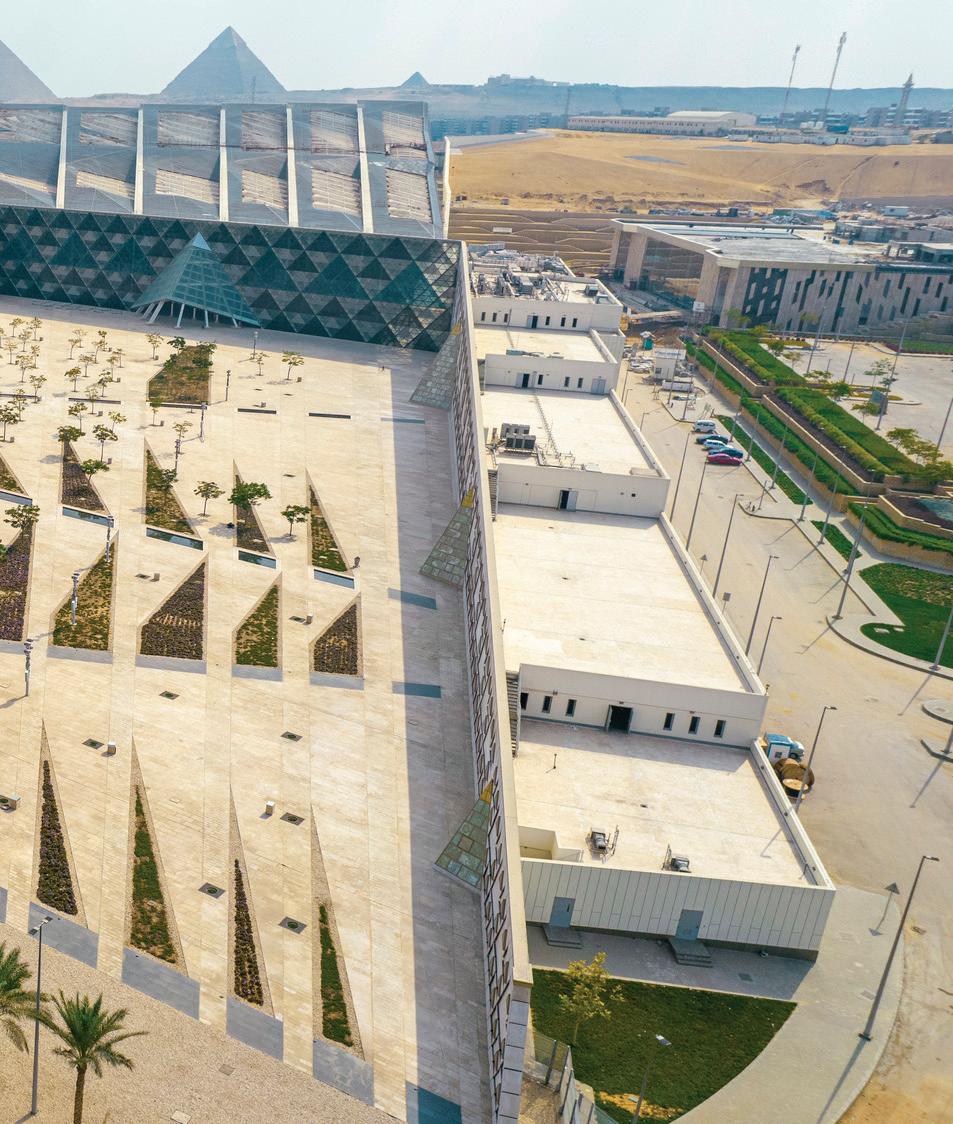
At the gallery level, the pyramids are visible, framed interior to the building. Cavernous interior spaces, with suspended concrete fixtures, span orthogonals radiating from the pyramids. Khufu, Khafre, and Menkaure occupy the vanishing point. The building fans
along these visual lines, integrating the structure aligned to the pyramids and the sloped roof augments the apex of the ancient structures, yet never surpasses them.
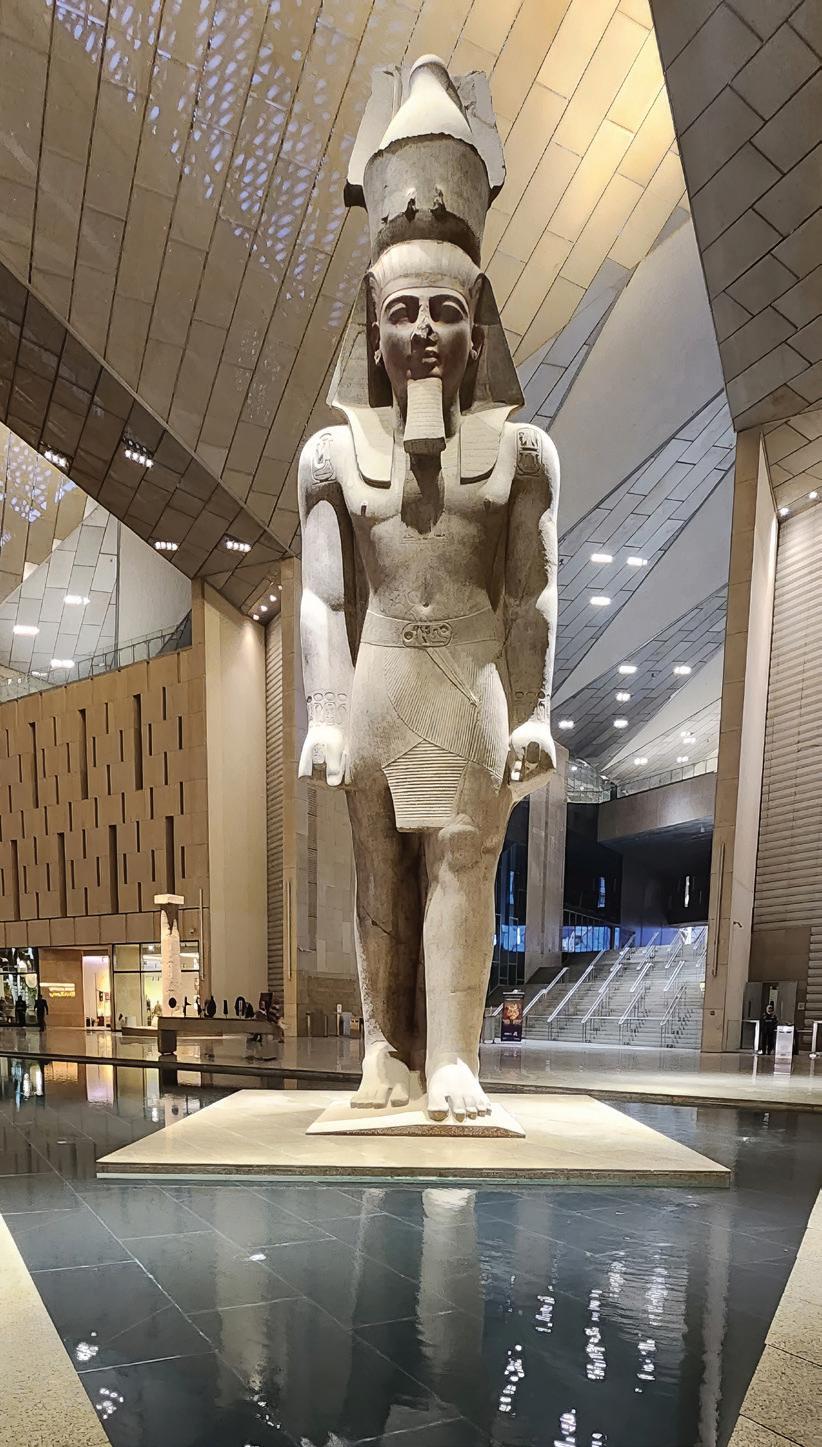
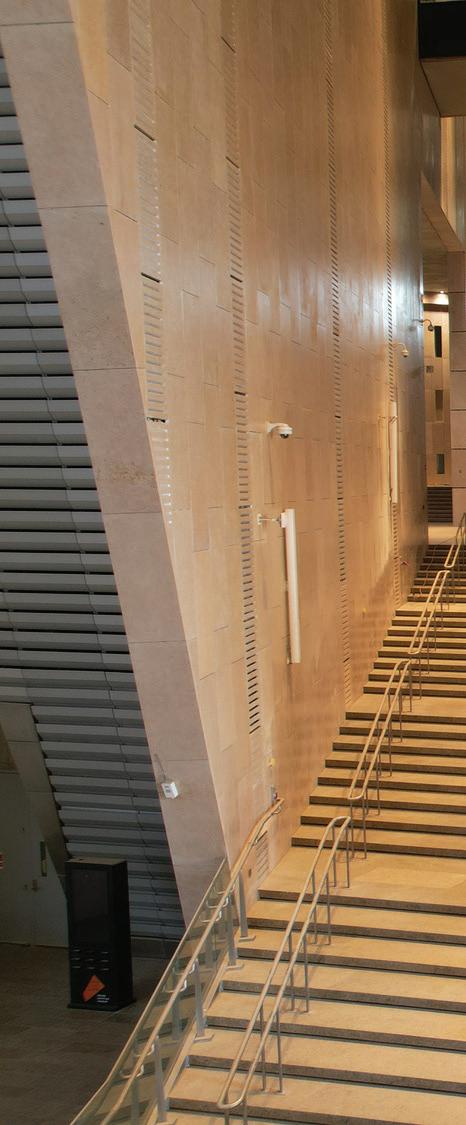
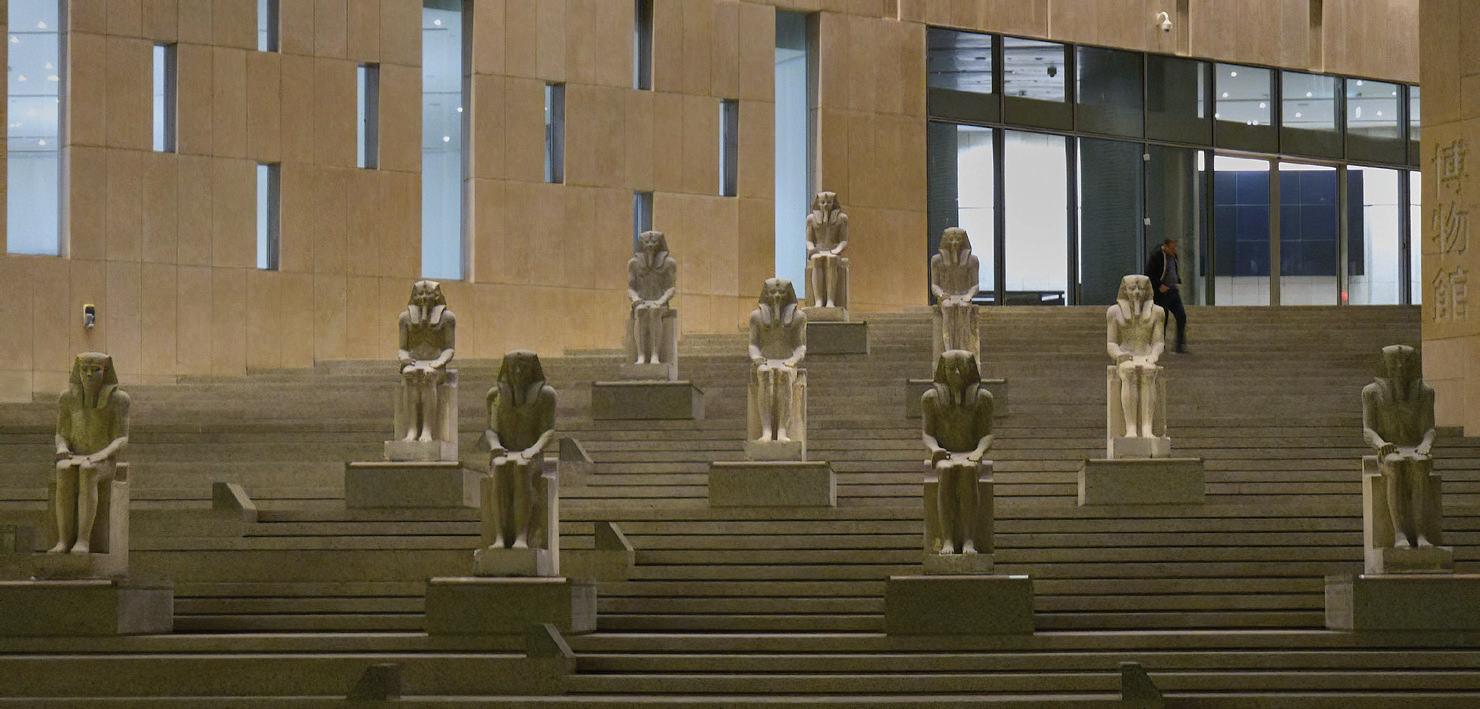
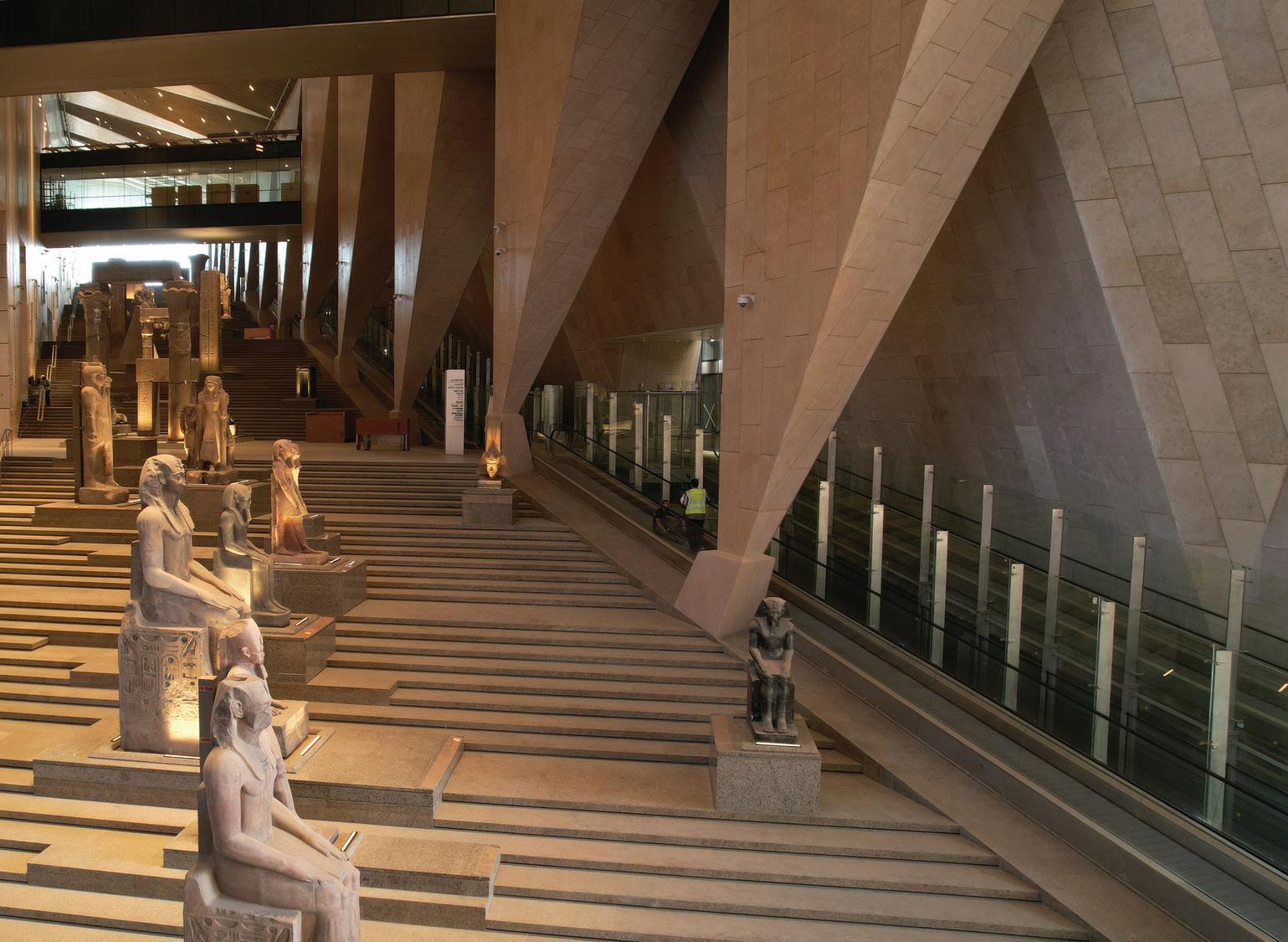
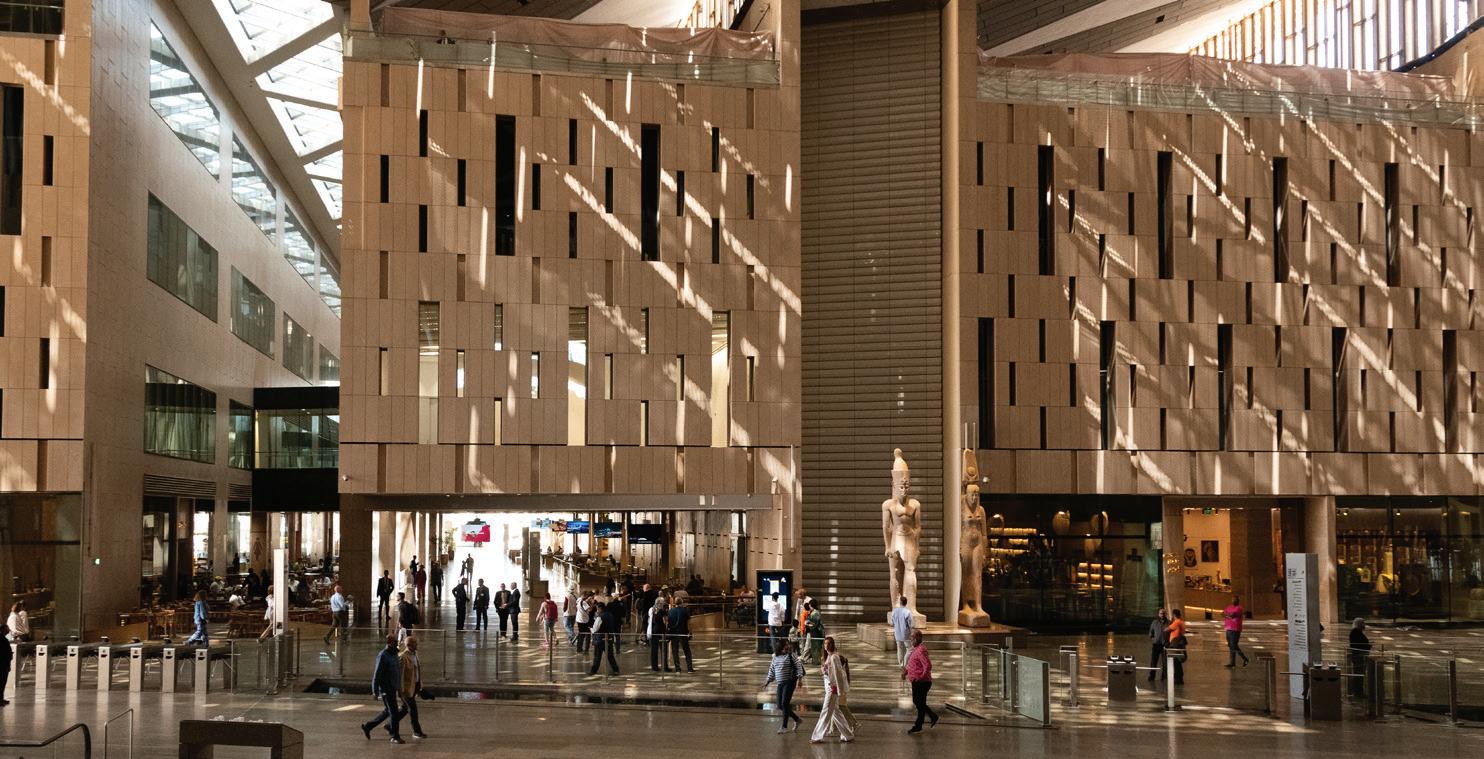
A grand staircase leads visitors up from the entrance court chronologically through millennia to the tombs of the pharaohs. Spanning 65,000 square-feet, the grand staircase rises six stories. Sixty large artifacts greet visitors, including fragments of temples and ten large statues of Senusret I, along the climb. At the top, the 10,000 square-feet atrium astounds visitors with unimpeded views of the Giza plateau. A 183,000-pound (around 83 tons) statue of Ramesses II towers 36.3 feet under the skylit vault where angular features of the building
play light and shadow in pyramidal forms which move with the day.
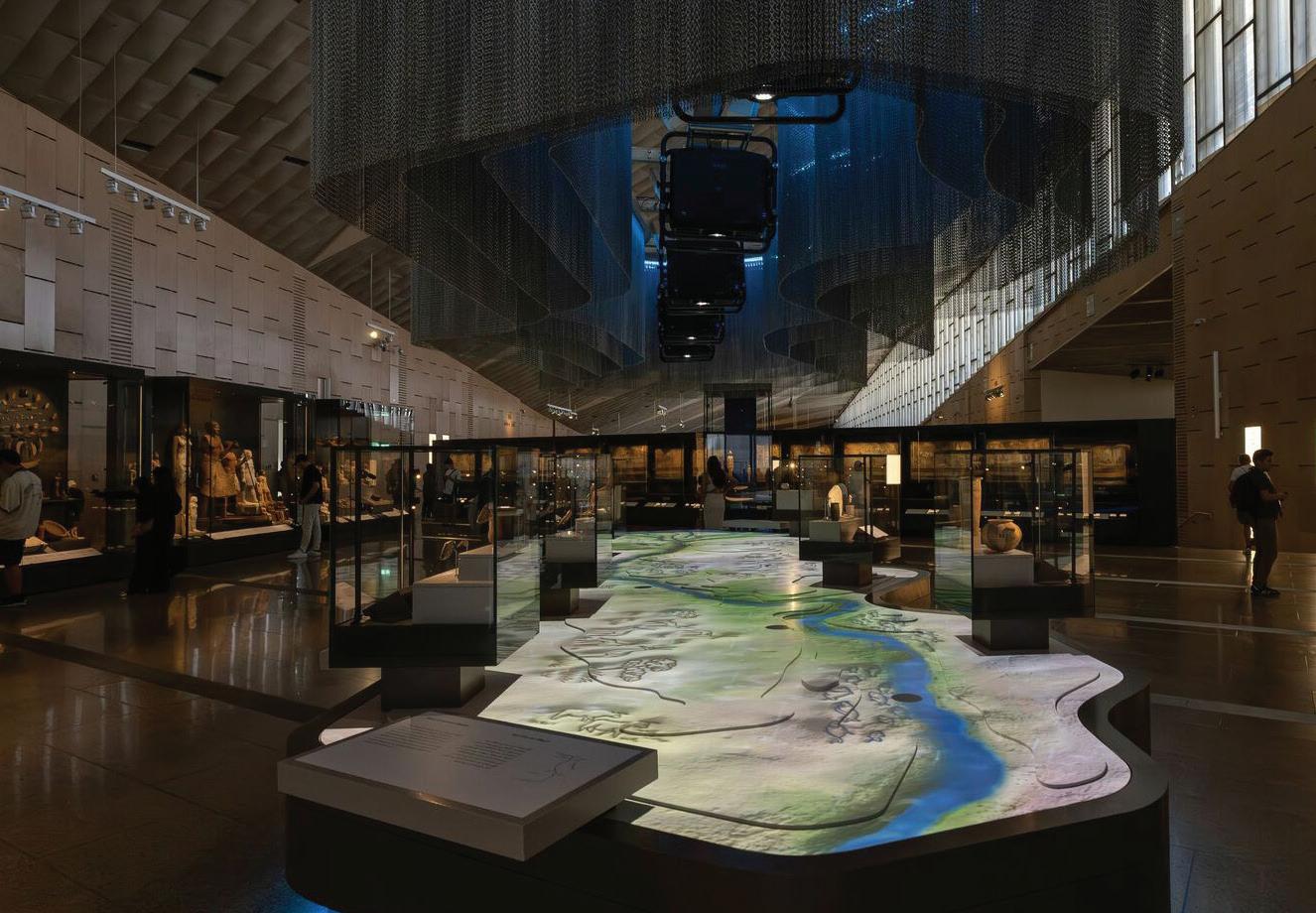
The museum houses more than 100,000 artifacts, distributed across twelve permanent exhibits in the main exhibition halls. Two of the halls are dedicated to Tutankhamun (ruled c. 1332-1323 BC), and, for the first time, the entirety of his treasure is on display in one place.
Halls 1 to 3 cover Prehistoric Egypt (c. 6000 BC), the Predynastic Period (c. 5500-3100 BC), the Early Dynastic Period (c. 29002350 BC), the Old Kingdom Era (c. 2686-2181 BC), and the First Intermediate Period (c. 2181-2055 BC). Halls 4 to 6 cover the Middle Kingdom (c. 2040-1782 BC) and the Second Intermediate Period (c. 1782-1550 BC). Halls 7-9 cover the New Kingdom (c. 1550-1070 BC). And Halls 10-12 cover the Third Intermediate Period (c. 1070-664 BC), the Late Period (c. 664-332 BC), and the Greek (c. 332-30 BC) and the Roman (c. 30 BC-641 AD) Periods. There are additional spaces (totaling 340,000 square-feet) where temporary exhibits are displayable, for rotating the archival collection and for guest and international exhibits.
Designing a museum to house the greatest civilization of the ancient world – one fascinated by intrigue and mystery – is no small task. In 2002, the Egyptian government announced a competition for the contract, soliciting submissions worldwide. After reviewing over 1,500 submissions, architects Róisín Heneghan and Shi-Fu Peng, her husband, were awarded the $250,000 prize for their chamfered triangular design
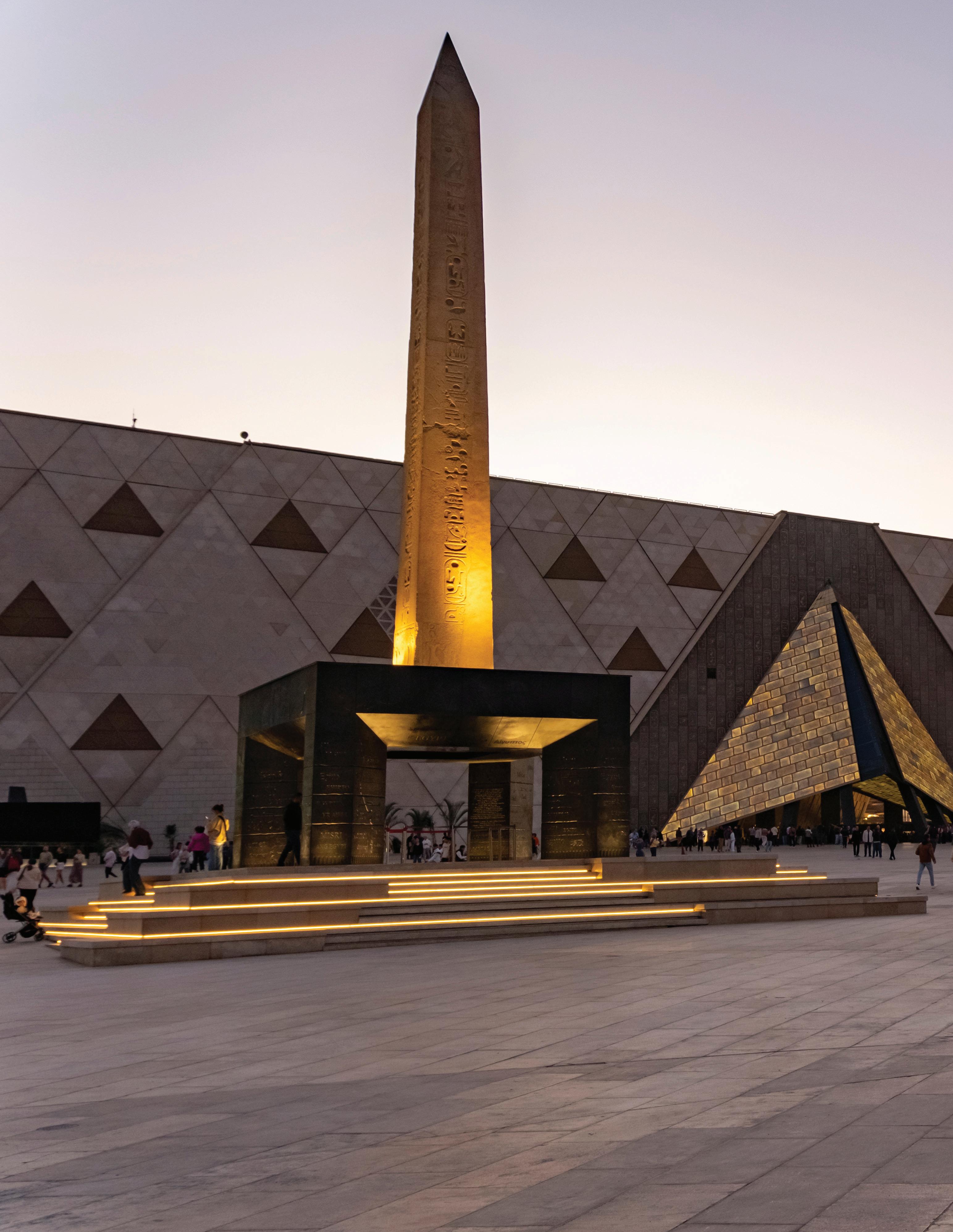
The entrance to the Grand Egyptian Museum. The obelisk originally belonged to Ramesses II (c. 1279-1213 BC). Carved from pink granite, it weighs 110 tons and stands almost 53 feet. Lifted upon a pillared pedestal, it is the worlds first "suspended" obelisk.
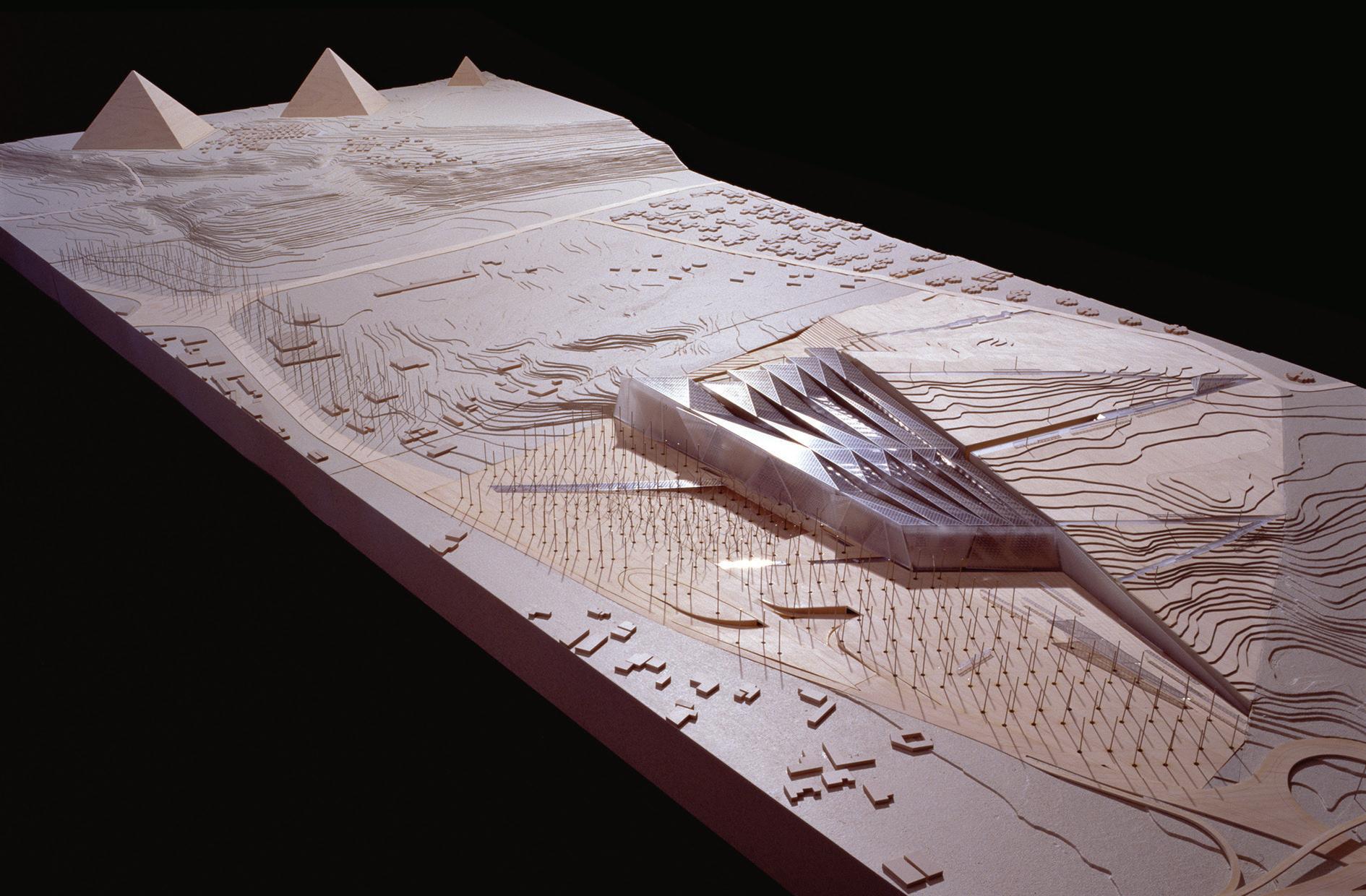

that fans out in visual alignment with the pyramids of Khufu, Khafre, and Menkaure, along the edge of the Nile valley.
“Designing a museum of this caliber, in such close proximity to a landmark as monumental and symbolic as the pyramids, is a once-in-a-lifetime opportunity,” Róisín Heneghan said. “Our design works to strengthen that connection to history and place, providing a home for some never-before-seen artifacts that rests upon the very land from which they were created. The result is an experience that evokes a sense of awe at the breadth and depth of ancient Egypt’s fascinating history in a way that feels both modern and timeless.”
Despite this, the museum has been subject to some controversy. The Architect’s Newspaper compared the interior spaces to an airport terminal, without a cohesive design inspired by the collection.
“Ancient Egyptians aligned stone to stars,” writes Mohamed Elsahed in The Architect’s Newspaper. “One civilization used geometry to construct meaning; the other is more concerned with branding.”
Elsahed seemingly desires a space that accentuates the exhibits, one designed around the collection itself.
“Although massed as one monumental structure,” he writes, “the Grand Egyptian Museum is effectively two buildings stitched together: a museum wing separated by a vast atrium from an events/ commercial/administrative one. The atrium is grand in scale but lacks a cohesive vision; instead, it is the meeting point of fragments. The monumental stair dotted with statues of kings and queens is photogenic but dwarfs the displayed objects; they are reduced to props to entertain the visitor on the long climb.”
But perhaps the Grand Egyptian Museum is about time; time – the vast expanse – swallows all. The enormousness of the interior echoes not indifference or disharmony, as Elsahed opines, but an
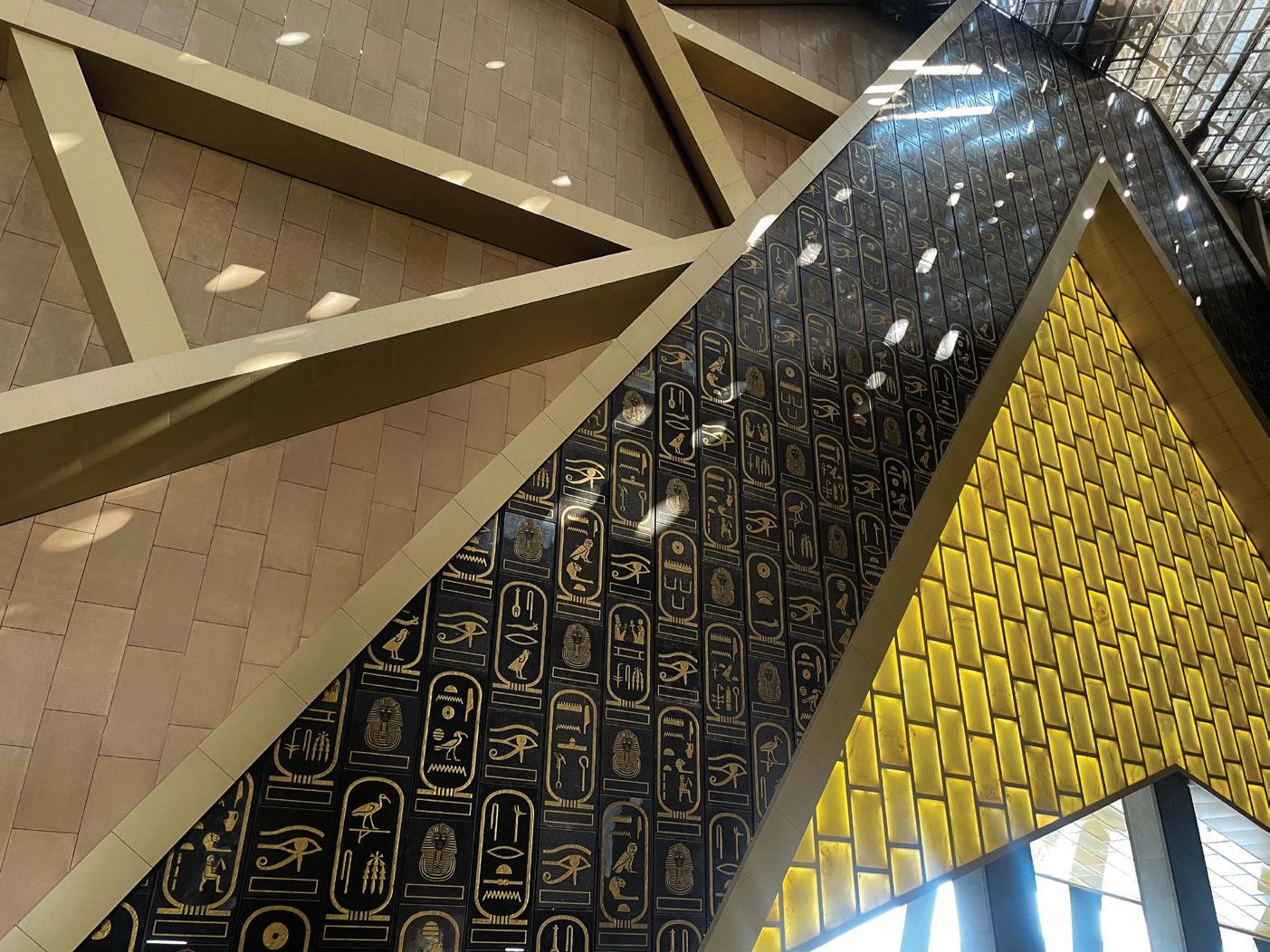
1. Model by Heneghan Peng showing the chamfered triangular design oriented to the pyramids of Giza. 2. The Grand Staircase with pyramidal supports. 3. The large statue of Ramesses II in the atrium. 4. An exhibit hall. 5. Cartouches adorn the entryway on both the exterior and interior architraves. 6. One of the views of the pyramids framed from the interior. 7. Ten statues of in a tetractys on the Grand Staircase. 8. speckled light creates pyramidal forms.
eclectic movement through centuries, as diverse and unpredictable as the rise and fall of the civilization it curates.
Elashed’s other criticism is one of multiple authorship diluting a singular vision (engineers and museologists and lighting professionals were all vital in the finished design; the actual design of the building proper is the result of a joint venture between Heneghan Peng and engineering firms Arup and Burro Happold, which necessarily varied the original design). However, under this chronological theme, collaboration is consistent. Civilization is itself a staggering alignment of efforts, successes and failures, heaped atop each other, lurching humankind forward with faltering, even discontinuous steps. The fact that the building becomes the exhibit (as opposed to augmenting or accentuating the exhibits, as Elsahed protests) is, perhaps, deliberate.
No matter what, the design is bold and, ultimately, effective. It has been dubbed the “fourth pyramid.” Like the great monuments, the museum is itself a chamber for awakening the mysteries of the past.
The building is mainly reinforced-concrete under a single,
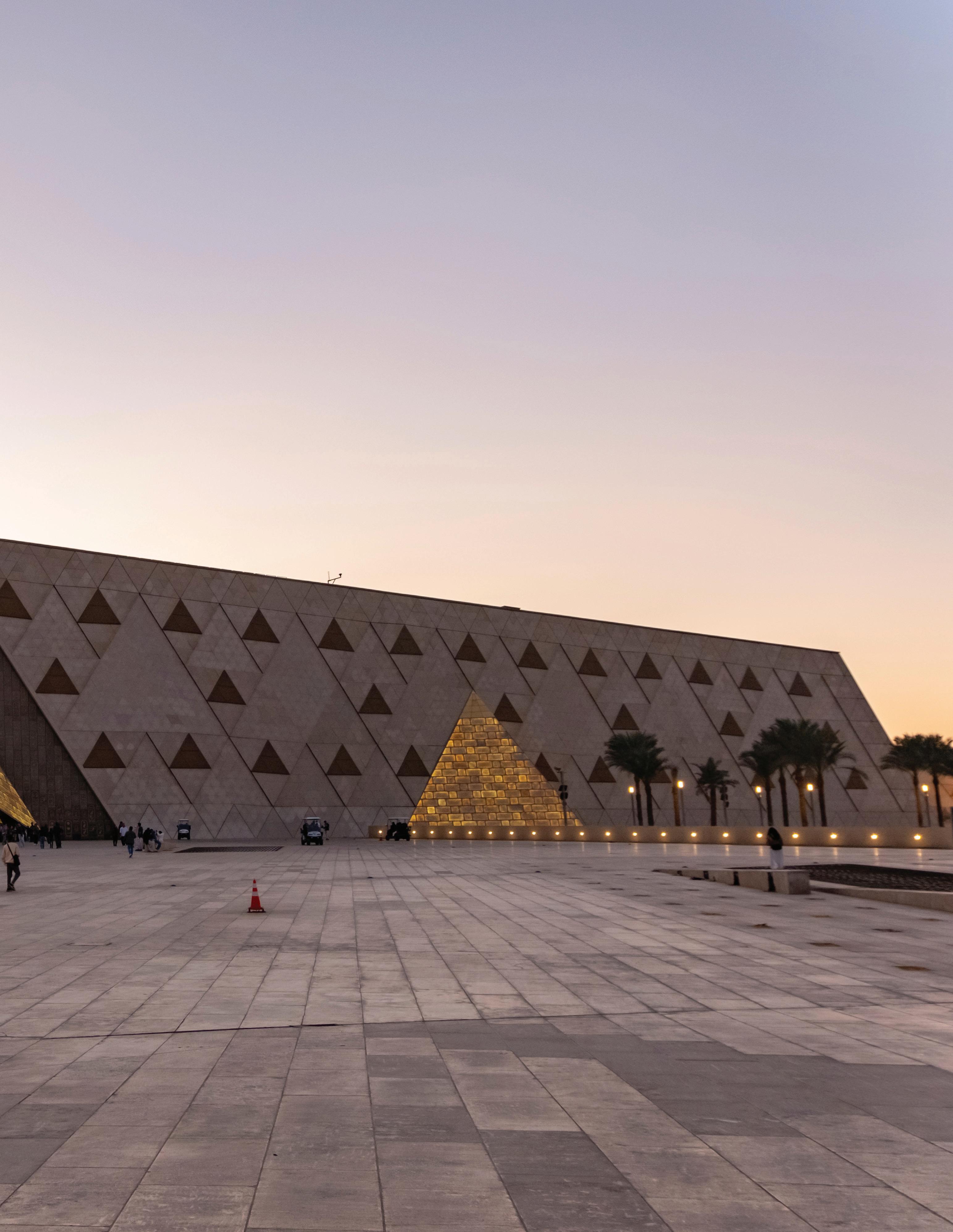
reinforced-concrete folded-plate roof structure with steel shading mesh. Translucent alabaster stone walls wrap the building to the east and north. A triangular motif in the cladding echoes the pyramids’ triangular forms but is reminiscent of a Sierpiński set – a fractal image of repeating triangles recursively diminishing to infinity. (The final building did not incorporate the translucent stone walls with the complete Sierpinski patterns, but the approximation remains nonetheless.) Developed in conjunction with West 8, extensive gardens adorn the exterior over the five hectares of outdoor exhibition space. Date palms testify to the movement of the Nile, its valley cut by water and laden with sediment from the lower Kingdom. The black earth, the land of Egypt.
The main entrance is pyramidal, tiled with cartouches said to comprise royal names. The form of the entryway echoes down the perspective to the distant tombs. The sense is wonderment, a reverberating awe where the unstoppable force of time breaks up against the vanishing past in the uniqueness of the moment.
From the air, the design seems to slice into the landscape cut by the Nile. It’s prominent – but windswept, like a scalar section of
the pyramids. It’s a modern, angular conception. But it is not obtrusive – the perspectives converge toward Giza. The museum does
not subsume the profile of the ancient monuments, it elevates them. It points to the past even as it invites the future. KT
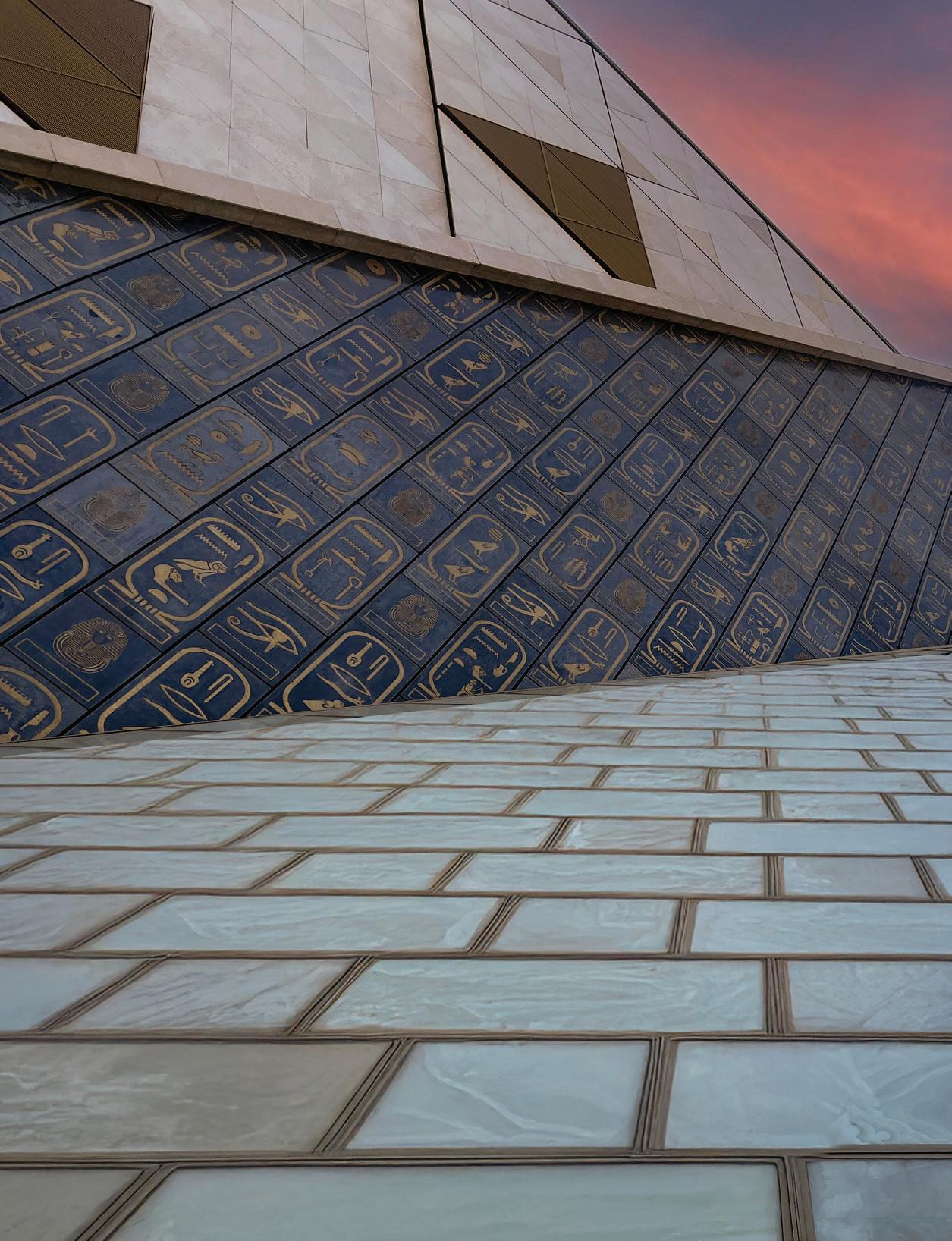
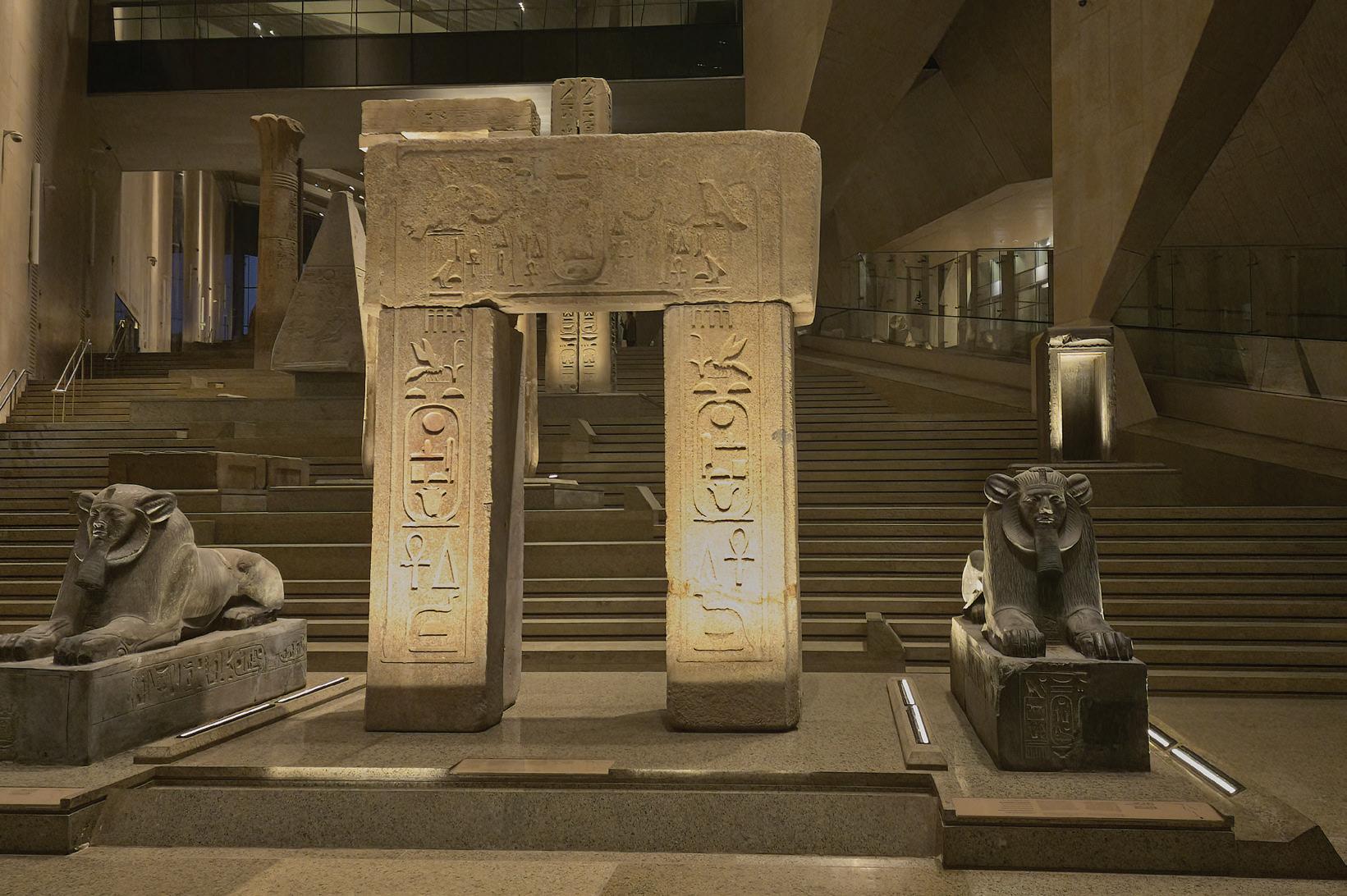

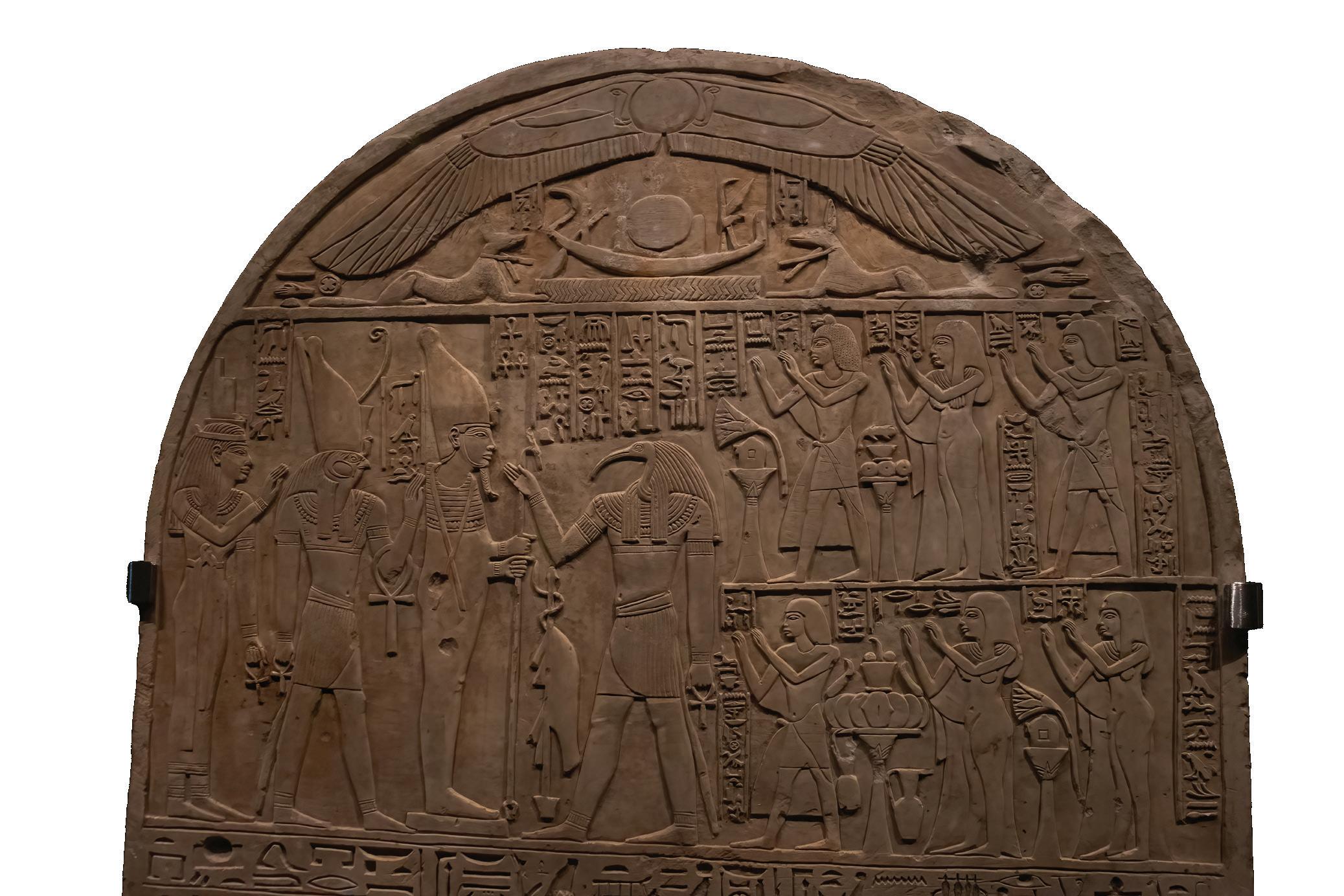
9. Temple fragments on the Grand Staircase. 10. Exterior angles. 11. From the air. 12. Thoth. 13. Alignment with Giza. 14. Entryway.
by Charles “Chic” Cicero
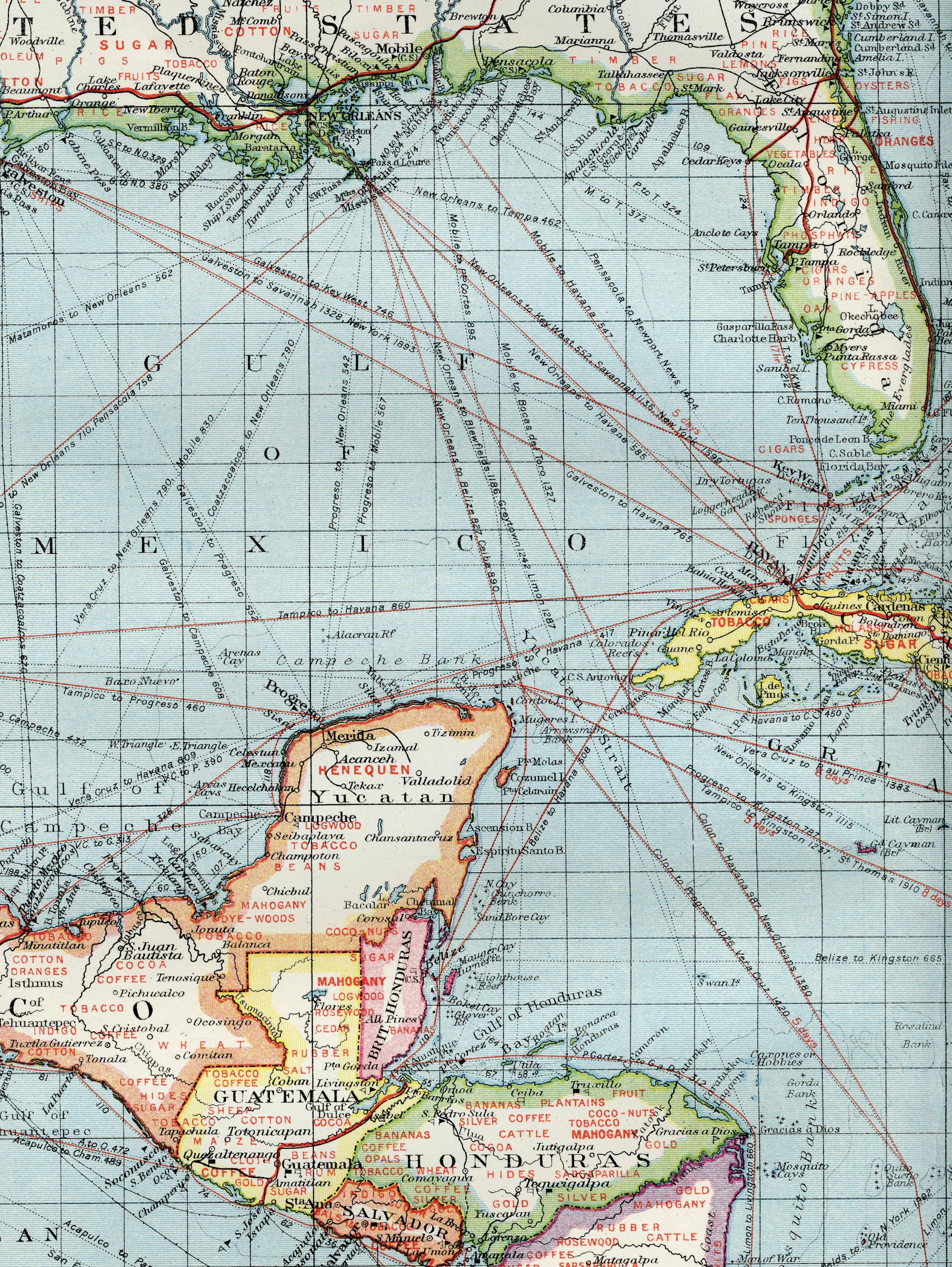
The peninsula of Florida was discovered in April 1513 by the conquistador Juan Ponce de Leon, who named it Florida after the Easter season (Pascua Florida) – or, more probably, because of the luxuriant plant life. Spanish settlement began in 1565 with the founding of the city of Saint Augustine, in response to the perceived threat of a shortlived French Huguenot colony that had been established nearby in 1564 (and rapidly destroyed by Spain). Other Spanish settlements followed and the area remained under Spanish control until the Seven Years War when it was seized by Britain (1763).
Economic prosperity ensured Floridian loyalty to Great Britain during the American War of Independence when the British used the region as a base for attacks on colonial coastal cities. After the war, control of the area was returned to Spain by the Treaty of Paris (1783), although this led to constant conflict between Spain and American expansionist interests. During the War of 1812, the British used Pensacola, in the extreme north-western part of Florida, as a base for their operations. After General Andrew Jackson’s second capture of Pensacola in 1818, the Spanish position
became untenable and in 1819 Florida was ceded to the United States by purchase. However, the period from 1818 to 1842 was a difficult one for the Florida Territory due to conflicts with the native Indian tribes, which led to the two Seminole Wars (1818 and 1835-42). In 1845 Florida was admitted as the 27th State of the Union.
The early history of Freemasonry in Florida is a matter of some dispute, and not all Masonic historians are in agreement on this matter. Freemasonry in Florida is said to date back to the year 1768. There is no trace of the lodge chartered in East Florida by the Grand Lodge of Scotland in 1768. Gould suggests that this lodge might in fact be St. Andrew’s No.1, since its name indicates a Scottish origin, when Florida was a still a territory ruled by Britain. It was on March 15th of that year that a lodge in East Florida was granted a charter by the Grand Lodge of Scotland. According to Albert G. Mackey who cites R. F. Gould as his reference, “In 1768, the Grand Lodge of Scotland erected a lodge, No. 143, at East Florida and appointed Governor James Grant Provo G.M. for North America, southern district.” 1 Another source
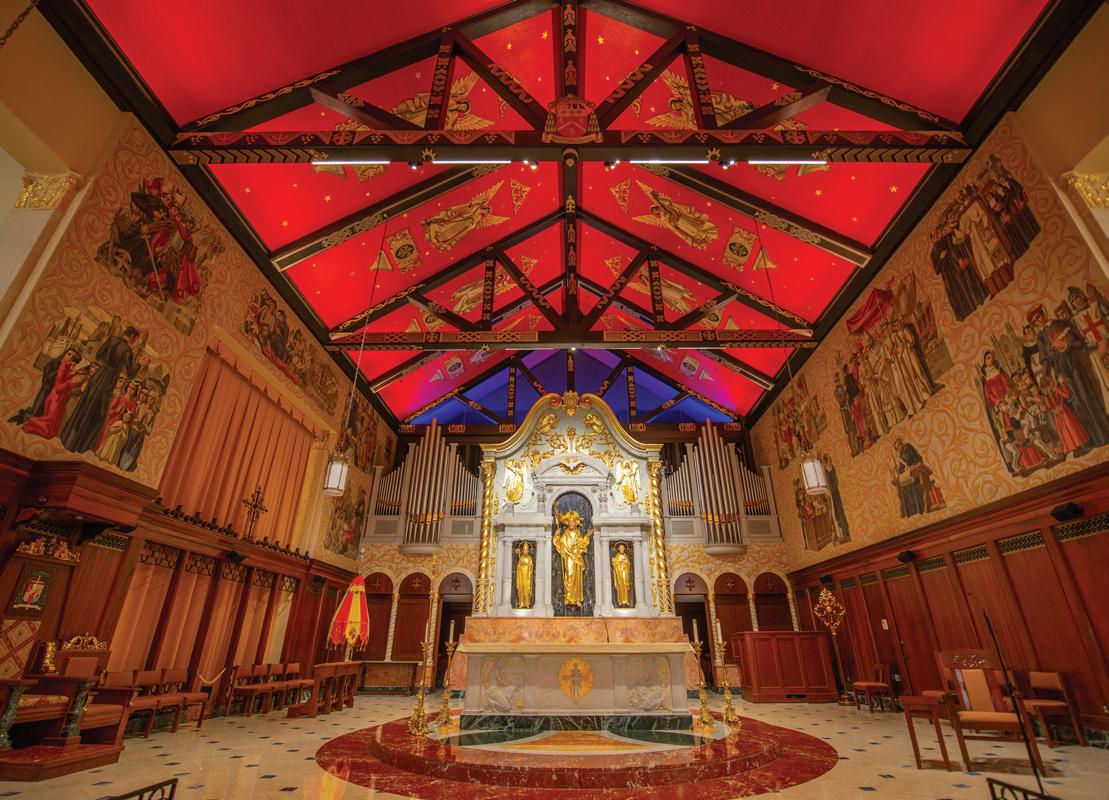
states that this lodge was Grant’s East Lodge No. 143 located in St. Augustine in the Territory of East Florida.2
On July 8, 1783 the Grand Lodge of Pennsylvania received “a memorial from the Brethren of St. Andrew’s Lodge No.1, late of West Florida, now of Charlestown, South Carolina, with sundry papers relative thereto.” 3 Little more is known of the origin of this lodge - it had not been chartered by the Grand Lodge of Pennsylvania as some have speculated, owing to the fact that the charter granted upon the memorial was sent to the Worshipful Master of a different lodge, with instructions that it was only to be delivered “provided
that the Master and members of said Lodge are found to be of the Ancient and Honorable Fraternity and accept to be under this jurisdiction.”4
While this may well be the most plausible solution to the enigma of Florida’s first lodge, it also presents another problem: the lodge chartered in 1768 was located in East Florida, while the memorial received by the Grand Lodge of Pennsylvania from St. Andrews’s Lodge No.1 indicates that it had been located on the West coast of Florida. In any event, it remains a mystery. It may also be noted that during the American Revolutionary War, many American lodges lost contact with their
mother lodges in Britain.
The Grand Lodge of South Carolina (Ancients) made several early attempts to charter lodges in Florida. According to lists of masonic lodges published in 1804, a lodge in St. Augustine, Lodge No. 30, was chartered by the Grand Lodge of South Carolina. Mackey states that this lodge became “extinct in consequence of a decree of the King of Spain.”5 (Drummond hints his doubt at this statement.)6 No. 56, at Pensacola, was also chartered by the Grand Lodge of South Carolina; however, the date of the charter is unknown. It too became extinct. On June 30, 1820, the same Grand Lodge chartered Floridian Virtues Lodge, at St. Augustine, which replaced the (then) extinct No. 30 which had closed in 1827. On June 29, 1821, that same Grand Lodge resuscitated No. 56 at Pensacola, under the new name of Good Intension [sic] Lodge, No. 17. This lodge was also short-lived, becoming extinct in 1825. On January 3, 1824, that Grand Lodge issued a charter to La Esperanza Lodge, No. 47, at St. Augustine, which was supposed to be a revival of No. 30. Due to a division in local membership from the old Lodge
Tallahassee, located in the Florida Panhandle region, which was chartered by the Grand Lodge of Alabama in 1825. On December 15 1827, this lodge was suspended and its charter was forfeited on December 8, 1829. It was later restored to good standing on the payment of its arrears of dues. A second lodge, Concord Lodge No. 29, was chartered by the Grand Lodge of Alabama but it was short-lived.
organized under the laws of the United States, developing as a new State, was also so entitled.
The unsettled state of the territory, coupled with Indian uprisings and the anti-masonic excitement generated by the William Morgan affair in the 1820s and 1830s slowed the growth of the new Grand Lodge for the next few years.
No. 30 between No. 28 and the new No. 47, La Esperanza was suspended in 1827. Both No. 28 and No. 47 went under. According to Drummond, “the chartering of a new Lodge killed them both.”7
The Committee in charge of the Reprint of the Proceedings of the Grand Lodge of Florida on the authority on Col. Gad Humphreys of St Augustine, state that the first lodge in East Florida was warranted by the Grand Lodge of Georgia in 1806. This was St. Fernando Lodge at St. Augustine. However, this was not the first lodge, since South Carolina had issued a warrant to No. 30, two years earlier. Unfortunately, many of the early records of both the Grand Lodge of Georgia and the Grand Lodge of South Carolina were lost, so there is much that cannot be verified. The earliest reference in the records of the Grand Lodge of Georgia to such a lodge in Florida is San Fernando Lodge, No. 28, which was listed in 1818. (It had probably been chartered no earlier than 1817.) There are no records of an earlier Georgia Lodge in Florida.
Florida’s first enduring lodge was Jackson Lodge No. 23, in
The Grand Lodge of Georgia re-asserted its authority in Florida by chartering Washington Lodge No.1, located in Quincy, north of Tallahassee, in December of 1828. A year later in December of 1829 the same Grand Lodge chartered Harmony Lodge, No.2, in Marianna, near the borders of Georgia and Alabama.
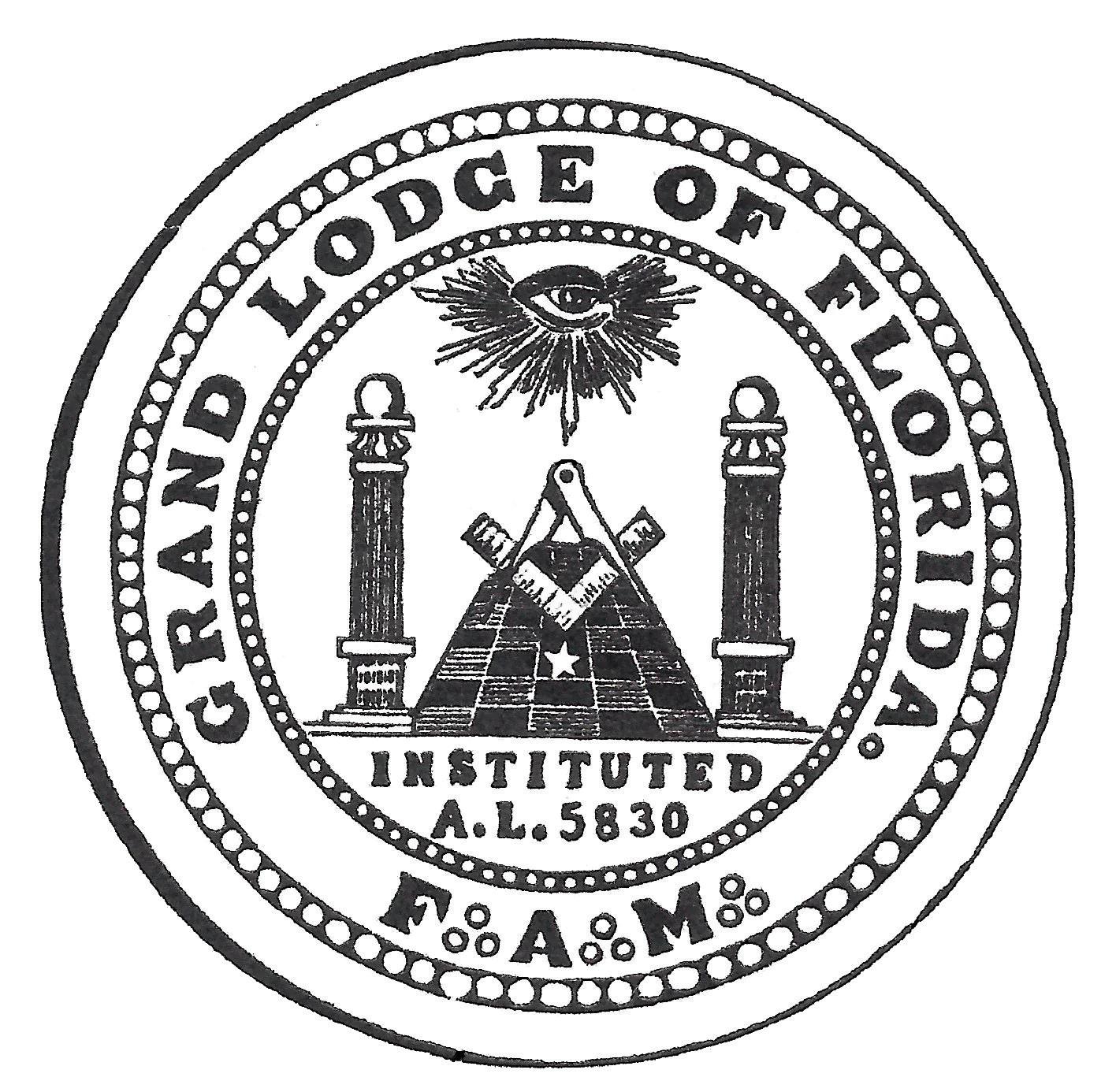
On July 5, 1830, representatives from Jackson, Washington, and Harmony Lodges met for the purpose of establishing a Grand Lodge for the Territory of Florida. They framed and adopted a constitution, and on 6 July they organized themselves into the Grand Lodge of Florida, Free & Accepted Masons. The Grand Master and Grand Officers were elected and installed. These lodges renumbered themselves as Jackson Lodge No.1, Washington Lodge No.2, and Harmony Lodge No.3. All three are still active today. The Grand Lodge of Florida is the oldest existing Grand Lodge to be first formed in a U.S. Territory.
Prior to this, U.S. Territories waited until they reached statehood before forming their own Grand Lodges. The only other exception was the Territory of Michigan which was not long-lived. It had previously been maintained that Grand Lodges could only be formed within sovereign states, but as the states became subject to a centralized government, in a limited capacity, this changed, especially after it was decided that Washington, D.C., was entitled to formulate its own Grand Lodge. Not long after, it was determined that a Territory
Whereas the keystone, the central wedge-shaped stone, is the primary locking stone of an arch the capstone is the crowing stone of an entire structure or wall. Thus, Royal Arch Masonry, which some have called “the Capstone of Ancient Craft Masonry,” is known as the Capitular Rite. In the U.S., Royal Arch Masonry confers the degrees of Mark Master, Past Master, Most Excellent Master, and the Most Sublime Degree of the Holy Royal Arch.8 In England the Royal Arch dates back to at least 1744, and in America to 1753.
When the two English Grand Lodges came together in 1813 to form the United Grand Lodge of England, the Articles of Union stated that Royal Arch Masonry is part of “pure ancient Masonry ... as a result the Craft and Royal Arch in England are closely linked constitutionally, administratively and thematically ... [and] the candidate [for exaltation] is informed that he must not regard himself as having taken a fourth degree, the Royal Arch being described as the Master Mason’s degree completed.”9
In the United States, the Craft and the Royal Arch are totally separate, the Royal Arch forming a part of the series of degrees known as the York Rite. However, the symbolism of the Royal Arch picks up where the Blue Lodge [Craft] symbolism leaves off. In Symbolic or Blue Lodge Masonry,
the symbolism of the degrees revolves around the building of King Solomon’s Temple. Royal Arch Masonry continues in this vein with symbols and allegories of the Second Temple, the Ark of the Covenant, further symbolism of the temple, and the lost word. Although it is certainly not a pan of the original three degrees of Freemasonry, the allegorical subject of Royal Arch Masonry indicates what is thought by many to be a natural progression or later extension of the Craft’s primary theme.
The Council of Royal and Select Masters fills what would otherwise be a considerable vacuum within the York Rite. Councils were a relatively late addition to the York Rite, dating from the early 1800’s. In the U.S., the Council confers the degrees of Royal Master, Select Master, and Super Excellent Master. These are known as the Cryptic degrees because their allegorical basis is the subterranean Vault supposedly constructed by Solomon as a depository for certain secret knowledge and guarded by a select priesthood. Many members consider the degrees of the Cryptic Rite to be an ongoing link between the proceedings of the Blue Lodge and Royal Arch rites.
According to Frederick G. Speidel, “Most masonic histories assert that the Cryptic Rite originated in America. This is true. However, the degrees of Royal and Select Master came into the United States, from France, by way of the West Indies, as side degrees of the Rite of Perfection in the 18th century.”10
In 1818, Jeremy Cross, the acknowledged founder of Cryptic Masonry received the Royal Master degree from Thomas Lowds in New York. Soon after, Cross put the two degrees (of Royal Master and Select Master) together and organized and warranted the first Councils of Royal and Select Masters.
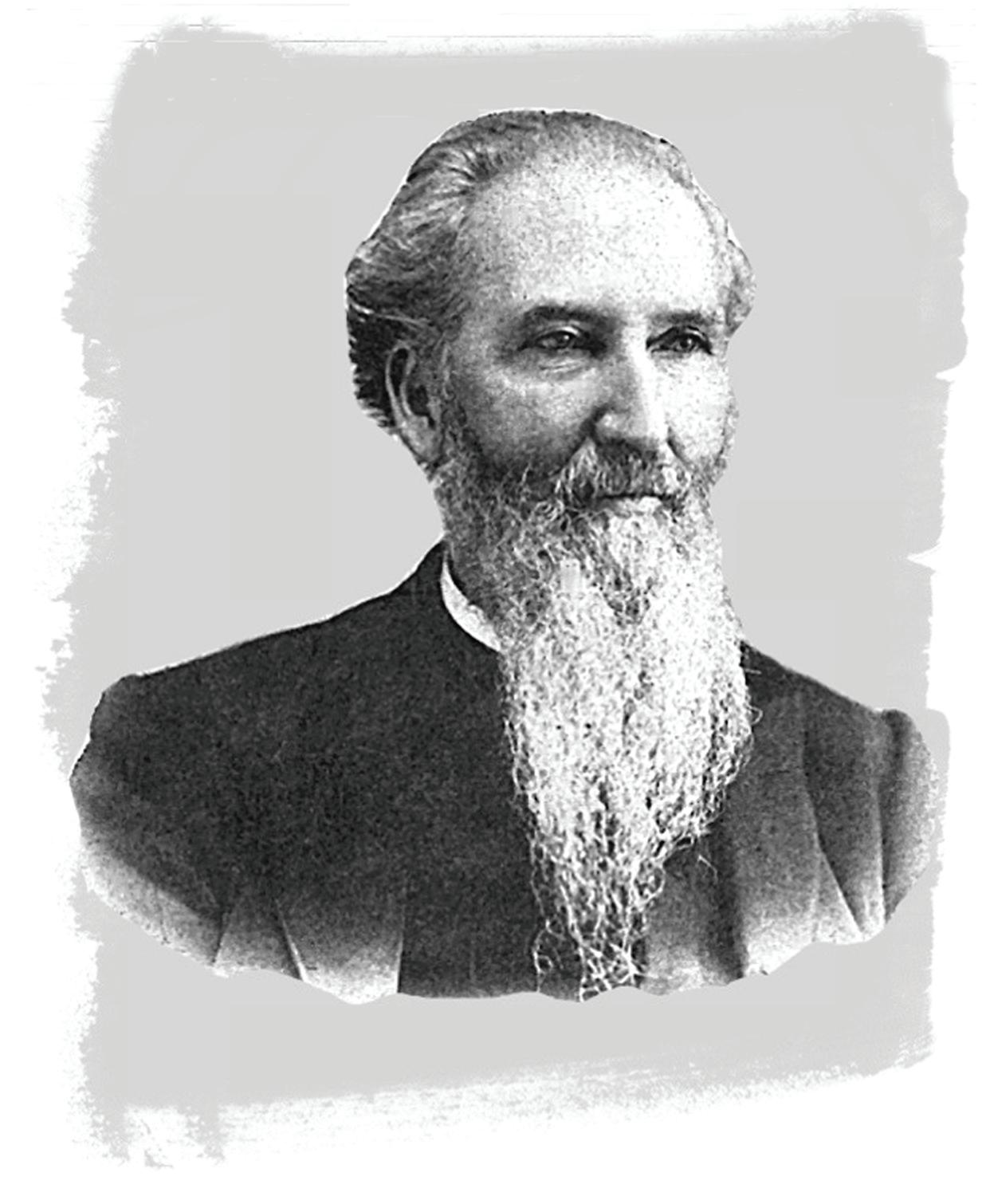
Not long after Jackson Lodge No. 23, in Tallahassee, was chartered by the Grand Lodge of Alabama in 1825, Florida’s first Royal Arch Chapter, Florida Royal Arch Chapter No. 32 of Tallahassee, was chartered by the Grand Chapter of Royal Arch Masons of the state of Virginia in 1827. It would be 1844 before another Florida Royal Arch Chapter was chartered—this was No. 4 of St. Augustine. One year later, Magnolia Chapter No. 16 of Apalachicola (in the Florida Panhandle region) was chartered in 1845. These three Royal Arch Chapters organized themselves into the Grand Royal Arch Chapter for the state of Florida in January 1847.11
Cryptic Masonry in Florida would not be organized until later. The Grand Council of Royal and Select Masters for the State of Florida, consisting of Mackey Council
called a Commander (equivalent to a Preceptor in the UK). At the 13th Triennial Conclave in 1856, the Grand Encampment of Knights Templar of the United States meeting at Hartford, attempted to abolish the title of “commanderies” in favor of the historical title “preceptories,” but the effort was unsuccessful.13 The business of an American Commandery takes place within the Templar asylum.
No. 1 of Tallahassee, Columbia Council No. 2 of Alligator (now called Lake City, between Jacksonville and Tallahassee in the northern part of the state), and Douglas Council No. 3 of Jacksonville was organized in January of 1858.12
Chivalric Masonry is the domain of the masonic Knights Templar, Based in spirit upon the traditions of the Chivalric Orders of knighthood that fought for Christian control of the Holy Land during the Middle Ages, the modem-day masonic version has no historical links to its mediaeval namesake.
A Commandery of Knights Templar in the United States (the equivalent of a Preceptory of Knights Templar in England) confers three Orders which are, in reality, degrees. They are: the Illustrious Order of the Red Cross, the Order of Malta, and the Order of the Temple.
The presiding officer is
All Knights Templar must adhere to the Christian faith, since the Commandery of Knights Templar is founded upon the legendary role of the Mediaeval Knights Templar to protect Christian pilgrims along the roads of Palestine, and it is also based upon the practice of Christian virtues as well as on moral and spiritual lessons that urge its members to live their lives as Christian Knights. Naturally, the Christian Cross, in many forms, is one of the most prominent emblems used to instruct “Sir Knights” in various lessons.
The General Grand Encampment of Knights Templar of the United States was organized in 1816, however in 1856, all “General” references where discontinued. The national body became the “Grand Encampment” and the presiding officer, the “Most Eminent Grand Master.”
According to the records of the Grand Encampment of Knights Templar of the United States of America, DeMolay Commandery of Tallahassee, Florida, was issued a dispensation on 17 March 1851 by Grand Master William B. Hubbard. However, this Commandery was never chartered.
A minute book exists for a Knights Templar asylum at Lake City. Lamienus Encampment No. 14 was chartered by the Grand Commandery of
Virginia in 1863 at the height of the Civil War. A dispensation had been previously issued to the Encampment by Sir Edward H. Gill, Grand Commander of Virginia. The Grand Commandery of Virginia had withdrawn its allegiance from the Grand Encampment of the United States and amended its constitution to “extend her authority to any State wherein there was no Grand Commandery, in which her aid might be desired.”14
It was not until after the war that the first Florida Commandery was chartered by the Grand Encampment of Knights Templar of the United States of America. Charters were issued to Coeur de Lion Commandery No.1 of Warrington (Pensacola) on September 18, 1868; Damascus Commandery No. 2 of Jacksonville on September 21, 1871; Baron Commandery No. 3 of Key West on December 3, 1874; and Olivet Commandery No 4 of Orlando on December 13, 1889. Of these, Baron Commandery lost its asylum, record, paraphernalia, and Charter in a fire in 1886.
The remaining three Commanderies, Coeur de Lion, Damascus, and Olivet, met in Jacksonville to organize the Grand Commandery of Florida on August 15, 1895. The convention was called to order by William Allen McLean, Past Commander of Damascus Commandery No. 2. McLean acted as a proxy for Hugh McCurdy, Grand Master of the Grand Encampment of the United States of America, who issued a warrant to form a Grand Commandery of Knights Templar in the state of Florida.
The irregularly created Lamienus Encampment No. 14, 15 chartered by the Grand Chapter of Virginia during the time of the Confederacy, was operating as late as 1868 as indicated in Grand Master William Sewall Gardner’s 1871 address to the Grand Encampment.16
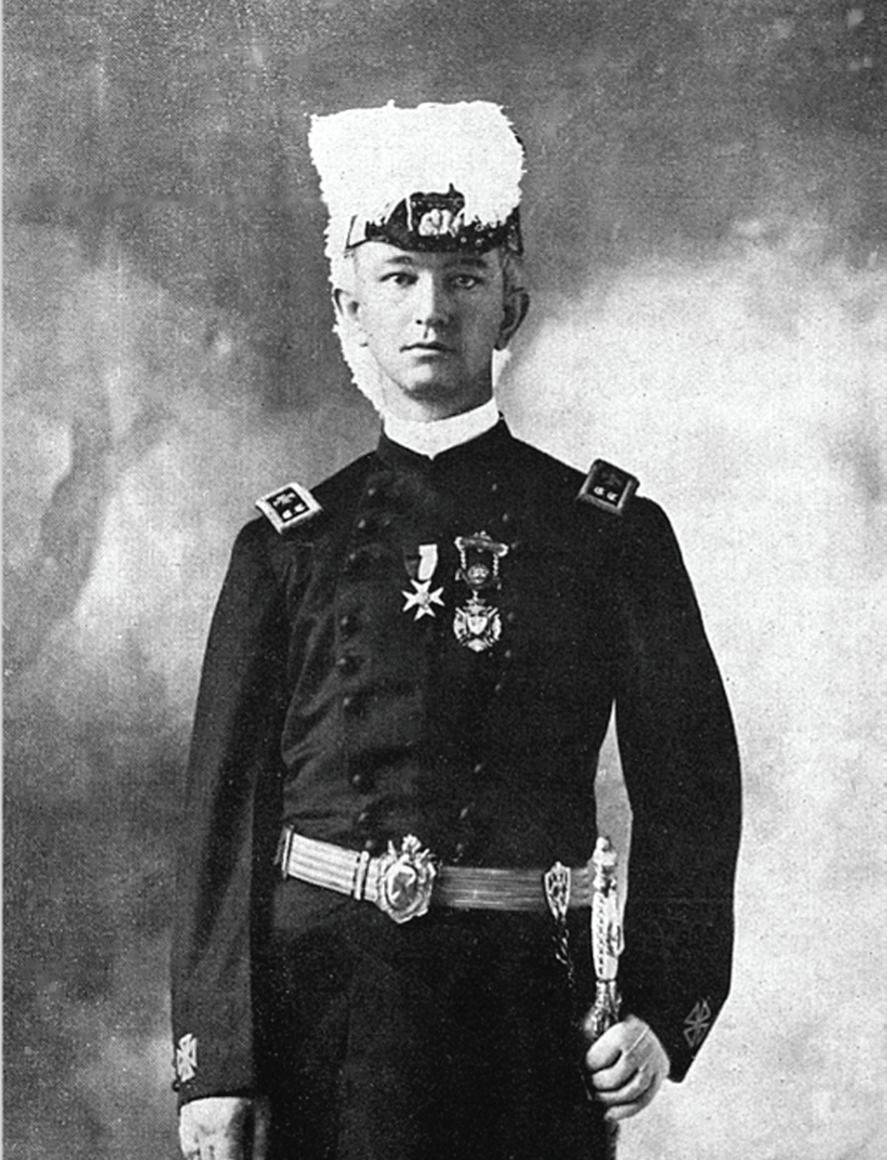
Prior to granting Damascus Commandery a dispensation, Gardner received a letter from a John S. Driggs dated November 16, 1869 explaining that he and two other Knights had gone to Lake City in July of 1868 and received the Order of the Temple from Lamienus Encampment, only to learn later that the Commandery was not in affiliation with the Grand Encampment of the United States, but held its Charter from the Grand Commandery of Virginia. Driggs indicated that Lamienus had since ceased to exist. The petition for Damascus Commandery was signed by five Knights who were former members of Lamienus: John S. Driggs, William Grothe, Theodore J. McCarty, David Jones, and Joseph N. Haddock. In order to qualify the irregularly created Knights to participate in the formation of Damascus Commandery, U.D., Gardner issued an order to Damon Greenleaf, one of the petitioners and the proposed new Commander, authorizing him, in the presence of the other petitioners, to “heal” the five Companions who had been
but throat problems hindered him in such a way that he was unable to carry on in his chosen line of service. Nevertheless, he continued to serve as a lay minister for the rest of his life.
McLean was raised to the degree of Master Mason in Solomon Lodge No. 20, F. & A.M. in 1858. He was elected Worshipful Master in 1868. He received the Capitular and Cryptic degrees in 1866 and 1868 respectively and the Chivalric degrees in 1869. He served as High Priest of Jacksonville Chapter No. 12 and Commander of Damascus Commandery No. 2.
made Knights “without authority” by the Grand Commandery of Virginia, and obtain from each of them a vow of allegiance and fealty to the Grand Encampment of the United States of America. Gardner’s order was sent and returned, along with the subscribed vows of allegiance dated May 2, 1870, in proper form.
After the Dispensation had been granted, Gardner authorized the Commander of Damascus No. 2 to “heal” one George R. Jones, who had also been created a Knight in Lamienus Commandery.
All of the above named Knights became charter members of Damascus Commandery No. 2, at Jacksonville, when its charter was granted on September 21, 1871.
William Allen McLean was born at Centenary Church in Telfair County, Georgia, on December 26, 1832. As a young man, McLean joined the ministry in the Methodist Church,
After leaving the ministry, McLean studied law. He was later accepted into the legal profession as a member of the Florida Bar. In 1869, he was appointed County Judge of Duval County, a position he held for twenty-one years. During that time he served two years as the municipal judge.
McLean served as Grand Master for three consecutive years, beginning in 1878. He received the 4th to the 32nd degrees of Scottish Rite Masonry, in Jacksonville. The returns of the Supreme Council, of 1886, show McLean as Venerable Master of St. John’s Lodge of Perfection No. 1 in Jacksonville, chartered in 1881. Sir Knight McLean received the honor of Knight Commander of the Court of Honor in 1890, was coroneted as Honorary 33rd Degree in 1892, and crowned an active member of the Supreme Council of the Southern Jurisdiction in 1893.
McLean was the 24th Grand High Priest of the Grand Chapter of Royal Arch Masons of Florida, an office he held for two consecutive years, in 1881 and 1882. He served as Grand Secretary of the Grand Chapter until his death. He is credited with organizing the Grand Commandery of Florida and served as the first Grand Commander in 1895. He also served as the Grand Recorder from 1896 until his death in
According to the records, “He died at his home at 1:20 p.m. in Jacksonville on August 22, 1898. He was laid to rest in the old city cemetery in Jacksonville. A monument marks the spot.”17
Charles Henry Ketchum also deserves particular notice. He was born on November 21, 1874 at Candor, New York. His parents were William P. and Laney Ketchum. As a young man, Charles entered a scholastic competition and won a scholarship to attend Cornell University. In 1894 he graduated from the Law School at Cornell at age 19 and entered into law practice in Washington, D.C. He remained there until 1896 when he was appointed the Chief Clerk in the Quartermaster’s Department in Key West, Florida.
When the Spanish American War erupted, Ketchum entered the Army as a private in Battery A of the First United States Artillery. He was stationed at Fort Taylor in Key West. At the end of the war, he was discharged from the military and again took up his duties as Chief Clerk in the Quartermaster’s Department in Key West.
Ketchum married Jennie L. Roberts, of Key West and daughter of one of its more prominent citizens, on May 17, 1899. Shortly afterwards he was appointed to the position of Postmaster at Candor, New York, and moved back to his birthplace. He was highly praised for excellent work as Postmaster, but in 1901 he resigned from that position and returned to his adopted home in Key West.
Upon his return Ketchum entered into the brokerage and insurance business and became a resident agent for the Mutual
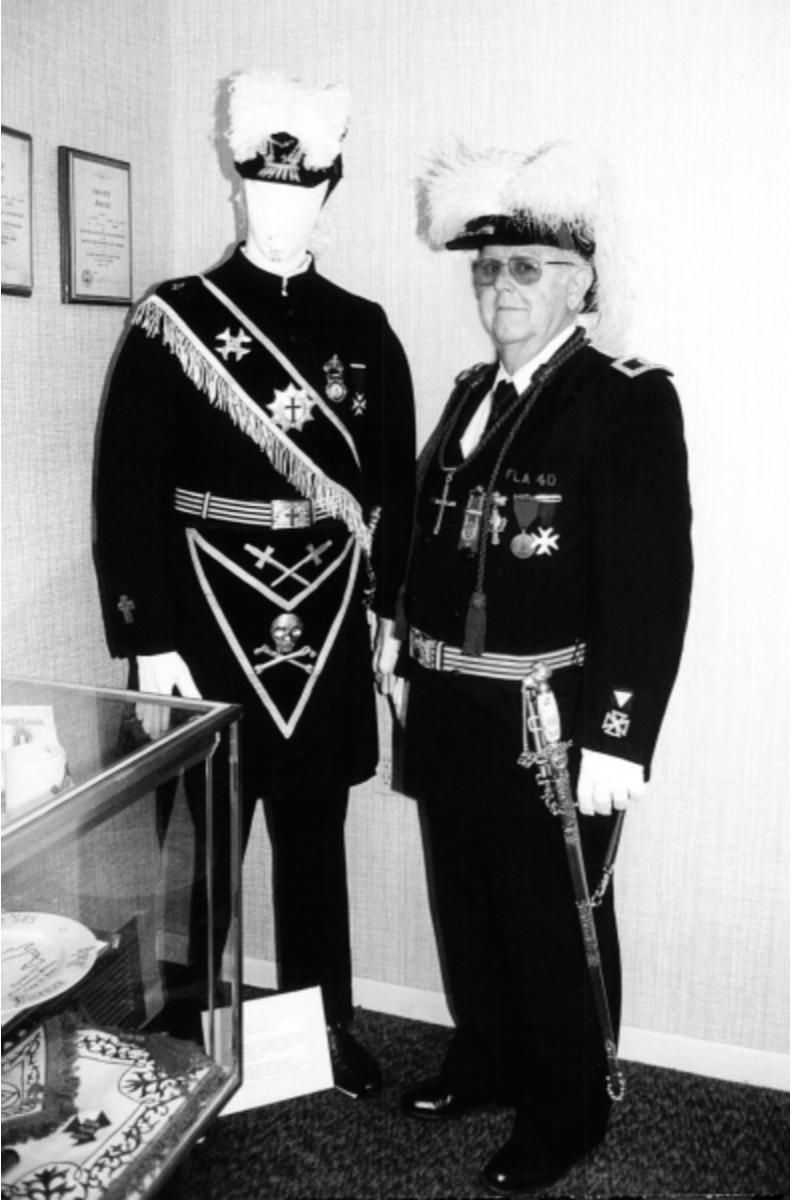
Life Insurance Company of New York and the United States Fidelity and Guaranty Company of Baltimore. He served as a director of the Island City National Bank and the Consumers Ice Company, two of Key West’s largest businesses. He was also president of the Consumers Bottling Company and served as a Councilman at Large during the period of Key West’s progressive growth.
Ketchum was initiated in Dade Lodge No. 14, F. & A.M., on April 1, 1903; Passed on June 17, and raised as a Master Mason on July 15. He received the degrees of Royal Arch Masonry on April 27, 1906, at Island Chapter No. 21, at Key West, and was installed as a Knight Templar on January 16, 1908, in Baron Commandery No. 3, also of Key West. Later he joined Monroe Council No. 2, Royal and Select Masters. He was elected High Priest of Island Chapter No. 21 in 1910 and 1911, and Commander of
years later, on October 17, 1921, Ketchum was coroneted a thirty-third degree member of the Supreme Council, A. & A. S. R. (SJ), at the House of the Temple in Washington, D.C.
This indefatigable mason served the York Rite with enthusiasm. He served as Grand High Priest in 1918. He was elected and installed Grand Commander in 1917 and then as Grand Master of the Grand Council in 1920.
Ketchum and his wife Jennie were members of Fern Chapter No. 21, Order of the Eastern Star, in Key West. He served as Grand Patron in 1919. He was also a Noble of the Ancient Arabic Order Nobles of the Mystic Shrine in Mahi Temple at Miami.
His devotion to the Symbolic Lodge was untiring and he was elected and installed as Grand Master of the Grand Lodge of Florida, F. & A.M., for two years, in 1921 and 1922.
Baron Commandery No. 3 in 1910, 1911, and 1912.
He received the Royal Order of Scotland in 1915 and served as District Deputy Grand Master of the 18th Masonic District in 1913 and 1915.
Ketchum was a charter member of Palm Lodge of Perfection No. 10 in 1908 and Venerable Master in 1909.
In 1911, he became a charter member and the first presiding officer of Southern Cross Chapter Knights of Rose Croix No. 3 and a charter member and first presiding officer of Alpha Council Knights Kadosh No. 3 in the same year. In the following year, 1912, he was a charter member and first presiding officer of Key West Consistory No. 4.
Brother Ketchum served as Secretary of all the Scottish Rite Bodies in the Valley of Key West for over a dozen years. In 1919 he was made a Knight Commander Court of Honor at the Supreme Council in Washington, D.C., and two
Charles Henry Ketchum was regarded, by those who knew him, as a man of broad interests and a balanced temperament. He was said to have been motivated by a high sense of honor and upright principles in everything he did.
On February 2, 1918, Grand Commander Ketchum gave a stirring address at the annual conclave of the Grand Commandery of Florida. The following is an excerpt from that address:
The past year has wrought many changes and has witnessed some of the greatest events of the centuries, events of so great importance and magnitude that it is hardly possible for us to grasp their real meaning and significance. Our great nation has been forced, in defense of its sovereign rights and in the interest of justice and humanity, to engage in the World War now raging with unrelenting fury, and from a Nation devoted to the arts of peace, we have become a
Nation at war.
Our country now demands of us the best and the most of which we are capable in the way of service and sacrifice. At no time in history has there been more need for patriotism and loyalty than at the present time. In the titanic struggle now raging, it is hoped that each Knight Templar will heed the teachings of the Order, and the duties of good citizenship, and forget not Our Government is worthy of his utmost loyalty and patriotism, and that its interests must always be first and foremost.
Consequently we meet today at a time fraught with much peril and responsibility to us as a Nation. We are at war with a first-class power and have landed troops on the continent of Europe for the first time in our history.
Prior to the declaration of the existence of a State of War with Germany, and for nearly three years, this Nation made every effort to maintain an attitude of strict neutrality. Our Government endured everything that a free Nation could bear and still claim to be worthy of the respect of its citizens and the respect of others. On account of the unwarranted, illegal, and inhuman conduct of the war on the part of the Imperial German
Government we have been compelled to recognize that it is our war, a war for humanity, a war to establish the Peace of the World, the Freedom of its Peoples, and to Bring About the End of Autocracies. That our Nation has taken upon itself a lofty resolve and purpose was made plain in President Wilson’s War Message of April 2nd, 1917, wherein he stated that our object “is to vindicate the principles of peace and justice in the life of the world, as against selfish and autocratic power, and to set up among the really free and self-governed peoples of the world such a concert of purpose and action as will henceforth insure the observance of such principles.
While it is not my desire to unduly dwell upon or refer to the war, yet I do not believe that we, the representatives of an integral unit of this great Order, can forego this occasion without placing ourselves on record in this Supreme contest of the ages. Let us uphold our Great Nation and cheerfully do all that we are called upon to do, and let us particularly, as individuals, show and exhibit our Loyalty and Patriotism in all the ways that are possible. Thousands of Knights Templar have entered into the Military and Naval Service of our
country and it is our solemn and bounden duty to do everything, within our power to strengthen and support those who are fighting our battles for us and for a glorious future for the Nations of the world.18
In 1995, Grand High Priest Harry Davis, Grand Master Addison Bennett, and Grand Commander Paul Hockett established a museum committee for the preservation of York Rite memorabilia. The Clearwater York Rite Bodies offered to house the museum in their temple building, and as word of the museum circulated by way of various masonic publications, interest was aroused among the Craft and the appendant bodies. Some items were purchased for the museum, and others were donated by individual members. To date, nearly a thousand items are on display and a number of organizations are represented—Blue Lodge, York Rite, Scottish Rite, Eastern Star, Shrine, Grotto, Amaranth, and others. In addition to aprons, swords, metals, jewels, coins, photographs, documents, and glassware, there are two life-sized mannequins in full Templar regalia. (The Museum has since been moved to Ivanhoe Commandery in Tampa.)
While Chivalric masons in the U.K. and the U.S. are similar in many ways, their dress is not.
One of the more visually striking differences between Chivalric Masonry as practiced in the U.S. and in Great Britain is the variation in regalia. The English attire is similar to that of a medieval Templar, including a white tunic emblazoned with a red cross, a hooded cloak, a sword, and the red chapeau or pillbox cap ornamented with a Christian Cross. The American manner of dress is based upon a black military-style uniform. The chapeau is quite different as well—the American version is a black naval-style hat with a white feathered plume across the top. Officers wear red crosses on their jacket sleeves. The uniform worn by Florida’s earliest Knights Templar was rather different. A high-collared, long frock military dress coat with cloth-covered buttons down the center, similar to that worn by Civil War officers, was standard Templar dress throughout the late nineteenth century and first part of the twentieth century. During the mid-1950s the uniform was changed to a more modern double-breasted Navy-style dress coat with a roll collar, worn over a white shirt with a black tie. The coat is ornamented with shoulder straps depicting a Knight’s rank. The sword is usually hung from a sword belt around the waist, or sometimes from a naval-style “frog” (adopted in 1983).
Originally, American Templars wore a triangular apron as a symbol of their masonic ties. This apron was black, trimmed
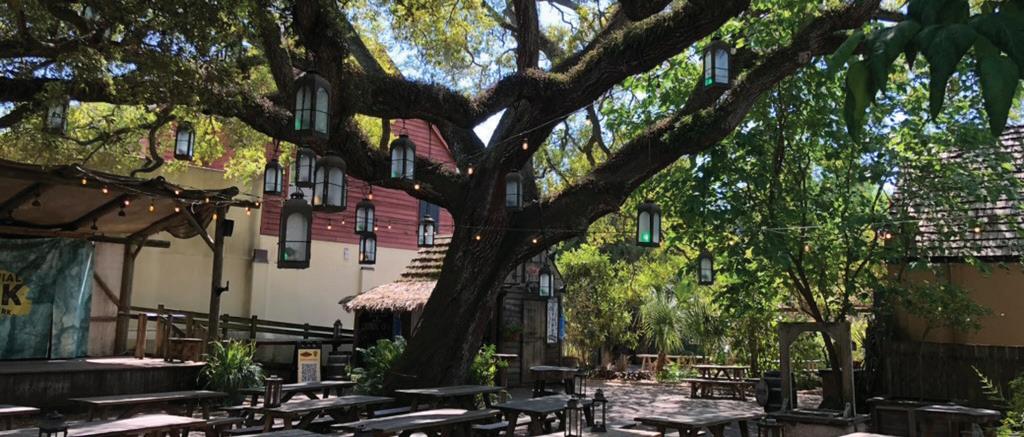
with white, and adorned with the symbol of the skull and cross bones (the “emblems of mortality”) to commemorate the martyrdom of Jacques De Molay. It formed a part of Templar regalia until 1857, when the Grand Encampment ruled to discontinue its use. Also discontinued was the baldric or belt that was worn across the chest and covered with emblems of rank and honor. In 1886 Grand Master Roome returned control of the uniform to the Grand Commanderies. A small number of Commanderies still use the apron on special occasions.
In 1999 the Grand Commandery Knights Templar of Florida History Committee was established. Its members were J. Roy Crowther, Past Grand Master; Marvin W. Gerhard, Past Grand Commander; Edwin B. Moore III, Past Grand Commander; and the present writer. Over the course of a year the committee set about the task of producing an account of the history of masonic Templary in Florida, which was completed in time for the Grand Conclave of the year 2000. The published
work is entitled Knights Templar of Florida Grand Commanders: A Comprehensive Historical Survey of the Knights Templar of Florida. (Full publishing details are given under Note 2).
The idea of producing such a book was conceived by Bro. M.W. Gerhard, and the committee utilized the various Proceedings of the Grand Commandery Knights Templar of the State of Florida and the invaluable “History Report” by J. Roy Crowther, which is incorporated in section Three. Further valuable assistance was provided by the late Ralph O. Sheppard, Past Grand High Priest of Panama. KT
1. Mackey, Albert G., and Singleton, William R, The History of Freemasonry, Volume V, (Masonic History Company: New York, 1898), 1437-8. Mackey’s reference is to Gould, Vol. III, p. 462.
2. Crowther, J. Roy, printed in section Three of Knights Templar of Florida Grand Commanders: A Comprehensive Historical Survey of the Knights Templar of Florida, (Privately printed by the Grand Commandery Knights Templar of Florida History Committee, 2000), 114.. This work, which constitutes the official history of the Grand Commandery, covers the period from 1851 to 2000. It is over 360 pages in
length and contains a photographic and biographical record of all Past Grand Commanders from the beginnings of Templary in Florida up to the present day. The book is divided into four sections: 1. A Pictorial Review of All Past Grand Commanders, 2. A Biographical Review in the Lives of Past Grand Commanders, 3. A Brief History of Templary and the Grand Commandery of Knights Templar of Florida from 1851 to 1998, and 4. A Chronological Review of General Information. Copies of the book may be obtained from the Grand Commandery of Knights Templar of Florida.
3. Gould, R F., The History of Freemasonry, Vol. IV, “The American Addenda,” (New York, 1889), 502. The relevant chapter was the work of Josiah H. Drummond.
4. Ibid.
5. Mackey, 1437.
6. Gould, op. cit., 502.
7. Ibid
8. Speidel, Frederick G. The York Rite of Freemasonry: A History and Handbook, (Press of Oxford Orphanage, 1978), 26.
9. Hamill, John, The History of English Freemasonry, (Lewis Masonic, 1994), 110.
10. Speidel, op. cit., 44.
11. Knights Templar of Florida Grand
Commanders: A Comprehensive Historical Survey of the Knights Templar of Florida, 114.
I2. Ibid.
13 Mackey, Albert G. and McClenachan, Charles T., An Encyclopedia of Freemasonry, Vol. II, revised edition by Hawkins, Edward L., and Hughan, William J. (The Masonic History Company, Chicago, 1924), 577.
14. Knights Templar of Florida Grand Commanders: A Comprehensive Historical Survey of the Knights Templar of Florida, 143.
15. This Commandery is variously described as Lamienus, No. 13, or Lamienus, No. 14.
16. Reprinted in Grand Commander William S. Ware’s 1901 “Address to the Grand Commandery of Florida” and published in the Proceedings of the Grand Commandery Knights Templar of the State of Florida for that year.
17. Knights Templar of Florida Grand Commanders: A Comprehensive Historical Survey of the Knights Templar of Florida, 2.
18. Op. cit., pp. 172-5.
This article was 0riginally published in Ars Quatuor Coronatorum: Transactions of Quatuor Coronati Lodge No. 2076, Vol. 113 for the year 2000, published in October 2001
by Ben Williams

Since time immemorial there have been naysayers and anti-Masons who’ve labeled the Masonic fraternity a secret society. Most Masons have insisted, however, that Masonry isn’t a secret society but a society with secrets. After all, our existence as a fraternity is not secret, nor are our Lodge locations, meeting times, or even our members’ identities.
Some Lodges have even had their officers’ names published in the local newspaper after each installation. Nowadays many lodges post such information on social media, revealing the names and faces of their officers for all to see. Real secret societies, such as the Bavarian Illuminati, went to great lengths to keep their existence quiet, their activities sub rosa, and their membership discreet.
Freemasons, on the other hand, are allowed to be wideopen about all but a few things pertaining to the Craft. For exam-
ple, Masonic authors have penned scores of books on the philosophy, symbolism, and lore of the Order. Masonic philosophy isn’t secret. We’d love for the rest of the world to know and adopt it. Our symbols aren’t secret. We display them on rings, lapel pins, bumper stickers, books, and even buildings. Our lore isn’t secret, either. We’ve published many treatises exploring ways to interpret them.
The only things we keep secret are our modes of recognition. That is, the grips, signs, passwords, obligations, catechisms, and ritual receptions which are esoteric. By esoteric, I mean understood only by the initiated.
But why?
Masonry, then, it’s not a secret society; it is a private order. In the quiet of the tiled lodge, shut away from the noise and clatter of the world, in an air of reverence and friendship, it teaches us the truths that make us men, upon which faith and character must rest if
they are to endure the wind and weather of life. So rare is its utter simplicity that to many it is as much a secret as though it were hid behind a seven-fold veil, or buried in the depths of the earth.
What is Secret in Masonry?
The method of its teaching, the atmosphere it creates, the spirit it breathes into our hearts, and the tie it spins and weaves between man and man; in other words, the lodge and its ceremonies and obligations, it’s signs, tokens, and words — its power to evoke what is most secret and hidden in the hearts of men. No one can explain how this is done. We only know that it is done, and guard as a priceless treasure the method by which it is wrought.1
The obvious reason for keeping our modes of recognition
1. Joseph Fort Newton, Short Talks On Masonry (Macoy Pub. & Masonic Supply Co.: 1988), Short Talks On Masonry, 58-59.
secret is they are how we try one another, how we prove ourselves as Masons when traveling to Lodges where nobody can vouch for us. If those secrets were made public, anyone could learn them, print a counterfeit dues card, and infiltrate our fraternity. This sort of thing has happened, unfortunately. Exposés of Masonic ritual have been printed as early as the first half of the 1700’s, and there have been more recent ones; but none of that would have happened if our brethren had been more diligent in guarding our modes of recognition and ritual. When brethren don’t take their obligations seriously, serious consequences can occur. Historically, a chief reason for Masonic secrecy was safety. Though Freemasonry is not a religion, its subject matter is spiritual from start to finish. In the 1500’s and early 1600’s, the era when our speculative fraternity had its beginnings, it was dangerous for people to discuss spiritual ideas
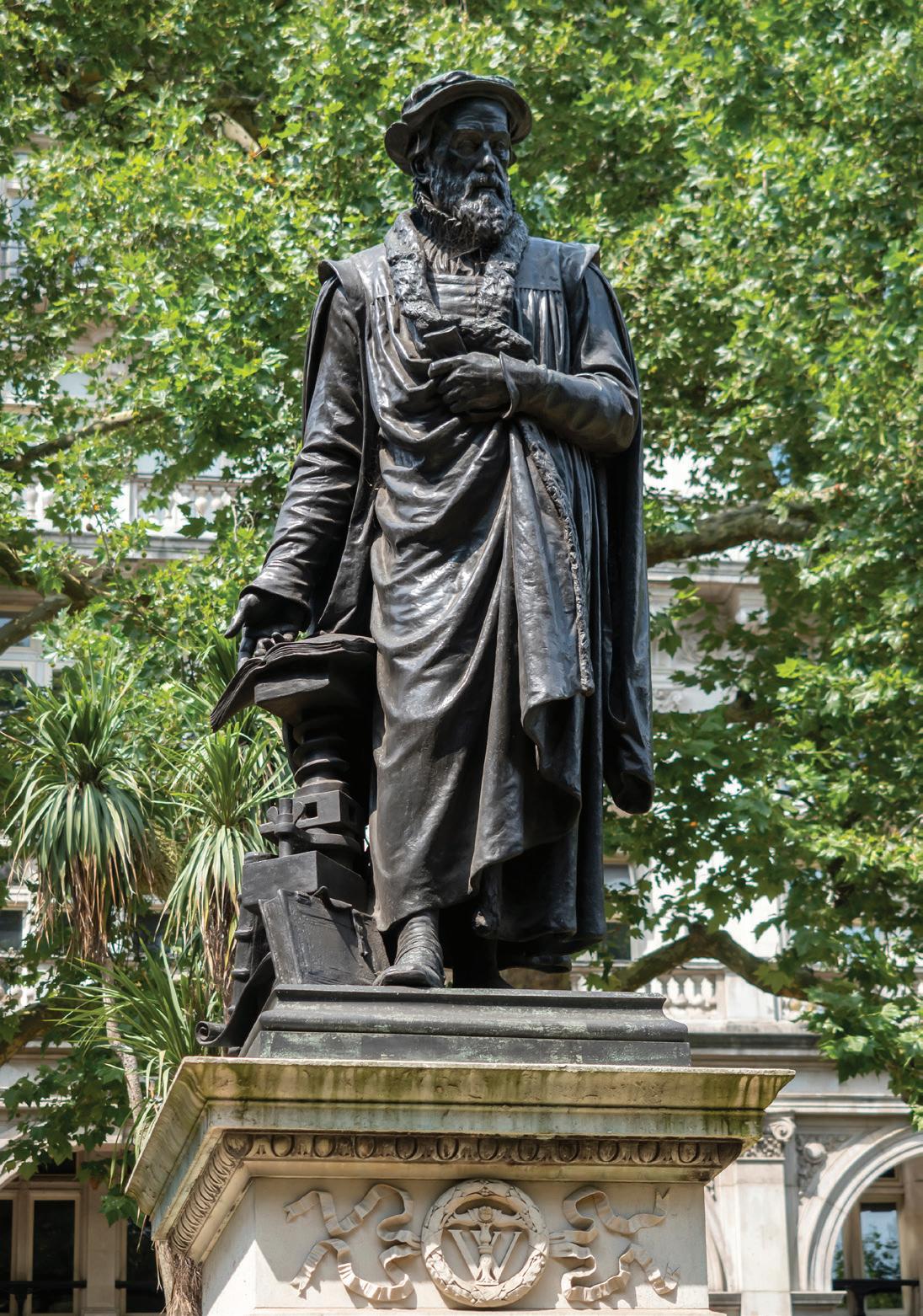
or philosophies not sanctioned by the religious authorities of their county. In those days, there was little to no separation between church and state in Europe. Fanaticism is always an enemy of mankind, but it is more dangerous when religious fanatics also wield temporal power. Spiritual despotism is terrible – and governmental tyranny is worse – but when a tyrannical ruler of a nation enforces laws based on superstitions of a state religion, freedom of conscience and freedom of speech cannot exist. Such was the condition of Europe in the early days of Freemasonry.
Lay people weren’t allowed to read the Bible for themselves, much less explore deeper interpretations or openly discuss other philosophies peripheral to its transmission. For example, in 1536, the English linguist and theologian, William Tyndale, was executed by strangulation and his body was burned at the stake
because he translated the Bible from Latin into English. In 1600 the Italian philosopher, Giordano Bruno, was burned at the stake by the Roman Inquisition on charges of heresy for teaching philosophical and cosmological ideas contrary to those taught by the Roman Catholic Church. In 1696 the English minister, Edward Wightman, was executed on charges of heresy for preaching doctrines that weren’t accepted by the Church of England. In 1743, three Masons were hanged by the Inquisition in Portugal, and John Coustos (the founder of the Lodge) was subjected to torture for over a year. In 1826 the schoolmaster, Cayetano Ripoll, was hanged by the Spanish Inquisition for teaching principles of deism. Many Jacobites were persecuted and killed in England during the 1700’s for practicing Catholicism and advocating support for the House of Stuart. Capital punishment for heresy or blasphemy
TOP LEFT: Statue of William Tyndale at the Victoria Embankment Gardens, London, murdered for the crime of translating the Bible into English. TOP RIGHT: Statue of Giordano Bruno in Campo de Fiori, Rome, murdered for claiming innumerable worlds existed and that Earth was not the center of the universe. BOTTOM: Woodcut of Edward Wightman meeting the flames at Lichfield, in Staffordshire, England. A radical Anabaptist, Wightman preached non-trinitarian views which lead to his arrest by order of King James I, and death for heresy.
wasn’t officially abolished in France until 1791.
From medieval times well into the nineteenth century, millions of Europeans perished for discussing ideas and beliefs that weren’t in alignment with the doctrines of the official religions of their respective countries. And the American Colonies weren’t much better off during the 1600’s, either. Women and adolescent girls in Salem, Massachusetts, were tortured and killed for accusations of witchcraft in the 1690’s. Among the earliest speculative Freemasons for whom we have written record were Sir Robert Moray and Elias Ashmole, initiated in 1642 and 1646 respectively. And there were undoubtedly other initiated before them in operative Lodges in Scotland and Ireland.
Freedom of conscience and freedom of speech are luxuries we
enjoy and take for granted in most western countries today, especially in the United States where these tenets are enshrined in the Bill of Rights. But this wasn’t the case in much of Europe during the early days of Freemasonry’s existence. Thus, since the rituals and symbols of Freemasonry have spiritual and philosophical significance, Masonic secrecy was imperative for the sake of Masons’ safety. If our early brethren were to safely discuss any sort of potentially controversial ideas, whether religious or secular, they had to do so in secret. That is still the case today in some countries where Freemasonry is illegal, such as Saudi Arabia and Iran.
Another reason for secrecy, and probably the most important one, has to do with morality. Masonry is, after all, a moral science. We’ve all heard it said that
Masonry is a “system of morality veiled in allegory and illustrated by symbols.” There’s hardly anything more immoral than to betray the trust someone has confided in you.
The ability to keep a secret –to keep in confidence that which is communicated to you discreetly – is perhaps the foundational indication of your character. If a man can’t be trusted with a secret, he can’t be trusted with anything. He certainly can’t be counted on to keep his word; and a man is only as good as his word. Thus, a man who can’t keep a secret is no good at all. That’s why secrecy is the first lesson we learn when we are received into a Lodge – and it’s the first thing we’re obligated to uphold. Secrecy is a foundational virtue.
Secrecy is, indeed, a priceless but rare virtue, so little effort is made to teach and practice it. The world of today is a whispering
gallery where everything is heard, a hall of mirrors where nothing is hid[den]. If the ancients worshiped a God of silence, we seem to set up an altar to the god of gossip. Someone has said that if Masonry did no more than train its men to preserve sacredly the secrets of others confided to them as such – except where a higher duty demands disclosure – it would be doing a great work, and one which not only justifies its existence, but entities it to the respect of mankind.2
Another reason for our secrecy has to do with the secret nature of truth in general. The secrets of nature are hidden in plain sight, until some scientist discovers them. Even the most basic truths are hidden mysteries until we are ready to learn them. Printed words
2. Newton, Short Talks , 57
on a page are opaque symbols that no man can interpret until he learns to read; algebraic equations are impenetrable mysteries to all men who haven’t been duly and truly prepared by first studying the prerequisite basics of mathematics.
Just as the truths of science are secrets until we are sufficiently educated and thus mentally prepared to understand them, the same is true of God: the Mystery of all mysteries, and the primary subject of Masonry.
Truth is not a gift; it is a trophy. To know it we must be true, to find it we must seek, to learn it we must be humble, and to keep it we must have a clear mind, a courageous heart, and the brotherly love to use it in the service of man.3
God is omnipresent, nearer
3. Newton, Short Talks, . 62
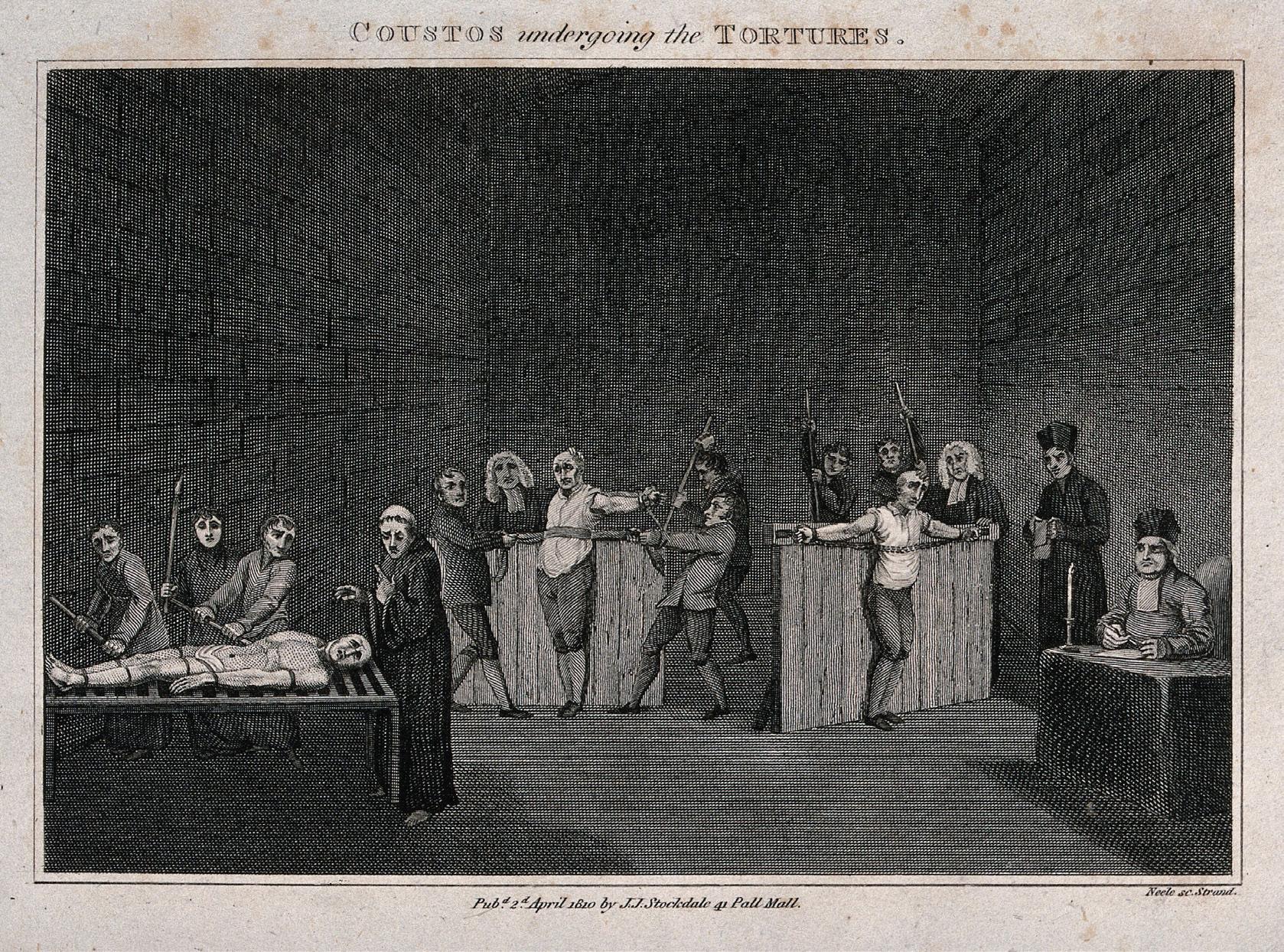
LEFT: Fictional portrayal of a man in employ by the Inquisition. TOP: Scenes from the tortures of John Coustos, RIGHT: A memorial stone in Salem, MA, commemorating the murder of an alleged witch.
to us than our own breath. The Supreme Being is the reality in whom “we live and move and have our being” (Acts 17:28). And yet many do not know God. He keeps Himself utterly, infinitely secret from those who don’t care to diligently seek Him. If we wish to know God, we must search humbly with a pure heart and an open mind. We must seek with a desire to serve; one who cannot keep a secret isn’t fit for the service of an earthly King, much less God. Practicing the virtue of secrecy, which is an indispensable prerequisite for integrity, prepares us to seek after Divine Truth. “It is the glory of God to conceal a thing: but the honor of kings is to search out a matter” (Proverbs 25:2).
If Masonry uses the illusion of secrecy, it is because it knows that it is the nature of man to seek what is hidden and to desire what
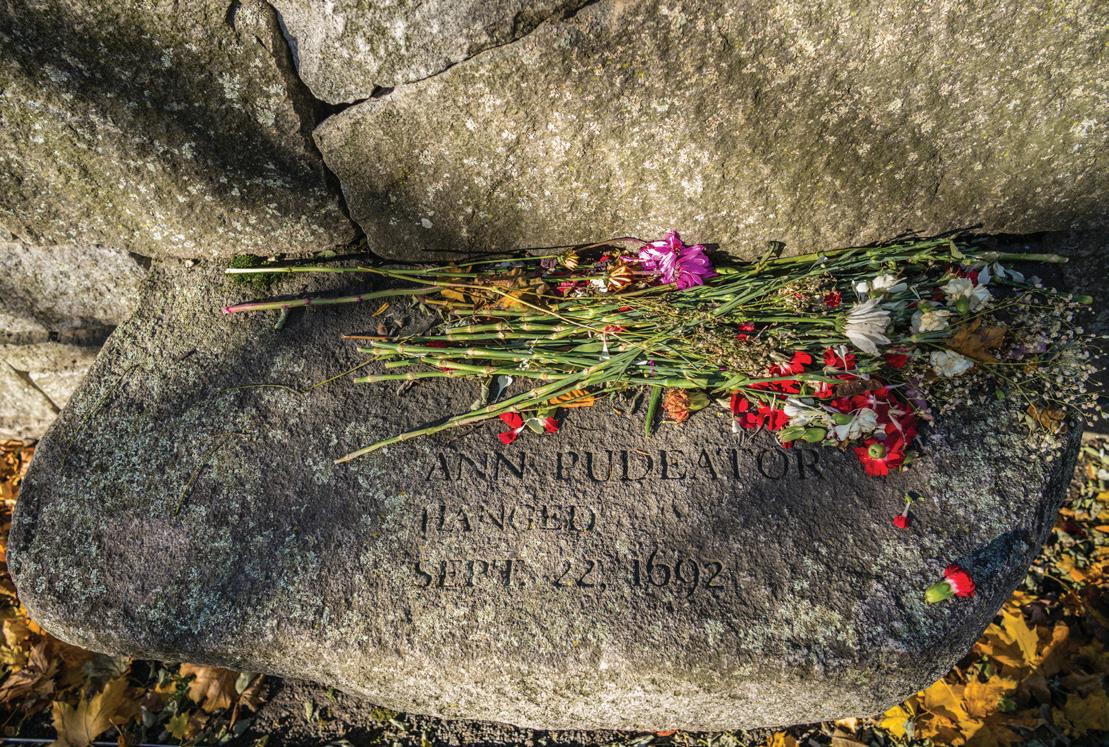
is forbidden. Even God hides from us, that seeking Him amid the shadows of life we may both find Him and ourselves. The man who does not care enough for God to seek him will never find him, though he is not far from any one of us.
One who looks at Masonry in this way will find that his Masonic life is a great adventure. It is a perpetual discovery. There is something new at every turn, something new in himself as life deepens with the years; something new in Masonry as its meaning unfolds. The man who finds its degrees tedious and its
ritual a rigmarole only betrays the measure of his own mind.4
The secrets of Freemasonry are like, if not altogether synonymous with, the secrets of life itself. They are the truths, hidden in plain sight, which can be known about God, nature, and ourselves. They’re the kind of secrets which are secret by default until we are duly and truly prepared to discover them and make good use of their discovery. Such is the nature of Masonic esotericism. It isn’t any kind of whimsical, magical stuff.
4 Ibid
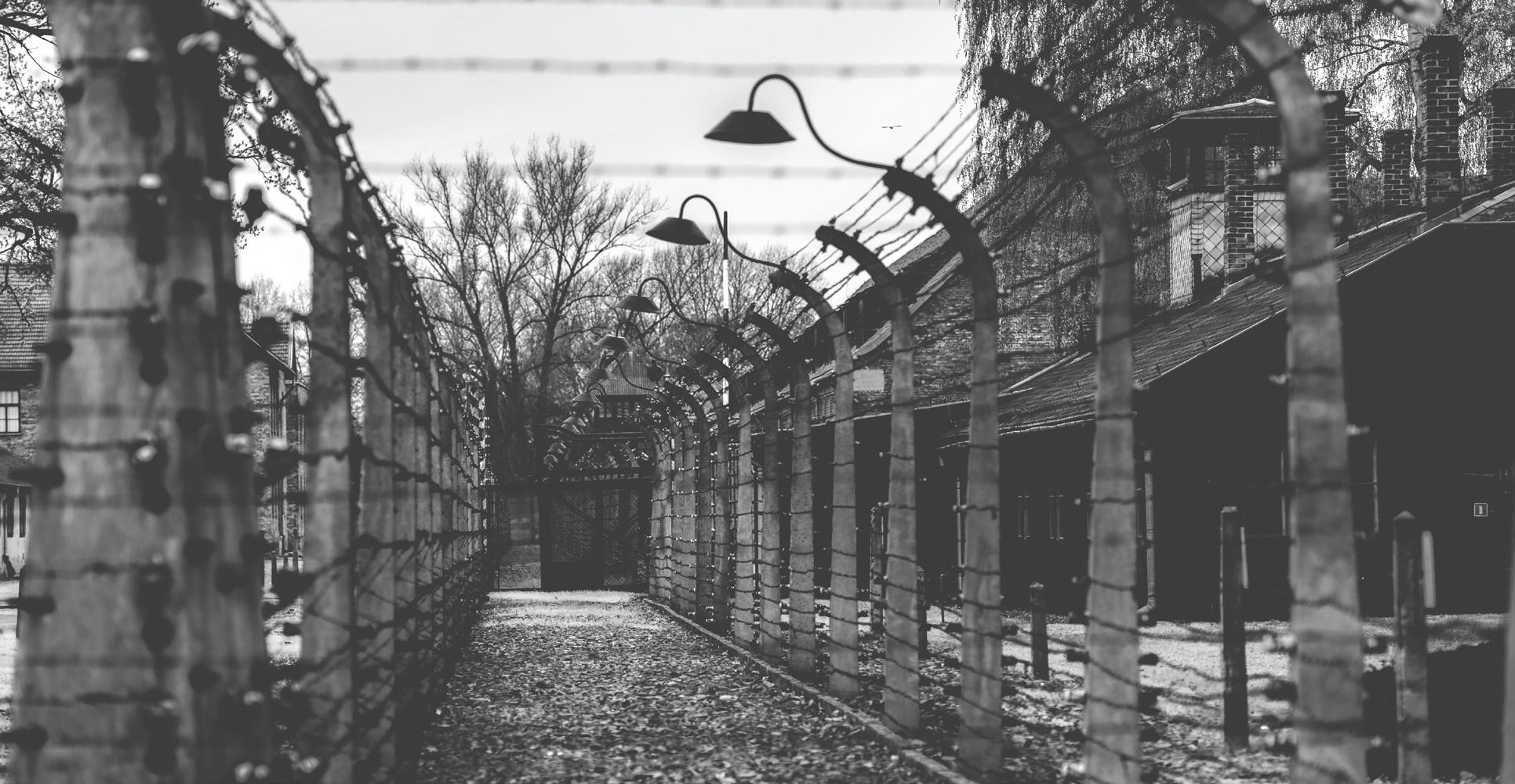
It’s a secret so simple that it is only hidden until you cease to be complicated. As Brother Newton so rightly and eloquently said, “most of the talk about esoteric Masonry misses the mark. When the story is told, the only secret turns out to be some odd theory, some fanciful philosophy, of no real importance. The wisdom of Masonry is hidden, not because it is subtle, but because it is simple. Its secret is profound, not obscure.”5
The secret of Masonry, like the secret of life, can be known only by those who seek it, serve it, live it. It cannot be uttered; it can only be felt and acted. It is, in fact, an open secret, and each man knows it according to his quest and capacity. Like all the things most worth knowing, no one can know it for another and no one can know it alone. It is known only in fellowship, by the touch of life upon life, spirit upon spirit, knee to knee, breast to breast, hand in hand.
For that reason, no one need be alarmed about any book written to expose Masonry. It is utterly armless. The real Secret of Masonry cannot be learned by prying eyes or curious inquiry. We do well to protect the privacy of the lodge; but the secret of Masonry can be known only by
those who are ready and worthy to receive it. Only a pure heart and an honest mind can know it. Others seek it in vain, and never know it, though they be adepts in all the signs and tokens of every rite and rank of the craft.6
The philosophy of Freemasonry is not secret at all. As Masons, we’d like nothing more than for the whole world to discover and embrace it. It is the simple idea that, though we all have our own respective names and concepts for Him, there is but one God; and all men are brethren under His fatherhood! It is a simple philosophy of Friendship, Morality, and Brotherly Love. It is a wise philosophy that encourages a culture of religious toleration; an acknowledgment that nobody has a monopoly on the Truth, and so no one has the right to persecute anyone for holding a different opinion.
Indeed, so far from trying to hide its secret, Masonry is all the time trying to give it to the world, in the only way in which it can be given, through a certain quality of soul and character which it labors to create and build up. To the making of men, helping to self discovery and self development, all the offices of Masonry
6 Newton, Short Talks, 61.
are dedicated. It is a quarry in which the rough stones of manhood are polished for use and beauty.7
Freemasonry is a fraternity that hopes to make the world better by making individual men better, by giving them the tools to build their character. We give them the twenty four inch gauge to manage their time, the common gavel to divest themselves of vices and superfluities, the mallet and chisel (in the Mark Degree) to direct their attention and energy effectively by education, the square to test the virtue of their actions, the level to remind them of human equality, the plumb to keep them upright in their integrity, the compass to circumscribe their desires and limit their passions, the skirret to keep their thoughts and intentions straight, the pencil to draw worthy plans on the trestle boards of their lives, and the trowel to spread the cement of brotherly love with all mankind; and especially their brethren.
Freemasonry aims to help men discover themselves and God in secret so that they might shine forth good works to glorify Him in the open.
If man knows God and man to the uttermost,” said Brother
7. Newton, Short Talks, 63
Newton, “even masonry has nothing to teach him. As a fact, the wisest man knows very little. The way is dim and no one can see very far. We are seekers after truth, and God has so made us that we cannot find the truth alone, but only in the love and service of our fellow men. Here is the real secret, and to learn it is to have the key to the meaning and joy of life.8 KT

Welcoming a new Assembly into our organization is both a celebration and a sacred milestone. For a century and a half, our Order has stood firmly upon the enduring principles of Faith,
Loyalty, and Love – guiding generations of devoted women in their support for the Sir Knights and in their service to one another. Each new Assembly is a living testament that these virtues are not relics of the past, but vibrant truths that
continue to inspire hearts today.
As this new Assembly begins its journey, it joins a legacy built by steadfast women who answered a call greater than themselves. May its members be strengthened by faith, united in loyalty, and bound
together in love, as they carry forward the light of our beloved Order for generations yet to come. KT
Charter Members of Nashville Assembly No. 268. FRONT ROW (L-R): (Mrs. Luther) Janice Thronebury; Miss Amanda Reed; (Mrs. Thomas) Carolyn Binford; (Mrs. Robert) Alicia Farmer; (Mrs. Charles M.) Susan Thames (PSWP); (Mrs. William) Renee Burfitt; (Mrs. Stephen) Viola Kimball; (Mrs. Michael) Cappi Villines Sr.; (Mrs. Quentin) Renee Bolden; (Mrs. John) Fay Weaver III; Mrs. Jesse Hooberry. 2ND ROW (L-R): (Mrs. Joe) Laurel Harrison; (Mrs. David) Jonna Martin; Miss Kelsey McVey; (Mrs. Michael) Alicia Villines, Jr.,; (Mrs. Roy) Jimmie Stevens; (Mrs. Thomas) Susan Kroll; Ms. Beverly Reed. BACK ROW (L-R): Mrs. Emily Crosby; (Mrs. Clinton) Lisa White; Mrs. Hannah Osborn; Miss Olivia Martin; (Mrs. Jerry) Jennifer Mulkey; (Mrs. Phillip) Regina Johnson; (Mrs. Wilbur) Beverly Bowman; Ms. Erica Trail; Mrs. Regina Perez; (Mrs. Roger) Meg Winningham; (Mrs. Ronald) Christy McVey; (Mrs. Wayne) Harriet Bible.
by Mrs. Stephen Kimball Worthy President
The constituting of a new Beauceant assembly brings together ladies who are like-minded and wish to support their Sir Knights in a more comprehensive way. There are many things to consider when contemplating the formation of an assembly. The first of those is the location and a sponsoring Commandery of Knights Templar. For the ladies in Nashville, Tennessee, this was the easiest part of the process, as the Sir Knights of Nashville Commandery No. 1 and the members of McWhirtersville Claiborne Lodge No. 293, F. & A.M., were ready and willing to assist and support the process in whatever manner necessary. These men continued to be the biggest encouragement throughout the process.
While it only takes one wife, widow, mother, sister, daughter, or granddaughter of a Knight Templar, or mother, sister, daughter, or granddaughter of a Beauceant member to light the flame of interest, a new assembly requires twenty-five petitioners. While three of these may be dual members and another five may be affiliated members who present a
demit or letter of good standing from an extinct assembly, there is still the issue of seventeen more potential members. This proved to be the most challenging part of the process for the ladies in Nashville. However, when it came time to sign their Petition to Assemble, their perseverance prevailed, and thirty-four ladies submitted the request to the Supreme Assembly.
Initially, the ladies prepared dinner for the commandery and leaders of the lodge to share their idea of forming an Assembly. Once they were given the go-ahead from the Masonic bodies, they sent letters to the area commanderies to invite their ladies to participate in their endeavor. They sponsored meals and a tea, which coincided with a time when many Sir Knights would be coming to the area to attend another event. This allowed wives and other family members an opportunity to learn more about the Order. At each gathering, interested ladies shared contact information so each could receive correspondence and learn more about this exciting opportunity.
For over a year, potential members committed themselves
to the process, yet amassing twenty-five seemed just a dream. However, the desire to be part of something greater drove the founding members to continue. In the spring of 2025 at their regular monthly meeting, the fruition of their efforts was realized.
A petition to form an assembly was requested from the Supreme Organizer, a couple of dates were established for its signing, and a potential date for the constituting was discussed with the Supreme Worthy President. In August of 2025, two-and-a-half years after the initial interest was expressed, the ladies of Nashville Assembly submitted their petition, and their first hurdle was behind them.
When constituting a new assembly, the Supreme Assembly is opened before any work is done. This means there are lots of people coming into the area and many more things to consider, such as housing, a venue large enough to accommodate the event, and celebratory meals to plan. While waiting for a response from the Supreme Organizer, the ladies in Nashville were busy contracting a hotel to host ladies from across
the United States which was close enough to the airport so the visitors could easily shuttle back and forth. They met with Douglas Dresden, Grand Master of the Grand Lodge of Tennessee, F. & A. M., and secured the Grand Lodge building for their venue for a banquet, luncheon, and the meetings. These ladies secured transportation for their Beauceant visitors as they traversed back and forth from the hotel and the Grand Lodge building, as well as secured a caterer for meals. They also made certain they had all the necessary paraphernalia for their assembly.
Throughout the entire process there were many highs and lows. Yet the encouragement from the Grand Commandery of Tennessee, and especially the members of Nashville Commandery, No. 1, helped these ladies to be relentless in their tasks, and on December 6, 2025, Nashville Assembly, No. 268, was constituted and ready to enter upon their service of love.
Forming an assembly unites not only its members but also those in the Masonic family who are like-minded, forming bonds that cannot be broken. KT

CA David W. Studley
FL Charles W. McElwee
FL Benjamin P. Minichino
GA Harry R. Strazzella
IA Monte L. Harris
IA Bryce B. Hildreth
KY Clarence W. Browder
ME Robert B. Ward
MD Vernon H. Huebschman
MD Kenneth A. Robertson
MA/RI Wesley W. Babbitt
MA/RI David Schildroth
MI Christopher DeVriendt
MN Brian K. Dimatteo
MO James E. Ashby
NV Jameson Smith
NM Randall C. Bond
NY Richard Tirado
OH David W. Feller
PA James D. Amos
PA Bruce K. Kelley
PA Gregory S. Magill
PA Abram M. Shaffner
PA Donald E. Zipp III
TN Kevin D. Chaffin
TN Larry W. Mick
TX Robert V. Barnes Jr.
TX Billy J. Hamilton Jr.
TX Reeves R.D. Winn
TX Jon K. Wych
VA Joseph M. Matthews
VA Kyle Olesevich
VA Sheldon B. Richman
WI Richard J. Rausch
AL Emory J. Ferguson
AL Amos G. Welborn
AZ Jeffery S. Baker
CA Joseph L. Andre
CA James C. Clay
CA Marty M. Cusing
CA Jonathan C. Dunten
CA George G. Ross Jr.
CA Kenneth E. St Clair
CA Michael D. Thibodeaux
CT Alan J. Carlson
CT Andrew N. Triandafilou
DC Michael J. Kastle
FL Adam M. Bryan
FL Paul W. Friend
FL Charles L. Hollinger
FL Robert D. Sever
FL Frank R. Wilson III
GA Marshall J. Agan
GA David A. Davis
GA Richard D. Johnston
GA Phillip W. Lovvorn
GA Christopher D. Mercer
GA John A. Mull
GA James R. Osborn
GA Stephen L. Prewett
GA Walter L. Tharp Jr.
GA John M. Tripp
GA Tracy D. Wright
IL Stephen T. Adamson
IL Enrique J. Unanue
IN Irvan Boeglin
IN Mark A. Elder
IN Tommy Parsons
IA David M. Dryer
MA/RI Kenneth A. Angilly
MA/RI John E. Bean
MA/RI John C. Christie
ME Alan D. Johnston
ME Stephen E. Nichols
MD William M. Beattie
MD Peter G. Nielsen
MD Michael R. Raab
MD John A. Rafine
MI Jeffrey M. Lewis
MN Scott A. Cummings
MN Lowell G. Wakefield
MS John B. McKelvy
MS Richard C. Spencer
MO James E. Ashby
NV Thomas A. Collins
NH David L. Bruce
NJ Jeffrey R. Chan
NJ Richard W. Westergaard
NY Maurice I. Cohen
NY David D. Goodwin
NY Donald R. Kunego
NC Louis E. Lamphear
NC James B. Steele
OH Nicholas D. Baker
OH Elbridge H. Brewer
OH William D. Dauterman
OH Ronald L. Ensell
OH Kyle A. Markel
OH Douglas K. McIe
OH Robert R. Rettig
OH Frank C. Sundquist
OK John L. Logan
PA David L. Burrier
PA Brian L. Daniels
PA Brenden R. Hunter
PA Edward J. Martin
PA Michael E. Noll Jr.
PA Howard L. Smith
PA John L. Wagner
SC Michael E. Wiggers Jr.
TN Donny K. Hesselbein
TN Ralph B. Taylor
TX Charles E. Campbell
TX Anthony D. Harris
TX Guy R. Niles
TX Michael Wisby
TX Ernest C. Wolfe III
UT Lonnie M. McCulloch
VT Donald C. Murray
VA Jeffrey L. Sparrow
WA Charles R. Davis
WA Steven K. Gerstner
WA James E. Nero
WI George H. Detweiler
JANUARY 2026
AL Phil E. Terrell
CA Joshua D. Cunningham
CA Elvan D. Moen
CA Ahren Putnam
CA Courtney M. Scandrett
CO Robert W. Gregory
CO Joe E. Kier
CO Hunter M. McCallum
DE John W. Merkley
FL Jeffery W. Meister Sr.
GA Matthew R. Astin
GA Robert Durland
ID Jay A. Leonard
ID Wayne M. Sprouse
IL Joseph L. Pieron
IN Charles M. Kostbade
IN Gregory W. Noland
IN Scott A. Sacek
IA Michael D.C. Boomer
LA Kimbal D. Bonner
ME Kenneth A. Caldwell
ME Gary K. Hemenway
ME Tyler D. Hoxie
ME Paul A. Rollins
MD Donald E. Jenkins
MA/RI Russell W. Wolf
MS Richard C. Spencer
MO Bernell C. Raye
MT Clarence E. Carter
MT Kenneth P. Richardson
NV Charles F. Steiner
NJ Joseph Cicchetti
NJ Charles E. Taylor Jr.
NY Richard Tirado
NC Patrick A. Day
NC Louis E. Lamphear
ND Merle G. Halvorson
OH Mark G. Giannaris
OH Arthur F. Koeniger
OH Michael D. Moorman
OH Robert W. Niebaum
OH Robert G. Seibert
OK Kernek E. McDonald
PA Daniel-Jay A. Barrett
PA Blake W. Daniels
PA Brenden R. Hunter
PA Bruce K. Kelley
PA Randy R. Knauss
PA William E. Rhydderch
PA Michael A. Wolcott
SC Thomas W. Hill
SC Terry D. McGuffin
TX Jimmy E. Barton
TX Stephen E. Gooch
TX Michael T. Malone
TX Gary E. Rock Jr.
TX Larry S. Wall
UT Paul D. Erickson
UT David J. Read
VT Jon W. Hosford III
VT Ronald L.B. Mack
VA James B. Bartley
VA James D. Bratton
VA Peter E. Terrill
WI James J. Burton
WI Richard J. Rausch
WY Kraig A. Kobert
WY Jon C. Rowe
NOVEMBER 2025
FL Charles W. Machell
FL Paul J. Mast
FL Edward J. Mayfield Jr.
FL Benjamin P. Minichino
GA Tommy T. Marshall
GA James G. Mashburn
HI Carlos M. Espiritu
KY Clarence W. Browder
ME Robert M. Wright
MA/RI Randall C. Oxley
MI Christopher DeVriendt
MN Brian K. Dimatteo
NV James D. Phelps
ND Gregory B. Taylor
OH David W. Feller
OH James K. Lawson
OR Michael D. Sullivan
PA James D. Amos
PA Bruce K. Kelley
PA Alberto D. Rodriguez
PA Donald E. Zipp III
TN Larry W. Mick
TX Frank Gilbert
TX Billy J. Hamilton Jr.
UT Brandon T. Cole
VA Gary N. Orsborn
WI Richard J. Rausch
DECEMBER 2025
AL Emory J. Ferguson
AL Brian L. Smith
CA James C. Clay
CO Ross A. Allen
DC Larry D. Guerin
FL Rodger L. Craig Sr.
FL Charles L. Hollinger
FL Donald L. Rice Jr.
GA James B. Phillips
GA Harry R. Strazzella
IL Enrique J. Unanue
IN Mark A. Elder
IN Brian D. Hooten
IN Todd C. Smith
KY Wallace E. Fizer
KY Kevin G. Sell
LA James A. Koontz
LA William J. Surls
ME Darrell R. Gilman
MA/RI John E. Bean
MI Jeffrey M. Lewis
MI James D. Rutherford
NV Richard L. Sidford
NJ Dennis M. Huey
NJ John W. Iaria
NM Randall C. Bond
OH Alan K. Booker
OH Elbridge H. Brewer
OH Arthur F. Koeniger
OH David D. Mowry
PA Nigel K. Foundling
PA James O’Connor
PA Howard L. Smith
PA John L. Wagner
SC Richard P. Panuska
TN Ricky D. Blake
TX Charles E. Campbell
VA William M. Eubank
VA Jeffrey L. Sparrow
WA John S. Burrage
WA Charles R. Davis
WA James E. Nero
JANUARY 2026
CA Maxim Mironenko
CA Ahren Putnam
CO Bruce Hinde
FL Adam M. Bryan
FL Matthew A. Hankes
FL Raymond D. Harris
IL Stephen T. Adamson
IL John C. Proffit
IN Gregory W. Noland
KY George F. Brooks Jr.
MI Dean R. McDougal
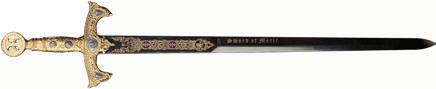
MS John B. McKelvy
MO James E. Ashby
MT Kenneth P. Richardson
NJ Richard W. Westergaard
NM Dustin R. Cummins
OK John L. Logan
OH Douglas K. McIe
PA Blake W. Daniels
PA Richard P. Hughes Jr.
PA Bruce K. Kelley
PA Douglas J. Kendzior
PA Mark G. Mattern
SD Bruce A. Crisman
SD Stan H. Schwellenbach
TN Ralph B. Taylor
TX Mark E. Eastwood
TX Michael T. Malone
TX Michael D. Phillipus
TX Larry S. Wall
UT David J. Read
VA James P. Arab
VA Peter E. Terrill
WV William C. Baun
WI Richard J. Rausch
WY Kraig A. Kobert
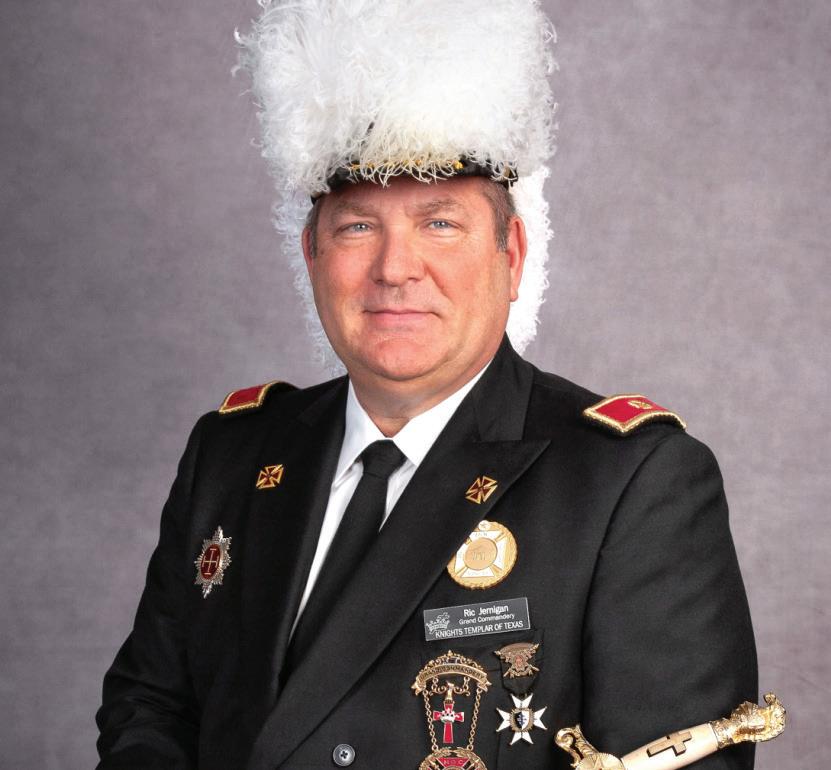
This article is for all my Masonic Brethren. In my experience, every degree or order within the Masonic fraternity is about you – you the candidate – until the Order of the Temple. Our Masonic system is designed to take each of us from that rough ashlar that we all are towards that smooth ashlar we all strive to be. It is about self-improvement. About removing from our personalities those flaws, those rough edges that hold us back from the Glory of God. We all have them.
Through our system of degrees, we are shown individuals throughout history, individuals who overcame their individual flaws to achieve something worthwhile. We use symbols to represent moral lessons which remind us how we should act towards one another, how we should treat our responsibilities and obligations in life. These lessons help us become better than we were. By following those guidelines and lessons we are better citizens, better husbands, better workers, better fathers –better at all aspects of our existence.
We are striving to become
by Richard Jernigan
“The people living in darkness have seen a great light; on those living in the land of the shadow of death a light has dawned.” Matthew 4:16 (NIV)
worthy of God’s presence. To finally, at the end of our days, hear the “well done thou good and faithful servant” we all hope to hear. And although we cannot fully become that perfect ashlar on our own, by careful study and determined practice we can become better than we were when we knocked upon that door.
It is a noble effort. Something the world should pay attention to because, as I have said in many talks, "improve the man, you improve the world."
This all changes with the Order of the Temple. It is no longer about you. When you become a Knight Templar, from a spiritual sense, your journey to becoming that perfect ashlar is complete. All the rough and superfluous parts of you are wiped away by the sacrifice of Jesus Christ upon the cross.
The Order of the Temple is about the rest of the world. It is about you now becoming an Apostle of Christ, taking the place of Judas and now taking Christ to the world. It is about helping others find and take the path you have. You learn on your pilgrimage what God expects of us. You learn to defend Christianity and protect
the faith from all who would attack it. You learn from Simon of Cyrene that it is now our turn to pick up the burdens of Christ and carry them out into the world. It is not about you. It is about others.
One of Christ’s most common miracles was the restoration of sight. How can you perform that miracle? How can you do the job of an Apostle? By giving to others. By supporting, through your efforts and finances, the charity of this Brotherhood, the Knights Templar Eye Foundation.
Your contributions to it allow those with the skills and knowledge given them by God to research future ways to bring light to those in darkness. To restore sight, just as Jesus did. Your efforts and donations allow miracles to happen – light to be seen, lives to be improved, and your obligations to be fulfilled.
In the 18º of the Scottish Rite we are told the more you have the more you owe to those who need your assistance. What a great lesson to those who are fortunate in this world. If you cannot afford to donate, do something in your area to raise money from those
who can. Spread the news of our Foundation. Show them the videos from the web site. There are things you can do beyond just giving your money. All are important; all are worthwhile, and all help you live the life you and God have chosen. Dig deep my Brothers. Pray for God’s guidance. Follow in Christ's footsteps. Defend the Christian faith. Spread the word of God. Help others see God through you. Help them, guide them along the road to God so that they too can hear those words, “well done thou good and faithful servant.” In His and your service,
Richard Jernigan, PGC of Texas Chairman, Voluntary Campaign