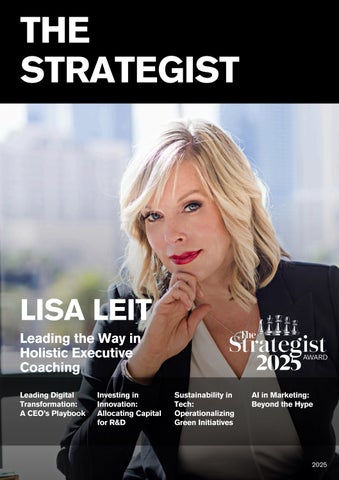
THE STRATEGIST


In a world where leadershi founder of Happy Whole H innovation and compassio Executive Coach of the Yea has not only redefined lead holistic, evidence-based ap with professional excellenc
Lisa’s journey began in dev human growth and self-act become her signature coac personal well-being and pr coaching gave me a practic leaders align their inner wo understanding allows Lisa journeys, grounded in both
The creation of Happy Who bring structured personaliz high-pressure environmen innovations is the Happy W validated tool that helps in multiple dimensions of life everything we do offerin well-being,” she explains
What sets Lisa apart is her blending psychological ins goal-setting Her sessions a but the whole human bein boardroom and beyond Th extraordinary client outcom executive on the brink of b his professional passion an “Seeing that kind of turnaround is why I do this work,” she says

With The Strategist recognition, Lisa is poised to amplify her impact. “This award validates our approach and gives us a platform to scale our mission,” she shares Future plans include expanding online coach training developing digital self-help tools, and deepening collaborations with forward-thinking organizations dedicated to employee well-being
Through the Happy Whole Human Institute Lisa is also training the next generation of coaches, emphasizing essential qualities such as selfawareness, emotional intelligence, and adaptability skills vital in today’s dynamic world “Our goal is to equip coaches to facilitate real, lasting change,” Lisa emphasizes
Remaining at the forefront of her field, Lisa is committed to ongoing research and innovation, continuously updating her programs to reflect cutting-edge science in psychology and leadership. And while her focus is on helping others, Lisa lives by the principles she teaches, prioritizing mindfulness, boundaries, and self-care to sustain her own well-being
Looking ahead, Lisa envisions Happy Whole Human as a global force, making holistic leadership coaching accessible worldwide “In five years, we aim to create a movement that redefines success where well-being and performance go hand in hand,” she concludes
Lisa Leit’s work is a masterclass in leading with heart, science, and vision empowering leaders to become truly whole humans
Goldie Uttamchandani is a bilingual Leadership and Youth Coach since 2015 Goldie has got more than 1000 hours of client experience in diverse business sectors and has also collaborated actively with the public-school education system in Cataluñya, Spain She was recognised as Best Life & Youth Coach in Cataluñya for 2023 and also was a finalist for the ICF Impact Awards 2023, in Accomplished coach category
Youth coaching has always been a select niche in Spain, a challenging one to embrace In her years of experience, she has managed to rise to the challenge by acquiring a handsome number of clients but also raised awareness for it through her engagements in schools and other collaborations in the education arena Goldie also advocates coaching for the youth through pro bono initiatives and offers them to international university students, who are trying to find their grounding as they begin degrees in new countries, away from home
Challenges are something we must all overcome, growth comes from these very moments that offer challenge Goldie explains;
“It’s often been difficult to get to the end client, because with youth coaching there is a gateway to cross, whether it is communicating with the families directly or going via the educators first Being transparent and persistent has always been helpful and sometimes as a coach I have had to offer a complimentary session to the parent first in order to build a relationship of trust and connection”
Goldie knows her profession is more than just that, and always considers her mission is to serve her clients with purpose
“I do not see my work as merely a pay check The objective in coaching is to partner in a creative process with the client to facilitate them in obtaining their goals It is more than a transaction rather it is a transformational experience, in many cases clients remain grateful for life”
Goldie works with high profile leaders as a leadership coach and has had the opportunity to coach over 25 different nationalities She also covers young people from the ages of 13 till 21, predominantly in Spain, but in recent times has also gained clientele from other continents, including Australia and Southeast Asia
Each client relationship is one of respect, mutual trust and a safe space where clients can freely talk about their needs and thoughts, without feeling judged something Goldie has naturally mastered
With an 8 year plus trajectory in the field of professional coaching, Goldie has obtained 1000+ hours of experience
“In my skills, I have seen a notable improvement when it comes to core coaching competencies and I especially feel a seasoned coach is gaining intuition and presence

along the way, paving the path towards mastery I am not yet a master coach, but I am confident the journey I am on will get me there I have been very lucky to be coached, mentored and supervised by some extraordinary professionals and also been fortunate to have colleagues who add so much value to the profession”
On a final note, Goldie is proving her invaluable skills against all odds, this time next year Goldie sees herself growing in the direction of coaching more relational teams such as professional partners, siblings, family groups and even educators who work together Keen to build her expertise in systemic coaching both in family as well as organisational coaching
We are proud to stand by Goldie and raise her profile, the world is certainly a better place with people like Goldie Uttamchandani in it

Richard Baker

In today's fast-paced digital landscape, the phrase "digital transformation" has become more than just a buzzword; it's a strategic imperative for any CEO intent on future-proofing their company.
Set a Clear Vision
First and foremost, setting a clear, compelling vision is essential The vision serves as the North Star that aligns all stakeholders, from executives to entry-level employees CEOs like Satya Nadella of Microsoft have been exemplary in this regard, pivoting the company ’ s focus towards cloud computing and successfully transforming it into a trilliondollar enterprise A transparent vision helps not only in steering internal teams but also in communicating the company ’ s future to investors and customers

Build a Culture of Innovation
Transformative CEOs understand that digital change is not just about technology but also about cultivating a culture that can leverage it Take Google's Sundar Pichai, for instance, who champions a culture of "10x thinking" and "moonshot" projects In an innovative environment, employees are encouraged to take risks, explore new ideas, and fail fast if they have to This culture becomes the cradle for disruptive solutions that drive digital transformation
Agility in Decision-Making
The speed of decision-making is another crucial factor Jeff Bezos’s famous "two-pizza teams" at Amazon epitomize this, where small autonomous groups can make decisions quickly, without bureaucratic hindrance Agile decision-making allows a company to adapt and pivot, which is essential in a digital landscape that evolves by the minute

Invest in Talent and Skills
Any digital transformation journey is handicapped without the right talent to drive it CEOs must focus on upskilling their current workforce while attracting new talent with the skills necessary for transformation Adobe's transition from packaged software to a cloud-based subscription model under Shantanu Narayen was fueled by an investment in skills like data analytics and customer experience management
Customer-Centric Approach
In the age of personalized experiences, a customer-centric approach is non-negotiable Salesforce CEO Marc Benioff has been a pioneer in this aspect, making "Customer 360" the cornerstone of his company ' s digital transformation strategy. A CEO needs to ensure that the transformation efforts directly correlate with enhanced customer experience, be it through faster service, better products, or personalized interactions
Leverage Data and Analytics
Data is the new oil, and CEOs need to understand how to refine it Data-driven decision-making is at the core of companies like Netflix, led by Reed Hastings, where viewer preferences directly influence content creation and recommendation algorithms The use of data and analytics can provide actionable insights, predictive analytics, and a competitive edge that is indispensable in a digital transformation journey.
Partnerships and Ecosystems
In an interconnected digital world, no company is an island Strategic partnerships can accelerate the path to transformation IBM's Ginni Rometty has been particularly savvy in this regard, forging partnerships with companies like Red Hat to expand cloud capabilities. Collaborative ecosystems can bring in external expertise, provide new customer channels, and even facilitate co-innovation
Measure and Adapt
Finally, what gets measured gets done CEOs must establish key performance indicators (KPIs) to evaluate the success of their digital transformation initiatives. Regular audits and reviews can provide an opportunity to refine the strategy and make course corrections as needed

Conclusion
Leading digital transformation is a complex yet rewarding challenge that offers CEOs an opportunity to revolutionize their businesses, disrupt industries, and leave a lasting legacy

As we ' ve seen from industry leaders, the key to successful digital transformation lies in a balanced approach that involves setting a clear vision, fostering innovation, making agile decisions, investing in talent, focusing on the customer, leveraging data, building partnerships, and continually adapting
BY INTEGRATING THESE STRATEGIES INTO YOUR PLAYBOOK, YOU'RE NOT JUST SURVIVING THE DIGITAL AGE YOU'RE THRIVING IN IT.
Kurt C Schweizer has dedicated his professional career to employment benefit law ever since it has become mandatory under Swiss law that employers provide for a pension fund and that employers and employees contribute to the pension funds Additionally, he has practiced corporate and corporate finance law This enables him to assess how corporate developments impact pension funds
Kurt C Schweizer successfully tried court cases of paramount significance for employment benefit law For instance, the federal supreme court upheld his request to allow a pension fund to alter a pension plan for severe economic reasons even though the pension plan had been declared unalterable
Kurt C Schweizer advises and represents the pension funds of local companies as well as of Swiss subsidiaries of international corpo comm collec insura execu
Corpo and p funds distrib affiliat such s their a Furthe or ben fund t such t restru financ
Contact
Dr Kurt C Schweizer
Bergstrasse 189, CH-8706 Meilen/Zurich
Tel: +41 44 914 4070
Email: kurt schweizer@kcs-law ch www kcs-law ch
Furthermore, Kurt C. Schweizer supports his clients in fulfilling their duties to report to the state agencies in charge of the supervision of the pension funds For decisions or transactions that require the approval of the agencies, he prepares and files the applications He also contests orders issued by the agencies
Kurt C Schweizer publishes regularly in the leading Swiss magazine on pension benefits and speaks at conferences His profound academic background, almost intuitive perception of the relevant facts, thorough analyses and strive for precise language are the foundation for his strong commitment to best serve his clients' needs and interests. He lives up to his full potential concentrating on independently counseling his clients and only exceptionally serves as a board member
Kurt C Schweizer graduated from the University of Zurich with a doctoral thesis on employment benefits (J D , 1985) and the U i it f Mi i (LL M 1995) I 1987 h d th b


In the high-stakes game of technological innovation, the role of a Chief Financial Officer (CFO) is evolving from a guardian of the purse strings to a strategic partner in driving growth.

The High Cost of Innovation
Innovation, especially in the technology sector, often comes with a hefty price tag. The costs of R&D, talent acquisition, and technology infrastructure can quickly escalate Yet, foregoing innovation is not an option, as it can lead to obsolescence and dwindling market share
The Profitability Conundrum
On the flip side, focusing solely on innovation without an eye on profitability can spell disaster. Investors are increasingly scrutinizing tech companies for sustainable business models and not just groundbreaking products Therefore, CFOs must ensure that the innovation pipeline is aligned with a viable financial strategy
Prioritizing R&D Spending
When it comes to R&D spending, a one-size-fits-all approach simply won't work CFOs need to collaborate closely with the Chief Technology Officer (CTO) and other stakeholders to identify projects with the most potential for market disruption and revenue generation. Apple’s commitment to innovation under CFO Luca Maestri is a prime example
Even during economic downturns, Apple has maintained a consistent investment in R&D, focusing on a few, highly impactful projects
The Risk-Reward Equation
The correlation between R&D spending and financial performance is not linear The risk of failure is high, and the rewards, though potentially enormous, are not guaranteed Consequently, CFOs must employ sophisticated financial models that factor in various scenarios, including worst-case and best-case outcomes Portfolio theory, which balances high-risk and low-risk projects, can be an effective strategy.
Agile Budgeting
Traditional budgeting models, with their rigidity and annual cycles, are ill-suited for the fast-paced tech industry Agile budgeting techniques, which allow for flexibility and rapid adjustments, are becoming the norm.
CFOs should consider adopting a rolling forecast model, which can be updated quarterly or even monthly, to adapt to the dynamic nature of tech innovation
Investment in Talent
Innovation is not just about technology; it's also about the people who make it happen The war for talent in the tech sector is intense, and CFOs must allocate sufficient capital for talent development and retention
Companies like Salesforce have excelled in this area, creating an ecosystem that not only rewards innovation but also cultivates it through continuous learning programs.
Leveraging External Funding
While internal R&D is crucial, external funding options like venture capital, government grants, and strategic partnerships can provide valuable financial cushioning CFOs should actively explore these avenues not only to mitigate risk but also to validate the commercial viability of their innovations
Measuring ROI on Innovation
Determining the Return on Investment (ROI) on R&D is complex and far from straightforward However, it's essential for CFOs to develop metrics that can provide some quantifiable measures These could range from time-tomarket for new products to patent filings or even customer engagement levels with new features.
Conclusion

Balancing innovation and profitability is a high-wire act that demands a new set of skills and a strategic mindset from today’s CFOs It involves nuanced financial modeling, agile budgeting, talent management, and an appetite for calculated risks. By taking a more integrated approach to R&D investment, CFOs in the tech sector can not only drive innovation but also build a sustainable financial model that fuels long-term growth
In a world where the pace of change is accelerating, the ability to innovate is the ultimate competitive advantage, and the role of the CFO as a catalyst for innovation has never been more critical

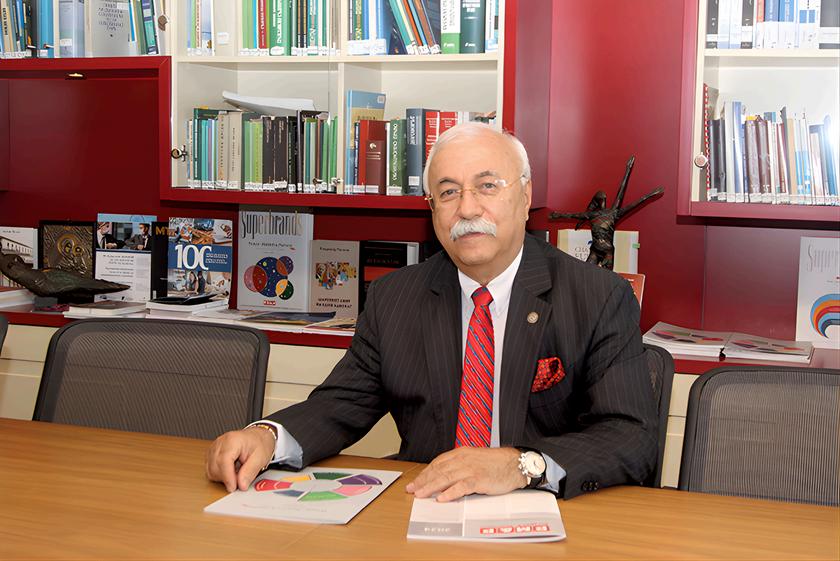
When Bulgaria transitioned to a free-market democracy in 1990, it required more than just legal expertise to navigate the uncharted territory it demanded vision, courage, and leadership. Few embody this more than Vladimir Penkov, founder, Chairman, and Senior Partner of Penkov, Markov & Partners (PM&P), and recipient of The Strategist – 2025 award Over three decades, Mr Penkov has built not only one of Bulgaria’s most respected law firms but also a legacy defined by innovation, integrity, and societal impact
From Early Reforms to Legal Leadership
A specialist in commercial law, foreign investments, banking and finance, taxation, concessions, and energy law, Mr Penkov began his career in a time of sweeping change Following Bulgaria’s democratic shift, he was among the pioneers establishing private legal practice, founding PM&P with a mission to meet international standards in a transforming market
From the outset, he was instrumental in shaping Bulgaria’s commercial environment participating in the drafting of key laws on corporate governance, taxation, concessions, and energy, and advising on transactions that set precedents in both business and jurisprudence. His leadership style blends deep legal knowledge with a pragmatic, forward-looking approach, consistently prioritising long-term client advantage over short-term gain
Defining Achievements and Landmark Deals
Mr Penkov’s name is linked to some of the country’s most complex and influential transactions He played a pivotal role in the joint venture between the Central Cooperative Union and Clarina Holding S A for Coca-Cola production, despite the absence of a clear commercial law framework His expertise guided major privatisations, including Zagorka (Heineken Group), Gipsfaser (Knauf), and the Bulgarian Telecommunications Company (BTC), navigating intricate negotiations and political sensitivities
Under his stewardship, PM&P successfully defended Bulgaria’s interests in landmark litigation such as the Vrana JSC case and the precedent-setting defence of renewable energy producers against unconstitutional turnover fees His team’s work with Enertrag established the concept of the “administrative contract” in Bulgarian law
Recognition and Influence
For his outstanding contributions, Mr Penkov has twice been named “Lawyer of the Year” (2013, 2020) and holds the Senior Statesperson distinction in Chambers Global/Europe for Energy and Corporate & Commercial law. He has been repeatedly listed in Best Lawyers Bulgaria and other global legal directories. Beyond professional accolades, he has been a long-standing Vice President of the Bulgarian Chamber of Commerce and Industry, an arbitrator for over 30 years, and a board member of major corporate and philanthropic organisations
Building a Culture of Excellence
While his personal achievements are remarkable, Mr Penkov’s lasting impact lies in the culture he has instilled at PM&P He believes that true success comes when a law firm develops its own identity rooted in teamwork, ethical responsibility, and social engagement PM&P’s culture encourages lawyers not only to solve legal problems but to influence positive change at the national and societal level.
This vision has driven the firm’s growth into a full-service powerhouse, with expertise spanning corporate law, M&A, banking, energy, IT, data protection, and more PM&P’s consistent international recognition, including repeated Superbrands awards, reflects the effectiveness of his leadership.
Strategy, Integrity, and Social Responsibility
For Mr Penkov, strategic legal thinking is inseparable from social responsibility He has championed corporate ethics, transparency, and community engagement, ensuring PM&P actively contributes to professional, cultural, and charitable initiatives His pursuit of work-life balance within the firm has created an environment where talent thrives and innovation flourishes
Legacy and Future
Looking ahead, Mr Penkov remains committed to mentoring the next generation of legal leaders and reinforcing Bulgaria’s place in the global legal community. His career stands as proof that in law as in business enduring success is achieved where strategy meets principle
Contacts:
www penkov-markov eu
Phone: +359 2 971 3935
LinkedIn (Firm): Penkov, Markov & Partners
Facebook: pmplawyers
Senior Partner: Mr Vladimir Penkov
Address: 13B Tintyava Str, Floor 6, Sofia 1113, Bulgaria



Chief Operating Officers (COOs) are increasingly tasked with integrating green initiatives into their operational strategies, not only to meet regulatory requirements and consumer expectations but also to ensure long-term business viability Let's explore how tech COOs are embedding sustainability into their core operations
Redefining the Core: Sustainability as a Strategic Imperative
The role of the COO in the tech industry has evolved far beyond managing day-to-day operations Today, COOs are pivotal in aligning operational strategies with the broader sustainability goals of their organizations This involves rethinking operational processes, supply chain management, and even the company culture
Companies like Apple have set the benchmark in this regard Apple’s COO, Jeff Williams, oversees an operation that is ncreasingly focusing on reducing the company ’ s carbon ootprint, with initiatives to use recycled materials and ensure all its facilities run on renewable energy
Greening the Supply Chain
One of the key areas where COOs can make a significant mpact is the supply chain Sustainable supply chain management involves selecting suppliers who adhere to environmental standards, optimizing logistics to reduce carbon emissions, and minimizing waste through efficient resource utilization
For example, Google, under the supervision of its COO, has committed to operating on 24/7 carbon-free energy in all its data centers and campuses worldwide by 2030 This ambitious goal requires innovative approaches to energy usage, including the use of AI to optimize power consumption
Product Lifecycle Management
Sustainability in tech also means being responsible for the entire lifecycle of products, from design to disposal COOs are now responsible for incorporating eco-friendly design principles that minimize environmental impact This includes designing products for durability, repairability, and recyclability
Dell Technologies, led by its COO, Jeff Clarke, has been proactive in this area, with its commitment to sustainable product design and a global recycling program Dell’s initiative to use recycled materials in its product manufacturing process is a testament to its commitment to circular economy principles
Employee Engagement and Culture Change
Embedding sustainability into the company culture is another area where COOs can have a significant impact
This means creating a workplace environment where sustainability is valued and encouraged at every level

Leveraging Technology for Sustainability
Technology itself can be a powerful tool in the pursuit of sustainability From using big data analytics to track and reduce emissions, to implementing IoT (Internet of Things) solutions for energy management, the possibilities are vast
Tech companies like IBM have been at the forefront of using technology to drive sustainability. IBM’s COO, James Kavanaugh, oversees operations that extensively use AI and blockchain to improve energy efficiency and reduce waste across the company ’ s global operations
Challenges and Opportunities
Operationalizing sustainability initiatives does come with its set of challenges. These include the need for significant investments in new technologies and processes, the complexity of measuring and reporting on sustainability metrics, and the need for a cultural shift within the organization

However, the opportunities outweigh the challenges By embracing sustainability, companies can benefit from increased operational efficiencies, improved brand reputation, and enhanced customer loyalty Moreover, they can drive innovation by developing new sustainable products and services
The Way Forward
For COOs in the tech industry, the path forward involves continuous innovation and collaboration This means working closely with other leaders in the organization, engaging with stakeholders, and staying abreast of emerging sustainability trends and technologies
Microsoft's COO, Kurt DelBene, exemplifies this approach Under his operational leadership, Microsoft is not only aiming to be carbon negative by 2030 but also to remove all the carbon the company has emitted since its founding by 2050 Achieving these ambitious goals requires a holistic approach to sustainability, encompassing everything from energy use to product design

Conclusion
In summary, sustainability is no longer an optional add-on but a crucial component of operational strategy in the tech industry COOs have a critical role to play in this transformation. By embedding sustainability into every aspect of operations, from supply chain management to product lifecycle and company culture, they can ensure their companies not only contribute to a greener future but also remain competitive and innovative in a rapidly evolving business landscape