F
E
A
T
U
R
E
S
6420
400 300 200 100 0
40nmTan 150nm Cu/40nm Tan 100nm ECD Cu ECD Cu CMP Cu W 400nm Wsi 55nm AI 200nm BPSG 300nm Nit 150nm 150nm Nit/35nm Ox 100nm Ox (B) Ox 100nm 100nm Ox (A) 100nm Poly/550nm Ox 200nm Poly/100nm Ox 240nm Poly/300nm Ox Resist C Polished Si 1300nm TEOS 1000nm TEOS 720nm TEOS Tin 70nm Tin/Ti 500/200A
PSL diameter (nm)
500
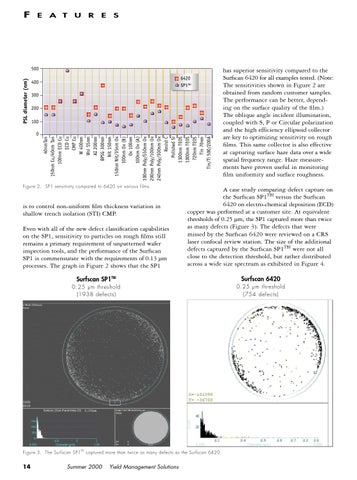
Figure 2. SP1 sensitivity compared to 6420 on various films.
is to control non-uniform film thickness variation in shallow trench isolation (STI) CMP. Even with all of the new defect classification capabilities on the SP1, sensitivity to particles on rough films still remains a primary requirement of unpatterned wafer inspection tools, and the performance of the Surfscan SP1 is commensurate with the requirements of 0.13 µm processes. The graph in Figure 2 shows that the SP1
A case study comparing defect capture on the Surfscan SP1TBI versus the Surfscan 6420 on electro-chemical deposition (ECD) copper was performed at a customer site. At equivalent thresholds of 0.25 µm, the SP1 captured more than twice as many defects (Figure 3). The defects that were missed by the Surfscan 6420 were reviewed on a CRS laser confocal review station. The size of the additional defects captured by the Surfscan SP1TBI were not all close to the detection threshold, but rather distributed across a wide size spectrum as exhibited in Figure 4.
Surfscan SP1TBI
Surfscan 6420
0.25 µm threshold (1938 defects)
0.25 µm threshold (754 defects)
TBI
Figure 3. The Surfscan SP1
14
has superior sensitivity compared to the Surfscan 6420 for all examples tested. (Note: The sensitivities shown in Figure 2 are obtained from random customer samples. The performance can be better, depending on the surface quality of the film.) The oblique angle incident illumination, coupled with S, P or Circular polarization and the high efficiency ellipsoid collector are key to optimizing sensitivity on rough films. This same collector is also effective at capturing surface haze data over a wide spatial frequency range. Haze measurements have proven useful in monitoring film uniformity and surface roughness.
captured more than twice as many defects as the Surfscan 6420.
Summer 2000
Yield Management Solutions