“Like most oral histories, a tad self-indulgent but filled with insights and good dish that movie buffs will relish.” from my lunches with orson
teams. At Reason magazine and, before that, at the Cato Institute, Balko was a pioneer at tracking the excessive violence of SWAT teams, especially in the context of raids on private homes suspected of harboring violators of drug laws. With SWAT teams often serving as the front line in the so-called “war on drugs,” abuses have been occurring with alarming frequency since the 1960s. Balko takes pains to state that police officers face daily danger and that most of them serve honorably. However, he writes, those who volunteer for SWAT teams or are chosen by police chiefs and sheriffs frequently harbor a cowboy mentality inappropriate when raiding homes unannounced with highvelocity weapons at the ready. Balko provides copious examples of SWAT teams raiding the wrong addresses or finding nothing but decriminalized marijuana inside. Meanwhile, injuries and sometimes deaths occur, and community trust in the police is shattered. And it can happen anywhere: The author opens with an egregiously conducted SWAT raid in Columbia, Mo., a small city with few violent drug offenders. Some of the historical sections are slow going—the book is organized chronologically, which means little compelling information arrives before page 50—and the book sometimes loses focus as Balko overreaches in terms of police department operations, which are only loosely related to SWAT team conduct. Nonetheless, the vast amount of evidence is certain to give pause to even the most ardent supporters of law enforcement agencies. An important, sometimes-groundbreaking account of police gone wild.
not, which represents yet another triumph of the owners. To call the author’s presentation opinionated is to risk understatement—at one point, he writes of Judge Kenesaw Mountain Landis, who delayed one antitrust suit, that pro baseball “was lucky enough to get a judge who put his love of the game above his professional obligations to follow the law”—but it is clear where his sympathies lie: with the players, the fans and the game itself, anywhere, it seems, except with the owners, who are the sole beneficiaries of the exemption. America’s game? The legal morass surrounding that exemption is as American as it gets—and, writes Banner, “it shows no signs of weakening.” Baseball fans of a legal bent will find this lively study both maddening and illuminating.
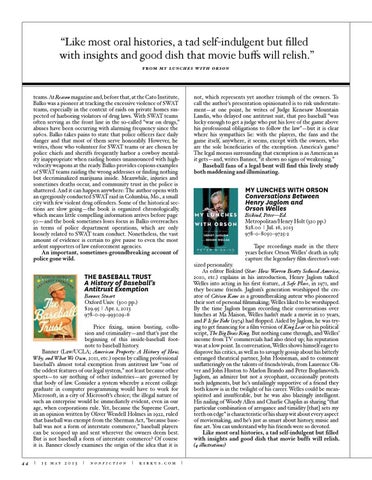
MY LUNCHES WITH ORSON Conversations Between Henry Jaglom and Orson Welles
Biskind, Peter—Ed. Metropolitan/Henry Holt (320 pp.) $28.00 | Jul. 16, 2013 978-0-8050-9725-2
Tape recordings made in the three years before Orson Welles’ death in 1985 capture the legendary film director’s out-
sized personality. As editor Biskind (Star: How Warren Beatty Seduced America, 2010, etc.) explains in his introduction, Henry Jaglom talked Welles into acting in his first feature, A Safe Place, in 1971, and they became friends. Jaglom’s generation worshipped the creator of Citizen Kane as a groundbreaking auteur who pioneered their sort of personal filmmaking; Welles liked to be worshipped. By the time Jaglom began recording their conversations over lunches at Ma Maison, Welles hadn’t made a movie in 10 years, and F Is for Fake (1974) had flopped. Aided by Jaglom, he was trying to get financing for a film version of King Lear or his political script, The Big Brass Ring. But nothing came through, and Welles’ income from TV commercials had also dried up; his reputation was at a low point. In conversation, Welles shows himself eager to disprove his critics, as well as to savagely gossip about his bitterly estranged theatrical partner, John Houseman, and to comment unflatteringly on the talents of friends/rivals, from Laurence Oliver and John Huston to Marlon Brando and Peter Bogdanovich. Jaglom, an admirer but not a sycophant, occasionally protests such judgments, but he’s unfailingly supportive of a friend they both know is in the twilight of his career. Welles could be meanspirited and insufferable, but he was also blazingly intelligent. His nailing of Woody Allen and Charlie Chaplin as sharing “that particular combination of arrogance and timidity [that] sets my teeth on edge” is characteristic of his sharp wit about every aspect of moviemaking, and he’s just as smart about history, music and fine art. You can understand why his friends were so devoted. Like most oral histories, a tad self-indulgent but filled with insights and good dish that movie buffs will relish. (4 illustrations)
THE BASEBALL TRUST A History of Baseball’s Antitrust Exemption Banner, Stuart Oxford Univ. (300 pp.) $29.95 | Apr. 1, 2013 978-0-19-993029-6
Price fixing, union busting, collusion and criminality—and that’s just the beginning of this inside-baseball footnote to baseball history. Banner (Law/UCLA; American Property: A History of How, Why, and What We Own, 2011, etc.) opens by calling professional baseball’s almost total exemption from antitrust law “one of the oddest features of our legal system,” not least because other sports—to say nothing of other industries—are governed by that body of law. Consider a system whereby a recent college graduate in computer programming would have to work for Microsoft, in a city of Microsoft’s choice; the illegal nature of such an enterprise would be immediately evident, even in our age, when corporations rule. Yet, because the Supreme Court, in an opinion written by Oliver Wendell Holmes in 1922, ruled that baseball was exempt from the Sherman Act, “because baseball was not a form of interstate commerce,” baseball players can be scooped up and sent wherever the owners deem best. But is not baseball a form of interstate commerce? Of course it is. Banner closely examines the origin of the idea that it is 44
|
15 may 2013
|
nonfiction
|
kirkus.com
|