MPMA
Proposed Slate for Leadership 2026-2028
President: Dr. Andrew Mastay
President-elect: Dr. Michele Bertelle-Semma
Secretary: Dr. Joshua Faley
Treasurer: Dr. Bruce Jacob
APMA Delegates: Dr. Marc Borovoy
Dr. Randy Kaplan (Chief Delegate)
Dr. Marie Delewsky
Dr. Jodie Sengstock
Alternates: Dr. Andrew Mastay
Dr. Zeeshan Husain
Dr. Joshua Rhodenizer
Special Recognition
50 YEAR
Phillip McRoberts, DPM
Gerald Dowling, DPM
William Peters, DPM
25 YEAR
Zeeshan Husain, DPM
Staff Executive Management Report
The MPMA staff continued to focus the majority of its time and efforts toward the financial success of the MPMA. The MPMA staff are thrilled to report that the MPMA budget remains sound, and MPMA staff thanks Dr. Bruce Jacob, MPMA Treasurer, for his continued oversight, help and direction.
Much of the financial stability going forward will depend upon the dues changes. Last year, the APMA revised and reformed its membership categories, and the MPMA followed suit. For the first time going on nearly two decades, the MPMA raised its dues. Most other organizations and associations raise dues annually or far more frequently, and the MPMA staff takes great pride that only a modest dues increase was necessary.
Finances will remain a staff priority for the coming year. Thankfully, the MPMA Great Lakes Conference remains both a solid educational and financial tool. The MPMA staff thanks all MPMA corporate partners, exhibitors, education sponsors, and advertisers. Their generosity and contributions are what make the MPMA Great Lakes Conference a financial success.
Looking forward, non-dues revenue could also minimize or even eliminate the need for a dues increase in the future. If the MPMA 401k retirement plan is utilized by MPMA members, practices and practice staff, the 401k program could generate enough revenue to the MPMA that a dues increase will not be necessary. The MPMA staff encourage all practices to learn more about this program at https://beyond-fp.com/mpma.
MEMBERSHIP
The MPMA staff believes the previously mentioned efforts are paying off. Over the course of the last year the MPMA has gained 28 new members!
Membership will be the other top priority for MPMA. Below is the membership comparison:
Respectfully Submitted,
MPMA Staff
Legislative Report
In 2025, the Michigan Legislature produced a record low of public acts totaling just 74 which is the lowest number during a regular legislative session since the founding of our state. The biggest reason for the low number of new laws was divided government within the legislature and new leadership in the House of Representatives believing “less is more.”
The Senate remains in Democrat control with a 20-19 majority and a pending special election in the spring to fill the 35th State Senate district that was vacated by now Congresswoman Kristen McDonald-Rivet. The House remains controlled by Republicans with a 58-52 majority and Governor Whitmer has one more year left in office before being term-limited.
2025 RECAP
In 2018, ballot initiatives were started in Michigan to increase minimum wage and create a mandatory paid sick time policy for all employees in Michigan. The legislature at the time feared that if these initiatives were put before Michigan voters, they would be approved so the legislature and Governor at the time, “adopted and amended” the proposals. Essentially, they signed the proposals into law, then changed them to make the legislation what they viewed as more business friendly.
Following years of legal jockeying, the Michigan Supreme Court ruled that adopting and amending laws within the same legislative session is unconstitutional and ordered that the original ballot initiatives would become law on February 21, 2025 unless changed by the current legislature prior to that date. The House and Senate came together and passed legislation on that date to make key changes to the new minimum wage law and Earned Sick Time Act (ESTA).
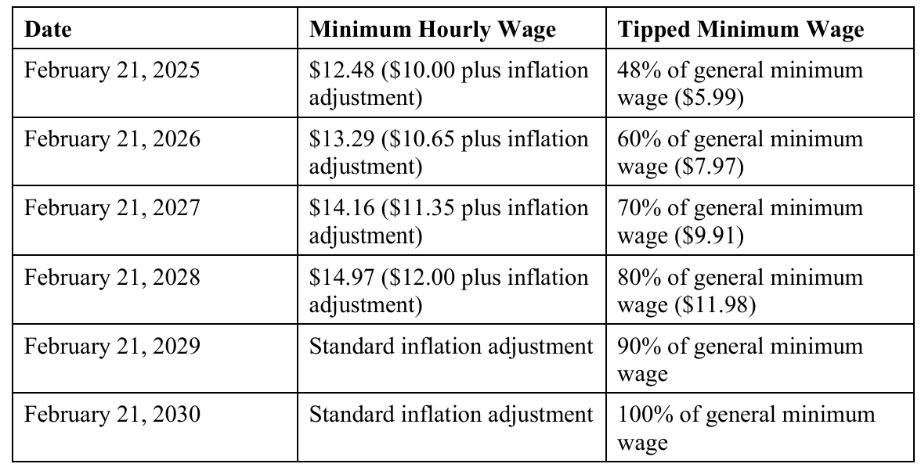
MINIMUM WAGE INCREASE
The following chart is the new schedule for the minimum wage law in Michigan moving forward:
Earned Sick Time Act (ESTA)
Like the minimum wage law, the legislature compromised and made changes to the looming Earned Sick Time Act (ESTA) on February 21st that included:
• Allowing employers to frontload an employee’s paid time off, giving small businesses of 10 employees or fewer until Oct. 1 to create a system to track the one hour of paid leave per every 30 hours worked.
• Requiring small businesses of 10 employees or fewer to provide 40 hours of sick time a year, as opposed to 72 hours
for employers of 11 employees or more.
• Giving small startup businesses three years to comply with the paid sick time accrual tracking requirement.
• Allowing employers to spell out call-in sick procedures in policy to prevent an employee from no-showing for work three days straight without repercussions.
• Excludes overtime, tips and bonuses from the rate employers need to pay their employees who are taking sick days.
• Exempts interns and startup companies from the earned sick leave policy, but that’s about it.
• Allows part-timers to get sick time that is proportional to the hours they work and at the rate full-time employees get sick time.
• The paid sick leave can carry over year after year, but can’t exceed 72 hours for businesses and 40 hours for small businesses.
• Allows for a mechanism in which sick leave is banked with vacation time if companies offer that option.
• Allows an employer to take personnel action against an employee who uses earned sick time if they are not actually sick.
MPMA SUCCESSFULLY ADVOCATES WITH LARA ON TEMPORARY RULE SET CHANGE FOR RESIDENTS
In 2022-23 the MPMA was successful in working with LARA on a temporary rule set change within the department regarding podiatry residents in Michigan. Similar to prior years, we again obtained a temporary revision in May to the new LARA rule that would have required residents to pass the APMLE. That exam is only offered in May and December. So, if an incoming resident did not pass in May, then they could not get licensure to begin residency on July 1st. Previously, they had essentially three tries to pass it before the start of the second year of residency.
In with LARA’s Licensing Division, and Boards and Committees staff, they determined it would be appropriate to extend the previous Parts 1 and 2 of the exam only requirement through February 9th (9 months from the promulgation date of rules). The Bureau of Professional Licensing (BPL) within LARA updated the licensing guides with the information that only parts 1 and 2 of the exam would be required for those limited licenses through February 9, 2026. Without a reversal of this rule set, it could have negatively impacted over forty podiatry residents in Michigan looking to begin their career.
LONG-TERM ROAD FUNDING
Following decades of attempting to do-so, the Michigan Legislature passed a $1.85 billion long-term road funding plan in 2025 that was made up of a compromise over both new revenue and spending cuts. Included in the plan was:
• A new 24 percent wholesale tax on marijuana that is estimated to raise roughly $420 million annually
• “Decoupling” the corporate tax breaks from the “Big, Beautiful, Bill” raising over $500 million annually
• Increasing the gas tax from 31 cents per gallon to 51 cents per gallon while eliminating the sales tax on gasoline which is predicted to be nearly revenue neutral
• Creating a Neighborhood Roads Fund that would focus part of the road funding package to local municipalities for upgrades
STATE BUDGET
After a contentious nine plus months negotiation over the state budget, lawmakers were able to pass an $81 billion 2025-26 Fiscal Year budget in the early morning hours on November 3rd. While a “framework” for a deal was announced the week prior, it took roughly a week for the details to get hammered out which forced the legislature to pass a “continuing budget” from Fiscal Year 2024-25 to avoid a state government shutdown until the final budget could be finalized.
Other budget highlights included the elimination of the Strategic Outreach and Attraction Reserve (SOAR) funding, an increase to K-12 funding, eliminating 1,800 unfilled state employee positions and expanding prescription drug cash payments for pregnant mothers and newborns.
BUDGET FOCUSED ON TRANSPARENCY, REDUCING “ENHANCEMENT GRANTS”
Aside from a long-term road funding plan, much of the discussion around this year’s budget centered around a more transparent budget process and less “enhancement grants” or one-time funding projects.
The House of Representatives required all one-time funding proposals from their members to identify the sponsor of the project, the public need for the project, the cost of the project and additional details that were posted to their website for the public to view. The Michigan Senate later followed suit and both chambers passed legislation requiring a process for proper disclosure and monitoring of earmark projects.
Following several embarrassing news stories on how earmarks in previous budgets were being spent and administered, one-time funding projects were reduced from $1.3 billion in the Fiscal Year 2024-25 budget to $168 million in the Fiscal Year 2025-26 budget.
HOUSE AND SENATE SECURE PRIORITIES IN BUDGET
Both chambers of the Michigan Legislature were able to secure key priorities in the budget that they outlined early on in the process. Aside from making the process more transparent, the House of Representatives was able to eliminate 1,800 unfilled state employee positions and the Speaker of the House, Matt Hall said he will make it a caucus priority to focus on eliminating additional “Ghost Positions” within state government. The House was also able to get language in the budget to require that state departments prioritize in-office work as opposed to work from home policies that have been adopted.
On the Senate side, Senate Majority Leader Winnie Brinks was able to secure $250 million for “RX Kids” which is a program that was launched to provide a $1,500 cash payment to pregnant women and $500 monthly for the first 12 months of the infants’ life.
2026 ELECTION
This year’s election will be a historic one here in Michigan. With Governor Gretchen Whitmer being term-limited and the announced retirement of U.S. Senator Gary Peters, it will be the first time EVER since the direct election of U.S. Senators started in 1916 that Michigan has both an open U.S. Senate seat and an open Gubernatorial seat in the same election.
Secretary of State, Jocelyn Benson (who is running for governor) and Attorney General, Dana Nessel are term-limited. Also, the entire Michigan Senate and Michigan House of Representatives are up for re-election in 2026. With Michigan considered a “Purple State”, expect to see a lot of political money spent in 2026.
MPMA LEGISLATIVE GOALS FOR 2026
In 2026, MPMA plans to work on several top legislative/advocacy issues including:
• A long-term solution to the residency issue previously discussed so we do not have to address the problem every year.
• Crafting legislation to introduce in the future session regarding the training and supervision of foot care nurses.
• Legislation to create a state licensing compact for DPM’s state-to-state.
Respectfully Submitted,
Jeffrey Frederick, DPM
MPMA 2025 ANNUAL REPORT
MPAS Report
In 2025, MPAS spent $7,100 on our advocacy efforts for Michigan legislators. With the Republicans controlling the House of Representatives and the Democrats controlling the Michigan Senate, the money was pretty evenly divided amongst political parties. The funds were used for Lansing events and in-district events.
MPMA appreciates each and every MPAS donation we received last year and encourages you to continue giving to MPAS. This money goes a long way in helping us support candidates that support podiatry. If you are not at the table, you are on it!
I also want to give a special thanks to those DPM’s that participated in the district events and KDA events on behalf of MPMA and putting a face to our organization.
MPAS 2025 DONORS
Anthony Alessi, DPM
William Bennett, DPM
Marc Borovoy, DPM
Norman Brant, DPM
Stephanie Carollo, DPM
Andrew Cohen, DPM
Derek Dalling (Executive Director)
Marie Delewsky, DPM
Judi Ecker, DPM
Joshua Faley, DPM
Jeffrey Frederick, DPM
Arnold Gross, DPM
Neil Hertzberg, DPM
Michael Holland, DPM
Crystal Holmes, DPM
Scott Hughes, DPM
Emily Hurst, DO (MOA President)
Zeeshan Husain, DPM, FACFAS, FASPS
Respectfully Submitted,
Jeffrey Frederick, DPM
Laura Jamrog, DPM
John Johnson, DPM
Randy Kaplan, DPM
Vincent Lefler, DPM
Jeffrey Levitt, DPM
Don Lutz, DPM
Andrew Mastay, DPM
Patrick Meyer, DPM
John Miller, DPM
Heidi Monaghan, DPM
David Moss, DPM
Joyce Patouhas, DPM
Jessica Patterson, DPM
Craig Pilichowski, DPM
Nicholas Post-Vasold, DPM
Kristin Raleigh, DPM
Angela Robin-Croft, DPM
Lawrence Rubin, DPM
Mark Saffer, DPM
Ali Safiedine, DPM
Peter Schaffer, DPM
David Schweibish, DPM (Florida member)
Jodie Sengstock, DPM
Zoe Simaz, DPM
Jeffrey Solway, DPM
Harold Sterling, DPM
Ingrid Stines, DPM
Rebecca Sundling, DPM
David Taylor, DPM
Elizabeth Tronstein, DPM
Christine Tumele-Vogt, DPM
Gregory Vogt, DPM
Jason Wadaga (Deputy Executive Director)
Marc Weiner, DPM
Laal Zada, DPM
APMAPAC Report
Health care and physician-related issues remain front and center for members of Congress. As lawmakers navigate these topics in 2026, APMA is advocating aggressively on behalf of podiatrists and the patients they serve. Through targeted legislative engagement, APMA will continue advancing policies that protect patient access to care and support the sustainability of podiatric medicine. Advocacy alone cannot be successful without a strong, viable, successful APMAPAC. Advocacy is the vehicle for the APMA legislative priorities and APMAPAC is the fuel that drives it!
Contributions from APMA members enabled APMAPAC to host multiple bi-partisan events in 2025, which educated members of Congress on legislative issues crucial to podiatry. APMAPAC recently hosted events for Reps. Brendan Boyle (D-PA), Diana DeGette (D-CO), John Joyce, MD (R-PA), Darren Soto (D-FL), and Sen. Lisa Blunt Rochester (D-DE), where APMA staff and members spoke on the need for reforms to prior authorization, physician payment, Medicare Advantage, excessive chart review requests, audits and diabetic shoe access in Medicare. Strong financial support throughout the year also allowed APMA staff and members to attend over 80 different PAC events since June. These events are game changers for the profession.
Together, these efforts demonstrate how your investment in APMAPAC directly strengthens APMA’s ability to build relationships, elevate podiatry’s voice, and advance the profession’s priorities on Capitol Hill. Thank you for your continued support that will allow our efforts to move forward in the new year. As a result, your voice can be heard in the US Congress.
“I give to the APMAPAC because I believe every one of us has a duty to protect our profession and make it better for the next generation. We are all fortunate enough to be in our positions because people before us put in the time, effort, and money to make this profession as great as it is. I view my annual donation as doing my small part in this much larger endeavor.”
Andrew Mastay, DPM, President MPMA
MPMA membership participation rate for 2025 was 10%, the same as last year! We made 141% of our financial goal for 2025. Michigan ranked 12th overall! The national average participation rate was 10.99%. Our average contribution was $61.88! We only had 38 members contribute out 364! We MUST do better this year. 2026 is a very important election year and the majority in Congress is up for grabs! We need your contribution now more than ever.
You can make contributions by going to APMA.org/donate or utilize the QR code to the right. We recommend that you join the $1 a day program or $365 a year program. You can make a onetime meaningful contribution or a recurring billing option for monthly payments. Special recognition is given to members who contribute and are published in the APMA news magazine.
Please be an advocate for your patients, yourself and the profession and utilize e-advocacy on the APMA website. Go to APMA.org, log in and click on advocacy. You can write an email to your members of Congress on critical issues, including Medicare fee schedule, Medicare advantage, student loans and many diabetic related legislation. It literally takes less than 5 minutes of your time! You can use the letter they provide and/or you can customize it. Either way, sending an email to your member of Congress goes a long way to help you and the profession. Please take a moment to write your member of Congress. Go to APMA.org/eAdvocacy.
For the complete 2025 APMAPAC Annual report, visit: https://www.apma.org/about-apma/news/news-releases/2026/apmapac-releases-2025-annual-report
If you know a member of Congress, please let us know. Thank you again for your important support of the profession through APMAPAC. With your contributions your voice will be heard in Congress!
We wish to thank the following MPMA members who contributed to the APMAPA 2025:
Platinum Level Supporters
$1,000-$2,499
Dr. Marc Borovoy
Executive Director Derek Dalling
Dr. Scott Hughes
Dr. Randy K. Kaplan
Dr. Andrew Mastay
Gold Level Supporters
$500-$999
Dr. Hatim Burhani
Dr. Zeeshan S. Husain
Dr. John Johnson
Dr. Vincent Lefler
Dr. David Moss
Dr. Ali Safiedine
Dr. Jodie N. Sengstock
Dr. Rebecca Sundling
Silver Level supporters
$300-$499
Dr. Michael Kelley
Dr. Craig Pilichowski
Dr. Mark Saffer
Dr. Harold Sterling
Bronze Level Supporters
$150-$299
Dr. Marie Delewsky
Dr. John Evans
Dr. Rachel Height-Kaplan
Dr. Crystal Holmes
Dr. Douglas Johnson
Dr. Donald Lutz
Dr. Hengelberth Montufar
Dr. Joyce Patouhas
Dr. Marc Weiner
Patriot Level supporters
Less than $150
Dr. Michele Bertelle-Semma
Dr. Lawrence Brown
Dr. Joshua Faley
Dr. Arnold Gross
Dr. Thomas Hall
Dr. Alton Johnson
Dr. John Miller
Dr. Brennan O’Dell
Dr. Jessica Patterson
Dr. Steve Sheridan
Dr. Zoe Simaz
Deputy Executive Director Jason Wadaga
Additionally, the MPMA continues to support the APMA PAC as well. Every year, the MPMA is among the leading state associations supporting the advocacy efforts of the profession. In 2025, the MPMA provided $5,000 to the APMA PAC.
Respectfully submitted,
Jodie N. Sengstock DPM
APMAPAC MI coordinator
APMA House of Delegates Report
The American Podiatric Medical Association’s annual 2025 House of Delegates (HOD) was convened on Saturday and Sunday, March 15 - 16, 2025. The House opened with addresses from staff and member leaders, including the installation of President Brooke Bisbee, DPM. Dr. Bisbee is serving as acting President in the absence of Dr. Larry Santi, DPM due to illness. Of note, this is the first HOD meeting for our new APMA Executive Director, Meghan McClelland, MBA, who was outstanding and impressive!
HOD adopted the following PROPOSITIONS:
POLICY PROPOSITIONS
• 2-24 Single certifying Board in Podiatric Medicine and Surgery
• 3-24 Economic burdens negatively impacting sustainable physician quality
• 4-24 Establishment of re-eligibility pathways for board certification in Podiatric Medicine and Surgery
AMENDMENTS TO THE BY-LAWS AND HOD OPERATIONS MANUAL
• A-25 - Establishment of a specialty area in Podiatry
• B-25 - Financial impact analysis of proposed modifications to governance documents
• C-25 - Review of APMA governance documents
• L-25 - Young physician participation in component delegations
• M-25- Students members voting in a referendum
• N-25 - Referendum procedures
BUDGETARY ACTION ITEM RESOLUTIONS
• 1-25 Evaluation of Vision 2015 outcomes, education & training of Podiatric physicians
A TOWN HALL FORUM ON THE FOLLOWING ISSUES
• Federation of Podiatric Medical Boards - Marlene Reid, DPM (IL)
• Health Care Reform & APMA’s Role in it - Christian A. Robertozzi, DPM (NJ)
• Foot Care Assistant Model for Foot Care Services - James H. Wheelan, DPM (WI)
• Podiatrist Compensation for Taking Call - Javan Bass, DPM (GA)
• Malpractice Insurance Premium Escalation/Lack of Carrier Competition - Janet Simon, DPM (NM)
GUEST SPEAKERS
• Bruce A. Scott, MD - President, American Medical Association (AMA)
AWARDS AND HONORS
• Award of Excellence - Robert Frimmel, DPM (FL)
• Distinguished Service Citation - Barry H. Block, DPM, JD (NY)
• APMAPAC Chairman’s Award - William N. McCann, DPM (NH)
2025 ELECTIONS:
President-elect:
Patrick A. DeHeer, DPM (IN)
Treasurer: Scott E. Hughes, DPM (MI)
APMA Board of Trustees:
Leslie Campbell, DPM, (TX) - incumbent, three-year term
William S. Long, DPM, (SC) - incumbent, three-year term
James R. Hana, DPM (NY) - one-year term
Speaker of the House: Timothy Tillo, DPM (FL) - one-year term
HOD Representative on the SRBC:
Tyson E. Green, DPM (LA)
The 2026 HOD will be held March 14-15, 2026 followed by the in-person Legislative Conference.
MPMA members serving on APMA committees:
Scott Hughes, DPM Board of Trustees APMA Diversity, Equity and Inclusion committee Finance committee
Liaison to American Association of Colleges of Podiatric Medicine (AACPM) Podiatric population health committee
Marc A. Borovoy, DPM Residency workforce committee
Randy K. Kaplan, DPM Chair, APMAPAC Legislative Committee
Andrew Mastay, DPM Policy Review committee Election committee
Jodie N. Sengstock, DPM Health Policy Committee Medicare CAC Chair Legislative committee APMAPAC coordinator
As always, the annual APMA House of Delegates is open to any MPMA member to attend. The Michigan Delegation welcomes any member who wishes to participate and attend its caucus and deliberations. We welcome your input as members in determining the important policies and direction of this great association. The delegation is always ready, willing and able to assist in any member issues, development of appropriate Policy/Bylaw propositions that any member may wish to be introduced, please do feel free to contact any one of your delegates. On behalf of the MPMA delegation, it is always an honor and a privilege to serve you, as your representatives/delegates to the APMA HOD.
Respectfully submitted,
2025 DELEGATES
Marc A. Borovoy, DPM
Marie Delewsky, DPM
Randy K. Kaplan, DPM, Chief Delegate
Jodie N. Sengstock, DPM
ALTERNATES
Crystal Holmes, DPM
Zeeshan Husain, DPM
Andrew Mastay, DPM, MPMA President
For a complete summary of the 2025 APMA HOD, please visit www.apma.org/hod, See 2025 Abstract of Proceedings.
Necrology Report
This report includes death notifications that MPMA received since the 2025 Great Lakes Conference and the 111th MPMA Annual Meeting. The MPMA remembers the following members who are no longer with us:
Michael Hartman, DPM December 14, 2025
Sanford Kaner, DPM February 28, 2025
Howard Reznick, DPM December 23, 2025
Michael Salter, DPM December 8, 2025
Stephen Wittenburg, DPM October 14, 2025
Insurance Committee Report
In 2025, MPMA did not identify any major insurance issues that were affecting membership across the board through the course of the year, but the insurance committee did assist members with a lot of one-off issues.
BCBSM UPDATE
Blue/Cross Blue/Blue Shield of Michigan (BCBSM) is continuing to encourage members to use the PET system and not contact MPMA for individual insurance inquiries. As a reminder, this is the information that they have shared with us in previous years. In 2024, PET focused on four major areas:
• Simplifying the inquiry submission process
• Enhancing the quality of provider communications.
• Educating providers on the submission process.
• Using the acquired analytics to target provider needs and educational opportunities.
According to BCBSM, 66% of inquiries received contained all the required information. As a result, PET conducted provider outreach campaigns to address identified issues, created an optional submission form to ensure the inclusion of all required information, and provided intensive training programs for PET mailbox staff.
We expressed the need to speak to a human being when dealing with complex issues such as ongoing enrollment issues or with appeals. BCBSM shared that while the enrollment area has faced major challenges, it is now under new leadership and improvements are in process. Regarding audits, they explained that PET cannot provide additional reviews for clinical editing or post service appeals. These issues are out of scope, however PET can, and will forward any outstanding issues to Enrollment or the Clinical Editing team as appropriate. BCBSM confirmed human beings monitor the PET
mailbox. When an inquiry enters the mailbox, it generates an automated response to notify the provider of receipt. The mailbox generates another notification message upon assignment of the inquiry to a provider consultant.
We inquired as to how podiatrists performed. BCBSM stated 79 DPM offices utilized the PET mailbox out of 6,300 providers so far this year. That is a small percentage, indicating podiatrists overall are doing well.
Finally, following inquiries from some members, BCBSM informed us that nothing has changed regarding DME and Northwood. Northwood is the exclusive third-party administrator (TPA) for the HMO products, BCN and BCN advantage. It is the preferred TPA for Blue Cross PPO and MAPPO products. Members may receive discounts for utilizing the preferred TPA.
UPDATES ON INSURANCE ISSUES AND HOW TO ADDRESS THEM
Make sure you have members’ social security number on file, or that you’re getting patient’s social security number at check in. Our billers see a lot of Medicare MBI numbers changing and offices are not always asking patients on each visit for insurance information to see if they have received a new card.
You can find the new MBI numbers on Medicare’s website if you have the members social security number.
Medicare Advantage: Make sure you are checking for new Medicare Advantage ID cards. Some contracts have changed from XYL prefix. X3LM. You can put the old member ID inside of Availity and it will give you the new ID number.
Humana has been an issue for a few of our doctors, we think it’s a good idea to call them and request your negotiated fee schedule to make sure you are getting paid appropriately. 1-800-626-2741.
Make sure your wound care documentation is descriptive size depth, pictures of wounds etc. We have had to have some providers add addendums to notes that include what staging system your utilizing National Pressure Injury Advisory Panel (NPIAP) or Wagner for diabetic wounds.
REMINDERS
As of April 1st 2025 HCPCS L1932 continues to represent a ridged AFO prefab custom fitted. NEW code L1933 ridged anterior AFO PREFAB off-the-shelf L1951 AFO spiral prefab custom fitting (Remember this code requires prior authorization) NEW code L1952 Spiral AFO prefab off-the-shelf. Previously, there was only the option for custom fitted
You can submit prior authorization through my CGS portal Prior Authorization Smart Submission (PASS) or use the prior authorization request coversheet located under prior authorization on the cgsmedicare.com website.
Respectfully Submitted,
Louis Geller, DPM
CAC-PIAC Report
On November 14, I attended APMA’s 25th Annual Joint National CAC-PIAC Meeting, held virtually due to the extended federal government shutdown. More than 60 CAC and PIAC representatives, state component leaders, subject matter experts, and APMA staff participated. Despite the shift from in-person to online, the meeting underscored the essential role that CAC and PIAC representatives play in protecting patient access, preserving the profession’s voice in Medicare and private insurance policy, and navigating an increasingly complex reimbursement landscape.
This year’s meeting focused heavily on major federal policy changes for 2026, skin substitute compliance and audit readiness, Medicare Advantage (MA) trends, private insurance challenges, and practical strategies for effective engagement with Medicare Administrative Contractors (MACs), medical directors, and private insurers. Below are key updates and takeaways to share with colleagues in our state. The agenda and other materials are available at www.apma.org/ CACPIAC2025.
APMA’S STRATEGIC DIRECTION: UNIFYING POLICY, ADVOCACY, AND WORKFORCE PRIORITIES
APMA’s President Dr. Brooke Bisbee provided an overview of APMA’s current strategic priorities, emphasizing: A sharpened advocacy agenda focused on fair reimbursement, scope modernization, workforce sustainability, and public promotion of podiatry
APMA’s investment in branding the profession and strengthening membership engagement
Work underway to expand research capacity, enhance education, and support advocacy through clearer data and coordinated messaging
Her remarks underscored the essential role CAC and PIAC representatives play as APMA’s “front line” in ensuring podiatry’s voice is represented in payer policy and medical director decisions.
PREPARING FOR 2026: MAJOR MEDICARE POLICY CHANGES
Cindy Moon, MPH, MPP, presented a comprehensive analysis of the 2026 Medicare Physician Fee Schedule (MPFS) and related Centers for Medicare and Medicaid (CMS) updates. Key points included:
Physician Fee Schedule Updates
• CMS finalized two conversion factors for 2026; impacts vary based on qualifying alternative payment (APM) model participant (QP) status. The overall CMS PFS net impact (after accounting for MACRA and the One Big Beautiful Bill Act) on podiatrists for 2026 is estimated to be around +4%
• The MPFS contains a provision that reduces the work Relative Value Units (RVUs) and intra-service time for all non-time-based codes by 2.5 percent in 2026. This “efficiency adjustment” would further reduce physician reimbursement, creating substantial financial pressures on practices that could limit patient access to crucial procedures and care. APMA is working with a coalition of like-minded stakeholders to reverse this policy through Congressional action.
• As a direct result of recommendations made by Specialty Society RVS Update Committee (RUC), in which APMA is actively involved to represent members’ interests, CMS finalized updated valuations for both great toe arthrodesis codes for CY 2026.
Skin Substitute Payment Overhaul
• Beginning in 2026, nearly all skin substitutes will be paid under the PFS at $127.28 per cm², regardless of product or indication.
• Non-sheet products will be contractor priced, but coverage remains local coverage determination (LCD)-dependent.
• All seven Medicare Administrative Contractors (MACs) have finalized LCDs limiting coverage for diabetic foot ulcers (DFUs) and venous leg ulcers (VLUs) beginning January 1, 2026. There are only 20 named products permitted for DFUs and only 5 products permitted for VLU; more than 200 codes will be considered non-covered.
• Providers in Wasteful and Inappropriate Service Reduction (WISeR) Model states will have to go through prior authorization or pre-payment review for certain skin substitute applications (Application of Bioengineered Skin Substitutes to Lower Extremity Chronic Non-Healing Wounds (L35041) and Wound Application of Cellular and/or Tissue Based Products (CTPs), Lower Extremities (L36690))
MIPS & MVP Updates
• A Podiatry Merit-based Incentive Payment System (MIPS) Value Pathway (MVP) was added to the MIPS MVP Inventory. This MVP is reflective of APMA’s continuous engagement with CMS to provide more meaningful measures for our members, while ensuring that care is correctly attributed only to appropriate practitioners.
COMPLIANCE, AUDITS, AND THE OFFICE OF THE INSPECTOR GENERAL (OIG): WHAT PROVIDERS NEED TO KNOW
Former HHS-OIG Senior Counsel David Traskey, Esq., provided practical tips on managing skin substitute documentation and reporting. Key messages included:
• Skin substitute utilization and relationships with vendors are high-risk audit targets, with the government scrutinizing high-cost use and potential Anti-Kickback Statute issues.
• OIG compliance risks and major red flags include unfamiliar referrals, questionable compensation arrangements, improper billing privilege reassignment, altered records, and reimbursement “guarantees.”
• Providers should keep internal compliance programs updated, conduct periodic audits, and seek legal counsel immediately if contacted by regulators.
MEDICARE ADVANTAGE TRENDS: CONTRACTING, NETWORKS, AND PRIOR AUTHORIZATION
Kelli Back, Esq., provided an in-depth overview of Medicare Advantage (MA):
• MA enrollment and market shifts: For the first time in a decade, CMS projects an overall decline in MA enrollment, with plan exits and service-area reductions affecting more than a million beneficiaries and driving some patients back to traditional Medicare.
• Network adequacy: MA organizations must meet CMS network adequacy standards for podiatrists; the period from late fall through mid-spring, when plans build networks for new or expanding service areas, is often the best time to negotiate contract terms and rates.
• New prior authorization (PA) rules in 2026: Standard PA decision timeframes will be cut to 7 days, plans must post PA approval/denial and appeal data on their websites by January 1 each year, and they must use electronic application programming interfaces (APIs) to receive and respond to PA requests.
• Limits on MA coverage criteria: MA plans must follow Medicare national coverage determinations (NCDs)/LCDs and cannot create criteria that narrow who can provide a covered service (for example, they cannot exclude podiatrists when fee-for-service Medicare allows podiatrists to perform that service), and any internal criteria must be evidence-based and publicly accessible.
• Gold-carding: Gold-card programs can reduce PA burden but do not prevent retrospective audits or payment denials
• Downcoding: CAC/PIAC reps should encourage practices to monitor payers for automatic downcoding and to appeal systematically, using payer policies and documentation to challenge inappropriate code changes.
ADVOCACY IN ACTION: LEGISLATIVE AND REGULATORY WINS:
APMA Vice President of Advocacy Chad Appel, JD, CAE, delivered timely updates on:
• Congressional physician payment reforms (including the 2.5% Medicare update for 2026). APMA’s advocacy to Congress to implement structural reforms to the Medicare payment system, including the establishment of an annual inflation adjustment for physicians.
• APMA’s work to fight downcoding, prevent misclassification of podiatrists, and protect Medicaid coverage and oppose student loan proposals following the passage of the One Big Beautiful Bill Act (OBBBA)
• Coalition efforts to repeal or reform the WISeR (Wasteful and Inappropriate Service Reduction) model
• Engagement with durable medical equipment (DME) MACs and CMS on therapeutic shoes for patients with diabetes and new legislative strategy
He also confirmed the group’s unanimous support for reaffirming Dr. Jodie Sengstock as CAC Chair for one more year.
MEDICARE PART B & DME TRENDS REVEAL SIGNIFICANT SHIFTS
Dr. David Freedman presented Medicare Part B data showing:
• Evaluation and Management (E&M) services account for about half of Medicare spending, and Dr. Freedman showed that podiatry’s E&M patterns still skew toward lower-level codes compared with other specialties, encouraging providers to bill the level that their documentation truly supports.
• Podiatry’s share of Medicare Part B spending has grown to roughly $3 billion, reflecting both increased volume and expanded service mix.
• Federal scrutiny is intensifying on high-cost services, including skin substitutes and the rising use of imaging for plantar fasciitis, signaling potential audit focus areas.
• Amputation trends remain concerning, with foot amputations continuing to represent the majority of lower-extremity amputations despite declining diabetic shoe utilization over the past decade.
• DME data show improper billing risks, including OIG findings of $22.7 million in inappropriate payments tied to inpatient stays, underscoring the importance of accurate place-of-service reporting.
SKILLS WORKSHOP: TURNING ADVOCACY INTO ACTION
Attendees spent significant time discussing real-world strategies for engaging with and building better relationships with medical directors in both public payer and private payer roles. Advice for succeeding in these roles also serves all podiatrists for ensuring compliance and awareness of coverage policies:
• Monitor your MAC proactively for changes to local coverage determinations for your services
• Sign up for newsletters for your contracted plan networks for private payers and the MAC and DME MAC for public payer issues
• See something, say something – communicate with your state and CAC/PIAC representative as appropriate when you encounter an inappropriate denial or coverage policy
Respectfully Submitted,
Jodie Sengstock, DPM
CAC representative from MPMA
APMA CAC chairperson
Northeast Division Report
The Northeast Division had our annual membership conference and meeting at the Grand Traverse Resort on April 25-27, 2025 at the Grand Traverse Resort. Our next conference will be held on May 1-3, 2026 at the Grand Traverse Resort. We would like to thank our members. We would also like to extend our appreciation to the vendors who support us. We also offer our continued thanks to Maria Rubino for her dedication to our division and for coordinating our conference. If you are interested in lecturing or attending, please contact Maria at 586-286-8660 or email her at missionpodiatry@gmail.com.
We are proud to acknowledge the outstanding leadership of our current leadership team. We thank our new representative, Dr. Jeffrey Lin.
• President: Joyce Patouhas DPM
• Vice President: Andrea Simons DPM
• Secretary: Mike Holland DPM
• Treasurer: Donald Lutz DPM
• State Representatives: Jeffrey Lin DPM, Joyce Patouhas DPM
We support charities that include veterans, shoe programs for kids and the military, clothing and food for the homeless, St. Jude Children’s Hospital and Special Olympics.
We are always looking for new members. Hope you all enjoy the annual MPMA Conference and have a successful 2026!
Respectfully Submitted,
Joyce E. Patouhas DPM Northeast Division President
Southeast Division
The Southeast Division held a meeting to discuss any issues providers may have been experiencing at that time. We are continuing to recruit new members and are actively seeking individuals who are passionate about serving on our board.
Respectfully Submitted,
Michelle Bertelle, DPM
Southern Division Report
The Southern Division held its most recent meeting in May 2025. We would like to thank our sponsor for the meeting, Treace Medical. Dr. Alan Bass presented on the topic of MIPS and RAF values along with coding concerns. Our next meeting is anticipated for May 2026. We are always looking to welcome new members for our division. Please reach out to Angela Robin at 734-775-5737 or arobin@spartanpodiatry.com with any questions or concerns.
Respectfully Submitted,
Angela Robin, DPM
PODIATRIC MEDICAL ASSOCIATION
Michigan Podiatric Medical Association
Dept 2: Publications
Dept 5: CME
Dept 7: Website
Dept 8: Legal
Dept 9: Board of Directors
Michigan Podiatric Medical Association Department Analysis Dept 9 Board of Directors
Dept 10: APMA House of Delegates
Michigan Podiatric Medical Association Department Analysis Dept 10 House Of
Dept 13: Corporate Sponsors
Dept 14: Midwest