DON’T BE FOOLED BY MEDICARE ADVANTAGE PLANS PAGE 6
FTC SENDS WARNING LETTERS TO HEALTH CARE EMPLOYERS IN LATEST NONCOMPETE DEVELOPMENT PAGE 8
DECODING MEDICAID CHANGES IN THE ONE BIG BEAUTIFUL BILL PAGE 9
CMS PRIOR AUTHORIZATION DEMONSTRATION AND PROTECTING PATIENT ACCESS PAGE 9
ICD-10-CM CHANGES RELATED TO PODIATRY PAGE 10
APMA CORNER PAGE 11
PRESIDENT’S MESSAGE
NATHAN GRAVES, DPM | IPMA PRESIDENT
As my time as President of the Indiana Podiatric Medical Association comes to a close, I want to extend my heartfelt thanks to each of you for your trust, engagement, and support over the past year. It has been an honor to serve this incredible community of physicians and leaders who continue to strengthen the practice of podiatric medicine across our state.
Our recent Annual Convention and 100th Anniversary Celebration was a true highlight—an event that perfectly captured the spirit of our Association. Seeing so many colleagues, friends, and new members come together to share ideas, learn, and celebrate a century of excellence was both humbling and inspiring. Your enthusiasm and participation made the weekend an unforgettable success.
As I reflect on our milestone year, I am deeply proud of what we’ve accomplished together—advancing education, advocating for our profession, and continuing to uphold the highest standards of patient care. Most of all, I am grateful for the relationships that make the IPMA not just an association, but a family.
Thank you for the privilege of serving as your President. I look forward to seeing the IPMA continue to grow and thrive in its next century, guided by the same dedication and passion that have carried us through the first hundred years.
INDIANA PODIATRIC MEDICAL ASSOCIATION
A CENTURY IN STEP
IPMA MARKS 100 YEARS WITH A MEMORABLE ANNUAL CONVENTION
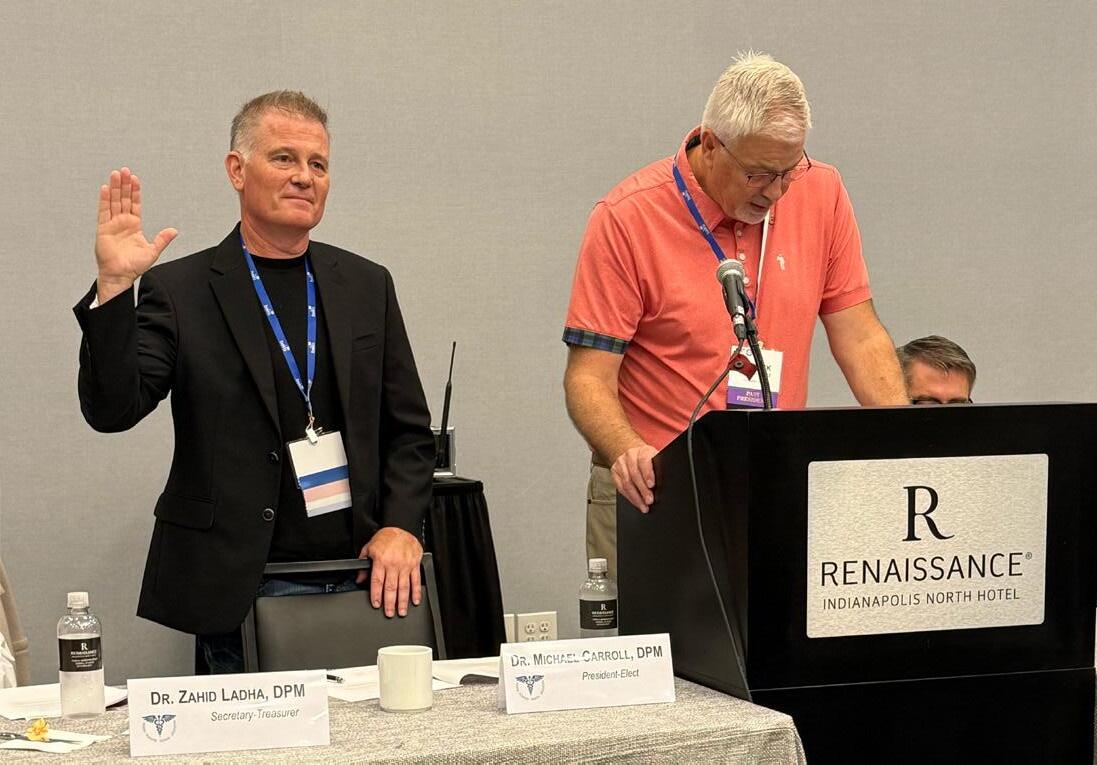
The Indiana Podiatric Medical Association (IPMA) took a confident step into its next century this fall, celebrating 100 years of service, education, and leadership in podiatric medicine. The milestone coincided with the Association’s annual Fall Convention—a fitting occasion that blended professional growth with a heartfelt tribute to the organization’s enduring legacy.
Hosted in Carmel, Indiana the two-day event brought together podiatric physicians, students, exhibitors, and friends of the profession from across the state and beyond. Attendees gathered not only for continuing education and networking, but to honor a century of progress and the people who made it possible.
The convention offered a robust program of lectures and workshops led by nationally recognized speakers, covering topics that ranged from innovative surgical techniques to evolving best practices in patient care. Between sessions, members explored a bustling exhibit hall, where industry partners showcased the latest technologies and treatments advancing foot and ankle medicine.
But the true highlight of the weekend came during the 100th
Anniversary Celebration Dinner, a festive evening that celebrated IPMA’s history with elegance and warmth. Guests shared stories from decades past, toasted to enduring friendships, and recognized the leaders whose dedication has shaped the profession in Indiana. Photographs and memorabilia from the Association’s earlier days offered a poignant reminder of how far both the IPMA and the field of podiatric medicine have come.
In his remarks, APMA President-Elect and IPMA Past President Dr. Patrick DeHeer reflected on the occasion:
“For a century, the Indiana Podiatric Medical Association has stood as a cornerstone of professional support and patient advocacy. Our centennial celebration is not just about honoring where we’ve been—it’s about setting the vision for where we’re going next.”
As the final sessions concluded and attendees said their goodbyes, one thing was clear: the IPMA’s centennial year was not merely a look back, but a proud step forward. With renewed energy and a shared commitment to excellence, the Association moves confidently into its next 100 years—one step at a time.
CREATING VALUE IN OTHERS
BY TINA DEL BUONO, PMAC DIRECTOR TOP PRACTICES VIRTUAL PRACTICE MANAGEMENT INSTITUTE
CONSULTANT AND PERFORMANCE COACH
Every business owner wants great employees. Yet, when I talk with physicians and managers, the number one concern I still hear is employee issues. What I rarely hear is, “I have amazing employees.” That makes me wonder — do employees even know the value they bring to the workplace?
DO EMPLOYEES KNOW THEIR VALUE?
Most employees want to do good work. But if they’ve never been told how their role fits into the bigger picture, it’s easy for them to lose sight of their purpose. Employers often assume staff “just know” how they contribute. In reality, many don’t. If an employee doesn’t see the connection between their work and the success of the practice, they’ll struggle to feel invested.
CONNECTING THE BIG PICTURE
Employees thrive when they understand:
Support Your Industry!
The IPMA Foot Support PAC is a nonprofit, bipartisan fundraising committee through which podiatrists support state candidates who support podiatric medicine’s issues before the Indiana General Assembly.
The Foot Support PAC’s role is to support candidates seeking office in the Indiana State Senate or Indiana House of Representatives.
• What the business stands for (its purpose and goals)
• Why their role matters (the “why” behind their daily tasks)
• How their work impacts others (coworkers, patients, and the doctor)
Imagine working in a factory making one part without knowing what the part does, how it fits with other parts, or what the finished product looks like. You would eventually lose motivation. Employees in medical practices feel the same way when they don’t see how their work connects to patient care and business success.
TRAINING BUILDS CONFIDENCE AND VALUE
Clear expectations must be paired with consistent training. Employees need time, coaching, and ongoing feedback to master their responsibilities. Training shouldn’t just be about tasks — it should also explain how each role supports other positions in the practice. When people understand how departments work together, they develop respect for their teammates and pride in their contributions.
INVESTMENT SHOWS VALUE
When leaders take the time to:
• Train thoroughly
• Share how each role contributes to success
• Provide growth opportunities
…employees see that as proof they are valued. Investment communicates worth more than words ever could.
THE POWER OF RECOGNITION
Training alone isn’t enough. Employees also need to hear how they add value. Recognition — whether in a team meeting, during a one-on-one, or even a quick “thank you” — reinforces their importance. When people feel seen and appreciated, they engage more deeply. And engaged employees create value every single day.
FINAL THOUGHT
Employees want to know they matter. When leaders consistently invest time in training, communication, and recognition, employees feel valued. And when employees feel valued, they naturally add value — to the business, their coworkers, and most importantly, to the patients you serve.
Tina Del Buono is a Practice Management Performance Coach, Consultant and Mentor for physicians and her fellow office managers/ administrators and their staff. She has been a practice manager for over 25 years. Tina is the author of a National Indie Award Winning Book, “Truth from the Trenches” The Complete Guide to Creating A HighPerforming, Inspired Medical Team.
ONLINE LIMITED PODIATRIC RADIOGRAPHY EDUCATIONAL PROGRAM
The Indiana State Department of Health (ISDH) requires all podiatric medical assistants who take x-rays to be licensed as a limited podiatric radiographer.
The IPMA wants to remind the membership of its new limited podiatric radiography program that meets the ISDH requirements and is designed to instruct the podiatry assistant in the safe and effective use of x-rays in the podiatric practice.
Content includes:
• History of the x-ray
• Risks and safety measures associated with radiography
• Image production and film development
• Principles of CT Scan, MRI, and Bone Scan
• Anatomy of the foot and ankle
• Positioning and x-ray machine placement
PROGRAM STRUCTURE
The program consists of four online content modules, each with a final exam, one attestation module, a student manual, and an x-ray log. A Certifying Physician must guide the applicant in the clinical portion of the program and the completion of the x-ray log. The podiatry assistant must document competency by demonstrating the proper performance of 60 x-ray views in the podiatrist’s office.
At the successful conclusion of the program, the applicant will have the proficiency and skill necessary to obtain the limited podiatric radiography license and will receive a Certificate of Completion. The Certificate, the completed Application for Proficiency Certification for Limited Radiographer and signed x-ray log should be sent to the IPMA.
To learn more about this program or to register, click here.
DON′T BE FOOLED BY MEDICARE ADVANTAGE PLANS
BY MARY-ELLEN SCHIMMOLLER INDEPENDENT NETWORKING GROUP, INC.
There has been much in the news regarding hospitals and health care systems dropping their contracts with Medicare Advantage Plans (MAPs). This is due to several reasons including slow reimbursement and invalid denials even on prior authorized services.
Anyone in the revenue cycle understands that inappropriately denied claims requires additional resources to fight the denial and also results in delayed reimbursement. Patients are of course confused when they receive the notice of denial because they thought the service was covered the same as it was in the past.
On several occasions, our staff have contacted the plan to discuss the denied services to inform the MAP that they are denying Medicare covered services. The response has been to tell us that “the patient’s plan changed, and this service is no longer covered”. If we were to take that info to heart, our Providers
would be losing significant revenue.
When you receive these denials, do not be fooled into thinking this is the final word. It may be necessary for you to show the MAP the error of their denial by citing the Medicare Coverage Policies that clearly shows the service should have been covered. This may be an LCD (Local Coverage Determination), or if there is not one on file for the service in your local Medicare jurisdiction, you would revert to the NCD (National Coverage Determination).
Medicare sets the standard and guidelines for what services will be covered. The MAPs are required to follow those guidelines when processing claims for payment. One example is with Foot Care Services where there may be two separate policies or NCDs. The first policy would refer to the coverage when the patient presents for nail debridement when accompanied by “pain”. (Billing for these services should be done with caution as overuse of this billing has resulted in many audits.) The other policy refers to patients with systemic conditions and the criteria
for coverage. When an AI generated denial is based on looking for a “pain” diagnosis, your diabetic or LOPS patients are getting inappropriately denied. Often the claims are denied with either a CO-96 (Non-covered Service), or a CO-97 (Bundled Service Error even when a 59 modifier is utilized). Both of these “CO” denial codes mean that you are required to adjust off the charge as part of your contractual obligation with the MAP you are contracted with. Don’t adjust – fight it!
Just recently I was told by a Provider’s office that DM shoes will no longer be covered by one of their regional MAPs. A representative of the plan actually told one of the staff this. This is also one of the plans that are generating the foot care service denials. I wish that I could tell you that it is just one carrier or MAP that is doing this but unfortunately this is a MAP trend. Today it might be one carrier, and tomorrow a different one.
The path to getting these bad edits corrected is never easy. If you are unable to effect change with the MAP carrier, it may be advisable to contact your state’s Department of Insurance to file a complaint. Change doesn’t happen fast in this area so you may have to flood them with copies of the appeals or redeterminations that you filed to show how rampant and
When you receive these denials, do not be fooled into thinking this is the final word. It may be necessary for you to show the MAP the error of their denial by citing the Medicare Coverage Policies that clearly shows the service should have been covered.
disruptive the MAPs denials are. Our office fought one carrier’s edit for two years before it was finally corrected. For two years we filed approximately 20 appeals per week which were always overturned and paid.
The point I’m stressing is that there can be significant roadblocks for you to be paid appropriately for the services that you provide. Don’t take the denials as the final word and fight for what you are owed. On the other hand, you might want to consider the hospitals option and stop contracting with the offensive MAP(s).
If you would like to learn more, you can visit Independent Networking Group, Inc.
FTC SENDS WARNING LETTERS TO HEALTH CARE EMPLOYERS IN LATEST NONCOMPETE DEVELOPMENT
BY THOMAS M. ABRAMS AND STEPHANIE T. ECKERLE KREIG DEVAULT
The Federal Trade Commission (“FTC”) sent letters on September 10 prompting many large health care employers and staffing firms to review their noncompete agreements (“noncompetes”) for compliance with Section 5 of the FTC Act, 15 U.S.C. § 45, which empowers the FTC to investigate and prevent unfair methods of competition. Five days prior, in a Press Release on September 5th, the FTC announced its intent to dismiss appeals and abandon further efforts to enforce a rule drafted by the FTC under President Biden that sought to ban most noncompetes throughout the country (“the Noncompete Clause Final Rule”), as described in a previous alert found here. The letters sent five days later on September 10 reminded the health care industry that regardless of the Noncompete Clause Final Rule being set aside, “[t]he FTC is focusing resources on enforcing Section 5 of the FTC Act against unlawful noncompetes, particularly in the healthcare sector.”
The version of the letter published by the FTC expressed concern that noncompetes used by many health care employers unreasonably limit options for “vital roles like physicians, nurses, and other medical professionals.” Factors identified by the letter and which health care employers are encouraged to review include:
y Whether alternative, less restrictive contract terms can achieve the same procompetitive purposes as a noncompete.
y Whether and to what extent a noncompete limits patients’ ability to choose a health care provider, especially in rural areas.
y Whether the duration and/or geographic scope of a noncompete is appropriate under the circumstances.
y Whether a noncompete is appropriate at all, considering the individual’s role.
Recipients are not accused of any specific wrongdoing, but rather the FTC uses the letters as one means to clarify its position on health care noncompetes and alert health care employers that these agreements will be scrutinized federally.
A Press Release on September 10 announced the letters with additional context and statements from FTC officials, including to clarify that the FTC’s withdrawal on September 5th from litigation concerning the vacated Noncompete Clause Final Rule should not be confused as a withdrawal from case-by-case
scrutiny of noncompetes in the health care industry. The FTC’s abandonment of the Noncompete Clause Final Rule and the letters sent to health care employers days later indicate the FTC is dialing back its rulemaking activity to increase its focus on case-by-case enforcement. This was further highlighted by the Press Release’s reference to a public Request for Information Regarding Employer Noncompete Agreements issued by the FTC on September 4, 2025, to solicit identities and descriptions of employers that currently use noncompetes in their workforce.
The FTC under President Trump’s second administration is rapidly outlining its approach to noncompete enforcement through the public inquiry launched on September 4th, the withdrawal from litigation supporting the Noncompete Clause Final Rule on September 5th, and the letters sent to health care employers on September 10th. As the FTC increasingly moves from planning to enforcement, employers and staffing firms— especially in the health care industry—should address risk sooner rather than later by reviewing and updating noncompetes as necessary to align with current FTC enforcement priorities.
In addition to aligning with current FTC enforcement priorities, healthcare providers in Indiana should also review the most recent laws passed that govern restrictive covenants entered into by and between physicians and hospital-related entities. Effective July 1, 2025, new statutes prohibit noncompetes between a physician and a hospital, a parent company of a hospital, an affiliated manager of a hospital, or a hospital system. (Ind. Code § 25-22.5-5.5-2.3). “Hospital system” is broadly defined to include “(1) a parent corporation of at least one hospital and any entity affiliated with the parent corporation through ownership, governance, or membership; or (2) a hospital and any entity affiliated with the hospital through ownership, governance, or membership.” (Ind. Code § 25-22.5-5.5-1.2). A separate statute that prohibits any type of employer from entering into a noncompete with a primary care physician (family medicine, general pediatric medicine, or internal medicine) remains in force and applies to noncompetes executed on or after July 1, 2023. (Ind. Code § 25-22.5-5.5-2.5).
For specific assistance regarding noncompete risk, please contact Stephanie Eckerle, Thomas Abrams, or any member of the Krieg DeVault team.
Disclaimer: The contents of this article should not be construed as legal advice or a legal opinion on any specific facts or circumstances. The contents are intended for general informational purposes only, and you are urged to consult with counsel concerning your situation and specific legal questions you may have.
PODCAST:
DECODING MEDICAID CHANGES IN THE “ONE BIG BEAUTIFUL BILL”
PRESENTED
BY
MEGHAN LINVILL MCNAB
HOSTED
BY GEORGE C. LEPENIOTIS
Welcome to the latest edition of the Krieg DeVault Podcast Series where we discuss the latest news, laws and trends affecting your industry.
The Trump administration’s “One Big Beautiful Bill” is poised to significantly impact healthcare providers by changing Medicaid financing and reimbursement. Meghan Linvill McNab, a partner at Krieg DeVault who focuses on Medicare and Medicaid reimbursement, describes key contours of the new landscape: placing limitations on provider taxes and levels of state directed payment programs in Medicaid managed care.
With host George Lepeniotis, she explains that the bill will limit some opportunities for states to use non-state dollars to
fund their portion of a Medicaid expenditure. “That’s going to result in either the state having to put up more funding to keep reimbursement at the current levels, or it’s going to result in reimbursement to providers decreasing because there’s not as much funding,” she says. “So, something has to give to keep the balance.”
Disclaimer: The contents of this podcast should not be construed as legal advice or a legal opinion on any specific facts or circumstances. The contents are intended for general informational purposes only, and you are urged to consult with counsel concerning your situation and specific legal questions you may have.
APMA has submitted comments to the Centers for Medicare & Medicaid Services (CMS) in response to a new prior authorization demonstration that will apply to certain services performed in ambulatory surgical centers (ASCs) across 10 states beginning December 15, 2025.
While APMA recognizes CMS’s intent is to curb fraud, waste, and abuse, we are deeply concerned about the potential unintended consequences for patients and providers. APMA’s comment letter to CMS voices the concerns of podiatric physicians, and it provides recommendations to CMS. APMA highlighted risks to patient access and increased provider burden including:
y Barriers to Care: Prior authorization requirements often lead to delays in necessary medical treatment. For patients with venous leg ulcers and other acute or chronic foot and ankle conditions, delays can worsen outcomes, reduce mobility, and increase risk of complications.
y Provider Burden: Podiatric physicians already dedicate significant time and resources to ensuring compliance with Medicare and other payer requirements. Adding another layer of prior authorization creates additional administrative work which pulls focus away from patient care.
y Duplicative Oversight: APMA emphasized that CMS already has numerous mechanisms in place to address
fraud, waste, and abuse. These safeguards are designed to protect the integrity of the Medicare program without restricting access to medically necessary services.
APMA provided CMS with the following recommendations to protect beneficiary access to medically necessary care and mitigate any associated administrative burden:
y Remove vein ablation from the demonstration because it is often medically necessary for treating venous leg ulcers and is not just for cosmetic purposes.
y Ensure timely review of prior authorization requests by adhering to CMS’s finalized rule timeframes to prevent harmful delays in care.
y Adopt a “gold carding” policy to exempt compliant providers from prior authorization requirements. This would reduce administrative burden while safeguarding Medicare funds.
y Incorporate appropriate clinical expertise in review models. This ensures podiatrists are involved in developing and applying medical necessity criteria for vein ablation related to venous leg ulcers.
ICD-10-CM CHANGES RELATED TO PODIATRY
The ICD-10-CM code set for 2026 takes effect October 1, 2025: All members should be using the new code set for services performed on or after this date. The new code set includes 487 new code additions, 28 deletions, and 38 modifications. Some of these are pertinent to foot and ankle care, including changes involving lower extremity ulcers, diabetes, and more. APMA has produced a presentation and list of ICD-10-CM changes for members online here, including a webinar by Jeffrey D. Lehrman, DPM, CPC.
TYPE 2 DIABETES
The 2021 International Consensus Report defining type 2 diabetes in remission, coauthored by the ADA, EASD, Diabetes UK, the Endocrine Society, and others, defines type 2 diabetes in remission as, “a return of HbA1c to <6.5% (48mmol/mol) that persists for at least 3 months after stopping glucose lowering pharmacotherapy.”
If the type 2 diabetes in remission diagnosis played a role in the management provided during an encounter, that should be reflected in the ICD-10-CM coding that accompanies the encounter. The new, complete ICD-10-CM code will be:
E11.A Type 2 diabetes mellitus without complications in remission
SHIN ULCERS
Non-pressure chronic ulcers of the lower limb are represented by ICD-10-CM codes that begin with the code stem, L97- (Nonpressure chronic ulcer of lower limb, not elsewhere classified). Until October 1, 2025, the only 4th character options for this code stem are:
y L97.1- Non-pressure chronic ulcer of thigh
y L97.2- Non-pressure chronic ulcer of calf
y L97.3- Non-pressure chronic ulcer of ankle
y L97.4- Non-pressure chronic ulcer of heel and midfoot
y L97.5- Non-pressure chronic ulcer of other part of foot
y L97.8- Non-pressure chronic ulcer of other part of lower leg
y L97.9- Non-pressure chronic ulcer of unspecified part of lower leg
Previously, there was no coding option to represent a nonpressure chronic ulcer of the shin. This changes on October 1, 2025, with the introduction of a new inclusion term for L97.2-, which is “Non-pressure chronic ulcer of shin.” With this change, non-pressure chronic ulcers of the shin will now be represented by the L97.2- codes.
AGGRESSIVE FIBROMATOSIS
Aggressive fibromatosis (commonly referred to as “desmoid tumor”) is an abnormal growth that can develop from muscle connective tissue and aponeuroses. It is nonmetastasizing, may demonstrate local infiltration into tissue, and typically displays a high risk of recurrence following surgical removal. This differs from typical plantar fibromatosis (Ledderhose Disease) which is typically confined to the fascia, does not involve muscle, and is not infiltrative in nature. Prior to this new code set, there was a diagnosis code representing desmoid tumor (D48.11), and effective October 1, 2025 “aggressive fibromatosis” will be added as an inclusion term under D48.11.
MULTIPLE SCLEROSIS
Prior to October 1, 2025, G35 (Multiple sclerosis) was a complete code. Starting October 1, 2025, G35- will no longer be a complete code and will require additional characters. This change creates the following new codes:
Social determinants of health often play a role in patient care. Social determinants of health can also play a role in evaluation and management level selection. In many cases, it is appropriate to represent certain social determinants of health, such as financial insecurity, in the diagnosis coding that accompanies an encounter. Prior to October 1, 2025, Z59.86 (Financial insecurity) was a complete code: Starting October 1, 2025, Z59.86 will no longer be a complete code and will require additional characters. This change creates the following new codes:
y Z59.861 Financial insecurity, difficulty paying for utilities
y Z59.868 Other specified financial insecurity
y Z59.869 Financial insecurity, unspecified
Information on all ICD-10-CM changes is available online here from CMS.
ANOTHER VICTORY! MATE ACT FIX PASSED BY CONGRESS
Congress passed the APMA-endorsed SUPPORT for Patients and Communities Reauthorization Act of 2025 (HR 2483), which includes an important change affecting podiatry organizations. As a direct result of APMA’s advocacy efforts, the bill includes a technical fix to the DEA Medication Access and Training Expansion (MATE) Act, which allows podiatry organizations to provide mandatory training on the treatment and management of patients with substance use disorders.
The original draft legislation unintentionally excluded APMA
STATE ADVOCACY FORUM STRENGTHENS COLLABORATION AND COMMUNICATION
Leaders from across the country came together September 18–19 in Boston, MA, for APMA’s 2025 State Advocacy Forum, co-hosted by the Massachusetts Foot and Ankle Society (MFAS). The forum provided two days of learning, collaboration, and strategy-building on pressing state-level issues, from scope of practice to payer challenges.
This year’s program welcomed almost 60 participants representing more than 30 states. Through panel discussions and peer exchange, leaders shared successful strategies for advancing interstate podiatric licensure compacts, identifying advocacy partners, building legislative champions, and navigating payer and reimbursement challenges. The event also highlighted the importance of clear and consistent communication among state components and between APMA and its members; this ensures all parties are aligned on advocacy goals and can collectively build momentum for change.
Look for a full summary of the event in an upcoming issue of APMA News and watch for updates from APMA and your state component about how you can support advocacy initiatives and help move podiatry forward.
and CPME from providing and approving training programs, which would have resulted in opioid education gaps for podiatric physicians. APMA commends Congress for their bipartisan commitment to address the opioid epidemic and ensure that podiatrists have the proper education to continue providing safe, effective pain management for foot and ankle patients.
APMA gratefully acknowledges all APMA members who advocated to ensure podiatry organizations were included as accepted providers of substance abuse education.
APMA CONTINUES CONGRESSIONAL ADVOCACY ON KEY ISSUES
APMA’s advocacy team has been working hard to expand congressional visibility on the important issues affecting podiatrists. APMA co-hosted an event in support of Representative Brendan Boyle (D-PA-02), a member of the House Ways & Means Committee, which has jurisdiction over the Medicare program. APMA staff and Maryland Podiatric Medical Association President Priya Parthasarathy, DPM, attended the event and discussed prior authorization and Medicare Advantage (MA) reform. Dr. Parthasarathy spoke about her practice’s challenges with MA, detailing the administrative burden in the MA prior authorization process and the lack of reimbursement parity with traditional Medicare.
The APMA advocacy team also hosted an event supporting Diabetes Caucus Co-Chair Representative Diana DeGette (DCO-01). Representative DeGette serves as the Ranking Member of the House Energy & Commerce’s Health Subcommittee and has been a consistent champion of the podiatry profession throughout her career. She has been the long-time Democratic lead of the Helping Ensure Life-and Limb-Saving Access to Podiatric Physicians (HELLPP) Act, which would add podiatrists as covered physicians under the Medicaid program and reform Medicare documentation requirements for therapeutic shoes. APMA Vice President of Clinical Affairs and Medical Director Dyane Tower, DPM, MPH, MS, CAE, thanked the Congresswoman for her support of podiatry and her efforts to strengthen care for diabetic patients. Dr. Tower also spoke on the challenges associated with rural foot and ankle care access.
These events provide important forums to educate members of Congress on the policy issues impacting podiatric medicine. They also serve to strengthen APMA’s relationships with key policymakers, ensuring podiatric physicians are heard.
2025-2026
IPMA VIRTUAL LEARNING SERIES
December 10 | January 20 February 10 | March 12
Webinars will be held 7-8:30 p.m. and will offer 1.5 CECH each. Members can attend for free, and this year’s convention attendees are automatically registereed for each webinar. Save the dates! More information and registration will be available soon.
ADVERTISE WITH IPMA
Forward is the official publication emailed semiannually to all member DPMs in the state of Indiana. The publication reaches the desks of nearly 200 podiatry professionals and their staff throughout the state of Indiana. It also boasts an open rate of 65%, on average with a 10% click through rate. Plus, all ads are hyperlinked to the advertiser’s website.
Spring/Summer April
Fall/Winter October September 15
Nathan Graves, DPM, President
Michael Carroll, DPM, President-Elect
Gage Caudell, DPM, First Vice President
Sarah Standish, DPM, Second Vice President
Zahid Ladha, DPM, Secretary/Treasurer
Kathleen Toepp-Neuhoff, DPM, Immediate Past President
Matt Lining, DPM, Central Trustee
Eric Rindlisbacher, DPM, North Trustee
Matthew Parmenter, DPM, South Trustee
IPMA STAFF
Matt Solak, Executive Director
Derek Dalling, Deputy Executive Director
Geri Root, Director of Events
Trina Miller, Membership Director
Melissa Travis, Creative & Communications Director