IN THIS ISSUE
BFAAM Conference Recap
PAGES 1-2
Legislative Spotlight:
Rep. Karl Bohnack
PAGE 3
BFAAM 2025 Legislative Wrap-Up
PAGES 4-6
Join the BFAAM PAC PAGE 5
Upcoming Events
PAGE 8
![]()
BFAAM Conference Recap
PAGES 1-2
Legislative Spotlight:
Rep. Karl Bohnack
PAGE 3
BFAAM 2025 Legislative Wrap-Up
PAGES 4-6
Join the BFAAM PAC PAGE 5
Upcoming Events
PAGE 8
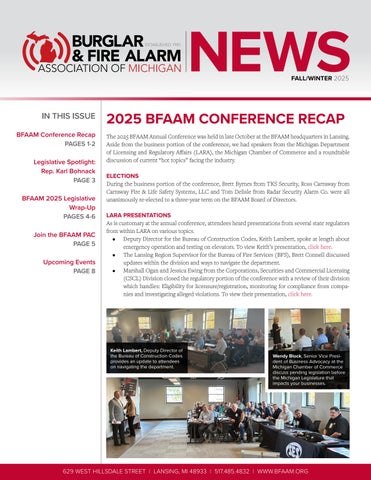
The 2025 BFAAM Annual Conference was held in late October at the BFAAM headquarters in Lansing. Aside from the business portion of the conference, we had speakers from the Michigan Department of Licensing and Regulatory Affairs (LARA), the Michigan Chamber of Commerce and a roundtable discussion of current “hot topics” facing the industry.
During the business portion of the conference, Brett Byrnes from TKS Security, Ross Carraway from Carraway Fire & Life Safety Systems, LLC and Tom Delisle from Radar Security Alarm Co. were all unanimously re-elected to a three-year term on the BFAAM Board of Directors.
As is customary at the annual conference, attendees heard presentations from several state regulators from within LARA on various topics.
• Deputy Director for the Bureau of Construction Codes, Keith Lambert, spoke at length about emergency operation and testing on elevators. To view Keith’s presentation, click here.
• The Lansing Region Supervisor for the Bureau of Fire Services (BFS), Brett Connell discussed updates within the division and ways to navigate the department.
• Marshall Ogan and Jessica Ewing from the Corporations, Securities and Commercial Licensing (CSCL) Division closed the regulatory portion of the conference with a review of their division which handles: Eligibility for licensure/registration, monitoring for compliance from companies and investigating alleged violations. To view their presentation, click here.


The Senior Vice-President of Business Advocacy for the Michigan Chamber of Commerce, Wendy Block, was on-hand to review with attendees on the legislation and potential ballot initiatives that the chamber is following the rest of 2025 and into 2026.
Amongst the most pressing topics discussed was the “ABC” test for independent contractors (see legislative update for more de-


tails), the “Open and Obvious” Doctrine following the Michigan Supreme Court decision in 2023 and potential statewide ballot initiatives in the 2026 election.
The Michigan Chamber of Commerce will be following efforts by various advocacy groups to raise the minimum wage, make changes to the Earned Sick Time Act and create a graduated income tax in Michigan.


Rep. Karl Bohnak was first elected to the state House of Representatives in November 2024. He serves the 109th House District, which includes the counties of Alger, Baraga, Marquette, and portions of Dickinson including the townships of Breen, Felch, Norway, Waucedah, and West Branch as well as the cities of Ishpeming, Marquette, Munising, Negaunee, and Norway.
Bohnak serves as vice chair of the House Committee on Economic Competitiveness. He also serves as a member of the Natural Resources and Tourism, Health Policy, and Transportation and Infrastructure committees.
A love of snow drew Bohnak north to the Upper Peninsula nearly 40 years ago where he became chief meteorologist at WLUCTV6 in Marquette. He’s been there ever since. Weather has been Bohnak’s passion since his youth, to this day he is captivated by learning about and informing people of interesting, extreme weather.
But Bohnak is more than just a meteorologist. He is also an author and historian. His award-winning book, “So Cold a Sky” was released in 2006. His next effort, “Michigan’s Upper Peninsula Almanac” was co-written with Ron Jolly. His latest book, “Sunburns to Snowstorms, Upper Michigan Weather in Pictures and Stories” is a collaboration with photo historian Jack Deo.
Bohnak and his wife, Liz, live in Deerton with their beloved cat Gracie. He has two sons and a twin sister who live in the Milwaukee area. He also has three grandchildren.
Bohnak is a past co-chair and former member of the United Way of Marquette County. He is still broadcasting daily radio weather updates in Newberry and Sault Ste. Marie.
WHAT’S YOUR NUMBER ONE LEGISLATIVE PRIORITY?
My #1 legislative priority is securing reliable, affordable energy to power the Upper Peninsula electric grid. My predecessor was the deciding vote on, I believe, a terrible piece of legislation, the Clean and Renewable Energy act of 2023. It mandates that Michigan produce carbon dioxide-free energy by 2040. It would mean shutting down the RICE units (the reciprocating internal combustion engines) powered by natural gas. They were just put online in 2019 at a tremendous cost. We are on the hook to pay off these units until 2049.
WHAT’S THE BEST PART OF YOUR JOB?
The best part of my job is working with the talented committed people on my team. Our priority is “Peninsula over Politics.”. It’s all about what benefits the U.P. and its people.
WHAT’S THE BIGGEST HIDDEN GEM IN YOUR DISTRICT?
The hidden gem in my district are the people. They go to work, they play, they hunt and just like me, they love this land and its rich history.
WHO’S YOUR MODERN DAY HERO?
My modern day hero has to be the late Charlie Kirk. He was willing to engage in respectful dialog with anyone. That is something that is sorely missing in today’s divisive environment.

BY JASON WADAGA BFAAM EXECUTIVE DIRECTOR
The 2024 election brought a change in leadership in the Michigan House of Representatives with the Republicans taking back control from the Democrats with a 58-52 split. The Senate was not up for re-election in 2024 so that chamber remained in control by Democrats which led to a much more divisive legislature to begin 2025. While only roughly 30 bills have been signed into law this year-to-date, several big pieces of legislation were signed into law including a minimum wage increase, an Earned Sick Time Act (ESTA), a long-term road funding plan and the constitutionally obligated state budget.
In 2018, ballot initiatives were started in Michigan to increase the minimum wage and created mandatory paid sick time for all employees in Michigan. The legislature at the time feared that if these initiatives were put before Michigan voters they would be approved so the legislature and Governor at the time “adopted and amended” the proposals. Essentially, they signed the proposals into law then changed them to make the legislation what they viewed as more business friendly.
Following years on legal jockeying, the Michigan Supreme Court ruled that adopting and amending laws within the same legislative session is unconstitutional and ordered the legislature that the original ballot initiatives would become law on February 21, 2025 unless changed by the legislature prior to that date.
The House and Senate came together and passed legislation on that date to make key changes to the new minimum wage law and Earned Sick Time Act (ESTA).
The chart to the right is the new schedule for the minimum wage law in Michigan moving forward.
Like the minimum wage law, the legislature compromised and made changes to the looming Earned Sick Time Act (ESTA) on February 21st that included:
• Allowing employers to frontload an employee’s paid time off, giving small businesses of 10 employees or fewer until Oct. 1 to create a system to track the one hour of paid leave per every 30 hours worked.
• Requiring small businesses of 10 employees or fewer to provide 40 hours of sick time a year, as opposed to 72 hours for employers of 11 employees or more.
• Giving small startup businesses three years to comply with the paid sick time accrual tracking requirement.
• Allowing employers to spell out call-in sick procedures in policy to prevent an employee from no-showing for work three days straight without repercussions.
• Excludes overtime, tips and bonuses from the rate employers need to pay their employees who are taking sick days.
• Exempts interns and startup companies from the earned sick leave policy, but that’s about it.
• Allows part-timers to get sick time that is proportional to the hours they work and at the rate full-time employees get sick time.
• The paid sick leave can carry over year after year, but can’t exceed 72 hours for businesses and 40 hours for small businesses.
• Allows for a mechanism in which sick leave is banked with vacation time if companies offer that option.
• Allows an employer to take personnel action against an employee who uses earned sick time if they are not actually sick.
Following decades of attempting to come up with a long-term road funding plan, the Michigan Legislature adopted a proposal

that’s estimated to dedicate over $1 billion annually to road infrastructure. The long-term road funding plan was made up of a compromise over both new revenue and spending cuts. Included in the plan was:
• A new 24 percent wholesale tax on marijuana that is estimated to raise roughly $420 million annually
• “Decoupling” the corporate tax breaks from the “Big, Beautiful, Bill” raising over $500 million annually
• Increasing the gas tax from 31 cents per gallon to 51 cents per gallon while eliminating the sales tax on gasoline which is predicted to be nearly revenue neutral
• Creating a Neighborhood Roads Fund that would focus part of the road funding package to local municipalities for upgrades
• Cut $690 million from the Department of Labor and Economic Opportunity (DLEG)
After a contentious nine plus months negotiation over the state budget, lawmakers were able to pass an $81 billion 2025-26 Fiscal Year budget in the early morning hours on November 3rd. While a “framework” for a deal was announced the week prior, it took roughly a week for the details to get hammered out which forced the legislature to pass a “continuing budget” from Fiscal Year 2024-25 to avoid a state government shutdown until the budget could be finalized.
After decades of trying to pass a long-term road funding plan in Michigan, the legislature was able to dedicate $1.85 billion annu-
BFAAM is constantly fighting for our industry, for our livelihoods, and for you! BFAAM cannot do this without your support. Your membership into the BFAAM PAC is more important now than ever. Become a PAC member today! Visit www.bfaam.org/pac to donate online! Large or small, we appreciate any effort you make to help our alarm industry.
Donate
ally to road funding and infrastructure. Other budget highlights included the elimination of the Strategic Outreach and Attraction Reserve (SOAR) funding, an increase to K-12 funding, eliminating 1,800 unfilled state employee positions and expanding prescription drug cash payments for pregnant mothers and newborns.
Aside from a long-term road funding plan, much of the discussion around this year’s budget centered around a more transparent budget process and less “enhancement grants” or one-time funding projects.
The House of Representatives required all one-time funding proposals from their members to identify the sponsor of the project, the public need for the project, the cost of the project and additional details that were posted to their website for the public to view. The Michigan Senate later followed suit and both chambers passed legislation requiring a process for proper disclosure and monitoring of earmark projects.
Following several embarrassing news stories on how earmarks in previous budgets were being spent and administered, one-time funding projects were reduced from $1.3 billion in the Fiscal Year 2024-25 budget to $168 million in the Fiscal Year 2025-26 budget.
Both chambers of the Michigan Legislature were able to secure key priorities in the budget that they outlined early on in the process.

Aside from making the process more transparent, the House of Representatives was able to eliminate 1,800 unfilled state employee positions and the Speaker of the House, Matt Hall said he will make it a caucus priority to focus on eliminating additional “Ghost Positions” within state government. The House was also able to get language in the budget to require that state departments prioritize in-office work as opposed to work from home policies that have been adopted.
On the Senate side, Senate Majority Leader Winnie Brinks was able to secure $250 million for “RX Kids” which is a program that was launched to provide a $1,500 cash payment to pregnant women and $500 monthly for the first 12 months of the infants’ life.
As we close in on the end of 2025, BFAAM will be focusing on key policy initiatives in 2026 and following potential new ballot initiatives to be put in front of the Michigan voters in the 2026 election. Next year will also be an important election year as many key seats are open in Michigan due to term limits and retirements.
Legislation has once again been introduced this year to create a three-part “ABC” test for subcontractors in construction to determine if the contractor is independent or a full-time employee. Senate Bills 6 and 7 will:
• Prescribe how to determine whether an individual was an independent contractor, basing the determination on Federal classifications of workers and Federal guidelines for determining economic dependence.
• Prohibit a person from classifying an employee as an independent contractor and prescribe penalties for a violation of this provision.
• Prohibit an employer from withholding wage information from an employee requesting information about similarly situated employees and prescribe penalties for a violation of this provision.
• Prescribe penalties for an employer that did not pay an employee owed wages or fringe benefits with intent to defraud that employee, depending on the amount of unpaid wages and benefits.
• Allow an employee to file a written complaint with the Department of Labor and Economic Opportunity (LEO) for perceived retaliation or discrimination under the Act and require LEO to conceal the employee’s identity if possible.
• Allow the Attorney General to initiate a civil action to enforce a LEO order.
• Require an employer to provide an employee with a written explanation of a court-ordered garnishment deduction at
least one pay period or 10 business days, whichever was greater, before the wage payment affected by the deduction was made.
• Create the Wages and Fringe Benefits Fund within the Department of Treasury.
• Transfer enforcement of the Act from the Department of Licensing and Regulatory Affairs (LARA) to LEO
This legislation has passed the Senate Labor Committee and awaits a vote before the full Senate.
The 2026 election will likely feature several ballot initiatives decided by Michigan voters. The signature threshold to get an initiative on the ballot is high and expensive, but several groups have started to collect signatures in the hopes of putting their measure before the voters next year.
Included in that are proposals to create a graduated income tax (as opposed to Michigan’s current flat 4.5% income tax), eliminating property taxes in Michigan and reverting back to the previously discussed minimum wage amounts from the 2018 ballot drive. With that, there are also rumors that a similar initiative will start to revert back to the original ESTA ballot drive.
Next year’s election will be a historic one here in Michigan. With Governor Gretchen Whitmer being term-limited and the announced retirement of U.S. Senator Gary Peters, it will be the first time EVER since the direct election of U.S. Senators started in 1916, that Michigan has both an open U.S. Senate seat and an open Gubernatorial seat in the same election.
On top of that, Secretary of State, Jocelyn Benson (who is running for governor) and Attorney General, Dana Nessel are term-limited. Also, the entire Michigan Senate and Michigan House of Representatives are up for re-election in 2026.
The Senate Democrats currently hold a 20-19 majority in the Michigan Senate with a pending special election to fill the open 35th Senate District in May of 2026. Meanwhile, the House Republicans hold a 58-52 majority in the House of Representatives.
Considering that Michigan is traditionally a “toss-up” state that will go back-and-forth between both parties, there will be a boatload of money spent on political races in 2026 from both in-state groups and out-of-state groups. If you are not a fan of political ads, keep your television remote close starting in the spring of 2026.


“We
629 W. Hillsdale St. | Lansing, MI 48933
517.485.4832 | www.bfaam.org
BOARD OF DIRECTORS
PRESIDENT
John Romano
VICE PRESIDENT
Roy Rogers
TREASURER
Daniel Decker, CFPS, CPP, SET
SECRETARY
Brett Byrnes
DIRECTORS
Ross Caraway
Tom Delisle
Robert Hakim
Alan Joseph
Jason McDonald
Jake Wynsma
VENDOR LIAISON
Jennifer Martineau
SUPPLIER LIAISON
Dean Belisle
STAFF
EXECUTIVE DIRECTOR
Jason Wadaga
DEPUTY EXECUTIVE DIRECTOR
Derek Dalling
EVENT DIRECTOR
Lauren Concannon
FINANCIAL & PAC ADMINISTRATOR
Miranda Strunk
MEMBER SERVICES DIRECTOR
Trina Miller
CREATIVE & COMMUNICATIONS DIRECTOR
Melissa Travis
ADMINISTRATIVE & COMMUNICATIONS
ASSISTANT
Brooklyn Heath

BOARD OF DIRECTORS MEETING
February 4, 2026
Virtual
BOARD OF DIRECTORS MEETING
April 8, 2026
Virtual
BOARD OF DIRECTORS MEETING
June 10, 2026
Lansing
BOARD OF DIRECTORS MEETING
September 9, 2026
Virtual
BFAAM ANNUAL CONFERENCE
October 23, 2026
TBD
BOARD OF DIRECTORS MEETING
October 23, 2026
TBD
BOARD OF DIRECTORS MEETING
December 2, 2026
Virtual