Advertising Sales 729 Seventh Avenue, 4th Floor New York, New York 10019 (212) 557-5757
Chairman: Philip S. Birsh
Editor in Chief Emeritus: Joan Alleman
Secretary/Treasurer: Shamindra Jagnanan
From the President and CEO
Dear Friends:
Happy New Year! We’re kicking off 2025 at full speed—apparently we made a resolution to fit an entire season’s worth of excitement into one month. First up: our free Three Kings Day celebration in Commonwealth Plaza, created in partnership with the Mexican Cultural Center. It’s family-friendly, joy-friendly, and a great excuse to experience a beautiful tradition with your neighbors. Then cellist Yo-Yo Ma joins The Philadelphia Orchestra. We’re expecting nothing less than an inspirational experience. We also present the Orchestra’s annual free Tribute Concert honoring the legacy of Dr. Martin Luther King, Jr.—always one of the most meaningful performances. And as if that were not enough, we’re proud to bring Philadelphia the premiere of the Tony Award®–winning musical Suffs—a powerful, witty, and timely story of the women who helped reshape America, and a reminder that the work for equality is ongoing.
We’re also excited to welcome the Year of the Horse with our Lunar New Year Concert led by Assistant Conductor Naomi Woo. This celebration holds deep meaning for us: Our relationship with the people of China dates back 52 years, when The Philadelphia Orchestra became the first American ensemble to visit the country. Since then, we’ve returned many times, including just this past November, when 10 of our musicians spent two weeks in residency, continuing our long tradition of people-to-people exchange through music.
This year’s Lunar New Year Concert features two remarkable soloists from Beijing’s Central Conservatory of Music—pipa player Zhang Hongyan and erhu player Yu Hongmei. The following night, the celebration continues as we welcome the Central Conservatory of Music Chinese Orchestra for a free Spring Festival performance in Perelman Theater. Founded over 60 years ago, the ensemble has become a powerhouse in preserving and pioneering Chinese traditional music— sharing its energy, elegance, and contemporary flair around the world. The Orchestra’s commitment to showcasing Chinese culture also extends into subscription concerts this month when Elim Chan returns to lead pipa superstar Wu Man in Du Yun’s Ears of the Book, a work co-commissioned by Yannick and the Orchestra.
Later this month we’ll be announcing the Orchestra’s 2026–27 season. We are incredibly excited about what’s ahead. Together with our artistic planning team, Yannick has shaped a season that brings out the Orchestra’s full brilliance and imagination. We continue our journey through Mahler’s symphonies, shine a brighter light on under-represented composers, and celebrate beloved masterpieces like Beethoven’s Ninth Symphony, Orff’s Carmina burana, and Rachmaninoff’s Piano Concerto No. 3. Stay tuned for more details!
Best regards,
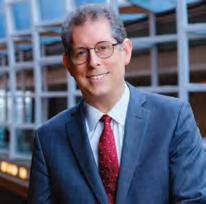
Ryan Fleur President and CEO
Jeff Fusco
The Philadelphia Orchestra
2025–2026 Season
Yannick Nézet-Séguin
Music and Artistic
Director
Walter and Leonore
Annenberg Chair
Marin Alsop
Principal Guest Conductor
Ralph and Beth Johnston
Muller Chair
Joe Hisaishi
Composer-in-Residence
Naomi Woo Assistant Conductor
Joseph Conyers
Education and Community Ambassador
Mark and Tobey Dichter Chair
Charlotte Blake Alston
Storyteller, Narrator, and Host
Osagie and Losenge
Imasogie Chair
First Violins
David Kim, Concertmaster
James and Agnes Kim Foundation Chair
Juliette Kang, First Associate Concertmaster
Joseph and Marie Field Chair
Christine Lim, Associate Concertmaster
Marc Rovetti, Assistant Concertmaster
Dr. James F. Dougherty Chair
Barbara Govatos
Robert E. Mortensen Chair
Jonathan Beiler
Hirono Oka
Richard Amoroso
Robert and Lynne Pollack Chair
Yayoi Numazawa
Jason DePue
Larry A. Grika Chair
Jennifer Haas
Miyo Curnow
Elina Kalendarova
Daniel Han
Julia Li
William Polk
Mei Ching Huang
Second Violins
Kimberly Fisher, Principal
Peter A. Benoliel Chair
Paul Roby, Associate Principal
Sandra and David
Marshall Chair
Dara Morales, Assistant Principal
Anne M. Buxton Chair
Philip Kates
Peter A. Benoliel Chair
Davyd Booth
Paul Arnold
Joseph Brodo Chair, given by Peter A.Benoliel
Amy Oshiro-Morales
Volunteer Committees Chair
Yu-Ting Chen
Jeoung-Yin Kim
Willa Finck
John Bian
MuChen Hsieh
Eliot Heaton
Violas
Choong-Jin Chang, Principal
Ruth and A. Morris Williams, Jr., Chair
Kirsten Johnson, Associate Principal
Kerri Ryan, Assistant Principal
Burchard Tang
Renard Edwards
Anna Marie Ahn
Petersen*
Piasecki Family Chair
David Nicastro
Che-Hung Chen
Rachel Ku
Marvin Moon
Meng Wang
Hsiang-Hsin Ching
Cellos
Hai-Ye Ni, Principal
Priscilla Lee, Associate Principal
Yumi Kendall, Assistant Principal
Elaine Woo Camarda and A. Morris Williams, Jr., Chair
Richard Harlow
Kathryn Picht Read
John Koen
Derek Barnes
Alex Veltman
Jiayin He
Michael Katz
Eugene Lin
Basses
Joseph Conyers, Principal
Carole and Emilio
Gravagno Chair
Gabriel Polinsky, Associate Principal
Tobias Vigneau, Assistant Principal
David Fay
Duane Rosengard
Nathaniel West
Michael Franz
Christian Gray
Some members of the string sections voluntarily rotate seating on a periodic basis.
Flutes
Jeffrey Khaner, Principal
Paul and Barbara Henkels Chair
Patrick Williams, Associate Principal
Rachelle and Ronald Kaiserman Chair
Olivia Staton
Erica Peel, Piccolo
Oboes
Philippe Tondre, Principal
Samuel S. Fels Chair
Peter Smith, Associate Principal
Jonathan Blumenfeld
Edwin Tuttle Chair
Elizabeth Starr
Masoudnia, English Horn
Joanne T. Greenspun Chair
Clarinets
Ricardo Morales, Principal
Leslie Miller and Richard Worley Chair
Samuel Caviezel, Associate Principal
Sarah and Frank Coulson Chair
Socrates Villegas
Paul R. Demers, Bass Clarinet
Peter M. Joseph and Susan Rittenhouse Joseph Chair
Bassoons
Daniel Matsukawa, Principal
Richard M. Klein Chair
Mark Gigliotti, Co-Principal
Angela Anderson Smith
Holly Blake, Contrabassoon
Horns
Jennifer Montone, Principal
Gray Charitable Trust Chair
Jeffrey Lang, Associate Principal
Hannah L. and J. Welles
Henderson Chair
Victoria Knudtson, Assistant Principal
Christopher Dwyer
Chelsea McFarland
Ernesto Tovar Torres
Trumpets (position vacant) Principal
Marguerite and Gerry Lenfest Chair
Anthony Prisk
Sam Huss
Trombones
Nitzan Haroz, Principal
Neubauer Family Foundation Chair
Matthew Vaughn, Co-Principal
Jack Grimm
Blair Bollinger, Bass
Trombone
Drs. Bong and Mi Wha
Lee Chair
Tuba
Carol Jantsch, Principal
Lyn and George M. Ross Chair
Timpani
Don S. Liuzzi, Principal
Don S. Liuzzi Chair, given by Linda and David Glickstein
Angela Zator Nelson, Associate Principal
Percussion
Christopher Deviney, Principal
Charlie Rosmarin, Associate Principal
Angela Zator Nelson
Keyboards
Davyd Booth
Harp
Elizabeth Hainen, Principal
Librarians
Nicole Jordan, Principal
Holly Matthews
Stage Personnel
Dennis Moore, Jr., Manager
Francis “Chip” O’Shea III
Aaron Wilson
*On leave
Music and Artistic Director
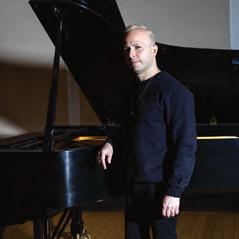
Canadian-born conductor and pianist Yannick Nézet-Séguin is currently in his 14th season with The Philadelphia Orchestra, serving as music and artistic director. An inspired leader, Yannick is both an evolutionary and a revolutionary, developing the mighty “Philadelphia Sound” in new ways. His collaborative style, deeply rooted musical curiosity, and boundless enthusiasm have been heralded by critics and audiences alike. The Philadelphia Inquirer has said that under his baton the Orchestra is “at the top of its considerable form”; the Associated Press has called it “a premier orchestra at its peak”; and the New York Times wrote, “the ensemble, famous for its glowing strings and homogenous richness, has never sounded better.”
Yannick has established himself as a musical leader of the highest caliber and one of the most thrilling and sought-after talents of his generation. He became the third music director of New York’s Metropolitan Opera in 2018. In addition, he has been artistic director and principal conductor of Montreal’s Orchestre Métropolitain since 2000. In 2017 he became the third-ever honorary member of the Chamber Orchestra of Europe. He served as music director of the Rotterdam Philharmonic from 2008 to 2018 (he is now honorary conductor) and was principal guest conductor of the London Philharmonic from 2008 to 2014. He has made wildly successful appearances with the world’s most revered ensembles and at many of the leading opera houses.
Yannick has shown a deep commitment to expanding the repertoire by embracing an evergrowing and diverse group of today’s composers and by performing and recording the music of underappreciated composers of the past, including Florence Price, Clara Schumann, William Dawson, Lili Boulanger, Louise Farrenc, and William Grant Still. In 2018 he signed an exclusive recording contract with Deutsche Grammophon. Under his leadership The Philadelphia Orchestra returned to recording with 15 releases on that label, including Florence Price Symphonies Nos. 1 & 3, which won a GRAMMY® Award for Best Orchestral Performance in 2022.
A native of Montreal, Yannick studied piano, conducting, composition, and chamber music at Montreal’s Conservatory of Music and continued his studies with renowned conductors, most notably Carlo Maria Giulini; he also studied choral conducting with Joseph Flummerfelt at Westminster Choir College. Among Yannick’s honors are an appointment as Companion of the Order of Canada; Companion to the Order of Arts and Letters of Quebec; an Officer of the Order of Quebec; an Officer of the Order of Montreal; an Officier de l’Ordre des Arts et des Lettres; Musical America’s 2016 Artist of the Year; ECHO KLASSIK’s 2014 Conductor of the Year; a Royal Philharmonic Society Award; Canada’s National Arts Centre Award; the Prix Denise-Pelletier; the Oskar Morawetz Award; and honorary doctorates from the University of Quebec, the Curtis Institute of Music, Westminster Choir College of Rider University, McGill University, the University of Montreal, the University of Pennsylvania, Laval University, and Drexel University.
To read Yannick’s full bio, please visit philorch.org/conductor.
Marian Anderson Hall
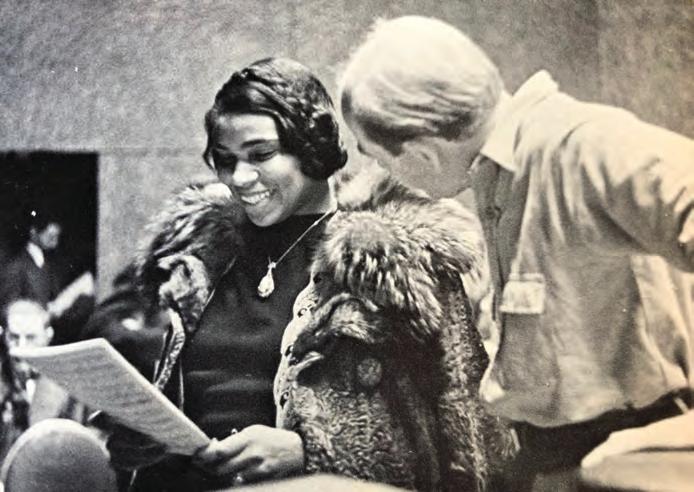
On June 8, 2024, Verizon Hall at the Kimmel Center for the Performing Arts was officially rededicated as Marian Anderson Hall in honor of the legendary Black contralto, civil rights icon, and Philadelphian. The first major concert venue in the world to honor Marian Anderson—85 years after she was barred from performing at Constitution Hall in Washington, D.C., because of her race—the hall is a permanent monument to its namesake’s artistry and achievements, a reflection of the inclusive future she helped to engender, and an active testament to the intersection of music, art, and positive social impact. We look forward to honoring Marian Anderson in perpetuity with a venue that reflects the ideals by which she lived her life: equity, justice, freedom, and the belief that the arts are for everyone.
Marian Anderson Hall was named in her honor by a visionary $25-million philanthropic gift from Richard Worley and Leslie Miller. Worley has been a member of The Philadelphia Orchestra’s Board of Trustees since 1997 and served as board chair from 2009 to 2019. Miller is a former Kimmel Center trustee and previous acting president of the Kimmel Center. They are among the largest donors in Philadelphia Orchestra history. Additional generous support for Marian Anderson Hall was given by Sidney and Caroline Kimmel.
Marian Anderson with Music Director Eugene Ormandy during a Philadelphia Orchestra rehearsal at the Academy of Music in December 1938
Adrian Siegel Collection/Philadelphia Orchestra Archives
Witness to History: Nancy Shear
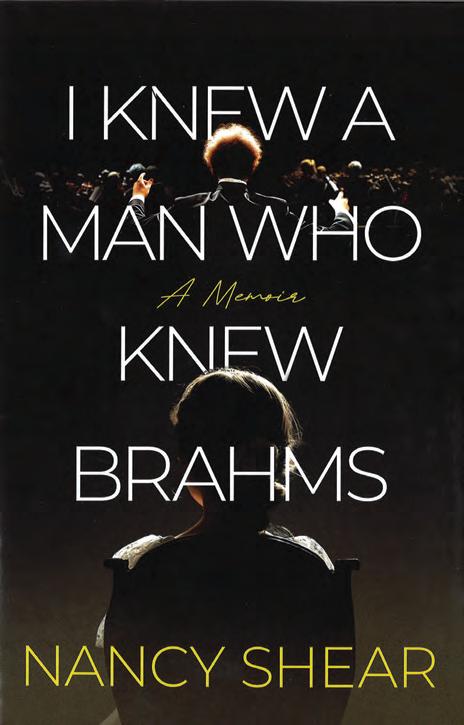
Part of a season-long series of oral histories. This month, read an excerpt from Nancy Shear’s memoir, I Knew a Man Who Knew Brahms.
On July 21, 1960, Leopold Stokowski was to conduct members of the Philadelphia Orchestra at the Robin Hood Dell, an outdoor amphitheater where they performed for eight weeks after the regular Academy of Music season. Stokowski, who brought the Philadelphia Orchestra to global prominence years earlier, had been away from the city for almost two decades. This would be his first appearance at the Dell in twenty-seven years, and although I was only fourteen, I was desperate to hear him conduct.
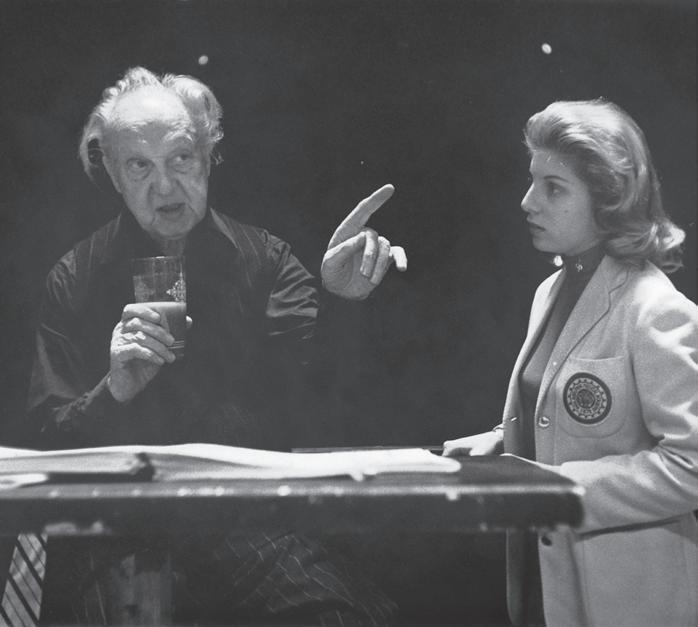
That concert became a landmark in my memory. Five summers later, backstage in his dressing room at the Dell, Stokowski would ask me to work with him as his personal orchestra librarian and musical assistant. It would be the beginning of a close, complex relationship that would bring me not only into his home but into his musical mind.
I was too young to travel alone in 1960. My mother probably wasn’t well, because my older neighbor, Eileen, went with me. Luckily, the tickets were free, available by clipping coupons from local papers.
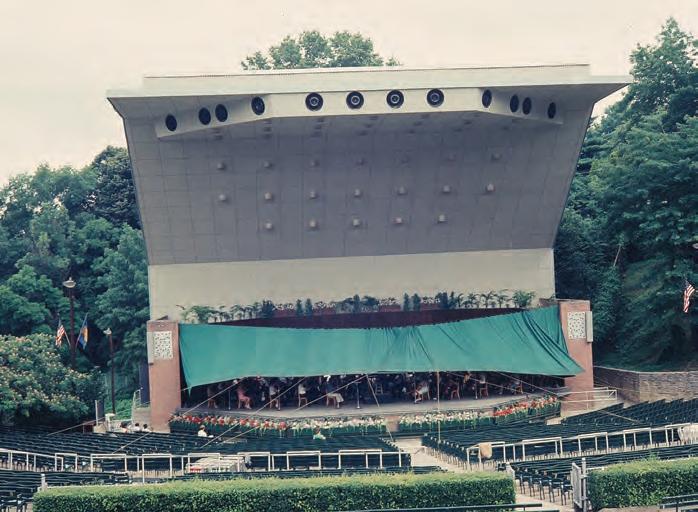
Eileen and I arrived early—more than an hour before concert time—but long lines had already formed at the entrance. Inside, green wooden seats lined the vast bowl-shaped venue. The extensive concrete paving was softened by a grove of trees to the left of the seats and an expansive grassy embankment to their right. A huge angular shell leaned protectively over the stage.
That July evening, more than thirty thousand music lovers filled the seats and covered the immense sloping lawn. Some people even climbed into the trees. Two thousand more stood outside the facility, listening through loudspeakers. Eileen and I were lucky to have gotten in.
At the Dell, even though we were sitting almost a block away from the stage, I caught sight of Stokowski just before the concert began. He was dressed in white tie and tails as he stood at the open backstage doorway. More than half a century later, I can still feel the thrill of seeing him in person for the first time.
Seconds later, to wild cheers and applause, the Maestro made his way onstage. Mounting the podium, he bowed several times in different directions, then—in one quick motion—pivoted to face the orchestra and launched a vibrant performance of Berlioz’s Roman Carnival Overture. Ravel’s Alborada del Gracioso followed, castanets clicking away, all color and seduction. Then came Debussy’s “Nuages” and “Fêtes” (“Clouds” and “Festivals”), two of the three sections of the Nocturnes
Adrian Siegel Collection/Philadelphia Orchestra Archives
Former Philadelphia Orchestra Music Director Leopold Stokowski with Nancy Shear at the Academy of Music in the 1960s
Atmospheric and mysterious—mostly soft winds and muted strings—“Nuages” gave way to the brisk and spirited “Fêtes,” with its swirling winds and scurrying strings. A few moments after “Fêtes” began, a train, chugging far off in the distance, tooted a rude counterpoint to the music and the performance abruptly stopped. People looked at each other questioningly, then at the stage. Facing the orchestra, Stokowski stood motionless, his hands at his sides. He held the pose for four interminable minutes. Then, once silence was restored, his hands moved, the music resumed, and the audience visibly relaxed. The peace, however, was short-lived. A loud diesel horn blew, the crowd laughed, and Stokowski flew offstage. Another four minutes elapsed before he returned. But back on the podium, before he resumed conducting, he turned to face the audience. “We must be patient with modern civilization,” he commented, and the crowd cheered.
During the second half of the concert, which included a powerful performance of Shostakovich’s Symphony No. 1, he stopped the music two more times for train noise but didn’t leave the podium. The shouting, footstamping crowd brought him back for ten curtain calls.
“I hear you asking for an encore,” he teased the audience. “We would be delighted to do it, but do not wish to disturb the Pennsylvania Railroad!” Everyone laughed but no one left. “If you will protect me,” he said into the microphone, “and you are sure we will not offend the Pennsylvania Railroad, we will play a little something.” (Back at the Dell a year later, he apologized to the Pennsylvania Railroad; it had been the Reading Company railroad.) He repeated the last movement of Amirov’s “Azerbaijan: Symphonic Suite,” which had already been performed in its entirety.
Visually, the Academy of Music’s backstage was intriguing: expansive raw brick walls; massive rope pulleys holding opera scenery, props and lighting fixtures; handcarts and dollies to move equipment. Enormous wooden double bass cases lay strewn about the floor like coffins, and cello cases, standing upright, looked like human silhouettes in the dim lighting mounted high above the dark-red velvet curtains. Battered black trunks served as moveable closets, their doors ajar to reveal concert dresses, dark suits, and sets of tails draped on
The Philadelphia Orchestra’s first commercial recording, Brahms’s Hungarian Dance No. 5
Courtesy of Nancy Shear
The Robin Hood Dell in the 1960s, showing the green curtain that shielded the musicians from the sun during rehearsals
wooden hangers. Larger trunks fitted with shelving stood ready to receive and transport the music folders for one hundred-plus players.
The entire backstage area smelled of music: the scent of bow rosin, the perfume of valve oil, and the aroma of freshly pressed concert clothing mingled with the mustiness of decades of dust. That smell was like a drug. As it filled my lungs, I was infused with a sense of well-being. …
I loved to walk across the abandoned, darkened stage after rehearsals, peering first through the crack of the door to be certain no one was there. Empty chairs and music stands fanned out from the podium, and the ghost light—a single bare bulb screwed into the top of a wrought-iron stand at the edge of the stage—threw elongated shadows high against the walls. The silence had a tone of its own, a kind of prelude to the music that would soon replace it.
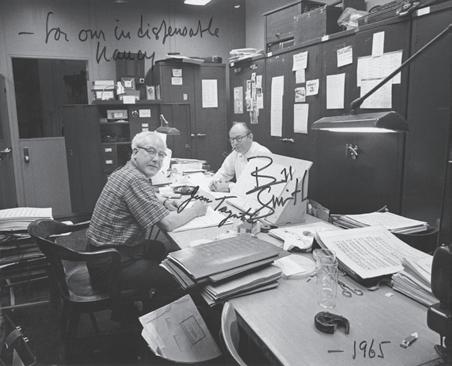
In 1963, when I was almost seventeen, Mr. Barnes [Orchestra stage personnel manager] finally gave up the battle. I was allowed to go where I wished backstage. Just off stage right, a few concrete steps led to a utilitarian-looking metal door and on one of my explorations, I opened it. Two men sat at a long, worn, pale-green linoleum table. A fluorescent lamp with a piece of paper taped to its side illuminated the end of the table nearest the door, where the assistant conductor of the orchestra, William Smith, sat puffing on his pipe. Jesse Taynton, the orchestra’s good-natured, white-haired librarian, sat to Mr. Smith’s left, a cigarette burning itself out in the ashtray in front of him. He was penciling strange-looking marks, like hieroglyphics, onto sheets of music. I always said hello to these two backstage, but they were obviously hard at work now. Wordlessly, I began to close the door. “You may come in,” Mr. Taynton said, and I pushed the door back open.
“This is the library, where we prepare the music,” he explained. I was confused. Composers wrote the notes. I knew that from playing the cello in the school orchestra. Why would anything have to be added to what the composers had written? I was also shocked. The music was sacred, like the Bible, and not to be tampered
Adrian Siegel
Collection/Philadelphia Orchestra Archives
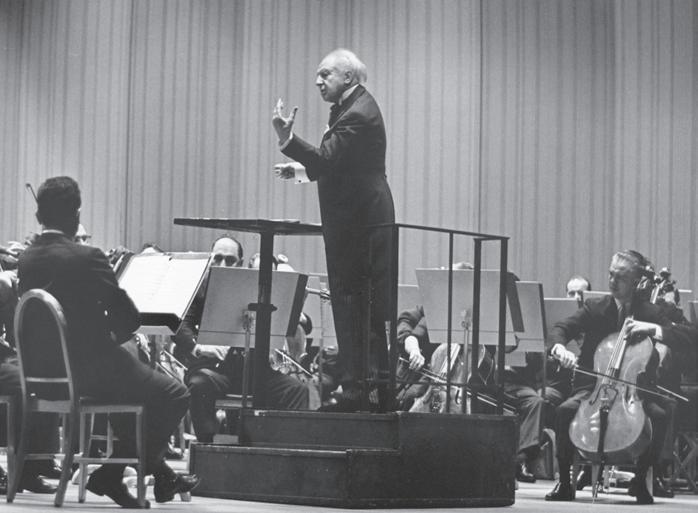
Leopold Stokowski conducting The Philadelphia Orchestra at the Academy of Music in the 1960s
with. “Pull up a chair,” he invited, “and I’ll show you what I’m doing.” Bill Smith smiled at me, his pipe clenched between his teeth.
Mr. Taynton explained that the printed music couldn’t convey everything needed for a performance. It instructed the musicians on what notes to play and basically how loud or soft, long or short, fast or slow, to play them. But the conductor, through gestures and sometimes verbal directions at rehearsals, would communicate specific tempos, volume (called “dynamics”), phrasing, and the subtleties of expression that make each conductor’s interpretation uniquely his own. To further convey his wishes, a conductor would give the librarian directives to mark into the parts.
The most heavily marked parts, Mr. Taynton explained, were those for the string players. They had to deal with bowings—markings that indicated the directions in which the bows should move, up or down, which varies the quality of sound. The conductor, the concertmaster, or the principal player of each string section determined the bowings. (Ormandy, a former violinist, did the bowings for many of his concerts.) The librarian then had to transfer those directions—hundreds or thousands of them—into every string part. There were also indications of how phrases should be shaped; if certain notes should be played aggressively or subtly, given relatively more or less emphasis; and a myriad of other interpretive details. A conductor might also decide if certain notes should be omitted. The markings, Mr. Taynton continued, must reflect the style of playing that a conductor will ask for through gesture.
The markings for a conductor who wants a lean, classical approach differ substantially from those of someone who wants an emotional, romantic interpretation. Markings, therefore, would have to be changed from conductor to conductor. Fascinated, I listened as Mr. Taynton talked. Pipe smoke curled in the air and the sound of the Philadelphia Orchestra flooded the room from a wall speaker mounted above a metal cabinet. I returned to the library the next afternoon, and started going there a few days a week, not just on Fridays.
The Philadelphia Orchestra’s first commercial recording, Brahms’s Hungarian Dance No. 5
Excerpts from I Knew a Man Who Knew Brahms by Nancy Shear are reprinted with permission from Regalo Press.
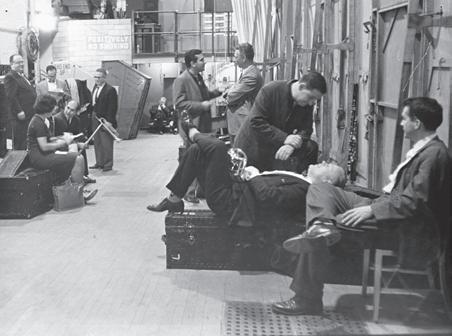
Backstage at the Academy of Music during a rehearsal break
Librarian Jesse Taynton and Assistant Conductor William Smith in the Orchestra library at the Academy of Music in 1965
Adrian Siegel Collection/Philadelphia Orchestra
Adrian Siegel Collection/Philadelphia Orchestra Archives, courtesy of Nancy Shear
Musicians Behind the Scenes
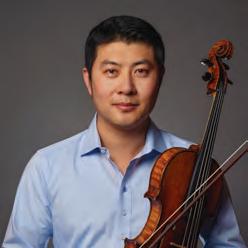
Meng Wang Viola
Where were you born? I was born in Shenyang, China. What piece of music could you play over and over again? Johann Sebastian Bach’s cello suites and Chaconne for solo violin. The more I play them, the more they teach me about time, structure, and humanity.
What is your most treasured possession? My viola. It’s been with me through so many chapters of my life, both on stage and off.
What’s your favorite food? Chinese food. I’m very mooddriven when it comes to food but I always gravitate toward simple, comforting dishes that feel like home.
Tell us about your instrument. My viola was made by Jean-Baptiste Vuillaume. I love the warm, noble sound it produces. I feel very lucky to play it.
What’s in your instrument case? I like to keep it simple and clean! Aside from the essentials, I have a picture of my family and a postcard from a childhood friend.
If you could ask one composer one question, what would it be? I would ask Johann Sebastian Bach if he could compose more works for the viola.
What piece of music never fails to move you? George Frideric Handel’s “Lascia la spina,” one of the most beautiful melodies from his famous oratorio The Triumph of Time and Disillusion [later recast as “Lascia ch’io pianga” from the opera Rinaldo]. The purity of the melody combined with melancholic pauses never fails to move me.
When did you join the Orchestra? In January 2017.
Do you play any other instruments? Like many violists, I started on the violin, which I still enjoy playing from time to time.
What’s your favorite Philadelphia restaurant? It depends on what I’m feeling at the moment! I enjoy a bowl of chicken pho at Pho Ga Thanh Thanh in the winter, a good breakfast egg and brie sandwich at Café Lutécia, or taking my kids to Pizzeria Vetri for a quick dinner.
What are you reading right now? I’ve been enjoying reading with my kids a lot. At the moment we are reading Charlotte’s Web I’m also reading a book recommended by a friend, Gödel, Escher, Bach: An Eternal Golden Braid by Douglas R. Hofstadter.
What do you like to do in your spare time? Whenever I can align our family’s schedule (which is very rare), I enjoy traveling and spending quality time with friends and family.
What is your favorite memory with the Orchestra? One of the most memorable concerts was playing Puccini’s La bohème with Yannick and singers from the Met Opera. It was so moving—the way the Orchestra and the voices intertwined was unforgettable.
What advice would you give to aspiring young musicians? Be patient with yourself. Stay curious, listen widely, and remember that your uniqueness is your greatest asset. not how fast or loud you can play, but how honestly you can speak through your instrument.
To read the full set of questions, please visit www.philorch.org/blog.
Jessica Griffin
2025–2026 | 126th Season
Marian Anderson Hall
The Philadelphia Orchestra
Saturday, January 31, at 8:00
Sunday, February 1, at 2:00
Yannick Nézet-Séguin Conductor
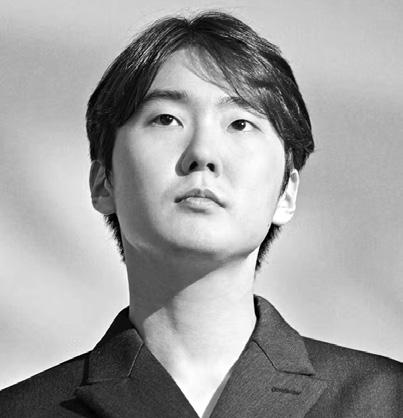
Seong-Jin Cho Piano
Ravel Mother Goose Suite
I. Pavane of Sleeping Beauty
II. Tom Thumb
III. Laideronnette, Empress of Pagodes
IV. The Conversations of Beauty and the Beast
V. The Fairy Garden
Shostakovich Piano Concerto No. 1 in C minor, Op. 35
I. Allegro moderato—Allegro vivace—Allegretto—Moderato—
II. Lento—Largo—
III. Moderato—
IV. Allegro con brio—Presto—Allegretto poco moderato— Allegro con brio—Presto
James Vaughen, solo trumpet
Intermission
Stravinsky The Rite of Spring
First Part: The Adoration of the Earth
Introduction—
The Auguries of Spring—Dances of the Young Girls— Ritual of Abduction— Spring Rounds—
Ritual of the Rival Tribes— Procession of the Sage—
The Sage—
Dance of the Earth
Second Part: The Sacrifice
Introduction—
Mystic Circles of the Young Girls—
Glorification of the Chosen One—
Evocation of the Ancestors—
Ritual Action of the Ancestors— Sacrificial Dance (The Chosen One)
This program runs approximately 1 hour, 50 minutes.
designates a work that was given its world or United States premiere by The Philadelphia Orchestra, part of the Orchestra’s 125th anniversary celebration.
Philadelphia Orchestra concerts are broadcast on WRTI 90.1 FM on Sunday afternoons at 1 PM and are repeated on Monday evenings at 7 PM on WRTI HD 2. Visit www.wrti.org to listen live or for more details.
The Philadelphia Orchestra
The world-renowned Philadelphia Orchestra strives to share the transformative power of music with the widest possible audience, and to create joy, connection, and excitement through music in the Philadelphia region, across the country, and around the world. Through innovative programming, robust education initiatives, a commitment to its diverse communities, and the embrace of digital outreach, the ensemble is creating an expansive and inclusive future for classical music. In June 2021 the Orchestra and its home, the Kimmel Center, united. Today, The Philadelphia Orchestra and Ensemble Arts brings the greatest performances and most impactful education and community programs to audiences in Philadelphia and beyond.
Yannick Nézet-Séguin is now in his 14th season with The Philadelphia Orchestra, serving as music and artistic director. His connection to the ensemble’s musicians has been praised by both concertgoers and critics, and he is esteemed by the musicians of the Orchestra, audiences, and the community. In addition to expanding the repertoire by embracing an ever-growing and diverse group of today’s composers, Yannick and the Orchestra are committed to performing and recording the works of previously overlooked composers.
Your Philadelphia Orchestra takes great pride in its hometown, performing for the people of Philadelphia year-round, at the Kimmel Center for the Performing Arts, throughout the community, over the airwaves, and online. The Kimmel Center has been the ensemble’s home since 2001, and in 2024 Verizon Hall at the Kimmel Center was officially rededicated as
Marian Anderson Hall in honor of the legendary contralto, civil rights icon, and Philadelphian. The Orchestra’s award-winning education and community programs connect, uplift, and celebrate nearly 40,000 Philadelphians and 250 schools from diverse communities annually, through inclusive arts education and vibrant engagement that reflect our city’s voices and expand access to creative opportunities. Students, families, and other community members can enjoy free and discounted experiences with The Philadelphia Orchestra through programs such as the Jane H. Kesson School Concerts, Family Concerts, Open Rehearsals, PlayINs, and Our City, Your Orchestra community concerts.
Through concerts, tours, residencies, and recordings, the Orchestra is a global ambassador and one of our nation’s greatest exports. It performs annually at Carnegie Hall, the Mann Center, the Saratoga Performing Arts Center, and the Bravo! Vail Music Festival. The Orchestra also has a rich touring history, having first performed outside Philadelphia in its earliest days. In 1973 it became the first American orchestra to perform in the People’s Republic of China, launching a now-five-decade commitment of people-to-people exchange through music.
Under Yannick’s leadership, the Orchestra returned to recording with 15 celebrated releases on the Deutsche Grammophon label, including the GRAMMY® Award–winning Florence Price Symphonies Nos. 1 & 3. The Orchestra also reaches thousands of radio listeners with weekly broadcasts on WRTI-FM and SiriusXM. For more information, please visit www.philorch.org.
Jeff Fusco
Photo: PeteChecchia
Soloist
Pianist Seong-Jin Cho has established himself worldwide as one of the leading pianists of his generation. Celebrated across the globe for his expressive magic and illuminative insights, he was brought to the world’s attention in 2015 when he won First Prize at the Chopin International Competition in Warsaw. In 2016 he signed an exclusive recording contract with Deutsche Grammophon and two years later made his Philadelphia Orchestra debut. In 2023 he was awarded the prestigious Samsung Ho-Am Prize in the Arts in recognition of his exceptional contributions to the world of classical music. An artist in high demand, he works with the world’s most prestigious orchestras including the Berlin and Vienna philharmonics, the London and Boston symphonies, and the Royal Concertgebouw Orchestra. Conductors he regularly collaborates with include Yannick Nézet-Séguin, Myung-Whun Chung, Gustavo Dudamel, Andris Nelsons, Gianandrea Noseda, Antonio Pappano, Simon Rattle, Santtu-Matias Rouvali, Esa-Pekka Salonen, and Lahav Shani. In the 2024–25 season he held the position of artist in residence with the Berlin Philharmonic.
During the 2025–26 season Mr. Cho is the London Symphony’s Artist Portrait, working with the orchestra on multiple projects including the world premiere of a new piano concerto by Donghoon Shin, written especially for him. The position also features touring across Europe, as well as chamber music concerts and recitals. In addition to these current performances, highlights of the season include returns to the Pittsburgh Symphony under Manfred Honeck with concerts in Pittsburgh and at Carnegie Hall, to the Boston Symphony with Mr. Nelsons, and to the Los Angeles Philharmonic under Mr. Dudamel. Mr. Cho embarks on several international tours, including his notable return to the Czech Philharmonic with Semyon Bychkov in Taiwan and Japan; the Munich Philharmonic with Mr. Shani in Korea, Japan, and Taiwan; and the Leipzig Gewandhaus Orchestra with Mr. Nelsons throughout Europe.
Mr. Cho’s latest recording for Deutsche Grammophon celebrates Ravel’s 150th anniversary, presenting the composer’s complete solo piano works and concertos with the Boston Symphony and Mr. Nelsons. The solo piano works were recognized with an Opus Klassik Award in the 2025 Instrumentalist of the Year category. Previous releases include his solo album The Handel Project, released in 2023, and Chopin’s Piano Concerto No. 2 and scherzos with the London Symphony and Mr. Noseda in 2021. His first album, also recorded with the London Symphony and Mr. Noseda, features Chopin’s Piano Concerto No. 1 and the Four Ballades. His solo album The Wanderer was released in 2020 and features Schubert’s “Wanderer” Fantasy and piano sonatas by Berg and Liszt. In 2018 he released a Mozart album with the Chamber Orchestra of Europe and Mr. Nézet-Séguin. Born in 1994 in Seoul, Mr. Cho started learning the piano at age six and gave his first public recital when he was 11. In 2009 he became the youngestever winner of Japan’s Hamamatsu International Piano Competition. In 2011 he won Third Prize at the Tchaikovsky Competition in Moscow at the age of 17. He is now based in Berlin.
Ben Wolf
Framing the Program
Parallel Events
1908
Ravel
Mother Goose
Suite
1913
Stravinsky
The Rite of Spring
Music
Elgar
Symphony No. 1
Literature
Stein
Three Lives
Art
Chagall
Nu rouge
History
First Model “T” produced
Music
Rachmaninoff
The Bells
Literature Mann
Death in Venice
Art
Sargent
Portrait of Henry
James
History
Balkan War
1933
Shostakovich
Piano Concerto No. 1
Music
Strauss
Arabella
Literature
Lorca
The Blood Wedding
Art
Giacometti
The Palace at Four
a.m.
History
First concentration camps erected by Nazis in Germany
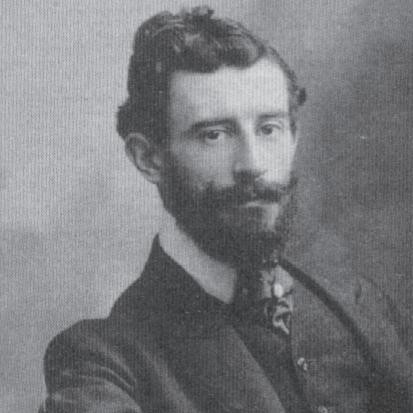
Maurice Ravel is justly recognized as one of the great orchestrators of the 20th century. In 1908 he began composing a collection of four-hand piano pieces based on French fairy tales, which he called Mother Goose Suite. It was intended for the children of close friends, although it proved too difficult. Ravel orchestrated the fivemovement set in 1911, the version we hear today, and later that year added two movements and interludes for a ballet that premiered in Paris.
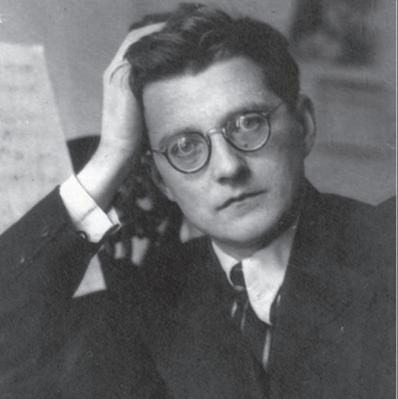
In 1934 The Philadelphia Orchestra gave the United States premiere of Dmitri Shostakovich’s First Piano Concerto. This Concerto is one of his wittiest pieces and proved a popular vehicle for him to shine as the piano soloist. The work prominently features the trumpet, supported by a string orchestra.
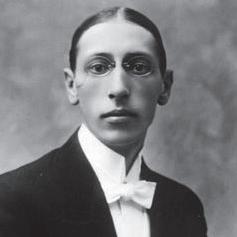
The legendary 1913 premiere of Igor Stravinsky’s The Rite of Spring in Paris by the Ballets Russes proved a landmark event in the history of Western music. Historians now generally agree that the audience was more scandalized by the ballet’s choreography than by the innovative music; within a year The Rite of Spring had emerged as an enormously successful concert piece. It took nearly a decade, until 1922, for the work to make it across the Atlantic. Leopold Stokowski conducted the American premiere with The Philadelphia Orchestra in March 1922.
The Philadelphia Orchestra is the only orchestra in the world with three weekly broadcasts on SiriusXM’s Symphony Hall , Channel 76, on Mondays at 7 PM, Thursdays at 12 AM, and Saturdays at 4 PM.
The Music
Mother Goose Suite
Maurice Ravel
Born in Ciboure, Lower Pyrenees, March 7, 1875
Died in Paris, December 28, 1937
It was not until the first decade of the 20th century that Maurice Ravel’s career as a composer, which had suffered fitful starts, finally took flight. He had failed several attempts to win the coveted Prix de Rome at the Paris Conservatory, partly because his daring experiments with color and harmony did not fit easily into a conservatory mentality. Finally, he abandoned his studies altogether, becoming involved instead with “Les Apaches,” the vaguely disreputable collection of Parisian aesthetes who met to discuss art, literature, painting, music, history, and any other topic that might arise. Ravel tried out many of his new works at meetings of Les Apaches—often for groups that included such notables as Manuel de Falla.
Despite critical aspersions, his reputation grew steadily. Around 1900 the Parisian publisher Demets had started to print several of the composer’s early works, such as the Pavane for a Dead Princess, the String Quartet, and the piano piece Jeux d’eau. They were received by the public with astonished enthusiasm. Buoyed by these successes, Ravel produced, in rapid succession, a string of brilliant works that secured his position as more than just Debussy’s also-ran—including several of the works for which he is best known, such as the Sonatine (1905), the five Miroirs (1905), Rapsodie espagnole (1907), Gaspard de la nuit (1908), Mother Goose (1908–11), and Daphnis and Chloe (1909–12).
Children’s Duets Ravel composed Mother Goose as a set of pieces for piano duet, originally intending them for Mimie and Jean, the young children of the composer’s close friends Xavier and Ida Godebski. He wrote the work mostly in 1908 at La Grangette, the Godebski’s summer home near Fontainebleau, but he didn’t complete the set until early 1910. Although he made the piano writing as simple and straightforward as possible, in the end it proved too difficult for the Godebski children (the youngest of whom was only eight). The piece was premiered, in this initial piano version, in Paris in April 1910, by Jeanne Leleu and Geneviève Durony—themselves just children at the time. The following year the composer transcribed the work for full orchestra, and this version is the one heard on today’s concert. He also expanded it into a full-length ballet score, adding two movements and interludes and rearranging the order of the pieces; this last version received its premiere in January 1912 at the Théâtre des Arts in Paris.
A Closer Look Ravel’s delightful evocation of childish pleasures takes its inspiration from three different versions of the Mother Goose tales, giving the version by Charles Perrault
(1628–1703) the most credence. It is the first story from Perrault’s Contes de ma Mère l’Oye (Mother Goose Stories, 1697), for example, that supplies the opening piece of Ravel’s Suite, Pavane of Sleeping Beauty —a slow-moving dance of melancholy charm. Ravel himself inscribed the second piece, Tom Thumb , with the following excerpt from Perrault: “Tom Thumb [who was lost in the woods] believed that he would easily be able to find the way by means of the bread that he had scattered wherever he passed—but he was surprised to discover not one single crumb. The birds had come and eaten it all!”
The brilliant, coloristic atmosphere of the third piece is a reflection of its subject, Laideronnette, Empress of Pagodes . Again, Ravel heads this quick march with a passage from the tale as told in Marie-Catherine d’Aulnoy’s Serpentin vert : “She disrobed and entered her bath. At once the pagodes and pagodines began to sing and play on instruments. Some had archlutes made of walnut shells, others played on viols made from the shells of almonds, for they were obliged to proportion their instruments to their stature.” (A pagode is a fairy creature made of jewels and precious metals.)
The fourth piece is a delicate and sad waltz, a sort of dreamy depiction of The Conversations of Beauty and the Beast . Ravel inscribes the score with a dialogue between the couple, taken this time from a version by Marie Leprince de Beaumont:
When I think how good-hearted you are, you do not seem so ugly.
Yes, I have indeed a kind heart, but I am a monster.
There are many men more monstrous than you.
If I had wit I would invent a fine compliment to thank you, but I am only a beast.
Beauty, will you be my wife?
No, Beast.
I die content since I have had the pleasure of seeing you again. No, my dear Beast, you shall not die; you shall live to be my husband!
The beast suddenly disappeared, and she saw at her feet a prince more beautiful than love, who thanked her for having broken his enchantment.
The clarinet tune at the beginning of this movement seems to represent Beauty, while the growling contrabassoon stands for the Beast; after a heartfelt discussion, the Beast’s theme is transformed, finally, into a “beautiful” violin melody. The fifth piece, The Fairy Garden (marked slowly, seriously) brings the set to a plaintive, subtly shaded close.
—Paul J. Horsley
Paul J. Horsley is performing arts editor for The Independent in Kansas City. Previously he was program annotator and musicologist for The Philadelphia Orchestra and music and dance critic for The Kansas City Star
Ravel composed the Mother Goose Suite from 1908 to 1910 and orchestrated it in 1911.
Artur Rodzinski was on the podium for the first Philadelphia Orchestra performances of the piece, in January 1926. The most recent subscription performances were in February 2023, with Stéphane Denève conducting.
Ravel scored the work for two flutes (II doubling piccolo), two oboes (II doubling English horn), two clarinets, two bassoons (II doubling contrabassoon), two horns, timpani, percussion (bass drum, cymbals, glockenspiel, tam-tam, triangle, xylophone), harp, celesta, and strings.
The Suite runs approximately 16 minutes in performance.
The Music
Piano Concerto No. 1
Dmitri Shostakovich
Born in St. Petersburg, September 25, 1906
Died in Moscow, August 9, 1975
The musician we perhaps too often associate with somber portrayals of the emotional turmoil of an artist under Stalinism was also one of the wittiest musicians since Joseph Haydn. “When listeners laugh at a concert of my symphonic music, I am not in the least bit shocked,” wrote Dmitri Shostakovich in a Soviet magazine in 1934. “In fact, I am pleased.” This composer’s early scores are characterized by a sardonic and effervescent humor that is as profound as it is satirical. “I want to defend the right of laughter to appear in what is called ‘serious’ music,” he wrote, touching on a truth known to great composers through the ages: that humor in art exists not just to elicit laughter, but to reveal truth. In Shostakovich, comedy and despair coexist as comfortably and intricately as they do in any music; humor is a means of coping with the unbearable. That there is a sharp edge to this humor should come as no surprise from one who embodied so completely the contradictions of living under the schizoid and unpredictable Soviet regime.
His early stage works ( The Nose, The Golden Age, The Bolt ) had dealt up ample servings of this sardonic wit, and the First Symphony of 1925 had its moments of youthful zest and joie de vivre as well . But it was with the First Piano Concerto that the composer brought the full force of his droll humor into the concert hall.
A Delightfully Ebullient Work Written in the summer of 1933, immediately after the completion of his opera Lady Macbeth of Mtsensk (the official condemnation of which, in 1936, would change the course of his career), the Concerto is one of the composer’s most delightfully ebullient works. Its wry humor and solid craftsmanship immediately assured that it would achieve the composer’s stated goal of “filling up the gap in Soviet instrumental repertoire, which lacks major works for the concert stage.” The work has remained a favorite of concert audiences for almost a century now.
It also became a solo vehicle for its creator, who had begun his career at the Petrograd Conservatory as a dual talent, completing a degree in piano (at age 16) before earning his composition diploma. He was, of course, the soloist in the work’s premiere in Leningrad on October 15, 1933, with Fritz Stiedry conducting the Leningrad Philharmonic—and featuring the orchestra’s principal trumpet, Aleksandr Schmidt, a friend and favorite musician of the composer.
The work was initially conceived as a “concerto for piano, with the accompaniment of string orchestra and trumpet,” and the prominent role assigned to the solo trumpet gives it a distinctive quality. This biting edge, and the essential roles given to piano and trumpet, have caused some writers to connect it to Petrushka —and there is no doubt that Shostakovich was familiar with Stravinsky’s masterpiece. But one could also make comparisons to Prokofiev’s early works, particularly his own First Piano Concerto of 1912, which had pulled at the trouser seams of Romantic traditions. Shostakovich’s humor is drier than that of either of those composers—and funnier, too, with an edge of hysteria. Nevertheless, his First Piano Concerto was one of the last times he would give such free rein to his wit—the lively sense of fun that he still believed formed a part of his mission as an artist.
A Closer Look Shostakovich’s conservatory study had been rooted in Classical styles and traditions, and he had learned his lessons well. In addition to quotations from Haydn, Beethoven, Tchaikovsky, and many others, this Concerto manages to work in popular tunes and a healthy dose of the burlesque. The opening Allegro moderato , which introduces piano and trumpet at the outset (in an admittedly Petrushka- like figure), presents a staunchly classical theme in C-minor before veering off into a sort of can-can— cartwheeling away, in the words of Ian MacDonald, “into a circus-world of comic turns and raspberries ringmastered by the trumpet.”
Wittiness is brushed aside in the second movement ( Lento ), a grave meditation in the vein of the slow movement of Ravel’s G-major Concerto, and one that makes clear the composer’s wholly serious intent. The third movement ( Moderato ) is little more than a mournful recitative, a transition to the audacity of the finale. About as “over-the-top” as anything in 20th-century music, this Allegro con brio begins wildly and progresses to such a point of absurdity that the listener becomes aware that it is not really very funny after all—and this is precisely the idea. A solo cadenza for piano serves only to heighten the shrill atmosphere of the movement, which also includes quotations from Haydn, from Beethoven’s “Rage over a Lost Penny,” and from a ditzy tune Shostakovich had originally composed as part of an interlude for Erwin Dressel’s opera Armer Columbus. In the final analysis, what appears to be a self-evident bit of dash and wit is, like almost everything in Shostakovich, full of complex and surprisingly dark hidden meanings.
—Paul J. Horsley
Shostakovich’s Piano Concerto No. 1 was composed in 1933.
Eugene List won the Philadelphia Orchestra Student Competition in 1934, aged 16, and as part of his award he had the privilege of presenting the United States premiere of the Shostakovich First Piano Concerto with The Philadelphia Orchestra and Leopold Stokowski, on December 12, 1934. Most recently, pianist Martha Argerich and Charles Dutoit collaborated in subscription performances in October 2008.
The First Piano Concerto is scored for trumpet, strings, and solo piano. The work runs approximately 20 minutes in performance.
The Music
The Rite of Spring
Igor Stravinsky
Born in Lomonosov, Russia, June 17, 1882
Died in New York City, April 6, 1971
Music connected with dance has long held a special place in French culture, at least as far back as the age of Louis XIV, and there was an explosion of major full-length scores during the 19th century in Paris. Some of the perennial favorites were written by now generally forgotten figures, such as Adolphe Adam ( Giselle from 1841) and his pupil Léo Delibes ( Coppélia in 1870 and Sylvia in 1876). These composers inspired the supreme ballet music of the late century, that written by Tchaikovsky, the great Russian. With his scores to Swan Lake (1875-76), The Sleeping Beauty (1889), and Nutcracker (1892), ballet found its musical master.
Back to Paris In the first decade of the 20th century, however, magnificent dance returned to Paris when the impresario Sergei Diaghilev started exporting Russian culture. He began in 1906 with the visual arts, presented symphonic music the next year, then opera, and, finally, in 1909, added ballet. The offerings of his legendary Ballets Russes proved to be especially popular despite grumbling that the productions did not seem Russian enough for some Parisians. Music historian Richard Taruskin has remarked on the paradox:
The Russian ballet, originally a French import and proud of its stylistic heritage, now had to become stylistically “Russian” so as to justify its exportation back to France. Diaghilev’s solution was to commission, expressly for presentation in France in 1910, something without precedent in Russia: a ballet on a Russian folk subject, and with music cast in a conspicuously exotic “Russian” style. He cast about for a composer willing to come up with so weird a thing.
Stravinsky and the Ballets Russes Diaghilev had some difficulty finding that composer. After being refused by several others, he engaged the 27-year-old Igor Stravinsky, who achieved great success with The Firebird in 1910. His second ballet, Petrushka, followed the next season. And then came the real shocker that made music history: The Rite of Spring.
The Russian artist and archeologist Nicholas Roerich, a specialist in Slavic history and folklore, devised the scenario for the Rite together with Stravinsky and eventually created the sets and costumes. Subtitled “Pictures of Pagan Russia,” the ballet offers ritual dances culminating in the sacrifice of the “chosen one” in order “to propitiate the god of spring.”
Stravinsky composed the music between September 1911 and March 1913, after which the work went into an unusually protracted period of rehearsals. There were many for the
orchestra, many for the dancers, and then a handful with all the forces together. The final dress rehearsal on May 28, 1913, the day before the premiere, was presented before a large audience and attended by various critics. All seemed to go smoothly.
A Riotous Premiere An announcement in the newspaper Le Figaro on the day of the premiere promised the strongly stylized characteristic attitudes of the Slavic race with an awareness of the beauty of the prehistoric period. The prodigious Russian dancers were the only ones capable of expressing these stammerings of a semi-savage humanity, of composing these frenetic human clusters wrenched incessantly by the most astonishing polyrhythm ever to come to the mind of a musician. There is truly a new thrill which will surely raise passionate discussions, but which will leave all true artists with an unforgettable impression.
Diaghilev undoubtedly devised the premiere to be a big event. Ticket prices at the newly built Théâtre des Champs-Élysées were doubled and the cultural elite of Paris showed up. The program opened with a beloved classic: Les Sylphides, orchestrations of piano pieces by Chopin. What exactly happened next that evening, however, is not entirely clear. Conflicting accounts quickly emerged, sometimes put forth by people who were not even in attendance. From the very beginning of The Rite of Spring there was laughter and an uproar among the audience, but whether this was principally in response to the music or to the dancing is still debated. It seems more likely that it was the latter. One critic observed that “past the Prelude the crowd simply stopped listening to the music so that they might better amuse themselves with the choreography.” That choreography was by the 23-yearold dancer Vaslav Nijinsky, who had presented a provocative staging of Claude Debussy’s Jeux with the company just two weeks earlier. Although Stravinsky’s music was evidently inaudible at times through the din, conductor Pierre Monteux pressed on and saw the 30-minute ballet through to the end. The evening was not yet over. After intermission came two more audience favorites: Carl Maria von Weber’s The Specter of the Rose and Alexander Borodin’s Polovtsian Dances from his opera Prince Igor.
Five more performances of The Rite of Spring were given over the next two weeks and then the company took the ballet on tour. Within the year the work was triumphantly presented as a concert piece, again with Monteux conducting, and ever since the concert hall has been its principal home. Yet it is well worth remembering that this extraordinary composition, which some commentators herald as the advent of modern music, was originally a theatrical piece, a collaborative effort forging the talents of Stravinsky, Roerich, Diaghilev, Nijinsky, Monteux, and a large ensemble of musicians and dancers. Leopold Stokowski conducted the American premiere of both the concert and staged versions of The Rite of Spring in Philadelphia.
A Closer Look The Rite of Spring calls for an enormous orchestra deployed to spectacular effect. The ballet is in two tableaux—“The Adoration of the Earth” and “The Sacrifice”— each of which has an introductory section, a series of dances, and a concluding ritual. The opening minutes of the piece give an idea of Stravinsky’s innovative style. A solo bassoon,
playing at an unusually high register, intones a melancholy melody. This is the first of at least nine folk melodies that the composer adapted for the piece, although he later denied doing so (except for this opening tune).
Some order eventually emerges out of chaos as the “The Auguries of Spring” roar out massive string chords punctuated by eight French horns. In the following dances unexpected and complicated metrical innovations emerge. At various points in the piece Stravinsky changes the meter every measure, a daunting challenge for the orchestra in 1913 that now seems second nature to many professional musicians. If Arnold Schoenberg had famously “liberated the dissonance” a few years earlier , Stravinsky now seems to liberate rhythm and meter.
Although the scenario changed over the course of composition, a basic “Argument” was printed in the program at the premiere, which read as follows:
FIRST ACT: “The Adoration of the Earth.” Spring. The Earth is covered with flowers. The Earth is covered with grass. A great joy reigns on the Earth. Mankind delivers itself up to the dance and seeks to know the future by following the rites. The eldest of the Sages himself takes part in the Glorification of Spring. He is led forward to unite himself with the abundant and superb Earth. Everyone stamps the Earth ecstatically.
SECOND ACT: “The Sacrifice.” After the day: After midnight. On the hills are the consecrated stones. The adolescents play the mystic games and see the Great Way. They glorify, they proclaim Her who has been designated to be delivered to the God. The ancestors are invoked, venerated witnesses. And the wise Ancestors of Mankind contemplate the sacrifice. This is the way to sacrifice Iarilo the magnificent, the flamboyant.
—Christopher H. Gibbs
Christopher H. Gibbs is James H. Ottaway Jr. Professor of Music at Bard College and has been the program annotator for The Philadelphia Orchestra since 2000. He is the author of several books on Schubert and Liszt, and the co-author, with Richard Taruskin, of The Oxford History of Western Music, College Edition. Stravinsky composed The Rite of Spring from 1911 to 1913.
The Rite of Spring is one of many essential works of the 20th century that received its United States premiere in Philadelphia. Leopold Stokowski and The Philadelphia Orchestra presented the piece on March 3, 1922. The most recent subscription performances were in March/April 2023 with Marin Alsop and Austin Chanu taking over for the indisposed Yannick Nézet-Séguin.
The Philadelphians have recorded the complete work four times: in 1929 with Stokowski for RCA, in 1955 with Eugene Ormandy for CBS, in 1978 with Riccardo Muti for EMI, and in 2013 with Nézet-Séguin for Deutsche Grammophon. An abridged version was recorded by Stokowski and the Orchestra in 1939 for RCA, the same version that appeared in the film Fantasia.
The score calls for piccolo, three flutes (III doubling piccolo II), alto flute, four oboes (IV doubling English horn II), English horn, three clarinets (III doubling bass clarinet II), E-flat clarinet, bass clarinet, four bassoons (IV doubling contrabassoon II), contrabassoon, eight horns (VII and VIII doubling Wagner tubas), piccolo trumpet, four trumpets, three trombones, bass trombone, two tubas, timpani, percussion (antique cymbals, bass drum, cymbals, güiro, tam-tam, tambourine, and triangle), and strings.
The Rite of Spring runs approximately 33 minutes in performance.
Photos: Allie Ippolito
Musical Terms
Cadenza: A passage or section in a style of brilliant improvisation, usually inserted near the end of a movement or composition
Chord: The simultaneous sounding of three or more tones
Chromatic: Relating to tones foreign to a given key (scale) or chord
Dissonance: A combination of two or more tones requiring resolution
Dynamics: The varying and contrasting degrees of loudness
Harmony: The combination of simultaneously sounded musical notes to produce chords and chord progressions
Legato: Smooth, even, without any break between notes
Meter: The symmetrical grouping of musical rhythms
Op.: Abbreviation for opus, a term used to indicate the chronological position of a composition within a composer’s output. Opus numbers are not always reliable because they are often applied in the order of publication rather than composition.
Pavane: A court dance of the early 16th century, probably of Spanish origin
Polyphony: A term used to designate music in more than one part and the style in which all or several of the musical parts move to some extent independently
Polyrhythm: The simultaneous use of two or more contrasting rhythms
Recitative: Declamatory singing, free in tempo and rhythm. Recitative has also sometimes been used to refer to parts of purely instrumental works that resemble vocal recitatives.
Scale: The series of tones which form (a) any major or minor key or (b) the chromatic scale of successive semi-tonic steps
Suite: During the Baroque period, an instrumental genre consisting of several movements in the same key, some or all of which were based on the forms and styles of dance music. Later, a group of pieces extracted from a larger work, especially an opera or ballet.
Timbre: Tone color or tone quality
Tonic: The keynote of a scale
THE SPEED OF MUSIC (Tempo)
Allegretto: A tempo between walking speed and fast
Allegro: Bright, fast
Con brio: Vigorously, with fire
Largo: Broad
Lento: Slow
Moderato: A moderate tempo, neither fast nor slow
Presto: Very fast
Vivace: Lively
TEMPO MODIFIERS
Poco: Little, a bit
Located inside the Kimmel Center
Regular Hours
Tues–Sat 8 AM–10 PM
Sun 10 AM–8 PM
Extended Hours
Open late on performance nights, with last call one hour post-performance.
Join Us for Happy Hour!
Tues–Fri 4–6 PM
Audience Services
We want you to enjoy each and every concert experience you share with us. We would love to hear about your experience at the Orchestra and it would be our pleasure to answer any questions you may have.
Please don’t hesitate to contact us via phone at 215.893.1999, in person in the lobby, or online at ensembleartsphilly.org/contact-us.
Please visit ensembleartsphilly.org/ tickets-and-events/ticket-information for information on Audience Services and Box Office hours and locations.
On concert dates (two hours before concert time and through intermission), the Box Office will be located at: The Kimmel Center Broad and Spruce Streets Philadelphia, PA 19102
Web Site: For information about The Philadelphia Orchestra and its upcoming concerts or events, please visit philorch.org.
Individual Tickets: Don’t assume that your favorite concert is sold out. Subscriber turnins and other special promotions can make last-minute tickets available. Visit us online at philorch.org.
Subscriptions: The Philadelphia Orchestra offers a variety of subscription options each season. These multi-concert packages feature the best available seats, ticket exchange privileges, discounts on individual tickets, and many other benefits. Learn more at philorch.org.
Ticket Turn-In: Subscribers who cannot use their tickets are invited to donate them and receive a tax-deductible acknowledgement by calling 215.893.1999. Twenty-four-hour notice is appreciated, allowing other patrons the opportunity to purchase these tickets and guarantee tax-deductible credit.
PreConcert Conversations: PreConcert Conversations are held prior to most Philadelphia Orchestra subscription concerts, beginning one hour before the performance. Conversations are free to ticket holders,
feature discussions of the season’s music and music-makers, and are supported in part by the Hirschberg-Goodfriend Fund in memory of Adolf Hirschberg, established by Juliet J. Goodfriend.
Lost and Found: Please call 215.670.2321.
Late Seating: Late seating breaks usually occur after the first piece on the program or at intermission in order to minimize disturbances to other audience members. If you arrive after the concert begins, you will be seated only when appropriate breaks in the program allow.
Accessible Seating: Accessible seating is available for every performance. Please visit philorch.org/patron-services/plan-your-visit/ accessibility for more information.
Assistive Listening: With the deposit of a current ID, hearing enhancement devices are available at no cost from the House Management Office in Commonwealth Plaza. Hearing devices are available on a first-come, first-served basis.
Large-Print Programs: Large-print programs for every subscription concert are available in the House Management Office in Commonwealth Plaza. Please ask an usher for assistance.
Fire Notice: The exit indicated by a red light nearest your seat is the shortest route to the street. In the event of fire or other emergency, please do not run. Walk to that exit.
No Smoking: All public space in Ensemble Arts Philly venues is smoke-free.
Cameras and Recorders: The taking of photographs or the recording of Philadelphia Orchestra concerts is strictly prohibited, but photographs are allowed before and after concerts and during bows. By attending this Philadelphia Orchestra concert you consent to be photographed, filmed, and/or otherwise recorded for any purpose in connection with The Philadelphia Orchestra.
Electronic Devices: All watch alarms should be turned off while in the concert hall and all cellular phones should be switched to silent mode.
Board of Trustees
The Philadelphia Orchestra and Ensemble Arts
BOARD OF TRUSTEES
Ralph W. Muller, Chair
Ryan Fleur, President and Chief Executive Officer
Yannick Nézet-Séguin, Music and Artistic Director, The Philadelphia Orchestra
James P. Brandau
Patrick J. Brennan, M.D.
Jeffrey Brown
Karen Dougherty Buchholz
Elaine Woo Camarda
Joseph Ciresi
Michael M. Cone
Joseph Conyers*
Robert R. Corrato, M.D.
Sarah Miller Coulson
Robert Curley
Robert J. Delany, Sr.
Mark S. Dichter
Jeff Dittus
Carl E. Dranoff
Joseph M. Field
Ryan Fleur*
Mark J. Foley
John Fry
Lauren Gilchrist
Donald A. Goldsmith
Amy Gutmann, Ph.D.
Julia Haller, M.D.
Robert C. Heim
Nina Henderson
Osagie O. Imasogie
Patricia Harron Imbesi
Philip P. Jaurigue
Kenyatta Johnson*
Bennett Keiser
Christopher M. Keith
David Kim*
Neal W. Krouse
Lauren Lambrugo*
Joan Lau
Brook J. Lenfest
Jeffrey A. Leonard
Bruce G. Leto
Tod J. MacKenzie
Joseph M. Manko, Sr.
John H. McFadden
Jami Wintz McKeon
Stan Middleman
Dara Morales*
Ralph W. Muller
Yannick Nezet-Seguin*
Amy Oshiro-Morales*
Benjamin Persofsky
Richelle Rabenou*
Jon Michael Richter
Caroline B. Rogers
Charles E. Ryan
Kerri Ryan*
Adele K. Schaeffer
Peter L. Shaw
Adrienne Simpson
Matthew A. Taylor
Jennifer F. Terry
Tiffany Thurman*
Michael R. Vennera
Rev. Dr. Alyn Waller
Robert Wilson
Richard B. Worley
Joseph Zebrowitz, M.D.
Bin Zhang
* Ex officio
THE PHILADELPHIA ORCHESTRA AND ENSEMBLE ARTS
PRESIDENT’S LEADERSHIP COUNCIL
Robert Bogle
Sheldon M. Bonovitz
Willo Carey
Kathleen P. Chimicles
Gerard P. Cuddy
Peter Dachowski
Kenneth E. Davis
Rodney D. Day III
Peter J. Dean, Co-Chair
Thomas A. Decker
James F. Dougherty, V.M.D., Co-Chair
Stacy M. Dutton
Carole Haas Gravagno
William P. Hankowsky
H. Edward Hanway
Martin A. Heckscher, Esq.
David F. Hoffman
Joseph H. Jacovini
Lisa D. Kabnick
Ronald L. Kaiserman, Esq.
Susan Y. Kim
Frederick W. Kyle
Larry Magid
Elizabeth M. Mahoney
David G. Marshall
Sandra G. Marshall
Joseph J. McLaughlin, Jr.
Edward A. Montgomery, Jr.
Hilarie L. Morgan
Henry N. Nassau
Charles P. Pizzi
Robert Pollack
Robert L. Pratter
Hon. Marjorie O. Rendell
Lyn M. Ross
David B. Rubenstein
John F. Salveson
Molly D. Shepard, Co-Chair
Richard L. Smoot
Leonard A. Sylk
Sheldon L. Thompson
Brian P. Tierney
Charles K. Valutas
Ramona Vosbikian
James W. Zug
As of November 2025
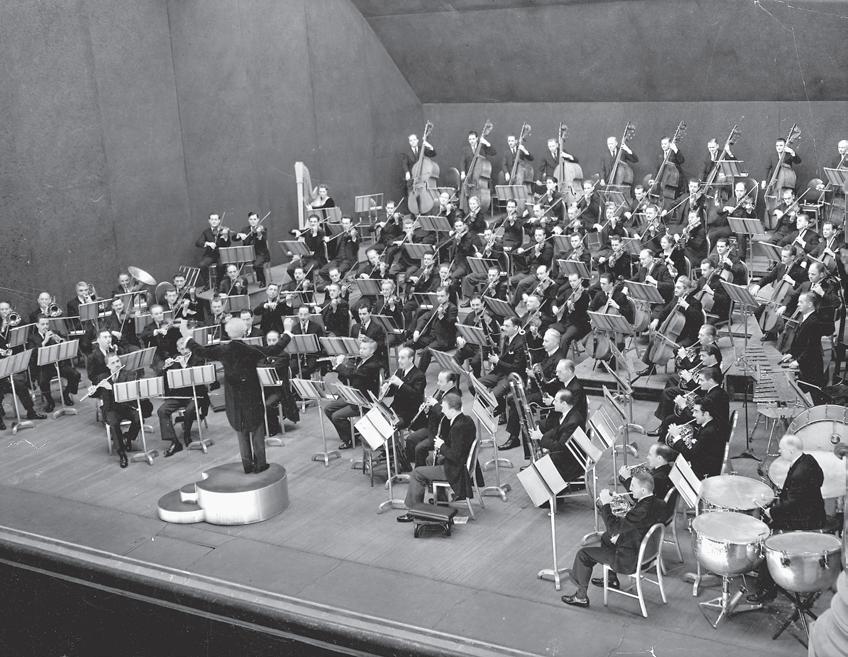
THEN: The Philadelphia Orchestra with Stokowski, 1936
MAKE A GIFT MAKE HISTORY
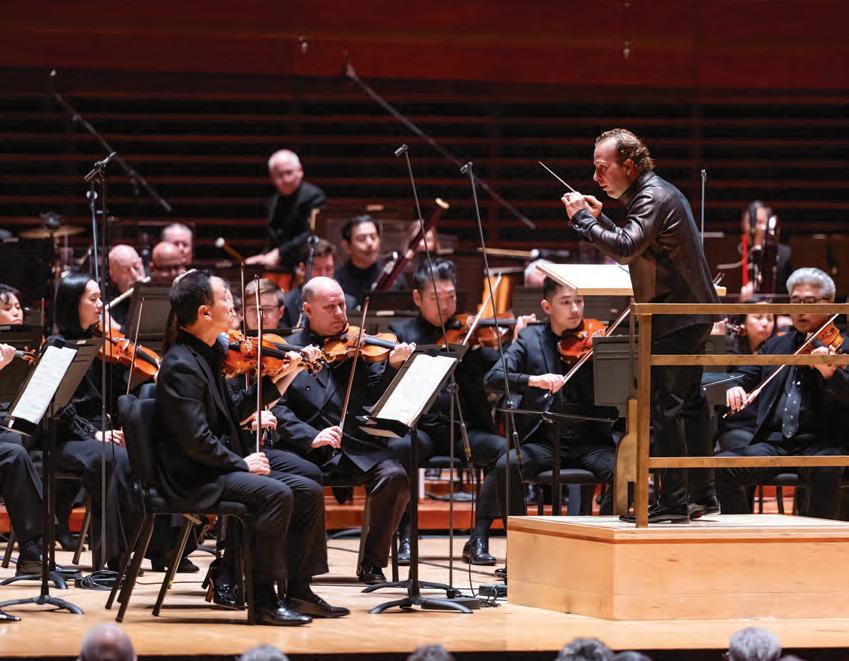
CELEBRATE 125 YEARS OF MUSIC
NOW: The Philadelphia Orchestra with Nézet-Séguin, 2024
Since 1900, The Philadelphia Orchestra has relied on support from patrons like you to create a legacy of exceptional music. The generosity of our donors makes it possible to present hundreds of performances each season, including free community and education events for audiences of all ages. Make a gift and be a part of the next 125 years of music history.
In appreciation, donors receive a variety of benefits, including:
• Access to Open Rehearsals and other members-only events
• Advance purchase opportunities for the best seats in the house
• Discounts on concessions, Curtain Call Cafe and Lounge, and Leo Restaurant and Bar
• And more exclusive opportunities that bring you closer to the art you love
Explore our membership levels, benefits, and flexible payment options at philorch.org/membership.
Photos: Allie Ippolito
Annual Fund
Philanthropic support inspires and sustains Your Philadelphia Orchestra’s work on stage, in our local communities, and around the world. We are proud to recognize our generous Annual Fund donors by name on this and subsequent pages. We extend our deepest gratitude to every donor, including those listed anonymously and at levels not included in this program.
For more information about donating to the Annual Fund at any level, please contact us at 215.893.3151 or development@ philorch.org, or visit philorch.org/donate.
Contributions listed were received between March 1, 2024, and November 18, 2025. Please contact us if your name has been omitted in error or if you would like to update your recognition name.
Artistic Council
$500,000 and above
Estate of M.J. Fischer
Estate of Robert T. Foley
Otto Haas Charitable Trust
Neal Krouse and Karl Fong
Leslie A. Miller and Richard B. Worley
Elizabeth Wiegers
Constance and Sankey Williams
Anonymous (2)
Artistic Council
$125,000 to $499,999
Lois and Julian Brodsky
Elaine W. Camarda and A. Morris Williams, Jr.
The CHG Charitable Trust
Dr. Alan R. Cohen and Michele Langer
Constance and Michael Cone
Tatiana Copeland
Tobey and Mark Dichter
Dr. James F. Dougherty
Susan and Jonas Ellenberg
Robert Heim and Eileen Kennedy
Osagie and Losenge Imasogie
Innisfree Foundation
Gretchen and M. Roy Jackson
Bennett Keiser and Joy Wilf Keiser
James and Agnes Kim Foundation
Dr. Richard M. Klein
Estate of Winifred Mayes
John H. McFadden and Lisa D. Kabnick
Ralph and Beth Johnston Muller
Estate of Dr. Betty T. Richards
Caroline B. Rogers
Peter and Mari Shaw
Dr. Cecilia Segawa Seigle Tannenbaum
Dr. and Mrs. Joseph B. Townsend
Estates of Dr. and Mrs. Robert Williams
Presenters Circle
$75,000 to $124,999
Estate of Sherrin H. Baky-Nessler
Estate of Dr. Noel Cawley
Estate of Dr. Barbara Comins
Sarah Miller Coulson
Jerome L. and Thao Dodson
Joseph and Marie Field
Mrs. Penelope P. Harris
Sandy and David G. Marshall
Carol Tyler
Presenters Circle
$50,000 to $74,999
Dean S. Adler and Susanna Lachs Adler
Estate of Jean Bodine
Dr. and Mrs. Robert R. Corrato
Christos Coutifaris and Deborah Driscoll
Estate of Thomas and Floramae Force
Linda and David Glickstein
Mr. and Mrs. Chris Keith
Marguerite and Gerry* Lenfest
Joseph M. Manko, in loving memory of Lynn Manko
Joe Neubauer and Jeanette Lerman-Neubauer
Estate of Ron North
Mr. Charles Ryan
Salkind Family Foundation
Diane Schneider
Mr. Oscar Tang and Dr. Agnes Hsu-Tang Anonymous
Presenters Circle
$25,000 to $49,999
Vijay and Susan Aggarwal
Janet M. Andereck
Dr. James R. Anderson
Donald E. Barb, Esq., and the Rev. Bruce H. Davidson
Peter A. Benoliel* and Willo Carey
James and Micaela Brandau
Judith Broudy
Karen Dougherty Buchholz
Mr. and Mrs. Christopher B. Chandor
Mr. and Mrs. John Fry
Irina and Patrick Gage
Barbara and Jerome Glickman
Juliet J. Goodfriend and Marc R. Moreau
Susan Hakkarainen
Julia A. Haller, M.D.
Nancy S. Halpern
Ed and Ellen Hanway
Ann S. and Steven B. Hutton
Patricia and John Imbesi
Rachelle and Ronald Kaiserman
Gay and Donald Kimelman
In honor of Katherine O. Leone
Mr. and Mrs. Bruce Leto
Chris and Jeffrey Libson
Mrs. Catharine Maxey
Susan and Frank Mechura
Dr. and Mrs. John L. Neigh
Estates of Adolf and Geraldine Paier
Ameline Pappas*
Claudio Pasquinelli and Kyong-Mi Chang
Robert and Lynne Pollack
Robert L. Pratter
Red Moose Charitable Trust
Jon and Karen Richter
Beth L. Rogers
Lyn Ross
Vincent N. and Lila Russo
Allan Schimmel and Reid Reames*
Kate Groark Shields
Constance Smukler, Trustee, Smukler-Lasch Family Trust
Michael L. Spolan
Mr. Wayne Titerence and Ms. Vicki Mechner
Michael and Renee Vennera
Thomas and Patricia Vernon
Jennifer and Ralph Watts
Zisman Family Foundation
Anonymous
Presenters Circle
$15,000 to $24,999
M. Therese and Barry Bentley
Estate of Mark J. Bojanowski
James and Doris Brogan
Carol W. Buettger
Drew Camarda
Joslyn G. Ewart
Estate of John Farmakis
Mr. and Mrs. Moses Feldman
Claudia and Richard Fischer
Ryan Fleur and Laura Banchero
Drs. Peter and Pamela Freyd
Ken and Sue Greathouse
Peter Grove and Nancy Greene
Joseph and Bette Hirsch
Terry and Ann Marie Horner
Toba and Lawrence Kerson
Mr. Kevin King and Mrs. Susan West King
Drs. Joan and Brook Lau
Lurie Family Foundation
Tom and Linda McCarthy
Mr. and Mrs. Bruce McKittrick
Miriam Ort and Lawrence Hirsch
Jane G. Pepper
The Estate of Miss E. Irene Reymann
Dianne and Jeffrey Rotwitt
Joan N. Stern
Mr. and Mrs. Sheldon Lee
Thompson
Dr. Bettyruth Walter
Steve and Mary Beth Young
Anonymous (2)
Presenters Circle
$10,000 to $14,999
John R. Alchin and Hal Marryatt
Mr. and Mrs. James Allison
Charles Arnao and Rosemary Watt
Barbara B. and Theodore R. Aronson
Jim and Janet Averill
Drs. Robert and Jean Belasco
Jill and Sheldon Bonovitz
Dr. and Mrs. Patrick J. Brennan
Mr. and Mrs. Jonathan Broder
Judy and Mark Brodsky
Dr. Eugenio* and Giuliana Calabi
Dr. Rosemary Cook
John Cornell
Joyce Creamer
Richard and Patricia Cummines
Mr.* and Mrs. Edward C. Dearden
Edith R. Dixon*
MaryAnn Edwards
Alex J. Ettl Foundation
Eph and Pat Fithian
Mr. and Mrs. David M. Friedman
Donald Goldsmith
In memory of
Rena and Morton C. Grad and John de Lancie
Vivian and Mark Greenberg
Gni Grossman and Christopher Murray
Leon and Miriam Hamui
Mr. and Mrs. Stephen Harris
Hannah L. Henderson
Richard H. Holzer Memorial Foundation
Ms. Lisa R. Jacobs
Andrew Jacobson and Carol Overvold
Erika James
Lyn Kratz and Pamela French
Dr. Peter Langmuir and Dr. Colette Desrochers
Carol and Howard* Lidz
Nestor Llorente and Don Jones
Sally and Tod MacKenzie
Nicholas Maiale*
Dr. Ann Elizabeth Mayer
Mr. Paul H. McKelvie
Missy and Bob McQuiston
Estate of Mary and David Meese
Dr. Jill Mortensen
Yannick Nézet-Séguin and Pierre Tourville
Mrs. Sarah Peterson
Mrs. Vivian W. Piasecki*
Dr. and Mrs. Joel and Bobbie Porter
Susan and David Rattner
Marney Roia
Xiaomei Shao
Lee F. Shlifer
Edward and Shelley Sigman
Kathleen and Roger Smith
Richard and Amanda Smoot
Samuel and Rosanne Spear
Mary Ann Stehr
Mr. and Mrs. William Stone
Walter and Alice Strine, Esqs.
Charles and Suzanne Valutas
The Vert Charitable Trust
Penelope and Thomas Watkins
Mary E. Webb
Carol A. Westfall
Martin Zeldin and Bill Brinkman
James W. and Debora C. Zug
Anonymous (3)
Ambassadors Circle
$5,000 to $9,999
Erika Aaron and Marc Fliegelman
Mrs. Neysa Adams
Peter J. Allen
Larry and Dr. Marcia Arem
Drs. Janine and Barry Arkles
Lynn Axelroth and Cricket Handsaker
Richard and Jane Baron
Carol Beam
Jeff Benoliel and Amy Branch
John D. Benson, Esq.
Isabelle Benton and Aileen White
Andrea Biondo and Kenneth Hartzell
Allen D. Black and R. Randolph Apgar
Alfred Anthony Brown and Hai-Ye Ni
Dr. and Mrs. I. Stephen Brown
Mr. and Mrs. James M. Buck III
Estate of James Buttenwieser
Malcolm and Carla Cain
Jennifer and David Cardy
Robert Carmichael
Alice Chen-Plotkin and Joshua Plotkin
Kathleen and Nicholas Chimicles
Kristine Christensen
Celia Mendes Chumaceiro
Georgette P. Ciukurescu
Earl* and Margaret Clime
Mrs. Marlynne Clothier
Dr. Robert Cody
Stephen Cohen and John McNett
Ruth M. and Tristram* C. Colket, Jr.
Peggy Cooke
Jeffrey Cooper and Nancy Klaus
Kenneth and Nancy Davis
Stephen and Rhoda Davis
Evelyn S.* and Rodney D. Day III
Mr.* and Mrs. Willem K. Dikland
Dr. and Ms. James Doghramji
Ellason Downs Perpetual Charitable Trust
Ms. Carol S. Eicher
Dr. Bruce Eisenstein, in memory of Dr. Toby Eisenstein
Mr. and Mrs. Spencer Ervin, Jr.
Audrey Escoll
Andrew E. Faust and Ann Russavage-Faust
Mary Felley
Allen R. and Judy Brick Freedman
John R. and Karen S. Fulton III
John and Beth Gamel
The Gant Family Foundation
Patsy and Ed Garno
Jim and Kay Gately
$5,000 to $9,999 cont.
Howard and Norah Goldfine
Mary L. Goldman
David and Bonnie Goldmann
Charles and Alison Graham
Lyn and Harry Groome
Fred and Michelle Harde
Diana and Robert Harding
Katherine Hatton and Richard Bilotti
Hope and Stephen Heaney
Martin and Cynthia Heckscher
Mr. and Mrs. Christopher Henkels, in memory of Paul M. Henkels
Ms. Rhoda K. Herrold, in memory of Deenie and Yale Evelev
Maria Hoek-Smit
Eric and Lenora Hume
Stockton Illoway and Mac K. Griswold
Mr. and Mrs. Joseph Jacovini
Mr. and Mrs. Scott M. Jenkins
Susan E. Kane
Arthur M. Kaplan and R. Duane Perry
Estate of Robert Michael Kelly
Dr. Stephanie and Mr. Andrew Kirk
Ms. Gabrielle Kissling
Dr. and Mrs. Anton J. Kleiner
Dr. Mel Kohn
Leroy E. Kean
William Lake Leonard
Jeff Lewis and Mary Ann Rossi
Mr. James P. MacElderry* and Ms. Marilyn S. Fishman
Drs. Leon and Elsa Malmud
Mary L.C. McAdoo
Susan and Graham McDonald
Mr. and Mrs. James M. McGrath
Robert and Claire McLear
Mr. and Mrs. Charles Meacham
Mr. and Mrs. Marshall Meyer
Madelyn Mignatti
Mr. Mladen Milic and Dr. Barbara Wolf
Mr. and Mrs. Stephen Miller
Mr. and Mrs. H. Laddie Montague, Jr.
Mr. and Mrs. Rodman W. Moorhead III
Mr. and Mrs. David J. Morgan
Mrs. Robert Morris
Ms. Susan Mucciarone and Mr. David Moore
Dr. Robert and Carla Myerson
Mr. and Mrs. Benjamin R. Neilson
Dick and Mimi Nenno
Arthur E. Newbold IV
Alexander Nikas and Dr. Marianne Ruhl Nikas
Marie O’Donnell and Bruce Satalof
Norman Olson
Mr. and Mrs. Richard Palmer
Lili Perski
Marjorie M. and Irwin Nat Pincus Fund
Susan C. Porcino and Peter R. Porcino
Dr. Carol A. Raviola
Nancy J. Remy
Maria and Eric Rieders
Mr.* and Mrs. Richard Rizzo
Sevgi B. Rodan, Ph.D.
Mrs. Willa Rosenbloom
Dr. Louis and Mrs. Val Rossman
Linda S. Rothermel
Dr. Marta Rozans and Prof. Ilan Peleg
Mr. and Mrs. Charles Schelke
Mrs. Carole L. Schultz
Valerie and Will Schwartz
Fredda L. Segal
Dr. and Mrs. Hass Shafia
Christine J. Shamborsky
Mr. and Mrs. Robert L. Stevens
Elizabeth Stokes and Lynne Brown
Cynthia Tehan and Ed Dougherty
Ms. Nancy L. Tindall
Mr. and Mrs. Archbold D.
van Beuren
Richard and Carolyn Veith
Maria Parisi Vickers
Nina Robinson Vitow
Dr. R.J. Wallner
Rebecca Wells and John Tobias
Alan and Leni Windle
Mr. and Mrs. Harold L. Yoh III
Stephen Zeller
Anonymous (12)
Ambassadors Circle
$3,500 to $4,999
Amaranth Foundation, Joan M. Moran, Trustee
Gary and Mary Ammon
Dr. Ronald and Mrs. Catherine Anderson
Mary Jo Ashenfelter and Thomas S. Heckman
Myrna and Howard* Asher
Mr. and Mrs. James R. Bacon
Sarah Batchelor and Kirk Schneider
Mr. and Mrs. Eugene Beier
Narinder and Tracy Bhalla
Jan R. Birsch
Mr. and Mrs. Stephen Bleyer
Samuel A. Bobrow and Maxine Blum
The Bohan and Fox Family
Ms. Donna Brennan and Mr. James Bergey
Ira Brind and Stacey Spector
Nancy Carey and DeWitt Brown
The Clarke Family Fund
Barbara R. Cobb for the Hamilton Family Foundation
Ms. Eileen Courtney
Ana V. Diez Roux and Jose Tapia
Ray Dombroski and Colleen DeMorat
Henry and Katherine Donner
Mr. Jay M. Donner
Dr. Andrew F. Drake
Barbara Eberlein and Jerry Wind
Dr. Pamela Edmonds and Mr. David Chianese
Helen and Phillip Escaravage
Nina Maria Fite
Debbie and Bob Fleischman
Ms. Jane Foster and Mr. Arthur Willson
Sara Fox
Mr. and Mrs. Lawrence Fridkis
Dr. Deborah Gaspar and Mr. Mark Gaspar
Robert Gelsher
Anna Marie and Michael Gewirtz
Eduardo Glandt and George Ritchie
Susan Kohn Gleeksman
Joseph and Jane Goldblum
Robert Graff
Mrs. Jane M. Hastings
Mr. Charles Head, Jr., and Mr. John Faggotti
Archibald C. Hewes
Lois Horgan
Dr. and Mrs. Leonid Hrebien
Ralph Johanson
Mr. and Mrs. Melvin Jones
Clare Kahn
Donald and Dorothy Kardon
Dr. Maureen Kelly
Mr. and Mrs. Robert C. Kline
Kenneth Klothen and Eve Biskind Klothen
Timothy E. Koehler
Mrs. Beth Ann Wahl Kolpen and Mr. Jack Kolpen
Shira Kramer and Leon Josowitz
Sanford and Carol Levy
Mrs. H. Gates Lloyd*
William A. Loeb
Robert Logemann
Drs. W.B. and Sarah S. Long
Dr. and Mrs. Michael B. Love
Robert and Lynn V.D. Luft
Mr. and Mrs. Robert Lukens
Joseph Manko, Jr., and Jennifer Porges
Dr. Bernard A. Mason and Jane R. Mason
Denise McCleary and Paul von Behren
Mr. and Mrs. Joseph J. McLaughlin, Jr.
Russell L. McTague
Michael and Anna Minkovich
Margarita Montanaro
Mr. Edward A. Montgomery, Jr.
Dr. and Mrs. A.H. Nishikawa
Mr. and Mrs. Stuart Ockman
Ellen J. Odoner and Edward W. Kerson
Mr. Frederick Oster and Ms. Catherine Jacobs
Linda and David Paskin
Barbara L. Phillips
Mrs. Vivian W. Piasecki*
Allan Rayfield
David Rhody
David Richman and Janet Perry
Dr. Elizabeth and Mr. Hershel Richman
Gretchen and Jay Riley
Pamela and Gresham Riley
Mr. and Mrs. Mark E. Rubenstein
John Salveson
Marilyn C. Sanborne and Richard J. Labowskie
William and Klare Scarborough
David Seidman
Mr. and Mrs. Robert W. Seminack
Dr. M. Lana Sheer, in memory of Dr. J. Peter Jesson
Janet A. Simon and Georg U. Simon
Joseph Sinkus and Christopher Labonte
Drs. Kobie A. Smith and Vincent H. Harris
Stacy Stone and Stephen McMillan
John and Sandra Stouffer
Mr. Brian A. Stumm
Dr. Norman L. Sykes and Mrs. Gabriella Sykes
Nancy and Bruce Urbschat
Mr. and Mrs. Michael Vogelmann
Jack and Ramona Vosbikian
Peggy Wachs
Laurie Wagman
Daniel V. Walls
Julie D. Williams
Ursule Phaeton Yates
Walter Zanchuk
John Zurlo and Margaret Kreher
Anonymous in memory of
Jan Popper
Anonymous (5)
Friends Circle
$2,500 to $3,499
Maury and Sally Alsher
Dr. Janice Asher
Theodore H. Ashford
William and Sylvia Barone
Ellen W. Baxter and Robert W. Kavash
Joel D. Beaver
Cathy and Saul Behar
Drs. Bruce and Carole Bogdanoff
Richard A. Brand
Linda Bross
Ms. Marilyn A. Brown
Estate of Elia Buck
Mrs. Linda Burke
Mark and Cindy Butler
Selden Cooper and Paige Edwards
Alice B. Cullen
Karen and John Cunningham
Stacy Maria Dutton and Charles McMahon
Dr. and Mrs. William L. Elkins
Robert N. and Doris D. Fanelli
Paul and Judith Farber
Mr. and Mrs. William W. Fox, Jr.
Ellen W. Freeman
Charles and Judith Freyer
Ms. Phyllis S. Gitlin
Joe and Madeleine Glossberg
Marybeth Henry
Joseph and Bette Hirsch
Kathy Hirsh-Pasek and Jeffrey Pasek
Mark and Sally Hurwitz
Eva R. Jackson
Richard and Gail Johnson
Lori Julian
Denise and Robert Keyser
David and Jane Kim
Mrs. Sylvia Kreithen
Mr. Robert D. Lane, Jr., and Ms. Randi Zemsky
Dr. Leona Laskin
Sylvia and Norman Lieberman
Jay Lippincott
Lawrence and Nancy Ludgus
Elizabeth M. Mahoney
Dwight and Christina McCawley
Elizabeth McLean
Virginia Montgomery
Dr. Margaret Motl
Charles and Etta Nissman
Dr. and Mrs. R. Barrett Noone
Kay and Jerry O’Grady
Mr. and Mrs. Lanny R. Patten
Judy and Jim Pohlman
Ms. Nancy Pontone
Mr. and Mrs. Alfred Rauch, Jr.
John and Claire Rodgers
Ms. Ann Rosewater and Mr. Robert Kronley
The Rev. Canon Dr. Alan K. Salmon
Joyce Seewald Sando
Howard J. Sedran and Martha Levine
Irene Shabel
Paul and Susan Shaman
Catherine and Stephan Schifter
Ms. Katharine Sokoloff and William B. McLaughlin III
Dr. Christina A. Stasiuk and Mr. George M. Farion
Dr. Mary K. Stom and
Ms. Dru E. Hammell
Ardith Talbott
Dr. Alan E. Tasoff and Jacalyn Shelley-Tasoff
Mr. and Mrs. Luciano Virgili
Ms. Carol P. Webber
Mr. and Mrs.* David R. Wilmerding, Jr.
Barbara Duby Wilson
Earl and Jackie Wolf
Anne Jeffrey Wright
Sherley Young
Ms. Margaret G. Zehner
Benjamin E. Zuckerman and Marian Robinson
Anonymous
We are proud to recognize the following musicians, retired musicians, and staff who have generously contributed to the Annual Fund.
Davyd Booth and Carlos Perez*
Colleen Coffey-Snyder
Joseph H. Conyers
Julie and Neil* Courtney
Tanya Derksen
Helen and Phillip Escaravage
Ryan Fleur and Laura Banchero
Andrea Gartner and Lee Clements
Anna Marie and Michael Gewirtz
Barbara S. Govatos
Jennifer Pratt Johnson and Fred Johnson
Ruth Kasow
Neva and Matthew Kelly
Herold R. Klein
Sophia Konopelsky
Marjorie and Nolan* Miller
Margarita Montanaro
Kathleen Moran and Nicholas Smith
Yannick Nézet-Séguin and Pierre Tourville
Hai-Ye Ni and Alfred Anthony Brown
Samantha Noll
April O’Brien
Hirono Oka
Doris Parent
Leslie M. Patterson-Tyler
Henry and Yumi* Scott
Joseph Sinkus and Christopher Labonte
Kobie A. Smith
Tubas for Good, Inc., Carol Jantsch, President and Founder
Anonymous (2)
*Deceased
Institutional Support
Generous support from corporations, foundations, and government agencies sustains
The Philadelphia Orchestra with vital funding for performances, education programs, and a variety of innovative projects. We are proud to acknowledge our current institutional donors.
For more information, please contact Ruth Auslander, managing director of institutional giving, at 215.790.5829 or rauslander@ ensembleartsphilly.org.
Contributions listed were received between March 1, 2023, and November 18, 2025.
$500,000 and above
City of Philadelphia
Department of Community and Economic Development
Ford Foundation
The Hess Foundation
The Knight Foundation
William Penn Foundation
The Pew Charitable Trusts
The Presser Foundation
$100,000 to $499,999
Dr. Robert C. and Veronica Atkins Foundation
Bank of China
Bells Grocery Stores
Casamigos Tequila
CHG Charitable Trust
China National Tourist Office
New York
Jessie Ball duPont Fund
The Hearst Foundation
The History Channel
Independence Blue Cross
Merck & Co. Incorporated
MKM Foundation
National Endowment for the Arts
PECO
Pennsylvania Emergency Management Agency
The Pew Center for Arts and Heritage
PNC Arts Alive
TD Bank
U.S. Department of State
Wyncote Foundation
$50,000 to $99,999
Paul M. Angell Family Foundation
Chubb
Dietz & Watson
Eagles Autism Foundation
KeyBank
KPK Development Co. LP
US-China Cultural Institute
Vault Communications
Verizon Pennsylvania
TN Ward Company Builders
Anonymous
$25,000 to $49,999
Abington Neurological Associates
Brotherston Homecare, Inc.
The Chamber of Commerce for Greater Philadelphia
China Center for International Communication Development
John Ciccone Playhouse
Comcast NBCUniversal
Drexel University
Faegre Drinker Biddle & Reath LLP
Amy P. Goldman Foundation
Gray Charitable Trust
Hamilton Family Charitable Trust
The Christian Humann Foundation
Kind Insurance
The Lincoln Financial Group Foundation
Megawholesale
The Andrew W. Mellon Foundation
Ollin, LLC
PHLCVB
Raynier Institute & Foundation
Rhubarb Hospitality Collection
Sun Cruiser
Wells Fargo Foundation
$15,000 to $24,999
Louis N. Cassett Foundation
Julius and Ray Charlestein Foundation in memory of Malvina and Morton Charlestein
Cozen O’Connor
Duane Morris LLP
Essential Utilities
The Anne M. and Philip H. Glatfelter III Family Foundation
The Hassel Foundation
Independence Foundation
The Blanche and Irving Laurie Foundation
Lyft
JPMorgan Chase & Co.
Philadelphia International Airport
Mrs. Ressler’s Food Products
SpotHero
Tito’s Handmade Vodka
Universal Health Services, Inc.
$10,000 to $14,999
Action Karate
Always Best Care Senior Services
Ardmore Toyota
Chameleon Cloud Service
Elliot’s Vending Company
Elliott-Lewis Corporation
HUB International
JKG Florida Business Corp.
Katznelson Associates LP
Laudenbach Periodontics and Dental Implants
Law Office of Ana Ferriera
M&T Charitable Foundation
The McLean Contributionship
One Source Reps
Origlio Beverage
Pennsylvania Council on the Arts
Power Marketing Group
Qlik
The H. Glenn Sample, Jr., M.D., Memorial Fund through the PNC Charitable Trusts Grant
Review Committee
MJ Settelen Construction, LLC
Subbio Center for Plastic Surgery
Team Clean
Truist
Universal Health Services, Inc.
White and Williams
$5,000 to $9,999
AARP Pennsylvania
Accordant Advisors
Corinne R. and Henry Bower
Memorial Trust
The Capital Grille
Dorothy V. Cassard Fund of the Philadelphia Foundation
The Connelly Foundation
Dolfinger-McMahon Foundation
Four Seasons Hotel Philadelphia at Comcast Center
The Gitlin Family Foundation
Grant Thornton, LLP
Christian R. and Mary F. Lindback Foundation
M3 Printing
The McCausland Foundation
New Music USA
Leo Niessen, Jr., Charitable Trust
Ninja Transfers, LLC
Rush Order Tees
Rutgers University—Camden
WSFS Bank
Wyatt Elevator Company
The Volunteer Committees for The Philadelphia Orchestra
The Volunteer Committees for The Philadelphia Orchestra are dedicated to supporting the Orchestra through audience development, educational programs, fundraising, community relations, and special events. The Committees were first formed in 1904 and have the distinction of being the oldest auxiliary volunteer organization associated with an orchestra in the United States. We are profoundly grateful for the Volunteers’ leadership and support throughout the years.
For more information about the Volunteer Committees for The Philadelphia Orchestra, please contact Samantha Noll, assistant director of development events and volunteer relations, at 215.893.1956 or snoll@philorch.org.
List complete as of November 18, 2025
Executive Committee Officers
Richelle Rabenou, President
Sara Cerato, Immediate Past President
Deborah Ledley, Vice President
Mrs. Diane Larzelere, Treasurer
Sheila Cox, Secretary
Governing Board Chairs
Central: Jean Park
Main Line: Jill Acker
New Jersey: Mrs. Diane Larzelere
Rittenhouse Square: Marlena Kleit and Fran Schwartz
Starlight Circle: Mrs. Anna Minkovich
Standing Committee Chairs
Annual Giving: Nancy Galloway
Education: Deborah Ledley*
Marketing: Kelsey Larzelere
Special Functions: Jennifer Porges
Volunteer Archives: Elizabeth A. Crowell
Volunteer Committee Members
Dennis Adams
Dr. Susan C. Aldridge
Pam Alles
Barbara A. Alleva
Rosana Anchondo-Issak
Mrs. Betsy Anderson
Dr. Marilyn H. Appel
Mrs. Daniel G. Bancroft
Mrs. Mercer B. Barrows
Mrs. Thomas E. Beach
Mrs. H. Binney Beale
Ms. Sandra Blumberg Beatty
Mrs. Nancy Belber
Isabelle Benton
Susan Segal Berrigan
Charlotte H. Biddle
Mrs. Thomas H. Bliss
Ann Young Bloom
Mrs. Peter Bodenheimer
Mrs. Eugene T. Borish, Jr.
Lois Boyce
Judith Bradley
Sibby Brasler
Mrs. Leanore Brookman
Judith Broudy
Ms. Carol Melman Brown
Mrs. Roland K. Bullard II
Mrs. Howard Butcher IV
Mrs. John P. Butler III
Mrs. Donald F. Cafiero
Mrs. Alfred M. Campbell III
Beverly Caplan-Freeman
Lorin Carlson-Healy
Nicole A. Cashman
Mrs. Thomas A.V. Cassel
Mrs. Kristine Christensen
DeAnn P. Clancy
Rebecca Clement
Marsha Cohen
Frances Connolly
Peggy Cooke
Sarah Miller Coulson
Mrs. James E. Crutchfield
Alice B. Cullen
Karen Cunningham
Chris D’Ascenzo
Mrs. J. David Davis
James F. Davis*
Mrs. Gerard de Lisser
Colleen DeMorat
Mimi Dimeling
Denise Dolan
Katherine Donner
Mrs. Virginia Dowd
Mrs. John G. Drosdick
Duc Duclos
Lynn Duclos
Roberta Epstein*
Mrs. William H. Eyre, Jr.
Mrs. Charles B. Fancher
Mrs. C. Richard Farmer
Kathleen Fitzgerald
Mrs. Timothy E. Foster
Mrs. Richard Freed
Katherine Garber
Ms. Janine Gardner
Judi Garst
Nancy J. Gellman
Robert Gelsher
Mrs. Kimberly Gerson
Mrs. Micki Ginsberg
Mrs. Jean Givey
Judy Glick
Paula Goldstein
Dr. Janice Taylor Gordon
Dr. Thelma B. Gosfield
Mrs. Richard B. Gould
Carole H. Gravagno
Grete Greenacre
Ms. Nancy V. Gulick
Kate Hall
Noel Butcher Hanley
Fred Harde
Michelle Harde*
Mrs. John S.C. Harvey III
Mrs. Jane M. Hastings
Mrs. Patricia Heidler
Marybeth Henry
Mrs. Frances Herr
Eileen Higgins
Mrs. Robert B. Hobbs, Jr.
Joan R. Holmes
Mrs. Stephen R. Holstad
Eric Hume
Lenora Hume
Ms. Adrienne Jacoby
Yardly R. Jenkins
Karen Jones
Mrs. Mary Anne Dutt Justice
Mrs. Wilma C. Katz
Ms. Phyllis Kauffman
Marie Kenkelen
Kris Kent
Liz Knudsen*
Ms. Ellen G. Kopeland
Mrs. Bernice J. Koplin
Laura Bender Koropey
Mrs. Anthony Lame
Mrs. MaryAnn Landmesser
Molly Lawrence
Matthew Ledley*
Mrs. Margery P. Lee
Sheila Leith
Mrs. Dana Thompson Lerch
Mrs. Roy Lerman
Anita Leto
Mrs. Bruce Leto
Mrs. Stephen Levin
Liddy Lindsay
Ric Lipman
Mrs. Rosemary Livingston
Miss Phoebe Loh
Carol Love, M.D.
Mrs. Robert S. Lovett II
Rochelle Magarick
Elizabeth Mahoney
Joseph Manko, Sr.
Sandy Marshall
Linda Massey
Mary MacGregor Mather
Mrs. James McAdam
Susan McChesney
Mrs. Stella McSparran
Ms. Peg Mertz
Mrs. Barbara G. Miller
Mrs. Keiko Miller
Leslie A. Miller
Mrs. Philippus Miller, Jr.
Michael Minkovich
Mrs. Robert F. Morris, Jr.
Ingrid Morsman
Ms. Cathy Moss*
Joanne Muhr
Linda Mui
Mrs. J. Brien Murphy
Mrs. Albert B. Murphy III
Carol Neiman*
Mrs. John J. Nesbitt III
Mrs. Patricia Ann Nogar
Mrs. R. Barrett Noone
Terry Norton-Wright
Mrs. Wilber W. Oaks, Jr.
Kay O’Grady
Diane Oliva
Mrs. Mimi O’Malley
Mrs. Eleanor Oxman*
Alice Pakman*
Mrs. Regina H. Pakradooni
Mrs. Sandra Pfaff
Mrs. John W. Piasecki
Linda Pizzi*
Elizabeth Pontillo
Mrs. Malcolm D. Pryor
Michelle Fella Przybylowski*
Mr. Kameron Rabenou
Mrs. Ellen Ragone
Jill Raich*
Mrs. Alfred Rauch, Jr.
Kate Brady Rauscher
Josephine Rees
Mrs. A. Gerald Renthal
Caroline B. Rogers
Mrs. Randy S. Ronning
Dr. Lucy B. Rorke-Adams
Miriam Rosenwasser
Mrs. Dianne Rotwitt
Mrs. John E. Royer, Jr.
Lynn Salvo
Joyce Seewald Sando
Mrs. Harold F. Scattergood, Jr.
Jason Schupback
Mrs. Michael P. Schwartz
Faye Senneca
Linda A. Serotta
Carol C. Sherman
Ms. Irina Sipe
Mrs. Carol Smith
Ann Sorgenti
Carol Spinelli
Joyce Stein
Robin Bender Stevens
Lois Stick*
Mrs. Kathleen Stone
Stacy Stone
Dr. Judith Sills Swartz
Roberta R. Tanenbaum
Ms. Faith Tarangelo
Ms. Mary Tattersfield
Barbara Taylor
Ling Tran
Kathryn E. Tusler*
Mrs. Hope Ulrich
Mrs. Annegret Voparil
Mrs. Ramona Vosbikian
Mrs. Jeffrey Warzel
Mrs. Nancy Weiss
Janine Weller
Mrs. Henry Wendt
Dr. Erlis Wickersham
Mrs. Brooke N. Williams
Julie D. Williams
Mr. Alan Windle
Ms. Marian Wissman
Lisa Yakulis
Bonnie Young
Mrs. Gilbert G. Young
Mrs. V. Scott Zelov Anonymous (5)
*Denotes current members of the Philadelphia Orchestra Docent Program
The Volunteer Committees for The Philadelphia Orchestra gratefully acknowledge the following benefactors for their generous support of the Main Line Committee’s 2025 Notable Kitchen Tour:
Bluebell Fine Cabinetry & Design
Devon Tile & Design Studio
Ferguson Home
High Swartz Attorneys at Law
Kountry Kraft
Main Line Kitchen Design
Period Architecture
Pinemar
The Hope and Tim Ulrich Fund
Lisa Yakulis Properties
Endowment
We proudly recognize our generous donors to The Philadelphia Orchestra’s endowment. Their leadership gifts support the Orchestra and its programs in perpetuity, helping to ensure the legacy of the ensemble for the next generation.
To learn how you and your family can be permanently associated with The Philadelphia Orchestra through an endowment gift, please contact Helen Escaravage, managing director of philanthropic engagement, at 215.893.1819 or hesca@philorch.org.
List complete as of November 18, 2025
Transformational Gifts
The Annenberg Foundation
Silicon Valley Community Foundation
$10,000,000
Leslie A. Miller and Richard B. Worley
The Neubauer Family Foundation
$1,000,000 to $9,999,999
The Acadia Fund
Peter A. Benoliel* and Willo Carey
Mr.* and Mrs.* J. Mahlon Buck, Jr.
Estate of Anne M. Buxton
Elaine Woo Camarda and A. Morris Williams, Jr.
Sarah and Frank* Coulson
Mark S. and Tobey Dichter
Dr. James F. Dougherty
Estate of Dwight V. Dowley
Samuel S. Fels Fund
Joseph and Marie Field
Carole and Emilio* Gravagno
Joanne T. Greenspun*
Otto Haas Charitable Trust
Phoebe W. Haas Charitable Trust
“A” as recommended by Carole Haas Gravagno
Phoebe W. Haas Charitable Trust “B”
Robert Heim and Eileen Kennedy
Hannah L. and J. Welles* Henderson
Mr. Paul M.* and Mrs. Barbara B.* Henkels
Hess Foundation
Osagie and Losenge Imasogie
The Kaiserman Family
The James and Agnes Kim Foundation
Dr. Richard M. Klein
Drs. Bong and Mi-Wha* Lee
The Lenfest Foundation
Sandra and David Marshall
Robert E. Mortensen*
Ralph and Beth Johnston Muller
Caroline B. Rogers
Estate of Mary R. Romig-DeYoung
Constance and Joseph* Smukler
Estate of Edwin E. Tuttle
Raymond H.* and Joanne T. Welsh
Constance H. and Sankey Williams
Ruth W.* and A. Morris Williams, Jr.
Richard B. Worley Tribute Fund
Zisman Family Foundation
Anonymous (3)
$500,000 to $999,999
Lois G. and Julian A. Brodsky Foundation
J. Alexis* and Patricia M.* Burland
T. Norwood* and Doreene* Collins
Evelyn S.* and Rodney D. Day III
Mrs. F. Eugene Dixon, Jr.*
The Horace W. Goldsmith Foundation
Gray Charitable Trust
The Hamilton Family Foundation
Mr. and Mrs. John C. Imbesi
Orton P.* and Noël* Jackson
Billy Joel Fund for Music Education
Peter M. Joseph* and Susan Rittenhouse Joseph*
Christian R. and Mary F. Lindback Foundation
Estate of Katharine S. Matthews
Vivian W. Piasecki*
Lyn and George* Ross
Gary and Ruthanne Schlarbaum
Scott and Cynthia Schumacker
Charlotte and Bob Watts Anonymous (3)
$250,000 to $499,999
Mr. and Mrs. James M. Buck III
Peter Buttenwieser* and Terry Marek
Ruth M. and Tristram C.* Colket, Jr.
Michael and Constance Cone
Kenneth Conners*
L. Patrick Gage
Toni and Bob Garrison
Ed and Ellen Hanway
Mrs. Winnifred Howard*
Mr. and Mrs. Berton E. Korman
William A. Loeb*
Mr.* and Mrs. A. Bruce Mainwaring
Winifred Mayes*
Estate of Joseph F. McCrindle
Mrs. J. Maxwell Moran*
Mitchell and Hilarie Morgan
Wendy and Derek Pew Foundation
Robert and Lynne Pollack
Lorraine* and David* Popowich
Mrs. Eleanor K. Read*
Ronald* and Marcia Rubin
Peter and Mari Shaw
Mr. and Mrs. Frank P. Slattery, Jr.
Ann and Harold* Sorgenti
Mr.* and Mrs. Bernard Spain
Mr. and Mrs. Wilson H. Taylor
Donors to the Allison Vulgamore Legacy Endowment Fund
Anonymous (4)
$100,000 to $249,999
Mr. and Mrs.* Leonard Abramson
Lorraine and Ben* Alexander
Mr. and Mrs. Sid R. Bass
Donna and Jon Boscia
Mr. Theodore A. Burtis*
Donald R. Caldwell
William B.* and Elizabeth* Chamberlin
Catherine R. and Anthony A. Clifton
Marie* and Peter* Dooner
Michael and Joan Emmi
Peter and Catherine Ernster
The Moses Feldman Family Foundation
Dr. Betty Gottlieb*
The Frederick and Colette B. Heldring Charitable Fund
Hirschberg-Goodfriend Fund established by Juliet J. Goodfriend
Lynn and Tony* Hitschler
David and Gale Hoffman
Estate of Howard Hornstein
The Hovey Foundation
Joseph and Ann Jacovini
Estate of Jane Kesson
Joseph K.* and Bernice J. Koplin
Neal W. Krouse
Elena and Frederick Kyle
Joanna M. Lewis
Lomax Family Foundation
Trust of Helen T. Madeira
Joseph and Lynn* Manko
Donors to the Lynn K. Manko Volunteer Endowment Fund
Gene and Linda Massey
The McCausland Foundation
Stephanie and Michael Naidoff
Jeffrey P. Orleans
Estates of Mr. and Mrs. Eugene Ormandy
Francis H. Rasmus
Harold* and Frances* Rosenbluth
Dr. Harry Rosenthal
Frank Joseph Saul and Joseph Donald O’Keefe Endowment
Christa and Calvin Schmidt
Mr.* and Mrs.* John J.F. Sherrerd
Richard and Amanda Smoot
John and Sandra Stouffer
Sunoco
Mr. and Mrs. Leonard Sylk
Robbi and Bruce Toll
Mrs. Joseph B. Townsend*
Mr. and Mrs. Archbold D. van Beuren
The Wahl Endowment Fund for Music Education, established by Beth Ann Wahl
James W. and Debora C. Zug
Anonymous (4)
$50,000 to $99,999
Estate of Phyllis H. Bernstein
Mr. Frank Boni and Mrs. Julia Ann Gehman*
Richard P. Brown, Jr.*
Mr. and Mrs. William C. Buck
Mr. and Mrs. Roland K. Bullard II
John* and Helen* Christy
D. Walter Cohen* and Family
Stacy Maria Dutton
Deborah E. Glass
Mrs. William Gerstley II*
Martin A. and Cynthia P. Heckscher
Richard B. Kent, M.D.
Ken and Molly Lawrence
Doris and Joseph Levine
Mrs. Elsie H. Lisovitch*
The Malmud-Kravitz Foundation/ The Henrietta Varbalow Kravitz Fund
John H. McFadden and Lisa D. Kabnick
Frances C. Middleton*
The Helen Sewall Minton Memorial Fund
Janneke Seton Neilson*
Mr. and Mrs. Jeremiah O’Grady
Louise and Alan* Reed
Mr.* and Mrs. Norman P. Robinson
Dr. and Mrs. Francis Schumann
Carol C. Sherman
Mr. Oliver I. Shoemaker*
The Sidewater Family Foundation
Mr.* and Mrs.* Lewis S. Somers III
Joseph and Joyce Stein— The Philibosian Foundation
Karen and Shel Thompson
James and Wendy Undercofler
Mrs. Francis L. Van Dusen*
Jack and Ramona Vosbikian
Anonymous (2)
$25,000 to $49,999
The Reba Bacharach Trust
Helen and Jack* Bershad
Stephen Breman
David E. Brinson*
Estate of Harold W. Brown
In memory of Richard P. Brown
Kathleen “Kit” Cafaro
Mr. Joseph L. Castle*
Cordelia E. Clement
Don* and Viki Denny
Charley* and Rogie Dickey
In memory of David P. Eastburn
Mr. David B. Ford
Joanne B. and Arthur Frank
Charles* and Beatriz Furr
The Eugene Garfield Foundation
Peter G. Gould and Robin M. Potter
Mr. and Mrs.* J. Barton Harrison
Joseph Kluger and Susan Lewis
In memory of John B. Leake
William Lake Leonard
Mrs. Anna Hayward Lisle*
Mr. and Mrs. David S. Loeb, Jr.
Dr.* and Mrs.* Francis R. Manlove
Charles and Etta Nissman
R. Steward Rauch*
Mr.* and Mrs. Richard Ravenscroft
Lois and Gerald Renthal
Dr. and Mrs. Yale Richmond
Robert and Caro Rock
The Rubenstein Foundation
Mr.* and Mrs. Samuel J. Savitz
Mr. Nathan Snader*
Mr. and Mrs. Robert L. Stevens
Harue and Gaisi Takeuti
Memorial Fund
Bradford Wm. Voigt
Allison Vulgamore
Mary E. Webb
Elizabeth C. Wiegers
Richard C. Woodhams and Kiyoko Takeuti
Anonymous (5)
*Deceased
Academy of Music Restoration & Preservation Fund
We gratefully acknowledge the following individuals, foundations, and corporations for their generous support of the Academy of Music Restoration Fund. We extend our gratitude to all supporters of the Academy of Music, including those not listed below and event sponsors.
For more information about making a gift to the Academy Restoration Fund, please contact the Annual Fund office at 215.893.3151 or AcademyofMusic@philorch.org.
Gifts received between March 1, 2024, and November 18, 2025
Proscenium Circle
$25,000 and above
Joanna McNeil Lewis
Pennsylvania Department of Community and Economic Development
Caroline B. Rogers
Mrs. Adele K. Schaeffer
Twenty Fifth Century Foundation
Anonymous
Directors Circle
$10,000 to $24,999
Mr. and Mrs. S. Matthews V. Hamilton, Jr.
Mr. and Mrs. Harry Edward Hill III
Mr. and Mrs. Bruce Leto
Ms. Jacqueline Badger Mars
Presidents Circle
$5,000 to $9,999
Lois and Julian Brodsky
Gay and Donald Kimelman
Sandra and David Marshall
The Philadelphia Contributionship
Benefactors and Patrons
$1,500 to $4,999
Barb and Clarke Blynn
Mr. and Mrs. James M. Buck III
Ian and Marci Comisky
Penelope P. Harris
Ms. Rita W. Ingersoll
Robert and Margo Keith
The McCausland Foundation
John and Tammy Murabito
Mr. and Mrs. Benjamin R. Neilson
Harold A.* and Ann R. Sorgenti
Mr.* and Mrs. Bernard Spain
Mr. and Mrs. Archbold D. van Beuren
Friends
$1,000 to $1,499
Frank and Sandra Baldino
Sibby Brasler
Bob and Cheryl Carfagno
Barbara R. Cobb
Ryan Fleur and Laura Banchero
Peter G. Gould and Robin M. Potter
Gail Howard
Mr. and Mrs. Kenneth E. Jones
Maxine de S. Lewis
William A. Loeb*
Ms. Stefanie W. Lucas and Mr. Christopher Thompson
Asuka and Karen Nakahara
Mrs. Bonnie Rocap, in memory of Richard S. Rocap
Catherine A. Worrall
*Deceased
The Frances Anne Wister Society
Individuals who have included The Philadelphia Orchestra in their estate plans are recognized through membership in the Frances Anne Wister Society. Miss Wister made a long-lasting mark on the Orchestra through decades of volunteerism and by leaving a major portion of her estate in support of its continued excellence. We gratefully acknowledge the generosity and foresight of those who have joined the Wister Society, and we welcome others to follow their example and make the Orchestra the beneficiary of a bequest or other form of planned gift.
If you would like more information about how to make a planned gift to the Orchestra, please contact Helen Escaravage, managing director of philanthropic engagement, at 215.893.1819 or hesca@philorch.org.
List complete as of November 18, 2025
Hon. Lynne Abraham
Joseph and Julia Anisko
Mr. and Mrs. Robert S. Balter
Dr. F. Joshua Barnett* and Dr. Heidi Kolberg
Mr. and Mrs. Clifford W. Baumbach, Jr.
Joel D. Beaver
Peter A. Benoliel* and Willo Carey
Ms. Jane Berryman
Jan R. Birsch
Jill and Sheldon Bonovitz
Dr. Elizabeth M. Bowden
Mrs. Frances Brenner
Beth* and Edward B. Brunswick
Dr. Robert A. Bubeck
Carol W. Buettger
Mrs. Laura T. Bullitt
Mrs. Carolyn S. Burger
Peter L. Buttenwieser* and Terry A. Marek
Ms. Kathleen Cafaro
Mr. Donald R. Caldwell
Mr. and Mrs. Frank J. Campbell III
Beverly Caplan-Freeman
Lawrence Chanen
Mr. and Mrs. Anthony A. Clifton
Dr. Alan R. Cohen
Gianne Conard
Mrs. M. Todd Cooke
Joyce J. Creamer
Ann Csink
Malcolm and Seta Demurjian
Tobey and Mark Dichter
Lisa and Peter DiLullo
Norman E. Donoghue, Esq.
Mrs. Anne Dooley
Dr. James F. Dougherty
MaryAnn Edwards
Dr. David J. Eschelman
Dr. and Mrs. John Farmer
Gilbert Feinberg and Nadeen Van Tuyle
Anne S. Foote
George and Joan Forde
Mr. and Mrs. William W. Fox, Jr.
Joanne B. and Arthur Frank
Mr. Charles* and Mrs. Beatriz Furr
Rosalie K. Gerson
Dr. Alfred E. and Adele* Goldman
Betty and Gary Grunder
Nancy S. Halpern
Donna K. Hammaker, Esq., and Dr. Thomas M. Knadig
Nimmi Harisinghani
Mr. and Mrs. Henry Hauptfuhrer
Martin A. Heckscher, Esq.
Robert Heim and Eileen Kennedy
Mrs. Rhoda Hershman
Dr. Archibald C. Hewes
Kris and Dick Hughey
Linda R. Jacobs
Jerome Kaplan, Esq.
Dr. Richard B. Kent
Robert E. Keppler
Carolyn Kidder
William E. Kindley
Dr. Richard M. Klein
Mr. and Mrs. Robert C. Kline
Dr. Charles L. Knecht III
Dr. Deborah Komins
Bernice J. Koplin and Joseph K. Koplin*
Ms. Deborah Krauss
Drs. Bong and Mi-Wha* Lee
Dr. Sherman Leis
William L. Leonard, Esq.
Doris and Joseph Levine
Denis Lohman and Ellen Feldman Lohman
Mrs. Robert S. Lovett II
Mr.* and Mrs. A. Bruce Mainwaring
Mr. Donald Malpass, Jr.
Dr. and Mrs. Robert L. Meckelnburg
Carol R. Meister
Mrs. Philippus Miller, Jr.
Arlene Notoro Morgan
Stephanie and Michael Naidoff
Dr. and Mrs. Samuel K. Nash
Dr. and Mrs. John L. Neigh
Charles and Etta Nissman
Hon. Joseph D. O’Keefe
Mrs. Frank J. O’Malley
Mrs. Peter B. Pakradooni
John N. Park, Jr.
Claudio Pasquinelli and Kyong-Mi Chang
B.J. Phillips and Kath Howarth
Barbara L. Phillips
Robert and Lynne Pollack
Nancy D. Pontone
Roger T. Prichard and Astrid M. Caruso
Janet T. and Frank P.* Reiche
Mr. David Rhody
Dr. and Mrs. Yale Richmond
James. M. Roland
Mr. Edward Rorer
Dr. Harry Rosenthal
Lyn and George* Ross
Mr. and Mrs. Richard L. Rothermel
Harold and Marianne* Sacks
Jeffrey and Kendell Saunders
Catherine and Steve Schifter
Allan Schimmel
Mr. and Mrs. Gary G. Schlarbaum
Dr. and Mrs. William Schwartz
Robert and Joan Shaffer
Mr. Richard J. Shaginaw
Edward and Shelley Sigman
Mr. and Mrs. Richard L. Smoot
Yara Snylyk and Christina Snylyk
Dr. Norman Solomon and Dr. Merwin Geffen
Mr. and Mrs. Harold* A. Sorgenti
Marilyn and Dean R. Staats
Alyce and Howard F. Stick
John and Sandra Stouffer
Dr. Norman L. Sykes
Leonard and Barbara Sylk
Andrew J. Szabo
Peter H. and Elizabeth V. Talbot, in memory of Peter H. Talbot, Jr., and Frank A. Talbot
Dr. Cecilia Segawa Seigle Tannenbaum
Mr. and Mrs. Sheldon L. Thompson
John and Gina Torzolini
Mrs. Herman B. Wagner
Nicholas A. Walls
Ruth W.* and A. Morris Williams, Jr.
Jackie and Earl L. Wolf
Dr. and Mrs. Theodore V. Yuhas
Walter Zanchuk
Ms. Margaret G. Zehner
Benjamin Zuckerman, Esq., and Marian Robinson
Anonymous (9)
*Deceased
MAKE A PLANNED GIFT to The Philadelphia Orchestra
Ensure your legacy, benefit your loved ones, and support The Philadelphia Orchestra—today and for years to come—with a planned gift.
Planned giving can include a variety of deferred donations, such as bequests, IRA rollovers, and charitable gift annuities. Consider including The Philadelphia Orchestra in your estate plans.
To learn more about planned giving, or if you’ve already arranged for a legacy gift, visit philorchlegacy.org or contact:
Helen Escaravage
Managing Director of Philanthropic Engagement hesca@philorch.org 215.893.1819
I included The Philadelphia Orchestra in my estate plans because it is the cultural gem of Philadelphia, and I want to assure that future generations enjoy what I have been privileged to enjoy.”
— Joel Beaver, Wister Society member
Photo:
Administrative Staff
The Philadelphia Orchestra and Ensemble Arts
EXECUTIVE OFFICE
Ryan Fleur, President and Chief Executive Officer
Crystal Brewe, Executive Vice President and Chief Operating Officer