
HealthforDesigningLiteracy Using generative tools to realize health potential within an ecological health literacy model Kimberly Gottschild ++ =
2 “Design provides that each and every individual good can within the framework common good.”
3 the possibility every person’s can be considered, framework of—the The Design Way
4
5 HealthforDesigningLiteracy Kimberly Gottschild Using generative tools to realize health potential within an ecological health literacy model
6
7 Table of Contents Maria’sAbstractStory LimitationsResearchJustificationQuestion Literature Review GlossaryResearch Endnotes Bibliography AcknowledgmentsAppendix1781221181143834301210846116
Health literacy is dependent upon the communication of health information. Various communication strategies exist to support the delivery of health information and ecological models have also been developed to support health information delivery more effectively through multiple sources.
8
Yet, only a fraction of the population is considered health literate. Women and immigrants in particular need health provider supported health literacy development strategies that focus on empathy and emotional support to help motivate them to make health decisions for a preferred health outcome.
Research was conducted to explore how participatory, generative design research tools could be an effective approach to help female and immigrant patients realize their health potential by empowering them with health literacy skills through accessible and engaging health information aligned with their personal strengths and identified solutions. Generative tools, such as interviews, worksheets, and journey mapping, that could potentially help women and immigrants express their both their current and ideal future state, were explored. Generative tools were iterated to allow patients to
Health literacy is recognized worldwide as a key to obtaining and maintaining personal health. A health literate individual who has the access to resources that they can both understand and navigate can make empowered, personal health decisions both on their own and with their health care provider, and the benefits thereof are many. For example, health literacy has been shown to prevent disease, lead to early detection of disease, and lead to improved adherence to chronic disease treatment.
Regarding the type of health information communicated, research has suggested that patients prefer information on actionable solutions rather than facts about the condition itself. Solution-focused, strengths-based, and participatory design strategies have also been shown to be effective in increasing health literacy skills. Participatory, generative design research tools engage participants to elicit deeper emotions regarding their current state and preferred future state and could be useful in supporting health literacy development. How might generative tools support women’s and immigrants’ health literacy development within an ecological health literacy model?
9
align their personal strengths, solutions, and health information with their ideal future state in order to create a roadmap tool that could support health literacy development and assist them in realizing their potential in health situations.
Abstract
The resulting literature review-based generative health literacy toolkit was tested at the at the Indiana University School of Medicine Student Outreach Clinic. Nursing students, who serve the role of patient navigators, engaged their patients with the toolkit activities. Surveys to measure patient confidence in realizing their health potential were also conducted before and after intervention. Findings included a health literacy ecosystem that comprises at least two levels for health information communication, actionable health information patients can utilize to improve their health condition, and patient generated strategies for treatment plan and lifestyle change adherence in everyday life outlined in a journey map form that can be taken home for reference and motivation. Outcomes of toolkit use in the clinic included improved communication between providers and patients, as well as patient empowerment to move forward with improved health behaviors.
Patients like Maria need the ability to access, engage with, and act on health information in order to maintain or achieve a desired quality of life.
The doctor comes to the waiting room to collect Maria, and, together with the nurse, takes her back into an exam room to do an initial screening.
10 Maria, a fifty-one-year old, Spanish speaking Hispanic woman enters a community free medical clinic. She doesn’t have health insurance, so she’s come to the clinic today with empty pill bottles in her purse, a painful bump on her eyelid, and sharp pain running through the right side of her head.
The doctor asks her why she is taking the medications, and she says that she believes she is taking them for her heart. Additional questions about health conditions such as type 2 diabetes or hypertension are answered in the negative. The doctor goes back to the hub to look for his patient’s medical records in the computer. There he finds out that his patient actually takes these medications for type 2 diabetes and hypertension. Now he can discuss a detailed plan to examine the patient further for complications stemming from these two diseases, as well as investigate whether or not her current symptoms, the eye pain, and the headache, are a result of her high blood sugar and high blood pressure.
The doctor goes back to the examination area and explains to the patient that she is taking the medications for type 2 diabetes and hypertension. He explains that it is extremely important that she gets health insurance. She will need it to see an opthamologist, which is now necessary because it is possible that she is developing glaucoma as a result of her high blood sugar He also explains that she needs to buy a blood pressure monitor, which she can find at CVS, and monitor her blood pressure every day. The nurse is writing all this down, then she leaves and comes back with two index card
She doesn’t speak a word of English, but signs in and takes a seat to wait. She doesn’t engage with the other waiting patients or the health insurance information booth, as her language prohibits her from doing so.
This doctor, who is a volunteer, happens to speak Spanish. He converses fluently with Maria and asks her what her needs are for that day. She pulls the empty pill bottles out of her purse and explains that she has run out of her medications and would like to have them refilled. She also motions to her eye and around her head to explain the pain she is experiencing.
11
Maria’s Story
The purpose of the research conducted aims to serve people like Maria who need engaging and accessible health information to help them realize their health potential. People need the ability to access, engage with, and act on health information in order to maintain or achieve a desired quality of life.
Maria’s story, while fictional, is based on true events that highlight issues common to health literacy development and sheds light on areas requiring additional solutions to support patient-provider communication and health behavior modification to improve health outcomes.
sized leaflets explaining type 2 diabetes and hypertension. Maria smiles and nods the entire time. When asked if she understands everything that is going on and being explained to her, she answers yes. Then the nurse takes her to speak with the insurance agent, who schedules a home visit for her. During the home visit, the agent will ensure that her paperwork and required documentation is filled out correctly so she can be insured. Then the nurse takes Maria to the clinic pharmacy, where her prescriptions are filled. At first the labels and instructions are in English only, so Maria has to wait a while longer while the pharmacists reprint the labels and instructions in Spanish. The pharmacist then verbally explains to Maria how to take her medications. Then Maria thanks everyone and leaves the clinic. Because Maria was unaware of her health condition, she was unable to make lifestyle changes that could improve her condition. Her current condition may be worsening as a result, despite medication. While the leaflets she received say to talk to her healthcare provider about exercise and diet, they offer no immediate, actionable solutions for Maria to work towards a healthier future. How will she learn to manage her conditions? How and where will she learn to change her lifestyle to achieve the best possible health outcome? How are these health concerns affecting her life as a whole and how can she be empowered to make decisions for her health that support her needs, hopes, and dreams for her life? These are all health literacy issues.
12 ++ =
Introduction
13
Justification
The development of health literacy skills in patients, so that they may make empowered decisions to improve their health outcome, is a complex, global issue comprising many facets. Health literacy skills are built through communicating health information, also called health communication, which serves many purposes, such as to inform patients of health conditions, treatments, or behaviors or empower them to utilize and act upon received health information. Health communication can occur on many levels, from interpersonal to organizational, and an ecological, multi-pronged approach to health communication can share the burden of supporting patient health literacy development. Developing health literacy through health communication comes with its own set of unique challenges including reaching low literate patients or patients experiencing language barriers. Many strategies have been researched, proposed, and implemented to support health literacy development, such as engaging patients through participatory design, which has shown to be effective yet is still largely unknown. This paper explores how participatory, generative design tools might support women’s or immigrants’ health literacy development within an ecological health literacy model in a health care setting.
Health literacy definitions vary, yet common elements comprising health literacy definitions include empowerment and realizing potential, implying that the ability to take action towards preferred health outcomes is a key desired outcome of health literacy skills.
On a global level, The World Health Organization (WHO) defines health literacy as being “more than being able to read pamphlets and successfully make appointments” and believes that “by improving people’s access to health information and their capacity to use it effectively, health literacy is crucial to empowerment.”1 (McNeil, Arena 2017, 464)
14
On a national level, the United States’ Center for Disease Control (CDC) defines health literacy as “the potential a person has to do or accomplish something. Health literacy skills are those people use to realize their potential in health situations. They apply these skills either to make sense of health information and services or provide health information and services to others.”2 (McNeil, et al 2017, 464)
What is health literacy?
The following research conducted relied on the combined WHO and CDC definitions of health literacy. Health literacy development not only requires access to health information, but also the development of skills to use the acquired information effectively in order realize their potential in health situations. The overall desired outcome for health literacy development is the ability to realize health potential and reap the benefits thereof. Health literacy skills are those people use to realize their health potiential.
Not only are health literacy action plans and roadmaps being developed globally, studies are being conducted around the world, as well. Authors Sibel, Vildan, Altin, and Stephanie Stock conducted a study in Germany to evaluate the impact of health literacy and patient centered communication on shared decision-making and satisfaction with care. The authors discovered that respondents with sufficient health literacy skills were more likely to be involved with shared-decision making with their health care providers, as well as more likely to be satisfied with their care.5 This is significant as greater personal involvement in decision making leads to treatment plan adherence and improved health outcomes.
15
Justification
Health literacy is a global issue.
Health literacy development is recognized across the globe as an important and necessary issue on both a national, continental, and global scale. In response to the positive benefits of health literacy for populations, national action plans and policy roadmaps have been developed in the US, Australia, and European Union to inform policy and decision makers on suitable national strategies that will develop health literacy within their populations. These action plans include measures for the educational, health care, and workplace settings.3 In addition, the WHO and IOM (Institute of Medicine) are also concerned with organizational strategies to support the development of health literacy needs, and the Commonwealth Fund also recently reviewed purposeful interventions to address low health literacy.4
In addition to a lack of support, women have been found to be negatively constrained by socio-cultural norms and gender roles which adversely affects their ability to focus on managing their health, as they often place the needs of family, work, and others before their own.
Women, for example, face specific challenges in developing and acting upon health literacy skills. A study conducted by Bhaloo et al to understand patient motivation in diabetes self-management revealed that women are under supported in their health management and may be more vulnerable to low health literacy.8
16
Another study conducted by Lahance, Kelly, Wilkin, Burke, and Waddell from the University of Michigan on community-based efforts to prevent and manage diabetes in women living in vulnerable communities, with a focus on developing health literacy and community support, found that women suffer from a lack of social support which prevents them from both receiving and acting upon health information to improve their health condition.9 For example, Bhaloo and team discovered that married women report lacking support from their spouses, even at times being tempted by their spouses into behaviors that were not conducive to improving their health outcomes.
10
11
Despite a global value placed on health literacy and the many interventions and strategies that have been implemented, a deficit in health literacy skills remains a worldwide epidemic, and in the U.S. alone, only 12% of the population is considered to be health literate.6 The consequences of a deficit in health literacy skills are numerous, and affect patients’ ability to take medication appropriately, receive appropriate and timely health care, interact with providers, search for health information, and manage chronic diseases and conditions as well as personal health.
Who is affected?
7 The deficit in health literacy skills affects populations across various demographics, but has greater impact on populations such as the elderly, those with chronic diseases, women, and immigrants.
Justification
Women living in poverty experience even greater barriers to caring for their health. Lachance and team conducted a community needs assessment at the start of their study and found that women in their community were “disproportionately exposed to stressors that create a negative impact on their health, including high levels of poverty, low-literacy, and female-only heads of households.”
In addition to cultural differences, language barriers that arise between the health care system, or provider, and the patient in a new health care system prevent health literacy retention or development.16 For example, language barriers affect the ability to receive and engage with health information and result in an inability to read health related material, communicate symptoms to health care professionals, locate health care providers, or understand the time when an appointment might take place.17 The deficit in health literacy skills that the language barrier creates results in an inability to receive necessary and appropriate medical attention.
17
12
Immigrants are faced with multiple challenges when navigating life in a new country such as making sense of a new health care system, in a new language, both of which make immigrants vulnerable to low health literacy skills. While making sense of a new home country, cultural differences, norms, and perspectives on health make it difficult for immigrants to navigate the health system in their new environment.13 Research has shown that health practices in the new country may be vastly different from those in their former country.14 Also, while immigrants may have been health literate in their home country, studies have shown that immigrants do not take their health literacy with them to their new country, as they may not be applicable in the same manner.15
18
The Role of Health Communication
The development of health literacy skills, which leads to shared decision making and personal involvement in decision making and adherence to treatment plans, depends upon the delivery of health information, also called health communication. Without being able to communicate health information in an accessible and engaging way, patients will not be unable to understand the health information they need in order to develop skills necessary to make informed and empowered decisions to create their best possible health outcome as “health communication is a key health promotion strategy to convert scientific findings into actionable, empowering information for the public (Neuhauser 2017, 154).
18
Health communication can exist between a provider and patient, or an organization and patient. Health communication interventions range from interventions that enhance patient provider communication to support patient understanding of health information as well as empower the patient to make informed health decisions. Systemic models of health information delivery have also been proposed to support the patient from multiple levels of engagement ranging from interpersonal to organizational.
The Roles of CommunicationPatient-Provider Support Understanding
In order to support patient-provider communication, interventions have been staged and proposed to support the delivery of health information in ways that support the access to and understanding of health conditions, treatment plans, and health behaviors. One method that checks for patient Effective delivery of health information through health communication is the foundation of health literacy.
Xix Also, a theoretically informed process for developing health literacy materials was developed by Seligman and team and includes strategies for making written materials more accessible for all audiences to promote understanding of health information. These strategies include shortening words, using plain language instead of jargon, using simple sentence structure and the active voice, and using concrete suggestions.25 Empower While many strategies exist or have been proposed to support patient understanding of health information, the definitions of health literacy demonstrate that understanding health information alone is not enough to improve health outcomes. Individual empowerment in the development of health literacy is part of the solution in addressing the challenges facing patients in realizing their potential in health situations, as patients must be
19 The “chunk and choke method” also aims to support patient understanding of health information by breaking down points of information into smaller, more digestible chunks as opposed to overwhelming a patient with large volumes of information.20 The use of plain language and an effort to avoid jargon is also used to make health information more accessible to patients in layman’s terms and support understanding.21 In addition to these methods, there is also the “Ask, Share, Know” question set that supports patient understanding of health information by giving a patient opportunity to ask what their options are, explore the benefits and harms of those options, and evaluate how likely the benefits or harms are likely to have an impact.22
Health literacy empowers individuals with the ability to make informed health decisions.
Written materials to support patient-provider communication and patient understanding of health information are typically drafted at a 4th, 5th, or 6th grade reading level and may include pictorials and visuals.23 Guidelines for drafting these materials may come from government developed toolkits on clear written and visual communication strategies to help organizations develop accessible health information.24
19 understanding of the health information pertinent to their condition in called the “teach back method.” The “teach back method” asks a patient to repeat the health information they’ve received in their own words as a means for the provider to check for understanding.
Justification
The 5 R’s are geared for patients who are not yet ready to make health behavior changes. This strategy provides a way for the clinician to facilitate a conversation with the patient to talk about the relevance, risks, rewards, roadblocks, or repetition of the appropriate health behavior change.
Empowering patients to act upon the health information they receive has been shown effective through creating action plans. One focus group study conducted by Seligman et al to explore facilitating behavior change with low-literacy patient engagement materials revealed that patients are more concerned with what they need to do rather than what practitioners think they need to know. Patients are more interested in taking action than acquiring knowledge.29 Therefore, providing action plans for patients is a method outlined by Seligman and team to guide patients towards acting upon health information through healthier behaviors.
31
Building upon shared decision making, motivational interviewing is a strategy that incorporates a patient’s goals and values while evaluating health behavior changes, focusing on developing a patient’s intrinsic motivation. This type of interviewing allows the patient to incorporate their sense of self with the health behavior change.32
Shared decision making is a strategy that requires a high level of patient engagement to empower the patient to make health related decisions.
20 able to act upon the health information they receive in order to achieve preferred health outcomes.26 When health literate patients are better able to engage in decision making for their own health, it becomes less of a topdown, passive approach to individual health.27 Also, Krist, Tong, Aycock, and Longo contend that patients need to be empowered as they actually spend little time in health care facilities or with health care providers and often have to make health care decisions themselves and are therefore drivers of their own health.28
The 5 A’s is a shared decision making strategy that allows clinicians to ask every patient about health behaviors, advise patients to modify unhealthy behaviors, assess a patient’s willingness to change the behavior, assist the patient in changing their health behavior, and arranging for follow up.30
35
Justification
40 Bi-directional empathy is the foundation of the framework as it gives both patient and provider a chance to understand the other side – that the patient has their own realm of expertise and the provider is coming from a place of collaboration.41
21
In addition to motivational interviewing as means to empower patients, strengths-based, solution-focused strategies also have been studied for their ability to help a patient focus on positive attributes and outcomes for their health. Self-affirmation exercises, such as identifying a patient’s strengths have shown to increase positive health behavior change.33 Also, solution focused approaches value and integrate the patient as the expert of their own experience, who can express their own needs, perspectives, and goals34 and can allow them to build on what they already know and do, set goals, and improve self-efficacy and self-management.
Health harmonics is a theoretical framework for communication proposed by McNeil and Arena of the University of Chicago in Illinois to help providers and patients collaborate and construct a shared meaning36 in effort to expand upon the efforts to build health literacy through shared decision making, plain language, and decision aides.37 The authors contend that, while strides have been made to improve upon patient-provider communication strategies, more work is required to make sure that patients are active participants in the health communication process38 and current shared decision making strategies assume that the patient possesses a certain degree of medical vocabulary and that layperson language is obsolete.39 Also, the authors point out that even patient-centered communication still keeps the patient engaged in a passive way through closed-ended questions that only allow for pre-determined responses. Therefore, the authors propose a framework to construct a shared meaning between the patient and provider in a way that allows the patient to be the expert of their own experience through openended questions that honor the patient’s expertise while also enabling the patient to view the provider as a collaborator.
22
23 “More work is required to make sure that patients are process.”communicationinparticipantsactivethehealth
Health behaviors of individuals are a result of interactions within a larger system spanning societal contexts such as families and the local community, as well as the culture.
42 Bhaloo et al discovered that the most successful patients, in dealing with managing their diabetes, reported needing a support network. A combination of support not only from their doctor, but also family, friends, and other professionals, such as a clinic nutritionist, was shown to be more effective than one source of support alone.43 Patients with a support system consisting of multiple sources rate higher on an adherence scale, showing that having multiple sources of support may be necessary to sustain motivation over a longer period of time.44
Similarly, McCormack, Thomas, Lewis, and Rudd propose a social ecological approach to the support and development of health literacy. They contend that an ecological approach, in which the burden for health literacy development is placed on organizations, practitioners, and individuals alike disperses the responsibility thereby taking the burden off already stressed patients. The authors propose five different models that deliver health information through various channels ranging from organizational to interpersonal to create more comprehensive interventions across multiple levels so that individual efforts can be supported by interventions at additional levels of influence.45
Social Support
24
25 Justification source: L.McCormack et al 2017,9ORGANIZATIONALINTERPERSONALINDIVIDUALCOMMUNITYMACRO-POLICY Ecological health literacy models support the delivery of health information on many levels.
46 Neuhauser sought to integrate participatory design as this design process involves the end users and stakeholders from the very beginning of the design phase, rather than during a limited stage later in the process. The point of participatory design isn’t merely to be able to say that end users, or patients, as the case may be, have been involved at some point of health literacy conceptual model or intervention development. It’s not merely to collect a perspective, or get feedback. The point is to engage patients on an equal level and level out the playing field at every stage of the design process. Nelson and Stolterman state in The Design Way that “service is a full partnership between those being served and a design team, working in
The Role of Participatory Design
26
Participatory design for health literacy development has been shown to be effective, though its positive benefits and impacts on health literacy development are not commonly known. Participatory design is defined by Elizabeth Sanders, an Associate Professor at Ohio State University and founder of MakeTools, and Pieter Jan Stappers, a faculty member of Delft University of Technology, in Convivial Toolbox, Generative Research for the Front End of Design, as “an approach to design that attempts to actively involve the people who are being served through design in the process to help ensure that the designed product/service meets their needs” and “attempts to involve those who will become the ‘users’ throughout the design development process to the extent that this is possible.” (Sanders et al Linda2012,19)Neuhauser, from the School of Public Health at the University of California, Berkeley, sought to integrate Participatory Design and health literacy to improve research and interventions. Neuhauser proposes that, while Participatory Action Research from the social sciences is useful, it requires a lengthy amount of time to conduct. Participatory design, on the other hand, can be implemented rather quickly to serve the stakeholders in a healthcare setting.
Paticipatory design actively involves all affected stakeholders who are being served through the design process by giving them an equal voice.
27 conspiracy- in other words, breathing together.”
Neuhauser outlines six strategies to incorporate participatory design with health literacy development. These include identifying participants and setting up a committee, using participatory methods with participants to identify problems and solutions, include stakeholders to draft resources, test and revise developed solutions with stakeholders, continually revise with end users during implementation, and scale successful interventions for other populations. Demonstrating47 the effectiveness and value of participatory design methods, Neuhauser has used these strategies successfully to develop mass communication for Medicaid beneficiaries, a community wellness project with Chinese factory workers, the Chronology MD mobile app, as well as parent education kits, maternity leave resources, and emergency preparedness communication for the deaf and hard of hearing.48
Justification
There is also a need to develop additional health literacy theory models which can then be applied in health care settings.52
McNeil and Arena contend that an “evolved form of practitioner-patient” communication must be put forth and implemented.”53 The authors hope that using their proposed Health Harmonics model could be a starting point for developing communication efforts that utilize a wide array of modes of communication such as verbal, non-verbal, written, and visual so that both sides of the conversation can transpire authentically while constructing meaning.54
In addition, despite advancements in participatory design and health literacy, the approach is still not widely accepted or known, and additional models and case studies can help guide further advancement.50 D. Levin-Zamir, et al state that a Participatory Action Research (PAR), or Community Based Participatory Research (CBPR), model is necessary to both understand the needs of the patients as well as inform and involve the public.
28
Reasoning Despite advancements and discoveries made regarding health literacy development, there are still areas for further research. Opportunities for additional research to support specific populations, advance participatory design, and develop additional health literacy models have been noted by researchers. For example, understanding health literacy in a cultural context, as well as the discovering the relationships between language, culture, and health services so that immigrant populations can be better supported is necessary to unlock ways to empower immigrants as they navigate new health systems in a new culture and language.
49
51
29
Cultural liaisons bridge cultural and language barriers through their ability to communicate both languages and understand both cultures and are helpful to promoting health literacy.
Therefore, given evidence supporting patient involvement in developing health literacy interventions, evidence supporting participatory design, gaps in current research regarding health literacy models, in particular ecological health literacy models, and evidence that women and immigrant populations are often hard to reach for research, this research will take a qualitative look into health literacy development through the lens of participatory, generative design research.
Justification
30 How might generative support women’s health literacy development within an ecological literacy * model* ?
31 generative tools* women’s and ecologicaldevelopmentimmigrant’shealthResearchQuestion
materialindividuals.58tools
32 Key Terms *Generative tools *Health Literacy *Ecological Health Literacy Model
an individual’s ability to access, engage with, make sense of, and utilize health information to make decisions for their own health.57 a comprehensive health literacy system to share the burden of health literacy development by spreading the responsibility across macro and micro level systems, rather than leaving the burden to used in participatory design activities55 which afford a glimpse into the hopes, dreams, and ideal futures of the people who will be using the designed product.56
33
In order to answer the research question, I will need to explore the following sub-questions:
How might patients externalize their strengths and goals as well as their current and preferred health condition?
What does the current, existing health literacy ecological model look like at the IU School of Medicine Student Outreach Clinic? What are the health information communication needs within that system?
54321
How might patients align their goals with their strengths and appropriate health information? How might patients be empowered to act upon the health information they receive?
Sub Questions
Limitations
34
According to research conducted in 2007, there are roughly 15,000 homes in the neighborhood and 50% of residents live at or below the poverty level.
60 For a high percentage of IUSOC patients, lack of insurance or a primary care provider, cost, and lack of transportation serve as barriers to receiving appropriate healthcare, alongside a fear of the medical community The IUSOC strives to meet the needs of this community by providing a nonthreatening, local medical services.
61
Student-run free clinics are satellite medical operations that provide primary and preventive health services. A student-run clinic is similar to a standard clinic in that it provides basic tests like urinalysis, bloodwork, and mammography free of charge, except it is almost completely staffed, operated, and led by medical students. Although the quality of care provided may be debated due to the central role of medical students (supervised by
The IU Student Outreach Clinic is a free clinic housed in the Neighborhood Fellowship Church on Indianapolis’s near east side. This neighborhood is racially, culturally, and economically diverse, and its’ strong relationships, supportive families, and deep-seated involvement in community organizations and ministries earned it the title of “an activist community” by the Indianapolis Star.
Due to a high number of uninsured people, a shortage of primary care physicians across the nation, and an increasing focus on health disparities and access to care, there is a window of opportunity for medical schools to provide educational experiences while providing care to the uninsured and underserved. These educational experiences simultaneously foster a sense of social responsibility, empathy, and compassion.
Empathy based, generative design research methods will be developed to explore how they might be useful in supporting health literacy development at the Indiana University School of Medicine Student Outreach Clinic.
59
35
The IUSOC is an interdisciplinary, student-run, free clinic that incorporates ten partners from Indiana University, Butler University, and the University of Indianapolis including the IU Schools of Social Work, Dentistry, Health and Rehabilitation Sciences, Law, Nursing, Physician Assistants, the University of Indianapolis College of Health Sciences, and IUPUI’s Timmy Global Health chapter. The mission of the clinic is compassionate patient care, patient and student education, and community research, in that order of priority
Between 30 and 60 students from the 10 partners volunteer every Saturday to provide care for their diverse and underserved community members, yet barriers exist. The average patient in the IUSOC is seen by at least four partners (Timmy Global Health, IU School of Nursing, IU School of Medicine, Butler University Community Outreach Pharmacy) and the average patient visit at the IUSOC is 2.5-3.5 hours, making appointment length a barrier for patients to seek out medical attention. The demographic and socioeconomic status of the students volunteering is generally different from that of the community members they are serving.
Spanish-speaking immigrants comprise 12% of the clinic’s population and face issues such as language barriers, chronic disease diagnosis and treatment, a need for health information, and lack of health insurance. Some of the clinic’s rotating nurses, medical students, and residents speak Spanish and are able to translate or interpret, but they are not available every Saturday. The clinic needs support in communicating with both English and non-English speaking patients, and focusing on both women and Spanish speaking women will help generate scalable solutions applicable to other populations, as well. This study will be limited in terms of research participants as the female patient population and Spanish-speaking immigrant population only comprises a small percentage of the clinic’s patients. This study will also not be able cover health information related to every possible health condition
Limitations
a physician) caring for patients, the educational environment of student-run clinic fosters a culture of flexibility, passion, innovation, and openness to new ideas.
Additionally, due to the time constraint, research will not include additional elements of the ecological health literacy model that might exist within the clinic’s neighborhood, but will focus on the system that exists within the clinic Initself.order to bridge the language gap, and as Spanish is the most predominant language spoken by clinic patients other than English, the generative tools will be translated into Spanish and will be available for use in both English and Spanish.
Also, strategically planning and implementing developed generative tools is beyond the scope of this project time frame.
36 that patients may present, but will focus on the most common chronic conditions patients experience.
37 The IU School of Medicine Student Outreach Clinic is located at 10th and Rural in Indianapolis. Currently housed in a church, it serves the surrounding neighborhood with free medical services. . Limitations

Generative research tools aim to reveal the tacit, invisible, and not readily expressed ideas, dreams, and insight of the people being served to help them envision an ideal future state.62 They are useful for engaging end users to elicit deep, underlying emotions that communicate more about their needs than they may be able to reveal during typical participatory design sessions.
Generative design research, which falls within participatory design, is a design framework that “empowers everyday people to generate and promote alternatives to the current situation.” (Sanders eta al 2012, 20)
38
Generative tools aim to engage users in stories and look for the meaning embedded within to solve problems. Storytelling is useful in design as people recall stories better than abstract facts, and can engage in storytelling more easily than trying to recall facts alone.63 Storytelling also elicits empathy, emotion, and creativity and can be an effective way to imagine the future and dream of ideas about a preferred future state.64
Stories can be told and explored through what people do, say, and make, and a generative research study will usually require all three actions for increased effectiveness.65
Empathy based in nature, generative design research brings depth to the participatory design process. Nelson and Stolterman believe that true design is an act of service that brings people together as equals. Service can only happen when there is empathy, an ability to think, feel and “be”, as the other or “walk in their shoes” while remaining a whole individual. It involves listening and seeking out the humanness in each individual. “Design,” the authors state, “provides the possibility that each and every person’s individual good can be considered, within the framework of the common good.” Generative design research can do just that through generative tools.
What are generative tools?
39 Literature Review MAKEWHATPASTPEOPLE.... SAY DO SAY MAKE FUTURE Generative tools help people tell stories about their past, current, and ideal future experience through the things they do, say, and make. source: Sanders et al 2012, 75
Exploring the stories that arise from what people do can be generated from observations in which someone observes people as they interact with objects, communicate with other people, and engage with their environment.
While generative design research tools can be used in research, two Stanford professors have found that generative tools can be used to design life itself. Bill Burnett, executive director of the Stanford design Program and cofounder of the Life Design Lab, and Dave Evans, also a co-founder of the Life Design Lab, are co-authors of the book Designing Your Life. In Designing Your Life, the authors contend that “a well-designed life is a life that is generative- it is constantly creative, productive, changing, evolving,” and that it is possible to “use design thinking to create a life that is meaningful, joyful, and fulfilling.”75 Based on their wildly popular Stanford course, Designing Your Life, the authors guide the reader through the participatory design process
74
40
In exploring what people say, researchers can ask questions of the end users to understand their experience through activities such as polls, questionnaires, survey, and interviews, with interviews being the format that gives the user the most freedom to express themselves through open ended and responsive questions.69 Activities and tools that ask participants to verbally describe their experience can express their thoughts, opinions, needs, and reasons for such on a level that merely observing could not provide. However, one must consider that subjectivity plays a role when using the “say” techniques. In some cases, the things people say even contradict what they do.70 Their view of themselves may even not be exactly aligned with the objective truth.
71 The things that people make provide the deepest insights into the needs of the users.72 Having users make things gives them an opportunity to be creative in regards to the subject at hand.73 Toolkits containing materials for creativity and crafting are compiled to offer the user multiple avenues for expressing with the items at hand. Different types of toolkits include emotional toolkits, storyline toolkits, and cognitive toolkits.
68
66 Exploring what people do is useful because it can be done objectively.67Tools that are useful include cameras and recorders to document, paper and pencils to record notes.
41 while utilizing generative tools to allow the reader to have empathy with themselves76 and design their own life from a design thinking perspective. The authors use generative tools to engage the reader and help them start where they are77, imagine a life that doesn’t yet exist,78 and create plans that are actionable.79
source: Sanders et al 2012, 71 Examples of generative tools include blocks, words, symbols, images, legos, and other materials with which people can engage to make artifacts to tell their stories.
Literature Review
42
43 Literature Review
How could generative tools help patients realize their health potential?
Solution focused health literacy strategies, for instance, provide a future oriented outlook for the patient to strive for. For example, instead of disease focused health literacy supports that emphasize the patient’s current state, health information may be geared towards ideal solutions which can provide greater motivation for behavior change. A solution focused approach values and integrates the patient as the expert of their own experience, who can express their own needs, perspectives, and goals80 and can allow patients to build on what they already know and do, set goals, and improve selfefficacy and self-management.
81 Also, motivational factors that can stem from expressing deeper dreams, desires, goals, and perspectives through generative tools can include desires such as spending time with children, grandchildren, or great-grandchildren and lead one to make healthier lifestyle choices.82 Since generative tools are future oriented, as are solution-based strategies, these two techniques could work synergistically to support patients in realizing their health potential.
Much like solution focused strategies, solution-focused, strengths-based
Studies have shown that focusing on solutions, strengths, and self-affirmation leads to improved engagement with health information, health behavior change, and treatment adherence. Zhang et al have discovered that a patient-centered and collaborative, strength-based approach to addressing psychosocial and behavioral needs of patients is effective. As generative tools are collaborative in nature, generative tools and solution-focused, strengths-based strategies complement each other in purpose and outcome. Combining these strategies with generative tools, such as a storyline toolkit, could provide a rich method for aligning health information with the selfaffirming stories patients generate regarding their strengths, as well as ideal outcomes.
A strengths-based,-solution focused approach can be used to promote positive emotions and perceptions in patients which can be useful in creating effective health behavior change.87 This strategy also aligns well with the purpose of generative tools. Not only are solution-focused, strengths-based strategies effective for identifying key factors that make the delivery of health information more engaging and palatable for the end user, the collaborative aspect of generative tools could be effective in affecting positive health literacy development for patients, as well.
Generative tools could be utilized to develop deep empathy with the people who are best served by understanding, engaging with, and making sense of health information, while also empowering them to be active agents in designing their own preferred health outcome. When the deeper dreams, desires, and goals are understood they can be matched with the health
44 strategies can help a patient focus both on the preferred future state as well as their strengths that will help them get there. Empowering in nature, a solution focused approach to health that concentrates on patient strengths83 is a strategy aimed to focus on solving an issue without focusing on the problem itself.84 A strengths-based, solution-focused approach focuses on patients’ resources and preferred future rather than their histories and problems.85 Working collaboratively with patients, health care practitioners can co-construct solutions based on patients’ past successes in solving their own problems, which can be useful in patients who are resistant to change.86
In addition to solution focused and strengths-based strategies, strategies promoting self-affirmation have also been shown to be effective in creating meaningful health behavior change. Many times, disease focused health information can convey and elicit negative emotions of failure, worry, and fear in patients.88 But affirming a patient’s core, inherent value before receiving health information, such as a diagnosis that could be perceived as negative, can reduce the experience of anticipated regret and help a patient view the prognosis more objectively, remaining more open to solutions and changes that could be made to improve their condition. Self-affirmation exercises have shown to increase positive health behavior change.89 As generative tools are effective at eliciting emotions, the use of generative tools may be applicable to elicit feelings of self-affirmation, as well.
45 Literature Review
++
care actions one could take in order to reach the desired future state. Understanding the deeper emotions goals and ideals for a future state could support meaningful and effective motivations for health behavior changes and inform the health literacy interventions of a patient’s health ecosystem, thereby affecting motivation for long term health behavior change.
A solution focused approach values and integrates the patient as the expert of their own experience, who can express their own needs, perspectives, and goals.80
46 Working collaboratively patients, health care can co-construct on patients’ past solving their own
47 collaboratively with care ownsuccessessolutionspractitionersbasedinproblems.
48
The Simplex process can be used to help make sense of fuzzy front end, wicked problems through its problem solving approach.
Research Methodology
The Simplex Process Research will be conducted using the Simplex process, developed by Dr Min Basadur. The Simplex model is a modular, eight-step model used for creative and effective problem solving and allows for participatory inclusion.
Basadur developed Simplex to help people work more effectively, strategically, and creatively by guiding participants through activities that separating content from process.90 Content is what one knows about their jobs, or profession, but the process is how one actually conducts their job. It is important to separate process from content while still focusing on both separately to achieve creative results. Process skills, such as deferral of judgment, active divergence to generate options, active convergence to evaluate options, and vertical deferral of judgment are necessary to help the process run smoothly through each step.91
The Simplex process is unique in its cyclical, rather than linear, nature, allowing for fluidity within the design process. Steps may or may not be followed in order, or may even be conducted simultaneously and may be adapted as needed to fit each individual research project. The explicit, detailed steps of this wheel allows for more nuanced usage of the various steps, leading to specific or intentional outcomes. Yet, no matter the order in which the process is followed, process skills are utilized and divergence and convergence happens in each step.
49 Research
The Simplex design process, while similar to other existing design wheels, is more explicit in its breakdown of steps. The steps and their purpose, as well as how they will be applied during this research project are outlined below.
Step 6
The Process at a Glance
Step 1
Gaining Acceptance is when it’s time to gain buy-in from decision makers. In this context, buy in was needed from IUSOC decision makers.
Step 5
Stage 3: Solution Implementation
Action Planning involves developing an action plan for implementation. This step will be beyond the scope of the research project, due to time constraints.
Step 8 Taking Action is the point at which the action plan is implemented. This step is beyond the framework of this research.
Stage 2: Problem Solving
Idea Finding involves generating ideas based on the opportunities defined in Step 3. Prototyping and solution modeling may be carried out and ideas will go through many iterative phases as they are refined. Previously conducted literature review generated ideas for Step 4 for this project.
Evaluating and Selecting is when generated ideas are evaluated. Criteria grids are developed and used to objectively evaluate the desired effectiveness of the refined ideas. Prototypes and solution models generated in Step 4 through literature and further refinement were evaluated throughout the development process, happening alongside step 4.
Step 4
Step 3
Problem Finding is about exploring opportunity spaces and deciding where to look deeper to discover problems that need solving. Step 1 research was conducted via an informal interview with the IUSOC chair.
Step 2 Fact Finding is about discovering and making sense of facts as they pertain to the discovered opportunity space in Ste 1. Step 2 was conducted via literature review and was revisited via interviews and an immersion.
Problem Definition is when the problem to solve is defined and reframed as an opportunity. This step was completed through literature review.
Step 7
50
Stage 1: Problem Finding
51 Research source: Basadur Design Methodology The Simplex Process FPROBLEMORMULATION SOLUTION FORMULATION IMPLEMENSOLUTIONTATION Action FindingProblemFactFindingProblemIdeaFindingEvaluate + Select AccePlanptance8 1 2 3 4 5 6 7 The Simplex process is adaptable to any project at any stage of development.
52 WEEK 2 3 4 5 6 7 8 91 TASK Tookit EndExpertDevelopmentPrototypeFeedbackStrengthsPromptCardsDailyLifeJourneyMapSolutionWorksheetFutureDailyLifeJourneyMapMidtermReviewUserFeedbackPresentationPlanningImmersionThesisWritingFinalSubmissionOralDefense
53 10 11 12 13 14 15 16 Research
54
55 Stage 1 Steps 1, 2, and 3 Problem and Fact Finding, Problem Defining
The problem finding phase of the Simplex process was conducted through an informal interview with the project sponsor, who is the Chairman of the IU School of Medicine Student Outreach Clinic. Multiple opportunity spaces to apply design research were generated through discussion, and a decision was made to focus on communication, as this was the greatest area of need for the clinic. Literature review was conducted for the fact finding phase. And the problem was defined through narrowing down populations affected most by low health literacy skills and how to address gaps in research regarding participatory design in health literacy, empowering patients through solutionfocused, strengths-based patient-provider communication, and ecological health literacy models. The resulting research question defined the problem and set the stage for moving into Stage 2 of the Simplex design process.
Research
56
57 Research How might condition?preferredcurrentandtheirexternalizepatientsstrengthsgoals,andhealth
During Step 4 of the Simplex process, prototypes and solutions models are developed and go through many iterations as ideas are gathered and refined. In order to discover how generative tools might support the development of health literacy, it was necessary to ideate and prototype generative tools to evaluate their purpose in supporting health literacy.
As access to the clinic and patients was not possible at this point in the design process, the focus shifted from patients becoming co-designers of the health literacy tools to developing research backed generative tools that would allow patients to become designers of their own health experience.
58
Stage 2: Step 4, Idea Finding
Method: Literature Review (Martin et al, 112)
59 Research
Method: Brainstorm Graphic Organizer (Martin et al, 22)
A graphic organizer was created to evaluate the role that each generative tool could effectively play in supporting the development of health literacy
In order to diverge possible generative tools, ideas were collected from the methods books, Universal Methods of Design and 101 Design Methods. A list of possibilities was generated such as concept mapping, picture cards, cultural probes, interviews, puppet skits, ideation games, open ended sentence prompts, and journey mapping.
Then, a list of health literacy support strategies was developed based on the literature review previously conducted, including simple language, teach back, action plans, patient centered communication, strengths-based, solution focused, shared decision making, and health harmonics.
In order to narrow down the possibilities, criteria were determined for the purpose of the toolkit from both a design and a health literacy perspective. Criteria was developed based on both the definition of health literacy and design. Therefore, from a design perspective, the generative tools needed to help a patient express their current and ideal future states. From a health literacy perspective, the generative tools needed to support health information delivery and understanding, and empower patients to take action and make health decisions on their own. Criteria was also based on literature review findings, such as the need for materials to be accessible to low literacy levels and the use of pictorials to support understanding.
Possible purposes for health literacy support were diverged as well, being support health information delivery, understanding and sense making, affirming strengths, identifying solutions, and creating an action plan.
60 Method: Prototyping (Martin et al, 138)
Generative tools and their purposes were selected from the graphic organizer for iteration and were developed as follows:
Identifying Strengths: Objective: The purpose of identifying current personal strengths is to confirm the patient’s core value before receiving health information. An internet search for words to describe personal strengths was conducted. The objective was to compose a simple, yet comprehensive list of personal strengths. Two websites were consulted: mystrengthsandweaknesses.com and Monster com. The former website offered a longer, categorized list of strengths. Categories included personal, transferable, and knowledge-based skills. Monster.com included a brief list of mostly personal strengths that overlapped with the personal strengths listed on the other website. As the objective was to find personal strengths to affirm patients, the short Monster.com list was selected for its varied yet brief list that wouldn’t overwhelm patients with possibilities, yet provide options that cover different types of personal strengths.
1st iteration: Strengths Mapping (Martin et al, 38): This short list of strengths prompts was intended to be a list of prompts for the personal strengths mind-mapping activity. A mind map was drawn on a piece of printer paper to map out personal strengths. Patients or health care providers would require a writing utensil to utilize this generative tool, and during the course of the activity, the conversation would be documented in the map and additional, related strengths noted. Brief evaluation of this tool during iteration demonstrated that the time,
61 Research vocabulary, and effort required to complete a mind map – for both providers and patients – would be too great and could be a potential barrier to clinic use.
What generative tools might allow patients to start where they are and create a new, ideal health state?
What is What’s Ideal Opportunity Strengths Solutions
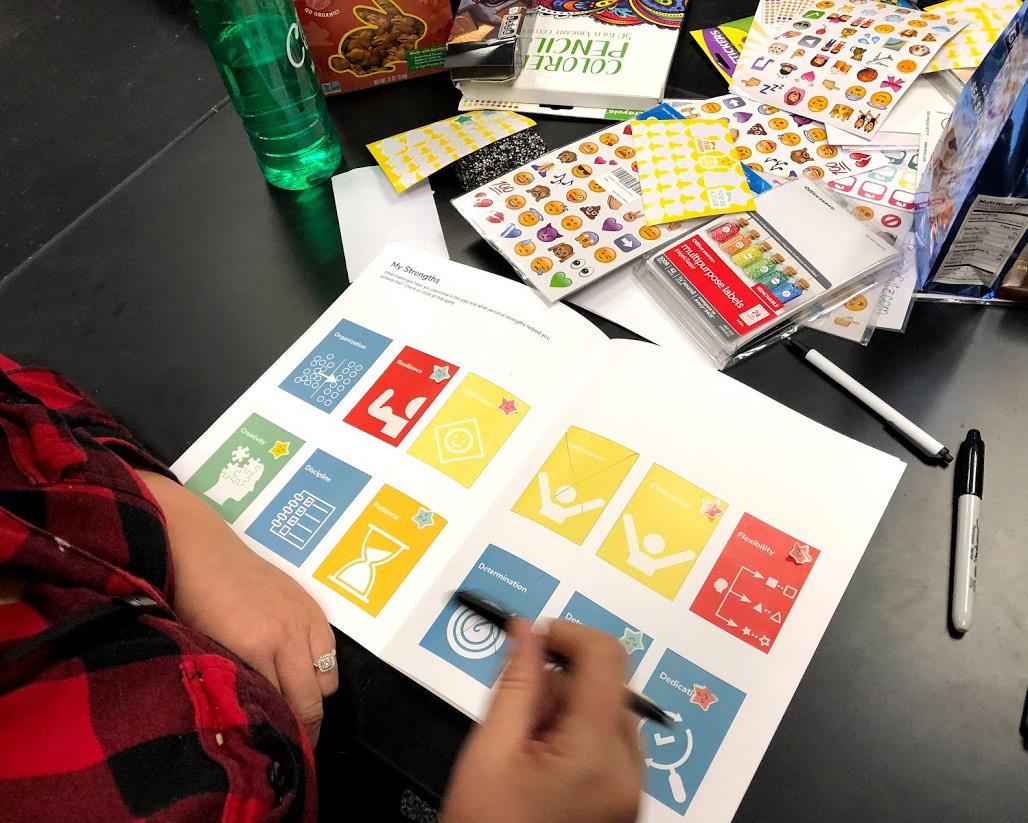
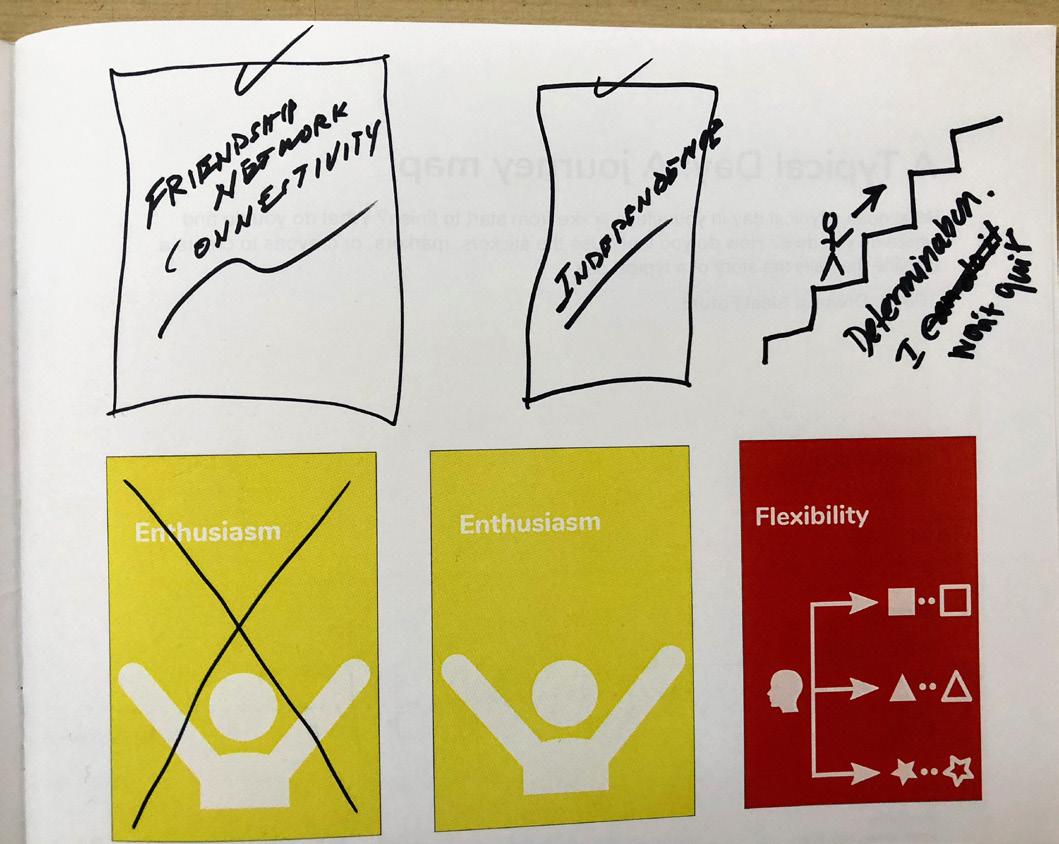
2nd iteration: Strengths prompt cards (Martin et al, 136): The list of prompts from the mind mapping activity were used to develop a set of prompt cards.
62 Method: Prototyping cont’d Understanding current health behaviors: Journey Map Activity (Sanders, 54):
A higher fidelity version of the journey map was created.
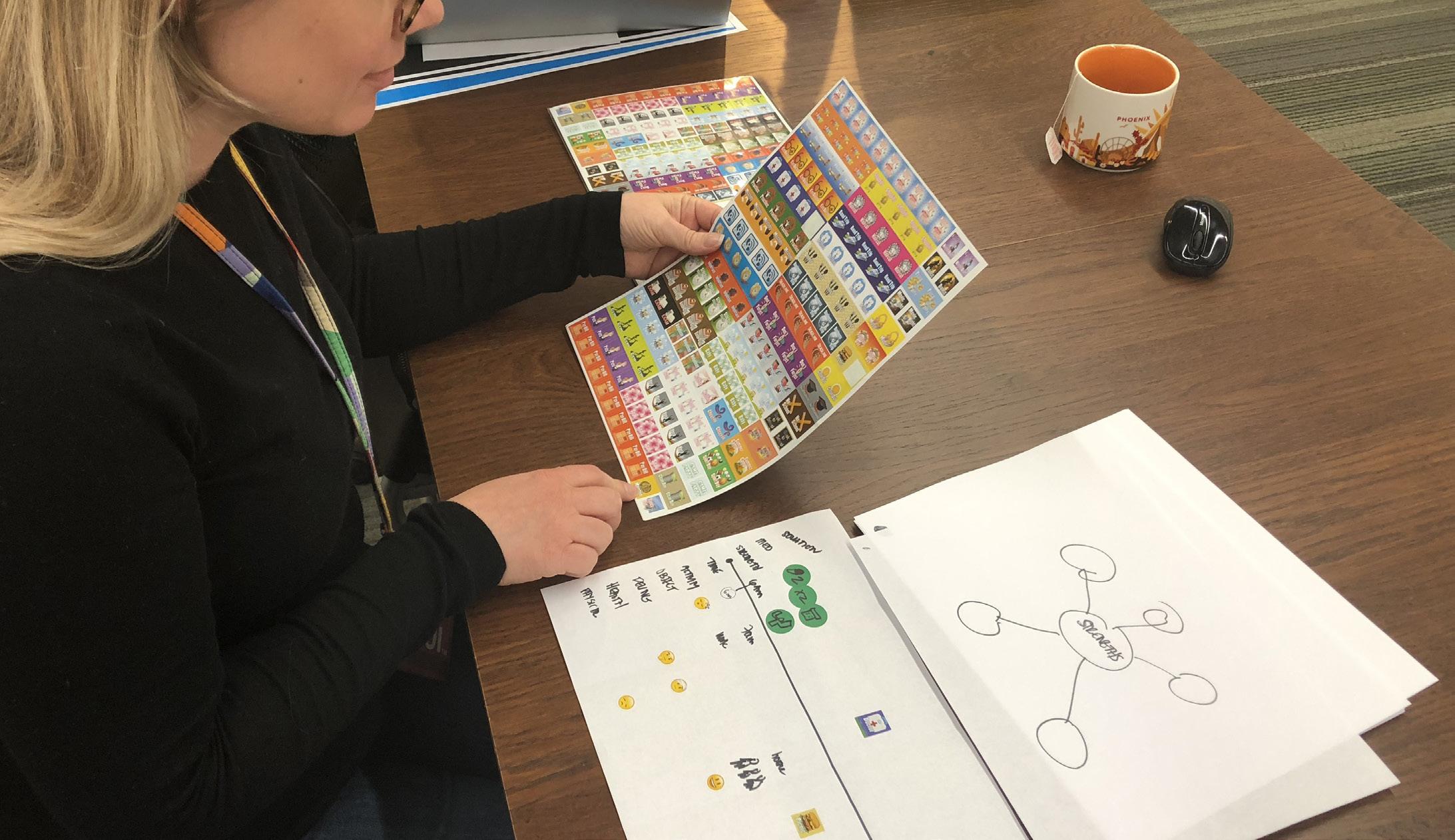
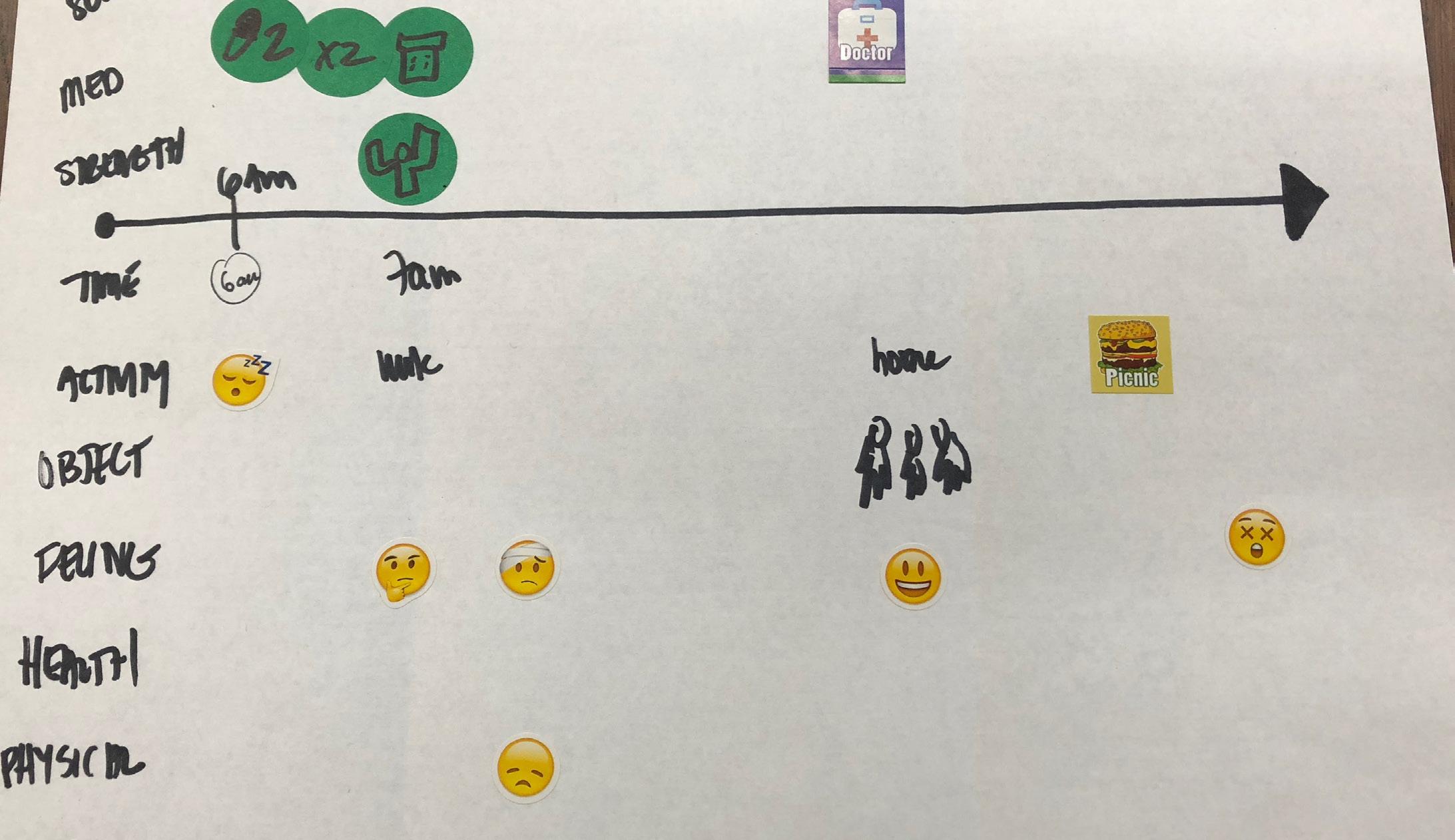
1st iteration: On printer paper, handwritten. The objective of this journey map activity was for a patient to be able to communicate and objectively observe what a typical day in their life is like. As journey maps often comprise a timeline with various categories plotted along the timeline, the POEMS observation framework (101 Design Methods, 104) which allows a researcher to study people, objects, environments, messages, and services, was added to the journey map as a prompt for patients to objectively communicate their daily life experience. Icon stickers representing various life activities were purchased for this iteration with the intention of having patients sort the icon stickers and place them on the worksheet at various touchpoints to develop a picture of their current life including habits, thoughts, emotions, and health experiences.
2nd iteration: Digital version
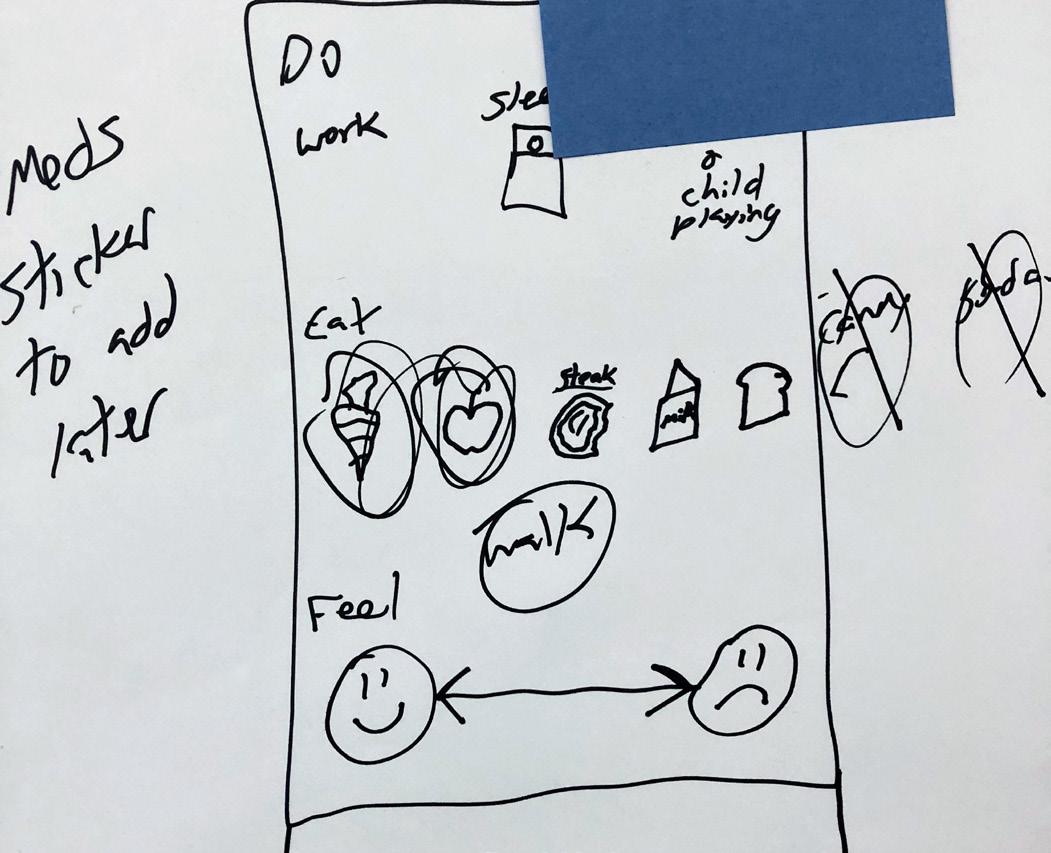
Stickers representing typical daily health behaviors were used for journey mapping during the early prototyping stage. The visual nature of the stickers was intended to make the toolkit activities more accessible to all literacy levels.
63 Research
A solution focused activity was generated from selected questions from the book 1,001 Solution Focused Questions, Handbook for SolutionFocused Interviewing. This book was written on the premise that clients “have the inner resources to construct highly individualized and uniquely effective solutions to their problems.” (Bannink 2006, xi) As solution-focused strengths-based initiatives have been proven effective in supporting health literacy these questions are useful for helping patients construct solutions to improve their health. While these questions would serve as interview questions, Sanders demonstrates in her book Convivial Toolbox that turning questions into open ended statements to be filled in by the participant results in a generative tool capable of eliciting deep emotions, dreams, and desires.
My best hopes are_____________________________.
Instead_______________________.ofthishealthcondition,
1st iteration: A good outcome for me would be __________________________.
When I have reached my goal, my life will be different because I want to see make it easier for me to accomplish these goals. My dream life looks like_____________________________. My dream health state is personal strengths
________________________. _______________________would
The solution focused open-ended statements, also called “Goal setting” were developed into a worksheet with the following statements:
____________________________________. My
are______________________________________.
64 Method: Prototyping cont’d Identifying Solutions: Solution Focused Prompt Worksheet: (Bannink, 151-153)(Sanders, 45)
Research
Understanding future health behaviors: Future Journey Map Activity (Sanders, 54):
6565
1st iteration: In order to allow patients to integrate new health behaviors into their current life experience, prompts for an ideal future state were added to the top portion of the journey map activity. The bottom half comprised the current state, and the top half the future. The intent was for the patient to be able to look at the current life experience and evaluate where and how new, doctor prescribed health behaviors could be added. Patients will sort the icon stickers and place them on the worksheet at various touchpoints to develop a picture of their ideal life including habits, thoughts, emotions, and health experiences. Doctor driven solutions will also be added as stickers and available for incorporation in to the ideal future.
Strengths stickers will also be included.
66 A low fidelty prototype helped demonstrate how a daily life journey map might help patients express their current or future health behaviors.
Output: A health literacy development toolkit, first prototype (see Appendix) This toolkit prototype is ready to share with potential end users to gather feedback and additional ideas for further prototyping.
In order to scaffold patients through a design process that would empower them to be active agents in designing their own health outcome, the generative tools were then placed in an order that would allow a patient to first explore their current strengths and health behaviors before receiving a diagnosis or information about their condition. Then, after receiving a diagnosis, a patient would then focus on the ideal or preferred future state by focusing on solutions and choosing new health behaviors in their future journey map. Also, as the generative tools were intended to be used in a clinic setting, the usability in this setting was considered. Instead of having multiple, separate activities requiring separate, loose sheets of paper that could become complicated to use and keep track of in a clinic setting, the various activities were compiled into a workbook form, or toolkit.
67 Research
Application:
To answer the research sub-question, the toolkit comprises generative tools to help patients express strengths (prompt cards), goals (open ended solution-focused statements), and current and future health behaviors (visual journey map).
68 How might patients toempoweredbeactupon the health information they receive?
69 Research How might patients align their goals with their strengths and healthappropriate information?
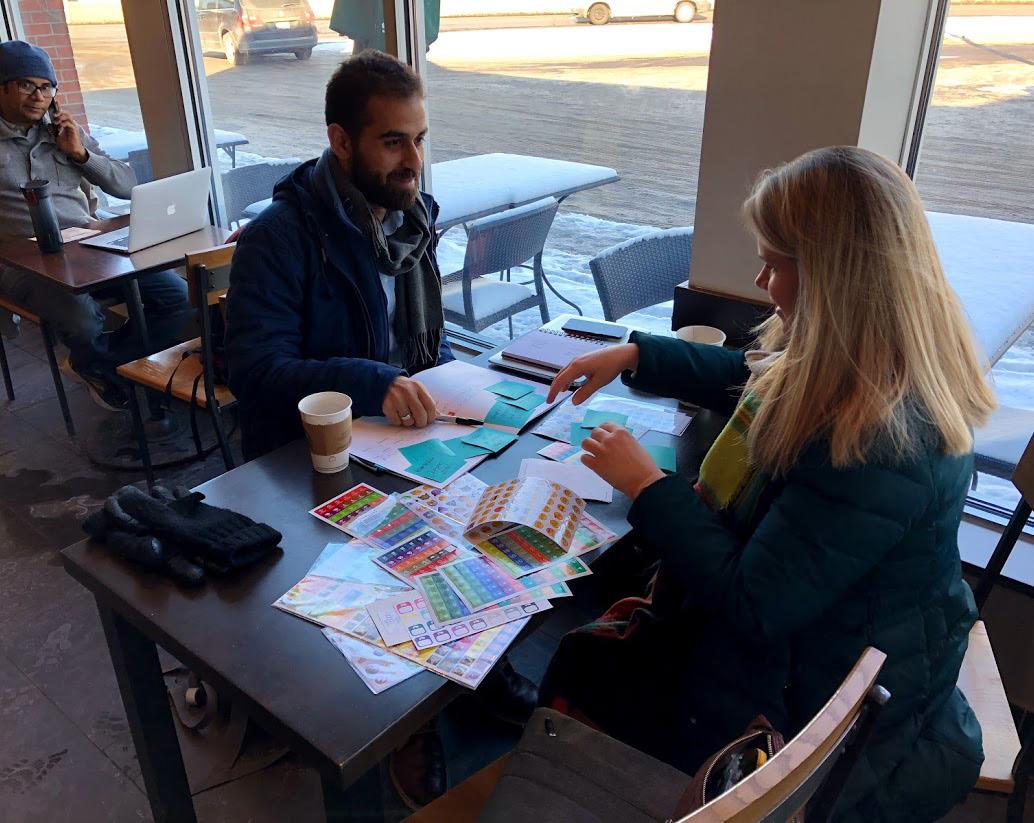
As access to the clinic and patients was not possible at this point in the design process, it became necessary to look for surrogates to participate in the design process and further develop the toolkit prototype. Surrogates are used when it is not possible to contract the end users for the participatory design process.92 Surrogates were found who could participate to serve in the interests of those who would be the end users of the design.93
70
Method: Think Aloud (Martin et al, 180)
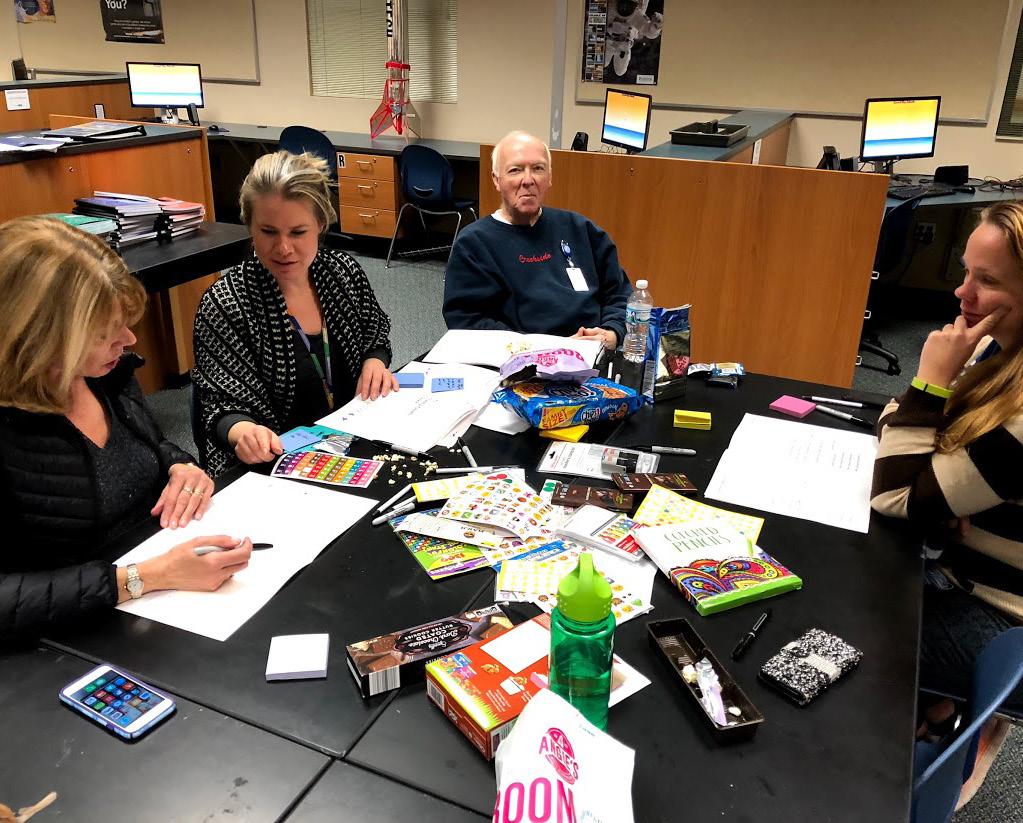
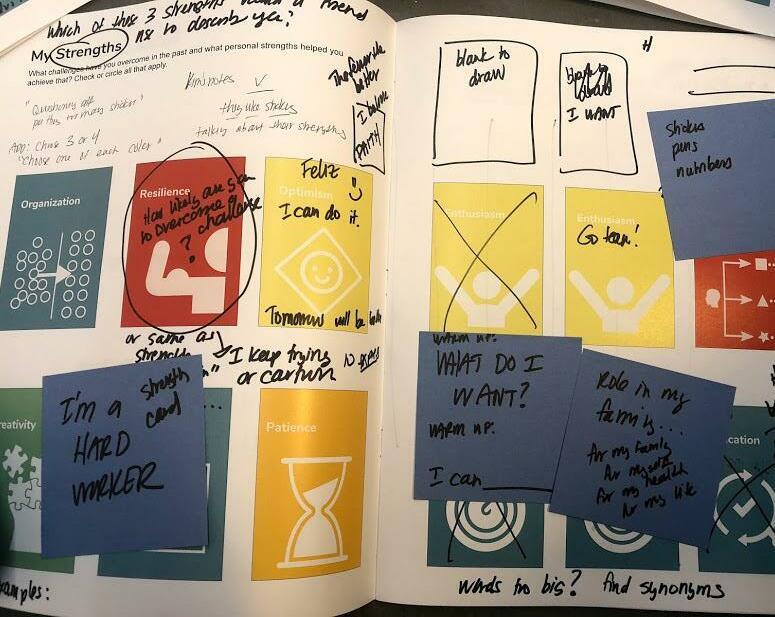
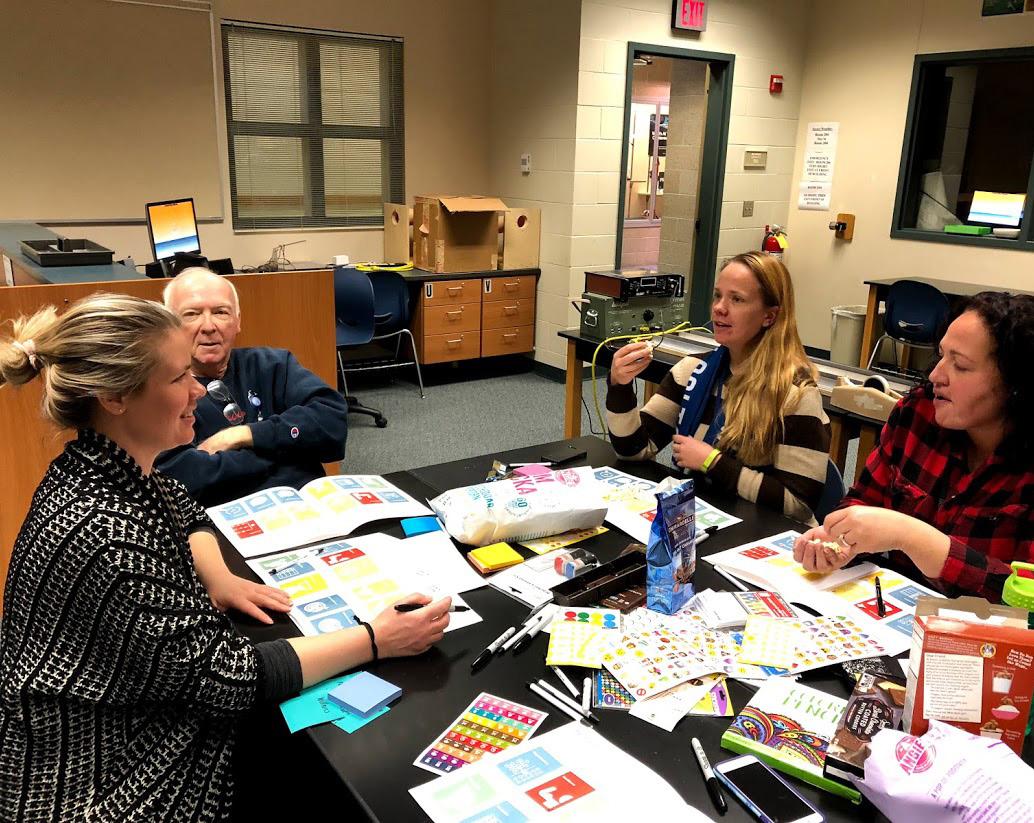
Surrogate participants were asked to go through the toolkit prototype and engage with the activities as if they were patients themselves. They were given sharpies and post its and asked to write down thoughts, feelings, or suggested changes to the toolkit as they moved through the toolkit. Each session was also recorded using an iPhone voice recorder.
Stage 2 Steps 4 and 5 Expert Evaluation and Idea Finding
The surrogates chosen were the Clinic Chair, who could serve in the interest of both the clinic’s health care providers and patients and provide insight into the content and usability of the toolkit, and a group of five middle school teachers, who are experts in developing materials to communicate at a 5th or 6th grade reading level as preferred for health literacy materials. Of the middle school teachers, four of the five were women, two were bilingual, one of whom was an immigrant. Two of the five had previous experience volunteering as interpreters in a health care environment that serves disadvantaged populations. This group of teachers could serve to provide insights into developing activities and communications to engage and reach a low-literate audience.
Surrogate participant feedback was collected and key data points that had been written on post its and in the toolkits themselves were noted on color coded post-its according to type of participant. The voice recordings were transcribed and each key data point from the recording was also written on a post it. One all post its were on a whiteboard, they were organized and arranged according to likeness and patterns and themes emerged.
Output: The combined feedback received resulted in a further developed toolkit prototype ready for clinic testing and evaluation.
71 Research
Method: Affinity Mapping (Martin et al, 12)
Application: Participants had input and suggestions on how to help patients align goals and strengths with health information. Suggestions included moving the future journey map to the back page of the toolkit and to make it detachable. The ideas stemming from that included being able to tear the back page off to be able to look at the old journey map at the same time as filling out the new one. It was suggested to leave a space for patients to note their goals as well as their strengths on the future journey map so they could be reminded why and how they are going to be motivated and empowered to make health behavior changes. Surrogate participants also pointed out that the positive nature of the toolkit would be important in empowering patients to make health behavior changes. The removable back page could also be removed and taped to a refrigerator as a reminder of their goals, and also as a way to communicate with family and friends.
Think Aloud method
The generated for and how it might help with
improving the toolkit
health behaviors. This feedback was affinity mapped to make sense of the large amount of feedback.
72
patients align their strengths and goals
multiple ideas
73 Research
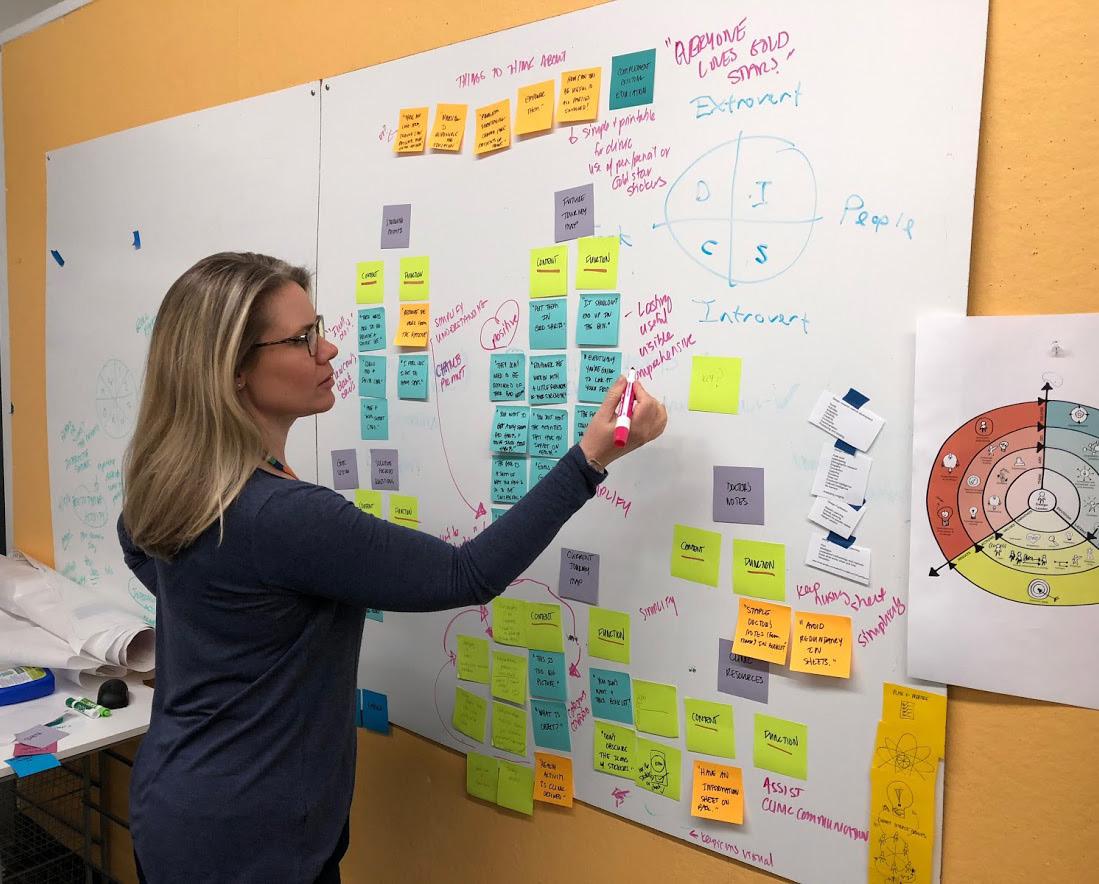
74 Useful Toolkit Expert Feedback: Affinity Grouping Empowering The Simple Move journeyfuturemap to back of toolkit Staple nurse’s sheet in toolkit Include info sheet about clinic and partiesusefulNeedsresourcescommunitytobetoallinvolved Make it visually simple for them Avoid redundancy in sheetsYou don’t want a thick booklet “This journey(blankmap) is too big picture.” Remove work from user Visual journey map instead of stickers Ask women role in family Strengths on side of future journey map, goals at top Make fridgeCandetachableseparate,sheetbetapedto“Itshouldn’t end up in the bin.” Ask whatwomentheywant Have them turn smaller steps into bigger goals Goals should be at top of future journey map Empower women with a reminder of their strength ContactWebsiteinfo existingComplementeducation “The back is a sum of what you have to do to be successful.”
75 Grouping InsightsEmphasize Support toolkit should be... Positive Clearly Prompted Patients should identify people who will help with plan Include focus on having a social network and finding support in toolkit Needs substancespromptsvisualfor Health activity is clinic defined Strengths prompt: How would family or Choosedescribe?friend3 Use gold stickers to reinforce good choices in journey Focusmap on the good habitsMake it easier for them to talk about themselves Simplify prompts with descriptions “I feel like I put too manyMakestars.”understandable Add faith prompt card “What ‘object’?”isGoal setting: “I would down.”scaffold Journey map: when do you feel your Worst?best? “You’re eventually going to have to look at your fridge.” promptStrengthscard for friendship Prompt in future journey map for identifying people for support “They don’t need to be reminded of their bad habits.” Get away from bad habits and move into good habits Put them in good spirits
76 What does the current, existing health ecologicalliteracy model look like at the IU School of OutreachStudentMedicineClinic?
77 What are the health needscommunicationinformationwithin that system? Research
As generative tools to support health literacy were iterated and evaluated, more information about the needs health literacy tools needed to meet became evident, even reflecting the literature that prompted its development to begin Therefore,with.this stage of the research process moved back to the Fact Finding step of Phase 1. Answering these research questions involved discovering and understanding facts about the clinic as opposed to finding ideas to develop the toolkit. Yet the facts that were be uncovered and analyzed helped to determine how the toolkit prototype could fit into the clinic’s health literacy ecological model by enhancing the communication at as many levels as possible while serving the communication needs of the system.
Stage 1 Step 2 Fact Finding
78
Utilizing the Simplex design process during this research project allowed for flexibility. Initial research plans required adaptation due to unforeseen delays in clinic access. Yet the research process could continue to iterate, prototype, collect data and ultimately develop a solution to address health literacy needs within the Indiana University School of Medicine Student Outreach Clinic while continuing to understand more and more about the problem. This “co-evolution of problem and solution,” as discussed by Nigel Cross in Designerly Ways of Knowing, allows a designer to explore a problem space, in this case using generative tools to support health literacy, while concurrently discovering pieces of the solution through continuously moving forward. This forward moving, symbiotic cycle of solution development and problem discovery eventually leads to a “matching problem-solution pair.”94
Method: Data Collection Tool Development (Kumar, 104) A data tool was developed to help organize observations made by the researcher during the immersion. Based on a POEMS Observation template, which allows a observer to organize observations according to People, Objects, Environment, Messages, and services, the data collection tool was adapted to focus on the communication and delivery of health information.
The data collection tool was designed to help observe who was delivering health information, how and when health information was being delivered, in what environment the delivery was taking place, and what was being said. The researcher’s emotions were also incorporated as well as time spent at various touchpoints and ideas on how the toolkit could be used at various points throughout the journey.
Method: Immersion (Martin et al, 60): The purpose of an immersion is to experience a particular service, product, or system first hand. Empathy-building in nature, this process can also afford deep insights to the user experience.
79 Research
80 Immersion Data Collection Tool: FeelingsIdeasObjectsTouchpointMessagesTimeEntityMode state, community, clinic, Understandingweb,paper,whiteboard,communicated?beinginformationwhathere?communicateopportunityisfamily,provider,friend,etc.thereantohealthispamphlet,app,etc.a patient’s interaction with health information within an ecological health Used Available Used verbal written visual verbal
81 health literacyAvailablemodel. Used Available written visual verbal written visual Research
82 source: L.McCormack et al 2017,9FamilyIndividualNursingMedicalClinicCommunityandFriends The clinic’s ecologocal health literacy model includes support from family and friends.
Output: A patient journey map that communicates how the patient engages and interacts with the environment, people, and objects in the clinic as well as the messages communicated in verbal, written, or visual format. (Universal Methods of Design, Martin and Hannington196) An understanding of the health literacy ecological system was also gained. The health literacy ecological model consists of an individual level, interpersonal with providers, organizational with the clinic, and community with services such as health insurance company and legal representatives. Health information communicated involved diet, exercise, and emotional needs.
83 Research
The understanding of the clinic’s health literacy ecological model provides insight into the various levels of health communication and how the toolkit can be used to support patients through more than one avenue for support. The toolkit can communicate clinic health information, community-based information such as services provided, such as sources for health insurance, and provider health information regarding diet, exercise, and medications. Also, the toolkit could be used to communicate the patient’s needs with family members.
Application:
84 A Health Literacy Journey Map: KeyTime Check-in Wait ScreeningNurse 1st Year MedWait PT Kim 9:45 9:50 10:15 10:30 10:34 11:47 EntityTouchpointMessagesClinic Social WorkStudentNursing 1st/2nd yr Med Student 3rd/4th yr Med Student Written Visual Verbal Mode IdeasCommunicationof is there opportunityan here?communicateto servicesTimmisocialmedicaloffered:nursingworkPTpharmacyGlobalHealth screened for health and life issues this would be a good time to identify strengths and current journey identifying strengths first would have helped me feel more confident at this point a clear picture of my current habits would help me communicatehere many patients are here with friends servicesfamilyoroffered:medicalnursingsocialworkPTpharmacyTimmiGlobalHealth exercises to help me alleviateappsresuorcessymptomssuggested spoke about women’s concerns, weight gain Understanding a patient’s interaction with health information within an ecological health literacy model.
85 3rd Year MedWait Wait Clinic Doctor Social Work Check Out 12:15 12:47 1:06 1:15 1:40 1:55 goal oriented questions would work here future journey map communicateusedhere?towithfamilyathome? include info in toolkit as part ecosystem?of future journey map here? Wall postersl “I will take my meds, cook for her toight” shows how health enables to care for loved ones activitiesmonitorto nurse educationalprovidedhandoutsondiet,exercisewomen’sissues finalanddiagnosisplanofaction resources for health insurance instructionssheetreceivewithandplan
86
At this stage of the design process it became clear that the IU School of Nursing representatives at the clinic would be key players in testing, evaluating, further prototyping, and eventually implementing the health literacy toolkit. It was now time to obtain their buy-in. The clinic’s Nursing Chair and Vice-Chair were contacted and a meeting was quickly scheduled.
At the meeting, two tools were used to facilitate the conversation- the toolkit and the immersion patient journey map, and the design processes of diverging and converging were once again used to facilitate this step of the design process.
Then, to assist the Nursing Chair and Vice-Chair in making sense of how the toolkit could fit into the clinic patient experience, they were presented with the immersion journey map, which communicated when, how, where, and with whom the toolkit could be used to support the development of health literacy.
Method: Think Aloud (Martin et al, 180)
Output: It was decided to have the nursing students run the current toolkit prototype with their patients the following day and not to develop the prototype further until additional feedback had been obtained.
Stage 3: Step 7 Gaining Acceptance
The chair and vice-chair were first walked through the toolkit, step by step, though the same think aloud process as previous surrogate participants.
87 Research A Think Aloud helped the chair and vice-chair openly express their thoughts, feelings, and ideas regarding the toolkit and how it might benefit clinic patients.
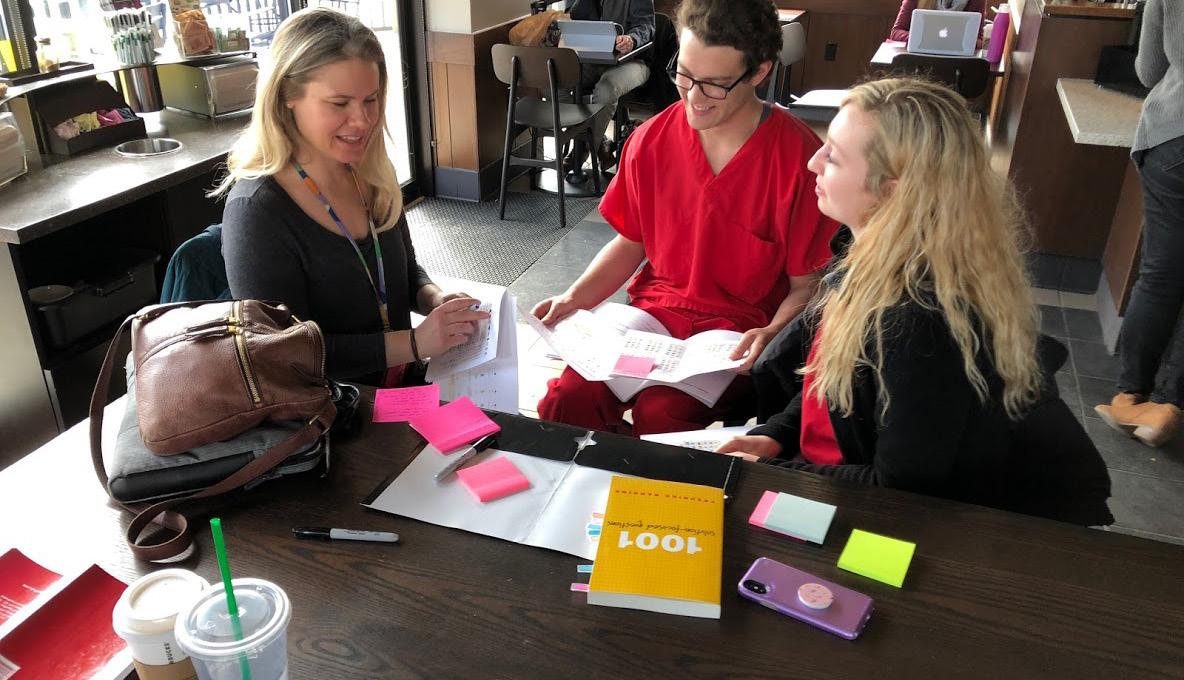
88
89 Research How might generative tools support women’s and immigrants’ health literacy withindevelopmentan healthecologicalliteracy environment ?
Do you feel that this toolkit could empower patients to make decisions/take actions to improve their health? Why or why not?
Method: Nursing Exit Interviews (Martin et al, 102)
Method: Nursing Toolkit Implementation (Martin et al, 120):
90
Prior to the clinic opening, the toolkit was presented to nursing students on duty that day with a brief orientation as to the toolkit’s purpose and use. The instructions were intentionally simple as to test the intuitive use of the toolkit.
Stage 2: Steps 4 and 5 Idea Finding and Evaluating
Nurses who had used the toolkit with patients were asked to complete an exit interview sheet comprising the following questions:
Nursing students with toolkits were shadowed and observed using the toolkit to understand how the toolkit fits into the natural flow of the patient and nursing experience. Provider-patient interaction was observed and evaluated for the toolkits ability to spark conversations easily. Provider and patient response to the toolkit was noted. All these key data points were noted in the researcher’s own toolkit at specific points of toolkit use.
Did the activities support patient provider communication? Why or why not? Did the toolkit affect the delivery of health information? Why or why not? Did the patients’ understanding of health information and healthy behaviors improve? Why or why not?
Do you feel that this toolkit could be useful for you as a practitioner as well as your patients? Why or why not? Was this toolkit easy to understand and use? Why or why not? What worked or didn’t work? What would you keep or change?
A nursing student engages a patient in the future journey mapping portion of the toolkit. “This is going to keep me focused,” said the patient.
91 Research
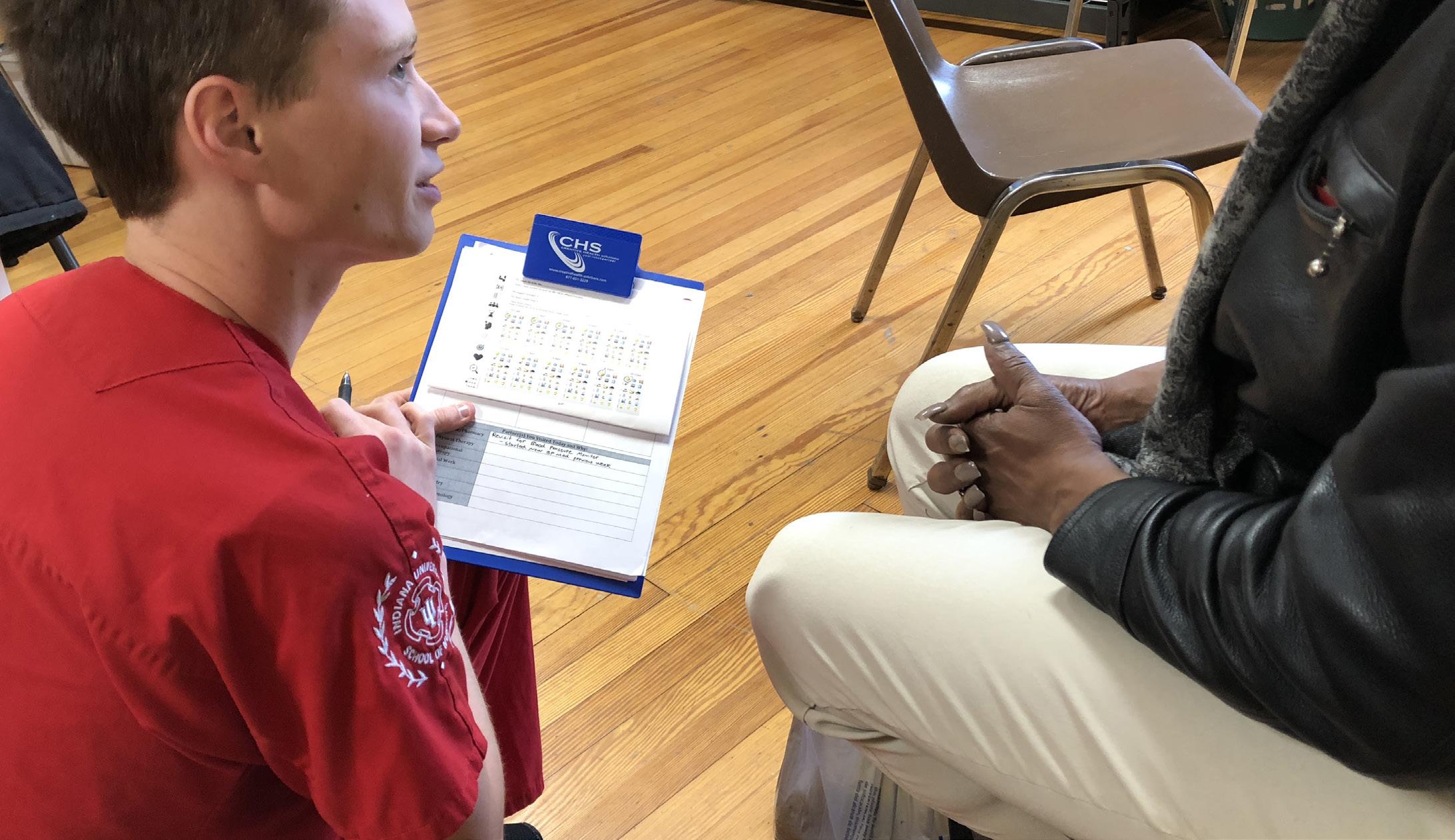
Strongly Agree Agree Neutral Disagree Strongly Disagree
I know where to find health information when I need it.
I understand my health condition.
I understand what actions I can take to improve my health condition.
Method: Patient Surveys and Exit Interviews (Martin et al, 102)
Strongly Agree Agree Neutral Disagree Strongly Disagree
Strongly Agree Agree Neutral Disagree Strongly Disagree
Overall, how did you feel about using the toolkit?
Do you feel the toolkit activities are useful for you? Why or why not?
Of the 8 patients who completed a toolkit, only 4 surveys were completed, due to patients leaving the clinic prior to actually concluding their visit. Survey questions were as follows:
Surveys were previously developed to gauge a patient’s increase in understand of health information. The survey was written as a short series statements and responses on a Likert scale. Statements were based off of the definition of health literacy and gauged the understanding of health information and the ability to take action before and after toolkit use. The post survey was also followed by an exit interview on the same sheet.
Did the toolkit activities help you feel capable of taking actions to improve your health? Why or why not?
Strongly Agree Agree Neutral Disagree Strongly Disagree
92
Were the toolkit activities easy to understand and use? Why or why not?
I received information from my health care provider that helps me make health care decisions.
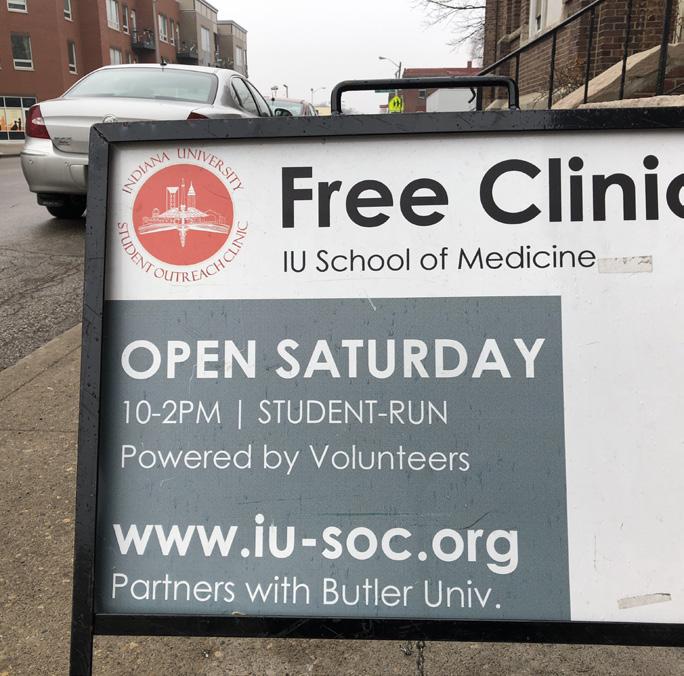
Informal, impromptu interviews were conducted with a nursing professor, who serves as a faculty advocate for the nursing students and also has a deep desire to serve the people of the community through the clinic’s services, and the church director, who is a patient advocate with deep knowledge of the surrounding community, in order to get feedback on the toolkit’s usability, appropriateness to the culture, environment, and people, and also feedback on its content. An interview with a small group of nursing students was also completed after testing the toolkit with their patients. Nurses using the toolkit were also engaged during their downtime to get feedback.
In order to make sense of such a large quantity of qualitative data, all key points from the collected surveys, interview transcripts, exit interviews, observation notes, and notes on completed toolkits were written on post its and affinity grouped on a large wall to look for patterns and insights. Pre-determined categories that emerged from the expert feedback session were used as a starting point to evaluate the toolkit’s simplicity, usefulness, positivity, and ability to engage, empower, and support. Within each grouping the data points were also sub-grouped according to sub-categories as well as positive and negative experiences or feedback with the toolkit and new ideas for further use or development.
Research
93
Method: Affinity Mapping (Martin et al, 12)
Method: Stakeholder Interviews (Martin et al, 102)
94 Affinity mapping data colelcted in the clinic through interviews, observations, and surveys allowed for common themes to emerge and provided valuable insights into the toolkit experience.
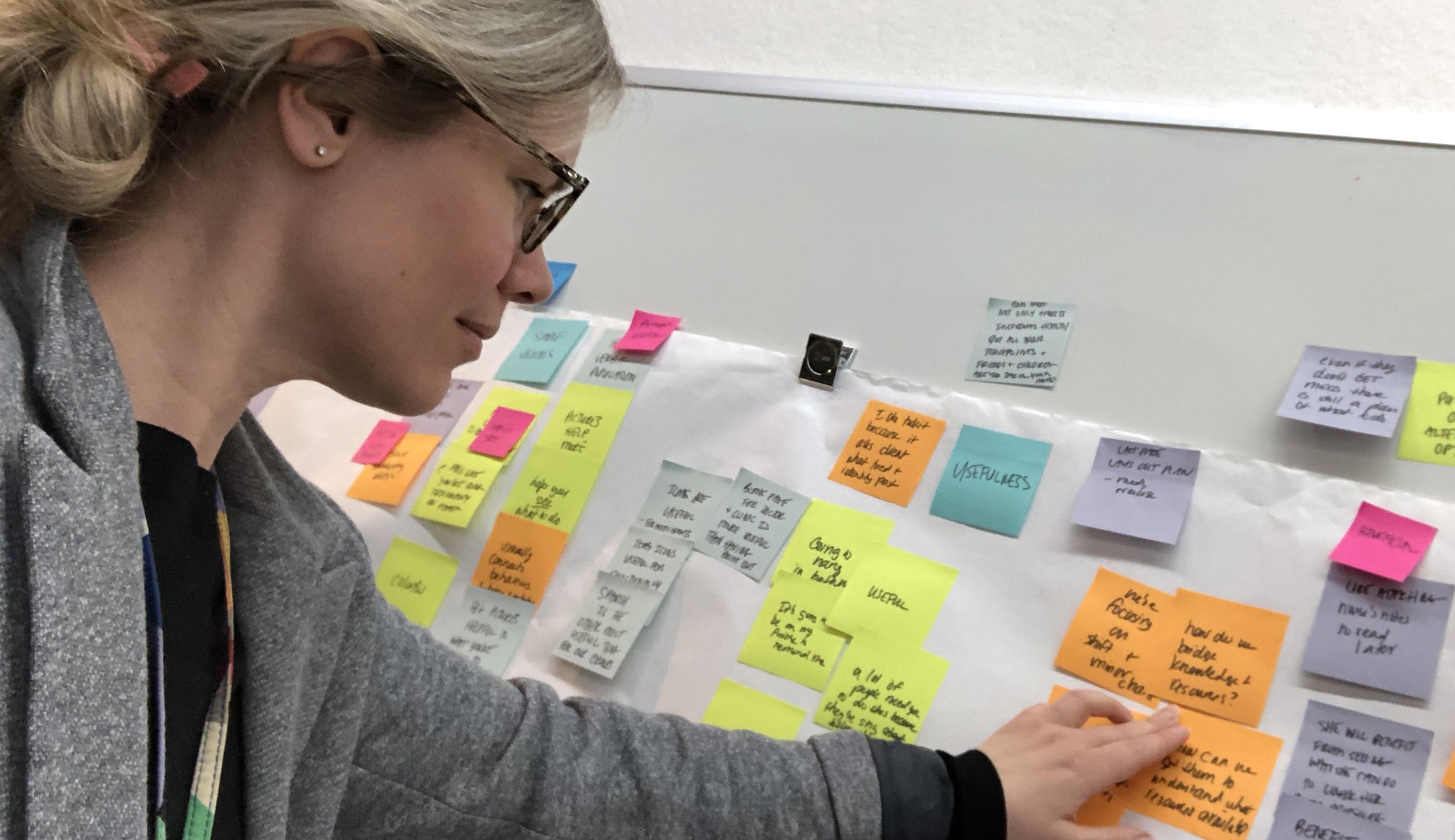
Overall, the simplicity of the generative toolkit, and the clear prompts, allowed for easy engagement for nursing students and patients. The positive tone of the toolkit activities made patients feel comfortable enough to open up and share more with nursing students. Nursing students were then able to learn more about the patients and more quickly build rapport. The ability for the toolkit to develop allow for patient participation and facilitate conversation between two people on a level playing field allows for both sides to better understand each other and collaborate to understand the current health situation and how to move forward towards a healthier one. The toolkit’s involvement of social and community support also fosters collaboration to improve patient outcomes and support new health behaviors. This multi-level collaboration serves to empower patients to move forward knowing what to do to work towards their health goals.
Research
95
Output: This prototype will be available for further testing and implementation.
Application:
An additional toolkit prototype resulted from the suggestions and insights collected during clinic testing. Also, from the data collected during the clinic visits, a picture fo how geenrative tools could support healt hliteracy could be formed.
96 Toolkit Stakeholder Feedback: Affinity Simple PositivePromptedClearly “Made sense to me, easy to understand.” “She was flying through it.” Easy and simple to understand and quick to use .”It was explained and demonstrated to me.” Pictiures help more, helps you see what to Toolkitdo laid it out for Visual,patient no tjust words on a discharge paper Timeline helps elicit more accurate answers Visualize what it looks like Soothing, supportive, Patient’s nursingresponsepositivechangedstudentNursingPatient student Nursing professor Church Director “We’re “Toolkitstrengths-based.”veryisincredibly“Thorough and detailed.” Big pictures helpful to what you’re trying to communicate “Not overwhelming.”
Helpplan feel capable of taking action, keep focused, help move forward, keep on track, focus on goals
97 Affinity Grouping Insights Positive Patient Voice SupportEmphasize Empowering supportive, Comfortable enough to open up positivechangedoutlook Learn more about Knowpatienthow to better care for faciitatehealthSeeplacesSeenotPartneringLevelsbuildingRelationship/rapportpatienttheplayingfieldrelationship,paternalwherepatientimportancepatternsinpatientbehaviorandconvo
“It was my truth.”
Helps focus on what patient wants to do Patient left fully knowing what to do
Toolkit helps patients under stand what resouorces are available “I’m going to hang this in my bathroom.” strengths-based.”incredibly friendly.”
Explained everything going on, points in right direction, expains what needs to be done
Not only affects individual health, but all their touch points along the way Community support “We’re communal here.”
Relationships are our currency
Offers problem solving option“Youcan’t do right if you don’t know right. Now you know right.”
Now you have set up the
Collaboration
“Health care is going out of hospitals and into community.” Patient needs a support system
98
99 Research Third Toolkit Draft
100
101 HealthyMy Goals Toolkit Herramienta/ para mis metas de salud Identifying our strengths, goals, and ideal health outcomes. / Identificar nuestras fortalezas, metas y resultados ideales de salud developed by Kimberly Gottschild / Desarrollado por Kimberly Gottschild ++ =
Here’s when to use this toolkit:
102
The copyright owners and publisher of this book appreciate your honesty and integrity and ask that you do not participate in or encourage piracy of copyrighted material. you for your support.
© 2018. All rights reserved.
Scanning, uploading, and/or distribution of this book, or any designs or photographs contained herein, in whole or in part (whether re-drawn, re-photographed, or otherwise altered) via the Internet, CD, DVD, E-zine, photocopied handouts, or any other means (whether offered for free or for a fee) is permissible only within non profit, educational, or community outreach settings. Reproduction for commercial purposes without the expressed written permission from the copyright owners is illegal and punishable by law.
• pharmacy.
• Then, walk through the future journey mapping acitivty on the back page to identify new health behaviors, then have them circle the strengths and identify a person who will help them make new health decisions.
• During initial nurse screening, use the prompts on pages 4-5 to help patients affirm their strenghts. Then help them identify their current health habits using the visual journey map on pages 6-7.
The author and designer of this work grant limited permission to produce derivative works from the ideas and designs contained in this book for use only in non-profit, educational, and community outreach settings. Commercial production of works based in whole or in part upon the ideas and designs contained in this book are strictly forbidden without the prior written permission of the copyright owners.
• Talk with patients about goal setting by using the worksheet on page10 (back cover) during their wait time after seeing the 3rd/4th year med student or resident, or while they are waiting on the
Thank
Purpose of this Toolkit / Propósito de esta herramienta
The purpose of this toolkit is to empower patients to express themselves and connect with their healthcare givers to become active designers of their ideal future. This toolkit provides engaging activities to help patients identify their strengths, future goals, and preferred health behaviors.
103 Table of Contents / Tabla de contenido Identifying Strengths / Identificar MyfortalezasDailyLife / Mi vida diaria Diagnosis / Diagnostico Clinic Resources My New Daily Life / Mi nueva vida diaria 109846
104 My Strengths/ Fortalezas(fuerzas) What three words would a friend or family member use to describe you? Choose 3 or more Cuáles tres palabras usaría un amigo o un miembro de familia para describirte? Elige 3 o más
105
106 12-2am create your own foodmedicalactivitydrinkexercisenotesemotion 2-4am create your own foodmedicalactivitydrinkexercisenotesemotion 4-6am create your own foodmedicalactivitydrinkexercisenotesemotion 12-2pm create your own foodmedicalactivitydrinkexercisenotesemotion 2-4pm create your own foodmedicalactivitydrinkexercisenotesemotion 4-6pm create your own foodmedicalactivitydrinkexercisenotesemotion A Typical Day/Un día típico
107 Circle the activities that you do in a typical day. Circule las actividades que haces en un día típico. 6-8am create your own foodmedicalactivitydrinkexercisenotesemotion 8-10am create your own foodmedicalactivitydrinkexercisenotesemotion 10-12pm create your own foodmedicalactivitydrinkexercisenotesemotion 6-8pm create your own foodmedicalactivitydrinkexercisenotesemotion 8-10pm create your own foodmedicalactivitydrinkexercisenotesemotion 10-12am create your own foodmedicalactivitydrinkexercisenotesemotion
108 Doctor’s Advice / Recomendación del doctor Staple the nurse’s notes here.
109 Clinic Resources / Recursos de la clínica Clinic resource labels go here Long term community resource labels go here Short term community resources written in here
110 12-2am ownyourcreate activity medical food drink exercise notesemotion 2-4am ownyourcreate activity medical food drink exercise notesemotion 4-6am ownyourcreate activity medical food drink exercise notesemotion 6-8am ownyourcreate activity medical food drink exercise notesemotion 8-10am ownyourcreate activity medical food drink exercise notesemotion 10-12pm ownyourcreate activity medical food drink exercise notesemotion 12-2pm ownyourcreate activity medical food drink exercise notesemotion 2-4pm ownyourcreate activity medical food drink exercise notesemotion 4-6pm ownyourcreate activity medical food drink exercise notesemotion 6-8pm ownyourcreate activity medical food drink exercise notesemotion 8-10pm ownyourcreate activity medical food drink exercise notesemotion 10-12am ownyourcreate activity medical food drink exercise notesemotion resources.myuseItrying.keepI okay.bewillitknowI believe.Isupport.findIfocused.stayI calm.stayI it.docanIknowI quit.won’tIway.afindwillI adapt.canI like_____________________________.lookslifedreamMy becausedifferentbewilllifemygoal,myreachedhaveIWhen _______________________. is___________________________________.motivatorbiggestMy __________________________________isstatehealthdreamMy_. ________________________.seetowantIcondition,healththisofInstead and____________________,actions:_______________________,threeThese accomplishtomeforeasieritmake____________________________would goals.healththese 3.Circleyourstrengthsthatwillhelpyou.4.Whowillhelpyou?_______________________ below.blankstheinFillgoals?yourareWhat1. goals.yourreachyouhelpwillthatactivitiestheCircle2.
111
Beginning with the strengths prompts, users reported engaging conversations resulting in a clearer picture of the patient’s life and needs. A patient interviewed reported that the strengths prompts allowed her to feel comfortable tell her truth. Nursing students were surprised at the opportunity to discover more about their patients than during a regular visit without the toolkit, which allowed for a quicker method to establish rapport. The nursing faculty member appreciated the strengths prompts as their ethic is very
The last page of the toolkit comprising goal setting (open ended solutionfocused statements) as well as a future journey map to complete after seeing the medical students was also well received by nursing students, patients, faculty, and the church director alike for its ability to offer a problem-solving option and clearly communicate what can be done to improve health, and
Outcomes
The overall response to the toolkit as a whole and the individual generative tools it comprises was overwhelmingly positive. Users and stakeholders alike appreciated the purpose, usability, and content of the generative tools and found them to be both accessible and engaging.
Thestrengths-based.currentdaily life journey map gave providers an opportunity to discover more about a patient’s current life and health behaviors than would have previously occurred. Nurses reported gaining deeper insight into a patient’s life that allowed them to better understand patient history on the day to day and understand assess their daily health behaviors. Nursing faculty appreciated the current daily life journey map for its ability to identify where a patient places importance in their lives and helps elicit a more accurate picture of their life. And patients felt that it helped understand everything that is going on in their life. Nurses also saw value in the current journey map as it makes a patient really think through what they normally do in a day.
112
Overall the toolkit was reported by nursing students to be easy and quick to use. The toolkit was easy for patients to understand. Big print, clarifying statements on strengths prompts, and visuals played a role in being accessible to a largely verbal population, and the icons felt engaging to patients. “It’s like using technology on paper,” reported one patient. Multiple ideas were collected to improve the toolkit. Ideas for prompts in the journey map were suggested, such as prompts for a sedentary lifestyle, culturally appropriate food options, and prayer. A space for patients to name their own activity was also suggested to personalize the tool. Ideas on how to make the clinic and community page more effective were suggested, such as using labels or stickers with services and resources printed on them to be able to adapt to a patient’s needs.
Barriers to using the toolkit included an initial concern from nursing students that the toolkit would take too long, be too complicated, and add to the paperwork already required. One non-English speaking patient was not able to engage with the toolkit and her son, who was her interpreter for the clinic visit, was visibly overwhelmed by the added activities and was not interested in completing the toolkit. Nursing also reported a lack of depth of the health information provided and that the toolkit could be hard to utilize if the patient doesn’t have a chronic health condition.
Nursing also reported that the toolkit was confusing to some people, but did not indicate how. While some nurses found the way the day was broken down in the journey map, ideas were suggested for simplifying the page to make it potentially less overwhelming, such as only showing six, two hour increments per page. Patient pre- and post surveys indicated that knowledge of their condition did not necessarily improve, yet knowledge of how to take action and move
113 Research
therefore life, outcomes. Nursing students and patients alike reported knowing what health actions to take and what to do. Patient feedback indicated that the tool will help them stay focused and keep them on track with their new health behaviors, helping them to move forward as they feel capable of taking action.
114 forward did. Surveys indicated the toolkit was helpful to them stay focused and move forward.
According to nursing faculty, the feedback indicated that the toolkit supports a partnering relationship between the provider and patient that levels the playing field between the two. The partnering relationship supported by the toolkit facilitates conversation to ask the patient, “What’s working? What’s your ideal situation?” Nursing students also reported that the toolkit allowed them to build a relationship with patients and helped with the interaction between them and the patient as it allowed them to be on the same level with the patient.
Most disciplines in the Indiana University Student Outreach Clinic have student volunteers to serve clinic patients and volunteers are there on their own time and motivated to understand and serve the underserved neighbors of the clinic. The nursing school is the only discipline to require its students to serve four Saturdays at the clinic in a row. This requirement may or may not affect students’ motivation to serve and their openness to using a new health literacy tool. While the faculty, chair, and vice-chair are there as volunteers to serve and are open to change and new methods to continually improve patient-provider, nursing students may come with their own set of motivations and levels of openness to new ideas and methods of engagement. Experience may also play a factor in comfort level in engaging with patients.
Limitations
Based on the clinic testing outcomes, areas for further research to further develop the toolkit and its reach include provider training, establishing and overcoming potential barriers to provider use, patient follow-up and long term use, how to adapt the toolkit to specific health conditions and populations, translating the toolkit into other languages, cultural adaptations, and implementation in non-student-run clinic settings such as other local free clinics.
Areas for Additional Research
115 Next Steps
Research
In collaboration with the nursing faculty, nursing chair and vicechair, the resulting prototype version will undergo another round of clinic implementation and evaluation to determine its use and future implementation.
116 “Now I know what to do.” “We’re very communal here.” “This was my “Thistruth.”is going to keep me focused.”
117 “This again.”togethermetosupposedisputback “We’re very strengths-based.”
118
Ecological health literacy model: Ecological models provide a comprehensive health literacy system to share the burden of health literacy development by spreading the responsibility across macro and micro level systems, rather than leaving the burden to individuals.95
Patient centered communication: a component of patient centered care, which is respectful of and responsive to individual patient preferences, needs, and values and ensures that patient values guide all clinical decisions.98
WHO: World Health Organization IOM: Institute of Medicine
Participatory design: an approach to design that attempts to actively involve the people who are being served through design in the process to help ensure that the designed product/service meets their needs
Participatory Action Research: PAR seeks to understand and improve the world by changing it. At its heart is collective, self reflective inquiry that researchers and participants undertake, so they can understand and improve upon the practices in which they participate and the situations in which they find themselves. The reflective process is directly linked to action, influenced by understanding of history, culture, and local context and embedded in social relationships. The process of PAR should be empowering and lead to people having increased control over their lives (adapted from Minkler and Wallerstein5 and Grbich6).
Empathy: the ability to put oneself in another’s shoes
Shared decision making: a patient and health care provider sharing the health care decision making process
Generative tools: material tools used in participatory design activities96 which afford a glimpse into the hopes, dreams, and ideal futures of the people who will be using the designed product.97
Community Based Participatory Research: “a collaborative process that equitably involves all partners in the research process and recognizes the unique strengths that each brings. CBPR begins with a research topic of importance to the community with the aim of combining knowledge and action for social change to improve community health and eliminate health disparities.100
Health literacy: the ability to engage with and make sense of health care information in order to make empowered personal health decisions
99
119 Glossary
120 1McNeil, Arena 2017, 464 32ibdAltin et al, 2017, 7 4Altin, et al. 2017, 7 “Several scholars and organizations such as the WHO and IOM already propose organizational techniques deemed helpful to identify and support patients with particular health literacy needs. Further, a recent review on purposeful interventions to address the issue of limited patient health literacy conducted by the Commonwealth Fund, also recommends specific measures for primary care.” 5Altin, Sibel Vildan, and Stephanie Stock, 2017, 1 6McNeil et al 2017, 464 7Manganello. Jurkowski, Carbone 2017 8Bhaloo, et al 2017, 5 9Lachance etal 2017, 2 10Bhaloo et al 2017, 5 11Lachance, Kelly, Wilkin, Burke, and Waddell, 2017, 1 12Lachance et al 2017, 2 13Levin-Zamir et al, 2017, 139 14 15Ibd.Mantwill, Sarah, and Peter J. Schulz, 2016, 16Levin-Zamir, Diane, Angela Yee Man Leung, Sarity Dodson, and Gillian Rowlands, 2017, 139 17Levin-Zamir, Diane, Angela Yee Man Leung, Sarity Dodson, and Gillian Rowlands, 2017, 139 18Neuhauser, 2017, 155 19Altin et al 2017, 7 20 2221Ibd.Ibd.Muscat, Shepherd, Nutbeam, Morony, Smith, Dhillon, Trevenal, Hayen, Luxford, McCaffery 2017, 261 23Altin et al, 2017, 7 24Clear Communication 2016 25Seligman et al 2007, 3 26Altin et al, 2017, 2 27Seligman, Hilary K., Andrea S. Wallace, Darren A. Dewalt, Dean Schillinger, Connie L. Arnold, Betsy Bryant Shilliday, Adriana Delgadillo, Nikki Bengal, and Terry C. Davis 2007, 5 28Krist, Alex H., Sebastian T. Tong, Rebecca A. Aycock, and Daniel R. Longo, 2017, 29Seligman et al, 2017, 5 ”Patients emphasized the need for practical advice on how to achieve behavior recommendations in their daily life- the ‘need to do.’” 30Krist et al 2017, 111 333231ibdibdvan Koningsbruggen et al 2016 34Bhaloo et al 2017, “A solution-focused approach positions the patient as expert, concentrating on his/her needs, perspectives, or 35goals.”Bhaloo et al 2017. “ 36McNeil, arena, 2017, 467 37McNeil et al 2017, 463 38McNeil et al 2017, 465 39McNeil et al 217, 466 40McNeil et al 2017, 468 41ibd 42Alcaraz et al 2016 43Bhaloo et al 2017, “Therefore, one factor may inspire a patient to adhere, but multiple factors may be instrumental in sustaining that motivation over the long term.” 44Bhaloo at al 2017. 45Mccormack, Lauren, Veronica Thomas, Megan A. Lewis, and Rima Rudd, 2017, 1 46Neuhauser, “Because participatory action research is often a long-term process, it does not always align well with time constraints of many health literacy efforts.” Neuhaser 48Neuhauser 49Levin et al, 2017, 148 50 51Neuhauser D. Levin-Zamir et al, 2017 5352Ibd.McNeil et al 2017, 468
47
121 Endnotes 54 55ibdSanders, “the material components that are used in PD activities.” 56Sanders, “We will be using generative design thinking to address change in the future. The use of generative design tools lets one look forward into the possible futures of the people who will be living, working, and playing there. 57McNeil, WHO defines health literacy as “more than being able to read pamphlets and successfully make appointments” and believes that “by improving people’s access to health information and their capacity to use it effectively, health literacy is crucial to empowerment.” The CDC defines health literacy as “the potential a person has to do or accomplish something. Health literacy skills are those people use to realize their potential in health situations. They apply these skills either to make sense of health information and services or provide health information and services to others.” 58McCormack 2017 59 60http://soc.medicine.iu.edu/about-us/ ibd 61ibd 62Sanders, et al, Convivial Toolbox, “The generative tools approach is a way to explore ideas, dreams, and insights of the people who will be served through design.”(20) 63Sanders et al 2012, 48 64Sanders et al 2021, 49 65Sanders et al 2012, 66 66Sanders et al 2012, 67 67ibd 68ibd 69Sanders et al 2012, 68 70Sanders et al 2012, 69 71ibd 72Sanders et al 2012, 66 73Sanders et al 2012, 70 74Sanders et al 2012, 73 75Burnett, Evans 2017 xvi 76Burnett, Evans 2017 xx 77Burnett, Evans, 2017 3 78Burnett et al 2017 xxi 79Burnett et al 2017, 9 80Bhaloo et al 2017, “A solution-focused approach positions the patient as expert, concentrating on his/her needs, perspectives, or 81goals.”Bhaloo et al 2017. “ 82Bhaloo et al 2017 83Bhaloo et al 2017, “Recognized for its shift from limitations to possibilities, a solution-focused approach concentrates on strengths.” 84Bhaloo et al 2017 85Zhang, Franklin, Currin-McCulloch, Park, Kim, 2017 86Zhang et al 2017 87Zhang et al 2017 88van Koningsbruggen et al 2016 89van Koningsbruggen et al 2016 90Basadur, 1994, xix 91Basadur 1994, 72 92Nelson, et al 2012, 242 93ibd 94Cross 2006, 102 95 96McCormack,Sanders,“the material components that are used in PD activities.” 97Sanders, “We will be using generative design thinking to address change in the future. The use of generative design tools lets one look forward into the possible futures of the people who will be living, working, and playing there.” 98Altin et al, 2016 99Baum, et al, 2006 100Minkler, 2003
122 Alcaraz, Kassandra I., Jamilia Sly, Kimlin Ashing, Linda Fleisher, Virginia Gil-Rivas, Sabrina Ford, Jean C. Yi, Qian Lu, Cathy D. Meade, Usha Menon, and Clement K. Gwede. “The ConNECT Framework: a model for advancing medicine to foster of Behavioral Medicine 40, no. 1 (2016): 23-38. Research September 18,
2017. gov/institutes-nih/nih-office-director/office-communications-public-liaison/clear-communication.ClearKnopf,Burnett,18,Withliams,Brunk,Illness,ingBhaloo,NewBannink,cles/10.1186/s12913-016-1693-y.vicesdecision-makingAltin,cation-health-education-and-health-literacy/.cine.ingAllen,tunities_for_Future_Scholarship&p=DevEx,5062.1.net%2fpublication%2f303394948_The_Status_of_Health_Literacy_ResF&rd=1&h=Hy0rxdpX5ZP2JB1RjeBUBLnZ1PqF1cCrUKn6M7wRYtw&v=1&r=https%3a%2f%2fwww.researchgate.www.bing.com/cr?IG=84E78298E1CC453EB750604A6E19FB14&CID=0650A532D1BB6965326BAE33D0BD686https://earch_in_Health_Communication_and_OpporMarinP.,PhD,ElaineAuld,MPH,RobertLogan,PhD,J.HenryMontes,MPH,andStacyRosen,MD.“Improv-CollaborationamongHealthCommunication,HealthEducation,andHealthLiteracy.”NationalAcademyofMediJuly10,2017.AccessedSeptember18,2017.https://nam.edu/improving-collaboration-among-health-communiSibelVildan,andStephanieStock.“Theimpactofhealthliteracy,patient-centeredcommunicationandsharedonpatients’satisfactionwithcarereceivedinGermanprimarycarepractices.”BMCHealthSerResearch.August30,2016.AccessedSeptember18,2017.https://bmchealthservres.biomedcentral.com/artiFredrike,andIngeDeTaeye.1001solution-focusedquestions:handbookforsolution-focusedinterviewing.York:W.W.Norton&Company,2010.Tajudaullah,MichaelJuma,andChristineCriscuolo-Higgins.“Asolution-focusedapproachtounderstandpatientmotivationindiabetesself-management:Genderdifferencesandimplicationsforprimarycare.”Chronic2017,174239531773637.doi:10.1177/1742395317736372.DebraR.,DNP,APN,FNP-BC,AnnGillTaylor,EdD,RN,FAAN,MyraL.Clark,PhD,RN,FNP-C,IshanC.WilPhD,andDanielJ.Cox,PhD,ABPP.“ACulturallyAppropriateSelf-ManagementProgramforHispanicAdultsType2DiabetesandLowHealthLiteracySkills.”JournalofTransculturalNursing.2017.AccessedSeptember2017.http://journals.sagepub.com/doi/abs/10.1177/1043659615613418.William,andDavidJ.Evans.DesigningYourLife:HowtoBuildaWell-lived,JoyfulLife.NewYork:AlfredA.2017.”Communication.”NationalInstitutesofHealth.July29,2016.AccessedSeptember18,2017.https://www.nih.
in Health ...” 2017. Accessed
science and practice
health equity.” Journal
behav ioral
Aldoory,doi:10.1007/s10865-016-9780-4.Linda.“TheStatusofHealth Literacy
Koningsbruggen,“Indianagi?article=1093&context=chr_symposium&p=DevEx.LB.1,5519.1.NDekuePkdNz7iPFjWFc0&v=1&r=http://escholarship.umassmed.edu/cgi/viewcontent.c8ADD62618716C93169DCCD6042&rd=1&h=V_u1w34NR_IMd7KBF0dKoN-http://www.bing.com/cr?IG=C6A5EF63C6C84813AB34847795D832C2&CID=38C73A2018.University.”AboutUs.AccessedMay02,2018.http://soc.medicine.iu.edu/about-us/.GuidoM.Van,PeterR.Harris,AnjèsJ.Smits,BenjaminSchüz,UrteScholz, and Richard Cooke. “Self-Affirmation Before Exposure to Health Communications Promotes Intentions and Health Behavior Change by In creasing Anticipated Regret.” Communication Research 43, no. 8 (2016): 1027-044. doi:10.1177/0093650214555180. Krist, Alex H., Sebastian T. Tong, Rebecca A. Aycock, and Daniel R. Longo. “Engaging patients in deci sion-making and behavior change ...” 2017. Accessed September 18, 2017. 2017.non-immigrants-AnMantwill,vices-and-use/isu834.&lations:Levin-Zamir,Wiley,Kumar,vention&p=DevEx,5060.1.net%2fpublication%2f317637625_Engaging_patients_in_decision-making_and_behavior_change_to_promote_preM4cmt_b4ojNT7dTj3BY9TNZ15ELbroWdqWi5dCPko&v=1&r=https%3a%2f%2fwww89C3985B64C6D9D3080FE479C6F64&CID=2282F73C958A6C590BB5FC3D948C6D76&rd=1&h=Behttps://www.bing.com/cr?IG=71C-.researchgate.Vijay.101designmethods:astructuredapproachfordrivinginnovationinyourorganization.Hoboken,NJ:2013.Diane,AngelaYeeManLeung,SarityDodson,andGillianRowlands.“HealthliteracyinselectedpopuIndividuals,families,andcommunitiesfromtheinternationalandculturalperspective.”InformationServicesUse.January01,2017.AccessedSeptember18,2017.http://content.iospress.com/articles/information-serSarah,andPeterJ.Schulz.“Doesacculturationnarrowthehealthliteracygapbetweenimmigrantsandexplorativestudy.”PatientEducationandCounseling.October24,2016.AccessedSeptember18,http://www.sciencedirect.com/science/article/pii/S0738399116304906.
123 Cross, Nigel. Designerly Ways of Knowing. Basel: Birkhäuser, 2007. Crouch, Christopher, and Jane Pearce. Doing research in design. London: Bloomsbury Academic, 2015. Manganello, Jennifer A., Janine M. Jurkowski, and Elena T. Carbone. “Empowering Women in Underserved Communities: Using CBPR ...” March 3, 2017. Accessed May 2,
Bibliography
Mccormack, Lauren, Veronica Thomas, Megan A. Lewis, and Rima Rudd. “Improving low health literacy and patient engagement: A social ecological approach.” Patient Education and Counseling 100, no. 1 (2017): 8-13. Accessed September 10, 2017. doi:10.1016/j.pec.2016.07.007. McGee, Jeanne, PhD. “Toolkit for Making Written Material Clear and Effective.” September 2010. Accessed Septem ber 18, 2017.
tionAdrianaSeligman,Amsterdam:Sanders,S0738399115300215.tionKim.Nguyen,mationNeuhauser,andNelson,com/science/article/pii/S0033062017300269.ProgressMcNeil,montefiore.org%2fdocuments%2fHealth-Literacy-ToolkitPart04Chapter01-01-12-2016.pdf&p=DevEx,5062.1.34B46BF8773B6B76&rd=1&h=oycfP0tse-rWVdnnSoh6sSzYeiNYDXVxayNyR6S-Uu0&v=1&r=http%3a%2f%2fwww.http://www.bing.com/cr?IG=C4ECC2A6DAA442B493A7E03CADDE4D49&CID=1D0760F9763D6AF7Amy,andRossArena.“TheEvolutionofHealthLiteracyandCommunication:IntroducingHealthHarmonics.”inCardiovascularDiseases.February16,2017.AccessedSeptember18,2017.http://www.sciencedirect.HaroldG.,andErikStolterman.Thedesignway:intentionalchangeinanunpredictableworld:foundationsfundamentalsofdesigncompetence.EducationalTechnologyPublications,2003.Linda.“Integratingparticipatorydesignandhealthliteracytoimproveresearchandinterventions.”Infor-Services&Use37,no.2(2017):153-76.AccessedSeptember10,2017.doi:10.3233/isu-170829.TamH.,HyunjeongPark,Hae-RaHan,KittyS.Chan,MichaelK.Paasche-Orlow,JolieHaun,andMiyongT.“Stateofthescienceofhealthliteracymeasures:Validityimplicationsforminoritypopulations.”PatientEducaandCounseling.July29,2015.AccessedSeptember18,2017.http://www.sciencedirect.com/science/article/pii/ElizabethB.-N.,andPieterJan.Stappers.Convivialtoolbox:generativeresearchforthefrontendofdesign.BIS,2014.HilaryK.,AndreaS.Wallace,DarrenA.Dewalt,DeanSchillinger,ConnieL.Arnold,BetsyBryantShilliday,Delgadillo,NikkiBengal,andTerryC.Davis.“FacilitatingBehaviorChangeWithLow-literacyPatientEducaMaterials.”AmericanJournalofHealthBehavior31,no.1(2007):69-78.doi:10.5993/ajhb.31.s1.9.
124 Martin, Bella, and Bruce M. Hanington. Universal methods of design 100 ways to research complex problems, devel op innovative ideas, and design effective solutions. Beverly, MA: Rockport Publishers, 2012.
Bibliography
125 Soellner, R., N. Lenartz, and G. Rudinger. “Concept mapping as an approach for expert-guided model building: The example of health literacy.” Evaluation and program planning. February 2017. Accessed September 18, 2017. https:// Wieland,www.ncbi.nlm.nih.gov/pubmed/27771012.MarkL.,JaneW.Njeru,Marcelo M. Hanza, Deborah H. Boehm, Davinder Singh, Barbara P. Yawn, Christi A. Patten, Matthew M. Clark, Jennifer A. Weis, Ahmed Osman, Miriam Goodson, Maria D. Porraz Capetillo, Abdullah Hared, Rachel Hasley, Laura Guzman-Corrales, Rachel Sandler, Valentina Hernandez, Paul J. Novotny, Jeff A. Sloan, and Irene G. Sia. “Pilot Feasibility Study of a Digital Storytelling Intervention for Immigrant and Refugee Adults With Diabetes.” The Diabetes Educator 43, no. 4 (2017): 349-59. doi:10.1177/0145721717713317. Zhang, Anao, Cynthia Franklin, Jennifer Currin-Mcculloch, Sunyoung Park, and Johnny Kim. “The effectiveness of strength-based, solution-focused brief therapy in medical settings: a systematic review and meta-analysis of random ized controlled trials.” Journal of Behavioral Medicine, 2017. doi:10.1007/s10865-017-9888-1.
126
127 Appendix Transcripts 1. Nursing professor 2. Church employee 3. Nursing students
128 1: 00:00 What kind of interest me, what do you teach in your class that relates to this?
Speaker
New Speaker: 00:09 We talk abou tin the didactic, You talk about health behaviors how to facilitate shifts in behavior so the current recommendations that are out talk about rying to incorprate healthy eating or um, shifts in behavior and so like the current nutrition recommendations that are out talk about trying to incorporate more healthy behaviors. And so it used to be that when we would meet with clients we would try to overhaul their whole process and so now we're focusing more on shift and minor changes that lead to bigger change in the long term. and thats a piece of what to what we talk about kind of of globally but for all of these different health behaviors. But then for the clinical research and we talk it out or she, um, and then also how can they engage community and the responsibility for their own house? How can we get them to understand what resources are available? Right. And how can we in the nursing roles, facilitate those crossovers between patient can be, um, community health, healthcare, right? Because that's where healthcare is going out of the hospitals in community. So that the tool kit Alexa show me the other day, it really helps to kind of tie all those things together. And then we're also a very strengths based for, you know, previously in the care approach is very paternalistic. You've come in and you telling your problems and I also believe in what to do and then you go to it and then if you don't, then our problems are your fault. You didn't do what I told you. Right. And so now it's much more of a partnering relationship. We're always trying to come alongside and say, you know, you've been doing life for alot longer than you've been workign with me. So what's working? And then what's your idea of health rather than acknowledging that someone else's idea of health may look very different from my idea of health, great, what's your, what's your ideal situation? And then where are you now and how do we bridge gap with the knowledge and resources that I can offer, if you Give me permission to offer those to you. Right, right, right. So that's sort of the shift that we try to address with our students and traditional students through our experiences. They're having you take care of a population that's probably not been treated well and have very different backgrounds. And so from my observations to kind of attract a pretty homogenous individuals right into nursing school, but we expect them to go out and take care of really diverse population. Yeah. And so if we come in and so part of my research says that is about service learning, empathy in that kind of professional development piece and so how do we, how do we get students to not come in and like have a jesus complex and then we extract ourselves and all of
New Speaker: 05:01 Yeah Speaker 1: 05:08 So does this kind of. Do you think that this can help them meet in the middle?
New Speaker: 05:12 I think so because especially I really liked the timeline because it may be that if I even doing really well and ask really good open ended questions and I'm saying tell me about, tell me about your diet or telling you about your scheduled during the day or you know, I think a lot of times they want to tell you the right answer. And so even with open ended questions, I think we can sometimes get the. I want to give you the right answer answer.
129 resources and we've just become used to that community for leaving them anything lasting
New Speaker: 05:01 Interested. Right. And maybe does it kind of facilitate a conversation between the two because you were saying that they kind of missed each other.
So that's the bigger picture of where I try to help them understand like wherever you're working, be cognizant of what you're bringing to what your clients bringing acknowledged that community was doing before oyu got there there. There may be some things you can write an ad to. And so that's why I really like the tool kit because it asks the client until tried first and doing how can I use those past and identify do well. So do you feel like the tool kit like that would be useful for both nurses and patients in the clinic? Because I think a lot of times we can, as healthcare providers, we can kind of spin her wheels, right, because we, each person comes in with an agenda that patient comes in with an agenda or their solutions that they want to see happen that day, but then we also come in with an agenda and we have a way that we wanted to try to implement the solution in a lot of times you just miss each other and that kind of. You're both trying to find a solution, but the approach is very different and I think that this helps to sort of level that playing field and it makes the healthcare provider aware of, OK, this is where the patient is placing that of the things that are important. And so that helps me to focus in on what they want to do because if we're trying to work on either side of that where can make any progress right? You have to have the buy in from the patient. You have to be speaking to the resources that they have available. Right. And so I think that it is helpful because it makes sense. Visualize what that looks like in the winter and operationalize it with what they've identified.
Speaker 1: 03:16
Speaker 1: 06:53 It will definitely be added. They added.
New Speaker: 06:56 Yeah.
Speaker 1: 05:39 Yeah.
130
New Speaker: 05:39 I say I'm living healthy, but I eat chocolate all day.
New Speaker: 06:56 So you stop for today. When is it that we see this person who's like looking at this and thinking, OK, when I get up I get up and I have a cigarette and then I get ready for work and then before I leave here I'm going to have a cigarette and then when I'm at work and I, you know, I'm feeling busy with my day, you know, I have a lot of time where I'm not smoking but then don't ever make it straight into what. Right. Have a cigarette. Right. And so instead of them having to tell me just in a normal day, I have 15 cigarette, we can look and see like OK, it looks like some high concentration times for you and you smoke are early in the morning and then mid day when you go to that break. So tell me, tell me more about that. And so then for them they're not having to say I smoke 15 cigarettes a day. They're saying they're having to think through, OK, what is it about that time of day?
New Speaker: 06:45 Well, and I think it would be interesting to look at, you know, any pick, any unhealthy behavior like few soda.
New Speaker: 06:29 So yeah, I actually don't have a cigarette on there now. I forgot it. I have one picked out, I caught and then I was like, and then I was like, I don't know where to put it and I, I didn't make a new one again. But.
New Speaker: 05:39 I've heard that twice now, earlier now from you. And we know that in design as well, that what people say, you know, is that ideal version sometimes. Like when we conduct interviews, so we would do this, why we do observations who see me really Redo.
New Speaker: 06:00 Yeah, it's true. I think that that timeline is helpful because it tells the emotional temperature down. Right. And it takes a lot of the, the um, the pressure off because they're just looking through and seeing like what do I do in this span of time, what are my usual activities? And then for me as the healthcare provider, it can sort of look at that and see, you know, I didn't see exactly which I think then it could be really helpful with smoking cessation.
New Speaker: 08:56
Maybe this is when I'm caring for my grandkids and I can't speak from the right. So that helps you to identify, OK, so there are times when they are willing to elevate, you know, the importance and you can work with saying how do we incorporate more first time stream during the day, you know, so it just really helps them to see it also objectively and say, OK, I do smoke a lot and, or hurting me because smoking is an easy example because it's a very subconscious activity, right? Most, most cigarettes or smoke without the person being conscious.
New Speaker: 07:48 And then you can say, now I notice here we've got kind of, you know, you're not really smoking at all, so what's usually going right where you're not able to smoke and then they can say, my employer doesnt allow me to smoke inside or, or whatever.
New Speaker: 09:11 um, do you know what I might suggest is. So we have like sleeping but I think also we look at a sedentary lifestyle, right?
131
So like when are you just sitting like for some people a lot, a large part of their work day sitting or when they get home they just can not like they have it, they've expended all of their energy and so they need that time and what we've found is in reducing the sitting time we can actually see, make improvements in their overall health. So I think if there was a way to maybe incorporate like what are those sitting doing this for you? That was actually one when I did it on myself because I did an immersion here. I did this on myself afterwards and I was like there's no chair. So yeah, because I sit all day and I've seen a decline in my health from that. I have no ab muscles anymore. Every and other things I'm not going to go into right now. But yeah. So I, I, yeah, I see the need for that in there.
New Speaker: 10:43 (get what one? I don't know. I've been talking. I saw him actually I think he went with a male patient so I'm not sure if it's OK. Yes, you did. Everyone's trying. Yeah. )
Is there anything else that you think might be missing? Health wise? Health, behavior wise besides the cigarette,
New Speaker: 10:18 And you might and you might, even if you're, if you havereally astute practitioner, you might be able to see like OK, so when these times when you're really sedentary, it looks like that's also when you're reaching for the soad or the cigarette, you know, if you have an active, I wonder if that would. So when you're kind of trying to help them solve what that client, you could say like, you know, this part of the day it looks like you're really going to
And so if you're calling their attention to that and say, "What do you think that's about?" you know, at the lab will be your mom. I think that that would also be helpful to you.
New Speaker: 10:57 So and then I think you can help them kind of draw some correlations like and then offers, offers problem solving option so we can up and more active. Maybe you won't feel that desire to smoke as much and so well around if we tried that speaker and yeah. And then it would be helpful as they're, as they are the one that they do. So as they are kind of, you could give them an extra one even in say just try one day because
New Speaker: 11:25 that was something that's kind of beyond the scope of my thesis right now is what's the follow up with this chart and tracking those new behaviors. OK, fabulous. Thank you so much. That gives me a lot of valuable feedback for my thesis.
132
Speaker 1: 00:00 Well, first of all, you saw that you took a look at it. What are your impressions of this, or how do you think it might be able to serve the population, the neighborhood here?
New Speaker: 00:40 s the clinic, but you might as well say I'm surveying all adults. I don't know, is someone excluded if they're eighty one?
133
Speaker 1: 00:48 Um, well it's just what I have permission from Irb for i New Speaker: 00:48 f not your parameters.
New Speaker: 00:55 Not really. I just had to create crane amateurs to get permission from Irb to be in the clinic and interact with patients, but when it's an actual use, it's for everyone. Yeah. So for the purpose of my thesis, I had to focus on in age range and um, females. So I'm looking right now at how this can work with females, but the intent is for it to work for all of your neighbor. OK.
New Speaker: 01:48 nurse to actually show the, the, New Speaker: 02:00 the kit itself is wonderful as the, uh, um, uh, that's its in big print. So I'm one of the things that happens in poverty as you don't have eyeglasses. So that's very helpful. I'm always impressed when there's big print in English and Spanish is the most useful thing for our major, uh, groups. Uh, we have other groups, but, um, you know, having some in Burma, Burmese, which one, the Burmese languages would you choose? Um, uh, but, uh, this is great. And then again, the big blue pictures at the beginning and very helpful to identify what you're trying to communicate. So many people, exclude faith in a conversation about, um, what is your support? What your hope. And I was very encouraged when I saw that. And then when go through the typical day and the time periods, it's great. It's just a thorough and detailed and not overwhelming one, two, three, four, five, six categories to evaluate at every hour of the day. I
Speaker 2: 00:15 Don't worry. I'm very honest. I'm going to start with my one criticism was one criticism, maybe two, criticism, uh, it said, uh, that you were serving people from 18 to 80 and I thought, wow, that's abroad. And so I don't know, uh, what your purpose of that is but that fit
Speaker 2: 01:21 We'll my other criticism, sorry, you said because I wanted to get those out of the way. Show your kit is incredibly friendly. Your introduction is all based on a very verbal population, uh, that they could read, a literate population and uh, this when you have the people person a sheet of paper and they're illiterate
Speaker 1: 05:27 that is brilliant so. Yeah, I mean it's generally pretty easy to print labels or stickers or something like that for sure.
New Speaker: 04:03 sticker stickers from. Wait, I love that idea. And you write that in there for me. Oh, sorry. No, I can't let you know why it's recorded in the interview. I'll remember. I'll give this back to you
Speaker 1: 03:36 [inaudible] we were thinking of putting clinic information here because this is just a prototype and it's not done yet. So we did want to include clinic information here as it, as an opportunity for the clinic to be able to communicate with patients
134 was very impressed. And then the blank page for the doctor's recommendation and the blank page for the clinic resources is, is actually more useful than having a print out of the 50 things because that changes all the time.
Speaker 2: 05:35 Well, and, and the list that are available for community resources, are there two kinds of lists where call them formal and informal? Formal folk will have a list of the 10 food pantries that have certain hours and what the requirements are, the neighborhood knows where you can actually get good food versus poor food or bad food or healthy food versus unhealthy food, emergency food anytime versus a, a, a truck load. And you would need a vehicle. So to have a community input for each clinic that you go to or each community you go to would be very useful. And so the, the, the patients become partners you could
New Speaker: 04:20 really liked that sticker idea because you're New Speaker: 04:58 not, everybody needs the same resources, you know, the food pantries, some people need food pantries, but if you give a list of food pantries to people who need jobs, they're not to impress. Excuse me, just a second. We're having a separate page that is somehow attached. So a, just a piece of tape with the shepherd page because a for immigrants, they would need certain supports for people without food. Certain supports, people who want jobs, certain supports, people who need a transportation, uh, you know, so it just kind of insert information on that page rather than have a. If you have a dedicated kit, a, it gets bulky, but if you have a diversified kit that's either that or in a folder, um, uh, it helps idea
Speaker 2: 03:53 depending on what kind of resources you have. If, um, so if you have someone who comes in and they need job training, you should stick a sticker on that
Speaker 2: 08:07 down the street. There's a dinner tomorrow afternoon and here there's one tomorrow afternoon, and then time we're at church. Uh, there's food anytime we're in the building here, someone's, iin need we feed them. What list will you find that on? Because then we become overwhelmed with the food needs of the community rather than the many things that we do.
135 ask them, well, where the food pantries you go to, I know things that are not, are on no formal lists because I live here. Um, and I also know community gardens where you can get healthy fresh stuff.
Speaker 1: 06:47 Are those the kinds of things you can, we can put on stickers for that
Speaker 2: 06:51 or you can write it on the sticker, a marker. And, and you pull a blank food here and um, you just learned from patients that there's a community garden that's available for the next two weeks where you don't need to print that, but it needs to be written down.
Speaker 1: 08:00 Right. So there's also a free dinner at the grocery store down the street, a solid
Speaker 1: 08:35 So this would be more of a word of mouth section so we can compartmentalize like maybe, um, what would the different compartments do you think would be for different permanent stickers and we have our word of mouth in here, but for the permanent stickers, what kinds of categories do you think there might be for that?
Speaker 2: 08:52 Well, first of all, I'd say that, uh, there's a Bible College, the divide it into two groups, urban and suburban, and I think that's inadequate. It should be a, how you divide the urban up urban
Speaker 1: 07:13 OK. So maybe there could be sections for stickers, have more permanent thing, and then a section to write non permanent yes, not are more fluid. We could, we could split this page up Speaker 2: 07:28 and the fluid, a structured health is valuable, but there are all sorts of hurdles that prevent people from getting long term structured help. And so to avoid frustrating people with the long term, you give them the consolation prize of, by the way, we're going to have pizza here today. Uh, you know, just the momentary information is useful because right now that are suffering and they need relief, right now
Speaker 2: 10:22 Yes, um, New Speaker: 10:54 and that might support the word of mouth
Speaker 2: 10:17 for all of that portion of it or not.
Speaker 1: 10:22 Um, I think that that sounds like a really useful system to be able to communicate with your neighbors. And I remember when I spoke with you last fall, you had mentioned that being able to communicate with the neighbors was, I wouldn't say an issue, but maybe a challenge in getting it known that you're here or something like that. But if they have a list of resources here that they can take home with them, they might be able to share with their neighbors.
136 poverty or urban wealth we used to call it the inner city. So I say there's three categories, not to, um, there, there should be three categories, not to top long term help, um, uh, which is getting them into the healthcare system. One of the goals the clinic has. And what are those long term point of entry secondary, uh, informal or a short term help that's available. Um, tomorrow, this week. Uh, there's, there's a fair downstairs today. What, what's short term help that isn't immediate. And then the immediate help, are you hungry right now? That shouldn't be a question that asks in this building because if someone's hungry, we have food, we have drink, we have. Do you have a headache? We have tylenol. We can, we can deal with the little things right this moment.
Speaker 1: 10:11 Wow. That's amazing
New Speaker: 11:47 So we still need icons on this page. The
New Speaker: 10:57 yes, in a functionally illiterate community. Word of mouth is the only communication. Now that word of mouth can be broadcast over television. So it can be broader, but it is a auditory. A visual will not written. Visual can work with the pictures. You've got, its great, visual work, but it's visual attached to, uh, uh, attached to. I'm sorry. So you put your food sticker there. They may not be able to read all the details of it, that they can read some of them or they can find someone. This is where we get food.
Speaker 1: 11:49 visuals to communicate. This is where you get your health or icon.
Speaker 1: 13:11 Yeah. That's really insightful. On this last page, intent was to help them identify their personal overarching life goals and then scaffold down to like what's their motivation and then their health goals and then what are actions that they can take to help them achieve those goals. What are your thoughts on that?
New Speaker: 14:43 This should be torn off and I'm put on a fridge or the woman I spoke with last week, she said she was going to hang on your bathroom mirror somewhere. She could see it.
New Speaker: 14:19 Perforated page?
137
Speaker 2: 14:55 So um, uh, to facilitate that you should hand them a magnet because you've got to put it somewhere and if you don't have
Speaker 2: 13:35 That's wonderful though. I think you need to add a leading question. That is part of our community relationship is our currency. Not individualism a sorry. America has set up for individuals, but poverty is a sub culture, the American culture, and it operates within circles of relationships. Therefore, you don't get rid of your bad relationships. They're all, you've got to so . I would just add a question. Who will help you with to that? Uh, I didn't see that on the shot.
Speaker 1: 14:19 the way we were going to. Yeah, this is the first step. And then the second step is creating a new daily habit based on these are the things you heard from your doctor, like eat fresh fruit and things like that. Stay away from junk food, whatever, or get some exercise. So what are the new activities that you're going to do it?
New Speaker: 11:54 (That would be not including them in my thesis. So otherwise I would. Yeah. Thank you. I think there aren't that many female patients today. It seems like they're mostly male. I think they're usually mostly male. No. Yeah, I mean we can do a couple on the male patients just to see if it works for you all. And I clearly, I mean I can't use it for my thesis but we need to also know that it works for you guys. So go ahead. Thank you.
Speaker 2: 12:37 Icons are useful. Because when you have immigrants who really have a language barrier. Yeah. And then when you have a functionally illiterate people, you have a written word barrier, but the barriers or things that they know how to overcome, but they have to be able to say to a child or to a family member, what does this say about food? What does it say about a healthcare? This is where they wrote,, where titles in words Just keep them lost.
Speaker 2: 16:42 Um, would it be used for? Well, we've, uh, who's going to help you matters this being available to be seen every day for weeks, months, however long it stays on the refrigerator. The Bathroom Mirror will make a lasting impression. What I would, um, eh, what will segment this into reality is, who's your buddy? Who's going to help you? That's one question. Let's call them right now, or let's connect the. Hi, this is uh, the. So she, um, your friend said we could call you and that you have to, uh, be a likely person to help them with this process, this new schedule that we're them for their own health and you'll get, of course, or you'll get a, I can't believe she called, but whatever you get you then by, by the phone call or by the connecting with this, um, you get real support.
Speaker 1: 16:27 Yeah, that makes sense. How do you think that this, looking at this and you know, your neighbors so well, how do you feel that something like this might be useful for them or empower them or not?
New Speaker: 15:35 Does the clinic currently offer magnets with information on it? You know, like some places do have intentions right now. Are there barriers to having magnets available?
138 magnet or tape or you know, those resources aren't available. A show on tape strip or something.
New Speaker: 15:48 money?
Speaker 1: 15:18 So one of the was actually Alexa, who's thought that this tool kit would work well in a folder so that any other information that they're getting could go in the pockets that would work. And then maybe a magnet could be putting in the pockets as well.
New Speaker: 15:18 that would work very well
Speaker 2: 15:48 Every barrier is answered with the same answer.
New Speaker: 15:55 Yes. And uh, so, uh, this is what Solomon says in Ecclesiastes, he should use his money. he answered all things, but we've not had anything we've needed to put up. So we've gone to a appointment cards with phone numbers and show people put those in their wallets. But you want that to be visual every available every day. And so that's why I suggested a magnet.
Speaker 1: 18:11 Reminds me of, um, what's his show? Who wants to be a millionaire game? A friend.
Speaker 3: 20:46 Oh yes. I'll be there to make sure you stay dry. So yeah, I, I'm, I'm, I'm really excited about all of this feedback. I'm guessing that this page might be too small.
Speaker 2: 20:44 You've seen worse than a coffee shop?
Speaker 3: 20:33 Sure.
Speaker 2: 20:17 not only affected the individual's health but all their touch points or their friends now their children are concerned about one of those things. Are you taking your medicine?
Speaker 2: 18:20 Well, and that's exactly right. It is a, people are, um, they are. None of us are owners. We are communal. Um, when we are relational here were particularly relational. Everyone now has a phone, a show. Let's call someone right now. If they did or who did you come with? Oh, you didn't come with any one. Um, what? We're going to finish this up next week when you bring in your friend such and su, but making it a group event. Um, it's one of the reasons I've wanted nursing to become outward focused and do home health care visits because there's statistics about home health care visit by nursing for diabetics is incredible. That visit in the home or that visit of just another person. It's not accounting accountability has a negative tone to it. It is, um, it is building the person. It is a accountability has part of that, but it's, it's true support. Uh, the individual who gets used to seeing that on their refrigerator just get used to seeing it on their refrigerator, but the person with the, a friend who's coming over tomorrow, they know they've got to look at it before their friends shares it.
139
New Speaker: 21:16 A little small. Let me see if I can see without my reading glasses too. (So we've got some in the kitchen. It's a little container in the kitchen. Uh, sorry, uh, on, on the, on the divider between the rooms. Um, show that big open kitchen window. You're welcome.) Uh, so this is, this is as small as it can be. I'm, if you're stuck with that, that's fine. If you wanted to do two pages, you would need it to be the center page. Pull it out of
Speaker 1: 19:46 OK, yeah. I like that thought because what I'm looking at is, um, how to support the development of health literacy within an ecological model, which is what this is. And so, um, that's why like, you know, how looking at provider, patient communication clinic, patient communication and also the family members and friends there, that they're a part of that ecosystem. So for all of that,
New Speaker: 23:17 Right, right.
New Speaker: 23:49 And so, uh, uh, in fact I would put that above the last page because let's just say your title, this page can't do, right if you don't know right. And then people go, oh, no, right. I guess have to do, right? Because now you have set up the, uh, a plan for doing, um, and um, and uh, in two hour increments is useful the, um, uh, so our, our community, I used to say, I get up at the crack of nine, no matter what I was in early riser, I'm where the rest of us a word. If people at your church started at three in the afternoon here, because there's no reason to be up in the morning. Um, but if you couldn't be up by three, we, we'd laugh at you. So at some point you might say, I don't know how your day really works. Is he putting 12 pm on one page and [inaudible] and some people don't have these hours at all. Nothing is happening in their sleep, sleep, sleep, sleep, sleep. Actually, it's really from about 3:00 AM. Nothing's happening till, til noon. And so if, as long as the person who is a uh. This starting at midnight is right, not only does it start at the beginning of the day, but many social work, uh, events would say, well, let's start at 6:00 AM pretending that anyone in our community was going to do anything, well already you've
New Speaker: 23:07 Would That would be too big to hang up.
New Speaker: 22:25 having it being like a fold out. Would it be too big to hang on a fridge?
New Speaker: 23:09 No big vision matters more than size.
140
New Speaker: 22:32 But what I'm saying is like this page, the middle page is just stapled in the middle and it could, I, I really, I don't know if that helps you and then I'm not really going to design anything.
New Speaker: 23:17 That's good. Um, how do you feel knowing your neighbors, how do you feel a tool kit like this? Moving from identifying strengths, looking at their current health behaviors, identifying new ones and goals, how do you feel that that might or might not empower your neighbors to, um, make better health decisions?
Speaker 3: 23:17 Yeah. you can't do right If you don't know.
New Speaker: 22:55 Anyway, we'll play with it can work to potentially make that bigger. Do you feel like if it were to. Yeah, that would be aware. 11. The whole thing gets for your neighbors.
141 judged the person told them they're failing because they're not up
New Speaker: 29:46 Take a fellow who was getting his phd. Sure. That we run a things they're looking for, um, for being a fellow was getting his phd so that he could run hospotals he said I'm not going to treat a murderer the same way I'm going to treat the same way I am family man. And just being honest. (Hi Guys. How can I help you out) with another student who had a, you had an
Speaker 1: 26:22 people in mind who might work different shifts second or third shifts, so they're not confined to, um, if we didn't want it to be confined people that I was working with and developing this, um, because I didn't have access to the clinic initially because my approval it took so long to get through. So we're just, um, unless that's an institutional review board. That was the university. So I worked with some middle school teachers because they're great communicators and they develop tools to communicate. And I worked with them on, I'm prototyping this and they, we all felt that. Yeah, I mean you might work second or third shift. And so this needs to be inclusive of everyone and what their hours might look like or might be like,
Speaker 3: 27:24 that's excellent. So I'm a questionnaire for us when you're training someone to use this you might need to train them to say "when does mormign start for you?". Oh yeah. Good point. Because, um, because you're right, this takes out the judgement because instead starting at 6:00 AM and we've got blank blank, blank for the first three, four, five hours of the day and feeling judged by that. Um, but uh, how you ask the question that allows a person the freedom to talk about their life as it should be rather than as it is people feel like they need to enter a doctor's questions with the right answer rather than with the actual answer. So one of the questions I heard this morning was used tobacco products. Well, what, what's the response there? The response from the person they asked, right? Right. Laugh said the question was asked in a way that, Speaker 1: 28:57 that makes sense. And that's hopefully the point of this type of tool is to elicit, give them permission to express themselves. And honest and authentic because I really liked what you said earlier about everyone having dignity and everyone having value is um, I, I agree with that.I really feel like we're all born with that in there that value and already blessed, you know, since I have a, I have a problem, with "Oh, I'm so glad. [inaudible]. No, you're not because you know, you'd have everyone was born blessed for already. Plus we just don't even need to go there. That's me. That's just me.
142 international background and I'm not a criminal. So anyway, I worked in someone who lived an honorable life and I smile and relax. That makes you judge jury and executioner. You get to decide who is worthy and got their figure. What your decision is. And here's the problem. I'm, uh, uh, whether I'm glad he admitted that he had a particular view because in Europe right now, healthcare has come to the point that there are no babies born with downs in France or in Belgium.
Greg was teaching at the school of philanthropy writing this book and he visited many clinics in the nation into court. And he came here and said, I've never seen a model like this. And we laughed and he said, you don't seem them raise money or a doctor should be, we'll, we'll take bodies. Not a good buddy. What are you doing? Volunteerism. Money follows that about the other way around. And we talked about that some more. And so dave is, it came to me one day and asked me what my view on healthcare was, a, was it a right or responsibility? And he expected a certain answer. But, and I said either if it's a right, then the doctors my slave, if it's your responsibility and I can't pay, then I'm out of luck. And uh, I said it's a mercy each others, a few months later he said, these idiot Republicans are talking about death panels for a socialized healthcare and these, these decisions never be death panels.
Speaker 3: 31:17 They are not, they are not healthy. They're not what is the list? Uh, and so with a so that I became aware of this as a theologian and a philosopher named John and he wrote a book with a guy from Georgetown, Stanley hower wash and the book was a living, gently worked and a started the, a low arch communities that are communities for the disabled and they are the point of the community. Uh, they are the members of the community. And the helpers come this, this helpers, ah, not as staff that are paid. It's a very, very useful circle of relationship and genre. A, uh, uh, tells the number of stories. But when one of his friends who hand out for that, there weren't downs children born in France, he said, well, that doesn't make us feel very welcome. And uh, and so dignity was now they expressed to the disabled and I was with a friend at the school of philanthropy, uh, who was, uh, about five years ago, he was doing a study on clinics and wrote a book called a healthcare or social good, whose name is David Craig to Dr David.
Speaker 3: 32:56
Speaker 3: 34:12 And I said, David, you're right, there won't be death animals initially. But when accountants start measuring life and money, we ended up where you're at. And then I pointed out in France and Belgium and he said, and yeah, with our kids or people with disabilities, we are a very rough society. There's not oci, time ish
143 comparison is no longer necessary. And he said, Jim, I know the more disabled folk shack, the sacraments. And I said, I have the word for that. But I do think that there are place where mercy's expressed and show, uh, the clinic health. Oh, dig, dig, dig, dig. Dig has to be somebody who's having a value independent of their, used to society. Because when you get older, the questions I have for you is that.
New Speaker: 02:00 But I think what's good that we got out at night as he found out that like we're missing the prayer, you know, like, well we don't do anything during this time of the day besides pray because I think so. But then the one I did it super easy for her to follow. Like she knew exactly like hey, like I'm sleeping at this time, I take this, I take the medicine at this time. So that was like easy to fill out because I think it's good for the doctors too because it's a way to test compliance to medication. So no was in Nigeria too. So there's two situations that she spoke she was able to do it on her own.
New Speaker: 00:47 What are you guys is how easy did you feel it was too? So you had it maybe a different criteria and the,
New Speaker: 01:07 I think it was difficult she didn't actually get to answer that. It was the son answering the questions for herHe was just like, oh this is how she feels what she does. So I didn't think it was a true representation of like how, like what her, how she called herself. Yeah, that makes sense.
New Speaker: 01:27 No it does, New Speaker: 01:28 but I can see how it can benefit like with like the patient and the caregiver and like how it breaks it down by like hours of the day. What's your typical day like when you sleep? When you eat lunch with breakfast, like I like see how that would help and then you can determine OK, what kind of foods you eat, when do you exercise and taking medications. But it was just hard to.
144 Speaker 1: 00:00 Ok, so um, how did you, how were you feeling as you used the toolkit with the patient?
New Speaker: 00:15 New Speaker: 00:22 Do you feel like you and your work as a nurse to have this tool kit to kind of facilitate the patients that don't really know what they need to be working at or what they really think about what like seeing on paper, especially with the images that I've seen really like that it was easy for them just to give me a direct answer.
New Speaker: 00:15 I thought it was easy, The patient helps me. Maybe me being able to.
New Speaker: 01:55 Yeah, that was, that was a challenging situation.
Speaker 1: 03:29 But it was hard because like I was telling her like mental illness and like totally skipped without phase three study in their culture. That's not really something that they recognize. It's like, he's like, she feels like she's happy, she's happy, even though I kind of knew she like asked her like if like brothers
New Speaker: 04:13 Sure, sure. So how did you feel? Did you feel like it made your work easier or harder?
New Speaker: 03:53 like Debbie in high school clinic that is one of the managers from Nigeria and she's being uncomfortable in their culture. Like they want to tell anyone that they, like if they do have like a mental illness, if they don't want anyone to know about that, just they just keep it to themselves. They don't open up about that. So that's like another barrier, like how do you deal with that?
New Speaker: 02:55 I just super quick. Honestly, it was really quick
New Speaker: 02:58 at first whenever you first said it I was like oh my, it's a lot to do with like some of these patients. But yeah, like you said, it was quick and especially with like the one that like could speak English. So it didn't take that long to fill out like the other one that didn't speak English a little bit longer
New Speaker: 03:17 but if we can have these in every language like actual translator who was actually as a parent with questions that would have been much mor ehelpful.
145 Speaker 1: 02:39 And how did you feel using. Did you feel like, oh this is another task for me to do and you can be totally honest. Um, did you feel like it was it added burden to your tasks or do you feel like it would help or make your task easier be useful for you as a nurse?
New Speaker: 04:25 At first I was like, I had the same thought, like all right, one more thing to do here, but I guess like the patient's reaction to is a lot more positive than I thought it was going to be, which made my outlook on how it's going to be easy. And then like in my situation it was pretty simple and easy to do and I think I just kinda like laid it out for her to like look at her look at herself and she was just like flying by through it saying it could be this, it could be that , you know, easily said OK. Which one do you feel more about and she chose So I think it was easy. I think it is helpful especially with like not just the nurses but like other professionals in medicine, they could easily look at that, and
A lot of the times. I think a lot of the times they are just kind of confused how things are going on and to see that image and that has to actually look like see it drawn out for you. I think it would, it could definitely help a patient change.
New Speaker: 06:07 Okay, like even though I didn't give him the medication, but these are other things that can be doiong that help
New Speaker: 05:09 So that's useful to you.
New Speaker: 05:11
And also I know, in general maybe not just here, patients want like they want something physically, like after they come from the doctor's office. So then like you can give them that plan, like the last page, what's your plan, but from now on. it lays it out take medications at this time, exercising. Let's say they don't get medication and they were wanting medication, they don't get it and they still have this plan is like physical piece of paper that they could take with them to say like, OK, like this is what I'm supposed to be doing.
New Speaker: 06:07
146 understand a good majority of how she's feeling or what her daily tasks look like or something.
New Speaker: 06:19 It's not just like words like picture.
I think hanging it p on the fridge or somewhere they can see it is very easy to do.
New Speaker: 05:18
New Speaker: 05:09 Yeah.
New Speaker: 06:20 Yeah, it's not like a discharge thats just words on paper. It's a true visual
Did you feel that something like this could be empowering for the patient to help them make better health behavior choices?
New Speaker: 06:31 And I also like how it's broken out by the hour to hour because like I can say OK you asked me what I do today and wake up, eat breakfast, I go to school, I come home, do homework in. But it's like there's so much more throughout the day. And if I think about hey, what I really do, during these like two hours. Like I would never think to tell my doctor. Like I wake up and I take a medication, I wake up, I get ready for school. There's a lot that can be skipped without the short periods for the doctors and healthcare team to know like what you do in a typicall day here,
Speaker 1: 05:40
147
New Speaker: 09:25 I'm trying to think of some questions here.
New Speaker: 08:33 I kind of was feeling but I, I was feeling like he was overwhelming with a all the papers having to interpret it takes a lot of concentration to interpret it. I've done it before professionally even and um, takes a lot of brainpower and he's probably already having to do it all the time anyway. So
New Speaker: 07:10
Speaker 1: 08:14 Did they, do you feel like for you and the patients, it was a positive experience with the tool kit was the tool kit or positive like
New Speaker: 09:28 And then another thing was in my patients, I don't think from our signature, I don't know if she can like she can be, I don't
New Speaker: 07:33
I think it's easy. I mean there was a point because I mean for like four of those sections they're just sleeping so you know, so that's six at night when they go sections are done with them next year, eating and feel like. So it's not like they had to circle one from every. Every line like they were not always doing certain are not always eating, they're not always drinking and they're not always like working out. So it goes a lot more quicklt than I thought it was going to. When I first saw that page. I was like, well, it's going to take a long time But they're not doing all those activities every hour. So it went. I think it went really quick.
So it supports communication, does support that patient provider communication. Did you feel that there's enough time to sit through those nuances of the day for them to be able to objectively look at each block of time and think about what they did? Was there enough time? Did you feel rushed? Did they feel rushed? into that visual.
New Speaker: 08:52 I didn't think that would like with the first one was a great experience, but the second one I thought was great and then I said once we see like the doctor we'll circle stuff. So I think it will be good for her cause she's like very concerned about like what's causing my high blood pressure and like what should we do about it? So I think that she will really benefit from it me from it, was like I can do this to lower my blood sugar and it takes minutes and this stuff I think that any good for her appeal is positive.
New Speaker: 08:23 I do not think of was positive with first one because he made a comment like I was, I was glad to do the vote but didn't want to finish this.
Speaker 1: 10:17 It allowed us to break it down and be on the same level. It was easy for her to explain like what she does throughout the day and it was easy for me to, you know, ask for that information.
New Speaker: 10:55 They like the idea, For sure. She was New Speaker: 11:08 really. Wow. OK.
New Speaker: 11:15 You know, she had to really think, okay, there is something else besides taking medications and having this constant battle.
New Speaker: 11:23 Wow. That's really fascinating. Do you think that mean, did she choose new behaviors is totally fine. Thank you so much. [inaudible]. No, don't apologize. I'm just thankful for your openness. Thank you. Do you think that she might actually feel empowered to act on those new behaviors?
New Speaker: 09:56 That was definitely an interesting situation but there may maybe more situations. And how do you address that? So was your patient positively impacted the way that it was a positive experience for them?
New Speaker: 10:32 And do you feel like your patients and you haven't done that last agm, if you need to leave, just go ahead and go. You need to stay. Like if your patient's going to be, um, do you feel that that last page was also empowering for them to be able to set their goals and choose new behaviors? How did they feel about that?
New Speaker: 12:15 It basically braks down your goals and holds you accoutnable to yourself OK. I'm going to cut down on cigarettes, back to saying I'm going to do every day for one week and then actually go down one more like actually like having it written out on your fridge and holds you accountable. So you're going to see, it would be like break it down and then you'll like, it makes me want to work on that. t
New Speaker: 11:56 I think so, she seemed really interesed, she was showing really good sign. She lost like 10 pounds since like a month or two ago. She was cutting down cigarette smoking. So I think positive like heading in that, you know, you're doing, you're doing well in my mind.
148 know any of that. So like would she be the one to actually look at a piece of paper and benefit from it? Probably not She'd probably be more like OK, just tell me what to do just so it just like depends on her son.
New Speaker: 14:52 I think so because my patient was already having a lot of ppositive changes in he rlife and Maybe she's at the point it, she was today, but she's going to find a point where it kind of slows down. She might be reverting back to old ways. So I think having those thoughts in the back of your head that, you know, I need to have my support system with me, I can do this. Like those kinds of encouraging things can definitely reinitiate the person changes.
New Speaker: 12:41 thought it was easy to, um, and the pre and post surveys and these were like to the point like much short
Speaker 1: 12:53
Like if, if this is something that the clinic would actually use going forward, which is the intent, it would just be the packet and it would be for the patient to take home the whole thing, but that would be detachable for them to hang on the fridge or a bathroom or something like that. So yeah, it's a, it's an issue of making sure the prompts are clear and useful that the kits useful for you and the patients and empowering and positive.
Um, and let's see, what else. Easy to use, visually simple. You guys have all mentioned things along those lines. So are there any ways in particular that you feel the toolkits will make the patient able to act on the health information that they got from their doctors today? that it supports their ability to take action t
New Speaker: 13:57 like whenever they. I know. So like whenever the doctor was like talk a lot of times they may not understand like what they said. So that's what's nice about attaching at the nurse's notes attached to like the way this is what the doctor said just to like for them to read it again.
New Speaker: 12:36 Were the prompts clear enough. Um, were there any prompts that you would change about
149
Speaker 1: 14:17 I'm sure. Yeah. So like having that to be able to look at in reference in the toolkit. And um, so then the plan, you talked about the plan, you feel at that goal setting and the choosing new behaviors in the end would help them feel able to take action.
New Speaker: 15:15 It comes down to how motivated are they patients. So like obviously there's somewhat motivated because they come here on their own choices and your good health, your health better, more healthy, whatever. And then like she said, maybe maybe
New Speaker: 12:52 future that won't be necessary.
New Speaker: 17:36 did because like you said, like I just thought positive things about myself like your smoking habits bad, you need to lose weight, you're probably purchased something like some of these things. Identify positives or negatives about them
New Speaker: 15:41 And i think it's good because it's open ended. So it's a. so, I mean it goes back to I think it's the, you're in life mean if they're not ready and maybe this one, like if they're not ready to change, maybe this is a great, but it's still something that can look at and think about it. If they're in that mindset of like maybe I want to make that change, it's just a little something extra to like once they write out those goals and like I know if I did these things, this is how my health benefit. I think feel well maybe embracing the change. So I think it's good for that group as kind of on the edge of like. I want to make that change will be hard. Not sure if I'm ready though because I think it'd be good for that group of people to like, OK, if I did all these benefit in all of these ways in all those things on. Great. So like move into that next stage of like, now I'm ready.
New Speaker: 17:36 starting off on a good note.
New Speaker: 18:01 Yeah, even on myself. Like when I was up at pt crying about Grad school stress, I was like, I was beating myself up, like I know what to do, why am I not doing it? And you know, like it's like, oh, the strengths would've worked on me beforehand. I should've identified my strengths. Say I did the toolkit on myself retroactively and he's like, yeah, I might have felt better. Like why am I not doing anything? I know I'm supposed to be doing just enough chocolate. So I've gained 20 pounds this semester
150 just specifying your goals and writing them down accountable for them
New Speaker: 16:32 Right? Yeah. Maybe it plants that seed. Yeah. I had a health practitioner, my acupuncturist, but told them I how much chocolate I. It was like, I could help you with that. And I was like, what are the things? Yeah, I was clearly not ready. I'm still not. I can joke about it because it's chocolate. But anyway. So I understand where like any other health behavior change you might not be ready or open for changes is big and daunting. It can be. It can be. Are there any other closing thoughts or impressions that you guys have? Like I appreciate hearing in the beginning. It felt overwhelming for you at first. Like, oh my gosh, this is one more thing to do. Um, thank you for doing it anyway and being open. I really appreciate it. Are there any other impressions or closing thoughts you have or ways that I can improve this can be improved for you and the patient
New Speaker: 20:56 do you feel like there might be a way to adjust to that experience to mitigate that overwhelming feeling? Or do you feel like just leave this
151 was just this atrophy. I've just fallen apart since Christmas anyway. Grad school, just getting closer, close of a thesis was just, no, not yet. Not yet. The first year was different because they don't have like the pressure of like finding a job afterwards and it was all just fun. And this year was not like that. This is fun though. Being here is fun. I like that. So for you, any closing thoughts, impressions, things you would change about it or the experience that
New Speaker: 21:07 honestly, maybe like the first 12 hours a day on one page and then the next higher scores on the next page. Does. I mean if you go to one page and it's just one piece, it just not as bad as to the whole page be covered once they like break it down, like it's not overwhelming, but when you open it up and it's corner to corner, pictures kind of like no white on the paper and then if you add more icons, more pictures, it's like, I feel like it wouldn't even more or. Right. But um, so like maybe like, just have space for comments,cause obviously that family was like, oh, you
New Speaker: 19:29 I think maybe mental health can be it's own kinda thing. Especially when someone's watching you? Yes. When you haven't built that report. So it's like, I mean when I have to talk to my doctor about mental health, like I don't know why, like what the anxiety, she would have like no code less than it is just because I don't know, like it's just, it's something hard to talk about. It is so rarely know they're back. They're like, so like a tree here The third word I will, we're almost done here but that will be out there if you need to go just as of this mental health assessing that.
Speaker 1: 20:11 Um, I also know I need to add a cigarette and the prayer, like adding the fair for the faith in there because it's still a strength. So it's not individual journey map, sedentary lifestyle to add like a chair. But if I add all these things, do you feel like it would get even more overwhelming than it already looks like? Did you think, did you feel like your patients were overwhelmed when they first looked at it because you guys were.
New Speaker: 20:35 I think when to look at it the whole like, OK, it's like this two big pages. There's like, OK, like what is all this? Then once you break it down to the OK, like between 12 and 2:00 AM where you do like, you know what I mean, like one step at a time. and then its better Whereas if they look at it as a whole,
Speaker 1: 24:44 You're like, oh my God, how am I going to get this done on top of what you're doing? Mission, which was like the new not returning client. That was. That was. So then you're like, OK, this is a lot. But then it doesn't take that long. Just reiterate like it looks like a lot, but it's really not. It'll take you five minutes, but I mean if you have five minutes, I'm like, I did on my first page.
New Speaker: 23:46 Maybe have lines, sight issues in certain situations. I mean like today we've tried to tell everyone get one. I thought every person would get one and then we're like going around and I'm like, do you have those? Are you doing it? And I'm like, female, do it like that because no one's saying you have to do this today. I needed to use my voice, but it's like OK. And then another thing is whenever you'd like, whatever, when you present it say
New Speaker: 24:33 like it's not as complicated as it looks like it does look up because just packet of papers like, oh I did do all isolated it so much pre survey or post service sent this packet to fill out.
New Speaker: 21:52 actually I've had that recommended before already have a space for comments or like a spot for like if there's a pill but they need to take it twice, that kind of thing. Have a spot on there. So that needs to be reworked. This is just a prototype and now I have to say for my thesis defense is, here are the ways this tool kit might support health literacy. I will graduate people. Um, OK. Yeah, that's all really useful feedback. Um, [inaudible], they definitely want it to be as simple but useful as possible for both you and the patients. OK. Any other feedback you want to share it? Because if you hated it, you can tell me that too. Like this is a piece of crap. Thanks for tryings and how and I thought it was like, yeah, but no, I'm thanking you for being honest about that. So that's something to address things in a, you know, as I keep developing this is how to make it not look so overwhelming because there are always new nurses coming through. So if always somebody new is going to be using it, there's an additional barrier for you to being able to use it with patients. Right? Because today I saw new faces and this is, I ran this last week and I just all new faces but one. So. And if the nurses are feeling overwhelmed using it then that's going to maybe have you as motivated to use it with patients or something. Or do you think that there's something that could be done to motivate nurses more to use something like this beforehand?
152 don't have her in your prayer. Like they immediately know guys, you've already
New Speaker: 21:52 Just tell them they have to do it.
Speaker 1: 25:44 OK, but your, your experiences that they were genuinely pretty open to using it because I just had an experience where the patient broke down because it was complicated for her in that moment.
New Speaker: 25:31 so the nurses need to know that it's to be sensitive as extensive as it looks and then a patients need to know but it's not as extensive as looks.
New Speaker: 25:57 We did ask someone in a family health day downstairs if they wanted to. They were just like sitting there while they were waiting and they will shut us down. So they obviously didn't want to do it.
153 Took a while, but that was just because obviously later and all the other paperwork and so this is interesting, but then like the second one, let me get with her. I did the screening for the new patient in reading this and it wasn't at all just fish
New Speaker: 26:07 Well that's OK because it's like, I think it's a different thing or they're downstairs to kind of learn about opportunities were upstairs. They're here intentionally to see a doctor or a healthcare provider and get help. So I feel like that would be. That would be the difference in doing something like this because their intention for being here is different, so that's OK. This helps so much. Thank you very, very much. I'm going to answer my research question, but thank you.
154
155 First Toolkit Draft Appendix
156
157 HealthyMy Goals Toolkit Identifying our strengths, goals, and ideal health outcomes. developed by Kimberly Gottschild ++ =
158
159 Table of Contents Identifying Strengths My Daily Life HealthDiagnosisand Life Goals My New Daily Life Tracking Chart1198753
160 My Strengths ResistenciaResilience OptimismoOptimismCreatividadCreativityOraganizaciOrganizationón DisciplinaDiscipline PacienciaPatience I use my time, energy, and resources to achieve a goal. I keep trying. It will be okay. I will find a way. I keep improving. I stay calm. What challenges have you overcome in the past and what personal strengths helped you achieve that? Check or circle all that apply.
161 EntusiasmoFriendship FlexibilidadFlexibility DeterminaciDeterminationón Enthusiasm DedicaciDedicationón I find support. EntusiasmoFaith I believe. I can do it. I can adapt. I won’t quit.
162 A Typical Day: A journey map Goals,StrengthsDreams, Ideal Future Health Activities Feeling/EmotionEnvironmentObjectActivityTimeCurrentFuture Feeling/Physical What does a typical day in your life look like from start to finish? What do you do and where do you do it? How do you feel? Use the stickers, markers, or crayons to create a timeline that tells the story of a typical day.work, sleep, eat, play office, home, school happy, sad, frustrated pain, unwell, pain-free 12am 1 2 3 4 5 6 7 8 9 10 11
163 12pm 1 2 3 4 5 6 7 8 9 10 11
164 Doctor’s Advice FollowMonitor:Exercise:Diet:NextMedication:Description:Diagnosis:steps:up:
165 My Goals A good outcome for me would be __________________________. My best hopes are_____________________________. When I have reached my goal, my life will be different because Instead_______________________.ofthishealthcondition, I want to see _______________________would________________________. make it easier for me to accomplish these goals. My dream life looks like_____________________________. My dream health state is ___________________________________. My personal strengths are_________________________________.
166
167 Second Toolkit Draft Appendix
168
169 HealthyMy Goals Toolkit Herramienta/ para mis metas de salud Identifying our strengths, goals, and ideal health outcomes. / Identificar nuestras fortalezas, metas y resultados ideales de salud developed by Kimberly Gottschild / Desarrollado por Kimberly Gottschild ++ =
170 Purpose of this Toolkit / Propósito de esta herramienta
171 Table of Contents / Tabla de contenido Identifying Strengths / Identificar MyfortalezasDailyLife / Mi vida diaria Diagnosis / Diagnostico Health and Life Goals / Metas de salud y vida My New Daily Life / Mi nueva vida Trackingdiaria Chart / Carte de seguimiento 1198753
172 My Strengths/ Fortalezas(fuerzas) What three words would a friend or family member use to describe you? Choose 3 or more Cuáles tres palabras usaría un amigo o un miembro de familia para describirte? Elige 3 o más
173
174 A Typical Day/Un día típico foodmedicalactivitydrinkexerciseemotion 12-2am foodmedicalactivitydrinkexerciseemotion 2-4am foodmedicalactivitydrinkexerciseemotion 2-4pm foodmedicalactivitydrinkexerciseemotion 4-6pm foodmedicalactivitydrinkexerciseemotion 12-2pm foodmedicalactivitydrinkexerciseemotion 4-6am
175 Circle the activities that you do in a typical day. Circule las actividades que haces en un día típico. foodmedicalactivitydrinkexerciseemotion 6-8pm foodmedicalactivitydrinkexerciseemotion 8-10pm foodmedicalactivitydrinkexerciseemotion 10-12am foodmedicalactivitydrinkexerciseemotion 6-8am foodmedicalactivitydrinkexerciseemotion 8-10am foodmedicalactivitydrinkexerciseemotion 10-12pm
176 LaMetasvidade mis sueños se ve como ___________________________. Cuando haya alcanzado mi meta, mi vida será diferente porque __________________ _______________________. Mi mayor motivación es ___________________________________ Mis fortalezas personales son _____________________________ _. El estado de salud de mis sueños es _________________________. En lugar de esta condición de salud, yo quiero ver Estas________________________.tresacciones:_______________________, __________________, y __________________ harían más fácil el alcanzar mis metas de salud
177 My Goals My dream life looks like_____________________________. When I have reached my goal, my life will be different because make____________________,These________________________.InsteadMyMyMy_______________________.biggestmotivatoris___________________________________.personalstrengthsare_________________________________.dreamhealthstateis___________________________________.ofthishealthcondition,Iwanttoseethreeactions:_______________________,and____________________________woulditeasierformetoaccomplishthesehealthgoals.
178 Doctor’s Advice / Recomendación del doctor
179 Clinic Resources / Recursos de la clínica
180 activity medical food drink exercise emotion 12-2am activity medical food drink exercise emotion 2-4am activity medical food drink exercise emotion 2-4pm activity medical food drink exercise emotion 4-6pm activity medical food drink exercise emotion 6-8pm activity medical food drink exercise emotion 8-10pm activity medical food drink exercise emotion 10-12am activity medical food drink exercise emotion 12-2pm activity medical food drink exercise emotion 4-6am activity medical food drink exercise emotion 6-8am activity medical food drink exercise emotion 8-10am activity medical food drink exercise emotion 10-12pm resources.myuseItrying.keepI okay.bewillitknowI believe.Isupport.findIfocused.stayI calm.stayI it.docanIknow quit.won’tIway.afindwillI adapt.canI
181
182
183 Acknowledgments This project would not have been possible without the support and guidance of the following people, to whom I give my utmost thanks: Thesis Committee Terri Wada Adjunct Instructor, IU Herron School of Art and Design Visual Communication Design President, Collabo Creative Emily Stump Adjunct Instructor, IU Herron School of Art and Design Visual Communication Design Customer Experience Design Strategist - Operations IU Health Plans Bryan Richards Adjunct Instructor, IU Herron School of Art and Design Visual Communication Design President, Aspen Impact Mohammad Aref IU Student Outreach Clinic Chair
Scanning, uploading, and/or distribution of this book, or any designs or photographs contained herein, in whole or in part (whether re-drawn, re-photographed, or otherwise altered) via the Internet, CD, DVD, E-zine, photocopied handouts, or any other means (whether offered for free or for a fee) is permissible only within non profit, educational, or community outreach settings. Reproduction for commercial purposes without the expressed written permission from the copyright owners is illegal and punishable by law.
The copyright owners and publisher of this book appreciate your honesty and integrity and ask that you do not participate in or encourage piracy of copyrighted material. Thank you for your support.
184 © 2018. All rights reserved.
The author and designer of this work grant limited permission to produce derivative works from the ideas and designs contained in this book for use only in non-profit, educational, and community outreach settings. Commercial production of works based in whole or in part upon the ideas and designs contained in this book are strictly forbidden without the prior written permission of the copyright owners.