Terms to Know in Your Search for the Right Educational Experience for Your Child
CHARTER SCHOOL A tax-supported public school that is independently run, allowing for greater educational choice for parents in the community.
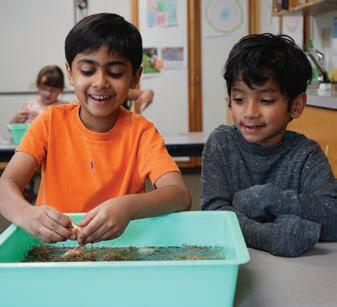
EXPERIENTIAL LEARNING An educational approach using applied, hands-on methods of learning.
INTERNATIONAL BACCALAUREATE (IB) A specifically designed comprehensive academic program emphasizing traditional disciplines while instilling a global perspective in its students.
MAGNET SCHOOL A public school that offers a specific or enhanced curriculum designed for students of special interest or ability.
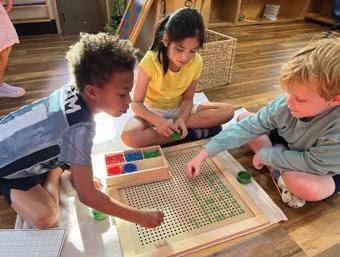
MONTESSORI A school following the principles developed by Dr. Maria Montessori, focusing on the unique individuality, self-reliance and independence of children.
SPECIAL NEEDS A school or program for children who have mild to moderate learning differences. It usually features smaller class sizes, individualized attention and multisensory learning methods.
ACCREDITATION Official certification that guarantees a school provides an education of a reasonably high quality. Schools must prove levels of quality and maintain continuous standards of improvement.
ACT An alternative to the SAT, this national college admissions examination consists of subject area tests in English, Mathematics and Reading, with optional Science and writing tests.
EARLY CHILDHOOD EDUCATION
Education that applies to children from birth to age 8, focusing specifically on their development, including physical, emotional, sensory, communicative, cognitive and social needs.
EVERY STUDENT SUCCEEDS ACT A federal law passed in 2015 designed to ensure that all children receive a high-quality education that will prepare them to succeed in college and in the workforce.
GEORGIA MILESTONES Tests designed to measure how well students in grades 3 through 12 acquire the skills and knowledge outlined in the state-adopted content standards. They include multiple-choice questions, open-ended questions and a writing component.
GEORGIA STANDARDS OF EXCELLENCE Statewide standards of academic content to which every school must adhere and on which students are annually tested.
MISSION/PHILOSOPHY A statement outlining the guidelines a school follows as it works to achieve its various education goals and/or to maintain its performance standards.
HOPE SCHOLARSHIP (Helping Outstanding Pupils Educationally) A scholarship in Georgia, funded by the Georgia Lottery, that rewards academically achieving students with
Did You Know?
Using data from the U.S. Department of Education, Niche.com named Buford County Schools the best school district in Georgia for 2026.
financial assistance to attend a degree, diploma or certificate program at eligible public and private Georgia colleges and universities.
NOTIFICATION DEADLINE
The date by which an independent school notifies families of the acceptance of a child for enrollment to the school.
OPEN HOUSE An event held at a school where parents can talk to teachers and staff and learn more about the school and its offerings.
PSAT A standardized test that offers students practice for the SAT Reasoning Test and allows them to qualify for the National Merit Scholarship Program
REPLY DEADLINE The date by which parents must notify an accepting school of their commitment to enroll their child at the school.
SAT This standardized test measures the writing and language, reading and mathematical reasoning skills of students planning to attend college.
SECONDARY SCHOOL ADMISSIONS TEST (SSAT) Assesses the verbal, math and reading abilities of students seeking to enroll in an independent school.
STEM Acronym for a program that focuses on Science, Technology, Engineering and Mathematics. Some schools add an Arts component (STEAM).
SUMMER CAMP A common destination for children and teenagers during the summer, at which they can participate in a variety of activities or classes.
Deciphering Associations and Organizations
Many local and national organizations work to bring out the best in summer camps and public, private and boarding schools by identifying schools that meet certain standards through accreditation. These groups also set policies, research educational advancements and offer services to the educational communities both in Atlanta and in Georgia. The following are just some of the associations and organizations you should know in your search for the best educational experience for your child.
AdvancED advanc-ed.org
The parent organization for the Southern Association of Colleges and Schools, AdvancED advances education excellence through accreditation and school improvement.
The Association of Boarding Schools (TABS) boardingschools.com
This organization of 250 boarding schools serves
the professional development needs of boarding schools and provides information to potential students and their families.
American Camp Association (ACA) acacamps.org
Accredits camps that meet industry-accepted and government-recognized standards, educates owners and directors and establishes guidelines.
Association of Christian Schools International (ACSI) acsi.org
ACSI strives to enable Christian educators and schools worldwide to teach effectively using Christcentered curricula and programs.
Association Montessori Internationale (AMI) ami-global.org
Recognizes and provides support, training and development to schools that strongly adhere to Montessori method principles.
Atlanta Area Association of Independent Schools (AAAIS) aaais.org
Promotes the highest standards and best administrative practices for accredited independent schools.
Cognia cognia.org
Formed from the merger of two organizations (AdvancED and Measured Progress), it advances education excellence through accreditation and school improvement initiatives.
Georgia Association of Educational Leaders (GAEL) gael.org
This statewide umbrella organization of six professional associations provides unity among school leadership organizations in Georgia.
Department of Education (DOE) gadoe.org
A statewide, policy-driven organization governing the public school system of education in Georgia for grades K-12, the Georgia DOE operates under the direction of the state superintendent of schools.
Georgia Association of Christian Schools (GACS) gacs.org
Uses generally accepted indicators of quality, voluntary self-improvement and peer review to measure Christian schools.
Georgia Association of Private Schools for Exceptional Children (GAPSEC) gapsec.org
This state organization of independent schools for students with learning disabilities maintains a code of ethics.
Georgia Charter Schools Association (GCSA) gacharters.org
A membership organization whose mission is to be an effective advocate and service provider for all charter public schools in Georgia.
Georgia Independent School Association (GISA) gisaschools.org
An association of Georgia’s private, independent
and parochial schools dedicated to serving the professional growth, advocacy and interscholastic needs of member schools.
Georgia Partnership for Excellence in Education (GPEE) gpee.org
This nonprofit organization of business, education, community and government leaders aims to shape policy and reform public education in the state.
Georgia Private School Accreditation Council (GAPSAC) gapsac.org Association of K-12 private schools whose students are recognized and approved by the Georgia DOE for transferring credits to public schools on the same basis as students from public schools.
National Association for the Education of Young Children (NAEYC) naeyc.org
A professional membership organization working to promote high-quality early learning for all young children, birth through age 8, by connecting early childhood practice, policy and research.
National Association of Independent Schools (NAIS) nais.org
This association values and works to maintain the independent nature of each member school by promoting high standards of educational quality and ethical behavior.
National Association of Private Special Education Centers (NAPSEC) napsec.org
Represents private specialized education programs by promoting quality programs and services for individuals with disabilities and their families.
National Christian School Association (NCSA) nationalchristian.org
An organization that accredits member schools, overseen by a board of administrators from Christian schools and universities.
Southern Association of Independent Schools (SAIS) sais.org
Provides accreditation services, professional growth opportunities and leadership development programs for 390 independent U.S. schools.
For more information about these and other organizations and associations that ensure quality education among camps and schools, visit the websites of the Georgia Department of Education (gadoe.org) or the U.S. Department of Education (ed.gov).
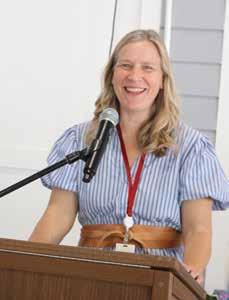
Elizabeth Lener
Head of School, Springmont School
In July, Elizabeth Lener will complete her third year as head of school at Springmont. She has a bachelor’s degree from Binghamton University and a master’s degree from Lewis & Clark College. She previously served as assistant head of the Burgundy Farm Country Day School.
What is your educational philosophy? When we put children at the center of our work, it becomes our compass and guides our actions as teachers. This is why the best educators invite their students to make choices about what and how they learn and involve students in decision-making.
How is the field of education changing?
The pandemic made it clear how important in-person education is and how essential teachers are in our communities. The relationship between students and between students and teachers cannot be replaced by technology.
How can parents best contribute to the education process? We view ourselves as parents to parents in their child’s educational journey. The relationship between school and home is crucial.
What do you love most about your job? I love that I get to work with such a
diverse group of people, help a school community fulfill its mission, and that there’s a new learning opportunity waiting for me every day.
What advice would you offer parents about their children’s education?
I would advise parents to explore a range of schooling options for their child, talk to other parents about their experiences, ask deep questions of potential schools, and use your child’s needs as your guide when making a choice.
Emphasis: Springmont’s authentic Montessori experience balances academics with socialemotional well-being.
Year Founded: 1963
Grades:18 months8th grade
Students: 250 Avg. Class Size: 18
or Affiliations: AMI, AAAIS, GISA, SAIS/Cognia, NAIS
Location: 5750 Long Island Dr. NW, Atlanta, GA 30327
Contact: 404-252-3910, springmont.com
SPRINGMONT SCHOOL
room setting. Others may teach average or even above-average learners while also offering additional programs and classes for students with learning differences.
How to Tell if Your Child Has a Special Needs Situation
First, it’s important to identify your child’s specific challenges. Students who exhibit average or above-average intelligence but often seem distracted and don’t perform well in a traditional classroom setting may be struggling with dyslexia, Asperger’s syndrome, ADHD or some other disorder that affects their ability to learn effectively. Also, disruptive or aggressive children may be exhibiting frustration brought on by a learning disability.
If you suspect your child may have a learning dis-
ability, it’s critical to have him or her evaluated by a mental health professional. A diagnosis is necessary in order to address the child’s educational needs.
After a Diagnosis: What’s Next?
A professional evaluation is crucial in order to evaluate your child’s educational needs.
If your child is diagnosed with a learning disability and attends public school, talk with the principal, school counselor or another administrator about developing an Individualized Education Program (IEP). All public schools are required to create an IEP for students with learning disabilities who meet special education requirements. An IEP is a document that specifies your child’s learning situation and educational needs and outlines a course of action for teachers and other professionals to follow to help make sure your child learns to the best of his or her ability. u
If you feel your local public school isn’t the right environment for your child or simply want to explore all your options, there are many quality independent schools in metro Atlanta devoted to helping children with special needs and learning issues. Visit the Georgia Association of Private Schools for Exceptional Children’s website (gapsec.org) or our listings for special needs schools on page 98 to help you with your search.
How Do I Find the Right School?
All special needs schools are not the same. The first step is to identify those schools that can address your child’s specific learning difficulty, and offer the level of special needs instruction that you (and perhaps a professional) feel is best for your child.
You may be more comfortable enrolling your child in a school that focuses specifically on his or her needs, or you may want a more diverse environment where he or she can interact with many different kinds of students. Familiarize yourself with the different options offered by each kind of school.
Traditional independent schools that offer special needs programs as part of a larger curriculum can offer that kind of environment, but may have larger class sizes than schools that specialize in specific learning disabilities. These kinds of schools may also focus more on academics than on the therapeutic aspects of special
needs education. Independent special needs schools can offer more individualized instruction and a more structured and predictable environment, and are likely to address nonacademic issues such as social skills and self-esteem.
As you begin searching for the right school for your child’s situation, here are some questions to keep in mind:
• Will your child fare better in a school that focuses on his or her specific learning disability, or would you rather that he or she be able to interact with students with a wide range of learning capabilities?
• Does the school serve a specific age range or work with students on all grade levels? Many students with learning disabilities have trouble transitioning to new schools.
Identify those schools that can best address your child’s specific learning difficulty.
• Does the school offer a variety of extracurricular activities, including arts and sports programs?
• Is the school accredited? If so, by which organizations?
• Is the staff certified to instruct special needs children or those with your child’s specific learning difficulty?
• Does the school focus more on academics or on addressing the child’s therapeutic needs?
Financial Assistance
Many independent special needs schools participate in the Georgia Special Needs Scholarship program (GSNS), a school choice program available to special needs students attending Georgia public schools. It offers funds to offset tuition and fees at
participating private schools authorized by the Georgia Board of Education. According to the Georgia Department of Education, scholarship amounts ranged from $504 to $15,816, with an average amount of about $7,358 for the 2023-2024 school year.
The Qualified Education Expense Tax Credit program provides another scholarship option. Donations are made to an organization known as a Georgia Student Scholarship Organization (GaSSO), which uses the money to award scholarships to students in pre-K through grade 12. Many schools also offer their own scholarships or tuition assistance programs as well. Contact individual schools for details.
For more information on special needs schools and resources, please see our listings on page 98.
TIPS
FOR STUDENTS WITH DYSLEXIA
SAINT FRANCIS SCHOOL’S
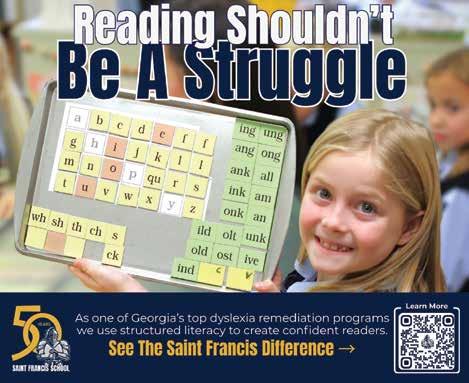
Saint Francis School understands that all students learn differently, especially those with dyslexia. Saint Francis teachers use these five strategies to help struggling readers develop strong foundational reading skills while fostering self-confidence, resilience, and a lifelong love of learning.
1 Use a Multisensory Approach
By using sight, sound, touch, and movement, multiple areas of the brain are activated simultaneously. This makes information more memorable and easier to recall later.
2 Focus on Phonemic Awareness
This approach teaches children to hear and manipulate the individual sounds within spoken words. Strong phonemic awareness predicts reading success.
3 Employ Structured Literacy Instruction
Structured literacy instruction is grounded in how the brain learns to read, ensuring that all
students, especially those with dyslexia, develop foundational reading skills.
4 Present Information in Manageable Chunks
Breaking information into smaller, more manageable pieces leads to improved retention and better comprehension.
5 Celebrate Progress
Celebrating each student’s progress builds confidence, reduces frustration and fosters motivation.
COMMON SPECIAL NEEDS TERMS
Asperger’s Syndrome: An outdated diagnostic term that is no longer used. The symptoms that characterized Asperger’s are now classified as part of Autism Spectrum Disorder (ASD).
Attention Deficit Disorder (ADD): An outdated term used to refer to the inattentive form of ADHD, in which a person is typically inattentive or distractible, but not hyperactive or impulsive.
Attention Deficit Hyperactivity Disorder (ADHD): A brain-based syndrome affecting the regulation of functions including attention, concentration, memory and impulsivity.
Autism Spectrum Disorder: A developmental disorder affecting the ability to communicate and interact. Symptoms include repetitive behaviors; intense, narrow interests; and sensory sensibility.
Dyslexia: A learning disability that impairs specific language skills, particularly reading.
Georgia Association of Private Schools for Exceptional Children (GAPSEC): An organization of independent schools serving students with learning disabilities and differences.
Georgia Special Needs Scholarship (GSNS): A school-choice scholarship program for special needs students being served by an IEP in Georgia public schools.
Individualized Educational Program (IEP): A written statement that outlines the needs of a public school student with learning disabilities and creates a customized plan for meeting those needs.
Individuals With Disabilities Education Act (IDEA): The federal law that governs how states and public education agencies that accept funding under the law address the educational needs of students with disabilities.
Learning Disability: A neurological condition that affects how one processes information. Learning disabilities can impair reading, writing, speech, math, reason, memory, attention and coordination, as well as social skills and emotional maturity.
Multisensory Instruction: An educational approach involving the use of all of a child’s senses, not just sight and hearing, to help with understanding concepts and solving problems.
Response to Intervention (RTI):
A process used by educators to help identify and address the needs of students experiencing behavioral or educational challenges, based on screening, instruction and assessment.
Student Scholarship Organization (SSO): An organization authorized by the state of Georgia to receive funds and award scholarships under the Georgia Qualified Education Expense Tax Credit program.
EDUCATION THAT GOES BEYOND ACADEMICS
BY SHEILA COSGROVE AND DANIEL BEAUREGARD
or many parents, a good education means much more than academics. While reading, math and science are all important, having their child learn about such values as kindness, respect and empathy for others is just as important, if not more so. Fortunately, most Atlanta-area public and independent schools incorporate some form of character education in their curricula, placing an
emphasis on guiding children to become caring, involved members of society.
In fact, the state of Georgia devotes an entire month to the importance of character. Back in 2012, a group of students and teachers at Cobb County’s Durham Middle School wrote their state senator proposing that the little-known Georgia History Day be changed to a day that honored character and good choices. Gov. Nathan Deal
extended the idea to a whole month, signing a law that set aside the month of September as Georgia History and Character Month.
As such, different public school systems in metro Atlanta integrate character education into their ongoing curricula.
At Kennesaw Mountain High School in Cobb County, students get together with local leaders on a monthly basis to learn character and leadership skills. SmithBarnes Elementary School in Henry County focuses on a different character trait each month, such as respect, kindness, loyalty and self-control, and recognizes students who personify these traits.
Atlanta Public Schools emphasizes character education by making social emotional learning (SEL) a key focus of its curriculum. SEL is “the process through which all young people and adults acquire and apply the knowledge, skills, and attitudes to … feel and show empathy for others, establish and maintain supportive relationships, and make responsible and caring decisions,” according to the website for the Collaborative for Academic, Social and Emotional Learning.
A LARGER PERSPECTIVE
That approach is similar to the one taken by the Atlanta International School (AIS), an independent school in Buckhead that builds its curriculum around the framework of the International Baccalaureate (IB) program, preparing its students to engage with the world with intercultural understanding and respect.
This type of foundation often begins early. The Personal Social Education component of the Early Years program equips young learners with the language and strategies to approach social and emotional challenges thoughtfully. In addition, AIS’s renowned language immersion programs offering
The state of Georgia devotes an entire month to the importance of character.
instruction in English, French, German, Spanish, and Chinese enable students to develop linguistic fluency and cultural awareness from the earliest stages of learning. As they progress, each grade’s IB curriculum integrates goals that promote communication, open-mindedness, and intellectual curiosity. The school also emphasizes independent thinking and respect for differing perspectives. Students are regularly exposed to multiple cultures and worldviews, learning to engage thoughtfully with ideas and opinions that differ from their own. u
Learning to respect the viewpoints of others is a key component of character-based education.
At McGinnis Woods School in Alpharetta, which serves infants through eighth-graders, students have character education classes with a counselor each week. The classes start in pre-K, with subjects such as how to be kind, how to resolve an issue and how to deal with others who are not kind, says Principal Mary Johnson.
“With our older children … we’ll go into things like digital safety so they will not say things on social media that are rude to others or inappropriate, being mindful of those things because they can stay there forever,” she says.
The school also promotes character education through its morning announcements, which include the character word of the month, and by honoring a student
as a Citizen of the Month for exhibiting strong character traits.
At the Galloway School, an independent school serving children from age 3 through high school, the early learning program focuses on a different value each month.
“In October, our value is empathy,” says Early Learning Counselor Dana Eisenman.
“The lessons we’re teaching in social emotional learning are focused on empathy, highlighting how different people in our community exemplify that. And we recognize those students and faculty members who exhibit the different qualities of the value of the month.”
Galloway school students also put their character education lessons into practice, beginning at a young age. “We recently had
our pre-K students partnering with the middle learning students to create posters for food donations for Meals on Wheels,” Eisenman says. “Last year, our second-graders had a food insecurity unit and partnered with Backpack Buddies,” a nonprofit that provides kids with nutritious weekend meals.
RESPECTING DIFFERENCES
Learning to respect the viewpoints of others is a key component of character-based education. At AIS, the Galloway School and other schools, students are exposed to other cultures and different viewpoints, and learn to value others’ opinions, even when they don’t agree with them.
“We work a lot with flexible thinking, the ability to think about things in new and different ways,” says Eisenman, “and how you can use that to see different perspectives. One thing we emphasize a lot is that you don't always have to agree with the other person, but you have to understand their perspective. And we also do what we call perspective taking, where we look at characters in popular books, movies or other media, and talk about how the same situation could look different depending on whose perspective you’re looking at it from.”
Woodward Academy, an independent school serving pre-K through high school students on two metro Atlanta campuses, takes SEL one step further with its SEE (social, emotional and ethical) Learning program. Developed by the Center for Contemplative Science and CompassionBased Ethics at Emory University, the program exposes students to different viewpoints and helps them to develop traits like compassion and resilience that will serve them throughout their lives.
One example of this, says Jennifer Knox, Woodward’s director of character education and the Ron M. Brill chair of ethical leadership, is the program’s focus on helping students learn to look at themselves and try to remain calm in high-stress situations.
“We look at what’s going on that relates to emotions, to the brain, to navigating those,” she says. “How do we recognize those? How do you respond when an emotion becomes difficult?”
Whether you choose a public or independent school education for your child, there are options throughout the metro Atlanta area that seek to help prepare them for the future not just academically but as a person of good judgment and character, as well.
A HANDS-ON APPROACH TO LEARNING
BY WENDY LITTLE & PHIL KEELING
s you navigate Atlanta’s educational landscape, you’re likely to come across many types of schools and educational methods beyond simply public and independent schools. One that has become increasingly popular in metro Atlanta is Montessori education, named after Dr. Maria Montessori, an Italian physician and educator. Montessori education is a distinctive and widely respected approach to teaching that emphasizes independence, hands-on explora-
tion followed at the student’s own pace, and respect for a child’s natural development.
While Montessori schools are perhaps most often seen at the preschool and elementary levels, the Montessori method has been implemented all the way through high school. At each level, the focus is as much on social, physical, and emotional development as academics. Life skills, responsibility, and respect for the environment are taught alongside more traditional subjects, such as
science, mathematics, history, and language. Learning objectives are accomplished through experiential, practical, and sensory activities in an organized setting.
The Montessori method began in 1907 when Dr. Montessori was invited to open a school for disadvantaged children in the San Lorenzo district.
Observing how children learn naturally through exploration and repetition, Montessori created materials designed to refine their senses and skills. She noticed that when given the freedom to choose and concentrate, even the most unruly children became calm, engaged, and eager to learn.
HOW MONTESSORI SCHOOLS TEACH
Montessori schools differ from traditional public or independent schools in several ways. At the heart of Montessori education lies an intense trust in the child’s innate drive to learn.
smaller class sizes and more specialized instruction, but they often maintain similar structures. In a Montessori classroom, children take ownership of their learning, and teachers act as collaborators rather than authorities.
Generally speaking, classrooms are less rigid, and the student, not the teacher, is the focus. You won’t see rows of children sitting at desks. Instead, students are grouped by age ranges rather than grades, and allowed to work and think independently, given the opportunity to learn from their own mistakes and grasp concepts at their own pace.
The classroom may be divided into distinct learning areas, each filled with specialized materials designed to engage multiple senses. A child might learn geometry by physically handling wooden shapes, or language by tracing letters made of sandpaper to feel their form before writing them out. Essentially, this comes down to the child learning, understanding, and using specific
Attheheart of Montessori education lies an
intense tr t in the child’s innate drive to learn.
Compared to the structured environments of public and private schools, a Montessori school can feel quite different. Traditional classrooms often emphasize direct instruction, testing, and uniform curricula. The Montessori model, by contrast, values process over product and curiosity over compliance.
In public schools, students typically move through subjects as a group, with a teacher leading the lessons at a set pace. Independent schools may offer
skills, rather than focusing on tests and forgetting that information the moment the exam is finished. Instead of giving a lecture or handing out assignments, teachers work one-on-one with students, providing guidance when necessary, like presenting a new topic or a new challenge to meet when a child is ready.
CHOOSING A MONTESSORI SCHOOL
You may wonder whether this approach is right for your child. After all, every child learns in their own way. Montessori educators encourage parents to ask questions and talk about their child’s learning style, habits, and home environment when visiting a school. Does your child learn better in a group setting or on their own? Do they like to stay in one place or do they need to move around? Children who operate with few limits at home may not flourish within the structure of a Montessori school, and children used to very strict guidelines may have trouble adapting to a self-directed setting that allows them the freedom to explore on their own.
When considering a Montessori school, it’s important to understand that they’re not all the same. Since the term is not trademarked, any school can refer to itself as a
Montessori school. Some may claim to follow an “alternative” or “hybrid” Montessori program or offer Montessori instruction for just part of the day.
The most reliable sign of a school’s adherence to Montessori principles is certification. Montessori teachers are trained and certified in the Montessori method. What’s more, schools that have been accredited by organizations such as the Association Montessori International (co-founded by Maria Montessori) and the American Montessori Society have been determined to operate in accordance with Montessori standards.
THE BENEFITS OF MONTESSORI EDUCATION
Research into Montessori outcomes paints a largely positive picture. Studies have found that Montessori students often outperform their peers in both academic and social-emotional measures. They tend to show stronger executive functioning skills like focus, organization, and selfregulation and demonstrate heightened creativity and problem-solving ability.
One of the greatest benefits is the cultivation of deep-rooted motivation. Because children choose their work, they learn to pursue goals for personal
satisfaction rather than external rewards. This self-directed approach fosters resilience and confidence qualities that serve them far beyond the classroom.
In recent years, tech entrepreneurs and innovators from the founders of Google to Jeff Bezos have credited Montessori schooling with shaping their curiosity and creativity. It’s no coincidence that many leaders in creative industries praise an education that prioritized exploration over rote memorization.
Montessori education operates on the principle that education is not a process of filling vessels, but of lighting fires. In an age of information overload and dwindling attention spans, Montessori’s slow, mindful, and purposeful approach may be just what your child needs.
Montessori education is grounded in a few key principles:
Child-Centered Learning: Teachers guide rather than instruct, allowing students to take the lead in their education.
Prepared Environment: Classrooms are carefully designed to promote independence and curiosity.
Hands-On Materials: Montessori classrooms use specialized educational tools that allow students to learn through physical manipulation.
Mixed-Age Classrooms: Typically spanning three years (e.g., ages 3–6, 6–9, etc.), this structure encourages peer learning, mentoring, and social development.
Intrinsic Motivation: Montessori education emphasizes the joy of learning itself rather than grades or external rewards.
BY SHEILA COSGROVE AND SUSAN FLOWERS
here are many elements that contribute to your child’s educational success finding the right school, building a strong relationship with their teachers and even encouraging their participation in extracurricular activities. But one of the most important components of a thriving educational career is the establishment of good study habits.
Educational achievement hinges on parental involvement that evolves to fit the child’s needs, from the first day of first grade to high school graduation and beyond.
Communication with your child is critical, both when establishing a study routine and afterward, to ensure that things go smoothly.
YOUWHATCAN DO TO HELP
That means not only telling a child to do his or her homework, but talking about their existing study habits in order to help improve them.
WHERE AND WHEN TO STUDY
The key to establishing good study habits is to start early, says Katherine Carroll, associate director of the Marist Academic Center at Marist, an independent Catholic school for students in grades 7-12.
“What habits can you set up now, even before they necessarily need them?” she asks. “That can be something as simple as a planner. Our seventh- and eighth-grade students maybe don’t need a planner yet,
When a child sits down to study is also important. But that time doesn’t have to be when the student gets home from school.
but eventually they’re not going to be able to keep track of everything in their minds. So you build the habit of putting things in a planner so that when they really need to start doing that, it’s second nature to them.”
Elektra Thompson, an executive functioning specialist with the Academic Resource Center at The Lovett School, emphasizes the importance of marking a break between the school day and the rest of the child’s day.
“If you look at it as, your job is going to school, when you get home you need to wash your face and put on some comfortable clothes, so you’re taking off your work clothes,” she says. “Take a 10- or 15-minute break, get a snack, refuel. You need to be able to take that time for yourself before you dive into studying.”
“I’m definitely a proponent of the Pomodoro Method, which recommends 20 to 25 minutes of focused work and a 5- to 10-minute break, to help improve your focus,” Carroll says.
A well-defined space for doing homework and reviewing lessons is key.
“Do they have a designated space where they work? Even if it’s not a formal desk or a formal room maybe it's sitting at this part of the kitchen table,” Carroll says. “But one thing I always tell my students is, do not do your homework on your bed.”
When a child sits down to study is also important. But that time doesn’t have to be when the student gets home from school.
“If they have extracurricular activities, they may not get home until 8 o’clock, but that doesn’t mean their work can’t start before then,” Carroll says. “They might be sitting at school for a practice that doesn’t start until 4:45, but school lets out at 3 o’clock. Or maybe you’re dropping them off at 7:30 but school doesn’t start until 8 a.m. I’m not saying they have to spend every minute of their free time doing work. But when their schedules are so packed, you don’t have to wait until you’re home. Where can you find little blocks of time throughout the day where they can get something done?”
UNDERSTANDING YOUR CHILD'S BRAIN
But making sure that your child practices proven study habits is only half of the equation, says Tamara Hamilton, executive functioning specialist for middle school students at The Lovett School. u
“Learning isn’t just about behavior and habits, it’s about understanding brain development,” she says. “That’s where executive function comes in.”
Executive functions are a set of mental skills that help us manage our thoughts, actions and emotions. “That’s what tells us, when we get up in the morning, the first decision we’re going to make,”
says Thompson. “It’s what keeps us organized. All these things are happening in our brain, sometimes without us even having to think about it.”
“Helping students understand how their brains are wired is a crucial part of helping them know what to do, when to do it, and how to get it done,” Hamilton says.
“For example, if you have attention issues, you’ll want to figure out how to practice training your brain to maintain focus. That might mean tracking how many times you’re distracted within one study period, and how do you bring yourself back to what you’re focusing on? Maybe you’re only good for 10 minutes at a time, and you need to do something else and come back to it. Helping students figure out how their brains work helps them use that knowledge to learn more effectively.”
“Encourage them to think about what their own learning styles are,” says Dennis Freeman, co-founder of In-Home Tutors. “Some children do really well visually. Other children are more auditory learners. If you’re an auditory learner, have your mom quiz you verbally for a test. If you’re a visual learner, take some scrap paper and take notes.”
TIPS FOR EFFECTIVE STUDYING
1. Before beginning a study session, have your child write down the goals for that day’s study time.
2. Have your child study at the same time each day.
3. Keep a daily log so that your child can track his or her progress and accomplishments.
4. Major projects and papers can be intimidating for children. Help your child get started by breaking large tasks into small, doable pieces. This practice will also help your child to form good habits and avoid procrastination.
5. Don’t overload or overschedule your child to the point that studying is secondary to extracurricular activities.
“There’s no guarantee that the teacher is going to teach the way that you prefer,” says Carroll. “But that doesn’t mean you can’t apply that and study in a way that you prefer. The teacher might teach you in a way that’s very auditory. So when you go home, think about how you can turn that into something that’s more visual to help you process the information.”
Many schools have research labs or academic centers like Lovett’s Academic Resource Center or the Marist Academic Center. These resources often have counselors, teachers, learning specialists and tutors on hand to help students identify and address different areas where they may need some assistance. Carroll, at Marist, for instance, teaches a class on “Strategies and Skills for Success.”
PARENTAL INVOLVEMENT
Last but not least, don’t forget who the most important figure is in your child’s school life the person who teaches him or her every day. “I don’t think there’s ever anything wrong with the parent having a relationship with teachers,” Freeman says. “So, whether that means shooting an email or taking them aside at the school open house, just to let them know what’s going on, that will make the teacher more likely to communicate with the parent.”
At every stage of your child’s education, being a motivated parent can do a great deal to ensure academic success. Paying attention, creating structure and giving your young scholar the space they need can go a long way toward putting them on the right path.
Top Atlanta Schools
Metro Atlanta is home to many excellent K-12 independent schools, which means you can find exactly the right environment to fit your child’s academic needs, learning style, extracurricular interests and values. The following profiles represent some of the leading independent schools serving the metro Atlanta area, each of them equipped with the staff and curriculum to provide your child a challenging and nurturing educational experience.
ATLANTA INTERNATIONAL SCHOOL
Celebrating its 40th year, Atlanta International School (AIS) is an International Baccalaureate (IB) World School, offering Primary Years, Middle Years, Diploma, and Career-related IB Programs.
AIS attracts global and local families who particularly seek out the school's renowned
language programs beginning in 3K and 4K with full immersion (French, German, Chinese, and Spanish), followed by dual and partial immersion in Primary School. Expert instruction in Secondary School supports all language levels, from beginners to those pursuing a bilingual or even trilingual IB diploma.
Innovation is core to an AIS education, where students pursue STEM/STEAM-endorsed IB diplomas. Extracurriculars include a space program, robotics, Model United Nations, internships, and international trips.
The school boasts 40 athletic teams in 12 different sports and has a unique tennis training partnership with the esteemed Mouratoglou Academy based at the AIS Sandy Springs Campus.
The AIS Buckhead Campus is located at 2890 North Fulton Drive, Atlanta, GA 30305, while the Sandy Springs Campus is at 1701 Brandon Hall Drive, Sandy Springs, GA 30350. For more information, call 404-841-3840, email admission@aischool.org, or visit aischool.org
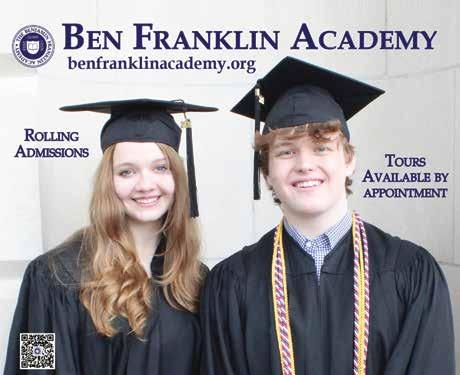
BEN FRANKLIN ACADEMY
Serving grades 9-12, Ben Franklin Academy (BFA) is a nonprofit, private high school, accredited by both the Southern Association of Colleges and Schools (Cognia/SACS) and by the Southern Association of Independent Schools (SAIS). It provides its students with a challenging individualized college preparatory education within a caring community of learners, while advancing the knowledge and methodology of adolescent education. The school is small by design, with enrollment
THE PAIDEIA SCHOOL
The Paideia School offers inspired, studentcentered learning in Atlanta from early childhood (ages 3–5) through elementary (K-6), junior high (7-8), and high school (9-12).
What truly defines Paideia is its commitment to blending academic rigor with whole-hearted support. Its philosophy is built on the belief that students thrive when they are both encouraged and stretched; the school emphasizes hands-on discovery and a curriculum that elevates creative expression.
In the classroom and beyond, Paideia fosters deep connections: communities within a community where students know their teachers and peers as collaborators rather than strangers. Extracurricular offerings, from student-run clubs and travel programs to athletics and service projects, provide abundant avenues to find one’s voice and passion.
Set on an Atlanta campus alive with
around 125 each year and a student/teacher ratio of about 4:1.
BFA is committed to individualized instruction and mastery learning. Students have a faculty advisor who meets with them daily and helps them plan each week’s course work. It offers three levels of instruction: College Prep, Honors and Advanced Placement. The school also offers six foreign languages: Spanish, German, French, Russian, Latin, and American Sign Language. BFA also offers 26 Advanced Placement courses and 25 Honors classes.
After-school activities include Drama, Jazz/Rock Music Ensemble, Cross Country, Golf, Latin Dance and Ultimate.
BFA is located at both 1585 Clifton Road, Atlanta and 752 Houston Mill Road, Atlanta. For more information, call 404-633-7404, email bfa@benfranklinacademy.org or visit benfranklinacademy.org.
creativity and communal purpose, Paideia is more than a school it’s a place where joy, challenge, and belonging converge to shape thoughtful, engaged learners.
The Paideia School is located at 1509 Ponce de Leon Ave., Atlanta, GA, 30307. For more information, please call 404-377-3491 or visit paideiaschool.org
TOP ATLANTA SCHOOLS
ARBOR MONTESSORI SCHOOL
For 55 years, Arbor Montessori School has been the leader in authentic Montessori education in the Southeast. Founded in 1970, Arbor serves children from 18 months through adolescence and offers one of the region’s most comprehensive AMI (Association Montessori International)-accredited programs. Arbor is well known for offering a balance of joyful learning, rigorous academics, and meaningful real-world work.
Arbor's Adolescent Program (seventh and eighth grades), first established in 1997, provides students with opportunities to run businesses, engage in community service, and lead integrated humanities and science projects. Building on this success, Arbor will launch its high school program in Fall 2026. The program extends Arbor's continuum of learning to grade 12, preparing students for college and life with mastery-based evaluation, internships,
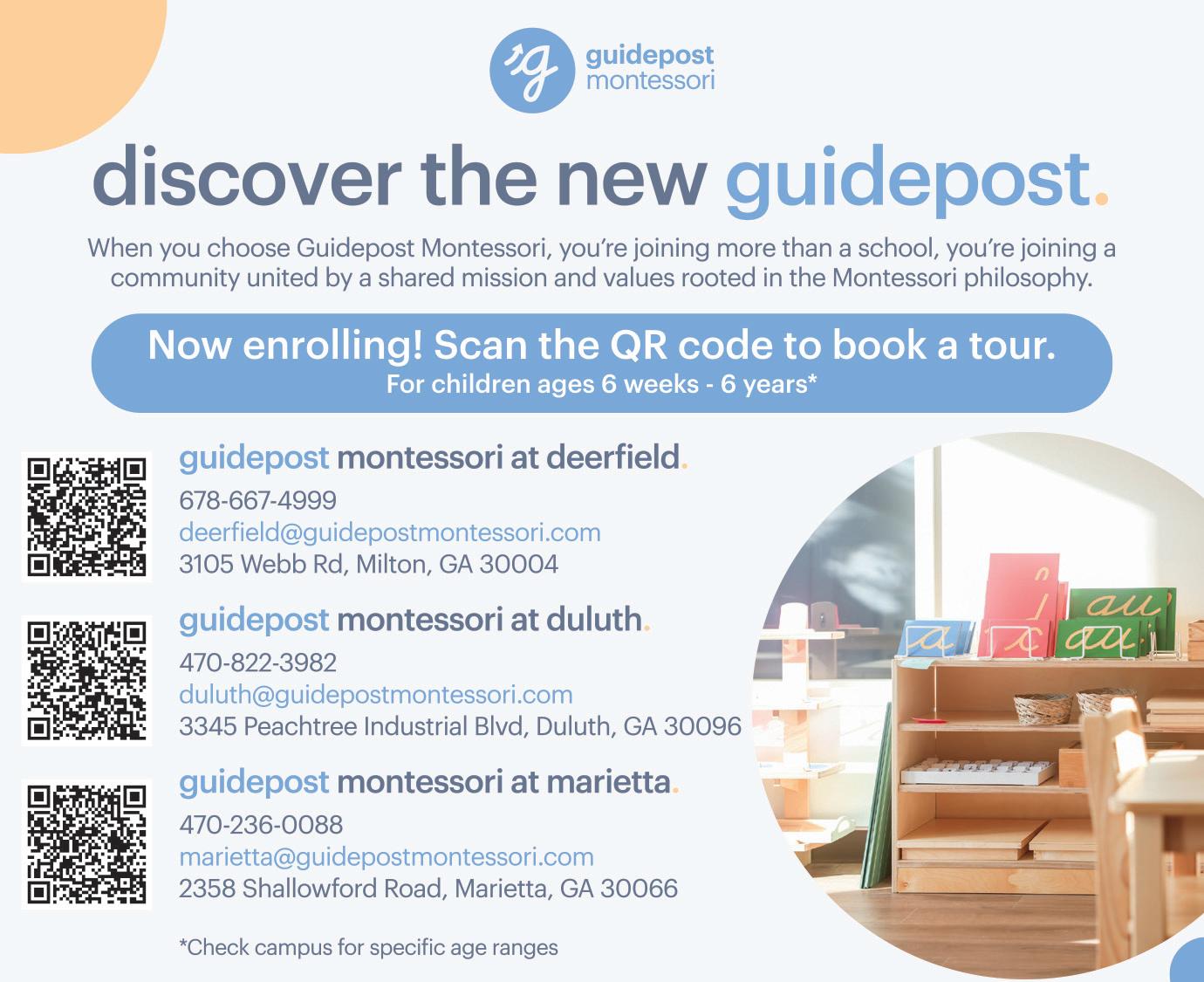
GUIDEPOST MONTESSORI
At Guidepost Montessori, children build confidence, independence, and a lifelong love of learning through an authentic Montessori approach. With three campuses serving families across the Atlanta area, Guidepost offers thoughtfully designed environments
dual enrollment opportunities, and student-run enterprises.
Arbor Montessori continues to thrive because of its commitment to fostering independence, critical thinking, and integrity in every child. Arbor prepares students to contribute meaningfully to the world with confidence and purpose. Go here, then go anywhere.
Arbor Montessori School is located at 2998 Lavista Road, Decatur, GA, 30033. For more information, please call 404-321-9304 or visit arbormontessori.org
that nurture curiosity and respect at every stage of early childhood.
The Marietta campus serves children from 16 months to 6 years, offering programs that nurture independence and a love of learning. At the Duluth and Deerfield schools, families can choose programs for infants as young as 6 weeks through kindergarten, including Spanish immersion options for children ages 2 to 6.
More than just schools, Guidepost’s campuses are vibrant communities where children are known, families are connected, and learning extends beyond the classroom. Each environment is guided by trained Montessori educators who partner closely with parents to support each child’s individual development.
Experience the difference of a community rooted in respect, curiosity, and joyful discovery. Learn more at guidepostmontessori.com
TOP ATLANTA SCHOOLS
MONTESSORI EDUCATION
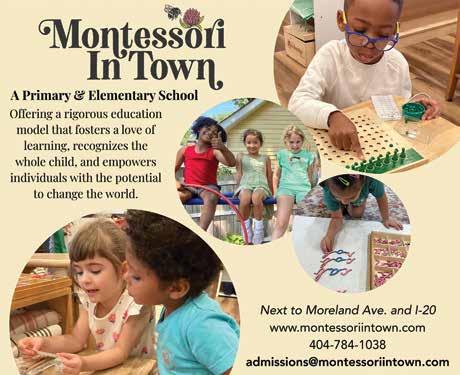
MONTESSORI IN TOWN
Founded in 2005, Montessori In Town is a locally owned school serving Atlanta's intown community. It offers an authentic Montessori experience for children through sixth grade, with a robust elementary program that prepares students for middle-school success.
The Association Montessori Internationaltrained staff guides K-6 students in building essential skills in time management, accountability, collaboration, and critical thinking, preparing them not only academically, but also for real-world challenges. Its graduates consistently thrive in competitive local, private, and public schools.
What truly sets Montessori In Town apart is its close-knit community. In this respectful atmosphere, differences are celebrated and meaningful connections flourish. The school offers numerous opportunities for families to engage with one another, creating a supportive village that helps raise confident, resilient children.
SPRINGMONT SCHOOL
As the oldest Montessori school in the Southeast, Springmont offers students 18 months through 8th grade an authentic Montessori education. Individualized, hands-on learning is balanced with social/emotional well-being, inspiring its diverse and inclusive community of learners to become creative, independent and globally minded.
Multi-aged classes and specially designed
At Montessori In Town, students don't just memorize facts they develop independence, curiosity, and the practical skills needed to navigate their future with confidence.
Discover how Montessori In Town can prepare your child for academic success and a meaningful life beyond the classroom.
Montessori In Town is located at 1192 Arkwright Place SE, Atlanta, GA, 30317. For more information, please call 404-784-1038 or visit montessoriintown.com
materials are complemented by highly experienced and caring teachers who guide students’ curiosity toward meaningful, collaborative discoveries. Large, light-filled classrooms and a beautiful campus with natural areas, class gardens and farm animals offer rich outdoor experiences.
Springmont’s middle school prepares students for success in Atlanta’s premier high schools and life beyond academics. Opportunities to hone time-management skills, experience active leadership roles and work both independently and in diverse groups allow students to become engaged learners.
Springmont School is located at 5750 Long Island Dr. NW, Atlanta, GA 30327. Admission tours are by appointment. Applications for the 2026-27 school year open October 1 and are due February 1. For more information call 404-252-3910 or visit springmont.com
area map
REGIONS FOR INDEPENDENT SCHOOLS N
For features of independent schools, turn to Education At a Glance on pg. 40. For public school system information by county, turn to pg. 75.
3 3
2
2
1 1
5 5
Boarding Schools Florida, Georgia, Maine, North Carolina, Southern Illinois, Tennessee, Virginia, West Virginia
REGION 4: Atlanta South/ Southeast/Southwest Atlanta South, Carrolton, Eagles Landing, Fayetteville, Locust Grove, Sharpsburg, Peachtree City
REGION 1: Atlanta North/Northwest Buckhead, Chastain Park, East Cobb, Roswell
Tutoring, Summer Camps and Activities, Field Trips and Education Programs.
REGION 5: Atlanta West Brookstone, Buckhead, Kennesaw, Powder Springs, Smyrna/Vinings
REGION 2: Atlanta North/Northeast Alpharetta, Dunwoody, Johns Creek, Roswell p.53
REGION 3: Atlanta East Ansley Park, Athens, Dacula, Decatur, Midtown, Morningside, Northeast Atlanta
REGION 3: Atlanta East Athens, Collins Hill, Dacula, Decatur, Druid Hills, Edgewood, Loganville, Monroe, Morningside/Ansley
Education At a Glance
REGION 1: ATLANTA NORTH/NORTHWEST
REGION 2: ATLANTA NORTH/NORTHEAST
3: ATLANTA EAST
Education At a Glance
INDEPENDENT SCHOOLS
REGION 4: ATLANTA SOUTH/SOUTHEAST/SOUTHWEST
REGION 5: ATLANTA WEST
Education At a Glance
*KEY:
REGION 1
Independent Schools
NEIGHBORHOODS OF NOTE
Alpharetta Once a small farming community, Alpharetta’s growth has exploded in recent years, and the North Fulton city is now one of Atlanta’s most affluent neighborhoods, creating the perfect mix of country living and lots of city amenities.
Woodstock Located in Cherokee County, Woodstock is, as locals say, “where modern amenities meet old Southern charm.” Historic Olde Towne pays a continual tribute to Woodstock’s pioneers through vintage shops and good old-fashioned Southern hospitality.
BUCKHEAD
EAST COBB • CHASTAIN PARK
ROSWELL
Independent Schools
REGION
NEIGHBORHOODS OF NOTE
Duluth A successful mix of small-town charm and booming economic growth, Duluth plays host to many major corporations and is also home to numerous golf clubs, private tennis clubs and parks. The city prides itself on accommodating a growing, diverse population.
Dunwoody A popular community among young and established professionals alike, Dunwoody is often referred to as the “tennis set” neighborhood because of its numerous recreational outlets. Its location provides suburban living close enough to the city.
ROSWELL • JOHNS CREEK
Independent Schools
NEIGHBORHOODS OF NOTE
Decatur The county seat of DeKalb County, Decatur’s small-town charm revolves around the Courthouse Square, which features trendy restaurants and shopping, entertainment options and special events, including its annual summer beach bash.
EAST
Lawrenceville Located in the heart of Gwinnett County and known as “Crepe Myrtle City,” Lawrenceville is Atlanta’s second oldest city. Its historic downtown square, which has been revitalized, is home to a variety of shops, restaurants and community events.
ATHENS
DRUID HILLS •
EDGEWOOD• LOGANVILLE
Independent Schools
Schools Page
Community Christian School 62
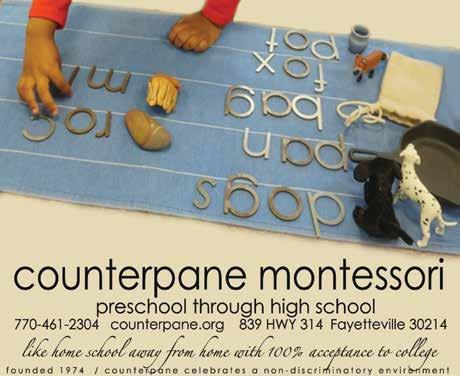
Counterpane Montessori School 63
Creekside Christian Academy 62
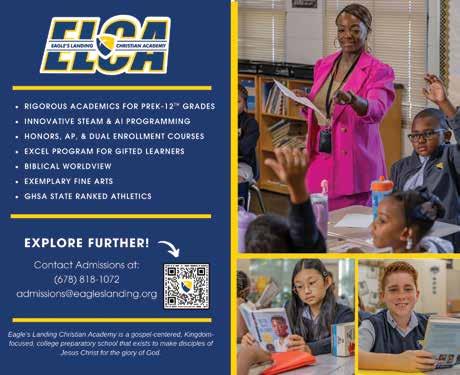
Eagle’s Landing Christian Academy 63
Faith Academy and Faith Academy Online 57
NEIGHBORHOODS OF NOTE
East Point The up-and-coming East Point area combines the charm of a small town with conveniences of a big city. Residents enjoy the city’s prime location near the Hartsfield-Jackson Atlanta International Airport, MARTA and Downtown Atlanta.
Fairburn Less than half an hour from Atlanta, Fairburn is filled with historic buildings and boasts a peaceful, smalltown atmosphere. The city is home to the annual Georgia Renaissance Festival and the local campus of Georgia Military College.
EAGLES LANDING • CARROLTON V• ATLANTA SOUTH
EAGLES LANDING •
Independent Schools
FULTON
NEIGHBORHOODS OF NOTE
Acworth Surrounded by two lakes and 12 parks, Acworth offers plenty of recreation opportunities. Located 35 miles northwest of Atlanta, the town is convenient to both I-75 and Highway 41. Acworth is designated as a Georgia Main Street City.
Douglasville Located west of Atlanta on I-20, Douglasville has easy access to all that Atlanta offers. Listed on the National Register of Historic Places, Downtown Douglasville’s historic district is an outstanding example of a turn-ofthe-century southern railroad town.
ATLANTA WEST
BUCKHEAD
BROOKSTONE • KENNESAW
SMYRNA/VININGS • POWDER
There are many benefits of a boarding school education. Boarding schools are an option for students seeking a more independent learning experience. Because students generally live on campus, learning takes place in and out of the classroom almost on a 24-hour basis.
When selecting a boarding school, it is important to visit the school campus, but representatives from many boarding schools visit Metro Atlanta throughout the year—contact each school for specific dates.
Boarding Schools
GEORGIA • FLORIDA
GEORGIA • MAINE
TENNESSEE
TENNESSEE • VIRGINIA
SPOTLIGHT ON METRO ATLANTA’S SCHOOL SYSTEMS
Avariety of improvements and innovative programs in Georgia’s public school systems have resulted in many stellar elementary, middle and high schools across the metro area. Different school systems feature specialized programs and academic opportunities, such as magnet, charter, vocational or alternative schools, to suit their respective students, parents and communities. However, despite variations in programming and academic offerings, all public schools must offer instruction aligned with standards approved by the Georgia Board of Education. Here is a county-by-county guide to metro Atlanta’s public school systems. For more information about the Georgia Department of Education, call 404-656-2800 or visit gadoe.org. u
CHARTER SCHOOLS
CHARTER SCHOOLS
CHARTER SCHOOLS
BARTOW
Board of Education
770-606-5800
bartow.k12.ga.us
CHEROKEE
Board of Education
770-479-1871
cherokeek12.net
CLAYTON
Total
2024 Mean Georgia Milestone Scores:
3rd: (ELA) 502 (M) 526
5th: (ELA) 521 (M) 520
8th: (ELA) 514 (M) 535
2024 Average SAT: 1044
Top 3 Schools by Average
2024 SAT Score
Adairsville High 1061
Cass High 1041
Woodland High 1032
What’s New: Three of the district’s high school students earned seats in the prestigious Georgia Governor’s Honors Program at Georgia Southern University, running June 15 to July 12. The finalists are Cass High juniors Charlotte Langhans, Emma Brown and Woodland High junior Maka Messier.
2024 Mean Georgia Milestone Scores:
3rd: (ELA) 517 (M) 533
5th: (ELA) 536 (M) 533
8th: (ELA) 523 (M) 540
2024 Average SAT: 1083
Top 5 Schools by Average
2024 SAT Score
Total # of Students:
Creekview High 1101
Sequoyah High 1098
Woodstock High 1092
Cherokee High 1078
River Ridge High 1075
What’s New: In March the district acknowledged educators at the 2025 Legacy Makers: CCSD Teachers of the Year Celebration, where Lisa Spence of Hasty Elementary School Fine Arts Academy was named the district’s Teacher of the Year.
2024 Mean Georgia Milestone Scores:
3rd: (ELA) 471 (M) 497
5th: (ELA) 492 (M) 485
8th: (ELA) 499 (M) 496
2024 Average SAT: 901
Top 5 Schools by Average
2024 SAT Score
Elite Scholars Academy 1131
M. E. Stilwell School of the Arts 1015
Morrow High 935
Riverdale 917
Jonesboro High 909
What’s New: Chandaranita Phe of M.E. Stilwell School of the Arts was a gold medalist at the National Scholastic Art and Writing Awards.
Board of Education
770-426-3300 cobbk12.org
COWETA
Board of Education 770-254-2800 cowetaschools.net
DEKALB
Board of Education
678-676-1200 dekalbschoolsga.org
2024 Mean Georgia Milestone Scores:
3rd: (ELA) 520 (M) 530
5th: (ELA) 532 (M) 524
8th: (ELA) 531 (M) 537
2024 Average SAT: 1105
Top 5 Schools by Average 2024 SAT Score
Walton High 1249
Alan C. Pope High 1194
Lassiter 1182
Wheeler High 1167
Kennesaw Mtn. High School 1143
What’s New: Three Cobb high schools rank among Georgia’s top 20 high schools, according to U.S. News and World Report: Walton (ranked fourth), Lassiter (10th) and Pope (20th).
2024 Mean Georgia Milestone Scores:
3rd: (ELA) 519 (M) 530
5th: (ELA) 530 (M) 522
8th: (ELA) 521 (M) 520
2024 Average SAT: 1062
Top 3 Schools by Average 2024 SAT Score
Northgate High 1090 East Coweta High 1058
Total # of Students: 23,064 Student
Newnan High 1039
What’s New: Moreland Elementary School first-grade teacher Ashley Linch was chosen as the 2025 Coweta County Teacher of the Year in March at the annual Coweta Teacher of the Year ceremony.
2024 Mean Georgia Milestone Scores:
3rd: (ELA) 488 (M) 506
5th: (ELA) 508 (M) 499
8th: (ELA) 506 (M) 503
2024 Average SAT: 994
Top 5 Schools by Average 2024 SAT Score
Total # of Students:
Chamblee Charter High 1174
DeKalb School of the Arts 1138
Lakeside High 1132
DeKalb Early Coll. Acad. 1121
Dunwoody High 1108
What’s New: Cedar Grove Elementary won the School Engagement category (Elementary) at the Association for Positive Behavior Support Film Festival at the annual APBS conference in St. Louis. Tucker High won in the Instruction category (High School).
DOUGLAS
Board of Education
770-651-2000 dcssga.org
Board of Education
770-460-3990
fcboe.org
FORSYTH
Board of Education
770-887-2461
forsyth.k12.ga.us
Total # of Students: 25,521
Student Spending: $16,880
2024 Mean Georgia Milestone Scores:
3rd: (ELA) 493 (M) 508
5th: (ELA) 510 (M) 502
8th: (ELA) 516 (M) 508
2024 Average SAT: 983
Top 5 Schools by Average
2024 SAT Score
Alexander High 1045
Douglas County High 1004
Chapel Hill High 991
Lithia Springs High 938
New Manchester High 921
What’s New: Factory Shoals Middle School media specialist Katrina
Barnett was named the 2025 Douglas County School System Library Media Specialist of the Year. She has been an educator for more than 20 years, the past seven as a library media specialist.
2024 Mean Georgia Milestone Scores:
3rd: (ELA) 539 (M) 545
5th: (ELA) 550 (M) 542
8th: (ELA) 552 (M) 561
2024 Average SAT: 1116
Top 5 Schools by Average
PUBLIC SCHOOL COUNTY GUIDE
Total # of Students: 19,800
Student Spending: $17,741
2024 SAT Score
McIntosh High 1180
Starr’s Mill High 1170
Whitewater High 1098
Sandy Creek High 1050
Fayette County High 1010
What’s New: Fayette County students won a combined 17 medals in the 2025 Georgia Student Technology Competition at the Academy for Advanced Studies in McDonough.
2024 Mean Georgia Milestone Scores:
3rd: (ELA) 533 (M) 551
5th: (ELA) 546 (M) 557
8th: (ELA) 542 (M) 567
2024 Average SAT: 1174
Total # of Students:
Student
Top 5 Schools by Average 2024 SAT Score Lambert High 1256 Alliance Academy 1245
South Forsyth High 1221
Denmark High 1180
West Forsyth 1125
What’s New: Forsyth County Schools was named one of America’s Best Large Employers by Forbes, a top national ranking that highlights organizations fostering exceptional workplace environments. The ranking is based on an independent survey of employees across the country.
DOUGLAS
FULTON
Board of Education 470-254-3600 fultonschools.org
GRIFFINSPALDING
Board of Education
770-229-3700 gscs.org
Board of Education
678-301-6000 gcpsk12.org
Number of Schools
2024 Mean Georgia Milestone Scores:
3rd: (ELA) 522 (M) 538
5th: (ELA) 538 (M) 529
8th: (ELA) 533 (M) 538
2024 Average SAT: 1063
Total # of Students: 87,019
Student Spending: $20,281
Top 5 Schools by Average 2024 SAT Score Northview High 1286
Johns Creek High 1218
Chattahoochee High 1197
Alpharetta High 1185
Cambridge High 1165
What’s New: Cambridge and Global Impact Academy high schools came in first and second places, respectively, at the district level at the Helen Ruffin Reading Bowl Competition, and advanced to the regional event.
Number of Schools
2024 Mean Georgia Milestone Scores:
3rd: (ELA) 468 (M) 492
5th: (ELA) 493 (M) 490
8th: (ELA) 495 (M) 497
2024 Average SAT: 937
Total # of Students: 9,350 Student
Top 2 Schools by Average
What’s New: The Griffin-Spalding County district shined in the results for the College and Career Ready Performance Index (CCRPI), which is used by the Georgia Department of Education to measure preparation of students for college and careers. The data showed that the district improved in eight of the 13 components.
2024 Mean Georgia Milestone Scores:
3rd: (ELA) 508 (M) 528
5th: (ELA) 526 (M) 523
8th: (ELA) 525 (M) 545
2024 Average SAT: 1016
Top 5 Schools by Average 2024 SAT Score
Gwinnett School of Math, Science, and Technology 1370 North Gwinnett High 1150
Total # of Students:
Brookwood High 1100 Mill Creek High 1094 Paul Duke STEM High 1072
What’s New: Six Gwinnett County Public Schools (GCPS) students received the 2024-25 GCPS Caring Award, sponsored by the GCPS Office of Counseling, College and Career Services.
Board of Education
770-534-1080 hallco.org
HENRY
Board of Education
770-957-6601
henry.k12.ga.us
PAULDING
Board of Education
770-443-8000
paulding.k12.ga.us
Total # of Students:
27,257
Student Spending:
$18,303
2024 Mean Georgia Milestone Scores:
3rd: (ELA) 488 (M) 514
5th: (ELA) 501 (M) 502
8th: (ELA) 506 (M) 521
2024 Average SAT: 1049
Top 5 Schools by Average 2024 SAT Score
North Hall High 1094
Flowery Branch High 1050
East Hall High 1048
Cherokee Bluff High 1037
Chestatee High 1029
What’s New: Six Hall County students placed in the top three in their respective categories at the annual State of Georgia Technology Consortium competition held in Henry County.
2024 Mean Georgia Milestone Scores:
3rd: (ELA) 486 (M) 504
5th: (ELA) 506 (M) 496
8th: (ELA) 508 (M) 501
2024 Average SAT: 984
Top 5 Schools by Average
2024 SAT Score
Total # of Students:
Student Spending: $17,752
Ola High 1051
Union Grove 1048
Woodland High 993
Dutchtown 981
Eagle’s Landing High 964
What’s New: Pleasant Grove Elementary School mental health and wellness facilitator Cleo Canty was named Henry County Schools’ 2024 Educational Support Person of the Year.
of Schools
2024 Mean Georgia Milestone Scores:
3rd: (ELA) 506 (M) 523
5th: (ELA) 519 (M) 507
8th: (ELA) 520 (M) 520
2024 Average SAT: 1020
Top 5 Schools by Average
PUBLIC SCHOOL COUNTY GUIDE
Total # of Students:
Student Spending:
2024 SAT Score
North Paulding 1040
Paulding County High 1034
East Paulding High 997
Hiram High 997
South Paulding High 993
What’s New: State Superintendent Richard Woods has named all five Paulding district high schools to the list of Advanced Placement (AP) Honor Schools for 2025. The schools—East Paulding, Hiram, North Paulding, Paulding County and South Paulding—all received honors in multiple AP categories.
HALL
PUBLIC SCHOOL COUNTY GUIDE
ROCKDALE
ROCKDALE
Board of Education
770-483-4713
rockdaleschools.org
ATLANTA PUBLIC SCHOOLS
BUFORD CITY SCHOOLS
Number of Schools
2024 Mean Georgia Milestone Scores:
3rd: (ELA) 482 (M) 501
5th: (ELA) 505 (M) 491
8th: (ELA) 515 (M) 509
2024 Average SAT: 980
Top 3 Schools by Average 2024 SAT Score
Rockdale High 1034
Total # of Students: 15,342
Student Spending: $17,574
Heritage High 948
Salem High 904
What’s New: The graduation rate for Rockdale district students involved in Career, Technical, and Agricultural Education (CTAE) programs increased to an all-time high of 99.49% for 2024, continuing above the statewide rate, which rose to 98.24%.
Board of Education
404-802-3500
atlantapublicschools.us
of Schools
Total # of Students: 49,945
Student Spending: $29,194
2024 Mean Georgia Milestone Scores:
3rd: (ELA) 496 (M) 514
5th: (ELA) 510 (M) 501
8th: (ELA) 507 (M) 503
2024 Average SAT: 921
Top 5 Schools by Average 2024 SAT Score Atlanta Classical Academy 1181 Midtown 1166
Charles R. Drew Charter High 1001 North Atlanta High 995 KIPP Atlanta Collegiate Academy 909
What’s New: Atlanta Public Schools students are making progress and in some instances outpacing their peers in other large urban districts, according to the results of the 2024 National Assessment of Educational Progress (NAEP), also known as “the nation’s report card.”
Board of Education
770-945-5035 bufordcityschools.org
Number of Schools
Elementary (K-1) 1 1st-3rd Grade Academy 1 4th-5th Grade Academy 1 Middle 1 High 1
Total # of Students: 6,007
Student Spending: $23,815
2024 Mean Georgia Milestone Scores:
3rd: (ELA) 553 (M) 556
5th: (ELA) 550 (M) 551
8th: (ELA) 557 (M) 574
2024 Average SAT: 1141
What’s New: Buford City Schools Superintendent Melanie Reed announced she will retire at the end of the 2024-25 academic year. Her departure will mark the end of an education career that lasted 33 years, 31 of which were with the Buford district.
CITY SCHOOLS OF DECATUR
Board of Education
404-371-3601
csdecatur.net
Total # of Students: 5,367
Student Spending: $20,710
2024 Mean Georgia Milestone Scores:
3rd: (ELA) 550 (M) 554
5th: (ELA) 565 (M) 560
8th: (ELA) 560 (M) 563
2024 Average SAT: 1169
What’s New: Starting in August, the district will start charging tuition for K-5 students who live outside its typical attendance zone. The tuition of $7,883 will only be charged to out-of-district students. According to the district’s website, 63 seats in K-2 schools and 76 seats in grade 3-5 schools will be available in the 2025-26 academic year.
GAINESVILLE CITY SCHOOLS
Board of Education
770-536-5275
gcssk12.net
Total # of Students:
2024 Mean Georgia Milestone Scores:
3rd: (ELA) 475 (M) 501
5th: (ELA) 487 (M) 491
8th: (ELA) 493 (M) 490
2024 Average SAT: 987
What’s New: Gainesville High School named Mercy Rico as its STAR Student and Chandra Karnati as its STAR Teacher. Both were honored for their academic success at the annual Student Teacher Achievement Recognition Banquet at First Baptist Church.
MARIETTA CITY SCHOOLS
Board of Education
770-422-3500
marietta-city.org
Total # of Students: 8,664
Student Spending: $22,433
2024 Mean Georgia Milestone Scores:
3rd: (ELA) 512 (M) 531
5th: (ELA) 520 (M) 522
8th: (ELA) 515 (M) 522
2024 Average SAT: 1063
What’s New: Marietta City Schools is one of three districts in Georgia chosen for the prestigious Georgia ACRE Collective’s Local Foods Incentive School Pilot Program. This program paves the way for the Marietta district to provide fresh, locally sourced food in school cafeterias. Now in its second year, the district’s program has received nearly $40,000 in funding, enhancing school meals while supporting minority farmers across the state. “This program is transformative,” said Cindy Culver, director of nutrition.
PUBLIC SCHOOL COUNTY GUIDE
EDUCATIONAL RESOURCES
SUMMER CAMPS & ACTIVITIES
FIELD TRIPS & EDUCATION PROGRAMS
ALLIANCE THEATRE
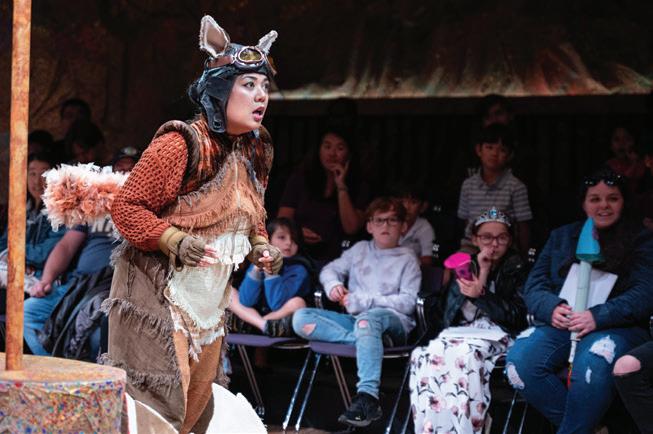
After a year of construction, Atlanta’s Alliance Theatre is pleased to announce three productions that will open the new Goizueta Stage for Youth & Families. Inspired by the massive construction project that uncovered the dirt floor beneath the Memorial Arts Building, Alliance will open with three productions all set underground and performing in repertory from January 2026 through the summer. The Underground Rep will feature the delightful family musicals “Into The Burrow: A Peter Rabbit™ Tale,” “Naked Mole Rat Gets Dressed: The Rock Experience,” and the world premiere of “The Great Ant Sleepover.”
The Goizueta Stage for Youth & Families will be a transformative space for Atlanta’s youngest patrons, featuring thoughtfully curated, year-round programming by Alliance Theatre and the Atlanta
Symphony Orchestra on the campus of the Woodruff Arts Center.
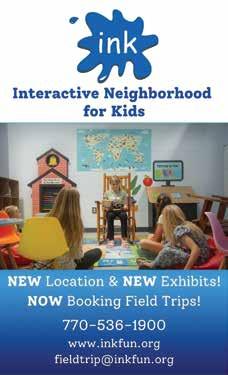
INTERACTIVE NEIGHBORHOOD FOR KIDS (INK)
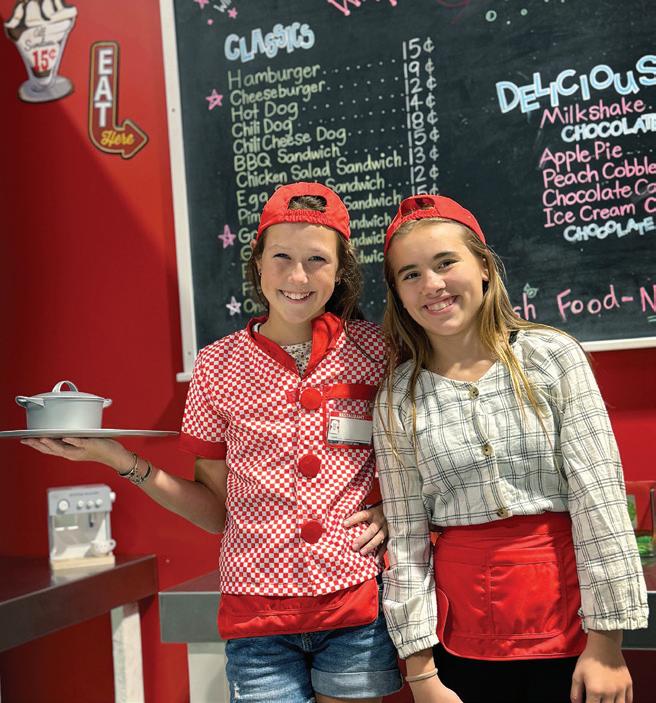
Have your field trip at Interactive Neighborhood for Kids (INK) and offer your students a fun, hands-on learning experience that connects classroom lessons to real-world discovery. The museum provides a safe, engaging environment where children can
Research conducted through the Woodruff Arts Center’s Multi-Visit Program in partnership with the University of Arkansas’ National Endowment for the Arts Research Lab showed students who attend multiple arts field trips have higher levels of socialemotional skills, stronger school engagement, and higher standardized test scores. For more information, visit alliancetheatre.org/field-trips. explore career-themed exhibits that encourage curiosity, creativity, and critical thinking. They can pretend to be a pilot, chef, veterinarian, firefighter and more!
Teachers must schedule field trips in advance to receive a special discounted rate, depending on your group size. Teachers are free when scheduled and parent chaperones and siblings will receive the student discounted rate as well. Groups can bring sack lunches and eat at the museum after playing. Additional options such as Pottery and Arts & Crafts can also be added in advance for an additional fee.
Come visit INK’s brand-new facility, located in Oakwood, GA, with new and upgraded exhibits for your students to explore. A field trip to INK is an unforgettable way to inspire lifelong learning and imagination!
INK is located at 3900 INK Avenue, Oakwood, GA, 30566. For more information, please call 770-536-1900, email fieldtrip@inkfun.org, or visit inkfun.org