Terms to Know in Your Search for the Right Educational Experience for Your Child
CHARTER SCHOOL A tax-supported public school that is independently run, allowing for greater educational choice for parents in the community.
EXPERIENTIAL LEARNING An educational approach using applied, hands-on methods of learning.
INTERNATIONAL BACCALAUREATE (IB) A specifically designed comprehensive academic program emphasizing traditional disciplines while instilling a global perspective in its students.
MAGNET SCHOOL A public school that offers a specific or enhanced curriculum designed for students of special interest or ability.
MONTESSORI A school following the principles developed by Dr. Maria Montessori, focusing on the unique individuality, self-reliance and independence of children.
SPECIAL NEEDS A school or program for children who have mild to moderate learning differences. It usually features smaller class sizes, individualized attention and multisensory learning methods.
ACCREDITATION Official certification that guarantees a school provides an education of a reasonably high quality. Schools must prove levels of quality and maintain continuous standards of improvement.
ACT An alternative to the SAT, this national college admissions examination consists of subject area tests in English, mathematics, reading and science, with an optional 40-minute writing test.
COLLEGE AND CAREER READY PERFORMANCE INDEX (CCRPI) A school improvement, accountability and communication platform for all educational stakeholders that will prepare all Georgia public
EARLY CHILDHOOD EDUCATION
Education that applies to children from birth to age 8, focusing specifically on their development, including physical, emotional, sensory, communicative, cognitive and social needs.
EVERY STUDENT SUCCEEDS ACT
(ESSA) The main federal law for K-12 general education covers all students in public schools.
GEORGIA MILESTONES Tests designed to measure how well students in grades 3 through 12 acquire the skills and knowledge outlined in the state-adopted content standards. They replaced the CRCT and involve both multiplechoice and free-response questions.
GEORGIA PERFORMANCE
STANDARDS Statewide standards of academic content for all K-12 subjects, to which every school must adhere and on which students are annually tested.
HOPE SCHOLARSHIP
(Helping Outstanding Pupils Educationally)
Funded by the Georgia Lottery since its founding in 1993, this is a scholarship in the state that rewards academically achieving students with financial
Did You Know?
Georgia's high school graduation rate rose in 2022, jumping to 84.1% – an all-time high since the state began using the adjusted cohort calculation.
assistance to attend eligible public and private Georgia colleges and universities.
MISSION/PHILOSOPHY A statement outlining the guidelines a school follows as it works to achieve its various educational goals and/or maintain its performance standards.
NOTIFICATION DEADLINE
The date by which an independent school notifies families of the acceptance of a child for enrollment to the school.
OPEN HOUSE An event held at a school where parents can learn more about the school and its offerings.
PSAT A standardized test that offers students practice for the SAT Reasoning Test and allows them to qualify for the National Merit Scholarship Program
REPLY DEADLINE The date by which parents must notify an accepting school of their commitment to enroll their child at the school.
SAT This standardized test, known as the Scholastic Aptitude Test, measures the critical thinking, writing and mathematical reasoning skills of students planning to attend college.
SECONDARY SCHOOL ADMISSIONS
TEST (SSAT) The admissions test that many independent schools require students take in order to be considered for enrollment.
SUMMER CAMP A common destination for children and teenagers during the summer, at which they can participate in a variety of activities or classes.
Communication
Deciphering Associations and Organizations
Many local and national organizations work to bring out the best in summer camps and public, private and boarding schools by identifying schools that meet certain standards through accreditation. These groups also set policies, research educational advancements and offer services to the educational communities both in Atlanta and in Georgia. The following are just some of the associations and organizations you should know in your search for the best educational experience for your child.
The Association of Boarding Schools (TABS) boardingschools.com
This organization of 250 boarding schools serves the professional development needs of boarding schools and provides information to potential students and their families.
Association Montessori Internationale (AMI) ami-global.org
Recognizes and provides
support, training and development to schools that strongly adhere to Montessori method principles and practices.
Atlanta Area Association of Independent Schools (AAAIS) aaais.org
Promotes the highest standards and best administrative practices for accredited independent schools in the metro Atlanta area.
Cognia cognia.org
Formed from the merger of two organizations (AdvancED and Measured Progress), it advances education excellence through accreditation and school improvement initiatives. Department of Education (DOE) gadoe.org
A statewide, policy-driven organization governing the public school system of education in Georgia for grades K-12.
Georgia Association of Christian Schools (GACS) gacs.org
Uses generally accepted indicators of quality, voluntary self-improvement and peer review to measure Christian schools.
Georgia Association of Private Schools for Exceptional Children (GAPSEC) gapsec.org
This state organization of independent schools for students with learning disabilities maintains a code of ethics and shares information about programs at member schools.
Georgia Independent School Association (GISA) gisaschools.org
An association of Georgia’s private, independent and parochial schools, dedicated
to serving the professional growth, advocacy and interscholastic needs of member schools.
National Association for the Education of Young Children (NAEYC) naeyc.org
A professional membership organization working to promote high-quality early learning for all young children, birth through age 8, by connecting early childhood practice, policy, and research.
National Association of Independent Schools (NAIS) nais.org
A membership association
providing research, leadership and governance guidance and professional development opportunities for school and board leaders in U.S. independent schools.
National Association of Private Special Education Centers (NAPSEC) napsec.org
Represents private specialized education programs by promoting quality programs and services for individuals with disabilities and their families.
Southern Association of Colleges and Schools (SACS) sacs.org
The recognized regional accrediting body for both public and private schools in the 11 U.S. Southern states.
Southern Association of Independent Schools (SAIS) sais.org
Provides accreditation services, professional growth opportunities and leadership development programs for 375 independent U.S. schools.
For more information about these and other organizations and associations that ensure quality education among camps and schools, visit the websites of the Georgia Department of Education (gadoe.org) or the U.S. Department of Education (ed.gov).
Information on Learning Disabilities, Education Options and More
What is a Learning Disability?
A learning disability is a neurological disorder that affects how your child processes certain information. Children with learning disabilities are as smart as or even smarter than other children, but may face challenges with reading, writing, spelling, reasoning and other functions. As a result, they often struggle to achieve in traditional classrooms. There are many types of learning disabilities, from Attention Deficit Hyperactivity Disorder (ADHD) and dyslexia to more serious forms such as autism.
What is a Special Needs School?
Special needs schools are those that serve children who struggle with learning disabilities or don’t perform well in a conventional school environment. These schools use alternative approaches to instruction in order to help children learn more effectively and also achieve success in the classroom and in social settings. Other schools don’t specifically target those with learning disabilities, but may teach different kinds of students who have had difficulty learning in a typical class-
room setting. Others may teach average or even above-average learners while also offering additional programs and classes for students with learning differences.
How to Tell if Your Child Has a Special Needs Situation
First, it’s important to identify your child’s specific challenges. Students who exhibit average or above-average intelligence but often seem distracted and don’t perform well in a traditional classroom setting may be struggling with dyslexia, Asperger’s syndrome, ADHD or some other disorder that affects their ability to learn effectively. Also, disruptive or aggressive children may be exhibiting frustration brought on by a learning disability.
If you suspect your child may have a learning dis-
ability, it’s critical to have him or her evaluated by a mental health professional. A diagnosis is necessary in order to address the child’s educational needs.
After a Diagnosis: What’s Next?
A professional evaluation is crucial in order to evaluate your child’s educational needs.
If your child is diagnosed with a learning disability and attends public school, talk with the principal, school counselor or another administrator about developing an Individualized Education Program (IEP). All public schools are required to create an IEP for students with learning disabilities who meet special education requirements. An IEP is a document that specifies your child’s learning situation and educational needs and outlines a course of action for teachers and other professionals to follow to help make sure your child learns to the best of his or her ability. u
• Does the school offer a variety of extracurricular activities, including arts and sports programs?
• Is the school accredited? If so, by which organizations?
• Is the staff certified to instruct special needs children or those with your child’s specific learning difficulty?
• Does the school focus more on academics or on addressing the child’s therapeutic needs?
Financial Assistance
Many independent special needs schools participate in the Georgia Special Needs Scholarship program (GSNS), a school choice program available to special needs students attending Georgia public schools. It offers funds to offset tuition and
fees at participating private schools authorized by the State Board of Education. According to the Georgia Department of Education, scholarship amounts range from $2,500 to $13,500, with an average amount of around $6,000.
The Qualified Education Expense Tax Credit program provides another scholarship option. Donations are made to an organization known as a Georgia Student Scholarship Organization (GaSSO), which uses the money to award scholarships to students in pre-K through grade 12. Many schools also offer their own scholarships or tuition assistance programs as well. Contact individual schools for details.
For more information on special needs schools and resources, please see our listings on page 98.
COMMON SPECIAL NEEDS TERMS
Asperger’s Syndrome: A developmental disorder on the autism spectrum, characterized by high intelligence, impaired social skills and repetitive patterns of behavior and interest.
Attention Deficit Disorder (ADD): A strain of ADHD (see below) marked by a difficulty maintaining focus or concentration and frequent or consistent fatigue. ADD differs from ADHD in that hyperactivity or impulse-control issues are markedly decreased.
Attention Deficit Hyperactivity
Disorder (ADHD): A chronic condition that includes hyperactivity, impulsive behavior and difficulty keeping one’s attention focused.
Autism: A developmental disorder that affects the ability to communicate and interact with others, accompanied by rigid, repetitive behavior patterns.
Dyslexia: A learning disability that impairs one’s ability to read.
Georgia Association of Private Schools for Exceptional Children (GAPSEC): An organization of independent schools serving students with learning disabilities and differences.
Georgia Special Needs Scholarship (GSNS): A school-choice scholarship program for special needs students being served by an IEP in Georgia public schools.
Individualized Educational Program (IEP): A written statement that outlines the needs of a public school student with learning disabilities and creates a customized plan for meeting those needs.
Individuals With Disabilities
Education Act (IDEA): The federal law that governs how states and public education agencies that accept funding under the law address the educational needs of students with disabilities.
Learning Disability: A neurological condition that affects how one processes information.
FaithBased Education
BY EVERETT CATTS
OFFERING MUCH MORE THAN ACADEMICS
arents searching for a school for their child have a variety of education options to choose from, including public schools, charter schools, magnet schools and independent schools. Among those, one of the more popular options is faith-based schools. Of the more than 32,000 independent schools in the United States, 84% are religious, according to the website of the Noah Webster Educational Foundation.
Faith-based schools, or religious schools,
are independent schools that are supported by or affiliated with a particular church or religious organization, and incorporate elements of that religious faith into their curriculum.
Examples of some local faith-based schools include The Westminster Schools and Mount Paran Christian School (Christian); St. Pius X (Catholic); The Davis Academy (Reform Jewish); St. Martin’s and Holy Innocents’ (Episcopal); The Mount Vernon School (Presbyterian); The Friends School (Quaker);
and Dar un Noor Academy (Islamic).
Parents who choose a faith-based school for their child may do so for a number of reasons.
RELIGIOUS INSTRUCTION
One big advantage of faith-based schooling, of course, is that students receive a strong foundation in the teachings of their religion. Parents who prioritize a religious education for their child take comfort from knowing that they will learn and grow surrounded by friends, teachers and clergy who share their same faith and sense of morality.
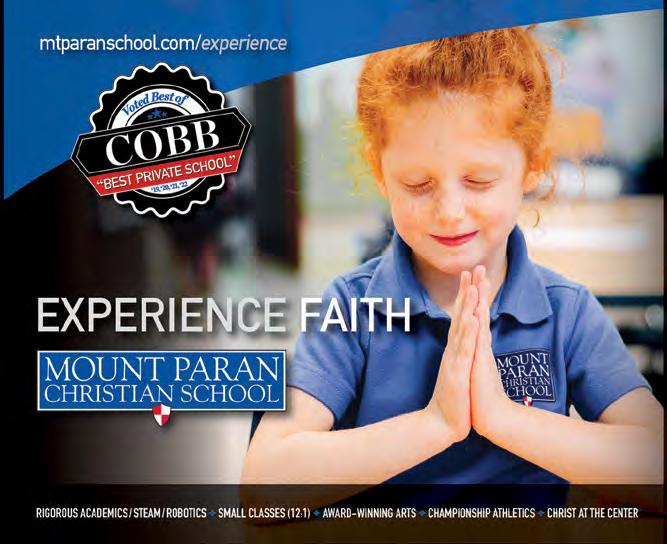
At Mount Paran, a K-12 school located in Kennesaw, “we approach everything with a Christian worldview, in the classrooms and also through chapel, through Bible classes, through prayer in small groups,” says Tiffany Westbrook, the school’s director of marketing and communications. “It’s in everything we do.”
Davis, which serves Reform Jewish
students from pre-K through eighth grade on two Atlanta campuses, “provides an immersive Jewish environment where children are invited to explore the many facets of Jewish faith, culture and tradition,” says Rabbi Micah Lapidus, director of Jewish and Hebrew studies.
“Reform Judaism believes that all aspects of Jewish religion, culture and heritage have the potential to imbue our lives with spirituality and meaning,” he continues, “but that each person ultimately makes choices about which Jewish practices are most personally relevant to them at different stages of their life.”
BUILDING CHARACTER
One essential element of a faith-based curriculum is an emphasis on morals and values that help to establish character. u
“At the heart of The Davis Academy are our Menschlichkeit values of community, respect, wisdom, spirit and righteousness,” says Lapidus. “In addition to a welcoming and inclusive spirit, Reform Judaism is deeply committed to the concept of Tikkun Olam: repairing the world. Good faith-based education draws on the richness of religion and spirituality so that children develop not only physically, emotionally, and intellectually, but also ethically, morally, spiritually and religiously.”
At Mount Paran, students and their parents have the opportunity to serve their community during Serve Saturdays, a monthly volunteer program.
This focus on developing a strong sense of values and character is a component of faith-based education that even non-religious
parents find attractive.
“There are people who come to our school who aren’t Christians, but want those Christian values ingrained in their children,” says Chris Cleveland, head of school at Wesleyan School, a K-12 college-preparatory Christian school in Peachtree Corners. “The value of a faith-based education is really creating a culture in which the values of the school reflect the values of the home.”
AN ACADEMIC EDGE
In addition to religious and moral instruction, many faith-based schools offer highquality academic programs that give their students an advantage when applying to colleges. Mount Paran, for instance, offers 56 Advanced Placement and honors courses, and applies the principles of STEAM
In addition to religious and moral instruction, many faith-based schools offer high-quality academic programs that give their students an advantage when applying to colleges.
Taking a tour or attending a school’s open house event can help both parents and their children get a feel for the school.
(science, technology, engineering, arts and mathematics) beginning in preschool.
“We have a pretty rigorous curriculum,” says Brian Dooling, director of marketing and enrollment at the Roman Catholic Archdiocese of Atlanta’s Office of Catholic Schools, which oversees 18 Catholic schools under the umbrella of the Archdiocese in the metro area, Athens and Rome.
According to Dooling, the Archdiocese’s schools benefit from a 100 percent graduation rate, and its students achieve better test scores than their peers in public and independent schools. “We have excellent results with regard to getting our kids into the colleges of their choice,” he says.
CHOOSING A SCHOOL
Parents whose children aren’t part of a school’s particular religion may worry that a faith-based school won’t welcome their child. But while some local religious schools, like Catholic schools, remain steeped in a particular faith, others have evolved into nondenominational schools, serving multiple denominations within their faith.
While Davis is recognized as the nation’s largest Reform Jewish day school, it welcomes students of all Jewish backgrounds.
“Reform Judaism embraces all different types of Jewish families, including families where one or more parents may identify with a religion other than Judaism,” Lapidus says. Mount Paran’s student body represents 120 different churches, says Westbrook. And some schools, like Wesleyan, welcome students from outside their faith.
So how can a parent narrow down their options to find the right fit for their child?
Taking a tour or attending a school’s open house event can help both parents and their children get a feel for the school. Talking with faculty, staff and other students can help them get a sense of the school’s academic curriculum, its approach to teaching its faith, and its overall atmosphere. Is there a strong roster of extracurricular activities? Do the teachers and administrators seem warm and welcoming? Do the students seem happy to be there?
Just as important, can you and your child envision them thriving at a particular school, not just academically and morally but as a fully balanced, multifaceted citizen of the world?
“Faith-based education can be one of the most profound and influential gifts a family can provide to their child,” says Lapidus. “Only faith-based schools can help children develop in all areas of their lives, as opposed to just some areas. Well-rounded development is in the best interest of every child.”
To learn more about some of Atlanta’s Top Faith-Based Schools, turn to pages 24-26. >>
HOLY INNOCENTS’ EPISCOPAL SCHOOL
Holy Innocents’ Episcopal School enrolls 1,365 students in grades PK3-12. Borrowing a phrase from its school hymn, the school will "inspire each mind and fire each heart," because HIES has created a unique, vibrant learning community filled with encouragement and every imaginable opportunity for its students to explore their talents, pursue their passions and achieve their full potential.
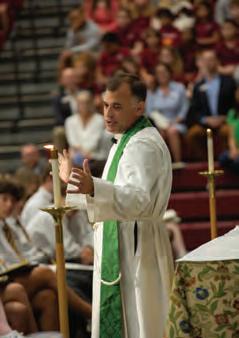
HIES offers an educational program encompassing academics, arts, athletics and spiritual formation. Through opportunities to grow intellectually, spiritually, physically and emotionally, students develop their individual worth and dignity. Weekly chapel services and a religious curriculum offer the opportunity for students to learn and grow in their faith.
The challenging academic program prepares students for higher education and
emphasizes learning as a pathway toward ethical leadership and a commitment to the common good. Students learn in small classes and actively participate in all classroom discussions. Close connections between student and teacher flourish within the curriculum.
The Upper School offers nearly 30 Honors and Advanced Placement classes. With a team of highly regarded college counselors, HIES is committed to working closely with each student and family to help navigate the college search and application process.
As a global member of Round Square, an international network of 180 schools in 50 countries, HIES provides a multicultural education for students through travel, student exchanges, globally minded service and partnerships with key organizations and speakers.
The school provides a welcoming and supportive environment, embraces the differences inherent in a diverse community and embodies the inclusive Episcopal tradition of respect for the beliefs of others. HIES is an active Christian community of faith engaged in local, national and international service to others.
Located on 43 acres in Sandy Springs, the school recently opened a new Upper School humanities building and a new Lower School building, providing state-of-the-art spaces for its students to learn, explore and experiment.
Holy Innocents’ Episcopal School is located at 805 Mount Vernon Hwy. NW, Atlanta, GA 30327. For more information, call 404-303-2150 or visit hies.org
THE DAVIS ACADEMY
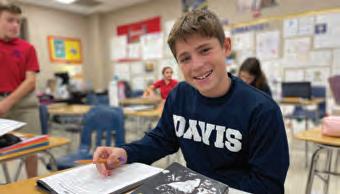
From kindergarten prep – eighth grade, The Davis Academy teaches to the whole child, creating compassionate leaders and equipping them with skills they will use for the entirety of their academic careers and beyond. The school teaches life skills, instills Jewish values and provides remarkable learning experiences so its students become well-rounded and self-confident individuals. Students learn amongst a warm and supportive community that shares common values and visions. Davis celebrates both the ways its diversity makes its school vibrant and the individual differences that make its school community so unique. With a retention rate of 97%, Davis’ community is comprised of families from across the globe, nation and 31 metro Atlanta zip codes. Davis graduates attend the most prestigious public and private high schools in Atlanta,
they know who they are and continuously make a difference in their communities and the world.
Davis offers many options for prospective families to learn about the school and its community. In addition, families can engage in wonderful Nurture events that are free and open to the community. For more information, call 678-527-3300 or visit davisacademy.org/admissions.
MT. BETHEL CHRISTIAN ACADEMY
Mt. Bethel Christian Academy, celebrating its 25th year of Christ-centered educational excellence in East Cobb, is looking ahead to the next 25 years with an eye on growth, continued excellence and maintaining its commitment to teaching through a Biblical worldview.
The school, serving 690 students in JK-
12th grades, introduced a tackle football program this year and broke ground on a state-of-the-art competition turf field for football, lacrosse and soccer. Expanding athletics facilities is phase one of a multi-year construction plan that will bring a field house, STEM/fine arts wing and enhancements to the new Upper School Film Academy at MBCA.
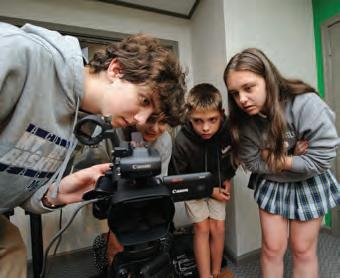
The Film Academy is an extension of the Middle School’s successful digital production offering, serving students who have a passion for film, media and digital production in a Christian context. The impact that film and media production have on our society is profound, and this field is one where its students will have a tremendous opportunity to learn, grow and be the light in a profession that sometimes challenges it. It’s a great time to be an MBCA Eagle! For more information, call 770-971-0245 or visit mtbethelchristian.org.
ST. JOHN THE EVANGELIST CATHOLIC SCHOOL
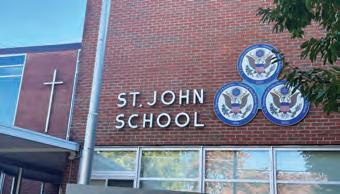
St. John the Evangelist Catholic School, a three-time National Blue Ribbon School of Excellence, serves students in PK-8th grade. Established in 1954, the school celebrates a rich legacy of over 65 years of excellence in Catholic education. Certified teachers and highly qualified staff nurture students’ God-given potential, encourage them to discover their passions and provide a rigorous academic and spiritual foundation, with the
HOLY SPIRIT PREPARATORY SCHOOL
Holy Spirit Preparatory School is a truly unique family-oriented school providing both spiritual formation and intellectual formation for children 6 months old through the 12th grade. Faith is at the core of everything it does. The school offers a classical curriculum to help students develop critical thinking skills, reason and sound judgement, along with a classical approach which provides academic excellence with a moral framework. Its extensive extracurricular offerings in the arts and athletics make for a complete education for students of all ages.
goal of forming courageous and compassionate leaders.
SJE offers a vibrant, before and after Extended School Program structured to develop students’ talents and interests and includes a variety of enriching activities such as drama, dance, band, karate, Science Olympiad and soccer. Students in grades 5-8 compete in team athletics.
Located at 240 Arnold St. in Hapeville, at the intersection of three main interstate highways, SJE's unique campus and excellent reputation attract students from 10 counties and 21 parishes in metro Atlanta. The cultural and socioeconomic diversity of SJE reflects the world, and the school delights in the unique gift it offers to the community. For more information, call 404-767-4312 or visit sjecs.org.
PINECREST ACADEMY
For more information, call 678761-7992 or visit holyspiritprep.org.
Pinecrest Academy is a PreK3-12 Catholic school providing an atmosphere of academic rigor and critical thinking. Rooted in Catholic tradition and inspired by the goodness, beauty and truth of the Christian worldview, its whole-person approach helps children discover their God-given gifts. A Cardinal Newman Society Catholic School of Excellence, Pinecrest is the No. 1 Catholic High School in Georgia by Niche.com. Average class size is 15 students. Athletics and fine arts are part of the student experience. Students participate in service projects, supporting Pinecrest’s mission to form Christian leaders who will transform society. For more information, call 770-888-4477 or visit pinecrestacademy.org.
Scott Harsh, President,
Greater Atlanta Christian School
Scott Harsh has been at GAC since 1996, serving as an educator, principal and vice president before becoming president in 2018. He holds a bachelor of arts degree in math from Harding University, a master of education degree from the University of Georgia, an education specialist degree from Georgia State University and a doctorate of education from Abilene Christian University.
What is your educational philosophy?
I believe children thrive in a personalized learning environment guided by caring teachers who help students cultivate curiosity and creativity. Learning is best when students are engaged in the process and where relationships are strong.
How is the field of education changing?
The jobs of tomorrow will be more complex and relational. Preparing students to thrive in those settings requires equipping them to solve complex issues, develop relational acuity, cultivate character and build the resiliency needed to adapt to new challenges.
What advice would you offer parents about their children’s education?
Actual growth requires appropriate challenges and struggle. Be slow to fix problems for your child; natural consequences can be excellent teachers. Put most of your focus on growing your child’s character and building confidence.
What do you love most about your job?
I love interacting with our students and seeing them grow and lead. And I love the opportunity we have to provide an exceptional educational experience in a Christian community.
How can parents best contribute to the education process?
Embrace the partnership of the school and home. Get involved where you can and invest in relationships. Enjoy this time in your child’s life.
GREATER ATLANTA CHRISTIAN SCHOOL
Emphasis: GAC cares actively, innovates wisely, nurtures with intentionality.
Year Founded: 1961
Grades: Infant–12th
Students: 1,806
Avg. Class Size: 16
Tuition Range: $17,300–$26,800
Accreditations or Affiliations: SACS, AdvancED, CESA, SAIS, NCSA; member of NAIS, GISA, AAAIS, College Board, NACAC, SACAC
Location: 1575 Indian Trail Road, Norcross, GA 30093
Contact: 770-243-2000, www.gac.org
CREATING A P L AN TO IMPROVE STUDENTS’ WELL-BEING in Schools
BY JON STYF
The COVID-19 pandemic wreaked havoc on the mental health of school-aged children, adding in isolation and fear to an already complicated point in life.
From virtual schooling to separation of students to masking, the many elements to a complex situation all contributed to an environment where more students felt alone or at risk.
Their rates of depression, suicidal thoughts and other problems have increased exponen-
tially while schools have seen increased requests for counseling and a large jump in students seeking mental health assistance outside of school.
HOW SCHOOLS MANAGE MENTAL HEALTH
So what are metro Atlanta schools doing to combat this epidemic in mental health for students?
Many are adding staff and programming
to directly address mental health with students, teachers, staff and parents. Eliminating a stigma related to mental health issues is a key component of that education.
Schools are also teaching students more about the science behind mental health, integrating more study of the nervous system into science classes while also increasing special programming and speakers related to mental health.
“I think everyone is more aware of mental health so kids might seek support more regularly,” says Sara Friedman, director of K-12 counseling at The Lovett School. “We
Woodward Academy is adding a full-time psychologist position to assist students of all grade levels and is also involved in an Emory University study on mental health in schools.
are talking about it more and we’re trying to address it as we would our physical health. We’re trying to get rid of any stigma associated with mental health and knowing that it’s OK to not be OK.”
Woodward Academy is adding a fulltime psychologist position to assist students of all grade levels and is also involved in an Emory University study on mental health in schools. The parents of students involved in that study are receiving even more communication on mental health than other parents.
The schools’ philosophy also understands that the first line of positive impact for students is the school’s teaching staff, which interacts with students the most regularly.
“Teacher well-being is a huge component,” says Jennifer Knox, Woodward’s director of character education. “So much of what we’re offering is really recognizing that if our teachers are not well and our teachers are not feeling supported, then that transfers to the classroom. Even though the programs are focusing on skill-building with the students, the way in which those workshops are offered is really centered on teacher well-being as well.”
Public schools are taking stock of how
students are doing mentally, in part through the Georgia Student Health Survey from the Georgia Department of Education, which began in 2019. It asks students questions on everything from whether students look forward to attending school to if they are stressed and what factors lead to stress. The 2022 survey of middle and high school students shows that, of more than 386,000 respondents, nearly 128,000 feel stressed sometimes and more than 106,000 feel stressed always.
HOW YOU CAN HELP
What can you do to help your children stay healthy?
It starts with the basics: eating and sleeping enough, which are essential for overall healthy living, according to Dr. John Lochridge, a recently retired Atlanta-based child and family psychiatrist.
From there, you should be encouraging more face-to-face interaction and reducing individual screen time. Part of the current mental health crisis is a societal shift from in-person group activities to individual electronics, like phones and tablets.
While that technology can be great for
educational purposes, it can also cause issues as it adds to isolation and allows teens to criticize one another more anonymously and not face to face.
“We need to get back in our clubs and our teams and into our group outings, and we really need to work hard at doing new things,” Lochridge says. “Before, it may have been a baseball team. Now, everybody can go to some sort of museum or whatever. I really feel that social interaction is the key, and that is not electronic social interaction. You have got to go outside and play. And you have to go outside and learn, and learn about the world. Get reading, get in the car, get on MARTA and go places.”
REMAIN CALM AND CONSISTENT
Lochridge believes that consistency on everything from bed times to screen-time rules is important. However, he understands, with the upheaval of the past few years for everyone, that could be difficult for you. But the more you can remain calm and consistent, the better it is for your children.
Friedman says it is important how parents respond to stress and anxiety that they see
The better you know your children or interact with them daily, the more you will be able to notice the subtle changes that occur before or during a mental health crisis.
in their children, acknowledging it and that both are normal emotions that cannot and should not be avoided.
“Stress is an unavoidable part of life and one that comes under positive and negative conditions,” she says. “Stress is what happens when we operate at the edge of our capacity. We wouldn’t want children to avoid stress even if they could, because kids build up their capacities when they stretch beyond their comfort zones.”
So it is important to emphasize resilience, understanding that no one will be perfect and that anxious thoughts can lead to overestimating the danger facing us.
Instead, Friedman says, it’s important to acknowledge what the danger really is and then express non-dismissive confidence in their children related to those fears, giving the children confidence that they can combat those fears and excel in spite of them.
WARNING SIGNS
A key to helping in a mental crisis is if you can detect the warning signs early. Georgia’s chapter of the National Alliance of Mental Illness has given presentations on “Ending the Silence” of mental health issues, saying the warning signs can include excessive worry or fear, feeling excessively sad or low, confused thinking or issues concentrating, extreme highs or lows, prolonged feelings of irritability or anger and avoiding friends or social activities.
The better you know your children or interact with them daily, the more you will be able to notice the subtle changes that occur before or during a mental health crisis. Those issues can also show up in changes
in sleep or eating habits, ailments showing up without a clear cause, an inability to complete daily activities and an increased fear of weight gain.
Friedman said that Lovett is partnering with The Westminster Schools for a Behind Happy Faces program to educate about the warning signs of mental health issues and how parents and school staff can identify those issues.
The symptoms can also include changes in performance at school, excessive worrying or avoiding both going to sleep or going to school, hyperactivity, nightmares, an increase in aggression or disobedience and temper tantrums.
Most important is that you remain engaged with your children, listening to them and observing them often to better understand the signs of risk and addressing those risks before they could accelerate.
BALANCING AND LIFE
SUPPORTING YOUR CHILD ON AND OFF THE FIELD
hether it’s Pee Wee Soccer, Little League or “Friday Night Lights,” youth sports today may actually be our true “national pastime” with lessons, teams and leagues available for children practically from infancy.
That’s a great thing: in addition to providing the physical benefits of exercise, studies consistently show that sports boosts kids’ selfesteem, improves academic performance and reduces the likelihood of risky behaviors. It also teaches important social skills like teamwork, goal setting and emotional resilience. Nurturing your child’s involvement in sports
offers definite benefits, but it also demands active parental planning and involvement to maintain a balance with other aspects of their growing up.
PRESCHOOL: TIME FOR INFORMAL PLAY
However, up until the age of 6 or 7, kids’ bodies, motor skills and powers of concentrations are still developing. For the first couple of years of your child’s life, just getting outside and having fun together will give everyone plenty of exercise as you model an active lifestyle. At this stage, your balancing act as a parent is to maintain equilibrium
between the freedom of unstructured play and the structure of organized activity.
At around age 3, you can introduce your toddler to classes such as swimming, dance, martial arts or gymnastics. Remember to keep the emphasis on fun and movement. Classes or games should be short and avoid elements of perfect technique or competition. Let your youngster explore different activities to maintain interest. If he’s not interested, just stick with informal play— there’s no evidence that participation in preschool sports enhances development or activity levels later in life.
GRADE SCHOOL: GETTING YOUR FEET WET
At around age 6 or 7 years old, children are usually physically and mentally ready to begin participating in organized sports. Ask your youngster what sport he or she would like to try: He or she may already have a clear favorite, or want to play on a team with friends.
While signing up for too many activities of any kind can overload anyone, it’s a good idea during this period to try over the course of a year at least two sports that each emphasize different skill sets. Playing one sport exclusively can contribute to stress injuries and lead to burnout on sports and physical activity in general. Mixing it up actually contributes to higher levels of success in an athlete’s primary sport.
When choosing a sport, consider your child’s physical and mental attributes. If he or she is on the small side physically, football or soccer may not be the best sport, at least for now. If he or she is still working on coordination, tae kwon do or a “big ball” sport such as soccer may suit him or her better than tennis or softball. Quiet and reserved
kids may prefer an individual sport such as swimming, track or golf to the rough and tumble of team sports.
Whatever sport your child participates in, competition should remain secondary to having fun, staying active and learning the fundamentals. However, this is also a good time to instill the value of commitment. Unless they’re experiencing genuine distress, ask them to play for a full season— usually only a few weeks at this age— before quitting.
As a parent at this time, you’re finding the balance between encouraging participation
The Concussion Conundrum
In recent years, new data on both the frequency and the effects of concussions and traumatic brain injury (TBI) for participants in contact sports at all levels has raised concerns over the appropriateness of these sports for players under age 18.
The concerns are not unfounded: a study by the National Academy of Sciences has shown that high school athletes, especially those in the sports of football, baseball, soccer, hockey and lacrosse, are almost twice as likely to suffer concussion as players at the college level. More than 5 percent of high school athletes are concussed each year while participating in contact sports, and high school athletes are three times more likely to experience a second concussion if concussed once in a season.
At the high school level, awareness of the problem has led to stricter safety guidelines covering play and practice procedures and equipment specifications. Coaches and support staff are frequently more adequately trained to recognize and deal with concussion issues in their players. However, any recommendations do not have the force of law, and actual practices can vary by location. When making decisions for their children, parents need to weigh the risks against the definite benefits of sports participation.
The Centers for Disease Control and Prevention has instituted the Heads Up program to help coaches, trainers and parents recognize, respond to and minimize the risk of concussion or other serious brain injuries. To learn the symptoms of concussion, what to do in the event of brain injury and how to talk to your teen about these injuries, visit cdc.gov/headsup
and forcing it. It’s good for children to have the chance to find a sport that they’ll enjoy, hopefully for a lifetime. It’s easy at this age for kids to want to stop if things don’t gel right away, but listening to your child will tell you if they should try something else or walk away altogether. If that happens, accept it. Remember that it’s not about you.
MIDDLE AND HIGH SCHOOL:
Middle school is a critical time for determining if a child continues an active lifestyle. The character lessons of sports, particularly those of discipline and dealing with adversity, are especially valuable now, and the camaraderie gives kids a sense of belonging. Student athletes also tend to have better grades, higher achievement levels and more positive attitudes toward school.
But this is also when demands on kids’ time ratchet up, and many kids quit sports, saying, “It’s not fun anymore.” Almost 70 percent of student athletes quit by age 13. If you’ve focused on sports as something to be pursued for fun and personal fulfillment before now, as opposed to a competition or path to a scholarship, this may not happen. But if it does, again, accept it. The impor-
tant thing is that physical activity remains a part of their life in some way, whether it’s intramurals instead of junior varsity, independent league play or just putting down the phone and the books to kick a ball with you on the weekend.
High school is the time to let your child take the lead in balancing sports and the many other priorities facing them on the threshold of adulthood. You may want to plan a calendar together at the start of the school year that includes games or tournaments, test dates, college applications and other known obligations. But then step back and let them learn to manage their time. If sleep, family time or grades suffer, then it’s time to step in. But learning to prioritize their goals and find a way to achieve them is the first step toward success, both in college and beyond.
Ultimately, you want your child to be healthy, have fun and build the character traits that help them succeed in life off the field. Keep this in mind and you’ll succeed in the balancing act that is parenting a young athlete.
area map
SCHOOLS
For features of independent schools, turn to Education At a Glance on pg. 38. For public school system information by county, turn to pg. 78.
3 3
2
2
1 1
5 5
Boar ding Schools Florida, Georgia, North Carolina, Pennsylvania,
Educational Resour ces T utoring, Summer Camps and Activities, Field Trips and Education Programs.
REGION 5: Atlanta West Acworth, Buckhead, Kennesaw, Smyrna/Vinings
REGION 4: Atlanta South/ Southeast/Southwest Eagles Landing, Fairburn, Fayetteville, Hapeville, Locust Gr ove, McDonough, Metr o-Atlanta, Sharpsburg/Peachtree City p.68
Buckhead, Chastain Park, Crabapple, East Cobb, Holly Springs, Marietta, Roswell p.50
REGION 3: Atlanta East Athens, Bethlehem, Brookhaven, Collins Hill, Decatur, East Atlanta, Loganville, Watkinsville
REGION 3: Atlanta East Ansley Park, Athens, Dacula, Decatur, Midtown, Morningside, Northeast Atlanta p.41
*KEY:
Education At a Glance
INDEPENDENT SCHOOLS
Religious Affiliation: CC = Catholic C = Christian E = Episcopal J = Jewish JC = Judeo-Christian ND = Non-denominational P = Presbyterian Q = Quaker
41
REGION 1: ATLANTA NORTH/NORTHWEST
50 REGION 2: ATLANTA NORTH/NORTHEAST
Education At a Glance
This information reflects the latest available data at publication time. Please confirm with each individual
INDEPENDENT SCHOOLS
56 REGION 3: ATLANTA EAST
62 REGION 4: ATLANTA SOUTH/SOUTHEAST/SOUTHWEST
Education At a Glance
This information reflects the latest available data at publication time. Please confirm with each individual school.
INDEPENDENT SCHOOLS
68
REGION 5: ATLANTA WEST
71 BOARDING SCHOOLS
REGION 1
Independent Schools
NEIGHBORHOODS OF NOTE
Alpharetta Once a small farming community, Alpharetta’s growth has exploded in recent years, and the North Fulton city is now one of Atlanta’s most affluent neighborhoods, creating the perfect mix of country living and lots of city amenities.
Woodstock Located in Cherokee County, Woodstock is, as locals say, “where modern amenities meet old Southern charm.” Historic Olde Towne pays a continual tribute to Woodstock’s pioneers through vintage shops and good old-fashioned Southern hospitality
BUCKHEAD
BUCKHEAD
CRABAPPLE • CHASTAIN PARK
EAST COBB
HOLLY SPRINGS
ROSWELL
Independent Schools
NEIGHBORHOODS OF NOTE REGION
Duluth A successful mix of small-town charm and booming economic growth, Duluth plays host to many major corporations and is also home to numerous golf clubs, private tennis clubs and parks. The city prides itself on accommodating a growing, diverse population.
Dunwoody A popular community among young and established professionals alike, Dunwoody is often referred to as the “tennis set” neighborhood because of its numerous recreational outlets. Its location provides suburban living close enough to the city.
Serving children in grades Kindergarten to High School with language, learning and social challenges.
Call for a private tour!!!
Certified masters-level teachers deliver a regular-education curriculum combining:
• Georgia Standards and National Core
• Differentiated Instruction
• PE, Art, Foreign Language, Theatre and Culinary Arts
• Technology in every classroom
Rolling Admissions. Fully Accredited GAC! 2022-2023
DUNWOODY
JOHNS CREEK
PEACHTREE CORNERS • ROSWELL
ATLANTA EAST
3
Independent Schools
NEIGHBORHOODS OF NOTE
Decatur The county seat of DeKalb County, Decatur’s small-town charm revolves around the Courthouse Square, which features trendy restaurants and shopping, entertainment options and special events, including its annual summer beach bash.
Lawrenceville Located in the heart of Gwinnett County and known as “Crepe Myrtle City,” Lawrenceville is Atlanta’s second oldest city. Its historic downtown square, which has been revitalized, is home to a variety of shops, restaurants and community events.
ATHENS • BROOKHAVEN
DECATUR
COLLINS HILL • EAST ATLANTA
Independent Schools
NEIGHBORHOODS OF NOTE
McDonough One of the fastest-growing neighborhoods South of Atlanta, McDonough is the county seat of Henry County and features many historic structures around its town square. The city has ample green space and is a favorite destination for antique shoppers.
Peachtree City A master-planned city comprised of several smaller villages, Peachtree City’s many amenities include golf courses, lakes and an amphitheater. The city is renowned for its network of golf paths connecting its neighborhoods.
EAGLES LANDING • FAIRBURN
Fairburn | Peachtree City | PK3-12
HAPEVILLE • LOCUST GROVE
ATLANTA WEST
Independent Schools
FULTON
NEIGHBORHOODS OF NOTE
Acworth Surrounded by two lakes and 12 parks, Acworth offers plenty of recreation opportunities. Located 35 miles northwest of Atlanta, the town is convenient to both I-75 and Highway 41. Acworth is designated as a Georgia Main Street City.
Douglasville Located west of Atlanta on I-20, Douglasville has easy access to all that Atlanta offers. Listed on the National Register of Historic Places, Downtown Douglasville’s historic district is an outstanding example of a turn-ofthe-century southern railroad town.
ACWORTH • BUCKHEAD
SMYRNA/VININGS
There are many benefits of a boarding school education. Boarding schools are an option for students seeking a more independent learning experience. Because students generally live on campus, learning takes place in and out of the classroom almost on a 24-hour basis.
When selecting a boarding school, it is important to visit the school campus, but representatives from many boarding schools visit Metro Atlanta throughout the year—contact each school for specific dates.
Boarding Schools
FLORIDA
NORTH CAROLINA
NORTH CAROLINA • PENNSYLVANIA
TENNESSEE
TENNESSEE
SPOTLIGHT ON METRO ATLANTA’S SCHOOL SYSTEMS
Avariety of improvements and innovative programs in Georgia’s public school systems have resulted in many stellar elementary, middle and high schools across the metro area. Different school systems feature specialized programs and academic opportunities, such as magnet, charter, vocational or alternative schools, to suit their respective students, parents and communities. However, despite variations in programming and academic offerings, all public schools must offer the core curriculum as determined by the Georgia Board of Education. Here is a county-by-county guide to metro Atlanta’s public school systems. For more information about the Georgia Department of Education, call 404-656-2800 or visit gadoe.org. u
CHARTER SCHOOLS
CHARTER SCHOOLS
TOP CHARTER SCHOOLS
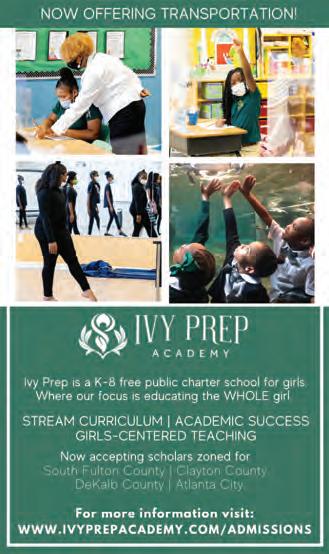
IVY PREP ACADEMY
Ivy Preparatory Academy is the first singlegender, K-8 charter school for girls in Georgia, educating families in DeKalb, Clayton and south Fulton counties and the city of Atlanta.
Ivy Prep offers an established culture of achievement whereby academic success is vital, and the development of a girl’s individual potential is central. Its scholars are taught by highly effective teachers who understand how girls learn best, and how to inspire each scholar to reach her potential. For more information, call 404622-2727 or visit ivyprepschool.org
CHARTER SCHOOLS
BARTOW
Board of Education
770-606-5800
bartow.k12.ga.us
CHEROKEE
Total # of Students: 12,849
Student Spending: $10,399
2022 Mean Georgia Milestone Scores:
3rd: (ELA) 497 (M) 519
5th: (ELA) 514 (M) 513
8th: (ELA) 505 (M) 509
2022 Average SAT: 1032
Top 3 Schools by Average 2022 SAT Score
Woodland 1079
Adairsville High 1034
Cass High 995
What’s New: The bodies of over 3,000 students and staff from five Bartow County schools physically formed the word “family” on the Adairsville High School football field as part of the district’s Pink Out 2022 celebration. The event helped to raise more than $10,000 for local families affected by cancer.
2022 Mean Georgia Milestone Scores:
3rd: (ELA) 517 (M) 535
5th: (ELA) 525 (M) 538
8th: (ELA) 520 (M) 527
2022 Average SAT: 1091
Top 6 Schools by Average
Board of Education
770-479-1871
cherokeek12.net
CLAYTON
Total # of Students:
2022 SAT Score
River Ridge High 1102
Sequoyah High 1101
Creekview High 1099
Woodstock High 1093
Etowah High 1081
What’s New: The Cherokee County School District partners with Child Find to help identify students eligible for free appropriate special education services. Parents concerned their child may have a learning disability may request more info from the district office.
2022 Mean Georgia Milestone Scores:
3rd: (ELA) 458 (M) 485
5th: (ELA) 484 (M) 472
8th: (ELA) 494 (M) 479
2022 Average SAT: 939
Top 5 Schools by Average 2022 SAT Score
Elite Scholars Academy 1099 M. E. Stilwell School of the Arts 1034
Morrow High School 965
North Clayton High School 943
Total
Charles R. Drew High School 921
What’s New: Automated speed cameras have been installed to increase the safety in school zones, operating each school day.
Board of Education
770-426-3300 cobbk12.org
COWETA
Board of Education
770-254-2800
cowetaschools.net
DEKALB
Board of Education
678-676-1200 dekalbschoolsga.org
2022 Mean Georgia Milestone Scores:
3rd: (ELA) 517 (M) 529
5th: (ELA) 525 (M) 523
8th: (ELA) 523 (M) 524
2022 Average SAT: 1111
Top 5 Schools by Average 2022 SAT Score
Walton High School 1255
Wheeler High School 1211
Lassiter High School 1186
Alan C. Pope High School 1178
Sprayberry High School 1070
What’s New: Fair Oaks Elementary School’s new Exploratorium is chock-full of hands-on activities for young children to explore.
2022 Mean Georgia Milestone Scores:
3rd: (ELA) 518 (M) 529
5th: (ELA) 524 (M) 519
8th: (ELA) 520 (M) 521
2022 Average SAT: 1070
Top 3 Schools by Average
2022 SAT Score
Northgate High 1117
Newnan High 1054
Total # of Students:
East Coweta High 1049
What’s New: The Coweta County School System Transportation Department has begun offering the Bus Bulletin notification system to provide bus route schedule changes or delays.
2022 Mean Georgia Milestone Scores:
3rd: (ELA) 482 (M) 502
5th: (ELA) 500 (M) 491
8th: (ELA) 503 (M) 495
2022 Average SAT: 1000
Top 5 Schools by Average
2022 SAT Score
Total # of Students:
Chamblee Charter High 1200
DeKalb School of the Arts 1123
DeKalb Early College Academy 1115
Dunwoody High 1108
Lakeside High 1108
What’s New: Nearly 800 DeKalb County School District teachers are volunteering their personal time to participate in Language Essentials for Teachers of Reading and Spelling (LETRS). It is a two-year, specialized training program.
PUBLIC SCHOOL COUNTY GUIDE
PUBLIC SCHOOL COUNTY GUIDE
DOUGLAS
Board of Education 770-651-2000 dcssga.org
Number of Schools Elementary 20
Total # of Students: 25,685
Student Spending: $10,216
2022 Mean Georgia Milestone Scores:
3rd: (ELA) 491 (M) 510
5th: (ELA) 513 (M) 499
8th: (ELA) 515 (M) 498
2022 Average SAT: 1001
Top 5 Schools by Average 2022 SAT Score
Douglas County High 1022
Alexander High 1021
Chapel Hill High 1012
Lithia Springs High 990
New Manchester High 947
What’s New: To help prevent dangerous situations, Douglas County School System is offering students a new safety app called See It, Say It, Send It. It’s used to share photos, videos, audio recordings and text messages anonymously.
2022 Mean Georgia Milestone Scores:
3rd: (ELA) 533 (M) 542
5th: (ELA) 543 (M) 541
8th: (ELA) 541 (M) 542
2022 Average SAT: 1132
Board of Education
770-460-3990 fcboe.org
FORSYTH
Total # of Students: 19,552
Student Spending: $11,687
Top 5 Schools by Average 2022 SAT Score McIntosh High 1183 Starr’s Mill High 1151 Whitewater High 1122
Sandy Creek High 1080 Fayette County High 1049
What’s New: McIntosh STEM students, along with key school and community partners, have finished renovations of the school’s courtyard for special needs students.
Number of Schools
23
Board of Education
770-887-2461 forsyth.k12.ga.us
Total # of Students: 50,712
Student
2022 Mean Georgia Milestone Scores:
3rd: (ELA) 535 (M) 557
5th: (ELA) 543 (M) 561
8th: (ELA) 537 (M) 554
2022 Average SAT: 1172
Top 5 Schools by Average 2022 SAT Score
Lambert High 1240
Alliance Academy 1232
South Forsyth High 1216
Denmark High 1177
West Forsyth 1128
What’s New: The Forsyth County Schools district has broken ground on the replacement building for Midway Elementary School. The current Midway serves about 750 students; the new facility will be able to accommodate 1,175. The building is entirely funded by E-SPLOST dollars.
DOUGLAS
Board of Education
470-254-3600 fultonschools.org
GRIFFINSPALDING
Total # of Students: 88,390 Student Spending: $11,746
2022 Mean Georgia Milestone Scores:
3rd: (ELA) 518 (M) 536
5th: (ELA) 526 (M) 524
8th: (ELA) 528 (M) 521
2022 Average SAT: 1101
Top 5 Schools by Average 2022 SAT Score
Northview High 1298
Chattahoochee High 1247
Alpharetta High 1223
Johns Creek High 1214
Milton High 1178
What’s New: Milton High School student Dave Githutu, who has Down syndrome, won the Teen 3 Division title of World Champion Powerlifter and set three world records at the Amateur Powerlifting World Congress in Manchester, England.
2022 Mean Georgia Milestone Scores:
3rd: (ELA) 466 (M) 497
5th: (ELA) 492 (M) 485
8th: (ELA) 489 (M) 481
2022 Average SAT: 970
Board of Education
770-229-3700
spalding.k12.ga.us
Total
Top 2 Schools by Average
2022 SAT Score Spalding High 1013 Griffin High 917
What’s New: In efforts to ramp up school safety, all GriffinSpalding County middle and high schools have received metal detectors to conduct random screenings at different places throughout the buildings and possibly at extracurricular events. The schools have also implemented a clear bookbag policy requiring all student bookbags to be transparent.
2022 Mean Georgia Milestone Scores:
3rd: (ELA) 513 (M) 527
5th: (ELA) 521 (M) 522
8th: (ELA) 522 (M) 520
2022 Average SAT: 1097
Top 5 Schools by Average
2022 SAT Score
Gwinnett School of Math, Science, and Technology 1386
North Gwinnett High 1193
Board of Education
678-301-6000
gcpsk12.org
Total # of Students:
Brookwood High 1136
Mill Creek High 1132
Peachtree Ridge High 1115
What’s New: Georgia Gwinnett College will receive $3.7 million from the U.S. Department of Education to help 40 aspiring educators become teachers in Gwinnett County Public Schools.
PUBLIC SCHOOL COUNTY GUIDE
Board of Education
770-534-1080 hallco.org
Board of Education
770-957-6601
Total # of Students: 26,558
Student Spending: $9,934
2022 Mean Georgia Milestone Scores:
3rd: (ELA) 484 (M) 509
5th: (ELA) 503 (M) 504
8th: (ELA) 500 (M) 505
2022 Average SAT: 1041
Top 5 Schools by Average 2022 SAT Score
North Hall High 1083
Flowery Branch High 1082
Chestatee High 1050
Johnson High 1021
Cherokee Bluff High 1014
What’s New: The Kubota Manufacturing of America Corp. donated an excavator to the Hall County School District. The machine is valued at more than $100,000.
HENRY PAULDING
Total # of Students: 42,048
Student Spending: $9,638
2022 Mean Georgia Milestone Scores:
3rd: (ELA) 490 (M) 509
5th: (ELA) 503 (M) 491
8th: (ELA) 504 (M) 495
2022 Average SAT: 996
Top 5 Schools by Average 2022 SAT Score Union Grove High 1076 Ola High 1066 Luella High 993
Locust Grove High 990 Dutchtown High 987
schoolwires.henry.k12.ga.us
What’s New: Henry County Schools has launched HenryConnects Family View, a website designed to strengthen the partnership between home and school by offering online resources.
of Schools
2022 Mean Georgia Milestone Scores:
3rd: (ELA) 505 (M) 521
5th: (ELA) 515 (M) 511
8th: (ELA) 517 (M) 514
2022 Average SAT: 1032
Board of Education
770-443-8000
paulding.k12.ga.us
Total # of Students:
Top 5 Schools by Average 2022 SAT Score
Paulding County High 1052
South Paulding High 1035
North Paulding High 1034
East Paulding High 1022
Hiram High 1000
What’s New: Over 500 students at P.B. Ritch Middle School were assigned brand-new Microsoft Surface laptops and given tutorial instruction to set them up as the Paulding County School District launched its new 1:1 initiative. The program is scheduled to provide devices to all students in the district within two years.
HALL
ROCKDALE
Number of Schools
ROCKDALE
Board of Education
770-483-4713
rockdaleschools.org
ATLANTA PUBLIC SCHOOLS
Total # of Students: 15,334
Student Spending: $11,236
2022 Mean Georgia Milestone Scores:
3rd: (ELA) 482 (M) 500
5th: (ELA) 502 (M) 485
8th: (ELA) 515 (M) 499
2022 Average SAT: 980
Top 3 Schools by Average 2022 SAT Score
Rockdale High 1032
Heritage High 956
Salem High 903
What’s New: Rockdale County Public Schools Board of Education meetings will now be streamed live for citizens to view in real time. Recordings will also be posted to the district’s YouTube channel for later viewing.
Board of Education
atlantapublicschools.us
BUFORD CITY SCHOOLS
Total # of Students:
49,811
Student Spending:
$17,725
2022 Mean Georgia Milestone Scores:
3rd: (ELA) 483 (M) 503
5th: (ELA) 497 (M) 490
8th: (ELA) 503 (M) 494
2022 Average SAT: 947
Top 5 Schools by Average
2022 SAT Score
Midtown High 1132
Atlanta Classical Academy 1119
North Atlanta High 1026
KIPP Atlanta Collegiate Academy 1006
Charles R. Drew Charter High 980
What’s New: Atlanta Public Schools offers access to quality health care services at no cost to families through Hazel Health. Whether at home or at school, students can be evaluated by a Hazel doctor via a live video visit, and treatment is coordinated with local providers to ensure continuity of care.
Board of Education
770-945-5035
bufordcityschools.org
Number of Schools
Total # of Students: 5,447
Student Spending: $11,241
2022 Mean Georgia Milestone Scores:
3rd: (ELA) 543 (M) 551
5th: (ELA) 543 (M) 544
8th: (ELA) 549 (M) 563
2022 Average SAT: 1133
What’s New: Buford City Schools ranks as the 2023 Best School District in the state of Georgia, according to data compiled by Niche, an education research platform. The ranking is based on a weighted index of several measures.
PUBLIC SCHOOL COUNTY GUIDE
PUBLIC SCHOOL COUNTY GUIDE
CITY SCHOOLS OF DECATUR
Board of Education
404-371-3601
csdecatur.net
Total # of Students: 5,620
Student Spending: $14,521
2022 Mean Georgia Milestone Scores:
3rd: (ELA) 553 (M) 560
5th: (ELA) 560 (M) 570
8th: (ELA) 549 (M) 542
2022 Average SAT: 1196
What’s New: College Heights Early Childhood Learning Center is hosting a workshop series called School to Heart to Home. Each monthly session features one of the Seven Skills of Discipline, empowering parents to respond to conflict in a way that teaches children healthy behaviors while managing their personal emotions.
GAINESVILLE CITY SCHOOLS
Board of Education
770-536-5275 gcssk12.net
Total # of Students: 7,469 Student Spending: $10,842
2022 Mean Georgia Milestone Scores:
3rd: (ELA) 477 (M) 506
5th: (ELA) 495 (M) 500
8th: (ELA) 491 (M) 486
2022 Average SAT: 976
What’s New: Gainesville City Schools System has hired 10 armed security guards to patrol every school in the district: one at each elementary and middle school, and two at Gainesville High School. The 10 guards hired have a combined 296 years of experience in law enforcement, military and private investigation services.
MARIETTA CITY SCHOOLS
Board of Education
770-422-3500
marietta-city.org
Total
2022 Mean Georgia Milestone Scores:
3rd: (ELA) 498 (M) 523
5th: (ELA) 516 (M) 524
8th: (ELA) 513 (M) 514
2022 Average SAT: 1084
What’s New: Marietta City Schools Superintendent Grant Rivera personally paid for one college application fee for each Marietta High School senior who submitted an early action or early decision application during the school’s Apply to College Day. Rivera has offered this help to the district’s seniors for four consecutive years.
EDUCATIONAL RESOURCES
Ways to Enhance your Child’s or Student’s Learning
FIELD TRIPS & EDUCATION PROGRAMS
FIELD TRIPS & EDUCATION PROGRAMS
TITANIC MUSEUM ATTRACTION
Its Young Guests Review the Titanic Museum Attraction As reported by First Officer Campbell
Is it possible for children to be so excited about a museum that they can barely contain themselves?
You might be inclined to say no, and I would have been a doubter myself before I had the opportunity to interact with the young guests at the Titanic Museum Attraction
Kids are the stars at Titanic Museum Attraction. It's all about families and it is especially focused on the children, who are ready to seize the experience with joy, enthusiasm and delight.
The Titanic Museum in Pigeon Forge, Tennessee, is a “living historical museum.” The children are brimming with curiosity and a sense of being on a learning adventure. Just ask the kids. They say so openly, honesty and
with enthusiasm: two thumbs up. “Awesome. Cool. Best ever.”
For more information, call 417-334-9500 or visit titanicpigeonforge.com.
ARTSBRIDGE FOUNDATION
The ArtsBridge Foundation is excited to present its 2023 Spring Field Trip lineup at the Cobb Energy Performing Arts Centre. There’s something for everyone this season: Atlanta Ballet presents Beauty and the Beast (at 11 a.m. Feb. 16); Llama Llama LIVE! brings a preschool favorite to life (at 10:15 a.m. and noon Feb. 21) and The Atlanta Opera's Candide (at 7 p.m. March 2) is a great way to introduce kids to the world of opera. To find out more about ArtsBridge’s masterclasses and workshops, call 770-9162805 or visit artsbridgega.org.