15 – 20 JUNE 2025
PROGRAM BOOK

ASOF21MAY2025, forthemostuptodateinformationpleasevisit ims-ieee.organdrfic-ieee.org.



Superior RF Performance. Unlimited Possibilities.
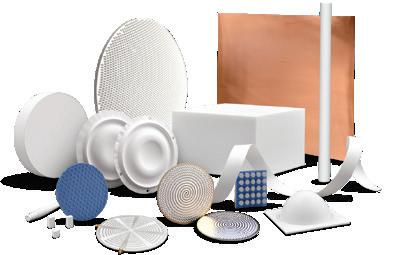
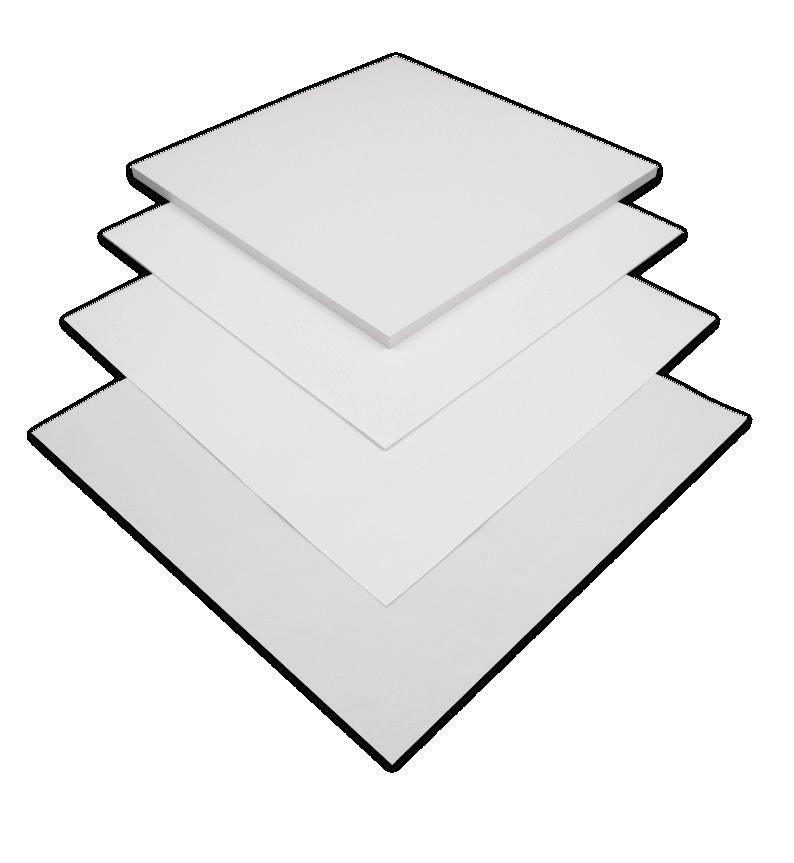
2.5-20.4 Dk \ Ultra Low-loss \ Dielectric Material
Backed by decades of material science and manufacturing innovation, WavePro® is a high-performance dielectric material that enables enhanced RF designs. Precision manufactured custom shapes and panels from WavePro empower RF designers to take their designs to the next level. Join
MICROWAVE WEEK
From social media to downloading papers in real time — we’ve got you covered!
JOIN THE CONVERSATION:
Make sure you’re engaging with IMS2025 on our social channels:
Follow us on X: https://x.com/MTT_IMS
Follow us on Instagram: http://instagram.com/mtt_ims
Like us on Facebook: http://www.facebook.com/IEEE.MTTS.IMS
Follow us on LinkedIn:
https://www.linkedin.com/company/ieee-mtt-s-internationalmicrowave-symposium-ims/
Follow us on YouTube: http://www.youtube.com/user/mttims
IMS MICROWAVE WEEK:
There’s an app for that! Download papers in real time! The IMS Microwave Week app is now available in the Apple App Store and Google Play store. Install the app on your Android or iOS device to view the full schedule of Workshops; Technical Lectures; IMS, RFIC, and ARFTG Technical Sessions; Panel Sessions; Social Events; and
Exhibition Information. You will be able to download the technical content that you registered for, e.g., IMS and/or RFIC papers/presentations, workshop presentations; as well as locate exhibitors and explore everything that IMS has to offer! Download the app today!
To download the app, search for ‘IMS Microwave Week’ on the app store for your device or scan a QR code below.




rFor assistance, please email: support@mtt.org
Wifi is available throughout the Convention Center!
SSID: IMS2025
Password: SanFrancisco

WELCOME TO IMS2025 IN SAN FRANCISCO
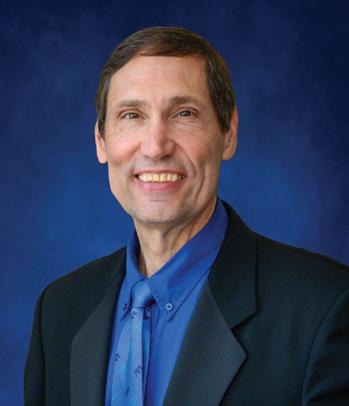
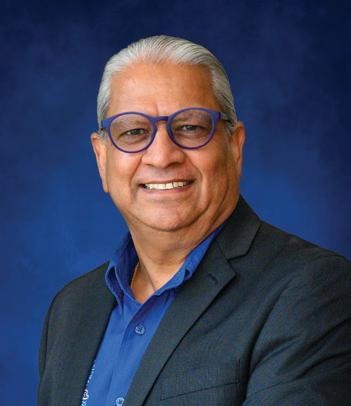
STEVEN ROSENAU, IMS2025 GENERAL CHAIR; JAY BANWAIT, IMS2025 GENERAL CO-CHAIR
It is our great pleasure to welcome you to San Francisco, California, for the 2025 IEEE Microwave Theory and Technology Society (MTT-S) International Microwave Symposium (IMS2025), taking place on 15–20 June 2025 in the City by the Bay. Co-located with the IEEE Radio Frequency Integrated Circuits Symposium (RFIC) and the Automatic Radio Frequency Techniques Group (ARFTG) Conference, IMS2025 offers an unparalleled platform for learning, networking, and collaboration. Over the past several years, a dedicated team of volunteers has worked tirelessly to design a truly unique and enriching experience. It is both a privilege and an honor to lead this team in organizing the MTT-S’s premier event.
San Francisco has long captivated visitors with its iconic landmarks, including the Golden Gate Bridge, Fisherman’s Wharf, and Ghirardelli Square. Hop aboard the city’s famed cable cars to explore world-class museums, theaters, and cultural treasures that reflect San Francisco’s innovative spirit. IMS2025 will be hosted at the newly renovated Moscone Center, which offers expanded spaces for technical sessions, engaging social events, and an impressive exhibit hall showcasing the latest advancements in our field. Situated in the heart of San Francisco’s vibrant SoMa (South of Market) district, the Moscone Center provides easy access to the city’s renowned cultural and culinary attractions. Whether you join us for the technical program or the exhibition, IMS2025 promises to be a remarkable experience set against the unforgettable backdrop of one of the world’s most dynamic cities. IMS2025 in San Francisco is the place for professionals who are pushing the boundaries of microwave and RF technology.
Just as the Golden Gate is the gateway to San Francisco Bay, San Francisco is the gateway to Silicon Valley and the Bay Area—global innovation hubs in RF and microwave technology. This dynamic region is at the forefront of break throughs in wireless communication, radar systems, and high-frequency electronics, driven by a unique synergy of start-ups, established industry leaders, and world-class research institutions. The Bay Area is shaping the wireless future, from pioneering advancements in 6G and satellite communications to transformative solutions in defense systems and the Internet of Things.
Collaborations with universities such as Stanford and UC Berkeley have propelled groundbreaking developments in semiconductors, spectrum management, and energy-efficient design, directly influencing industries ranging from telecommunications to autonomous vehicles. Whether revolutionizing compact, high-power RF amplifiers or unlocking the potential of next-generation radar systems, the Bay Area continues to lead the way in RF and microwave innovation. IMS2025 invites you to join this dynamic ecosystem, where cutting-edge research and real-world applications converge to create a smarter, more connected world.
For the first time at IMS, IMS2025 will be colocated with the IEEE Hard Tech Venture Summit, a
symposium leading the way. The IMS formally opens on Monday, 16 June with the Industry Showcase, highlighting cutting-edge technical advancements from participating companies, immediately followed by the plenary session.
The IMS Plenary Session will feature two talks. Jin Bains, CEO of Mini-Circuits and a global leader in the design and manufacturing of RF, intermediate frequency, and microwave components, will present “Powering the Next Generation of RF Systems,” exploring the evolving role of RF in modern technology. Arogyaswami Paulraj, Professor Emeritus at Stanford University and a pioneer of multiple-input, multiple-output wireless technology, will deliver “Antenna Arrays for Communications, Positioning, and Sensing: Emerging Applications and Challenges,” sharing insights into the breakthroughs that have shaped wireless systems worldwide.
ground breaking event designed to connect hard tech start-up founders with visionary investors and manufacturers, fostering the growth of next-generation companies. This exciting addition to Microwave Week offers a unique platform for innovation and collaboration, featuring a series of panels and talks led by leaders in the venture capital and small business innovation research communities on Wednesday. Complementing these sessions, the Hard Tech Pavilion, strategically located near the StartUp Pavilion and MicroApps Theater on the exhibit floor, will provide an engaging networking space and showcase emerging technologies. The Hard Tech Venture Summit is a must-attend for anyone looking to engage with the vibrant startup ecosystem and drive the future of hard tech innovation.
IMS2025 will feature innovative and disruptive technologies through various thematic areas, including Systems and Applications, Aerospace and Security, Chips for Critical Infrastructure, and Emerging Technologies, Innovations, and Entrepreneurship. This includes the co-located, industry-focused Future G Summit, jointly sponsored by the MTT-S and the IEEE Antennas and Propagation, Communications, and Photonics Societies. You can also look forward to industry-focused initiatives, such as the Industry Showcase, Best Industry Paper Award, and technical session keynotes, ensuring a deep connection between academic research and practical application.
Microwave Week kicks off on Sunday, 15 June 2025 with various informative workshops and boot camps designed to keep participants at the forefront of industry trends or refresh their understanding of microwave fundamentals. Sunday also marks the start of our technical symposia, with the RFIC
After the plenary session, you are invited to the IMS Welcome Reception at the San Francisco Museum of Modem Art, just a short walk from the Moscone Center. With access to all five floors of this cultural landmark, you can enjoy works from iconic artists, such as Jackson Pollock, Andy Warhol, Diego Rivera, and Frida Kahlo. Highlights include the breathtaking Living Wall, a vertical garden of more than 4,400 square feet, and the open-air sculpture garden, offering a serene backdrop to stunning city views.
Throughout the week, various net working events provide opportunities to connect with colleagues and peers. Receptions for Women in Microwaves, Young Professionals, amateur radio enthusiasts, and MTT-S journal reviewers will be held at exclusive venues on Tuesday evening.
The MTT-S Awards Banquet, a hallmark of the symposium, will take place on Wednesday, 18 June (registration is required). Finally, IMS2025 will close on Thursday, 19 June, with a special presentation titled “Next Generation Networking in the Data Center,” which explores the exciting convergence of wireless and optical technologies. This presentation is by David F. Welch, who is chief strategy officer at Infinera and an industry leader with more than 40 years of experience in the fiber optics and optical communications industries. Microwave Week concludes with the 105th ARFTG Microwave Measurement Symposium on Friday, 20 June, to round out an incredible week of collaboration, discovery, and innovation.
With more than 550+ companies participating in the exhibition, the IMS is the world’s largest gathering of the RF and microwave community. The IMS2025 Exhibition will take place in Halls A through E of the Moscone Convention Center, spanning more than 100,100 square feet of dedicated space. The exhibition will be open from the morning of Tuesday, 17 June, through the afternoon of Thursday, 19 June.
In addition to the extensive industry exhibition, you can look forward to various engaging events held within the exhibit hall throughout the week. Tuesday will feature the Student Design Competitions, while Wednesday will include the Interactive Forum. The MicroApps Theater will host continuous presentations
Steven Rosenau Jay Banwait
featuring the latest advancements from participating companies.
Building on past success, IMS2025 will continue the StartUp Pavilion, first introduced in 2019, to spotlight emerging RF/microwave startups. The StartUp Pavilion will be near the MicroApps Theater and the new Hard Tech Pavilion.
On Wednesday afternoon, there will be a dedicated time slot for the exhibition, with no technical sessions scheduled, allowing you to fully explore the exhibit floor. The day will culminate in the Industry Hosted Reception on the exhibit floor. This event offers a chance to network and express gratitude to our Diamond, Platinum, Gold, and Silver Prestige Sponsors for their generous support in making Microwave Week a success!
It takes a great team to put on a great conference, and we are privileged to work with an amazing group of individuals. Supporting our executive committee is a dedicated team of more than 70 volunteers, IEEE staff, contractors, and the Hall-Erickson team, who are instrumental in managing IMS and Microwave Week. While much of their work is highlighted in the other columns in this issue, a significant portion happens behind the scenes. We sincerely thank the Steering Committee for its time, expertise, and dedication to delivering a successful IMS2025!
Our Technical Program Committee, a cornerstone of any symposium, is chaired by Anh-Vu Pham, professor of electrical and computer engineering, UC Davis, and co-chaired by Tom McKay, Pacific Avenue Research LLC. They have assembled a fantastic team of volunteers to bring you an exciting and engaging technical program.
IMS2025 continues its commitment to outreach and inclusion. The Outreach and Inclusion Chair oversees the implementation of best practices to support diversity, equity, and inclusion throughout the symposium. This critical role is led by Lori Silverman, Science, Technology, Engineering, and Mathematics Division Dean, Ohlone College, and Sherry Hess, Cadence Design Systems.
The IMS2025 Local Arrangements and Operations Committee, led by Darin Phelps, Keysight Technologies, with co-chair Balvinder Bisla, retired, has coordinated the behind-the-scenes activities that keep IMS running smoothly. This includes recruiting and managing an army of student ambassadors who will assist throughout Microwave Week.
Completing our IMS2025 Executive Committee are Marketing/Publicity/Promotion/Publications Committee Co-chairs, Amarpal Khanna, Apionics LLC, and Venkata Gadde, Apple, as well as Finance Cochairs, Jim Sowers, Maxar Technologies and Norman Chiang, retired.
In closing, we are thrilled to welcome you to IMS2025 in San Francisco for Microwave Week, 15-20 June 2025!
Steven Rosenau, IMS2025 General Chair Jay Banwait, IMS2025 General Co-Chair
ABOUT SAN FRANCISCO
San Francisco’s history dates back to 1776, when Spanish settlers established an outpost named for the native Yerba Buena plant. In 1847, the settlement adopted its current name, San Francisco. Often affectionately referred to by locals as “The City,” San Francisco has evolved significantly since IMS last visited in 2016. IMS2025 will be held at the centrally located Moscone Center, providing easy access to everything San Francisco has to offer.
THE BAY AREA
The San Francisco Bay Area, California’s secondlargest metropolitan region, spans about 7,000 square miles and is home to more than seven million people. This diverse and dynamic region comprises nine counties and includes major cities like Santa Rosa, Oakland, San Jose, and, of course, San Francisco. It also encompasses Silicon Valley, the cradle of countless high-tech startups and pioneering companies such as Hewlett Packard, Intel, Apple, Nvidia, Google, Facebook, and X (Twitter).
The Bay Area’s leadership in high-tech and wireless industries has fostered a community rich in innovation, entrepreneurship, and engineering talent. Not surprisingly, the region boasts some of the world’s top universities—such as the University of California, Berkeley; Stanford University; and the University of California, San Francisco—further fueling its status as a global innovation hub.
San Francisco itself, with a population of about one million residents in a mere 47 square miles, is the cultural, commercial, and financial centerpiece of Northern California. It is the second most densely populated city in the United States, after New York City. In recent years, a surge in startups and emerging technologies has infused the city with fresh energy, particularly in social media, mobile communications, wearables and AI. Young professionals gravitate to the city for its vibrant lifestyle, world-class dining, and cultural diversity.
GETTING AROUND
San Francisco’s compact downtown area means that many hotels and attractions are within walking distance of the Moscone Center. Beyond walking, visitors can choose from an array of transportation options. The Bay Area Rapid Transit (BART) system offers convenient links to other parts of the Bay Area, including the San Francisco International Airport. San Francisco’s iconic cable car system, the last manually operated network in the world, remains a beloved attraction. The city also offers light-rail systems, ferries, buses, and driverless taxis to ensure seamless exploration of the region.
THINGS TO DO
Downtown San Francisco brims with diverse restaurants, entertainment venues, and cultural attractions within steps of the conference site. Sports enthusiasts can take in a baseball game at the San Francisco Giants’ Oracle Park, just a short stroll from the convention center. Iconic neighborhoods—Union Square, the Mission District, Chinatown, and Japan town—each offer unique cultural experiences.
No visit is complete without exploring famed landmarks like Alcatraz Island, the Golden Gate Bridge, Fisherman’s Wharf, and Lombard Street. The Golden Gate Bridge, a 1.7-milelong suspension masterpiece, is one of the most photographed and admired structures in the world, representing a pinnacle of modern engineering and design.
San Francisco also boasts Pier 39, Golden Gate Park, the California Academy of Sciences, the de Young Museum, the Asian Art Museum, the Exploratorium, the Cable Car Museum, and the San Francisco Zoo and Gardens. With sweeping vistas, a stunning shoreline, vibrant cultural activities, world-class cuisine, and inspired art and music scenes, it is easy to see how one can “leave their heart in San Francisco,” as the famous Tony Bennett song suggests.

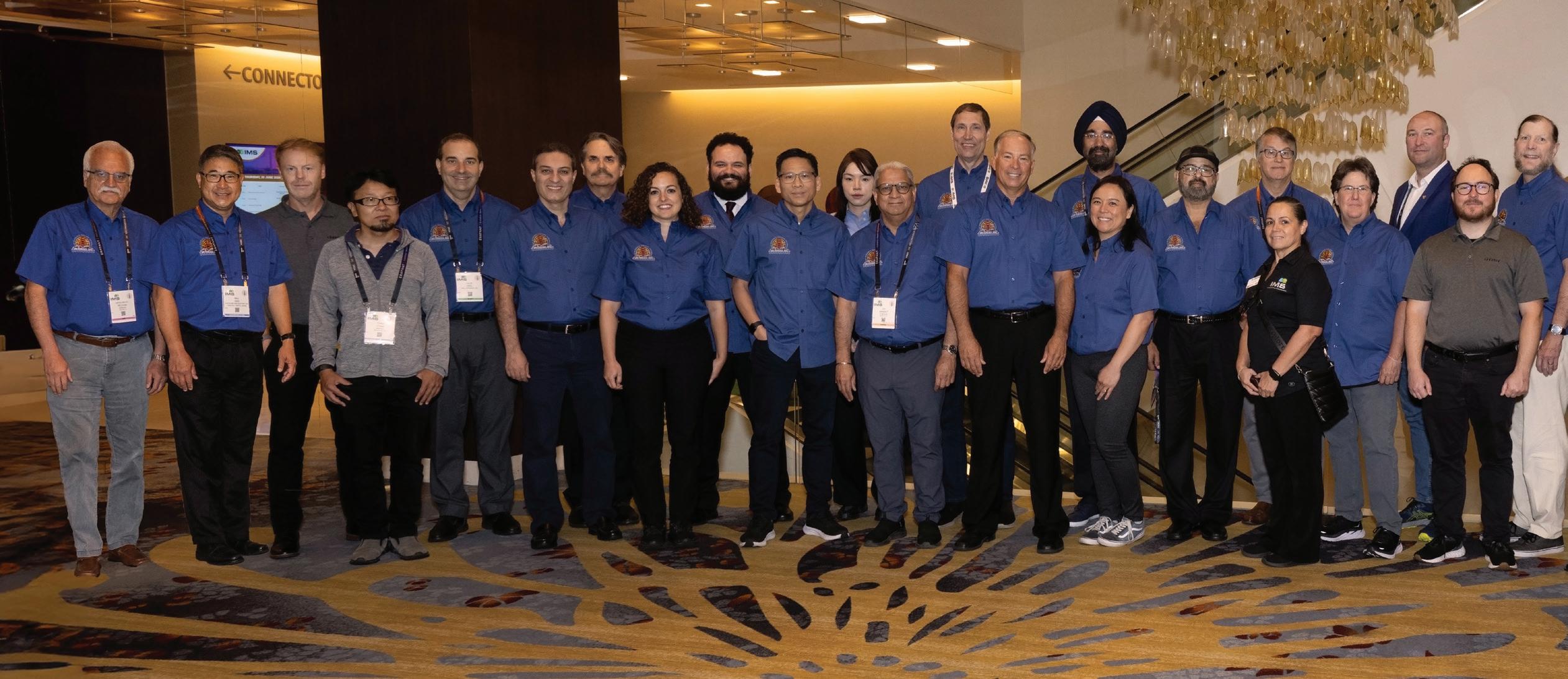
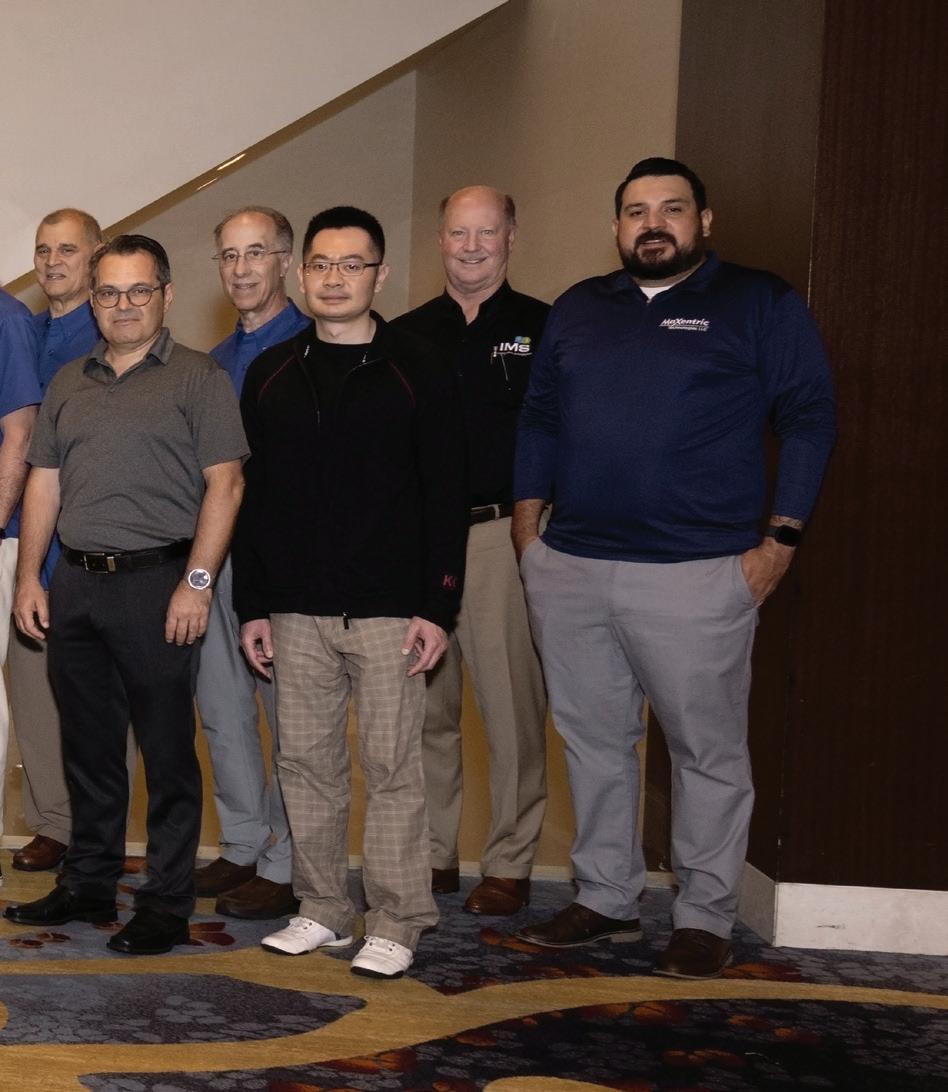
IMS2025 STEERING COMMITTEE
SAN FRANCISCO, CA
EXECUTIVE COMMITTEE
Steven Rosenau, General Chair
Jay Banwait, General Co-Chair
Anh-Vu Pham, TPC Co-Chair
Thomas McKay, TPC Co-Chair
Amarpal “Paul” Khanna, MP3 Co-Chair
Venkata Gadde, MP3 Co-Chair
Darin Phelps, LAOC Co-Chair
Balvinder “Biz” Bisla, LAOC Co-Chair
Lori Silverman, DEI Co-Chair
Sherry Hess, DEI Co-Chair
James Sowers, Finance Co-Chair
Norman Chiang, Finance Co-Chair
John Barr, Protocol/Advisor
Elsie Vega, Conference/Event Manager
Dillian Waldron, Conference/Event Planner
Taylor Lineberger, Conference/Event Planner
Francois Rivet, RFIC Conference General Chair
Dennis Lewis, ARFTG Conference General Chair
Robert Alongi, Treasurer
Amanda Scacchitti, MP3 Manager
Dave Weil, Exhibition Director
Tina Vickery, Exhibition Operations Manager
JK McKinney, IMSEC Chair/Advisor
TPC (TECHNICAL PROGRAM COMMITTEE)
Anh-Vu Pham, TPC Co-Chair
Thomas McKay, TPC Co-Chair
Joy Laskar, Plenary Session Chair
Sandy Owens, Electronic Paper Mgmt Chair
Omeed Momeni, Workshops Chair
Brad Nelson, Workshops Co-Chair
Hao Wang, Workshops Co-Chair
Sushil Kumar, RFIC Workshop Liaison
Shahrokh Saeedi, RF Boot Camp Co-Chair
Christian Hurd, RF Boot Camp Co-Chair
Alfred Riddle, Panel Sessions Chair
Austin Chen, Panel Sessions
Chenyu Liang, Focus/Special Sessions Chair
Abdi Karbassi, Focus/Special Sessions
Arvind Keerti, Industrial Keynote/Invited Talks
Bert Henderson, Interactive Forum Chair
Matt Clements, Interactive Forum
Kiyoshi Miyashita, Interactive Forum
Amir Javan, Student Paper Competition Chair
Dennis Derickson, Student Paper Competition Co-Chair
Chung-Tse Michael Wu, Student Paper Competition
Hazal Yuksel, Student Design Competition Chair
Benson Chan, Student Design Competition
Can Cui, Advanced Practice/Industry Paper Competition Co-Chair
Ali Rezvani, Advanced Practice/ Industry Paper Competition Chair
Nick Shtin, Advanced Practice/ Industry Paper Competition Co-Chair
Ken Mays, Early Career Competition Co-Chair
Payem Nayeri, Early Career Competition Co-Chair
Nguyen Nguyen, Early Career Competition Co-Chair
Chao Lu, FutureG Program Co-Chair
Peter Gammel, FutureG Program Co-Chair
Ilona Piekarz, Pre-Conference Tutorials Co-Chair
Jakoub Sorocki, Pre-Conference Tutorials Co-Chair
MP3 (MARKETING/PUBLICITY/ PROMOTION/PUBLICATIONS)
Amarpal “Paul” Khanna, MP3 Co-Chair
Venkata Gadde, MP3 Co-Chair
JK McKinney, IMSEC Marketing Strategy Liaison
Utkarsh Unnikrishna, Local Marketing
Amanda Scacchitti, MP3 Manager, Website and Mobile App Editor, MARCOM Liasion for TPC and LAOC
Mark Slater, Website and Mobile App
Alfred Riddle, Microwave Magazine Guest Editor
Austin Chen, Microwave Magazine Associate Editor
Tyler Day, Marketing Agency
Rachel Patterson, Marketing Agency
LAOC (LOCAL ARRANGEMENTS/ OPERATIONS COMMITTEE)
Darin Phelps, LAOC Co-Chair
Balvinder “Biz” Bisla, LAOC Co-Chair
Elsie Vega, Conference/Event Manager
Dillian Waldron, Conference Planner
Taylor Lineberger, Conference Planner
Susie Horn, Visa Support/ Student Ambassador Coordinator
David Viera , StartUp Program
Kelvin Yuk, Hard Tech Summit Liaison
Vetakat Gadde, Hard Tech Summit Liaison
Rodrigo Vasquez, Student Ambassador Coordination Co-Chair
Tai Truong, Student Ambassador Coordination Co-Chair
John Barr, Protocol/Gifts
Rashaunda Henderson, Project Connect Chair
Rhonda Franklin, Project Connect
Dennis Derickson, Amateur Radio
David Witkowski, Amateur Radio
Suresh Ojha, Amateur Radio
Joanne Wong, Hard Tech Summit Chair
Darin Phelps, Historical Exhibit (Local Participation)
Steven Stitzer, Historical Exhibit (MTT Collection)
Alexander Chenakin, MicroApps Co-Chair
Suresh Ojha, MicroApps Co-Chair
Toru Otani, MicroApps Co-Chair
Amit Jha, Industry Workshops Co-Chair
Mohammad Slah, Industry Workshops Co-Chair
DEI (DIVERSITY, EQUITY AND INCLUSION)
Lori Silverman, DEI Co-Chair
Sherry Hess, DEI Co-Chair
Baljit Chandhoke, Young Professionals Chair
Yashika Sharma, Young Professionals
Rajpreet K. Gulati, Young Professionals
Ana Valeria Gonzalez Ortiz, Young Professionals
Johana Yan, Women in Microwaves Co-Chair
Janine Love, Women in Microwaves Co-Chair
Priya Kongara, Women in Microwaves
Edna Moreno, Women in Microwaves
Kevin Chuang, STEM Co-Chair
Bill Ishii, STEM Co-Chair
Dustin Hoekstra, Affinity Zone
Bryce Hotalen, Affinity Zone
Gent Paparisto, Affinity Zone
Robyn Reed, Affinity Zone
Sylvia Lin, Affinity Zone
IMS2025 TECHNICAL PAPER REVIEW COMMITTEE
SAN FRANCISCO, CA
Mohammad Abu Khater
Wael Ahmad
Richard Al Hadi
Shuhei Amakawa
Bayaner Arigong
Peter Asbeck
Dominique Baillargeat
Joe Bardin
Taylor Barton
Simone Bastioli
Roee Ben-Yishay
Pierre Blondy
Luciano Boglione
Fabrizio Bonani
Vicente Boria-Esbert
Olga Boric-Lubecke
Hermann Boss
Slim Boumaiza
Steven Bowers
David Brown
Jack Brunning
Shi Bu
Jan Budroweit
Guillaume Callet
Vittorio Camarchia
Charles Campbell
Christian Carlowitz
Nuno Carvalho
Robert Caverly
Malgorzata Celuch
Sudipto Chakraborty
Wing Shing Chan
Hong-Yeh Chang
Austin Chen
Kenle Chen
Zhizhang Chen
Pei-Ling Chi
Taiyun Chi
Debabani Choudhury
Chenhao Chu
Kevin Chuang
Gayle Collins
Jonathan Comeau
Julio Costa
Alessandra Costanzo
Christian Damm
Kaushik Dasgupta
Marcus daSilva
Debasis Dawn
Sagar Dhar
Damla Dimlioglu
Marco Dionigi
Tarek Djerafi
Georgios Dogiamis
John Ebel
Najme Ebrahimi
Danny Elad
Rudy Emrick
Kamran Entesari
Murat Eron
Christian Fager
Mohamed Fahmi
Aly Fathy
Patrick Fay
Ahmed Gadallah
Markus Gardill
Edward Gebara
Anthony Ghiotto
Gian Piero Gibiino
Pere L. Gilabert
Roberto Gomez-Garcia
Xun Gong
Jose Luis Gonzalez Jimenez
Kavita Goverdhanam
Katia Grenier
Jasmin Grosinger
Changzhan Gu
Kamel Haddadi
Amelie Hagelauer
Naoki Hasegawa
Rashaunda Henderson
Payam Heydari
Damon Holmes
Glenn Hopkins
Da Huang
Tzu-Yuan Huang
James Hwang
Shekh Md Mahmudul Islam
David Jackson
Mona Jarrahi
Mahdi Javid
Hamhee Jeon
Sanggeun Jeon
Amit Jha
Dan Jiao
Telesphor Kamgaing
Tumay Kanar
Pekka Kangaslahti
Arvind Keerti
Roni Khazaka
Erin Kiley
Kevin Kobayashi
Alexander Koelpin
Nicholas Kolias
Kenneth Kolodziej
Pawel Kopyt
Sushil Kumar
Ko-Tao Lee
Timothy Lee
Wooram Lee
Dennis Lewis
Changzhi Li
Sensen Li
Chenyu Liang
Julien Lintignat
Changjun Liu
Lei Liu
Zheng Liu
Ruochen Lu
Victor Lubecke
Alon Ludwig
Xun Luo
Fabian Lurz
Stephen Maas
Peter Magnee
Ifana Mahbub
Raafat Mansour
Jon Martens
Holger Maune
Kenneth Mays
Davide Mencarelli
Nizar Messaoudi
Paolo Mezzanotte
Shirin Montazeri
Jesse Moody
Amir Mortazawi
Michal Mrozowski
Koichi Murata
Michel Nakhla
Jeffrey Nanzer
Julio Navarro
Duy Nguyen
Nguyen Nguyen
Phat Nguyen
Edward Niehenke
Thas Nirmalathas
Kenjiro Nishikawa
Luis Cotimos Nunes
Joachim Oberhammer
Vladimir Okhmatovski
Arnaldo Oliveira
Abbas Omar
Valentina Palazzi
Marcus Pan
Giacomo Paolini
Spyridon Pavlidis
Jose Pedro
Dimitrios Peroulis
Anna Piacibello
Luca Pierantoni
Marco Pirola
Jean-Olivier Plouchart
Nils Pohl
Zoya Popovic
Neelam Prabhu Gaunkar
Dimitra Psychogiou
Joe Qiu
Rüdiger Quay
Oscar Quevedo-Teruel
Frederick Raab
Hamed Rahmani
Jose Rayas-Sanchez
Negar Reiskarimian
Shahed Reza
Ian Rippke
Michael Roberg
Davi Rodrigues
Eduardo Rojas
Mohammad Sadrabadi
Shahrokh Saeedi
Abhishek Sahu
Laila Salman
Kamal Samanta
Dominique Schreurs
Shreyas Sen
Kaushik Sengupta
Munkyo Seo
Hasan Sharifi
Ki Shin
Constantine Sideris
Hjalti Sigmarsson
Richard Snyder
Zhe Song
Jason Soric
Jim Sowers
Wolfram Stiebler
Almudena Suarez
Adrian Tang
Smail Tedjini
Manos Tentzeris
Werner Thiel
Chris Thomas
Cristiano Tomassoni
Zuo-Min Tsai
Thomas Ussmueller
Suresh Venkatesh
Roberto Vincenti Gatti
Dieff Vital
Jacquelyn Vitaz
Sorin Voinigescu
Martin Vossiek
Photos Vryonides
Rajah Vysyaraju
Christian Waldschmidt
Walter Wall
Huei Wang
Jan Wessel
John Wood
Chung-Tse Michael Wu
Hung-Wei Wu
Ke Wu
Vadim Yakovlev
Kazuya Yamamoto
Li Yang
Tao Yang
Siva Yegnanarayanan
Ming Yu
Mohammad Zarifi
Hualiang Zhang
Lei Zhang
Yulong Zhao
Xinyu Zhou
Anding Zhu
GETTING AROUND AT IMS2025
MOSCONE CENTER, SAN FRANCISCO, CA
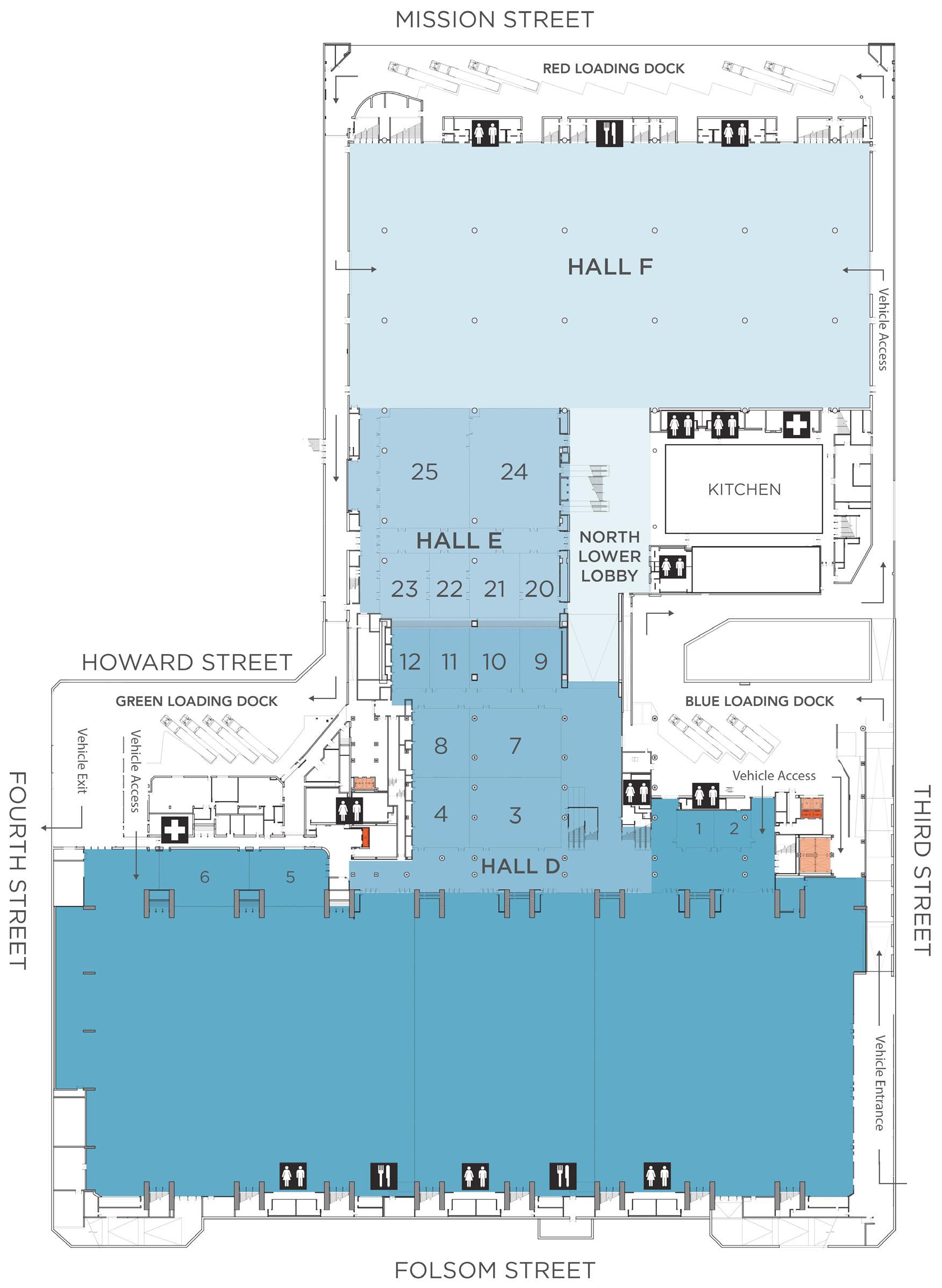
Exhibition
Level
Level Two
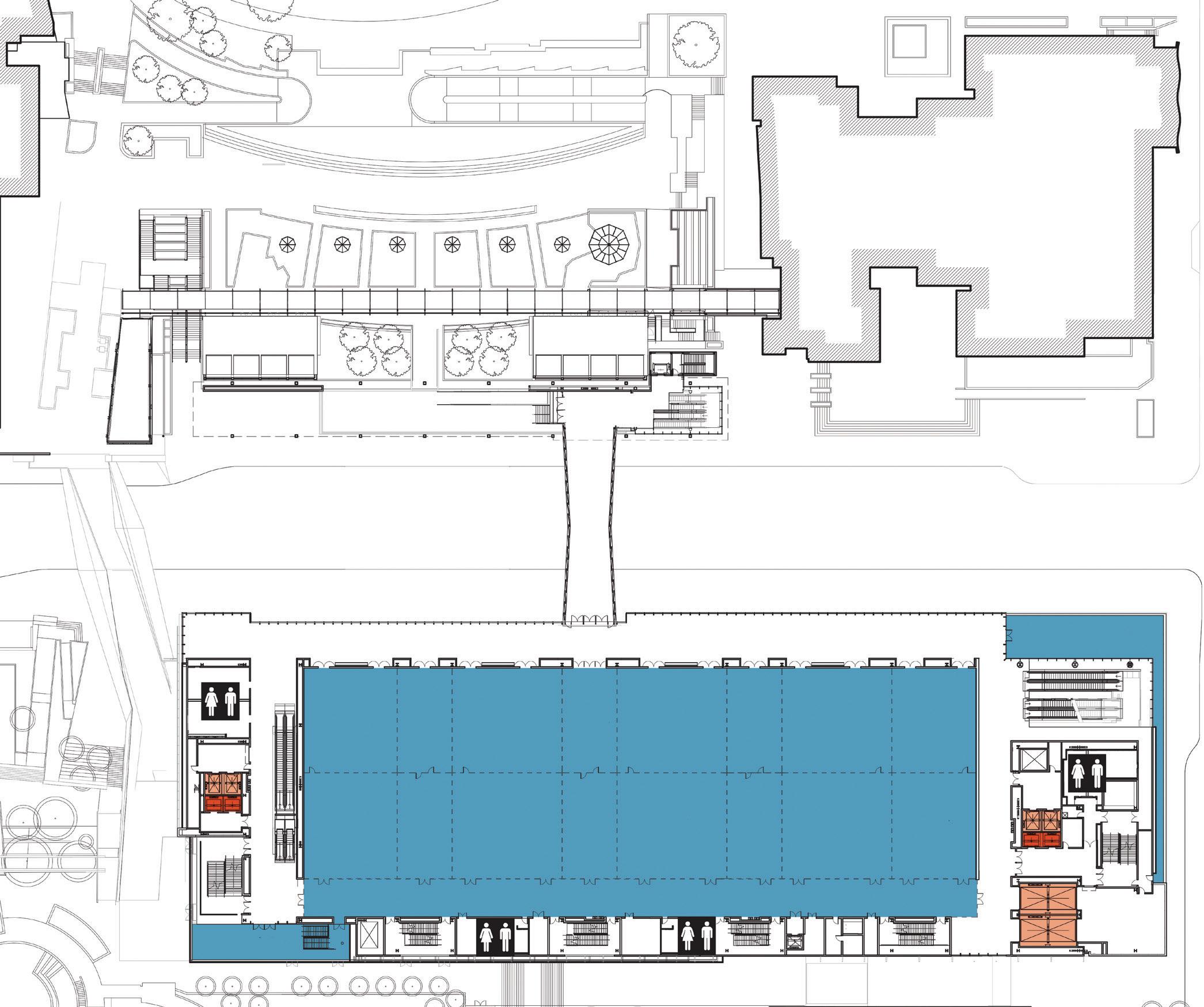
TERRACE
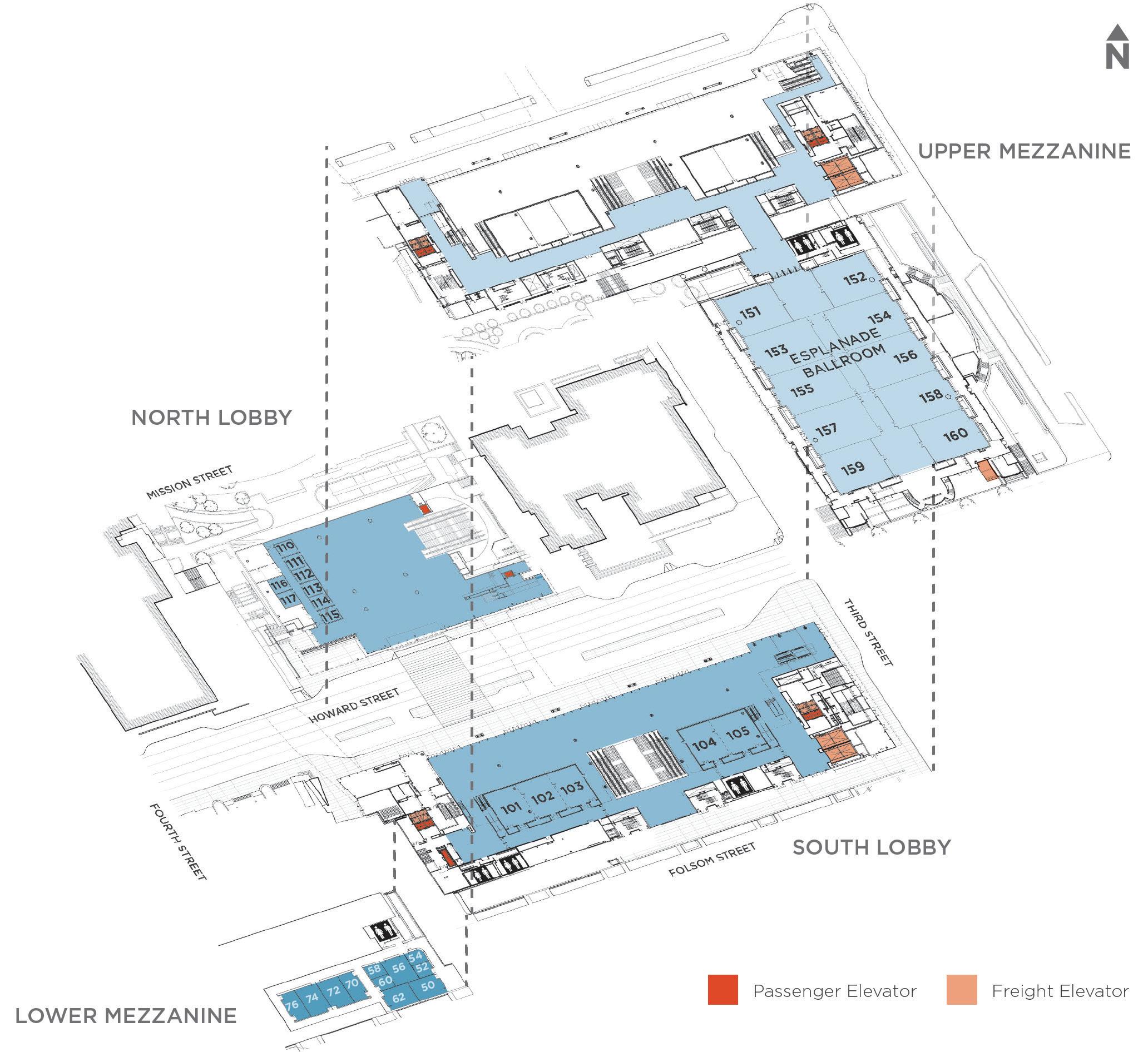


GETTING AROUND AT IMS2025
FOLSOM STREET

Sponsored
WEEK AT-A-GLANCE WEEK
Workshops
RFIC Technical Lecture
RFIC Plenary Session, Reception, Industry Showcase
Quantum Bootcamp
AI/ML Bootcamp
RF Bootcamp
WPT Bootcamp
RFIC Technical Sessions
Three Minute Thesis
IMS Industry Showcase, Plenary and Welcome Reception
IMS Technical Sessions
IMS Interactive Forum
Panel Sessions
Future G Summit Exhibition
MicroApps and Industry Workshops
Amateur (HAM) Radio Reception
Young Professionals Events
Industry Hosted Reception
Women In Microwaves Events
IMS Closing Session
105th ARFTG Workshops | Technical Lectures | RFIC | Bootcamp | Three Minute Thesis | IMS Panel Sessions | Future G Summit | Exhibit Hall Activities | Focus Groups | ARFTG
On-site registration for all events will be available in the South Lobby of The Moscone Center.
ON-SITE REGISTRATION HOURS
Saturday, 14 June 2025
Sunday, 15 June 2025
Monday, 16 June 2025
Tuesday, 17 June 2025
Wednesday, 18 June 2025
Thursday, 19 June 2025
Friday, 20 June 2025
08:00 – 17:00
07:00 – 18:00
07:00 – 18:00
07:00 – 18:00
07:00 – 18:00
07:00 – 16:00
07:00 – 10:00
BOXED LUNCH DISTRIBUTION:
Boxed Lunch Distribution will take place Sunday–Thursday in the Level 3 Meeting Room Foyer of The Moscone Center.
Note: Boxed Lunches are included with Workshops and Boot Camps. They are also available for pre-purchase in the registration system through 13 June 2025 (the advance registration deadline).
DIAMOND
SPONSOR
PLATINUM
SPONSOR

OFFICIAL ME D I A SOURCE OF MTT- S

SILVER
SPONSOR
SUNDAY WORKSHOPS
WORKSHOP TITLE
08:00 – 17:20 | Sunday, 15 June 2025
WORKSHOP
ABSTRACT WSA
Frequency Synthesizer Design — from Fundamentals to Advanced Techniques
Sponsor: RFIC
Organizers: Ahmed Elkholy, Broadcom; Salvatore Finocchiaro, Qorvo; Teerachot Siriburanon, University College Dublin; Wanghua Wu, Samsung 08:00 – 17:20 ROOM: 201
Integrated Communications and Sensing: Circuits, Systems, Algorithms, and Applications
Sponsor: RFIC
Organizers: Alberto ValdesGarcia, IBM Research; Oren Eliezer, Samsung ; Yahya Tousi, University of Minnesota 08:00 – 17:20 ROOM: 204
AI/ML for Next-Generation Microwave Design and Modeling: From Devices to Systems
Sponsor: IMS; RFIC
Organizers: Caglar Ozdag, IBM Research; Kamal Samanta, AMWT LTD
08:00 – 11:50 ROOM: 203
Low-to-Ultra-Low Power RFIC: Technologies, Architectures and Circuit Design
Sponsor: RFIC
Organizers: Andreia Cathelin, STMicroelectronics; Yann Deval, University of Bordeaux 08:00 – 17:20 ROOM: 210
WSE
Integrating FR2 OAI and Hybrid RIS: Enhanced Network Management Implementing FR2 OAI, ORAN, MIMO, and RIS
Sponsor: IMS
Organizers: Ethan Lin, TMY Technology
08:00 – 11:50
ROOM: 206
Frequency synthesizers are among the most critical blocks in wireless, wireline, and digital clocking applications. This workshop will cover both the fundamentals and the latest advances in frequency synthesis circuits and systems to efficiently generate LO signals with low phase noise, low spurious tones, and large modulation bandwidth. Prior-art techniques will be discussed in-depth, such as energy-efficient reference clocks, high-FOM wide-tuning range VCOs and DCOs, DPLL fundamentals, modern low-jitter fractional-N PLLs. Special attention will also be given to pulling and spur mitigation techniques and PLL based chirp generators for FMCW radar applications.
Integrated communication and sensing capabilities are on a strong trajectory to become an integral part of the next generation of wireless systems. While the exploration of these techniques started decades ago, their development has accelerated with the increasing availability of highly integrated Si-based transceivers, baseband compute capabilities, and wireless testbeds for experimentation, and more recently AI. Nevertheless, the development of wireless systems with efficient joint communication and sensing capabilities remains a challenging multi-disciplinary task where EM, circuit design, signal processing, and ML techniques are relevant. The goal of this workshop is to bring together a set of active researchers on these topics to share their vision and expertise and enhance the cross-disciplinary awareness and understanding between the RFIC and systems communities. The speakers span academic and industrial research institutions from across the globe and the presentations will cover circuit, algorithm, and application aspects.
As the world rapidly embraces Artificial Intelligence (AI) and Machine Learning (ML) across various industries, the key question arises: how can we best leverage AI/ML to transform our own field? This workshop addresses this critical question by highlighting cutting-edge research from industry and academia experts who are using AI to transform microwave design. With new techniques emerging at an unprecedented pace, the workshop will shine a light on their revolutionary potential in RF and microwave engineering. The focus is on how AI is streamlining design processes, optimising results and enhancing productivity, ultimately helping engineers to navigate increasingly complex challenges in ways that were previously not possible. Our six distinguished speakers, all pioneers in their respective areas, will present a comprehensive view of AI’s role in advancing the entire spectrum of microwave engineering, including topics such as device modeling (including GaN PA), component synthesis (together with inductor, transformer and other passives), circuit (including RFIC and MMICs) and system design, performance optimisation (like PA linearisation) and electronic design automation (EDA) covering RF to THz frequencies. Attendees will gain valuable insights into how AI/ML is reshaping the future of microwave engineering, providing the tools and perspectives needed to stay ahead and empowering innovation and realisation of advanced devices to highly integrated modules/systems, enabling applications for 5G, 6G and beyond.
The workshop will delve into the design of ultra-low and low-power RF integrated circuits, emphasizing various applications where energy efficiency is paramount. This is particularly relevant within the Internet of Things (IoT) domain, which spans multiple application fields. Given that power consumption is a critical concern for all battery-powered or always-on applications, the workshop will comprehensively address this issue. The workshop will commence with two presentations focusing on Silicon technologies optimized for such applications, specifically FD-SOI, FinFET, and emerging technologies such as gate-all-around nanoribbon transistors. Following this, two additional presentations will explore the trade-offs associated with the most powerintensive components, namely the frequency synthesis unit and power amplifiers. The subsequent four presentations will concentrate on architectural innovations pertinent to low and ultra-low power RFIC solutions. This segment will begin with discussions on novel sensor interface solutions, such as event-driven operation systems. The final three presentations will address comprehensive system solutions designed for wireless environments, achieving power consumption down to sub-microWatt levels, and secure biomedical applications.
This half-day workshop titled “Integrating FR2 OAI and Hybrid RIS: Enhanced Network Management implementing FR2 OAI, ORAN, MIMO, and RIS” is designed to address the rapidly evolving technical landscape of mm-wave (FR2) OpenAirInterface (OAI) technology and network deployment with Dynamic RIS. The workshop will showcase cutting-edge developments in FR2 OAI, including its integration with ORAN architecture, and applications in ISAC and MIMO, as well as network deployment. Participants will benefit from presentations by experts who will share insights on innovative solutions and tools that enable advanced beamforming, intelligent RAN control, and efficient resource allocation in high-frequency networks.
SUNDAY WORKSHOPS
WORKSHOP TITLE
RF-FE and Phased Array System for 5.5G and 6G
Sponsor: RFIC
Organizers: Didier Belot, STMicroelectronics; Hao Gao, Technische Universiteit Eindhoven; Yun Fang, Southeast University
08:00 – 17:20
ROOM: 207
RFIC Architectures, Circuits and Systems for LEO SATCOM
Broadband Access for 6G NTN
Sponsor: IMS; RFIC
Organizers: Didier Belot, STMicroelectronics; Pierre Busson, STMicroelectronics; Salvatore Finocchiaro, Qorvo 08:00 – 17:20 ROOM: 205
Addressing Challenges in System-in-Package and 3D Heterogeneous Integration for mm-Wave Phased Array Systems
Sponsor: IMS; RFIC
Organizers: Salvatore Finocchiaro, Qorvo; Yu Cao, Qorvo 08:00 – 17:20
ROOM: 208
Self-Interference Cancellation Techniques for Future Integrated Communication and Sensing Systems
Sponsor: IMS; RFIC
Organizers: Song Hu, Apple; Tong Zhang, Google
08:00 – 17:20
ROOM: 211
Advanced Power Amplifier Design for Sub-20GHz Wireless Infrastructure
Sponsor: IMS; RFIC
Organizers: Alexandre Giry, CEA-LETI ; Jennifer Kitchen, Arizona State University
08:00 – 17:20
ROOM: 215
08:00 – 17:20 | Sunday, 15 June 2025
WORKSHOP ABSTRACT
With rapid technological advances, the scope of communication systems is expanding significantly. Among the most groundbreaking developments are the use of mm-wave and sub-THz frequencies, which are poised to revolutionize wireless communication by unlocking unprecedented capabilities. This workshop will explore the transformative potential of mm-wave and sub-THz technologies, covering the frequency range from 30GHz to 300GHz. Once underutilized, these high-frequency ranges are now pivotal to major technological breakthroughs. Central to this advancement is the broadband front-end, which is crucial for effectively harnessing these frequencies for cutting-edge applications. A major focus of the workshop is the advancement of high-frequency communication technologies. Attendees will examine innovations in ultra-fast data transfer, low-latency networks, and the integration of mm-wave and sub-THz frequencies within wireless systems. These advances are reshaping connectivity, supporting the rollout of 5.5G and 6G networks, enhancing autonomous vehicles, and enabling smart cities. The workshop will also highlight the potential of 5.5G and 6G technologies to transform various industries. Additionally, the integration of Reconfigurable Intelligent Surfaces (RIS) and Radio-over-Fiber (RoF) technologies will be discussed, showcasing their critical roles in optimizing signal quality and extending network reach in the evolving landscape of 5.5G and beyond.
In the context of 6G and beyond, the performance demands are geared towards massive parallelization. For instance, the Non-Terrestrial-Network (NTN) is an essential component of future 6G wireless systems, and the next-generation SATCOM network will play an enabling role to support 6G NTN. High throughput, capacity, and low latency, and beamformed wireless links are the key success factors for NTN. Most existing SATCOM terminals, either on the ground or on the satellite payload, require large-sized phased array systems with 1024 elements or more per array. Such massive parallelization results in significant challenges not only in terms of integration density, but also on calibration and practical operation; a particularly challenging task in SATCOM-on-the-Move (SOTM) systems that necessitate fast beam forming and tracking. In this WS we will have an overview of potential process/circuit/system solutions addressing these challenges.
The ever-increasing demand for high-throughput communication links and high-resolution radar sensors is driving the development of future wireless systems at higher operating frequencies. In order to support multiple functionality, the flexibility requested to those systems, is driving the adoption of large phased array antennas and complex System-in-Package (SiP) Bit-to-RF or Optical-to-RF solutions. Heterogeneous technologies and vertical 3D integration will play a vital role in enhancing the performance and functional density, along with reducing the size and costs, of such RF systems. 3DHI will pose a new set of technology (processes and substrates), design (MMICS, RFIC, analog, power management, passives), packaging and thermal challenges, which will be addressed by renowned experts from Academia and Industry in this workshop.
As wireless communication and sensing systems evolve toward higher data rates and greater spectral efficiency, the integration of self-interference cancellation (SIC) techniques becomes crucial, particularly for enabling simultaneous transmit and receive (STAR) operations in full-duplex (FD) and frequency-division duplexing (FDD) systems. This workshop brings together leading experts to explore the challenges and solutions in SIC for advanced communication and sensing systems. The discussions will cover innovative SIC architectures for integrated radios, with a special focus on FD systems and their applications in 5G and beyond, including mmWave, IoT, radar, biomedical, and quantum systems. Attendees will gain insights into state-of-the-art time-domain and frequency-domain SIC techniques, antenna interface designs, and machine learning approaches for adaptive cancellation. The workshop will also address the transition of these technologies from academic research to real-world deployment, especially in high-performance commercial and defense applications.
As the demand for high-speed wireless communication continues to grow, efficient PA design becomes critical for supporting modern communications network infrastructure, especially in the sub-20GHz spectrum (FR1 and FR3 bands). This workshop will delve into comprehensive design and development of power amplifiers (PAs) for sub-20GHz base station applications. The latest processes and technologies will be covered, focusing on semiconductor advances that drive power handling, linearity, and efficiency. Participants will explore theory and modeling principles to predict performance and optimize PA designs for various operational scenarios. The session will also emphasize architecture and design techniques, addressing key challenges such as linearity, efficiency, and bandwidth. Finally, the workshop will cover module design and integration, where participants will learn about packaging considerations and thermal management to ensure optimal performance in real-world deployments. This workshop is ideal for RF engineers, circuit designers, and researchers aiming to enhance their expertise in cutting-edge PA technology for wireless infrastructure. Participants will gain an in-depth understanding of key PA architecture and design techniques through interactive sessions with practical case studies.
08:00 – 17:20 | Sunday, 15 June 2025
WORKSHOP TITLE
WORKSHOP ABSTRACT WSK
Addressing Challenges in the Design and Characterization of Circuits for THz Communications and Sensing
SponsorS: IMS; ARFTG
Organizers: Jeffrey Hesler, Virginia Diodes; Xiaobang Shang, NPL
08:00 – 17:20
ROOM: 305/309
Sub-THz Power Amplifiers in CMOS, SiGe, and III-V
Sponsors: IMS; RFIC
Organizers: Aritra Banerjee, University of Illinois at Chicago; Susnata Mondal, Intel
08:00 – 17:20
ROOM: 306
The Technology Landscape of the Wireline and Wireless Optical Communication
Sponsors: IMS; RFIC
Organizers: Bahar Jalali Farahani, Cisco; Mahdi Parvizi, Cisco; 08:00 – 17:20
ROOM: 307
Towards Highly Scaled Quantum Computing: Signal Density/Delivery Challenges
Sponsor: IMS
Organizers: Duane Howard, Amazon; Kevin Tien, IBM Quantum 08:00 – 11:50 ROOM: 308
RF Challenges in the Design and Characterization of Quantum Computing Hardware
Sponsors: RFIC; IMS
Organizers: Sorin P. Voinigescu, University of Toronto; Vadim Issakov, Technische Universität Braunschweig; 08:00 – 17:20
ROOM: 310-311
This workshop provides an opportunity for presenters to share their work in addressing the challenges of unlocking the potential of the THz spectrum for future wireless communications and radar sensing applications. The presenters come from diverse backgrounds — including instrumentation manufacturing, metrology institutes, industry, and academia — offering a wide range of perspectives. Topics covered in this workshop include THz electronics, novel integration approaches for THz systems, interconnections and packaging technologies, photonics-based THz generation for communications, on-chip and waveguide antennas, design and characterization of high electron mobility transistors, and recent advances in testing and measurements up to 1THz and beyond.
The power amplifier is one of the most critical blocks in the transceiver and obtaining the desired performance from the PA at sub-THz frequencies remains a challenge. At sub-THz frequencies, transistors suffer from reduced gain impacting the performance of the PA. Designing sub-THz PAs with improved power added efficiency (PAE), output power, and linearity is an active area of research. SiGe and III-V technologies such as InP and GaN demonstrate higher fT and fmax than CMOS and as a result, sub-THz PAs designed in these technologies outperform their CMOS-based counterparts. On the other hand, CMOS can achieve better yield and higher level of integration compared to III-V technologies. In this workshop, the speakers will present recent developments in sub-THz PA design in CMOS, SiGe, and III-V technologies demonstrating their comparisons and trade-offs.
According to Global Market Insights Inc., the optical communication and networking market is expected to grow at a compound annual growth rate (CAGR) of 8.6% from 2024 to 2031, reaching $61.92 billion by 2031. The significant revenue comes from emerging technologies such as IoT (Internet-of-Things), machine-to-machine networks, AI, cloud-based services, and web-based applications. Driven by this demand, many innovations are underway to enhance optical communication systems. In this full-day workshop, we will learn about the latest advances in the field of wireless and wireline optical networks. The morning session of this workshop covers four talks on OWC (Optical Wireless Communication) and applications for Free Space Optics. The afternoon session focuses on wireline optical communication systems, with some talks elaborating on the circuit design techniques for high-speed drivers, transimpedance amplifiers, and data converters as the major building blocks of such transceivers.
The development of quantum computing shows no sign of slowing down, with multiple major players in the field recently announcing impressive achievements and aggressive roadmaps towards the deployment of quantum computers able to solve impactful problems for society. Though research and improvement of the core qubit technologies and the quantum processor units (QPUs) themselves have generally dominated the discourse in the quantum computing community, the engineering challenge of actually delivering complete scaled quantum computers with a full-fledged control/interaction framework is gaining increased attention as industrial and academic teams demonstrate qubit counts that push the envelope for I/O. This is especially problematic for technologies which require cryogenic environments, such as the popular superconducting qubit family, as a significant burden is incurred in trying to deliver necessary signals from room temperature through cabling down into the cryogenic environment itself. As proposed qubit counts on roadmaps increases beyond the 5000-physical-qubit mark, it is clear that interconnects will pose a massive challenge for the community. Though cryogenic electronics can help alleviate this, it does not resolve the fundamental problem of intra-fridge wiring towards the QPU proper. This half-day workshop collects speakers with deep expertise in this problem for discussions of the state-of-the-art in signal delivery, both for precision measurements and at scale. Attendees will be able to interact with experts to understand both the current best practices, but also hear about the bottlenecks and opportunities for innovative solutions from the broader microwave community.
This workshop will cover the latest industry developments and research trends in the design, large volume manufacturing, and characterization of superconducting, ion-trap, and semiconductor spin qubits along with the associated quantum processor architectures. We will start with a systematic and comprehensive comparison of the different qubit families, RF hardware realization challenges and their unique features. Presentations will also delve into cryogenic modeling, packaging, on-die small-signal and noise measurements and calibration at microwave and mm-wave frequencies of CMOS and SiGe HBT technologies needed in the control and readout electronics of these qubit families. We will end with the latest examples of such cryogenic control and readout circuits.
SUNDAY WORKSHOPS 08:00 – 17:20 | Sunday, 15 June 2025
WORKSHOP TITLE
WSP
Designing with
Time:
Linear Periodically Time-Varying (LPTV) Circuit Approaches
Enabling Advanced RFIC Applications
Sponsor: RFIC
Organizers: Subhanshu Gupta, Washington State University; Travis Forbes, Sandia National Laboratories
13:30 – 17:20
ROOM: 206
Automating Microwave Design: Challenges and Solutions
Sponsor: IMS
Organizers: Charles Baylis, Baylor
University; Matthew Ozalas, Keysight Technologies
13:30 – 17:20
ROOM: 203
Integrating Wireless Power Transfer with Communication Systems: Techniques and Strategies
Sponsor: IMS
Organizers: Naoki Hasegawa, SoftBank
13:30 – 17:20
ROOM: 308

WORKSHOP ABSTRACT
While much of RFIC design works in the linear time invariant regime where blocks such as amplifiers provide a constant response during all time, linear time variant circuits bring time variance through clocking and/or mixing to enable significant performance advances. These advances are already showing promise in applications such as increased throughput in phased arrays, enabling full-duplex communication systems, and filtering of RF blockers for high bandwidth receivers. This workshop will bring together multiple research areas of linear periodic time variant (LPTV) circuit techniques from experts in industry and academia to provide attendees with both the theory of operation and the circuit and system implementation. Beginning with theory, the first talk will overview the theory of operation and analysis of LTV circuits with intuitive time-frequency domain analysis for mixing and filtering operations suited towards software-defined radios. The second talk will overview non-uniform sampling and engineering the clock to realize time-approximation filters for mixed-signal receiver implementations. The third talk will discuss sharp filtering through sampling aliases in LPTV filtering applications. The fourth talk will present advances in discrete-time true-time delay technologies and non-reciprocal components for use in full-duplex systems and circulators. The final talk will show significantly increased phased array throughput using joint phase and time array using an LPTV true-time delay as a key component. To end the workshop, we will bring the experts together for cross-pollination of ideas through a panel interaction with attendees.
Despite the automation of many processes in the engineering world, microwave circuit design still remains very much an “art” rather than a “science”. However, recent developments in intelligent algorithms, artificial intelligence, and machine learning make the automation of microwave circuit design a potential breakthrough of epic proportions. The ability to automatically design circuits meeting goal specifications would allow improved designs and more efficient use of designer time. This workshop discusses facets of automated circuit design, including the motivation for automated microwave design, the limitations of artificial intelligence, how automation can be placed in the design workflow, and applications of automated design to different potential microwave application spaces. The workshop will conclude with a panel session of all speakers to discuss the way forward in microwave design automation.
With the widespread use of mobile phones and smartphones, the contract for communication lines has shifted from being household-based to device-based. The wireless and mobile transformation of communication lines has improved communication speed and convenience, bringing significant changes to our society. However, electricity contracts remain at the household level and are limited to wired supply. The advancement of social implementation, such as DX (Digital Transformation), is predicted to significantly increase the number of sensors and IoT devices. In recent years, the development of 5G (fifth-generation mobile communication system) has aimed to establish a communication infrastructure capable of managing high volumes of traffic. However, significant challenges still persist regarding power supply methods for devices. To build a communication infrastructure capable of accommodating the increasing number of devices, wireless power supply methods to simplify battery replacement and charging are essential. This workshop focuses on research and development projects related to the integration of communication and power transmission. The requirements for research on the fusion of communication and power transmission include additive methods for incorporating wireless power transmission functionality into communication systems, power supply systems for communication purposes, mechanisms for simultaneous communication and power reception, device development for efficient conversion of radio waves into electrical energy, and the development of high-efficiency and cost-effective high-gain antennas. Wireless power transmission has recently been institutionalized in Japan and has begun commercial use. In the future, this theme will be of great importance in collaboration with Beyond-5G and 6G. The technologies presented in this session have the potential to significantly transform our energy utilization practices.
QUANTUM BOOTCAMP
The field of quantum computing relies heavily on the advancements in microwave technology. However, a gap exists between the microwave engineering community and the quantum research effort. To bridge this divide and propel the quantum industry forward, it is crucial to cultivate a new generation of engineers proficient in both microwave engineering and quantum physics. These multidisciplinary experts will be essential in driving innovation in quantum sensing, communication, and the control of quantum computing platforms, particularly those based on superconducting qubits. Initiatives like the Quantum Boot Camp aim to address this need by providing microwave engineers with foundational knowledge in quantum engineering, emphasizing the design, fabrication, control, and measurement of quantum systems. By equipping engineers with this expertise, the program seeks to empower them to contribute meaningfully to this rapidly evolving technological landscape. The program caters to a diverse audience, including recent graduates, career changers, and marketing professionals, all seeking to deepen their understanding of quantum technology and its practical implications.
Organizers: Shirin Montazeri, Google Quantum AI; Michael Hamilton, Google Quantum AI
Speakers: Introduction to Quantum Computing: Qubits, Gates, and Algorithms
William Oliver, MIT
RFIC TECHNICAL LECTURE
LECTURE TITLE
TL1
Microwave Engineering of Quantum Computers
Kevin O’Brien, MIT
The Art of MetrologyMeasurement Techniques & Pitfalls
Speaker: Dr. Shahriar Shahramian Nokia Bell Labs
Industry Perspective: Quantum Computing at Google
Juhwan Yoo, Google Quantum AI
12:00 – 13:30 Sunday, 15 June 2025 Room: 212 – 214
ABSTRACT
Advancements in instrumentation and metrology over the past decade have been extraordinary, blurring the boundaries between measurement domains. We rely on these tools as windows into reality, yet the increasing complexity of measurement setups, abstraction of instrument functions, and limited user experience (often) result in erroneous characterizations. Faulty measurements not only risk reputational damage within the scientific community but can also lead to costly failures, potentially causing millions of dollars in losses during productization. This lecture celebrates the ingenuity of modern test equipment while also highlighting their limitations and the challenges of accurate DUT characterization.
ARTIFICIAL INTELLIGENCE/MACHINE
(AI/ML)
This bootcamp will present the basics of AI/machine learning (ML) for microwaves. The bootcamp is targeted to general audiences in the microwave community who are not necessarily experts in AI/ML. To start with, the course addresses basic questions such as: what is AI/ML. Why are AI/ML tools relevant to the microwave community. How can AI/ML be used in microwave design, and how can it be adopted in microwave circuits and system design. We also address what the benefits and limitations of using AI/ML in microwave technologies are. The course will introduce basic types of machine learning methods such as multilayer perceptrons, radial basis function networks, convolutional neural networks, time-delay neural networks, recurrent neural networks, long-short term memory networks, generative adversarial networks, and reinforcement learning. Examples of applications of AI/ML to microwaves to be presented include electromagnetic modeling and optimization, microwave filter modeling/design, GaN HEMT modeling, PA-DPD and I/Q imbalance mitigation, MIMO, SIW design, electromagnetic inverse scattering, breast cancer detection/localization, Doppler radar based human motion recognition, gesture recognition and object identification. This course is intended for engineers who want to learn the basics of AI/ML or are interested in using AI/ML for microwave applications, marketing and sales professionals who are interested in understanding the basics and relevance of AI/ML for microwaves, and university students who like to acquire the basic knowledge of AI/ML. The course will provide ample opportunities for audience interaction and Q&A.
Organizers: Qi-Jun Zhang, Carleton University; Costas Sarris, University of Toronto
Speakers: AI and Machine Learning for Microwave Design — An Introduction
Qi-Jun Zhang, Carleton University
AI for 3D Radar — Approaches and Opportunities
Asaf Tzadok, IBM T.J. Watson Research Center
Scientific Machine Learning: Principles, Methods and Applications
Costas Sarris, University of Toronto
Augmented Intelligence for End-to-End Design
Xia (Ivy) Zhu, Intel Corp.

RFIC in the Age of 6G: Challenges, Innovations, and Future Directions
KEYNOTE SPEAKER: Dr. John Smee, Senior Vice President of Engineering, Qualcomm

ABSTRACT: In the upcoming era of 6G, RFICs are set to undergo transformative advancements to meet the demands of next-generation wireless communications. As on-device AI expands to more connected compute applications, the wireless data transfer requirements and number of connected edge devices will keep increasing. This talk will explore the incredible opportunities for RF development, including integrating new spectrum bands like the upper mid-band (6-15 GHz) with the wide range of existing FDD and TDD frequency bands for cellular systems. These advancements will enable innovative solutions in network infrastructure and devices, with a focus on improving the coverage and power efficiency for next-generation wireless systems. We will also delve into the latest innovations and future directions of RF technology, emphasizing its critical role in achieving the ambitious use cases envisioned for 6G such as ambient IoT, RF sensing, and full duplex communications. Join us as we highlight the bright future for RFICs and their pivotal role in the 6G revolution.
SPEAKER BIO: John Smee is Senior Vice President of Engineering and Global Head of Wireless Research at Qualcomm. He oversees all 5G/6G and Wi-Fi R&D projects including systems design, standards contributions, and advanced radio, hardware, and software research testbeds and technology trials with industry partners. He joined Qualcomm in 2000, holds over 200 U.S. Patents, and has focused on the innovation and commercial launches of wireless communications across 5G NR, 4G LTE, 3G CDMA, and IEEE 802.11. He also leads Qualcomm’s companywide academic collaboration program across AI, augmented/virtual reality, automotive, IOT, security, semiconductor, and wireless. John was chosen to participate in the National Academy of Engineering Frontiers of Engineering program and served on the National Academy of Medicine Committee on Emerging Science, Technology, and Innovation. He received his Ph.D. in electrical engineering from Princeton University and also holds an M.A. from Princeton and an M.Sc. and B.Sc. from Queen’s University.
Next-Gen RFICs: Redefining Data Centers and Wireless Networks for the AI Era
KEYNOTE SPEAKER: Maryam Rofougaran, CEO and Co-founder, Movandi
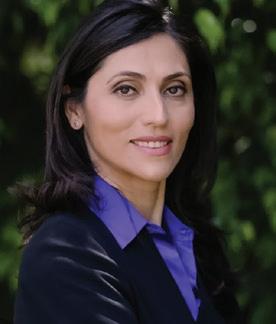
ABSTRACT: As data demands surge across wireless networks and data centers—driven by AI growth—high-frequency RFICs are becoming vital to the future of both wireless and wireline connectivity. Operating in the millimeter-wave (mmWave) and sub-Terahertz (THz) frequencies, future RFICs unlock unprecedented data rates, enabling high-speed and low-latency links—both wirelessly to consumers as well as within data centers between GPUs. With new higher modulation techniques, sub-THz RFICs reduce latency and power usage, paving the way for sustainable, scalable data center interconnect architectures. Innovations in RF process nodes enable higher maximum frequencies and lower power consumption, optimizing RFICs’ efficiency and performance. This presentation will explore the transformative role of RFICs across applications such as next-generation radars, sensors, 5G/6G networks, and satellite communications, with a focus on their pivotal role in data center interconnections.
SPEAKER BIO: Maryam Rofougaran is CEO and Co-founder of Movandi, a leader in RF and millimeter wave semiconductor and technology commercializing multi-gigabit millimeter wave networks. Movandi is breaking through the coverage and network challenges of millimeter wave networks. Their BeamXR active repeater and system solutions solve today’s real-world 5G deployment challenges – by increasing 5G coverage and capacity, while reducing infrastructure costs by more than 50%, accelerating large-scale 5G commercialization. Before founding Movandi, Maryam was Senior Vice President of Radios at Broadcom Corporations and was instrumental in starting and building the wireless business at Broadcom and in growing it to annual revenue of more than $3 billion. Her first start-up Innovent System was acquired by Broadcom Corporations in 2000 and was the entrance of Broadcom into the wireless market. She is an Inventor and co-inventor on more than 300 U.S. patents. Maryam has a BS and MS in Electrical Engineering from UCLA. She was part of the team at UCLA that made RFCMOS and SOCs a reality. Maryam has been a member of various councils including CNBC CEO council and GSA CEO council.
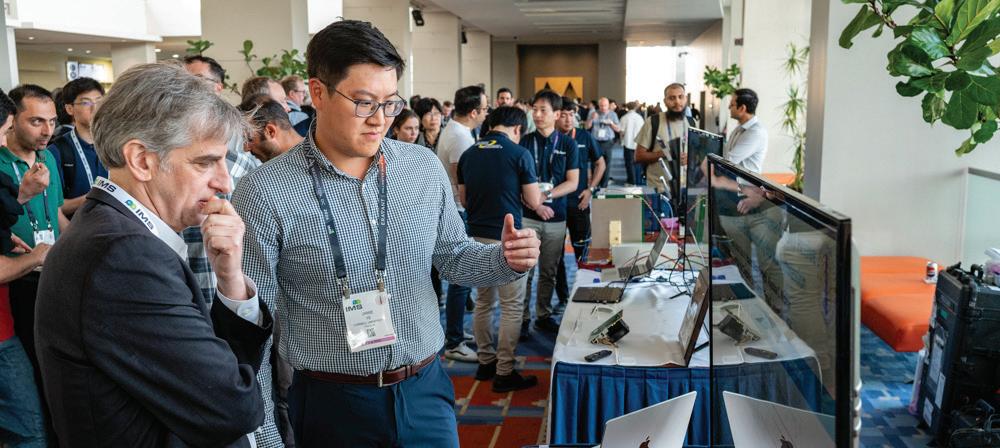
RFIC RECEPTION AND SYMPOSIUM SHOWCASE
19:00 – 21:00 Sunday, 15 June 2025 ROOM 301–304
The RFIC Interactive Reception starts immediately after the Plenary Session and will highlight the paper award finalists and other papers in an engaging social and technical evening event with food and drinks. Authors of these papers will present their innovative work, summarized in poster format Some showcase papers will also offer live demonstrations.
Student Paper Finalists:
RMo1B-1: A 19GHz Circular Polarized 256-element CMOS Phased-Array Transmitter with 11W Average Power Consumption for LEO Satellite Terminal
Xiaolin Wang, Institute of Science Tokyo
RTu3B-2: A Terahertz FMCW Radar with 169-GHz Synthetic Bandwidth and Reconfigurable Polarization in 40-nm CMOS
Aguan Hong, South China University of Technology
RTu3B-4: A Fully Integrated 263-GHz Retro-Backscatter Circuit with 105°/82° Reading Angle and 12-dB Conversion Loss
Mingran Jia, Massachusetts Institute of Technology
RTu2A-1: Topology-Optimized Nonintuitive Multilayered mm-Wave Power Amplifiers
Vinay Chenna, University of Southern California
RMo4B-4: An Ultra-Compact Switchless Bidirectional PA-LNA with 8-Shaped Transformer-Based Inter-stage Matching Networks for W-Band Applications
Lingtao Jiang, South China University of Technology
RTu3C-1: A 19.4-fs RMS Jitter 0.1-to-44 GHz Cryo-CMOS Fractional-N CP-PLL Featuring Automatic Bleed Calibration for Quantum Computing Jinghai Xiao, Xidian University
Showcase:
RMo2C-5: An Ultra-Compact and Broadband C–X-Band Wilkinson Power Divider/Combiner Using Folded Two-Section Mechanism in 65-nm Bulk CMOS Technology
Jiazhi Ying, Beijing Institute of Technology
RMo1A-5: A Fully Integrated Optimal Modulation Bits-to-RF Digital Transmitter Using Time-Interleaved Multi-Subharmonic-Switching DPA
Timur Zirtiloglu, Boston University
RTu1C-5: Fully-Integrated Autonomous K-Band Complex Permittivity Sensor in 22 nm FDSOI for Biomedical Body Parameter Monitoring Applications
Adilet Dossanov, Technische Universität Braunschweig
RMo3C-1: A 40GS/s 8bit Time-Interleaved Time-Domain ADC Featuring SFDR-Enhanced Sample-and-Hold Circuit and Power-Efficient Adaptive Pulse Generator in 28nm CMOS
Chenhao Zhang, Xidian University
RMo2B-1: A 60-GHz Area-efficient Coupled Standing-Wave-Oscillators LO Distribution Network for a 240-GHz 2-D Phased-Array
Ying-Han You, National Taiwan University
RTu3A-3 A 28–38GHz Digitally-Assisted Frequency Tripler with Background Calibration in 55nm SiGe BiCMOS
D. Lodi Rizzini, Politecnico di Milano
RTu2C-4: 3D-Millimeter Wave Integrated Circuit (3D-mmWIC): A Gold-Free 3D-Integration Platform for Scaled RF GaN-on-Si Dielets with Intel 16 Si CMOS
Pradyot Yadav, Massachusetts Institute of Technology
RTu4A-1: A 15/30/60-GHz 1TX/4RX Radar Chipset Achieving 6° Angular Resolution Using Frequency Dimension for Virtual Aperture Expansion
Ruilin Liao, University of Electronic Science and Technology of China
RMo1C-4: D-Band Radio-on-Glass Modules for Spectrally-Efficient FD & FDD Multi-Kilometer Wireless Backhaul Links
Shahriar Shahramian, Nokia Bell Labs
RMo3A-3: A 210-320GHz Power-Combining Distributed Frequency Doubler with Tuned Pre-Amplification in 0.13µm SiGe BiCMOS
Akshay Visweswaran, Nokia Bell Labs
RMo2A-4: A High Power SOI-CMOS WI-FI 6 Front-End Module with Reconfigurable Class-J Power Amplifier
Pascal Reynier, CEA-Leti
Have you downloaded the IMS and Microwave Week Mobile App?
View papers and presentations in real time, locate exhibitors, and explore everything that IMS has to offer!
To download the app, search for ‘IMS Microwave Week’ in the app store for your device or scan a QR code.
WIRELESS POWER TECHNOLOGIES
(WPT) BOOTCAMP
08:00 – 11:50 Monday, 16 June 2025 Room: 216
ABSTRACT: As our world and economy become increasingly digital, the density of wireless devices per square kilometer has reached astonishing levels. Predictions suggest that a single square kilometer could soon host up to 10 million devices, creating substantial environmental and economic sustainability challenges. Fortunately, wireless power technologies (WPT) present a promising solution. By enabling wireless energy delivery to devices, WPT eliminates the reliance on batteries, which not only reduces the environmental footprint and conserves raw materials but also lowers costs by eliminating the need for frequent battery replacements. Embracing WPT could pave the way for a more sustainable and efficient future. The upcoming WPT boot camp will introduce participants to wireless power transfer for electronic devices, helping to accelerate the digitalization of both society and the economy. The program will explore two distinct WPT technologies: near-field transfer, which is already utilized in wireless charging and the emerging near-field communication charging, and far-field wireless power transfer, which is gradually being adopted in the market. These technologies use different methods to transmit power. The boot camp will provide comprehensive insights into both, with academic experts covering the foundational concepts and design principles, while industry professionals will discuss various business applications and standards. This WPT boot camp is tailored for engineers seeking to learn the basics of wireless power transfer or apply it to their work, marketing and sales professionals aiming to grasp WPT technologies, and university students interested in gaining foundational knowledge in the field. The course offers ample opportunities for participant engagement and interaction.
Organizers: Nuno Carvalho, IT-Universidade de Aveiro; Jasmin Grosinger, Graz University
Speakers:
Near-field Wireless Power Technologies: Basics and Design Principles
Jasmin Grosinger, Graz University
NFC Based Wireless Charging Technology: Applications and Market trends
Jernej Izak, Renesas Electronics
NearField WPT
Alberto Peralta, nucurrent
Energy Mules for Space and Earth Exploration
Nuno Carvalho, IT-Universidade de Aveiro
High Power-Energy Wireless Power Beaming Components and Systems
Hooman Kazemi, Raytheon-RTX
08:00 – 17:20 Monday, 16 June 2025
ABSTRACT: This course will provide an overview of RF and Microwave basics, with theory, design and measurement techniques as well as applications. The intended audience includes technicians, new engineers, engineers who may be changing their career path, marketing and sales professionals seeking a better understanding of microwave technology, as well as current college students looking to learn more about the practical aspects of RF and Microwave technology. The format of the RF Boot Camp is interactive based learning, with multiple presenters from industry and academia presenting on a variety of topics including: RF-Microwave systems basics, network and spectrum analysis, simulation and matching network design modulation and signal analysis, signal generation and modulation analysis, as well as RFMW Tx-Rx Communications Designs.
Organizers: Joanne Mistler, Keysight Technologies
Speakers:
The RF-Microwave Signal Chain, Network Characteristics, Analysis and Measurement
Joanne Mistler, Keysight Technologies
End to End RF Simulation
Murthy Upmaka, Keysight Technologies
RFMW Communications, Quantum Design and Matching Basics
Kevin O’Brien, MIT
Spectral Analysis and Receiver Technology
Joanne Mistler, Keysight Technologies
Signal Generation, Modulation and Vector Signal Analysis
Joanne Mistler, Keysight Technologies
Tx-Rx Communications System Digital-to-RF Design and Test
Bryan Goldstein, Analog Devices
Design, Modeling and Operation of Antennas, Arrays and Metasurfaces in mmWave and THz Communications
Arjun Singh, SUNY Polytechnic


08:00 – 17:20 | Monday, 16 June 2025
WORKSHOP TITLE WORKSHOP ABSTRACT
Advanced Design and Integration/ Packaging of Power Amplifiers and Front-End Modules
Sponsor: IMS
Organizers: Kamal Samanta, AMWT LTD; Paragkumar Thadesar, Qualcomm
08:00 – 11:50 ROOM: 201
Advanced Low-Noise Measurement Techniques for Cutting-Edge Room-Temperature and Cryogenic Applications
Sponsor: IMS
Organizers: Fabian Thome, Fraunhofer
IAF; Mehmet Ogut, Jet Propulsion Laboratory
08:00 – 11:50 ROOM: 204
Space-Borne and Ground-Based Sub-mm-Wave and THz Science Instruments for Astrophysical Applications
Sponsor: IMS
Organizers: Rainee N. Simons, NASA Glenn
08:00 – 11:50 ROOM: 302
Acoustics Meets Quantum: Bridging RF Acoustics and Quantum Technologies
Sponsor: IMS
Organizers: Andreas Tag, Qorvo; Milad
Koohi, Texas A&M University
08:00 – 17:20
ROOM: 305/309
In advanced mobile and wireless communication systems, including for sub-6GHz and mm-wave 5G and 6G, the integration and packaging of PA with other circuits has recently gained significant attention for enhancing electrical performances and achieving reduced size and integration cost. At the same time, in a front-end module (FEM), power amplifiers are considered the most expensive and critical component, dissipating high power within a compact space. PA’s thermal management and integration (considering electromagnetic interference) are crucial in achieving the required system performance with high reliability and repeatability. This workshop will focus on recent advances in PA design techniques, co-designing power amplifiers with other active (like, LNA, PS) and passive components (including filter, antennas) and integration, packaging, and thermal management techniques for realizing high-performance FEMs. It will present superior PA and FEM performance utilising advanced materials and techniques, including a diamond composite material compatible with II-V semiconductors and bond wires matching technique-based fully integrated PA. Furthermore, it will showcase wafer-level and chipset-based packaging of PA using silicon interposer and co-designing and integrating with passives and other RF (GaAs/GaN) and Si/CMOS circuits into a single substrate and demonstrating state-of-the-art output power and efficiency, enhancing integration and reducing manufacturing costs.
The measurement of noise temperatures or noise figures of low-noise amplifiers and receivers is a key technique for a multitude of applications. Especially when talking about cutting-edge performance, eg for satellite-based systems at room temperature or quantum computing and radio astronomy at cryogenic temperatures, low-noise measurements become more and more challenging. While noise measurements are very often understood as straight forward, measurements at different ambient temperatures, operating frequencies, or input matching conditions are a major challenge so that low noise temperatures with a low uncertainty are difficult to maintain. This is especially true when the measured performance further improves and gets closer to physical limits. With applications such as array receivers or highly-scaled systems, such as astronomical interferometer or quantum computer, the increasing number of devices under test is a continuously growing requirement and will be addressed. In this workshop, we address several challenges and show state-of-the-art solutions for applications at room temperature and cryogenic conditions; best practices are discussed. This includes noise sources that are a key technology for the characterization and calibration of THz instrumentation ranging from amplifiers to radiometers. Therefore, the first talk will describe the development of noise sources, both diode and transistor based, with a focus on increasing ENR to enable a wide range of applications. In addition, the characterization methods and error analysis of the noise sources will be presented. The characterization of noise parameters is a key technique for device modeling and the assessment of different transistor technologies and devices. Thus, the second talk will focus on the characterization of noise parameters and corresponding conclusions. The following two talks discuss setups and challenges for cryogenic devices. The third talk describes a method for on-wafer noise temperature measurements of low-noise amplifiers using the cold-attenuator approach. Furthermore, a detailed analysis of the measurement uncertainty is presented. The fourth talk discusses an approach in measuring and qualifying cryogenic LNAs for their application in radio astronomical receivers. The basis of the presentation will be the activities for ALMA Band 2 1st stage LNA at W-Band. Here the main RF performance characteristics of effective noise temperature, full two-port s-parameters, amplitude and phase stability need to be verified at a cryogenic temperature of 15K and evaluated against specifications. Current and future projects in radio astronomy require a procedural approach in order to handle production volumes in the order of hundreds of cryogenic components. An increase of production volume is clearly foreseeable for the near future. This necessitates the use of automated processes for measurement and document generation. It is noteworthy that these activities often take place in research institutions, where, traditionally, many components used in cryogenic radio astronomy receivers are still developed, fabricated and tested. The learning and best practice of measurement setups in such demanding environments help also to improve the understanding in an even wider area of applications. Thus, developments, as discussed in this workshop, serve the entire IMS community.
Over six decades of exploration of our solar system by robotic spacecraft has not only been one of the greatest adventures in history but has also transformed our understanding of the universe. Every mission has enabled stunning scientific discoveries that altered our knowledge of the universe. The breadth and depth of the discoveries from these robotic missions would not have been possible without the parallel development of a broad range of science instruments that operate over a wide range of wavelengths across the electromagnetic spectrum. These instruments provided the data to address key science questions and test scientific hypotheses. The focus of this workshop is the development of space borne and ground based sub-mm-wave and THz science instruments for exploring our universe and its origin, discovering and understanding planetary systems around nearby stars, and the cosmological parameters governing the evolution of the universe, etc. At present there are significant technological needs for improving existing instruments and adapting completely new concepts. Practically all instruments can benefit by technology developments that can reduce their mass and power consumption and improve data communications capability. Additionally, increased sensitivity and measurement accuracy are desired attributes along with survivability under extreme temperature/ pressure in the ionizing radiation environment of space. Furthermore, autonomy is important given the enormous planetary distances that are involved. Accordingly, the workshop includes presentations from space agencies and organizations across the globe highlighting their instrument development successes and the missions that were enabled. The workshop commences with an overview talk that presents the developments leading up to the James Webb Space Telescope, the Nancy Grace Roman Space Telescope, and the Habitable Worlds Observatory operating in the far-infrared/THz regime (~30–300 microns / 1–10THz). The second presentation will review the history of superconducting THz detectors that are used and their status and prospects. In the third presentation, the development of superconductor-insulator-superconductor (SIS) receivers developed at the National Astronomical Observatory of Japan (NAOJ) for the Atacama Large Millimeter/Submillimeter Array (AL-MA) for operations at Band 4 (125–163GHz), Band 8 (385–500GHz), and band 10 (787–950GHz) will be presented. The fourth presentation will focus on the THz semiconductor Schottky junction used as a low noise, room temperature mixer for high spectral resolution THz observations. In particular, the 1.2THz front-end of the Submillimeter Wave Instrument (SWI) of the European Space Agency (ESA) Jupiter Icy Moon Explorer (JUICE) mission. The fifth presentation will describe a unique large-format 1.9THz heterodyne array using planar silicon micromachined package for high-resolution spectroscopy of interstellar clouds. The sixth presentation will describe the Herschel Heterodyne Instrument for the far-Infrared (HI-FI) for very high-resolution spectroscopy and the German Receiver for Astronomy at Terahertz Frequencies (GREAT) operated on the Stratospheric Observatory for Infrared Astronomy (SOFIA). The last talk will focus on big antennas in space and on ground to carry out astrophysical research.
The integration of RF acoustics with quantum technologies presents new opportunities for advances in both classical and quantum systems. This workshop will bring together leading experts from academia and industry to explore key innovation opportunities at the intersection of these fields. The event begins with a look at RF acoustic resonators, addressing challenges in fabrication and simulation. Key performance issues will be explored, alongside modeling techniques to optimize devices. The workshop will be followed by a presentation on the limitations of today’s acoustic wave technologies and discussions on tackling them. Next, high-overtone bulk acoustic-wave resonators (HBARs) are discussed for their ability to support ultrahigh coherence phonon modes, with implications for quantum memory, sensors, and transducers. Strategies for quantum control of phonons via optomechanical and electromechanical couplings will be introduced. The workshop also highlights advances in phononic circuits for classical and quantum information processing, focusing on electron-phonon interactions and non-linearities. Recent progress in Surface Acoustic Wave (SAW) devices for quantum computing, including their integration with superconducting circuits, will be showcased. Finally, thermal management in nanoscale devices will be discussed, offering solutions to challenges in heat dissipation. A panel discussion will conclude the workshop, encouraging collaboration between the RF acoustics and quantum communities.
Advanced Modeling and Design of High-Power Microwave Passive Components: Filters, Multiplexers, and Beyond
Sponsor: IMS
Organizers: Aly E. Fathy, University of Tennessee Knoxville; Gamal Hegazi, Hegazi Consulting; Mohamed M. Fahmi, DRDC
08:00 – 17:20
ROOM: 210
Challenges and Opportunities in On-Wafer Measurements at mm-Wave Frequencies for Future Applications
SponsorS: IMS; ARFTG
Organizers: Abhijeet Kanitkar, FBH; Gia Ngoc Phung, PTB
08:00 – 17:20
ROOM: 310/311
GaN/Si: an Enabler for FR3 Applications?
Sponsor: IMS
Organizers: Bertrand Parvais, IMEC; Marianne Renoz, Incize; Mostafa Emam, Incize; Nadine Collaert, IMEC
08:00 – 17:20
ROOM: 215
Microwave Materials and Processing Technologies for RF Wireless Applications
Sponsor: IMS
Organizers: Guoan Wang, University of South Carolina; Yang Yang, UTS
08:00 – 17:20
ROOM: 206
This workshop delves into advanced modeling techniques and innovative design strategies for high-power microwave passive components, such as power combiners, filters and multiplexers, which are crucial for applications in telecommunications, radar, and satellite communications. The workshop aims to provide participants with the latest insights and practical skills to tackle challenges in high-power microwave component design. Overview and Core Content: The workshop begins with an overview of passive components, highlighting their roles in microwave systems. It covers the principles and design methodologies of high-power components, including fixed frequency filters, radial combiners, waveguide polarizers, and tunable 3D filters. Sessions provide a detailed look at specific design challenges and solutions, offering a comprehensive understanding of the technical aspects. Key Challenges: Addressing critical challenges, such as RF breakdown and thermal management, is a key focus of the workshop. These issues are vital for components operating under high-power conditions in both terrestrial and space-based systems. The sessions will explore advanced modeling techniques and strategies to overcome these challenges, ensuring high reliability and performance. Emerging Technologies and Innovations: The workshop emphasizes emerging technologies reshaping high-power microwave design, particularly the integration of Artificial Intelligence (AI) and Machine Learning (ML) for optimizing high-power filters. This allows for enhanced performance, reduced design time, and greater reliability. The use of additive manufacturing (AM) for waveguide subsystems is also highlighted, demonstrating its capacity to create complex, efficient designs that exceed traditional manufacturing capabilities. Specialized talks: Sessions will cover AI-driven optimization techniques, including ML algorithms for predictive modeling and real-time adjustments. Participants will gain insights into advanced modeling of high-power components using modern software tools, as well as the synthesis of additively manufactured waveguide assemblies. These sessions are tailored to provide practical knowledge that attendees can directly apply to their work. Expert Interaction and Distinguished Speakers: Featuring a panel of distinguished speakers who are experts in the field, the workshop offers opportunities for direct interaction and engagement. Each session includes Q&A segments, allowing attendees to discuss challenges and gain deeper insights. This format encourages a collaborative atmosphere, promoting the exchange of ideas and professional networking. Community Support and Open Discussion: The workshop is supported by the Microwave Theory and Techniques Society (MTT-S), specifically through Technical Committees TC-4 (Passive Components) and TC-5 (Filters), underlining the significance of these topics within the microwave community. An open discussion session will enable participants to delve deeper into topics, propose ideas, and collaborate on emerging challenges, creating an inclusive environment for all attendees. Goals and Impact: By combining advanced modeling, innovative design strategies, and emerging technologies, this workshop aims to advance high-power microwave component design and manufacturing. It seeks to equip participants with the tools, knowledge, and connections needed to drive innovation in their work. Through a comprehensive and interactive program, the workshop aspires to foster the development of high-performance, reliable, and efficient high-power microwave components for contemporary RF and microwave systems.
Future wireless systems operating beyond 100GHz will enable a wide range of applications such as high data-rate communications, radar sensing and imaging. Such wireless systems are becoming a reality given the rapid increase in the development of RF devices at upper mm-wave and sub-THz frequency range. Accurate on-wafer measurements play an important role in the development of many established and emerging industrial applications. It is key that the performance of the fabricated planar RF circuits must be characterized by performing on-wafer measurements for quality assurance or during product development as a feedback to the design process. However, despite the significant progress made over the last decade in improving the accuracy of on-wafer measurements, several challenges remain to be overcome, particularly as frequencies increase. One of the most challenging aspects of on-wafer measurements is the presence of probe parasitics, multimode propagation and neighborhood effects. These effects occur both in active and passive devices, which are the key components of RF systems. This workshop will review the challenges and opportunities of on-wafer measurements and present fundamental aspects of on-wafer measurements, such as techniques to minimize calibration and measurement errors in the mm-wave range, the on-wafer traceability path, and techniques to improve on-wafer measurement accuracy. The workshop will also emphasize on-wafer calibration and automation for active device characterization and will address the importance of on-wafer measurements from IC designer’s perspective. During this interactive full-day workshop, ten experts from around the world will share their experience and guide you through various aspects of on-wafer measurements. The speakers come from a variety of backgrounds: National Metrology Institutes (NMIs) from the USA, Europe and Asia, instrument manufacturers, industry and academia. The aim of this workshop is therefore to provide an overview of these current research areas and to present future directions in the field of on-wafer measurements.
GaN HEMT technology plays a crucial role in wireless telecom infrastructure for 3G, 4G, and 5G standards. Thanks to its excellent transport properties, GaN HEMTs support highly efficient, high-power operation at frequencies up to several tens of GHz. This makes them particularly well-suited for the FR3 spectrum (7–24GHz), which has emerged as a key focus for 6G communications. Historically, GaN has been grown hetero-epitaxially on high-resistivity SiC substrates, known for their superior performance but also high cost. Recently, driven by the success of GaN in power switching applications, GaN-on-Si is gaining momentum in RF and microwave communication. While GaN-on-Si introduces some trade-offs — such as lower thermal conductivity and parasitic effects like conductive channels at the Si/AlN interface — it presents immense potential due to its economic advantages. Silicon substrates are not only more affordable, but can also be produced at up to 300mm in diameter and processed in high-volume Si foundries. Additionally, GaN-on-Si offers technical benefits like scalability and easier integration with Si CMOS technology. In this workshop, we will explore GaN-on-Si HEMT technology in the FR3 spectrum from multiple angles. Topics include material science, the foundry perspective, device scaling, reliability, co-integration with existing technologies, and its application in both telecom infrastructure and user devices. Competitive benchmarking and future market prospects will also be discussed. This workshop features presentations by experts from both industry and academia, providing a comprehensive overview of the state of GaN-on-Si technology. Interactive sessions, including live polling, Q&A discussions, and a panel, will allow participants to engage with speakers and fellow attendees.
Microwave materials and processing/manufacturing technologies are the fundamental questions to be addressed for all microwave devices, systems and applications. The committee focuses on bridging the gap between microwave materials/ manufacturing technologies and their applications in RF devices, microwave circuits, systems and applications. The committee promotes the materials and processing solutions for implementing functional RF devices and systems using conventional and emerging processes, including additive, subtractive, and hybrid manufacturing, multi-material fabrication and integration. The committee is an excellent window for cross-discipline collaboration and innovation. Experts from microwave chemistry and physics are involved in the working groups expanding the FoI of MTT society, which brings opportunities for the MTT-S community to gain cross-disciplinary expertise. The proposed workshop will host distinguished researchers in this area to share their news and views on microwave materials and processing technologies for radio-frequency and wireless applications.
WORKSHOP TITLE
Microwave Quantum Engineering: From Methods to Hardware and Algorithms
Sponsor: IMS
Organizers: Michael Haider, Technische Universität München; Thomas E. Roth, Purdue University; Vladimir Okhmatovski, University of Manitoba
08:00 – 17:20 ROOM: 208
WMJ
Microwave Sensors from Near-Field Advanced and Sustainable Materials to Remote Far-Field Sensing
Sponsor: IMS
Organizers: Mahmoud Wagih, University of Glasgow; Mohammad H. Zarifi, University of British Columbia 08:00 – 17:20 ROOM: 306
Next-Generation Devices: Where Do Ultra-Wide Bandgap Semiconductors Fit In?
Sponsor: IMS
Organizers: Andrea Arias-Purdue, HRL Laboratories; Farid Medjdoub, IEMN (UMR 8520); Spyridon Pavlidis, North Carolina State University; 08:00 – 17:20 ROOM: 307
Numerical Methods and Fast Algorithms of Computational Electromagnetics
Sponsor: IMS
Organizers: Costas D. Sarris, University of Toronto; Vladimir Okhmatovski, University of Manitoba; Zhizhang Chen, Dalhousie University
08:00 – 17:20
ROOM: 308
08:00 – 17:20 | Monday, 16 June 2025
WORKSHOP ABSTRACT
The demonstration of a quantum computer outperforming the largest conventional supercomputers has triggered researchers and enterprises worldwide to work towards improving these systems’ hardware performance and investigating their novel uses in the form of quantum methods and algorithms. In the case of superconducting quantum computers, low temperatures and weak microwave control signals are used, making the quantum nature of the electromagnetic field important. Hence, the design, optimization, and scaling of the respective microwave components must be performed on an entirely new theoretical basis, given by the framework of circuit quantum electrodynamics. For microwave engineers, this signifies a transfer of knowledge from classical electromagnetics to the quantum realm. More or less standard microwave components such as mixers, isolators, parametric amplifiers, and circulators are vital for realizing superconducting quantum computers. Also, alternative quantum computing concepts, such as trapped ions or spin qubits, heavily rely on microwave technology. Modeling the associated devices and components requires methods from quantum theory or hybrid semi-classical quantum approaches, which are particularly important if quantum effects are fundamental to the device’s operation. In tandem with hardware developments, many quantum algorithms have been proposed to exploit the unique properties of quantum computers to solve challenging computational tasks. In the field of electromagnetics, specialized quantum algorithms have the potential for significant speedups against classical computing strategies, especially when it comes to NP-hard optimization problems. Quantum algorithms also show great potential for solving integral equations, inverse scattering problems, and synthesizing antenna radiation patterns. However, at the current stage, inevitable noise and limited qubit coherence times are prohibitive for most methods to show a real quantum advantage. To exploit the full potential of general-purpose quantum computers, which will enable breakthrough applications in the mid and longterm, further technological advances in quantum error correction and qubit readout are necessary. This will require significant scaling of current hardware while continuing to engineer components to achieve improved performance. Thus, in this workshop, we will address current topics in the modeling and experimental realization of microwave devices across a range of quantum hardware platforms. Hardware aspects will be connected to the design and implementation of advanced quantum algorithms for general-purpose quantum computers. The workshop aims to bring together specialists in the modeling, design, and experimental realization of quantum hardware and experts in quantum algorithms with a focus on computational electromagnetics to discuss their individual ideas and perspectives on quantum computing, as well as other emerging technologies like quantum sensors and quantum communications. Another important aspect of this workshop is to provide a comprehensive step-by-step introduction to the strange new world of quantum theory, specially tailored for microwave engineers. This introduction will be given through a comprehensive tutorial at the beginning of the workshop, bridging the language barrier between quantum physics and RF microwave engineering.
Microwaves emerged as a pervasive interface to read advanced materials, and to remotely detect measurands. This workshop will present state-of-the-art insights by inter-disciplinary research leaders around different microwave sensing modalities, illustrating a holistic image from advanced materials at MHz to sub-THz frequencies, to remote sensing using novel microwave front-ends, and system co-design. Microwave sensing characterisation will be presented for the first time for new materials including 2D materials, polymers and biodegradable metals. Moving to readouts/remote sensing, co-advances in circuits and antennas will be presented with a focus on adapting radio astronomy, mm-wave radar, exploiting losses, and other novel readout techniques. Through both applications, sustainable design guidelines will be presented including low-power front-end design, battery-free wireless-powered and chipless systems, as well as, for the first time, Life Cycle Assessment (LCA) of microwave circuits. In addition to expert speakers, our workshop will bring lightning talks from excellent students/young professionals. Thus fostering 2-way knowledge exchange and showcasing the diversity and future of MTT. The talks are: Prof. Ferran Martin, Universitat Autònoma de Barcelona, “Lossy Microwave Sensors”; Dr Sara Salem Hesari, National Research Centre Canada, “Leveraging Radio Astronomy Techniques for Enhanced RF and Microwave Sensing”; Dr Laila Salman, Ansys Canada, “Multiphysics Design and Analysis of Silver-Based Low-Emissivity Coating Technology for Energy Saving Sustainable Windows Applications”; Prof. Aline Eid, University of Michigan, “Ultra-Low-Power, Long-Range Trackers enabled by mm-Wave Backscatter and Radar Principles”; Prof. Will Whittow, Loughborough University, “Additive Metamaterials and Far-Field Techniques for Sensing”; (Co-Chair) Prof Mohammad Zarif, University of British Columbia, “RF/Microwave Wearable Devices for Body Armor and Personal Protective Equipment”; (Co-Chair) Prof Mahmoud Wagih, University of Glasgow, “Sustainable Materials-Enabled Microwave Sensors: Are We Considering Manufacturing?”.
Predictions based on popular figures of merit, such as the Johnson Figure of Merit (JFOM) and Baliga Figure of Merit (BFOM), have motivated the development of wide bandgap semiconductors (WBGSs) for RF and power electronics. In recent years, the rapid adoption of gallium nitride (GaN) and silicon carbide (SiC) demonstrates that investments in these technologies is indeed paying off. Thus, it is natural to look ahead and ask if even better performance can be obtained from devices based on emerging ultra-wide bandgap semiconductors (UWBGSs). While the above mentioned FOMs indicate that these UWBGSs could outperform today’s WBGS devices, there remain technological hurdles at all levels: from substrates and epitaxy, to contacts and passivation. This workshop brings together international experts currently investigating these topics to discuss the state-of-the-art of UWBGS III-Nitride (AlGaN, AlN), gallium oxide and diamond devices for RF and power electronics. In addition to covering the use of UWBGSs as a channel material, the use of these materials as substrates and thermal management solutions will also be examined, with the overarching goal of exploring how to best use UWBGS in next-generation electronic devices. The workshop will conclude with a round table session to invite audience participation and interaction with the speakers.
Numerical methods for computational electromagnetics (CEM) are ubiquitous in design of today’s microwave and THz electronics, wireless communication links, high-speed digital interconnects and various other applied areas driving modern information and communication technologies to their new frontiers. Acceleration of these methods with fast algorithms and their deployment on heterogeneous high-performance computing platforms featuring farms of CPUs and GPUs enables the shrinking of simulation times from days to seconds, ensuring rapid virtual prototyping and drastically shrinking the time to market for today’s industrial, consumer, and defence products. Depending on the applications, sophistication of the geometric and material properties, as well as required accuracy of the simulations, differential equation-based methods such as FEM and FDTD, integral equation methods such as MoM and LCN, or high-frequency asymptotic methods such as SBR are commonly used. To ensure minimum simulation time and memory use, these methods are typically not implemented in their stand-alone form, but are used in conjunction with sophisticated sparse matrix algorithms, hierarchical compression schemes, and tensor train decompositions, and are often deployed on hybrid shared and distributed memory multiprocessors augmented with GPUs. The workshop will consist of two parts (half-day each): Part I will introduce microwave engineers and active users of commercial tools in a step-by-step manner to the underlying electromagnetic theory and algorithmic background of popular computational tools by means of a comprehensive coverage on the most popular numerical schemes such as FEM, FDTD, MoM, High-Frequency asymptotic methods and their hybridization through domain decomposition strategies. Hands-on exercises delivered through Slido platform will make Part I of the workshop interactive and engaging for the participants. It will conclude with a unified outlook at the discussed numerical methods. Part II of the workshop will target an advanced audience and introduce iterative fast algorithms in CEM, including FFT based methods and Fast Multipole Method as well as emerging fast direct algorithms based on hierarchical matrices (H- and H2-matrices) and tensor train decompositions. The relation of the material characterization to CEM modeling will be discussed in this part also. Part II will conclude with an expert panel discussion on recent advances in the use of machine-learning methods in CEM.
WORKSHOP TITLE
Recent Advances in Full-Duplex Techniques for Wireless Communication and Sensing Systems
Sponsor: IMS
Organizers: Alexander Ruderer, OvG
Universität Magdeburg; Thomas Ussmueller, B&E antec
08:00 – 17:20
ROOM: 211
Three-Dimensional Passive Components and Devices for High-Density Integration and Functionality
Sponsor: IMS
Organizers: Aly E. Fathy, University of Tennessee Knoxville; Ke Wu, Polytechnique Montréal
08:00 – 17:20
ROOM: 313
Unseen Insights: Radar and the Future
of Human Sensing
Sponsor: IMS
Organizers: Changzhi Li, Texas Tech University; George Shaker, University of Waterloo
08:00 – 17:20 ROOM: 314
08:00 – 17:20 | Monday, 16 June 2025
WORKSHOP ABSTRACT
The rapid evolution of wireless communication and sensing systems necessitates continuous innovation to meet the increasing demand for higher data-rates, improved spectrum efficiency, and reduced latency. One promising technique to address these challenges is the In-Band Full-Duplex (IBFD), also known as Simultaneous Transmit And Receive (STAR) technology. IBFD enables a device to simultaneously transmit and receive on the same frequency at the same time. The benefits of this technology include a doubling of the capacity, higher spectral efficiency, reduced latency, a higher data-rate, optimized network performance, and improved sensing systems. In this workshop, several experts will present various approaches to cancel the inherent self-interference from the own transmitter. It begins by explaining the three domains where self-interference can be mitigated: propagation, analog, and digital domain. The current challenges and recent research advances are elucidated, and the presentations are organized in accordance with the overarching themes of the workshop. One presentation is dedicated to the analysis of digital self-interference phenomena occurring in different modulation formats within the VHF band. The presentation compares and contrasts the characteristics of analog (AM, FM, PM) and digital (OFDM) formats. Another presentation addresses IBFD phased array systems, with a focus on self-interference suppression techniques, including RF cancellation, adaptive beamforming, and digital filtering, and their potential for application in 6G systems. A subsequent presentation will examine the utilisation of full-duplex FMCW radar systems, with a particular focus on the deployment of active Self-Interference Cancellation Couplers (SICCs) to enhance radar system isolation and facilitate miniaturisation and over-the-air synchronisation. Additional presentations address self-interference cancellation in Advanced Duplex (AD) systems, with an emphasis on techniques within MIMO communication and adaptive RF front-ends, which are of particular importance for IBFD and FDD, employing tunable filters and electrical balance duplexers. Furthermore, the workshop examines the potential of Gallium Nitride (GaN) technology in the development of fully integrated transceiver front-ends for applications such as radar and electronic warfare. In this context, the material’s advantages in terms of power, size, and radiation tolerance, particularly for space systems, are emphasised. Additionally, the discussion encompasses a range of GaN designs, including power amplifiers and low-noise amplifiers, along with their associated testing and measurement processes.
The evolution of 3D passive components and devices has become increasingly important in advancing high-density integration and multifunctionality in microwave and mm-wave systems. Traditional planar technologies, such as 2D layouts on PCBs, often face limitations in scalability, integration density, and performance at higher frequencies due to increased parasitic effects and limited space for component placement. In contrast, 3D integration techniques leverage vertical stacking and embedding of components, significantly improving the overall performance, reducing form factors, and enhancing the functionality of passive circuits. 3D integration utilizes advanced materials and processes, including GaAs, CMOS, GaN, and MEMS, which offer distinct advantages over conventional approaches: (•1) GaAs-based Integrated Passive Device (IPD) Technology: GaAs IPD technology allows for the development of highly integrated, multifunctional filtering circuits. These circuits combine lumped and distributed elements, leading to compact designs that exhibit low loss and high-quality factors. (•2) MEMS-based Bulk Acoustic Wave (BAW) Filters: MEMS technologies enable the fabrication of high-performance BAW filters that offer superior selectivity and low insertion loss at microwave frequencies. The miniaturization and integration capabilities of MEMS devices allow these filters to be directly integrated into RF front-end modules, enhancing the performance of wireless communication systems. (•3) GaN-based Filtering Switches: GaN materials are known for their high breakdown voltage and power-handling capabilities, making them ideal for high-frequency, high-power applications. GaN-based filtering switches integrate filtering and switching functions, reducing the need for separate components and thereby minimizing signal loss and improving system efficiency. Addressing High-Frequency Challenges with 3D Technologies — high-frequency applications, particularly in the mm-wave range, pose unique challenges such as increased parasitic effects, signal loss, and thermal management issues. 3D integration addresses these challenges by: (•1) Reducing Size and Parasitics: The vertical stacking of components and the integration of passives directly onto semiconductor substrates minimize interconnect lengths and associated parasitics. (•2) Performance Optimization: By leveraging advanced electromagnetic modeling techniques and novel manufacturing processes like micro-dispensing and aerosol jetting, 3D technologies enable the design of complex metasurface architectures and efficient RF packaging solutions. These processes allow for the precise control of material properties and geometric configurations, leading to optimized performance in terms of bandwidth, insertion loss, and isolation. Heterogeneous Integration and Packaging Innovations — the integration of microelectronics and heterogeneous 2.5D/3D packaging techniques further supports the development of high-density, energy-efficient designs essential for emerging 5G and 6G systems. Advanced packaging methods, such as die-embedded glass substrates, provide innovative solutions for integrating high-frequency components. For example, a die-embedded glass packaging effectively mitigates electrical losses and manages thermal dissipation. Additionally, the ability to stack multiple layers of passive and active components enables the creation of highly compact modules. In this workshop, we address the transition to 3D high-integration technologies which marks a significant advance in the microwave and mm-wave field, offering a pathway to more compact, efficient, and multifunctional electronic systems. By overcoming the limitations of traditional planar approaches, 3D integration is set to revolutionize the design and implementation of high-frequency electronic systems, driving innovation and expanding the possibilities for future technologies.
The rapid advances in radar technology, along with AI and machine learning, are unlocking unseen insights into human behavior, health, and security. In “Unseen Insights: Radar and the Future of Human Sensing,” we explore how radar is reshaping the future of human sensing. From monitoring vital-signs such as heart rate, breathing rate, glucose levels, and blood pressure to enhancing human security, radar’s ability to detect minute physiological and behavioral details without contact signals a new era where human sensing becomes more intelligent, seamless, and highly adaptable. This workshop will dive into how radar, coupled with AI, is set to revolutionize key industries, from healthcare to automotive, by offering transformative, real-time solutions to monitor and understand human activity in ways previously unimaginable. As radar technology continues to evolve, it is poised to redefine how we interact with our surroundings. Whether it is enhancing in-home health monitoring, improving security systems, creating safer autonomous vehicles, or becoming part of the next wave of AR/VR and smart home devices, radar is offering a window into the unseen. By capturing the subtlest of signals — heartbeat, breathing rate, glucose, blood pressure — radar has the potential to make environments more responsive, healthcare more proactive, and safety systems more robust. This workshop will highlight these groundbreaking developments, featuring insights from industry leaders, cutting-edge startups, and academic experts, all shaping the future of radar-powered human sensing.
WMP
Challenges and Solutions in Signal and Power Integrity for Next-Generation High-Speed Systems
Sponsor: IMS
Organizers: Ahmed Abdellatif, Microchip; Laila Salman, Ansys 13:30 – 17:20 ROOM: 201
As data-rates continue to rise and system complexity increases, maintaining robust signal integrity (SI) has become a critical challenge in next-generation high-speed systems. Applications in Artificial Intelligence (AI) and cloud computing are driving the demand for higher data throughput and increasingly complex interconnect designs. To meet this demand while maintaining reasonable power consumption, advanced nodes like 3nm and associated packaging technologies, such as chiplets, are being employed — introducing additional signal integrity (SI) challenges. This workshop will address key broadband SI challenges and offer cutting-edge solutions for mitigating impairments like inter-symbol interference (ISI), crosstalk, and discontinuities across a broad frequency spectrum. Participants will also explore modeling and analyzing interconnects and transitions for broadband applications using integral equation (IE) methods, a crucial tool for accurately modeling signal behavior in advanced packaging and PCB designs. The workshop will cover the fundamentals, state-of-the-art techniques, and ongoing challenges of applying these methods to broadband SI analysis in high-speed systems. In addition to signal integrity, power integrity (PI) is an equally critical factor, particularly as emerging AI and cloud computing systems require thousands of amps to be delivered to high-speed digital designs. A specialized talk will address power integrity challenges in multi-die packages, AI chips, and cloud servers, focusing on digital twin PI simulations to mitigate hardware failures. Participants will gain insight into the complexities of end-to-end power delivery networks, voltage regulators, and power integrity digital twins for next-gen systems. The workshop will also build on modeling broadband interconnects, culminating in comprehensive models for packaging and PCB designs using finite element method (FEM) and IE methods. A case study on Rigid-Flex PCB modeling up to 100GHz will be presented, with an in-depth discussion of the challenges encountered. Once the broadband channel model (comprising the package, PCB, and connectors) is established, the workshop will explore the need for spectrally efficient modulation schemes (eg PAM-4) and digital equalization techniques to overcome channel impairments for data-rates exceeding 200Gb/s. With rising data center cooling costs, energy-efficient digital equalization has become a crucial research area. This talk will provide an overview of the evolution, current landscape, and future trends in digital equalization for high-speed links. As background, our IEEE Ottawa AP-S/MT-S chapter recently launched an MTT-sponsored Signal Integrity course in the Kanata tech area, which has been extremely successful among both students and professionals. The course was fully booked, and demand continues to grow, underscoring the importance of providing high-quality content in the signal integrity field.
MHz-to-THz
Techniques
Measurement
for Advancing RF GaN HEMTs
Sponsor: IMS; ARFTG
Organizers: Gian Piero Gibiino, Università di Bologna; Nicholas Miller, Michigan State University
13:30 – 17:20
ROOM: 204
The Load Modulated Balanced Amplifier (LMBA): Design, Operation, and Performance
Sponsor: IMS
Organizers: Roberto Quaglia, Cardiff University; Taylor Barton, University of Colorado Boulder
13:30 – 17:20
ROOM: 302
Gallium nitride (GaN) high electron mobility transistors (HEMTs) continue to play a critical role in numerous RF applications including communications, satellite communications, radar, and electronic warfare. The GaN technology development cycle has always been critically reliant on measurements to characterize the transistors and provide precise data for device process engineers, modeling engineers, as well as for circuit and system designers. New variants of GaN HEMTs, often designed for specific applications, will continue to require both established and advanced measurement techniques — particularly tests that characterize the transistor in application-like environments. It is, therefore, critical to understand the landscape in terms of microwave measurements specific to characterizing GaN HEMT technologies for their use cases. This half-day workshop will assemble an international group of experts in the field of advanced RF measurements to present the latest research from MHz to THz techniques. This proposed workshop will enable an inclusive, international audience and will welcome open discussions on the technical aspects of the presentations.
The load modulated balanced amplifier (LMBA) architecture has received considerable attention due to its great potential for efficiency and bandwidth enhancement. Many variations on the architecture have been proposed: LMBA vs. SLMBA vs OLMBA, single-input vs. dual input, frequency-reconfigurable vs. broadband, hybrid vs. MMIC, and so on. The aim of this workshop is to describe this broad design space and help provide guidance on how to find the right LMBA solution for a particular application. After a general introduction to the technique, individual presenters will focus on a specific variant and how its design, operation, and performance compares to the baseline architecture.
2025 IEEE FELLOWS
THE MOSCONE CENTER | ESPLANADE BALLROOM
RECOGNIZING THE ACHIEVEMENTS OF ITS MEMBERS IS AN IMPORTANT PART OF THE MISSION OF IEEE. Each year, following a rigorous evaluation procedure, the IEEE Board of Directors confers a selected group of members for elevation to IEEE Fellow. The IEEE Fellow is the highest grade of membership in the IEEE. Less than 0.1% of voting members are selected annually for this member grade elevation. It is recognized by the technical community as a prestigious honour and an important career achievement.
CLASS OF 2025 IEEE FELLOWS, EVALUATED BY MTT-S
Julio Costa for contributions to the development of RF silicon-on-insulator technologies and circuits for mobile applications
Larry Dunleavy for contributions to commercial development of microwave device models and microwave education leadership
Kamran Entesari for contributions to millimeter-wave high-efficiency front ends and high-linearity mixer-first receivers
Christian Fager for contributions to RF power amplifier efficiency enhancement and modeling of transmitter distortion
Kamran Ghorbani for contributions to microwave sensors and multifunctional microwave structures
Alexander Koelpin for contributions to microwave interferometry and six-port technology
Naoki Shinohara or contributions to wireless power transfer technologies and applications
Aarno Parssinen for contributions to high-power and smooth-profiled filters
Nils Pohl for contributions to wideband and ultra-precise millimeter-wave radar sensors
Costas Sarris for contributions to microwave and electromagnetic field computations
Kaushik Sengupta for contributions to millimeter-Wave and terahertz technology in silicon-based integrated circuits
Adrian Tang or contributions to Millimeter-Wave Systems-on-Chip Instruments for space science
Cristiano Tomassoni for contributions to miniaturized microwave filters and additive manufactured filters
EVALUATED BY OTHER IEEE SOCIETIES/COUNCILS
Krzysztof Kulpa for contributions to passive radar
Nelson Fonseca for contributions to microwave beamforming techniques and technologies in terrestrial and space wireless communication systems
Maokun Li or contributions to nonlinear inversion algorithms for subsurface imaging
Simone Paulotto for contributions to 5G mm-wave and leaky-wave antennas
Satish Sharma for contributions to antennas design for satellite and radar applications
Hiroshi Harada for technical leadership and contributions in wireless smart utility networks and software-defined cognitive radio
Christian Schuster for contributions to physics-based modeling, design, and optimization of interconnects in servers and networking equipment
Malin Harindhu Premaratne for contributions to theory, modelling, and simulations of optical quantum devices
Brian Ginsburg for contributions to CMOS mm-wave radars
Chih-Ming Hung for contributions to CMOS digitally-assisted RF designs
Patrick Mercier for contributions to low-power and energy-efficient circuits and systems
Mauricio Pereira Da Cunha for contributions to the commercialization of harsh-environment microwave acoustics materials, sensors and systems
Pavel Nikitin for contributions to the analysis and design of RFID tags and systems
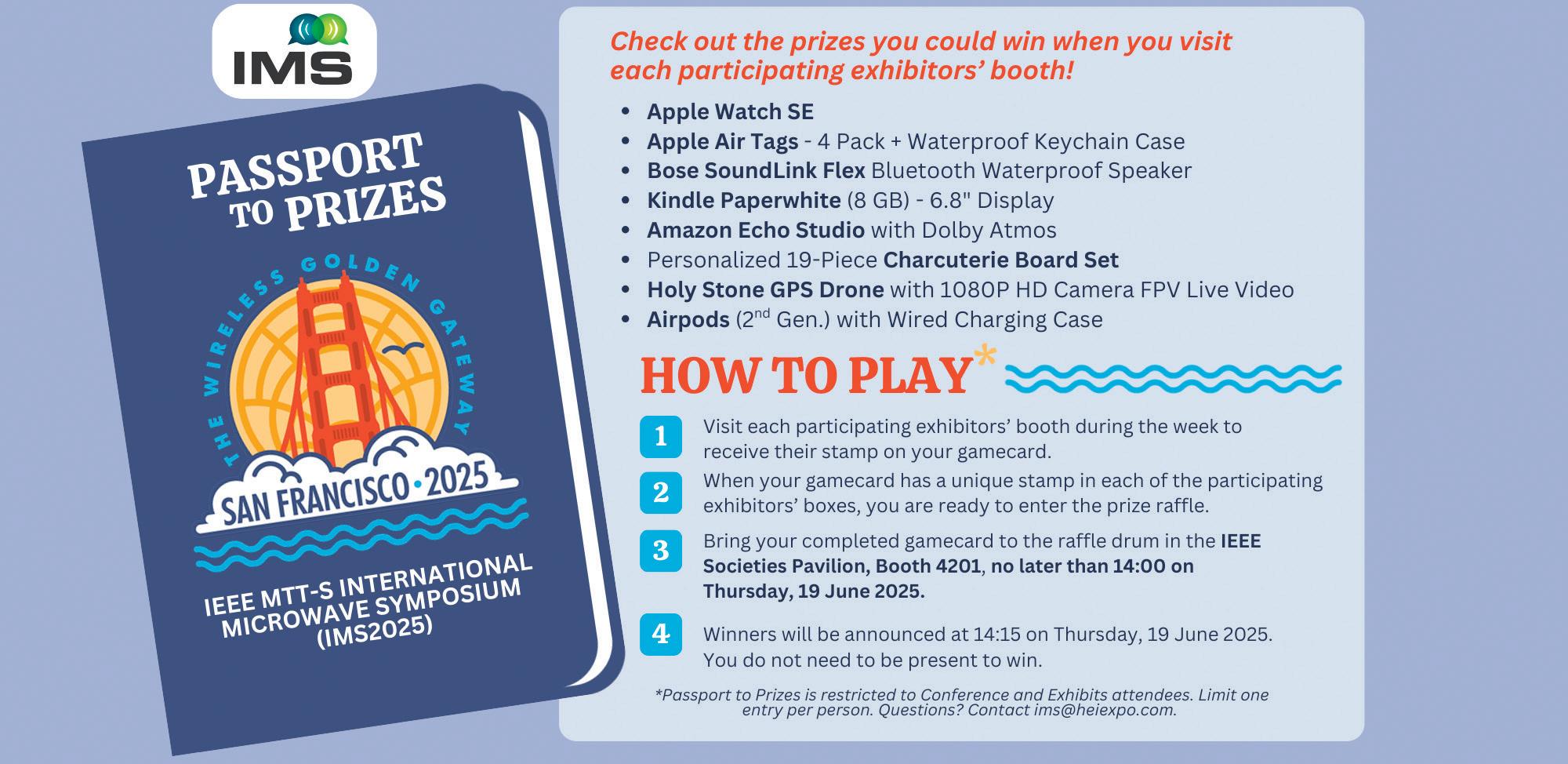
RFIC TECHNICAL SESSIONS
203
RMo1A: Digital Transmitters and Power Amplifiers
Chair: Andreia Cathelin, STMicroelectronics
Co-Chair: Xun Luo, UESTC
RMo1A-1: A 71–86GHz 1024QAM Direct-Carrier Phase-Modulating Transmitter with Digital-to-Phase Converters and Constant-Envelope Phasors
J. Zhou, C.-J. Tien, C. Chen, J. Du, J.-W. Chen, A. Bharathan, Univ. of California, Los Angeles; A.J. Tang, Jet Propulsion Lab; S.-W. Tam, NXP Semiconductors; M.-C.F. Chang, Univ. of California, Los Angeles
RMo1A-2: A 50–64GHz 21.4dBm, 20.6% SE Intrinsically Linear Digital Cartesian Transmitter with 6.5° System AM-PM Distortion Using ImpedanceCompensated RFDAC in 40-nm CMOS
D. Tang, UESTC; B. Yang, UESTC; X. Luo, UESTC
RMo1A-4: An 802.15.4/4z-Compliant UWB All-Digital Transmitter with Hybrid FIR Filtering Achieving 47dBr Sidelobe Suppression
Z. Huang, Tsinghua Univ.; W. Deng, Tsinghua Univ.; H. Jia, Tsinghua Univ.; B. Chi, Tsinghua Univ.
205
RMo1B: Reconfigurable Phased Arrays for Satellite Communication
Chair: Kostas Doris, NXP Semiconductors
Co-Chair: Aarno Pärssinen, University of Oulu
RMo1C: mm-Wave Circuit Advances in Industry
Chair: Travis M. Forbes, Sandia National Laboratories Co-Chair: Justin Wu, AmLogic
RMo1A-5: A Fully Integrated Optimal Modulation Bits-to-RF Digital Transmitter Using Time-Interleaved Multi-Subharmonic-Switching DPA
T. Zirtiloglu, Boston Univ.; A. Tan, Boston Univ.; B. Ozaydin, MIT; K. Duffy, Northeastern University; M. Medard, MIT; R.T. Yazicigil, Boston Univ.
RMo1B-1: A 19GHz Circular Polarized 256-Element CMOS Phased-Array Transmitter with 11W Average Power Consumption for LEO Satellite Terminal
X. Wang, D. You, X. Fu, T. Ota, M. Ide, S. Kato, J. Mayeda, Science Tokyo; M. Higaki, J. Sudo, H. Takizawa, M. Shirakura, Axelspace; T. Tomura, H. Sakai, K. Kunihiro, K. Okada, A. Shirane, Science Tokyo
RMo1B-2: A Ka-Band 64-Element 4-Beam Polarization-Reconfigurable Phased Array Based on 65-nm CMOS Tx RFICs for SATCOM
Z. Ma, Zhejiang Univ.; X. Xie, Zhejiang Univ.; H. Gao, Georgia Tech; B. Lan, Zhejiang Univ.; N. Li, Donghai Laboratory; H. Chen, Zhejiang Univ.; C. Song, Donghai Laboratory; Z. Xu, Zhejiang Univ.
RMo1B-3: An 18-to-50GHz 2-Element Phased-Array CMOS Transceiver with Dual-Resonator T/R Switch with Three-Port Reconfigurable Network and Embedded Tunable Image Rejection Filter
J. Gong, Tsinghua Univ.; W. Deng, Tsinghua Univ.; F. Zhao, Tsinghua Univ.; H. Jia, Tsinghua Univ.; W. Zheng, Tsinghua Univ.; L. Gu, Tsinghua Univ.; S. Yao, Tsinghua Univ.; D. Li, Tsinghua Univ.; H. Wu, Tsinghua Univ.; B. Chi, Tsinghua Univ.
RMo1B-5: An 18–32-GHz Reconfigurable Multi-Beam Phased-Array Transceiver in 65-nm CMOS for Wideband Wireless Communications
N. Li, Donghai Laboratory; B. Yang, Zhejiang Univ.; Y. Liu, Zhejiang Univ.; Z. Ma, Zhejiang Univ.; X. Xie, Zhejiang Univ.; H. Gao, Georgia Tech; S. Wang, Zhejiang Univ.; H. Lu, Zhejiang Univ.; B. Lan, Zhejiang Univ.; N. Yan, Fudan Univ.; Q.J. Gu, Georgia Tech; C. Song, Donghai Laboratory; Z. Xu, Donghai Laboratory
RMo1C-1: A 35–65GHz Quadrature-Balanced N-Path Filter with a 0.1–0.9GHz Tunable Bandwidth
S. Yamashita, Mitsubishi Electric; Y. Tsukui, Mitsubishi Electric; Y. Kawamura, Mitsubishi Electric; K. Mori, Mitsubishi Electric; A. Hirai, Mitsubishi Electric
RMo1C-2: A 60GHz Fully Integrated Low-IF CMOS Radar Transceiver with -6dBm IP1dB and -14 to 5dBm Power Control for Ultra-Short-Range Applications
B.-T. Moon, K. Kim, J. Jeong, G. Baek, D. Kim, H. Lim, J. Kim, M. Lee, S. Jung, K. Yoo, T. Yu, T. Kim, S. Kim, Y. Lee, W. Lee, O. Eliezer, H.-C. Park, C.-H. Park, Samsung
RMo1C-3: A CMOS-Enabled HeterogeneouslyIntegrated InP HEMT W-Band LNA with 2.8-dB Noise Figure at 7.7-dB Gain and 4.5 mW PDC
J.J. Kim, PseudolithIC; A. Dinkelacker, PseudolithIC; N. Vong, PseudolithIC; M.D. Hodge, PseudolithIC; M.H. Tom, PseudolithIC; B.C. Coy, PseudolithIC; M.R. Soler, PseudolithIC; C. Maxey, PseudolithIC; F. Herrault, PseudolithIC; J.F. Buckwalter, PseudolithIC
RMo1C-4: D-Band Radio-on-Glass Modules for Spectrally-Efficient FD & FDD Multi-Kilometer Wireless Backhaul Links
S. Shahramian, Nokia Bell Labs; M.J. Holyoak, Nokia Bell Labs; M. Sayginer, Nokia Bell Labs; M. Zierdt, Nokia Bell Labs; C. Adams, Nokia Bell Labs; M.W. Mansha, Nokia Bell Labs; J. Weiner, Nokia Bell Labs; A. Rai, Nokia Bell Labs; I. Kartam, Nokia Bell Labs; Y. Baeyens, Nokia Bell Labs
RFIC TECHNICAL SESSIONS
203
RMo2A: High Performance Power Amplifiers and Front-End Modules
Chair: Debopriyo Chowdhury, Broadcom
Co-Chair: Rocco Tam, NXP Semiconductors
RMo2A-1: A 13-GHz Single Chip Front-End Module with 42% TX PAE and 2.2-dB RX Noise Figure in 0.15-µm E/D-Mode GaAs pHEMT Technology for 6G Wireless Communications
J. Kim, Samsung; K.P. Jung, Samsung; S.H. Kim, Samsung; S. Oh, Samsung; S.-K. Kim, Samsung; D. Jung, Samsung; D.Y. Lee, Samsung
RMo2A-2: A 13-GHz Harmonic Tuned Asymmetric Doherty Power Amplifier with Compact and Precise Matching Network for 6G Application
S.H. Kim, Samsung; K.P. Jung, Samsung; S. Oh, Samsung; J. Kim, Samsung; S.-K. Kim, Samsung; D. Jung, Samsung; D. Kim, Samsung; D.Y. Lee, Samsung
RMo2A-3: A Ku-Band 2-Stage Differential Doherty Power Amplifier with Compact Asymmetric Doherty Combiner Based on Virtual Stub in 0.15-µm GaAs pHEMT
S. Oh, Samsung; S.H. Kim, Samsung; K.P. Jung, Samsung; J. Kim, Samsung; H.J. Kim, Samsung; S.-K. Kim, Samsung; D. Jung, Samsung; D. Kim, Samsung; D.Y. Lee, Samsung
RMo2A-4: A High Power SOI-CMOS WI-FI 6 Front-End Module with Reconfigurable Class-J Power Amplifier
P. Reynier, CEA-LETI; A. Serhan, CEA-LETI; A. Giry, CEA-LETI
205
RMo2B: Advances in VCO Design at Microwave, mm-Wave, and Sub-THz Frequencies
Chair: Alexandre Siligaris, CEA-LETI
Co-Chair: Hamidreza Aghasi, University of California, Irvine
RMo2C: mm-Wave Building Blocks & Components
Chair: Mohamed Elkhouly, Broadcom
Co-Chair: Giuseppe Gramegna, IMEC
RMo2A-5: An Ultra-Compact, >17dBm POUT, >30% PAE, Single Transformer-Based Doherty PA in 28-nm CMOS FD-SOI for 5G FR2 UE AiP Products
H.-W. Choi, Samsung; J. Yun, Samsung; J. Jeong, Samsung; I. Lee, Samsung; G. Park, Samsung; Y. Kim, Samsung; H. Choi, Samsung; H.-C. Park, Samsung; C.-H. Park, Samsung
RMo2B-1: A 60-GHz Area-Efficient Coupled Standing-Wave-Oscillators LO Distribution Network for a 240-GHz 2-D Phased-Array
Y.-H. You, National Taiwan Univ.; P.-Y. Lin, National Taiwan Univ.; S.-Y. Chen, National Taiwan Univ.; W.-Y. Lin, Univ. of California, Berkeley; J.-C. Chien, Univ. of California, Berkeley
RMo2B-2: A Compact 190GHz Push-Push Colpitts VCO in 130-nm BiCMOS with 3.5%-DC-to-RF Efficiency and 3.9-dBm Peak Output Power
H. Yang, NUS; H. He, NUS; J. Huang, NUS; Y. Liu, HKUST; Z. Shu, NUS; H.C. Luong, HKUST; K. Chai, A*STAR; Y. Guo, CityUHK
RMo2B-3: An Image-Reused Phase-Tuning mm-Wave QVCO with a FoMT of -204 dBc/Hz
Y. Zhu, East China Normal Univ.; Y. Lu, East China Normal Univ.; C. Shi, East China Normal Univ.; L. Huang, East China Normal Univ.; H. Deng, Univ. of Houston; J. Chen, Univ. of Houston; R. Zhang, East China Normal Univ.
RMo2B-4: A 580-µW 13.8–16.2-GHz Series-TankAssisted Transformer-Based Oscillator Achieving -188 dBc/Hz FoM and 50MHz/V Supply Pushing
S. Kumar, Univ. College Dublin; S. Dash, Univ. College Dublin; R.B. Staszewski, Univ. College Dublin; T. Siriburanon, Univ. College Dublin
RMo2C-1: A 28–40GHz 6-Bit Variable Gain Phase Shifter with <0.4°/<0.31dB PS RMS Phase/Gain Errors and 31.5-dB Gain Tuning Range
T. Zhang, Xidian Univ.; H. Chen, Xidian Univ.; D. Sun, Xidian Univ.; L. Chen, Xidian Univ.; R. Ding, Xidian Univ.; S. Liu, Xidian Univ.; Z. Zhu, Xidian Univ.
RMo2C-2: A V-Band Transmitter Front-End IC for Phased-Array FMCW Radar with Impedance-Invariant Variable-Gain Phase Shifter
M. Lee, Chonnam National Univ. ; S. Lim, Chonnam National Univ. ; E. Oh, Chonnam National Univ. ; G.-H. Ko, Chung-Ang Univ.; S.-K. Ryu, Chung-Ang Univ.; E.-T. Sung, ETRI; D. Baek, Chung-Ang Univ.; J.-R. Yang, Konkuk University; S. Lee, Chonnam National Univ. ; J. Park, Chonnam National Univ.
RMo2C-3: A Compact 25–32GHz Frequency Doubler with up to 32% Efficiency and >39 dBc Harmonic Rejection in 22nm FDSOI
M. Helal, Univ. of California, San Diego; G.M. Rebeiz, Univ. of California, San Diego
RMo2C-4: A 24–31GHz Compact Low-Power Complex Impedance Sensor for Beamforming Transmitters in 22nm FD-SOI
X. Wu, IMEC; Y. Zhang, IMEC; G. Mangraviti, IMEC; R. ElKashlan, IMEC; D. Peumans, Vrije Universiteit Brussel; P. Wambacq, IMEC
RMo2C-5: An Ultra-Compact and Broadband C-X-Band Wilkinson Power Divider/Combiner Using a Folded Two-Section Mechanism in 65-nm Bulk CMOS Technology
J. Ying, Beijing Institute of Technology; Z. Zhao, Beijing Institute of Technology; Y. Wang, Beijing Institute of Technology; K. Zhu, Beijing Institute of Technology; H. Sun, Beijing Institute of Technology
RFIC TECHNICAL SESSIONS
203
RMo3A: Advanced Frequency Generation in Sub-10nm CMOS and SiGe BiCMOS
Chair: Bichoy Bahr, Texas Instruments Co-Chair: Steven Turner, BAE Systems
205
RMo3B: mm-Wave Transmitter and Receiver Front-Ends
Chair: Swaminathan Sankaran, Texas Instruments
Co-Chair: Shahriar Shahramian, Nokia Bell Labs
RMo3A-1: A 13.5 to 23GHz Compact PLL Based on a 0.006mm² Transformer-Based Dual-Resonator Tuned LC VCO in 5nm CMOS
A. Dascurcu, IBM; B. Sadhu, IBM; H. Ainspan, IBM; G. Kurtzman, IBM; J. Borkenhagen, IBM; Z. Xu, IBM; J. Strom, IBM
RMo3A-2: A 16–22GHz Fractional-N PLL in 8nm FinFET with 68 fsrms Jitter
W. Wu, Samsung; Z. Chen, Samsung; K. Kwon, Samsung; S. Hu, Samsung; P.-K. Lau, Samsung; C. Song, Samsung; A. Binaie, Samsung; S. Kumpatla, Samsung; J. Kim, Samsung; J. Lee, Samsung; C.-W. Yao, Samsung; S. Son, Samsung; J. Hur, Samsung
RMo3A-3: A 210–320GHz Power-Combining Distributed Frequency Doubler with Tuned PreAmplification in 0.13µm SiGe BiCMOS
A. Visweswaran, Nokia Bell Labs; Y. Baeyens, Nokia Bell Labs; M. Sayginer, Nokia Bell Labs; H. Castro, Nokia Bell Labs; A. Rai, Nokia Bell Labs; S. Shahramian, Nokia Bell Labs
RMo3A-4: Design Technology Co-Optimization for RF/ mmWave Circuits with Circuit Under Inductor (CUI) in FinFET CMOS Technologies
H.-H. Hsieh, TSMC; W.-L. Chang, TSMC; K.-C. Chang, TSMC; W.-S. Chen, TSMC; Y.-J. Chen, TSMC; T.-J. Yeh, TSMC; S. Li, TSMC; S.-H. Yang, TSMC; H.-C. Tseng, TSMC; C.-Y. Lu, TSMC; H.-Y. Yang, TSMC; G.-W. Huang, NARLabs-TSRI
RMo3B-1: A 15–50GHz LNA with 2.4dB NF and 25.4±1.4dB Gain in 0.15µm GaAs pHEMT Process
N. Zhong, SCUT; Y. Li, SCUT; S. Hu, SCUT; C. Gao, SCUT; X. Wang, NJUST; Y. Wang, SCUT
RMo3C: High Speed and Domain Specific Data Converters
Chair: Emily Naviasky, IBM
Co-Chair: Antoine Frappé, Université de Lille
RMo3B-2: Design of 22.6–29.5/30.4–43.5GHz
Dual-Band Low Power LNA with 2.6–3.8dB NF for Millimeter-Wave 5G Applications in 28-nm CMOS
H. Lin, SCUT; L. Gao, SCUT; X. Liu, Sanechips Technology; X.Y. Zhang, SCUT
RMo3B-3: A 50–68GHz IF Absorptive Receiver with 8-GHz IF-Bandwidth Supporting 16-Channel Carrier-Aggregation and 12Gbps-64QAM Modulation for 5G NR FR2-2 Application
A. Han, UESTC; Q. Li, UESTC; J. Zhou, UESTC; X. Luo, UESTC
RMo3B-4: A 22-to-50GHz Bi-Directional Beamforming CMOS Front-End with Distributed Impedance Reshaping Technique for 5G NR FR2 Applications
W. Zheng, Tsinghua Univ.; W. Deng, Tsinghua Univ.; J. Gong, Tsinghua Univ.; H. Jia, Tsinghua Univ.; D. Li, Tsinghua Univ.; H. Wu, Tsinghua Univ.; B. Chi, Tsinghua Univ.
RMo3C-1: A 40GS/s 8bit Time-Interleaved TimeDomain ADC Featuring SFDR-Enhanced Sample-andHold Circuit and Power-Efficient Adaptive Pulse Generator in 28nm CMOS
C. Zhang, Xidian Univ.; M. Liu, Xidian Univ.; Y. Chang, Xidian Univ.; Y. Yang, Xidian Univ.; Y. Yang, Xidian Univ.; Y. Chen, Tsinghua Univ.
RMo3C-2: A 12-Bit 6-GS/s Time-Interleaved SAR ADC with On-Chip Mismatch Calibration in 28nm CMOS Technology
S. Linnhoff, Technische Universität Berlin; F. Buballa, Technische Universität Berlin; M. Reinhold, Robert Bosch; R. Spanl, Robert Bosch; E. Sippel, FAU Erlangen-Nürnberg; F. Gerfers, Technische Universität Berlin
RMo3C-3: Mostly Digital, Calibration-Free, Band-Pass Delta-Sigma Modulator Using Dual Time-Interleaved Noise-Shaping SAR ADCs
M. Kinsinger, Arizona State Univ.; A. Bengaluru, Arizona State Univ.; J.-C. Chuang, Arizona State Univ.; S. Bhanushali, Arizona State Univ.; A. Sanyal, Arizona State Univ.
RMo3C-4: Circuits-Informed Machine Learning Technique for Blind Open-Loop Digital Calibration of SAR ADC
S. Bhanushali, Arizona State Univ.; D. Maiti, Arizona State Univ.; P. Bikkina, Alphacore; E. Mikkola, Alphacore; A. Sanyal, Arizona State Univ.
RMo3C-5: A 17mW 8-Element 2-Beam Hybrid Slepian Beamforming Receiver with SAR-ADC-Based Charge-Domain Multiply and Accumulation
Z. Xu, Univ. of Michigan; Z. Zhao, Univ. of Michigan; M.A. Laun, Univ. of Michigan; C. DeLude, Georgia Tech; J. Romberg, Georgia Tech; M.P. Flynn, Univ. of Michigan
RFIC TECHNICAL SESSIONS
203
RMo4A: Transmitters Beyond 100GHz
Chair: Aritra Banerjee, University of Illinois at Chicago
Co-Chair: Andrea Mazzanti, Università di Pavia
205
RMo4B: Design Techniques of RF/mm-Wave Low-Noise Amplifiers (LNAs) and Front-End Modules (FEMs)
Chair: Hsieh-Hung Hsieh, TSMC
Co-Chair: Ying Chen, Samsung
RMo4A-1: A D-Band Direct-Modulation 64-QAM Transmitter with On-Chip Digital Calibration in 16nm FinFET Technology
R. Chen, Univ. of California, Los Angeles; H.-Y. Chien, Univ. of California, Los Angeles; C.-J. Tien, Univ. of California, Los Angeles; H.-S. Chen, TSMC; H.-H. Hsieh, TSMC; T.-J. Yeh, TSMC; M.-C.F. Chang, Univ. of California, Los Angeles
RMo4A-2: A 110 to 122-GHz Four-Channel Oversampling Digital-to-Phase Transmitter for Scalable, Energy-Efficient Arrays
J.J. Kim, Univ. of California, Santa Barbara; A. Dinkelacker, Univ. of California, Santa Barbara; J.S.-C. Chien, Samsung; J.F. Buckwalter, Univ. of California, Santa Barbara
RMo4A-3: A 45Gb/s D-Band Hybrid Star-QAM-OOK Transmitter Using a Quad-Harmonic Modulator with Constant Impedance Balanced Architecture in 90nm SiGe BiCMOS
H. Li, Northeastern University ; N. Ebrahimi, Northeastern University
RMo4A-4: A 200-GHz Phased Array Transmitter with Element-Level Scanning Antenna for ±45° Scanning Range with 0.71ƛ0 Antenna Pitch
S.-Y. Tang, P. Zhou, R. Zhou, R. Zhang, Z. Wang, D. Tang, L. Wang, X. Xia, W. Zhu, J. Li, J. Li, P. Yan, H. Gao, J. Chen, W. Hong, Southeast Univ.
RMo4A-5: A 270-to-300GHz Amplifier-Last Transmitter with 6.7dBm Peak Output Power Using 130nm SiGe Process
P. Zhou, Southeast Univ.; J. Chen, Southeast Univ.; Z. Wang, Southeast Univ.; J. Yu, Southeast Univ.; Z. Chen, Southeast Univ.; H. Gao, Southeast Univ.; W. Hong, Southeast Univ.
RMo4B-1: A 23–40GHz Compact LNA with Dual-Path Noise-Cancelling Technology Enabled by a Quad-Coil Coupled Transformer
Y. Li, SCUT; T. Xu, SCUT; P. Qin, SCUT; Q. Xue, SCUT; W. Che, SCUT
207
RMo4C: Unleashing Energy Efficiency and High Linearity in IoT RFICs
Chair: Yao-Hong Liu, IMEC
Co-Chair: Pierluigi Nuzzo, University of California, Berkeley
RMo4B-2: A 3.23dB Average NF and 2.32dB Minimum NF V-/E-Band Common-Gate/Common-Source
Joint-Feeding LNA with Three-Line Coupler Input Matching for Simultaneous Noise/Power Matching
B. Lin, ETH Zürich; N. Villaggi, ETH Zürich; T.-Y. Huang, ETH Zürich; H. Wang, ETH Zürich
RMo4B-3: A 22-nm CMOS 3.5–7.2GHz Wideband FEM with a Balanced-Power-Combining DPA and a Dual-Resonant Input Matching LNA
K. Zhao, C. Liu, L. Zou, K. Liu, Y. Xu, X. Jiang, R. Xu, W. Xie, Y. Zhou, East China Normal Univ.; H. Deng, Univ. of Houston; L. Huang, C. Shi, East China Normal Univ.; L. Chen, SUEP; J. Chen, Univ. of Houston; R. Zhang, East China Normal Univ.
RMo4B-4: An Ultra-Compact Switchless Bidirectional PA-LNA with 8-Shaped Transformer-Based Inter-Stage Matching Networks for W-Band Applications
L. Jiang, SCUT; L. Chen, SCUT; X. Que, SCUT; Q. Xue, SCUT; Y. Wang, SCUT
RMo4C-1: A Single-Side-Band Frequency Translated 64-QAM Backscatter Communication IC with Phase-Rotation Time-Variant Reflector and LUT-Based Digital Predistortion
S. Kong, HKUST Guangzhou; F. Chen, HKUST Guangzhou; Z. Huang, HKUST Guangzhou
RMo4C-2: A 742µW -94.5dBm Sensitivity 5G-NR Wake-Up Receiver
S. Wang, Univ. of Michigan; D.D. Wentzloff, Univ. of Michigan
RMo4B-5: A 24–30GHz GaN-on-SiC T/R Front-End Module with 37.1-dBm Output Power and 34.4% PAE
C.-J. Hu, SCUT; H.-Y. Li, SCUT; J.-X. Xu, SCUT; R.-F. Chen, SCUT; J.-M. Zhu, SCUT; X.Y. Zhang, SCUT
RMo4C-3: A Harmonic-Suppressing Gain-Boosted N-Path Receiver with Clock Bootstrapping for IoT Applications
S. Araei, MIT; M. Barzgari, MIT; H. Yang, MIT; N. Reiskarimian, MIT
RMo4C-4: A 1.9–4GHz Receiver with Enhanced In-Band and Out-of-Band Linearity Using Double Sampling and Time-Domain Processing
S. Poolakkal, Washington State Univ.; D. Kar, Washington State Univ.; A. Rao, Washington State Univ.; D. Mazidi, Washington State Univ.; P. Venkatachala, Skyworks Solutions; S. Gupta, Washington State Univ.
RMo4C-5: A 5.75mW Fully-Integrated Galvanic Isolator for Gate Drivers with Asynchronous 66.7/66.7Mb/s Full-Duplex Communication
L. Navarin, Università di Padova; K. Norling, Infineon Technologies; M. Parenzan, Infineon Technologies; A. Uran, Infineon Technologies; S. Ruzzu, Infineon Technologies; K. Rathinam, Infineon Technologies; A. Neviani, Università di Padova; A. Bevilacqua, Università di Padova
THREE MINUTE THESIS
14:30 – 16:30 Monday, 16 June 2025 Room: 301

THIS YEAR’S FINALISTS ARE:
What’s Cooking in the Microwaves — Planet Earth
Bharath Cimbili, University of Freiburg
Holographic Communication: Bringing Star Wars Magic to Life
Yiting Zhang, Tianjin University
Enabling Real Time Underwater Diver-to-Diver Communication
Sukriti Shaw, Purdue University
Analog Predistortion
Dhecha Nopchinda, Gotmic AB
Beam-Charged Minds by Crafting a Wireless Symphony
Mohammad Abdolrazzaghi, University of Toronto
In its ninth year, the IMS2025 3MT competition is designed to stimulate interest in the wide range of applications of microwave technology Contestants will make a presentation of three minutes or less, supported only by one static slide, in a language appropriate to a non-specialist audience The winners of the 3MT competition will receive their prizes at the Student Awards Luncheon on Thursday, 19 June 2025.
Wireless Positioning Using Radar Reflections
Shivani Sharma, University of South Florida
AFSIW: The Technology That Keeps You Connected Like Never Before
Maxime Le Gall, Bordeaux University
The Last SAW Duplexer
Christof Pfannenmüller, Friedrich-Alexander-Universität Erlangen-Nürnberg
Fast and Reliable Operating Point Switching for Mobile Network Basestation PAs to Reduce Global Energy
Consumption
Maximilian Becker, TU Dresden
Living with Autonomous Drones — Radar Technology as the Science Behind that Fiction
Tobias Welling, Ruhr University Bochum
IMS INDUSTRY SHOWCASE
Detecting Challenging Objects Using Radar Repeater
Tasin Nusrat, University of South Florida
Efficient Atmospheric Pressure Plasma Jet Array: From Medicine to Manufacturing
Kushagra Singhal, University of Toledo
Small but Mighty: A Power-Efficient Radar for Contactless Vital Signs Detection
Donglin Gao, Rutgers University
From Radar to Artificial Intelligence: Matrix Multiplication on a Chip!
Amirhossein Aalipour Hafshejani, University of California, Los Angeles
What Happens When 5G Antennas Work Against Each Other?
Xuepu Wu, IMEC
15:10 – 17:00 Monday, 16 June 2025
Esplanade Ballroom Foyer
Join us before the IMS Plenary Session for the Industry Showcase where selected IMS paper authors will present their work.
PAPER TITLE
Th2F: 2300-GHz-Band InP HBT Power Amplifier Module Enabling 280-Gbps 0-dBm Signal Generation with Digital Predistortion
We3C-1: A Highly Linear 4W Differential SOI-CMOS RF Switch
We2E-5: High-Power Handling, Amplitude and Phase stable, Full Band WR-06 Rotary Joint Based on TE01 Mode
Th1B-2: A Low-Loss, Wideband, 0-110 GHz SPDT Using PCM RF Switches with Integrated CMOS Drivers
We2H-2: A High-Efficiency GaAs HBT Power Amplifier for 6G FR3 Applications
Tu2D-2: An Integrated Doherty Power Amplifier Module Based on an Advanced GaN-on-Si HEMT Technology and a Wideband Power Combiner
Tu3E-1: Experimental Demonstration of E-Band Tunable Analog Predistortion
Th1G-2: DC-to-89-GHz AMUX-based IQ Modulator in 250-nm InP HBT Technology for Multiplexing-DAC Subsystem
Tu3B-1: 150GHz-Band Compact Phased-Array AiP Module for XR Applications toward 6G
Tu2E-4: Recurrent Neural Network Modeling of Radio Frequency Amplifiers for System-Level Simulation and Design
Tu1E-2: Modeling Josephson traveling-wave parametric amplifiers with electromagnetic and circuit cosimulation
Th1D-5: A Novel Q-Choked Sapphire Sandwiched Resonator for Wide-Band Measurements of Flat Dielectric Samples
SPEAKER
Teruo Jyo, NTT Corporation
Ting-Li Hsu, Tech. Univ. of Munich
Alex H Chen, Eravant
Nabil El-Hinnawy, Tower Semiconductor
Jung-Tao Chung, National Taiwan Univ.
Ioannis Peppas, Graz Univ. of Technology
Dhecha Nopchinda, Gotmic AB
Munehiko Nagatani, NTT Corporation
Yohei Morishita, Panasonic Industry Co., Ltd.
Alan Preciado-Grijalva, Epirus, Inc.
Likai Yang, Keysight Technologies
Malgorzata Celuch, QWED
Sp. z o.o.
SESSION 17:30 – 19:00 Monday, 16 June 2025 Esplanade Ballroom
Antenna Arrays for Communications, Positioning, and Sensing: Emerging Applications and Challenges
KEYNOTE SPEAKER: Arogyaswami J Paulraj, Emeritus Professor (Research), Department of Electrical Engineering, Stanford University
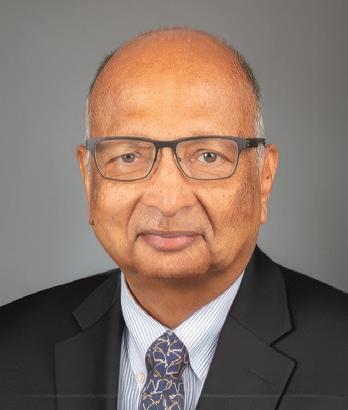
ABSTRACT: Antenna arrays are playing a crucial role in a wide range of applications, including communications, positioning, and sensing. This presentation will provide an overview of the significance of multi-element antennas in various applications, highlight their potential for adding value, and conclude by summarizing the numerous challenges they present for the RF and antenna design communities.
The presentation, with a systems perspective, is aimed at both academia and industry, and will also explore the growing significance of AI in antenna array applications.
SPEAKER BIO: Arogyaswami Paulraj is an Emeritus Professor (Research) in the Department of Electrical Engineering, where he served from 1993 to 2013. Paulraj is recognized for his invention, advancement, and commercialization of MIMO (Multiple Input, Multiple Output) wireless technology. MIMO is at the core of 4G/5G mobile and WiFi networks that power today’s ubiquitous internet access infrastructure. Paulraj has received several awards for MIMO, including the 2024 RAE (UK) Prince Philip Medal, the 2023 IET Faraday Medal, the 2014 Marconi Prize, the 2011 IEEE Alexander Graham Bell Medal, and the 2018 induction into the USPTO’s National Inventors Hall of Fame.
Prior to joining Stanford University, Paulraj served in the Indian Navy from 1965 until 1991. During his tenure, he led the development of the APSOH anti-submarine sonar and founded or co-founded three R&D labs for the Indian government. He received several awards from the Government of India, including the Padma Bhushan, the country’s third highest civilian honor.
Powering the Next Generation of RF Systems
KEYNOTE SPEAKER: Jin Bains, Chief Executive Officer, Mini-Circuits
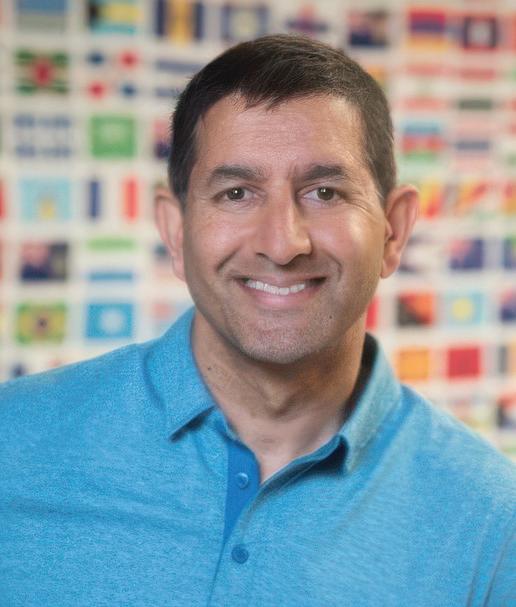
ABSTRACT: The history of the RF and microwave industry to date has tracked the advancement and proliferation of numerous communications and sensing technologies. While evolving standards in these domains continue to drive innovation in RF circuits and systems, future applications are likely to stem from new intersections of microwave theory and techniques with an even broader range of adjacent technologies.
In this keynote presentation, Mini-Circuits CEO, Jin Bains will examine how the evolution of established RF applications and the emergence of novel ones are driving the need for more advanced component and system design, measurement and manufacturing. The discussion will explore several recent examples of technologies setting new standards of performance in applications such as next-gen wireless systems, multi-orbit satellite communications, automotive, and quantum computing. Additional attention will be paid to the role of RF component and system design in addressing the growing importance of energy efficiency and sustainability.
SPEAKER BIO: Jin Bains is the Chief Executive Officer of Mini-Circuits, a global leader in design, manufacturing, and sale of RF, microwave & millimeter-wave components and subsystems. Bains is a 30-year RF and Microwave industry veteran who began his career as an RF engineer and R&D manager at Spectrian, Hewlett-Packard and Agilent Technologies, where he worked on a variety of systems including power amplifiers, cellular base stations, and test and measurement instrumentation. He went on to build the RF/Wireless division of National Instruments before serving as the Head of SoCal Connectivity for cellular and satellite programs at Facebook (now Meta), where he directed key aspects of the effort to expand access to affordable connectivity across the globe. Prior to joining Mini-Circuits, he served as a Director of Project Kuiper at Amazon, an initiative to increase global broadband access through a mega-constellation of satellites in low Earth orbit.
Jin has played an active role in the industry as a senior IEEE member and has presented numerous keynote talks and participated in many panels. He serves on the Board of Advisors of the University of California Davis Electrical and Computer Engineering (ECE) Department. Jin received an undergraduate degree in ECE from UC Davis and a graduate degree in Electrical Engineering and Communication Systems from Stanford University.
SAN FRANCISCO MUSEUM OF MODERN ART
IMS WELCOME RECEPTION 19:30 – 21:00 Monday, 16 June 2025
IM2025 starts with a welcome event on Monday for all attendees, which will be hosted San Francisco Museum of Modern Art (SFMOMA) following the IMS2025 Plenary Session and is just a short walk from the Moscone Center. With access to all five floors of this cultural landmark, you can enjoy works from iconic artists, such as Jackson Pollock, Andy Warhol, Diego Rivera, and Frida Kahlo. Highlights include the breathtaking Living Wall, a vertical garden of more than 4,400 square feet, and the open-air sculpture garden, offering a serene backdrop to stunning city views. Sponsored by:
INDUSTRY WORKSHOPS
SESSION CODE
TIME & LOCATION TITLE AND ABSTRACT
IWTU1
08:00 – 9:40 Room: 204
08:00 – 17:20 Tuesday, 17 June 2025
SPEAKER(S), AFFILIATION
IWTU2
08:00 – 9:40 Room: 206
Addressing Next Generation Intelligent Wireless Connectivity using Emerging Materials and Technology Solutions — The next generation of wireless connectivity network will incorporate increasing intelligence to efficiently and reliably address emerging applications like XR, teleporting, low latency links for and among automated vehicles. At the heart of this future intelligent network, there’ll be hardware based on novel technologies and materials that can enable high data throughput and energy-efficient sustainable connectivity. This workshop will highlight examples of some of the R&amp;D activities ongoing in the industry in terms of emerging materials and technologies covering 3 key aspects a) engineered substrate b) innovative RF technologies and c) wafer-scale packaging with heterogeneous integration.
Circular Polarization with mmWave Phased Array Antenna: Over-the-Air Testing and Performance Evaluation — Phased Array Antennas (PAAs) are crucial in satellite communications, where beamforming plays a vital role. Circular Polarization (CP) is widely used in satellite applications, requiring an axial ratio (AR) &lt;3 dB, wide frequency range, and scanning angle. This workshop will discuss efficient evaluation of CP performance using PAAs, including influential factors like phase and gain variations. The PAA under test will be the Fujikura FutureAccessTM Phased Array Antenna Module (PAAM) and we will report on the importance of accurate Over-The-Air (OTA) testing and demonstrate CP performance using Rohde &amp; Schwarz equipment.
Navneet Sharma, Samsung Reseach America; Cesar Roda Neve, Soitec; Randy Wolf, GLOBALFOUNDRIES; Siddhartha Sinha, IMEC; Arul Balasubramaniyan, GLOBALFOUNDRIES; Navneet Sharma, Samsung
Fabrício Dourado, Rohde & Schwarz GmbH & Co KG; LEI XU, Fujikura Ltd. IWTU3
10:10 – 11:50
Room: 204
System Budgeting to System Realization - A 14nm FinFET 48GHz FEM for Next-Generation 5G-6G Applications — This workshop explores recent developments in design, analysis, and implementation workflows driven by electromagnetic (EM)-thermal analysis, RF circuit-antenna co-simulation, and phased array synthesis addressing hardware-validated silicon-to-antenna co-design for emerging 5G applications at 48GHz, the n262 band. A link budget analysis of FEM in a system simulator determines block specifications catering to early package, PCB floorplanning, and thermal challenges. Co-design of FEM with packaged antenna is implemented on Samsung’s 14nm FinFeT process, including low-power LNAs and reliable p-FinFET PAs. The presented unified chip, package, PCB co-design methodology highlights importance of heterogeneously integrated workflows for first-pass silicon success at advanced mmWave.
David Vye, Cadence Design Systems, Inc.; Ritabrata Bhattacharya, Cadence Design Systems, Inc. IWTU4
10:10 – 11:50 Room: 206
13:30 – 15:10 Room: 204
3D Heterogeneous Integration (3DHI) Solutions for Design of Phased Array Systems — 3D Heterogeneous Integration (3DHI) promises to bring the ‘holy grail’ of technology advancements: best of breed ICs, dense packaging, and reconfigurable, vendor-agnostic ‘plug and play’ solutions. But how will you choose the right ICs, interposers, and packages, and how will you actually design these complex systems with commercial EDA tools? Participants will learn about the latest trends in heterogeneous integration, technologies specifically designed to address dense packaging of these components, and finally will walk through a demonstration of an EDA tool flow for analysis of electrical, EM, and thermal behavior of a complete 3DHI assembly for phased array applications.
Multi-chip Modules with 3D IC Implementations, Designing for the Next Wave of Innovation — IC geometries continue to shrink, but raising manufacturing cost and process limitations lead designers to consider innovative and unique packaging and die stacking configurations to satisfy growing system requirements. Join our workshop to see how stacked die, 2 1-2D, and 3D designs can be configured and integrated in Heterogeneous Integration or Multi-Chip Modules. See how simulation and analysis tools are used in an integrated fashion to tune and center the system under process corners and manufacturing tolerances with EM and Thermal analysis effects. All within a design flow with LVS and DRC capabilities leading to successful manufacturing.
Ed Horne, 3DGS; Ian Rippke, Keysight; Nathan Altaffer, Keysight;
IWTU7
15:40 – 17:20 Room: 204
15:40 – 17:20
Room: 206
A Practical Overview of Antenna Characterization and Simulation with an Eye on AI — Communications systems such as 5G, 6G, and Satcom as well as radar applications consistently rely on phased array systems. The growing complexity of the antenna array has a key impact on the system performance and overall cost. In this workshop, we cover best practices for accurate antenna characterization in the near and far field. Once the array is characterized, we will show how to use measurements to optimize and tune algorithms for calibration and correction in conjunction with beamforming architectures. We will demonstrate the use of AI techniques applied to antenna measurements to speed up the characterization and verification process.
Michael Thompson, Cadence Design Systems
Markus Loerner, Rohde & Schwarz; Remi Faggiani, Greenerwave; Vishwanath Iyer, MathWorks; Giorgia zucchelli, MathWorks;
Implementing an Open-Source 5G End-to-End Testbed Using OAI and USRP Radios — This workshop profiles the implementation, configuration, and operation of a comprehensive stand-alone open-source 5G end-to-end testbed to enable 5G research, development, and prototyping. The testbed provides a 5G SA FR1 and FR3 platform based on the OAI software stack and the USRP radio, for use both over-the-air (OTA) and with coax cable, and includes the all the primary system components: the core network; the basestation (gNB); and three implementations of the handset (UE). We will discuss in detail the full procedure for building this testbed and highlight several practical use-cases and explore troubleshooting steps. Neel Pandeya, National Instruments; Luis Pereira, Allbesmart; Irfan Ghauri, EURECOM; Amr Haj-Omar, National Instruments ;
STUDENT DESIGN COMPETITIONS
09:30 – 17:00 Tuesday, 17 June 2025
All attendees are invited to the annual IMS Student Design Competitions on Tuesday, 17 June 2025. Students have been busy over the past several months designing and building solutions to the challenging engineering problems presented in the nine student design competitions listed below. Judges will measure the students’ designs at this event to determine the winners of the various competitions. Come to this event to cheer on the students, celebrate their hard work, and learn about their innovative designs!
SESSION CODE TOPIC
SDC1 Allen Katz High Efficiency Power Amplifier
SDC2 Miniaturized Magnetoceramic Composite Antenna
SDC3 Switched Acoustic Filter Module
SDC4 Radar Tracking Challenge: Amplifying Rocket RCS with Retro-Reflective Systems
SDC5 PCB Based Filter
SDC6 Wide Passband Bandstop Filter
SDC7 mmWave Multi-Beam 3D-printed Antenna Design
SDC8 High-Efficiency Power Amplifier for 144 MHz
SDC9 Power Amplifier Linearization through Digital Predistortion (DPD)
VISIT THE SOCIETIES PAVILION
Learn how you can take advantage of all the great things the IEEE Microwave Theory and Technology Society (MTT-S) has to offer and meet other IEEE societies, organizations and partners.
Booth 4201




Wolfspeed and Microwave Journal invite attendees to Booth 1700 for a complimentary headshot photo
Get your complimentary professional headshot taken in the Societies Pavilion (Booth 4201) Tuesday, 17 June 2025: 09:30 – 12:30 & 13:30 – 17:00 Wednesday, 18 June 2025: 09:30 – 13:00 & 14:00 – 18:00 Thursday, 19 June 2025 09:30 – 12:30 & 13:00 – 15:00
RFIC TECHNICAL SESSIONS
203
RTu1A: mm-Wave Power Amplifiers and Transmitters
Chair: Song Hu, Apple
Co-Chair: Hyun-Chul Park, Samsung Electronics
205
RTu1B: High-Performance RF Oscillators
Chair: Hanli Liu, Zhejiang University
Co-Chair: Teerachot Siriburanon, University College Dublin
RTu1A-1: A 10 to 40GHz Stacked Push-Pull Class-B Power Amplifier in 45-nm CMOS SOI with 20.4dBm PSAT and Continuously Supporting 72Gb/s 64-QAM and 10Gb/s 1024-QAM Signals
S. Hassanzadehyamchi, Univ. of California, Davis; H. Bameri, Univ. of California, Davis; A.M. Niknejad, Univ. of California, Berkeley; O. Momeni, Univ. of California, Davis
RTu1A-2: A Wideband Dual-Mode Power Amplifier with Slotline-Based Series-Parallel Combiner in 28-nm Bulk CMOS Technology
G. Park, Korea Univ.; S. Jeon, Korea Univ.
RTu1A-3: A K-Band Process-Corner Robust Balanced Power Amplifier Utilizing Current-Mode Adaptive Biasing Network in 65-nm CMOS
J. Zhao, Tsinghua Univ.; H. Jia, Tsinghua Univ.; Q. Peng, Tsinghua Univ.; W. Deng, Tsinghua Univ.; Z. Gao, Tsinghua Univ.; X. Duo, Tsinghua Univ.; Z. Wang, Tsinghua Univ.; B. Chi, Tsinghua Univ.
RTu1A-4: A D-Band Guanella Transformer Based Stacked Doherty Power Amplifier with Adaptive Bias Network in 250-nm InP DHBT
S. Gielen, IMEC; B. Gungor, KU Leuven; Y. Zhang, IMEC; M. Ingels, IMEC; P. Reynaert, KU Leuven
RTu1B-1: An Inverse Class-F VCO with Reduced Third Harmonic Detriment Using a High Fundamental and Second Harmonic Q-Factor Resonator Achieving a 198.9dBc/Hz Peak FoM
Y. Wu, University of Macau; Y. Peng, University of Macau; F. Yuan, University of Macau; J. Li, University of Macau; J. Yin, University of Macau; R.P. Martins, University of Macau; P.I. Mak, University of Macau
RTu1B-2: A 4.21-to-15.18GHz Pure MagneticCoupling and Fully Symmetrical Quad-Core Quad-Mode VCO Achieving 220.5dBc/Hz FoMTA@10MHz
S. Huang, SCUT; P. Qin, SCUT; H. Zhu, SCUT; X. Yi, SCUT; W. Feng, SCUT; W. Che, SCUT; Q. Xue, SCUT
X. Kong, GDUT; K. Xu, King’s College London; H. Lian, GDUT; F. Dai, GDUT; C. Guo, GDUT TUESDAY
RTu1A-5: A 23.6–30.0GHz Phased-Array Transmitter with Wide-Angle-Scanning Load-Compensation Technique Achieving OTA-Tested 2.9dB Array-Gain Enhancement and 1.2dB EVM Improvement
M. Geng, UESTC; Y. Yu, UESTC; B. Sun, UESTC; R. Wang, UESTC; H. Liu, UESTC; Y. Wu, UESTC; C. Zhao, UESTC; K. Kang, UESTC
RTu1B-3: 7.8-to-10.7GHz Reliable-Mode-Switching Series Resonance Oscillator with Bidirectional Inductive-Mode-Pulling Achieving -156.5dBc/Hz Phase Noise and 199.2dBc/Hz FoMT at 10MHz Offset in 40-nm CMOS
Q. Leng, UESTC; Y. Shu, UESTC; Y. Wang, UESTC; X. Luo, UESTC
RTu1B-4: A Compact VCO Using Coupling-Canceling Common-Mode Resonance Expansion Achieving 120–155kHz 1/f³ Corner and 0.27dB FoM Variation Without Harmonic Tuning
RTu1C: Pushing RFIC Boundaries with Out-of-the-Box Innovation
Chair: Aly Ismail, Apple
Co-Chair: Jin Zhou, MediaTek
RTu1B-5: A Multi-Tap-Transformer Based Quad-Core Dual-Mode VCO Achieving 213.1dBc/Hz FoMTA@100kHz and Wideband 1/f³ Noise Suppression
Y. Li, SCUT; P. Qin, SCUT; H. Zhu, SCUT; X. Yi, SCUT; W. Feng, SCUT; W. Che, SCUT; Q. Xue, SCUT
RTu1C-1: An Ultra Low Power Analog/Mixed-Signal Processor for a Smart RF Signal Classification System in the ISM Band
N. Pekcokguler, Analog Devices; C. Dehollain, EPFL; A. Burg, EPFL; P. Courouve, CEA-LETI; D. Morche, CEA-LETI
RTu1C-2: Enabling Fast Steering of Arbitrary Beams with Phased Arrays
A. Paidimarri, IBM; B. Sadhu, IBM; M. Yeck, IBM; A. Valdes-Garcia, IBM
RTu1C-3: An 8-Lane 58Gb/s/Lane 0.66pJ/bit Modulator Driver Electrical-IC for a 3-D Integrated Silicon Photonic Transmitter in 22nm FD-SOI Process
L. Szilagyi, GLOBALFOUNDRIES; B.J. Pawlak, GLOBALFOUNDRIES; L. Pauwels, IMEC; P. Bex, IMEC; C. Marchese, IMEC; G. Lepage, IMEC; Y. Ban, IMEC; D. Velenis, IMEC; N. Argyris, NVIDIA; D. Kalavrouziotis, NVIDIA; K. Tokas, NVIDIA; P. Bakopoulos, NVIDIA
RTu1C-4: A 6.5 to 9GHz IEEE 802.15.4/4z Compatible IR-UWB SoC Capable of Handling -22dBm WiFi-5 or -24 to -17dBm LTE Blocker Levels
B. Vakili-Amini, M. Vignasse, S. Enam, A. Sarkar, J. Dalwadi, J. Velandia, M. Bagheri, S. Darfeuille, Y.-W. Chen, M. Apostolidou, J. van Sinderen, H. Jensen, NXP Semiconductors; NXP Semiconductors
RTu1C-5: Fully-Integrated Autonomous K-Band Complex Permittivity Sensor in 22nm FDSOI for Biomedical Body Parameter Monitoring Applications
A. Dossanov, Technische Univ. Braunschweig; M. Weißbrich, Technische Univ. Braunschweig; A. Meyer, Technische Univ. Braunschweig; L. Bakh chova, Technische Univ. Braunschweig; F.-N. Stapelfeldt, Technische Univ. Braunschweig; G. Payá-Vayá, Technische Univ. Braunschweig; V. Issakov, Technische Univ. Braunschweig 207
RFIC TECHNICAL SESSIONS 10:10
203
RTu2A: Design Techniques for High Performance SiGe PAs
Chair: Tolga Dinc, Texas Instruments Co-Chair: Shintaro Shinjo, Mitsubishi Electric
205
RTu2B: mm-Wave and Sub-THz Radar SoCs and Sensing Techniques
Chair: Yahya Tousi, University of Minnesota
Co-Chair: Oren Eliezer, Samsung
RTu2A-1: Topology-Optimized Nonintuitive Multilayered mm-Wave Power Amplifiers
V. Chenna, Univ. of Southern California; H. Hashemi, Univ. of Southern California
RTu2A-2: 31.7 and 36.7dBm Ka-Band SiGe BiCMOS Power Amplifiers Using Resonated Amplifier Cores and Optimized Power Combining
A. Haag, milli IC; A.Ç. Ulusoy, KIT
RTu2A-3: A SiGe Common-Collector-Common-Base Linear Power Amplifier with 17–28-GHz P1dB 3-dB Bandwidth and Enhanced Large-Signal Stability
T.-C. Tsai, KIT; A.Ç. Ulusoy, KIT
RTu2A-4: A Linear Q-Band Balanced Power Amplifier in a 130nm SiGe BiCMOS Technology Using Two-Tone Load-Pull Optimization
A. Haag, milli IC; A.Ç. Ulusoy, KIT
RTu2A-5: A 5/6GHz Compact, Dual-Band, and Highly Linear Wi-Fi 6E SiGe HBT Power Amplifier Using Q-Modulated Switched Capacitor Interstage Matching Network and Optimized Output Stage
Y. Kang, Ajou Univ.; H. Lee, Ajou Univ.; I. Ju, Ajou Univ.
RTu2B-1: A 4.6mW 232GHz Autodyne Complementary Self-Injection-Locked Radar for Micrometer-Level Displacement Sensing and Imaging
S. Thomas, Univ. of California, Los Angeles; W. Sun, Univ. of California, Los Angeles; A. Babakhani, Univ. of California, Los Angeles
RTu2B-2: 400-GHz Concurrent Transceiver Imaging Pixel with Improved Noise Performance and Increased Injection Locking Range
G. Murugesan, M. Awais, S. Shariff, Y. Zhu, P.R. Byreddy, F. Zhang, Univ. of Texas at Dallas; W. Choi, Seoul National Univ.; K.K. O, Univ. of Texas at Dallas
RTu2B-4: A 140GHz FMCW Radar with 22dB Wideband RF-Domain Multipath Self-Interference Cancellation in 28nm CMOS
Y. Chen, Univ. of California, Berkeley; H. Beshary, Univ. of California, Berkeley; E. Chou, Univ. of California, Berkeley; M. Wei, Univ. of California, Berkeley; N. Baniasadi, Univ. of California, Berkeley; A.M. Niknejad, Univ. of California, Berkeley
RTu2B-5: An E-Band Phase-Modulated Bistatic Radar with 10mW/Channel Fast-Time Baseband Processing
W. Zhou, Univ. of Minnesota; Y. Tousi, Univ. of Minnesota
207
RTu2C: Heterogeneous Integration for RF/ mm-Wave Applications and Measurement Techniques
Chair: Duane Howard, Astranis Space Technologies
Co-Chair: Florian Voineau, STMicroelectronics
RTu2C-1: A 3D Heterogeneously Integrated Power Amplifier Module Using BiCMOS and RF SOI CMOS Technologies for 5G Applications
A. Le Ravallec, STMicroelectronics; S. Sadlo, STMicroelectronics; D. Gaidioz, STMicroelectronics; C. Arricastres, STMicroelectronics; R. Coffy, STMicroelectronics; F. Paillardet, STMicroelectronics; O. Noblanc, STMicroelectronics
RTu2C-2: Heterogeneous Integration of a 0.15µm GaN Circulator and a 45nm RF SOI Voltage-Boosted Clock Generation IC
N. Patil, Columbia Univ.; A. Dascurcu, Columbia Univ.; N. Jahan, Columbia Univ.; H. Krishnaswamy, Columbia Univ.
RTu2C-3: Heterogeneously-Integrated Amplifier-onGlass with Embedded Gallium Nitride (GaN) Dielet for mmWave Applications
X. Li, Georgia Tech; P. Yadav, MIT; T. Palacios, MIT; M. Swaminathan, Georgia Tech
RTu2C-4: 3D-Millimeter Wave Integrated Circuit (3D-mmWIC): A Gold-Free 3D-Integration Platform for Scaled RF GaN-on-Si Dielets with Intel 16 Si CMOS
P. Yadav, MIT; J. Wang, MIT; D.A. Baig, Georgia Tech; J. Pastrana-Gonzalez, AFRL; J. Niroula, MIT; P. Darmawi-Isakandar, MIT; U.L. Rohde, Universität der Bundeswehr München; A. Islam, AFRL; M. Bakir, Georgia Tech; R. Han, MIT; T. Palacios, MIT
RTu2C-5: Determination of the Thermal Noise Parameters of FD-SOI MOSFET Through Hybrid Noise Matrix
B. Dormieu, STMicroelectronics; J. Azevedo Gonçalves, STMicroelectronics; C. Belem Gonçalves, STMicroelectronics; P. Scheer, STMicroelectronics; F. Paolini, STMicroelectronics; G. Gouget,
IMS TECHNICAL SESSIONS
201
Tu1A: Integrated Millimeter-Wave Radar Systems
Chair: Jacquelyn Vitaz, Raytheon Technologies
Co-Chair: Suresh Venkatesh, North Carolina State University
Tu1A-1: A Fully Integrated Ka-Band FMCW Radar SoC with Baseband Accelerator for Vital Signs Monitoring in 40-nm CMOS
P. Diao, Southeast Univ.; C. Xu, Southeast Univ.; N. Jiang, Southeast Univ.; X. Liao, Southeast Univ.; B. Wang, Purple Mountain Laboratories; P. Zhang, Southeast Univ.; N. Zhang, Purple Mountain Laboratories; Y. Li, Purple Mountain Laboratories; Q. Wu, Southeast Univ.; D. Zhao, Southeast Univ.
Tu1A-2: A D-Band 1Tx 4Rx Mid-Range Automotive CMOS FMCW Radar
S.-W. Kang, Sungkyunkwan Univ.; D.-Y. Yang, Sungkyunkwan Univ.; J.-B. Yoon, Sungkyunkwan Univ.; J.-H. Park, Sungkyunkwan Univ.; Y.-J. Han, Sungkyunkwan Univ.; S. Kim, Sungkyunkwan Univ.; R. Song, Sungkyunkwan Univ.; K.-I. Lee, Hyundai Motor Group; B.-S. Kim, Sungkyunkwan Univ.
Tu1A-3: An 120GHz 8×8 FMCW MIMO Radar System With 90° Biaxial FOV for Autonomous Navigation of UAVs in 3-D Space
T. Welling, Ruhr-Universität Bochum; D. Starke, Fraunhofer IMS; C. Bredendiek, Fraunhofer FHR; V. Palazzi, Università di Perugia; T.T. Braun, Ruhr-Universität Bochum; N. Pohl, Ruhr-Universität Bochum
Tu1A-4: A 94GHz 8Tx-16Rx Direct Center-Fed Active Array TD-MIMO FMCW Radar in 28-nm CMOS
D.-Y. Yang, Sungkyunkwan Univ.; S.-W. Kang, Sungkyunkwan Univ.; J.-H. Park, Sungkyunkwan Univ.; J.-B. Yoon, Sungkyunkwan Univ.; S.-Y. Kim, Sungkyunkwan Univ.; J.-W. Lee, Sungkyunkwan Univ.; H.-H. Choi, Sungkyunkwan Univ.; B.-S. Kim, Sungkyunkwan Univ.
Tu1A-5: Radar-Based Measurement of Image Rejection Ratio in Sub-THz Hartley Receivers with its Impact on Doppler Detection Accuracy
C. Tripathy, National Sun Yat-sen Univ.; H.-E. Wang, National Sun Yat-sen Univ.; Y.-T. Li, National Sun Yat-sen Univ.; T.-S. Horng, National Sun Yat-sen Univ.; W.-C. Su, National Sun Yat-sen Univ.
208
Tu1B: Innovative High-Speed Communication Links
Chair: Shreyas Sen, Purdue University
Co-Chair: Edward Niehenke, Niehenke Consulting
Tu1B-1: Double HOOK: A 140 GHz 15 Gb/s Reconfigurable 3-Level ASK Modulator with Constant Input Impedance for High-Speed Connectivity
H. Li, Northeastern University ; K. Richard, Keysight Technologies; D. Bodet, Northeastern University ; N. Ebrahimi, Northeastern University
Tu1C: Microwave Photonics Radars, Signal Generators, Radio-Over-Fiber Transmitters, and Integrated Circuits
Chair: Siva Yegnanarayanan, MIT Lincoln Laboratory
Co-Chair: Jonathan Comeau, BAE Systems
Tu1C-1: Field Trial of a Coastal Surveillance System Exploiting a Multistatic Multiband Photonics-Based Radar in Coherent Sparse MIMO Configuration
M. Scaffardi, CNIT; F. Scotti, CNIT; A. Malacarne, CNIT; M.M.H. Amir, Scuola Superiore Sant’Anna; S. Maresca, CNR-IEIIT; P. Ghelfi, CNIT; A. Bogoni, CNIT
Tu1D: High-Power and High-Frequency Doherty Power Amplifiers
Chair: Gayle Collins, Obsidian Microwave
Co-Chair: Yulong Zhao, Skyworks
Tu1B-2: A V-Band OOK Transmitter with 14.5Gbps Data Rate and 11.1% DC-toRF Efficiency in 65nm CMOS
Y. Wu, SCUT; J. Liu, SCUT; G. Feng, SCUT; Z. Yang, SCUT; R. Liu, SCUT; S. Li, SCUT; C. Hu, CAS; X. Zhang, SCUT
Tu1B-3: A Receiver-Assisted Joint Linearization Scheme for U6G Uplink Coverage Enhancement
Q. Ma, UESTC; Y. Xiong, UESTC; M. Zhang, UESTC; X. Wei, UESTC; Y. Liu, UESTC
Tu1C-2: Ultra-Low Phase Noise Frequency Synthesis Using ElectroOptic Detector-Based Comb-Microwave Synchronization
V. Surendranath-Shroff, Universität Paderborn; M. Bahmanian, Universität Paderborn; J.C. Scheytt, Universität Paderborn
Tu1D-1: Load Modulated Power Amplifiers for Wireless Infrastructure
R. Hou, Ericsson
Tu1B-4: Hardware-Software Platform Enabling Joint Communication and Radar Sensing at 25GHz with 1GHz Bandwidth
S. George, Barkhausen Institut; P. Sen, Barkhausen Institut; M. Ramzan, Barkhausen Institut; M. Umar, Barkhausen Institut; Y. Richhariya, Barkhausen Institut; J. Adler, Barkhausen Institut; C. Carta, IHP
Tu1C-3: Multi-Channel Integrated Microwave Photonic Transmitter for Radio-over-Fiber Systems
V. Gemmato, Scuola Superiore Sant’Anna; F. Scotti, CNIT; L. Rinaldi, CNIT; P. Ghelfi, CNIT; A. Bogoni, Scuola Superiore Sant’Anna
Tu1D-2: A 7GHz High Efficiency GaN Doherty Power Amplifier Module for 5G Massive MIMO Base-Stations
S. Sakata, Mitsubishi Electric; K. Saiki, Mitsubishi Electric; Y. Fuchibe, Mitsubishi Electric; K. Kato, Mitsubishi Electric; H. Kurusu, Mitsubishi Electric; Y. Sasaki, Mitsubishi Electric; S. Shinjo, Mitsubishi Electric
Tu1D-3: A 90W High-Efficiency FourWay Doherty Power Amplifier with 37.8% Fractional Bandwidth Over a 15dB Power Back-Off Range
L. Zhou, Technische Universiteit Delft; L. Liu, Technische Universiteit Delft; M. Pelk, Technische Universiteit Delft; A.R. Qureshi, Technische Universiteit Delft; L.C.N. de Vreede, Technische Universiteit Delft
Tu1C-4: A 22nm CMOS 15–25GHz Dual-Differential Driver for RF Silicon Photonic Front-End
Y.-L. Luo, Texas A&M Univ.; D. Paladugu, Texas A&M Univ.; C. Madsen, Texas A&M Univ.; K. Entesari, Texas A&M Univ.; S. Palermo, Texas A&M Univ.
Tu1C-5: Programmable Microwave Photonic Processor in the Thin-Film Lithium Niobate Platform
C. Wei, Universiteit Twente; K. Ye, Universiteit Twente; D. Marpaung, Universiteit Twente
Tu1D-4: A 400W Symmetric Doherty Power Amplifier Covering 1.8–2.7GHz
P. Saad, Ericsson; M. Helgöstam, Ericsson; R. Hou, Ericsson
IMS TECHNICAL SESSIONS
Field, Device & Circuit
215
Tu1E: Quantum Computing Technologies
Chair: Joseph C. Bardin, Google
Co-Chair: Abbas Omar, OvG Universität Magdeburg
Tu1E-1: A Cryogenic Front-End Module Applied to Readout Two-Qubits with FDM Technology in Superconducting Quantum Computing System
C.-H. Li, ITRI; C.-N. Kuo, NYCU; C.-S. Chen, ITRI; S.-S. Sheu, ITRI; C.-D. Chen, Academia Sinica; P.-Y. Hsu, ITRI; L.-C. Hsiao, Academia Sinica; L.-W. Chang, Academia Sinica
Tu1E-2: Modeling Josephson TravelingWave Parametric Amplifiers with Electromagnetic and Circuit CoSimulation
L. Yang, Keysight Technologies; J. Wang, MIT; M.A. Hassan, Keysight Technologies; P. Krantz, Keysight Technologies; K.P. O’Brien, MIT
216
Tu1F: Transformative Innovations in Wireless Power Transfer for Smart Cities and Biomedical Applications
Chair: Ifana Mahbub, University of Texas at Dallas
Co-Chair: Dieff Vital, University of Illinois at Chicago
Tu1F-1: Transforming 5G Wireless Power Harvesting: A Broadbeam Equiconvex Lens-Integrated mmWave Harvester for Smart City Environments
M. Joshi, Georgia Tech; K. Hu, Georgia Tech; C. Lynch, Georgia Tech; M. Tentzeris, Georgia Tech
Tu1E-3: A Cryogenic Push-Pull Class-C Dual-Mode VCO with 72%-Tuning Range for Quantum Applications
T.-S. Yang, National Taiwan Univ.; Y.-C. Chou, National Taiwan Univ.; L.-H. Lu, National Taiwan Univ.
Tu1F-2: Time-Multiplexed BeamSteering Antenna Arrays for Programmable-Coverage RF Powering of mm-Scale CMOS Brain Implants
M. Abdolrazzaghi, Univ. of Toronto; R. Genov, Univ. of Toronto; G. Eleftheriades, Univ. of Toronto
Tu1F-3: A Highly Efficient Design of Triple-Band Flexible Rectenna for Ambient RF Energy Harvesting in Passive IoT Applications
D. Chang, BUPT; J. Zhang, BUPT
Tu1E-4: A Photonic Link at 4.7K with >1GHz Bandwidth Towards an Optical Quantum Computing Interface
S. Mutum, Forschungszentrum Jülich; P. Vliex, Forschungszentrum Jülich; J. Bühler, Forschungszentrum Jülich; D. Nielinger, Forschungszentrum Jülich; M. Schlösser, Forschungszentrum Jülich; S. van Waasen, Forschungszentrum Jülich
Tu1E-5: A Demonstration of MultiFloating Superconducting Qubits on a 3D Flip-Chip Platform with TLS Loss Mitigation via Apertures
Z. Luo, Technische Univ. München; T. Mayer, Fraunhofer EMFT; D. Zahn, Fraunhofer EMFT; C. Moran Guizan, Fraunhofer EMFT; J. Weber, Fraunhofer EMFT; S. Lang, Fraunhofer EMFT; H. Bender, Fraunhofer EMFT; L. Schwarzenbach, Fraunhofer EMFT; L. Nebrich, Fraunhofer EMFT; R. Pereira, Fraunhofer EMFT; A. Hagelauer, Technische Univ. München
Tu1F-4: Power Receiving Circuit Design of Single-Ended Biological Capacitive WPT for Artificial Retina System
K. Makabe, Toyohashi University of Technology; R. Aoyama, Toyohashi University of Technology; Y. Naka, Toyohashi University of Technology; M. Tamura, Toyohashi University of Technology
Tu1F-5: Overcoming Efficiency Degradation in Wireless Power Transfer Systems: A Supply Voltage Modulation Method Empowered by 5.64-GHz 256-Element Antenna Array Receiving 10.6-Watt
T. Yoon, Seoul National Univ.; Y.-S. Lee, Seoul National Univ.; M. Kim, Seoul National Univ.; S. Lee, Seoul National Univ.; J. Lee, SAIT; S. Nam, Seoul National Univ.; J. Oh, Seoul National Univ.
JOIN US FOR
Treat Tuesday AT 12:30!
Enjoy a “Sweet Treat” in the company of attendees, exhibitors, and colleagues on the IMS Exhibit Floor.

Sponsored By:
IMS TECHNICAL SESSIONS
201
Tu2A: Advanced System Concepts and Signal Processing for Radar and Imaging
Chair: Nils Pohl, Ruhr-Universität Bochum
Co-Chair: Fabian Lurz, OvG Universität Magdeburg
Tu2A-1: Frequency-Spatial Adaptive Digital Beamforming Technique for Range-Angle Decoupling With HighResolution MIMO Radar
J. Zhang, SJTU; Y. Li, SJTU; Z. Zhang, SJTU; C. Gu, SJTU; J. Mao, SJTU
10:10 – 11:50 Tuesday, 17 June 2025
208
Tu2B: MHz-to-THz Systems for Communication and Sensing
Chair: Dieff Vital, University of Illinois at Chicago
Co-Chair: Rashaunda Henderson, University of Texas at Dallas
Tu2B-1: Interaction of EM-Fields with Human Body for Efficient Communication: Body as a Wire and Body as a Transmission-Line
S. Sen, Ixana
Tu2A-2: High-Resolution 3D Radar Imaging with Silicon-Micromachined Sub-THz Frequency-Diverse Antennas
M.R. Seidi, KTH; J. Oberhammer, KTH
Tu2A-3: Clutter-Based Wireless Localization in Distributed Radar Networks with Repeaters
S. Sharma, Univ. of South Florida; T. Nusrat, Univ. of South Florida; S. Vakalis, Univ. of South Florida
Tu2B-2: 60 Mbps Time-Domain Video Transfer Using Body Communication
G. Barik, Purdue Univ.; S. Sarkar, Purdue Univ.; S. Sen, Purdue Univ.
Tu2C: THz Photonics: Components and Systems
Chair: Mona Jarrahi, University of California, Los Angeles
Co-Chair: Steven M. Bowers, University of Virginia
Tu2C-1: Monolithically Integrated Optoelectronic Terahertz Sources and Detectors on Quantum Well PIN Substrates
Y. Zhao, Univ. of California, Los Angeles; S-E- Zumrat, Univ. of California, Los Angeles; M. Jarrahi, Univ. of California, Los Angeles
Tu2D: High-Power GaN Transmit Components
Chair: Charles F. Campbell, Qorvo
Co-Chair: Anna Piacibello, Politecnico di Torino
Tu2D-1: RF-Input Doherty-Like LoadModulated Balanced Amplifier with Decade Bandwidth Enabled by Novel Broadband 180-Degree Power Divider
P. Gong, Univ. of Central Florida; N.B. Vangipurapu, Univ. of Central Florida; J. Guo, Univ. of Central Florida; K. Chen, Univ. of Central Florida
Tu2A-4: Joint 4D Radar and Communication System Enabled by Virtual Transceiver Matrix Architecture for Advanced Automotive Sensing and Connectivity
S.A. Keivaan, Polytechnique Montréal; P. Burasa, Polytechnique Montréal; K. Wu, Polytechnique Montréal
Tu2B-3: Body-Resonance Human Body Powering
S. Sarkar, Purdue Univ.; L. Ding, Purdue Univ.; S. Sen, Purdue Univ.
Tu2C-2: On-Chip Photonic THz Emitter with Integrated InGaAs UTC-PD and 2×2 MPA Array on SiC Substrate
M. Che, Kyushu Univ.; Y. Kamiura, Kyushu Univ.; R. Doi, Kyushu Univ.; K. Kato, Kyushu Univ.
Tu2B-4: Enhanced Channel Capacity Underwater Multi-Diver Communication with Dual-Resonant Magnetoquasistatic Coupling
S. Shaw, Purdue Univ.; D. Yang, Purdue Univ.; G. Barik, Purdue Univ.; S. Sen, Purdue Univ.
Tu2C-3: An Ultra-Low-Noise 600–700GHz Heterodyne Terahertz Receiver for Ground-Based Astronomy Observations
J.J. Hwang, Univ. of California, Los Angeles; S.-A. Tsao, Univ. of California, Los Angeles; M. Jarrahi, Univ. of California, Los Angeles
Tu2D-2: An Integrated Doherty Power Amplifier Module Based on an Advanced GaN-on-Si HEMT Technology and a Wideband Power Combiner
M. Iqbal, Infineon Technologies; I. Peppas, Technische Universität Graz; M. Pitton, Infineon Technologies; P. Singerl, Infineon Technologies
Tu2A-5: Three-Dimensional Fourier Domain Millimeter-Wave Imaging Using Incoherent Active Illumination and Pulse Compression
J.R. Colon-Berrios, Michigan State Univ.; J.M. Merlo, Michigan State Univ.; J.A. Nanzer, Michigan State Univ.
Tu2A-6: Repeater-Aided MillimeterWave MIMO Radar for Improved Detection of Specular Targets
T. Nusrat, Univ. of South Florida; S. Vakalis, Univ. of South Florida
Tu2B-5: Intelligent Smoke Detection: State Recognition and Monitoring of Heating Processes Using FMCW Radar and Data-Driven Algorithms
F. Schenkel, Ruhr-Universität Bochum; R. Schmitz, Ruhr-Universität Bochum; C. Baer, Ruhr-Universität Bochum; J. Barowski, Ruhr-Universität Bochum; I. Rolfes, Ruhr-Universität Bochum; C. Schulz, Ruhr-Universität Bochum
Tu2C-4: High Sensitivity W-Band LEKIDBased On-Chip Polarimeter
M.C. de Ory, V. Rollano, Centro de Astrobiología; M. Calvo, Institut Néel (UPR 2940); D. Rodriguez, A.P. Laguna, Centro de Astrobiología; U. Chowdhury, F. Levy-Bertrand, Institut Néel (UPR 2940); M.T. Magaz, Centro de Astrobiología; B. Aja, L.M. de la Fuente, Universidad de Cantabria; D. Granados, IMDEA Nanociencia; J. Martin-Pintado, Centro de Astrobiología; A. Monfardini, Institut
Tu2C-5: 100-Gbps Fiber-Terahertz System in 330-GHz Band Using Stable Transmitter and Simple PhotonicsEnabled Receiver
Pham Tien Dat, NICT; Y. Yamaguchi, NICT; K. Inagaki, NICT; N. Yamamoto, NICT; N. Sekine, NICT; K. Akahane, NICT
Tu2D-3: System-in-Package Doherty Power Amplifier Using Hybrid LDMOS/ GaN Line-Up for 5G Macro Driver Applications
A. Courty, Ampleon; K. Houssein, Ampleon; W. Rili, Ampleon; C. Quindroit, Ampleon; M. Ercoli, Ampleon; S. Maroldt, Ampleon
Tu2D-4: 10 Watt CW Power Handling SPDT RF Switch Using E-Mode p-GaN Dual-Gate HEMT Technology
H.-C. Chiu, Chang Gung Univ.; C.-H. Lin, Chang Gung Univ.; C.-H. Yu, Chang Gung Univ.; C.-R. Huang, Chang Gung Univ.; H.-L. Kao, Chang Gung Univ.; H.-C. Wang, ITRI; P.-T. Tu, ITRI; B. Lin, Wavetek Microelectronics
Denotes Keynote Presentation
IMS TECHNICAL SESSIONS
Field, Device & Circuit
215
Tu2E: AI for Device, DPD and RF System Design
Chair: Arnaldo S.R. Oliveira, Universidade de Aveiro
Co-Chair: Sensen Li, University of Texas at Austin
Tu2E-1: An Embedded-Structured Convolutional Neural Network for Efficient RF Device Behavior Model Extraction
J. Wang, Hangzhou Dianzi University; J. Su, Hangzhou Dianzi University; H. Li, Hangzhou Dianzi University; T. Fu, Hangzhou Dianzi University; Y. Tong, Hangzhou Dianzi University; K. Xu, Hangzhou Dianzi University; W. Li, Hangzhou Dianzi University
Tu2E-2: DeltaDPD: Exploiting Dynamic Temporal Sparsity in Recurrent Neural Networks for Energy-Efficient Wideband Digital Predistortion
Y. Wu, Technische Universiteit Delft; Y. Zhu, Ampleon; K. Qian, Technische Universiteit Delft; Q. Chen, Universiteit Leiden; A. Zhu, Univ. College Dublin; R. Gajadharsing, Ampleon; L. de Vreede, Technische Universiteit Delft; C. Gao, Technische Universiteit Delft
Tu2E-3: Enhancing Digital Predistortion Performance Under Load Mismatch Using a VSWR Generative Neural Network Simulator
E. Loebl, Technion; N. Ginzberg, Tel Aviv University; E. Cohen, Technion
10:10 – 11:50 Tuesday, 17 June 2025
216
Tu2F: Advances in RF Rectification and Efficiency Optimization for Wireless Power Transfer Applications
Chair: Jasmin Grosinger, Technische Universität Graz
Co-Chair: Nuno Carvalho, Universidade de Aveiro
Tu2F-1: A Differential Rectifier Design Based on Impedance Splitting and Compression Technique for Achieving > 70% ηRF-DC Over 13dBm Input Dynamic Power Range
R. Mahin, Univ. of Texas at Dallas; I. Mahbub, Univ. of Texas at Dallas
IMS STUDENT PAPER COMPETITION
Th1C-4 | Twisted-Shaped Millimeter-Wave Hybrid Couplers in 150 nm GaN Technology for 5G Applications
Author: Sujeevan Vigneswaran, University of Bordeaux
Advisor: Eric Kerhervé, University of Bordeaux
We3C-3 | A DC-51.5 GHz Digital Step Attenuator with Sub-5 dB Insertion Loss and 3.1° RMS Phase Error
Author: Ziang Zhang, Southeast University
Advisor: Lianming Li, Southeast University
Th2C-2 | A Miniaturized Marchand Balun-Based BroadbandVector Sum Phase Shifter with 0.49 RMS Phase Error
Author: Sungwon Kwon, Yonsei University
Advisor: Byung-Wook Min, Yonsei University
Tu2F-2: High-Power Quasi-Vertical GaN Schottky Barrier Diode RF Rectifier Based on Impedance Compression Network for WPT Applications
X. Yu, University of Liverpool; Y.-X. Lin, University of Liverpool; J. Zhou, University of Liverpool; T.-J. Yen, National Tsing Hua Univ.; I.Z. Mitrovic, University of Liverpool; Y. Huang, University of Liverpool; Y. He, Shenzhen Univ.; C. Song, Shenzhen Univ.
Tu2F-3: 1.9GHz–4.1GHz CMOS Rectifier with Over 48% Efficiency Using Inductive Feedback and CRT Reduction for Beamforming WPT
B. Gyawali, Kyushu Univ.; W. Jordan, Kyushu Univ.; R.K. Pokharel, Binghamton Univ.; A. Barakat, Kyushu Univ.
Tu2D-1 | RF-Input Doherty-Like Load-Modulated Balanced Amplifier with Decade Bandwidth Enabled by Novel Broadband 180-Degree Power Divider
Author: Pingzhu Gong, University of Central Florida
Advisor: Kenle Chen, University of Central Florida
Th1G-1 | Broadband and Power-Efficient Optoelectronic Transmitter Monolithically Integrated in a SiGe BiCMOS ePIC Technology
Author: Festim Iseini, IHP Microelectronics
Advisor: Gerhard Kahmen, IHP Microelectronics
Tu4B-2 | A 2:1 Bandwidth 3-6 GHz Dual-Polarized True-Time-Delay Based Reconfigurable Intelligent Surface (RIS)
Author: Jurui Qi, University of California, San Diego
Advisor: Gabriel M. Rebeiz, University of California San Diego
Tu4F-2 | Simultaneous Multibeam Operation in 19.5 GHz SATCOM Receive Phased Arrays using Orthogonally-Coded Nested Subarrays
Author: Jacob Drewniak, University of California, San Diego
Advisor: Gabriel M. Rebeiz, University of California
Tu4A-2 | Asynchronous Space-Time Coding Direct Antenna Modulation-Enabled Automated Beam-Scanning Multi-Target Vital Sign Radar Sensing
Author: Shuping Li, Rutgers University
Advisor: Chung-Tse Michael Wu, Rutgers University
Tu3A-1 | Passive Subcutaneous Microwave Thermometry with Spatial Pattern Diversity
TUESDAY
Tu2E-4: Recurrent Neural Network Modeling of Radio Frequency Amplifiers for System-Level Simulation and Design
J. Corsello, Epirus; A. Preciado-Grijalva, Epirus; S. Shaboyan, Epirus; K. Wray, Epirus; L. Rau, Epirus; D. Kultran, Epirus
Tu2E-5: Calibration of Wideband Multiport Junction Receivers Using Memory-Polynomial-Informed Neural Network
L. Syed, K. Khan, S. Qayyum, PAF IAST; M. Tarar, University of Chakwal; R. Negra, RWTH Aachen Univ.
Tu2E-6: AdaAFE-CIM: A Hardware Implementation of Subspace Tracking for Adaptive Radar Data Compression
A. Saad-Falcon, Georgia Tech; W.-C. Wang, Georgia Tech; L. Shamieh, Georgia Tech; J. Park, Georgia Tech; X. Mao, Georgia Tech; S. Mukhopadhyay, Georgia Tech; J. Romberg, Georgia Tech
Tu2F-4: 27-GHz Silicon-Integrated Rectenna Based on Novel Multilayer Substrate
S. Trovarello, Univ. of Bologna; M. Aldrigo, IMT Bucharest; D. Vasilache, IMT Bucharest; C. Parvulescu, IMT Bucharest; D. Masotti, IMT Bucharest; M. Dragoman, IMT Bucharest; A. Costanzo, Univ. of Bologna
Tu2F-5: Compact Design of HighlyEfficient Dual-Band Voltage Doubler Rectifier by Using Second-Harmonics Suppression for Wireless Power Transfer
G.T. Bui, Soongsil Univ.; H.T. Vu, Soongsil Univ.; D.-A. Nguyen, Soongsil Univ.; K. Woo, Soongsil Univ.; W.H. Jang, Korea Radio Promotion Association; C. Seo, Soongsil Univ.
Author: Jooeun Lee, University of Colorado
Advisor: Zoya Popovic, University of Colorado Boulder
Th3F-4 | Dall-EM: Generative AI with Diffusion Models for New Design Space Discovery and Target-to-Electromagnetic Structure Synthesis
Author: Yingqing Guo, Princeton University
Advisor: Mengdi Wang, Princeton University
SESSION 11:00 – 11:45 Tuesday, 17 June 2025
Built to Last: Forming, Growing and Sustaining Enduring Businesses in the RF Industry
ABSTRACT: In this panel, we will discuss what it takes to found, grow and sustain a successful business in the RF industry. We will focus not only on the founding and funding of fledgling ideas, but also on the winning (and losing) strategies to build successful, financially healthy businesses that are built for sustained growth over many years and decades. The panelists have all led and advised some of the most iconic and successful RF companies over the past 30 years and will share their secrets and wisdom to generate long-term prosperity in this small but dynamic industry.
MODERATOR: Christopher Marki, Chairman and CEO of Marki Microwave PANELISTS:
Peter Y. Chung, Managing Director and CEO of Summit Partners
Gerhard Schoenthal, COO of Virgina Diodes, Inc James Morgan, Founder of MicroMetrics and Semigen
PL2: RFIC Innovation: Has the Field Stalled or Are Researchers Losing Their Way?
ORGANIZERS: Subhanshu Gupta, Washington State University; Pierreluigi Nuzzo, University of California, Berkeley; Oren Eliezer, Samsung PANELISTS:
Naveen Yanduru, Axiro
Lawrence Kushner, Raytheon Technologies
Andreia Cathelin, STMicroelectronics
Oleh Krutko, IMEC
Ali Nikkejad, University of California, Berkeley Dev Shenoy, Office of the Under Secretary of Defense for Research & Engineering
ABSTRACT: The past few years have arguably seen a decrease in transformational or disruptive discoveries reported in radio-frequency integrated circuits (RFIC) papers and publications. Does this indicate that RFIC design has reached its maturity, or does it instead suggest a shift of innovations in emerging areas across the boundary of RFIC design, such as the heterogeneous integration of silicon, antennas, and processors using advanced packaging? If so, what should our community look for in publications and what would be considered &ldquo;publishable work&rdquo;? Are universities and research institutions addressing the most compelling challenges? And what has been the role of the funding agencies in promoting fundamental research? Our panel of experts, with the audience’s participation, will attempt to answer these questions and diagnose the trends seen in RFIC publications and in the field in general.
RFIC TECHNICAL SESSIONS
203
RTu3A: PLLs and Frequency Multipliers
Chair: Ahmed Elkholy, Broadcom Co-Chair: Jingzhi Zhang, UESTC
RTu3A-1: A 116–132GHz -193.6dBc/ Hz-FoMT -252.8dB-FoMJ Frequency Synthesizer Using a 114fs-Jitter 60-GHz Double-Sampling PLL with Magnetic Parabolic Tuning and Injection-Locked Frequency Doubler
Z. Liu, HKUST; H.C. Luong, HKUST
RTu3A-2: A 324-to-360-GHz -6-dBm Output Power THz Phase-Locked Loop in 40-nm CMOS
W.-T. Tseng, National Taiwan Univ.; T.-Y. Chiu, National Tsing Hua Univ.; C. Wang, National Tsing Hua Univ.; C.-H. Li, National Taiwan Univ.
205
RTu3B: D-Band Circuits and Systems for Sensing and Communications
Chair: Vadim Issakov, Technische Universität Braunschweig
Co-Chair: Zeshan Ahmad, Coherent
RTu3A-3: A 28–38GHz Digitally-Assisted Frequency Tripler with Background Calibration in 55nm SiGe BiCMOS
D. Lodi Rizzini, F. Tesolin, M. Rossoni, B. Nanino, P. Granata, R. Moleri, Politecnico di Milano; A. Mazzanti, Università di Pavia; A.L. Lacaita, S.M. Dartizio, S. Levantino, Politecnico di Milano
RTu3A-4: A 35.2–51.4GHz Frequency-Tracking Injection-Locked Frequency Tripler Achieving >28.5dBc Harmonic Rejection Ratios, -7.3dBm Output Power, and 4.3dB Output Power Variation
Z. Jing, HKUST; Y. Liu, HKUST; H.C. Luong, HKUST
RTu3B-1: A Low-Power D-Band Radar Transceiver with TL-MCR Matching Technique and Output Phase Shifting
Z. Chen, Zhejiang Univ.; L. Du, Zhejiang Univ.; N. Li, Donghai Laboratory; Q.J. Gu, Georgia Tech; C. Song, Zhejiang Univ.; Z. Xu, Zhejiang Univ.
RTu3B-2: A Terahertz FMCW Radar with 169-GHz Synthetic Bandwidth and Reconfigurable Polarization in 40-nm CMOS
A. Hong, SCUT; X. Yi, SCUT; Y. Wang, SCUT; J. Hu, CAS; Z. He, SCUT; G. He, SCUT; Y. Yang, UTS; J. Lai, UTS; H. He, SCUT; L. Su, SCUT; Z. Deng, CAS; J. Xie, CAS; S. Yang, CAS; H. Zhou, CAS; L. Zheng, CAS; S. He, SCUT; P. Qin, SCUT; H. Zhu, SCUT
RTu3B-3: A 108-to-141.8GHz 27.1%-Tuning-Range Synthesizer Employing a Dual-Reference-FTL Sub-Sampling PLL and 3rd-Harmonic-Enhancement Class-F VCO and Injection-Locked Frequency Tripler
K.T. Phan, HKUST; H.C. Luong, HKUST
207
RTu3C: High-Speed Circuits and Systems for Photonic and Quantum Applications
Chair: Sushil Subramanian, Intel
Co-Chair: Bahar Jalali Farahani, Cisco
RTu3A-5: A High-Conversion-Gain Compact W-Band Distributed Doubler with Second Harmonic Positive Feedback Using Cross-Coupled Capacitor
D. Yoo, Yonsei Univ.; B.-W. Min, Yonsei Univ.
RTu3B-4: A Fully Integrated 263-GHz RetroBackscatter Circuit with 105°/82° Reading Angle and 12-dB Conversion Loss
M. Jia, MIT; J. Wang, MIT; J. Jung, MIT; X. Chen, MIT; E. Lee, MIT; A.P. Chandrakasan, MIT; R. Han, MIT
RTu3C-1: A 19.4-fsRMS Jitter 0.1-to-44GHz Cryo-CMOS Fractional-N CP-PLL Featuring Automatic Bleed Calibration for Quantum Computing
J. Xiao, Xidian Univ.; Y. Chen, Tsinghua Univ.; N. Zhang, Xidian Univ.; R. Liu, Xidian Univ.; Y. Zhang, Xidian Univ.; P. Luo, Xidian Univ.; M. Liu, Xidian Univ.; Y. Yang, Xidian Univ.; X. Ma, Xidian Univ.; Y. Hao, Xidian Univ.
RTu3C-2: A Low-Power High-Dynamic-Range Analog Correlator Based on Parametric Multiplication and Integration
A. Aalipour Hafshejani, Univ. of California, Los Angeles; Y.E. Wang, Univ. of California, Los Angeles
RTu3C-3: A 204GS/s 1-to-2 Analog Demultiplexer in 22nm FDSOI CMOS
T. Jian, Univ. of Toronto; R.A. Khan, Univ. of Toronto; A. Rivera, Univ. of Toronto; D. Tkachenko, Univ. of Toronto; S.P. Voinigescu, Univ. of Toronto
RTu3B-5: A 127-to-156GHz 64QAM/256QAM Zero-IF CMOS Transceiver Chipset Achieving 42dB IRR and 17.8dBm Output Power
Z. Guo, Tsinghua Univ.; W. Deng, Tsinghua Univ.; W. Zheng, Tsinghua Univ.; X. Jiang, Tsinghua Univ.; H. Jia, Tsinghua Univ.; F. Zhao, Tsinghua Univ.; H. Wu, Tsinghua Univ.; B. Chi, Tsinghua Univ.
RTu3C-4: A 224-Gb/s PAM-4 Linear Distributed Driver for Silicon-Photonic Modulators in SiGe BiCMOS
H. Liu, CAS; R. Deng, UCAS; Z. Dong, CAS; G. Li, CAS; J. Liu, CAS; N. Wu, CAS; W.F. Cops, Shenzhen Sibroad Microelectronics; T. Chen, Shenzhen Sibroad Microelectronics; L. Liu, CAS; N. Qi, CAS
RTu3C-5: A ±1V-DC to 20-GHz Front-End Chipset with 1.5-Vpp AC and 0.5-to-1V DC Outputs for Direct Sampling Real-Time Oscilloscopes
Z. Wang, UESTC; X. Li, UESTC; C. Zhang, UESTC; X. Tang, UESTC; R. Chen, UESTC; Z. Yu, UESTC; R. Liao, UESTC; Z. Wang, UESTC; Y. Wang, UESTC; X. Jiang, UESTC; Y. Xu, UESTC; Z. Wang, Jiujin Technology; S. Chen, Jiujin Technology; K. Kang, UESTC; Y. Zhang, Jiujin Technology; Y. Wang, UESTC
IMS TECHNICAL SESSIONS
201
Tu3A: Innovations in Biomedical Devices: Exploring Advanced Systems, Devices and Concepts
Chair: Jan Wessel, Fraunhofer FHR; Co-Chair: Christian Damm, Universität Ulm
Tu3A-1: Passive Subcutaneous Microwave Thermometry with Spatial Pattern Diversity
J. Lee, Univ. of Colorado; Z. Popovic, Univ. of Colorado
208
Tu3B: Advances in Sub-THz and mm-Wave Phased Array Systems
Chair: Negar Reiskarimian, MIT; Co-Chair: Nizar Messaoudi, Keysight Technologies
Tu3B-1: 150GHz-Band Compact Phased-Array AiP Module for XR Applications toward 6G
Y. Morishita, K. Takahashi, R. Hasaba, A. Egami, T. Abe, M. Suzuki, T. Murata, Y. Nakagawa, Panasonic; Y. Yamazaki, S. Park, T. Uchino, C. Liu, J. Sakamaki, T. Tomura, H. Sakai, Science Tokyo; H. Taneda, K. Murayama, Y. Nakabayashi, Shinko Electric Industries
210
Tu3C: Memorial Session: Al Katz and the Development of Analog Linearization
Chair: Frederick H. Raab, Green Mountain Radio Research; Co-Chair: Marc Franco, Macom
Tu3C-1: Recollections of Al Katz
Sally Katz, Linearizer Technology
Tu3D: Sub-Teraherz and Terahertz Signal Sources
Chair: Hamed Rahmani, New York University;
Co-Chair: Richard Al Hadi, ÉTS Montréal
Tu3D-1: A 4–240-GHz InP Variable-Gain Amplifier Using an Analog-Controlled Input Attenuation Network
P.T. Nguyen, Univ. of California, Davis; V.-A. Ngo, Univ. of California, Davis; N. Tran, Univ. of California, Davis; N. Wagner, Keysight Technologies; A. Stameroff, Keysight Technologies; A.-V. Pham, Univ. of California, Davis
Tu3A-2: Advanced Immunoassay Detection Using Microwave Whispering Gallery Mode Resonators
S. Gigoyan, mmSense Technologies; M.R. Nezhad-Ahmadi, mmSense Technologies; A. Charchoglyan, ImmunoCeutica; A. Abrahamyan, ImmunoCeutica
Tu3A-3: Numerical Testbench for a priori Uncertainty Estimation of Dielectric Spectroscopy in Organ-on-Chip Devices
T.B. Hosman, Technische Universiteit Delft; E. Shokrolahzade, Technische Universiteit Delft; M. Mastrangeli, Technische Universiteit Delft; M. Spirito, Technische Universiteit Delft
Tu3B-2: A 28GHz Beamformer Element Demonstration Using Monolithically Integrated GaN and Si Transistors in 300mm GaN-on-Si Technology
Q. Yu, Intel; I. Momson, Intel; A. Farid, Intel; G. Dogiamis, Intel; S. Bader, Intel; S.-W. Tang, Intel; J. Garrett, Intel; D. Thomson, Intel; L. Xie, Intel; M. Radosavljevic, Intel; H. Vora, Intel; M. Beumer, Intel; M. Tiebout, Intel; G. Knoblinger, Intel; S. Rami, Intel; H.W. Then, Intel
Tu3B-3: Ka-Band 4×4 Butler
Matrix-Based Switched Beamformer Supporting Uniform EIRP Beams in Single-/Dual-Port Excitations
Y. Lee, Yonsei Univ.; H. Choi, Yonsei Univ.; D. Chun, Yonsei Univ.; B.-W. Min, Yonsei Univ.
Tu3C-2: Al Katz and Amateur Radio
Marc Franco, Macom
Tu3D-2: A 4-420-GHz Distributed Amplifier MMIC in a 20-nm InGaAs-onSi HEMT Technology With 11±2-dB Gain
F. Thome, Fraunhofer IAF; A. Leuther, Fraunhofer IAF
Tu3A-4: A 0.3dB-NF SiGe LNA Array for 10.5T Multi-Channel MRI Receivers
A. Rouhafza, Univ. of Minnesota; R.L. Lagore, Univ. of Minnesota; G. Adriany, Univ. of Minnesota; K. Ugurbil, Univ. of Minnesota; Y. Tousi, Univ. of Minnesota
Tu3B-4: Body Proximity Detection Based on Reflections of Multi-Antenna Uplink Transmission from a 5G Mobile Handset
V. Ariyarathna, Samsung; O. Eliezer, Samsung; G. Feygin, Samsung; W.J. Kim, Samsung; P. Dayal, Samsung; B. Singh, Samsung; H.-S. Chen, Samsung
Tu3C-3: History of Linearizer Technology, Inc. Roger Dorval, Macom
Tu3D-3: A 280GHz Sub-Harmonic Injection Locked Oscillator in 45nm CMOS PD SOI
M. Aylar, CEA-LETI; A. Siligaris, CEA-LETI; J.-L. Gonzalez Jimenez, CEA-LETI; B. Blampey, CEA-LETI
Tu3A-5: Resonance Frequency Retuning System for Flexible MRI Coils
F. Narongrit, Purdue Univ.; T.V. Ramesh, Purdue Univ.; J.V. Rispoli, Purdue Univ.
Tu3A-6: Fano-Resonance-Based THz Metasurface for Psoriasis Skin Detection
H. Lu, Southeast Univ.; C. Liu, Southeast Univ.; X. Zhang, Nanjing Univ.; F. Yang, Southeast Univ.; Y. Wen, Nanjing Univ.
Tu3B-5: Dual-Band Near-Field Probing Antenna for Enhancing the Performance of Dual-Band Shared-Aperture LinearPolarized Phased Antenna Arrays
H. Jin, Univ. of Waterloo; A. Ben Ayed, Univ. of Waterloo; S. Boumaiza, Univ. of Waterloo
Tu3C-4: Predistortion Linearization: Concepts, The State of the Art, and the Future
Christopher Tenev, Macom
Tu3D-4: 300-GHz-Band SingleBalanced Resistive Mixer Module in 60-nm InP HEMT Technology with LO Leakage Suppressing Function
T. Jyo, NTT; H. Hamada, NTT; T. Tsutsumi, Osaka Metropolitan University; D. Kitayama, NTT; I. Abdo, NTT; M. Nagatani, NTT; H. Takahashi, NTT
Tu3C-5: Recollections of Al Katz Various
IMS TECHNICAL SESSIONS
Field, Device & Circuit Techniques
215
Tu3E: Analog Linearization Techniques for Power Amplifiers
Chair: John Wood, Obsidian Microwave; Co-Chair: Arvind Keerti, Qualcomm
13:30 – 15:10 Tuesday, 17 June 2025
Tu3F: Advanced Techniques in Microwave and Wireless Sensors
Chair: Thomas Ussmueller, B&E antec; Co-Chair: Kazuya Yamamoto, Mitsubishi Electric
Tu3E-1: Experimental Demonstration of E-Band Tunable Analog Predistortion
D. Nopchinda, Gotmic; H. Zirath, Chalmers Univ. of Technology; M. Gavell, Gotmic
Tu3E-2: An Integrable Analog Domain Linearization Architecture for the Power Amplifiers in MIMO Systems
X. Wei, UESTC; Y. Liu, UESTC; W. Pan, UESTC; W. Ma, UESTC; Q. Xu, UESTC; S. Shao, UESTC
Tu3F-1: Driving Innovation in the RF and Microwave Industry Through Radio Astronomy
S. Salem Hesari, NRC
Tu3E-3: Simple Analog Pre-Distorter Design with Controllable AM/AM and AM/PM Distortion
T.-W.W. Wong, CUHK; K.-K.M. Cheng, CUHK
Tu3F-2: A Self-Sustaining Regenerative Amplifier Sensor Using Perfect Metamaterial Absorber for Liquid Concentration Prediction
N. Kazemi, Polytechnique Montréal; G. Karabulut Kurt, Polytechnique Montréal; E. Baladi, Polytechnique Montréal
Tu3F-3: Analysis and Design of a New Material Sensor Utilizing an Oscillator with a Self-Injection Loop
C. Moncada, Universidad de Cantabria; F. Ramírez, Universidad de Cantabria; A. Suárez, Universidad de Cantabria
Booth 2059 on the IMS Exhibit Floor, catch up with colleagues, and charge your device.
Sponsored By:
Tu3E-4: A GaAs HBT Doherty Power Amplifier with 31dBm Linear Output Power and 43% Efficiency by Using Dynamic IM3 Cancellation
S. He, Beijing Onmicro Electronics; L. Xu, Beijing Onmicro Electronics; X. Ding, Univ. of California, Davis; H. Chen, Beijing Onmicro Electronics; H. Meng, Beijing Onmicro Electronics; Y. Qian, Beijing Onmicro Electronics
Tu3E-5: A High-Linearity QuasiDarlington Amplifier with Sub-Degree AM-PM for WLAN Applications
Y. Zhang, Tianjin Univ.; K. Ma, Tianjin Univ.; P. Li, Tianjin Univ.; K. Hu, Tianjin Univ.
Tu3F-4: Differential Frequency Selective Surface Sensor for Polymeric Coating Damage Detection Using Electromagnetically Shielded Reference Resonator
V. Balasubramanian, Univ. of British Columbia; M.H. Zarifi, Univ. of British Columbia
Tu3F-5: AoA Sensing Enabled Reconfigurable Intelligent Surface
W.-L. Hsu, J.-F. Deng, S.-K. Luo, National S.-C. Lin, C.-C. Chang, S.-F. Chang, National Chung Cheng Univ.
Tu3F-6: A Hybrid CMOS-Polyimide Adaptive Force Radiometric Array with 3-5 GHz Wireless Connectivity
A. Montazar, Univ. of California, Irvine; X. Liu, Univ. of California, Irvine; Z. Zhang, Univ. of California, Irvine; H. Aghasi, Univ. of California, Irvine
09:30 – 16:45 Tuesday, 17 June 2025
SESSION CODE
TUMA1 09:30 – 09:45 Ultra-Low Jitter Reference Oscillator Provides Foundation for High-end Communication Systems
TUMA2 09:45 – 10:00 Design Issues for Frequency Sources Based on Precision Low Phase Noise Oven Controlled Crystal Oscillators
TUMA3 10:00 – 10:15 Faster Frequency Switching in Space Qualified K-Band PLL
SPEAKER(S), AFFILIATION
Russell Hoppenstein, Qorvo
Aleksandr Kotiukov, KVG GmbH
Ajeet Pal, Texas Instruments India
TUMA4 10:15 – 10:30 Is Your Over-the-air EVM Bathtub Curve Limited by Your Measurement System? Fabricio Dourado, Rohde & Schwarz
TUMA5 10:30 – 10:45 Solving PLL Synthesizer Fast Frequency Switching Challenges for EW Applications Dean Banerjee, Texas Instruments
TUMA6 10:45 – 11:00 Democratizing Millimeter Wave: Unlocking Accessibility for Innovation Wendy Shu, Eravant
TUMA7 11:00 – 12:00 StartUp Panel #1— Built to Last: Forming, Growing and Sustaining Enduring Businesses in the RF Industry
TUMA8 12:00 – 12:15 Measurement Breakthrough: Accurate G-T for Large Phased Arrays, No Calculations Required
TUMA9 12:15 – 12:30 Revolutionize Phased Array Testing: Radiation Patterns in Seconds, Not Minutes
TUMA10 12:30 – 12:45 True Wideband Load Pull
TUMA11 12:45 – 13:00 Differential Device measurements in 6G (D-G band) - Active, Passive and Frequency Translating devices
TUMA12 13:00 – 13:15 Comparison of Banded and Single-Sweep Measurements to 220 GHz
TUMA13 13:15 – 13:30 Fast S-parameter Measurements for Filter Test
TUMA14 13:30 – 13:45 Resonant Characterization of Solid Dielectrics for Microwave and 5G-6G Applications in the 1-220 GHz range
TUMA15 13:45 – 14:00 In-Design Multiphysics Analysis For Assessing, Validating, and Mitigating Thermal Impacts of Semiconductor Devices
Moderator: Christopher Marki, Marki Microwave Panelists: Peter Y. Chung, Summit Partners; Gerhard Schoenthal, Virgina Diodes, Inc; James Morgan, MicroMetrics and Semigen
Fabricio Dourado, Rohde & Schwarz
Fabricio Dourado, Rohde & Schwarz
Markus Loerner, Rohde & Schwarz
Navneet Kataria, Anritsu,ARFTG
Gavin Fisher, FORMFACTOR GmbH
Markus Loerner, Rohde & Schwarz
Marzena Olszewska-Placha, QWED Sp. z o.o.
Ken Mays, The Boeing Company
TUMA16 14:00 – 14:15 GaN on SiC RF Solutions Enabling Megatrends - 5G, Satellite Communications, Aerospace and Defense Baljit Chandhoke, Microchip Technology
TUMA17 14:15 – 14:30 High Linearity GNSS Wideband LNA for Automotive Antenna Hiroshi Sato, Nisshinbo Micro Devices
TUMA18 14:30 – 14:45 A 9 W Low-Cost GaAs MMIC Power Amplifier for C and X Band Communications Carlo Poledrelli, Mini-Circuits
TUMA19 14:45 – 15:00 Techniques for Simulating Noise Power Ratio of Power Amplifiers Andy Howard, Keysight
TUMA20 15:00 – 15:15 Improvement of Noise Figure for LNAs with New Gate Structure Hiroshi Sato, Nisshinbo Micro Devices
TUMA21 15:15 – 15:30 Power up: The Rise of GaN as an Alternative to GaAs for Enhanced Power and Efficiency Tudor Williams, Filtronic Broadband Ltd.
TUMA22 15:30 – 15:45 RapidRF: A Push-button Solution to Tapeout-ready RFIC Designs Eduard Heidebrecht, MillerMMIC; David Bierbuesse, MillerMMIC0
TUMA23 15:45 – 16:00 RF 3D Heterogeneous Integration (3DHI) Physical Design and Simulation Matt Ozalas, Keysight Technologies
TUMA24 16:00 – 16:15 JESD204B-C Compliant Clock Distributions in Large Array Cascaded Systems Ajeet Pal, Texas Instruments; Harish Ramesh, Texas Instruments; Jason Xavier, Texas Instruments
TUMA25 16:15 – 16:30 Highest Speed Signal Control and Readout in Quantum Systems Using Sequencer Based AWG Alexander Krauska, Tektronix
TUMA26 16:30 – 16:45 Synchronizing Systems with a High Number of ADCs-DACs Emrecan Gidik, Analog Devices
Sponsored By:

YOUNG PROFESSIONALS (YP) EVENTS
The IEEE Young Professionals (YPs) welcomes you to our program at the 2025 IEEE Microwave Theory and Technology Society (MTT-S) International Microwave Symposium (IMS). This year we will be providing multiple opportunities for YPs and other IEEE members to take advantage of to accelerate their careers. Join us to capitalize upon these opportunities to enhance your career, expand your network, be mentored, explore entrepreneurial endeavors, and lead your community both professionally and technically.
AFFINITY ZONE (formerly YP Lounge)
We invite you to the Affinity Zone. This is a place to learn, network, and hang out. We will have talks and round table discussions. You can network with your colleagues in our open area during conference hours. Like previous years, we will have a number of games to help you relax in this open area. One not to be missed event is the foosball tournament where you can challenge the IMS2025 General Chair and Co-Chair to a game!
Tuesday, 17 June 2025:
07:30: Lite Kickoff Breakfast to help get you going!
13:30: WIM Keynote (details from WIM)
15:30: YP Panel Session (details from YP)
Wednesday, 18 June 2025:
All day — Scavenger Hunt Bingo Activity. Grab a bingo card and fill in the boxes by visiting selected vendors and learn about what they are showcasing at IMS. Prizes for the winners.
Thursday, 19 June 2025:
12:00 13:30: Foosball tournament. The tournament winner gets to pit their skills against IMS Steering Committee General Chair, Steven Rosenau and General Co-Chair, Jay Banwait!
Mentorship, Entrepreneurship, Rising the Corporate Ladder
Help in your career development from many distinguished thought leaders: PANELISTS:


The speakers will also be available for questions and answers at the Panel and afterward.
SOCIAL EVENT
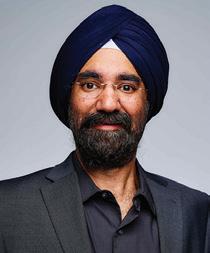
19:00 – 20:30 Tuesday, 17 June 2025 Room: Industry/Mix
Trivia Competition and Reception
After the Panel Session, we will head to the W Hotel for the YP Social Event where there will be tables for Young Professionals to interface with Topic Leaders focused on a variety of industry topics such as:
● Role of Semiconductor Integrated Chips Enabling RF Technologies — Baljit Chandhoke
● Role of Collaboration Between Industry and Academia — Lori Silverman
● Role of RF in Consumer Applications — Yashika Sharma
● Importance of a Pitch Deck for Entrepreneurship — Rajpreet Gulati
● Importance of EDA Tools — Dustin Hoekstra
● Heterogeneous Integration EDA Tools — Bryce Hotalen
We will have questionnaire for YPs to ask questions from to start the discussion with topic leaders at the tables. There will also be a Trivia competition based on the questionnaire to win prizes.
Sponsored By:
Wendy Shu, CEO of Eravant
Sherry Hess, Sr. Group Director Cadence
Baljit Chandhoke, RF Product Manager, Microchip Technology
IMS TECHNICAL SESSIONS
Tu4A: Advancing Biomedical Radar Technology
Chair: Davi V.Q. Rodrigues, University of Texas at El Paso; Co-Chair: Chung-Tse Michael Wu, Rutgers University
Tu4A-1: Through-the-Wall Concurrent Vital Signs Monitoring of Three Subjects Using Single-Channel CW Radar and Independent Component Analysis
S. Hossain, University of Illinois Chicago; S.K. Pramanik, University of Dhaka; O. Adekola, University of Illinois Chicago; S.Md.M. Islam, University of Dhaka; D. Vital, University of Illinois Chicago
Tu4A-2: Asynchronous Space-Time Coding Direct Antenna ModulationEnabled Automated Beam-Scanning Multi-Target Vital Sign Radar Sensing
S. Li, Rutgers Univ.; D. Gao, Rutgers Univ.; S. Vosoughitabar, Rutgers Univ.; C.-T.M. Wu, National Taiwan Univ.
Tu4B: Advances in Reconfigurable Surface and Antenna Technologies for Next-Generation Wireless and Sensing Systems
Chair: Najme Ebrahimi, Northeastern University ; Co-Chair: Tzu-Yuan Huang, ETH Zürich
Tu4B-1: Shape estimation and pattern correction of flexible phased arrays using local curvature measurements
Y. Dashevsky, Ben-Gurion University of the Negev; M. Gal-Katziri, Ben-Gurion University of the Negev
Tu4C: RF Power at HF, VHF and UHF
Chair: Robert H. Caverly, Villanova University; Co-Chair: Frederick Raab, Green Mountain Radio Research
Tu4C-1: Advancements in RF High Power Supply Chain and Ecosystem Enabling Transition from Vacuum Electron Devices to Multi-kW RF SolidState Solutions and Systems
T. Kole, Integra Technologies
211
Tu4D: Sub-Teraherz and Terahertz Signal Modulation
Chair: Lei Liu, University of Notre Dame; Co-Chair: Wooram Lee, Pennsylvania State University
Tu4D-1: Ultrawideband Vector Modulators for Next-Gen Wireless Networks in the 200–480GHz Range
K. Kuliabin, Albert-Ludwigs-Universität Freiburg; B. Gashi, Fraunhofer IAF; S. Chartier, Fraunhofer IAF; C. Maurette Blasini, Albert-Ludwigs-Universität Freiburg; R. Lozar, Fraunhofer IAF; A. Leuther, Fraunhofer IAF; R. Quay, Fraunhofer IAF
Tu4A-3: Accurate Doppler Cardiogram Sensing with Frequency-Domain Digital Beamforming Technique Based on a K-Band Biomedical Radar
J. Zhang, SJTU; S. Dong, SJTU; Y. Li, SJTU; Y. Cao, SJTU; Z. Zhang, SJTU; C. Gu, SJTU; J. Mao, SJTU
Tu4B-2: A 2:1 Bandwidth 3–6GHz Dual-Polarized True-Time-Delay Based Reconfigurable Intelligent Surface (RIS)
J. Qi, Univ. of California, San Diego; J. Drewniak, Univ. of California, San Diego; T. Liang, Univ. of California, San Diego; G.M. Rebeiz, Univ. of California, San Diego
Tu4B-3: Chirp Sequence-Based Beamwidth Control in a Reconfigurable Intelligent Surface
A. Ebihara, Univ. of Tokyo; A. Kumagai, AGC; O. Kagaya, AGC; H. Morikawa, Univ. of Tokyo; Y. Narusue, Univ. of Tokyo
Tu4C-2: Planar Low-Loss UltraWideband Coaxial-Less Balun and 4-Way Combiner for High-Power Applications
V. Bregeon, Thales; A. Ghiotto, IMS (UMR 5218); J. De Oliveira, Thales; C. Goujon, DGA; G. Mouginot, DGA
Tu4D-2: Sub-THz Phase Shifter Using a Photoconductive Solid-State Plasma Evanescent-Mode Waveguide Switched Stub
E.T. Der, Jones Microwave; T.R. Jones, Jones Microwave; N. Vahabisani, Jones Microwave; D. Mildenberger, Jones Microwave; D. Peroulis, Purdue Univ.
Tu4A-4: Highly Sensitive Frequency- and Self-Injection-Locked Radar for Precise Vital Sign Detection
K.-C. Peng, NKUST; C.-C.M. You, National Sun Yat-sen Univ.; S.-H. Lin, National Sun Yat-sen Univ.; T.-S. Horng, National Sun Yat-sen Univ.
Tu4A-5: Moving Person Vital Sign Detection Using Four-Channel Phaseand Quadrature Self-Injection-Locked Radar and MPCA Method for Dynamic Clutter Immunity
I.-H. Chen, National Sun Yat-sen Univ.; J.-X. Zhong, National Sun Yat-sen Univ.; J.-Y. Shih, National Sun Yat-sen Univ.; B.-Y. Lai, National Sun Yat-sen Univ.; F.-K. Wang, National Sun Yat-sen Univ.
Tu4B-4: Enhanced EIRP and Reconfigurable Polarization Multi-Feed Active Antenna Module for MillimeterWave Beamforming Phased Arrays
B. Tung, Univ. of Waterloo; M. Abdollah Chalaki, Univ. of Waterloo; A. Ben Ayed, Univ. of Waterloo; H. Jin, Univ. of Waterloo; S. Boumaiza, Univ. of Waterloo
Tu4C-3: Continuous Current Mode Class-F Power Amplifier: A Solution for Bandwidth Extension in Low Breakdown Voltage Applications
D. Alonso-Tejera, CICESE; J.A. Reynoso-Hernández, CICESE; J.R. Loo-Yau, Cinvestav; M.A. Pulido-Gaytán, CICESE; M. del Carmen Maya-Sánchez, CICESE; J. Sánchez-García, CICESE; E.A. Murillo-Bracamontes, CNyN-UNAM
Tu4C-4: A Highly-Efficient 4.3GBaud Push-Pull LDMOS Based Pre-Driver with 6V Signal-Swing for GaN HEMTs in 22nm FDSOI
F. Buballa, S. Linnhoff, Technische Universität Berlin; A. Wentzel, FBH; E. Wittenhagen, Technische Universität Berlin; T. Hoffmann, W. Heinrich, FBH; F. Gerfers, Technische Universität Berlin
Tu4C-5: High-Efficiency VHF Polar and Doherty Amplifiers for Satellite Transponder Applications
Tu4B-5: Integrated Sensing and Communication Using Reconfigurable Intelligent Surface: Hardware, RayTracing Demonstration, and Channel Measurement in the 6G Mid Band
H. Kim, H. Yang, H. Kim, J. Oh, Seoul National Univ.
Tu4B-6: Low Power Consumption and Beam-Sustainable Reconfigurable Intelligent Surface for Fixed Wireless Communication at Millimeter-Wave 5G Band
H. Kim, Seoul National Univ.; S. Oh, Kwangwoon Univ.; J. Oh, J. Oh, Seoul National Univ.
D. Madueño-Pulido, Universidad Politécnica de Madrid; M. Patiño-Gomez, Universidad Politécnica de Madrid; F.J. Ortega-Gonzalez, Universidad Politécnica de Madrid
Tu4C-6: Highly-Efficient and Low-Power Class-E Amplifier for Miniaturization Using a Small Antenna
F.P. Lanter, Curtin University; A.T. Sutinjo, Curtin University
Tu4D-3: A Compact 8.2mW Complementary Current-Reusing D-Band Frequency Quadrupler in 22nm FDSOI CMOS
T. Schmidt, Technische Univ. Braunschweig; F.-N. Stapelfeldt, Technische Univ. Braunschweig; V. Issakov, Technische Univ. Braunschweig
Tu4D-4: Comparison of Wideband LowPower H-Band Frequency Doublers with and without a Driving Stage in 22nm FDSOI CMOS
F.-N. Stapelfeldt, Technische Univ. Braunschweig; B. Schoch, Univ. Stuttgart; D. Wrana, Univ. Stuttgart; V. Issakov, Technische Univ. Braunschweig
Tu4E: Digital Linearization Techniques for Power Amplifiers
Chair: Luís C. Nunes, Universidade de Aveiro;
Co-Chair: Pere L. Gilabert, Universitat Politècnica de Catalunya
Tu4E-1: Efficiency Enhancements Using Digital Predistortion and Advanced Transmitters
P.J. Draxler, Eridan Communications
Tu4F: Recent Advances in Space Systems for SATCOM and Remote Sensing
Chair: Jan Budroweit, DLR; Co-Chair: Rudy Emrick, Northrop Grumman
Tu4F-1: Recent Data Downlink Antenna Developments for Small Satellites with Focus on NewSpace and CubeSat Applications
N.J.G. Fonseca, Anywaves
AMATEUR (HAM) Radio Reception
Innovations in Radio Engineering
18:00 – 20 :30 | Tuesday, 17 June 2025
Calling all amateur radio enthusiasts and IMS participants who love the art of radio engineering: The theme for this reception is “Innovations in Radio Engineering ” Students are especially invited to attend.
Reception Schedule:
18:00 to 18:30: Gather for a mixer to get to know each other with provided food and drinks. If you bring your HT, the call-in repeater is Bay-Net at 443.975 PL 100 +5Mhz offset (www.bay-net.org/). Bring QSL cards if you have them to trade.
18:30 to 20:00: Special Topic booths on innovation in Radio Engineering to stimulate participant discussions. Booths include:
● Student project displays (all students are invited to display their work)
Tu4E-2: Predistortion of GaN Power Amplifier Transient Responses in Time-Division Duplex Using Machine Learning
A. Fischer-Bühner, Nokia Bell Labs; L. Anttila, Tampere Univ.; A. Brihuega, Nokia ; M.D. Gomony, Nokia Bell Labs; M. Valkama, Tampere Univ.
Tu4E-3: Reference Phase Adjustment Technique with Cross-Polarization Cancellation for Enhanced Digital Predistortion in Mobile Dual-Polarized Arrays
U. Park, Seoul National Univ.; J. Oh, Seoul National Univ.
Tu4F-2: Simultaneous Multibeam Operation in 19.5GHz SATCOM Receive Phased Arrays Using OrthogonallyCoded Nested Subarrays
J. Drewniak, Univ. of California, San Diego; G.M. Rebeiz, Univ. of California, San Diego
Tu4E-4: Phase Derivative Approach for Nonlinear Power Amplifier Forward Modeling with 2-D LUTs
V. Lampu, Tampere Univ.; L. Anttila, Tampere Univ.; M. Valkama, Tampere Univ.
Tu4F-3: A Heterogeneous Transceiver in 0.1µm D-Mode GaAs and 65nm CMOS for SATCOM Phased Arrays
J. Mayeda, Science Tokyo; X. Wang, Science Tokyo; S. Kato, Science Tokyo; D. You, Science Tokyo; X. Fu, Science Tokyo; T. Tomura, Science Tokyo; H. Sakai, Science Tokyo; K. Kunihiro, Science Tokyo; K. Okada, Science Tokyo; A. Shirane, Science Tokyo
Tu4F-4: Polarimetric Spectrometer Receivers for Remote Sensing of Ionospheric Currents
O. Montes, Jet Propulsion Lab; I. Ramos, Jet Propulsion Lab; S. Sin, Jet Propulsion Lab; A. Fung, Jet Propulsion Lab; S. Padmanabhan, Jet Propulsion Lab; S. Misra, Jet Propulsion Lab; P. Kangaslahti, Jet Propulsion Lab
● Antenna innovations
● AREDN networks live demonstration
● County Government Communications
● Overview of new Amateur Radio Equipment on the Market
● 915 MHz mesh network demonstration
20:00 to 20:30: Open discussion with your amateur radio enthusiast colleagues.
MTT-S JOURNALS RECEPTION
19:00 – 21:00 | Tuesday,
Join us at our 2025 MTT-S Journals reception! We will again try to have most of our Editors-in-Chiefs present to answer questions, chat about their journals, and discuss scientific publishing in general. It is also a chance to get involved as a volunteer to help out with one or more of our publications or to better target your research papers for maximum impact and visibility. Food and drinks will be served.
Tu4E-5: Neural Network Based Nonlinear Forward Model Identification for Digital MIMO Arrays Under Load Modulation
J. Fernandez, Tampere Univ.; L. Anttila, Tampere Univ.; K. Buisman, Univ. of Surrey; V. Lampu, Tampere Univ.; C. Fager, Chalmers Univ. of Technology; T. Eriksson, Chalmers Univ. of Technology; M. Valkama, Tampere Univ.
Tu4F-5: An Interleaved 1×8 DualPolarized L-band Phased Array with Digital Transmit/Receive Beamforming Using RFSoC
P. Yang, NUS; A. Tornese, NUS; G. Chen, NUS; K. Mouthaan, NUS
YERBA BUENA BALLROOM, SALON 7 SAN FRANCISCO MARRIOTT MARQUIS
WOMEN IN MICROWAVES
(WIM) SESSION
Engineering Your Success: The Power of Reputation, Resilience, and Reinvention
SPEAKER:
Wendy Shu, CEO, Eravant

ABSTRACT:Success in technical fields is often attributed to deep expertise, but career advancement requires more than knowledge alone. Professionals who distinguish themselves do so through a combination of strategic awareness, emotional intelligence, and disciplined execution. Yet, these skills are not always emphasized in traditional mentorship or professional development.
This keynote will explore four critical, often-overlooked factors that help professionals gain trust, demonstrate commitment, and position themselves for leadership. Attendees will learn how to strengthen their emotional intelligence to navigate workplace dynamics, use resilience and accountability to build credibility, signal dedication in ways that resonate with leadership, and cultivate a personal brand that authentically reflects their expertise. By applying these principles, professionals can take greater ownership of their careers and create more opportunities for meaningful growth and impact within their organizations.
SPEAKER BIO: Wendy Shu is the CEO of Eravant (formerly SAGE Millimeter), an engineering firm that designs and manufactures millimeter-wave and sub-THz hardware solutions for commercial, industrial, and defense applications. She leads the company’s business development and operations, ensuring its continued growth and innovation in the industry.
Wendy is passionate about building high-impact teams with the opportunity to pursue their full potential. She believes technology companies succeed when engineering has the freedom to lead, all functions are valued, and industry outsiders can contribute meaningfully, bringing fresh perspectives to drive progress.
She earned her B.A. in International Relations from the University of Southern California and her J.D. from the USC Gould School of Law. A member of the State Bar of California, Wendy also serves as an Advisory Board Member for the Torrance Cultural Arts Foundation.
Amplifying Impact: Engineering Influence in an Era of Disruption
SPEAKER: Sathya Padmanabhan, CEO, Maury Microwave Corporation
ABSTRACT: In an era of unprecedented technological disruption, RF and microwave engineers stand at the forefront of transformative change. This keynote, “Amplifying Impact: Engineering Influence in an Era of Disruption,” explores how evolving technologies—6G’s terahertz frontiers, space-based communication networks, IoT’s compact connectivity, and quantum’s emerging promise are reshaping our field and the world beyond. Drawing on cutting-edge examples like AI-optimized 6G phased arrays, satellite swarm communications, and energy-efficient IoT designs, we’ll navigate the barriers that challenge us with technical, systemic, and personal and uncover strategies to overcome them. For women in microwave engineering, this is more than just adaptation and about driving innovation and making a statement as disruptors. This talk inspires actionable steps to amplify our influence, redefine leadership, and shape a connected, sustainable tomorrow.
SPEAKER BIO: Sathya Padmanabhan is the Chief Executive Officer of Maury Microwave Corporation. She joined the company in December 2006, as a Microwave engineer responsible for product development and has since held various technical, management and leadership positions within the company driving innovation and creating operational efficiencies across the organization while working towards creating confidence in measurements for customers. Prior to Maury, she worked at Trompeter Semflex as their RF Project engineer managing design and custom interconnect solutions for aerospace and defense customers.
Sathya received the B.E degree in 2001 in India and the M.S degree in Electrical Engineering from the University of South Florida, Tampa in 2004 with an emphasis in RF & Microwave engineering. Her thesis was focused on calibration and measurement accuracy which has been foundational for her work at Maury over the last two decades.

This event welcomes all members of IMS to promote collaboration, with a spotlight on the work of female RF engineers and researchers. We will continue our traditional social cocktail party, which grows yearly. The reception will also feature social networking opportunities, games, and more!
Sponsored By:
RFIC TECHNICAL SESSIONS
203
RTu4A: Circuit Techniques for Radar and Phased Array
Chair: Roxann Broughton-Blanchard, Analog Devices
Co-Chair: Chun-Huat Heng, National University of Singapore
205
RTu4B: Circuit Blocks for D-Band Integrated Systems
Chair: Muhammad Waleed Mansha, Nokia Bell Labs
Co-Chair: Kenichi Okada, Science Tokyo
207
RTu4C: Innovations in Low-Power, HighPerformance Receiver Front-Ends
Chair: Marcus Granger-Jones, Qorvo
Co-Chair: Andrea Bevilacqua, Università di Padova
RTu4A-1: A 15/30/60-GHz 1TX/4RX Radar Chipset Achieving 6° Angular Resolution Using Frequency Dimension for Virtual Aperture Expansion
R. Liao, UESTC; H. Wang, UESTC; J. Zhang, UESTC; W.-H. Yu, University of Macau; Y. Song, UESTC; H. An, UESTC; H. Liu, UESTC; K. Kang, UESTC
RTu4A-2: An 8-Element 800MHz BW 0.083mm²/ element Scalable Current-Mode True-Time-Delay Analog Combiner for Low SWaP-C Antenna Arrays
A. Kharalkar, IIT Bombay; P. Gouniyal, IIT Bombay; S. Khalapure, IIT Bombay; S. Jain, IIT Bombay; R. Zele, IIT Bombay; S. Poolakkal, Washington State Univ.; S. Mohapatra, Washington State Univ.; S. Gupta, Washington State Univ.
RTu4A-3: A Compact, 17.8TOPS/W, 2Gbps Programmable Analog Matched Filter and Coherent Accumulator for 79GHz PMCW Radar
H. Jiang, Columbia Univ.; C. Xue, Columbia Univ.; J. Huang, Columbia Univ.; P.R. Kinget, Columbia Univ.
RTu4B-1: 110-to-140GHz Frequency Tripler with 13% Efficiency, 7.2dBm Psat Using Adaptive Biasing and 3rd Harmonic Boosting in 22nm FDSOI
V. Lasserre, Technische Univ. Braunschweig; S. Koop-Brinkmann, Technische Univ. Braunschweig; C. Ziegler, Technische Univ. Braunschweig; F.-N. Stapelfeldt, Technische Univ. Braunschweig; V. Issakov, Technische Univ. Braunschweig
RTu4B-2: A 126–137GHz Regenerative Frequency Shifter in 22nm FDSOI
V. Lasserre, Technische Univ. Braunschweig; F.-N. Stapelfeldt, Technische Univ. Braunschweig; S. Koop-Brinkmann, Technische Univ. Braunschweig; M. Dimic, Infineon Technologies; F. Padovan, Infineon Technologies; V. Issakov, Technische Univ. Braunschweig
RTu4B-3: A 200GHz Quasi-Circulator with a Widely Tunable Termination for >30dB Isolation and 8.3dB SNR Degradation in a 22nm FD SOI Process
H. Seo, Univ. of California, Davis; O. Momeni, Univ. of California, Davis
RTu4C-1: A 2.4GHz 676µW Receiver Front-End with Passive Analog FIR Filtering Embedded in Down-Converter Achieving >60dB Blocker Rejection
W. Zhang, Southeast Univ.; C. Chen, Southeast Univ.; Y. Guo, Southeast Univ.; Y. Zhao, Southeast Univ.; W. Yang, Southeast Univ.
RTu4C-2: 10-to-30-GHz Blocker-Tolerant Mixer-First Receivers with 40-dB/Decade Transition-Band Roll-Off and Maximum 61.7-dB LO-to-RF Isolation
K. Li, Tianjin Univ.; S. Wang, Tianjin Univ.; K. Wang, Tianjin Univ.
RTu4C-3: An 11.5mW 12.3–14.5GHz Passive Mixer-First Receiver Front End Achieving 4.2dB NF and -5dBm B1dB
A.H. Antón, Cornell Univ.; J.C. Ye, Cornell Univ.; S. Sadeghi, Cornell Univ.; A.C. Molnar, Cornell Univ.
RTu4A-4: A 28-nm 9-mm High-Resolution Multi-Mode IR-UWB Radar SoC with 16-GS/s Equivalent-Time Sampling for Non-Contact Detection of Human Vital Signs
P. Luo, Xidian Univ.; Y. Chen, Tsinghua Univ.; Y. Liu, Xidian Univ.; R. Jiang, Xidian Univ.; J. Xiao, Xidian Univ.; M. Liu, Xidian Univ.; Y. Yang, Xidian Univ.; X. Ma, Xidian Univ.; Y. Hao, Xidian Univ.
RTu4A-5: A Fully-Integrated Doppler-Assisted FMCW Radar with Low Hertz Range Noise Figure for Indoor Localization and Vital Sign Sensing
Y. Zhang, East China Normal Univ.; Z. Zhang, East China Normal Univ.; Z. Zhang, East China Normal Univ.; Z. Zhang, East China Normal Univ.; Y. Zhu, East China Normal Univ.; R. Xu, East China Normal Univ.; Y. Liu, East China Normal Univ.; S. Ding, East China Normal Univ.; J. Wang, East China Normal Univ.; K. Wang, East China Normal Univ.; D. Li, East China Normal Univ.; P. Wang, East China Normal Univ.; G. Chen, East China Normal Univ.; H. Deng, Univ. of Houston; L. Huang, East Chi
RTu4B-4: An Ultra-Compact and Wideband D-Band Power Amplifier in 28nm CMOS with Area-Efficient Coupled Line-Based Matching Network
H.-R. Jeon, KAIST; H. Lee, KAIST; S.-G. Lee, KAIST; K.-S. Choi, Yonsei Univ.
RTu4B-5: A 110-to-203-GHz 18.3-dBm Broadband Power Amplifier Using Modified Three-Conductor Baluns in 130-nm SiGe BiCMOS S. Li, Tsinghua Univ.; S. Fu, Tsinghua Univ.; X. Liu, Xidian Univ.; Q. Liao, Wuhan Univ.; H. Wu, Tsinghua Univ.; S. Hu, Tsinghua Univ.; W. Chen, Tsinghua Univ.
RTu4C-4: A 4.2dB NF and 39dB Passive Gain Ultra-Low Power Receiver Front-End with an RF-IF Dual-Stage Capacitive Stacking Technique
J. Jin, NJUST; Z. Xu, NJUST; H. Bai, NJUST; B. Xiao, NJUST; W. Wu, NJUST; T. Huang, NJUST
RTu4C-5: A 0.2–6GHz 65nm CMOS Active-Feedback LNA with Threefold Balun-Error Correction and Implicit Post-Distortion Technique
B. Guo, CUIT
INDUSTRY WORKSHOPS
SESSION CODE
TIME & LOCATION TITLE AND ABSTRACT
IWWE1
IWWE2
8:00 – 9:40 Room: 204
10:10 – 11:50 Room: 204
IWWE4
10:10 – 11:50 Room: 206
– 17:20 Wednesday, 18 June 2025
SPEAKER(S), AFFILIATION
IWWE5
13:30 – 15:10
Room: 204
13:30 – 15:10
Room: 206
5G RF Front Ends evolution to 6G from engineered substrates to RF Front End systems — Connectivity systems evolve continuously to effectively and efficiently address new and emerging wireless applications.
To timely support this evolution, semiconductors solutions need to ensure the level of RF performance required from early RF and microwave circuits and systems design and manufacturing stages. During this industry workshop, designing and manufacturing of such RF solutions will be identified and analyzed.
Guideline and tools to use such solutions to implement the RF Front End of the next generation of wireless systems will be provided. Practical challenges and topics discussed will range from wafers and engineered substrates to RF ICs and Front Ends.
Design and Optimization of Beamforming Radios: Live Demos on How Modeling, Simulation and OTA Measurements Can Benefit from Each Other— This workshop explores the synergy between over-the-air (OTA) measurements and modelling/simulation for optimizing wideband mmWave radios. Practical examples will show how to enhance RF models for transceivers design and optimization, covering:
• Linearization of power amplifiers and beamforming transmitters
• Equalization and interference mitigation strategies for receivers
• Leveraging simulation to interpret OTA measurement results.
Attendees will learn to improve design, reduce re-spins, and understand root causes of performance issues. The demonstrations will use a highly integrated mmWave beam-former capable of circular polarization, including frequency converters, filters, and a SATCOM phased array in two remote compact antenna test range systems.
Quantum Solutions: Pioneering the Future — The rapid advancements in quantum computing demand specialized solutions to scale up and improve qubits. This workshop will explore Keysight’s quantum solutions for hardware and EDA, addressing current limitations and paving the way for innovations. Keysight’s Quantum Control System (QCS) and Quantum EDA tools provide integrated workflows for developing superconducting qubits and quantum amplifiers. Keysight offers a low-frequency noise characterization system and a novel test methodology for QKD designs. Participants will gain insights into the latest advancements, understand the unique challenges, and learn about practical applications and case studies. Join us to explore the future of quantum solutions with Keysight.
Circuit and 3D Electromagnetic Co-Design, Synthesis, and Simulation for RF Applications — With the integration of Clarity 3D Solver and Microwave Office software, RF designers can access high-capacity and scalable EM analysis for design verification and signoff of large, complex RF mixed-signal systems beyond the capabilities offered by conventional full-wave solvers, thanks to the Clarity distributed multiprocessing technology. In this workshop, we demonstrate the efficacy of the Microwave Office and Clarity solver technologies for several complex antenna-RF problems including design verification, antenna arrays and in-design RF applications areas.
New Methods on Wideband Device Characterization for Amplifiers and Phased Arrays — In this event, we will delve into innovative methods for characterizing both passive and active devices, showcasing novel methodologies and architectures for measurement applications in radar, satellite and mobile communication technologies. Our primary objective is to provide a comprehensive and precise understanding of the device under test, ensuring that the influence of the measurement system is kept to an absolute minimum. By focusing on wideband modulated signals, participants will gain valuable insights into new approaches in characterization methods, equipping them with the knowledge to improve their own testing processes and results across various applications.
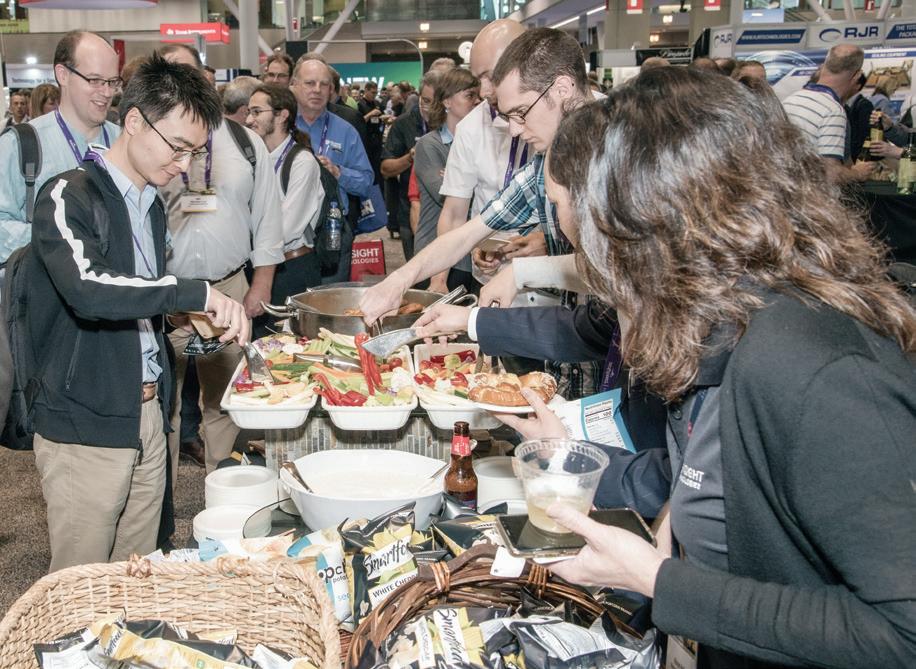
Don’t Miss the Industry Hosted Reception on Wednesday, 18 June, from 17:00–18:00 on the IMS Exhibit Floor!
Gabe Lenetsky, Keysight Technologies; David Van Workum, Keysight Techologies; Mani Peroomal, Low Noise Factory
Karthik Ramalingam, Cadence Design Systems; Dustin Hoekstra, Cadence Design Systems; Ben Held, Cadence Design Systems
Wolfgang Wendler, Rohde & Schwarz; Johan Nilsson, Rohde & Schwarz; Darren Tipton, Rohde & Schwarz; Florian Ramian, Rohde & Schwarz; Martin Lim, Rohde & Schwarz North America; Markus Loerner; Rohde & Schwarz
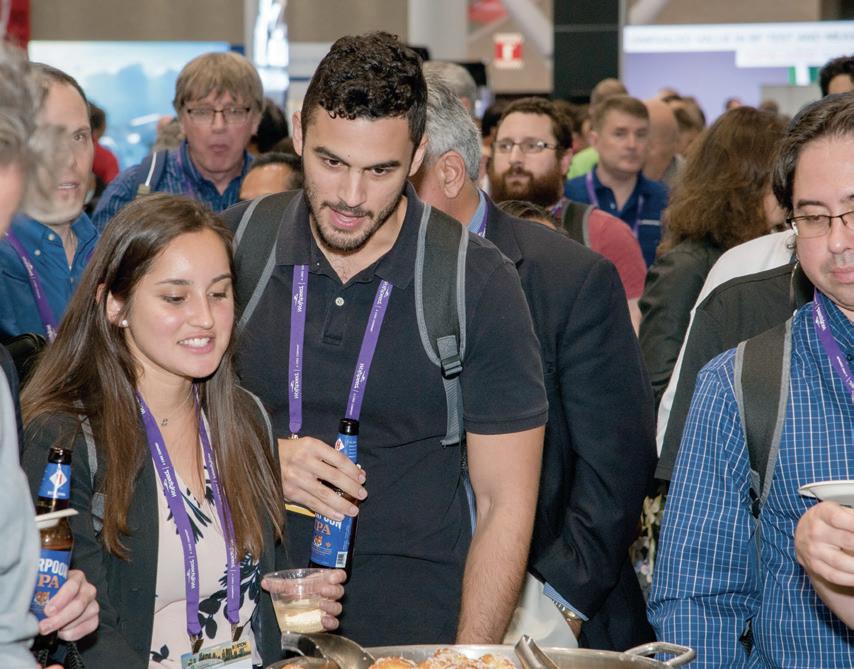
Rui Ma, pSemi, A Murata Company; Luis Andia, Soitec
Fabricio Dourado, Rohde & Schwarz; Giorgia Zucchelli, MathWorks B.V.
IWWE3






























































































































FUTURE G SUMMIT
08:00 – 17:00
Wednesday, 18 June 2025
Overview: The Summit will feature four sessions throughout the day, each focusing on a different theme: Standards and regulatory progress towards the next G, AI in wireless communications, technologies for mmWave to THz and Non Terrestrial Networks. Each of the themed sessions will feature speakers from governments, industry and academia describing some of the interdisciplinary concepts enabling these Future G systems. At the conclusion of each session, there will be an interactive panel comprising technical experts who will field questions from the audience and discuss some of the challenges for the realization of Future G networks.
SPEAKERS AND AGENDA:
8:00-9:40
10:00-11:40
STANDARDS AND REGULATORY PROGRESS ON NEXT G
A New Paradigm: Mid-Band Sharing-Native 6G
6G visions and Standardization Activities
6G: Future Wireless for the AI Era
Monisha Gosh, Notre Dame
Le Liu, Qualcomm
Athul Prasad, Samsung; Ira Keltz, FCC AI/ML IN WIRELESS COMMUNICATIONS
Towards AI-Native Air Interface for 6G: Machine Learning-based Channel State Information (CSI) Feedback Enhancements in 5G-Advanced Nick Sutardja, Danger Devices
6G: Future Wireless for the AI Era
13:00-14:40
15:00-16:00
Society Sponsors:
Russel Ford, Samsung
AI for RF SoC Optimization Andreas Roessler, Rohde & Schwarz
The Interplay between Artificial Intelligence and 5G-Advanced toward 6G Xingqin Lin, Nvidia SEMICONDUCTOR DEVELOPMENT FOR NEXT G
6G Network Technologies, Systems & Architecture Shahriar Shahramian, Nokia
Next Generation Cellular Radio System Development Sang-Jue Park, Mediatek
Digital-Friendly CMOS Flexible for the Next-G Jeffrey Walling, Virginia Tech AI-Enabled RF/mmWave IC Design Kaushik Sengupta, Princeton ADVANCES IN NON-TERRESTRIAL STATIONS AND NETWORKS
The Future of Direct to Device
Ku and Ka-band Low-Cost Phased-Arrays for LEO SATCOM Using Highly Integrated Silicon Beamformer Chipsets

IMS EARLY CAREER PAPER COMPETITION
Media Sponsor:
Now in it’s third year, this competition is open to authors from industry, government agencies, and post-doctoral candidates, with less than 10 years of professional experience, and who are not full-time students or faculty members.
THIS YEAR’S IMS EARLY CAREER PAPER COMPETITION FINALISTS:
Tu1E-1: A Cryogenic Front-end Module Apply to Readout Two-qubits with FDM Technology in Superconducting Quantum Computing
Che-Hao Li, National Yang Ming Chiao Tung University
Tu2C-2: On-chip Photonic THz Emitter with Integrated InGaAs UTC-PD and 2×2 MPA Array on SiC Substrate
Ming Che, Kyushu University
Tu4F-3: A Heterogeneous Transceiver in 0.1µm D-Mode GaAs and 65nm CMOS for SATCOM Phased Arrays
Jill Mayeda, Institute of Science Tokyo
We1B-6: A 10-GHz Localized-LO-Phase-Shifting Phased-Array Transmitter
Francesco Tesolin, Politecnico di Milano
Th1A-1: A D-band Tx FOWLP Module With Silicon-based Resonator Antenna Array
Sirous Bahrami, Pohang Univ. of Science and Technology
Th1D-1: An EVA-based High-Power and Absorptive Frequency-Selective Plasma Limiter Sandeep Narasapura Ramesh, University of Toledo
Th2F-3: 300 GHz 8×1 Active Phased Array MMIC with On-Chip Power Amplifiers, Vector Modulators, and Antennas
Bersant Gashi, Fraunhofer Institute for Applied Solid State Physics
IMS TECHNICAL SESSIONS
203
We1B: Next Generation Front-End Components and Architectures For RF Applications
Chair: Kenneth Mays, Boeing; Co-Chair: Aly E. Fathy, University of Tennessee Knoxville
We1B-1: A MIMO Perspective of Phased Arrays and its Applications
John Cowles, Analog Devices
205
We1C: Advances in MultiFunctional Planar Filter Technologies
Chair: Laila Salman, Ansys; Co-Chair: Dimitra Psychogiou, University College Cork
We1C-1: Multi-functional Ultrawideband BPFs with Reconfigurable Absorptive and Tunable Attenuation Characteristics
A. Nadeem, Frederick University; N. Shoaib, NUST; S. Nikolaou, Frederick University; D. Psychogiou, Univ. College Cork; P. Vryonides, Frederick University
We1D: Advances in Computational Techniques
Chair: Vladimir Okhmatovski, University of Manitoba; Co-Chair: Werner Thiel, ANSYS
We1D-1: AI on Functions and Neural Operators
Z. Li, K. Azizzadenesheli, A. Anandkumar, Caltech
We1E: Advanced Non-Planar Filter Designs
Chair: Simone Bastioli, RS Microwave; Co-Chair: Mohamed M. Fahmi, DRDC
We1B-2: A 1.53-mm² Fully-Integrated Wi-Fi 7 Front-End Module with 1.65-dB NF and 41.9% FBW in 0.25-µm GaAs p-HEMT Technology
P. Li, Tianjin Univ.; K. Ma, Tianjin Univ.; Y. Zhang, Tianjin Univ.; J. Zhao, Tianjin Univ.; H. Shi, Tianjin Univ.
We1B-3: A 5–7.1GHz 4-Channel CMOS Wi-Fi 7 Transceiver Front-End for Fiberto-the-Room with Analog Beamforming and Digital Predistortion
B. Feng, XJTU; K. Fu, XJTU; X. Huang, XJTU; X. Lei, XJTU; X. Gui, XJTU
We1C-2: A Compact Planar QuadChannel SIW Filtering Crossover with Flexibly Allocated Channel Frequencies and Bandwidths
Z. Luo, SJTU; K. Zhou, Eastern Institute of Technology; K. Wu, Polytechnique Montréal
We1D-2: Electromagnetic Emission Simulation of Radio-Frequency Circuits Using Direct Domain Decomposition Solver
J. Lu, The Ohio State University
We1E-1: Compact Ku-Band Diplexer with Additive Manufactured Multi-Material Dielectric Resonator Insets
P. Boe, Christian-Albrechts-Universität zu Kiel; D. Brouczek, Lithoz; L. Mikiss, Lithoz; M. Hofbauer, Lithoz; D. Miek, ChristianAlbrechts-Universität zu Kiel; M. Höft, Christian-Albrechts-Universität zu Kiel
We1B-4: A 9.4–11.4GHz Low-IF Linear Transmitter Front-End with 47.2dB Dynamic Range and 0.5dB Gain Resolution in 40-nm CMOS
J. Li, UESTC; B. Yang, UESTC; Q. Li, UESTC; Y. Shu, UESTC; X. Luo, UESTC
We1C-3: A New Folded Coupling Reflectionless Bandpass Filter with Broadband Ultra-Low Reflection Property and Very High Frequency Selectivity
M. Ohira, Doshisha University; K. Hirota, Saitama University; Z. Ma, Saitama University; H. Deguchi, Doshisha University
We1C-4: Miniaturized Multilayer and Self-Packaged Triple-Mode Bandpass Filter with High Selectivity and Wide Stopband
L. Gu, UESTC; X. Luo, UESTC; Y. Dong, UESTC
We1D-3: Towards Tensor-Train Solution of Vector Volume Integral Equation in 3D with log-N Complexity
C. Nguyen, Univ. of Manitoba; V. Okhmatovski, Univ. of Manitoba
We1E-2: Novel Double Rejection Cavity to Improve Selectivity in Inline Rectangular Waveguide Filters
C. Tomassoni, Università di Perugia; G. Macchiarella, Politecnico di Milano; M. Oldoni, Politecnico di Milano
We1B-5: A C-Band High-Precision Amplitude-Phase Control MultiFunctional Chip with Symmetric Polyphase Filter and X-Type Attenuator
G. Shi, CAS; Z. Li, CAS; L. Liu, CAS; P. Chen, Tianjin HiGaAs Microwave Technology; Z. Dai, CAS; S. Chen, CAS; Y. Geng, Tianjin HiGaAs Microwave Technology
We1B-6: A 10-GHz Localized-LO-PhaseShifting Phased-Array Transmitter
F. Tesolin, S.M. Dartizio, F. Faillace, A.L. Lacaita, M. D’Amico, S. Levantino, Politecnico di Milano
Denotes Keynote Presentation
We1D-4: Fusing Leontovich Boundary Conditions and Scalar 2D FEM to Compute Lid and Lateral Wall Losses in H-plane Waveguide Devices
H. Jiang, Universidad Autónoma de Madrid; J. Córcoles, Universidad Politécnica de Madrid; J. Ruiz-Cruz, Universidad Politécnica de Madrid
We1E-3: Advances on Size Reduction and Spurious Suppression in Rectangular Waveguide Filters
D. Rubio, Univ. Politècnica de València; S. Cogollos, Univ. Politècnica de València; V.E. Boria, Univ. Politècnica de València; M. Guglielmi, Univ. Politècnica de València
We1E-4: Coupling Matrix Reconfiguration Aided with a Start System Based on Simultaneous Diagonalization
Y. Zeng, SUSTech; Y. Wu, NUIST; M. Yu, SUSTech
We1D-5: A Finite Element Method to Model Transmission Lines with Various Rough Conductor Surfaces up to 110GHz
F. Sepaintner, Technische Hochschule Deggendorf; F. Roehrl, Rohde & Schwarz; G. Fischer, FAU Erlangen-Nürnberg; W. Bogner, Technische Hochschule Deggendorf; S. Zorn, Rohde & Schwarz
We1E-5: Band-Pass Filter Based on Stacked Metal Plates in V-Band Waveguide Technology
E. Dischke, FBH; S. Nozinic, FBH; D.G. Hellmich, RWTH Aachen; T. Flisgen, BTU; A. Rämer, FBH; W. Heinrich, FBH; V. Krozer, FBH
We1E-6: Ultra-Compact SurfaceMountable Air-Filled Coaxial Filter for 5G Applications
Y. Yang, Xidian Univ.; S. Li, Xidian Univ.; Q. Wu, Xidian Univ.; M. Yu, SUSTech
IMS TECHNICAL SESSIONS
211
We1G: Advanced mm-Wave Frequency Converters and Modulators
Chair: Hong-Yeh Chang, National Central University; Co-Chair: Stephen Maas, Nonlinear Technologies
We1G-1: A Q-Band Ultra-Low-Jitter Subharmonically Injection-Locked Frequency Quadrupler with FTL and Switched-Capacitor Array
P.-Y. Chen, National Central Univ.; H.-Y. Chang, National Central Univ.
08:00 – 09:40 Wednesday, 18 June 2025
215
We1H: X-Band III-V MMIC Power Amplifiers with Harmonic Control
Chair: Taylor W. Barton, University of Colorado Boulder; Co-Chair: Rajah Vysyaraju, Macom
We1H-1: LNA and Power Amplifiers for Operation up to 100GHz
D.W. Runton, Macom
We1G-2: A 22–34GHz CMOS Neutralization-Based Direct-Conversion I/Q Up-Converter for 1024-QAM Modulation
C.-Y. Lee, National Central Univ. ; P.-Y. Chen, National Central Univ. ; H.-Y. Chang, National Central Univ.
We1H-2: A Ku-Band Input Harmonically Tuned Class-F GaAs MMIC Power Amplifier Achieving 28.4-dBm Psat and 56% Peak PAE
K.P. Jung, Samsung; S.H. Kim, Samsung; S. Oh, Samsung; J. Kim, Samsung; S.-K. Kim, Samsung; D. Jung, Samsung; D.Y. Lee, Samsung
We1G-3: A 14.5Gb/s, 2.75pJ/bit, Direct-Digital, Star-QAM Modulator and Co-Designed Frequency Multiplier Operating at 140GHz
S.Z. Aslam, Univ. of Florida; A.I. Omi, Univ. of Florida; B. Chatterjee, Univ. of Florida; D.P. Arnold, Univ. of Florida
We1H-3: A Continuous-Mode Class-F-1 X-Band GaN MMIC Power Amplifier with a 29.7% Fractional Bandwidth
Y.-H. Shang, National Tsing Hua Univ.; K.-Y. Chuang, National Tsing Hua Univ.; H.-C. Lin, NARLabs-TSRI; Y.-C. Chang, NARLabs-TSRI; D.-C. Chang, NARLabsTSRI; S.S.H. Hsu, National Tsing Hua Univ.
We1G-4: Monolithic Implementation and Performance Comparison of Three Single Balanced Architectures for D-Band HEMT Mixers
P. Umbach, Fraunhofer IAF; F. Thome, Fraunhofer IAF; A. Leuther, Fraunhofer IAF; R. Quay, Fraunhofer IAF
We1G-5: A DC-to-170GHz DirectCoupled Mixer Achieving 47dB LO-RF Isolation in 250nm InP DHBT Technology
P. Xiang, Southeast Univ.; K. Yang, Southeast Univ.; W. Wang, Nanjing Electronic Devices Institute; W. Cheng, Nanjing Electronic Devices Institute; Y. Chen, Southeast Univ.; H. Miao, Southeast Univ.; Y. Chen, Southeast Univ.
We1H-4: An X-Band 35-dBm Compact Continuous-Mode Class-J Power Amplifier in 0.25-µm GaN Process
Y.-F. Chen, National Central Univ.; J.-J. Chen, National Central Univ. ; P.-Y. Chen, National Central Univ. ; H.-Y. Chang, National Central Univ.
We1H-5: An X-Band Low-Voltage GaN HEMT Stacked Power Amplifier Operating in Class-J with Active Second Harmonic Injection
A. Yamaguchi, Sony; K. Kohama, Sony; M. Shimada, Sony

IMS TECHNICAL SESSIONS
203
We2B: Advanced Ku-Ka Beamforming ICs and Calibration Techniques
Chair: Mahdi Javid, Qorvo; Co-Chair: Glenn Hopkins, Georgia Tech
We2B-1: A 22–30GHz Ultra Low RMS Phase Error SiGe HBT BiCMOS Active Vector Modulator Phase Shifter with a Tunable Two-Section Lumped Element Differential Quadrature Hybrid
K.W. Choi, Ajou Univ.; S.-M. Moon, ETRI; D. Chang, ETRI; I. Ju, Ajou Univ.
205
We2C: Synthesis and Design Techniques for Advanced Filter Design
Chair: Roberto Gómez García, Universidad de Alcalá; Co-Chair: Photos Vryonides, Frederick University
We2C-1: Direct Synthesis for High Selectivity Lowpass/Bandpass CoDesigned Filters with Independent Sub-Band Responses
L. Xiao, Southwest Jiaotong Univ.; Y. He, Southwest Jiaotong Univ.; C. Wei, Shenzhen Polytechnic University; X. Zou, Southwest Jiaotong Univ.; L. Yan, Southwest Jiaotong Univ.; G. Macchiarella, Politecnico di Milano
We2D: Modeling Techniques for Innovative Applications
Chair: Oscar Quevedo-Teruel, KTH; Co-Chair: Werner Thiel, ANSYS
208
We2E: Innovative Non-Planar Passive and Multi-Functional Components
Chair: Dimitrios Peroulis, Purdue University;
Co-Chair: Vicente E. Boria, Universitat Politècnica de València
We2B-2: A 28/39-GHz Reconfigurable Phased-Array Transmitter Front-End for 5G New Radio in a 65nm CMOS
R. Wang, UESTC; Y. Yu, UESTC; R. Liu, UESTC; Y. Wu, UESTC; X. Xie, UESTC; Z. Chen, UESTC; Z. Jing, UESTC; Z. Li, UESTC; M. Geng, UESTC; H. Liu, UESTC; C. Zhao, UESTC; Y. Wu, UESTC; K. Kang, UESTC
We2B-3: A 28GHz Compact PhasedArray Beamformer with 21.3dBm PSAT and 5.2dB Noise Figure in 40nm CMOS
Z. Ma, Tianjin Univ.; Z. Ma, Tianjin Univ.; H. Shi, Tianjin Univ.; M. Yin, Tianjin Univ.; Y. Yan, Tianjin Univ.; W. Liu, Tianjin Univ.; Y. Wang, Tianjin Univ.; F. Meng, Tianjin Univ.; K. Wang, Tianjin Univ.; K. Ma, Tianjin Univ.
We2B-4: A 16.2-to-22.2-GHz Phased-Array Receiver with -60-to85°C Simultaneously Gain and NF Temperature Compensation Supporting 24Gb/s 64QAM Modulation
D. Li, Tsinghua Univ.; W. Deng, Tsinghua Univ.; H. Jia, Tsinghua Univ.; Z. Guo, Tsinghua Univ.; X. Li, Tsinghua Univ.; X. Nie, Tsinghua Univ.; B. Chi, Tsinghua Univ.
We2B-5: Calibration of Vector-Summing Type Variable-Gain Phase Shifters Using Novel Rectangular Constellation Modeling
Y. Chen, Univ. of Waterloo; M. Hazer Sahlabadi, Univ. of Waterloo; S. Boumaiza, Univ. of Waterloo
We2C-2: Novel Synthesis Method for Wideband Filter with Additional Insertion Phase
C. Yi, UESTC; X. Chen, CETC 29; B. Liu, UESTC; P.-L. Chi, NYCU; T. Yang, UESTC
We2D-1: Reverberation Chambers as a New Solution for Wireless Testing of Highly Integrated Antenna Systems
A. Hubrechsen, ANTENNEX
We2C-3: Compact 7–23-GHz Bandpass Filter with High Selectivity and Wide Stopband Using Hybrid Microstrip/ SIDGS Scheme for 6G Application
Y. Bai, UESTC; L. Du, UESTC; J. Zhou, UESTC; X. Luo, UESTC
We2D-2: Green’s Function Analysis of Spatially Discrete Traveling-Wave Modulated (Parametric) Loop Networks
A. Babaee, Univ. of Michigan; Z. Fritts, Univ. of Michigan; S.M. Young, Univ. of Michigan; A. Grbic, Univ. of Michigan
We2E-1: 50-Way W-Band All Waveguide Radial Combiner Design
M. Fahmi, DRDC; M. MacDonald, MIT Lincoln Laboratory; A. Fathy, Univ. of Tennessee; M. Abouzahra, MIT Lincoln Laboratory
We2C-4: Extraction of Coupling Matrix for Bandpass Filters Based on Magnitude of S-Parameters
K.F. Lao, CUHK; J. Liu, CUHK; W.H. Hung, CUHK; K.-L. Wu, CUHK
We2D-3: Equation-Based Solver for High-Performance SI CuMax Routing Within Pin Fields
Y. Zhang, Univ. of South Carolina; X.-D. Cai, Cisco; K. Li, Cisco; Y. Li, Cisco; D. Fu, Cisco; B. Sen, Cisco; G. Wang, Univ. of South Carolina
We2E-2: Novel Radial Combiners with Integrated Low Pass Filtering Function
M.M. Fahmi, DRDC; J.A. Ruiz-Cruz, Universidad Politécnica de Madrid; R.R. Mansour, Univ. of Waterloo
We2D-4: A Power-Efficient Plasma Jet Line Enabled by Dielectric Anapole Resonator Technology
M.R. Akram, Univ. of Toledo; A. Semnani, Univ. of Toledo
We2E-3: A Multi-Functional Circularly Polarized All Pole Filtering Conical Horn Antenna
M. Kumar, IIT Roorkee; G. Basavarajappa, IIT Roorkee
We2E-4: Rectangular WaveguideBased CRLH Frequency Scanning Array Antenna Operating at W-Band
M.E. Farage, Univ. of Glasgow; C. Li, Univ. of Glasgow
We2D-5: Mixed-Mode Distributed Physical-Based Model on OSFP Connector for Fast PAM-4 Channel Analysis and Pathfinding up to 212.5Gbps
Y. He, K. Song, H. Wu, Z. Liu, M. Feng, Univ. of Illinois at Urbana-Champaign
We2D-6: THz Diffraction Radiation Analysis of Finite Graphene Strip Grating with Grounded Dielectric Substrate Excited by Electron Beam
D.O. Herasymova, NASU; M.E. Kaliberda, S.A. Pogarsky, A. Biloshenko, V.N. Karazin Kharkiv National University
We2E-5: High-Power Handling, Amplitude and Phase Stable, Full Band WR-06 Rotary Joint Based on TE01 Mode
A.H. Chen, Eravant; Y. Shu, Eravant
We2E-6: Optimizing Material and Shape of 3D-Printed Waveguide Terminations
L. Damaj, Lab-STICC (UMR 6285); V. Laur, Lab-STICC (UMR 6285); A. Chevalier, Lab-STICC (UMR 6285); A. Maalouf, Lab-STICC (UMR 6285); K. Elis, CNES
IMS TECHNICAL SESSIONS
Field, Device & Circuit
211
We2G: Advanced RF/mm-Wave Frequency Multiplication Techniques
Chair: Steve Maas, Nonlinear Technologies;
Co-Chair: Austin Chen, Infinera
We2G-1: A 13.7–41GHz Ultra-Wideband Frequency Doubler with Cross-Coupled Push-Push Structure Achieving 10.6% Peak Efficiency and 7-dBm Psat K. Li, Tianjin Univ.; K. Wang, Tianjin Univ.
215
We2H: High-Efficiency Power Amplifiers for 6G FR3 Handset and MIMO Radar Applications
Chair: Rajah Vysyaraju, Macom; Co-Chair: Wing Shing Chan, CityUHK
We2H-1: Efficient InGaP/GaAs HBT Differential Power Amplifier Using a New Adaptive Cross-Capacitor Bias Circuit for 6G FR3 Handset Applications
S. Bae, Hanyang Univ.; B. Yoon, Hanyang Univ.; S. Lee, Hanyang Univ.; S. Hwang, Hanyang Univ.; J. Jeon, Gangneung-Wonju National University; J. Kim, Hanyang Univ.
We2G-2: A 110–130-GHz Frequency Quadrupler with 12.5% Drain Efficiency in 22-nm FD-SOI CMOS
J.J. Kim, Univ. of California, Santa Barbara; J.S.-C. Chien, Samsung; J.F. Buckwalter, Univ. of California, Santa Barbara
We2G-3: A D-Band ×15 Frequency Multiplier Chain in 45nm SiGe BiCMOS for Board-Level Packaged Array Applications
R. Chen, Univ. of California, Los Angeles; H.-Y. Chien, Univ. of California, Los Angeles; C. Chen, Univ. of California, Los Angeles; B. Yan, Univ. of California, Los Angeles; C.-K.K. Yang, Univ. of California, Los Angeles; M.-C.F. Chang, Univ. of California, Los Angeles
We2G-4: A 100–180-GHz InP
Distributed Frequency Doubler with 11.5dBm Peak Output Power Using a Power-Bandwidth Enhancement Technique
P.T. Nguyen, Univ. of California, Davis; V.-A. Ngo, Univ. of California, Davis; N. Tran, Univ. of California, Davis; N. Wagner, Keysight Technologies; A. Stameroff, Keysight Technologies; A.-V. Pham, Univ. of California, Davis
We2G-5: A 220–280GHz InP Frequency Doubler with a Compact, Low-Loss Folded Marchand Balun
T. Shepard, Univ. of California, Davis; P. Nguyen, Keysight Technologies; N.S. Wagner, Keysight Technologies; A. Stameroff, Keysight Technologies; A.-V. Pham, Univ. of California, Davis
We2H-2: A High-Efficiency GaAs HBT Power Amplifier for 6G FR3 Applications
J.-T. Chung, National Taiwan Univ.; K.-L. Hsu, National Taiwan Univ.; C.-T. Chang, National Taiwan Univ.; K.-C. Feng, National Taiwan Univ.; K.-Y. Lin, National Taiwan Univ.; C.-H. Wu, National Taiwan Univ.; J.-H. Li, WIN Semiconductors; S.-Y. Tu, WIN Semiconductors; T.-Y. Chou, WIN Semiconductors; S.-H. Tsai, WIN Semiconductors; C.-K. Lin, WIN Semiconductors
We2H-3: A 9-to-13.5GHz 29.2-dBmPSAT 44.4%-PAE Power Amplifier Using Extended Cascode Cores and 4-to-1 Folded Transformers in 130-nm CMOS SOI
Y. Zhang, Tianjin Univ.; N. Zhu, Tianjin Univ.; F. Meng, Tianjin Univ.
We2H-4: A Compact Doubly Neutralized Ku Band Power Amplifier with 39% Peak PAE and 23 dBm Output Power in 22FDX+ EDMOS for 6G FR3
J. Xu, ETH Zürich; M. Eleraky, ETH Zürich; T.-Y. Huang, ETH Zürich; C. Chu, ETH Zürich; H. Wang, ETH Zürich
We2H-5: A 24GHz Power Amplifier with a Switching Output Combiner for a DualMode MIMO Radar System
Y.-C. Pan, National Taiwan Univ.; Z.-H. Fu, National Taiwan Univ.; H.-C. Jhan, KaiKuTeK; J.-W. Ye, National Taiwan Univ.; Y.-C. Chen, KaiKuTeK; C.-H. Wang, KaiKuTeK; K.-Y. Lin, National Taiwan Univ.
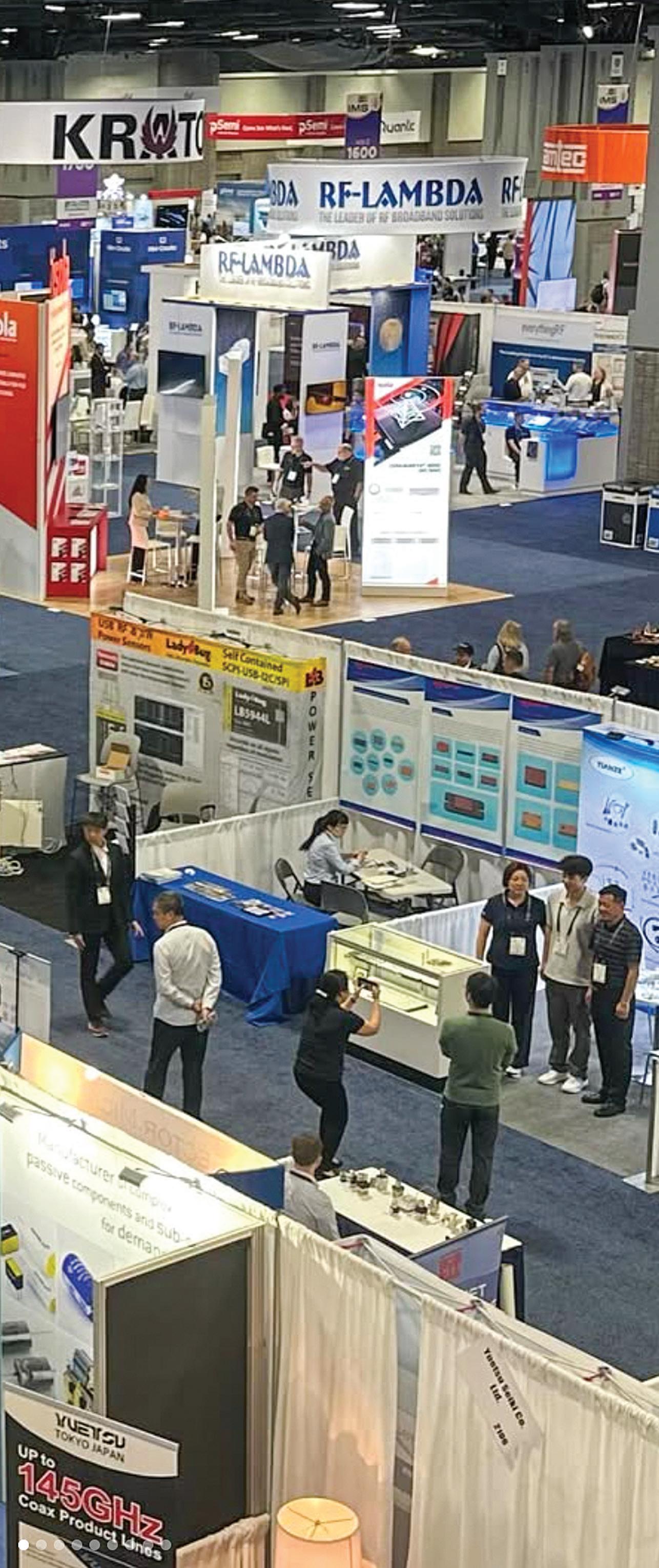
IMS2025 has designated Exhibit Only time today from 15:10-17:00!
Visit with the Exhibitors, view posters at the IMS Interactive Forum (Booth 5003) or attend a MicroApps Session (Booth 5401)!
MICROAPPS 09:30 – 17:00 Wednesday, 18 June 2025 MicroApps Theater: Booth 2159
SESSION
SPEAKER(S), AFFILIATIONS
WEMA1 09:30 – 09:45 Non-Terrestrial Networks (NTNs): Where Cellular and SatCom Converge Mike McLernon, MathWorks
WEMA2 09:45 – 10:00 Advanced FR2 Network Solutions: Leveraging OpenAirInterface (OAI) with ORAN, FlexRIC, and MIMO for Practical Deployment Ethan Lin, TMY Technology Inc.
WEMA3 10:00 – 10:15 Far-field Radiation Pattern: Analysis, Visualization, Prediction and Challenges Vishwanath Iyer, MathWorks, Inc.
WEMA4 10:15 – 10:30 ADF4382 Fast Calibration Feature Chukwuka Osemene, Analog Devices
WEMA5 10:30 – 10:45 A Dual-Band Channel Sounder Module for FR1 & FR3 Band Modelling Daniel Ford, Mini-Circuits
WEMA6 10:45 – 11:00 Achieving Superior Phase Synchronization Stability and Tracking Between Two Microwave Signal Sources Using 1.6 Ghz Frequency Reference Sadashiv Phadnis, Anritsu
WEMA7 11:00 – 11:15 Satellite Communications - Testing. Veeram Reddy, Anritsu Co.; Krishna Kishore Reddy, Anritsu Co.
WEMA8 11:15 – 11:30 Millimeter-Wave RCS Measurements Using a Compact Antenna Test Range Andrew Laundrie, Eravant; Alex Chen, Eravant
WEMA9 11:30 – 11:45 Future Technologies for Wireless Communications and 6G Jonathan Borrill, Anritsu Co.
WEMA10 11:45 – 12:00 Performing Large OTA Data Collections with the USRP Neel Pandeya, National Instruments
WEMA11 12:00 – 12:15 Qualified Frequency Sources for Rapid Deployment in Space Applications Ian Matthews, Narda-Miteq
WEMA12 12:15 – 12:30 Measuring PA Parametric-Level and System-Level EVM for 5G-NR Neel Pandeya, NI; Cole Huth, NI
WEMA13 12:30 – 12:45 Novel 6G Channel Sounding Application - OTA Measurements for 6G FR3 Band Navneet Kataria, Anritsu, ARFTG
WEMA14 12:45 – 13:00 Precise Measurements of the Effective Conductivity of Copper Foils and Copper Clad Laminates for 5G-6G Applications
WEMA15 13:00 – 13:15 Tackling Four Common Phased Array Performance Shortcomings with RF Lensing
WEMA16 13:15 – 13:30 Revolutionizing Phased-Array Antenna Design: A Fast and Accurate Full-Wave Simulation Tool
WEMA17 13:30 – 14:30 StartUp Panel #2: SBIR/STTR
Marzena Olszewska-Placha, QWED Sp. z o.o.
Philip Lambert, Fortify; Henrik Ramberg, Fortify
Jakob R. de Lasson, TICRA
Moderator: David Vieira, Vieira High Frequency Design
Panelists: Marco Romani, NAVALX; Tony Williams, NAVALX; Paul Scott, Matrix Information Services
WEMA19 14:45 – 15:00 Efficient approach to Microwave and RF Design for Space Applications. Enow Tanjong, 3ds
WEMA21 15:15 – 15:30 EM-TWIN: Accurate & Efficient Digital Twin EM simulation
Winfried Simon, IMST GmbH
WEMA22 15:30 – 15:45 From Simulation to Optimization: Leveraging DOE and Automation in 3D Electromagnetic Design Yun Xu, 3ds
WEMA23 15:45 – 16:00 Integrating System Simulation Testbenches with Virtuoso Design Link Designs Gent Paparisto, Cadence Design Systems, Inc.
WEMA24 16:00 – 16:15 Load Pull Analysis in XFdtd EM Simulation Software
WEMA25 16:15 – 16:30 A Machine Learning Generative AI Approach for Antenna Design and Topology Optimization
WEMA26 16:30 – 16:45 RF Digital Twins with Human Bodies: A Hybrid EM Simulation Approach
WEMA27 16:45 – 17:00 About Sampling Rates, Master Clock Rates, and Nyquist Zones on the USRP X440
Sponsored By:
Justin Newton, Remcom, Inc.
Moein Nazari, Cadence Design Systems; Xiaobo Wong, Cadence Design Systems; Suomin Cui, Cadence Design Systems
Tarun Chawla, Remcom
Neel Pandeya, National Instruments; Drew Fischer, National Instruments; Cole Huth, National Instruments
PL3: Sustainable Cities: Harnessing Technology for a Greener Future
ORGANIZERS: Sulekha Chattopadhyay, California Environmental Protection Agency; J.C. Chiao, Southern Methodist University PANELISTS:
Saifur Rahman, Virginia Polytechnic Institute and State University, USA
Karin Sung, California Public Utilities Commission
Christopher Rodenbeck, Naval Research Laboratory
Yuliya Shmidt, Bay Area Rapid Transit
Ronnie Siegel, Swire Siegel Landscape Architects
Ann Xu, ElectroTempo
ABSTRACT: The true benefit of technological innovation is realized when it enhances lives while adhering to environmental sustainability. This connection is crucial for researchers, businesses, and policymakers to understand and prioritize. As technology evolves, its integration into urban environments can drive significant improvements in quality of life. Cities are often epicenters of technological gatherings like IMS, making them ideal arenas for demonstrating the implementation of sustainable technologies. This panel will illustrate how the convergence of technology and policy can lead to significant tangible societal benefits. E.g., the adoption of broadband technology and legislation is helping bridge the digital divide, integration of smart grids and renewable energy sources are reducing carbon emissions, innovations in public transportation and waste management are improving living standards and lowering the environmental impact. We hope that this would result in providing a roadmap for creating economically vibrant and environmentally livable communities around the world.
SBIR/STTR
ABSTRACT: Federal agencies working with Entrepreneurs to fund innovation.
MODERATOR: David Vieira, Vieira High Frequency Design PANELISTS:

Marco Romani, NAVALX
Tony Williams, NAVALX
Paul Scott, Matrix Information Services
Reception to follow in the StartUp Networking Lounge
IMS TECHNICAL SESSIONS
203
We3B: Advances in MillimeterWave Transceivers for Next Generation Radar and Communication Applications
Chair: Julio Navarro, Boeing
Co-Chair: Glenn Hopkins, Georgia Tech Research Institute
We3B-1: From Components to Turn-Key Systems: Innovations in Aerospace Through Heterogeneous Integration
J. Navarro, Boeing
We3B-2: A 60-GHz RadCom DownConverter in 22-nm CMOS FDSOI for Short-Range Hand Gesture Sensing and High-Data-Rate Proximity Communication
N. Rzaik, CEA-LETI; C. Dehos, CEA-LETI; A. Siligaris, CEA-LETI; M. Zarudniev, CEA-LETI; B. Blampey, CEA-LETI; J.-L. Gonzalez Jimenez, CEA-LETI
We3B-3: A 71-to-76GHz 8-Element Switchless Isolated Spectrum PhasedArray Transceiver with Direct-Modulation and Reflectionless Sliding-IF
W. Chen, UESTC; B. Yang, UESTC; C. Han, UESTC; J. Zhou, UESTC; X. Luo, UESTC
205
We3C: Highly Integratable Passive Devices Based on CMOS and SOI Technology
Chair: Hamhee Jeon, Qorvo Co-Chair: Ki Shin, Oorvo
We3C-1: A Highly Linear 4W Differential SOI-CMOS RF Switch
V. Solomko, Infineon Technologies; T.-L. Hsu, Technische Univ. München; S. Syroiezhin, Infineon Technologies; Y. Zhang, Infineon Technologies; A. Hagelauer, Technische Univ. München
207
We3D: Computational Methods, Optimization, and Modelling Techniques for Circuit and System Design
Chair: Marco Pirola, Politecnico di Torino
Co-Chair: Erin Kiley, Massachusetts College of Liberal Arts
We3D-1: Computational Electromagnetics and a Facilitator of Microwave Creativity and Industrial Innovation
M. Celuch, QWED
We3B-4: A D-Band Front-End T/R MMIC in a 70-nm GaN HEMT Technology
T. Zieciak, Fraunhofer IAF; P. Neininger, Fraunhofer IAF; C. Friesicke, Fraunhofer IAF; P. Brückner, Fraunhofer IAF; R. Quay, Fraunhofer IAF
We3C-2: Miniaturized D-Band SPDT/ DPDT Switches Using Series Triple Coupled Transformer Cores in 65-nm CMOS SOI
N. Zhu, Tianjin Univ.; Y. Zhang, Tianjin Univ.; F. Meng, Tianjin Univ.
We3C-3: A DC-51.5 GHz Digital Step Attenuator with Sub-5 dB Insertion Loss and 3.1° RMS Phase Error
Z. Zhang, Southeast Univ.; J. He, Southeast Univ.; Q. Chen, Southeast Univ.; X. Jiang, Southeast Univ.; X. Fan, Southeast Univ.; L. Li, Southeast Univ.
We3D-2: A Simple Closed-Form CAD Approach for Sensitivity Analysis and Optimization of Passive Networks Against Load Variations
C. Ramella, Politecnico di Torino; P. Colantonio, Università di Roma “Tor Vergata”; M. Pirola, Politecnico di Torino
We3D-3: Frequency-Query Enhanced Electromagnetic Surrogate Modeling with Edge Anti-Aliasing Pixelation for Bandpass Filter Inverse Design
J. Bi, X. Zhou, PolyU; J. Xia, Jiangsu University; S. Chen, Hangzhou Dianzi University; W.S. Chan, CityUHK
We3D-4: Cognitive Broyden-based Input Space Mapping for Design Optimization
J. Rayas-Sanchez, ITESO
We3C-4: A 10-17 GHz Continuously Tunable CMOS Filter with FlexibleBandwidth Control Based on Mode-Switching Inductors
B. Liu, UESTC; K. Li, UESTC; Z. Chen, UESTC; Y. Ning, UESTC; S. Shao, UESTC; P.-L. Chi, NYCU; T. Yang, UESTC
We3B-5: A 71–76GHz Phased-Array Transmitter with Nested-Coupler-Based Phase Shifter in 65nm CMOS
Z. Mai, L. Wu, Q. Li, J. Xu, Z. Chen, W. Zhao, Zhejiang Univ.; N. Li, Donghai Laboratory; X. Qi, Zhejiang Univ.; C. Song, Z. Xu, Donghai Laboratory
We3B-6: A 71–76GHz Four-Element Phased-Array Receiver with Compact Footprint in 65-nm CMOS
L. Wu, Z. Mai, Q. Li, W. Zhao, Z. Chen, J. Xu, Zhejiang Univ.; N. Li, Donghai Laboratory; X. Qi, C. Song, Zhejiang Univ.; Z. Xu, Donghai Laboratory
We3C-5: An Ultra-Compact D-Band SIW Filter with Multifunction Transitions to Coplanar Input/Output
X. Tong, Cornell Univ.; X. Wang, Cornell Univ.; T. Li, Cornell Univ.; L. Li, Cornell Univ.; M. Ciabattoni, Cornell Univ.; F. Monticone, Cornell Univ.; J.C.M. Hwang, Cornell Univ.
We3D-5: Knowledge-based Extrapolation of Neural Network Model for Transistor Modeling
J. Cui, Carleton Univ.; L. Zhang, NXP Semiconductors; H. Kabir, NXP Semiconductors; Z. Zhao, NXP Semiconductors; R. Sweeney, NXP Semiconductors; Q.-J. Zhang, Carleton Univ.
We3D-6: Analysis of a Self-Injected Super-Regenerative Oscillator for Motion Sensing
S. Sancho, Universidad de Cantabria; M. Ponton, Universidad de Cantabria; A. Suarez, Universidad de Cantabria
We3G: Advanced RF/mm-Wave Low-Phase Noise Signal Generation
Chair: Amit Jha, Nokia
Co-Chair: Sushil Kumar, National Instruments
We3G-1: A 7.8–11.9GHz Quad-Mode Class-F2,3 VCO with Multi-Stage CrossShared Common-Mode Path Achieving -131.9dBc/Hz 1-MHz Phase Noise and 201.8dBc/Hz FoMT
Y. Wang, UESTC; Y. Shu, UESTC; Q. Leng, UESTC; X. Luo, UESTC
We3G-2: A 19.3-to-27.3GHz Area-Reuse Double Dual-Core Complementary Class-F-1 VCO with Non-Interfering Multiple Resonances Achieving 203.3dBc/Hz FoMT and 213.3dBc/Hz FoMTA
Z. Zhao, UESTC; Y. Shu, UESTC; J. Xie, UESTC; X. Luo, UESTC
We3G-3: A 60GHz Super Harmonic Injection Locked Oscillator with Quadrature Outputs
M. Cui, Technische Universität Dresden; X. Xu, Technische Universität Dresden; J. Wagner, Technische Universität Dresden; F. Ellinger, Technische Universität Dresden
We3G-4: Low-Power and Low-Phase Noise 94-GHz and 107.2-GHz Differential Fundamental Oscillators in 70-nm GaAs pHEMT Technology
C.-J. Wu, National Taiwan Univ.; X. Jiang, National Taiwan Univ.; A.Y.-K. Chen, Univ. of California, Santa Cruz; J.-T. Chung, WIN Semiconductors; L.-C. Chang, WIN Semiconductors; L.-Y. Tseng, WIN Semiconductors; C.-T.M. Wu, National Taiwan Univ.
We3G-5: A 134GHz High Efficiency High Power Fundamental Oscillator in 16nm p-FinFET with 12dBm Output Power and 6.5% DC-to-RF Efficiency
L. Cuskelly, Univ. of California, Los Angeles; Y. Lee, Univ. of California, Los Angeles; C. Chen, Univ. of California, Los Angeles; D. Huang, Univ. of California, Los Angeles; M.-C.F. Chang, Univ. of California, Los Angeles
Denotes Keynote Presentation
We3H: High Efficiency Doherty and LMBA Power Amplifiers
Chair: Vittorio Camarchia, Politecnico di Torino;
Co-Chair: Peter Asbeck, University of California, San Diego
We3H-1: Future State of GaN MMIC Technology for Defense Electronics
D.F. Brown, BAE Systems
We3H-2: A Broadband Doherty-like Load-Modulated Balanced Amplifier with an Optimized Impedance Transformation Ratio in InGaP/GaAs HBT Process for Handset applications
B. Yoon, Hanyang Univ.; S. Bae, Hanyang Univ.; S. Lee, Hanyang Univ.; S. Hwang, Hanyang Univ.; J. Jeon, Gangneung-Wonju National University; J. Kim, Hanyang Univ.
We3H-3: Wideband 3-W GaAs MMIC
Doherty PA with Stacked Devices and Load Variation Tolerance Under 2.5:1 VSWR
A. Piacibello, Politecnico di Torino; G. Bartolotti, Politecnico di Torino; V. Camarchia, Politecnico di Torino
We3H-4: A Sub-6GHz Ultra-Compact 69.8% Drain Efficiency Harmonic Control Doherty Power Amplifier in GaN Technology
S.-H. Li, ITRI; J. Zhang, ITRI; S.S.H. Hsu, National Tsing Hua Univ.

the Date Revolutionizing RF
We3H-5: A Ka-Band GaN Doherty Power Amplifier with High Efficiency Over a Fractional Bandwidth of 20.4%
M. Safari Mugisho, Fraunhofer IAF; C. Friesicke, Fraunhofer IAF; M. Ayad, UMS; T. Maier, Fraunhofer IAF; R. Quay, Fraunhofer IAF
IMS is the world’s premier RF/microwave technical conference and industry exhibition. Attendees will appreciate that IMS2026 has been refreshed with the technical content reorganized, and new branding, new website, and new mobile app launched. IMS2026 kicks off with the RF Integrated Circuits (RFIC) Symposium, then introduces two new symposia formed out of traditional IMS technical content, the RF Technology & Techniques (RFTT) Symposium and the RF Systems & Applications (RFSA) Symposium, before concluding the week with the ARFTG Microwave Measurement Conference. IEEE Hard Tech Venture Summit, which connects early-stage hardware startups with resources and funding, will again be co-located with IMS2026. The IMS Exhibition will continue to run for three days mid-week.
INTERACTIVE FORUM
| IF1 15:10 – 17:00 Wednesday, 18 June 2025 Exhibit Hall, Booth 5003
Chairs: Bert Henderson, Consultant; Matt Clements, Apple; Kiyoshi Miyashita, ASML
IF1-1: Ku-Band Multi-Functional Bandpass Filtering Isolators (BPFIs) Using GaAs Coupled-Line-Based Unilateral FrequencySelective Stages
K. Li, Univ. College Cork; A. Fontana, Univ. College Cork; D. Psychogiou, Univ. College Cork
IF1-2: GaN-Based Power Amplification Unit for the Europa Clipper Mission
K. Srinivasan, Jet Propulsion Lab; H.S. Figueroa, Jet Propulsion Lab; D.C. Howard, Astranis Space Technologies; E.T. Schlecht, Jet Propulsion Lab; R.S. Zebulum, Jet Propulsion Lab; T. Shenoy, Blue Origin Enterprises; D.L. Kirchner, Univ. of Iowa; A. Moussessian, Jet Propulsion Lab
IF1-3: Dielectric Filled Waveguide Antenna for Air-Borne Application
M. Chakravarti, IIT Hyderabad; A. Chepala, DRDO; A. Dutta, IIT Hyderabad
IF1-4: An Area-Efficient Reconfigurable Compact Multi-Band Directional Coupler in RF SOI CMOS Technology
T.-L. Hsu, Technische Univ. München; A. Hagelauer, Technische Univ. München; V. Solomko, Infineon Technologies
IF1-5: Metasurface Design for RCS Reduction Applications
I. Ahmed, NUST; M. Noman, Univ. of Glasgow; M. Imran, Univ. of Glasgow; F.A. Tahir, Univ. of Glasgow; Q.H. Abbasi, Univ. of Glasgow
IF1-6: USB Type-C Receptacle Connector with Ceramic Insulator and Three-Layer Ground Plates
J.-H. Park, Univ. of Seoul; C.-S. Lee, EDS Solution; J.-M. Jang, EDS Solution; S.-H. Yun, Univ. of Seoul; J.-H. Choi, EDS Solution; M.-Q. Lee, Univ. of Seoul
IF1-7: A TSPC mm-Wave Frequency Divider with up to 50GHz Input Frequency in 12nm FinFET Bulk CMOS
K. Vilyuk, FAU Erlangen-Nürnberg; K. Scheller, FAU Erlangen-Nürnberg; P. Hetterle, FAU ErlangenNürnberg; F. Probst, FAU Erlangen-Nürnberg; A. Engelmann, FAU Erlangen-Nürnberg; A.-M. Schrotz, FAU Erlangen-Nürnberg; N. Franchi, FAU Erlangen-Nürnberg; R. Weigel, FAU Erlangen-Nürnberg
IF1-8: A 28GHz Dual-Mode Power Amplifier for Enhanced Load Resiliency or Back-Off Efficiency Enhancement in 22nm FDSOI Process
H. Yu, Univ. of Waterloo; M. Hazer Sahlabadi, Univ. of Waterloo; S. Boumaiza, Univ. of Waterloo
IF1-9: Electromagnetically Induced Transparency Based Metamaterials Integrated with Plasma Cells for High Power Microwave Protection
M.R. Akram, Univ. of Toledo; A. Semnani, Univ. of Toledo
IF1-10: A Full V-Band High-Output Power Frequency Doubler with High Fourth Harmonic Suppression in a InGaAs mHEMT Technology
E. Sigle, Fraunhofer IAF; A. Leuther, Fraunhofer IAF; R. Quay, Fraunhofer IAF
IF1-11: Tensor Train Optimization for Polynomial Chaos for High Dimensional Uncertainty Quantification
Z. Wang, McGill Univ.; R. Khazaka, McGill Univ.
IF1-12: Detection Algorithm for Waveguide Connection and Probe Contact States Based on Machine Learning in Frequency up to 1.1THz R. Sakamaki, AIST; S. Kon, AIST; S. Amakawa, Hiroshima Univ.; T. Yoshida, Hiroshima Univ.; S. Tanaka, Hiroshima Univ.; M. Fujishima, Hiroshima Univ.
IF1-13: A Wideband TIA-Driver Unit in 22-nm CMOS FDSOI for Integrated Microwave Optoelectronic Oscillators
S. Banavdi, Texas A&M Univ.; J. Fu, Texas A&M Univ.; K. Entesari, Texas A&M Univ.
IF1-14: New Coaxial Interconnection — Application to Wilkinson Dividers/Combiners
E. Rius, Lab-STICC (UMR 6285); J. Benedicto, Lab-STICC (UMR 6285); J.F. Favennec, Lab-STICC (UMR 6285); J.P. Guzmán Vélez, Lab-STICC (UMR 6285)
IF1-15: A 230-GHz 3.5-dBm Phase-ShifterEmbedded Frequency Tripler with 360° Phase-Shifting Range in 40-nm CMOS
C.-S. Lin, National Taiwan Univ.; C.-H. Li, National Taiwan Univ.
IF1-16: RPRS: Real-Time Privacy mm-Wave Radar Sensing System
H. Wu, Intel; X. Cai, Intel; Y. Gao, Intel; C. Miao, Intel
IF1-17: Material Characterization of Graphene Oxide and Reduced Graphene Oxide Using Resonance Methods
L. Nowicki, QWED; M. Milenkovic, Univ. of Belgrade; S. Jovanovic, Univ. of Belgrade; M. OlszewskaPlacha, QWED; M. Celuch, QWED
IF1-18: A High-Efficiency Outphasing Power Amplifier Utilizing a Synthesized DirectMatching Technique Based on Two-Section Branch-Line Coupler Output Combiner
B. Zeng, CityUHK; P.-W. Shu, CityUHK; S. Zheng, Sun Yat-sen Univ.; X. Zhou, PolyU; W.S. Chan, CityUHK
IF1-19: Accurate Large-Scale Motion Sensing With FMCW Radar Based on Range-Dependent DFT Technique
J. Zhang, SJTU; Z. Zhang, SJTU; Y. Li, SJTU; C. Gu, SJTU; J. Mao, SJTU
IF1-20: A THz Attenuator Based on Voltage-Tunable Whispering Gallery Mode Resonator
H. Zhang, Nanjing Univ.; X. Tu, Nanjing Univ.; D. Gu, Nanjing Univ.; Z. Xu, Nanjing Univ.; Y. Rui, Nanjing Univ.; Z. Mai, Nanjing Univ.; B. Yan, Nanjing Univ.; C. Zhang, Nanjing Univ.; X. Yan, Nanjing Univ.; J. Wu, Nanjing Univ.; S. Zhou, Nanjing Univ.; L. Kang, Nanjing Univ.; J. Chen, Nanjing Univ.; P. Wu, Nanjing Univ.
IF1-21: Modified GaN Based Sequential Load-Modulated-Balanced-Amplifier Avoiding Schottky-Gate Effects & Increase Linearisability
G. Jindal, Nokia ; B. Jelonnek, Nokia ; T. Felgentreff, Nokia
IF1-22: Ultra-Wideband 6-Bit Passive Phase Shifter with Open-Circuit Microstrip Pseudo-π Network and Low RMS Phase Error
T. Zhang, CAS; Y. Zhang, CAS; K. Wang, CAS; J. Wan, CAS; X. Sun, CAS; X. Liang, CAS
IF1-23: A 28nm CMOS Almost All-Digital 0.5 to 4.0GHz Ultra-Wideband Ground Penetrating Radar for Lunar Surface Exploration
A. Tang, Jet Propulsion Lab; A. Bharathan, Univ. of California, Los Angeles; Z. Gonzalez-Ruskiewicz, Second Order Effects; O. Janani, Second Order Effects; C. Kniss, Stevens Institute of Technology; Y. Kim, Stevens Institute of Technology
IF1-24: Parallel Differential-Line Fed Planar Aperture Antenna-in-Package with Signal Lines Isolated from IC in 300-GHz Band
T. Uemura, Nagoya Institute of Technology; A. Yamazaki, Nagoya Institute of Technology; Y. Sugimoto, Nagoya Institute of Technology; K. Sakakibara, Nagoya Institute of Technology; N. Kikuma, Nagoya Institute of Technology
IF1-25: 2200W High-Efficiency Amplifier Module Covering 325MHz and 352MHz Applications
W.G. Leijenaar, Leijenaar Electronics
IF1-26: An Ultra-Low-Cost Early Warning Sensor for Pedestrians
C. Hajimiri, Polytechnic School; A. Hajimiri, Caltech
IF1-27: Quantum Method for Solving S-Parameters of Lossless Waveguides Based on the HHL Method and Finite-Element-Method
X. Li, Tianjin Univ.; F. Feng, Tianjin Univ.; Q.J. Zhang, Carleton Univ.
IF1-28: High Power-Added-Efficiency AlGaN/ GaN E-Mode HEMTs for Low-Supply-Voltage RF Terminal Applications
X. He, CAS; K. Wei, CAS; S. Zhang, CAS; R. Zhang, CAS; K. Wang, CAS; J. Guo, CAS; J. Wang, CAS; R. Zhao, CAS; X. Wang, CAS; Y. Li, CAS; W. Luo, CAS; J. Niu, CAS; X. Liu, CAS
IF1-29: GaN Trap Model Extraction Based on MHz Load-Line Measurements
P. Beleniotis, BTU; C. Andrei, BTU; C. Zervos, BTU; U.L. Rohde, BTU; M. Rudolph, BTU
IF1-30: A Coupler-Feedback Technique for Power Amplifier Gain Enhancement
R. Mannion, University of Colorado Boulder; T. Barton, University of Colorado Boulder
IF1-31: Analysis of High-Efficiency Power Amplifiers Exploiting Input Harmonics and Nonlinear I-V Knee Characteristics
P.-W. Shu, CityUHK; B. Zeng, CityUHK; L.-H. Zhou, Nantong University; X. Zhou, PolyU; W.S. Chan, CityUHK
IF1-32: S-Parameter-Based Simulation Technique and Crosstalk Suppression for Large-Scale Superconducting QuantumComputing Chip Design
S. Shiba, Fujitsu; S. Tamate, RIKEN; P.A. Spring, RIKEN; A. Dote, Fujitsu; N. Kouma, Fujitsu; Y. Doi, Fujitsu; Y. Nakamura, RIKEN; S. Sato, Fujitsu
IF1-33: High-Efficiency Low-Complexity ASK Transmitter Using an Inverse Class-F Power Amplifier with a Nonuniform TransmissionLine-Based Load Transformation Network
L. Hüssen, RWTH Aachen Univ.; M.-D. Wei, RWTH Aachen Univ.; R. Negra, RWTH Aachen Univ.
IF1-34: A SiGe J-Band Gilbert Cell-Based Frequency Doubler and Power Amplifier Chain with 10dBm Output Power
S. Hauptmeier, Ruhr-Universität Bochum; M.A. Yildirim, Ruhr-Universität Bochum; N. Pohl, Ruhr-Universität Bochum
IF1-35: An Effective Basis Function Generation Structure for Digital Pre-Distortion in Wideband Scenarios
T. Zhong, UESTC; J. Peng, UESTC; S. He, UESTC; J. Zhu, UESTC; Y. Bian, UESTC; M. Xiong, UESTC; X. Wang, UESTC; C. Liang, UESTC; Y. Tang, UESTC
IF1-36: Multi-Functional Modulated Surface Based on M-Type Ferrite for mmWave Application
N. Ha, Hanwha Systems; S. Kim, Pusan National Univ.; H. Lee, KIMS; M. Jang, KIMS; B. Park, KIMS; M.M. Tentzeris, Georgia Tech; S. Kim, Pusan National Univ.
IF1-37: Dual-Band Surface Acoustic Wave Filter Based on Parallel Connected Resonators J. Cai, UESTC; Y. Dong, UESTC
IF1-38: Fast-Switchable 3.6GHz GaN Doherty Power Amplifier for Energy-Efficient Non-Continuous Transmission of 256-QAM Signals
M.G. Becker, Technische Universität Dresden; R. Krämer, Technische Universität Dresden; M. Gunia, Technische Universität Dresden; F. Ellinger, Technische Universität Dresden
IF1-39: Predicting the Fidelity of Multiplexed Superconducting Qubit Readout with Multiphysics Numerical Methods
S.T. Elkin, Purdue Univ.; M. Haider, Technische Univ. München; T.E. Roth, Purdue Univ.
IF1-40: TCN-DPD: Parameter-Efficient Temporal Convolutional Networks for Wideband Digital Predistortion
H. Duan, Technische Universiteit Delft; M. Versluis, Technische Universiteit Delft; Q. Chen, Universiteit Leiden; L.C.N. de Vreede, Technische Universiteit Delft; C. Gao, Technische Universiteit Delft
IF1-41: Enhancing Long-Range Battery-Free Communication: A Passive Lens-Enabled Broadbeam Harmonic mmID for Emerging IoT Systems
M. Joshi, Georgia Tech; C.A. Lynch III, Georgia Tech; K. Hu, Georgia Tech; M.M. Tentzeris, Georgia Tech
IF1-42: Heart Rate Variability Monitoring Using a Chord-Based Algorithms in Low-IF CW Radar Systems
Y.-C. Tseng, National Cheng Kung Univ.; C.-L. Yang, National Cheng Kung Univ.
IF1-43: A Compact Brick-Type 40GHz-Band DBF Transmit Antenna Module Using Direct Digital RF Technology
K. Furuuchi, Tohoku Univ.; R. Miyagawa, Tohoku Univ.; Y. Fujiya, Tohoku Univ.; J. Zhang, Tohoku Univ.; T. Furuichi, Tohoku Univ.; S. Tsukamoto, Tohoku Univ.; N. Suematsu, Tohoku Univ.
IF1-44: A 30-mW D-Band High-Sensitivity Self-Injection-Locked Radar Sensor with Integrated SIW Antenna in 70-nm GaAs pHEMT Technology
C.-J. Wu, National Taiwan Univ.; D. Gao, Rutgers Univ.; S. Li, Rutgers Univ.; A.Y.-K. Chen, Univ. of California, Santa Cruz; C.-T.M. Wu, National Taiwan Univ.
IF1-45: Direction Finding for Software Defined Radios with Switched Uniform Circular Arrays
L. Werner, ETH Zürich; M. Gardill, BTU; M. Hutter, ETH Zürich
IF1-46: Extended D-Band Low-Noise-Amplifier MMICs Based on a 50-nm Metamorphic HEMT Technology
F. Heinz, Fraunhofer IAF; F. Thome, Fraunhofer IAF; A. Leuther, Fraunhofer IAF
IF1-47: A Body-Floating G-Band Frequency Doubler for Astronomical Receiver in 90-nm CMOS Process
Y.-H. Lee, National Taiwan Univ.; C.-C. Chiong, Academia Sinica; Y. Wang, National Taiwan Univ.; H. Wang, National Taiwan Univ.
ADVANCED PRACTICE AND INDUSTRY PAPER COMPETITIONS
The Advanced Practice Paper Competition (APPC) recognizes outstanding technical contributions that apply to practical applications. All finalist papers are on advanced practices and describe an innovative RF/microwave design, integration technique, process enhancement, and/or combination thereof that results in significant improvements in performance and/or in time to production for RF/microwave components, subsystems, or systems.
The Industry Paper Competition (IPC) recognizes outstanding technical contributions from industry sources. All finalist papers are from the RF/microwave industry and describe innovation of a product or system application that potentially has the highest impact on an RF/microwave product and/or system which will significantly benefit the microwave community and society at large.
ADVANCED PRACTICE PAPER FINALISTS:
Tu2F-3 | 1.9 GHz - 4.1 GHz CMOS Rectifier with Over 48% Efficiency using an Additional Resonance and CRT Reduction for Beamforming WPT System
Babita Gyawali, Adel Barakat, Ramesh Pokharel, Kyushu Univ.
IF1-2 | GaN-based Power Amplification Unit for the Europa Clipper Mission
Karthik Srinivasan, Harry .S Figueroa, Jet Propulsion Lab; Duane Howard, Amazon Web Services, Inc.; Erich .T Schlecht, Ricardo S. Zebulum, Jet Propulsion Lab; Tushar Shenoy, Blue Origin LLC; Donald L. Kirchner, Univ. of Iowa; Alina Moussessian, Jet Propulsion Lab
IF1-6 | Novel USB Type-C Receptacle Connector with Ceramic Insulator and Three-Layer Ground Plates
Jeong-Hun Park, Univ. of Seoul; Chung-Seok Lee, Jin-Man Jang, EDS Solution; Seon-Hwa Yun, Univ. of Seoul; Jae-Hyuk Choi, EDS Solution; Moon-Que Lee, Univ. of Seoul
IF1-9 | An EIT-Based Plasma-Integrated Metasurface for High-Power Microwave Protection
Muhammad Rizwan Akram, Abbas Semnani, Univ. of Toledo
Tu1C-5 | Programmable Multi-Functional Microwave Photonic Circuit in the Thin-Film Lithium Niobate Platform
Chuangchuang Wei, Kaixuan Ye, David Marpaung, Univ. of Twente
IF1-23 | A 28nm CMOS Almost All-Digital 0.5 to 4.0 GHz Ultra-Wideband Ground Penetrating Radar for Lunar Surface Exploration
Adrian .J Tang, Jet Propulsion lab; Arhison Bharathan, Univ. of California, Los Angeles; Zachary T. Gonzalez-Ruskiewicz, Omid Janani, Second Order Effects; Christopher Kniss, Rod Kim, Stevens Institute of Technology
Tu4B.1 | Shape Estimation and Pattern Correction of Flexible Phased Arrays Using Local Curvature Measurements
Yair Dashevsky, Matan Gal-Katziri, Ben-Gurion Univ.
We2B-3 | A 28GHz Compact Phased-Array Beamformer with 21.3dBm PSAT and 5.2dB Noise Figure in 40nm CMOS
Zheng Ma, Zonglin Ma, Hao Shi, Ming Yin, Weihong Liu, Yifei Yan, Yongqiang Wang, Fanyi Meng, Keping Wang, Kaixue Ma, Tianjin Univ.
INDUSTRY PAPER FINALISTS:
We2H-2 | A High-Efficiency GaAs HBT Power Amplifier for 6G FR3 Applications
Jung-Tao Chung, Keng-Li Hsu, Chang Cheng Te, Kai-Chen Feng, Kun-You Lin, Chao-Hsin Wu, National Taiwan Univ.; Jyun-Hao Li, Shao-Yu Tu, Tung-Yao Chou, Shu-Hsiao Tsai, Cheng-Kuo Lin, WIN Semiconductors Corp.
Th1B-2 | A Low-Loss, Wideband, 0-110 GHz SPDT Using PCM RF Switches with Integrated CMOS Drivers
Jeff Dykstra, Peregrine Semiconductor Corp.; Nabil El, Hinnawy, Tower Semiconductor; Greg Slovin, Tower Semiconductor
Th2D-4 | Cross-spectrum Phase Noise Measurements of $10^{, 15}$, Level Stability
Photonic Microwave Oscillators
Michele Giunta, Benjamin Rauf, Sebastian Pucher, Simon Afrem, Menlo Systems GmbH; Wolfgang W. Wendler, Alexander Roth, Jonas Kornprobst, Rohde & Schwarz GmbH & Co KG; Stefan Peschl, Jonas Schulz, Jan Schorer, HENSOLDT Sensors GmbH; Marc Fischer, Ronald Holzwarth, Menlo Systems GmbH
Tu3E-1 | Experimental Demonstration of E-Band Tunable Analog Predistortion
Dhecha Nopchinda, Gotmic AB; Herbert Zirath, Chalmers Univ. of Technology; Marcus Gavell, Gotmic AB
Th2A-3 | High Performance Waveguide Launcher in Interposer Package Technology for 77/79 GHz Automotive 4D Imaging Radar
Rasoul Ebrahimzadeh, Taieb Elkarkraoui, Mohammad Marvasti, MMSENSE Technologies Inc.; Abdellatif Zanati, Jonas Harm, NXP Semiconductors, Hamburg, Germany; MohammadReza Nezhad-Ahmadi, MMSENSE Technologies Inc.
We3C-1 | A Highly Linear 4W Differential SOI-CMOS RF Switch
Valentyn Solomko, Infineon Technologies AG; Ting-Li Hsu, Tech. Univ. of Munich; Semen Syroiezhin, Yiwen Zhang, Infineon Technologies AG; Amelie Hagelauer, Tech. Univ. of Munich
Tu3B-1 | 150 GHz-band Compact Phased-Array AiP Module for XR Applications Toward 6G
Yohei Morishita, Panasonic Industry Co., Ltd.; Ken Takahashi, Panasonic System Networks R&D Lab. Co., Ltd.; Ryosuke Hasaba, Panasonic Industry Co., Ltd.; Akihiro Egami, Tomoki Abe, Masatoshi Suzuki, Tomohiro Murata, Yoichi Nakagawa, Koji Takinami, Panasonic Industry Co., Ltd.; Yudai Yamazaki, Institute of Science Tokyo; Sunghwan Park, Institute of
We3H-3 | Wideband 3-W GaAs MMIC Doherty PA with Stacked Devices and Load Variation Tolerance under 2.5:1 VSWR
Anna Piacibello, Giulia Bartolotti, Vittorio Camarchia, Politecnico di Torino
Th2F-2 | 300-GHz-Band InP HBT Power Amplifier Module Enabling 280-Gbps 0-dBm
Signal Generation with Digital Predistortion
Teruo Jyo, NTT Corporation; Sam Kusano, Keysight Technologies; Hiroaki Katsurai, NTT Innovative Devices Corporation; Hiroshi Hamada, NTT Device Technology Laboratories; Munehiko Nagatani, Miwa Mutoh, Yuta Shiratori, NTT Corporation; Hiroyuki Takahashi, Nippon Telegraph and Telephone Corp.
We3B-4 | A D-Band Front-End T/R MMIC in a 70-nm GaN HEMT Technology
Thomas Zieciak, Philipp Neininger, Christian Friesicke, Peter Brückner, Rüdiger Quay, Fraunhofer Institute for Applied Solid State Physics
We2E-2 | Novel Radial Combiners with Integrated Low Pass Filtering Function
Mohamed Fahmi, Defence Research and Development Canada; Jorge A. Ruiz-Cruz, Univ. Politecnica de Madrid; Raafat R Mansour, Univ. of Waterloo
We2D-4 | A Power-Efficient Plasma Jet Line Enabled by Dielectric Anapole Resonator Technology
Muhammad Rizwan Akram, Abbas Semnani, Univ. of Toledo
Tu4F-4 | Polarimetric Spectrometer Receivers for Remote Sensing of Ionospheric Currents
Oliver Montes, Isaac Ramos, Seth Sin, Andy Fung, Sharmila Padmanabhan, Sidharth Misra, Pekka Kangaslahti, Jet Propulsion Lab
Th2D-2 | Millimeter-Wave Wideband Active Load-Pull System Using Vector Network Analyzer Frequency Extenders
Ahmed Ben Ayed, Slim Boumaiza, Univ. of Waterloo
We3D-6 | Analysis of a Self-Injected Super-Regenerative Oscillator for Motion Sensing
Sergio Sancho, Mabel Ponton, Almudena Suarez, Universidad de Cantabria
Tu3D-4 | 300-GHz-Band Single-Balanced Resistive Mixer Module in 60-nm InP HEMT Technology with LO Leakage Suppressing Function Teruo Jyo, NTT Corporation; Hiroshi Hamada, NTT Device Technology Laboratories; Takuya Tsutsumi, Daisuke Kitayama, NTT Corporation; Ibrahim Abdo, NTT Device Technology Laboratories; Munehiko Nagatani, NTT Corporation; Hiroyuki Takahashi, Nippon Telegraph and Telephone Corp.
Tu1E-2 | Modeling Josephson Traveling-wave Parametric Amplifiers with Electromagnetic and Circuit Co-simulation
Likai Yang, Keysight Technologies; Jennifer Wang, Massachusetts Institute of Technology; Mohamed Hassan, Philip Krantz, Keysight Technologies; Kevin P. O’Brien, Massachusetts Institute of Technology
We2E-5 | High-Power Handling, Amplitude and Phase Stable, Full Band WR-06 Rotary Joint Based on TE01 Mode
Alex H Chen, Yonghui Shu, Eravant
Th1G-2 | DC-to-89-GHz AMUX-based IQ Modulator in 250-nm InP HBT Technology for Multiplexing-DAC Subsystem
Munehiko Nagatani, Hitoshi Wakita, Teruo Jyo, Yuta Shiratori, Miwa Mutoh, Akira Kawai, Masanori Nakamura, Fukutaro Hamaoka, Hiroshi Yamazaki, Takayuki Kobayashi, Yutaka Miyamoto, NTT Corporation; Hiroyuki Takahashi, Nippon Telegraph and Telephone Corp.
Tu2E-4 | Recurrent Neural Network Modeling of Radio Frequency Amplifiers for SystemLevel Simulation and Design
Joshua Corsello,Alan Preciado Grijalva, Sergey Shaboyan, Kevin Wray, Lavanya Rau, Daniel Kultran, Epirus, Inc.
Tu2D, 2 | An Integrated Doherty Power Amplifier Module Based on an Advanced GaN- on-Si HEMT Technology and a Wideband Power Combiner
Mustazar Iqbal, Infineon Technologies; Ioannis Peppas, Graz Univ. of Technology; Marco Pitton, Peter Singerl, Infineon Technologies Austria AG
Th1D, 5 | A Novel Q-Choked Sapphire Sandwiched Resonator for Wide-Band
Measurements of Flat Dielectric Samples
Wojciech Gwarek, Malgorzata Celuch, Lukasz Nowicki, QWED Sp. z o.o
MTT-S AWARDS BANQUET
18:30 – 21:00 Wednesday, 18 June 2025
We are delighted to introduce the 2025 recipients of MTT-S Society Awards! Congratulations to all the awardees for being recognized for their outstanding contributions to the field of microwave theory and technology, significant achievements in their career, or distinguished services to the society. The MTT-S Awards Banquet program includes dinner, entertainment, and technical and service awards presented by the MTT-S Awards Committee.
MTT-S AWARDS
Microwave Career Award
Microwave Pioneer Award
Microwave Application Award
Distinguished Service Award
Distinguished Educator Award (established in 1992)
Distinguished Educator Award (established in 1992)
N. Walter Cox Award (established in 1992)
IEEE MTT-S Outstanding Young Engineer Award (established in 2001)
IEEE MTT-S Outstanding Young Engineer Award (established in 2001)
IEEE MTT-S Outstanding Young Engineer Award (established in 2001)
IEEE Microwave Prize
IEEE Microwave and Wireless Components Letters
Tatsuo Itoh Best Paper Award
IEEE Microwave Magazine
Best Paper Award
2025 AWARD RECIPIENTS AND DESCRIPTIONS
James Lin—For a Career of Leadership, Meritorious Achievement, Creativity and Outstanding Contributions in the Field of Microwave Theory and Technology
Dominic Deslandes & Ke Wu—For Pioneering Contributions to the Substrate Integrated Waveguide (SIW) Technology
Jianping Yao—For Outstanding Contributions to UWB Over Fiber Technologies
Mohammad Madihian—In Recognition of a Distinguished Record of Service to the MTT Society and the Microwave Profession over a Sustained Period of Time
Fadhel Ghannouchi—For Outstanding Achievements as an Educator, Mentor, and Role Model of Microwave Engineers and Engineering Students
Almudena Suarez—For Outstanding Achievements as an Inspirational Educator, Mentor, and Role Model in the Field of Microwave Engineering
Daniel Pasquet—For Exemplary Service to the Society in a Spirit of Selfless Dedication and Cooperation
Fabian Lurz—For Outstanding Early Career in the Field of Microwave Sensor Technology, and for Exemplary Service to the Society
Xiaobang Shang—For Outstanding Early Career Achievements in the Design and Measurement of Millimeter-wave and Sub-terahertz Circuits, as well as Exemplary Service to the Microwave Community
Monte Watanabe—For Outstanding Early Career Contributions to Development and Application of Heterogeneous Integration and Advanced Packaging for RF/microwave Aerospace Applications
Tzu-Yuan Huang, Naga Sasikanth Mannem, Sensen Li, Doohwan Jung, Min-Yu Huang, and Hua Wang “A Coupler Balun Load-Modulated Power Amplifier with Extremely Wide Bandwidth,” IEEE Transactions on Microwave Theory and Techniques, vol. 71, no. 4, pp. 1573-1586, April 2023
Ibrahim Abdo, Teruo Jyo, Adam Pander, Hitoshi Wakita, Yuta Shiratori, Miwa Muto, Hiroshi Hamada, Munehiko Nagatani, Carrel da Gomez, Chun Wang, Kota Hatano, Chenxin Liu, Ashbir Aviat Fadila, Jian Pang, Atsushi Shirane, Kenichi Okada, and Hiroyuki Takahashi—“300-GHz-Band Four-Element CMOS-InP Hybrid Phased-Array Transmitter With 36circ Steering Range,” IEEE Microwave and Wireless Components Letters, vol. 33, no. 6, pp. 887-890, June 2023
Valentina Palazzi, Ricardo Correia, Xiaoqiang Gu, Simon Hemour, Ke Wu, Alessandra Costanzo, Diego Masotti, Enrico Fazzini, Apostolos Georgiadis, Hooman Kazemi, Ricardo Pereira, Naoki Shinohara, Dominique Schreurs, Jung-Chih Chiao, Alexandru Takacs, Daniela Dragomirescu, and Nuno Borges Carvalho—“Radiative Wireless Power Transfer: Where we are and Where We Want to Go”, IEEE Microwave Magazine, vol. 24, no. 2, pp. 57-79, February 2023
IEEE Journal of Mícrowaves
Best Paper Award
IEEE Transactions on Terahertz Science and Technology
Best Paper Award
Mohmoud Wagih, Leonardo Balocchi, Francesca Benassi, Nuno Borges Carvalho, Jung-Chih Chiao, Ricardo Correira, Alessandra Costanzo, Yepu Cui, Dimitra Georgiadou, Carolina Gouveia, Jasmin Grosinger, John S. Ho, Kexin Hu, Abidun Komolafe, Sam Lemey, Caroline Loss, Gaetano Marrocco, Paul Mitcheson, Valentina Palazzi, Nicoletta Panunzio, Giacomo Paolini, Pedro Pinho, Josef Preishuber-Pflügl, Yasser Qaragoez, Hamed Rahmani, Hendrik Rogier, Jose Romero Lopera, Luca Roselli, Dominique Schreurs, Manos Tentzeris, Xi Tian, Russel Torah, Ricardo Torres, Patrick van Torre, Dieff Vital and Steve Beeby—“Microwave-Enabled Wearables: Underpinning Technologies, Integration Platforms, and Next-Generation Roadmap,” IEEE Journal of Microwaves, vol. 3, no. 1, pp. 193-226, January 2023
John D. Garrett, Cheuk-Yu Edward Tong, Lingzhen Zeng, Tse-Jun Chen, and Ming-Jye Wang, “A 345-GHz Sideband-Separating Receiver Prototype With Ultra-Wide Instantaneous Bandwidth”, IEEE Transactions on Terahertz Science and Technology, vol. 13, no. 3, pp. 237-245, May 2023
IEEE Microwave Magazine
Microwave Magazine is the official publication of IEEE Microwave Theory & Technology Society and an authority in the Microwave industry. Unrivaled editorial quality continues as the IEEE Microwave Magazine Editorial Board, Associate and Guest editors and writers all work together to communicate topics of contemporary interest to microwave and RF engineers by digging into the issues most important to them.


Microwave eNewsletter
Reach over 9,700 microwave engineers every month! The IEEE Microwave eNewsletter is delivered monthly to IEEE MTT Society Members, IEEE Microwave Magazine subscribers, attendees of IEEE MTT-S conferences and events, and other opt-in newsletter subscribers. We cover timely, and newsworthy papers and articles from IEEE MTT-S journals, magazines, and conference proceedings.
MTT-S Whitepaper/eBlast Promotions
MTT-S Whitepapers and eBlasts generate valuable, qualified sales leads and strengthen your lead nurture strategy. They boost visibility for your products and services, support product evaluation, and place your brand directly in front of IEEE’s highly engaged audience.
MTT-S Webinars
The brightest minds discussing the biggest topics. MTT-S Webinars are live online presentations by leading experts that attract the audience interested in your technology. With branded registration pages and custom content to build brand awareness, your logo will be seen throughout the webinar, driving viewers to your site.
For more information, please contact:
IEEE Advertising IEEE@naylor.com


IMS TECHNICAL SESSIONS
Th1A: Advanced In-Package mmWave Radiating and Waveguiding Structures
Chair: Manos M. Tentzeris, Georgia Tech
Co-Chair: Kamal Samanta, Sony Europe
Th1A-1: A D-Band Tx FOWLP Module with Silicon-Based Resonator Antenna Array
S. Bahrami, POSTECH; D. Lee, POSTECH; J. Kim, Samsung; K. Lee, POSTECH; J. Kang, POSTECH; S.-U. Choi, POSTECH; D. Oh, LB Semicon; J. Lee, LB Semicon; W. Hong, POSTECH; H.-J. Song, POSTECH
Th1B: Innovative RF Switches, Varactor and Modulator Technologies
Chair: Amir Mortazawi, University of Michigan
Co-Chair: Pierre Blondy, XLIM and Université de Limoges
Th1B-1: Edge Coupled DC–60GHz Differential SPDT MEMS Switch for High-Speed Digital Applications
X. Zhu, Menlo Microsystems; N. Yost, Menlo Microsystems; S. Yang, Menlo Microsystems
Th1C: Integrated Waveguide Technologies and Systems for RF and mm-Wave Applications
Chair: Jason Soric, Raytheon Technologies
Co-Chair: Tarek Djerafi, INRS
Th1C-1: Innovative Hybrid Stripline Guiding Structure for Wideband Crossover Implementation
M.M.M. Ali, Assiut University; L. Talbi, Université du Québec en Outaouais; K. Hettak, Université du Québec en Outaouais; K. Wu, Polytechnique Montréal
Th1D: Microwave to THz Dielectric Material Characterization and Plasma Applications
Chair: Katia Grenier, LAAS-CNRS Co-Chair: Kamel Haddadi, Université de Lille
Th1D-1: An EVA-Based High-Power and Absorptive Frequency-Selective Plasma Limiter
S. Narasapura Ramesh, Univ. of Toledo; K. Singhal, Univ. of Toledo; A. Semnani, Univ. of Toledo
Th1A-2: Empty-SIW (eSIW) Based Beamformer System on Glass Package for G-Band Phased Array Applications
X. Li, Georgia Tech; M. Al-Juwhari, Pennsylvania State Univ.; M. Ahamed, Pennsylvania State Univ.; M. Basha, 3DGS; J. Flemming, 3DGS; M. Swaminathan, Georgia Tech
Th1A-3: Evaluation of Stacked Structure for 160GHz End-Fire Type Compact Antenna-in-Package Considering Thermal Design
R. Hasaba, A. Egami, Y. Morishita, T. Abe, Panasonic; K. Takahashi, T. Murata, M. Suzuki, Y. Nakagawa, Panasonic; Y. Yamazaki, S. Park, T. Uchino, C. Liu, J. Sakamaki, T. Tomura, H. Sakai, Science Tokyo; M. Tsukahara, Shinko Electric Industries; K. Okada, Science Tokyo; K. Takinami, Panasonic
Th1A-4: A Wideband W-Band Slotted Over-Mode Cavity Array with DumbbellShaped Holey-EBG Units Based on Metallic Silicon-Based Process
J. Cai, Xiamen Univ.; M. Zhang, Xiamen Univ.; Q.H. Liu, Eastern Institute for Advanced Study
Th1B-2: A Low-Loss, Wideband, 0–110GHz SPDT Using PCM RF Switches with Integrated CMOS Drivers
J. Dykstra, pSemi; J.-L. Erb, pSemi; W. Asadi, pSemi; B. Hash, pSemi; Y. Mitsui, pSemi; N. El-Hinnawy, Tower Semiconductor; G. Slovin, Tower Semiconductor; D. Howard, Tower Semiconductor; R. Novak, pSemi; E. Shapiro, pSemi
Th1B-3: A Millimeter Wave AnalogDigital Variable Capacitor with High Tuning Ratio Realized by Monolithic Integration of BST Varactors and GeTe Switches
M. Golcheshmeh, Univ. of Waterloo; R. Mansour, Univ. of Waterloo
Th1C-2: A Compact Millimeter-Wave Phase Shifter Integrated Variable Coupler in SIW Technology for BeamForming Applications
I. Suryarajitha, IIT Roorkee; G. Basavarajappa, IIT Roorkee; R.K. Panigrahi, IIT Roorkee; M.V. Kartikeyan, IIT Roorkee
Th1D-2: A Microwave Plasma Jet Array Based on SIW-Enabled EvanescentMode Cavity Resonator Technology
K. Singhal, Univ. of Toledo; K.S. Kabir, Univ. of Toledo; A. Semnani, Univ. of Toledo
Th1D-3: Temperature and Humidity Effects on Electromagnetic Waves Utilizing 140GHz Radar Measurements
J. Mahendran, F. Schenkel, B. Hattenhorst, T. Musch, I. Rolfes, J. Barowski, C. Schulz, Ruhr-Universität Bochum
Th1A-5: An Antipodal SIW-Fed Vivaldi Antenna at D-Band in LTCC for Flip-Chip RFIC Integration
A. Dinkelacker, Univ. of California, Santa Barbara; J.J. Kim, Univ. of California, Santa Barbara; J.F. Buckwalter, Univ. of California, Santa Barbara
Th1B-4: Wideband Sub-THz EvanescentMode Waveguide Switch Using Reconfigurable Photogenerated SolidState Plasma Elements
E.T. Der, Jones Microwave; T.R. Jones, Jones Microwave; N. Vahabisani, Jones Microwave; D. Mildenberger, Jones Microwave; D. Peroulis, Purdue Univ.
Th1C-3: Ka-Band AFSIW Circuit-onSubstrate for Satellite Applications
M. Le Gall, Exens Solutions; A. Ghiotto, Université de Bordeaux; I. Marah, Exens Solutions
Th1B-5: A Microwave Acoustic QPSK Modulator Leveraging Poled Ferroelectrics
H. Desai, Univ. of Michigan; A. Mortazawi, Univ. of Michigan
Th1C-4: Twisted-Shaped MillimeterWave Hybrid Couplers in 150nm GaN Technology for 5G Applications
S. Vigneswaran, IMS (UMR 5218); E. Kerhervé, IMS (UMR 5218); N. Deltimple, IMS (UMR 5218); R. Mathieu, UMS; K. Vivien, UMS
Th1D-4: Dielectric Measurements of Conventional and 3-D Printed Substrate Materials from 50GHz to 1.5THz Using Free-Space and TDS Methods
X. Shang, L. Ausden, M. Naftaly, N. Ridler, NPL; D. Feng, M. Navarro-Cía, Univ. of Birmingham; J. Hales, Rogers; R. Premerlani, Varioprint
Th1D-5: A Novel Q-Choked Sapphire Sandwiched Resonator for Wide-Band Measurements of Flat Dielectric Samples
W. Gwarek, QWED; M. Celuch, QWED; L. Nowicki, QWED
Th1C-5: A 150-GHz Butler Matrix in Quartz-IPD Technology
Y.-C. Tseng, NYCU; Z.-W. Shao, NYCU; C.-N. Kuo, NYCU
Th1D-6: A Radio-Frequency Microfluidic Dielectric Sensor Based on Coupled Stepped-Impedance Resonators
H.-E. Liu, NTUST; C.-H. Tseng, NYCU
IMS TECHNICAL SESSIONS
211
Th1F: MMIC Power Amplifiers Covering E-Band to D-Band
Chair: David Brown, BAE Systems; Co-Chair: Munkyo Seo, Sungkyunkwan University
Th1F-1: A High-Efficiency E-Band GaN Doherty Power Amplifier with 35.7dBm Output Power and 22.8%/16.8% Peak/6-dB Back-Off Efficiency
B. Cimbili, Albert-Ludwigs-Universität Freiburg; M. Bao, Ericsson; M. Safari Mugisho, Albert-Ludwigs-Universität Freiburg; C. Friesicke, Fraunhofer IAF; S. Wagner, Fraunhofer IAF; R. Quay, Albert-Ludwigs-Universität Freiburg
Th1F-2: E-Band Power Amplifier with 32.2dBm Psat, 31.3dBm OP1dB Utilizing Commercial 0.10-µm GaAs pHEMT Technology
Z. Li, Wuhan Univ.; Q. Yu, Wuhan Univ.; J. Zhang, Wuhan Univ.
08:00 – 09:40 Thursday, 19 June 2025
Th1G: Mixed-Signal mmWave Circuits for High-Speed Communcation
Chair: Shi Bu, Broadcom; Co-Chair: Edward Gebara, Michigan State University
Th1G-1: Broadband and PowerEfficient Optoelectronic Transmitter Monolithically Integrated in a SiGe BiCMOS ePIC Technology
F. Iseini, IHP; A. Malignaggi, IHP; A. Peczek, IHP; C. Carta, IHP; G. Kahmen, IHP
Th1F-3: A Compact Wideband LowLoss On-Chip Power Combiner for High-Efficiency GaN mm-Wave Power Amplifiers
B. Cimbili, Albert-Ludwigs-Universität Freiburg; M. Bao, Ericsson; C. Friesicke, Fraunhofer IAF; S. Wagner, Fraunhofer IAF; R. Quay, Albert-Ludwigs-Universität Freiburg
Th1F-4: A 16-Way 115–129GHz High Power Amplifier with 20.9dBm PSAT and 17.6dBm P1dB in 40nm Bulk CMOS
J. Kim, Sungkyunkwan Univ.; M. Seo, Sungkyunkwan Univ.
Th1G-2: DC-to-89-GHz AMUX-based IQ Modulator in 250-nm InP HBT Technology for Multiplexing-DAC Subsystem
M. Nagatani, NTT; H. Wakita, NTT; T. Jyo, NTT; Y. Shiratori, NTT; M. Mutoh, NTT; A. Kawai, NTT; M. Nakamura, NTT; F. Hamaoka, NTT; H. Yamazaki, NTT; T. Kobayashi, NTT; Y. Miyamoto, NTT; H. Takahashi, NTT
Th1G-3: A 132GHz SiGe BiCMOS Sampler for Linear Front-Ends
S. Bagchi, Univ. of Toronto; G. Cooke, Alphawave Semi; S. Pati Tripathi, Univ. of Toronto; P. Schvan, Ciena; S. Voinigescu, Univ. of Toronto
Th1G-4: A >22GS/s, 44dB SNDR Wideband 4×4 Time-Interleaved Sampling Front-End with Bulk-Driven Mismatch Calibration in 22nm FDSOI
P.J. Artz, Technische Universität Berlin; Q. He, Technische Universität Berlin; M. Runge, Technische Universität Berlin; F. Buballa, Technische Universität Berlin; E. Wittenhagen, Technische Universität Berlin; P. Scholz, Technische Universität Berlin; F. Gerfers, Technische Universität Berlin
Th1G-5: A 0.9pJ/Bit 56Gb/s High-Swing Tri-Mode Wireline Transmitter with 6-Bit DAC Controlled Tailless-CML Driver and Impedance Calibration Loop
R. Kuai, F. Lv, J. Xu, Q. Wang, G. Zhang, L. Yuan, K. Xin, H. Huang, H. Ding, M. Lai, NUDT
Th1G-6: A Bi-Directional 5-Bit 131.5–150.5GHz Digital-Programmable Phase Shifter with 2.1°/0.3dB RMS Phase/ Gain Errors in 40nm CMOS
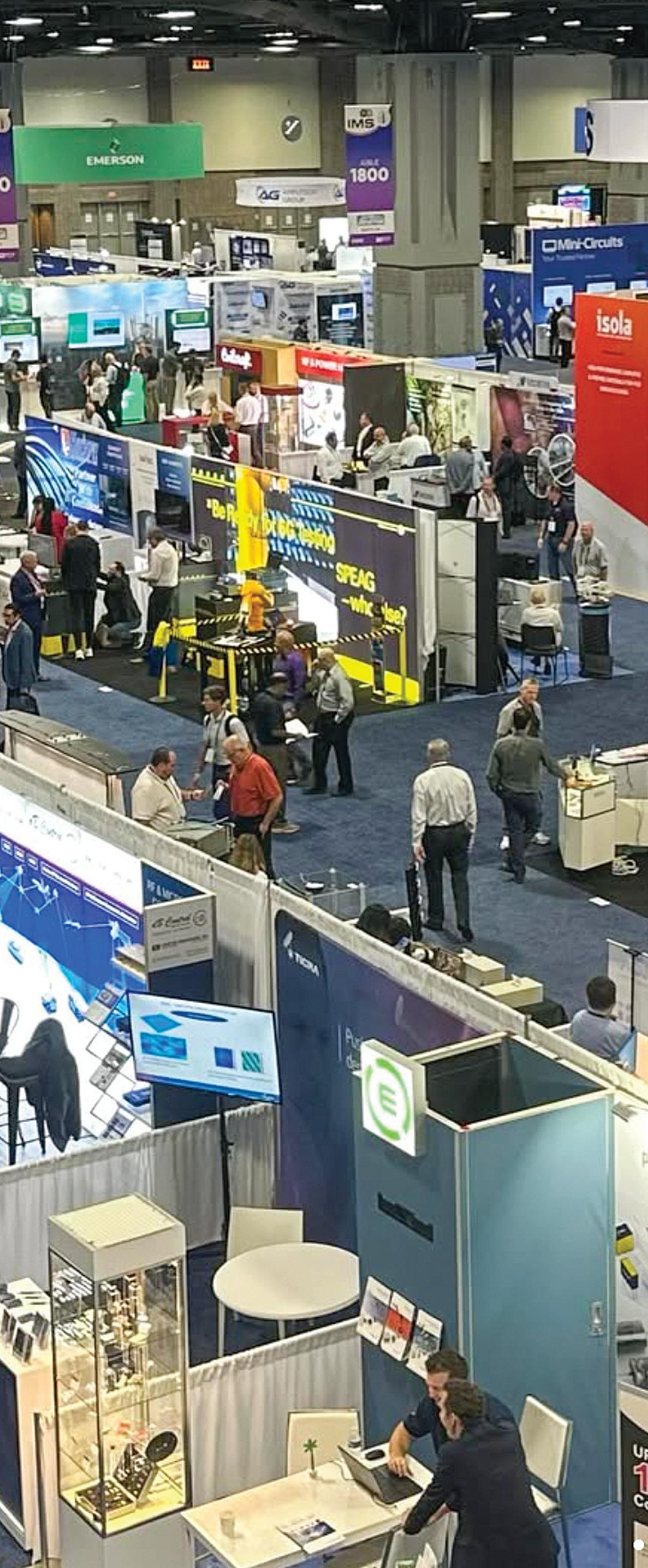
L. Wang, Tianjin Univ.; N. Zhu, Tianjin Univ.; Y. Cui, Tianjin Univ.; F. Meng, Tianjin Univ. There’s still time to visit the IMS Exhibition until 15:00 today!
IMS TECHNICAL SESSIONS
Field, Device & Circuit Techniques
203
Th2A: Advanced Packaging and Integration Technologies up to Sub-Thz Frequencies
Chair: Dominique Baillargeat, XLIM and Université de Limoges
Co-Chair: Telesphor Kamgaing, Intel
Th2A-1: Novel Low-Loss Shielded Interconnects for D-band/sub-THz Applications Using Microscale Metal Printing Technologies
G. Soto-Valle, Georgia Tech; M. Joshi, Georgia Tech; Y. Mensah, Georgia Tech; N. Roeske, Georgia Tech; C. Lynch, Georgia Tech; J. Cressler, Georgia Tech; M. Tentzeris, Georgia Tech
Th2A-2: 3DGS 3D Heterogeneous Integrated RF Multi-Layers GlassInterposer System-in-Package
J. Flemming, 3DGS; K. McWethy, 3DGS; R. Hulsman, 3DGS; M. Basha, 3DGS
205
Th2B: Recent Advances in Microwave Acoustic Filter and Resonator Technologies
Chair: Holger Maune, OvG Universität Magdeburg
Co-Chair: Amelie Hagelauer, Fraunhofer EMFT
Th2B-1: The Unexpected Technology Race Between Surface (SAW) and Bulk (BAW) Acoustic Wave Filters in Today’s Cell Phones
R. Ruby, Broadcom
Th2A-3: High Performance Waveguide Launcher in Interposer Package Technology for 77/79GHz Automotive 4D Imaging Radar
R. Ebrahimzadeh, mmSense Technologies; T. Elkarkraoui, mmSense Technologies; M. Marvasti, mmSense Technologies; A. Zanati, NXP Semiconductors; J. Harm, NXP Semiconductors; M.R. Nezhad-Ahmadi, mmSense Technologies
Th2A-4: First Demonstration of Highly Scaled RF GaN-on-Si Dielets Embedded in Glass Interposer
P. Yadav, MIT; X. Li, Georgia Tech; J. Niroula, MIT; P. Darmawi-Iskandar, MIT; U.L. Rohde, Universität der Bundeswehr München; T. Palacios, MIT; M. Swaminathan, Pennsylvania State Univ.
Th2B-2: Low-Loss Longitudinal Leaky SAW Filter with 1350MHz Bandwidth on LiNbO₃/SiO₂/SiC Platform for Wi-Fi 7
X. Fang, CAS; M. Sun, CAS; S. Zhang, CAS; P. Zheng, CAS; X. Ke, CAS; J. He, CAS; X. Ou, CAS
Th2C: Multi-Functional PhaseShifting Devices
Chair: Shahrokh Saeedi, Boeing Co-Chair: Roberto Gómez-García, Universidad de Alcalá
Th2C-1: A Reconfigurable Filtering Circulator/Isolator with Continuously Controllable Center Frequency and Insertion Phase
Y. Ning, UESTC; Z. Wei, UESTC; B. Liu, UESTC; P.-L. Chi, NYCU; T. Yang, UESTC
Th2D: Advances in RF to THz Instrumentation and Device Measurements
Chair: Gian Piero Gibiino, Università di Bologna
Co-Chair: Marcus Da Silva, National Instruments
Th2D-1: Traceable S-Parameter Measurements up to 165 GHz using 0.8 mm Coaxial Standards
A. Schramm, PTB; F. Gellersen, PTB; F. Rausche, PTB; K. Kuhlmann, PTB
Th2A-5: Thin Film Transmission Lines on Low-k Polymer Films for Sub-THz Applications
L.N. Vijay Kumar, Georgia Tech; P. Bhaskar, Georgia Tech; M. Al-Juwhari, Pennsylvania State Univ.; M. Swaminathan, Pennsylvania State Univ.
Th2B-3: Frequency and Bandwidth Design of Millimeter Wave Thin-Film Lithium Niobate Acoustic Filters
O. Barrera, Univ. of Texas at Austin; T. Anusorn, Univ. of Texas at Austin; S. Cho, Univ. of Texas at Austin; J. Kramer, Univ. of Texas at Austin; V. Chulukhadze, Univ. of Texas at Austin; T.-H. Hsu, Univ. of Texas at Austin; J. Campbell, Univ. of Texas at Austin; I. Anderson, Univ. of Texas at Austin; R. Lu, Univ. of Texas at Austin
Th2B-4: Miniature High-Coupling Lithium Niobate Thin Film Bulk Acoustic Wave Resonators at 10–30GHz
V. Chulukhadze, Univ. of Texas at Austin; Y. Wang, Univ. of Texas at Austin; I. Anderson, Univ. of Texas at Austin; J. Kramer, Univ. of Texas at Austin; S. Cho, Univ. of Texas at Austin; R. Lu, Univ. of Texas at Austin
Th2B-5: A 36GHz Trilayer AlN/ScAlN/ AlN Periodically Poled FBAR
W. Peng, Univ. of Michigan; S. Nam, Univ. of Michigan; D. Wang, Univ. of Michigan; Z. Mi, Univ. of Michigan; A. Mortazawi, Univ. of Michigan
Th2C-2: A Miniaturized Marchand Balun-Based Broadband Vector Sum Phase Shifter with 0.49° RMS Phase Error
S. Kwon, Yonsei Univ.; B.-W. Min, Yonsei Univ.
Th2C-3: Novel Reflective-Type Bandpass Filter with Simultaneously Integrated Tunable Attenuation and Phase Shifting Functions
Z. Wei, UESTC; X. Chen, CETC 29; Y. Ning, UESTC; H. Shao, UESTC; P.-L. Chi, NYCU; T. Yang, UESTC
Th2D-2: Millimeter-Wave Wideband Active Load-Pull System Using Vector Network Analyzer Frequency Extenders
A. Ben Ayed, Univ. of Waterloo; S. Boumaiza, Univ. of Waterloo
Th2C-4: Enhanced Performance of Continuously Variable Phase Shifters Using Liquid Crystals in Corrugated Oversized Substrate Integrated Waveguides
O. Tomé, INRS-EMT; E. Orgiu, INRS-EMT; T. Djerafi, INRS-EMT
Th2D-3: A Wideband Digital Compensation Model Based on Fast Bandwidth Sensing for Zero-IF Receiver
J. Zhu, UESTC; J. Peng, UESTC; L. Liu, UESTC; X. Qin, UESTC; T. Zhong, UESTC; Y. Bian, UESTC; X. Wang, UESTC; F. Yu, UESTC; M. Xiong, UESTC; C. Liang, UESTC
Th2C-5: A Novel Multi-Functional Filtering Amplitude/Phase Circuit with Tunable Frequency Using Simple Phase Control Network
Y. Ning, UESTC; Z. Wei, UESTC; B. Liu, UESTC; P.-L. Chi, NYCU; T. Yang, UESTC
Th2D-4: Cross-Spectrum Phase Noise Measurements of 10-15-Level Stability Photonic Microwave Oscillators
M. Giunta, Menlo Systems; B. Rauf, Menlo Systems; S. Pucher, Menlo Systems; S. Afrem, Menlo Systems; W. Wendler, Rohde & Schwarz; A. Roth, Rohde & Schwarz; J. Kornprobst, Rohde & Schwarz; S. Peschl, HENSOLDT; J. Schulz, HENSOLDT; J. Schorer, HENSOLDT; M. Fischer, Menlo Systems; R. Holzwarth, Menlo Systems
IMS TECHNICAL SESSIONS
Field, Device & Circuit Techniques
211
Th2F: Group III-V MMICs Above D-Band Frequencies
Chair: Nguyen L.K. Nguyen, University of California, Davis
Co-Chair: Kevin Kobayashi, Qorvo
Th2F-1: InP HBT Technologies for Integrated Circuit Development of Efficient mm-Wave and THz Power Amplifiers and Sources
Z. Griffith, Teledyne Scientific & Imaging
215
10:10 – 11:50 Thursday, 19 June 2025
Th2G: Advances in Receivers and Building Blocks
Chair: Mohammad Ghadiri-Sadrabadi, Kyocera
Co-Chair: Damla Dimlioglu, Cornell University
Th2G-1: A Ku-Band CMOS LNA with Symmetric Polarity-Selective Transformer for Efficient 180° Phase Shifting
J.-H. Song, J.-T. Lim, J.-E. Lee, J.-T. Son, J.-H. Kim, M.-S. Baek, E.-G. Lee, C.-Y. Kim, Chungnam National University
Join us in the Affinity Zone (Room 212–214) from 12:00 – 13:30 for the IMS Foosball Tournament!
The tournament winner gets to pit their skills against IMS Steering Committee
General Chair, Steven Rosenau and General Co-Chair, Jay Banwait!
Th2F-2: 300-GHz-Band InP HBT Power Amplifier Module Enabling 280-Gbps 0-dBm Signal Generation with Digital Predistortion
T. Jyo, NTT; S. Kusano, Keysight Technologies; H. Katsurai, NTT; H. Hamada, NTT; M. Nagatani, NTT; M. Mutoh, NTT; Y. Shiratori, NTT; H. Takahashi, NTT
Th2F-3: 300GHz 8×1 Active Phased Array MMIC with On-Chip Power Amplifiers, Vector Modulators, and Antennas
B. Gashi, Fraunhofer IAF; L. John, Fraunhofer IAF; K. Kuliabin, AlbertLudwigs-Universität Freiburg; A. Leuther, Fraunhofer IAF; R. Quay, Fraunhofer IAF
Th2G-2: A 130GHz 360° GainInvariant Phase Shifter with 5.625° Phase Resolution, 0.19° RMS Phase Error and < 0.56dB RMS Gain Error
J. Li, P. Li, P. Zhou, W. Hong, Southeast Univ.
Th2F-4: 208GHz InP Distributed Amplifier with Combining Loss Reduction Techniques
C. Cui, Univ. of California, Davis; N.L.K. Nguyen, Univ. of California, Davis; P.T. Nguyen, Univ. of California, Davis; N.S. Wagner, Keysight Technologies; A.N. Stameroff, Keysight Technologies; A.-V. Pham, Univ. of California, Davis
Th2F-5: A Broadband InP Darlington Amplifier with Two-Way Distributed Power Combining
L. Liu, Univ. of Texas at Austin; Z. Fu, Univ. of Texas at Austin; S. Li, Univ. of Texas at Austin
Th2G-3: An 86–90GHz Adaptive Gain CMOS LNA with Linearity Enhancement & -6dBm Blocker Tolerance
H.P. Govind Rao, T. Elazar, E. Socher, Tel Aviv University
Th2G-4: A 71–86-GHz Receiver with 5-GHz IF Signal Bandwidth for E-Band Broadband Communication in 65-nm CMOS
W. Zhao, Q. Li, J. Xu, B. Ruan, L. Wu, Zhejiang Univ.; N. Li, Donghai Laboratory; X. Qi, C. Song, Zhejiang Univ.; Z. Xu, Donghai Laboratory
Th2G-5: A 6.5-GHz Low-Power Self-Interference Cancellation Receiver with Two-Stage Feedforward Technique and Automatic Gain Control Loop
T.-S. Yang, Y.-C. Chou, L.-H. Lu, National Taiwan Univ.
Th2G-6: First Demonstration of MMIC Low-Noise Amplifiers Operating at Ka-Band Realized with EnhancementMode Gallium Nitride HEMTs
P.E. Longhi, Università di Roma “Tor Vergata”; P. Altuntas, Macom; M.S. Khenissa, Macom; P. Frijlink, Macom; C. Edoua Kacou, Macom; J. Poulain, Macom; S. Colangeli, Università di Roma “Tor Vergata”; W. Ciccognani, Università di Roma “Tor Vergata”; A. Serino, Università di Roma “Tor Vergata”; V. Sharma, Università di Roma “Tor Vergata”; E. Limiti, Università di Roma “Tor Vergata”

IMS TECHNICAL SESSIONS
Field, Device & Circuit
203
Th3A: Advances in 3D-Printing and Additive Manufacturing
Chair: Nicholas Kolias, Raytheon Technologies
Co-Chair: Neelam Prabhu Gaunkar, Intel
205
Th3B: Advanced Semiconductor Technologies
Chair: Wolfram Stiebler, Raytheon Technologies
Co-Chair: Lei Zhang, NXP Semiconductors
Th3A-1: Flexible Focalization: An Addititively Manufactured, Conformal, Low-Profile Multilayer Transmitarray for Space-Based 5G/mmWave Applications
T.W. Callis, Georgia Tech; M. Joshi, Georgia Tech; D.G. Dimitrova, Georgia Tech; C.A. Lynch III, Georgia Tech; M.M. Tentzeris, Georgia Tech
Th3A-2: A Reconfigurable DielectricLoaded Millimeter-Wave Waveguide Bandpass Filter Based on Customized 3D-Printing Vanadium Dioxide Filament
H. Tang, D. Kelley, UMass Lowell; P. Liu, FAMU-FSU; S.M.R.H. Shawon, B. Zheng, Y. Huang, Y. Dong, H. Zhao, B. Xiang, UMass Lowell; J. Li, Argonne National Lab; B. Arigong, FAMU-FSU; G. DeMartinis, W. Guo, H. Zhang, UMass Lowell
Th3A-3: Aerosol Jet Fully 3D Printed RF Attenuator Using Resistive Ink
L. Hendershot, Michigan State Univ.; M. Hodek, Michigan State Univ.; J. Albrecht, Michigan State Univ.; P. Chahal, Michigan State Univ.; J. Papapolymerou, Michigan State Univ.
Th3B-1: Deep Level Effects and HotElectron Reliability in Scaled GaN HEMTs
E. Zanoni, Università di Padova; A. Carlotto, Università di Padova; F. De Pieri, Università di Padova; M. Fregolent, Università di Padova; M. Saro, Università di Padova; F. Rampazzo, Università di Padova; C. De Santi, Università di Padova; G. Meneghesso, Università di Padova; M. Meneghini, Università di Padova
Th3B-2: On-Wafer Characterization of K-Band to V-Band GaN IMPATT Diodes
Z. Zhu, Univ. of Notre Dame; L. Cao, Univ. of Notre Dame; J. Xiong, Univ. of Notre Dame; Y. Duan, Univ. of Notre Dame; Y.-E. Jeng, Univ. of Notre Dame; J. Xie, Qorvo; P. Fay, Univ. of Notre Dame
Th3C: Reconfigurable Filtering Devices
Chair: Hjalti H. Sigmarsson, University of Oklahoma
Co-Chair: Julien Lintignat, XLIM and Université de Limoges
Th3C-1: Unilateral Single-Pole Multi-Throw Filtering Switch Using Spatiotemporally Modulated Resonator Arrays
Z. Zhang, Univ. College Cork; D. Psychogiou, Univ. College Cork
Th3D: On-Wafer Measurement Structures and Processes
Chair: Shuhei Amakawa, Hiroshima University
Co-Chair: Jon Martens, Anritsu
Th3D-1: Past, Present and Future Challenges of Testing RFIC Industry
G. Orozco, Emerson
Th3A-4: An Agile Additively Manufactured 5G/mm-Wave RF FrontEnd with Multi-Layer Conformality and Printed RF VIAs for Ultra-Wideband and Miniaturized Systems
H. Al Jamal, Georgia Tech; M. Tentzeris, Georgia Tech
Th3B-3: AlN/GaN MIS-HEMT With GeN Gate Dielectric for mm-Wave Applications
J. Wang, CAS; K. Wang, CAS; R. Zhang, CAS; X. He, CAS; S. Zhang, CAS; J. Guo, CAS; J. Niu, CAS; Y. Li, CAS; W. Wu, CAS; W. Luo, CAS; X. Chen, CAS; S. Huang, CAS; X. Wang, CAS; K. Wei, CAS; X. Liu, CAS
Th3B-4: Influence of Double-Deck T-Gate Structures on Cut-Off Frequency in Al0.3Ga0.7N/AlN/GaN HEMTs
J.Y. Park, ETRI; J. Jeong, ETRI; G. Lee, ETRI; K. Cho, ETRI; J. Kim, ETRI; B.-G. Min, ETRI; J.-M. Lee, ETRI; W. Chang, ETRI; H.-G. Ji, ETRI; D.-M. Kang, ETRI
Th3C-2: Tunable Dual-Band Coaxial Filter with Independent Band Control Using a Single Tuning Element Per Band
S.M. Pourjaafari, Univ. of Waterloo; M.M. Fahmi, DRDC; R.R. Mansour, Univ. of Waterloo
Th3D-2: Integrated Solution for Linear and Non-Linear Single-Touchdown On-Wafer Characterization of D-Band Mixers
P. Umbach, Fraunhofer IAF; N. Riedmann, Rohde & Schwarz; F. Thome, Fraunhofer IAF; M. Vossiek, FAU Erlangen-Nürnberg; R. Quay, Fraunhofer IAF
Th3C-3: A Magnetostatic Surface Wave Filter Tunable Over 8–32GHz Realized in Thickness Scaled Yttrium Iron Garnet
X. Du, Univ. of Pennsylvania; S. Yao, Univ. of Pennsylvania; S. Wu, Univ. of Pennsylvania; C.-Y. Chang, Univ. of Pennsylvania; R.H. Olsson III, Univ. of Pennsylvania
Th3A-5: Integration of Millimeter-Wave Air Filled Cavities and Filters Using Vertically Aligned Carbon Nanotubes
A.K. Verma, XLIM (UMR 7252); R. Jiang, CINTRA (UMI 3288); J. Zou, CINTRA (UMI 3288); C.W. Tan, CINTRA (UMI 3288); A. Kumar, CNRS@CREATE; B.K. Tay, CINTRA (UMI 3288); D. Baillargeat, CNRS@ CREATE; P. Coquet, CINTRA (UMI 3288); S. Bila, XLIM (UMR 7252)
Th3B-5: Small- and Large-Signal Characterization of RF Substrates Down to Cryogenic Temperatures
J. Lugo-Alvarez, CEA-LETI; Q. Berlingard, CEA-LETI; I. Charlet, CEA-LETI; M. Cassé, CEA-LETI
Th3C-4: Spin Wave Fast Tunable (SWiFT) Filter
K.D. Holzer, L3Harris Technologies; E.C. Chou, L3Harris Technologies
Th3D-3: Characterization Approaches to Reduce Process Variation Dependencies for On-Wafer Power Calibration Transfer Devices in Bi/CMOS Technologies
Z. Gao, Technische Universiteit Delft; C. de Martino, Technische Universiteit Delft; M. Pelk, Technische Universiteit Delft; S. Lehmann, GLOBALFOUNDRIES; M. Spirito, Technische Universiteit Delft
Th3D-4: Differential-Mode Characterization of Multi-Port Passives up to 170GHz Using Independent Single-Ended Two-Port Measurements
R. Schalk, Technische Universiteit Eindhoven; M. Lont, T.H. Both, L. Tiemeijer, NXP Semiconductors; M. Neofytou, G. Radulov, V. Vidojkovic, K. Doris, Technische Universiteit Eindhoven
Th3C-5: An Electrical Balance Duplexer Architecture without Inherent Insertion Loss Limitation
C. Pfannenmüller, Otto von Guericke University Magdeburg; B. Lenhart, FAU Erlangen-Nürnberg; M. Frank, FAU Erlangen-Nürnberg; A. Spielberger, FAU Erlangen-Nürnberg; D. Köhler, FAU Erlangen-Nürnberg; R. Weigel, FAU Erlangen-Nürnberg; O. Dorn, FAU Erlangen-Nürnberg
Th3D-5: Cryogenic Microwave Probe Technology with High Thermal Insulation
T. Arakawa, AIST; J. Igarashi, AIST; S. Norimoto, AIST; N. Hashimoto, AIST; M. Minohara, AIST; N.-H. Kaneko, AIST; H. Kayano, AIST
IMS TECHNICAL SESSIONS
211
Th3F: AI for Design and Optimization of RFICs and Arrays
Chair: Zheng Liu, Texas Instruments
Co-Chair: Chenhao Chu, ETH Zürich
Th3F-1: Algorithmic Design of Nonintuitive On-Chip Multilayered Passive Networks
V. Chenna, Univ. of Southern California; H. Hashemi, Univ. of Southern California
Th3G: Advances in LNAs from C-Band to D-Band
Chair: Roee Ben Yishay, Mobileye Co-Chair: Shirin Montazeri, Google
Th3F-2: A D-Band InP Power Amplifier Featuring Fully AI-Generated Passive Networks
S.H. Chai, Univ. of Texas at Austin; H. Chae, Univ. of Texas at Austin; H. Yu, Univ. of Texas at Austin; D.Z. Pan, Univ. of Texas at Austin; S. Li, Univ. of Texas at Austin
Th3G-1: A C/X-Band LNA Leveraging a Voltage-Tapered Gain-Cell Stacking Technique for 6G and IR-UWB
B. Lindstrom, Sandia National Laboratories; J. Moody, Sandia National Laboratories
Th3F-3: AI-Assisted Template-Seeded Pixelated Design for Multi-Metal-Layer High-Coupling EM Structures: A KuBand 6G FR3 PA in 22nm FDX+
C. Chu, ETH Zürich; J. Xu, ETH Zürich; Y. Liu, ETH Zürich; J. Zeng, ETH Zürich; A. Wang, ETH Zürich; T. Torii, Mitsubishi Electric; S. Shinjo, Mitsubishi Electric; K. Yamanaka, Mitsubishi Electric; H. Wang, ETH Zürich
Th3F-4: Dall-EM: Generative AI with Diffusion Models for New Design Space Discovery and Target-to-Electromagnetic Structure Synthesis
Y. Guo, Princeton Univ.; E.A. Karahan, Princeton Univ.; Z. Li, Princeton Univ.; Z. Shao, Princeton Univ.; Z. Zhang, Princeton Univ.; M. Wang, Princeton Univ.; K. Sengupta, Princeton Univ.
Th3F-5: On-Board Array Self-Calibration Using Amplitude-Only Proximal-Field Sensors and Machine-Learning-Based Phase Retrieval
A. Wu, Caltech; I.A. Syed, Caltech; A. Ayling, Caltech; A. Hajimiri, Caltech
Th3G-2: An 8–12.2GHz CMOS Low-Noise Amplifier with Partially Tail-Coupled Transformer and LargeTransistor Achieving 1.8dB Average NF
M.-S. Baek, J.-H. J.-E. Lee, J.-S. Park, I. Kim, J.-T. Lim, E.-G. Lee, Chungnam National University; S.-M. Moon, D. Chang, ETRI; C.-Y. Kim, Chungnam National University
Th3G-3: Broadband LNA with DualResonance Matching Network with Capacitive Feedback for Improved Gain and Noise Figure Using 0.1-µm GaAs pHEMT Technology
J.-S. Park, J.-T. Son, J.-H. Kim,
M.-S. Baek, B.-C. Lee, E.-G. Lee, J.-T. Lim, Chungnam National University; S.-M. Moon, D. Chang, ETRI; C.-Y. Kim, Chungnam National University
Th3G-4: A 140 GHz Low-Noise Amplifier in 45 nm RFSOI Based on a Joint-Noise-and-Gain-Optimized Embedding Network
P. Nguyen, Columbia Univ.; H. Krishnaswamy, Columbia Univ.
Th3G-5: A 50–70.9-GHz LNA with Defectly-Coupled-Transformer Achieving Sub-4 dB NF and 298.6-GHz GBW for 5GNR-FR2-2 and SATCOM
A. Han, UESTC; D. Tang, UESTC; X. Luo, UESTC;zzzz
INDUSTRY WORKSHOPS
SESSION CODE TIME & LOCATION TITLE AND ABSTRACT
IWTH1
8:00 – 09:40 Room: 204
IWTH2
8:00 – 09:40 Room: 206
IWTH3
10:10 – 11:50 Room: 204
IWTH5
10:10 – 11:50 Room: 206
13:30 – 15:10
Room: 204
08:00 – 15:10
Thursday, 19 June 2025
WinCal - the Engineers’ Flexible Friend — Although WinCal is well known and respected in the industry as a tool for performing RF calibrations, it has several other, perhaps underappreciated, features, which allow it to form a part of an analytics pipeline or as the basis for a low-cost and feature-rich test executive. This workshop will demonstrate some of these lesser-known analysis features, and additionally how WinCal can be integrated with popular open-source software packages to significantly extend its functionality whilst leveraging its robust and powerful algorithms. The 5.1 release of WinCal introduces a number of new APIs to facilitate this, which will be discussed in detail.
Advancements in Over-the-air Phased Array Calibration: Challenges, Innovations, and Best Practices — This workshop focuses on the critical aspect of phased array calibration, addressing complexities in ensuring precise beamforming and steering. As phased arrays become ubiquitous in applications like SATCOM, innovative design techniques are emerging to simplify calibration. We will explore innovative calibration methods, novel design approaches minimizing calibration efforts, and pioneering “calibration-less” architectures. Leading expert(s) will share insights, challenges, and solutions, enhancing attendees’ capabilities in designing, implementing, and maintaining high-performance phased array systems with reduced calibration burdens.
Advancing 5G and Beyond: Practical Implementations and Future Applications with FR2 OAI, ORAN, FlexRIC, and MIMO — This workshop delves into the cutting-edge technologies shaping the future of 5G and beyond, with a focus on the practical implementation of FR2 OpenAirInterface (OAI) structures, ORAN functionalities, and advanced applications such as FlexRIC and MIMO. Featuring presentations from industry leaders like allbesmart, Emerson (Origin NI), TMYTEK, and academic insights from the University of Hawaii, the session offers a comprehensive exploration of the latest telecom innovations. Attendees will benefit from demonstrations and interactive discussions on future applications, gaining valuable insights into emerging trends and practical deployment strategies.
Addressing Challenges and Techniques for RFIC Characterization in the 6G Era — The advancement towards 6G necessitates many innovations to transform vision into reality. Concurrently, the complexity and number of parameters requiring characterization are increasing, posing challenges in meeting commercial timelines. This workshop will address several ongoing trends that are enhancing our front-end devices. The presentations will provide valuable and comprehensive information on trends and measurement techniques for RFICs. The topics include linearization techniques, GaN power amplifiers, pulsed measurements and the workshop will conclude with an interactive session exploring the anticipated impact of artificial intelligence (AI) on the characterization of these devices.
System-Level Linearization and Characterization of Phased Array Transmitters for Satellite Communications — Satellite communication systems are rapidly moving towards higher frequencies and larger signal bandwidths for increased capacity. These trends impose tight requirements on transmitter linearity and power amplifiers efficiency. This workshop introduces an overview of state-of-the-art phased array architectures and how they can be combined with linearization schemes for enhanced efficiency. Advanced measurements and characterization techniques will be combined with behavioral models and prototypes for accelerating the design, optimization, and testing of linearization techniques and beamforming algorithms. We are using practical hardware to demonstrate how to tradeoff design parameters and improve ACLR, EVM, and other metrics for different standard waveforms.
SPEAKER(S), AFFILIATION
;
Sarah LeSelva, National Instruments
Markus Loerner, Rohde & Schwarz; Salvatore Finocchiaro, Qorvo; Florian Ramian, Rohde & Schwarz; Giorgia Zucchelli, MathWorks; Wissam Saabe, Dassault Systèmes - AMCAD Engineering IWTH6
13:30 – 15:10
Room: 206
Advancement in Technologies Leading to 6G — The global proliferation of smartphones has been significantly facilitated by improvements in CMOS technology at reduced feature sizes, leading to substantial gains in computational power. A crucial aspect of this development is the RF Front End Modules, along with the associated circuits and technologies. This workshop course will focus on the current designs of 5G RF front-end modules employed in RF cellular technologies, addressing the challenges linked to 5G implementation and its anticipated evolution towards 6G. Participants can expect an in-depth exploration of practical 5G RF deployment, the technologies involved, and the latest innovations in next-generation mobile applications.
Venkata Vanukuru, GLOBALFOUNDRIES; Tzung-Yin Lee, Skyworks Solutions; Florinel Balteanu, Skyworks Solutions
James Hibbert, FORMFACTOR GmbH
Gavin Fisher, FORMFACTOR GmbH
Fabricio Dourado, Rohde & Schwarz; Shoji Takahito, Fujikura Ltd
Ethan Lin, TMY Technology Inc.
PL4: Satellite Communications, Where Are We Heading?
ORGANIZER: Jim Sowers, Maxar Technologies
PANELISTS:
Will Caven, Maxar Space Infrastructure
Arul Thangavelu, Hughes Network Systems
Kelly Hennig, Stoke Space
John MacDonald, Redwire Tim Lee, Boeing
Seyed Tabatabaei, mmTron Paul Estey, SwissTo1
ABSTRACT: In the recent past we have seen an increase in space platforms launched to supply the need for communications and earth observation satellites. This need is being driven by many factors, from the front lines of the Ukraine War to Earth-observation missions, and high-speed communication systems at home to name a few. LEO systems like Starlink offer full earth coverage and low latency in support of this increased need. Additionally, large GEO, High Throughput Satellites (HTS) with increased capacity are also being deployed. The difference in these orbital environments raises a question as to the best types of electronics to use. With LEO systems like Starlink, the need for low-cost parts has made us question how we develop these parts and what is really needed. While the GEO type satellites require higher performance. Subsequently, this has created a plethora of new companies to service this need. This has also increased the types of products needed for these applications. Above all this has made us question “Where is it all headed”?
MICROAPPS 09:30 – 14:45 Thursday, 19 June 2025
THMA1 09:30 – 09:45 Collecting Big Data of RCS by 3D EM Simulation in WIPL-D suit
THMA2 09:45 – 10:00 RF Connector Selection Process
THMA3 10:00 – 10:15 EM Plugs for RF ICs; Practical EM Models for Fast and Accurate RF Design
MicroApps Theater: Booth 5423
SPEAKER(S), AFFILIATIONS
Branislav Ninkovic, WIPL-D d.o.o. Belgrade
Greg Gonzales, Emerson, NI
Sinan Alemdar, Analog Devices Inc.
THMA4 10:15 – 10:30 RF to mmWave Heterogeneous Design and Analysis of III-V and Silicon MMICs Dustin Hoekstra, Cadence
THMA5 10:30 – 10:45 Understanding the Error Vector Magnitude “Bathtub Curve” for RF System Design
THMA6 10:45 – 11:00 Unified Signal Analysis: Multi-Channel RF Capture with Parallel Spectrum Analyzers
THMA7 11:00 – 11:15 Using EVM to Assess the Quality of Power Management Circuits in RF Signal Chains
THMA8 11:15 – 11:30 Accelerating Wireless Modem Design for Real-World Applications
THMA9 11:30 – 11:45 Advancing RF Technologies: The Role of Wafer Level Test in 6G, AI and Quantum Computing
THMA10 11:45 – 12:00 A Commercial Implementation of Modal Calibration to Improve GSSG Calibration
THMA11 12:00 – 12:15 Absolute and Relative Power Measurements in dBm and dBFS on the USRP Radio
THMA12 12:15 – 12:30 Engineering Signal Purity at Every Level in Frequency Control and Timing Design
THMA13 12:30 – 12:45 Model-Based RF System Design and Simulation
THMA14 12:45 – 13:00 Using X Band RF Buffers with Sub-Picosecond Noiseless Delays to Mitigate Trace-cable Mismatches
THMA15 13:00 – 13:15 Transforming Oscilloscopes into Multi-Channel RF Signal Analyzers with Truly Independent Settings for Each Channel
THMA16 13:15 – 13:30 A Tuning Technique for Enhancing Far-Band Rejection Performance in Suspended Substrate Low Pass Filters
THMA18 13:45 – 14:00 Optimizing High-Rejection LTCC Filter Performance in Microstrip and Co-Planar Waveguide Implementations
THMA19 14:00 – 14:45 StartUp Panel Session #3: Venture Capital in Wireless and Hardware Innovation – Bridging the Gap Between Vision and Viability
Sponsored By:

Drew Fischer, National Instruments-Emerson
Alex Krauska, Tektronix
Eamon Nash, Analog Devices
Mike McLernon, MathWorks; Neel Pandeya, NI (Emerson)
Raajit Lall, FormFactor Inc.
James Hibbert, FORMFACTOR GmbH
Neel Pandeya, National Instruments; Jena Stone, National Instruments; Mike McLernon, MathWorks
Mike Sawicki, Quantic Wenzel; Mehran Mossammaparast, Quantic Wenzel
Vishwanath Iyer, MathWorks, Inc.
Dean Banerjee, Texas Instruments; Ajeet Pal, Texas Instruments; Harish Ramesh, Texas Instruments
KOTESHWARA RAJU, Tektronix
Narayanan Nachiyappan, Mini-Circuits
William Yu, Mini-Circuits
Moderator: David Witkowski, Oku Solutions; Panelists: Laura Swan, Silicon Catalyst Ventures; Steve Goldberg, Finistere Ventures; Ray Taylor, CARAT Venture Partners
Venture Capital in Wireless and Hardware Innovation
Bridging the Gap Between Vision and Viability
Abstract: Hardware development, critical to advancements in wireless RF and microwave technology, faces unique challenges in securing investment due to high initial costs, complex development cycles, and extended time-to-return. A select group of Silicon Valley venture capitalists are defying the norm, betting on the transformative potential of these fields. This panel brings together leading investors who are actively funding hardware startups, with a focus on wireless systems, RF technologies, and next-generation connectivity. Moderated by David Witkowski, Founder & CEO of Oku Solutions, the panel discussion will explore why these VCs are drawn to hardware despite the risks, what they look for in a startup, and how their investments are shaping the future of wireless innovation. Attendees will gain insights into emerging trends, funding strategies, and the intersection of venture capital and technical breakthroughs, offering a rare glimpse into the financial engines driving tomorrow’s wireless ecosystem.
MODERATOR: David Witkowski, Oku Solutions PANELISTS:
Next
Generation Networking in the Data Center
KEYNOTE SPEAKER: David F. Welch, PhD., Founder and CEO, AttoTude Inc.
ABSTRACT: Recent technology advancements have enabled dramatically lower power interconnections for data center networking. This approach can be seamlessly integrated in either pluggable or co-packaged forms resulting in scalable networking architectures for the future generations of AI centric data center architectures.
SPEAKER BIO: David F. Welch, Ph.D., founder and CEO of AttoTude, has over forty years of experience in the fiber optics and optical communications industries both as a leader in technology development and strategy, and as a business leader, including corporate management from initial start-up through public company with multi-billion dollar revenues. From 1985 to 2001, he was at SDL (formerly Spectra Diode Laboratories) as CTO and VP Corporate Development, he successfully established a differentiated technology and product strategy, resulting in a merger of the Company with JDS Uniphase. In 2001, he co-founded Infinera. As founder/CTO/President, he was responsible for establishing the key differentiating technology, photonic integrated circuits, and the implementation into a series of network managed product lines. The success of the technology has positioned INFN as the leader in optical communications. Most recently he has founded AttoTude which is aligned with highly differentiated technology that addresses power, cost and scale issues in the data center networking applications.
He holds over 200 patents, and has authored over 300 technical publications. In recognition of his technical contributionsd, he has been awarded the OSA’s Adolph Lomb Medal, Joseph Fraunhofer Award and John Tyndall Award, the IET’s JJ Thompson Medal for Achievement in Electronics, and the IEEE Ernst Weber Managerial Leadership Award. He is a Fellow of the OSA and the IEEE and a member of the National Academy of Engineering. Dr. Welch holds a B.S. in Electrical Engineering from the University of Delaware and a Ph.D. in Electrical Engineering from Cornell University.
Laura Swan, Silicon Catalyst Ventures
Steve Goldberg, Finistere Ventures
Ray Taylor, CARAT Venture Partner
David F. Welch, PhD., Founder and CEO, AttoTude Inc.



Automatic RF Techniques Group 08:00 – 17:00 Friday, 20 June 2025
THE MOSCONE CENTER Rooms: 303–304
105TH ARFTG MICROWAVE MEASUREMENT CONFERENCE
Challenges in Microwave Measurements under Cryogenic Conditions
07:50 – 08:00 | Welcome to the 103rd ARFTG Conference – Introduction
07:50 – 08:00 Welcome to the 105th ARFTG Microwave Measurement Conference Conference Co-Chairs: Dennis Lewis, Dominique Schreurs | TPC Co-Chairs: Chong Li and Apolinar Reynoso-Hernández
Session A: Challenges on Cryogenic Measurements
Session Chair: Rusty Myers, Keysight Technologies
A-1
08:00 – 08:40
A-2
08:40 – 09:00
A-3
Keynote: Superconductive Electronics for Quantum-based Signal Synthesis and Measurements S. P. Benz | National Institute of Standards and Technology (NIST)
Microwave Design and On-Wafer Characterization of Cryogenic Quantum-Well Infrared Photodetectors
Akim Babenko*; Emma Wollman; Choonsup Lee; Mahmood Bagheri; Arezou Khoshakhlagh | Jet Propulsion Laboratory
09:00 – 09:20 On-Wafer Cryogenic RF Noise Measurement Techniques
A-4
09:00-09:20
B-1
10:40 – 11:00
B-2
11:00 – 11:20
B-3
Jean-Olivier Plouchart*; Daniil Frolov; Utku Soylu; Alberto Valdes-Garcia | IBM Research
Minimizing System Drift in mmWave Wafer-Level Testing with Active Thermal Management
Shania Hsieh; Matt Lu; Hung Che Fu, Stojan Kanev, and Andrej Rumiantsev* | MPI Corporation
09:40 – 10:40 | BREAK — EXHIBITS, INTERACTIVE FORUM
Session B: Microwave Measurements on Noise and Disturbances
Session Chair: James Skinner | National Physical Laboratory
Calibration of a Digital Correlator for Noise-Parameter Measurements
Xifeng Lu*; Dazhen Gu; Daniel Kuester | National Institute of Standards and Technology (NIST)
VNA-based In-Band Spectral Purity Assessment for MM-Wave Frequency Extenders Carmine De Martino*; Marco Spirito | Delft University of Technology
11:20 – 11:40 On the Performance of True-differential/true-mode Stimulus Methods at Higher mm-wave Frequencies Jon Martens * | Anritsu
11:40 – 13:00 | ARFTG-105 AWARDS LUNCHEON
ARFTG President: Rusty Myers, ARFTG Awards: David Blackham
Session C: Nonlinear Devices and Measurements
Session Chair: Patrick Roblin| The Ohio State University
C-1
13:00 – 13:20 Performance Characterization of Power Amplifier Integrated into D-band Frontend with Different Modulation Schemes Piyaphat Phukphan*; Mikko Hietanen; Nuutti Tervo; Aarno Pärssinen; Marko Leinonen |University of Oulu
C2-S
13:20 – 13:40
C3-S 13:40 – 14:00
C-4
14:00-14:20
C-5 14:20-14:40
Student Paper: Digital Predistortion with ROVA
Amedeo Varano*1; Adam Cooman2; Piet Wambacq1,2; Gerd Vandersteen1,2; Yves Rolain1; Dries Peumans1,2 | 1 Vrije Universiteit Brussel; 2 IMEC
Student Paper: On-Wafer Oscilloscope-Based Nonlinear Characterisation: Benchmarking Against NVNA Measurements Daanish Smellie*1,2; Rana ElKashlan2; Bertrand Parvais1,3; Dominique Schreurs1 | 1 KU Leuven, 2 IMEC, 3 Vrije Universiteit Brussel
Optimal Design of Multisine Excitations with Non-Overlapping Intermodulation Using Minimal-Length Bh sets
Alberto Maria Angelotti*; Gian Piero Gibiino | University of Bologna
An Experimental Procedure for Assessing EVM Performance of VNA-based Measurement Systems
Mattia Mengozzi *; Gian Piero Gibiino; Alberto Maria Angelotti | University of Bologna
D-1
15:30 – 15:50
D2-S
15:50 – 16:10
D-3
16:10 – 16:30
D-4
16:30 – 16:50
Session D: Calibration Devices and Techniques
Session Chair: Xiaobang Shang | National Physical Laboratory
Standards Definition Impact on Impedance-Based VNA Calibration Methods
Arezoo Abdi*; Behrooz Rezaee; Lukas Ebner; Arash Arsanjani; Michael Ernst Gadringer; Jasmin Grosinger; Wolfgang Bosch | TU Graz
Student Paper: Automatic On-Wafer Probe Positioning System Based on Convolutional Neural Network Model
Zerui Gao*1; Alec Daalman1; Faisal Mubarak2; Chang Gao1; Carmine de Martino3; Steffen Lehmann4; Marco Spirito1 | 1 Delft University of Technology, 2 VSL, 3 Vertigo Technologies, 4 Global Foundries
Comparison of Broadband Single-Sweep and Conventional Banded System On-Wafer S-Parameter Measurements up to 220 GHz
Liam Ausden*1; Nick Ridler1; Andrej Rumiantsev2; Jon Martens3; Xiaobang Shang1 | 1 National Physical Laboratory, 2 MPI Corporation, 3 Anritsu
Metrology for Time-Domain Transformed and Time-Gated S-parameters using PyDynamic
James Skinner*1; Maximilian Gruber2; Sascha Eichstädt2; Roger Appleby3; Nick Ridler1 | 1 National Physical Laboratory, 2 Physikalisch-Technische Bundesanstalt, 3 RAMMW
ARFTG-105 CONFERENCE CLOSING
09:40 – 15:30
Interactive Forum
Session Chair: Dennis Lewis | The Boeing Company
P1—Nonlinear Millimeter Wave Power Amplifier Analysis with Hot S-Parameters
Patrick Umbach*1; Joel Dunsmore2; Fabian Thome1 | 1 Fraunhofer I AF, 2 Keysight Technologies
P2—Rethinking Microwave Power-Bar Characterization
Gianni Bosi*,1; Antonio Raffo*,2; Rocco Giofrè3; Valeria Vadalà1; Francesco Manni3; Reinel Marante4; Lorena Cabria4; Francisco de Arriba4; Paolo Colantonio3; Giorgio Vannini2|1 University of Milano Bicocca, 2 University of Ferrara, 3 University of Roma Tor Vergata, 4 Celestia TTI;
P3—Loadpull Behavioral Modeling for Power Amplifiers Under Modulated Operating Conditions
Talley Amir*; Jan Verspecht; Sam Kusano | Keysight Technologies
P4-S—Student Paper: Design, Simulation and Characterization of an Ultrathin Dual-band Polarization-Insensitive Metamaterial Absorber Lamyâ Ibili*,1; Thierry Lacrevaz1; Grégory Houzet1; William Feuray2; Nicolas Corrao1; Tân-Phu Vuong1 | 1 CROMA, 2 KNDS AMMO France
P5—Magneto-Dielectric Characterization of Materials using a Slow Wave CPW based Compact RF Sensor
Ankita Kumari*; Prakrati Azad; M Jaleel Akhtar | Indian Institute of Technology Kanpur
P6-S—Student Paper: Comparison of D-Band and G-Band On-Wafer Noise Figure Measurements
Nizar Messaoudi*, 1, 2; Shengjie Gao3; Muhammad Waleed Mansha4; Yves Baeyens4; Slim Boumaiza2; Bryan Hosein3; Shahriar Sahramian4 | 1 Keysight Technologies, 2 University of Waterloo, 3 Focus Microwaves, 4 Nokia Bell Labs
P7—Design of a 3–20 GHz Broadband Quad-Ridged Horn Antenna with a Closed Boundary and a Partially Open Feeding Structure Kyeong Min Na; Soon Soo Oh* | Chosun University
IMS2025 EXHIBITORS
2pi-Labs GmbH 4222
3D Glass Solutions Inc. 1943
3Rwave 1365
A.L.M.T. Corp./Sumitomo Electric USA 2026
Aaronia AG 1459
ABI-American Beryllia Inc. 126
Absolute EMC LLc 2119
ACE-Accurate Circuit Engineering 864
Admotech Co. Ltd. 428
Adsantec Inc. 1864
AdTech Ceramics 2054
Advanced Circuitry International 765
Advanced Test Equipment Corp. 1628
Aec Connectors Co., Ltd 2332
AEM: Renaissance 1767
AFT Microwave 1872
AGC Multi Material America Inc. 934
Agile Microwave 565
AI Technology Inc. 1535
A-INFO Inc. 1368
AJ Tuck Co. 509
Alaris USA 1951
AllSpice.io 134
Altera 1266, 5334
Altum RF 966
Alum-a-Lift 369
AMCOM Communications Inc. 1264
American Fairfield, Inc. 4106
American Standard Circuits 2336
Amphenol Printed Circuits 1126
Ampleon Netherlands BV 1372
Amplical 1873
AMRF Technologies 4233-D
AmTECH Microelectronics 2031
Amtery Corporation 131
Analog Devices Inc. 1243
Annapolis Micro Systems 566
Anoison Electronics LLC 1150
Anritsu 2143
Ansys 1543
Antennex BV 2129
AnTrust 333
Apollo Microwaves 2327
APSIS AEROCOM PVT LTD 237
AR RF/Microwave Instrumentation 942
Artech House 931
ASI CoaxDepot 1051, 1055, 1154
Association of Old Crows 1429
ASTRA WAVE TECHNOLOGIES INC. 668
Atek Midas 1147
B&Z Technologies LLC 535
Bascom Hunter Technologies, Inc. 1869
Berkeley Nucleonics Corporation (BNC) 2131
Bird 568
Bonsai Micro 4233-I
C/A Design 946
Cadence Design Systems Inc. 1843
CDM Inc. 2237
Century Seals Inc. 152
Cernex / Cernexwave 1134
Chengdu Eastland Electronic Technology Co., Ltd. 13
Chengdu HuaMing Microwave Technology Co. Ltd. 933
Chengdu Leader Microwave Technology Co. Ltd. 1933
Chengdu Qihang System Integration Co. Ltd. 2229
Ciao Wireless Inc. 1026
Cinch Connectivity Solutions 635
Circuits Integrated Hellas 4233-M
CML Micro 1659
Coilcraft 1335
Colorado Microcircuits Inc. 2329
Communication Power Corporation (CPC) 2523
Comotech Corporation 2066
Component Distributors Inc. 836
COMSOL Inc. 1932
Comtest Engineering 534
ConductRF / EAM 1965
Copper Mountain Technologies 926
Cornes RF Engineering 2264
Corning Gilbert 626
COTS RF 1272
CPI Electron Device Business 826
Crane Aerospace & Electronics 2135
Crystek Crystals Corp. 2048
Custom Cable Assemblies Inc. 2037
Custom Microwave Components Inc. 1228
CX Thin Films 2434
Dalian Dalicap Technology Co., Ltd 2330
Danger Devices 4233-J
Danyang Teruilai Electronics Co., Ltd. 2432
DAPU Technologies 1926
Dassault Systemes SIMULIA 2043
dB Control 234 Deepwave 4233-G
Delta Circuits 2250
Delta Electronics Mfg. Corp. 629
Denka Corporation 1466
DeWeyl Tool Company 1527
Dexin Digital Technology Corp., ltd 2267
DIAMOND ENGINEERING INC 1865
Dino-Lite Scopes 2126
Diramics 1833
DiTom Microwave Inc. 1154
Dongyang First Magnetics Co.,Ltd. 150
e360 Microwave Inc. 672
ECHO Microwave 2433
EchoICS Inc. 4233-K
EDS - Electronic Device Solution 4102 EECL
Electro Rent Corp. 755 Electronic Products (EPI) 567 Element Six 1467 Elite RF 1364
EMA Design Automation 2328
Embry-Riddle Aeronautical University
IMS2025 EXHIBITORS
Inspower Co. Ltd. 1834
Insulated Wire Inc. 1336
Integra Technologies Inc. 1766
International Manufacturing Services Inc. 526
inTEST Thermal 4103
Ironwave Technologies 1835
Ironwood Electronics 1132
ISI + BittWare 2268
Isola 759
ITF Co. Ltd. 2437
IVWorks Co. Ltd. 1765
Jariet Technologies Inc. 1435
JFW Industries Inc. 827
Jiangsu CaiQin Technology Co. Ltd. 433
Jiangsu Trigiant Technology Co. Ltd. 235
Johanson Technology 437
JQL Technologies Corp. 1859
JunCoax RF Technologies Co., Ltd. 1568
Junkosha Inc. 665
Kayaku Advanced Materials 2529
Keycom Corp. 137
Keysight 5335, 743
Knowledge Resources 1273
Knowles Precision Devices 1059
K-PA Inc. 1819
Kratos Microwave Electronics Division 853
KRYTAR 1635
KVG Quartz Crystal Technology GmbH 1464
Kyocera AVX 453
Kyocera International Inc. 1651, 552
LA Techniques Ltd 673
LadyBug Technologies LLC 1731
Lake Shore Cryotronics Inc. 633
Lanjian Electronics 865
Laser Processing Technology Inc. 1232
Laser Thermal Analysis 1866
Leader Tech Inc. 1928
LEONARDO SPA 2532
Liberty Test Equipment Inc. 1051
Lintrinsic Devices 4233-F
LISAT 1930
Logus Microwave 2136
Longtrox RF Scien-Tech Co., Ltd. 469
Lorentz Solution Inc. 2052
Low Noise Factory AB 1972
LPKF Laser & Electronics 1135
M2 Global Technology Ltd. 1229
MACOM 1143, 943
Magvention 2530
Marki Microwave Inc. 1743
Marvin Test Solutions 847
MathWorks 1853
Maury Microwave 1032, 727
MaXentric Technologies LLC 2042
Maybell Quantum Industries, Inc. 773
MCV Microwave East Inc. 965
MECA Electronics Inc. 1434
Mega Circuit Inc. 2149
MegaPhase 1827
Menlo Microsystems Inc. 2253
Mercury Systems 831
Metallix Refining 2167
MIcable Inc. 127
Mician GmbH 1436
Micro Harmonics Corporation 2539
Micro Lambda Wireless Inc. 1035
Microchip Technology Inc. 1153
Micro-Coax 1126
Micro-Mode Products 1726
Microsanj LLC 1159
Microsembly 1868
Micross Components 2027
Microwave Applications Group 527
Microwave Engineering Corp. 4202
Microwave Journal/Signal Integrity Journal 935
Microwave Product Digest 1918
Microwave Techniques LLC 1566
Microwave Technology Corporation 1235
Microwavefilters & TVC S.r.l. 2032
Microwaves & RF 1242
Microwaves 101 1430
Miller MMIC, Inc 2053
Millibeam Pty Ltd 1966
MilliBox 226
Millimeter Wave Products 1749
Mini-Circuits 1351
Mini-Systems Inc. 932
MISOTECH 2169
Mixed-Signal Devices Inc 361 mmt 1373
mmTron Inc. 2252
Mobiyu Corporation 2230
Modular Components National, Inc 2248
Molex 1958
Mosaic Microsystems 232
MOSIS 2.0 Prototyping Service 4112
Mouser Electronics 664
MPG-Microwave Products Group 843
MPI Corporation 1553
MRSI Mycronic 1629
Mtron 1231
Naprotek/Semigen 1526
Narda-MITEQ 349
National Radio Astronomy Observatory CDL 4239
Near Field Dynamics 4241-E
Networks International Corp. 627
NexWave Inc. 2431
NI (now part of Emerson) 1259
Nisshinbo Micro Devices Inc. 1927
Niterra North America,Inc. 133 Noble Metal Services 2333
Noisewave
IMS2025 EXHIBITORS
Sawnics Inc.
2337
Schmid & Partner Engineering AG 1326
Schott AG 1267
Scientific Microwave Corp. 1237
Sector Microwave Industries 1373
SemiDice 2027
Sensorview Co. Ltd. 459
Shaanxi Shinhom Enterprise Co.,Ltd 130
Shanghai Huaxiang Computer Communication Engineering Co., Ltd. 148
Shanghai XinXun Microwave Technology Co. Ltd. 1935
Shoufei Electronics 1066
Sibanye-Stillwater Reldan 2030
Sierra Circuits 4104
Siglent Technologies NA 2151
Signal Hound 764
Signal Microwave 1730
SignalCore Inc. 532
Shenzhen Superlink Technology Co. Ltd. 1164
Smiths Interconnect 343
Soctera 4241-A
Somefly Technologies Co. Ltd. 331
Southern Microwave Inc. 2133
Southwest Microwave Inc. 859
Space Machine & Engineering 1830
Spectrum Control Inc. 927
Spinner GmbH 1648
Spira EMI Gaskets 2227
SRTechnology Corp. 533
SSI Cable Corporation 1732
State of the Art Inc. 832
Statek Corp. 2430
Stellant Systems 143
Stellar Industries Corp. 1234
STI-CO Antenna Solutions 2523
STMicroelectronics Inc. 2034
StratEdge Corporation 336
Sumitomo Electric Device Innovations 2028
Summit Interconnect 2218
SUNG WON FORMING 435
Superapex LLC 1829
Susumu International (USA) Inc. 1630
Suzhou Hexagon Communication Technologies Co., Ltd 2261
Suzhou Lair Microwave Inc. 2436 SV Microwave 1127
SWIFT BRIDGE TECHNOLOGIES 1934
Switzer 144
SynMatrix Technologies Inc. 1549
Syscom Advanced Materials 2033
Tabor Electronics 2128
Tactron Elektronik GmbH & Co. KG 1731
TagoreTech 332
TAI-SAW TECHNOLOGY CO., LTD. 1329
Taiwan Union Technology Corporation 4416
TDK Corporation 1426
TDK-Lambda Americas 1426
Tecdia Inc. 1634
Tecnisco Ltd. 4204
Tektronix 2226
Teledyne 1643
Telewave.io 1159
Telonic Berkeley Inc. 2064
TestEquity LLC 155
Texas Instruments 355
The Boeing Company 4107
The EMC Shop 1733
The Goodsystem Corp. 4204
Thintronics 146
TICRA 1967
Tidalloft Electronic Design Consultancy, LLC 4241-B
Times Microwave Systems 1126
TMY Technology Inc. 1367
TnM Components 4233-A
TopLine 2132
Toptek PCB 511
TOTOKU INC. 4105
Tower Semiconductor 655
Trace-Tec Vietnam Co., LTD 1235
Transcom Inc. 528
Transline Technology Inc. 2127
TransSiP, Inc. 1246
Trans-Tech 2326
Trexon 1727
TRS-RenTelco 767
UEC United Electronics Company 2536
UIY
Exhibit Hall Hours and Happenings
EXHIBIT HOURS:
Tuesday, 17 June 2025 09:30 – 17:00
Wednesday, 18 June 2025 09:30 – 18:00
Thursday, 19 June2025 09:30 – 15:00
TUESDAY:
Professional Headshots in the Societies Pavilion (Booth 4201) 09:30 – 12:30 & 13:30 – 17:00
StartUp Pavilion (Booth 4233) 09:30 – 17:00
IMS Student Design Competitions 09:30 – 17:00
MicroApps Seminars (Booth 5411) 09:30 – 17:00
Coffee Break 09:40 – 10:10
StartUp Panel Session:
Built to Last: Forming, Growing and Sustaining Enduring Businesses in the RF Industry (Booth 5411) 11:00 – 11:45
Sweet Treat Tuesday 12:30
Coffee Break 15:10 – 15:40
WEDNESDAY:
Professional Headshots in the Societies Pavilion (Booth 4201) 09:30 – 13:00 & 14:00 – 18:00
StartUp Pavilion (Booth 4233) 09:30 – 17:00
MicroApps Seminars (Booth 5411) 09:30 – 18:00
Coffee Break 09:40 – 10:10
StartUp Panel Session: SBIR/STTR (Booth 5411) 13:30 – 14:15
Coffee Break 15:10 – 15:40
IMS Interactive Forum (Boot h 5003) 15:10 – 17:00
Industry Hosted Reception 17:00 – 18:00
THURSDAY:
Professional Headshots in the Societies Pavilion (Booth 4201) 09:30 – 12:30 & 13:00 – 15:00
StartUp Pavilion (Booth4233) 09:30 – 15:00
MicroApps Seminars (Booth 5411) 09:30 – 15:00
Coffee Break 09:40 – 10:10
StartUp Panel Session:
Venture Capital in Wireless and Hardware Innovation –Bridging the Gap Between Vision and Viability (Booth 5411) 14:00 – 14:45
Visit the Societies Pavilion (Booth 4201) to learn more about the IEEE Microwave Theory & Technology Society (MTT-S) as well as other IEEE societies, organizations and partners!
Stop by the StartUp Pavilion (Booth 4233) to engage with up and coming companies in the RF & Microwave space!
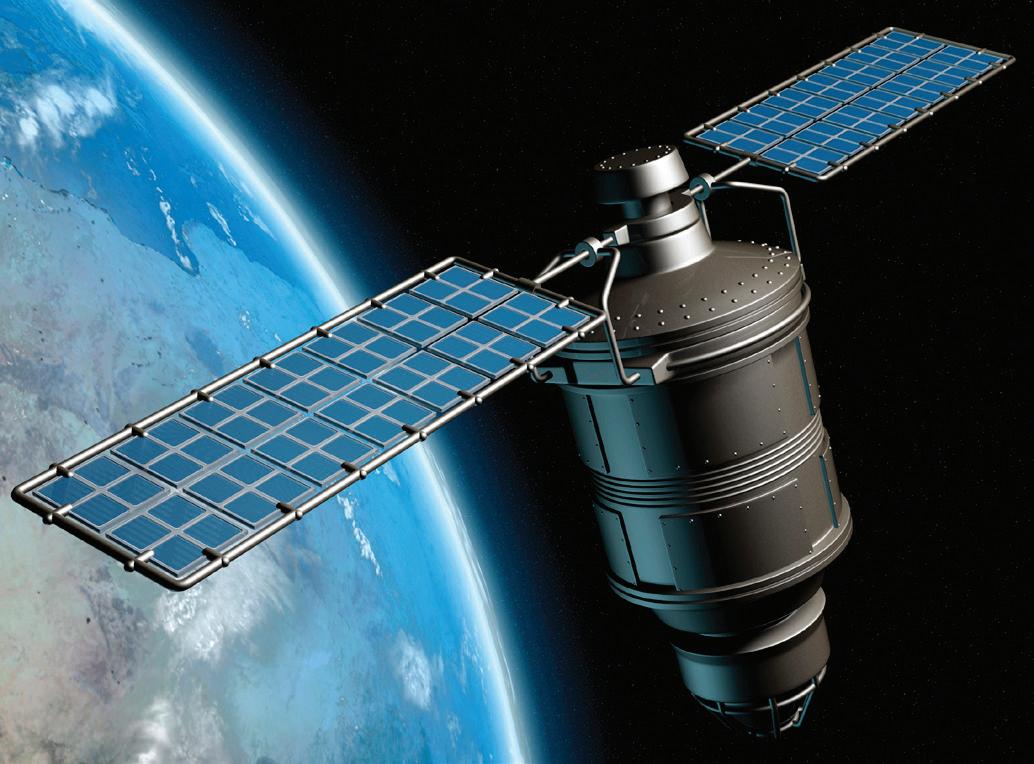

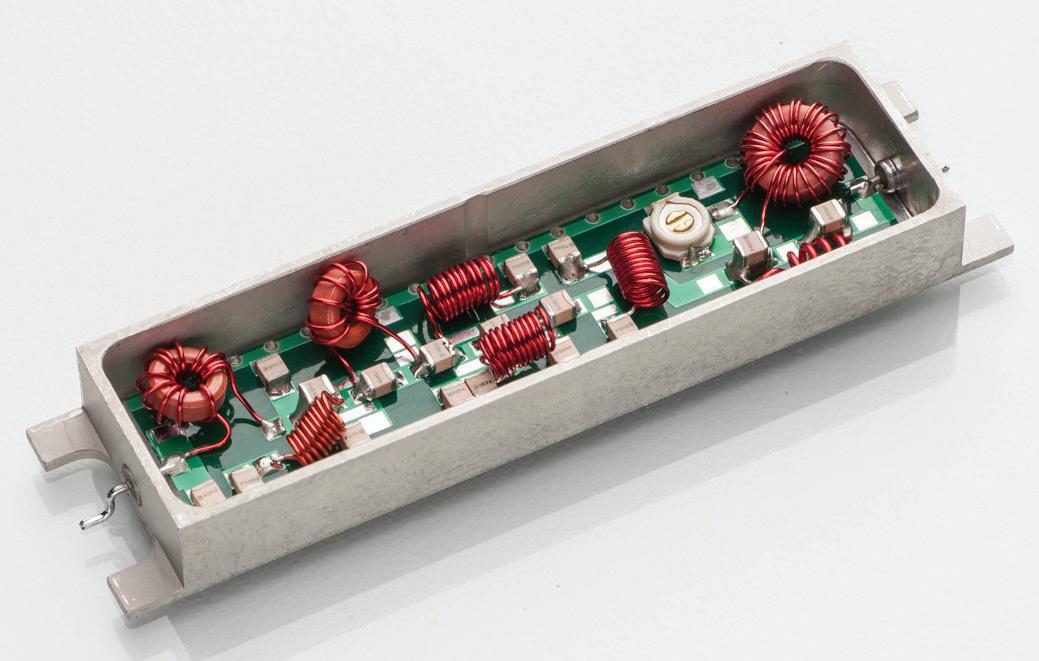
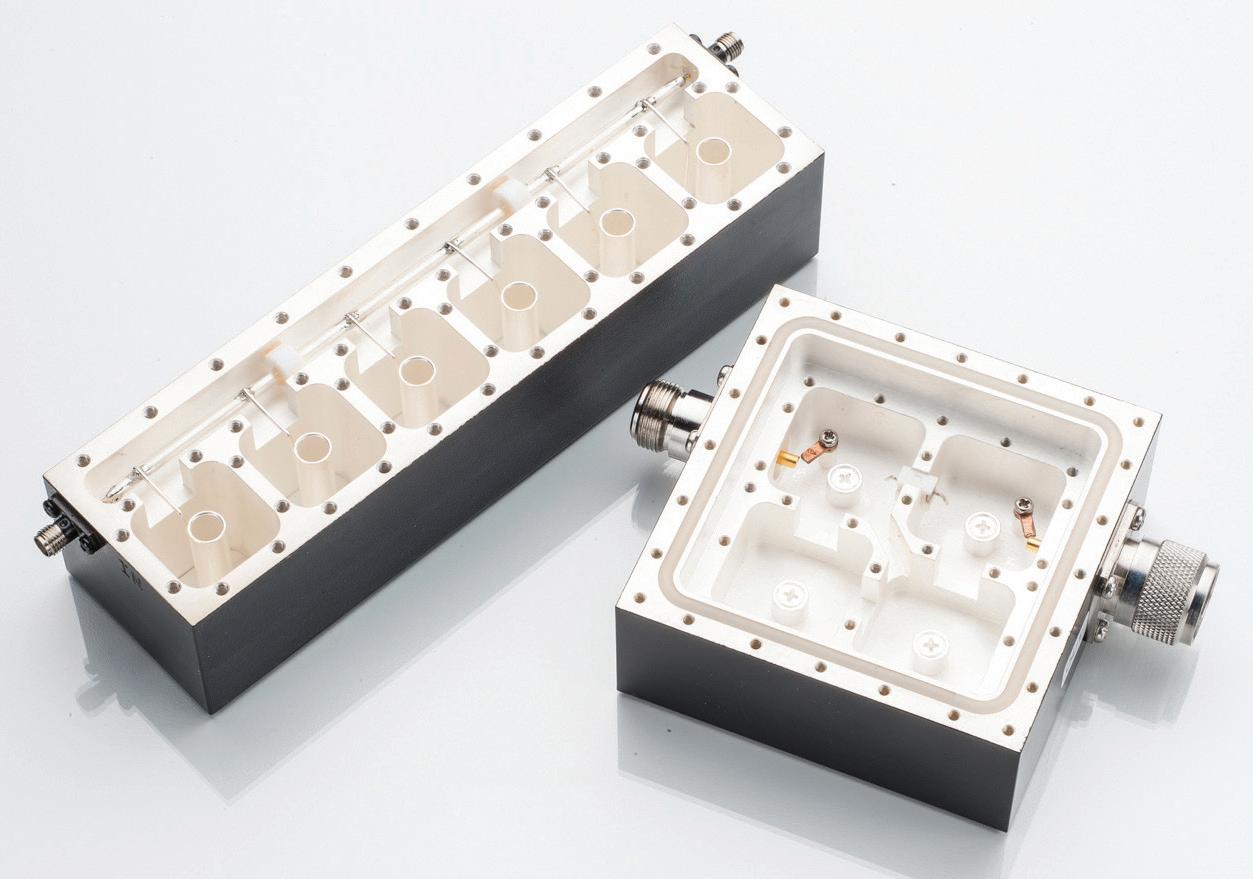
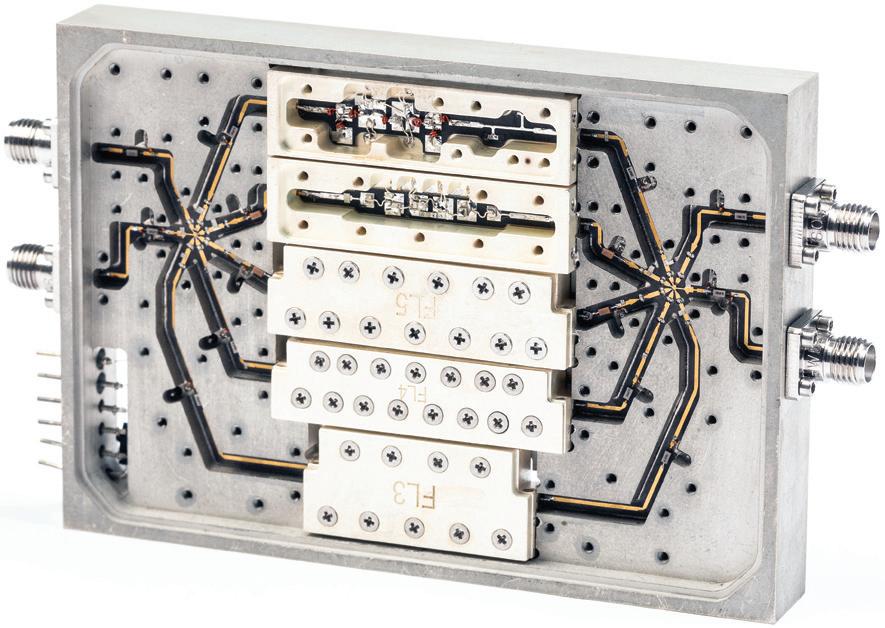
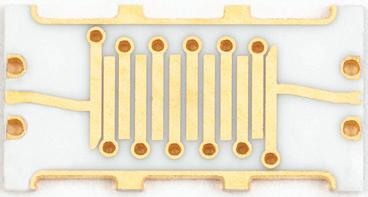


Printed Filters
Switched Filter Banks
Cavity Filters