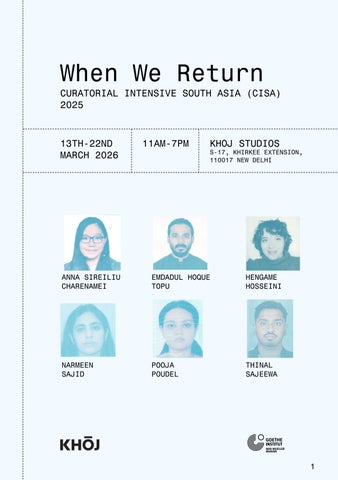
When We Return
As we waited — with the uncertainty of whether all of us in the cohort could gather again — and in anticipation of decisions shaped elsewhere finding their way to us, to separate us from everything we know, setting in motion the conditions that precipitate an unassuaged ache to return… As we began to think, we found each of our inquiries to be tethered by this undertow of return, only of course, every work of art within each imagination being irreducible to a singular idea.
When a place or a thing cannot be returned to; when lives, bodies, buildings, or objects are displaced and cannot resume their original shape, cannot be stepped into again; we begin to revisit them differently. We return instead through the precarious yet assuaging practices of remembering, recital and reenactment.
The exhibitions can be viewed as a consequence of activating different processes that become vectors we turn to, in order to return to a place, a time, a thing, a name.
It endeavours to murmur the aching gap that always persists, reminding us of a possibility of no return, and considers methods of returning that never quite arrive in their original form, never as they were once felt. As some of us wait here and some of us wait there, all longing to return.
Anna Sireiliu
Charenamei A Place is Made but, Do We Get It?
Emdadul Hoque
Topu Absence as an Artifact
Hengame Hosseini Unfinished
Narmeen Sajid
Pooja Poudel what do we do with what is broken
Thinal Sajeewa
UNEARTH: A Play on Material Memory as needed
A Place is Made but, Do We Get It?
Curated by Anna Sireiliu Charenamei
A place is made where the streets are “smelly” like home. A place is made through a handshake of “live and let live” between landlords and tenants. A place is made in which there is an ineffable certainty of safety . A place is made so it can be a mooring for kin who escaped arson and carnage. Two decades later. A place is made and it is desirable for a new high/art public who are pretending to get it. A place is made where the different publics of the city feel “safe”. A place is made by people who don’t feel the same safety where the rest of the city’s publics roam. A place is made where those who first cushioned the cold cement feel hesitant to enter. A place is made where the people’s dearth of time to respond to disrespect is mistaken to be docility and hospitality. A place is made where sacred food practices designed for our old gods are sleeplessly generated and mindlessly depleted. A place is made reluctantly for “Rice Beer Paglus”. A place is made to feel like home, but do we get it?
The Exhibition is an ongoing practice of collectivising in giving form to some of the grumblings deep in our hearts about this place that is made within Humayunpur. The Curator positions herself as a niece of Humayunpur who has been a receiver of joy her aunts offer and a witness to their immaculate acuity during moments of derision. The themes are guided by these emotions and an attempt at sieving through the bargains made in making a safe place through the framework of “Place Making”. These are Bargains made between Landowner and Tenant, both identities with complicated histories of belonging in the capital. The Exhibition provides for each artist to espouse divergent expressions of the place that run parallel with their personal experiences of Humayunpur. It is cautioned that this practice is not interested in an exercise of representing the entire region beyond the
chicken neck. While some of the artists respond to the history and “North-East” experience the place offers, the exhibition is also shaped by the Curator’s ongoing research on the incessant migration to Delhi from her home state. As this is being written in Delhi, irrational havoc carries on in Manipur. The exhibition asks, would Humayunpur not have been as desirable or cool without the unique political instability of a state that has forced its people out to achieve their dreams of a peaceful coexistence in this place? It also hopes to provoke the Delhi Publics to ask themselves whether it is fine to go on devouring a “niche” sum of experience (only to be replaced by the next exotic heritage) sans a careful math of its variables. Finally, this collaboration also responds to the collective exasperation felt by a people from a frontier region towards an expectation placed on them to situate themselves within intricate historiographies and gnarly local politics, perhaps this is a rebellion and the curation and artworks are for those who might get it.
ARTISTS
Bellona Yumnam
Children Supported by Centre for Women & Girls
David Yambem
Felix Chungkham
Jacob Nunthuk
Lamhoiching Mangte
Menty Jamir
Parismita Singh
Rachungailiu Gonmei
Saadgi G, Shashank Shekhar
Sarah Lalhrietzuol
Shiarlua Goldminson Aimol
Metamorphosis in the city (working title)
Print of Pen and ink on paper
The Act of Dreaming
Short (ANIMENTARY)
25–30 minutes
Parismita Singh
Saadgi G, Shashank Shekhar
Sarah Lalhrietzoul Untitled Acrylic , Tattoo Stencils on Carrom Board
Absence as an Artifact
Curated by Emdadul Hoque Topu
“Human memory is not a data storage; human memory is partial, contingent, malleable, contextual, erasable, fragile. It is prone to embellishment and error. It is designed to filter. It is designed to forget.”
- Audrey Watters.
Absence as an Artifact unfolds as a field of deferral and resonance. It does not seek to resolve absence but to think through it, reopening history as an unfinished terrain of violently interrupted relations. In this unfinished state, meanings, materials, and relationships remain unstable, shifting, and alive.
Drawing on Jacques Derrida’s deconstructive philosophy, absence is approached not as negation or lack but as a condition of possibility. Presence is never selfcontained; it emerges through what is deferred, displaced, or rendered invisible. Meaning does not arise from what is fully here but from what exceeds it.
Within this framework, I intend to read an archive not as a neutral repository of the past but as an active terrain of power. Every act of its preservation was also an act of selection; every gesture of protection carried the potential for exclusion. As if this archive determines what survives, how it appears, and who is permitted to approach it. It does not just store memory, it structures it.
This curatorial inquiry is informed by a specific and charged historical event: the lives of the Nowhere People of the Kaptai Reservoir in Rangamati, Bangladesh. Between 1959 and 1963, the construction of the Kaptai Hydroelectric Dam submerged 54,000 acre( 219 sqkm approx)
area displacing nearly 100,000 people, and became longterm refugees in northeast India, particularly in presentday Arunachal Pradesh. Their villages, memories, and communities were erased beneath water, yet their lives persist through adaptation, resilience, and survival across generations.
Photograph South Asian Colonial Photography Archive Rautenstrauch-JoestMuseum, Cologne, Germany
Photograph
Julius Konietzko
Bamboo Fences, Chakma Village, Rangamati District, (1927)
A View of Furomon Hill, Kaptai Valley, Rangamati, Chittagong Hill Tracts (2026)
In 2022, through the Leaky Archive fellowship programme, I encountered this colonial photographic archive collection of South Asia at the Rautenstrauch-Joest-Museum in Cologne. In its ethnographic section, I found 104 photographs of the Kaptai region, taken in 1927 by Julius Konietzko, a German explorer and trader with a focus on ethnology and folklore. His photographs were intended as spectral witnesses to a geography of the Chittagong Hill Tracts, with a commercial intent to monetize collected objects from the indigenous villages to museums in Hamburg and Leipzig.
Stretches against gravity | Kaptai Valley (2022-26)
Photograph
The exhibition is designed not to reproduce these photographs as ethnographic evidence but as unstable traces, fragments suspended between what was, what is remembered, and what has been forcibly erased. They testify not only to what they show but also to what they exclude.
The absence of these displaced communities within the archival frame becomes a living material: a residue, a vibration, a gravity in the body; registers as hum, whisper, pause, forms of presence: ways of being with loss that refuse the demand for explanation. They mark a form of knowledge that is felt rather than seen, heard rather than translated.
Threaded through its thematic constellations—The Archive and the Repertoire; The Space of the Not-Yet; The Opacity of Grief: Listening to the Frequencies of Loss; The Body as Site: Cruelty, Hunger, and the Politics of Memory; and Listening to What Remains—the exhibition treats absence as a force that generates. These are not isolated chapters but overlapping fields where histories are revisited, identities unsettled, and futures rehearsed. This exhibition’s true value lies not in what it answers, but in what it leaves unresolved—opening space for possibility, for things to unfold or remain suspended.
ARTISTS
Tayeba Begum Lipi
Mahbubur Rahman
Dilara Begum Jolly
Naeem Mohaiemen
Kiri Dalena
Dhali Al Mamoon
Kamruzzaman Shadhin
Molla Sagar
Prerana Khandelwal
Jayatu Chakma
Riggi Nokrek
Pulak K Sarkar
Navid Hasnain
Sabiha Ambareen Haque
Unfinished
Curated by Hengame Hosseini
Unfinished centers on Shahr-e No, Tehran’s former redlight district, which was set on fire and destroyed during the 1979 Revolution. The exhibition takes its conceptual point of departure from Kamran Shirdel’s film The Citadel, begun before the Revolution and completed afterward from interrupted footage and photographs by Kaveh Golestan—the only visual records to survive the site’s systematic erasure. The film ends with a single word: unfinished, naming not incompletion but a condition produced by political rupture, enforced interruption, and the conversion of violence into historical absence.
The participating artists worked directly with the site and its afterlives: the transformation of Shahr-e No into Razi Park, the disappearance of material traces, and the absorption of violence into urban space. Their works examine what remains when destruction leaves no ruins—when loss is managed as absence.
During the exhibition’s development, the recent national uprising intervened in this process. Blackouts, restricted movement, and disrupted communication transformed absence from a historical subject into a lived condition, reshaping the works themselves and making unfinishedness an operative reality.
Rather than reconstructing Shahr-e No or resolving its erasure through representation, Unfinished holds open the fractures left by disappearance. Here, unfinishedness functions as a mode of resistance, refusing closure and substitution, allowing images to remain provisional, accountable, and unresolved.
ARTISTS
Peggy Abbaspour
Soheila Bajelan
Marjan Ghorbani
Mahoor Mirshakak
Marjan Ghorbani
Sightline (2026)
Satellite image of Shahre-No before and after destruction in 1972 and 1993
National Cartography Centre of Iran
Soheila Bajelan
Erasure Room (2026)
Peggy Abbaspour
Razi Park (2025)
UNEARTH: A Play on Material Memory
Curated by Narmeen Sajid
UNEARTH is conceived as a traveling play, where unearthing becomes a continuous, evolving project across different geographies and cultural contexts. The idea of a traveling play means material memory isn’t confined to a single moment or place. Each location and artist who joins the play contributes to a fresh dig, revealing pods of memory relevant to a specific context. Thus, material memory becomes less about a fixed past and more about a living, breathing, and reinterpreted dialogue between artists, histories and places.
The artworks on display in this showcase are an invitation to the visitor to witness the site-specific temporalities of fragmentation, loss and pain. Through installations, the showcase plays with absence and presence, to reveal materials from the hidden worlds of graveyards, ruins of homes and within genetic code.
Syed Ali Sarvat Jafri’s lakhori bricks present the remnants of layered colonial and post-colonial histories of Faizabad (today, Ayodhya) while Ayushi Shukla demonstrates the visual politics of absence and presence, as historically witnessed by the feminine forms at the sites of Ajanta-Ellora caves and in the temples of Varanasi (India). Nad E Ali’s photo series You are the Salt of the Earth, evince The Aleph (borrowing from author Jorge Luis Borges)—a telephoto lens into the temporalities of pain, by which the resulting images travel from Lahore (Pakistan) and resonate across the borderlands. Pragya Jaiswal illustrates a daydream from the experience of migration in the urban landscape of New Delhi (India). Abdulla PA brings together this play, by holding the suspended moment between birth and disappearance.
The overall art showcase is a curatorial inquiry into five contemporary artists from South Asia and the exploration of visual materials in their creative practices. The result is this experimental multimedia display with support from the Curatorial Intensive South Asia Programme 2025 by Khoj International Artists’ Association and Goethe Institut/Max Muller Bhavan, New Delhi.
ARTISTS
Abdulla PA (b. 1996)
Ayushi Shukla (b. 2002)
Nad E Ali (b. 1990)
Pragya Jaiswal (b. 1998)
Syed Ali Sarvat Jafri (b. 1984)
Nad E Ali (b. 1990)
Transfiguration of Sardar Badshah, Nisar Haveli, Mochi Gate, Lahore, Pakistan (2014)
Horse/Men Series
Digital C-print
Group Show, Kaleido Kontemporary, Lahore, January 29, 2025
The Other Horses, Solo Exhibition & Zine Launch, Gurmani Centre for Languages and Literature, 2019
“As they came from their mother’s womb, so they shall go again, naked as they came.”
— Ecclesiastes 5:15
You are the Salt of the Earth Series Light-box transparency print
A Gentle Apocalypse, Indus Conclave, Lahore, 2025 Extended, Dhaka, 2022 (VII Academy & Pathshala South Asian Media Institute)
Afternoon Dreams
Dream Series (2025 - ongoing)
Shot & edited by Pragya Jaiswal, sound by Apratim Mishra Short Film
Nad E Ali (b. 1990)
Pragya Jaiswal (b. 1998)
what do we do with what is broken
Curated by Pooja Poudel
what do we do with what is broken? what do we choose to mend, and what do we discard? who gets to decide what is broken? what does a constant state of brokenness produce? how much does it matter how something breaks?
in what ways do we use break in language— a war breaks, a heart breaks, silence is broken, the law is broken?
what kinds of ruins and debris are left behind? what is carried forward as memory, and what is actively erased? what kinds of futures can we imagine with fragments?
Five artists respond to brokenness as both condition and method, across material and social worlds, in memory, relationships and institutions. Their practices approach breakage not as an anomaly, but as something carried, inherited, and negotiated daily. They offer stories of grief, of families splintering and reforming, of returns to homes that no longer recognise those who come back. They excavate the habits, silences, and modes of thinking that women are taught to carry with shame.
Many of us move through the world with an ingrained impulse to repair relationships, systems, and communities. And when repair is impossible, what remains is grief. Here, we sit with weight and debris, listening closely and asking insistently what we choose to carry forward, and what kinds of futures might still be shaped from what refuses to be made whole.
ARTISTS
Nabina Sunuwar
Sofiya Maharjan
Tara Abdullah
Taranga
Tsering Tsomo Gurung
Nabina Sunuwar
Letter of Home (2025)
Carving on MDF board and retrieved dust on Nepali paper
Sofiya Maharjan
We mend what we didn’t break (2026)
Texture and Stitching
This is true/this is not untrue (2026) Moving Image
Wailing (2025) Sound Installation
Tsering Tsomo Gurung
What remains (2026)
Text and Photographs
Taranga
Tara Abdullah
as needed
Curated by Thinal Sajeewa
as needed draws from the language of recipe writing, where instructions adapt to taste and availability rather than fixed measurement. A recipe is a set of instructions used to prepare and cook food. The exhibition reimagines the form of recipes by inquiring the question of ‘what more can a recipe be?’
Bringing together artworks by Firi Rahman (b. 1990), Rajyashri Goody (b. 1990), and Sarah K. Khan (b. 1964) the exhibition explores how knowledge is transmitted through everyday practices such as writing, conversation and bodily action. While reflecting on how access to literacy and resources shapes what is recorded and preserved, and how forms of domestic and cultural labour are often made invisible.
Focusing on processes of making rather than the final dish, as needed invites viewers to consider how cultural memory is sustained through ordinary, repeated acts.
ARTISTS
Firi Rahman (b. 1990)
Rajyashri Goody (b. 1990)
Sarah K. Khan (b. 1964)
Rajyashri Goody (b. 1990)
Writing Recipes (2016 - ongoing)
Printed matter
Collection the Artist
First exhibited: ‘Heterotopia’, Asia Culture Center, Gwangju, South Korea, 2016
Cookbook of Gestures (2018 - ongoing)
Multimedia video projection
Collection the Artist
First exhibited: ‘Working Conditions’, Asian Arts Initiative, Philadelphia, USA, 2018
Sarah K. Khan (b. 1964)
Rahman (b. 1990)
Meja kayang (2024)
Mixed media installation
Collection the Artist
Commissioned by Studio for Memory Politics
First exhibited: ‘Voices from an Archived Silence –Transoceanic Exchanges’ , Indus Valley School of Art and Architecture, Karachi, Pakistan, 2025
Firi Rahman (b. 1990)
Papan pemotong (cutting board) 01–08 (2025)
Mixed media installation
Collection the Artist
Commissioned by Studio for Memory Politics
First exhibited: ‘Voices from an Archived Silence –Transoceanic Exchanges’ , Indus Valley School of Art and Architecture, Karachi, Pakistan, 2025
Firi