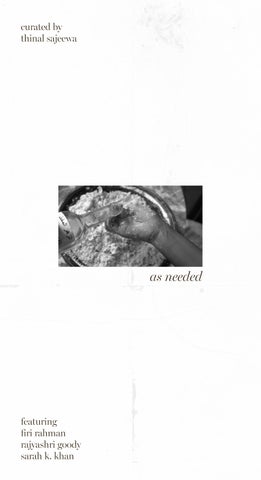
curated by thinal sajeewa


as needed featuring firi rahman
rajyashri goody
sarah k. khan
This publication was first developed as part of as needed, for the Curatorial Intensive South Asia 2025, with the support of Khoj International Artists Association and Goethe Institut/Max Mueller Bhavan New Delhi.

Curatorial Note
as needed draws from the language of recipe writing, where instructions adapt to taste and availability rather than fixed measurement. A recipe is a set of instructions used to prepare and cook food. The exhibition reimagines the form of recipes by inquiring the question of ‘what more can a recipe be?’
Bringing together artworks by Firi Rahman (b. 1990), Rajyashri Goody (b. 1990), and Sarah K. Khan (b. 1964) the exhibition explores how knowledge is transmitted through everyday practices such as writing, conversation and bodily action. While reflecting on how access to literacy and resources shapes what is recorded and preserved, and how forms of domestic and cultural labour are often made invisible.
Focusing on processes of making rather than the final dish, as needed invites viewers to consider how cultural memory is sustained through ordinary, repeated acts.
Firi Rahman (b. 1990)
Meja kayang (2024)
Mixed media installation
Collection the Artist Commissioned by Studio for Memory Politics
First exhibited: ‘Voices from an Archived Silence –Transoceanic Exchanges’ , Indus Valley School of Art and Architecture, Karachi, Pakistan, 2025
Firi Rahman presents a tablecloth incorporating drawings of ingredients used to prepare Malay Pickle (Melayu Accharu), a traditional accompaniment eaten by the Malay community in Sri Lanka. The ingredients displayed on the overhang of the tablecloth represent the dish’s traditional components. Those on the tabletop represent newer additions, such as carrots and mangoes, introduced by individuals as tastes evolve over time.
The dining table is a place where families gather to share meals. For Rahman, it is not only a space of gathering but also a site where culture and knowledge are shared and passed down across generations.
In this artwork, the fabric functions as a record of the recipe’s evolution across time. The table becomes an active surface that carries traces of those who sit around it. The work draws attention to the informal ways in which histories are recorded and communicated through everyday practices.


Firi Rahman (b. 1990)
Nene’s Recipe for Melayu Accharu (Malay pickle) recipe in Kadugu (mustard seed) bottle (2025)
Faded ink on bank receipt and glass bottle
Rimza’s Recipe for Melayu Accharu (Malay pickle) recipe in goola botol (sugar bottle) (2025)
Ink on receipts and bank slip and glass bottle
Datha’s Recipe for Melayu Accharu (Malay pickle) recipe in Chabey (chilli) and Bissar Chabey (capsicum) bottle (2025)
Ink on electricity bills and glass bottle
Nona BB’s Recipe for Melayu Accharu (Malay pickle) recipe in storage bottle (2025)
Ink on shop invoice and glass bottle
Maami’s Recipe for Melayu Accharu (Malay pickle) recipe in cuka (vinegar) bottle (2025)
Ink on receipt and glass bottle
Collection the Artist
Commissioned by Studio for Memory Politics
First exhibited: ‘Voices from an Archived Silence –Transoceanic Exchanges’ , Indus Valley School of Art and Architecture, Karachi, Pakistan, 2025
Rahman presents a series of glass jars containing handwritten Malay pickle recipes, similar to those found in Malay kitchens. He reflects on how these recipes are often passed down informally, written quickly on pieces of paper resembling receipts, or recorded on scraps of paper during phone conversations and stored inside ingredient bottles for safekeeping.
Rather than presenting precise instructions, the writings capture the way recipes are shared through conversation and experience, without fixed measurements or standardized methods. Each jar holds a different version of the same dish, reflecting how the recipe evolves across families and individuals.
The jars speak to a fluid, everyday form of cultural Inheritance. They highlight how memory is carried by those who continue to cook, share, and adapt recipes through practice and repetition.


Rajyashri Goody (b. 1990)
Writing Recipes (2016 - ongoing)
Printed matter
Collection the Artist
First exhibited: ‘Heterotopia’ , Asia Culture Center, Gwangju, South Korea, 2016
Presented here are fourteen hand-bound booklets, each in a different colour and bound together using twine. They are displayed as individual yet connected objects, meant to be handled and read. Each booklet contains an anthology of fragmented recipe-poems. By presenting these texts in the form of recipe booklets, the artist reimagines the traditional format of the cookbook.
The booklets draw from Dalit autobiographies and writings that reference food, hunger, memory, and survival. Passages describing eating, not eating, cooking, begging, and sharing are rewritten in the second person, creating fragments that sit between recipe and testimony. The work reflects histories shaped by caste-based labour, restricted access to food, literacy and also responds to contemporary caste violence and the politics of meat, particularly beef, in India.
The booklets function as carriers of memory, moving between text and object, archive and kitchen. The work reflects on how food is shaped by power and how everyday acts of eating can hold histories of exclusion and resistance.


Sarah K. Khan (b.
Cookbook of Gestures (2018 - ongoing)
Multimedia video projection
Collection the Artist
First exhibited: ‘Working Conditions’ , Asian Arts Initiative, Philadelphia, USA, 2018
The Cookbook of Gestures is a multi-channel video installation composed of 150 video clips. The installation is organised into five “recipes.” Each small frame shows a single hand gesture related to preparing food. The videos focus on repetitive movements associated with cooking - folding, stirring, holding, grinding, and waiting. The work centres the hands and the rhythms of preparation rather than the finished dish.
The gestures are drawn from the daily labour of five women who work as cooks or farmers in Fez, Morocco. The work reflects on cooking as embodied knowledge passed through practice rather than written instruction. The installation highlights the gendered nature of culinary labour and the often invisible work performed by women in sustaining food systems and households.
The work extends the idea of the recipe beyond text. It shows how knowledge can be transmitted through the body. The looping gestures reflect how cultural memory is preserved through repetition, positioning cooking as both archive and performance.


Papan pemotong (cutting board)
01–08 (2025)
Knife marks and engraving on wood
Collection the Artist Commissioned by Studio for Memory Politics
First exhibited: ‘Voices from an Archived Silence – Transoceanic Exchanges’ , Indus Valley School of Art and Architecture, Karachi, Pakistan, 2025
In this series, Rahman engraves cutting boards with key ingredients used to prepare Malay Pickle, such as red onions, capsicums, and dates. The boards also carry stains and marks left from repeated food preparation on their surfaces.
The work references Koranic writing boards, which Rahman recalls using as a child to learn Arabic scripture. On these boards, students would write and rewrite, learning through repetition. Similarly, the cutting boards bear traces of continuous use, where ingredients are cleaned, chopped, and processed. Through this connection, the artist reflects on how recipes, like languages, are transmitted and transformed across the surfaces they pass through.

Acknowledgements
This exhibition would not have been possible without the generosity, collaboration, and guidance of many individuals and institutions.
Participating Artists: Firi Rahman, Rajyashri Goody, and Sarah K. Khan
Supporters: Khoj International Artists’ Association; Goethe-Institut / Max Mueller Bhavan New Delhi
All tutors of the Curatorial Intensive South Asia 2025, and mentors Latika Gupta and Shuddhabrata Sengupta
All fellows of the Curatorial Intensive South Asia 2025
All staff of the KHOJ International Artists Association
Curatorial Team at Museum of Modern and Contemporary Art Sri Lanka: Sharmini Pereira, Sandev Handy, and Nimaya Harris
Exhibition Identity & Publication Design: Raeesah Samsudeen