





Help carry your clients from saving through retirement success with flexibility, protection and income
BY ANDREW FARRELL, MSJ SVP, RETIREMENT SALES, DISTRIBUTION AND MARKETING
As financial professionals, we talk a lot about how annuities can help provide guaranteed retirement income for the lifetimes of our clients. In particular, the concept of a “paycheck in retirement” has been an easy way to explain the value annuities can bring to a retirement portfolio during retirement. But there’s another way annuities can help diversify their holdings that can be overlooked in our planning conversations—using annuities to contribute to portfolio resilience and growth before retirement begins. Even with a plan and the guidance of trusted financial professionals, some of your pre-retiree clients may still
regard their own retirement readiness with concern. Last year, a Pew Research Center survey found that 45% of U.S. adults under 65 “aren’t confident they’ll have enough income and assets to last through their retirement years or say that they won’t be able to retire at all.”1 Granted, that survey is a small sample of Americans, but the narrative that today’s workforce may “never be able to retire” permeates the discourse about retirement.
Your clients already have an advantage, because they work with your team to support their investment decisions. But some may still worry they aren’t doing enough to prepare financially for their retirement years. Help them turn those concerns into action by introducing the idea that annuities could be a valuable addition to help grow their savings during the accumulation years.
A hidden strength: Accumulation with protection, growth and tax efficiency
FIA for growth and protection
• Stability through market cycles
• Long-term planning with predictable income
• Tax-deferred growth
for growth opportunities
• Some downside risk with market index performance
• Flexibility in strategy—tailor your risk/ reward profile
• Options for guaranteed lifetime income through annuitization
Fixed indexed annuities (FIAs) and registered indexed-linked annuities (RILAs) offer flexibility and stability for pre-retiree clients who may want to protect a portion of their savings but still want those assets to continue contributing to their portfolios as they get closer to retirement. Help them learn more about how the potential benefits of an asset type like annuities could fit into their portfolios and help them manage their concerns about having what they need for retirement success.
1Pew Research Center. “How Americans Are Thinking About Aging.” November 2025 (accessed Jan. 5, 2026). Annuities are issued by Symetra Life Insurance Company, 777 108th Avenue NE, Suite 1200, Bellevue, WA 98004-5135. Products, features, terms and conditions may vary by state and may not be available in all U.S. states or any U.S. territory. Neither Symetra Life Insurance Company nor its employees provide investment, tax, or legal advice or endorse any particular method of investing. Individuals should seek
advice before making savings and investing decisions.

Explore how FIAs support protected growth in any market. Scan the QR code for client-approved resources.






































BY JAMES ROGERS
Mention “succession” to most people in the last few years, and they would probably think about the hit HBO black comedy about the vicious intrafamily battle for control of a fictional media empire.
But in the advisor industry, succession is a ticking time bomb, a looming crisis born out of aging leadership and economics that no longer make sense. The numbers are stark – the average age of a family office principal is 68, according to data from Deloitte Private. But only 22 percent of respondents in DeVoe & Company’s latest annual RIA M&A outlook said that the next generation can afford to buy them out.
Companies are increasingly aware of this issue – 67 percent of the RIA leaders surveyed in the DeVoe & Company report cited succession planning as a major issue, up from 62 percent a year earlier.
“M&A may be booming, but succession planning is falling behind,” said David DeVoe, CEO of DeVoe & Company, in the report. “The independent RIA segment is now in a succession crisis. The traditional path of internal succession is slipping out of reach for the majority of SEC registered firms.”
Passing the business on to a family member may be an option for some firms, but what if your family can’t, or won’t, take over? A sale, say, to private equity, followed by years on the golf course, will be the perfect exit strategy for some business owners. But this can bring its own problems – not every potential acquirer will be a fit for your employees or your clients.
The cultural aspect of succession is critical. Chuck Failla, CEO of Sovereign Financial Group and host of goRIA, recently summed this up perfectly when he told me that Sovereign is his third child.
Sovereign, which has surpassed $1 billion in assets under management, has had plenty of overtures from private equity to sell. But this isn’t an option for Failla.
Instead of selling to outside capital, he has opted to sell a portion of his equity to the company’s leaders through seller financing. “I

am not selling out – I am sharing the equity so that I can put some in the hands of the next generation,” he told InvestmentNews . “It is important for me to maintain the
worlds. He is ensuring his legacy at Sovereign while continuing to do what he loves – working with his book of business while serving as the face of the
“In the advisor industry, succession is a ticking time bomb, a looming crisis born out of aging leadership and economics that no longer make sense”
culture of Sovereign.”
We could see more of this model in the coming years – Ritholtz Wealth Management, for example, is also sharing the wealth. The RIA recently announced a succession plan that involves expanding the company’s equity structure to 29 employees.
For Failla, his decision to sell some of his equity is the best of both
company and helping to guide its strategy. But he told me that he won’t have to focus on the minutiae that comes with running the company.
While this approach won’t work for every advisory firm leader, it proves that there is at least one way to defuse the succession time bomb.
Anchor: Gregg Greenberg
Journalists: Andrew Cohen, Leo Almazora
Senior Sponsored Content Writer: Manal Ali
SALES
Chief Revenue Officer: Dane Taylor dane.taylor@keymedia.com
Business Development Managers: Catherine Reale catherine.reale@keymedia.com; Victoria Hamilton victoria.hamilton@keymedia.com; Barry Echavarria barry.echavarria@keymedia.com
Lead - Fulfillment Team: Cole Dizon
Coordinators: Cyrus Arroyo, Pauline
Marketing
Project Manager: Kristyn Dougall
KM Business Information US, Inc. 3190 S Vaughn Way, Suite 550 Aurora, CO 80014
InvestmentNews is part of an international family of B2B publications, websites, and events for the finance and insurance industries
INSURANCE BUSINESS AMERICA cathy.masek@keymedia.com
INSURANCE BUSINESS AUSTRALIA sophie.knight@keymedia.com
INSURANCE BUSINESS CANADA elijah.hoffman@keymedia.com
INSURANCE BUSINESS UK gemma.powell@keymedia.com
BENEFITS & PENSIONS MONITOR
WEALTH PROFESSIONAL CANADA abhiram.prabhu@keymedia.com


The Women Advisor Summit brings together a dynamic community of women who are rewriting therules of advice and growth in wealth management, offering a dedicated space for advisors, planners, wealth managers and firm leaders to strengthen theirimpact and support one another.
♦ Gain practical insights to grow your practice and strengthen your leadership.
♦ Refresh your perspective with new approaches from inspiring women across the industry.
♦ Exchange ideas and experiences with peers who understand your challenges and ambitions.
♦ Build meaningful connections through interactive sessions and networking opportunities.
















The lowest-income retirees face around $3,800 in unexpected expenses annually, while those in the highest income level would confront around $11,000 in surprise spending.
Not surprisingly, a large chunk of services sought by high-net-worth clients are highly specialized. At least three-fifths of advisors in a recent BlackRock survey highlighted estate planning, customized retirement planning, and charitable giving – all areas with tax-planning implications – as services that they offer to their well-heeled clientele.
Source:
A recent Cerulli research analysis projects that, relative to other channels, nearly 6% fewer advisors will be operating in the wirehouse channel by 2028, while the independent RIA channel will see 12% more advisors.


A new read of RIA sentiment finds muted confidence among advisors, coming in at 53 out of 100 points. Concerns over stock market volatility and a potential downturn in 2026 weighed the most heavily on their minds, with rising inflation expectations also emerging as a key driver of declining optimism.




After an extremely competitive 2025, senior financial advice industry executives and headhunters think this year will also be a dog fight for the best advisors
BY BRUCE KELLY
2025 was a real donnybrook in the competition between large broker-dealers to land toptier financial advisor recruits, and by many accounts 2026 – the Year of the Fire Horse in the Chinese calendar – will turn out the same.
Last year’s catalyst was LPL Financial Holdings Inc.’s announcement, at the end of March, that it was buying rival Commonwealth Financial Network for $2.7 billion in cash. Broker-dealers and registered investment advisors immediately piled on, cold-calling Commonwealth’s close to 3,000 advisors so often that some took to social media and asked recruiters to stop bothering them.
Executives at Commonwealth Financial − which for decades presented itself as a boutique with top-shelf service in contrast to LPL Financial, the industry’s behemoth with more than 10 times the number of financial advisors − built a firm that was home to some of the largest-producing advisors in the financial advice business. That success, combined with their esprit de corps, makes them highly valuable Even though LPL Financial has closed the Commonwealth Financial transaction, it still needs to move the advisors onto its platform, giving recruiters plenty of opportunity to pitch them to leave and join a different firm.
Meanwhile, industry consolidation is continuing, and some senior industry executives believe that another large deal for a brokerage firm would create a catalyst for a recruiting frenzy similar to the one created by the Commonwealth acquisition.
“It’s a competitive environment right now,” said LPL Financial’s CEO Rich Steinmeier, answering an analyst’s question about attracting financial advisors during a conference call last month. “Competitors remain aggressive.”
And aggression in the brokerage business means money − specifically, bonuses referred to in the industry as “transition assistance,” paid to advisors when they move from one firm to another.
“We’ve seen TA levels spike up, most notably right after the Commonwealth announcement,” Steinmeier said.
“Recruiting reached a new intensity in 2025 − arguably the most competitive landscape I’ve seen − and I expect this trend to continue through
2026,” said Jeff Buchheister, chief financial officer of Cetera Financial Group, in a recent research note from William Blair.
“Significant M&A activity across the industry created disruption, which opened the door for firms like Cetera,” Buchheister said. “We capitalized on these opportunities, successfully attracting a substantial number of advisors and teams following these disruption events.”

“It’s a

competitive environment right now. Competitors remain aggressive. We’ve seen TA levels spike up, most notably right after the Commonwealth announcement”
RICH STEINMEIER, LPL FINANCIAL

Triggered in large part by the sale of Commonwealth Financial and by a stock market that just wouldn’t quit and rose 17.9 percent last year, 2025 was a tumultuous year for financial advisors jumping from one firm to another, looking for better compensation and service at a new home.
Recruiting financial advisors, particularly in such a highly competitive market, is not cheap. Bonuses, or the aforementioned transition assistance, are more dear than ever.
And large firms appear to be adjusting to those higher operating costs.
Raymond James Financial, in a first, broke out recruiting expenses for the last quarter of 2025 in its January earnings report. It reported “recruitingand retention-related compensation” of $107 million for the three months ending December 31, an increase of 22 percent compared to the same quarter last year.
The firm, a recruiting powerhouse, was highly focused last year on Commonwealth Financial advisors; industry sources told InvestmentNews that the firm finished second to LPL in the bidding for the privately held Commonwealth.
“There’s a lot of investment that goes into recruiting,” Raymond James Financial CEO Paul Shoukry said last month during a call with analysts to discuss the firm’s earnings. “The reason we broke out the retention- and transition-assistance-related expense for the first time this quarter is because in the last 12 months, we recruited advisors who had $460 [million in annual revenue] at their prior firms.”
“That’s equivalent to a pretty decent-sized acquisition in our space, especially when
you look at what is remaining out there,” Shoukry added.
And that’s a potential hurdle for the industry to face in 2026 when it comes to recruiting; consolidation of the brokerage industry has reached a level leading some to wonder who’s

“Recruiting reached a new intensity in 2025 − arguably the most competitive landscape I’ve seen − and I expect this trend to continue through 2026”
JEFF BUCHHEISTER, CETERA FINANCIAL GROUP
next to be bought, and potentially sending advisors scattering to rivals.
“If you go back at least five years or more, the biggest trigger for recruiting comes from an acquisition like Commonwealth,” said Jodie Papike, CEO of recruiting firm Cross-Search. “Another big factor is service. Some firms have simply lost touch with what advisors are looking for there.”
“But an acquisition forces financial advisors to look at their options, and I don’t see 2026 being any different,” Papike said.
Independent RIAs have become the fastest-growing advisor channel as consolidators, equity incentives, and tax-efficient deal structures reshape recruiting – and expose growing tensions around career paths, ownership, and scale
BY ANDREW COHEN
The RIA industry has been trending upward for years as the fastest-growing channel for advisor headcount, with last fall’s OpenArc breakaway from Merrill Lynch feeling like a gut punch delivered to the legacy wirehouse model.
OpenArc managed roughly $130 billion in assets as they exited Merrill to launch an independent RIA backed by minority investor Dynasty Financial Partners and Charles Schwab as its custodian. Cerulli Associates has projected an 11.8 percent headcount increase in the independent registered investment advisor (RIA) channel by 2028, which is more than double the projected growth of the nextfastest-growing channel of independent brokerdealers at 4.7 percent.
“The departure of Open Arc from Merrill Lynch’s global corporate and institutional advisory services team – I think that showed there’s a significant pool of assets out there that’s servicing adjacent businesses to wealth but are also looking to break away from larger businesses,” says Stephen Caruso, associate director at Cerulli Associates.
Schwab has projected that RIAs will need to hire more than 70,000 new staff over the next five years to keep up with current growth rates. However, most of the industry’s hiring has been dominated by private equity-backed aggregator firms. Cerulli says since 2014 RIA consolidators have increased advisor headcount nearly sevenfold – from under 200 advisors to nearly 1,300 – while the rest of the RIA market has remained largely flat over the past decade.
RIAs have a deal-structure edge over wirehouses or broker-dealers in recruiting advisors looking to sell their business, according to

Diamond Consultants CEO Louis Diamond, whose mother, Mindy, founded the advisor recruiting firm. Large RIAs can structure transitions so that most of the compensation is taxed at favorable long-term capital gains rates instead of ordinary income or forgivable loans, which is highly attractive to advisors.
“We’re seeing advisors really say, ‘I have a great team and I’m just looking to cash out,’ or ‘I want to merge my business with an existing RIA,’” says Louis Diamond. “So, they’ll legally sell their business to one of these large, typically private equity-owned RIAs and unlock capital gains tax treatment. Get a bunch of cash, equity, and reap the rewards of independence without having to take the hard step of running their own business. I think that’s going to keep accelerating.”
According to an RIA industry survey conducted last year by consultancy DeVoe & Company, 68 percent of respondents said a well-defined career path is the top request from next-gen professionals. These career-path prospects are often muddied for non-partnered advisors whose firm is sold to an acquirer, often prompting those advisors to seek other options.
“They get sold to a big RIA acquirer, and all of a sudden their shot at taking over the business and working with the firm of 10 people completely changes,” says Diamond. “So we’re seeing a lot of RIA breakaways, who built their own book or might just be more of a support advisor that’s looking to go out on their own, start their own RIA or go to a smaller firm, or go to a firm where they’re going to have equity and have more of a voice.”

“OpenArc’s RIA breakaway from Merrill Lynch showed there’s a significant pool of assets out there that’s servicing adjacent businesses to wealth but are also looking to break away from larger businesses”
STEPHEN CARUSO, CERULLI ASSOCIATES
A path to advisor equity was the second-mostdesired request for advisors according to DeVoe’s survey. RIAs that have developed their own models for advisor equity include Ritholtz Wealth Management, Bogart Wealth, Steward Partners, and Mercer, among others.
“Some firms offer actual equity – other firms it’s structured more as profits interest, so [advisors] get distributions and they can monetize in an acquisition, but it’s non-voting and there’s different tax treatment,” says Diamond. “What advisors care about, the voting doesn’t matter because they’re going to have such a small stake. It’s more, can I get distributions and how am I monetized in a transaction? Am I going to be diluted? What’s the value of the equity?”
Much of the RIA industry still operates 1099 independent contract models for advisors, but a growing number of firms are shifting toward W-2 employee models that cater toward equity participation. Private equity-backed acquirers to rollout W-2 programs include Mariner, OnePoint BFG Wealth Partners, Hightower Advisors, and Signature Estate & Investment Advisors (SEIA).

“Advisors [don’t care about] the voting … because they’re going to have such a small stake. It’s more, can I get distributions and how am I monetized in a transaction?”
LOUIS DIAMOND, DIAMOND CONSULTANTS
Sam Huszczo, founder of Michigan-based SGH Wealth Management, is an example of a smaller-scale RIA that has opted for a W-2 model for its 15 employees that manage $570 million in assets. His firm’s average employee is 27 years old, and he’s leveraged campus visits to colleges such as Michigan State to meet potential recruits.
“Our industry is literally no different than lawyers or accountants or audit people. We do a professional service, you need designations, and then you need to get clients. But why has the business model of wealth management always
been this independent contractor pool thing?” asks Huszczo.
Michigan State offers a minor in financial planning and wealth management for students interested in that career path. Schwab has also been active on college campuses, awarding $15,000 to winners of its RIA Talent Advantage Student Scholarship.
“With wealth management firms, I think we’re going to be occupying skyscrapers across the country at some point in the next 15 years, but not on a business model that can’t scale. And I’m sorry, but the independent contractor route is unscalable,” adds Huszczo.


exclusive experience. elite advisors. elevated independence.


at independent financial group, top advisors don’t just build successful practices— they earn access to something more. each year, ifg’s elite advisors convene in world class destinations including rome, london, hawaii, and the caribbean-experiences reserved for those operating at the highest level.
ifg is not for everyone. we partner exclusively with advisors producing $500,000+ annually. for those who qualify, ifg offers elevated independence and access reserved for the industry’s elite.
david fischer co-founder, ifg 800.269.1903 dfischer@ifgsd.com visit us at www.ifgsd.com


Public markets have been the default playground for investors for decades, but that landscape is shrinking.
As noted by the Tuck School of Business at Dartmouth, the peak of the market saw nearly 8,000 publicly traded companies in the US. Today, that number has dwindled to roughly 4,000.
Meanwhile, nearly 90 percent of companies generating $100 million or more in revenue are privately held, representing a vast universe of opportunity.
Thanks to evolving regulations and technology, access to private market investments is no longer reserved solely for institutions and ultra-high-net-worth
individuals. Advisors now have the tools to offer these options to a broader range of clients, helping them diversify their portfolios and pursue potentially stronger returns by investing in companies before they go public.
Some of the most sophisticated investors are increasingly allocating significant portions of their portfolios to private markets – including private equity, hedge funds, private debt, real estate, and infrastructure. This reflects a growing recognition that private markets can offer access to opportunities that are simply not available through public exchanges.
One of the compelling reasons to include private market assets in client portfolios is that they function as a
potential hedge against volatility. Unlike public equities, which are updated daily and can swing due to headlines, technical factors, or investor sentiment, private investments are typically revalued only during significant events like a capital raise or a sale.
This means they’re less correlated with matters that affect public markets, which can help smooth out portfolio performance during turbulent times. As public markets grow more unpredictable, private assets may offer a powerful tool for diversification.
Historically, private market investments were limited to those who could meet steep qualification thresholds and navigate complex structures; private equity firms offered access only to large limited
partners (LPs) with at least $5 million in investible assets.
That standard is shifting. Wealth management platforms have pushed for broader access, and private market managers have responded by creating new vehicles – like evergreen and tender option funds – designed to accommodate lower-net-worth thresholds. This democratization of private markets means that investments once restricted to qualified purchasers (net worth of $5 million+) are now available to qualified clients (net worth of $2.2 million) and even accredited investors (net worth of $1 million).
Some of these newer structures also offer liquidity features that create more flexibility for investors – for example, issuing 1099 tax forms instead of K-1s, which simplifies tax reporting and avoids the delays and costs associated with filing extensions.
Changes like these are making private markets investing more accessible, manageable, and attractive to a wide range of clients.
As private markets continue to evolve, the case for including them in client portfolios grows stronger, and advisors who overlook these opportunities risk falling behind. With access expanding through new fund structures, lower investment minimums, and simplified tax reporting, the barriers that once kept private markets exclusive are rapidly disappearing.
Advisors can offer stocks, bonds, and mutual funds. But those looking to deliver robust returns and meaningful diversification should explore how private market investments can elevate their practice. Take advantage of the growing pool of educational resources, learn more about product availability, and understand why these investments can add real value. As private markets become more accessible, clients may begin to seek them out – and advisors who are prepared can meet that demand with confidence.
Ken Novak is head of private markets strategy and co-head of the alternatives investment group at Raymond James.

































SIMPLY MAKING money over the course of 2025 wasn’t the challenge. The S&P 500 rose 16 percent, capping the best three-year return since the dot-com boom, while the Nasdaq Composite did even better with an annual return of 20 percent. It was a similar story across the other indexes. Handling the volatility was the true test.
Against this backdrop, InvestmentNews’ Top Financial Professionals 2026 proved themselves to be proactive. While clients wanted to see their assets growing, they wanted it done with sophistication, understanding, and foresight.
The 100 winning financial professionals were evaluated and ranked by weighted calculations of:
• 50 percent total 2025 AUM
• 25 percent AUM growth over the evaluation period
• 25 percent client growth over the evaluation period
Growing AUM has been impacted by the biggest RIAs and scalable platforms capturing a disproportionate share of new assets, mainly through consolidation, alternatives, and technology-enabled operating models.
In addition, the economies of scale offered by tech free professionals and advisors’ time for business development and operational targets, while these broader capabilities also attract
more high-net-worth clients. And there’s been greater integration of active ETFs, with McKinsey estimating in a 2025 report that “around half of active ETF flows represent substitution from legacy vehicles – primarily mutual funds – while the remaining is driven by new demand for active strategies, sometimes at the expense of passive allocations.”
This is something Andrew Blake, associate director of wealth management at Cerulli Associates, pinpoints.
“Top advisors especially have really taken steps to educate themselves about alternative products that behave differently from traditional equity or fixed income products,” he says. “Those using certain alternative products may highlight their steady performance, particularly during broader market volatility.”
And with all indexes on growth trends, many see valuations as elevated and markets as late in the cycle, which the best advisors are alert to.
“In this type of market, discipline, risk management, and thoughtful portfolio construction matter far more than blind participation because protecting capital is often the difference between a plan that works and one that doesn’t,” says Terri McGray, president of Longevity Capital Management LLC.





“The benefits to being our own RIA are we can do tax and estate planning, and we can help clients with a lot more decisions than we previously could because, for most families, it’s really not just about their investments”
JERRY DAVIDSE, PRESILIUM PRIVATE WEALTH


AUM
Client

Jerry Davidse, one of IN’s Top Financial Professionals 2026, illustrates an investment approach built around disciplined planning, downside preparation, and long-term family wealth.
Presilium Private Wealth’s CEO explains that in a highly volatile year, “we did a great job managing that volatility by having a plan in place for our clients ahead of time,” which allowed the firm to be “well prepared to buy stocks during that decline” in the April 2025 tariff-driven selloff rather than react emotionally.

Wealth.com is the industry’s leading estate and tax planning platform, empowering thousands of wealth management firms to modernize how planning guidance is delivered to clients.
Purpose-built for financial institutions, Wealth.com is the only tech-led, end-to-end platform that enables firms to scale estate and tax planning with efficiency, consistency, and measurable client impact.
Trusted by some of the largest names in finance, Wealth.com combines proprietary AI,
This discipline is anchored in Presilium’s Investment Policy Statement, meaning portfolio shifts are rules-based rather than ad hoc, which drives rebalancing and a holistic philosophy that Davidse emphasizes is “really not just about their investments [but] about a holistic, long-term financial plan” spanning tax, estate, gifting, and multigenerational wealth transfer.
enterprise-grade security, and deep legal and tax expertise

to support the full spectrum of client needs – from foundational estate plans to advanced estate and tax analysis and reporting.
Wealth.com has been widely recognized for innovation and leadership in estate planning technology. It has won multiple industry awards and holds the #1 estate planning market share in the 2025 Kitces AdvisorTech Study.
so volatility in stocks doesn’t derail near-term goals. Short-term money (next six months to two years) is invested conservatively, while longer-term money (five to 15 years) is invested for growth, “irrespective of the fluctuation.” This ensures that clients are “never in a position to have to sell stocks when they’re temporarily down in a material way to support their living needs or whatever their liquidity event is.”
METHODOLOGY AND AWARD DISCLOSURE













To compile the third annual Top Financial Professionals (previously Top Advisors) list, InvestmentNews opened a public nomination process for eligible financial professionals. Nominations were accepted from advisors, colleagues, industry professionals, and clients. Only professionals who were formally nominated were considered for the 2026 list. All nominee information was required to be reviewed and verified by each professional’s compliance department before it was accepted into the evaluation process.
A total of 394 nominations were received, and 100 professionals were ultimately selected as recipients of the 2026 Top Financial Professionals recognition.
Evaluation criteria and scoring Professionals were evaluated solely on quantifiable business metrics covering the period from August 2024 through August 2025. The ranking was based on the following weighted calculations:


Scott Van Den Berg –Century Management Financial Advisors
AUM growth: 8 percent
Client growth: 6 percent
Another winner, Scott Van Den Berg, president of Century Management, has boosted AUM. Roughly 15 percent was driven by net new deposits, both from new client relationships and existing clients adding capital, and the remaining 85 percent was attributable to portfolio appreciation.
That performance was not the result of any single position or narrow sector bet. Rather, it reflected broad participation across portfolios, sectors, and individual holdings, with multiple strategies performing well and most exceeding their respective benchmarks.
“We manage portfolios that range from fully invested, more aggressive equity strategies, to moderate and moderately aggressive balanced allocations, to conservative, 100 percent fixed-income portfolios – and all of these approaches contributed meaningfully during the year,” he says.
In 2025, gold was the firm’s strongest single contributor and typically represented 6–10 percent of client portfolios. Beyond that, performance contributions were well diversified across sectors including communications, technology, finance, healthcare, manufacturing, and energy.
Van Den Berg adds, “The breadth of participation was a key strength – it was not a concentrated or narrow market experience for our clients.”
The goal is not to forecast short-term market moves but to understand what is being paid for a stream of future cash flows and whether that price provides an appropriate margin of safety. Importantly, Van Den Berg’s definition of value incorporates both upside potential and downside risk.
He structures client money in different “buckets,”


“A distinguishing feature of our firm is that we do not use a model portfolio. That level of tailoring has been a significant driver of both performance alignment and client trust”
• 50% – total 2025 AUM


SCOTT VAN DEN BERG, CENTURY MANAGEMENT FINANCIAL ADVISORS
• 25% – AUM growth over the evaluation period
• 25% – client growth over the evaluation period
InvestmentNews assigned each professional a ranking within each of the three categories, and then applied the weighting formula above to calculate a combined score. Nominees were placed on the 2026 Top Financial Professionals list based on their final composite ranking.
What the award measures
This recognition is based only on the business metrics listed above: AUM, AUM growth, and client growth.
What the award does not measure
To comply with SEC advertising and anti-fraud rules, InvestmentNews confirms that the 2026 Top Financial Professionals list is not based on:
• investment performance or portfolio returns
Trevor Scotto –Fiduciary Financial Group
AUM growth: 34 percent
Client growth: 13 percent

Trevor Scotto, another of IN’s Top Financial Professionals 2026, has won the respect of clients with his ensemble model, a highly integrated tax and planning framework that he executes calmly and proactively, especially in volatile markets. Business owners, successful retirees, and tech professionals with significant stock concentrations are the groups his skills appeal to.
• client experience, testimonials, or satisfaction
• qualitative factors such as leadership, service quality, or professional reputation
• any criteria not expressly stated in the methodology
Fee and promotional disclosure
No fees are required to be nominated or considered for this recognition. Some professionals may choose to purchase optional promotional or marketing packages from InvestmentNews after being selected. Such purchases do not influence the methodology, scoring, or selection in any way.


“The majority of our new clients are joining specifically because they are not getting proactive planning nor tax planning. They feel like they are missing out on opportunities”
TREVOR SCOTTO, FIDUCIARY FINANCIAL GROUP


“When the market was down 20 percent in a couple of weeks, I had a lot of people asking, ‘You must be getting a ton of phone calls.’ But we don’t, because we don’t focus on day-to-day moves; we focus on a strategy”


THOMAS RUGGIE, DESTINY WEALTH PARTNERS
As part of our editorial process, InvestmentNews’ researchers interviewed the subject matter experts below for an independent analysis of this report and its findings.


Terri McGray, CFP, AIF President/Wealth Advisor Longevity Capital Management LLC
Andrew Blake Associate Director, Wealth Management Team Cerulli Associates
“We typically run tax projections. We might do that a couple of times a year, and that helps us identify if there are savings or strategies that might make sense. And then, on top of that, we do their tax returns,” he says.
Scotto explicitly distinguishes between generic tax planning and true, actionable tax advice that clients can implement immediately while avoiding big tactical bets based on news events and, instead, applies a disciplined playbook in drawdowns and volatility.
When investment changes occur based on world events, Scotto, one of the co-founding partners at Fiduciary Financial Group, turns to Roth conversion planning. This integrated approach turns the firm’s tax planning team into a key differentiator as clients see the immediate value of a portfolio managed with real-time understanding of their tax liability.
“We look at tax-loss harvesting and rebalancing, buying bonds or selling bonds and buying stocks at a discount. And if there’s excess cash, we put that to work in a down market,” he explains. “If we can do a tax redirection and we do a Roth conversion, the client can accurately see the full picture before making an informed decision.”
He says, “I’m not as worried about volatility itself. I’m worried about the psychology of volatility for our clients. Our strategy does a fantastic job of managing that.”
The aim is to prevent emotional decisions at the worst possible times.
He adds, “The goal is for our clients not to make irrational decisions at the two times people most often do: when things are going very well… and when things are going very poorly.”
For his core wealth management clients ($1–$5 million), Ruggie typically steers them into public securities and public equities in that pool, with some alternative investments mixed in.
The key differentiator is his firm’s proprietary alternative fund that holds investments at qualified purchaser (QP) level as the underlying investments – hedge funds, private equity firms, and even direct investments that are only available to QPs.
“We’re giving our wealth management clients the opportunity to invest the same way higher-net-worth and ultra-high-net-worth individuals invest,” says Ruggie.


AUM growth: 24 percent
Client growth:

For HNW and UHNW clients, they are heavy in the alternative investment world, and specifically on mid- to late-stage pre-IPO direct investments into private companies such as SpaceX, Anthropic, xAI, Databricks, Stripe, Anduril, Agility Robotics, and Crusoe. Ruggie emphasizes this as a major differentiator for clients.
“Those are only available to QP clients, but we do include some of those in our accredited alternative investment fund.”
The alternative fund has 60 percent in hedge funds and 40 percent in private equity and direct investments. Over the last year, the firm’s publicly traded portfolio almost doubled the S&P 500, and its alternative credit investments outperformed fixedincome benchmarks. Offering these services has an impact on AUM.
“We surpassed $1 billion as a firm. To think we’ve gone from $1 billion to now pushing $1.6 billion in just over two years is crazy to me, especially because it’s all organic growth – no mergers or acquisitions,” Ruggie says.
And he acknowledges that they are not aggressive marketers, implying the growth is largely client driven. One standout referral was for a ninefigure prospect, not in a rush to move her accounts, but continued contact on direct investment offerings stimulated interest and ultimately resulted in movement of the accounts.
“I know I’m biased, but our firm is a great firm, and we’re not the best in the world at promoting ourselves or generating new business through deliberate marketing. Yet, because we are as good as we are, we still get a lot of business without really having to ask for it,” Ruggie explains.
HOLISTIC FINANCIAL PRACTITIONERS
Clients are attracted by advisors and professionals who can offer a suite of services, and this is where firms can win more business.
Blake of Cerulli Associates says, “It’s really crucial that top advisors at least have a solution they can recommend for the comprehensive financial picture regardless of whether they offer it in-house or through a partnership with someone else.”
This is evident across the spectrum of IN’s Top Financial Professionals 2026. Ruggie points to the relative ease of investment management today and emphasizes that doing other things to support the client’s overall needs creates the value or the experience they’re looking for.
“If you give me a $2 million, $10 million, or $100 million portfolio, how to invest and manage that, set expectations, and build a plan – I can do that in my sleep. It’s everything else that really makes the difference,” he says.
Ruggie’s services extend to philanthropy, tax and estate planning, business liquidity event planning, and more. His golden rule is a belief that everyone should spend the majority of their time doing the top three things they really want to be doing.
“For virtually all my clients, their top three does not include managing their investment portfolio or talking to their CPA and attorney,” he says.
“If I can take all that off their plate, they have more time to focus on what truly matters to them. That’s where we create a lot of value.”
Talking about the investment-only model for advisors and professionals, Scotto describes it as “dying out quickly.”
For his clients, who are mostly based in California, one of the firm’s partners is an estate attorney affording the ability to offer in-house advice.
The focus is on ensuring Scotto understands clients’ financial situation inside and out, and then learning more about their goals, concerns, and what they want to accomplish.
“It honestly just comes down to asking the right questions and really having a genuine interest in the clients,” he says.
Fellow winner Davidse is determined not to create a “transactional” dynamic, hence opting to become a fee-only RIA. He publishes weekly videos and white papers to keep clients updated, along with using YouTube to educate and attract potential clients.
“We do quarterly meetings with each client where we’ll go through their financial plan, go through the performance of their accounts, and then talk about things that are more specific to them,” he explains.
Van Den Berg ties comprehensive planning to life stages. For younger clients, he recommends a fiveto-seven-year plan focused on getting “directionally correct” on debt, housing, family, and basic savings, rather than fixating on retirement 40 years away. He then highlights a second major checkpoint “five years before retirement” to stress test for premature death, long-term-care needs, layoffs, and other shocks in the clients’ peak earning years.
In retirement, he recommends continued reviews to ensure clients can fund bucket-list goals before their health and energy decline, noting that even very healthy clients in their early 80s often have “a little less energy, maybe some cognitive declines,” making it harder to enjoy those plans if they weren’t frontloaded.
Van Den Berg sees his job as knowing when to take “a deeper dive” and matching clients with the right professional, while he integrates their recommendations back into the overall plan.
For potential clients, he encourages them to interview advisors, evaluate experience, and understand the deliverables before committing, again reinforcing transparency as part of his trust building.
On retention, Van Den Berg sees how strong relationships form once it’s clear he understands all the moving parts of a client’s situation.
He says, “Whether you have to deliver good news or unfavorable news, as long as you’re straight with people, the returns become a little less important as far as the percentage return, because there’s more value placed on the relationship.”
Advancements in tech have enabled a closer relationship as advisors can model real numbers and scenarios in a way clients understand. This elevates the value to illustrate and interpret complexity and guide long-term strategies. The marketplace now recognizes comprehensive planning as the hallmark of a truly highperforming advisor.
As investors become more informed, many are looking for the same type of clarity they expect from other professional relationships, such as with their physicians or attorneys, where the expectation is that guidance is aligned with their best interest throughout the engagement.
McGray adds, “What’s changing now is that clients are no longer viewing this as a premium service. They want coordination between their investments, retirement income strategy, tax considerations, healthcare planning, and long-term goals. They want their portfolio and their financial plan working in concert, not in isolation.”

Brandon Downs

Phone: 404 264 1400
Website: hbwealth.com
Craig Bolanos
Phone: 847 907 9604
Email: craig.bolanos@vestgen.com
Website: getretiredstayretired.com
Nichole Raftopoulos
Phone: 207 985 8585
Email: nichole@nvestfinancial.com
Website: planwithnvest.com


Email: brandon.downs@hbwealth.com




Jerry Davidse
Phone: 215 982 4141
Email: jerry@presiliumpw.com
Website: presiliumpw.com
David J. Mammina
Phone: 631 473 1188
Email: dmammina@coastlinewealth.com Website: coastlinewealth.com

Kudla
David Pickler
Phone: 901 316 0160
Email: dpickler@picklerwealthadvisors.com

picklerwealthadvisors.com
Frank Waterson
Phone: 404 264 1400
Email: frank.waterson@hbwealth.com Website: hbwealth.com


Robin Aiken

Phone: 404 264 1400
Email: robin.aiken@hbwealth.com Website: hbwealth.com
Norman Grant
Phone: 913 361 8281
Email: info@grantcapital.net Website: grantcapital.net
Trevor Scotto
Phone: 415 578 6630
Email: tscotto@ffgwealth.com Website: ffgwealth.com
M. Wyrick
281 580 2100




rwyrick@postoakprivatewealth.com
postoakprivatewealth.com
Ruggie, ChFC®,
844 357 1120
tom@destinyfamilyoffice.com

Sijo Job

Phone: 630 716 3087
Email: sijo.job@lpl.com Website: genesiswealth.com

Jeffrey DeHaan Phone: 847 841 8650 Email: jeff.dehaan@ccpwealth.com

ccpwealth.com
Timothy Whitney
Phone: 984 257 7441 Email: tim@tradewinds.global
tradewinds.global


Scott Van Den Berg
Phone: 512 636 2026
Email: svandenberg@centman.com Website: centman.com
Laura K.






Seven advisors offer their 2026 outlooks for the once-spectacular septet
BY GREGG GREENBERG
The Beatles. The Who. Led Zeppelin. Van Halen. Time, egos, and market forces inevitably take their toll, compelling even the greatest of bands to break up.
Fine, not the Stones − they keep rolling along as the exception that proves the rule.
But the story, and the song, remains the same. All good things must come to an end. And that goes for the market’s Magnificent Seven just as much as pop music’s Fab Four.
In 2025, the average return for members of the “Magnificent Seven,” an informal term for the septet of mega-cap tech stocks that dominate the S&P 500 − Alphabet, Amazon, Apple, Meta Platforms, Microsoft, Nvidia, Tesla − was around 27.5 percent, well ahead of the S&P 500’s return of approximately 16 percent. In terms of individual performers, Alphabet and Nvidia led the pack, returning 66 percent and 40 percent respectively. Meanwhile, Apple and Amazon fared the worst of
the lot, rising only 9 percent and 6 percent for the year.
The fact that only a pair of Mag 7 companies beat the market’s overall benchmark last year seems like proof to many advisors that the group’s members have already begun to – with a nod to Fleetwood Mac – “go their own way.” The question facing wealth managers in 2026 is: which way will each of the multi-trillion-dollar members of the group go?
($3.67T)
Austin Graff, chief investment officer at 49 Financial, believes Apple remains a highquality, cash-generative technology franchise with improving medium-term fundamentals and a differentiated approach to the AI arms race. He expects Apple’s sales outlook to strengthen in 2026 as the product cycle reaccelerates, led by the iPhone franchise.
“After several years of low-singledigit smartphone unit growth, we believe volumes can move to mid-single-digit growth, supported by a more compelling hardware roadmap, including the anticipated launch of a newly designed foldable iPhone that may drive incremental upgrades and reinvigorate consumer demand,” Graff says.
And while Apple has lagged peers in both the AI narrative and recent stock performance, he views its relative restraint as a strategic advantage.
Adds Graff: “The company has historically avoided being first to market, instead scaling technologies once economics and use cases are proven.”
($4T)
Kelly Milligan, managing partner at Quorum Private Wealth, part of Sanctuary Wealth, is impressed by Alphabet’s portfolio of businesses with growing revenues and high margins. He also likes the fact that the company controls 90 percent of search and that it released Gemini, its artificial intelligence enhancement that’s leading other large language models. And because Alphabet already owned so much of search through Google, it merely had to enhance an existing product through Gemini − not convince consumers to a new adoption pattern.
Put simply, Gemini is powered by Google’s own chips, which means that Alphabet does not have to purchase semiconductors from Nvidia. Milligan, for one, is a big fan of that independence.
Further advancing his bullish case, he points out that Alphabet controls 70 percent of global operating systems and that it owns YouTube and YouTubeTV, Gmail, the Chrome browser, and Waymo robotaxis.
“That’s a lot of shots on goal and the reason why Alphabet recently exceeded Apple’s market capitalization,” Milligan says.
MAGNIFICENT 7: PERCENTAGE OF S&P 500, JANUARY 2026 Alphabet 5.6% Apple 6.8% Nvidia 7.7% Amazon 3.8%
2.4%
($2.48T)
Andrew Graham, founder and portfolio manager at Jackson Square Capital, is positive on Amazon in the coming year after it finished 2025 as the weakestperforming Mag 7 name. In his view, the company has meaningful exposure to a resilient consumer, who should benefit from tax refunds in early 2026. He adds that real income growth for middle-income consumers is expected to exceed 2.5 percent, reinforcing Amazon’s core retail and advertising businesses.
“Amazon offers multiple pathways to AI-driven earnings growth through cloud growth, cost efficiencies, and custom silicon production. The rise of AI agents should be a larger tailwind for AWS than other CSPs,” Graham says.
Mike Martin, vice president of market strategy at TradingBlock, is currently neutral on AI chipmaking giant Nvidia. That said, he notes he will likely turn bearish if the stock rallies another 5−10 percent in early 2026.
“I believe 2026 will be the year of proof for AI: are these massive investments actually paying off? If they are, the market’s focus should shift away from infrastructure and toward the businesses that deploy AI effectively,” Martin says.
In the options market, a call diagonal spread on NVDA fits this outlook nicely, according to Martin. This strategy involves buying a front-month call to stay exposed to near-term upside while simultaneously selling a later-dated call for a higher premium.

2.2%
“Amazon offers multiple pathways to AIdriven earnings growth through cloud growth, cost efficiencies, and custom silicon production. The rise of AI agents should be a larger tailwind for AWS than other CSPs”
ANDREW GRAHAM, JACKSON SQUARE CAPITAL
($1.42T)
Sam Diarbakerly, founder and private wealth advisor at Generation Capital Advisors, calls Tesla shares compelling but believes Elon Musk’s company’s stock carries the widest range of outcomes in the group. As a result, he frames it with a clear bull-and-bear case.
Leading his bull case is the fact that investors are increasingly focused on robotaxis and full self-driving, and the thesis strengthens if a federal self-driving framework develops in the US, which could position Tesla as a major beneficiary. He also sees long-term upside tied to FSD penetration and the company’s ability to introduce lower-cost vehicles, both of which can expand the addressable market. Tesla has “irons in the fire,” he says, including ongoing capacity ramp across multiple factories and a long runway for recurring revenue as software and data become a larger part of the story.
Diarbakerly’s bear case for Tesla centers around its near-term financial sustainability, including whether reduced SG&A is sustainable as volumes expand and whether gross margin dynamics fully reflect the costs of ramping newer factories. Supply chain concentration is also a risk, in his opinion, because several components are single-sourced, and the company does not typically use long-term supply agreements, so disruptions can directly impact deliveries.
Finally, he sees “key-man risk” as material given Musk’s central role, and notes that the company’s current valuation can be unforgiving if expectations are priced for perfection and near-term results do not continuously exceed the bar.

“As agentic AI starts to take on more responsibilities in the corporate world, companies that have trusted Microsoft with their data for decades will also trust it to deliver AI solutions using that data”
NATE GARRISON, WORLD INVESTMENT ADVISORS


($1.53T)
Rob Sechan, co-founder and CEO of NewEdge Wealth, has an overall “constructive” view on Meta and is sticking with his longstanding portfolio overweight despite the recent weakness. That’s because he views the company as one of the more attractive, albeit volatile, names within the Mag 7 group. In his estimation, Meta continues to demonstrate solid momentum in its core business, and the company’s long-running “dominance and scale” can still drive long-term shareholder value creation.
Despite his long-term positive outlook, however, Sechan recognizes that in the near term things may continue to be choppy for Meta, mainly due to the elevated capital intensity and recently more measured pace of AI innovation relative to peers. Both factors continue to weigh on sentiment and valuation. Nevertheless, in his view this will only provide a more attractive entry point for longterm investors.
“At the end of the day, we think it’s fair to question the elevated capital intensity, as historically not all of Meta’s capex has yielded attractive returns on investment. However, in our view the business is more operationally efficient today, and they are showing some more capital discipline in regards to optimizing spend around compute,” Sechan says.
Nate Garrison, chief investment officer at World Investment Advisors, foresees the massive investment in the AI boom continuing for several years, and he says today’s technology companies fully realize that the commanding heights of the economy are at stake. As this competition plays out, Garrison thinks the market’s deep, implicit trust of Microsoft blesses the company with a unique advantage. “Microsoft products and services are ubiquitous across businesses and have been for decades. ‘The world runs on Excel’ may be a little bit of an exaggeration, but it contains great truth. As agentic AI starts to take on more responsibilities in the corporate world, companies that have trusted Microsoft with their data for decades will also trust it to deliver AI solutions using that data,” Garrison says. He points out that startups, and even big tech companies competing for customers where Microsoft is already entrenched, will face a steep hurdle to win that business.
“It’s a great moat for Microsoft, giving it space and time that others won’t have,” Garrison says.
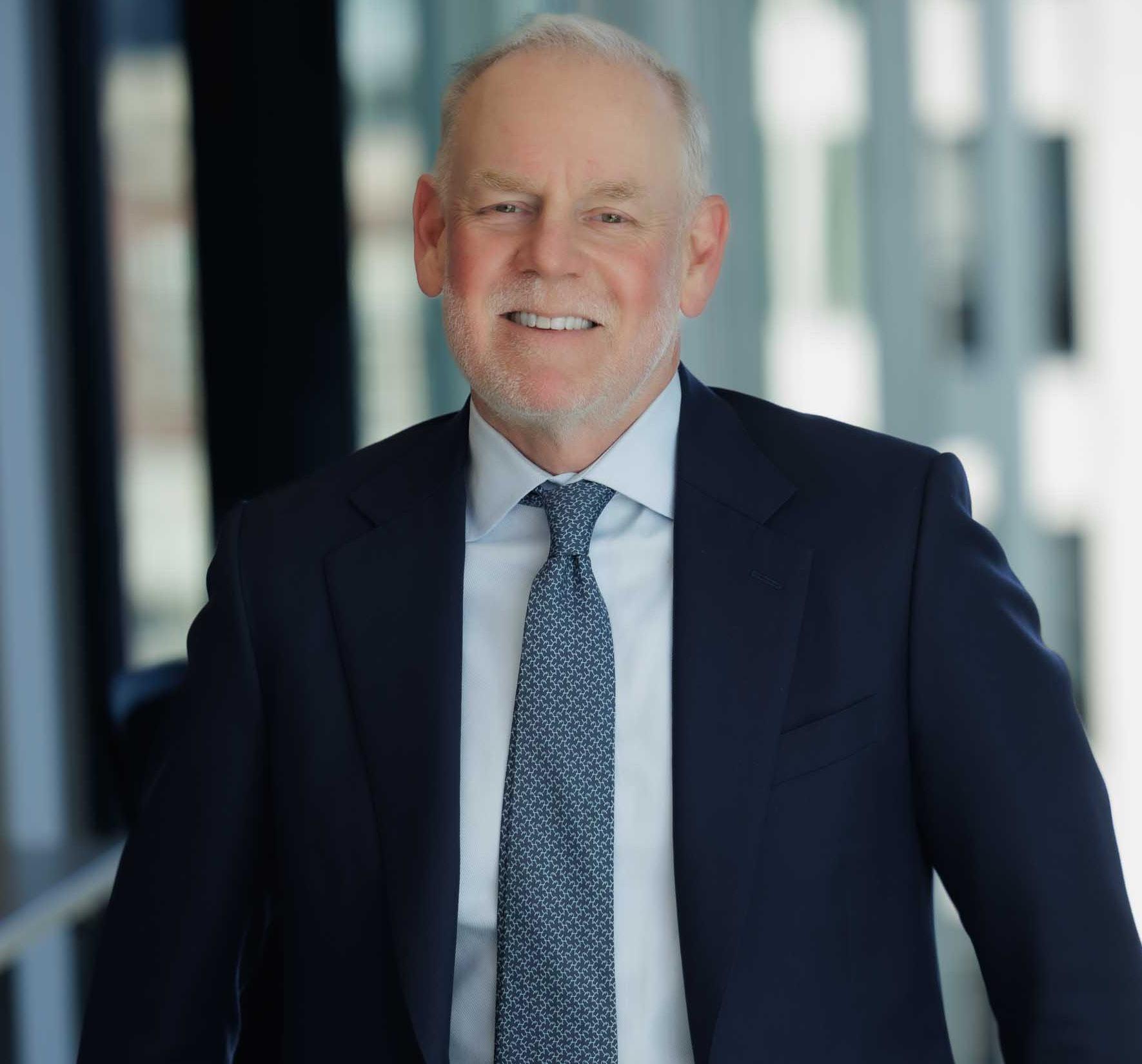
Fiduciary Trust International CEO Adam Spector details his plans for the century-old firm at the dawn of a new technology
BY GREGG GREENBERG
ADAM SPECTOR started as CEO of Fiduciary Trust International in October 2025. By now, he has had more than enough time to chart a path for the iconic $112 billion AUMA wealth manager.
So, with a brand-new calendar year in front of him and a century-old organization officially under his captaincy, where does the industry veteran Spector seek to steer Fiduciary Trust International in 2026?
“My priority is straightforward,” he says. “To preserve what has made Fiduciary Trust International successful for nearly a century, while ensuring we continue to evolve in thoughtful and disciplined ways. Our clients come to us at the most critical moments in their lives, often with
Headquarters: New York, NY
Founded: 1931
AUMA: $112 billion as of September 30, 2025
Specializations: Strategic wealth planning, investment management, trust and estate services, tax and custody services
Subsidiaries: Offices in Atlanta, GA; Boca Raton, FL; Coral Gables, FL; Fort Lauderdale, FL; Lincoln, MA; Los Angeles, CA; Radnor, PA; Reston, VA; San Mateo, CA; St. Petersburg, FL; Washington, DC; West Palm Beach, FL; Wilmington, DE
significant complexity, and our responsibility is to listen first, understand what matters most to them, and then build plans that serve those goals across generations.”
More specifically, says Spector, that means investing in the people, expertise, and culture that define the long-running firm, while also making targeted investments in technology intended to enhance – not replace – the human relationships at the core of its business. In his view, technology should simplify complexity, reduce friction, and allow
“My priority is straightforward: to preserve what has made Fiduciary Trust International successful for nearly a century, while ensuring we continue to evolve in thoughtful and disciplined ways”
Fiduciary Trust International’s professionals to spend more time advising clients, not managing processes.
In other words, Spector will not cede to faceless bots the white-gloved, human touch that has defined Fiduciary Trust International since before his birth.
“Above all, my goal is execution, and to continue what has allowed the organization to thrive for 95 years – consistent leadership, disciplined growth, and an unwavering commitment to putting clients’ interests first,” Spector says.
FROM GENERATION TO
Perhaps it should be no surprise that Spector has little intention of shaking things up too much at Fiduciary Trust International. He’s spent the last five years as executive vice president and head of global distribution at parent company Franklin Templeton, learning up close that Fiduciary Trust International is first and foremost a business run for families.
“Our clients want their wealth to endure for generations, and the first thing they often look for is a firm that has demonstrated the same durability. Fiduciary Trust International has navigated decades of market cycles, geopolitical shocks, and economic change, and we intend to be here for generations to come,” Spector says.
Put simply, he does not believe in change for its own sake. And while Spector views innovation as essential to an organization’s competitive development, he demands that it be purposeful.
“We evolve how we serve clients, how we use technology, and how we manage complexity, while never losing sight of what has always differentiated us: trust, stability, and a relentless focus on our clients’ best interests,” Spector says.
Not that Spector won’t be sprinkling into the mix a few new ideas from his own professional background, despite having spent the majority of it outside the traditional wealth management industry. Prior to joining Franklin Templeton, Spector spent over three decades at global asset managers Brandywine and SEI Investments.
Nevertheless, he views investment management and wealth management as “sharing a foundation,” with the latter ultimately proving more complex, primarily because, well, there are people and emotions involved in managing a family’s wealth.
“It’s like playing chess in three dimensions,” Spector says. “Many assume that managing
Education: BA in public policy and anthropology from Brown University; MBA from The Wharton School of the University of Pennsylvania
Experience: Senior leadership roles at Franklin Templeton and Brandywine Global, advising both institutional and private clients
Outside interests: Co-founded a small business in Prague with his then-girlfriend, now his wife of more than three decades
massive institutional pools of capital is more challenging, but in reality, advising families often involves far more constraints – tax considerations are of paramount importance, and certain family dynamics make the politics of a sovereign wealth firm look tame.”
When it comes to the current investing environment, the former asset management executive turned wealth management CEO expects 2026 to be a more normalized environment with modest growth, easing inflation pressures, and financial conditions that are no longer restrictive.
“Market leadership has been narrow, valuations are elevated in some areas, and selectivity matters. This is a market that rewards discipline, diversification, and attention to aftertax outcomes rather than momentum-driven strategies,” Spector says.
The value of the client-advisor relationship may remain timeless, but a lot has changed in the wealth management business since Fiduciary Trust International was founded in 1931. And it’s not merely that there have been technological advances like AI note-takers being added to Zoom meetings.
The recent flood of PE money has transformed the once staid financial advisory industry into Wall Street’s version of Survivor , with vulnerable financial advisors seeking alliances to remain viable.
And while Spector won’t comment on specific acquisition plans, he won’t deny that he is evaluating M&A opportunities. Of course, Fiduciary Trust International’s backing by a Fortune 500 company with a strong balance sheet certainly offers him plenty of options.
“The fact that Franklin Templeton’s founding family still controls the firm means that we are in no need to make forced purchases, nor are we managing the firm for an eventual ‘flip’ like many private equity owners do. Any acquisition opportunity we consider has to enhance our ability to serve clients and fit with who we are as a firm,” Spector says.
Oh, and when it comes to AI, he’s actively implementing those tools across the firm too.
“AI should empower our professionals, not replace them. By automating routine tasks and surfacing better insights, we free our teams to focus on what matters most: advising
clients through complex financial and personal decisions,” Spector says.
Fiduciary Trust International is one of the longest operating family offices, and as a result, its professionals know what it takes to properly address the financial needs of high-net-worth clients. That said, more wealth managers are, on their websites, professing to be “family offices,” even if they don’t understand what that description truly entails.
Don’t be fooled by their false advertising, warns Spector.
“A true family office must be able to integrate investment management, tax planning, trust and estate services, philanthropy, and family
governance into a cohesive strategy tailored to each family’s goals. That level of integration requires scale, expertise, and a team-based approach. We then go above and beyond that foundation for our family office clients, adding in specific services like tax preparation or bill-pay services based on their particular circumstances,” Spector says.
Stressing that “leadership in this space is earned through execution and trust, not labels,” Spector adds that the depth of that leadership is what keeps families engaged across generations.
“Our strong asset retention – our five-year client asset retention rate is 98 percent – reflects the strength of those relationships and the trust clients place in us,” Spector says.
“Our clients want their wealth to endure for generations, and the first thing they often look for is a firm that has demonstrated the same durability”
Direct indexing adoption accelerates as advisors target tax efficiency, personalization, and high-net-worth customization, while ETFs remain broader portfolio building blocks
BY ANDREW COHEN
As wealthy clients demand more personalization and tax efficiency, direct indexing is emerging as a powerful tool advisors can offer, though many are still learning how to use it.
The strategy, which allows investors to own the individual stocks of an index via a separately managed account instead of buying an index fund or ETF, has grown rapidly alongside rising expectations for portfolio customization in wealth management. For bigger accounts, this also unlocks significant tax advantages.
Emily Gray, managing director at Parametric, an asset manager owned by Morgan Stanley, believes direct indexing is now synonymous with tax management and loss harvesting. She says, “We can do tax-efficient transitions the client can fund with appreciated stocks that they have; we can manage them over time to get closer to the index. And we do daily loss harvesting, so we evaluate portfolios on a daily basis for opportunities to realize a loss − that client can take that loss and use it to offset a capital gain.”
Industry reports show the growth of direct indexing in recent years. Cerulli Associates found that direct indexing strategies closed out 2024 with $864.3 billion in assets − nearly double the level reported in 2021 − and they projected direct indexing to eclipse $1 trillion in assets this year. However, just 18 percent of advisors adopted direct indexing strategies as of 2024, with asset managers like VanEck remaining confident in the market dominance of ETFs and mutual funds.
“I see them working together. When direct indexing came out, everybody was like, oh this is going to eat ETFs alive,” says VanEck’s head of product management, Ed Lopez. “It will be an arrow in the quiver, a tool for advisors to use as needed.”
Direct indexing, as a subset of SMAs, represents 37.6 percent of manager-traded assets, more than doubling since 2020, per Cerulli’s latest data. Roughly one-quarter (26 percent) of advisors said they had access to direct indexing but hadn’t used it, while 12 percent indicated they were unfamiliar with the concept.
“Advisor education is crucial to adoption, as advisors are unlikely to recommend direct indexing strategies ... if they do not fully understand them,” Michael Manning, research analyst at Cerulli, said in a statement. “Wealth and asset managers that want advisors

“I think direct indexing is kind of synonymous with tax management and loss harvesting”
EMILY GRAY, PARAMETRIC
to adopt these solutions must make a concerted effort to educate them on potential use cases, the added benefits, and the tax optimization element.”
A report released in January by MSCI found that 98 percent of high-net-worth portfolios include a customization strategy, and that 62 percent of wealth firms expect direct indexing usage to increase over the next three years. Direct indexing is viewed as being “essential” for serving high-net-worth clients by 59 percent of wealth industry professionals surveyed in MSCI’s 2026 Wealth Trends Report
ESSENTIAL FOR HNW CLIENTS
98% of high-net-worth portfolios include a customization strategy
62% of wealth firms expect direct indexing usage to increase in the next three years
59%
of wealth industry professionals consider direct indexing “essential” for serving high-net-worth clients
Source: MSCI 2026 Wealth Trends Report
“Personalization has moved from a differentiator to a baseline expectation in wealth management,” says Alex Kokolis, global head of wealth at MSCI. “Nearly every new high-net-worth portfolio now reflects some level of customization, as clients seek investments aligned with their goals, values, and evolving views on risk. The challenge for advisors is no longer whether to personalize, but how to do so at scale while maintaining efficiency, consistency, and transparency.”
Investment clients who work at a Big Tech company like Apple or Google are an example of a


“The challenge for advisors is no longer whether to personalize, but how to do so at scale while maintaining efficiency, consistency, and transparency”
ALEX KOKOLIS, MSCI
particularly good fit for direct indexing. Given that they likely already own significant shares in these companies as employees, direct indexing can exclude their employer’s stock or avoid further investing in it, preventing outsized exposure in a single company.
“If an advisor has a client that maybe works in Silicon Valley and they’ve got concentrated wealth in that company that they work for, Parametric can partner with the advisor and the client to not only design something that excludes that particular company, but look across the universe of securities and maybe also exclude highly correlated sectors, industries, other companies,” says Gray.
Envestnet has seen 40 percent annualized growth in its direct indexing offerings since they debuted in 2013, the company’s chief investment officer Brandon Thomas tells InvestmentNews
“Advisors for various reasons like the fact that [with direct indexing] they don’t have to worry about underperformance like with an active manager, so they don’t have to explain underperformance to their clients,” says Thomas. And of course, they like the lower cost of direct index strategies. So I think those two things have really fueled the growth of direct indexing offerings.”
Envestnet’s push into direct indexing traces back more than a decade, shaped by the aftermath of the financial crisis and shifting advisor behavior. In the years that followed, ultra-low interest rates and quantitative easing made it harder for active managers to distinguish themselves.
“We wanted to offer advisors a way to get the best of both worlds, to have a passive, index-like low-cost solution in an SMA format,” Thomas says. “There had been other direct index providers, one or two at the time that were doing SMA business, but nobody had done it in the UMA [Unified Managed Account]. So we decided to offer these direct index portfolios as SMA sleeves in a UMA portfolio offering.”
Thomas says that large-cap ETFs typically charge about four or five basis points, with some at seven or eight bps, while a comparable US large-cap core direct indexing strategy can be as high as 15 bps. However, large direct indexing accounts could see their fee shrink to five or six basis points. “So, for smaller account sizes, there’s a fee advantage for ETFs for sure, but as the account size grows there’s less of a distinction between the two,” adds Thomas.
“It’s the clients that may have not only larger accounts but more income outside of their investment accounts,” Thomas says of the ideal fit for direct indexing. “In their investment portfolio, they may need to generate as many tax losses as possible. For those types of clients − large investment accounts or very high-income investors − they typically will benefit more from a tax management type of situation.”
Even as more platforms and asset managers enter direct indexing, market share remains concentrated. Envestnet ranked ninth in terms of direct indexing assets, according to Cerulli’s report released last April. Roughly 87 percent of the total market share was
$864.3 billion in direct indexing assets at end of 2024
Usage nearly doubled since 2021
Projected to exceed $1 trillion in 2026
controlled by the top five direct indexing providers − Morgan Stanley (via its Parametric business), Goldman Sachs Asset Management, Northern Trust, BlackRock, and Fidelity Investments.
That concentration reflects the structural advantage of separately managed accounts (SMAs), for which large providers have the scale and technology needed to deliver personalization and tax optimization at the individual client level.
“Clearly the incremental advantage of an SMA is both personalization based on what the end client wants if they have preferences or needs, but very importantly, [also] taxes,” said Paul Riccardella, managing director at MSCI. “Because the SMA wrapper allows for sophisticated tax optimization, the generation of tax alpha and taxes are increasingly important to high-net-worth individuals.”
Even as direct indexing gains traction, ETFs remain foundational in portfolio construction, and Riccardella is clear that the rise of SMAs has not displaced ETFs, nor was it ever likely to.
“ETFs, simply put, are just the preferred commingled vehicle for any investment strategy, regardless of whether it’s active or indexed,” Riccardella says. “They have a place in every portfolio. Obviously, there’s been regulatory changes that are going to make them even more accessible.”

WEALTH MANAGEMENT merger activity reached unprecedented levels in 2025, marking a structural shift that financial advisors can no longer afford to treat as temporary.
A new report from Berkshire Global Advisors shows that RIAs with more than $100 million AUM completed 349 transactions during the year, marking the highest total ever recorded and smashing 2024’s previous peak of 276, a 26 percent year-overyear jump in deal volume.
The surge reflects intensifying succession challenges, escalating client expectations, and a buyer market flush with private capital that continues to reward scale.
WITH THE US facing a looming shortage of financial advisors, firms are increasingly laser focused on what they can do to get hold of, and retain, top talent.
Stacy Francis, the founder and president of Francis Financial, points to career development as crucial, with the company putting “a huge amount of time and consideration” into building very detailed career paths for its 22 employees.

Culture is cited as critical by Peter Mallouk, president and CEO of Creative Planning. “I think [advisors] like that, we’re not a firm that requires them to sell products,” he said. “They don’t have to go find their clients at the country club –clients come to Creative Planning.”
BARRY RITHOLTZ and Josh Brown, famed RIA industry advisors who frequently appear across Bloomberg and CNBC channels, have announced a succession plan for their $7.6 billion RIA Ritholtz Wealth Management that sees its equity structure expand to 29 employees.
The firm’s namesake co-founder, Barry Ritholtz, is selling a portion of his shares to support new equity for employees. Fellow co-founder, Brown, will continue running day-today leadership of the firm, alongside managing partners Michael Batnick and Kris Venne and president Jay Tini. Ritholtz was founded in 2013 and has 85 employees, standing out as one of the industry’s biggest RIAs to resist private equity dollars to instead be fully owned by employees.
“As we started to add key employees, we had this realization that we were amassing a lot of talent, and if we didn’t make them owners and part
of the business, we would be at risk of other firms scooping them up,” Brown tells InvestmentNews. “We didn’t want to be in a situation where Barry and I own all the equity and then the equity value gets so big that there’s nobody else who can afford to buy us, other than a giant PE firm.”
A form ADV dated January 29, 2026, broadly lists the 29-employee equity structure at Ritholtz, with Brown as the largest shareholder holding at least 25 percent but less than 50 percent. Co-founders Venne and Batnick each own at least 10 percent but less than 25 percent. Barry Ritholtz and Tini each own at least 5 percent but less than 10 percent. Another 24 employees own less than 5 percent.
“Everyone who’s on the cap table is a buyer. Nobody was handed free stock or stock options, or anything like that − everyone invested,” says Brown. “Barry [Ritholtz] will be a shareholder forever, but he’s made shares available internally
JPMORGAN CHASE’S board has handed CEO Jamie Dimon a compensation package worth $43 million for 2025, intensifying the debate over how much Wall Street’s
most powerful leaders should earn in a slower-growth environment.
The bank said Dimon’s pay rose about 10 percent from 2024, even as profit growth cooled. According to regulatory disclosures and statements from the bank, Dimon’s package combines a $1.5 million base salary with $41.5 million in performancelinked incentives, keeping him among corporate America’s highestpaid chief executives.
JPMorgan’s board has framed the award as recognition for what it calls his exemplary leadership and the firm’s continued dominance across trading, investment banking, and consumer finance.
FINANCIAL ADVICE firms of all stripes are relying on the technology of artificial intelligence to drive down costs as technology replaces work performed by employees.
At the same time, using AI or machine learning in operating a financial advice firm opens the firm to potential hazards, according to a recent disclosure from industry giant Merrill Lynch. While stating that “Merrill may use
programs and systems that utilize AI, machine learning, probabilistic modeling and other data science technologies, AI tools, including those developed by third parties,” the firm warned, “AI tools are highly complex and may be flawed, hallucinate, reflect biases included in the data on which such tools are trained, be of poor quality, or be otherwise harmful, which therefore requires supervision and oversight.”
JOSH BROWN
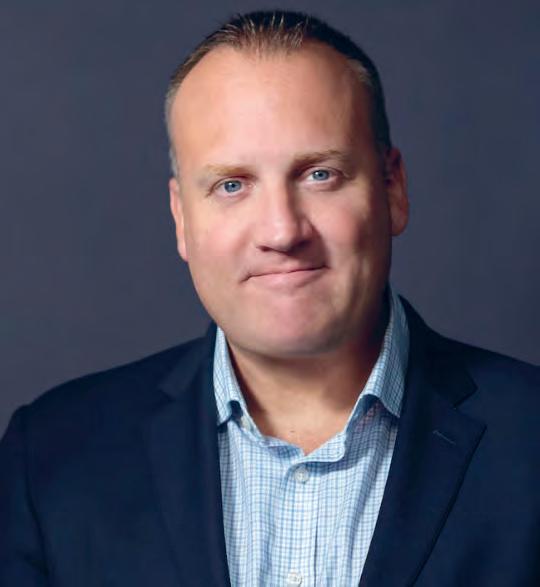
“Nobody was handed free stock or stock options, or anything like that − everyone invested”
JOSH
BROWN, RITHOLTZ WEALTH MANAGEMENT
to facilitate the transaction. Barry’s percentage ownership has gone down by a lot.”
Ritholtz Wealth Management is headquartered in New York City with 15 offices across the US.
“I turn 65 this year, and I wanted all
AS COMPETITION intensifies at the top of the US wealth management market, two of the country’s largest advisor platforms are making big, enterprise-level bets on technology to scale advice, deepen planning, and hard wire more of the client experience into their ecosystems.
of our clients, employees, and partners to understand that we have a plan to continue forever, without private equity dollars, regardless of my age. This structure is a key part of that plan,” adds Barry Ritholtz, who remains chief investment officer at the firm.

Edelman Financial Engines recently aligned with Orion to unify portfolio management, trading, data, reporting, and advisor engagement on a single connected platform. Meanwhile, LPL Financial entered a strategic relationship with Wealth.com to deliver digital estate planning capabilities across its network of more than 32,000 advisors and its advanced planning team.
AI ADOPTION among independent RIAs is accelerating rapidly, but most firms remain in the early phases of implementation, according to a new study.
The research, conducted in late 2025 with 533 RIAs, found that 63 percent of firms now use AI in some capacity. That figure represents more than double the adoption rate reported just two years earlier, underscoring how

quickly AI tools have entered advisory firm operations.
However, widespread use does not yet equate to deep integration. The research from Schwab Advisor Services found that only about one in 10 firms report that AI is embedded into their core business strategy.

CHALLENGER FINTECH RIA custodian Altruist has gained advisors in the aftermath of legacy custodian Schwab raising assets minimums within its RIA referral program, Altruist’s chief operating officer Mazi Bahadori tells InvestmentNews.
“We’ve certainly seen many, many advisors that have come to us
on the back of that development,” says Bahadori. “It gets a lot of RIAs very worried that Schwab is trying to expand their own advisory business. And so they’re [Schwab is] saying, under this amount we’re not referring these clients out anymore, so they’re continuing to grow their book.”
A “NEW NORMAL” in RIA dealmaking was reached in 2025 with a record-setting 322 M&A transactions, per a new report from consulting firm DeVoe & Company.
Total transactions for the year marked an 18 percent increase over the previous record of 272 announced deals tracked by DeVoe in 2024. The average AUM for selling firms in 2025 was just above $1 billion.
DeVoe’s data shows that while mid-size and large sellers grew their share of M&A transactions, deals

for smaller RIAs below $500 million AUM dropped to 38 percent of all 2025 transactions compared to 46 percent in 2024.

AS MORE broker-dealers and RIAs experiment with artificial intelligence tools that can plan and execute tasks on their own across multiple systems, the Financial Industry
SEC STAFF have issued fresh guidance on the commmission’s Marketing Rule, giving RIAs more clarity around using testimonials from certain disciplined individuals and more flexibility in how they present performance net of fees.
Regulatory Authority is sharpening its focus on “agentic” AI
In a recent post, Greg Ruppert, executive vice president and chief regulatory operations officer at FINRA, sketches out how firms are starting to deploy AI agents and invites member firms to share how they are approaching the technology.
The move builds on FINRA’s Generative AI Member Firm Use Portfolio and i ts 2026 Annual Regulatory Oversight Report, which highlighted generative AI and cyber-enabled fraud among other priorities over the next year.
In the latest update to its “Marketing Rule Q&A” – which follows the SEC’s “Marketing Rule Risk Alert” in December –staff from the SEC’s Division of Investment Management clarified that it would not recommend enforcement action if an advisor pays for a testimonial or endorsement from someone who is subject to a final order by a selfregulatory organization, as long as very specific conditions are met.

California’s billionaire tax would cost more than 5%, warns think tank
THE PROPOSED California wealth tax aimed at billionaires could expose some founders, tech executives, and other ultra-wealthy residents to effective rates well above its advertised 5 percent level, according to a new analysis from the Tax Foundation. In a recent note, the group argues that the ballot initiative’s valuation rules, treatment of voting shares, and anti-avoidance provisions could sharply raise liabilities and complicate planning for high-net-worth clients with ties to the state. The 2026 Billionaire Tax Act would ostensibly impose a one-time 5 percent tax on the net worth of the state’s billionaires.

FINRA’S DEPARTMENT of enforcement has filed a complaint against Sutter Securities Inc. and its former chief executive over alleged excessive trading in the account of an 89-year-old retired client, accusing the San Francisco firm of allowing millions of dollars in commissions and losses to rack up while supervision and controls fell short.
According to the complaint with FINRA’s Office of Hearing Officers, Sutter,
objective and moderate risk tolerance, allegedly paid more than $2.9 million in trading costs and suffered about $1.2 million in realized losses over that 17-month period.
The enforcement department alleges that during the time Regulation Best Interest was in effect, from June 30, 2020 through July 2021, the trading in the accounts generated roughly $2.5 million in trading costs and more
“One transaction in June 2021 in a commodityindexed trust produced a $44,000 loss but $28,400 in commissions, according to the complaint”
acting through an unnamed former registered representative, recommended and executed 2,217 trades in two trust accounts belonging to a retired semiconductor executive between March 2020 and July 2021.
The complaint detailed how the customer, described as a California-based 89-year-old with a long-term growth
ASA presses SEC to unlock e-delivery for shareholder communications
THE AMERICAN Securities Association is urging Securities and Exchange Commission Chair Paul Atkins to clear a path for wider use of electronic delivery in shareholder communications, saying investors should be able to receive fund
than $1.8 million in realized losses, with annualized cost-to-equity ratios as high as 52 percent. Those ratios indicate how much an account must earn just to cover commissions and other costs.
During the period in question, Sutter generated some $8.3 million in revenues from commissions charged to retail customers, according to the complaint.

and account information digitally while retaining the right to opt out.
In a recent letter to Atkins, the ASA asked the SEC to use its existing authority to update rules so broker-dealers and investment managers can rely on e-delivery when communicating with customers who prefer it. The group points to how investors already manage most of their financial lives online and argues that the agency’s paper-first framework is out of step with that reality.

The FINRA complaint noted that the trading strategy – assuming there was one, given the high frequency of movements in the accounts – bore little resemblance to the client’s stated profile. The accounts had turnover rates of up to 16, an average holding period of 17.3 days, and a pattern of frequent in-and-out trading, despite paperwork indicating a long-term growth objective and low liquidity needs. More than 90 percent of the trading allegedly involved margin, and by November 2020 the customer had a margin debit balance of about $7.66 million.
It also highlighted several individual round-trip trades where the representative quickly flipped large positions at
small price changes, allegedly locking in losses for the client while generating sizable commissions. One transaction in June 2021 in a commodity-indexed trust, for example, produced a $44,000 loss but $28,400 in commissions, according to the complaint.
The enforcement department alleges the trading was “excessive, quantitatively unsuitable, and not in the customer’s best interest,” citing the high costs, turnover, use of margin, and realized losses. It further claims the representative “did not have a reasonable basis to believe” the series of trades was not excessive or in the customer’s best interest given the client’s profile and the substantial commissions involved.
GLOBAL MARKET structure is poised for another year of rapid evolution, with multiple forces converging to redefine how institutional participants operate in 2026.
A new outlook from Crisil Coalition Greenwich highlights a series of structural trends that will directly affect capital markets, regulatory frameworks and trading behaviors in the year ahead, noting that the pace of transformation “has accelerated every

year since the 2020 pandemic inflection point,” and there’s little indication that momentum will slow as we enter 2026.
Competition among firms, technological breakthroughs, and policy shifts are among the key drivers shaping market outcomes, with AI’s divergent role one of the standout themes in capital markets this year.
THE FINANCIAL Crimes Enforcement Network has formally postponed the compliance deadline for its anti-money-laundering and counter-terrorism financing rules applicable to registered investment advisors and exempt reporting advisors
The rule, which was originally slated to take effect at the start of this year, has now been rescheduled to apply beginning January 1,
2028, under a final rule published in the Federal Register by FinCEN on January 2.
The amendment, codified under document number 2025-24184, alters the Anti-Money Laundering/ Countering the Financing of Terrorism Program and Suspicious Activity Report Filing Requirements for RIAs and Exempt Reporting Advisors (IA AML Rule).
FINRA HAS ordered American Portfolios Financial Services to return millions of dollars to customers and pay a civil penalty after finding that the broker-dealer overcharged investors and failed to properly disclose how it made money from a cash sweep program.
Under the settlement, American Portfolios must pay $4.6 million in restitution to affected customers and a $550,000 fine. The action cen-
ters on the firm’s bank deposit program, which automatically swept uninvested customer cash into interest-bearing, FDIC-insured accounts.
The firm was acquired by Osaic Holdings in November 2022 and later merged into Osaic Wealth in 2024. FINRA said the acquiring firm cooperated with regulators in calculating restitution, and repayments to customers began before the settlement was finalized.

ALABAMA HAS updated its advisor marketing policy to more closely align with SEC standards, opening the door for state-registered RIAs to use client testimonials and online reviews in their advertising.
The new policy adopted by the Alabama Securities Commission in December replaces its previous advisor marketing policies that were in place since 1990. The SEC began

allowing federally registered RIAs to promote online reviews and client testimonials in 2021, and roughly half of US states passed rules to allow state-registered advisors to do the same.
To register with the SEC, RIAs must have at least $100 million in assets under management.
AMERICAN INVESTORS are growing more cautious, reshaping how they think about risk, retirement, and financial security.
Affordability pressures and economic uncertainty are pushing households toward lower risk tolerance and new financial behaviors, with more than three quarters of respondents to a survey by F&G Annuities & Life
saying that the past year’s events have made them more financially cautious, a four-point increase from last year.
The findings of the firm’s sixth annual Risk Tolerance Tracker suggest that persistent cost-ofliving strain is no longer a temporary hurdle but a structural factor influencing long-term planning decisions.

vey of investors who are near or already in retirement shows that medical costs now eclipse all other money-related fears, although most retirees remain optimistic about the year ahead and report stable or improving financial conditions despite political and economic uncertainty.
FINANCIAL SERVICES giants Charles Schwab and Robinhood will both match the US government’s $1,000 contribution to Trump Accounts for the children of their employees.
HEALTHCARE EXPENSES are emerging as the dominant financial concern for retirement-age Americans, reflecting retirement planning conversations that are shifting beyond portfolios and toward health, lifestyle, and purpose.
The Oath Money & Meaning Institute’s quarterly national sur-
Gen X’s DIY mindset hides a major retirement planning opportunity
GENERATION X investors have spent decades navigating markets, managing their own portfolios, and building retirement
Among respondents, 81 percent placed healthcare costs in their top three financial worries for 2026, followed by insufficient savings at 67 percent, unexpected expenses at 52 percent, and housing costs at 39 percent.

savings largely on their own.
But new research from Equitable suggests that beneath this self-reliant confidence lies a significant planning gap and a demand for deeper, more holistic guidance.
The study Approaching Retirement: Getting Gen X from Good to Great explores how Americans born between 1965 and 1980 are preparing for retirement. The findings reveal a generation that feels capable making financial decisions yet often lacks the structured planning needed to convert savings into lasting retirement security and legacy outcomes.
The US Treasury will give $1,000 to Trump Accounts set up for children born in the United States between 2025 and 2028. The accounts are invested in index or mutual funds that track the US stock market, and generally cannot be withdrawn until the child turns 18 − operating similarly to an IRA or 401(k) from birth.
“By matching the government’s contribution for our employees’ children, we’re honoring that commitment − helping more families take an early, confident step toward building longterm financial security,” stated Schwab CEO Rick Wurster. “We will continue to work with this administration, future administrations, and Congress to do
all we can to support getting more Americans invested.”
Robinhood and Schwab follow announcements from other companies and wealthy individuals to donate to Trump Accounts − including Bank of New York Mellon, BlackRock, Ray Dalio, and Michael and Susan Dell. BlackRock and BNY each committed $1,000 matches to employees’ children, Dalio will give $250 each to 300,000 children in Connecticut, while the Dells will gift $250 each to 25 million American children with Trump Accounts who were not eligible for the government’s $1,000 contribution because they were born outside the 2025–2028 window.
Schwab has reported having roughly 32,000 employees, while Robinhood has about 2,300. Most financial advisors who spoke with InvestmentNews agreed that Trump
Why advisors must rethink the rollover opportunity now
A QUIET but powerful reshuffling of household wealth is underway, and financial advisors who recognize its scale early will be best positioned to capture growth.
New research from Hearts & Wallets reveals that US households are moving investable assets at levels well above recent norms, creating both urgency and opportunity for firms competing for rollover and transfer business.

Money movement, as defined in the study, includes recent or intended shifts of investable assets across financial providers, covering retirement plan rollovers, transfers of assets, and new accounts funded with fresh deposits.
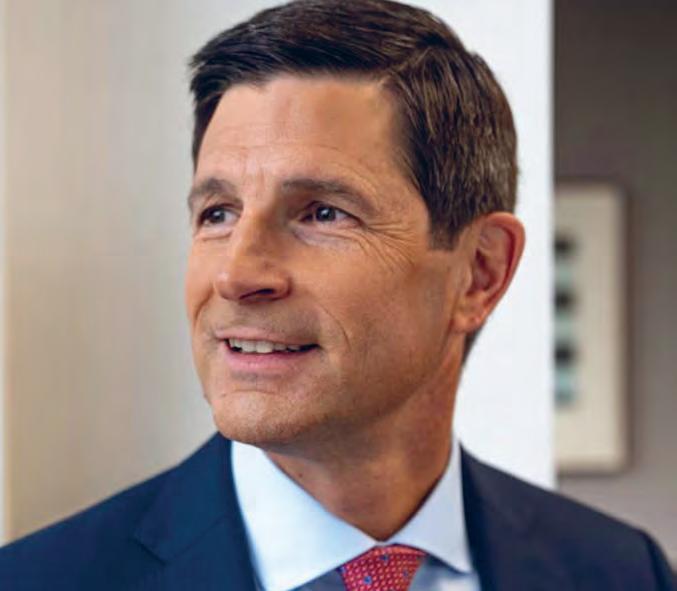
“I hope, as an industry, we’re able to tell the story to clients about the difference between gambling and investing”
RICK WURSTER, CHARLES SCHWAB
Accounts offer fewer tax advantages than similar savings vehicles such as UTMA or 529 plans, but they allow for parents to accept free contributions from the government, employers, and philanthropists.
FOR WORKING Americans, the workplace remains the primary gateway to retirement savings and health coverage. But even as employer plans retain their central role, financial strain and uneven access are limiting how well these benefits deliver lasting financial stability.
Shares of Robinhood have surged more than 200 percent this year, making it one of the top-performing stocks in the S&P 500. Schwab’s stock is up about 35 percent year to date.
Wurster took a not-so-thinlyveiled shot at Robinhood during his keynote speech at Schwab’s IMPACT conference in November, when he criticized stock-trading apps for blending gambling with investments.
“I just don’t want young people in our country to think that betting on the Monday night football game is equivalent to being invested for the long term in stocks and bonds,”
Wurster said, alluding to apps like Robinhood that offer sports wagering via prediction markets. “I hope, as an industry, we’re able to tell the story to clients about the difference between gambling and investing.”

A new national survey from CAPTRUST finds that financial worry is now a defining feature of the modern workplace. Drawing on responses from more than 4,300 employees at 795 organizations, the firm reports that 62 percent of participants describe their financial stress as moderate to severe.
Nearly three quarters say that stress undermines their motivation on the job, with anxiety, sleeplessness, and declining morale emerging as common consequences.
US RETIREMENT assets climbed to a historic peak of $48.1 trillion in the third quarter, marking another milestone in Americans’ long-term savings progress and reinforcing the central role retirement planning plays in household wealth.
New figures from the Investment Company Institute show total retirement holdings rising 4.5 percent from the prior quarter and repre-
STANDARD PLANNING conversation techniques may be working against advisors when they talk about annuities, according to new research from Jump that tracks real-world advisor–client meetings.
Based on data collected across 2025, the firm found that some of the most common approaches –explicitly linking annuities to clients’ stated goals, leaning on inflation-hedging language, or invoking other clients’ decisions – actually reduced the odds that a client would say yes to annuity purchases.
Goal-based alignment cut acceptance odds by 27 percent,
with many short on cash
RETIRED CLIENTS may be budgeting too tightly around “normal” expenses and not enough around the steady drip of financial shocks that hit almost every year, new research suggests.
senting roughly one third of all US household financial assets. The latest increase reflects both market appreciation and steady contributions into workplace plans and individual retirement accounts.


while positioning annuities as an inflation defense reduced the odds by almost 20 percent “likely because clients questioned how fixed products could actually hedge inflation.”
References to what “other clients” were doing chipped away at success rates as well, suggesting that appealing to social proof makes recommendations feel less personalized.

A recent Center for Retirement Research brief, backed by AARP, finds that nearly all retired households encounter at least one unexpected bill in a typical year, and many lack the liquid savings to absorb those costs without tapping investment accounts.
The analysis uses two decades of data from the Health and Retirement Study and its associated consumption survey, focusing on households where at least one spouse is 65 or older and receiving Social Security.

IT’S NOT simply enough to sign up new clients; RIAs need to keep them as well. And that means making sure they accommodate clients’ needs in-house whenever they can, lest they be tempted away by a competitor.
That’s why more RIA firms are opening new lines of business to expand their touch points and keep clients “sticky.”
RIAs in the Dynasty network, for example, are now exploring
several new business lines.
Many firms are moving into asset management and ETF creation, often tied to the 351 exchange opportunity, as they evaluate launching proprietary investment products.
Others are expanding into tax preparation and planning, which is highly complementary to wealth management and creates a more coordinated and sticky client experience.
DONORS USING DAFgiving360 pushed nearly $10 billion to charities in 2025, marking the most active granting year on record for the donor-advised fund sponsor and underscoring the role of DAFs in clients’ ongoing giving strategies. The organization, known as Schwab Charitable until its rebranding in 2024, said its donors granted
$9.9 billion to more than 165,000 charitable organizations last year, a 28 percent increase from 2024 and the largest annual total in its history.
DAFgiving360 touted 2025 as its fourth straight year of doubledigit growth in grants, as donors continued to draw on their DAF balances rather than letting assets sit idle.
HOUSEHOLDS WORKING with professional financial advisors are demonstrating stronger financial stability, greater confidence in their future, and higher levels of trust in their advisory relationships than individuals navigating finances on their own, per new longitudinal research on financial planning outcomes.
The multi-year study by the CFP Board tracks a nationally represen-
tative group of Americans to evaluate how ongoing financial guidance influences behaviors, preparedness, and overall well-being.
Early results show that those who work with CFPs are more likely to feel on track toward their goals, maintain adequate emergency savings, complete estate planning, and describe their financial lives as comfortable rather than uncertain.
THE 2026 Winter Olympics in MilanCortina, Italy, officially begins with the opening ceremony on Friday, February 6, 2026, and runs through February 22, 2026. During that span, the world will be watching the globe’s greatest athletes perform feats of strength and skill under the fiercest and most crushing pressure imaginable.
Members of the financial world –who also know a thing or two about operating under pressure – will surely be tuning in as well.
One of those Wall Streeters will be Cohen Taylor, a behavioral wealth specialist at Mission Wealth helping oversee $14.1 billion in AUM. Prior to joining the wealth management industry in 2019, she spent over 21 years as a figure skating coach, mentoring and training elite athletes. Prior to becoming a coach, she competed in the sport at the highest levels.
InvestmentNews sat down with Taylor to learn how her training for
individual competition instilled work habits that still guide her today.
InvestmentNews: You spent years as a competitive figure skater, where performance depends on routine, repetition, and competing alone under pressure. How does that background influence the way you work with clients today?
Cohen Taylor: During my time as a competitive athlete, I learned that my toughest opponent wasn’t another competitor – it was the pull to abandon a sound process when pressure and doubt crept in. When a strategy gets tested, it’s easy to start believing your doubts and doubting your beliefs. Learning to stay committed to preparation and process under pressure shaped how I support clients today. Financial decisions can feel just as high stakes as competition, especially during market volatility or major life transitions. I focus on helping clients stay grounded in their long-term plan and make
CFP BOARD has tapped K. Dane Snowden as its next chief executive, closing a months-long search to replace long-time leader Kevin Keller and setting up a pivotal transition for advisors who lean on the CFP mark as a core planning credential.
The credential-granting body said Snowden will take over on March 16 as Keller steps down after nearly two decades in the role.

Board chair Terri Kallsen, who officially took on the chair role earlier this year, said the search process considered internal and external candidates from financial services, wealth management, and the association world before directors settled on Snowden.

“Competing in an environment where there’s no pause or reset taught me that you can’t control when emotions arise, but you can control how you respond to them”
WEALTH
decisions that reflect their long-term goals, rather than the emotions they feel in the moment.
IN: In fi gure skating, there’s no opportunity to stop or start over once a program begins. What did competing in that environment teach you about managing emotions when the stakes are high?
Taylor: Competing in an environment where there’s no pause or reset taught me that you can’t control when emotions arise, but you can control how you respond to them. I learned to treat emotions as feedback rather than as a warning signal. When you interpret emotion as information instead of a threat, it becomes easier to regulate and use it constructively. That ability to work with emotion, rather than being driven by it, is what allows you to stay steady, make sound
decisions, and perform well when the stakes are high.
IN: Training for solo competition requires trusting the process even when things feel uncomfortable. How do you help clients lean on structure and consistency instead of reacting in the moment during periods of uncertainty?
Taylor: We know that uncertainty tends to activate fear, loss aversion, and short-term thinking, which can pull people away from their long-term goals. That’s why having a plan in place before uncertainty shows up is so important. Helping clients build a clear decision framework in advance, where their priorities are defi ned, their fi nancial strategy is aligned with their values, and expectations are set for how to respond when markets feel uncomfortable, helps to reduce emotional decision-making.
FREEDOM OF movement is expanding, but not equally, according to a new report highlighting how passport strength has become a tangible financial asset that influences opportunity, cost efficiency, and long-term risk planning.
The latest edition of the Henley Global Mobility Report and its passport index confirmed Singapore as the world’s most powerful passport, offering visa-free access to 192 destinations.
At the opposite end, Afghanistan’s passport allows entry to only 24 countries without a visa. The gap between top and bottom has widened over the past 20 years.

CARSON GROUP is adding new structure for how younger advisors grow within the firm, rolling out a formal career path framework and a new council of rising practitioners meant to influence its strategy.
The Omaha-based RIA, which oversees more than $55 billion in assets and serves over 54,000 client families across more than 150 partner offices, said the moves are part of a long-term effort to develop and retain the nextgeneration of talent.
They build on the firm’s advisor mentorship initiative launched in November, which pairs emerging advisors with veteran practitioners across its network.


THE CFP Board is rolling out a suite of competency changes that will raise continuing education requirements, reshape qualifying experience, and clarify what it means to be ready for independent practice as a financial planner.
Most of the updates begin to hit in 2026 and 2027, but advisors and firms with an interest in the CFP mark– likely including firms interested in having the most CFP professionals – will need to start
planning around them now.
Board chair Terri Kallsen said the overhaul was driven by expectations from both the profession and the public. The review, she said, was guided by a “clear responsibility to ensure CFP certification reflects both the realities of today’s financial planning profession and the trust placed in it” and by a belief that “as the profession evolves, the standards that support it must evolve as well.”
Advisors warm to AI but still have trust issues
FINANCIAL ADVISORS are leaning into artificial intelligence to streamline their workdays, but they are drawing a firm line when it comes to who makes the final call on client advice, according to new research from Advisor360.
In its latest Connected Wealth Report, fielded by FUSE Research Network, Advisor360 surveyed 301 advisors at RIAs, broker-dealers, and
banks across the US. Respondents reported an average of $548 million in client assets under management, with a median firm AUM of $65 billion. The study suggests AI is becoming a practical tool in the tech stack rather than a futuristic threat.
Most advisors see clear benefits – 74 percent said generative AI already helps their practice, while just 8 percent consider it a threat.

AFTER YEARS of stalled exits and cautious fundraising, global institutional investors are signaling that private markets may be entering a new cycle.
A new survey of limited partners by Coller Capital indicates growing confidence that IPO markets will reopen in 2026, while private credit, secondaries, and Asia-Pacific strategies continue to draw fresh capital. The findings
IN A move that highlights how quickly capital markets infrastructure is evolving, the New York Stock Exchange is developing a blockchain-based platform for trading tokenized securities, which could ultimately see the end of more than 100 years of opening and closing bells.
highlight how investors are reshaping portfolios for a landscape defined by renewed liquidity prospects but sharper manager differentiation.
More than three quarters of surveyed LPs say their private equity managers are preparing portfolio companies for IPOs, and almost a third report hearing that multiple managers have concrete listing plans for 2026.

If regulators approve the plan, US listed stocks and ETFs could eventually trade around the clock with near-instant settlement, marking a fundamental departure from the traditional market structure financial advisors have long built portfolios around. Intercontinental Exchange, the exchange’s owner, plans to link the NYSE’s existing Pillar matching engine with block-chain-based posttrade systems.
ADVISORS WITH the foresight − or plain old good luck − to have allocated clients into gold or gold mining stocks are certainly pleased with their decision. The yellow metal has nearly doubled in the past 12 months and is up over 20 percent in 2026 alone, as of January 28. Over the past five years, gold has steadily risen from $1,700 an ounce to more than $5,300.
All of which prompts the question: after such a tremendous run, what should advisors do with their gold stakes now?
Nolan Mauk, investment research analyst at Orion, for one, says the price action in gold and silver so far in 2026 appears to be behavioral, and the rally that started amid heightened geopolitical volatility has snowballed into what may be considered a FOMO trade. As a result, he believes investors should be aware of short-term correction risk.
That said, his longer-term outlook for gold remains positive primarily due to central banks growing their reserves as purchasing activity remains strong even amid higher gold prices. Furthermore, he says dollar weakness has continued into 2026, increasing gold’s attractiveness as a store of value.
“If markets expect the dollar to be entering a structural downturn, gold should continue to be a beneficiary,” Mauk says.
As for gold mining stocks, investors must be comfortable accepting a much higher level of volatility and an extra layer of risk exposure in equity market risk.
“If the outlook for gold were to change, gold miners would likely be the first to feel the effects at high magnitudes,” Mauk stresses.
For the record, the VanEck Gold Miners ETF (Ticker: GDX) is up almost
THROUGH A new partnership with Schwab Asset Management, Advyzon Investment Management is expanding fixed-income options on its turnkey asset management platform The deal brings actively managed bond strategies onto Advyzon’s Nucleus Model Marketplace.
Under the arrangement, Schwab will provide its Wasmer Schroeder strategies, which offer portfolios across different tax preferences, durations, and
credit profiles. Schwab will also handle day-to-day trading, making it the first outside fixed-income manager to run manager-traded strategies on the Advyzon platform.
Advyzon’s in-house team has been building and trading individual bond strategies, but the relationship with Schwab marks a shift toward outsourcing some of that work to a third-party manager while broadening the menu for RIAs.

NOLAN MAUK
“If markets expect the dollar to be entering a structural downturn, gold should continue to be a beneficiary”
NOLAN MAUK, ORION
200 percent in the past year and over 27 percent YTD.
Elsewhere, Wheeler Crowley, cofounder and financial advisor at CoFi Advisors, views gold as a “useful diversifier” at this point, as it appears to reflect a change in how the rest of the
world views the safety and utility of the US dollar.
He says that may remain the case for a while, adding that he’s “not trying to call a top or predict a bubble, as some of these moves have good reasons.”

Corporate AI spending booms, but investors may wait for the payoff
THE RUSH of corporate money into artificial intelligence is accelerating, but for investors hoping for quick wins that might be gained from AI boosting companies’ profitability, the path to real value may be slower and more uneven than the headline numbers suggest.
A report from Boston Consulting Group finds that companies plan to double their spending on AI in
2026, lifting it to about 1.7 percent of revenues, more than double the increase projected for 2025.
Nearly all companies in the survey say they will keep investing in AI even if it does not generate immediate returns.


Wells Fargo strategists offer 2026 forecast, wary of
I N A pair of influential January commentaries, senior strategists at Wells Fargo Investment Institute outlined a cautiously upbeat view of the global economy and financial markets for 2026, while also spotlighting geopolitical developments that could unsettle investor confidence.
Jennifer Timmerman, senior investment strategy analyst, pointed to recent US economic data as evidence of expanding momentum.
In market commentary this week, she highlighted third quarter US GDP growth that “came in at 4.3 percent, well above expectations and far stronger than long-term historical averages.”
Timmerman reported that consumer spending remained robust, business investment in automation and artificial intelligence showed significant contributions, and a narrowing trade deficit bolstered the overall expansion.
FINANCIAL ADVISORS are becoming a central force behind the rapid expansion of fixed-income ETFs, a shift prompting issuers to step up product development and education, according to research from Cerulli Associates.
Cerulli finds that as more advisors use ETFs to implement fixed-income exposures, issuers are racing to meet what they see as meaningful unmet demand in the bond sleeve of client portfolios. That is helping shift flows toward both passive and, increasingly, active fixed-income strategies.
By Cerulli’s reckoning, assets in taxable fixed-income ETFs climbed from $1.2 trillion in 2022 to nearly $2 trillion by the end of the third quarter of 2025. Tax-free fixed-income ETFs also grew over the same period, from $106 billion to $165 billion.

MERGERS AND acquisitions activity in the US middle market is poised to expand in 2026, supported by rising confidence among corporate executives and private equity leaders after a year marked by uneven conditions and several high-profile transactions.
Citizens’ 15th annual M&A Outlook shows sentiment at its strongest level
in six years, with 58 percent of respondents characterizing the current deal environment as strong. The findings point to a growing belief that the market has moved past the hesitation that defined much of the prior year.
Improved outlooks appear tied to greater economic clarity following challenges in 2025 that included elevated costs and supply chain disruptions.
FOR THE last 10 years, Cathie Wood’s ARK Invest has published its flagship research report on technologies poised to reshape the global economy, and Big Ideas 2026 places AI firmly at the center of what’s ahead.
Synthesizing insights from both public and private market engagements, the analysis suggests that a
fresh cycle of innovation, propelled by converging technologies, could be the backbone of outsized returns in the years ahead
This shift will be fueled by what the report calls “The Great Acceleration” − a period when AI and other novel infrastructure technologies are co-accelerating economic growth.

JANUS HENDERSON is moving deeper into the model portfolio and separately managed account business with the planned acquisition of Richard Bernstein Advisors, in a deal that comes as the active manager prepares to go private.
The firm said it has agreed to acquire
GLOBAL CAPITAL markets are bracing for a reconfiguration of global commerce that could reshape portfolios and strategic risk frameworks.
New analysis from the Boston Consulting Group points to resilient trade flows that are forecast to expand moderately over the next decade, but within a highly fragmented, “patchwork” geopolitical order that presents both opportunities and
100 percent of New York-based macro, multi-asset manager Richard Bernstein Advisors, which oversees about $20 billion in client assets as of January 16. The transaction is expected to close in the second quarter of 2026, subject to customary approvals. Terms were not disclosed.

structural challenges for investors and their financial advisors.
The report models four scenarios for the evolution of world trade through 2034, with the one gaining the most traction among policymakers and analysts assuming goods trade growth of about 2.5 percent annually, slightly outpacing projected global GDP and lifting total trade volumes from roughly $23 trillion in 2024 to nearly $30 trillion by 2034.



















There are a million reasons to give. There’s one way to do it better.
Your clients’ giving can go further with a donor-advised fund account from DAFgiving360™. They can claim a tax deduction for contributions, invest the funds for potential tax-free growth, and recommend when and where to give—whether immediately or over time. Help maximize their charitable giving using a fund with 25 years of expertise bringing donors, financial advisors, and charities together to make a greater impact.