Got a story or suggestion, or just want to find out some more information?
twitter.com/CMPmagazine
facebook.com/MortgageProfessionalCA
UPFRONT
02 Editorial Brokers who lean in can forge productive connections in 2026
04 Statistics
Rental market demand cooled and housing starts rose last year
FEATURES
24 From niche to necessity Alternative lenders are rewriting Canada’s mortgage rulebook
Flexibility, comprehensive
PEOPLE
30 Broker focus ‘Social media is the new business card,’ says Vince Gaetano of OwlMortgage.ca
32 Other life
CEO Ameera Ameerullah’s extensive philanthropic accomplishments
Why 2026 belongs to smart brokers
Nobody in Canada’s mortgage industry is expecting the record-smashing activity of the pandemic market to return in 2026 – but this year is already shaping up to be a powerful opportunity for mortgage brokers to show their worth and drive new business.
A choppy economy and stubborn interest rates are expected to keep a lid on homebuying activity, but the spring market has already clicked into gear – and life doesn’t move in lockstep with the rate cycle.
Every month, tens of thousands of Canadians still need to move for work or family reasons, downsize, or simply stop waiting for the “perfect” time to buy. Beyond the doom and gloom that often pervades monthly sales updates, those are the decisions that show up on brokers’ phones and in their calendars.
“For brokers who lean in, 2026 offers a perfect opportunity to focus on relationship-driven business and forge lasting, productive connections”
Then there’s the renewal story, arguably the defining theme of this market. The long-anticipated renewal wave is well underway, with a huge cohort of borrowers rolling off the rock-bottom rates of the COVID era and into a far more complex landscape.
Many of those clients have never renewed in a higher-rate environment before. They’re worried about payments, they’re sorting through options, and they’re looking for someone they can trust. And that’s where brokers come in.
For brokers who lean in, 2026 offers a perfect opportunity to focus on relationship-driven business and forge lasting, productive connections. That means not waiting for the phone to ring and, instead, taking a proactive approach built around letting current and prospective clients know the broker is there for whatever they need.
The most successful professionals this year will be the ones who are already in their clients’ in-boxes and DMs months before renewal, offering clear comparisons, budget check-ups, and calm, confident advice.
Yes, the easy volume of the ultra-low-rate years is gone. But in its place is something even more valuable: a market that rewards expertise, consistency, and genuine care. Brokers who show up that way in 2026 won’t just survive this cycle; they’ll emerge with stronger books, deeper loyalty, and a head start on the next surge in activity.
KM Business Information Canada Ltd 317 Adelaide Street West, Suite 910 Toronto, ON M5V 1P9 tel: +1 416 644 8740 www.keymedia.com
Canada • USA • UK • Australia • NZ • Philippines
CanadianMortgageProfessionalis part of an international family of B2B publications, websites, and events for the real estate and mortgage industries
MORTGAGE PROFESSIONAL AUSTRALIA claire.tan@keymedia.com
T +61 2 8437 4772
AUSTRALIAN BROKER simon.kerslake@keymedia.com
T +61 2 8437 4786
NZ ADVISER alex.knowles@keymedia.com
T +61 2 8437 4708
MORTGAGE PROFESSIONAL AMERICA charles.weed@keymedia.com
T +1 720 316 7378
MORTGAGE INTRODUCER (UK) matt.bond@keymedia.com
T +44 7525 456869
CELEBRATING 20 YEARS OF EXCELLENCE
For two decades, the CMAs have set the benchmark for professionalism, performance, and impact across Canada’s mortgage sector. In this milestone year, we continue that legacy, bringing the industry together once again to recognize those raising the standard.
NOMINATIONS OPEN JUNE 8, 2026
For
HOUSING STARTS UP IN 2025
CANADA’S RENTAL MARKET LOOSENS IN 2025
Canada’s once cutthroat rental market finally eased in 2025 as vacancy rates for purpose-built rentals rose to 3.1%, up from 2.2% in 2024 and above the 10-year average. Purpose-built units became easier to find in most major centres, with new supply coming online even as demand from newcomers and international students cooled.
241,171
(up 6% y/y in centres with population of 10,000 or greater)
Actual housing starts
259,028 (up 5.6% compared to 2024)
Total housing starts
Vacancy rate: 3.7% Average 2-bedroom rent: $2,363 (+2.2%)
The affordability outlook improved in some of the major Canadian cities in 2025 as falling mortgage rates and lower home prices reduced the income required to purchase a home. Vancouver
2025 AFFORDABILITY IMPROVES
282,439 (-0.6% y/y)
Monthly SAAR of
Source: Canada
HOME SALES FALL IN 2025
The
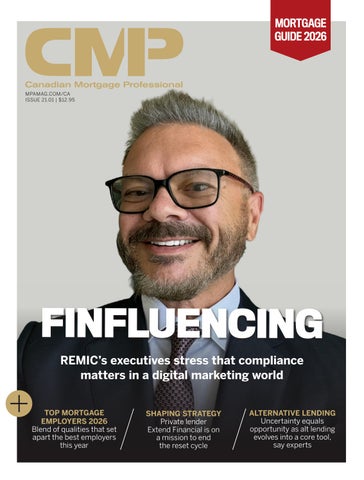
RISE OF THE FINFLUENCER: THE NEW RULES OF DIGITAL MORTGAGE MARKETING
The way clients identify and evaluate brokers has fundamentally changed
MORTGAGE PROFESSIONALS are operating in an environment where trust is increasingly formed before any direct contact takes place. Clients research advisors online, assess credibility through their digital presence, and often decide who they will speak to long before making an inquiry. However, this shift has significant implications for how brokers present themselves publicly, how they manage compliance, and, crucially, how digital activity translates into business outcomes – especially in a world dominated by social media.
Speaking to CMP , Joe White, CEO of REMIC, agrees that the way clients identify and evaluate brokers has fundamentally changed, something he’s seen firsthand throughout his 35-year tenure in the industry.
“The way people learn about mortgage brokers and learn who they can trust is really online now,” he says. “Newspapers are gone the way of the dodo bird − so we
have to be where people are. I think it’s so important to be online and have a significant online presence.”
‘That’s the way you build trust now’ Here, White describes trust-building today as a one-sided process that often happens without the broker’s knowledge.
idea who you are.’ And they say, ‘I want a relationship with you. I want you to do my mortgage.’
“That’s the way we build trust now. You put your messages out − whether you have 12 followers or 12,000 or 12 million − you don’t know who they are, but they know who you are.”
“People are getting serious information and advice not just from Google but literally from TikTok and Instagram Reels. That’s the top of the funnel” Cain Daniel , REMIC
“It’s like somebody knocks at your door − you answer it, and they say hi, and you say hi. And they say, ‘I trust you.’ And you say, ‘What?’ And they say, ‘I actually know you very well.’ And you say, ‘I don’t have any
Cain Daniel, president at REMIC, places this behaviour within a wider shift in how authority is perceived and validated.
“I think there are actually a lot of reasons, but one of the big ones is that trust
PROFILE
Title: CEO
Organization: REMIC
Years in industry: 35
PROFILE
Title: President
Organization: REMIC
Years in industry: 16
Name: Joe White
Name: Cain Daniel
EXPERT SPOTLIGHT
in authority has moved from in-person to online,” he explains. “People have been googling for years, but now there’s another shift to social media. People are getting serious information and advice not just from Google but literally from TikTok and Instagram Reels. That’s the top of the funnel.”
However, increased reach does not necessarily equal better information. Daniel warns that visibility without expertise presents a risk to both consumers and professionals.
“The big challenge is that it’s a loud space, and in some regards it’s unregulated,” he tells CMP . “There are a lot of people with loud voices and significant influence who are not licensed and don’t understand
‘Compliance is front and centre on our program’
“The whole concept of this is to influence ethically and compliantly,” explains White. “We look at the regulations, we refer to CIRO, to the advertising standards, and other bodies that already have information available − and take what regulatory bodies have said can and can’t be done from a marketing standpoint and bake that into the program.”
And, rather than treating compliance as a separate constraint, White argues that it should shape how messages are actually delivered.
“Compliance is front and centre on our program,” he says. “Not in a ‘you’re taking a
“It’s like ignoring AI or not having a website during the dot-com era. Those who do it well and compliantly will thrive. Those who don’t will struggle” Joe White, REMIC
as much as they should. So, being visible is important − but being visible with the right information is critical.”
This concern underpins one of the biggest barriers to participation − fear of making a compliance mistake. Recently, the CSA/CIRO Staff Notice 31-369 specifically addressed financial influencer (finfluencer) activity in Canada, which has led to many professionals taking a step back. Here, White adds that this hesitation is understandable, but often it’s based on a misunderstanding of how compliance should be approached. Through REMIC’s Financial Influence Program, individuals learn how to create impactful content confidently without making costly compliance mistakes.
compliance course’ way − but in how you say things and how you finfluence compliantly.”
Daniel reinforces White here, adding that compliance applies regardless of the medium.
“There’s a general misunderstanding that when you speak publicly about financial matters, you’re not operating in a regulated environment,” he says. “But you are. Being that we’re a school − an academic institution − we [embed] that into all parts of the program. We’re not just focused on content creation – we’re also concerned about compliance.”
The objective is not to create influencers but to give mortgage professionals a structured, repeatable way to show up consistently. In REMIC’s course, each student receives a
certificate of completion and gains a strong understanding of what financial influencing is, why it matters, and how to do it effectively.
“One of the major things is being able to walk away with a repeatable system they can put into their business,” adds Daniel. “It’s not just theory. It’s practical − how to find content, how to display content in a meaningful way that’s compliant.”
‘If they’re not already well established, they’re going to struggle’
In terms of commercial impact, both White and Daniel are clear that digital activity should not be viewed transactionally. As White tells CMP, professionals here shouldn’t just be throwing up an Instagram ad − they need to be focused on building a community where people get to know them and trust them. Because it’s that digital familiarity that often determines who is contacted when the need arises.
“When people start shopping for mortgages, they do much more than google,” adds White. “They look at social media. If they’ve been seeing your content, that informs who they view as the expert. When someone says, ‘I don’t need a recipe today, I need a mortgage,’ someone else says, ‘I know this person.’ And they share your content. That’s how it turns into closed mortgages.”
Time, here, remains a common objection, but White rejects the idea that digital engagement is optional.
“It’s more than realistic − it’s necessary,” he says. “Once you get into a cadence, it becomes easy. Once it becomes a habit, it’s just part of your day.”
And, for those still choosing not to engage, both of these experts see clear consequences.
“If they’re not already well established, they’re going to struggle,” White continues. “It’s like ignoring AI or not having a website during the dot-com era. Those who do it well and compliantly will thrive. Those who don’t will struggle.”
EMPLOYERS Top
Recognized by their employees and ranked alongside respected peers, Canada’s Top Mortgage Employers earned their place by building flexible and supportive workplaces
IN GOOD COMPANY
THE CONTEST to retain top-tier mortgage talent has become the defining issue on the industry’s agenda as the Top Mortgage Employers 2026 stake their claim.
Across Canada, leading lenders, brokerages, and networks are competing for a workforce that has refined its criteria and, crucially, has options to go elsewhere.
Historically, three attributes have ranked in Canadian Mortgage Professional data as the most important employees consider when choosing where to work:
• compensation
• culture
• company reputation
In 2026, flexibility is a decisive factor in day-to-day satisfaction and influential enough to prompt job changes, while comprehensive health coverage and meaningful time off continue to anchor the package desired by employees.
Development opportunities and visible recognition rank alongside retirement and other primary benefits, shaping how professionals assess long-term value and career prospects within an organization.
When asked whether they would change jobs for working arrangements that better suit their preferences:
• 38 percent would be willing to move
• 62 percent would not
Takeaway: More than one in three respondents would consider changing employers for improved work options. While a majority remain in place, flexibility and work design are influential enough to create measurable mobility risk for organizations that fall short of employee expectations.
For Michelle Campbell, mortgage broker at MA - A Better Way Mortgage Group, differentiation starts with investment in people. “The strongest organizations invest in their people through mentorship,
coaching, and real career development rather than simply focusing on production,” she says. “They understand that mortgage professionals are running businesses within a business.”
In practice, that means providing structure, tools, and support so brokers can focus on serving clients instead of being buried in administration, compliance, or inefficient processes.
Flexibility, she adds, has become key to retention. “Mortgage professionals want autonomy over how and where they work,” Campbell says, noting that leading firms trust brokers to manage their schedules while still fostering connection and support. Culture reinforces that autonomy. “Professionals stay where they feel respected and connected.”
Organizations that promote collaboration, celebrate achievements, and create opportunities for shared learning build deeper loyalty than those that operate as purely transactional environments.
That reset defines CMP’s Top Mortgage Employers 2026, selected on the strength of employee satisfaction scores. The process unfolded in two stages. Organizations outlined their programs, policies, and workplace practices. Employees from nominated companies then completed an anonymous survey assessing compensation, development, culture, and work environment. Each company had to meet a minimum response threshold tied to its size. Only those that achieved a satisfaction rating of 75 percent or higher earned the Top Mortgage Employer designation.
What sets a five-time Top Mortgage Employer apart
HomeEquity Bank
HomeEquity Bank’s 84 percent employee satisfaction rating and five consecutive top employer awards point to a consistent employee experience.
Employees rate the Schedule 1 Canadian bank highly for:
• safe work environment
• strong coworker relationships
• feeling inspired to meet their goals
Sustaining that performance, says chief customer, brand, and advice officer Yvonne Ziomecki-Fisher, begins with a strong sense of mission.
A shared focus on the customer
“The first reason you’re seeing our company on repeat is the shared focus on the customer,” Ziomecki-Fisher says. “Across the organization, we believe in what we do and how we help our customers. When you know the person on the other end, their name, and their circumstances, and you’re able to make a meaningful difference in their life, that is fundamental. We’re lucky to work at a place where we get that opportunity.”
HomeEquity Bank, headquartered in Toronto, is the only financial institution in Canada focused exclusively on Canadians aged 55 plus. They target strategies such as aging in place, improving cash flow, paying out mortgages, and enabling retirement experiences through a range of reverse mortgage solutions, including the flagship CHIP
METHODOLOGY
The process of finding and recognizing the best employers in the Canadian mortgage industry took place in two phases. First, Canadian Mortgage Professional invited organizations to submit their details in a survey, in which they were able to describe their offerings and business practices. Second, employees from the nominated companies were asked to fill out an anonymous survey to rate their satisfaction with a number of key factors, such as compensation, employee development, culture, and work environment.
Each company was required to meet a minimum number of employee responses based on its overall size. Any company that achieved a satisfaction rating of 75 percent or greater was named a Top Mortgage Employer.
Reverse Mortgage product. Employees feel personally connected to the realities facing aging parents and grandparents reflected in their daily work.
“It creates this shared sense of purpose,” Ziomecki-Fisher says. “It’s very special. There isn’t anybody else like that in the market.”
Collective goals and recognition
Sustained engagement also depends on shared direction. At the company’s November 2025 conference, the theme was “Stronger Together.” “We try across the organization to align our goals and measure progress collectively,” ZiomeckiFisher explains. “It’s not each team pulling in their own direction. We understand the big picture, and everybody gets behind it.”
Recognition reinforces that shared focus and is tied to behaviour and customer
TOP MORTGAGE EMPLOYERS 2026
IMPORTANCE RATINGS OF BENEFITS/PROGRAMS
impact as much as performance. “We’re not shy when it comes to celebrating successes,” she adds.
Programs range from the peer-to-peer Appreciate Points to President’s and Leaders Awards presented at the annual conference. Sales awards acknowledge originations and partner relationships. Employees are also recognized for doing the right thing and
helping customers, with customer success stories highlighted in what the company calls “moments worth sharing.”
Investing in the workplace
Back in mid-2023, HomeEquity Bank moved into a new head office near Union Station in Toronto. “By having the right space at the right location, it has really helped bring
people together,” Ziomecki-Fisher says. “The office is beautiful, modern, and encourages collaboration.”
While many organizations debate remote versus in-office work, she notes that many employees feel they can do their best work alongside colleagues. The physical environment supports that preference.
Comprehensive benefits reinforce the message. The bank increased its mental health allowance to $4,000 per year. “People go through different things in life,” Ziomecki-Fisher says. “To have a company you work for that understands you may need a little bit of a boost and support from time to time is a big deal.”
Usage of the program has increased over time, something she describes as a source of pride.
Leadership and brand credibility
Recent leadership decisions have also shaped the employee experience. President and CEO Yousry Bissada joined in January 2026 with more than 30 years of experience across technology, financial services, and the broker channel.
“He’s well recognized and really well respected,” Ziomecki-Fisher says. “It elevates the brand in the eyes of customers and partners.”
The bank has also partnered with nationally recognized figures, including Peter Mansbridge, Pattie Lovett-Reid, and Kurt Browning. This is pivotal as brand credibility reinforces internal pride.
“Historically, the reverse mortgage category hasn’t been mainstream,” adds Ziomecki-Fisher. “When you’re an employee, and you see your company aligning with respected thought leaders across Canada, it makes you feel like you’re in the right place. It reinforces why people feel proud working here.”
Operational discipline and scale
Behind the culture is infrastructure. AI initiatives are most advanced in the contact centre and marketing functions, driving efficiencies and surfacing insights. The bank has invested in a formal customer experience strategy and redesigned its complaints management system to move beyond tracking toward insight generation.
A voice-of-the-customer program captures feedback at 12 different touchpoints, from initial inquiry to discharge and post-interaction follow-up. Ziomecki-Fisher says, “It provides really valuable information for the company to get better.”
Underwriting and core operational workflows have been modernized to support scale. Even after several decades, ZiomeckiFisher describes the organization as having the mindset of a growing company. She says, “We’re almost like a startup, but we’ve been in business for 40 years.”
Now a $10-plus-billion organization and backed by the Ontario Teachers’ Pension Plan, HomeEquity Bank combines institutional stability with continued expansion in a specialized market. For employees, that combination of purpose, recognition, operational investment, and growth has translated into measurable satisfaction.
The data gathered by CMP underscores the significance of the award:
• Flexible work options post the highest overall importance score at 4.57, with 837 respondents rating them “very important,” more than any other benefit.
• Medical coverage at 4.39, dental at 4.38, and vacation leave at 4.37 cluster just below flexibility, reinforcing the continued primacy of traditional benefits in total compensation.
• Development and educational programs
“We’ve been growing at a high pace. External validation of our growth and culture reinforces our ability to attract and retain top talent”
Yvonne Ziomecki-Fisher, HomeEquity Bank
and employee recognition programs both score 4.21, nearly level with retirement plans at 4.25, and ahead of most culture-oriented perks.
• Sabbaticals at 3.36 and paternity leave at 3.32 draw more divided views, underscoring that flexibility and core coverage drive broad-based satisfaction.
The overall ranking remains consistent across the sector, even as emphasis varies by employer type.
What employees value in 2026
The Top Mortgage Employers distinguish themselves by getting the fundamentals right and then building upward, and the data shows that flexibility and robust benefits, combined with structured development and visible recognition, resonate most with how mortgage professionals assess their careers today.
• Flexibility is universal. It ranks first among lenders at 4.65, brokerages at 4.57, and networks at 4.26, making it the shared top priority across the industry.
• Lenders lean into security. After flexibility, vacation leave at 4.58, medical at 4.57, and dental at 4.56 follow closely, reinforcing the priority employees place on comprehensive, traditional benefits.
• Brokerages emphasize the full experience. Health coverage and time off rate highly, while recognition at 4.21 and development at 4.20 track closely with retirement and sick leave, reflecting a workforce that values growth alongside coverage.
• Networks skew toward growth and purpose. In a smaller sample, development at 3.96 and recognition at 3.91 rank near the top, ahead of most core benefits, pointing to a more entrepreneurial profile.
• Perks trail the essentials. Wellness programs, loyalty initiatives, volunteering time, and green programs cluster in the mid- to low-3 range, positioning them as enhancements rather than deciding factors.
Cautious labour market meets a muted housing cycle
Canada’s mortgage employers are operating in a labour market that is stable but constrained. Indeed Hiring Lab’s 2026 Canadian Jobs & Hiring Trends report described 2025 as “soft, but fairly stable,” with job vacancies easing from 3.1 percent in Q3 2024 to 2.8 percent in Q3 2025 and postings essentially flat heading into year-end.
TOP MORTGAGE EMPLOYERS 2026
Over the three months to November 2025, hiring rates were down 22 percent compared to the 2017–2019 average, while layoffs were down 9 percent, reinforcing what the report called a “low-hire, low-fire labour market.”
Canada’s national housing sector shows no signs of a sharp recovery, even as the Bank of Canada held the policy interest rate at 2.25 percent as of January 28, 2026. For mortgage professionals, the message is about endurance.
While not mortgage industry specific, hiring sentiment reflects that restraint.
According to a December 2025 Express Employment Professionals-Harris Poll survey, in the first half of 2026, 44 percent of companies plan to increase headcount, down from 51 percent the year prior, while 42 percent expect to keep it the same and 10 percent plan reductions. Most hiring managers, 86 percent, anticipate challenges in 2026, with 41 percent citing difficulty finding qualified candidates and 22 percent flagging increased competition for talent.
For the Top Mortgage Employers, this backdrop reinforces what CMP’s data
shows. Retention is as vital to performance as recruitment.
Skills gaps, not compensation, define the talent challenge
Hiring conditions remain competitive, even as expansion plans ease. According to the 2026 Canada Salary Guide and Compensation Trends by Robert Half, salary and compensation continue to rank as a core focus across industries for both employers and job seekers. Yet compensation alone does not determine decisions. When base pay remains constant, candidates cite the following as the strongest draws:
• 52 percent: work-life balance
• 51 percent: financial benefits
• 43 percent: retirement benefits
Flexibility remains central to retention. Two-thirds of Canadian workers say that when and where they work significantly influences job satisfaction and their decision to stay with an employer.
Most companies now offer some form of hybrid arrangement, but only 33 percent extend hybrid options to all regular employees regardless of seniority. Employers are therefore competing not just on pay, but on how work is structured and experienced.
Employee preferences point to a continued tilt toward remote and selfdirected work.
• Hybrid: 47.23 percent currently work in a hybrid model, yet only 36.71 percent identify it as their preferred arrangement.
• 100 percent remote: 36.54 percent are fully remote today, while 40.32 percent would prefer to be.
• Employee’s choice: 9.08 percent currently have full autonomy, but 17.51 percent would choose it.
• 100 percent office based: 7.15 percent are fully office based, and just 5.45 percent say that it is ideal.
Takeaway: The data shows a measurable change in preference toward greater autonomy and remote-first structures. Hybrid remains the dominant model in practice, but preference leans more strongly toward full remote and employee-directed arrangements, with limited appetite for mandated in-office work.
That broader definition of value exposes a gap in parts of the mortgage sector. Campbell argues that many firms still operate on a production-only model, where success is measured purely by volume.
“Professionals also want growth opportunities, which could be mentorship roles, leadership pathways, specialization in certain lending areas, or business coaching,” she says.
If candidates are weighing balance, flexibility, and long-term security alongside salary, then performance frameworks built solely on volume risk falling short. For Campbell, attracting and retaining talent requires expanding the definition of performance. Organizations that embed mentorship, create specialization tracks, and invest in structured development are better positioned in a market where experienced professionals have options.
The implication is structural. When skills are scarce and expectations extend beyond compensation, development shifts from cultural aspiration to competitive necessity.
Flexibility and leadership in transition
Technology is another dividing line. Mentions of AI in job postings nearly doubled to 5.9 percent, and 29 percent of workers report using AI regularly at work, the Indeed Hiring Lab’s report found. Additionally, 23 percent of companies planning staff reductions cite increased automation and AI, and 21 percent say they will not replace departing employees.
Campbell sees uneven adoption across the mortgage space. Some organizations continue to rely on outdated systems that create inefficiencies and strain client experience. Employers that modernize workflows and reduce manual tasks are better able to support flexible work and sustain productivity.
“Leading employers recognize that productivity is not tied to being physically present in an office,” Campbell says. “Trusting professionals to manage their schedules and businesses fosters loyalty and long-term commitment.” When files and communication move seamlessly, flexibility becomes operational rather than symbolic.
Leadership style is evolving alongside technology. Campbell observes a move away from authority-driven models toward leaders who coach and communicate. “Teams respond better to leaders who listen, coach, and support rather than simply direct,” she says. As younger professionals enter the sector, purpose and community engagement are gaining influence in how employers are judged.
In a market defined by cautious growth, skills constraints, and uneven modernization, the winners are those who combine structural investment in people with operational efficiency.
Conclusion: built to compete for talent and out-of-work matters
Five themes define the 2026’s Top Mortgage Employers:
• Flexibility is offered: Autonomy must be supported by technology and workflow design, not policy alone.
• Core benefits are central to their offering: Health coverage, retirement plans, and meaningful time off continue to anchor employer choice.
• Structured development and recognition are fundamentals: Mentorship, specialization, and consistent feedback drive retention alongside compensation.
• Embracing operational modernization: AI adoption and streamlined processes determine whether flexible models work at scale.
• Purposeful leadership: Employees respond to organizations that connect daily work to a defined mission.
On the other side of the equation, in 2026, employees were clear that it’s the not-in-office offerings that move the needle for them, instead focusing primarily on:
• work-life balance
• comprehensive healthcare
• attractive vacation packages
On a mission to end the reset cycle MORTGAGE BROKERS
Extend Financial president Rafael Alter on why repeat borrowers, not scarce credit, are shaping strategy and how structural continuity is driving growth in a slower market
“THE BIGGEST STRESS in private lending isn’t approval. It’s maturity.”
Rafael Alter returns to that observation often when discussing the past year. As president of Extend Financial, he has overseen a period in which the firm doubled its loan volume, expanded its internal team, and significantly increased its broker relationships. The growth unfolded in a market many participants would describe as flat or stalled.
On the surface, that trajectory appears counterintuitive. Look closer, and a more deliberate strategy emerges.
Alter describes a pattern that became clear only after thousands of transactions. Brokers were not primarily struggling to secure approvals. They were managing the same borrowers repeatedly, with situations taking longer to resolve and maturity dates arriving before outcomes did. The recurring pain point was not the initial access to credit but the constant reset cycle that followed.
“We’ve always believed a business grows consistently only if it solves a real operational problem,” Alter says, “not just offers a slightly different rate.”
That premise has shaped Extend’s approach to expansion. Rather than chasing growth through pricing or volume alone, the firm has focused on removing recurring friction for brokers and borrowers. In a segment where timelines shift and transactions repeat, that friction has long defined the private lending experience.
A market built on endurance
If the past two years in private lending have resembled anything, Alter suggests, it is less a sprint and more an Olympic endurance
MORTGAGE BROKERS
event. Progress has depended on maintaining control and consistency through uneven conditions rather than accelerating at the first sign of opportunity.
Brokers have found themselves returning to the same files again and again. Borrowers re-enter the system because projects take longer, sales timelines stretch, or refinancing windows shift. Each time, the file must be rebuilt, even when the underlying situation has not materially changed.
“After thousands of transactions, a pattern became clear,” Alter says. “The issue wasn’t access to credit. It was the reset cycle.”
Each reset requires documentation to be reconstructed and the deal to be repositioned with a new lender. The repetition consumes time and introduces uncertainty, particularly when maturity dates arrive before outcomes are achieved.
Extend structured its lending model around removing that repetition. Facilities are designed to adjust alongside the borrower, allowing financing to continue without forcing a full restart each year. The objective is continuity rather than repeated repositioning.
“If the financing adapts with the borrower, brokers don’t have to restart the file every year,” Alter explains.
Central to this continuity is a strictly broker-centric structure. Extend does not engage directly with borrowers at origination or renewal. The broker remains the primary advisor and relationship manager, while Extend operates as the credit infrastructure behind that relationship.
“Once brokers understood they weren’t creating a future placement problem by using us, usage naturally became repeat usage instead of transactional usage,” Alter says.
The framework applies across loan sizes and levels of complexity, from smaller consolidations behind bank mortgages to larger development facilities.
Building for scale before scaling
As volume began to increase, Extend focused on how that growth would be experienced by
brokers. Rather than expanding originations first and addressing workflow later, the firm examined where pressure would appear as activity rose. Document movement, communication clarity, and renewal processes all came under scrutiny.
when circumstances allow. Brokers are not left managing around surprise fees or lastminute decisions.
“Ironically, removing urgency improves risk management,” Alter says. “Decisions made calmly are usually better decisions.”
“After thousands of transactions, a pattern became clear. The issue wasn’t access to credit. It was the reset cycle”
Rafael Alter, Extend Financial
“We never tried to grow first and fix later,” Alter says. “Every time volume increased, our question wasn’t ‘how do we keep up?’ It was ‘what will break next?’”
The objective was straightforward. A broker returning with their 50th deal should find the process smoother than it was the first time. If growth made interactions more complicated, something in the structure needed to change. That discipline has guided hiring, workflow design, and internal systems as the firm has expanded.
Doubling up, not doubling down Alter describes Extend’s strategy using a phrase that has become shorthand internally: double up, not double down.
“Doubling down is doing more of the same and hoping conditions improve,” he says. “Doubling up is improving the structure so the same effort produces more results.”
Maturity deadlines, penalties, and unexpected costs can turn every file into a timesensitive situation. When everything feels urgent, decision quality tends to decline.
“A lot of stress in private lending comes from artificial urgency,” Alter says. “When every file becomes urgent, decision quality drops and risk actually increases.”
Removing that urgency has been central to Extend’s model. Facilities are structured to remain open and flexible, with transparent pricing and no forced exits tied to arbitrary timelines. Borrowers can reduce principal
Technology that clears the path
Technology supports this structure, though Alter is careful not to overstate its role. Digital tools are most valuable where they remove repetitive administrative work and make information easier to follow. When document collection and status updates become more seamless, conversations shift away from logistics and toward outcomes.
For some institutions, the FINTRAC requirements and conditions in the GTA resulted in extra steps piled on top of existing workflows. Extend Financial tried to take a different route.
“It reinforced that compliance has to live inside the workflow, not beside it,” says Alter. “Regulation is not temporary, so building extra steps only creates friction.”
Technology plays a complementary role.
“We use technology to remove waiting and confusion, not to replace thinking,” he says, adding, “When administrative friction disappears, conversations become higher quality.”
Credit decisions still rely on context and judgment. Technology simply clears the path so those conversations can happen more effectively.
Extend’s expansion has also required attention to internal continuity. The firm doubled its staff over the past year and was recognized as a CMP Top Employer for 2026. For Alter, retention is directly tied to service. Brokers rely on familiarity with the
MORTGAGE BROKERS
people handling their files. Stability builds trust that processes and decisions will remain consistent.
“Brokers don’t just rely on policies,” he says. “They rely on familiarity.”
Maintaining that familiarity as volume increases has required structure and intention. Growth, in this sense, is measured not only by how much the firm expands but also by how consistent the experience remains.
Planning beyond the next placement
As Extend’s platform has matured, Alter has noticed a shift in how brokers engage with it. Conversations that once focused on immediate placement now extend further into planning. Because the firm does not replace the broker in the borrower relationship, even renewals remain broker-managed. That continuity allows for more strategic discussions about timelines, transitions, and eventual exits.
“If the financing adapts with the borrower, brokers don’t have to restart the file every year” Rafael Alter, Extend Financial
Reflecting on what 2025 taught the firm, Alter returns to the same pressure point he hears from brokers. “The biggest stress in private lending is not approval; it is maturity,” he says. Brokers are less anxious about getting a yes than about what happens if timelines slip and exits are delayed.
Extend Financial built its model to remove that cliff edge. “We do not rely on individual investors deciding whether to renew, and we do not treat maturity as a forced exit,” says Alter. If the borrower is
cooperative and servicing the loan, the company continues working with them while conditions improve. “We also offer multi-year options and remain fully open, so the borrower chooses the right time to exit; not the calendar,” he explains. Trying to predict when the market will turn has limited value. What matters more is whether the structure can hold when timelines slip, projects stall, or exits take longer than planned. If the financing can absorb that reality without forcing a reset each time, growth follows more naturally.
PURPOSE, RESILIENCE, AND REINVENTION IN BROKERING
From underwriter to award-winning broker and podcaster, Sabeena Bubber has built a purpose-driven
mortgage career defined by intention
SHE MAY not have plotted a direct path into mortgage brokering, but over more than two decades in the industry Sabeena Bubber has unmistakably found her calling.
Her career began in consumer finance, helping borrowers with complex credit situations and stressed finances. Those early days, working with people for whom affordability and cash flow mattered far more than rate, gave her a deep understanding of how debt really works in people’s lives – and what it takes to build a solution that genuinely helps.
From there, a headhunter at a private mortgage lender invited her into underwriting. Suddenly, she was assessing deals for mortgage brokers, offering a front row seat to how top performers structured files – and how lenders truly thought.
It also led to a pivotal conversation that changed the course of her career.
“One of the brokers said to me, ‘You work so hard. You’re working on the wrong side of the desk. You should consider coming to the broker side, and you’ll be rewarded for your hard work,’” Bubber tells CMP
The idea was compelling – but challenging. She had moved from Saskatchewan to Vancouver and had only been in the city for about a year. She didn’t know many people, and, like her clients, she had her own mortgage to worry about. Going straight to
100 percent commission felt like a significant risk.
Bubber’s response was characteristically pragmatic. She completed the broker course, but instead of immediately going independent, she joined one of the country’s big banks as a mortgage specialist, helping her build business and a professional network.
“When I started doing the work at the bank, I realized that I had really found my passion, because I felt like I was making a difference with what I was doing, and I was helping people and building great relationships by doing it,” she says.
Still, there was a tension she couldn’t ignore. The bank’s model made it difficult to
“My passion, my purpose, is to make a difference in the lives of other people. Having a passion project does make me feel like I’m making a difference”
Sabeena Bubber, Xeva Mortgage
Those early months demanded relentless effort. She spent the transition period selling aggressively, networking, and introducing herself to anybody who would listen. The pipeline she’d been building began to flow.
Within two years, she had gone from knowing almost nobody in Vancouver and having no business to ranking among the top mortgage specialists at the bank. More importantly, she had discovered work that finally felt like a calling.
keep the kind of long term advisory relationships she wanted with clients.
“You work with a client and then you pass them to the branch and you’re not ever dealing with that client again,” she says.
Taking the plunge
Eventually, the pull toward independent brokering became too powerful to ignore, and she stepped away from the security of the bank to become a full time broker.
“My volume dropped for the first little while after becoming a broker, but my income went up,” she says. With more flexibility around product and structure, and the freedom to work with multiple lenders, she could focus squarely on doing what was best for the client –and be compensated accordingly for that work.
Crucially, Bubber didn’t limit her networking to real estate. She built relationships with financial advisors and other professionals, seeing “everybody” as a potential referral source and positioning herself as a trusted resource in a wider professional ecosystem.
“Getting cancer was probably the best thing I didn’t know I needed because it taught me that I could slow down, that my business could run if I wasn’t in it, and that I could take time for myself, my kids, my wellness, and ultimately that comes first,” she says. “I also realized that my personal goals needed to be more in the present and not ‘some day,’ so I started travelling more.”
The experience forced her to re examine what success meant – and to redesign her life and business around what truly mattered.
“If we’re too busy as brokers, we’re not living – we’re working. If we’re too slow, we’re stressing and we’re not doing things because we’re stressed and worried about it being slow and being in lack financially”
Sabeena Bubber, Xeva Mortgage
Her background in high interest consumer finance and underwriting continued to give her an edge. She had seen firsthand how to work with stressed debt to income ratios, build consolidation plans, and show clients the real interest cost of their decisions. It also made her a favourite with lenders, who appreciated her accuracy and familiarity with underwriting policy.
Long hours typified those successful early days as a broker. Bubber is candid about the period when she was chasing ever-higher production while balancing single parenthood and the demands of running a company.
Over time, the strain of that lifestyle took its toll.
A breast cancer diagnosis would become a profound turning point.
Inside a mind-powered life
Today, life and work are built around what she describes as her “mind powered day” with a deliberate structure extending beyond her brokering practice.
Alongside a decorated career – she has picked up multiple accolades over the years, including a coveted Broker of the Year title at the Canadian Mortgage Awards and recognition on CMP’s Women of Influence lists –Bubber has channelled her energy into two passion driven initiatives: The Divorce Circle and Brokers Who Care.
The Divorce Circle, a podcast she launched last year, emerged from her own experience of separation and the lessons she wished she’d had earlier.
“It’s not just about divorce,” she says. “It’s about life after divorce and creating a better life
AT A GLANCE
Multiple-time member of CMP’s Women of Influence list
afterwards, because if it didn’t go well the first time, do you want to repeat the same patterns, or do you want to have something better?”
At the same time, Bubber continues to help grow Brokers Who Care, the industry wide charitable initiative that sees brokers contribute monthly to support individuals and families in need. For her, it’s another expression of the same drive that underpins her client work and her podcast.
“I feel like my passion, my purpose, is to make a difference in the lives of other people,” she says. “Having a passion project does make me feel like I’m making a difference and helps me in my day-to-day life.”
And discipline around priorities is matched by a clear philosophy on balance and pace.
“If we’re too busy as brokers, we’re not living – we’re working,” she reflects. “If we’re too slow, we’re stressing and we’re not doing things because we’re stressed and worried about it being slow and being in lack financially. So it’s really about focusing on the big picture and living a life with intent, being present and purposeful.”
Member of Key Media’s Mortgage Global 100, 2025
Broker of the Year – National, Canadian Mortgage Awards 2025
ALTERNATIVE LENDING ROUNDTABLE 2026
‘BAD THINGS HAPPEN TO GOOD PEOPLE’:
WHY ALTERNATIVE LENDING MATTERS NOW
‘Unemployment is up – we’re in a recession – but ultimately, for us, we’re looking at it as an opportunity’
BETWEEN AFFORDABILITY pressures, regulatory scrutiny, and changing borrower behaviour, alternative lending is rapidly evolving from a niche solution into a core tool. With that in mind, CMP recently brought together a selection of industry leaders to debate ongoing market challenges, opportunities, and trends set to dominate the landscape in 2026 and beyond – beginning with instability.
“The markets are uncertain right now,” prefaced Susan Thomas, vice president of sales at Haventree Bank. “And markets don’t like uncertainty. But for the alternative space,
this presents opportunity. Currently, we’re seeing Canadians struggling with affordability. Things like extended amortizations and extended ratios allow the alternative side to provide solutions.
“Haventree Bank is optimistic about 2026. We’ve invested heavily in technology –we’re rolling out a new loan-operating system that allows us to provide faster turnaround times for brokers so they can get answers for their clients.”
Paul Campbell, vice president of mortgage origination at Magenta Capital Corporation, predicts that in the MIC mortgage space the
margins will widen – with people going from the A space, down the credit curve, and into the MIC space.
Cautious optimism, authentic partnerships
“Unemployment is up – we’re in a recession – but ultimately, for us, we’re looking at it as an opportunity to come up with more products to help Canadians through this really tough time.”
And while he’s optimistic, Campbell is certainly not reticent about how difficult this period will be.
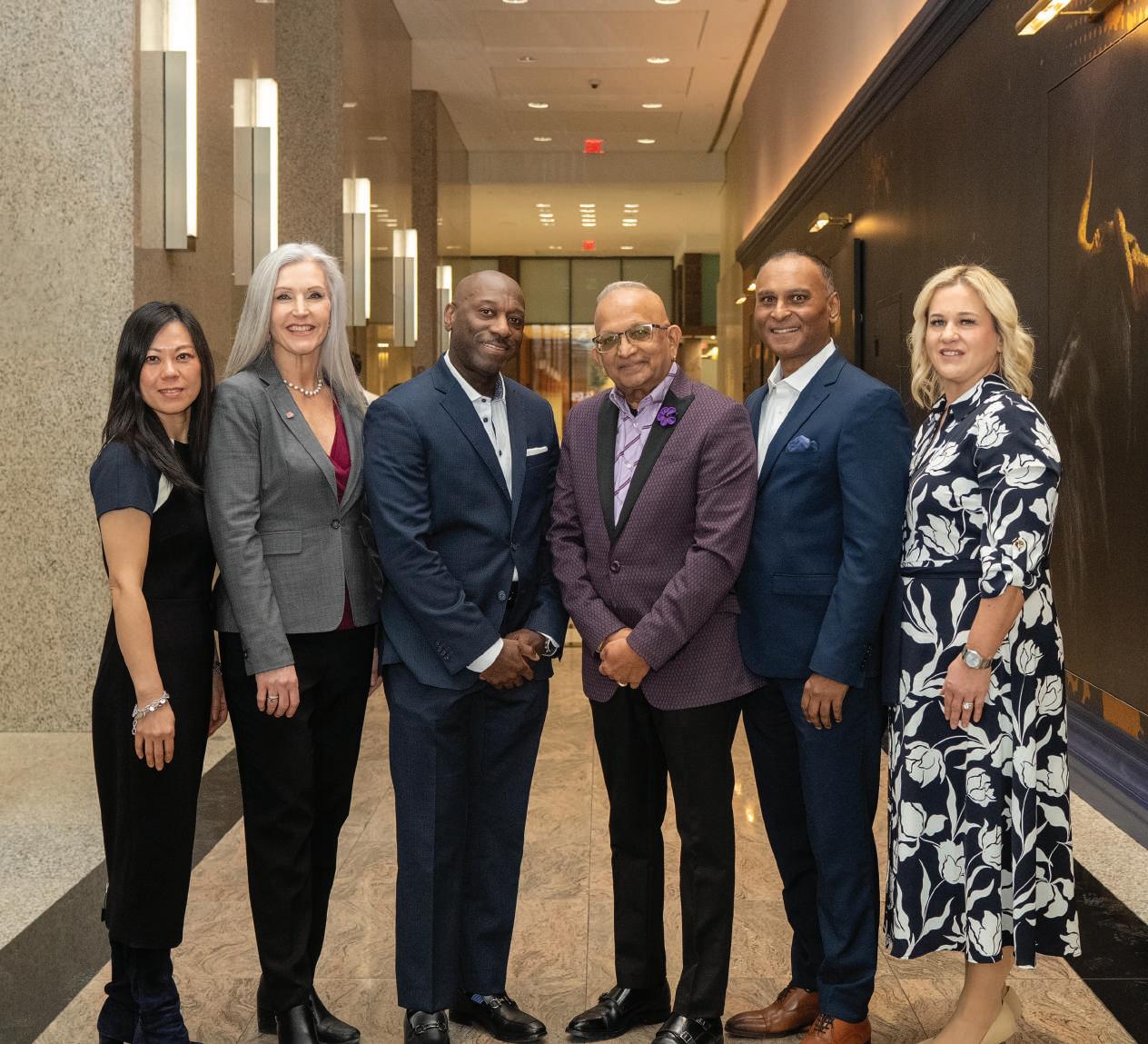
THE PANELLISTS
“It’s not going to be easy. I don’t anticipate it being a smooth transition for the consumer this year. A lot of the economists are saying there’s going to be some pain points until early next year. For us, it’s about positioning – it’s about marketability because we’re a property-first lender. When we’re connecting with our broker partners, we do our best to get the full story. By the time they’re sending that deal to us, we want to make sure they’re telling us everything up front so we can give them an informed decision to ensure a solution for their clients.”
And in a market still digesting the aftermath of a brutal reset at renewal, the mortgage conversation going into 2026 is already changing shape. According to the Bank of Canada, approximately 60 percent of all outstanding Canadian mortgages will come up for renewal by the end of 2026. Furthermore, many of these borrowers will see an increase in mortgage payments, with payment shocks of up to 25 percent for those who locked in rates in 2021, and up to 40 percent for those from 2020.
As such, the current landscape is no longer dominated by rate chatter or lender shopping in a narrow prime box. Instead, it’s increasingly about affordability pressure and underwriting realism, borrower complexity, and a growing reliance on alternative and private solutions.
“We’re optimistic about the year,” added Reaza Ali, national broker relations manager
at Neighbourhood Holdings. “Looking at this from an opportunity perspective, more clients are being shifted into the mixed space and the alt-lending side of the business.
“[However], there’s some concerns around affordability. [After all], with more and more people struggling at this point with multiple sources of income, it can make it very difficult for those clients to keep up with payments and stay in their homes.”
Those pain points are already reshaping borrower behaviour and, by extension, the types of deals flowing through the system.
year. When we first came out of COVID, there was a very common trend in the MIC space where people wanted what they wanted. The MIC space had the flexibility to offer 35-, 40-, or even 50-year amortizations. Borrowers would get told no by their A-bank, try to get approved on the B space, and then say, ‘Oh wow, these guys can amortize me for 50 years? I’ll go there.’”
Balancing flexibility and responsibility
For many households, those options were not about optimization but survival. Paying a
“We use a phrase all the time at Haventree – ‘Bad things happen to good people’ – and we’re there to help bring them back and help them get to the A space if possible”
Susan Thomas, Haventree Bank
Lenders have to be quick, flexible, and adaptable. Here, Campbell described the post-pandemic period as a turning point in how borrowers approached financing decisions.
“It’s a pivotal part of what we’re doing strategy-wise this year,” he said. “Specifically, around the types of deals we’re doing this
higher rate or fee was an acceptable trade-off if it meant keeping monthly payments manageable. The problem is that this flexibility has also begun to reveal deeper affordability stress.
“That trend has taken off, and, toward the end of the year, we’ve seen lower credit scores showing up – which tells us more
Shane Suepaul Mortgage broker, Hand in Hand Mortgages
Donna Thornton Founder/principal broker, Mortgage Powered Financial Group
Nancy Truong Mortgage broker, Real Mortgage Associates
Susan Thomas Vice president of sales, Haventree Bank Reaza Ali National broker relations manager, Neighbourhood Holdings
Paul Campbell Vice president of mortgage origination, Magenta Capital Corporation
ALTERNATIVE LENDING ROUNDTABLE 2026
people are feeling the pain,” added Campbell. “There’s a lot of financial pressure on consumers.”
What lenders are now seeing is not a sudden collapse in credit quality but a slow erosion that reflects sustained strain rather than isolated events. And that erosion becomes particularly concerning when paired with higher loan values and repeated refinancing activity.
“When you start looking at those types of profiles from a risk perspective, you really have to think twice,” Ali said. “These inquiries are often at very high values, sometimes to pay out another private loan. We’re not going to do our max loan-to-value. We want to protect both our broker partners and the consumer from putting themselves in a bad position.”
At Haventree, that balance between flexibility and responsibility is core to the alternative lending mandate. Here, Thomas made clear that understanding that story has become increasingly important as borrower circumstances grow more complex. Health
“For clients, Neighbourhood really does have many different options –whether it’s fully open, partially open, a no-lender-fee product, or a 1 percentlender-fee product” Reaza Ali, Neighbourhood Holdings
issues, job loss, business disruption, and family breakdowns are showing up more frequently in files that might otherwise appear straightforward.
“On the alternative side at Haventree, we will go as low as a 500 Beacon score,” she said. “We will look at double bankruptcies, we will look at consumer proposals, and we will look at situations where we keep a consumer proposal in place. We do the tough stuff, but we need to understand the story. We use a phrase all the time at Haventree –‘Bad things happen to good people’ – and
we’re there to help bring them back and help them get to the A space if possible.”
Asset quality is an anchor point of risk assessment. “One commonality across both the MIC and the alternative lending space is the importance of the property,” Thomas said. “Tell us about the property, because if we ever have to go power of sale or foreclosure, which we never want to do, what does this property look like?”
Campbell echoed that shift, noting that underwriting today bears little resemblance to what it looked like even a few years ago.
“When you’re looking at your client now compared to two years ago, you’re not just looking at loan-to-value,” he said. “Location is critical. Then it becomes about risk mitigation, and loan-to-value might move from 75 to 70 or even 65 depending on the area and your comfort level.” The goal, he stressed, is not to restrict credit unnecessarily but to ensure durability in a market where affordability stress is proving persistent rather than temporary.
A human-to-human interaction
As lender expectations evolve, brokers are being forced to adjust how they engage with clients. Transactional approaches that may have worked in a faster, looser market are proving insufficient in an environment where suitability and documentation are under intense scrutiny. Shane Suepaul of Hand in Hand
Mortgages described his approach as deliberately personal.
“I’m probably old school,” he said. “I like to have a eyeball on my clients when I’m talking to them in difficult situations. I’m not doing a phone call – I need to see your face because I need to see that reaction from you.”
Donna Thornton of Mortgage Powered Financial Group was even more direct, particularly when it comes to private lending.
“Just because I can do something doesn’t mean that I should,” she told CMP . “If I can’t realistically get you out of the private space and into at least the B space in one to two years, I’m not doing the private in the first place unless the exit strategy is to sell. Because when something goes wrong, it doesn’t go wrong when we close the mortgage. It goes wrong when they can’t renew and they can’t get out.
“Where I come from, we have an exit strategy form. We literally document all of these things. It’s my policy to make sure I do it on the B side as well to ensure that the exit strategy is made with the client.”
‘Partnership, not access’
And as regulatory scrutiny intensifies, suitability has become the central measure of responsible lending, forcing brokers to spend more time understanding not just numbers but also behaviour. Thornton was clear that private mortgages still have an important role to play.
“A private mortgage has a place in this market,” she said. “I do lots of them. They’re great as long as they’re a piece of the puzzle, not the entire solution.” Thomas cautioned against oversimplifying borrower distress, noting that many of the files coming through today reflect circumstances beyond a borrower’s control.
ALTERNATIVE LENDING ROUNDTABLE 2026
“We’re looking at it as an opportunity to come up with more products to help Canadians through this really tough time”
Paul Campbell, Magenta Capital Corporation
Brokers are also navigating expectations shaped outside the mortgage channel. Nancy Truong of Real Mortgage Associates pointed to the growing influence of realtors in affordability-driven decisions.
“The realtor will come and look – the market is low – ‘If you buy today, it’s $100,000 to $200,000 less than next year,’” she said.
For her, that’s when she has to ask, ‘Okay, after one year, what’s the exit strategy?’”
As complexity grows, lenders and brokers are increasingly selective about who they work with.
“We are not all things to all brokers,” Thomas said. “I want to partner with trusted brokers who respect our business model and who bring quality files. You don’t need 150 lenders. You need 10 lenders that you know really, really well. What matters now is partnership, not access.”
‘We listen to the demands from our brokers as well’
As the discussion turned toward what 2026 might look like on the product side, the tone
shifted from caution to collaboration. Ali highlighted the importance of listening closely to broker demand – noting that product evolution has become inseparable from market consolidation and shifting borrower needs.
“We listen to the demands for our brokers as well,” he told CMP. “We look at the trends that are coming through – and the landscape is changing quite a bit. Neighbourhood, back in October, acquired Fisgard, so there were some great opportunities that have come together there for both lenders. At Neighbourhood, we’re able to do a higher loan to value, a wider lending area, and wider credit box as well. [What’s more,] we’re a national lender, coast to coast, so we can help our broker partners in many different ways on that front too.”
As far as products are concerned, Ali revealed that his team has revamped its
bridge financing product and is developing a reno product too.
“From a pricing perspective, it’s pretty much staying the same,” he added. “We’ve adopted the Neighbourhood price guide, which is credit driven and loan-to-value driven. For clients, Neighbourhood really does have many different options – whether it’s fully open, partially open, a no-lender-fee product, or a 1 percent-lender-fee product, as well as first and second mortgages too.”
For Thomas, the next phase of alternative lending growth is being shaped less by headline economics and more by broker-led innovation.
“We have invested a lot of money into new technology so that we can offer a wider range of products,” Thomas said. “There are quite a few changes coming together. It’s an exciting time to be at Haventree Bank to see some of these things come forward. One example is our improvements mortgage. It’s a great product that’s in the market that’s like a purchase-plus product you’d be familiar with through CMHC or Sagen, only it’s on the alternative side. And it’s not just purchase – it can be a refinance up to $100,000. So, if you have a client trying to buy in an area and the house is a bit dated, and they want to do renovations to bring it up to date, we can do that.”
Ultimately, Thomas pointed to growing demand among borrowers looking for secondary income streams as affordability tightens.
“Where I see a big uptick is for people with affordability issues who want to put in a basement suite, for example,” she said. “They already own the house – they do a refinance plus improvements.
“We will finance the as-is version and then give the rest once the work is complete. These are the kinds of things that came right out of our broker advisory council. The one thing I would ask brokers is always, always give us these ideas. You’re the ones with the clients. You’re the ones with the best ideas for us to bring brand-new products into the market.”
BROKER FOCUS
Adapting to a rapidly evolving industry
With a mortgage career stretching more than three decades, OwlMortgage.ca principal broker Vince Gaetano says empathy, honesty, and smart use of technology are the real differentiators in today’s volatile market
FOR MORE than three decades, Vince Gaetano has watched Canada’s mortgage landscape evolve – first from inside a bank, then as one of the driving forces behind Monster Mortgage, and now as principal broker and owner of OwlMortgage.ca.
If there’s a through-line in that journey, it’s a simple one: in a complicated market, character and clarity matter more than ever.
OwlMortgage.ca, he says, was formed around a single idea: giving today’s mortgage agent a brokerage that actually helps them grow a real, sustainable business.
“OwlMortgage.ca was built with one simple idea in mind,” Gaetano explains. “The mortgage agent deserves a brokerage that helps them grow in the real business in today’s world. We’ve seen a changing environment, so it’s not just about processing deals.”
The value of social media Gaetano remembers when business was driven by TV spots and traditional marketing. Today, he’s convinced the real action is online. “I really think that social media is where the market is and where people are hoping to find someone they can trust and engage with,” he says. “It’s not about selling –it’s about being authentic, being true to your values, and you could really establish the type of person you are for that potential client.”
That philosophy is shaping Owl’s strategy in what he calls a pivotal year. “I think 2026 is a year where strategy matters most,” he notes. Rather than chasing volume at all costs, he’s leaning hard into deeper client relationships, empathy, and straight talk – even when that means recommending a course of action that doesn’t result in a deal.
“It may not make us money today, but it’s going to create a trust that we’re helping them breathe a little bit and give them a break,” he says. “Going from a prime to an alternative or a private doesn’t get cheaper. It gets more expensive. And when you’re already in a cash crunch, you’re just kicking the can down the road and the inevitable is going to happen. And
“Be patient, stay curious, have your passion, and commit to learning. That is where you can build real value and credibility for your clients”
“I truly believe empathy and honesty are the superpower to build your brand this year,” he says. In practice, that sometimes means telling a client that the best decision is to sell and step back from ownership, rather than piling on more expensive debt in the alternative or private space.
KEEPING LENDERS ONSIDE
who benefits? Lawyers, appraisers, brokers, and lenders, not the client.”
Shifting expectations
If consumer pressure has intensified, expectations have also changed. Today’s borrowers expect speed, transparency,
Gaetano’s lender playbook is simple: be disciplined with exceptions and make your partners’ lives easier. Drawing on years as a banker, he uses a strict “three-wish rule.” “You can only call a lender three times a year for an exception,” he says. “If you call them more than three times, then you’re a problem because all your files are exceptions.” He stresses that sending clean files, respecting lenders’ time, and saving exceptions for truly deserving cases remain the keys to maintaining responsive, collaborative lender relationships.
and a digital-first experience. “They want information now, they want it fast, and they want to collect as much information as quickly as they can,” Gaetano says. “They want to feel educated and not sold to.”
That’s where he believes educationbased marketing – not hard-sell tactics – and intelligent technology come in. OwlMortgage.ca has been built around automation and modern tools, and Gaetano has become an unlikely example of how a veteran broker can thrive in the new environment.
“I never thought an old guy with white hair would get as many followers and clicks as I do,” he laughs. “But if you’re authentic, you’re consistent, you’re disciplined, and you’re providing good quality content that people digest and think it’s worth something, it’s a platform to really build a brand in your business.”
For newer agents trying to break into a difficult market, Gaetano’s advice is clear: don’t do it solo, and don’t hide. “The fastest-growing agents are the ones who plug into a system, a mentor, and a community,” he says. “Social media is the new business card. If you do not have social media in your work life, that’s a red flag when someone can’t find you.”
$550,000
Beyond CMFG, Ameerullah volunteers, fundraises, donates, and advises for charities tackling housing, hunger, health, education, and exploitation across Canada and globally.
GIVING BACK
CEO Ameera Ameerullah has turned a lifetime of trials into a wideranging philanthropic mission that reaches far beyond mortgages
FOR AMEERA AMEERULLAH, CEO of Canada Mortgage and Financial Group, philanthropy is not a sideline – it is the heartbeat of her life. She has endured family separation, homelessness, a car accident that left her in a wheelchair for seven months, and ovarian cancer.
Instead of turning inward, she chose
service. “Every setback helps us to grow and shifts us to the direction we are meant to be on,” she reflects. That belief now powers daily volunteering, fundraising, and advocacy for at-risk youth, women battling addiction and mental health, incarcerated individuals, and families facing eviction.
“Giving back is a blessing,” she says,
“so when I can help someone, it is an opportunity even in the smallest way.”
Her spiritual journey deepened her conviction that tomorrow is never guaranteed and that a mortgage career can be a platform for impact: “Helping is not always about giving money; in so many other ways we can be there to support one another.”
Raised annually through Covenant House Toronto Sleep Out Champions
Women in Mortgage Summit
EMPOWER. ELEVATE. LEAD.
The mortgage landscape is evolving fast – and women are at the forefront of driving that change. The Women in Mortgage Summit Canada is your opportunity to step away from the day-to-day and reconnect with your purpose, your peers, and your potential in a focused, high-energy environment in Toronto.
Bringing together leaders, rising talent, and changemakers from across the mortgage ecosystem, this summit will offer fresh perspectives, candid conversations, and practical ideas you can put into action – all while expanding your network with professionals who are just as ambitious and driven as you are. Previous years have sold quickly, and we anticipate strong demand again – secure your place early to avoid missing out.