ANALYSIS 14
brokernews.com.au
FOS FACTS:
The Ombudsman’s look at the industry The EDR scheme’s annual report gives insight into how brokers and lenders are performing
S
ay what one will about external dispute resolution (EDR) schemes, they tend to provide an insightful snapshot on the state of the mortgage industry, as well as a look at how consumers feel they’ve been treated. The Financial Ombudsman Service (FOS) has released its annual report on the industry’s two EDR schemes. For brokers and mortgage lenders, there’s good news and bad news. First the bad news: almost half of the complaints accepted by FOS related to credit products, with disputes about home loans and credit cards the most common in 2012/13. Another potentially worrying trend is the drop-off in FOS membership. The service saw an overall 5% decrease in its membership for the year. While there could be many reasons for the attrition, it does point to the possibility of dwindling broker numbers. FOS blamed the decrease on industry consolidation. “A number of reasons account for the slight drop in members. One key factor was that there were a considerable number of mergers between FSPs [financial service providers] in the last 12 months – particularly in the credit union and general insurance sectors – which means that where there
were once multiple memberships, there is now only one.” But the report offers some positive news as well. After four years of “large” increases in dispute numbers, FOS says it has finally experienced a reduction in overall dispute numbers. Registered disputes are down 17% from last year, while accepted disputes fell 5%. FOS chief ombudsman Shane Tregillis says a key contributor to the reduction in overall disputes was a 22% decline in financial difficulty disputes. “This appears to be a result of the improvements by the major banks and other financial service providers to their financial hardship programs over the last few years following the changes introduced under the 2010 National Credit Code.” Many Australian borrowers have also had a reduction in repayment pressures, given the lower interest rates of the past
few years, and Tregillis says this may have played a part in reducing the number of financial hardship disputes coming to FOS. “There was also a big reduction in natural disaster disputes due to a much higher prevalence of flood cover following recent legislative changes and the efforts by the insurance industry to improve practices in this area over the last couple of years. “Investment disputes have also declined 25%; the main reason appears to be that the impact of the GFC on the number of disputes coming to FOS is now diminishing.” Tregillis says the early resolution of disputes continues to be a key focus for FOS. “Fifty-five per cent of all disputes were closed within 60 days and 73% within 120 days in 2012–2013. “We recognise there is still much work to be done to improve how quickly we resolve disputes and this will be a key focus of our efforts over the coming year.” Here’s a look at some further insights from the FOS report:
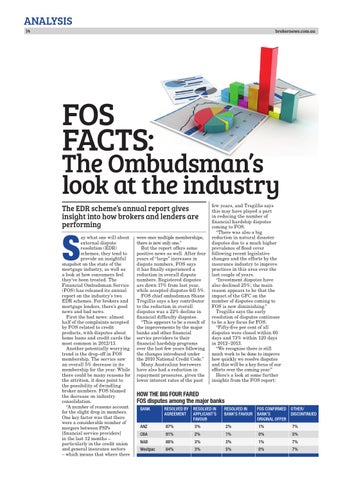
HOW THE BIG FOUR FARED FOS disputes among the major banks BANK
RESOLVED BY AGREEMENT
RESOLVED IN APPLICANT’S FAVOUR
RESOLVED IN FOS CONFIRMED OTHER/ BANK’S FAVOUR BANK’S DISCONTINUED ORIGINAL OFFER
ANZ
87%
3%
2%
1%
7%
CBA
91%
2%
1%
0%
5%
NAB
86%
3%
3%
1%
7%
Westpac
84%
3%
5%
0%
7%