Studies from the
Center for Neuropsychology and Neuroscience Research at Kessler Foundation
![]()

Studies from the
Center for Neuropsychology and Neuroscience Research at Kessler Foundation
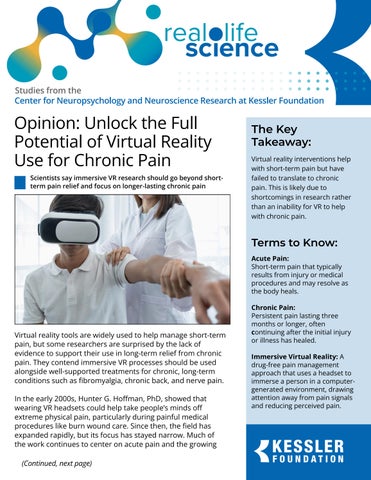
Scientists say immersive VR research should go beyond shortterm pain relief and focus on longer-lasting chronic pain

Virtual reality tools are widely used to help manage short-term pain, but some researchers are surprised by the lack of evidence to support their use in long-term relief from chronic pain. They contend immersive VR processes should be used alongside well-supported treatments for chronic, long-term conditions such as fibromyalgia, chronic back, and nerve pain.
In the early 2000s, Hunter G. Hoffman, PhD, showed that wearing VR headsets could help take people’s minds off extreme physical pain, particularly during painful medical procedures like burn wound care Since then, the field has expanded rapidly, but its focus has stayed narrow. Much of the work continues to center on acute pain and the growing
(Continued, next page)
Virtual reality interventions help with short-term pain but have failed to translate to chronic pain This is likely due to shortcomings in research rather than an inability for VR to help with chronic pain.
Acute Pain:
Short-term pain that typically results from injury or medical procedures and may resolve as the body heals
Chronic Pain:
Persistent pain lasting three months or longer, often continuing after the initial injury or illness has healed.
Immersive Virtual Reality: A drug-free pain management approach that uses a headset to immerse a person in a computergenerated environment, drawing attention away from pain signals and reducing perceived pain.


(Continued from first page)
number of review articles revisit its short-term effects. That’s the concern highlighted in an editorial by lead author Carly L.A. Wender, PhD, from Kessler Foundation, who made a case for changing the way we think about VR as a valuable tool in the treatment of chronic pain.
Dr. Wender described a field “plagued by proliferation of review articles.” A recent literature search found more published reviews (157) than clinical trials (124)
She urged researchers to break through this stagnation and use existing knowledge to move the field forward: apply what they’ve learned in acute pain research to address chronic pain.
Dr. Wender didn’t just critique the field: she outlined a roadmap for progress, highlighting four key action items for future research:
1.Focus on mechanisms. Chronic pain is multifaceted, involving physiological, psychological, and emotional components. Interventions that target only one mechanism (i.e., via distraction), common in pain research, are unlikely to
help those with chronic conditions. Future studies should address multiple interacting mechanisms of pain
2.Integrate VR with existing treatments. Rather than using VR as a standalone therapy, researchers should test it alongside evidencebased approaches such as physical therapy, exercise, or cognitive behavioral therapy
3 Leverage the acute pain literature. Research on short-term pain already gives useful guidance for creating and adjusting VR tools to help with persistent pain.
4.Prioritize transparency and access. Researchers and industry leaders should openly share how VR tools are developed, tested, and refined to ensure reproducibility and equitable access.
Dr. Wender suggested that real progress will come only when researchers stop circling the same acute pain literature and instead use that momentum to advance chronic pain research With focused, transparent, and collaborative studies, VR interventions could finally take a monumental step towards addressing chronic pain.
The study, “Virtual reality in chronic pain management: how do we galvanize a stagnant field?” was published in Pain Management (2025)
Lead author Carly L.A. Wender, PhD, is a research scientist in the Center for Neuropsychology and Neuroscience Research at Kessler Foundation.
To read the full study, scan the QR code below or visit: 10.1080/1758186 9.2025.2554561.
This Real-Life Science summary is part of our series that translates peer-reviewed research into practical, realworld understanding.

