

Center for Autism Research at Kessler Foundation

![]()


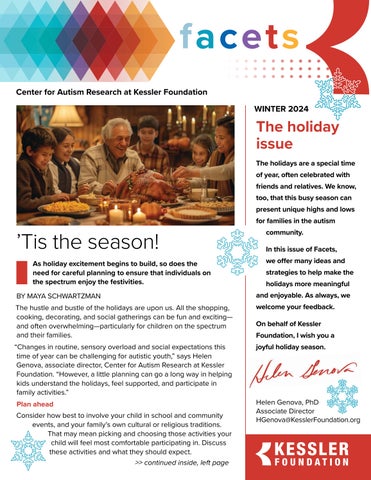
As holiday excitement begins to build, so does the need for careful planning to ensure that individuals on the spectrum enjoy the festivities.
BY MAYA SCHWARTZMAN
The hustle and bustle of the holidays are upon us. All the shopping, cooking, decorating, and social gatherings can be fun and exciting— and often overwhelming—particularly for children on the spectrum and their families.
“Changes in routine, sensory overload and social expectations this time of year can be challenging for autistic youth,” says Helen Genova, associate director, Center for Autism Research at Kessler Foundation. “However, a little planning can go a long way in helping kids understand the holidays, feel supported, and participate in family activities.”
Plan ahead
Consider how best to involve your child in school and community events, and your family’s own cultural or religious traditions. That may mean picking and choosing those activities your child will feel most comfortable participating in. Discuss these activities and what they should expect.
>>continued inside, left page
The holidays are a special time of year, often celebrated with friends and relatives. We know, too, that this busy season can present unique highs and lows for families in the autism community.
In this issue of Facets, we offer many ideas and strategies to help make the holidays more meaningful and enjoyable. As always, we welcome your feedback. On behalf of Kessler Foundation, I wish you a joyful holiday season.

Helen Genova, PhD Associate Director HGenova@KesslerFoundation.org
<< continued from front cover
Help prepare them in advance by practicing greetings, small talk, and other social skills in a low-key setting. Creating “social stories” can also be helpful in preparing your child and ensuring they feel safe, seen, and supported throughout the season. (See Facets Summer 2024 for more on social stories. Online at bit.ly/3Yoh8UA )
Get them involved
Having your child participate in holiday planning will give them a sense of control and help build their comfort and confidence. Encourage them to convey their interests and preferences so that you can adjust plans accordingly. For example, if your child is not into a raucous family football game on Thanksgiving, plan a quiet activity for them to enjoy. Be open to establishing new traditions to accommodate the needs of all family members.
Avoid sensory overload
The bright lights, loud music, strong smells, and different foods of holiday season may be overwhelming to individuals on the spectrum. To help minimize any issues:
★ Choose sensory-friendly decorations. LED lights, for example, offer various settings.
★ Seek out sensory-friendly shops, Santa visits, and other activities.
★ Bring noise-canceling headphones, sunglasses/eye mask, or other aides when at school, community or other large gatherings.
★ Have a quiet space for your child to escape to if it all becomes too loud or overstimulating, whether at home or visiting family and friends.
Maintain a routine
Despite school vacations and changes to your child’s usual activity calendar, it’s important to maintain core routines and schedules as much as possible, even if you are traveling. This includes mealtimes, bedtime, bathing, and other personal needs.
Relax and rejoice
Eat too much at Thanksgiving. Decorate the Christmas tree.
Light the menorah for Chanukah or the kinara for Kwanzaa. And ring in the New Year. Most of all, rejoice in good health with your loved ones.

Maya Schwartzman is a research assistant at the Center for Autism Research.
It’s hard to find the “perfect” gift, but here are some ideas for autistic youths.
WEIGHTED BLANKET, a potential game-changer in helping them fall asleep
NOISE-REDUCING headphones
FIDGET TOYS like spinners, cubes, and pop-its
KINETIC SAND, slime, or Silly Putty®
MAGNETIC TILES or other building sets
PLAY TENTS
BEAN BAG CHAIR, pea pod sensory chair, swing
AQUARIUM or bubble lamp
TOYS, BOOKS, OR GAMES related to your child’s interests, hobbies, or obsession—whether arts and crafts, music, super-heroes, or princesses!
Our studies investigate changes after MS diagnosis, and ways to minimize deficits prior to or following their onset. Scan code to learn about our pioneering research >>
Our research develops interventions focusing on the critical adolescence-to-adult transition. Go to KesslerFoundation.org/autism-research or scan code to learn more.
Once again, Nassan’s Place is spreading holiday cheer in the local autism community through its annual toy drive.
It’s a busy time of year, but that doesn’t stop Nadine WrightArbubakrr from devoting her time and energy to deliver joy and special holiday gifts to individuals on the autism spectrum and their families in and around the greater Newark, NJ, area.
As the mother of a young adult on the spectrum, she knows first-hand how difficult the holidays can be, especially given the lack of accessible, affordable resources in her community. That’s what led her to establish Nassan’s Place in 2012, a 501(c)3 non-profit organization providing educational and recreational programs to assist families like hers who are living with autism
Nadine and her tireless team of “elves” are working to make the holidays extra special for these families. Through its annual toy drive, Nassan’s Place will distribute gifts to children at its holiday celebration on December 14.

Last year’s event, which featured sensory-friendly activities, music, refreshments, and surprise guests, drew over 300 people.

Wright-Arbubakrr at last year's toy drive.
games for children of all ages, as well as monetary donations that will go to purchase additional gifts. Items will be accepted from November 1 to December 13.
Dr. Helen Genova with a research participant

Events like this succeed only with the support of autism community partners, including Kessler Foundation and other organizations across the state. You can help spread the joys of the season. Nassan’s Place is collecting unwrapped toys and
“This event celebrates the ‘unity’ within our community,” says Wright-Arbubakrr, “and we are so very grateful for your support and the difference you make.”
To learn more about Nassan’s Place and how to donate to this year’s Holiday Toy Drive, visit nassansplace.org
In this season of giving, there is one more significant way to support the autism community: Volunteer to participate in the important and innovative research being conducted at the Center for Autism Research at Kessler Foundation. Your involvement will increase our understanding of autism spectrum disorders and lead to the development of new tools and resources to benefit autistic individuals and their families.
To learn more and enroll, see the back page >>
Diagnosed with autism at age four, Kerry Magro, EdD, once struggled to communicate. Today, Dr. Magro is an award-winning speaker, best-selling author, film consultant, and founder of KFM Making A Difference, a 501(c)3 non-profit organization focused on autism awareness and advocacy. For over ten years, he has also played Santa at sensoryfriendly holiday events across New Jersey. This unique and very personal experience inspired him to write a new children’s book, Santa Goes the Extra Mile for Children with Disabilities, (available in November on Amazon.com), which is sure to spread joy and understanding this season. To learn more, visit KFMmakingadifference.org
Individuals on the autism spectrum can identify and express their strengths and improve overall goal achievement—thanks to groundbreaking Kessler Foundation research.
BY DANIEL SULLIVAN
As the new year approaches, many individuals begin thinking about resolutions. This often seems to be an appropriate time to make changes in our lives, including those behaviors that may have a negative impact or warrant “correction.” For example, we may vow to lose weight, exercise more, or become more organized. Despite our best intentions, it’s easy to abandon these goals in the first few weeks or months.
Capturing strengths
Keeping our resolutions and achieving our goals are more likely to be successful when we build on our strengths, not weaknesses. Strengths are the inherent, positive character traits and individual skills we use in everyday life. Being aware of these strengths allows us to harness these attributes and work toward our goals with a positive mindset, rather than focus on fixing a weakness.

Positive strategies
The established principles of positive psychology are the basis of the work at Kessler Foundation’s Center for Autism Research. Using a variety of tools, researchers help individuals on the spectrum identify their strengths, incorporate them in their daily lives, and leverage them in the workplace. Many individuals may resolve to find a new job, attend academic or training programs, or participate in community activities. Discovering their strengths is a critical first step… and the Foundation is here to help. We offer several strength-finding studies, including Kessler Foundation Strength Identification and Expression (KF-STRIDE®) and STRIDE into Work.

Daniel Sullivan is a research assistant at the Center for Autism Research.
To learn more and enroll in
< Dr. Kerry Magro, champion of sensory-friendly cheer