Studies from the Center for Traumatic Brain Injury Research at Kessler Foundation
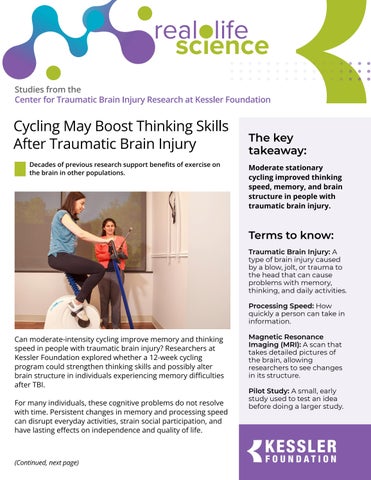
Cycling May Boost Thinking Skills After Traumatic Brain Injury Decades of previous research support benefits of exercise on the brain in other populations.
The key takeaway: Moderate stationary cycling improved thinking speed, memory, and brain structure in people with traumatic brain injury.
Terms to know: Traumatic Brain Injury: A type of brain injury caused by a blow, jolt, or trauma to the head that can cause problems with memory, thinking, and daily activities. Processing Speed: How quickly a person can take in information.
Can moderate-intensity cycling improve memory and thinking speed in people with traumatic brain injury? Researchers at Kessler Foundation explored whether a 12-week cycling program could strengthen thinking skills and possibly alter brain structure in individuals experiencing memory difficulties after TBI. For many individuals, these cognitive problems do not resolve with time. Persistent changes in memory and processing speed can disrupt everyday activities, strain social participation, and have lasting effects on independence and quality of life.
(Continued, next page)
Magnetic Resonance Imaging (MRI): A scan that takes detailed pictures of the brain, allowing researchers to see changes in its structure. Pilot Study: A small, early study used to test an idea before doing a larger study.
(Continued from first page) While medications and cognitive rehabilitation can help with some cognitive issues after TBI, they aren’t always beneficial for learning, memory, and processing speed. Because of this, our researchers are exploring other alternatives like exercise to help people think more clearly. Previous studies showed that exercise protects the brain from aging and can prevent memory declines in healthy adults. So, our researchers wondered if exercise could do the same for people with traumatic brain injury. Study elements Five people with memory impairments and severe TBI were included in the study Two participants rode a stationary bike at a moderate intensity three times a week for 12 weeks Three participants performed stretching and toning on the same schedule as a comparison Researchers conducted learning and memory tests, processing speed tests, and MRI brain scans to all participants before and after the program to measure progress in the two groups
Study results In this small study, the cycling group improved compared to the stretching and toning group. Specifically, those who cycled improved learning and thinking speed, while also showing brain growth in structures related to memory and processing speed Why these results matter This very small study provides exciting early evidence that moderate exercise may be a powerful tool for helping people with TBI recover cognitive abilities. The changes in brain structure offer clues about how exercise might help the brain heal. These results are a first step. Larger studies are needed to confirm the benefits of exercise on thinking abilities and brain healing after TBI. Learn more The full study, “The preliminary effects of moderate aerobic training on cognitive function in people with TBI and significant memory impairment: a proofof-concept randomized controlled trial,” was published in Neurocase, The Neural Basis of Cognition (2021).
The lead for this study was Carly L. A. Wender, PhD, research scientist in the Center for Center for Neuropsychology and Neuroscience Research at Kessler Foundation. This summary was written by Tylan Ozkuzey, a recent summer intern, presently a student at Bates College, Lewiston, ME. Additional Foundation scientists involved in the study include Drs. Brian M. Sandroff, Denise Krch, Glenn Wylie, Nancy D. Chiaravalloti, and John DeLuca. Learn more about our research on traumatic brain injury. Visit our Join a Study webpage for information on how to participate in a Kessler Foundation research study. This Real-Life Science summary is part of our series that translates peer-reviewed research into practical, realworld understanding. To read the study abstract, scan the QR code or visit: doi/full/10.1080/1 3554794.2021.19 90964.
120 Eagle Rock Avenue, Suite 100 | East Hanover, NJ 07936-3147 973.324.8362 | KesslerFoundation.org /KesslerFoundation
/KesslerFdn
/KesslerFdn
/the-kessler-foundation
/kesslerfoundation