Changing the lives of people with disabilities
FALL 2025 Your support maximizes recovery, independence, and inclusion for people with disabilities
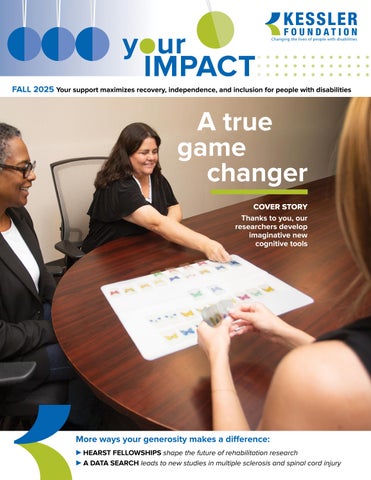
A true game changer COVER STORY Thanks to you, our researchers develop imaginative new cognitive tools
More ways your generosity makes a difference: HEARST FELLOWSHIPS shape the future of rehabilitation research A DATA SEARCH leads to new studies in multiple sclerosis and spinal cord injury
COVER STORY
KF-PUPIL exercises the mind’s eye Aubree Alexander, PhD, was at a pivotal point in her career. After more than a decade of clinical practice in neuropsychology, she wanted a challenge that would transfer her knowledge to the scientific study of cognition after brain injury. KF-PUPIL, a home-based intervention was born. The timing was perfect.
Rethinking cognition
Game on
Kessler Foundation had just been awarded a prestigious two-year fellowship grant from the Hearst Foundations. Dr. Alexander applied for the fellowship… and that was just the beginning of her new focus.
Dr. Alexander aimed to focus her work on improving cognitive function—the ability to think, reason, problem-solve, and recall information—particularly as it applies to the performance of daily activities. She saw the potential of expanding the established Kessler Foundation Modified Story Memory Technique (KF-mSMT®). This 10-week protocol teaches participants to visualize verbal information, incorporate unrelated material into a meaningful context, and apply these strategies to the memory demands of everyday life.
Inspired by the protocol, Dr. Alexander created a companion intervention called KF-PUPIL—Play, Understand, Partner, Interact, and Learn— to be used at home.
“Receiving this fellowship was a life-changing opportunity. Under the mentorship of Drs. Nancy Chiaravalloti and Denise Fyffe, I was trained to become a researcher,” says Dr. Alexander. “Dr. Chiaravalloti helped me develop the skills to design and conduct studies, analyze data, and apply for grants. The goal is greater understanding of cognition and improved outcomes for people with brain injury.” During the fellowship, she drew on findings from previous studies— funded by the generosity of donors like you—to lay the groundwork for her work. Her clinical experience gave her valuable insight into how hands-on practice can shape scientific inquiry and how new discoveries can, in turn, enhance patient care.
KF-PUPIL features an educational component for family caregivers and a tabletop game designed to promote the use of cognitive strategies. With funding from the New Jersey Commission on Brain Injury Research, Dr. Alexander is studying the effectiveness of this program in supporting memory and other daily living skills.
“The KF-mSMT protocol has been shown to enhance cognitive performance in individuals with traumatic brain injury, as well as those with multiple sclerosis,” notes Dr. Alexander. “It is a transformative tool that prompted me to consider how we can reinforce these critical skills outside the rehabilitation setting in a way that is engaging, accessible, and affordable.”
Dr. Nancy Chiaravalloti, center, flanked by Hearst Fellows Dr. Silvana Lopes Costa, left, and Dr. Aubree Alexander, right.
KF-PUPIL teaches cognitive strategies for the memory demands of everyday life.
Gateway to learning Serving as the primary mentor for our Hearst Fellows “is one of the most rewarding aspects of my work,” admits Nancy Chiaravalloti, PhD, director of the Centers for Neuropsychology,
Each Hearst Neuroscience, and Traumatic Fellow brings a Brain Injury Research. different perspective, “which opens the door “It allows me to teach to new ideas and the entire process—and ways of thinking.” purpose—of scientific study -Dr. Chiaravalloti
that will ultimately lead to improving the lives of people
with disabilities.” Equally important to the doctor is the opportunity to learn from her mentees. “Each person brings a different perspective to rehabilitation research, which opens the door to new ideas and new ways of thinking,” she says. “They are our future.” Kessler Foundation recently received a fourth Hearst Fellowship. This highly competitive award will expand current cognitive rehabilitation research to answer the question, “How can we change the dynamics of aging?” Stay tuned...
A journey to discovery How a pursuit for data led to a fellowship and groundbreaking research in multiple sclerosis and spinal cord injury. While working toward her doctorate in her native Portugal, Silvana Lopes Costa, PhD, visited Kessler Foundation to learn about multiple sclerosis research. She later returned to gather data for her dissertation on visual processing and cognitive deficits in MS. Soon thereafter, she joined Kessler Foundation and was awarded a prestigious Hearst Fellowship. “Being a Hearst Fellow expanded my knowledge of research protocols, clinical trials, and the impact of cognitive rehabilitation on people with MS, brain injury, and spinal cord injury,” says Dr. Costa, now director of Kessler Foundation’s Neuropsychology of Eye Movements Laboratory. Through this fellowship, she conducted two studies
on cognitive rehabilitation in MS, presented at international conferences, and earned several honors.
An eye-catching approach Dr. Costa’s current research focuses on eye-tracking technology to uncover how people with neurological disorders solve problems. “Eye-tracking, paired with traditional neuropsychological, visual, and motor assessments, offers greater insight into attention, perception, and other cognitive processes. This helps identify underlying causes of impairment and guides more effective treatment,” she explains. One promising study uses eye-tracking as a “humancomputer interface” to enable
Dr. Costa uses eye-tracking technology to investigate problem-solving.
people with spinal cord injuries to operate computer systems and control their environment, which, she says, “could be life-changing.”
Building blocks of science Dr. Costa credits the Hearst Fellowship and mentorship she received at Kessler Foundation with helping build her career. She notes, “I am grateful to work in such a highly collaborative setting where, thanks to our generous donors, we’re able to conduct critical research and improve outcomes.”
Why your support means the world Thank you for championing rehabilitation research and employment for people with disabilities. You make discovery possible, bringing pioneering treatments from the lab to the lives of those who need them most. Every single gift matters. With deep gratitude, Rodger DeRose President and CEO
Michele Pignatello Vice President and Chief Development Officer
WAYS TO GIVE
For more information, please contact us at 973.324.8430 or email Development@ KesslerFoundation.org
Credit/Debit/ Digital Wallet
Changing the lives of people with disabilities
Check
DonorAdvised Fund
Bank or Stock Transfer
IRA
Crypto
120 Eagle Rock Avenue, Suite 100 East Hanover, NJ 07936-3147 tel. 973.324.8430 | fax 973.386.1361 | KesslerFoundation.org
Bequest