![]()


One hundred and forty years ago, New Mexico was still a territory. Santa Fe was a small, rugged capital defined by adobe buildings, dirt roads, and vast distances between communities. In 1885, there was no statewide public education system and no guarantee of access for children with disabilities, along with little understanding of the importance of language access for Deaf and Hard of Hearing children. Families did what they could, often in isolation. Expectations were limited, and possibilities were few. It was within this context that New Mexico School for the Deaf was born. That vision was shaped in large part by Lars M. Larson, a Deaf man whose lived experience, determination, and belief in the potential of Deaf children helped make the school a reality. At a time when Deaf voices were rarely centered in educational decisions, his advocacy ensured that Deaf children in the New Mexico Territory would have access not only to schooling, but to language, community, and belonging.

Establishing a school for Deaf children in 1885 required courage. When the school opened its doors, Santa Fe’s population numbered only a few thousand residents, railroads were just beginning to reach the Southwest, and many students traveled great distances to attend. Despite these challenges, a foundation was laid that would endure for generations.
Today, 140 years later, the landscape looks very different. New Mexico is a state, Santa Fe is a vibrant and diverse capital city, and our understanding of
Deaf education, bilingualism, and language access has evolved significantly. We are now a nationally acclaimed school, recognized for our commitment to high quality instruction, comprehensive outreach services supporting school districts and the broader community, and strong early intervention programs serving children and families across the state.
Our success is made possible by the dedication of educators, specialists, and support staff across every department. I also recognize with deep gratitude the critical role of the Office of the Governor, the New Mexico State Legislature, the Department of Higher Education, and our partner state agencies, whose continued support allows us to carry out this mission as envisioned in the New Mexico State Constitution. Their investment ensures that Deaf and Hard of Hearing children across New Mexico have access to opportunities that were unimaginable in 1885.
As we honor both past and present, we also look forward. Over the next 140 years, future generations of students will achieve milestones we have not yet begun to imagine. While education, technology, and access will continue to evolve, the heart of our mission remains unchanged.
Our story began in 1885 with vision and determination. As Superintendent, I remain deeply committed to continuing Mr. Larson’s mission. With compassion, gratitude, and collective effort, our work continues today, guided by the belief that the best chapters are still ahead.


Dr. Jennifer Herbold, Superintendent Warmly,


New Staff: July 1st, 2025 through November 30th, 2025


Not Shown:
Amanda Lovato
Manuel Lucero
Glena Jo Marcum
Cassandra Valdez
by Dr. Jennifer Herbold, Superintendent


Dr. Mette Böell

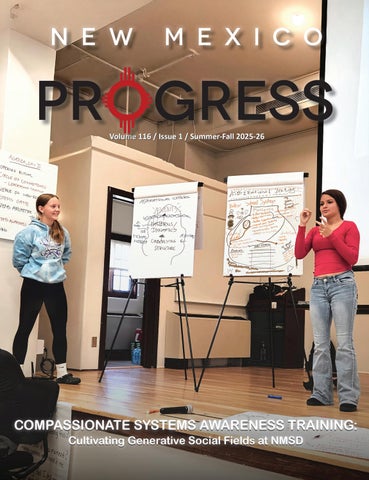
In October, staff stepped away from their usual routines for three days of Compassionate Systems Awareness Training. Coming on the heels of IEP meetings and a busy fall quarter, energy was low at first, but it didn’t stay that way. Within the first day, staff were fully immersed, and the time was welcomed as a chance to reset and reflect.
This wasn’t simply a sit-and-listen experience. Through hands-on activities, reflection, and conversation, energy in the room shifted as the days unfolded. At times, students and staff participated together sharing insights and learning side by side. This was a powerful reminder that the most meaningful learning happens when it’s experienced together.
"I truly appreciated being able to attend the Compassionate Systems of Awareness October Foundations I training. The experience taught me to be more aware of the power of actively connecting with my students to establish a sense of calm and focus in the classroom. Through conversational and grounding moments, I see firsthand how my students can become more connected as a unit, which makes our daily learning more enjoyable and meaningful.
~Laurie
Anderson - High School Teacher
The New Mexico School for the Deaf has long been known as a place where everyone is part of a close-knit family, grounded in strong relationships and a deep sense of community. With the goal of continuing our shared commitment to serving Deaf and Hard of Hearing children and families across the state, NMSD has taken steps to further grow that foundation by hosting a series of Compassionate Systems Awareness experiences designed to strengthen how we support one another, lead together, and grow as a learning community. Compassionate Systems Awareness (CSA) was founded by Dr. Mette Böell and Dr. Peter Senge, both established faculty members at the Massachusetts Institute of Technology. Their work focuses on long-term growth, systems thinking, and organizational learning.
CSA is both a framework and a practice that helps individuals and organizations understand how human nervous systems interact within groups. It emphasizes awareness of internal states, recognition of stress and regulation patterns, and the development of shared language and tools for checking in with ourselves and with one another. Rather than focusing on fixing problems or behaviors, CSA invites communities to slow down, notice what is happening beneath the surface, and interact with intention and care.
Most leaders at NMSD have received training over the past two years. However, Dr. Herbold felt that this training should not be limited to administrators and talked to the leadership at CSA, who agreed to come to NMSD to support our community. As a result, NMSD hosted Compassionate Systems Awareness Foundations I training over three days for over one hundred staff members who work directly with children,
"The concept of the iceberg stuck with me, as it prompted me to think more deeply and analyze whether the problems were merely on paper or if there was an underlying conflict beneath the general disputes.
~

"Compassionate Systems taught me that transformation happens through intentional habits. When we lead with presence, teach students to see patterns, and design structures that elevate every voice, compassion becomes a daily practice and not just an aspiration.
Real change begins with how we see one another. When we slow down, listen deeply, and honor the connections between us, a school becomes more than a place of learning; it becomes a community where every voice matters and every student can thrive.

followed by a two-day administrative retreat. During the Foundations I training, we also hosted a dedicated youth experience for our high school students. The trainings were facilitated by members of the Center for Systems Awareness, including Dr. Mette Böell, who traveled from Denmark, and Jane Drake from England. Several educators and administrators from California also participated in this shared learning experience. The student sessions were led by university students Gustav Böell from Denmark and Isamu Thung from Stanford California. Dr. Jennifer Herbold, Superintendent and Compassionate Systems Awareness Master Practitioner, worked closely with the CSA team to plan

and coordinate the experience. This event would not have been successful without the essential support provided by CSA staff as well as NMSD’s Executive Administrative Assistant Liliana Macias and the facilities, nutrition, and interpreting departments.
During the Foundations 1 training, staff were introduced to core Compassionate Systems concepts and explored how small, consistent practices can strengthen communication, trust, and collaboration through common tools for working with each other and for navigating our complex world together. The administrative retreat built on this foundation by providing leaders, who had previously completed Foundations 1, with the time and space to reflect upon shared values while creating a collective vision for the future. The retreat supported leaders in strengthening their capacity to model compassion, remain steady during moments of stress, and foster environments where staff feel supported and empowered.
Equally important was the inclusion of a youth experience. Students were engaged in learning how to better understand their emotional states, communicate needs, and support peers in healthy and respectful ways.
Together, these experiences supported the development of what is known as a “Generative Social Field” across our campus—an environment where learning and collaboration thrive, and where challenges are met with curiosity and shared responsibility. Students and staff alike were encouraged to reflect on how their actions can contribute positively

"There is a definition of compassion that has always stayed with me: to pay attention. During the training, there was an exercise where we took turns paying close attention to emotions, body language, and what was underneath words when telling a story about a memory of feeling connected. My group noticed that during the activity, the temperature of the room was raised, people were smiling, and there was a sense of camaraderie. It created a generative social field! It's easy to underestimate the power I have in just paying attention, but it is a transformative resource that is always available to me for my work at NMSD.
~ Paige Foreman - Registrar
to this shared field rather than diminish it. This work continues. Compassionate Systems Awareness is not a single event, but an ongoing practice. NMSD is committed to sustaining and expanding this effort as part of our strategic plan.
"The Compassionate Training provided valuable strategies that I continue to apply in my daily practice. The handson activities and group discussions helped translate theory into real classroom action. One key takeaway for me was recognizing how small, compassionate responses can significantly impact student engagement and behavior. The training strengthened my awareness of how trauma and stress can affect learning and reinforced the importance of patience, clear communication, and relationship-building.
~ Sheng Li - Middle School / High School Teacher

More Staff & Student Reflections:

"We wrapped up the training by standing around in a circle as each person stated one word describing their experiences. It was such a wholesome experience, and I found myself feeling sad as the circle broke because I wanted more of the training. It was a wonderful bonding experience.
~ Lisa Craig - Middle School English Teacher

by Joanne Corwin, EID Director

The Western Regional Early Intervention Conference (WREIC) was a resounding success! Designed to support professionals and families of children birth to three who are Deaf, Hard of Hearing, blind, low-vision, or Deaf-Blind, WREIC has operated for over 40 years — making it the nation’s longest-running early intervention conference. Held biennially across five western states, this year it was New Mexico’s turn. NMSD hosted in partnership with the New Mexico School for the Blind and Visually Impaired and the New Mexico Project for Children and Youth Who Are Deaf-Blind.


Highlights included:

‣ The conference was held at the Sheraton Uptown Hotel in Albuquerque. The conference was in such demand that it reached maximum capacity with 325 attendees from 14 different states and a waiting list of several hopeful participants.
‣ In addition to many professionals, this year’s event included the highest number of parent participants in WREIC’s history.
‣ Speakers addressed topics including language and brain development in young ASL users, maximizing incidental learning, and drawing on Deaf adults’ expertise in early intervention.
‣ This year marked the inaugural presentation of the Wendy Prouse Memorial Award, honoring individuals who have made significant contributions to the field.
‣ Conference surveys returned a 100% approval rating, with many calling it the best specialized early intervention conference they’ve ever attended.
by Sha Reins, Preschool Teacher
Oh! How important it is to have opportunities for children to learn from each other. Students were invited to explore ice in baking pans and watercolor paint. They began by painting the ice, but soon grew tired of simply coloring it and wanted to explore the ice in different ways.
One child noticed that the block of ice swirled around when using a paintbrush and soon others tried the same thing. A new idea emerged—one child wanted to see the ice outside of the metal pan. They had difficulty getting the ice out, so craft sticks were offered to the three children, and they were shown how to use them. They worked hard to remove their ice from the pan!
Through this activity, students interacted with a simple machine and a lever through hands-on exploration. After removing the ice, one child noticed how hard it was and tried to bang it with a craft stick, but nothing happened. Another friend tried using their hand, also without success. An adult was then asked to help break the ice, and she did. This once again stirred the children’s investigation and curiosity as they returned to exploring their blocks of ice.


by Angela Corona, Albuquerque Supervisor & Educational Leader
The Reggio Emilia philosophy encourages educators to observe children closely and use their actions and interests to guide meaningful learning experiences. Albuquerque’s Early Childhood Program has seen how students’ curiosity can lead to rich and unexpected areas of study.
At the start of the year, kindergarten students showed strong interest in differences among people and a fascination with dogs. Staff noticed that curiosity was not always paired with kindness, so teachers collaborated on a study of service dogs. This allowed students to explore compassion, acceptance, and ways people are helped-while also practicing new vocabulary, writing, signed language, and mapping obstacle courses.
One Pre-K class made an observation: wet footprints appear and disappear on the sidewalk. This sparked a study of permanence. Students explored what stays and what disappears, while also learning about size, color, and shape.
Preschoolers in another class became interested in shoes, leading to explorations of color, size, and movement, complete

with playful runway shows. Toddlers joined their interest in the ocean with lessons on sharing through The Rainbow Fish, practicing generosity during both literacy time and play.
Across all ages, students and educators use children’s interests to inspire learning every day.


by Mary Helen Perez, Farmington Teacher


An aha moment unfolds: Tronson Eltsosie raised his eyebrows, cried out with joy, his mouth in a perfect O formation. He discovered that he could mix and manipulate watercolors using a saturated brush and a medicine dropper. He worked in this way for nearly an hour. These flashes of sudden understanding, insight, or realization can feel magical to a child. Why are these aha moments so important? They help children build confidence in their own ability to learn and solve problems. The curiosity and persistence generated can be used when tackling future challenges. While attempting the monkey bars, Abbie Varela discovered she could reach the bar if she used a step stool. She carefully pulled her feet off the stool and a huge smile spread across her face. Children associate joy with learning, making them more eager to explore, ask questions, and test ideas.
In another activity, students used watered down clay to paint. Ander Bellah noticed the chunky clay on his paint bush. He studied the clay as it met his paper. Ezekiel Ten studied his clay covered hands as they dried and began to crack. The knowledge acquired in this manner sticks, laying a stronger foundation for future learning. Each discovery sparks excitement and curiosity.
These moments may be born from struggle and problem-solving attempts, such as when Tronson Eltsosie created a Minecraft style chair after multiple attempts building with large waffle blocks. These breakthroughs teach the value of patience, experimentation, and resilience.
Aha moments teach children to see themselves as capable thinkers, creators, and problem solvers. This encourages independence and a sense of self. Along with intellectual gains, aha moments come with a rush of positive emotions: pride, joy, and relief. Igniting lifelong curiosity, confidence, and love of learning, these sparks of realization lay the groundwork for a mindset that views the world as full of possibilities rather than limitations. Stay curious and continue to discover!


by Jonathan Smith, 5th grade teacher, in collaboration with Elise Englert, Graphic Designer
To mark NMSD’s 140th anniversary, Jonathan Smith’s 5th grade class partnered with graphic designer Elise Englert to explore the theme Then and Now. Students learned the basics of typography and color, researched how NMSD has changed over 140 years, and created graphic designs that visually tell the story of those differences— past to present.

by Elijah


by Aniella


by Paul

by Monique Johnson, Middle School Teacher
During the 2025 Battle of the Books season, our readers had an outstanding year. NMSD fielded three teams— Buff, Blue, and Bison—representing multiple reading levels and showing strong preparation and teamwork.
Battle of the Books began in 2007 with just four teams, including NMSD, and has grown significantly over the past 18 years, thanks in large part to the dedication of educators like Dr. Jennifer Herbold, whose long-standing commitment has helped sustain and strengthen the program. In 2012, Gallaudet University expanded the competition so more schools serving Deaf and Hard of Hearing students could participate, including -fun fact - a team from England. This year, nine NMSD readers competed in the November


preliminaries, and all three teams advanced to the December playoffs. Team Bison reached the national semifinals and finished seeded #2 in the nation. Team Blue also performed well in playoffs. Team Buff advanced to Nationals and will travel to Washington, D.C. in April. The team—Aspen, Gabriella M., and Eliana—will prepare by reading four new books between February and April.
Our readers—Aniella, Aspen, Eliana, Ezrah, Gabby, Jesse, Nicole, Paul, and Rianza—worked hard all season, and our community should be proud of them. Congratulations to Ezrah, who earned an All-Star Award in the Bison Division. And if you see our Buff team, be sure to wish them luck at Nationals!


By Dominic Harrison and Nataly Fonseca-Cole, High School Teachers

Our NMSD Jr. NAD (National Association for the Deaf) chapter hosted the 30th Biennial National Jr. NAD Conference at our Santa Fe campus during fall break in October 2025. After bidding to host during the virtual 2021 conference, our Jr. NAD officers and members spent a year and a half planning an inclusive national event that gave youth leaders valuable experience in collaboration, planning, and conference logistics. Centered on the theme “Unleash Your Potential!”, participants engaged in workshops, general assemblies, and special projects. connections with Jr. NAD members from across the country.

The conference opened with a welcome ceremony honoring Native American culture and New Mexico’s tribal communities. Elizabeth Gordon (Educational Assistant) and her husband, David, from the Cochiti Pueblo, led a blessing ceremony and traditional dance, followed by homemade fry bread prepared by a Jr. NAD family and warmly received by attendees. Representatives from twenty-one Deaf and mainstream schools participated in leadership-focused sessions led
by Alana Beal (T-Mobile Accessibility), Dr. Jennifer Herbold (NMSD Superintendent), Dr. Renca Dunn (Creative Professional), Meredith Burke (DeafDisabled Advocate), and Sean Sinderholm (NM Commission for the Deaf and Hard of Hearing), exploring leadership, advocacy, selfexpression, accessibility, and technology in Deaf communities.
Youth leaders also took part in four special projects— ASL Entertainment, the George W. Veditz Video, the Youth Ambassador Competition, and the Frederick C. Schreiber Roundtable — building skills in leadership, advocacy, creativity, and public speaking while preserving Deaf history and inspiring social change.

We extend our sincere gratitude to the New Mexico School for the Deaf, our staff, and community partners for supporting a successful conference and honoring sixty years of Jr. NAD legacy. We also thank our sponsors, including NMCDHH, Gallaudet University, Rochester Institute of Technology, NMSD Alumni Association, New Mexico Association of the Deaf, Deaf Culture Center NM, and NM RID.
by Jesse Woosley, Transition Coordinator
AtNMSD, high school students don’t just learn about work; they experience it. Through required Job Preparation credits and hands-on work experiences, students take meaningful steps toward future employment and independence, while developing essential skills such as communication, teamwork, responsibility, time management, and a strong work ethic.
Work experience also builds confidence. As students discover their strengths and abilities, they gain a clearer sense of their potential and create strong résumés that support future applications for college, scholarships, jobs, and other opportunities after graduation.
Students contribute in a variety of on-campus roles, from assisting in classrooms and working in the cafeteria to helping with landscaping and grounds projects. Staff members across departments serve as both workplace supervisors and mentors, offering guidance and constructive feedback that support professional and personal growth.
Many students earn stipend wages through their work experiences, providing an introduction to financial literacy. By setting up direct deposit, submitting bi-weekly timesheets, and managing earned income—whether saving for college, a vehicle, gifts for family, or an occasional Starbucks treat— students gain firsthand experience planning for their future.


NMSD’s ECE–2nd grade summer camp included meaningful play, exploration, and growth for our younger learners. Guided by caring staff, students engaged in hands-on activities that encouraged curiosity, creativity, and collaboration, while building confidence and early independence. Through shared experiences both indoors and out, children formed friendships, discovered new interests, and created lasting summer memories in a supportive, language-rich environment.


Summer camp offers an immersive outdoor experience in a fully accessible, ASL-rich environment where Deaf and Hard of Hearing students connect, explore, and grow together. This year, upper elementary and middle school–aged students participated, gaining opportunities to build confidence, independence, and lasting friendships. Through shared challenges and time in nature, students strengthened communication skills, teamwork, and a sense of belonging within the Deaf community.


By Orlando Obeso, Spanish, ASL, English Interpreter
While many people looked forward to our traditional celebration of Mexican Independence Day, a beloved community tradition, we chose instead to explore a holiday celebrated by many Spanishspeaking countries around the world: el Día de los Muertos (Day of the Dead). Thanks to the hard work and support of the organizing committee (Ana Duran Prado, Silvia Sotelo, Claudia Hernandez, Lorena DávilaQuiles, Nataly Fonseca-Cole, Uriel Torres, and Roddy Cabbage), we proudly hosted the first NMSD Los Día de Muertos celebration. Larson Gym came alive with color—from papel picado strung across tables and walls to cempasúchil flowers at the feet of handmade catrina centerpieces glowing by candlelight.

The aroma of food prepared by our families, paired with children’s laughter as they got their faces painted, filled the space. Approximately 150 people attended, including families, students, staff, and performers—an incredible turnout for a first-time event. Our MCs, Alex Gonzalez-Lopez and Nevaeh Garcia, opened the evening by introducing the Santa Fe Aspen Ballet Company, which performed three traditional folclórico dances. After a vibrant display of swirling dresses, sombreros, and machetes, attendees lined up for a feast featuring enchiladas, rice and beans, tamales, gorditas, posole verde, elote en vaso, chile colorado, pan dulce, cake, and homemade cinnamon cider. As always, the food became a

highlight—made possible by the generosity of our families and fondly discussed for weeks afterward.
After dinner, the construction of the ofrenda began. Alex and Nevaeh explained that Day of the Dead is a joyful tradition—one that honors loved ones who have passed and welcomes them back through remembrance, storytelling, and offerings. Students helped set up and cover the altar tables while families framed photos of nearly 30 community members being honored. The tables were then adorned with salt, water, candles, food, candy from the evening’s piñatas, and meaningful items to welcome loved ones on their journey.
We closed the night by turning off the lights and sharing a moment of silence together. The softly glowing ofrenda illuminated the gym, reminding everyone of the importance of gratitude and love—so that we too are remembered when we pass.


Students across NMSD, from PreK through high school, enjoyed a beautiful fall day in the school orchard through age-group visits that allowed each group to engage fully in the experience. PreK, elementary, middle school, and high school students attended in separate groups, each spending time picking apples, pressing fresh cider, and creating apple-themed crafts.
Bathed in sunshine and crisp fall air, the orchard became a place of seasonal learning and joy. Students explored the sights, sounds, and tastes of autumn while connecting with nature in meaningful, hands-on ways. The day offered a shared experience across grade levels, celebrating fall, community, and learning beyond the classroom.


Spirit Week brought energy and creativity to NMSD as students and staff celebrated a full week of themed days. From the imaginative fun of Anything but a Backpack to bold outfits on Clash Day, heroic costumes on Superhero Day, and western flair on Farm Day, each day invited participation and school spirit. The week wrapped up with Red and White Day, filling the campus with pride and unity.


by Letty Perez, Athletic Director
NMSD’s Homecoming was a spirited celebration, highlighted by strong performances from the volleyball, football, and Academic Bowl teams. The volleyball team finished on top in a round-robin tournament against the Arizona, Oklahoma, and Colorado Schools for the Deaf, while the football


team earned an exciting victory over the Oklahoma School for the Deaf and the Academic Bowl team competed against NMSD alumni. The weekend also featured an Athletics Wall of Fame induction honoring Gary Shiplet, making Homecoming a memorable event for the NMSD community.


Roadrunner Royalty


Sophomore Roadrunner Ambassadors


Junior Roadrunner Ambassadors


Roadrunner Ambassadors


by Katherine Ronci, Director of Outreach

AsDirector of Statewide Educational Outreach, I’m honored to continue work deeply connected to New Mexico’s communities. Outreach has a strong history of supporting students, families, and educators across the state, and I’m proud to help guide its next chapter. Over the past six months, I’ve focused on listening to our team, partners, and the communities we serve to build on the strong work already in place.

At its core, Outreach is about connection. We work alongside schools, families, and community partners to increase access to resources, learning opportunities, and support for Deaf and Hard of Hearing children. Through consultation, training, and community-based programming, our goal is to ensure children, families, and educators feel equipped and empowered. These relationships create statewide impact.
Looking ahead, I’m focused on expanding that impact by strengthening partnerships across New Mexico, increasing visibility of Outreach services, and supporting high-quality professional learning opportunities. I’m committed to keeping our work responsive to community needs while creating sustainable systems that support those we serve as well as staff doing the work.
Full and part-time ASL Mentors working in Santa Fe use state vehicles for travel. Mentors outside the metro area receive mileage reimbursement and may become eligible for a state vehicle in their second year. ASL Mentors also host regional community events and serve as collaborators, teachers, role models, and tutors. The program is thrilled to have expanded the ASL Mentor team.

I’m grateful for the opportunity to continue this work and energized by what lies ahead. Outreach is a team effort, and together we will continue strengthening educational outcomes for Deaf and Hard of Hearing children across New Mexico.
by Michael Mann, Lead Security Officer, and Sam Montoya, IT Manager
AtNMSD, creating a safe and welcoming environment starts the moment students arrive. Our trained security officers are stationed at the front gates each day, greeting families, guiding visitors through check-in procedures, and maintaining a calm, visible presence across campus. This approach balances professionalism with approachability, helping to build trust with students and staff while deterring potential problems.
Safety on campus is also supported by consistent preparation. All security staff are state-certified and participate in ongoing emergency response training. School-wide drills—such as lockdowns, fire evacuations, and shelter-in-place exercises—are practiced throughout the year. These efforts ensure that the entire community is ready to respond quickly and confidently in any situation.
More than just enforcing rules, NMSD’s security team helps nurture a sense of belonging. Their steady presence offers reassurance to families and supports a learning environment where students feel protected and confident. By combining readiness with warmth, our safety efforts make it clear: NMSD is a place where care and vigilance go hand in hand.

As technology becomes essential in classrooms, keeping our school’s digital environment secure is more important than ever. At NMSD, students and staff use laptops, tablets, and online tools daily— making cybersecurity a shared responsibility. We protect sensitive data like student records through strong passwords, regular updates, secure networks, and compliance with privacy laws such as FERPA.
To support safe learning, NMSD uses content filters that block harmful or distracting websites, including explicit content and social media. These tools help meet the Children’s Internet Protection Act (CIPA) while guiding students toward age-appropriate resources and responsible technology use.
Education is just as important as tools. NMSD teaches smart online habits and digital citizenship, and staff receive cybersecurity training, including how to spot phishing scams. Families help by encouraging strong passwords, setting screen time limits, and talking openly about online safety. Together, we’re building a culture of awareness that protects our community.

by Keri-Lynn McBride, Retired Director of Development and Community Relations
Ifirst met Martin and his momPriscilla shortly after they moved to Santa Fe and became part of our NMSD family in 2005. Right from the start, Priscilla and I became fast friends, and it didn’t take long for me to become a part of Martin’s life as well.
Martin was a thoughtful and kindhearted soul. Even as a teenager, he stood out for his compassionate, respectful, and encouraging nature. He was well liked by everyone and had a special way of brightening the day of anyone he encountered.
Martin had an incredible zest for life. I’ll always remember his genuine thoughtfulness and the way he cared deeply for the people around him. Campus just isn’t the same without him.

Martin was always quick to lend a hand, taking pleasure in helping those around him. We’d often cross paths on campus, exchanging big smiles and friendly waves. He never passed by without asking me, “Need help KL?” No matter the request, he always said, “YES!”

Martin had a great sense of humor, and we were always teasing and making each other laugh. One of our favorite pastimes was poking fun at his mom, and the three of us shared countless laughs over that.
Martin and I shared many meaningful conversations throughout the years. His insights touched me deeply, and I learned so much from him. It was truly a privilege to watch Martin blossom into the independent and confident man he became. For that, I will be forever grateful.
One of the greatest gifts Martin brought into my life was his mother, and over the past twenty years, I’ve been blessed to witness the tenderness, deep love, and unbreakable bond they shared.

Martin, you will always be remembered as a gentle soul, a beloved friend, and a devoted son. Know that you have a special place in my heart, a place that will remain forever.