In this issue...
Join the Revylution page 14
Field tests reveal a mighty new azole


Resistance shifts page 5
Redefining innovation page 8
The quest for the impossible molecule
Farmers’ Real Results page 17
EXTRA JANUARYISSUE . EXTRA JANUARYISSUE . EXTRA JANUARYISSUE . EXTRA JANUARYISSUE In association with
Volume 22 Number 1 January 2020
Editorial & Advertising Sales
PO Box 4856, Shrewsbury, Shropshire. SY1 9NX
Tel: (01743) 861122
E-mail: tom@cpm-magazine.co.uk angus@cpm-magazine.co.uk
Advertising Copy
Brooks Design, 24 Claremont Hill, Shrewsbury, Shropshire. SY1 1RD
Tel: (01743) 244403
E-mail: fred@brooksdesign.co.uk
Editor Tom Allen-Stevens
Technical Editor Lucy de la Pasture
Writers Tom Allen-Stevens Lucy de la Pasture
Design Brooks Design
Bus. Dev. ManagerCharlotte Alexander
Publisher Angus McKirdy
To claim two crop protection BASIS points, send an email to assistant@basis-reg.co.uk, quoting reference CP/84198/1920/g.

To claim two NRoSO CPD points, please send your name, NRoSO member number, date of birth and postcode to angus@cpm-magazine.co.uk
Reader registration hotline 01743 861122
*the claim ‘best read specialist arable journal’ is based on independent reader research, conducted by the National Farm Research Unit 2014

CPM Editorial, advertising and sales offices are at POBox 4856, Shrewsbury SY1 9NX.
Tel: (01743) 861122. CPM is published eleven times a year by CPM Ltd and is available free of charge to qualifying farmers and farm managers in the United Kingdom.
In no way does CPM Ltd endorse, notarise or concur with any of the advice, recommendations or prescriptions reported in the magazine. If you are unsure about which recommendations to follow, please consult a professional agronomist. Always read the label. Use pesticides safely. CPM Ltd is not responsible for loss or damage to any unsolicited material, including photographs.
Triazoles - A star is born
Last month marked the official launch of Revystar XE ––a fungicide containing a shiny new azole, Revysol, and BASF’s flagship SDHI, Xemium.
Innovation Insight - Mission impossible?
When the decision was made by BASF to bring a new triazole fungicide to market, an entirely new approach was needed.
Research Briefing - A revylation in the field?
Revysol has a chemistry that may translate into more spraying opportunities and reliable performance.
Research Briefing - Rising to the septoria challenge
An insight on a series of trials which set out to answer many of the questions about the performance of Revysol.
Significant step at a critical time
As a company, our mantra at BASF is to do the right thing, not the easy thing and this sentiment certainly applies to the discovery of Revysol.
It’s been 15 years since the last azole was launched, and it feels like the regulatory environment is stacked against us for achieving a new authorisation for this class of chemistry. It is fantastic to achieve the registration of Revysol in the UK, because to do this we had to completely rethink our approach to its development. The launch of Revystar XE brings to the market the first isopropanol-azole combined with Xemium, the best in-class SDHI. I sense that the industry is collectively giving a
huge collective sigh of relief at this very positive news. The authorisation comes at a critical time given the loss of chlorothalonil and an everchallenging disease control environment.
As a wider business, we have an exceptionally strong pipeline of crop protection products, including a blackgrass herbicide, a range of pioneering digital solutions and a comprehensive seed portfolio, including a hybrid wheat breeding programme.
We continue to work closely with growers, as well as our distribution partners, to develop our products and services, as CPM readers will have seen with our Real Results partnerships an initiative that we are looking to grow. Farmers are helping us to define and develop the solutions they need, not the ones that we think they need. You’ll read firsthand in this issue from some of the 50 farmers who trialled Revysol on their own farms last season, what they think about the chemistry and how they will use it.

Of course we’re very pleased to be launching this new innovation but we do recognise the challenges that the industry is facing at the moment regarding the weather. We do hope
that the strong partnership we have with our distribution partners, agronomists and farmers can help navigate the challenging months ahead. As a business, agriculture really matters to us in 2019 we spent about €900 million for R&D to support BASF’s innovation pipeline for agriculture. By 2028, BASF will launch over 30 new products in crop protection, biologicals, digital solutions and seeds.
Sustainability criteria are firmly embedded in our entire R&D process to identify and further develop those compounds that benefit both farmers and the environment.
Our pledge as a business is to create chemistry for a sustainable future. We can only do this by finding the right balance for farmers, agriculture and future generations.
I’d like to thank the CPM team for all of their hard work on this issue and also for their enduring partnership with us. I’d also like to thank the many farmers who are working with us to find the solutions for farming’s tomorrow.
Neil Kay is BASF Agricultural Solutions business director for UK and Ireland
Innovation 17 20 Real Results - New chemistry reveals its potential On-farm trials with Revystar XE suggest some careful tweaks may unlock barn-busting potential in a Kent grower's wheat crop. Digital Direction - Data drives disease decisions There’s already a wealth of information on how best to use Revystar XE, but how do you make sense of it on your own farm? 3 crop production magazine january 2020
Opinion Forward- Introduction from this issue’s sponsor. Talking Tilth- A word from the editor. Last Word - A view from the field from CPM’s technical editor 4 3 23 5 8 11 14
Technical
What’s the story?
When I first started in agricultural journalism over 20 years ago,there were times when barely a month would go by without the launch of another new triazole.

The pipeline soon dried up, however, and many of us thought prothioconazole, introduced in 2005, was the last of this critical family of chemistry that would come to UK farms. As the years have passed, prospects of a new azole have only become more remote with each new seemingly unsurmountable barrier that’s been cast in the way: Annex 1 listing, the Precautionary Principle, endocrine disruption, not to mention the rise of septoria resistance.
So just the fact that today, in 2020, Revysol has succeeded in its passage from discovery to greenhouse to regulatory scrutiny to launch is a story in itself, and why the CPM team were absolutely thrilled to have the opportunity to tell that story
For me, perhaps the most fascinating aspect is the determination of both scientists and those in regulatory affairs at BASF to overcome those barriers. From the moment the decision was made to embark on Mission Impossible, every skillset and technical resource appears to have been focused towards a successful outcome. The steps the research teams took redefine
what you’d class as innovation. But Revysol's route to the greenhouse was only the start of the story. What’s just as interesting is how it’s been evaluated in the field. Here, I’m not just talking about the extensive trials programme, of which the work undertaken in the UK by ADAS is impressive enough. With the 50 Real Results farmers, BASF has also striven to redefine in-field evaluation. Armed with ADAS’s Agronomics, which puts scientific rigour into on-farm trials, the Revystar XE evaluations not only put the new technology into the hands of farmers but give the industry an honest and open forum in which to discuss the results.
The Revysol story doesn’t even end there, though ––indeed you could say it’s a journey farmers have only just embarked on. We’ve learnt to our cost what happens when too much reliance is placed on a single technical breakthrough ––it’s why our fields are infested with blackgrass and our oilseed rape with cabbage stem flea beetle. We simply cannot afford to be thwarted by septoria, but if our sole strategy is simply to seek a more powerful product to stem its rise, we deserve to lose the battle.
The problem with fungicide resistance, though, is that it’s contagious. Plaster your fields with herbicides and you’ll give yourself resistant weeds, but they’ll by and large stay where they are. Cook up a superresistant septoria population, however, and it’ll spread, even to those growers who act responsibly to avoid it.
With chlorothalonil (CTL) falling away, the risk of resistance becomes that much greater It’s tempting to ask whether Revysol, with its greater efficacy and longer
application window, will replace the gap left by this multisite. But the answer from those who already have experience of using the new chemistry, is that’s probably the wrong question to ask.
And that’s the next chapter of the Revysol story ––the part that starts here and that hasn’t yet been written. How it’s played out won’t depend on the ingenuity of scientists but the pragmatism of farmers. It won’t be so much about mixing modes of action, as a complete change of mindset, and chemistry won’t be the default go-to solution but part of a toolbox.
That’s not to say that new technology won’t retain its key role against disease, however, and that’s another interesting aspect about Revysol. It’s the first new fungicide to be introduced alongside the new digital farming platform xarvio. Set for launch later this year is xarvio’s Field Manager, which combines data on product efficacy with local climatic and crop data on your farm to give you a tailored recommendation on when and what to spray
Revysol’s vast datasets are being plugged into Field Manager’s clever algorithms, and expect this to be a feature of the future ––it won’t be so much about relying on the new chemistry to perform as harnessing technology that
ensures the minimum usage gets the maximum effect.
So all of us at CPM would really like to thank BASF for sponsoring this special issue, and we’re especially grateful to those in the R&D teams and others involved in Revysol who have shared their stories on how they achieved the seemingly impossible. We often hear of the €250M cost of bringing a new fungicide to market, but what lies behind this figure are years of dedication by committed individuals passionate about progressing agriculture, and it’s a privilege to relay that, although the 24 pages here hardly does the story justice.
But this story’s only half written. As we enter a new decade, we may be entering a new phase of agriculture. If Revysol’s to be a true success, we’ll look back on this moment and realise it was the point disease control itself moved on, and maybe you’ll ask yourself what part you played in that story.
Tom Allen-Stevens has a 170ha arable farm in Oxon but finds it easier to tell the story than put it into practice.
tom@cpm-magazine.co.uk
@tomallenstevens
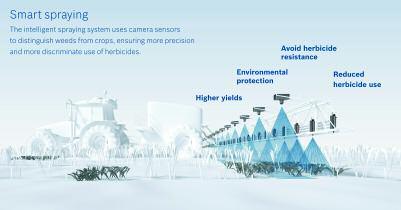
Smart spraying techniques are set to revolutionise herbicide application. Will decision-support platforms do the same for fungicides? (Picture:Bosch)
4 crop production magazine januar y 2020
Technical Triazoles
Last month marked the official launch of Revystar XE – a fungicide containing a shiny new azole,Revysol, and BASF’s flagship SDHI, Xemium. CPM takes a look at the evolution of fungicide insensitivity that the new chemistry will play a part in managing.
By Lucy de la Pasture
The last new azole to hit the UK market was prothioconazole in 2005 but the fungicide development team at BASF have just written a new chapter to a book that most people thought was finished. Prof John Lucas of Rothamsted Research describes the discovery as ‘courageous and an important addition to the fungicide portfolio for a number of reasons.’

“The first cereal azole, triadimefon (Bayleton) was introduced into the UK in 1976, more than forty years ago, and there were subsequent generations of azoles which arrived throughout the seventies, eighties and early nineties,” he explains.
Tebuconazole, epoxiconazole and metconazole were in this last wave of chemistry and brought a marked improvement in disease control over the azoles that had gone before them. The arrival of a new group of chemistry, the Qols (strobilurins), seemed to outclass the
A star is born
performance of the azoles and the development race effectively stopped.
Fast forward a decade and septoria (Zymoseptoria tritici) populations in the UK and Ireland were starting to show a notable increase in the frequency of isolates with reduced sensitivity to azoles and the strobilurins had failed altogether This was the backdrop to the launch of a new azole prothioconazole from Bayer.
“Prothioconazole was a big step forward, not just because of its efficacy on septoria, but for the other diseases it had activity on, such as eyespot,” highlights John. “It also proved that you can find new and desirable properties in a well-explored area of chemistry, and that azoles still had much to offer,” he comments.
New generation
“The arrival of a new generation of SDHI fungicides for use in cereals a few years later meant few people expected further new fungicides to emerge from the azole class of chemistry.”

John describes the azoles as ‘a remarkable group of chemistry’ which has provided a multitude of fungicides for use in agriculture, where the target site is the fungal sterol-14 -demethylase enzyme, commonly known as CYP51. But azole molecules have been equally as effective as human medicines and, ironically, it’s their success in both of these fields that has led to the gradual removal of many azole fungicides from the market.
In humans, azoles can be used for the treatment of oestrogen-dependent diseases, such as in breast cancer therapy Whereas the inhibition of CYP19 (aromatase) is the
John Lucas explains that resistance to azoles has developed relatively slowly and doesn’t seem to impact all compounds equally.
working principle for tumour therapy, it’s an unwanted side effect of azoles used as fungicides or antifungal drugs and it’s this possibility ‘dual-activity’ that led to the concerns over endocrine disruption (ED) when the EU moved to a hazard-based system for the registration of agrochemicals.
With epoxiconazole under risk from the ED criteria, BASF set out to screen azole molecules to find one that didn’t act on CYP19 so wouldn’t have any endocrine disrupting risk. And as a result, the UK now has the first new azole to gain registration as a fungicide for 15 years and it has come at a very interesting time in terms of fungicide resistance management.
“The textbook says that once a fungicide class has been compromised by the development of resistance, all compounds in that class will most likely be affected. We now know that this is an over- ▲
5 crop production magazine januar y 2020 ” “
A remarkable group of chemistry.
simplification, and the azoles are a prime example,” explains John.
“By comparison with other single-site inhibitors, like the MBCs and QoIs, resistance to azoles has developed relatively slowly, and even when present, it doesn’t seem to impact all compounds equally.
“CYP51 has turned out to be not only an excellent target to inhibit, but also a highly conserved protein with tight constraints on what mutations are tolerated. Over the years we’ve seen gradual erosion of efficacy in pathogens like Z. tritici as CYP51 has changed over time in response to selection by fungicides and other resistance mechanisms accumulate, such as efflux where the azole is pumped out of the cell before it can affect the target site ––and over-expression, where the increase in the amount of CYP51 means more fungicide is needed to inhibit it. But no complete breakdown in efficacy has occurred.”
Possible plateau
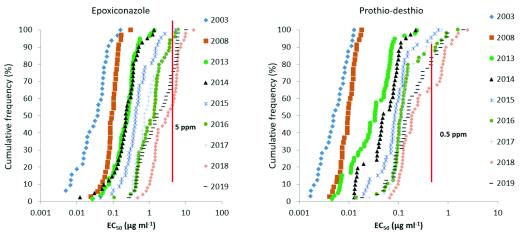
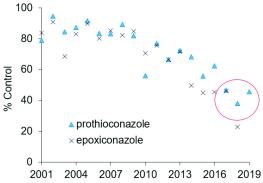
ADAS principal research scientist, Jonathan Blake presented AHDB’s fungicide performance data at its Agronomist Conference which took place last month. He believes that the results indicate that we’ve now reached the point where there’s been little further evolution in the septoria population, according to the results of Rothamsted Research early season monitoring in 2019, with a possible plateau in the ‘older’ azole activity now reached.
In the wider context, BASF monitoring across Europe has detected a clear and continued shift in the sensitivity of the septoria population to prothioconazole. Dr Rosie Bryson, BASF’s senior principal scientist, explains that dry seasons, such as 2017, seem to trigger a bigger shift in sensitivity the following year, possibly because more of the ‘fitter’ pathogens

survive the adverse conditions.
“Up until now, over 60% of the fungicides applied to the wheat crop across Europe have contained either prothioconazole or epoxiconazole. We’ve identified crossresistance between the two azoles, mostly this is found in Ireland and the UK because the weather conditions favour septoria development, putting the septoria population under higher selection pressure because of fungicides needed to control epidemics.”
Rosie explains that when talking about insensitivity to azoles it’s mutations at their target site, CYP51, in the septoria pathogen that are most often referred to. In the field the reality is that the situation is very much more complicated.
“Each septoria isolate with insensitivity to an azole has a complex of CYP51 mutations, with nine main haplotypes representing 85% of the European population.
“Each mutation effectively changes the shape of the target site which makes it more
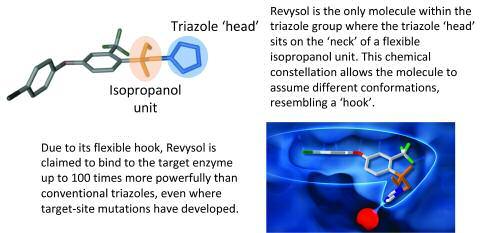
explains that the new molecule belongs to a new class of azoles and is an isopropanol. The isopropanol “linker” on which the azole is attached gives Revysol’s chemical structure a shape that’s different to all the other azole molecules and a unique ability to change spatially.
“In the Revysol molecule, the triazole ring sits on the ‘neck’ of a flexible isopropanol unit. This unique chemical constellation allows the molecule to assume different conformations easily ––bound and unbound.”
When Revysol ‘docks’ on to CYP51, it switches from the unbound to the bound form (which resembles a ‘hook’) and binds to the target enzyme up to 100 times more powerfully than conventional azole fungicides. It’s this ability to adapt and be flexible that makes Revysol capable of coping with the small changes in shape at the CYP51 target site caused by mutations.
“Its flexibility means it’s able to adapt its
Rothamsted Research early season monitoring, 2019
difficult for the fungicide molecule to bind, meaning it can’t as effectively inhibit the CYP51 enzyme. Even with complex haplotypes, such as G1 which has seven mutations, some of them will have a smaller effect than others, but generally the more complex they are then the less sensitive the septoria isolate is to fungicides,” explains Rosie.
This high level of background insensitivity in the septoria population makes it a challenging time to launch a new azole fungicide. “When epoxiconazole was released the septoria population was still sensitive and 15 years ago when prothioconazole came along, the population had probably begun to shift but was very different than the make-up of the population today,” she says.
It begs the question, what makes Revysol (mefentriflucanazole) different? Rosie
Source:AHDB,2019.
Azole efficacy on Zymoseptoria tritici (2001–19)
Protectant activity at full rate.
Source: AHDB,2019.
6 crop production magazine january 2020
▲
Rosie Bryson explains that the flexibility of the Revysol molecule means it can adapt its shape to bind with CYP51,even where the most complex target site mutations have developed.
shape to bind with CYP51 even where the most complex target site mutations have developed,” explains Rosie.
As a result, Revysol has consistently been performing at a level above the current best-performing azole, prothioconazole, in field trials and is obtaining a similar level of septoria control to that expected from the ‘newer’ azoles when they first came on to the market, before insensitivity evolved.
“In glasshouse work we’ve found Revysol can control all of the septoria haplotypes currently found across Europe,” adds Rosie.
Asked whether this strong level of performance can be expected to continue, Rosie says she’d love to be able to give a definitive answer to the question. The truth is no-one knows what will happen and John believes Revysol is highly unlikely to escape the evolution of some sort of resistance within some pathogen populations.
Another mode of action
However, both scientists agree that the industry is far better informed in recent years and have learned lessons from the active ingredients that have succumbed to fungicide resistance. One of those is to protect it with another mode of action with similar efficacy and this is why Revystar XE contains the SDHI, Xemium (fluxapyroxad), deemed essential for sustainable resistance management.
Even though SDHIs have seen some erosion in efficacy over the past three seasons, they’re still giving good levels of performance in the field. Rosie believes it’s likely their activity will slowly erode further in time, but in 2019 there appeared to be a much smaller shift than happened from 2017 to 2018.
“There’s a wide perception in the field that SDHIs didn’t work as well in 2019, compared with 2018, but what’s actually happened is that the effect of the shift in sensitivity that happened in 2017 wasn’t really noticed in 2018 because it was so dry, and consequently the disease pressure was low.
“BASF insensitivity testing across Europe shows there’s been no statistical change in sensitivity from 2017–2019 across Europe but it identifies a higher level of variability, with the greatest range of mutations present in the UK and Ireland and declining in an eastward direction across the continent,” explains Rosie.
Since the first changes in septoria sensitivity to the SDHIs, detected in 2016, the evolution has been characterised by a series of target site mutations giving partial levels of resistance and a slow decline in efficacy rather than the step-change in

activity that happened with the Qols in 2003.
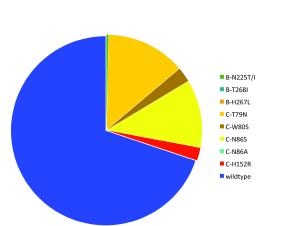
“In monitoring, we’ve found the two most dominant mutations are C-T79N and C-N86S, both are moderately adapted. The severe C-H152R mutation has only ever been found to be present at very low levels in the spring so it does seem to have a fitness penalty which means it doesn’t overwinter well,” she explains.
The azole and SDHI components of Revystar have been balanced to produce a fungicide which can perform at a level greater than could be expected from the sum of its parts, adds Jonathan. He’s conducted Matrix trials at ADAS which explore the dose rates of each active ingredient alone and in mixture to identify whether there are any antagonisms or synergies between them.
“Using some complex mathematics, it’s possible to compare the observed performance of Revystar against its predicted performance. It’s a very tough test and very unusual to find a fungicide
remember Revystar will only take us back to where we were in terms of fungicide efficacy,” he says.
Integrated pest management will also play a crucial part in Revystar stewardship, says Rosie, with the adoption of more septoria resistant varieties central to an overall resistance management strategy.
“It’s going to be just as important to try and hit the right timings in the field, even though Revystar has good curative activity, and to dose appropriately by matching the dose to variety susceptibility and disease pressure,” she advises.
John agrees selecting varieties with more durable resistance and both smarter for mulation and use of chemistry are impor tant tools to slow the development of fungicide resistance. He’s witnessed many classes of fungicide come and go over the years and war ns, “the behavior of the microbial world won’t change, even after Brexit!” ■
that gives a better than predicted performance,” explains Jonathan.
“In 2018 we found Revystar performance almost perfectly fitted the line of prediction and in 2019, it exceeded it. That indicates there is a possible synergy between Revysol and Xemium, and Revystar may perform as well, or better than you’d expect from the sum of its parts,” he says.
Although the arrival of Revystar is undoubtedly an exciting development and will provide a much-needed option in a fungicide market where active ingredients are being lost at an alarming rate, it’s impor tant not to underestimate the impor tance of stewardship in preserving its activity, believes John.
“We’re not going to get out of an evolutionar y ar ms race with the septoria pathogen, but we are getting smarter about co-for mulation, as Revystar demonstrates. We also have to be smart about how we use chemistry and
BASF pathotype monitoring in UK, spring 2019
UK early season monitoring,n=44 (up to end of April)
Source:BASF,2019.
Triazoles 7 crop production magazine january 2020
The nine main Zymoseptoria tritici haplotypes
The table shows the nine most common Zymoseptoria tritici haplotypes found in the European population and the CYP51 mutations associated with them. Source:Huf et al.,2019.
Mission Impossible? Technical Innovation Insight
When the decision was made by BASF to bring a new triazole fungicide to market, an entirely new approach was needed to ensure it passed through the EU’s difficult approvals process.
By Tom Allen-Stevens
They say necessity is the mother of innovation and you could argue it’s never been more necessary to bring new fungicide chemistry to growers. But perhaps the true innovation behind Revysol,the first new azole to reach the UK market for 15 years,has been the approach BASF has taken in the face of the tough EU regulatory regime.

“With Revysol we put the cart before the horse,” notes UK and Ireland head of technical management Rob Gladwin.
“The EU’s aversion to conventional crop protection is a major challenge for the industry, growers and eventually for consumers.
“For the azoles there is the backdrop of concerns over endocrine disruption, so we
addressed this head on ––right from the start, our research teams looked not just to target enzymes in the fungal pathogens, but also specifically for chemistry that does not harm mammals.”
But it’s not just Revysol’s regulatory profile that’s of note, according to Dr Martin Semar, senior principal scientist with BASF and one of the first to test it in the field. “To have an active that’s so effective against so many diseases in so many crops, that’s really rare,” he says.
Great uncertainty
The quest for new chemistry started around eight to ten years ago, Rob recalls. “The decision was made to look for a new azole. The efficacy of current chemistry was shifting and there was great uncertainty over whether the majority of the existing azoles in the market place would get through the very difficult EU approval renewal process. BASF has always understood the need for the precautionary principle, but we feel it’s been abused ––to succeed it’s not just about getting the science right, but also the politics.”
So in a new molecule, there were two key features the BASF research teams were tasked with finding ––the right selectivity and also a favourable regulatory profile. “The difficulty is that the target enzymes in fungal pathogens are closely related to
those found in mammals,” notes Rob.
The breakthrough came with the development by the biochemistry team of new enzyme assays. Dr Ian Craig, a computational chemist, joined the team in 2011. “The assays test the efficacy with which the DMI chemistry, which includes azoles, inhibit the fungal target site, CYP51 –– blocking this enzyme prevents a fungal cell from producing ergosterol causing it to
Right from the start,research teams looked specifically for chemistry that does not harm mammals, recalls Rob Gladwin.
8 crop production magazine januar y 2020
CPM tells the story.
“
With Revysol we put the cart before the horse. ”
What is the ‘hook’?
die,” he explains.
With the new assays the team could quickly screen a large number of molecules in their quest for those that were highly effective. What was entirely new, however, was the screening programme running alongside this. “In tandem, the team set up similar assays to test the chemistry for its effect on CYP19. This enzyme target site is found in mammals and is associated with unwanted side effects.”
The team screened hundreds of compounds and received very quick feedback, not just on how effective they were, but also how safe. And this is where Ian’s specialism comes in, but what does a computational chemist do?
“I work closely with the chemistry teams and use algorithms to effect different simulations of how a molecule would bind to a target site and inhibit an enzyme,” he explains. “It’s a branch of chemistry that’s
been in use for some time, but the technology we employ today is highly advanced. The 3-D models we produce help chemists prioritise and then narrow down the molecules they want to investigate and develop.”
Together, the team discovered a unique property of an entirely new family of triazoles ––this molecule has a ‘hook’. “It’s an isopropanol linker. This moiety is a small part of the larger molecule and it’s unique for a DMI. We synthesised it and noticed very strong fungicidal effects.”
Ian’s simulations showed the ‘hook’ allows the molecule to bind very tightly to the target site. “What’s unique is that it’s flexible ––it not only fits perfectly into the CYP51 binding site but it also has the flexibility to adapt if this binding site changes, unlike other azoles. We think that helps with the control of septoria isolates that have evolved mutations,” he notes.
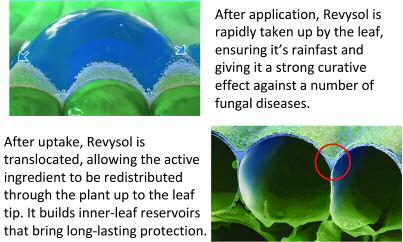
Revysol’s mobility and durability
Source: BASF, 2019
Martin Semar says it’s very rare to have an active that’s so effective against so many diseases in so many crops.

For Ian, both the discovery of this molecule with its unique properties as well as the journey to find it represent the big achievements behind Revysol. “DMIs have a mode of action which is inherently interesting. But the approach we took has taken our work in a new direction and has become the standard way we start the process of new active ingredient development,” he notes.
“We do everything we can to put forward the right molecules into our development pipeline so we don’t have problems later, but we see so many that fail. It makes it all the more rewarding when you find one that succeeds.”
But so far, the new molecule had only got as far as the lab. How would Revysol perform in the field? Martin put it to the test against a broad range of key diseases across globally important commercial crops. “When we saw how highly active it was across such a wide spectrum of situations, we realised this was the one to take forward,” he says.
Shifted strains
“It’s not only the high activity on major diseases such as Septoria tritici ––it’s not so difficult to find this. It’s also the selectivity ––having the ability to use it across a large number of commercial crops in many different countries. What we also noticed was that Revysol was effective on shifted septoria strains. It’s the combination of these factors that made it a potential blockbuster.”
After the first initial and promising results, the team extended the testing program, broadening it to more crops and diseases, first in the greenhouse then on a few research stations and then globally under various conditions.
The regulatory studies of new active substances also continued in parallel with the efficacy work. “The development of Revysol heralded this new focus in our R&D activities, targeted on the regulatory profile, which now start at a much earlier stage and
9 crop production magazine januar y 2020
▲
Innovation Insight
Source:BASF,2019
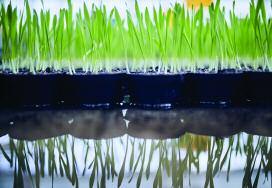
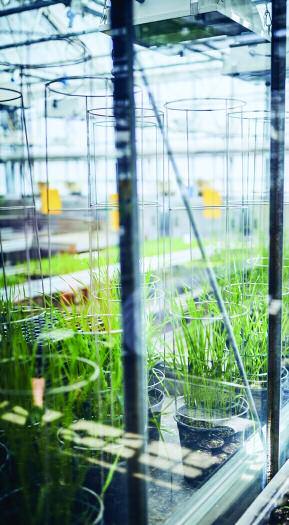
Tests in the BASF lab and the glasshouse at Limburgerhof confirmed how highly active Revysol was across a wide spectrum of situations.
in far greater detail,” explains Martin.
“This is different to the studies we carried out in the past where biological optimisation had the higher priority All told, it was a long and expensive process, but we built up a complete picture of both Revysol’s biological efficacy and its regulatory profile.”
The final piece of the jigsaw was to make the molecule mobile within the plant and ensure the product’s stability Dr Christian Sowa is a formulation chemist with BASF. “The first thing you do with a new molecule is to get to know its structure and its solubility profile. That can be a particular challenge with DMIs as they tend to crystallise, so we use an emulsifiable concentrate (EC) to deliver the right results,” he explains.

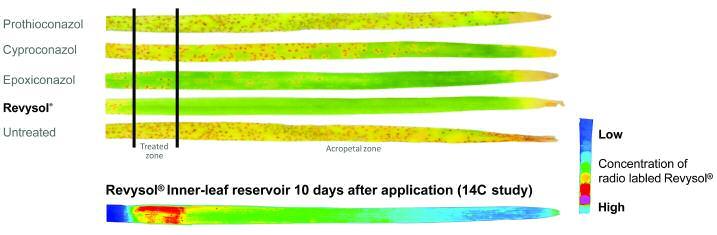
“But one property we noticed about Revysol is that it has very poor solubility, so there’s a lack of suitable solvents. That leads you towards complex solvent mixtures, which have their drawbacks in terms of how they may interact in the can or in the sprayer The upside is that once in the leaf, the low solubility helps ––Revysol forms an inner leaf reservoir which slowly moves
through the leaf, ensuring long-lasting protection.”
Formulation chemistry has moved on apace since the last azole came to market, however. A new aspect in this field again is computational chemistry, which is often brought in to tailor formulations and model different scenarios. “You have to know how it will behave when the product’s scaled up ––you don’t want any surprises when it’s already in use by thousands of farmers.”
Revysol’s broad range of uses was a further challenge ––it’s available in no fewer than 30 different formulations to cater for the different countries and crops in which it’ll be used. There’s also the interaction with Xemium once formulated as Revystar XE. “Xemium has different properties ––it creates crystal depots on the leaf surface, and the crystals can form in the can if you have the wrong formulation,” notes Christian.
Revysol passed through a gradual process of refining, assessing and addressing questions raised. “Some tests take many months until you have a result, which may be a nice outcome, but raise ten more queries. But what we try to ensure is a formulation that is flawless and performs invisibly ––success is when the farmer doesn’t even notice it,” he says.
It’s also a key requirement that the delivery to the target is optimised, and it was Dr Marcel Patrik Kienle who ensured this was the case. “What we do is test what happens in the field through lab experiments. We look at how much stays on the leaf, how quickly it’s taken up following application and its movement to the leaf tip,” he explains. “Revysol is barely soluble in water, so not that mobile.”
Environmental influences
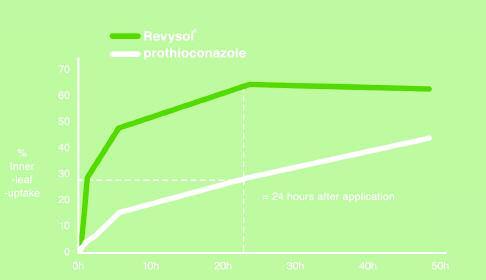
So how quickly is it taken up into the leaf? “We found up to 65% of the applied active ingredient got into the leaf within one day, most of this within just six hours. This is important as, once inside the leaf, the active is protected from environmental influences like rainfall or UV-light,” notes Marcel.
“There’s also a remarkably high uptake in cold conditions ––20% is taken up in the first six hours, which compares with a standard formulation where you’d expect nearer 5%.”
Droplets were placed on the leaf between the stem and the leaf tip to assess how quickly Revysol moves through the plant. “You’re looking for a good, even distribution and don’t want it to move too quickly because that can cause phytotoxicity and you get scorch. Equally you’re looking for longevity, so that its strong curative action lasts. We found 10% of the active made its
way from the application area into the direction of the leaf tip within a week.”
Numerous small-plot trials (see article on p14) and on-farm field-scale evaluations (see article on p17) have now demonstrated the properties of Revysol. “But what’s taken the industry by surprise is the speed with which it’s passed the EU regulatory hurdles,” says Rob.
“With Revysol we had the quickest process from submission for active substance approval to registration of the first formulation. BASF developed Revysol by optimising exceptional biological efficacy and an outstanding regulatory profile.”
The registration was also designed to be Brexit proof ––applications for Revysol were submitted both through the EU and separately to UK’s Chemical Regulation Directive (CRD), in case the UK had left the EU before approval was granted.
“We’ll be following the same procedure with future product approvals to ensure UK growers always get access to the best chemistry available,” Rob assures. “But approval for Revysol is really good news for global agriculture as well and a stunning endorsement of our R&D and regulatory teams.
“By proactively addressing all of the concerns of the toughest approvals system on the planet, we’ve put a truly innovative product in the hands of growers that will allow them to progress cropping systems around the world.” ■
One property the formulation chemists noticed about Revysol is that it has very poor solubility.
▲ 10 crop production magazine januar y 2020 Innovation Insight
Marcel Patrik Kienle found up to 65% of the applied active ingredient got into the leaf within one day, most of this within just six hours.
Technical Research Briefing
Revysol has a chemistry that gives it many useful properties in the field. CPM finds out how this may translate into more spraying opportunities and reliable performance.
 By Lucy de la Pasture
When the team from BASF reviewed the results from the first trials of Revysol (mefentrifluconazole),even they were surprised, according to Dieter Strobel, responsible for the company’s technical market development for cereal fungicides in Europe
“We saw Revysol was giving stunning efficacy, even better than we’d expected and far superior to other chemistry. The advantage it was showing grew over time due to the continued erosion of efficacy in the older azoles,” he comments.
“In high disease pressure situations, the strength of Revysol was particularly noticeable. Where conventional products were struggling, it continued to provide control of septoria.”
In total more than 1,000 field trials were carried out using Revysol throughout Europe and by summarizing all the data BASF were able to link aspects of its performance directly to some of the new azole’s chemical properties and its clever formulation.
“Revysol has very low solubility, so it was a real challenge to our chemists to formulate a product that would be easily taken up by
Chemistry
A revylation in the field?
plants. They found a way to formulate Revysol in a way that makes it available as free molecules and not crystals in an emulsifiable concentrate (EC),” he explains.
The work of the formulation chemists means Revysol is taken up very quickly by plants, which is an essential property for an azole fungicide to be effective.
“Quick uptake makes an azole effective, but we learned from our experience with epoxiconazole that it can also mean that its longevity of performance may be limited. In trials, Revysol clearly had a longer-lasting efficacy than either epoxiconazole or prothioconazole, which was surprising. We’d expected its quick uptake to mean Revysol would have a short duration in the plant, but this isn’t the case,” explains Dieter.
Formulation wizardry
He explains the unexpectedly long duration of Revysol’s action as being down to the solubility of the molecule. It’s made ‘artificially’ soluble using formulation wizardry to get quick uptake into the plant, but once inside the leaf it reverts to its normal insoluble state.
“It’s so insoluble that only a few Revysol molecules at a time can make it to the end of the leaf. In other words, it has a low but consistent level of translocation in the leaf.”
Rather than being a disadvantage, the high intrinsic efficacy of Revysol means that traces in the leaf are enough to control the septoria pathogen. The advantage of its slow rate of movement is that once the Revysol has got into the leaf, which happens quickly, it remains as a rich inner-leaf reservoir to constantly release low levels of active substance towards the leaf tip.
So how does Revysol’s quick uptake but slow translocation translate into properties that are of benefit in a field situation?
“Its rapid rainfastness, just 15 minutes, can be explained by Revysol’s fast uptake. When leaf wetting occurs, the chemistry is already protected within the leaf so it can’t be washed off,” explains Dieter.

The same dynamic properties of Revysol also make the fungicide very stable to UV light, which is known to influence the performance of some other azoles.
“We’ve experienced some hot summers in recent years, and prothioconazole gave a relatively poor performance in the field where high UV conditions occurred, which can be linked to UV-degradation of the fungicide. Revysol is held within the leaf so is protected from UV light,” he explains.
A further benefit of Revysol’s chemistry is that its quick uptake means it isn’t influenced by temperature in the same way as conventional azoles, where cool weather ▲
Dieter Strobel explains that Revysol’s quick uptake means it isn’t influenced by temperature in the same way as conventional azoles, where cool weather can limit uptake.
that will bring control back to the grower.
11 crop production magazine januar y 2020 ” “
Systemic biotest wheat
Application at basal zone,inoculation of whole leaf with brown rust 21 days after application.
Source:BASF,2019.
can limit uptake. “All of these characteristics ––rainfastness, UV stability and temperature independence ––all mean more opportunities to go spraying without concerns about reductions in efficacy.”
Benefits finder
BASF has developed a ‘Benefits Finder’ app. which helps illustrate how much the spray window can be ‘stretched’ when using the new chemistry. Dieter gives an example where over the period of a week, the rainfall amounts meant six days were possible spray days (threshold: 5mm/day). Of these only three were optimum for the application of conventional products, while Revysol would perform on all six days ––even when the temperature dipped below 13oC and there was rainfall forecast.
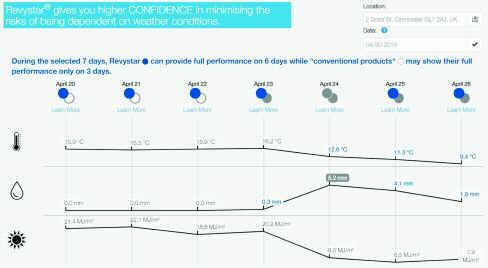
Steve Dennis, BASF head of business development in the UK, says the effects of climate change mean we’re experiencing much more variable weather patterns in the
Leaf uptake
More spray days
UK, with an increasing tendency to get ‘stuck’ within prolonged periods of wet or dry conditions.
“Adding to the difficulties is that septoria is becoming more adapted to our current chemistry. The combination of the loss of curativity from azoles and disruptive weather means it’s becoming harder to get fungicide
The properties of Revystar XE in the field mean more spray days.
Source:BASF Benefits Finder app,2019.
timings right,” he says.
Steve sees Revysol as “chemistry that will bring control back to the grower.” While he emphasises the importance of correct fungicide timings in providing optimum protection to the leaves of the upper canopy, the properties of Revysol mean that it doesn’t matter as much if the weather does intervene.
“Weather is unpredictable, especially in the UK, and fungicide application is all about the weather. Revysol means there’s less need to predict, which takes some of the worry out of application.”
In 2019, heavy rain fell across the UK and Ireland in June, a couple of weeks after flag leaf sprays had been applied, and septoria “went mad”. It was a disease situation that would have been a lot worse if chlorothalonil
Revysol leaf uptake in one day equals the amount of prothioconazole taken up in a day
Source:BASF,2019.
12 crop production magazine januar y 2020 Research Briefing
▲
Using Revystar XE will take some of the worries away when making spraying decisions, says Steve Dennis.
(CTL) hadn’t been widely used, believes Steve.
“CTL is a long-term, effective protectant fungicide and has given flexibility if following timings haven’t been quite right, so it hid the effects of less than optimum fungicide inputs. In a world without CTL, we’re going to have to be a lot more on our toes,” he comments.
Revystar XE (mefentrifluconazole+ fluxapyroxad) will bring much-needed flexibility and curativity and the BASF
The Irish experience
Dr Steven Kildea has been keeping a keen eye on Revysol in trials at Teagasc’s Crops Research Centre at Oak Park in Carlow. Septoria pressure is at its highest on the Emerald Isle,which marks the westerly horizon of wheat growing in Europe. It was Ireland where the first slip in SDHI activity was experienced, with the UK following close behind.Since then,it’s CTL that has been supporting fungicide chemistry and may be partially responsible for stabilising the situation, he believes,with little further erosion of SDHI activity seen since 2017.
“New chemistry is very welcome and in trials, we’re seeing Revysol moving the yield contribution from the azoles back up to where they used to be,” he says.
Disease development is so strong in Ireland that fungicide programmes need the most highly active ingredients throughout the programme,with as much emphasis on the T1 timing as at the T2. Diversity is the key to resistance management as it allows growers to potentially reduce the dose used or the number of times individual actives are actually applied,so Steven is keen to include different chemistry in fungicide programmes.
“We have the opportunity to use fungicides better,having learned from our past experiences. The septoria pathogen will most likely evolve in
recommendation is for a programmed approach at T1 and T2 timings, says Steve, though he accepts that in many situations it will be used just once, at T1 or T2.
“The evidence for using Revystar at T1 is strong and if there’s a wet period, then it really is the product of choice,” he believes.
The full label rate for Revystar is 1.5 l/ha, but agronomists will use their discretion to dose appropriately according to disease pressure and varietal resistance, he adds. “Revystar at 1.0 l/ha offers a great performance and value compromise, but higher rates may be necessary in some circumstances. There may also be situations at T1 where 0.8 l/ha will be suitable but at T2, I don’t advise using at rates below 1.0 l/ha,” he says.
Apical translocation
Steve says the very slow apical translocation of Revysol means it has a very good crop safety profile, avoiding some of the scorch effects seen with faster moving fungicides. Revystar will also offer good control of brown rust, where its performance is equivalent to market standards, says Steve. “For yellow rust control, the addition of a strobilurin will be beneficial. In terms of mildew and eyespot control, Revystar’s
performance is equal to prothioconazole.”
The demise of CTL will leave one of the biggest holes in programmes to control ramularia, where it has become the mainstay since instances of resistance have been reported to single-site chemistry, including azoles, strobilurins and SDHIs.
“We’re seeing Revysol maintain its performance against azole-resistant strains of ramularia compared with prothioconazole. It’s a disease that develops in response to stress so it’s important to manage crop stress as well, part of which is good early season disease control.” ■
response to selection pressure and we’re not starting with a native population of septoria.It’s the pathogen’s ability to accumulate mutations that poses the biggest threat to Revysol.
“We’ll need to be very careful about how we protect this new chemistry,otherwise we won’t get the same amount of time we’d had with the other azoles before their performance was eroded.”
Part of that process will be careful agronomic choices, which make a big contribution to disease control,he says.“It comes down to local decisions– matching the rate of fungicide applied to disease pressure will reflect the season and agronomic factors,such as varietal resistance and planting date.”

“Under Irish conditions we need ver y high cultivar resistance before you can reduce the rate of fungicide without affecting yield.We still see yield responses to fungicides in cultivars with septoria resistance ratings in the high 7s.”
Ramularia is a disease that poses one of the biggest problems with the imminent withdrawal of CTL. Teasgasc has conducted trials to assess the contribution of different actives to its control in both winter and spring barley at the T2 timing.
“As we anticipated, CTL gave the best control of ramularia.We found the performance of SDHI
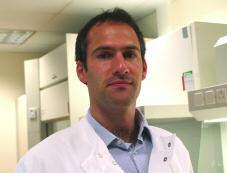
Steve Kildea believes we have the opportunity to use fungicides better,having learned from our past experiences.
applied at full-rates to be disappointing,so resistance has had a significant impact on their efficacy.Proline (prothioconazole) has also been significantly impacted but it gave better control than we’d anticipated and above that of the alternative multisites,folpet and mancozeb.
“Revysol gave decent control of ramularia in the trial, offering a level between CTL and Proline,so it will help take the pressure off prothioconazole. Whilst the loss of CTL will clearly be felt, we will be able to manage ramularia.The crop won’t be completely clean but that’s not necessary,as long as grain numbers and fill is protected enough to maximise yield potential.”
Research Briefing 13 crop production magazine januar y 2020
The high intrinsic efficacy of Revysol means that traces in the leaf are enough to control the septoria pathogen.
Rising to the septoria challenge

Technical Research Briefing
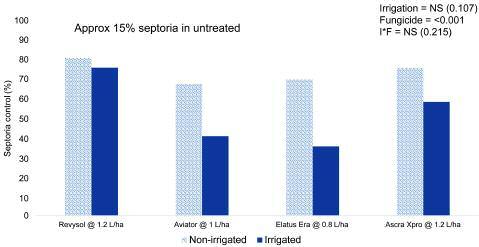
for each fungicide in the irrigated and unirrigated plots and found that Revysol was the most rainfast, with only a very small reduction in control when it was irrigated 15 mins after application.”
Revysol is also believed to have good curative activity and to assess whether this is truly the case, Julie set up a field experiment to compare it with other azoles. The field plots were inoculated with field isolates of Zymoseptoria tritici on 17 May 2019 and fungicide applications were made at either one, five, 10 or 15-day intervals after inoculation, followed by disease assessments at GS65 and GS73.
 By
de
By
de
The unique chemistry of Revysol (mefentrifluconazole) gives the new azole some key attributes that should translate into superior performance in the field. Tasked with finding out whether it would live up to expectation,ADAS senior research scientist Dr Julie Smith set out to test Revysol’s capabilities.
“There are five main attributes that BASF believe Revysol has because of its chemistry. These are superior rainfastness and rapid uptake of the fungicide, contributing to strong curative activity; long lasting performance in the field; maintenance of efficacy under high disease pressure; effectiveness against DMI-adapted (insensitive) strains of septoria; and a benefit on resistant varieties,” explains Julie.
To put Revysol through its paces she designed a series of field trials using it as a straight rather than the co-formulated product, Revystar XE (mefentriflucoazole+ fluxapyroxad).
“To look at Revysol’s rainfastness, we set up a trial where we were able to irrigate overhead the plots and compare the performance of different fungicides, with and without a period of ‘rainfall’ after application.” she explains (see chart right).
“We allowed disease to develop then assessed septoria levels on the flag leaf
“The results show septoria control from Revysol was consistently highest of all treatments, for all application dates, on both leaf one and leaf two,” she says.
Julie highlights that Revysol is providing more than 80% control of septoria in a shifted population, even when it’s applied a week after infection.
“On leaf three, there’s also evidence of strong curative activity. Revysol has more than twice the efficacy of the older azoles for all fungicide applications over the 12-day period after leaf two was inoculated,”
she adds.
“In practical terms this means that you would get the same level of control from Revysol applied 14 days after infection as you would with a well-timed prothioconazole application.”
Given the slide in efficacy of the current azoles, the ability Revysol has to control insensitive strains of septoria is of key interest to growers and agronomists, highlights Julie.
“We looked at Revysol’s ability to control DMI-adapted (azole insensitive) strains of septoria by setting up a trial with a number of different inoculation treatments. We included a control where we allowed septoria to develop from natural field infestation. For the other treatments, increasing septoria pressure was achieved by inoculating with local field isolates (Hereford), applied when the flag leaf was fully expanded, at either 1M spores/ml (106), 10M spores/ml (107) or 100M spores/ml (108), and DMI-adapted septoria was applied at 10M spores/ml.
“To put these treatments into perspective, the pressure exerted by the 10M spores/ml level of inoculation is extreme and 100M spores/ml is akin to a nuclear strike to the
The efficacy data needed for product registration doesn’t necessarily answer all the questions about the performance of a new active ingredient. CPM gets an insight on a series of trials which set out to test the boundaries of Revysol.
Lucy
la Pasture
The pressure exerted by 100M septoria spores/ml is akin to a nuclear strike to the plant.” 14 crop production magazine januar y 2020
“
Septoria on the flag leaf
Source:ADAS,2019.
Performing as an azole used to
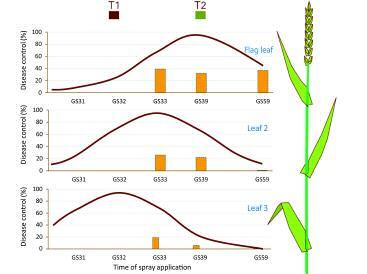
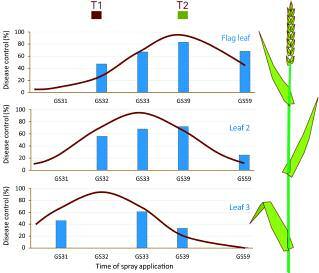
To investigate the long-lasting performance of Revysol,Julie set out to replicate some of the work that led to the basis of the spray timings we currently aim at to provide the best septoria control GS32 (to protect leaf three) and GS39 (to protect leaf one),with the combined timings protecting leaf two.
“We set up a ‘wave’ experiment on five sites over two seasons (2017-2018).This indicates the fungicide’s flexibility at different spray timings, providing the ‘spray window’,”she explains (see charts,below).
“The results show the decline in standard azole performance since the original work was done,with the levels of disease control from prothioconazole application falling well short of
the ‘curve’.For Revysol,the data shows its performance is pretty much what we’d have expected from an azole before their performance was eroded by the evolution of a less sensitive septoria pathogen population.”
While the level of disease on the main leaves that contribute to yield is a useful assessment, looking at the Healthy Area Duration (HAD) for each fungicide treatment provides a measure of both canopy size and its duration.This data can help explain yield effects,highlights Julie,and is also the most objective and unbiased way of assessing the performance of a product because it’s not just a snapshot in time.
Analysis of yield across all five sites demonstrated a yield response for the
Revysol treatments of just over 1t/ha above prothioconazole at GS39,maintaining an advantage of nearly 0.5t/ha even at the GS39 plus 15 days timing (see chart,bottom left).
“A cross-site analysis of HAD showed that Revysol treatment produced a much higher HAD than prothioconazole at all the treatment timings, which helps explain the higher yields in the Revysol treatments,”she explains.
The range of spray timings either side of the optimum timing at GS39 produces a bell-shaped curve for the yield data.“The shape of the Revysol curve shows there is a spray window either side of the optimum timing,further supporting the curative and protectant claims for the new azole,”adds Julie.
Source:ADAS,2019.
plant,” describes Julie.
Fungicides were applied five days postinoculation using Revysol (1.5 l/ha), Proline (0.72 l/ha), and compared with an untreated control. Septoria spores can germinate within
Yield,cross-site analysisfive sites 2017-2018
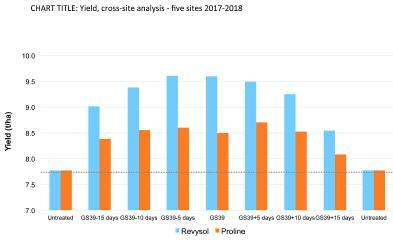
Source: ADAS, 2019.
12h of hitting the leaf surface so waiting for five days before applying the fungicides is a robust test, she reasons. The progress of septoria was monitored and Revysol demonstrated its ability to protect the crop
under all disease pressures, including the shifted strains (see chart, bottom right).
“I still gasp when I see 80% of a flag leaf covered with septoria but these are the disease levels that we achieved with some
Efficacy against DMI-adapted strains
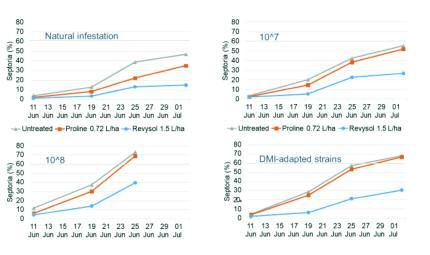
Source:ADAS,2019.
Source:ADAS,2019.
15 crop production magazine januar y 2020 Research Briefing
Revysol wave experiment
Prothioconazole wave experiment
▲
Research Briefing
One of the most difficult decisions to make in the field is the best approach to take at T1 and T2. To get more insight into this,Julie selected leaves with little or no disease visible when fungicide was applied.When sprayed at GS39 plus five days, septoria was visibly present on the flag leaves at a level <1% but DNA analysis of the septoria present inside the leaves painted a very different picture.
“The untreated had the highest amount of septoria DNA,as expected,and prothioconazole treated had significantly more septoria DNA than the Revysol-treated leaves.The level of septoria within leaves was tracked using DNA analysis on a weekly basis to monitor its progressions and even in the most curative treatment,GS39 plus 15 days,the control from Revysol was still good,” says Julie.
Additional data from Cura Crop research, carried out for BASF in 2017,supports the results of the ADAS work,says Steve Dennis,BASF’s head of business development in the UK.
“It’s not until cell death occurs that visual symptoms on the leaf become visible.So by the
time the pycnidia can be seen,the damage has already been done within the leaf itself,”he explains.
The aim of the Cura Crop research was to bust the myth that no visible infection means no disease,even in a lower disease year.
“Leaf two is generally out for some time without any fungicide protection,so for the Cura Crop work we asked growers for a visual assessment of septoria on leaf two just before the T2 timing and 60% of them thought their crops were free of disease.
“We collected leaves one and two,to represent the top of the plant,and leaves three and four which received a fungicide at T1.Latent disease levels could then be clearly detected by DNA analysis.At the T2 timing,the vast majority (75-90%) of lower leaves (L3 & L4) were infected and 50-65% of upper leaves (L1 & L2) were also infected.
“Even though it’s not intended to apply a T2 fungicide as a curative,in most cases there is latent septoria present in the upper leaves and infection on the lower leaves at the time of
investigated this by setting up a ‘domino’ experiment using a range of varieties at different ends of the resistance scale.
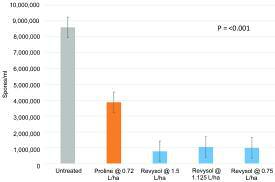
Spores produced after treatment
Source:ADAS,2019.
application,”he comments.
In the ADAS work Julie looked at the effect of Revysol on spore production.“We induced spore release and quantified the number of spores in untreated,prothioconazole and Revysol-treated plots.There were significantly fewer spores released where Revysol was applied,resulting in a lower inoculum load to initiate the next cycle of disease which will decrease the epidemic in the upper canopy,”she explains.
because doing so is likely to result in a more rapid breakdown of either.
“The levels of control from Revysol when under pressure from the DMI-adapted strains was good, so this work supports the claim that it will currently control insensitive strains,” she adds.
The adoption of more septoria-resistant varieties is part of an integrated approach to controlling the disease, but is there still a benefit from applying Revysol?
Julie and her colleague Chloe Morgan
Under a tsunami of disease
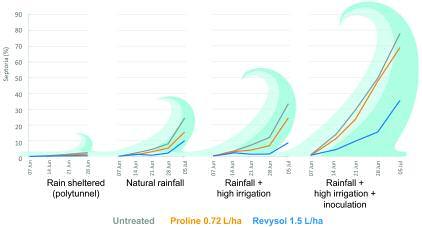
ADAS also looked at the efficacy of Revysol under differing disease pressures using a tsunami experiment at a site in Hereford,explains Julie.
“We wanted to set up different disease levels in a single randomised trial so we designed a series of treatments to manipulate disease pressure,ranging from very low septoria (<3%) to very high (>75%). Each level of disease was then subjected to fungicide treatment with either Proline or Revysol.” Rain-out shelters mimicked a dry season, while some plots were irrigated and some were inoculated,using a mixture of field isolates and insensitive strains.
“The results show an increasing separation in the performance of Revysol and prothioconazole as disease pressure increases,”she concludes.
“We established three disease pressures, which were natural infestation; natural plus inoculation with field isolates; and natural plus inoculation with DMI-adapted strains.
“We found that there was a benefit to applying Revysol irrespective of the wheat variety, although when it came to disease control and yield benefit, these were biggest in the more septoria susceptible variety,” she adds.
“The important thing is that we don’t rely solely on fungicides or varietal resistance,
Our programme of work validates the claims made by BASF about the efficacy of Revysol in the field. We tested Revysol using the most robust methodology available and were not able to break it,” notes Julie.
“Revysol consistently out-performed competitors irrespective of disease pressure, pathogen insensitivity or wheat variety Despite the tremendous challenges that we currently face, BASF have re-set the clock in terms of azole efficacy against septoria leaf blotch and that achievement should not be underestimated.” ■
Source:ADAS,2019.
The latent challenge 16 crop production magazine januar y 2020
Tsunami experiment,Hereford 2018
▲ of our inoculation treatments. But there’s very little difference between the control from prothioconazole and the untreated. Under the highest inoculated pressure most fungicide products would break but Revysol still performed,” she comments.
Real Results Pioneers
New chemistry reveals its potential
In the same year Kent grower Richard Budd achieved a barn-busting 7.2t/ha yield from oilseed rape,on-farm trials with Revystar XE suggest some careful tweaks may unlock similar potential in his wheat crop. CPM visits to find out.
By Tom Allen-Stevens
Considering his heavy Weald clay has received 60mm of rain in the past week alone, Richard Budd’s current crop of oilseed rape is looking remarkably spritely on ground that feels firm underfoot.
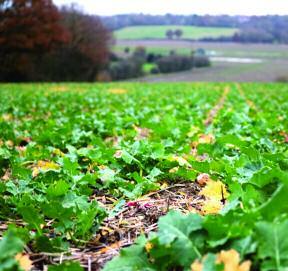
“We’ve only managed to get about 40% of our winter wheat drilled this year, but all 150ha of the OSR crop is up and away,” he reports. “It looks good, considering it’s received two thirds its annual rainfall in the last six weeks, but I don’t think we’ll get a repeat of last year’s crop.”
That would be quite an achievement, because Richard’s 2019 crop of Campus
yielded an eye-watering 7.19t/ha. It was by far the highest yielding crop entered in the Oilseed YEN (Yield Enhancement Network) and would probably have beaten the world record set in 2018 by Lincs grower Tim Lamyman (7.01t/ha) had it been officially entered and recorded.
But this bounty represents just one of the fascinating features of Stevens Farm, near Hawkhurst, Kent, that Richard farms with his father, David. Alongside 900ha of arable crops (winter wheat, OSR, barley, oats and beans with spring barley, beans and oats), there’s 125ha of top fruit and 75ha of permanent pasture let out on short-term agreements.
Fairly robust
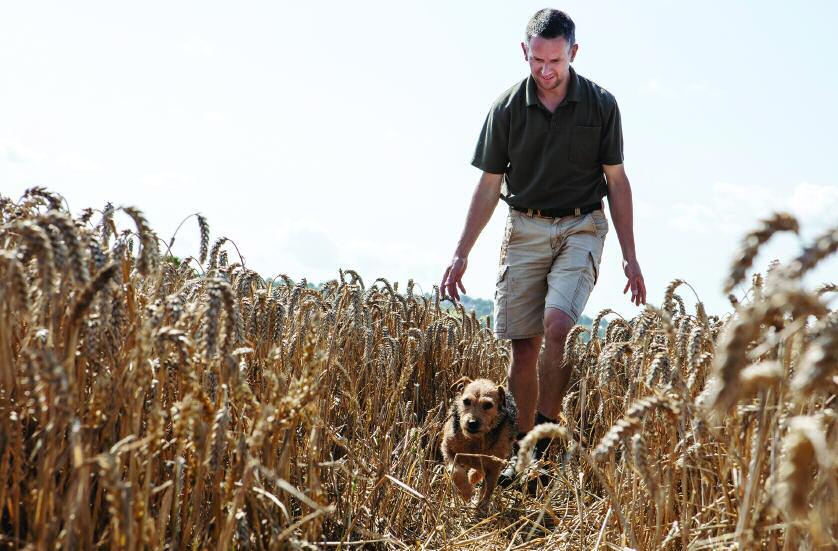
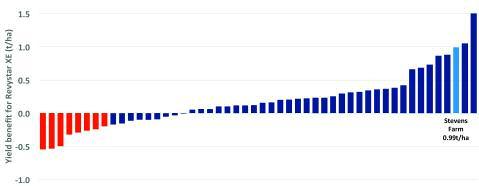
Within the 2019 wheat area was a field also entered into YEN, and within that field was a Real Results replicated tramline trial of BASF’s new fungicide Revystar XE (see panel on p18). While his farm standard fungicide programme yielded a fairly robust 13.89t/ha, the Revystar plots brought in 14.88t/ha –– a yield that would also put his wheat among the top YEN performers of the year
“For me, farming’s about optimising the inputs to get the best output –– that’s why we
The opportunity to use the new chemistry early and have the results assessed using ADAS’s Agronomics has given us a thorough insight into how it’s best used.
use YEN,” Richard explains. “The report gives you a good, detailed analysis of how your crop has performed which we use to test and improve how we grow our crops.
“It’s not all about growing the highestyielding crop, though –– we’re aiming for a yield that’s achievable and sustainable. So we’re not going to travel 20 miles to put on a micronutrient simply because YEN’s
The current crop of oilseed rape looks remarkably spritely,but is unlikely to yield the barn-busting 7.2t/ha achieved last year.
▲ 17 crop production magazine januar y 2020 ” “
Revystar XE trials provide 1t/ha extra yield and valuable insight
This is the third year Richard has been one of 50 growers taking part in BASF’s Real Results on-farm trials.Across a section of a wheat crop, this has compared the farm standard fungicide approach at the main two timings with the BASF recommended programme,usually based on Adexar and Librax.
“It’s been quite exciting to be involved this year,because we’ve used Revystar in place of the usual Ad/Lib programme,”notes Richard. “The opportunity to use the new chemistry early and to have the results assessed using ADAS’s Agronomics approach has given us a thorough insight into how it’s best used.”
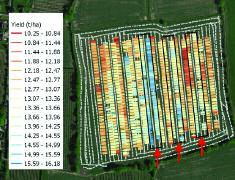
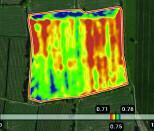
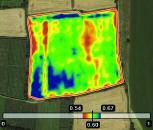
The trial was placed in the eastern part of the field,the area with the most consistent soil type.The BASF trial plots were interspersed with three tramlines that received the on-farm standard.NDVI (normalised difference vegetation index) maps were taken through the season and these were assessed by ADAS scientists, along with disease levels from samples taken in July The Agronomics approach was then used to compare the results, using spatial modelling and statistics to allow yield-map data from the combine to be assessed with scientific rigour
“Last year we had a dr y, mild winter and came into the spring with a good, well tillered crop,”reports Richard.“There was a lot of septoria on the lower leaves, but this didn’t develop and by May it was quite dr y,although there was no sign the crop was under stress. The rain that came in late May and early June was really quite timely and we beefed up the T3 spray application as a result.”
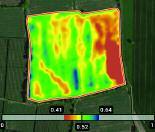
NDVI images (see below) showed the east side of the field as more even prior to T1,while ‘striping’ found in May and June was “fairly subtle”and not related to the treatments, according to ADAS project manager Susie Roques.“From mid-July,the NDVI appeared slightly higher in the three BASF tramlines, suggesting that the BASF treatment helped to delay senescence,”she notes.
Richard agrees.“Up until the end of June, you couldn’t really tell the difference.But in first half of July,the Revystar plots stayed green for a good ten days longer – it was a noticeable
2019 Real Results trials - Stevens Farm,Hawkhurst,Kent
BASFFarm Approach
T0 (28 Mar)CTL (1 l/ha)
T1 (01 May)Revystar XE (1 l/ha)Ascra (0.8 l/ha)
T2 (21 May)Revystar XE (1.25 l/ha)Elatus Era (0.8 l/ha)
T3 (06 June)Firefly 155 (0.75 l/ha) + tebuconazole (0.3 l/ha)
Results
Yield (t/ha)
14.8813.89
Variety – KWS Lili @375 seeds/m2 drilled on 17 Sept; Previous crop – beans; In the Real Results trial, the yield shown is for the treatment strips only,excluding wheelings and calculated using ADAS Agronomics.
Revystar XE contains fluxapyroxad+ mefentrifluconazole; Ascra – bixafen+ fluopyram+ prothioconazole (PTZ); CTL – chlorothalonil; Adexar – fluxapyroxad+ epoxiconazole; Librax – fluxapyroxad+ metconazole; Elatus Era – benzovindiflupyr+ prothioconazole; Firefly 155 – fluoxastrobin+ prothioconazole; GLA – green leaf area
difference.What’s more,the plants were green down to leaves four and five,while in the farm standard plots,these had senesced.
“It was similar to the greening effect we’d seen in the Teagasc trials during a trip last summer to Ireland,but those plots had high levels of septoria.The difference with us is that our extended GLA wasn’t down to disease –I’ve never seen that effect before.”
Susie explains that maintaining a high proportion of the upper leaves green for as long as possible is key to realising a high yield.
“But the only disease obser ved when we assessed the crop in July was septoria, present at very low levels up to the flag leaf.There were no significant differences between treatments in disease severity or GLA from the July tissue assessment.”
These did become apparent at harvest, however.“We excluded the headland and combine runs containing wheelings,which adjusted the yield in the farm standard treatment area to 13.89t/ha,”she reports.
“The modelled effect of the BASF treatment was to increase yield by 0.99t/ha,relative to the farm standard,which is a statistically significant difference.In this trial a yield difference of only 0.44t/ha was needed for statistical significance at the 90% confidence level.”
It was a result noticed during harvest, observes Richard.“You couldn’t really see the
difference between tramlines,but when the combine went through,it filled up the tank faster in the Revystar strips, so we knew these would perform better.”
The YEN analysis suggests there was an extended grain-fill period. “It looks as though the crop yield was somewhat constrained by a relatively low ear population,which is set early in the year, so that’s something to look at addressing in future.But the crop fared well during grain fill,and the higher yield from the Revystar plots suggests that’s where the new chemistry really helped,”notes Richard.
“But we mustn’t overuse Revystar,or resistant populations will build. So I think the best timing is at T1 as the early protection will put the crop in a good place.Then we’d only need to use the product twice if the season really turned against us,”he concludes.
From mid-July,the NDVI appeared slightly higher in the BASF tramlines,suggesting that the Revystar helped to delay senescence.
Pioneers 18 crop production magazine januar y 2020
Real Results
The trials,with the Revystar tramlines marked with arrows, were assessed using ADAS’ Agronomics tool which delivers statistical confidence to on-farm trials.
26 Feb 14 May 16 July
grain analysis suggests it might be lacking. But it does help us make year-on-year refinements and monitor the incremental benefits these bring.”
So where did that barn-busting OSR yield come from? “We weren’t expecting it, to be honest. Firstly, it’s a good field on Grade 2 Ragstone series, free-draining heavy silty clay. It’s previously been let to a dairy farmer in a maize, stubble turnips and grass rotation, and this was the field’s first year in OSR.
“Secondly, the sunlight levels just went bonkers over the season. I noticed this especially in June which would have been when the crop filled the pods. What we managed to achieve was to set the crop up right so it made the most of it.”
That starts with the crop’s establishment. For around seven years, Richard’s run a controlled traffic farming (CTF) system that puts a 6.5m Väderstad Carrier with crosscutter discs through just the top 5-10mm to encourage a chit of grassweeds. After spraying off the green cover, this is followed by a 6m Sumo DTS with Dutch coulters that puts the seed in 33cm bands.
“We leave the crop residues –– soil organic matter and structure have been steadily improving, along with the yields, since we switched to this strip-tillage system. The DTS puts the seed in a narrow channel tilled in front of the coulters. For our heavy soils that drainage channel is key ––it mineralises the nitrogen, you get a good root structure and it allows the crop to get away in the spring. With the OSR, we then follow up about a week later with some DAP.”
Quite controversially, he sows the OSR late with a high seed rate. “Up until 5-6 years ago, we were sowing hybrids in mid-Aug, aiming for 20 plants/m2, but found it a bit of a lottery and often had to re-drill much of the area at the start of Sept. So we switched strategy ––in autumn 2018, the crop was drilled with conventional Campus at 90 seed/m2 in midSept, looking for 60 plants/m2
High solar radiation
“We didn’t get the large tree-like plants some growers aim for, but did achieve a nice, even canopy that was knee-high by Christmas. It all went into flower at an even timing in spring, coming out of flower about 3.5-4 weeks later. With a crop dominated by a main raceme, it had a fine structure during its long pod-filling period, so clearly made best use of the high solar radiation,” reasons Richard.
Although he hasn’t been aiming for the Oilseed YEN top slot, Richard’s crops have moved steadily up the rankings towards last
year’s big success. Could this year’s result with Revystar point the way towards top-yielding wheat crops?
“The answers to higher yields don’t come out of a can these days,” he says. “We’re aiming for a healthy start for our wheat crops so we’re not firefighting through the rest of the season. I believe that’s also the best way to look after the chemistry.”
That starts with the soil, continues Richard. “We’re not going to be able to grow big crops on unhealthy soils, and our CTF system is really delivering the benefits here. Our involvement with YEN and with Real Results is helping us develop a truly sustainable farming system and identify points where we can give the crop a helping hand –– it’s those small changes that add up.” ■
Real Results Pioneers 19 crop production magazine januar y 2020
A low ear population in the Revystar plots was more than offset by an increase in grains/m2, suggesting that’s where the new chemistry really helped.
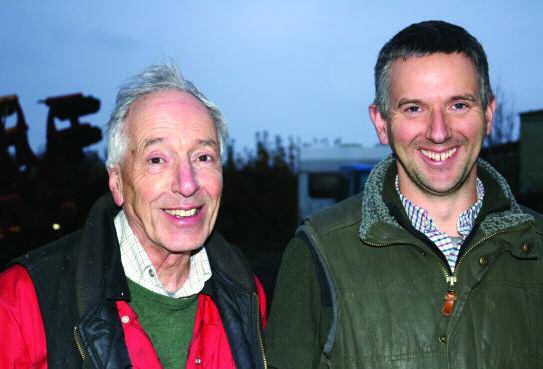
Richard Budd (right) farms with his father David and joined Real Results to optimise the inputs to get the best output.
Source:ADAS,2019.
▲
Performance in the real world – How Revystar XE performed against farm standard programmes
Data drives disease decisions
Features DigitalDirection
that will not only provide that reassurance to the consumer, but also digitises the journey It’s a much wider project potentially, which could have huge benefits for the whole grain trade.”
 By Tom Allen-Stevens
Imagine if you could scan a QR code on a packet of oats which brought up an app that allowed you to trace the product right back to the farm of origin so you could ensure they were gluten-free.
It’s a project involving a number of growers in Aberdeenshire, including Andrew Booth of Savock Farms, near Ellon, who are developing systems to put more trust and integrity into the food industry. It’s built on blockchain, a tamperproof system of digitally filing and preserving a list of records. As well as developing a farmer-owned oat-processing plant, they’ve received almost £100,000 of funding from the Scottish Government Knowledge Transfer and Innovation Fund to pioneer the technology.
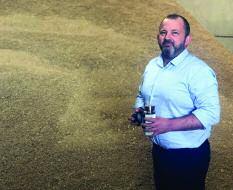
“If a product’s gluten-free, there are very strict measures everyone, including growers, must follow to avoid contamination,” explains Andrew. “This project puts in place a system
Savock Farms extends over 1500ha, with spring and winter oats grown alongside winter wheat, oilseed rape and spring barley, while rye and grass are grown for an AD plant. A keen advocate of digital systems in farming, he’s used various precision farming techniques for more than 15 years. “The most progressive step we’ve taken on this journey is to adopt variable-rate drilling. All crops are sown in this way, including grass,” he says.
On-farm trials
Alongside this, he’s been running on-farm trials. “I first started doing them as an AHDB Monitor farmer, and now carry out a number of field trials on the farm for our own benefit as well as for other companies. We’re members of Scottish Agronomy who have a wealth of trials and skills so it’s good to take that small-plot data and turn it into a field trial to gain your own information. I’m also growing crops, such as rye, grass and oats, on which there’s limited trials information.”
Last season was Andrew’s first with BASF’s Real Results. Local BASF agronomy manager Scott Milne suggested he try out Revystar XE against his own standard, based on prothioconazole with one application of boscalid at the T1 timing, with the trial facilitated by Hutchinsons.
“There wasn’t a huge disease pressure
last season, but I noticed the crop treated with the BASF programme held on to its flag leaf for a good couple of weeks later than the farm standard plots. I remember raising a concern that they’d never senesce enough for us to put the combine through.
“The difference came at harvest –– yields were generally unusually high and our wheats brought in 10.5t/ha on average, which is 1.5-2t/ha above our budget. The Revystar-treated areas yielded comfortably above this, demonstrating a clear benefit from the new chemistry.”
This season, Andrew’s keen to use Revystar in conjunction with xarvio Field Manager, the new digital farming package from BASF (see panel on p22). “The challenge will be managing the amount of data we now receive across various platforms and making sure it beds in with our current system without overloading the
” “
It’ll become an invaluable way to prioritise and time various treatments when we haven’t got the comfort blanket CTL provides.
20 crop production magazine januar y 2020
Andrew Booth aims to put in place a system that will not only provide reassurance on gluten-free oats, but also digitises the journey.
There’s already a wealth of information on how best to use Revystar XE,but how do you make sense of it on your own farm? CPM asks two growers with experience of digital platforms and finds out how xarvio Field Manager will fit in.
on-farm team,” he says.
“But everything we do is customerfocused. As we get closer to the end user, I want to show that we’re not just blanket-spraying crops, that there’s thought and consideration given to every application. We need tools like xarvio that can provide this reassurance, and I believe it’ll become an essential part of retaining the chemistry we currently have.”
Digital insight
Andrew Williamson is a grower who likes to delve behind the details of any farming progression that comes along. He’s developed a suite of precision farming tools to help manage considerable variability he has over the 320ha he farms on land that undulates between 100-200m above sea level, based at Upper Overton Farm near Bridgnorth, Shrops.
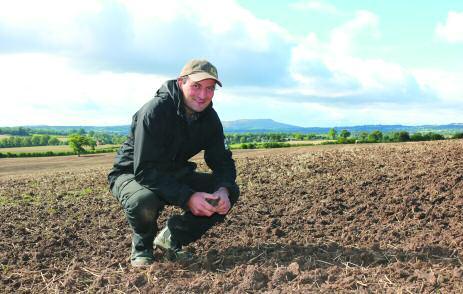
“Farmers fall into two camps when it comes to digital farming,” he says. “There are those who employ a specialist or hire in a service to help them make sense of it, and there are those who take the job on themselves. I’m interested in it and I believe I benefit from the understanding this brings.”
So he’ll bring in weed maps he’s generated from various sources, for example, and create layers within Gatekeeper, his crop recording and mapping software, that will then tie with other layers to produce variable-rate seed plans. “There are packages that can do that for you, but I get to tailor the results how I want them and get to understand the value of the data I have.”
Andrew brings in the same level of analysis when it comes to trying new practices on his crops. A keen advocate of on-farm trials, he’s been involved with BASF’s Real Results since the start and got the first glimpse of Revystar in 2018.
“Unfortunately the trial failed –– a crop of JB Diego that was the worst on the farm and died off early in the drought. So last year, I was determined to get a true picture of how the new chemistry performs,” he says.
This time it was a crop of KWS Siskin, with Revystar applied over three tramlines to give three replicates, with the results assessed and calculated using ADAS Agronomics. But Andrew’s been doing his own monitoring through the season, too. “I went to Ireland to see the Revystar trials at Teagasc and noticed the visual difference, so when I came home, I set about assessing my own. You could see the difference between the treatments –– the Revystar areas had more green leaf area.”
One aspect in particular he’s focused on
is the use of CTL –– this was deliberately omitted from both the comparison treatments, although it was used elsewhere on the farm. “There was a clear yield benefit from Revystar over the farm standard, but I got a yield lift from using CTL elsewhere, although this comparison didn’t go through the rigorous ADAS Agronomics to give me confidence in the results,” notes Andrew.
“Revystar is a step forward and will clearly help, but we’re going to be left exposed when we can’t use CTL, especially here in the West where septoria pressure is higher. We mustn’t become too reliant on the new chemistry and develop other means to relieve disease pressure.”
2019 Real Results trials
Digital Direction
Andrew’s looking forward to using xarvio Field Manager in the coming season to help with this. “It’s a decision management tool that’ll help me make the right choices based on live local data it’ll bring in. I can see it’ll become an invaluable way to prioritise and time various treatments when we haven’t got the comfort blanket CTL provides.
“But I hope I’ll be able to delve beneath the surface, too, and bring in other data that will help inform those decisions with xarvio. Like anything, you’ll get as much out of a system as you put into it. That’s especially true of data and in my experience many farmers are too precious about hanging on to their data, to their own detriment.” ■
Savock Farms, Newburgh,near Ellon,Aberdeenshire
(1.4 l/ha) + CTL (1 l/ha)
T2 (28 May) Revystar XE (1.25 l/ha) + CTL (1 l/ha) Proline (0.6 l/ha) + CTL (1 l/ha)
Variety:Skyscraper; T0 – CTL,T3 – Proline + tebuconazole + CTL; In this trial a yield difference of just 0.28t/ha was needed for statistical significance at the 90% confidence level.
Upper Overton Farm,Bridgnorth,Shrops
Timing BASF Farm Approach
T1 (24 Apr)Revystar XE (1 l/ha)Aviator (1 l/ha)
T2 (20 May))Revystar XE (1.25 l/ha)Ascra (1.24 l/ha)
Yield (t/ha) 10.179.97
Variety:KWS Siskin; No T0 was applied,T3 – Proline + tebuconazole; In this trial a yield difference of 0.26t/ha was needed for statistical significance at the 90% confidence level,so the difference between treatments was not statistically significant.
The yield shown is for the treatment strips only,excluding wheelings and calculated using ADAS Agronomics. Revystar XE contains fluxapyroxad+ mefentrifluconazole; CTL – chlorothalonil; Chord – boscalid+ epoxiconazole; Proline – prothioconazole; Aviator – bixafen+ prothioconazole; Ascra - bixafen+ fluopyram+ prothioconazole.
21 crop production magazine januar y 2020
TimingBASFFarm Approach T1 (09 May)Revystar XE (1 l/ha) + CTL (1 l/ha)Chord
Yield (t/ha) 12.1911.14
Andrew Williamson likes to delve behind the details of any farming progression that comes along, and make use of the data that comes with it.
What is Field Manager?
Field Manager from xarvio is a web and smartphone app-based crop production optimisation system,designed to help you make the right decision on when and how to treat your crops (currently wheat,barley and oilseed rape).
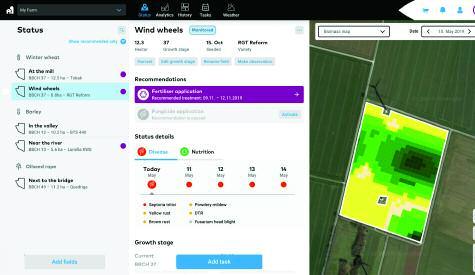
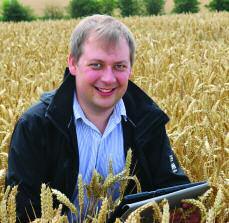
Due to go on commercial release in 2020, it’s been trialled across Europe,including 14 on-farm development sites in the UK,and is the second of a suite of new tools,following the launch of smartphone-based xarvio Scouting last year.
“There are a couple of new functions we’ve released on Scouting,”notes Louis Wells,UK solutions and services manager at BASF. “Multiweed Detection allows you to take an image of a patch of weeds and xarvio will pick them out and identify what they are.Emergence Analysis counts how many crop plants/m2 you have.Currently it works just with sugar beet and maize,but the plan is to widen its scope to include oilseed rape and cereals.These build on the five existing tools that help you assess crop status, weed,pest and disease pressure simply through uploading images through the app.
“But Field Manager will be the big launch in 2020. We’re really excited about how this will help growers make decisions on managing their crops,”he says.This is presented through its three modules.
The three modules
Field Monitor pulls satellite imagery into your dashboard during the season to give you an idea of biomass cover, and also leaf area index,based on normalized difference vegetation index (NDVI).The information is useful for in-season monitoring, such as to tell whether variable applications of seed and/or fertiliser have evened up a crop,and to relate biomass scans to yield maps. Spray Timer is a field-specific service that takes in information you enter about variety, drilling date, etc, and puts it through a clever algorithm that brings in local weather data and crop-growth information to advise on if, and when to spray to protect your crop most efficiently The neat bit is that it factors in what field management tasks you’ve already performed. A traffic-light system indicates when you need to get the sprayer out, and special symbols help you prioritise jobs. The tool factors in what you’ve already used, with drop-down menus containing a comprehensive line-up of products,including generics and competing brands to the BASF products.
Zone Spray makes use of the biomass maps and gives you a variable-rate application map,allowing you to adjust fungicide and/or growth regulator based on crop cover.Like Spray Timer,the module builds in information on previous applications and current disease pressure to determine rate.Safeguards within the module ensure statutory label rates and concentrations are not compromised, but with the variable application based on the fungicide input,the performance of tank-mix partners is at the user’s risk.A variable rate application tank-mix including a herbicide product for example is not recommended.
“Feedback we’ve had suggests Field Manager predicts growth stage very accurately with the Spray Timer module offering decision support on a range of key cereal diseases.The tool interacts at the field level giving advice on your local situation.It even considers the protection and curativity given by your fungicide inputs.The more users who come on board,the better it will get as the algorithms learn as they go along,”notes Louis.
While xarvio Field Manager is an independent platform,which is powered by BASF,Revystar is set to work neatly within the system,he says.It’s the first major product launch from BASF since the development of the xarvio suite of services.The wealth of trials data BASF holds on Revystar will be incorporated to help optimise user decisions within Field Manager.“We know Revystar has a relatively long application window,for example,with plenty of data to back this up.Field Manager takes this into account and the algorithms will update automatically as new information is
Spray Timer advises on if,and when to spray, factoring in what field management tasks you’ve already performed.
made available.
The team has also made progress in ensuring Field Manager ties in seamlessly with other platforms,says Louis.“Compatibility is a key priority for us,and we’re aware it’s also a key requirement for farmers. We have a new interface with MyJohnDeere that works wirelessly with Field Manager, and we’re connected to Agrirouter,bringing compatibility with the large number of ser vices also using the platform.Our vision is that xarvio should work seamlessly and with minimum effort,whatever systems you’re running or level of service you require,”he notes.
• xar vio Scouting is available free to download for iOS and Android smartphones.Field Manager will be launched later this year pricing information has not yet been released.
Field Manager will takes into account the data behind Revystar’s relatively long application window when making recommendations,says Louis Wells.
22 crop production magazine january 2020 Digital Direction
Lessons learned bode well for Revysol
Last month I bought a new car for the ver y first time. Once it was home it just sat in the yard,looking pristine and, frankly, too clean and shiny to take to the roads and get covered with grime.
This was an entirely unexpected reaction. I’m not a car-proud person, to the point that generally it will only ever get a wash if it goes into the garage, but even the thought of leaving it in the supermarket car park was too risky to contemplate. But a few weeks on and the car has become what it was intended to be and it’s ‘situation normal’ ––there are mud splatters on the paintwork and food in the house once again.
I’m feeling the same way about Revysol. A brand-new azole fungicide that rewinds the clock and works as well as azoles used to, that’s exciting. But at the same time, I’d almost rather it stayed firmly nestled its box where it can come to no harm. The one lesson we’ve learned about azole chemistry is that Revysol will most likely never be as good again after it’s been widely used for a number
of years. Or will it be the one to buck the trend?
There’s a buzz of excitement emanating from BASF HQ about the launch of their new Revysol-containing product, Revystar XE, and rightly so. It’s been an amazing achievement to breathe new life into a group of chemistry which had been deemed on its last legs. In reality the azoles have had bad press. They may have suffered a huge decline in their curative performance, but in the field azole protective performance has been hanging on and still delivering a useful contribution to septoria control albeit less than they used to. The azoles have been remarkably resilient given the exposure they’ve had, with a decline happening slowly over a relatively long period of time.
The smart money would probably go on the septoria pathogen finding a way of stopping this super-flexible azole from binding to its target site. But the truth is no one really knows whether this will happen and, if it does, then just how quickly is also a big unknown. Our already highly-adapted septoria population is a very different environment to the one any previous azole has ever been launched in to. Has the pathogen evolved as far as it can go already, or will it be able to evolve a nifty new mutation that can reduce Revysol’s efficacy without damaging its own ability to thrive? It’s going to be fascinating to see whether septoria can ultimately rise to this new Revysol challenge.
What we do know is that taking ever y measure to stack
the odds in Revysol’s favour is the wise approach to prolonging the useful life of this badly needed new fungicide. The older azoles have provided a useful opportunity to learn about how to slow the development of resistance and this has been put to good use to help stabilise the SDHIs once they showed early signs of weakening. The fact that Revysol is only available in formulation with BASF’s SDHI, fluxapyroxad, as Revystar bears testimony to the fact that combining groups of chemistry has been proven to protect fungicide performance.
We also know that the dose rate and number of applications of an azole affect the selection pressure that septoria pathogens are under. Mother Nature has already done her bit this autumn/winter to limit the new active’s exposure in the coming season, with a much-reduced area of winter wheat in the ground which will have a big impact on fungicide use. As far as dose rate is
concerned, there’s still more an element of judgement than science involved in determining field rates of fungicide.
In time, science will continue to help us optimise fungicide use in the field, from both the grower margin and resistance management perspectives. But right now, we have a new azole with some very interesting attributes to celebrate and its arrival is timely. BASFs older azole epoxiconazole remains under threat from the regulators and, should it go, the last azoles standing will welcome the assistance of a younger, more agile member of the family in dealing with a septoria population that has a lot more fight than it used to.
Based in Ludlow, Shrops, Lucy de la Pasture has worked as an agronomist, while among the Twitterati, she’s @Lucy_delaP. lucy@cpm-magazine.co.uk
Revystar Roadshows
BASF is joining forces with the far ming community to run a series of agronomy-focused roadshows from late Jan until early March 2020, focusing on farmer dominated business insights and the launch of new cereal fungicide, Revystar XE.
The dates and venues for the events are:
● 29 Jan - Newbury Racecourse with Robin Aird
● 4 Feb - Exeter Rugby Club with Mike Hambly
● 6 Feb - Cosford RAF Museum, Shropshire with Andrew Williamson
● 10 Feb - Beeswax Dyson, Lincs with Ben Abell
● 12 Feb - Hop Farm, Maidstone with Richard Budd
● 14 Feb - Ravenwood Hall, Bury St Edmunds with Toby Hogsbjerg and Hannah Darby
● 3 March - York Racecourse with Pat Thornton
● 5 March - Murrayfield Stadium, Edinburgh with Andrew Booth
To sign up, go to basfrealresults.co.uk/revylution
23 crop production magazine january 2020