Ohio Section American Water Works Association 260 South State Street, #310, Westerville, Ohio, 43086
We All Benefit from a Connected Membership
Hopefully by the time you are all reading this, we have been able to thaw out from the snow and cold temperatures that most of us have been experiencing in this new year. No matter what the weather has been, the diligent and dedicated members of OAWWA have been hard at work to ensure this will be another great year ahead.
In November, the Second Ohio Young Professionals Summit was held, and the attendance speaks for itself! Over 104 professionals networked, developed leadership skills, and heard from others within the field with real life stories and how it resulted in their own personal growth. In addition to this, planned hands-on activities allowed the attendees to get up and learn more about water on the go! Plans are already underway for this year’s event so stay tuned.
In January, committee and district chairs, members of the OAWWA governing board and other leaders met at our first ever Section Summit. While so many great events are going on, it sometimes is beneficial to sit down with our leaders and review all of the information that is the foundation of our Section. Discussed at this meeting were several key items to better develop
our leadership within and provide the best experience for you, the member. Resources within our section were discussed so that communication is clear and timely to our members. Using the newsletter (at your fingertips right now), e-newsletter, email, social media, and our section website are a few of those resource examples. Additionally, a clear understanding of accountability that comes with the role that our leaders are seated in was explained. With all of this foundational knowledge, I feel our leadership can come to our members and fully implement the purpose of our committees and districts: supporting OAWWA’s mission and goals, delivering quality programs, services, and member engagement, and providing leadership and expertise within the water industry.
At the end of the day, we asked our leaders the following questions: how could processes improve, what
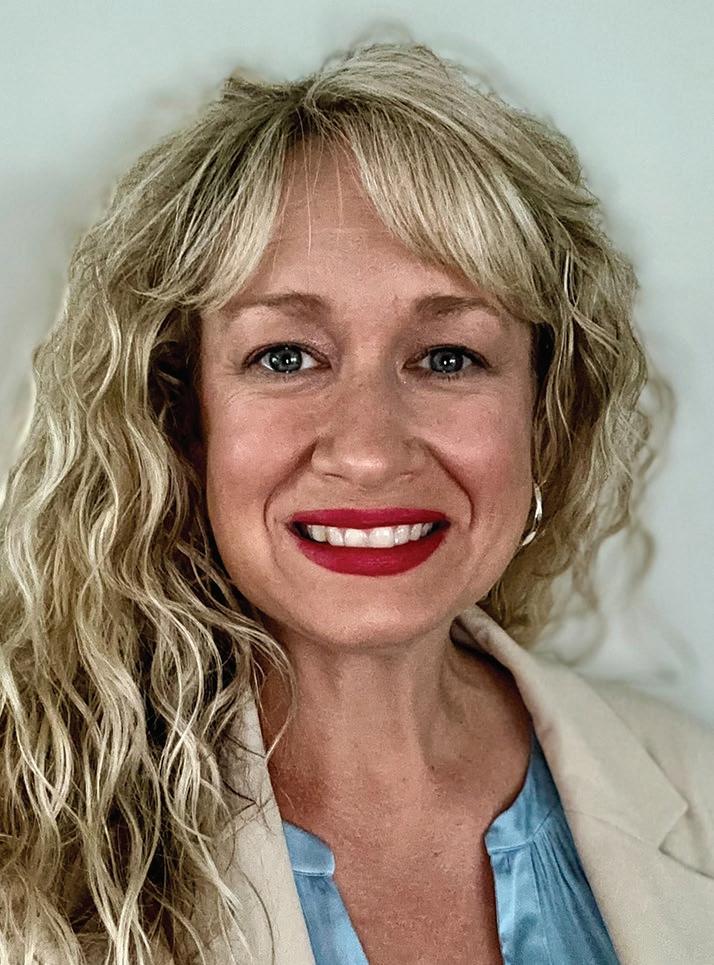
VALERIE COPANIC
support is needed, and do you have enough volunteers? As we gather that information, we may be reaching out to our membership to help these committees and districts better serve our section. If you have answers to those first two questions, email them over to me and I’ll work to incorporate those for an improved section experience.
Meanwhile, other members are still working in the background to prepare the year ahead: committees have been busy with planned meetings, reviewing technical abstracts and continuing to plan for the One Water Conference this summer. This is certainly not a complete listing of all of the work that is going on. Your continued commitment to the section is the only reason for its consistent success. Thank you for your work thus far and going forward!
We asked our leaders the following questions: how could processes improve, what support is needed, and do you have enough volunteers? As we gather that information, we may be reaching out to our membership to help these committees and districts better serve our
section.
2026 ONE WATER CONFERENCE
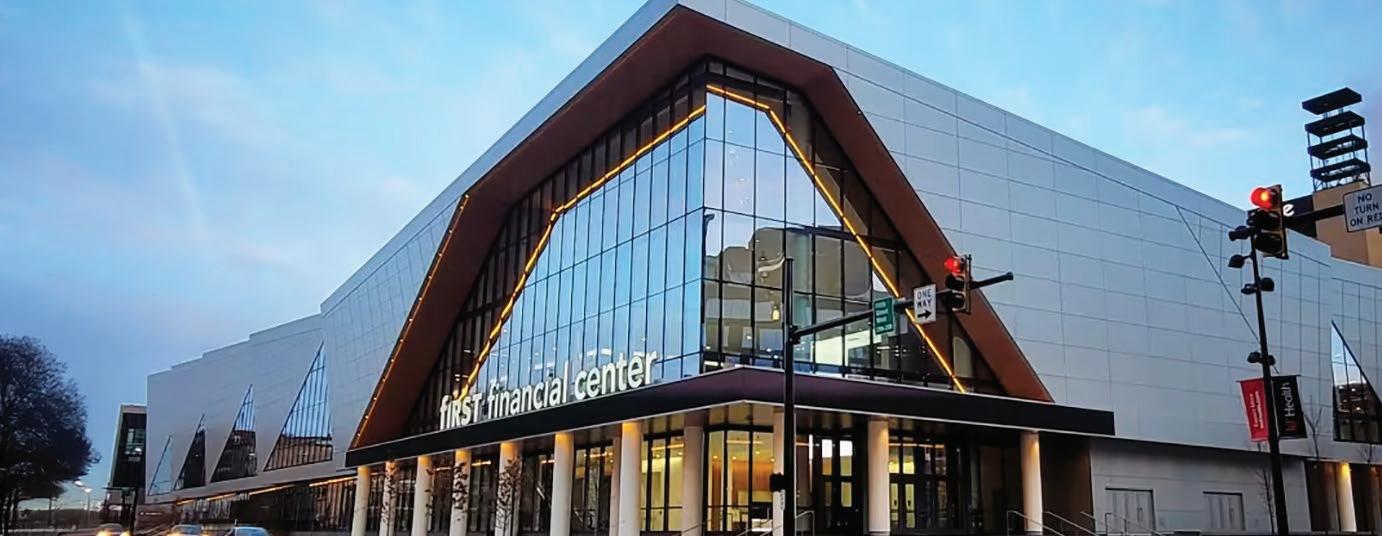
AUGUST 17 –20, 2026 | FIRST FINANCIAL CENTER | CINCINNATI, OH
MONDAY
• Golf Outing
• Community Outreach: Details TBD
• Exhibitor Move-In
• OWEA Challenges (Day 1)
• Pre-Conference Workshop: Water Reuse
• Welcome Mixer
TUESDAY
• Kick-Off Breakfast & Keynote
• Exhibits
• OAWWA Competitions
• OWEA Challenges (Day 2)
• Technical Sessions
• OWEA Awards Lunch
• Exhibit Hall Mixer
• Meet & Greet
WEDNESDAY
• Technical Sessions
• Exhibits
• OAWWA Member Appreciation Lunch
• Women’s Networking Event
• Happy Hour Networking Event
THURSDAY
• Technical Sessions
• Ohio EPA Updates
• Ethics
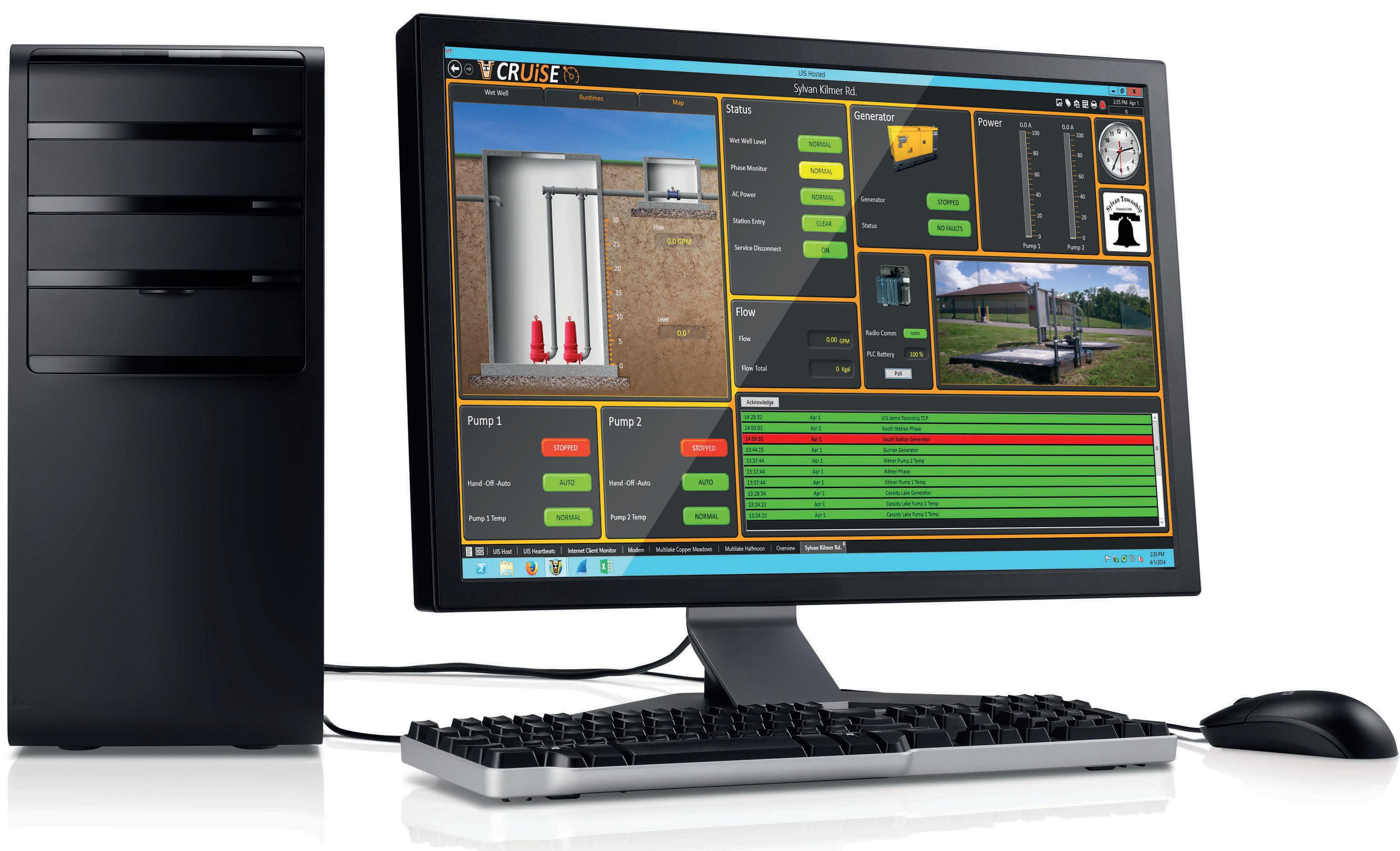
SCADA
Calibrate
Awards Call for Nominations
The following are Ohio Section AWWA Awards given annually, open for nomination from the membership. Previous awardees meet to discuss nominees before the OneWater Conference in August. If the Award is given by a Committee, members from that Committee will choose the awardee.
Visit www.oawwa.org/awards for more information and to submit your nomination!
JOHN LECHNER AWARD OF EXCELLENCE
The John Lechner Award of Excellence recognizes a Section Service Provider member who has demonstrated outstanding service in advancing the Manufacturer/Associate Council (MAC) and the mission of the Ohio Section AWWA.
This award honors individuals whose contributions reflect leadership, mentorship, volunteer service, and meaningful advancement of the MAC and the waterworks industry.
Eligibility Criteria
To be eligible, the nominee must be a current Ohio Section AWWA member and part of the Service Provider (SVP) membership category, must not be a current AWWA Manufacturer/Associates Council member or a prior recipient of the Service Provider Award of Excellence, and must demonstrate contributions in one or more of the following areas: leadership within the Ohio MAC community, mentorship in the MAC field, support of education for the public and drinking water profession, volunteer service to the Ohio Section, or outstanding accomplishment in water industry training and/or education.
JOHN J. SADZEWICZ AWARD
The John J. Sadzewicz Award recognizes outstanding contributions to safe public health practices, the use of proven new technologies, and sound operational approaches in achieving regulatory compliance and ensuring safe drinking water for the citizens of Ohio. Consideration is intended first for individuals whose careers are in the public regulatory sector.
Eligibility Criteria
To be eligible, the nominee must be a current Ohio Section AWWA member, be recognized as a leader in the drinking water community, and demonstrate contributions in one or more of the following areas: proactive process improvements, research or technological innovation, leadership in achieving regulatory compliance, development of policies or procedures based on sound science, or advancement of practical and effective industry solutions.
KEITH HUNSBERGER OUTSTANDING CUSTOMER SERVICE AWARD
The Keith Hunsberger Outstanding Customer Service Award recognizes excellence in leadership and service within the customer service functions of the drinking water community.
Eligibility Criteria
To be eligible, the nominee must be a current Ohio Section AWWA member, be recognized as a customer service leader, and demonstrate contributions in one or more of the following areas: process improvements in customer service, leadership in promoting service excellence, mentorship, advancement of customer service standards, or support of education and volunteer service.
OPERATOR MERITORIOUS, WATER TREATMENT SERVICE
The Operator’s Meritorious – Water Treatment Service Award recognizes an individual who has demonstrated consistent and outstanding contributions to water treatment operations and maintenance.
This award honors operators whose work reflects dedication to plant
performance, equipment longevity, innovation in treatment processes, and commitment to protecting public health through reliable treatment practices.
Eligibility Criteria
The nominee must demonstrate one or more of the following: continuous compliance with public health standards for finished water; consistent and outstanding contributions to plant maintenance that prolong the useful life of treatment equipment; development of new and/or modified equipment or significant process improvements that provide more efficient or effective treatment; special efforts in the training of treatment plant operators and/ or water distribution personnel; special acts not directly related to water treatment or distribution that demonstrate dedication to the public beyond the normal call of duty; consistent and outstanding contributions to the operation and/or maintenance of water treatment facilities; and concurrence from the Ohio EPA Water Supply Unit Supervisor (required).
OPERATOR MERITORIOUS, DISTRIBUTION SERVICE
Recognizes consistent and outstanding contributions to water distribution system operations, maintenance, and training.
Eligibility Criteria
The nominee must demonstrate continuous compliance with public health standards; outstanding contributions to distribution system maintenance; equipment or process improvements; training of operators; dedication beyond the normal call of duty; and concurrence from the Ohio EPA Water Supply Unit Supervisor (required).
RICHARD MELICK AWARD FOR EDUCATION
Recognizes a member who has given unselfishly to the field of operator training and technical education through Ohio EPA, the Operator Training Committee of Ohio, Inc., and/or AWWA.
OAWWA YOUNG PROFESSIONAL OF THE YEAR
The OAWWA Young Professional of the Year Award recognizes an outstanding young professional who demonstrates leadership, initiative, and meaningful engagement in advancing the mission of the Ohio Section AWWA.
The award celebrates emerging professionals who contribute to the profession, strengthen member engagement, and represent the future of Ohio’s water community.
Eligibility Criteria
To be eligible, the nominee must be a current Ohio Section AWWA member, be 35 years of age or younger at the time of nomination, and demonstrate excellence in the following areas: leadership and initiative; engagement in OAWWA and the profession; innovation and forward-thinking contributions; service, collaboration, and community impact; and professionalism and representation of Section values.
SOURCE WATER PROTECTION AWARD
The Ohio AWWA Source Water Protection Award recognizes exemplary source water protection programs that demonstrate meaningful, measurable efforts to protect Ohio’s drinking water sources.
This award highlights innovative strategies, collaborative initiatives,
emergency response success stories, educational campaigns, and long-term protective actions that strengthen source water protection across the state.
Up to three awards may be presented annually.
Eligibility Criteria
Eligible nominees include community public water systems and collaboratives representing drinking water systems.
Anyone may submit an application on behalf of their system or collaborative. If there is a high volume of applicants, awards may be distributed across population categories as follows: small (fewer than 10,000 population served), medium (10,000–50,000), and large (greater than 50,000).
Applications may remain under consideration for up to three years.
Systems are eligible to apply each year.
Measuring Induced Infiltration Using Stable Isotopes of Water
PI Jonathan Levy, co-PI Jason Rech, and graduate student Idah Ngoma of Miami University recently completed an Ohio Water Resources Center-funded project via an Ohio Water Development Authority subaward on surface watergroundwater interactions. The project, titled Quantifying induced infiltration by municipal production wells using stable isotopes of water, aimed to measure the extent of induced surface water infiltration from pumping alluvial aquifers in Fairfield, Ohio.
Groundwater is an important source of drinking water globally. Many communities rely on wells within alluvial aquifers – layers of unconsolidated sediments that hold water because the aquifers are hydraulically connected to surface water bodies. This allows them to recharge quickly due to their ability to pull in water from the surface, otherwise known as induced infiltration. Although induced infiltration mitigates potential aquifer depletion, it can introduce contaminants from the surface to groundwater and deplete surface-water resources.
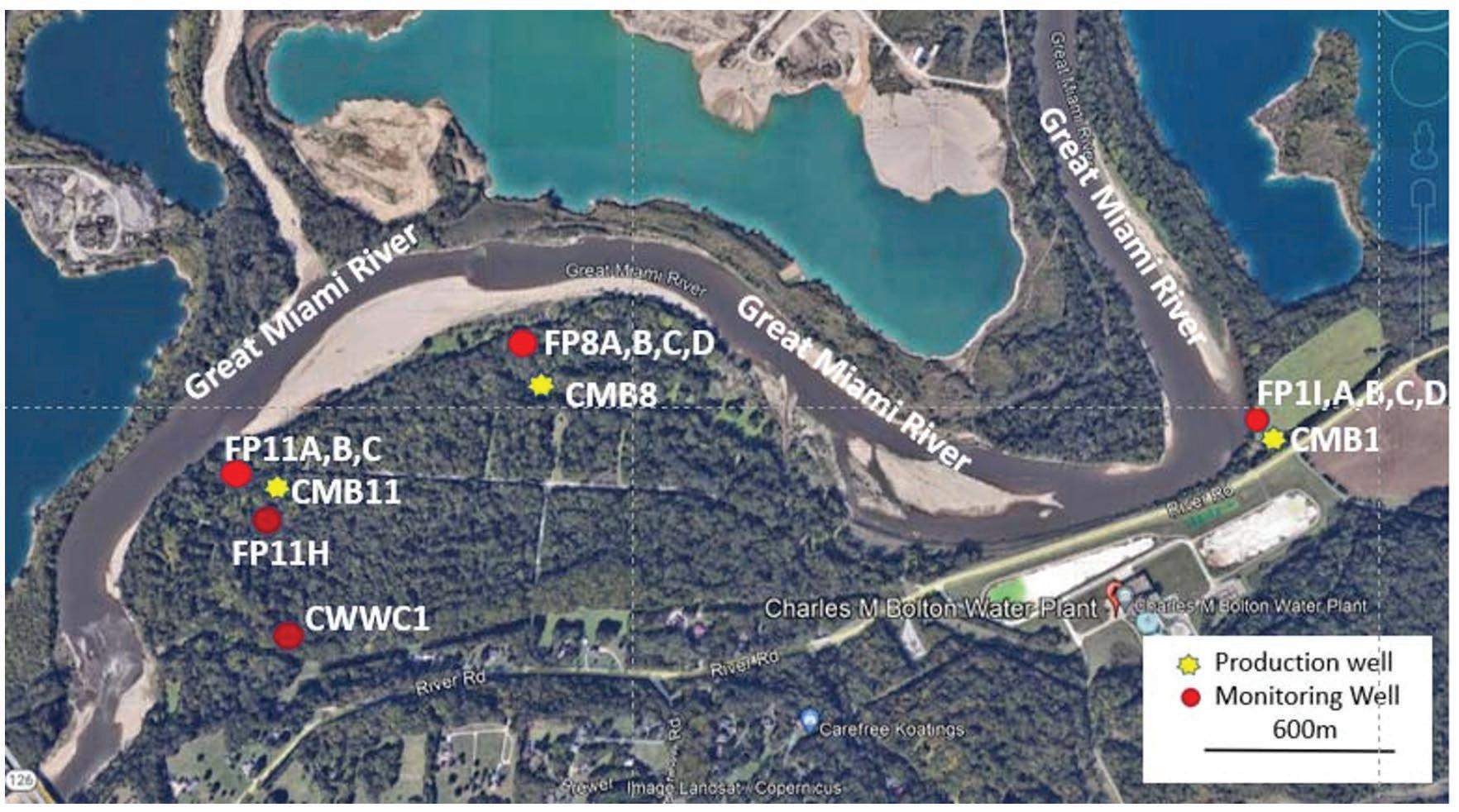
The research team sought to quantify the degree of groundwater-surface water mixing that occurs under induced infiltration to better understand where the water in aquifers originates and how the dynamics might impact water quality. Using three production wells and a series of monitoring wells at the Charles M. Bolton Wellfield, researchers sampled biweekly from two locations on the Great Miami River near the
wellfield, three production wells (CB-1, CB-8, CB-11), and nearby monitoring wells and piezometers (Figure 1). Samples were analyzed for oxygen (δ18O) and hydrogen (δ2H) isotope composition, with the expectation that groundwater unimpacted by surface water would have lower variability and compositions of δ18O and δ2H due to less temperature variation.
The monitoring wells hypothesized to not be affected by induced infiltration had some of the lowest δ18O and δ2H values. However, river water isotopic compositions did not fit the initial hypothesis that they would present the highest δ18O and δ2H values, which made mixing calculations difficult. While the method worked well at a smaller wellfield in a previous study, the results were less clear at this wellfield, complicated by nearby gravel pits and overlapping cones of depression. At one well, calculations estimated that 40%
of its water originated from induced infiltration, but at another well, the δ18O and δ2H values calculated differed widely (83% and 27%, respectively). Although temperature and specific conductance data provided insight into groundwater travel time, the isotopic method did not appear reliable enough to estimate induced infiltration. In order to contribute to sustainable groundwater management decisions, more investigation is needed to refine the method of quantifying induced infiltration.
Researcher Profiles: At Miami University, Dr. Levy is an associate professor in the Department of Geology and Environmental Earth Science and director of the Institute for the Environment and Sustainability. Dr. Rech is a professor and chair of the Center for Aquatic and Watershed Sciences. Ngoma is a graduate student under Dr. Levy, studying hydrogeology.
Figure 1. Production and monitoring wells within the Charles M. Bolton wellfield that were sampled for isotope analyses.
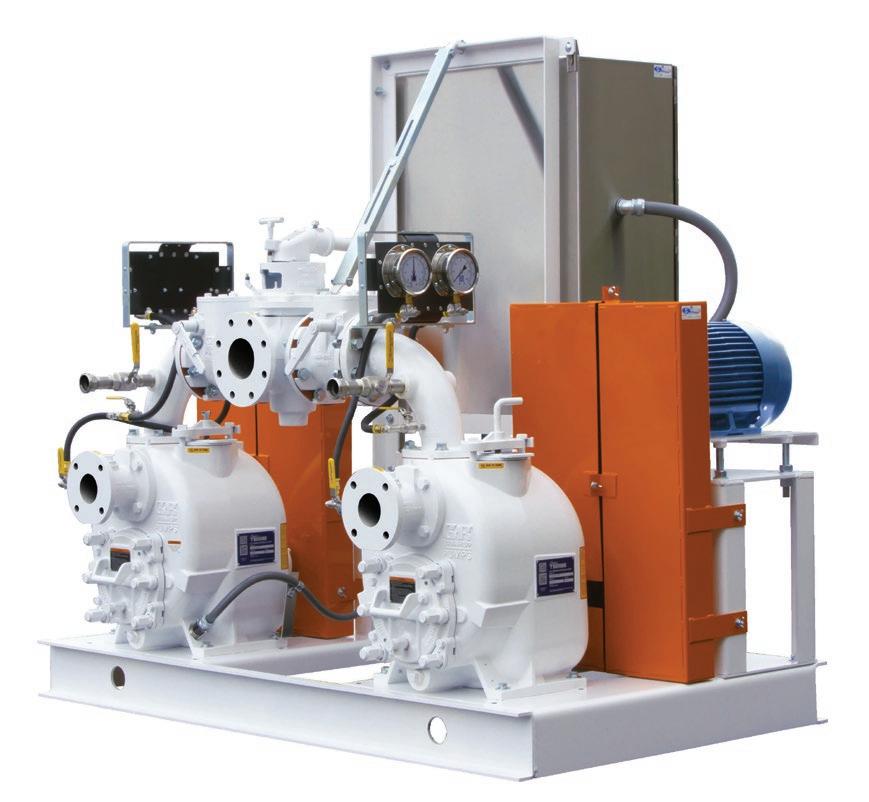
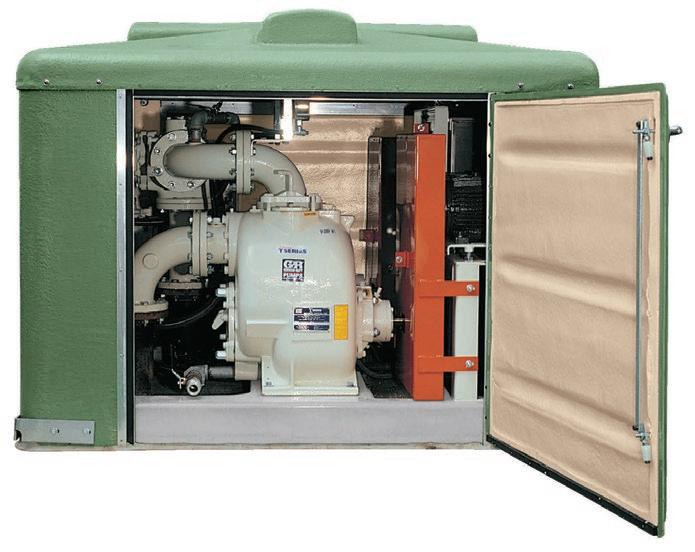
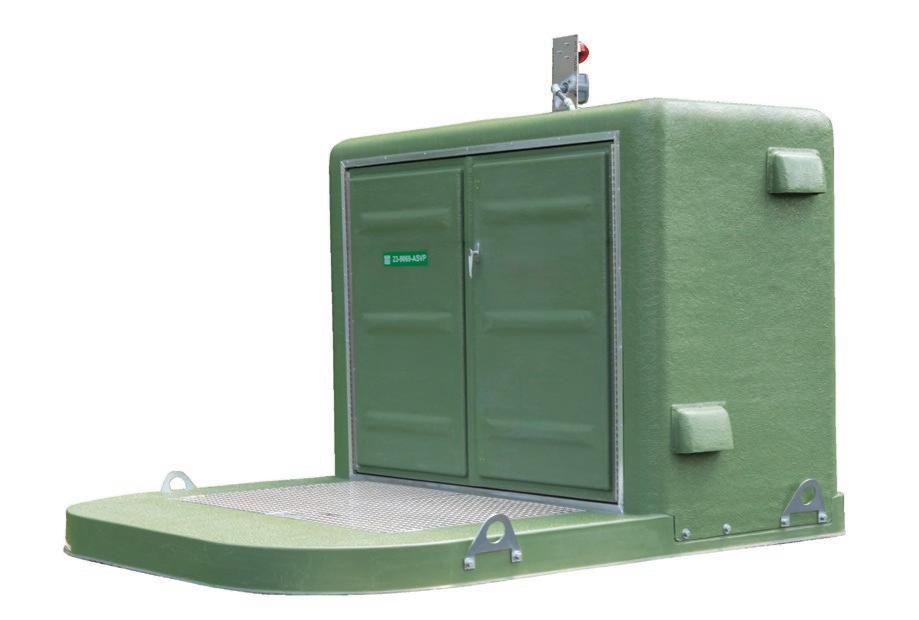
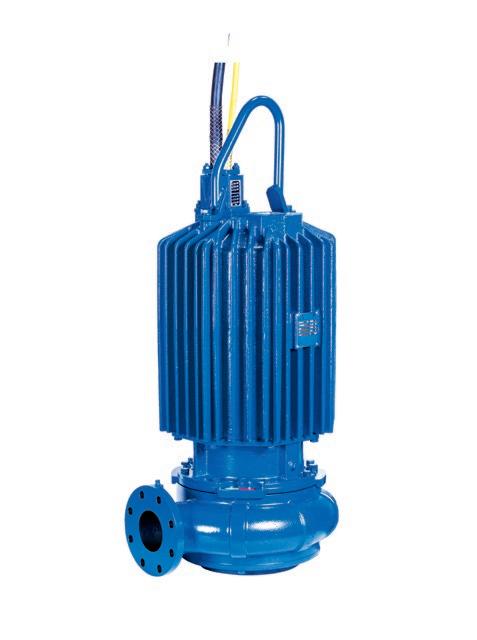
LIFT STATIONS DELIVERED FAST.
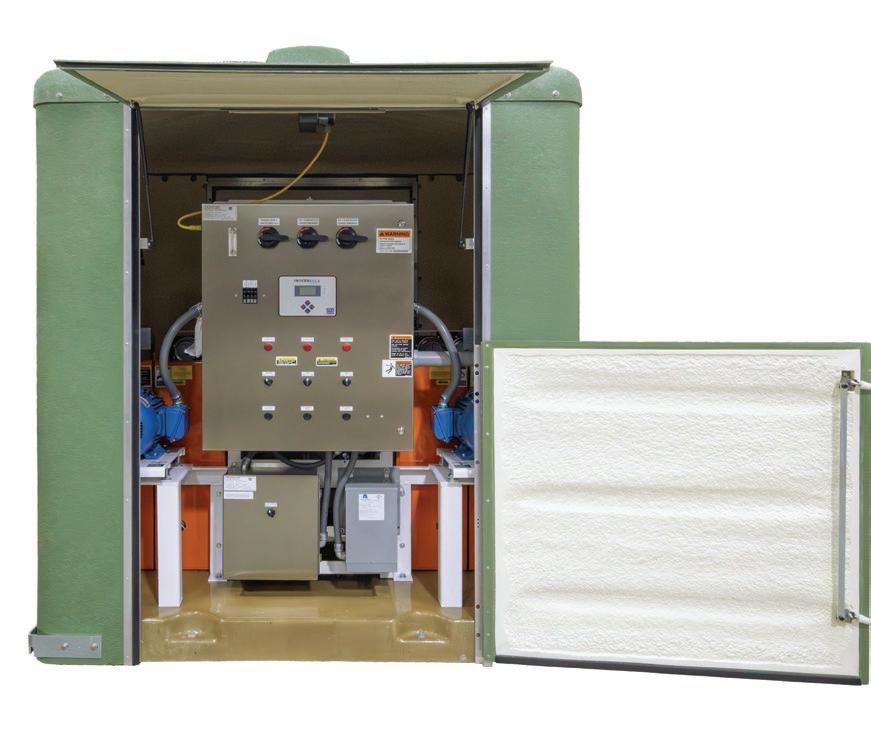
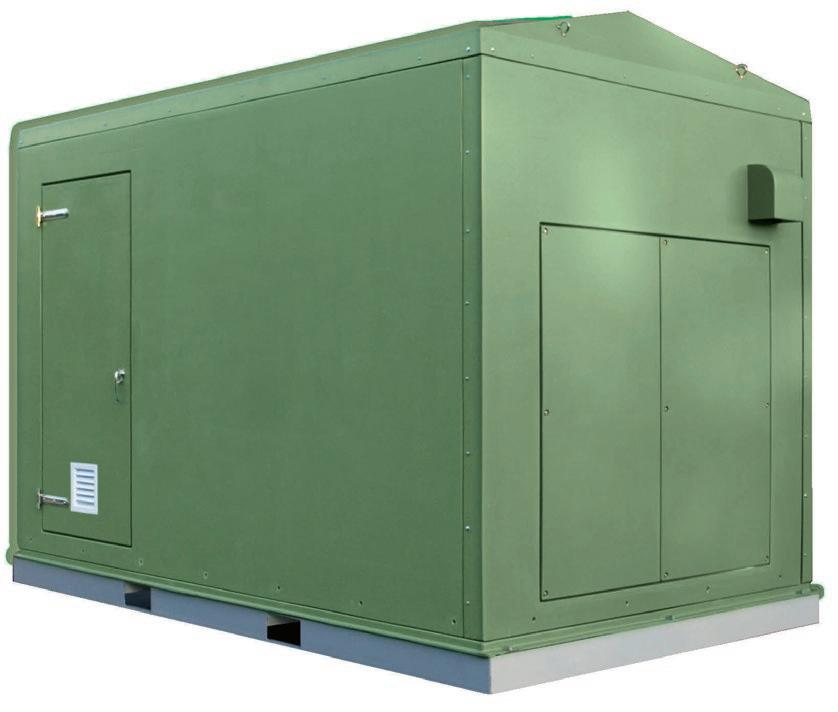
Gorman-Rupp’s ReliaSource® Express program offers the opportunity for personalization, delivered at top speed. Choose from a variety of station types configured with your choice of pumps, controls and other components. The combinations are endless without the wait.
Advancing Practical Leadership for Ohio’s Water Utilities
The Utility Management Committee (UMC) is pleased to share with the OAWWA community how we support Ohio’s water professionals through practical, relevant, and accessible utility management education.
OUR PURPOSE
The Utility Management Committee exists to strengthen the business, leadership, and organizational side of water utility operations by complementing technical excellence with management practices that support long-term sustainability.
OUR PRIMARY GOAL
To provide consistent, practical education and engagement opportunities for Ohio water utility professionals focused on effective utility management.
WHAT WE’RE FOCUSED ON
To advance this goal, the committee is committed to delivering programming that is relevant, actionable, and scalable for utilities of all sizes across Ohio.
AS WE LOOK AHEAD TO WHAT WE WANT TO ACCOMPLISH IN 2026, OUR OBJECTIVES INCLUDE:
• Hosting Learning Opportunities through topical webinars that address real-world utility management challenges, case studies, and emerging best practices.
• Facilitating a Comprehensive Annual Workshop of seminar that blend key concepts and approach training with peer case studies and experiences, panel discussions, interactive sessions, and networking that can’t happen virtually.
• Promoting Effective Utility Management (EUM) to build awareness and practical adoption of the EUM framework,
and supporting utilities using EUM as a living, decisionsupport approach, not just a reference document. Topics span leadership, governance, financial sustainability and rates, asset management, organizational culture, risk and resilience, and strategic decision-making.
AN INVITATION TO GET INVOLVED
The UMC is actively seeking engaged OAWWA members who are interested in contributing their experience, ideas, and perspectives to help shape our programming. There are multiple ways to participate, including:
• Assisting with webinar topic development and speaker identification
• Contributing short articles or thought pieces for OAWWA communications
• Helping plan or support the annual workshop, including agenda development, facilitation, or peer discussion sessions You do not need to be a management expert to contribute; just be willing to share practical lessons learned, challenges faced, or ideas worth exploring with peers across the state.
JOIN THE CONVERSATION
Whether you are an emerging professional, a seasoned utility leader, or somewhere in between, the UMC welcomes your involvement. By working together, we can strengthen management capability across Ohio’s water sector and better equip utilities to serve their communities today and into the future.
To express interest or learn more, please contact: Joe Crea, UMC Chair, jcrea@raftelis.com Kris Dye, UMC Vice Chair, kdye@delcowater.org
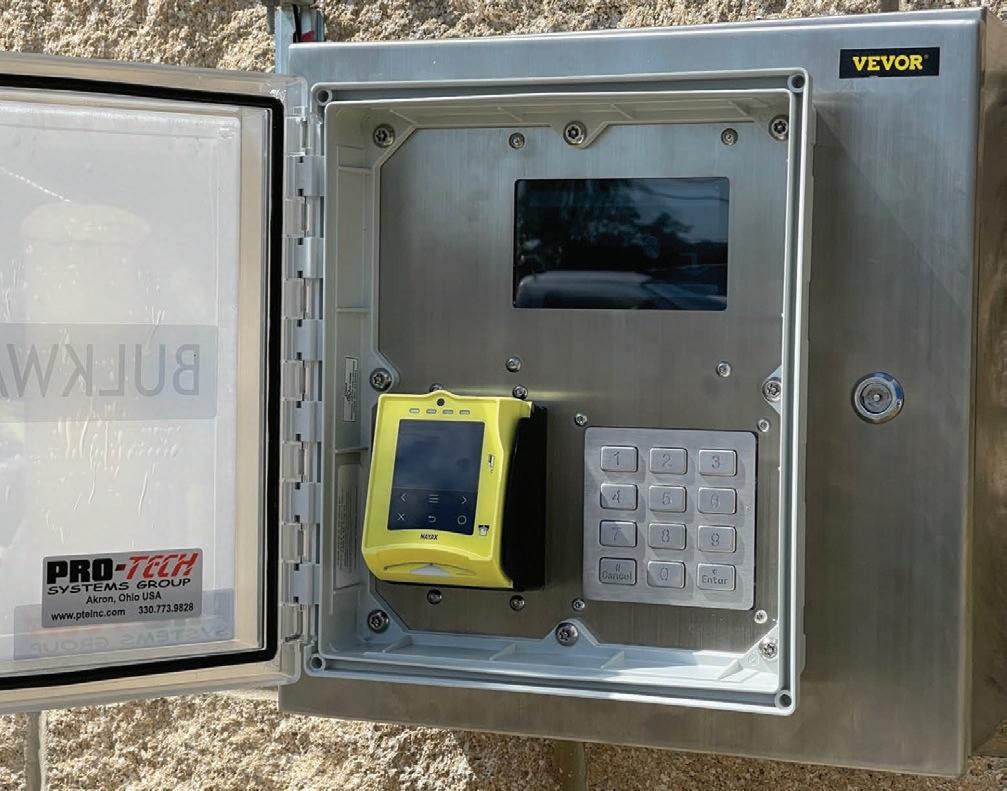
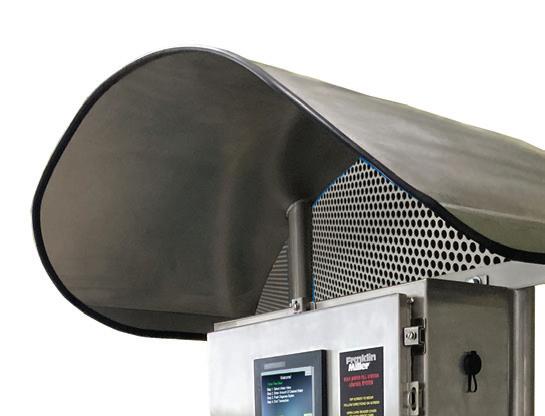
HAULERPORT ® Bulk Water Fill Stations
Smarter Water Access. Total Control.
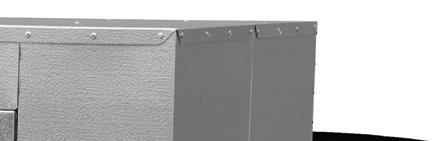
HAULERPORT® Bulk Water Fill Stations deliver secure, automated water dispensing –giving you full control of your water resources while providing 24/7 unattended access for authorized users.
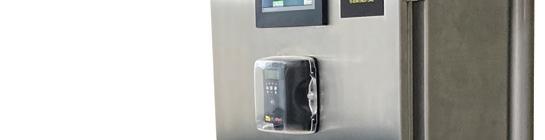
HAULERPORT simplifies bulk water distribution, cuts administrative overhead, and boosts operational efficiency. The intuitive touchscreen HMI makes self-serve operation easy.
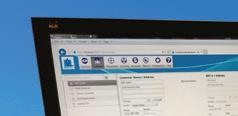
When integrated with our HaulerLogic® Software, you gain even more power to track activity and transactions, manage user accounts, set rates, invoice customers, and generate reports – all from the comfort of your office.
HAULERPORT is the only system on the market that supports both credit card and customer account transactions – giving you unmatched flexibility. To learn more, call us, or use the QR code to visit us online today.
TOP OPS 2026 Competition Teams Needed
The OAWWA Top Ops Committee would like to showcase teams from the Northwest, Northeast, Southeast, and Southwest Districts for the upcoming One Water Conference in Cincinnati Ohio!
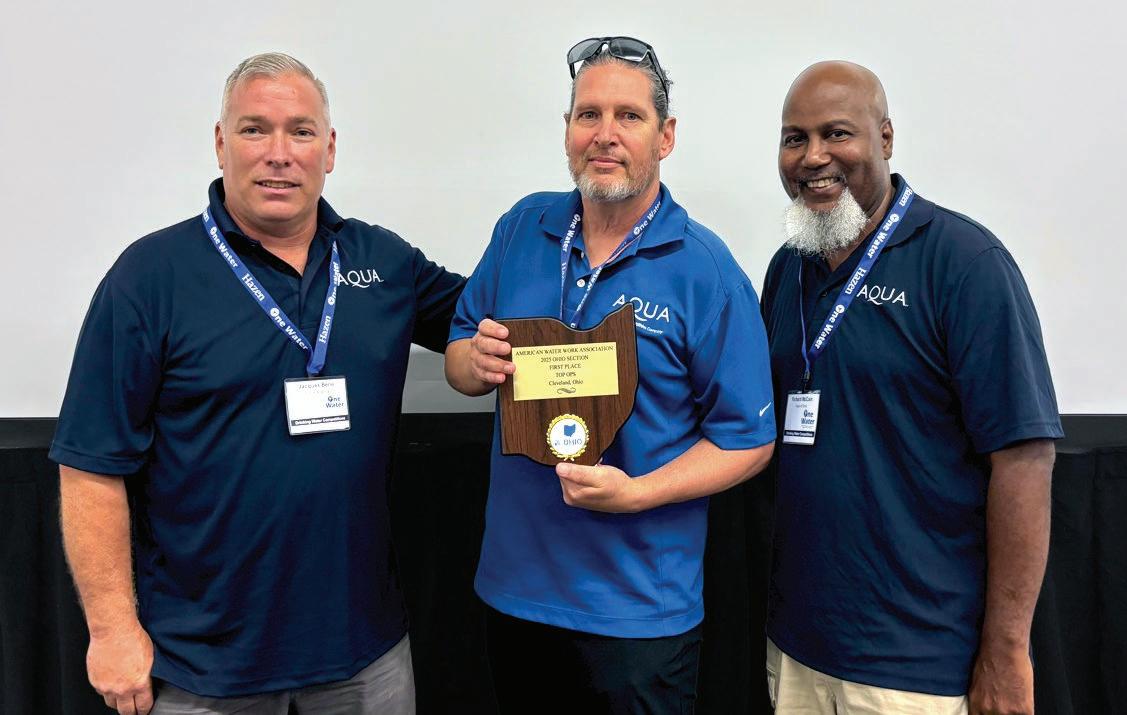
In 2025 the North-East Top Ops team took home the title and will be representing us for the nationals in Washington D.C. for the 2026 ACE Conference!
We are hoping to field teams from all four districts at the next One Water Conference, August 17-20, 2026 in Cincinnati, Ohio.
If your utility cannot send a team to the whole conference, the AWWA will cover a One-Day Competitor’s pass that includes entrance into the exhibit hall and vendors, as well as lunch for the day of the competition.
The teams can consist of one to three team members, and a coach. The questions can range from Operational, Laboratory, to Water Treatment Processes, so a wellrounded team can be represented from these three disciplines.
If your utility is interested in participating in this event, you can contact Shawn Justus at shawn_justus@clevelandwater.com, or Marvin Banks at mebanks@columbus.gov.
Thank you,
Marvin E. Banks III Water Maintenance Coordinator Operations Control Center Division of
Water
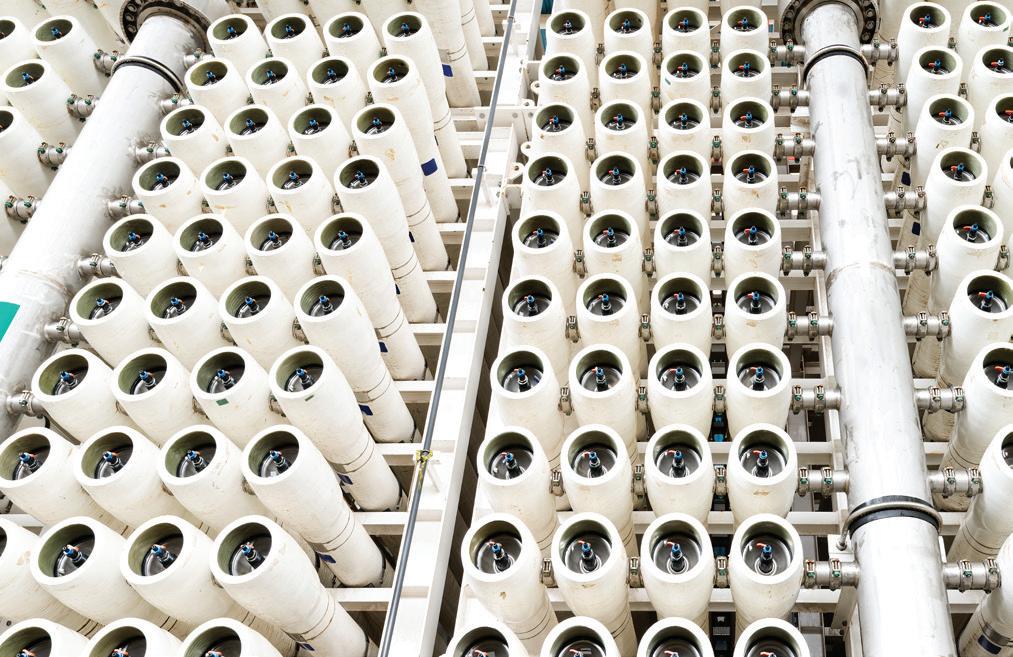
manufactured in Texas by Ovivo, our Silicon Carbide (SiC) ultrafiltration membranes are setting a new standard in water and wastewater treatment. Engineered for unmatched durability and performance, SiC technology is the trusted choice for municipalities seeking high reliability and future-ready solutions. Whether upgrading existing systems or tackling the toughest treatment challenges, Ovivo delivers innovation you can count on. Reach out to BL Anderson today to discuss how we can meet your water goals.
2025 Top Ops winners Jacques Berie, Richard McCain, and Rick Fisher from Aqua Ohio.
WIW is OFFICIAL!
Women in Water (WIW) is officially a subcommittee under the Ohio AWWA Diversity & Inclusion Committee! The subcommittee was established in 2025 to support women in the water industry by promoting greater engagement in OAWWA events, leadership, and peer support and by increasing visibility and engagement for women across all career stages and all facets of the water industry. WIW welcomes women from a wide range of career paths including:
Meet Your WIW Leadership Team!
Co-Chair
Co-Chair
Stacia Eckenwiler
• Operations & Maintenance
• Science & Laboratory Work
• Engineering & Consulting
• Construction & Skilled Trades
• Regulatory & Environmental Protection
• Customer Service & Administration
• Utility Management
• Anyone working in the water and wastewater field!
skeckenwiler@columbus.gov
Stephanie Johnson stephanie.johnson@kimley-horn.com
Administrator Maria DeLuca maria.deluca@aecom.com
NW District Lead
NE District Lead
SW District Lead
SE District Lead
Communications Lead
OWEA Communications Lead
Mentorship Lead
Jen Rosemark jrosemark@rlcwa.com
Kimberly Colich colichk@neorsd.org
Sarah Hayes sarah.hayes@gcww.cincinnati-oh.gov
Megan Patterson mpatterson@brwncald.com
Miranda Scheitlin miranda.scheitlin@aecom.com
Kathryn Crestani kathryn.crestani@jacobs.com
Kari Mackenbach kmackenbach@msconsultants.com
WAYS TO GET INVOLVED IN WIW
All are welcome! No membership fees are required to join WIW. Join our bimonthly committee meetings to get the latest details on upcoming WIW events and much more! Email miranda.scheitlin@aecom.com to be added to the bimonthly meetings.
Interested in attending District or statewide events?
Scan the QR code to view the latest events calendar.
Have ideas for future events or want to get involved in WIW event planning? Reach out to your District lead to learn about ways to get involved.
Careers Start Here: YP Committee Update
Ohio YP Summit 2025
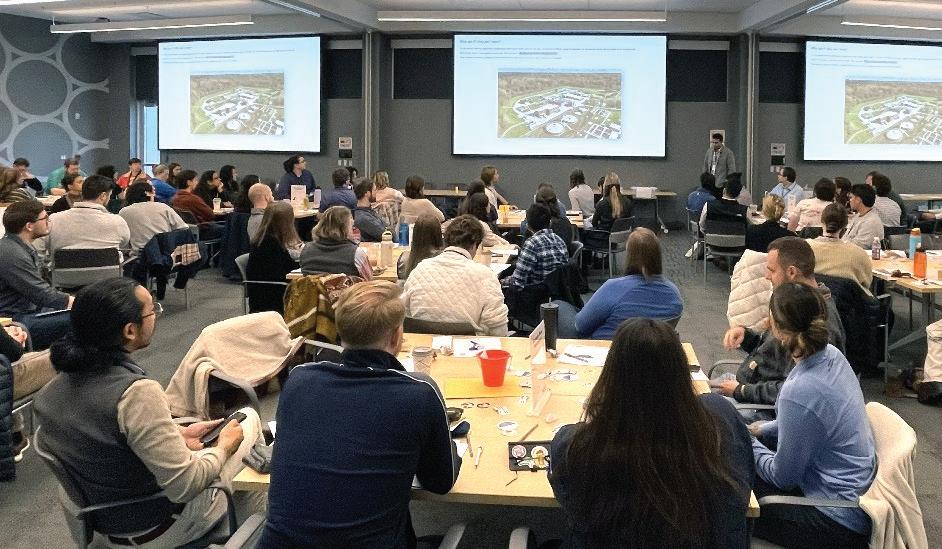
On November 14, the second annual YP Summit took place at the Kokosing Headquarters in Westerville, Ohio. Over 100 YPs across the state and from a variety of professional backgrounds attended the one-day, highly-interactive event. This year’s summit focused on fostering professional development, collaborative networking and problemsolving, learning how to tackle emerging challenges in the water/ wastewater industry, including water reuse, and learning how to overcome professional obstacles.
YPs from
The morning kicked off with YP Power Hour, featuring four dynamic 10-minute presentations delivered by YPs from across the state. The session was designed to sharpen public speaking skills while offering valuable lessonslearned from overcoming personal and professional challenges in the water/wastewater industry. A summary of each of the presentations is included below!
Bridging Generations in the Workplace – Shane Derricotte (City of Elyria)
Shane provided insight into how generational differences in the workplace can lead to miscommunication and stagnation, and how bridging traditional methods with new ideas contributes to further innovation and improvement.
Overcoming an Unexpected Career Change: My Experience with the Government Layoffs – Esther Hughes (Hazen and Sawyer)
Esther shared her experience navigating an unexpected layoff during the government workforce reductions and how she overcame the sudden change to ultimately find a new, fulfilling career path.
Shedding Anxieties About the Watershed – Frances Wiggins (Del-Co Water Company)
Frances (YP Power Hour Winner!)
shared how a daunting project she was assigned at work turned into a positive lesson learned on effective communication and check-ins, leading her even better equipped to tackle new projects in the future.
Stepping Back to Step Forward: How Pausing my Postgraduate Studies Led to Better Growth – Austin Le (Wade Trim)
Austin exemplified how professional paths are often not linear, and changing your course by, in his case, pausing his postgraduate studies, can result in a stronger career path and lifestyle.
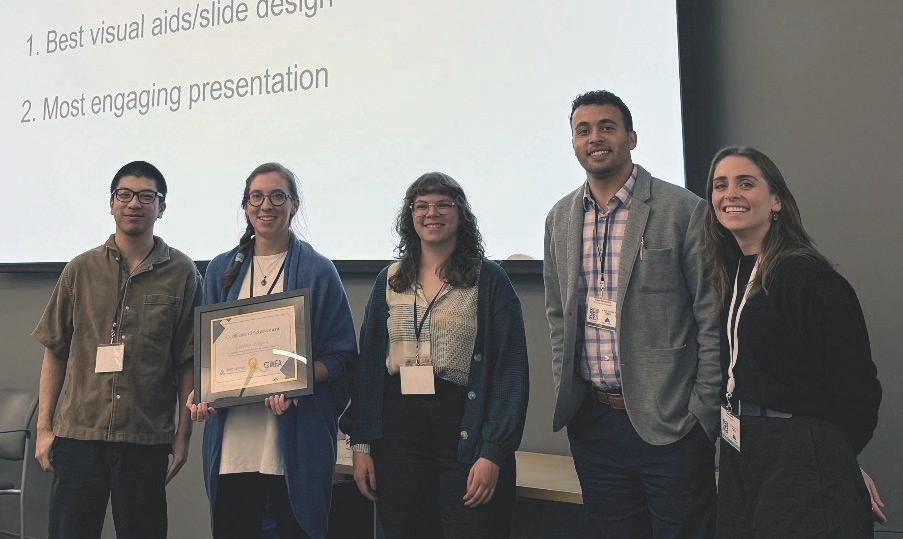
Congratulations to the YP Power Hour winner, Frances Wiggins.
This discussion allowed YPs to hear new perspectives on their fears from their peers, how best to overcome these fears, and served as a reminder that character is built through perseverance.
As part of the morning session, YPs also heard from Stacia Eckenwiler (City of Columbus) who reflected on an early-career experience where she faced ‘failure’ during a water treatment pilot study and how she reframed her perspective to focus on the positive outcomes this experience led to.
After lunch, the Problem Solving Challenge asked YPs to consider a theoretical scenario where a proposed data center required additional water for cooling purposes and was considering water reuse as part of the solution. The YPs heard perspectives from 4 different water professionals with backgrounds in water reuse who represented different stakeholders in this scenario. Brian Coghlan (Del-Co) provided the city perspective, Walter Ariss (Ohio EPA) provided the regulatory perspective, John Sheets (CDM Smith) provided the data center perspective, and Mike Frommer (CDM Smith) discussed project implementation more holistically. Each distinct perspective facilitated meaningful conversation amongst the YPs as to how scenarios like this might be handled in real life in the water/ wastewater industry today.
After YP Power Hour, YPs broke out into groups to participate in the Overcoming Fear of Failure interactive activity aimed at sharing and discussing professional fears and how best to overcome them.
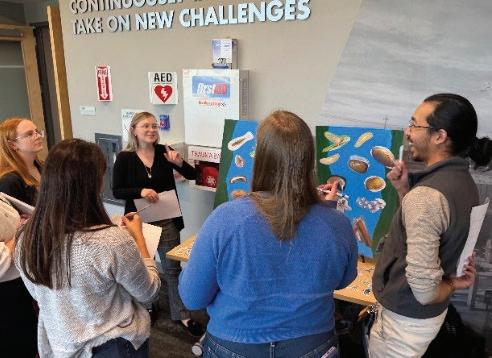
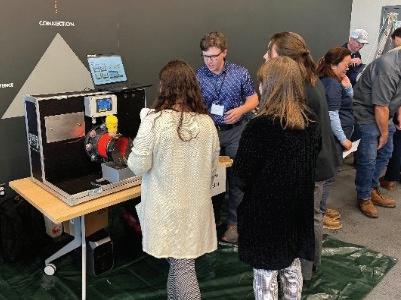
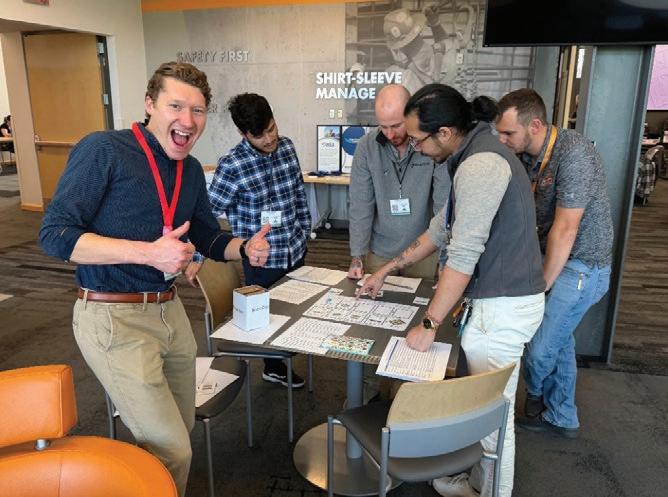
The day concluded with the most action-packed part of the summit: The Water Circuit Challenge! The Water Circuit Challenge consisted of 16 handson activity stations for each team to complete together. These engaging hands-on activities included assembling a pipe tree with Victaulic joints, a blind water taste test, stream water quality characterization, identifying water service line materials, reuse treatment train assembly, and many more activities spanning across the water industry.
across Ohio gathered at the Kokosing Headquarters for the 2025 YP Summit.
YP Power Hour Presenters (from left to right): Austin Le, Frances Wiggins, Esther Hughes, and Shane Derricotte; accompanied by OAWWA YP Past Chair Dane Elliott.
Careers Start Here: YP Committee Update
The YP summit concluded with closing remarks and encouraging all YPs to stay connected with their table teams by sharing LinkedIn and contact information. Thanks to all who contributed to making this year’s YP summit an awesome event!
District Events
Bowling Competition
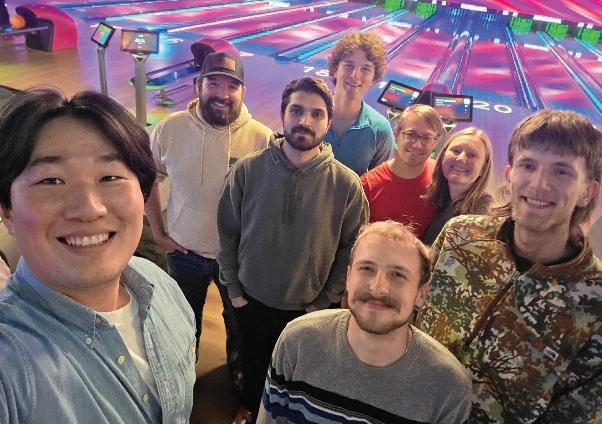
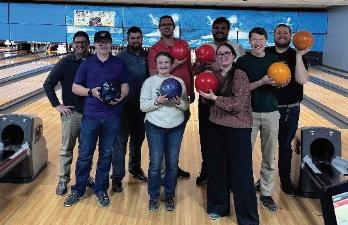
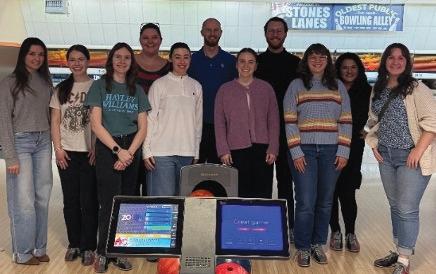
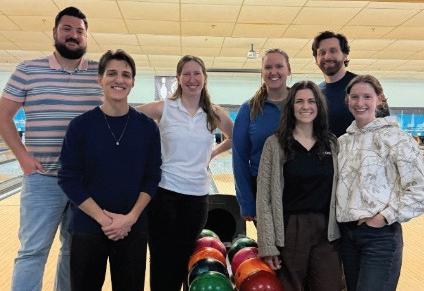
In December, all four districts participated in a bowling competition! The competition took place at different locations within the same week, and the district with the highest average score was crowned the overall winner.
Congratulations to the NW district who took home the trophy!
SE District
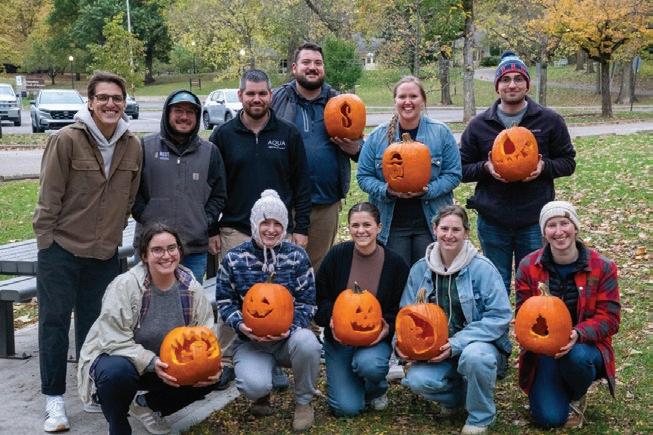
Pumpkin Carving Party –October 22, 2025
In October, the SE District hosted a pumpkin carving party for YPs to gather and carve their own pumpkins! The winner of the pumpkin carving party was Meghan Nicholson, with
Shannon Taylor and Mark Tischer winning second and third place.
YP Excellence Award
A new award for YPs is proposed to kick off this year! This award is intended to recognize outstanding YPs who demonstrate strong engagement in OAWWA, through leadership, innovation, and service. Refer to the ‘Awards’ section in this newsletter for additional information!
Get Involved
If you are interested in getting involved with the YPC, we would love to have you! See below for the different ways you can get involved.
1. Attend YPC Events. These are listed in the H2OintheKnow newsletters that go out each Thursday, and can also be found on the OAWWA calendar online.
2. Sign up for the YP Newsletter! This is a monthly newsletter that lists the upcoming YP events happening throughout the state. Sign up on the Young Professionals Committee website or using this QR code:
3. Join the Whatsapp Community for event reminders and discussion using this QR code:
4. Join our bimonthly calls to be more actively involved and participate in planning, or just to listen in! Reach out to the current chair, Matous Becker, at matous.becker@ burgessniple.com to understand how you can get involved more and get added to the Teams meetings.
YPs learning stream characterization by the identification of macroinvertebrates.
YPs at the Flow Meter Station learning about open channel flow metering.
YPs developing an effective water reuse treatment train at the Reuse Treatment Train Station.
Northwest District (Champions!)
Northeast District
Southwest District
Southeast District
SE District YPs at the pumpkin carving event.
Careers Start Here: YP Committee Update
Meet the OAWWA YP Committee Executive Team
The OAWWA Young Professional Committee (YPC) has experienced significant growth in recent years, bringing more members, more events and a growing need for increased leadership and coordination across the YPC. To support its growth, the
YPC implemented a re-organization in August of 2025. The reorganization introduced an ‘Executive Level YPC’ that added two new leadership positions, District Coordinator and Outreach Coordinator, to work with the Chair, Past Chair, and Chair Elect
in overseeing the committee. This was done to improve coordination and management of YPC activities, to strengthen connections across Ohio YP districts, and to improve outreach efforts with a specific focus on operators and students.
“[The Reorganization] Was Done To Improve Coordination And Management Of Ypc Activities, To Strengthen Connections Across Ohio Yp Districts, And To Improve Outreach Efforts With A Specific Focus On Operators And Students.”
The reorganization also modified the re-election and succession plan for YPC roles, including a three-year cycle for chair roles (Chair Elect -> Chair -> Past Chair), two-year terms for coordinators, and one-year terms for all other YPC roles. Executive level YP role applications will be open to all OAWWA YP members each year ahead of the One Water conference and announced at the YPC in-person meeting at the conference.
Learn more about your current YPC executive team on this issue’s YP Member Spotlight.
Young Professionals Committee
The Young Professionals (YP) Committee actively pursues the advancement of students and younger professionals and serves as a “Welcome Mat” for OAWWA and for the water industry as a whole. OAWWA considers YPs to be below the age of 36 or with less than 10 years of experience in the industry. Many of our events are approved for Ohio EPA water operator contact hours and are open to professionals of all career stages.
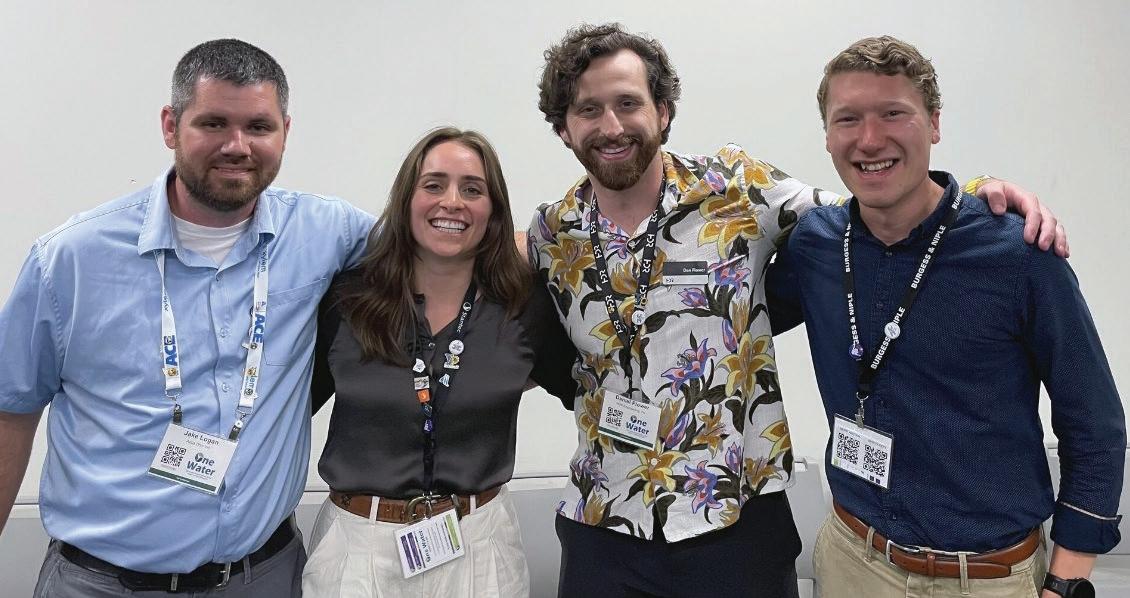
Pictured left to right: YPC District Coordinator Jake Logan; YPC Past Chair Dane Elliott; YPC Chair Elect Dan Flower; YPC Chair Matous Becker. (Not in the photo: Outreach Coordinator, Alex Short).
Careers Start Here: YP Committee Update
YP MEMBER SPOTLIGHT
YP Committee Chair, MATOUS BECKER
As Chair, Matous is the chief officer of the YPC, ensuring all activities align with the committee’s mission. He also manages finances, helps coordinate and plan statewide events, represents Ohio Section at national YP events, oversees recruitment and manages communications with the board.
YP Committee Chair Elect, DAN FLOWER
Dan supports the Chair in all YPC activities, in preparation to lead as Chair the following year. He also serves as Ohio YP Summit Chair, planning and executing the committee’s flagship event in collaboration with OWEA and OAWWA leadership.
YP Committee Past Chair, DANE ELLIOTT
As Past Chair, Dane provides continuity and serves as Section Engagement Coordinator, acting as liaison between the YPC and other OAWWA committees. She also advocates for YP involvement across the section, mentors liaisons, and helps YPs transition into broader leadership roles.
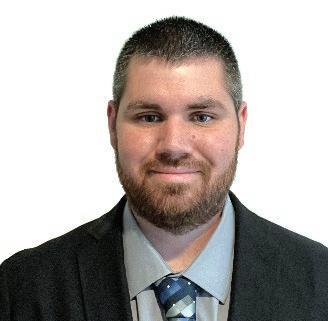
YP Committee District Coordinator, JAKE LOGAN
Jake leads the YPC District Sector, supporting YP district representatives across Ohio. He coordinates district events, maintains the statewide event calendar, and ensures alignment with section goals. Jake also encourages collaboration with local leadership and steps in when district reps need support.
YP Committee Outreach Coordinator, ALEX SHORT
Alex heads the Outreach Sector, driving initiatives with universities, operators, and students. He oversees several key outreach programs including Careers in Water Panels, the Fresh Ideas Competition, and State Science Day.
We asked our YPC leaders a couple quick questions. See page 26 for what they said!
Careers Start Here: YP Committee Update
YP MEMBER SPOTLIGHT
(continued)
What do you enjoy most about being involved with OAWWA and the YP Committee?
Matous Becker (YP Committee Chair):
The best part about being involved with OAWWA and the YP Committee in particular is the connections and friendships I have been able to make! I now have a host of people I can call for help with a problem I can’t solve or for information that I need for a project, not to mention the personal friends I have made through the YPC! I am also a sucker for an afterparty, and the committee is great at getting together after events to hang out (and sometimes sing karaoke). The Ohio Water Industry is a small world, and it’s wonderful to keep getting to know people within it.
Dane Elliott (YP Committee Past Chair): My favorite part of the YPC has been the connections I’ve made, which have allowed me to stretch beyond my comfort zone with my professional goals
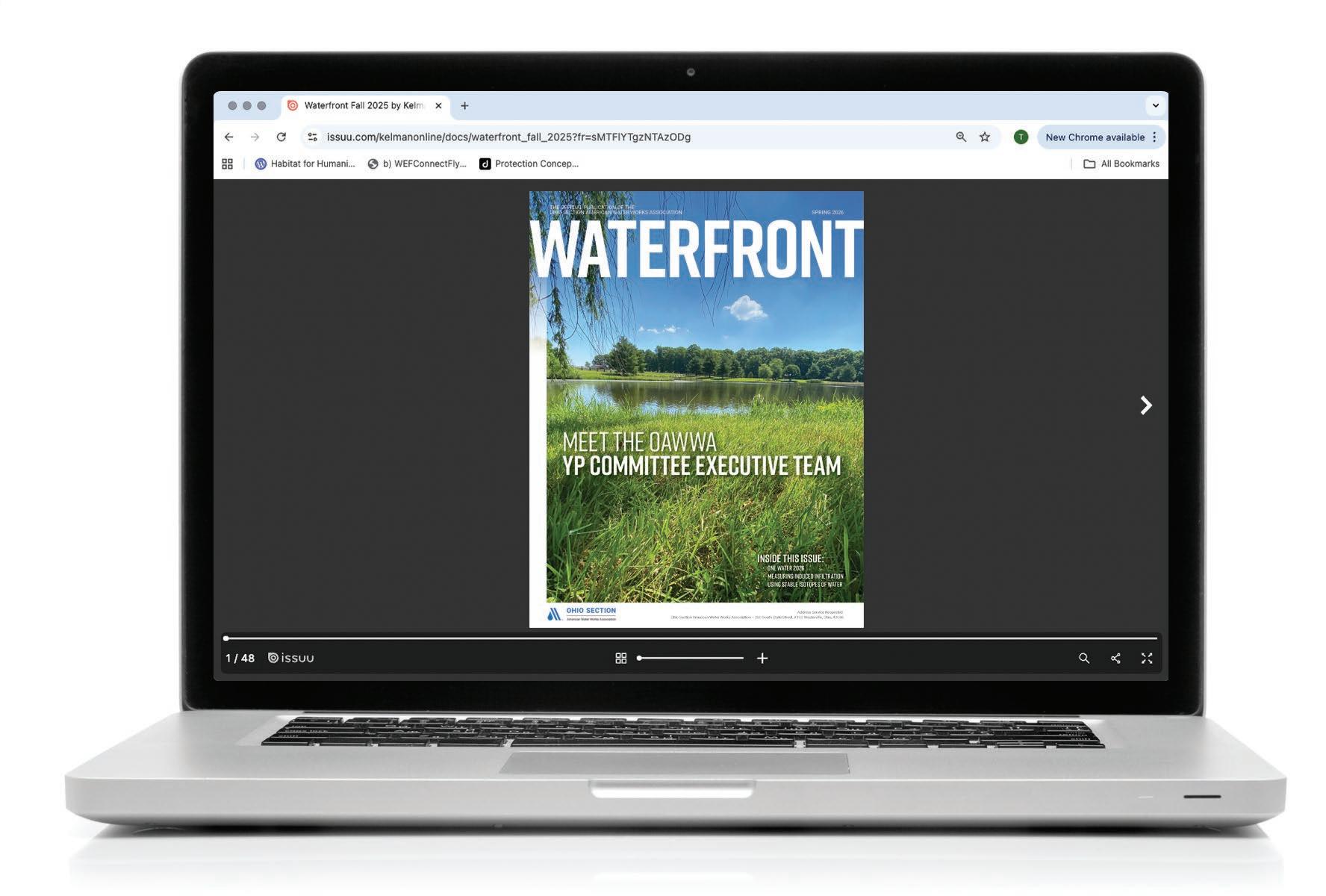
INTERACTIVE EDITION available online
With print and electronic communication operating hand-in-hand you can take advantage of the fact that WATERFRONT is also available online in a highly interactive format.
and growth! I have met so many people who are at different points and spaces in their career, and it has inspired me to be confident in forging my own path. Having such a large community in the water sector – in Ohio and beyond – has made work feel more fun, and it makes my personal work goals feel larger when I can contextualize them in the whole picture of the sector - which I’m able to do in having this community to share things with.
What is the most valuable skill you’ve gained through YPC involvement?
Dan Flower (YP Committee Chair Elect): With all the growth the YPC has had in the last two years, we recently restructured the committee to allow for more specialized roles. Using the restructure as an opportunity to allow people to harness their passion and create a committee system where people can run with ideas and have the support to execute them has been a rewarding challenge. I’m excited to see
how the committee continues to grow in the next two years!
Jake Logan (YP Committee District Coordinator): I’m naturally a quieter person, so the YP Committee has pushed me outside my comfort zone in the best way. The most valuable skill I’ve developed is the confidence to start conversations, share my experiences, and engage with people I don’t know well.
Alex Short (YP Committee Outreach Coordinator): Stepping into an executive role as Outreach Coordinator has allowed me to lead a sector of YPs focused on community engagement, significantly strengthening my leadership capabilities. I’ve had the opportunity to facilitate meetings and learn how to develop effective support strategies for team members. Additionally, attending events and conferences has allowed me to consistently maintain my networking and communication skills.
WHEN IS A PIPE MORE THAN A PIPE?
Made in America.
By AMERICAN
WHEN CUTTING-EDGE ISN’T A PHRASE, BUT OUR COMMITMENT. AMERICAN SpiralWeld Pipe is highly advanced. From engineering to a advanced robotic welding to controls that ensure a perfect layer of coating, our technology means unmatched precision in every pipe we ship. In turn, that means years of unmatched performance from every pipe you install—with the data to prove it. Call AMERICAN today. Or, even better, tour any of our mills. And see why, with our pipe, the future has already arrived.
DUCTILE IRON PIPE FLOW CONTROL
INTERNATIONAL
SPIRALWELD PIPE
STEEL PIPE
AWIA Emergency Response Plan Lessons Learned –Are You Prepared for Your Next Certification?
By Siraj Sirajuddin, Consultant at Trinity Consultants
For utilities serving a population of 3,301 to 99,999, requirements to complete risk and resilience assessments (RRAs) and emergency response plans (ERPs) under America’s Water Infrastructure Act (AWIA) is fast approaching.
On October 23, 2018, America’s Water Infrastructure Act was signed into law. Section 2013 of the AWIA amended section 1433 of the Safe Drinking Water Act (SDWA), requiring community (drinking) water systems (CWSs) serving more than 3,300 people to develop or update their risk and resilience assessments (RRAs) and emergency response plans (ERPs). The law specifies the components that the RRAs and ERPs must address and establishes deadlines by which water systems must certify to EPA completion of the RRA and ERP.
Since the start of the initial AWIA certification cycle in 2020, utilities and project teams have gained meaningful insights into developing RRAs and ERPs. The next ERP certification date for utilities serving a population of 50,000 to 99,999 or a population of 3,301 to 49,999, who certified on the previous deadline, is June 30, 2026, and December 31, 2026, respectively. The following lessons learned reflect recurring themes observed across utilities while developing their ERPs.
1. Risk & Resilience Assessment: A Critical First Step
AWIA requires RRAs to be updated every five years, and in practice, a utility’s risk profile can shift significantly within that period. During the assessment existing threats and vulnerabilities should be re-assessed to ensure the RRA is representative. The RRA should be updated accordingly based on the latest guidance and feedback from the utility. Furthermore, any capital or expansion projects should be reviewed to ensure all asset categories are captured in the RRA analysis. The ERP should incorporate any findings of the RRA.
2. Routine ERP Review: Going Beyond a Compliance Exercise
Given potential staff turnover, it is recommended that community water systems review their ERP on a quarterly basis to ensure basic contact information and assigned personnel responsibilities are correct and understood. It is an established best practice by the AWWA to schedule a more formal internal annual review of the ERP. To reflect emergency preparedness, utilities must treat the ERP as a living document. To accomplish this, identify and appoint an ERP champion to lead these routine reviews.
3.
Sever Weather Events: Planning for Natural Hazards
Recent history suggests that severity of weather events and natural hazards are one of the biggest threats to community water systems. Over the last few years, the sheer severity and intensity of natural hazards (e.g., ice storms, hurricanes, floods) can single handedly cripple utilities and resources. The ERP should have plans, procedures, and mitigation strategies to tackle these worst-case scenarios. It is recommended that utilities participate in an annual tabletop exercise to prepare and have accessible and readily executable plans during emergencies.
4.
Cybersecurity Assessment: Increase Your Resilience to Cyber Attacks
With the explosive use of artificial intelligence (AI), cyber attackers have become increasingly sophisticated and targeted. Experiencing a cybersecurity threat is no longer hypothetical, but an expectation. Utilities must engage their IT departments, leadership team, and operation managers for a thorough and detailed assessment of vulnerabilities. Using
EPA’s Water Cybersecurity Assessment Tool (WCAT) or AWWAs Cybersecurity Risk Management Tool provides a great starting point for these assessments. These frameworks help identify key cybersecurity concerns and provide a platform for utilities to further take ownership of their risk management strategies and improve their cybersecurity program.
5. Stakeholder Engagement: A Continuous Process
Engaging relevant stakeholders is an ongoing and continuous process. Internal and external stakeholders from different departments and across the organization should be informed of planned actions during emergency response and their role during these events and provided an opportunity to collaborate and share ideas on effective strategies. A typical list of relevant stakeholders include:
• Operational staff who understand day-to-day vulnerabilities
• IT and cybersecurity teams
• Leadership teams providing strategic direction
• External partners such as critical vendors, critical customers, Local Emergency Planning Committee (LEPC), and mutual aid networks
This can be facilitated by conducting an annual or biannual workshop for relevant stakeholders to participate which enhances preparedness and understanding of roles during emergencies.
6. Advance Planning & Preparedness: No Last-Minute Exercise
Developing an ERP is vital and not a last-minute exercise. Leverage the time allowed under the AWIA’s five-year comprehensive review and update cycle. Do not rush the review process and potentially miss inclusion of emerging threats or prevent sufficient stakeholder feedback. Allow at least four to six months to review and update the ERP prior to the certification deadline. Routine annual reviews and stakeholder engagement facilitate the five-year review and may streamline these timelines, preventing this from becoming a tedious, and time-consuming exercise. cdmsmith.com/
You’re facing challenges with lasting implications. We’re delivering world class solutions with lasting results. Tomorrow’s reality is unfolding today, and our forward-thinking approach will keep you one step ahead.
Know Your Member Benefits: Make the Most of Your Membership
YOU’RE A MEMBER: NOW LET YOUR MEMBERSHIP WORK FOR YOU
Whether you joined to grow your network, sharpen your skills, or bring more value back to your organization, your membership opens the door to opportunities many members don’t fully take advantage of.
Here’s a quick look at three of the most valuable benefits available to you – and how to start using them right away.
BUILD YOUR NETWORK (AND YOUR REPUTATION)
Your membership connects you to a statewide and national network of water professionals who understand your challenges – and can help you solve them.
What this means for you:
• Meet peers, mentors, and future collaborators at section and national events
• Get involved in committees, districts, and councils shaping the industry
• Build visibility and leadership experience that supports career growth
Tip: Attending just one event or volunteering once a year can dramatically expand your professional circle.
LEARN, GROW, AND STAY AHEAD
From frontline operators to executive leadership, members have access to highquality training and professional development designed specifically for the water sector.
Your benefits include:
• Member pricing on conferences, workshops, and webinars
• Access to technical resources, publications, and industry expertise
• Opportunities to present, publish, and share what you know Why it matters: Member discounts alone often offset the cost of dues – especially for training and events.
MAXIMIZE VALUE FOR YOUR UTILITY OR ORGANIZATION
If your employer is a utility or organization member, the value goes even further.
Organizational membership advantages include:
• Multiple included individual memberships that can transfer as staff change
• Member pricing for all employees –not just named members
• Access to utilityfocused resources, regulatory updates, and operational tools
Bottom line: One membership can benefit your entire team and support workforce development, retention, and compliance.
START USING YOUR BENEFITS TODAY
Your membership is more than a line item – it’s a resource designed to support you and your organization
• Explore upcoming training and events
• Connect with a committee or district
• Access memberonly tools and resources
Don’t leave value on the table.
Visit the member welcome page to activate your benefits and find your next opportunity to get involved.
GOT AN IDEA? Get Published inWaterfront!
Do you have a fresh perspective, a success story, or a challenge you’ve tackled in the water industry? Waterfront, the Ohio Section AWWA newsletter, is looking for contributors like you! Whether you’re an industry veteran or a first-time writer, this is your opportunity to share insights, highlight innovations, and spark discussions that move the water sector forward.
What We’re Looking For
You don’t need to be a professional writer, just someone with experience, research, or insight to share. Articles should provide valuable industry insights, technical expertise, or realworld experiences, focusing on knowledge-sharing rather than product promotion or marketing.
We welcome a wide range of topics, including:
• Technical Innovations & Industry Trends –Emerging technologies, case studies, and research
• Leadership & Workforce Development –Training, mentorship, and talent retention
• Community Engagement & Public Trust –Outreach, customer education, and partnerships
• Policy & Economics of Water – Infrastructure funding, regulatory updates, and industry challenges
If you have an interesting project, unique perspective, or valuable lesson learned, we want to hear from you!
Submission Categories – Choose What Works for You!
We offer flexible options to match your topic and level of detail.
• Quick Takes (500–1,000 words, 1–2 pages): Brief insights, industry observations, or lessons learned, such as case studies, emerging trends, or practical best practices.
• Feature Articles (1,500–2,500 words, 3–5 pages): In-depth explorations of projects, workforce challenges, leadership strategies, or policy insights.
• In-Depth Reports (2,500–3,000 words, 5–6 pages): Comprehensive research, major case studies, or data-driven analyses with visuals and technical details.
Upcoming Deadlines
Want to be featured in an upcoming issue?
Plan ahead with these key dates:
Issue Submission Deadline Target Mailing Date
Summer 2026 May 15, 2026 July 10, 2026
Fall 2026 September 18, 2026 November 6, 2026
Submissions are reviewed on a rolling basis but earlier is always better to ensure consideration.
Why Contribute?
• Share your perspective with Ohio’s water professionals
• Gain visibility in the industry and establish yourself as a thought leader
• Help shape the future by inspiring discussions on key issues
First-Time Writers Welcome!
Never written for a publication before? No problem! We encourage first-time contributors and can help guide you through the process. We welcome submissions from professionals at all levels. Email our managing editor julia@kelman.ca if you’d like formatting tips or writing help.
How to Get Started
Have an idea but not sure where to start? Let’s talk! Submit a brief summary of your idea to info@oawwa.org and we’ll help you bring it to life.
Take this opportunity to share your voice, make an impact, and get published in Waterfront!
Get
at neptunetg.com/BuiltForYou
Cyber Security Tools and Resources
Brandon Turner, Ohio EPA-DDAGW
Introduction
Ohio EPA’s Division of Drinking and Ground Water’s Operations and Resiliency unit manages a statewide cybersecurity program for public water systems (PWSs). This program provides PWSs with the appropriate tools, support, and resources to protect themselves from potential cyberattacks on their water system. Over the years, cyberattacks have evolved from informational technology (IT) based ransomware attacks to more advanced operational technology (OT) attacks. This article will discuss threats water systems often face and resources to mitigate them.
Potential Threats
Water systems can face a range of cybersecurity threats that can compromise operations and public safety.
• Ransomware attacks: hackers gain control of critical infrastructure and demand payment to restore access. PWSs can be locked out of their payroll systems for extended periods, potentially impacting the municipality’s revenue stream.
• Unauthorized access to SCADA systems: this can allow attackers to manipulate operational controls, potentially damaging equipment and contaminating the water supply by adjusting treatment rates to unsafe levels. Another danger is the ability to prevent HI/LO set point alarms from sounding to alert operations staff to issues.
• Insider threats: whether accidental or intentional, these pose significant danger when employees or contractors misuse their legitimate access. Phishing and social engineering attacks target personnel by impersonating trusted sources to steal credentials and gain system access.
• Other threats include supply chain compromises, data breaches, denial-of-service attacks, remote access vulnerabilities, and malware infections, all of which can disrupt services or expose sensitive information.
Increasing Vulnerability
Water systems are increasingly vulnerable to cyber threats as technology improves and expands. One major factor is outdated infrastructure, much of which was designed before implementation of modern cybersecurity standards. The growing use of internet of things (IoT) devices introduces more entry points for attackers, expanding the risk. Compounding these risks, many utilities lack the time, funding, and specialized resources needed to prioritize robust cybersecurity measures, leaving critical systems exposed.
Free Cyber Assessments
Ohio EPA encourages all water systems to take part in at least one of the free cyber assessments available to them. These confidential assessments are available from the Ohio Cyber Reserves (OhCR), U.S. EPA, and Dragos.
Through OhCR, a team of trained civilians help eligible Ohio municipalities with cybersecurity issues or concerns. They conduct assessments and provide recommendations to reduce cyber threats. Their goal is to support workforce development and educate cybersecurity personnel across Ohio. They can also respond to cybersecurity incidents to help municipalities identify, protect, detect, and respond in real time.
U.S. EPA offers free cybersecurity assessments, potentially reducing a PWS’ risk of attack by up to 45%. The risk mitigation template provided will help your PWS understand identified vulnerabilities and provide guidance for enhancing overall cybersecurity protection.
Dragos Community Defense program offers free access to a cybersecurity platform where you can track your OT assets, identify malicious behavior, assess and manage vulnerabilities, and provides a structured guide for incident response. Eligible participants include U.S. or Canada-based
EPA UPDATE
water, electric, and/or natural gas utilities not owned by a parent company that exceeds $100 million in revenue.
Mitigation
As your utility is working to complete the cyber security assessments discussed, there are several other steps you can take to reduce cybersecurity risks.
• Minimize exposure to the public internet by keeping devices on a secure local intranet.
• Conduct regular cybersecurity assessments, either internally or through a trusted third party.
• Change default passwords frequently and enforce strong password policies.
• Practice good cyber hygiene practices by removing past employee access to your network. Establish an allow list which only permits authorized IP addresses to access your network.
• Implement multi-factor authentication for all internetconnected devices.
• Maintain a comprehensive inventory of all operational technology (OT) and information technology (IT) assets.
• Develop and routinely test cybersecurity incident response and recovery plans.
• Update all security patches monthly, or as required.
• Provide ongoing cybersecurity training for staff to strengthen awareness and preparedness that can ensure a rapid and secure recovery.
• Implement redundancies within your system to limit outages.
• Finally, ensure all OT and IT systems are regularly backed up to protect against data loss and system compromise.
Benefits of a Cybersecurity program
Maintaining a robust cybersecurity program helps protect your systems and customer data from exposure, while safeguarding sensitive information. A strong program also plays a critical role in protecting public health by ensuring
water quality and safety. Additionally, it supports compliance with regulatory requirements and helps maintain operational continuity, reducing the risk of service disruptions. Mitigating the potential for significant financial losses from cyber incidents provides financial stability, preserves the reputation of your water system, and reinforces customer trust, which is essential for long-term success.
Conclusion
Although these programs, tools, and assessments are currently voluntary, the cybersecurity landscape for water systems is becoming increasingly complex and highrisk. Critical water and wastewater utility infrastructure is being targeted more frequently, and the severity of attacks continues to rise. It’s essential to take advantage of the available tools and resources before an incident occurs.
If you are interested in participating in a free assessment or just have general questions, please reach out to opcert@epa.ohio.gov.
Other Resources
Visit Ohio EPA’s dedicated cybersecurity website for details and links to each of the free cybersecurity assessments and a variety of other resources to ensure you’re well on the way to preventing and mitigating any identified vulnerabilities.
CISA (Cybersecurity and Infrastructure Security Agency) is a U.S. federal agency under the Department of Homeland Security (DHS) tasked with protecting the nation’s critical cyber and physical infrastructure. They offer a variety of resources, tools and training opportunities.
WaterISAC (Water Information Sharing and Analysis Center) is a nonprofit organization founded in 2002 to serve the cybersecurity and physical security needs of the U.S. and international water and wastewater sector. It operates as a trusted hub for utilities, agencies, and consultants to share critical threat intelligence and resilience best practices.
Although these programs, tools, and assessments are currently voluntary, the cybersecurity landscape for water systems is becoming increasingly complex and high-risk. Critical water and wastewater utility infrastructure is being targeted more frequently, and the severity of attacks continues to rise. It’s essential to take advantage of the available tools and resources before an incident occurs.
Operator Exam Preparation
Sean Roose and Colt Bush, Ohio EPA-DDAGW
Taking an exam can be a stressful experience. Have I studied enough? Covered the right subject areas? Will I remember what I’ve learned? Knowing that passing the test and getting the next level of certification could increase your salary and responsibilities can make it even more stressful.
This article outlines strategies for preparing for a certification exam and highlights resources available to help increase your chances of success.
Ohio EPA’s Operator Certification Program offers certifications in water supply, water distribution, water reclamation, and wastewater collection. To qualify for certification, you must pass the exam for the identified level. The internationally recognized Water Professionals International (WPI), formerly known as ABC, is Ohio EPA’s approved third-party exam provider. Applicants schedule their WPI exams through PSI, which provides testing locations and proctoring services. Use Ohio’s PSI registration link to select the time and location that best fits your schedule.
Where to Start, and What Do I Study?
Reference Material: Simply put, reference materials are the books and publications you need to study for your exam. All certification exam questions are derived from published sources in the field of water and wastewater. Reference material does not include unverified internet content. Reference materials change depending on the type and level of exam you are taking, so it is important to have the correct reference material for your exam. Common examples of reference materials include publications from California State University - Sacramento (CSUS), American Water Works Association (AWWA), and Water Environment Federation (WEF) to name a few. There will be a primary and secondary reference for you to use. An example of reference material
found in the Need-to-Know Criteria is pictured below and will be explained in the next section.
Operation and Maintenance CSUS Water Treatment Plant Operation, Volume 1 AWWA WSO Water Treatment Grade 1
15 Source Water Characteristics AWWA WSO Water Treatment Grade 1 AWWA Basic Science Concepts and Applications, 4th Edition
12 Security, Safety, and Administrative Procedures AWWA WSO Water Treatment Grade 1 No other references
Need-to-Know Criteria (NTK): Ohio EPA conducts a job analysis before developing any new exam. This process relies on nationwide operator surveys and workshops to identify the tasks and responsibilities associated with each certification exam level. In 2023, Ohio EPA distributed an exam development survey to operators specifically for this purpose.
Subject matter experts create the NTK criteria after compiling the data from surveys and workshops. The NTK outlines the frequency and importance of job tasks within the water and wastewater industry, based on operator level and experience. These tasks represent essential competencies and are considered critical for success at that certification level. Because exam questions are derived directly from the NTK, it is crucial for test-takers to review the appropriate NTK and master the material.
EPA UPDATE
The NTK is organized into major content areas – such as treatment processes, laboratory analysis, and safety procedures. Within each content area, you’ll find specific subjects and topics to study using the recommended reference materials. Below is an example of typical content areas included in the NTK.
The NTK criteria documents are listed on the Ohio EPA website under the ‘WPI Need to Know Criteria’ dropdown menu.
reinforce key concepts without requiring dedicated desk time.
To maximize effectiveness, consider setting small daily goals like listening to one lecture per day, and revisiting challenging topics multiple times. This approach turns passive time into productive learning opportunities and keeps the material fresh in your mind.
If you work at a plant and haven’t taken the exam yet, make it a priority to understand the plant’s processes in detail.
The licensed operators at your plant could be an invaluable resource – don’t hesitate to ask questions and seek their insights. Engage in conversations about troubleshooting, safety protocols, and common operational challenges. Take notes during your discussions.
Observe the operators during their shifts to see how they handle plant operations. This approach will not only improve your confidence and job performance but also give you a strong foundation for answering exam questions effectively. Please know that even though your plant may not use specific treatment or technologies listed on your NTK, you will still need to learn them.
Tips for Exam Day Success
• Get plenty of rest and eat a healthy breakfast on the morning of your exam.
Putting It All Together
As an example, if you plan to take the Water Supply Class 1 exam, begin by visiting Ohio EPA’s exam information webpage (linked above) to review the Class 1 Water Supply NTK criteria. The NTK document outlines the key content areas and subjects covered on the exam, along with the reference materials for study. Using both the NTK criteria and the listed resources, you can develop a focused study plan. Once you feel confident in your preparation, you can schedule the WPI exam through PSI.
Study Tips for Taking Certification Exams
Create flashcards using practice questions from the end of each chapter in the reference publications as well as other key sections of the book. Writing the information down reinforces memory and helps you retain important concepts. Flashcards are a great tool for active recall, allowing you to quiz yourself and strengthen understanding over time.
Use audio and video study guides to make the most of your study time, especially when you’re on the go. These resources allow you to learn while doing other activities, such as going for a walk, commuting, or even completing household tasks. Incorporating study materials into your daily routine helps
• Print directions to your testing location in advance to avoid last-minute stress.
• Bring two forms of identification, such as a driver’s license, passport, Social Security card, or student ID.
• Leave prohibited items at home – cameras, notes, tape recorders, and cell phones are not allowed in the testing room.
• No guests or visitors are permitted in the testing room or reception area.
• Personal belongings are limited to a wallet and keys, which will be stored in a locker during the exam.
• Watches and hats are not allowed in the testing room.
• Stay calm and focused – take a deep breath and work through each question one at a time.
• If you don’t pass, don’t give up! You can reschedule and retake the exam after 30 days.
Final Thoughts
It’s normal to feel anxious before an exam, but preparation is key. Use your time wisely by studying the correct reference materials and reviewing the NTK criteria to fully understand each content area. Doing so will give you the confidence you need for your best chance to succeed.
Best of luck!
Ohio EPA’s Radiological Monitoring Program
Isabel Leitholf, Ohio EPA – DDAGW
Summary
The addition of the Radionuclide Rule in 1976 to the Safe Drinking Water Act provides public water systems with treatment techniques and Maximum Contaminant Levels (MCL) which will reduce the risks of cancer and organ damage to the public. Throughout the state of Ohio there are natural and human made sources of radioactive elements. In drinking water, EPA is concerned with a variety of radiation sources such as: gross alpha particle activity, gross beta particle and photon activity, radium-226, radium-228, and uranium. Radium-226 and radium-228 have a shared MCL as Combined Radium and can increase the risk of cancer for people who are exposed to them over many years. The element uranium is a heavy metal and, over many years, can increase the risk of kidney damage as well as increase the risk of cancer as a result of its radioactivity. These elements can be found in the groundwater and surface water our public water systems (PWS) treat to provide potable water. The radiological monitoring program implemented by Ohio EPA and the Division of Drinking and Ground Waters (DDAGW) is designed to protect the health of consumers by eliminating or mitigating the risks radiation poses. Under the Radionuclide Rule, public water systems that have been classified as Community water systems are required to monitor for radiological contaminants on a regular basis.
History
The Safe Drinking Water Act was passed by congress in 1974 but originally did not address the potential of radiological contamination in drinking water. U.S. EPA proposed interim regulations for radiological contaminants in August 1975. The Federal Radionuclide Rule went into effect in December 1976 and Ohio’s corresponding rule went into effect on December 27, 1978. Over the next 25 years,
exposure and feasibility studies were conducted to determine what level the MCLs should be in order to ensure available laboratory analytical capabilities and protect human health. Some of these MCLs were proposed in 1991 as updates to the existing regulation but ultimately; they were not implemented. In December of 2000, U.S. EPA finalized the Radionuclides Rule as it is implemented today in 40 CFR Parts 141 and 142. The major changes between the 1976 rule and the modern rule are the addition of an MCL for uranium, requiring radium-226 and radium-228 to be measured separately before calculating the combined radium level, setting the monitoring periods to: quarterly, three, six, and § nine years, and finally, changing the gross beta screening level to only apply to systems that are determined to be vulnerable to gross beta particle and photon activity. This federal regulation is implemented in Ohio Administrative Code (OAC) 3745-81-15 Maximum contaminant levels and best available technologies for radionuclide contaminants and OAC 3745-81-26 Radionuclide monitoring requirements. These rules require community water systems to monitor for: gross alpha particle activity (excluding radon and uranium), radium-226, radium-228, combined radium, uranium, and, in rare circumstances, gross beta particle and photon activity. Table 1 provides the current MCLs for radiological contaminants. Except for gross beta particle and photon activity, and uranium, the MCLs are reported in pico-Curies per Liter. Pico-Curies (pCi) are a unit that is derived from the amount of material that produces 2.22 decays per minute. Since we are dealing with contaminants dissolved in water this becomes pico-Curies per Liter (pCi/L). Uranium is reported in micrograms per liter due to three primary isotopes (U-234, U-235, and U-238) having different half-lives, different rates of occurrence in different water sources, and it is a heavy
Table 1
Contaminant
Gross alpha 15 pCi/L*
Gross beta 4 mrem/yr†
Radium - 228 5 pCi/L
Radium - 226 5 pCi/L
Combined radium 5 pCi/L
Uranium 30 µg/L₮
* pCi/L or pico-curies per liter are a measure of radiation emitted per minute in a liter of water
† mrem/yr or milli-rem per year is a measure of radiation absorbed over a year by the body
₮ µg/L or micro-grams per liter (equivalent to parts per billion; ppb) is a measure of the weight, in micrograms, of a material per liter of water.
metal that is associated with kidney damage through chronic exposure. Gross beta is reported in millirem per year (mrem/yr) based on the potential for multiple elements and isotopes to be the source of radiation. Each isotope has a different decay rate and these can range from days to years and each element poses a risk to one or more organ. The mrem is a unit of absorbed dose, either to the whole body, a specific organ, or individual body part, so the mrem/yr represents the dose a target organ would receive throughout a year of exposure. Fortunately, gross beta monitoring is not typically required for PWS’s in Ohio.
Within the Radionuclide Rule and Ohio’s implementation of the program there are a few ways to reduce the monitoring burden of a public water system. For systems that have historically had low radionuclide contaminant levels there are the reduced monitoring schedules on three- and six-year cycles but the rule also allows for substitution of samples so long as they are below specific thresholds. Because of these allowances, the majority of community water systems in Ohio are only required to monitor for gross alpha and radium-228. Uranium monitoring may be satisfied using gross alpha data as long as gross alpha is below 15 pCi/L. Likewise, gross alpha can be substituted for radium-226 monitoring as long as gross alpha is below 5 pCi/L. If your public water system opts to substitute gross alpha data for radium-226 monitoring, special attention should be paid to both the gross alpha and radium-228 results as this substitution can result in a combined radium result over the 5 pCi/L MCL resulting in being placed on a quarterly monitoring schedule until four consecutive quarters have detections below the MCL.
Scheduling
Ohio EPA requires community water systems to analyze water samples collected from the entry point to the distribution system for radiological contaminants according to one of the following federal monitoring periods: quarterly, triennial (3 year), or once every 6 years. Within the triennial, and six-year monitoring period there are state compliance periods. These compliance periods break a given year into 2, 5-month blocks in order to stagger sample collection throughout the year with the goal of reducing sample load on analytical laboratories. If a public water system fails to collect a sample within the scheduled compliance period and report the analytical data results, a monitoring delinquency is issued. Once sample results have been reported to Ohio EPA, the delinquency is resolved. If a public water system fails to collect and analyze a sample within the quarterly, three-year, or six-year federal monitoring period, a federal monitoring violation is issued. To resolve a violation, a sample should be collected and the system will be required to issue a public notice. As a courtesy, the Chemical Monitoring and Compliance Unit at Ohio EPA preforms outreach throughout the compliance period and monitoring period to inform and remind water systems of deadlines and missing sample data.
The monitoring frequency and required contaminants are determined based on historical radiological data from regularly scheduled monitoring data or, in the case of new water systems, a new well analysis and 4 consecutive quarters of initial radiological monitoring.
Monitoring Frequency: Radionuclide Results for System:
3 months
At least once every 3 years
At least once every 6 years
Results are above the MCL or have few results for the system.
Results are above half of the MCL, but below the MCL.
Results are at or below half of the MCL.
This table outlines how radiological contaminant monitoring frequency is determined as detailed in OAC 3745-81-26.
Using Table 2 and the most recent radiological monitoring data, Ohio EPA staff determine the appropriate monitoring schedule for a PWS. Every year monitoring data is reviewed by Ohio EPA personnel and schedules are adjusted based on the available data. Annual monitoring schedules are distributed in mid-December. Occasionally, throughout the year it is
Table 2
Every
(Quarterly)
EPA UPDATE
necessary to adjust a radiological monitoring schedule. Revised monitoring schedules are reviewed and affected water systems are notified on a monthly basis. Revised monitoring schedules are hosted on the Ohio EPA website. Monitoring schedules are organized by County and within each county by Public Water System ID (OH0123456). A targeted email is sent to systems that have had a schedule revision. However, if you would like to be notified of changes regardless of which systems are on the list, you can sign up for updates at public.govdelivery.com/ accounts/OHEPA/subscriber/new.
I hope this look into the radiological compliance program gave you some background and perspective on the work our public water systems and Ohio EPA do together to keep drinking water safe for the state of Ohio.
I hope this look into the radiological compliance program gave you some background and perspective on the work our public water systems and Ohio EPA do together to keep drinking water safe for the state of Ohio.
There’s
Subject to change. Check www.oawwa.org/calendar-of-events for the most up-to-date information.
AWWA CAREER CENTER
• Search 175+ water industry jobs
• Upload your résumé and allow employers to contact you, while you remain anonymous
• Setup Job Alerts
• Access career resources, tips and tools
• Have your résumé critiqued by a résumé-writing expert
Our concern for the environment is more than just talk
We are committed to publishing the magazine in the most environmentally-friendly process possible. So enjoy this magazine... and keep thinking green.
Advertiser Product & Service Center
A&H
Waterfront is made possible by the companies below who convey their important messages on our pages. We thank them for their support of OAWWA and its publication and encourage you to contact them when making your purchasing decisions. To make it easier to contact these companies, we have included the page number of their advertisement, their phone number, and, where applicable, their website.
AUMA Actuators, Inc. 8 724-743-2862 www.auma..com
B.L. Anderson 17 513-889-4746 https://blanderson.com
Bennett & Williams Environmental Consultants, Inc. 37 614-882-9122 www.bennettandwilliams.com
BissNuss, Inc. 18 330-533-5531 www.bissnussinc.com
CDM Smith Inc. 29 312-346-5000 www.cdmsmith.com
Commerce Controls, Inc. 6 248-476-1442 www.commercecontrols.com/index.html Dixon Engineering, Inc. 32 800-327-1578 www.dixonengineering.net
EBAA Iron Sales, Inc. 8 229-273-7644 https://ebaa.com Fishbeck 37 800-456-3824 https://fishbeck.com
Franklin Miller Inc. 16 973-535-9200 www.franklinmiller.com
50 years of partnering with communities just like yours o quality projects ...
50 years of partnering with communities just like yours on quality projects...
Scan to learn more about our services
...and providing the funding assistance to get them done.
Bluffton
50 years of stories.
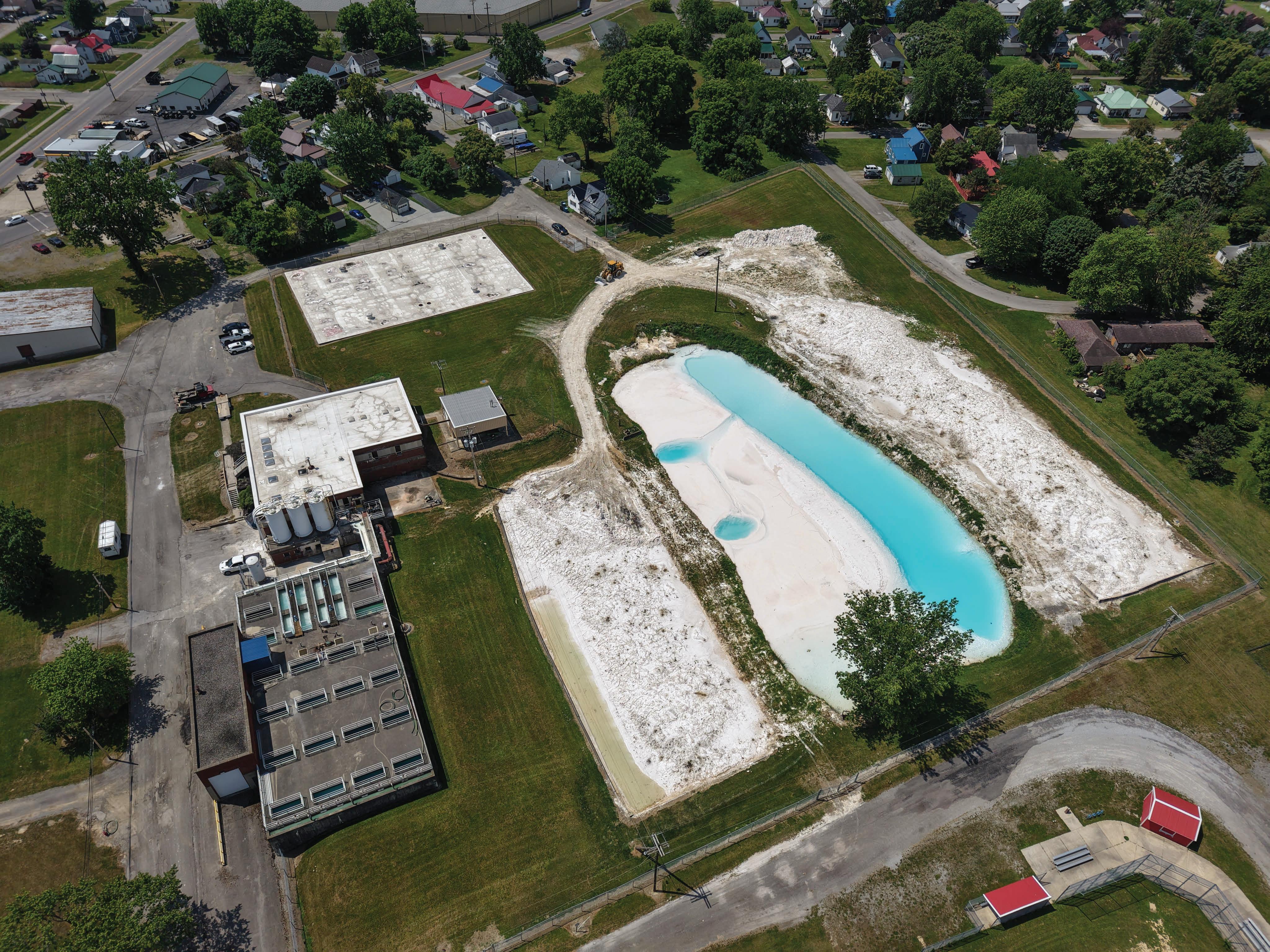
Water System Improvements Holgate, Ohio
Challenge: Naturally occurring bromide in the village wellfield created ongoing water quality concerns
Approach: Evaluated existing wells, water treatment facilities, storage, and distribution to meet Ohio EPA standards
Alternatives Studied:
Conventional treatment upgrades
Reverse osmosis
Regionalization
Selected Solution: Regionalized water supply with the City of Napoleon
Project Now in Design Includes:
Approximately 9 miles of new water main
TTHM mitigation infrastructure
N ew administration building
Booster station with chemical feed systems
C oordination with OEPA and funding agencies
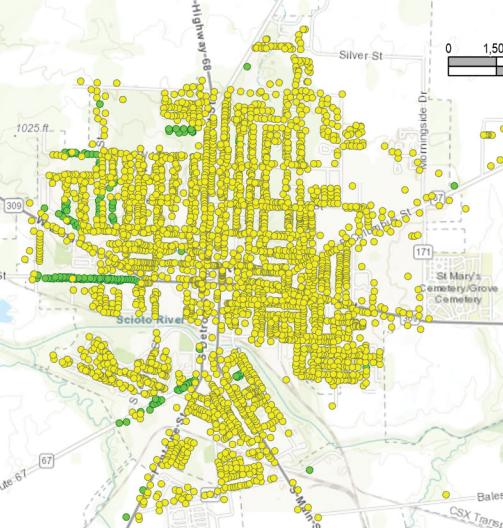
GIS Lead Service Line Inventory Kenton, Ohio
Regul atory Driver: Ohio EPA Lead Service Lin e Inventory (LSLI) requirements
Objective: Develop a comprehensive, maintainable inventory of s ervi ce line materials to support regulatory compliance and public transparency
Project Approach:
Developed a GIS-based Lead Service Line Inventory within the City’s existing mapping system
Created OEPA ‑ compliant fields and domains for tracking service line materials
Integrated available system, curb stop, and records data to populate inventory attributes
Deliverables Included:
Interactive GIS mapping layer for lead service line tracking
LSLI dashboard to summarize, view, and export inventory data
Training for City staff to access, maintain, and update the inventory
Outcome: Provides the City of Kenton with a scalable, OEPA compliant inventory tool that supports ongoing system evaluation, regulatory reporting, and future lead service line replacement planning
50 more years of stories to come.
Eric Davis, Business Development ericd@wesslerengineering.com
419.615.8708
For
Let’s
Protect equipment for years to come Cut energy waste