Clara Gfeller, Chapman, Nell Goss, Ellsworth; Cora Coffey, Manhattan; Mason Willard, Manhattan; Erica Lieb, Pike Valley; Eli Olander, Southeast of Saline
NORTHEAST
Carly Bohlken, Marysville; Ashton Neill, Atchinson County; Addison Bontrager, Holton; Natalee Stratham, Axtell; Liberty Sharpe, Wamego; Brooke Slipke, Jackson Heights
NORTHWEST
Lizzy Vajnar, Hays; Madison Johnson, Phillipsburg; Ella Neher, Hays; Kaelyn Schilling, Goodland; Hayden Short, Goodland; Mia Odle, Stockton
SOUTH CENTRAL
Kora Zongker, Fairfield; Eliza Rozenhagen, Cheney; Kayli Snyder, Buhler; Kenzie Kalb, Maize; Anna Doyon, Maize; Torbin LaPean, Sedgwick
SOUTHEAST
Riley Sturgis, Riverton; Delaney Bradford, Neodesha; Maria Cibrian-Vazquez, Uniontown; Jaci Falkenstein, Labette County; Lainey Prince, Girard; Sophia Heim, Marmaton Valley
SOUTHWEST
Rebecca Durler, Bucklin; Ethan Petersilie, La Crosse; Lexi Averhoff, Ingalls; Emma Petersilie, Ness City; Audra Oborny, La Crosse; Kamryn Meyer, Scott City
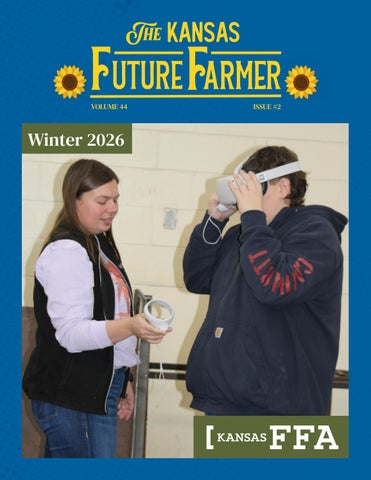
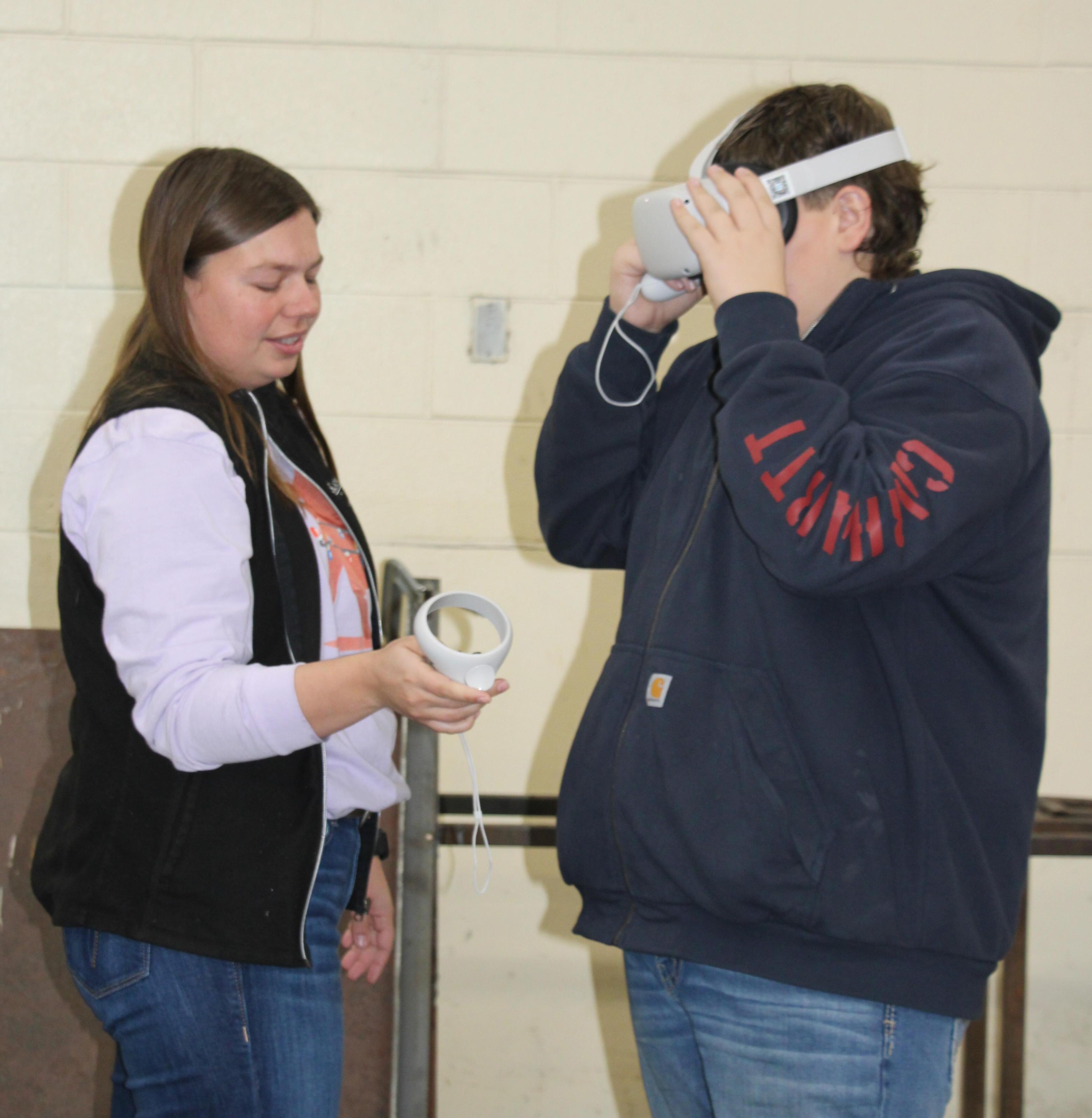
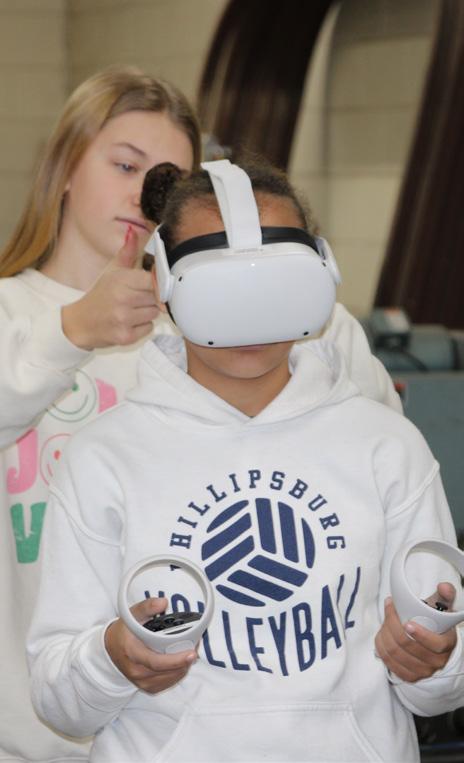
ON THE COVER: Phillipsburg agricultural education instructor, Allison Dix, works with a middle school student using a virtual-reality headset for career exploration.
by Lillian Hulse, State FFA President
We are halfway through the school year, Kansas FFA! The last few months have been filled with learning opportunities, new experiences, and loads of fun.
Looking back, members found success at the Kansas State Fair, seven district Greenhand Conferences were held, and chapters held many successful events. District CDE and LDEs have left participants with more knowledge in career success and leadership development. The first half of this FFA season has now concluded; what will the second half include?
The spring semester brings exciting experiences. National FFA Week awaits us all, as well as anticipated district events, chapter meetings, and much more. I encourage you to dive right in and embrace the opportunities presented. You
FAST FACT :
never know what you may learn from an experience or who you may meet.
I want to leave you with a challenge this semester: channel the power of “yet.” We all have things we struggle with. Growing up, I was a very slow reader. I could have easily told myself, “I am not a good reader.” But, I was encouraged to add one word to the end of that sentence,“YET!”
This spring as we think of what we want to improve on, remember the power of yet. When you think, “I am not good at public speaking, giving reasons, making new friends, etc…” Remember that these statements take all the power away from us. By adding the word, yet, we are taking back the power to work hard, improve, and to be the people we want to be.
Three Kansas FFA members were named FFA in the USA reporters. These members stories about Kansas can be found at www.ffa.org/ffa-in-the-usa/
This edition of the Kansas FFA Future Farmer is underwritten by Frontier Farm Credit. Learn more about Frontier Farm Credit at www.frontierfarmcredit.com
TANGIBLE RESULTS VIRTUAL REALITY
Virtual reality headsets give middle schoolers a clearer future into their career choices.
Imagine...being in middle school, and pondering what career path would be right for you…
Interestingly, eighth grade is considered a critical year - a predictor of staying in school and graduating. Students who’ve identified career paths have higher grades and a sense of belonging, resulting in more reasons to stay in school.
Several years ago, the Kansas Department of Education began requiring each eighth grader to start an ‘Individual Plan of Study’ - a guide for career focus and coursework throughout high school.
Also, Kansas’ future workforce needs young skilled workers.
And now!...Kansans in grades 6-8 have the exciting opportunity to ‘try out’ different careers; through virtual reality oculus headsets (including eyeglasses and career-planning curriculum.)
Thanks to the launch of the Youth Career Discovery partnership comprised of Kansas FFA, Kansas 4-H, Jobs for America’s Graduates–Kansas (JAG-K), State Alliance of YMCA’s, and Kansas Boys & Girls Clubs – and recent grant funding, this YCD partnership is placing virtual reality oculus headsets in various Kansas communities.
“These ‘TRANSFR Trek’ program simulations offer a high-impact, immersive feel of a virtual career discovery experience through simulations that take students into the virtual workplace,” said Joyce Glasscock, Executive Director; Kansas Alliance of Boys & Girls Clubs.
As Kansas FFA partnered with the four other youth organizations to showcase a wide range of career opportunities, students were encouraged to explore at least one agricultural career in
by Amy Hadachek
considering future career paths.
“It was exciting to see youth who visited the Kansas FFA space at the Kansas State Fair, along with current FFA members, engage in the VR career experiences this fall,” said Mary Kane, Kansas FFA Executive Secretary.
Through Kansas FFA, Kane offered the VR program to two rural northwest Kansas FFA chapters; Hoxie and Phillipsburg in September 2025.
“I get a new batch of 10 eighth graders every nine weeks. Students take a skilled-based quiz, so we can match them up with their preferences. Then, they’re put in headsets,” said Allison Dix, agricultural educator and FFA advisor at Phillipsburg High School. “I had a student use the VR program recently; who wanted to be a lineman. But, through the VR glasses, he looked out at the tower and realized - heights aren’t for him,” Dix explained. Another simulation is knee surgery, which shows blood in the project; important for students considering becoming a surgical technologist. Some students relayed, “This is awesome...sign me up!”
Additionally, headsets were placed in Russell and Hays schools by Jobs for America’s Graduates. Boys & Girls Clubs assigned headsets to Hutchinson and Manhattan. YMCA headsets are in Wichita. 4-H headsets are in Republic, Cloud, Washington and Clay counties.
OUR KANSAS FFA. OUR YOUTH. OUR FUTURE.
A quieter kind of power: how a statewide endowment will keep FFA strong for years to come.
Think about the last time you put on your FFA jacket. Maybe it was for a district contest, a chapter meeting, or a big trip to a convention. That jacket is more than clothing — it’s a symbol. It says you belong to something that teaches you how to lead, how to work, and how to take a plan from an idea to reality.
Now imagine more youth across Kansas having that same chance — more chances to travel to leadership events, more support for teachers, more scholarships, more help starting real projects like an SAE. That is the simple, powerful idea behind the Kansas FFA Foundation’s campaign, Our Youth. Our Future. Our Kansas FFA. The foundation has set a goal of raising $5 million to build an endowment that will support FFA programs for generations to come.
What is an endowment? Basically, a long-term savings account. The money is invested and a portion of the earnings is used each year to pay for programs and opportunities. The principal remains invested, producing income year after year. That means a single big push now can turn into steady support for decades to come. Put another way: it’s a way to make sure the chances you had in FFA are there for the students who come after you.
Why now? Because Kansas FFA is growing — fast. Today, nearly 14,000 members belong to 242 chapters across the state. New chapters are forming in small towns and in larger cities. That growth is cause for celebration, but it also creates new needs. More students means more teachers, more classrooms, and more demand for trips, contests, and hands-on projects. It also means many agricultural teachers are newer to the classroom and need mentoring, resources, and training to help students succeed.
by Beth Gaines
The endowment is meant to help with exactly that. Instead of relying solely on grants, annual sponsorships, and donations, the Foundation seeks a reliable, steady funding source. That stability doesn’t just make budgets easier to predict. It makes it possible to plan, to try new ideas, and to make sure every chapter — no matter its size — has a fair shot at the same opportunities.
What will the endowment pay for?
The short answer: the things that matter most to students and teachers.
Teacher support. The Beginning Educator Support Team, known as BEST, helps new agriculture teachers with mentoring, coaching, and curriculum support. It’s a lifeline for teachers who are finding their feet. The endowment will help sustain the program so more teachers can get the support they need.
Student programs. Earnings from the endowment will expand opportunities for student learning and growth at every level. Those small investments often turn into big opportunities.
Every day stability. The endowment will help maintain core services for the FFA Association so a change in the budget or a lost grant won’t force cutbacks in programs that students rely on. It also means additional staff can be hired, ensuring the much-needed support to create and produce the high-quality programs FFA is known for.
Who is leading the charge?
Every big campaign needs leaders who show the way. Kevin Harris, campaign chair and a lead donor, and his wife, Rosemary, gave the first major gift that helped launch the campaign. Their example helped others step forward.
“My wife Rosemary and I believe so strongly in this effort that we gave the first lead gift to kick off the campaign,” Harris said. “We know the value and the reward of supporting youth and agriculture. Any gift, large or small, will allow us to achieve the mission.”
Other donors have followed. Early and major gifts created momentum, encouraging alumni, businesses, and entire chapters to participate. That combination of grassroots energy and big leadership gifts is exactly the mix the foundation hopes will carry the campaign across the finish line.
What are some ways to support the effort?
The foundation wants to make giving easy and flexible. Farmers and ranchers who prefer can donate grain or livestock, which can have tax advantages. People can make one-time gifts, set up multi-year pledges, or give a little each month. Planned gifts — such as leaving a gift in a will — are another way to support the foundation over the long term.
Businesses can help through corporate sponsorships that raise their visibility while investing in the future workforce.
A campaign for the next 100 years
This campaign isn’t about a single season or a single group of students. It’s about building something that lasts. As the national FFA nears its 100th year, Kansas leaders see the endowment as a way to ensure the next century of students has the same—or better—opportunities than today’s students.
That’s a powerful idea: the choices made now could help a freshman 30 years from now attend a leadership conference, start a business, or find an inspiring teacher who believes in them.
What’s left to do?
The foundation has made huge progress. As the campaign moves into its final push, it is within
reach of its $5 million goal — and finishing strong will take contributions large and small.
The time is now
If you’ve ever benefited from a teacher who stayed late to help you practice or an advisor who believed in your idea, you know what a difference one person can make. This campaign is a way to multiply those moments — to give more kids the teachers, the trips and the chances that helped shape you.
“Our Youth. Our Future. Our Kansas FFA.” is more than a slogan. It’s a promise: that the next student to zip up a blue jacket will have someone, somewhere who helped make that moment possible.
WANT TO LEARN MORE? WANT TO LEARN MORE?
If you want to talk to someone about giving options, reach out to the Kansas FFA Foundation office — they’re ready to help. Johanna Anderes and Beth Gaines are available to answer any questions or set up a personal meeting.
This is your chance to be part of something that will last. Think about where your jacket has taken you. Share that story with others and act today. The future of Kansas FFA is in your hands.
ALL IN DUE TIME NATIONAL WINNERS
Two Kansas FFA chapters shine at the national level with high placings in Career Development Events.
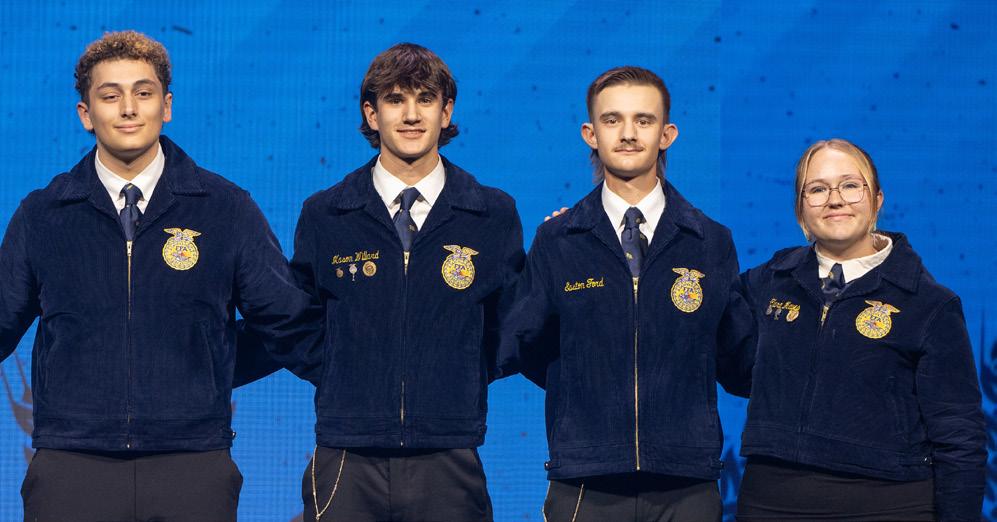
Two Kansas chapters soared to top levels at the 2025 National FFA Convention Career Development Events (CDE) with first place in agronomy from Washington County and second place in floriculture from Manhattan.
“CDEs are becoming more important,” said Manhattan advisor Alyssa Higbie. “Students enjoy showcasing what they are learning in class and on their own by competing.”
CDEs are competitive events at district, state and national levels challenging students to apply knowledge and skills to real-life situations.
“These events help bring our chapter together and give the members a sense of accomplishment,” she said.
AGRONOMY
Washington County’s top team included Amber Kolle, freshman at Kansas State University (KSU), seniors Jonathan Wright and Destyni Christenson, and junior Dawson Strunk.
“These schools [at nationals] are the best of the best year in and year out,” said John Kern, advisor. “I am very proud that our students were able to compete at this level with these outstanding programs.”
by Lucas Shivers
Individual sections of the agronomy CDE test knowledge in evaluating crop quality and identify various weeds, crop plants, seeds and soils, insects, plant diseases and nutrient deficiencies.
Participants’ understanding of agronomic sciences was tested through levels of competition in the four areas of pest management, soil and water quality, nutrient management and crop management.
The CDE proved to be one of the closest team finishes in the 25-year history of the competition, with 21 points separating the top three teams in the event.
Originally, the Kansas team was announced as the second place team. However, a scoring correction was discovered during the review process where the soils and nutrient management section was not tabulated correctly, adding 32 points to Kansas to become the highest scoring team.
“I was so excited for this year’s team and how they put so much time and effort into preparing for this event,” said Kern. “They have learned so much and I am very proud of them.”
This is the third national agronomy CDE championship for Washington County, with back to back titles in 2008 and 2009.
“Work hard and it’ll pay off. Anything is possible when you put in the time to really compete.”
- Mason Willard
FLORICULTURE
The Manhattan CDE team included Easton Ford, a freshman at KSU, and seniors Jibran Khmous, Clara Mayes and Mason Willard.
“A lot of work was put into winning these awards,” said Higbie. “The team met many times to practice together on a regular basis. We started meeting together over the summer to prepare. Many flowers were bought for arranging and many practice tests were taken. We also visited people who work in the field of floriculture to learn tips and tricks from industry professionals.”
The floriculture event inspires career interest with hands-on technical skills. Floriculture involves cultivating flowering and ornamental plants, greenhouse production, garden center management and floral design. The event also tests members’ employment readiness, plant identification and sales practices.
“Our plan is to constantly improve and get better every year,” said Higbie. “We have had a lot of fun working together as a team to make the Manhattan FFA Chapter known.”
IN THIER OWN WORDSMANHATTAN’S MASON WILLARD
“We didn’t know much at all to start off this journey in floriculture, but it was a real push from our teammate Easton and advisor Mrs. Higbie. We saw a little success at a few district events. We got a pep talk to try to win at state and get to the national level. We studied a lot, like hours each day.
We had always gotten second at the district level, so we had the advantage of being the underdogs in May 2025 at the state CDE where we actually won. At that point, we knew we’d compete at nationals in the fall. We knew it was a chance to be at the highest level so we met all summer and into the new school year to prepare.
We studied for most of the 14-hour road trip to Indianapolis. For the CDE, there were sections on plant, pest and disease identification. There was a table-setting demonstration for an awards banquet with an arrangement of centerpiece, wearables and napkin rings as well as a team component of greenhouse practicums and tests.
They announced the results two days later at a banquet. They ran through everyone in bronze and silver levels. None of our names were called in either of those. We did the math and found that we were all in the top 40 at the gold level.
So then, as a team, we were called up in front of everyone in the full 40,000 arena. We found out how hard work paid off with our second place finish behind North Carolina and California who tied for first. Even after some technical updates on scoring, we stayed in second place.
Work hard and it’ll all pay off. Anything is possible when you put in the time to really compete. Looking back at those first district competitions, we could have placed so much better with the knowledge we learned by the end. It took so much preparation to turn around with success at the national level.
It’s a dream to complete and place at this CDE. It’s something that will live with us for a long time. Manhattan FFA had very few members a few years ago, and now we’re succeeding at the highest level. We’re not a big chapter in a rural town, but we pull in all types of people to be who we are with a passion to learn more and a strive to compete.”
Mason plans to attend Pratt Community College for the electrical power lineman program.
Kansas FFA Association 110 Umberger Hall 1612 Claflin Road Manhattan, KS 66506
Attend the LEADER LAB Conference
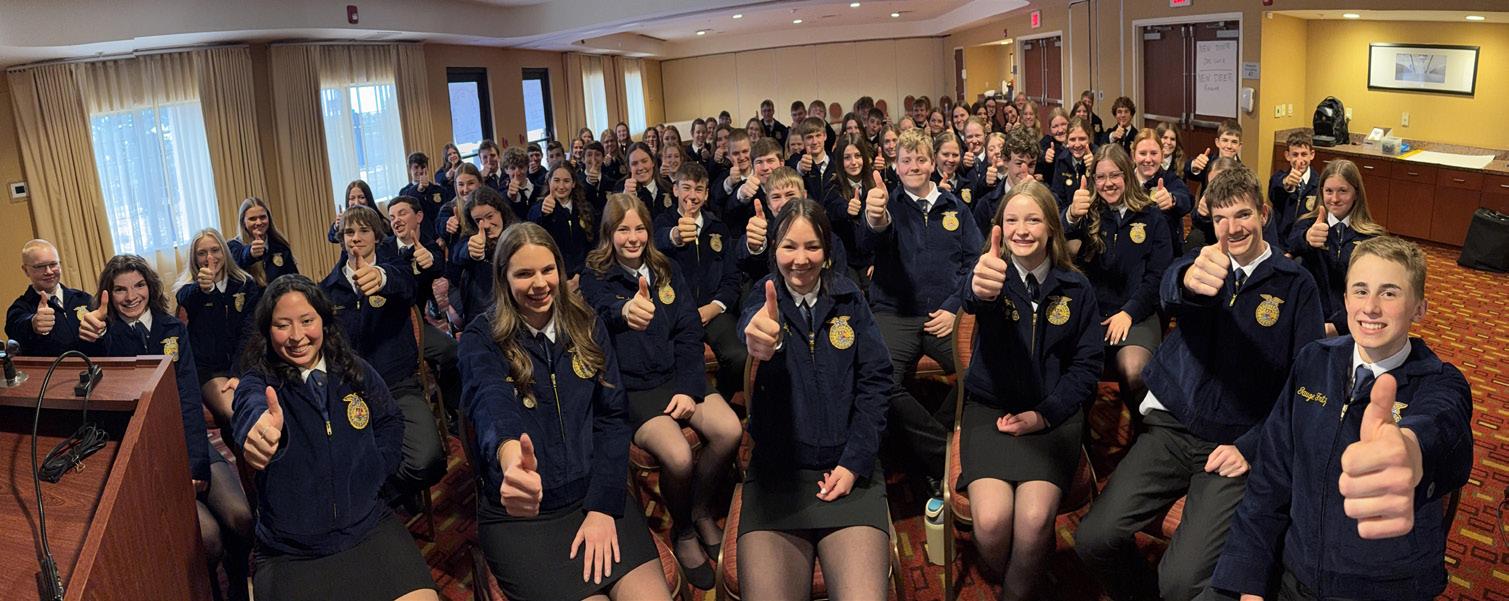
During Leader Lab members have an opportunity to network with others from across the state and go through workshops with professional facilitators on important topics such as goal setting, time management, and communication. Members learn a lot in a short amount of time that they are able to take back to their chapters.
March 12th at Hays
March 13th at Emporia
See our website (www.ksffa.org) for more information on the following:
Calendar of Events
List of Chapters and Districts
List of Foundation Sponsors Awards Programs
Give to the Kansas FFA Foundation by scanning the QR code above!