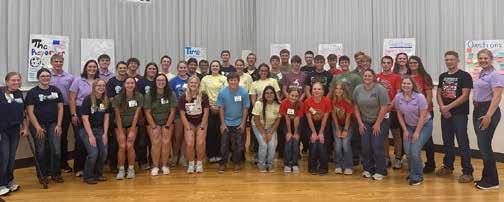
Clara Gfeller, Chapman, Nell Goss, Ellsworth; Cora Coffey, Manhattan; Mason Willard, Manhattan; Erica Lieb, Pike Valley; Eli Olander, Southeast of Saline
NORTHEAST
Carly Bohlken, Marysville; Ashton Neill, Atchinson County; Addison Bontrager, Holton; Natalee Stratham, Axtell; Liberty Sharpe, Wamego; Brooke Slipke, Jackson Heights
NORTHWEST
Lizzy Vajnar, Hays; Madison Johnson, Phillipsburg; Ella Neher, Hays; Kaelyn Schilling, Goodland; Hayden Short, Goodland; Mia Odle, Stockton
SOUTH CENTRAL
Kora Zongker, Fairfield; Eliza Rozenhagen, Cheney; Kayli Snyder, Buhler; Kenzie Kalb, Maize; Anna Doyon, Maize; Torbin LaPean, Sedgwick
SOUTHEAST
Riley Sturgis, Riverton; Delaney Bradford, Neodesha; Maria Cibrian-Vazquez, Uniontown; Jaci Falkenstein, Labette County; Lainey Prince, Girard; Sophia Heim, Marmaton Valley
SOUTHWEST
Rebecca Durler, Bucklin; Ethan Petersilie, La Crosse; Lexi Averhoff, Ingalls; Emma Petersilie, Ness City; Audra Oborny, La Crosse; Kamryn Meyer, Scott City
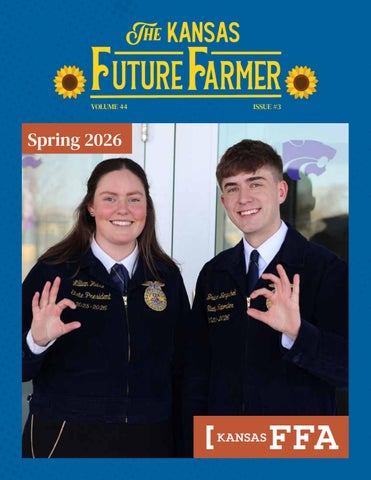
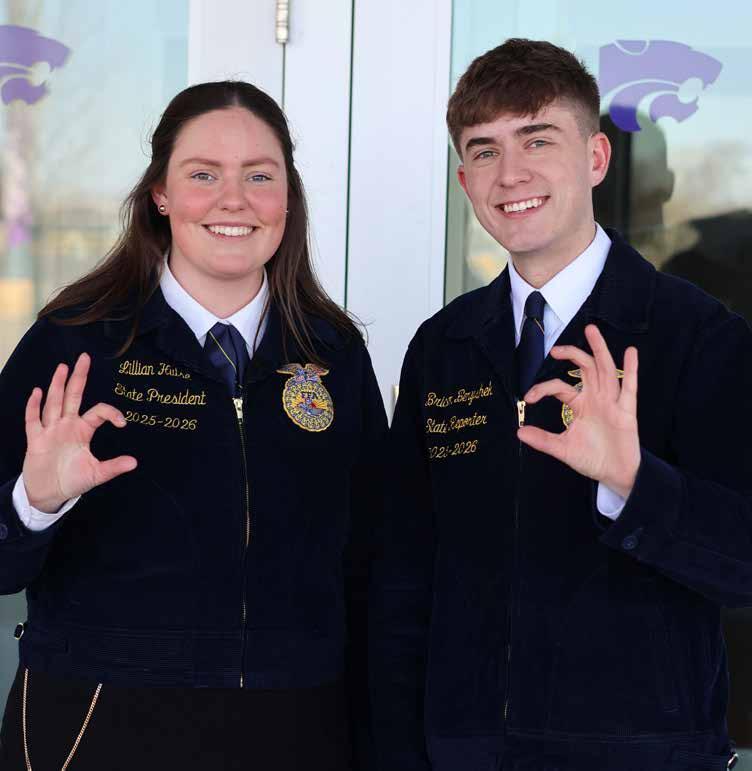
ON THE COVER: State Officers Lillian and Bricen pose in front of Morgan Family Arena doors, which will welcome members at the 1st General Session of the 2026 Convention.
by Lillian Hulse, State FFA President
What does it mean to cultivate? Merriam-Webster defines cultivate as, “to prepare or prepare and use for the raising of crops.” I am confident many members are familiar with this definition, whether your SAE is Grain, Poultry, Vegetable, Beef, or Sheep Production, and many, many more. Your crop could be wheats, eggs, vegetables, calves, lambs, wool, and the list goes on.
All members in these SAEs know one universal truth. To harvest any one of these crops, it is necessary to put in work to plant, prepare, and tend to their projects; it is necessary to “cultivate.”
Cultivate is the 98th Kansas FFA State Convention theme. My team and I spent time deliberating and reflecting on our choice, and ultimately we believe “Cultivate” is the perfect theme because of another definition, “to foster the
FAST FACT :
growth of.” This is not limited to wheat or calf crops. As FFA members and young leaders, we hold true to the motto, “Living to Serve”. To serve, it is necessary to foster growth in ourselves, our peers, and our community.
Cultivation is about putting in the up-front effort to create a space suitable for growth.
In our season of convention, we reflect and celebrate the accomplishments members have made in their competitions, SAE’s, impacts they have made on their communities, and many more. Convention is one of our “harvests.”
During this convention, as we celebrate the amazing year we have had, let’s cultivate an even better one to come. I encourage you to harness the power of cultivation to make this year one you could only imagine!
The Kansas FFA Convention sessions have taken place in McCain Auditorium on the campus of Kansas State Univesity since 1971.
This edition of the Kansas FFA Future Farmer is underwritten by American Farm Credit. Learn more about American Farm Credit at www.agloan.com
A NEW TRADITION
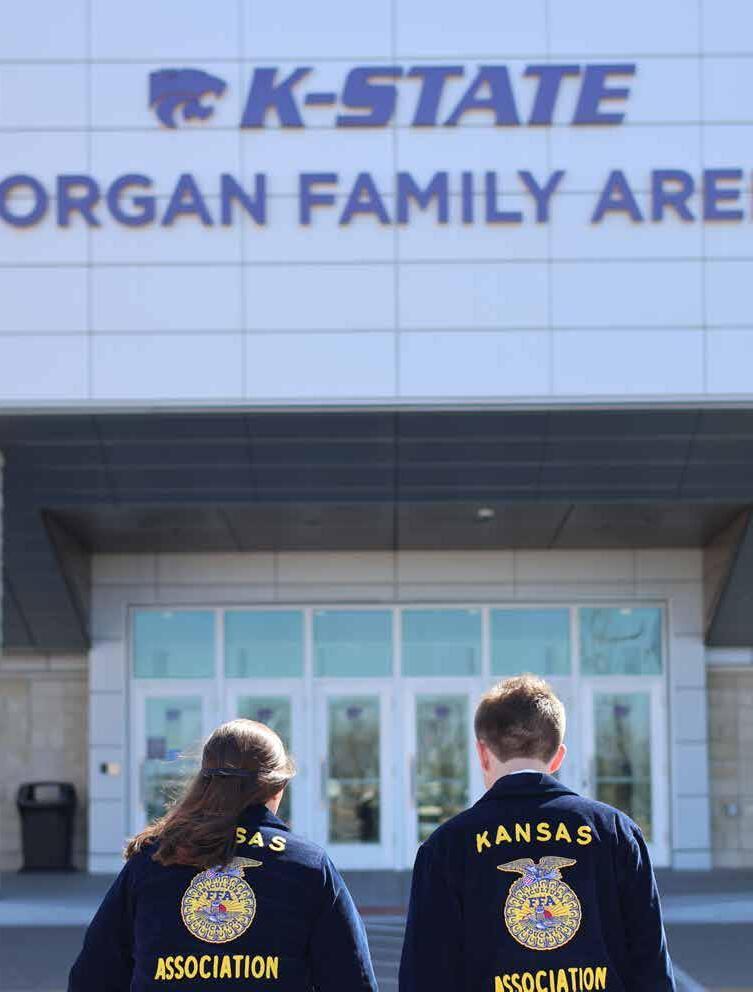
The Kansas FFA Association is proud to announce an exciting new chapter for the 98th Kansas FFA Convention with the Opening Session moving to the Morgan Family Arena on the campus of Kansas State University.
For the first time since experiencing significant growth, our event will bring all FFA members, advisors, and guests together in one location to kick off the convention, creating a unified and energetic start to this premier leadership event.
This change allows the Kansas FFA community to come together in a larger, more inclusive space, enhancing the experience and celebrating the impact of agricultural education across the state. Following the Opening Session, convention activities will continue at the historic McCain Auditorium, where Sessions 2 through 7 will be held.
The Kansas FFA Association looks forward to welcoming members to this new tradition and an unforgettable convention experience.
KANSAS FFA FOUNDATION BOARD OF TRUSTEES
• 15 Past State Officer teams achieved 100% giving
• Donors from all 105 Kansas counties
• Donors from all 50 states, Washington D.C., Canada, and Switzerland
• 67 volunteers and ambassadors helped encourage giving
Thank you to our Match Partners: Ag Partners Cooperative, Mustang Seeds, John and Jennifer Niemann, Keith and Sheri Westervelt, Kansas FFA Foundation Board of Trustees, Holle Gelbvieh — Orrin and Beth Holle, Mark Mayfield, Chris Schmidt, Regional Veterinary Service — David and DeRhonda Newby, S&S Rock Crushing — Peña Family, Jerry and Anita DeWeese, iCEV Curriculum, K-State Ag Education Club
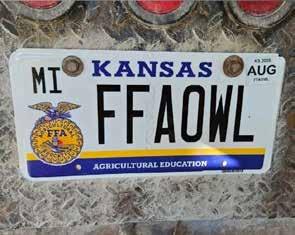
Are you renewing your vehicle tags soon? All across the state, you can visit your county treasurer and let them know you’re interested switching to the Kansas FFA plate! The cost for a Kansas FFA license plate is an annual donation of $50 for each vehicle, which benefits the Kansas FFA Foundation. They are even customizable!
KANSAS COMMUNITIES AG ED PROGRAMS NOURISH
Three Kansas agricultural education programs highlight the work they’ve done tackling food security.
Actively bolstering food security efforts, Kansas FFA chapters and their agricultural education programs are reaching deeply into the core needs of their students and communities.
Dexter in south/central Kansas near the Oklahoma border, is considered a food desert; 30 minutes from a grocery store. Being a part of the solution to food insecurity was Chelsy Champlin’s goal, when starting Dexter’s agriculture program seven years ago.
“Dexter High School was able to install five large raised garden beds to create a community garden five years ago, from a grant through the National FFA organization. Our garden has been really successful. We recently planted broccoli, cauliflower and tomatoes. We’ll also plant sweet potatoes, cabbage, peppers and green beans,” said Champlin, agricultural instructor and FFA advisor at Dexter High School. Dexter FFA shares produce from the garden and orchard with students, staff and the community. Supplementing their four apple trees, they used grant funding to buy eight more trees; including apple trees, peach, plum and pear trees, and raspberry bushes.
“We also have a chicken house out back for eggs, and we raise salad greens in grow towers throughout the year,” Champlin said.
Marysville High School’s FFA Chapter is strengthening food availability in the local community.
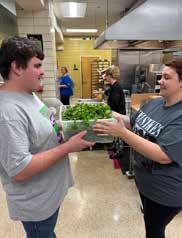
This year – the chapter is strengthening food security at school; harvesting hydroponic lettuce from their four hydroponic grow towers for lunches at their school cafeteria. Adding even more nutrition to school lunches this year, Marysville FFA’s “Farm To Plate” initiative” welcomes donations of locally raised beef, pork and produce from area farms.
by Amy Hadachek
“It’s great to say our kids are eating locally grown ag products, and my students have a hand in doing that. They enjoy cutting lettuce. Handing buckets of lettuce over to the cafeteria staff - is always a fun time,” Siemens said.
Turning a negative situation...into a positive has re-charged the agriculture program at Palco Junior Senior High School in Palco, Kansas. After the ag program nearly closed, the school revitalized the agriculture focus, which significantly increased the number of students attending, from surrounding areas.
Palco FFA is also prioritizing food security.
“People learned Palco is including a strong focus on agriculture. In my room, I have two tower gardens; growing lettuce, leafy greens, Swiss chard and basil in a 10-gallon aquaponic tank that cycles water up into the plant. We give lettuce to the cafeteria staff, to use in meals,” said Megan Bergstrom, FFA advisor and one of two agricultural educators at Palco Junior Senior High School in Palco, Kansas in Rooks County. Rusty Harmon is the other educator.
Palco FFA plans to plant fruit trees this spring in a school lot; eventually cooking with fruit and making jams.
“We want to teach our kids how to grow and make their own food when possible,” Bergstrom said…“like growing vegetables from seeds, breaking down a whole chicken or beef, and baking their own bread.”
A JOURNEY IN AG TECH DRIVEN BY INNOVATION
Lukas Koch, upcoming keynote speaker at the Kansas FFA Convention shares his agricultural journey.
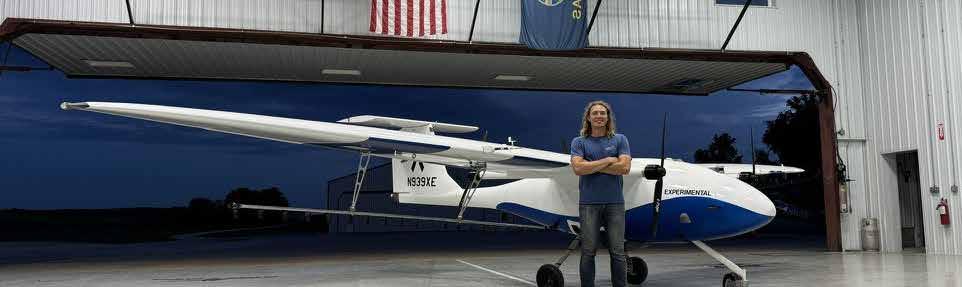
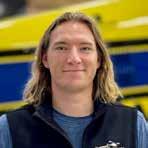
Lukas Koch, chief technology officer for Heinen Brothers Agra Services and CEO of Kelly Hills Unmanned Systems, represents a blend of heritage, innovation and forward-thinking leadership.
“There are many ways to implement new agricultural technology and stay profitable to successfully push operations forward,” says Koch. “I get to work with large-scale aerial machines that are not your typical four-propeller drones.”
Living and working in northeastern Kansas, Koch gets to support dozens of drone designs from around the world and learn alongside companies on the forefront of the technology.
“I’m part of a seventh-generation farm family that settled in Nemaha County in 1857, and we haven’t left since,” says Koch, who has five siblings. “We have ties that go way back, and innovation has always been part of that story.”
Roots in the Field
Koch plans to be a keynote speaker at the 98th Kansas FFA Convention to share game-changing tech ideas.
“The future could hold many possibilities of shared air space with existing lines and integrate new drones for long-range flights to deliver supplies or spray fields in our lifetimes,” he
reflects.
by Lucas Shivers
Generationally in a long line of creative problem solving, Koch recalls how his parents, Steve and Denise, played a role in developing auto-steer systems for tractors. Although this technology is now commonplace across modern operations, his uncles and father completed DIY projects with early prototypes.
“Growing up, I learned how things worked,” he says. “To keep the farm together in the 1980s and expand in the 1990s, our family had to be creative. We saw all sorts of emerging precision ag tech that could help our operation with features like automatic shutoffs on planters and selfpropelled ground rig sprayers.”
Generations before drones and precision agriculture entered the modern landscape of ag, the Kochs knew they needed to adopt technologies. However, the family didn’t always appreciate the high costs and capital needed for mainstream models, so they made their own versions.
“In shop class at school and on the farm, we built our own models of these same types of equipment using things like electronic hardware and military surplus trucks,” he says. “We could get the benefits of the newest tech to help the farming operation thrive by getting creative.”
Soaring Through FFA
Koch credits Kansas FFA with helping him step outside his comfort zone and discover new dimensions of agriculture.
“I joined FFA my freshman year at Centralia High School to push myself, especially in public speaking and being more outgoing,” he says. “FFA introduced me to so many facets of agriculture through CDEs and classes to broaden my perspective.”
Those experiences helped reshape how he viewed the entire industry and take pride in the quality of the products to understand the bigger picture at a systems-level thanks to trips to National & State Conventions and time in the organization.
Bob VanWinkle who was a long-time FFA instructor and cared deeply about the FFA’s mission. Koch also served as chapter president and Northeast District Secretary.
K-State’s
Cutting-Edge Technology
Koch continued his education at Kansas State University, earning degrees in Agricultural Technology Management (ATM) and a master’s in Agronomy.
“I always had an interest in drones,” he says. “I bought my first one in college just to take pictures, but it turned into something much bigger and led to my career path.”
Through his academic work and professional connections, Koch continues to collaborate with K-State on research projects with his companies.
“It’s important to scale technology with partners and find ways to commercialize it,” Koch says. “That’s where real impact happens.”
Leading Innovation in Rural America
Koch spent time after college at a business startup and later with a company rooted in Kansas.
“Business is done differently in venture capital compared to rural-based companies,” he says. “I wanted to be part of something grounded in our community.”
Both of Koch’s current roles with Heinen Brothers Agra Services and the spinoff Kelly Hills Unmanned Systems focus on advancing drone
applications across agriculture, medical delivery and defense sectors.
“We work with companies building drones and help navigate Federal Aviation Administration pathways while integrating that technology into real-world use,” Koch says. “We work with teams across multiple states and even several internationally.”
The companies operate across Northeastern Kansas and serve the heaviest concentrations of aerial application operations in the Great Plains states with dozens of aircraft. Koch’s work places him at the forefront of rapidly evolving technology.
“In the aerial application world, it’s becoming common to see massive drones in our hangar,” Koch says. “Some are up to 40 feet wide and can haul 1,300 pounds of product.”
Innovation at any level can come with some uncertainty.
“There’s no playbook,” he says. “We’re validating the technology, verifying manufacturer claims, and figuring it all out as we go.”
Vision for the Future
Koch believes agriculture is on the edge of transformation. Despite the complexity of his work, Koch sees opportunity for those willing to explore new paths. His message to current FFA members emphasizes the importance of curiosity and passion.
“Don’t shy away from daunting challenges,” Koch says. “You might stumble into something you didn’t expect. Keep your head down and work through the difficult and uncomfortable moments, that is when you’ll find the ultimate reward.”
CHAPTER Leadership TRAINING
Pittsburg - July 1st & 2nd
Salina - July 7th & 8th
Dodge City - July 9th & 10th
Ask your advisor about registering for CLT this summer to prepare you and your officer team for a successful year of FFA while having fun with chapters from across the state!