I hope the first quarter of 2026 is going well for you! Though we had a taste of winter to end January, we have also had some decent weather to enjoy the Zoo grounds and the animals have appreciated the sunshine as well. I hope the trend continues as we work our way into spring.
I want to thank you for helping us make 2025 another great year. Over 15,000 people visited on the three days following Christmas and helped us to reach our goal of 1.15M guests for the year, which was second only to 2024’s attendance. 2025 was also the third year in a row where we greeted over one million guests!
I am also happy to reveal that over 87,000 people came to see the fourth year of GloWild. Knowing that it has become a fan favorite and even a family tradition for some, we are already working on the theme for this year’s event.
GloWild is just one small part of what is coming your way in 2026. We have had quite a bit of activity at the Zoo over the winter and have welcomed multiple new additions. These include king penguin hatches as well as multiple giraffe and kangaroo births. We also celebrated the birth of a white-cheeked gibbon who is currently being successfully raised by his parents. You can read more about these “zooborns” inside this edition of Expeditions.
Some animals from other facilities have also joined our KCZoo family in the past few months. A two-year-old golden lion tamarin, Kian (pronounced Keen) is now a companion for Mica, an elderly female, who lost her previous companion last year. They can both be seen in the Discovery Barn. I am also excited that a pair of threeyear-old male capybaras now call the Tropics building home.
As always, we have some conservation and sustainability articles in this edition as well and an update on Giraffe Crossing, which will open by this summer. Once completed, it will provide a wonderful new space for the animals inside while still allowing plenty of room to roam on their savannah as well. And, you will get a much better view of them both inside and out year-round. You’ll also be happy to know that we have replaced the bathrooms and the snack shop in that area of Africa, which will help to make the entire area a great place to hang out this summer.
You may already be wondering what’s next after Giraffe Crossing, and I have the answer! As we enter summer, you will begin to see construction on the path to the World Gate Station. Our education programs have been so popular over the past few decades that we have run out of room. So, we are renovating our existing Zoo Learning Center and adding more space on the back side of the building to provide classes, camps, birthday parties, and better facilities for the staff who help make these a success. We expect the building addition to be completed in 2027.
Your Zoo continues to get a little bit better each and every year, and I thank you for your part in making it a success! I hope to see you here in the coming months.
Sincerely,
Sean Putney Executive Director/CEO
Executive Committee
Tony Reinhart, Chairperson – Ford Motor Company
Dave Sanchez, Treasurer – PwC
Al Mauro, Jr., Secretary – Chinquapin Trust Company/ Hallmark
Wesley Fields – Bryan Cave Leighton Paisner LLP
Sean Putney – Kansas City Zoo & Aquarium
Members
Clifton Alexander – REACTOR Design
J.C. Alonzo – Black & Veatch
Jennifer Bennett – Rocky Mountain Society of Orthodontists
Chris Cotten – KC Parks and Recreation
Dr. Ellen Crowe – Metropolitan Community College
Ethan Essig – Essig Family McDonald's
Jan Francis – Community Volunteer
Beth Haden – KC Parks & Recreation
Hayley Hanson – Husch Blackwell
Kate Lambert – Dixon Family Foundation
Katie McDonald – Evergy
Janet Miles-Bartee – Local Investment Commission (LINC)
Salvatore Montalbano – Constellation Energy
Helen Ortiz-Turley – Carthage Commercial Real Estate
Brian Pung – JE Dunn Construction
Terry Rusconi – Community Volunteer
John Russ – UMB Bank
Willard B. Snyder – Community Volunteer
Mark Swanson – Burns & McDonnell
Todd Trent – Lockton
Tom Wright – Children's Mercy
Representing the City of Kansas City
Andrea Bough – City Council
Mario Vasquez – City Manager
Zoological District Commissioners
Greg Canuteson – Clay County
Sharon Cleaver – Jackson County
Charlie Franklin – Jackson County
Beth Haden – KC Parks & Recreation
Jay Johnson – Clay County
Sean Putney – Kansas City Zoo & Aquarium
Zoo
Aquarium,
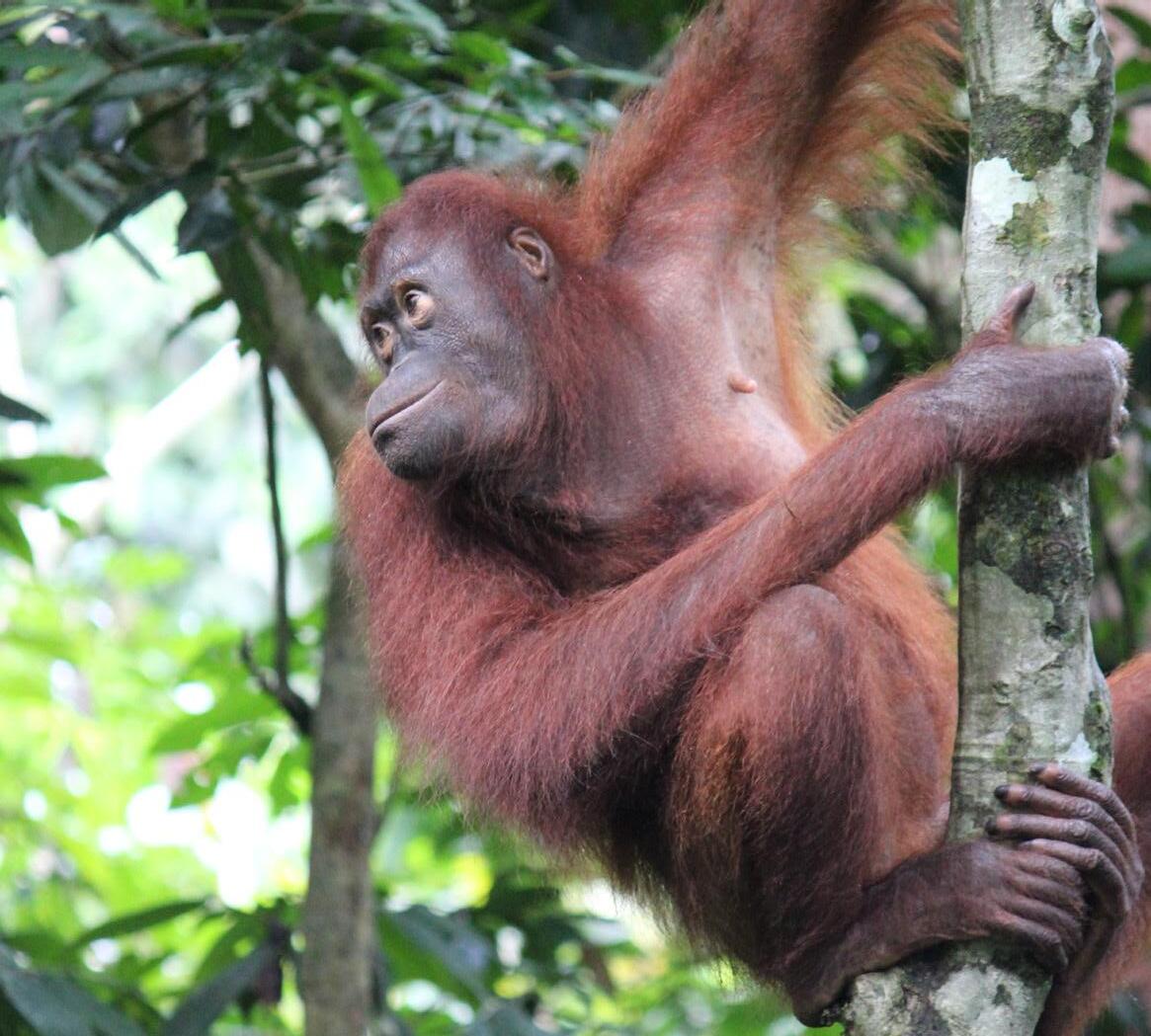
The rainforests of Borneo, a large island in Southeast Asia divided between the nations of Malaysia, Indonesia, and Brunei, are essential to the world's biodiversity. Due to the rise of palm oil and logging industries, much of the rainforest has been depleted, eliminating habitats and corridors that are necessary for the critically endangered Bornean orangutan and other native species to thrive and survive.
The palm oil industry continues to boom despite these effects. Palm oil, which is derived from the African palm oil tree, is in demand because it is found in a variety of commonly used household products. Unsustainable palm oil production has been a cause of deforestation, but APE Malaysia’s conservation work is beginning to change the narrative.
APE Malaysia, founded in 2006, is an organization that focuses on conservation and animal welfare through volunteer and educational programming. Since 2017, the Kansas City Zoo & Aquarium has partnered with APE Malaysia in the CREATE (Corridor REstoration for Animals Threatened and Endangered) Project, to help restore connecting corridors along the Lower Kinabatangan River. Stacia Pieroni, director of conservation and education, started this KCZoo-funded initiative, which as of August 2025, has planted 21,616 saplings and carried 2,631 tree pole plantings to areas along the river.
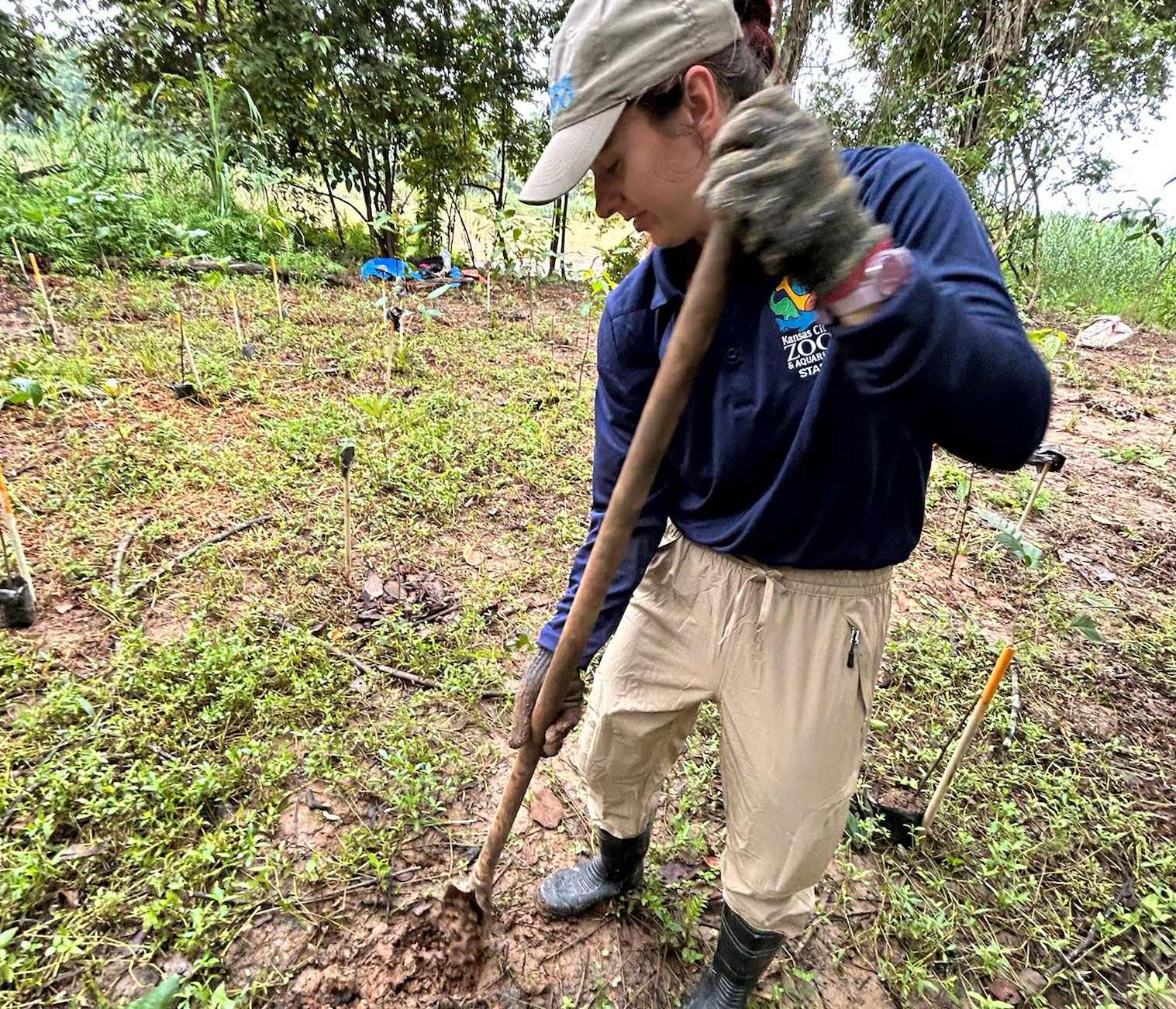
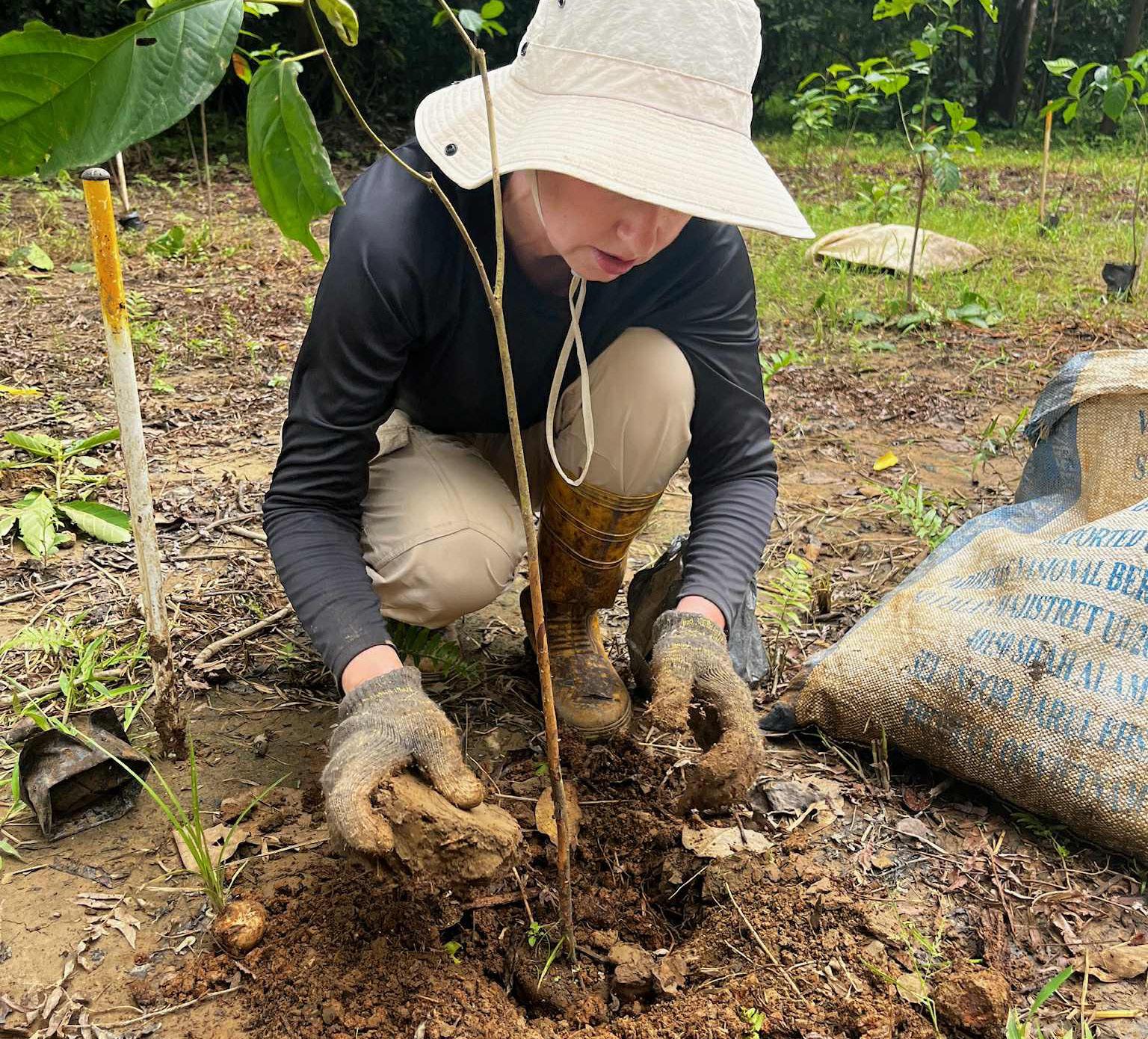
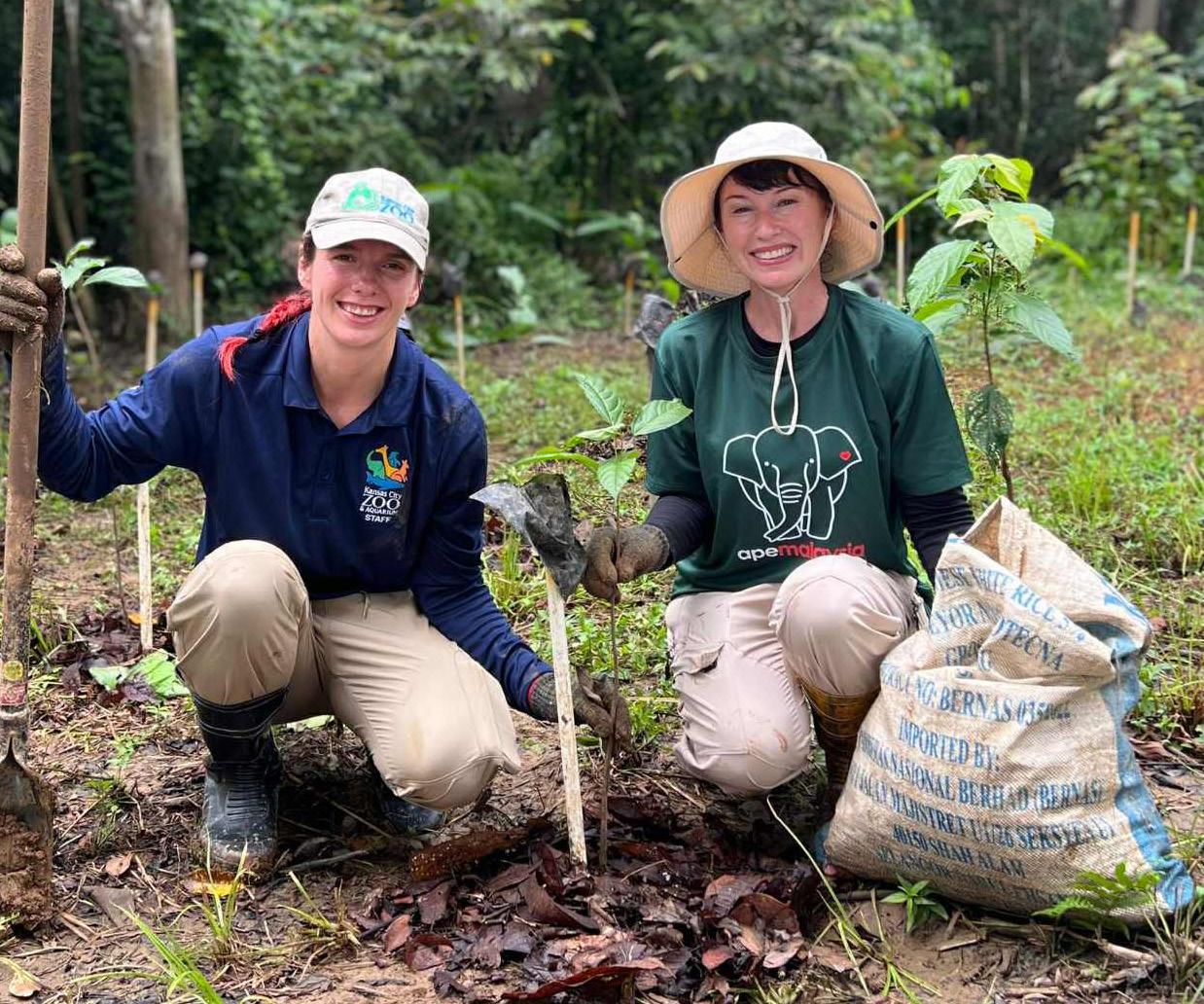
This past year, the Zoo’s Conservation Grant Committee selected two employees to continue this restoration work in Borneo. Maggie Sperkowski, a senior animal care specialist, and Amy Attaway, social media coordinator, traveled to Borneo in October with the mission of planting trees, recording growth data, and reviewing camera trap images. Mark Louis Benedict, project manager at APE Malaysia, along with local community members known as the “Tree Planting Squad," guided Maggie and Amy during the experience.
Maggie and Amy planted 200 saplings, visited a local tree nursery, and maintained trees which had been planted by APE Malaysia earlier in the year. To benefit the animal species in the area, flowering and fruit trees and plants are given priority in these projects. Although growth does not happen overnight, these plots of land will eventually grow into corridors where animals can travel, nest, eat, and live.
Continued on next page
Top: Maggie digging a spot for a sapling Bottom: Amy planting a sapling
“Being able to help firsthand restoring and connecting wildlife habitats and being a part of the great work APE Malaysia does was very rewarding,” Maggie said. “We learned so much about their conservation actions and work, the native flora and fauna, and the Malaysian and tribal culture.”
The experience left a lasting impression on Amy as well. “I am so inspired by the work of APE Malaysia and their tireless dedication,” Amy said. “The experience has filled me with hope for the future of the Bornean orangutan and other threatened species.”
Learn more about the CREATE Project at apemalaysia.com/create
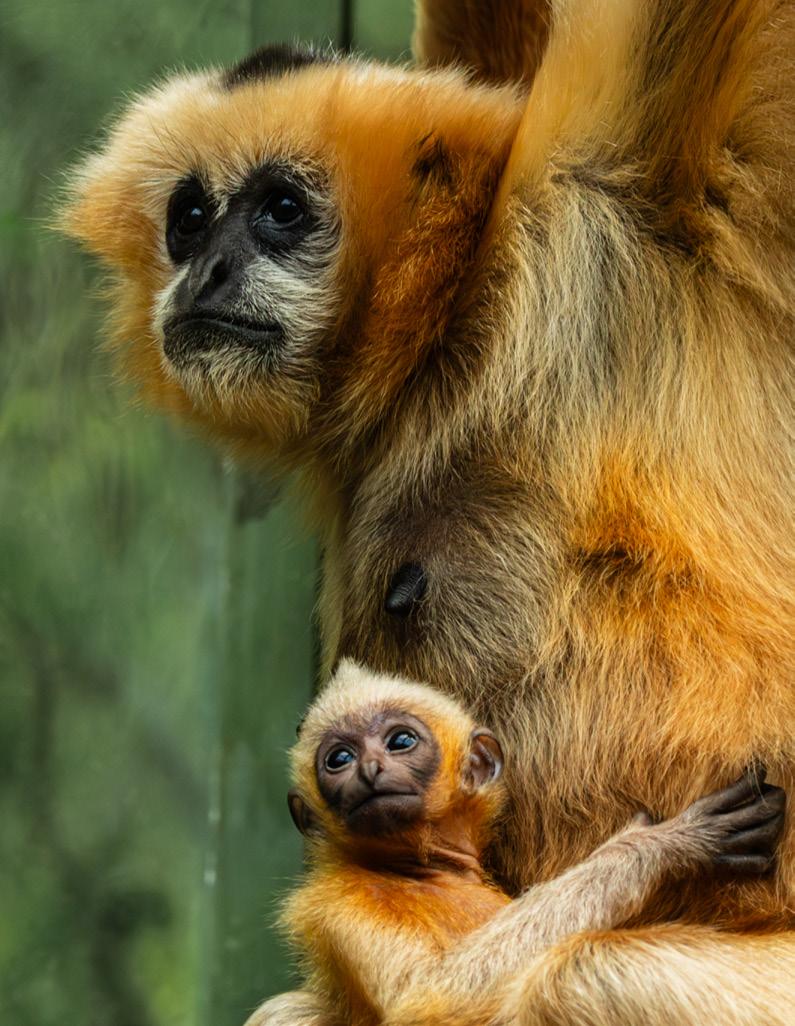
In the last issue of Expeditions, we introduced you to white-cheeked gibbon Kit’s new baby, Koa! Since that time, 4-month-old Koa has been growing not only in size but in confidence. His care team tell us that the young ape has begun to practice climbing by hanging from the habitat’s side mesh, unsupported by his mom. Guests may also see Koa playing with hanging enrichment, which is located atop the overhead glass.
Under the guidance of Kit and his father, Smithers, Koa is learning vital behaviors for white-cheeked gibbons. Although Koa will continue to nurse from his mother for approximately 10 months, he has started nibbling on lettuce and other types of produce.
Thank you to Saint Luke's, part of BJC Health, for sponsoring this year's Wild Beginnings program, which celebrates our zooborns. Learn more about the newest Zoo babies at kansascityzoo.org/animals/wild-beginnings
Stop by the Tropics to see Koa and his parents!
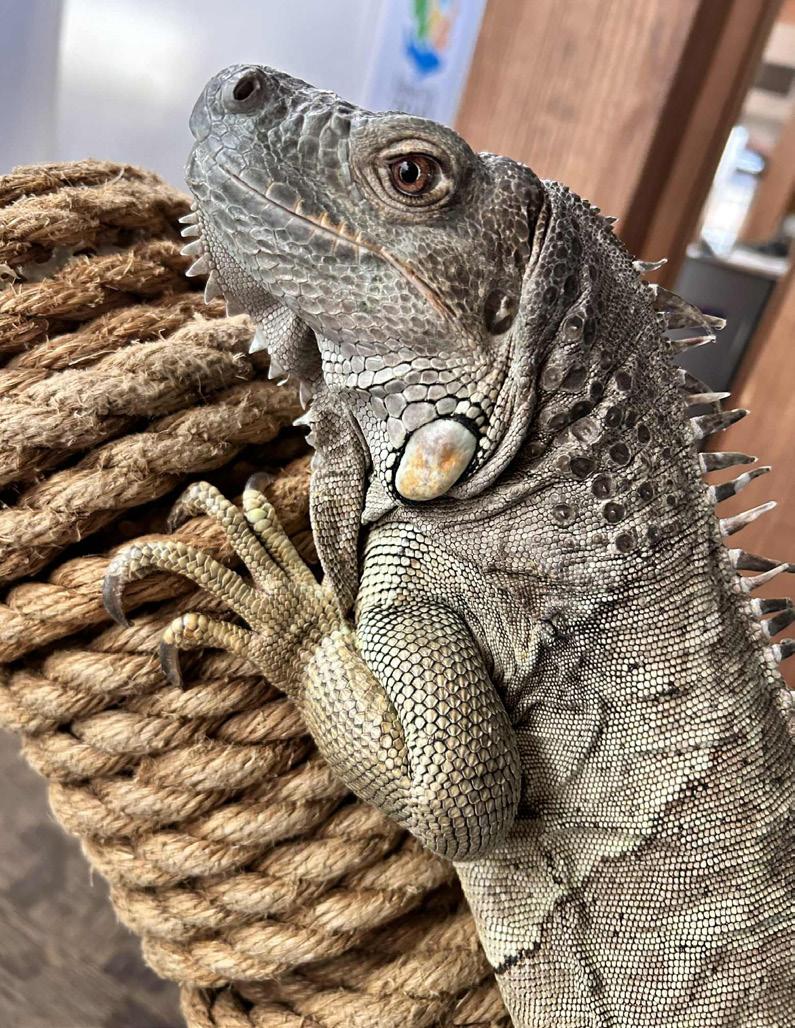
The Zoo is excited to welcome a new green iguana ambassador named Durga. This 7-year-old reptile will be part of our education program and visit schools, libraries, assisted living facilities, and more to help connect the public with her species.
Green iguanas are native to Central America, South America, and the Caribbean. One of the most important adaptations of an iguana is its tail, which provides balance, movement, and protection.
The name Durga comes from a Hindu goddess known for strength and invincibility. Durga lost an arm at a previous facility, but she is strong and able to climb and move just like a typical iguana. Durga enjoys sunning and receiving head scratches from her care specialists.
Keep an eye out for Durga, as she will also occasionally make pop-up appearances with her care team around the Zoo!
By Kelsey Dougherty, animal care manager
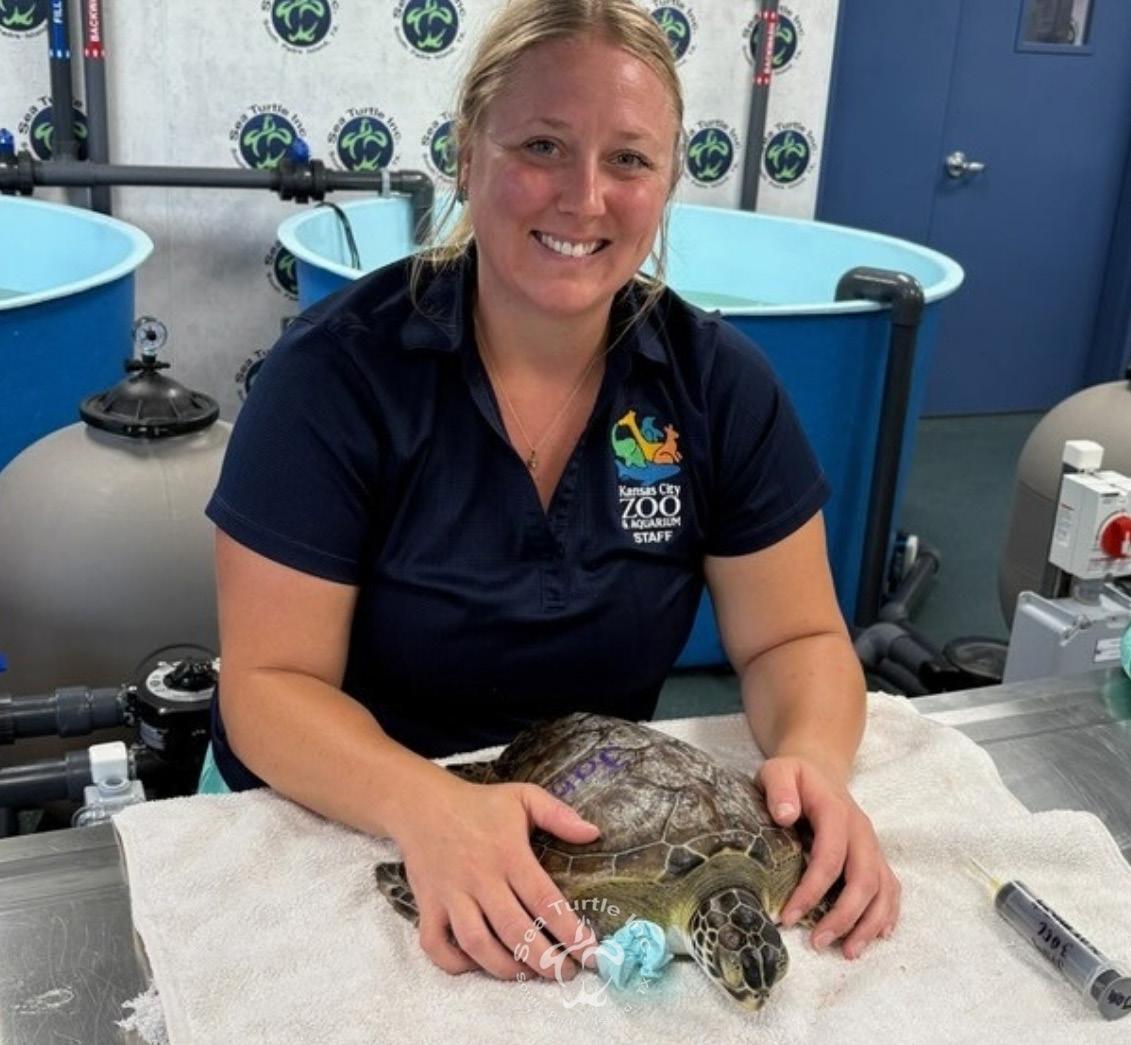
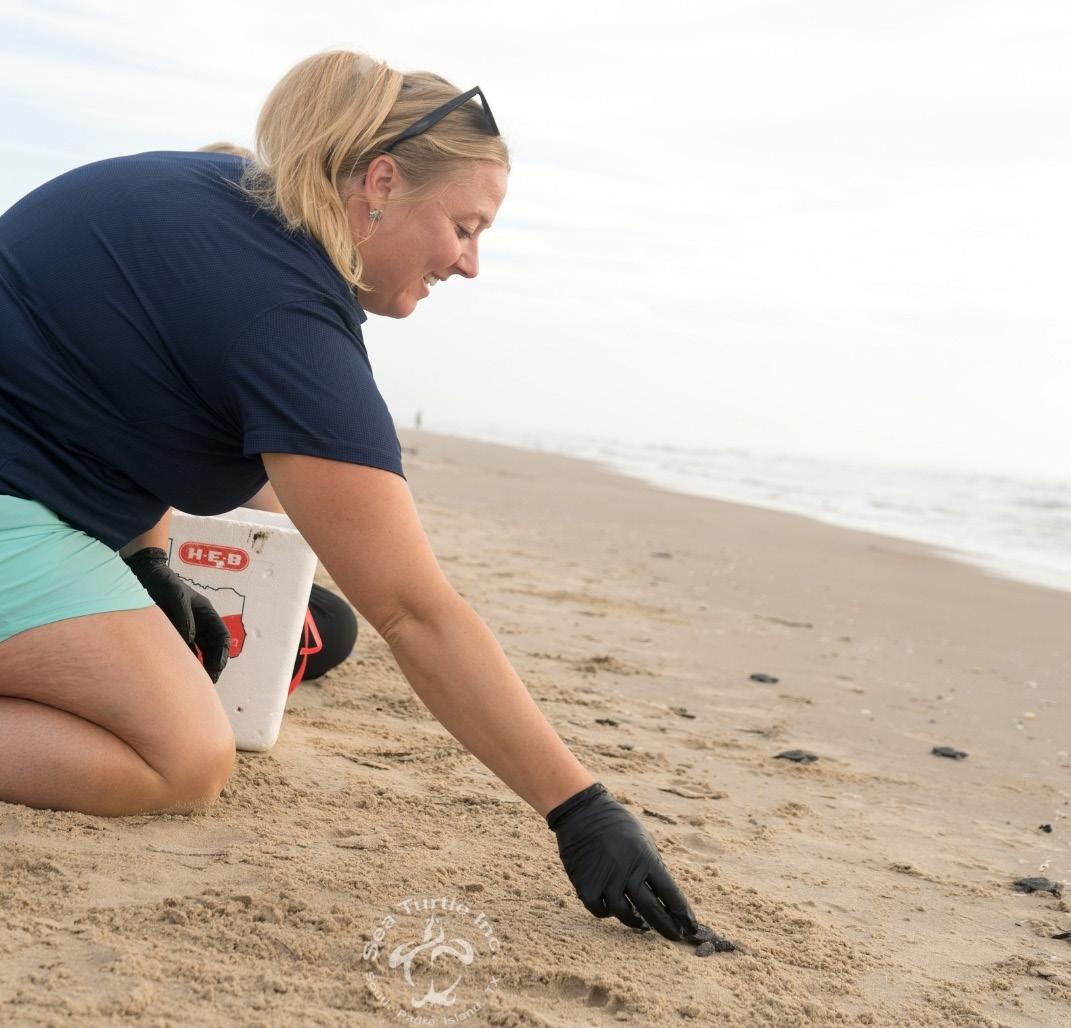
Through the KCZoo’s Conservation Fund and partnership with Sea Turtle, Inc., I recently had the opportunity to support sea turtle conservation efforts on South Padre Island, Texas, contributing directly to rehabilitation, nesting protection, and response efforts for stranded turtles.
Sea turtle conservation has long been a personal passion of mine, and this partnership allowed me to pursue that work in a meaningful way within my current role at the Zoo. Being able to step into the field and contribute directly to conservation efforts bridged the gap between my day-to-day work and the broader mission of protecting threatened species in the wild.
During my time with Sea Turtle Inc., I assisted in the hospital unit, supporting the care and rehabilitation of injured and ill sea turtles, including green sea turtles and the critically endangered Kemp’s ridley. Participating in the recovery process for these animals reinforced the importance of rehabilitation as both a conservation tool and a second chance for turtles facing increasingly challenging ocean conditions.
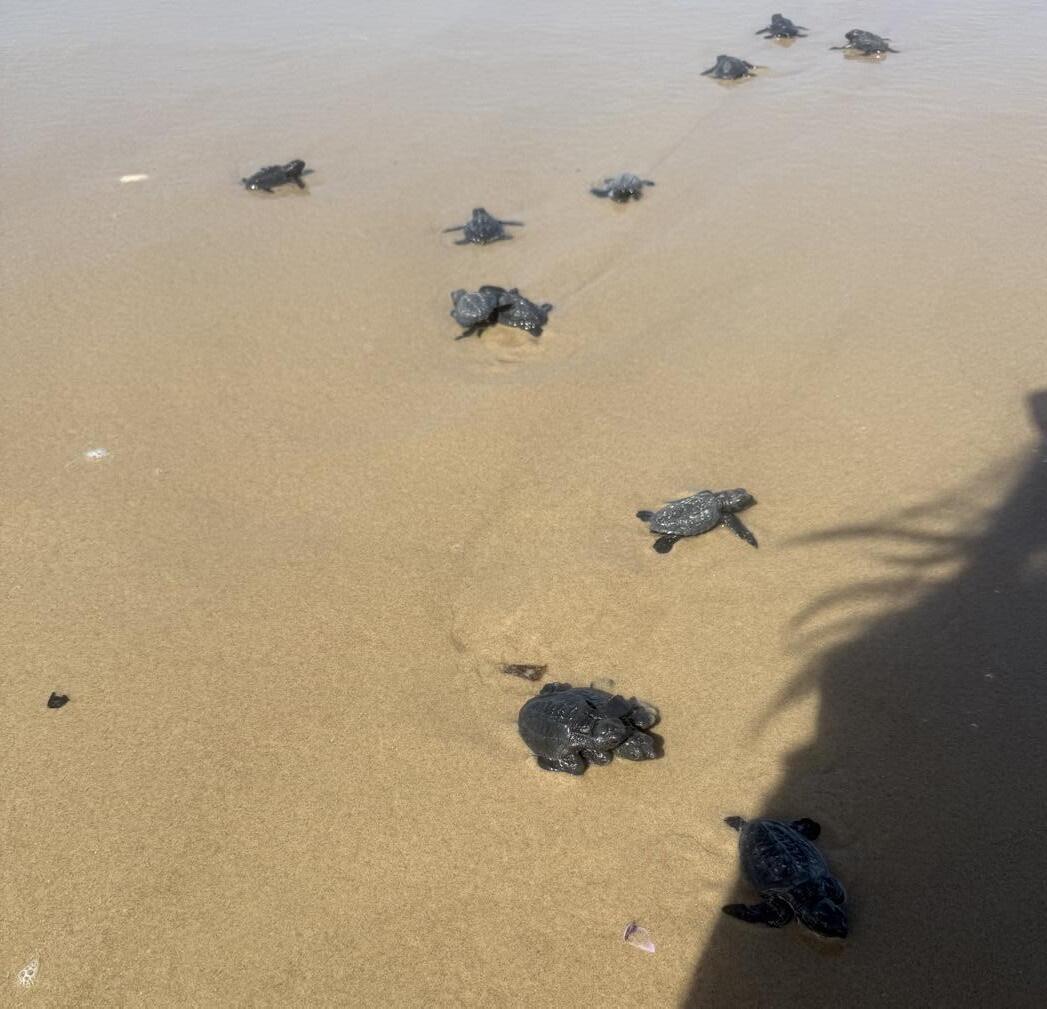
I also took part in nest monitoring and hatchling releases, helping to protect nests and support hatchlings as they made their first journey to the Gulf. Watching a tiny hatchling emerge and push toward the ocean is both humbling and inspiring. These turtles face extraordinary odds from the moment they hatch, and seeing their determination firsthand is a powerful reminder of why conservation work matters. This species has endured decades of population decline and ongoing threats, yet continues to persist.
In addition, I helped with the processing of stranded sea turtles, an essential part of conservation response along the Texas coast. Stranding events provide critical insight into environmental stressors and human-related impacts while allowing for immediate care and data collection that inform long-term recovery strategies.
This trip strengthened my connection to sea turtle conservation and reinforced the value of collaborative, hands-on efforts. As I lead the Zoo's Kemp's Riley Sea Turtle Recovery and Sea Turtle Rehabilitation Project, I know the experience and knowledge gained from it directly support education and outreach initiatives. These programs help connect communities like ours, who are far from the ocean, to the resilience of sea turtles and the ongoing work needed to protect them. Being able to contribute to the conservation of such remarkable species has been both professionally meaningful and personally inspiring.
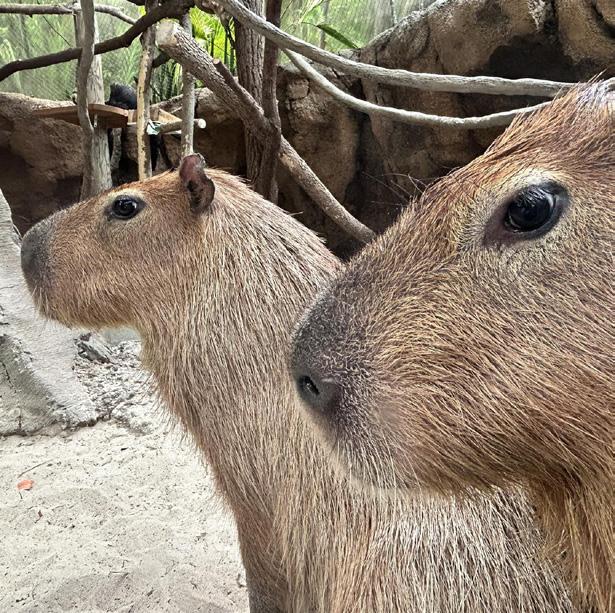
We can’t wait for you to meet the newest Tropics residents, 3-year-old capybara brothers Yoshi and Luigi! The duo transferred from the Abilene Zoo in late 2025, and they are already acclimated to their new Tropics home. You’ll find Yoshi and Luigi residing with species like the crested screamer, white-faced saki monkey, and prehensile-tailed porcupine.
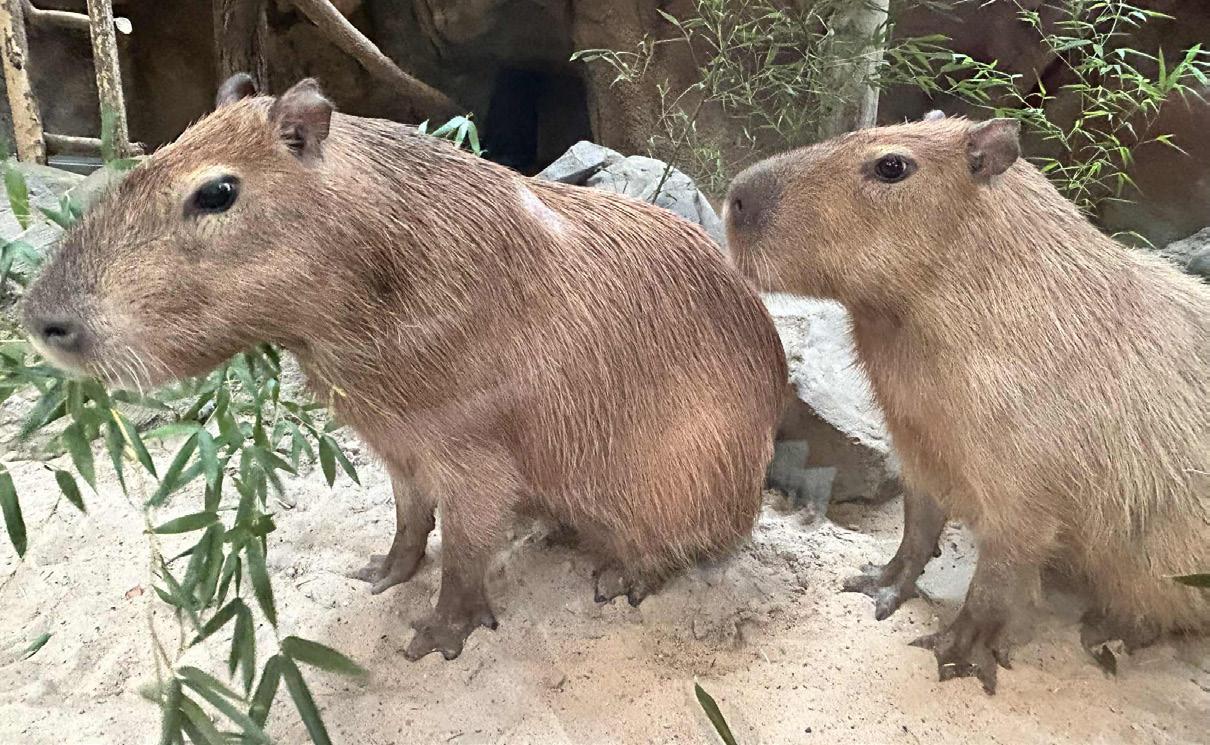
The next time you visit the Zoo, there are a few ways to tell the pair apart. Yoshi is the bigger of the brothers, but Luigi tends to be bolder and braver. Luigi is usually the first one to try something, and then Yoshi will follow suit. When it comes to swimming, however, Yoshi is the one you’ll find more frequently taking a dip in the pool.
The largest rodent in the world, the capybara species is found in Central and South America and can weigh over 145 pounds. In their native habitat, capybaras can be found residing near riverbanks, ponds, and marshy areas. The adaption of webbed feet makes this species an adept swimmer.
Stop by the Tropics each day at 12:30 pm for an informational chat with the animal care specialists!
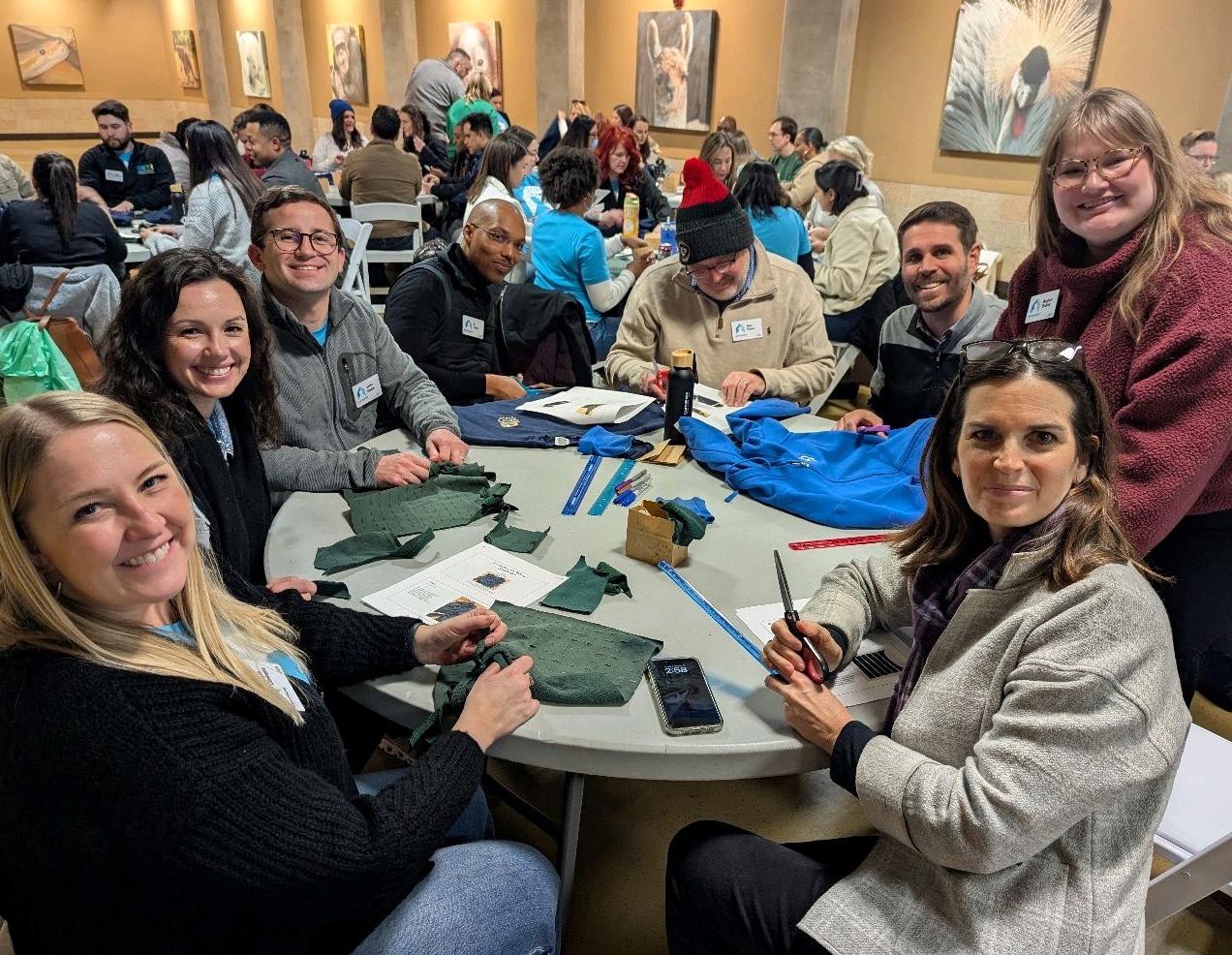
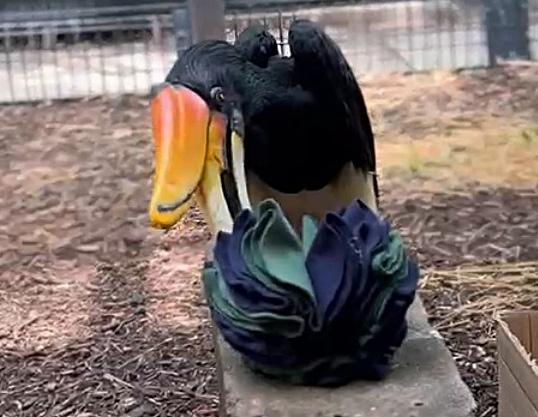
Conservation and community make the perfect combination! Hannah Wilson, sustainability coordinator, spearheaded a conservation project in 2025 to upcycle uniforms that were branded with an older Zoo logo and no longer used by staff. Rather than throwing these uniforms out, Hannah created a program where volunteers could create snuffle balls and mats, which are then used as animal enrichment. We are thrilled to share that nearly 300 snuffle items have been made by dedicated volunteers since the project began.
While these upcycled snuffle items were originally distributed to the Zoo’s animal residents, the mission has expanded even further into the metro community. As of December 2025, 30 snuffle mats were donated to KC Pet Project’s feline team and future dog fosters. The enrichment items will now provide both Zoo residents and KC Pet Projects’ adoptable pets with fun, stimulation, and relaxation when its naptime.
Since the start of the project, more than 230 Zoo volunteers have crafted snuffle balls and snuffle mats. Girl Scouts, summer camps, corporate businesses, and nonprofit organizations are all among the volunteers who have provided their services to this sustainability initiative.
Interested in learning how you can be a volunteer at the Zoo and help out with projects like this one? Learn more at kansascityzoo.org/support-us/volunteers/group-volunteers
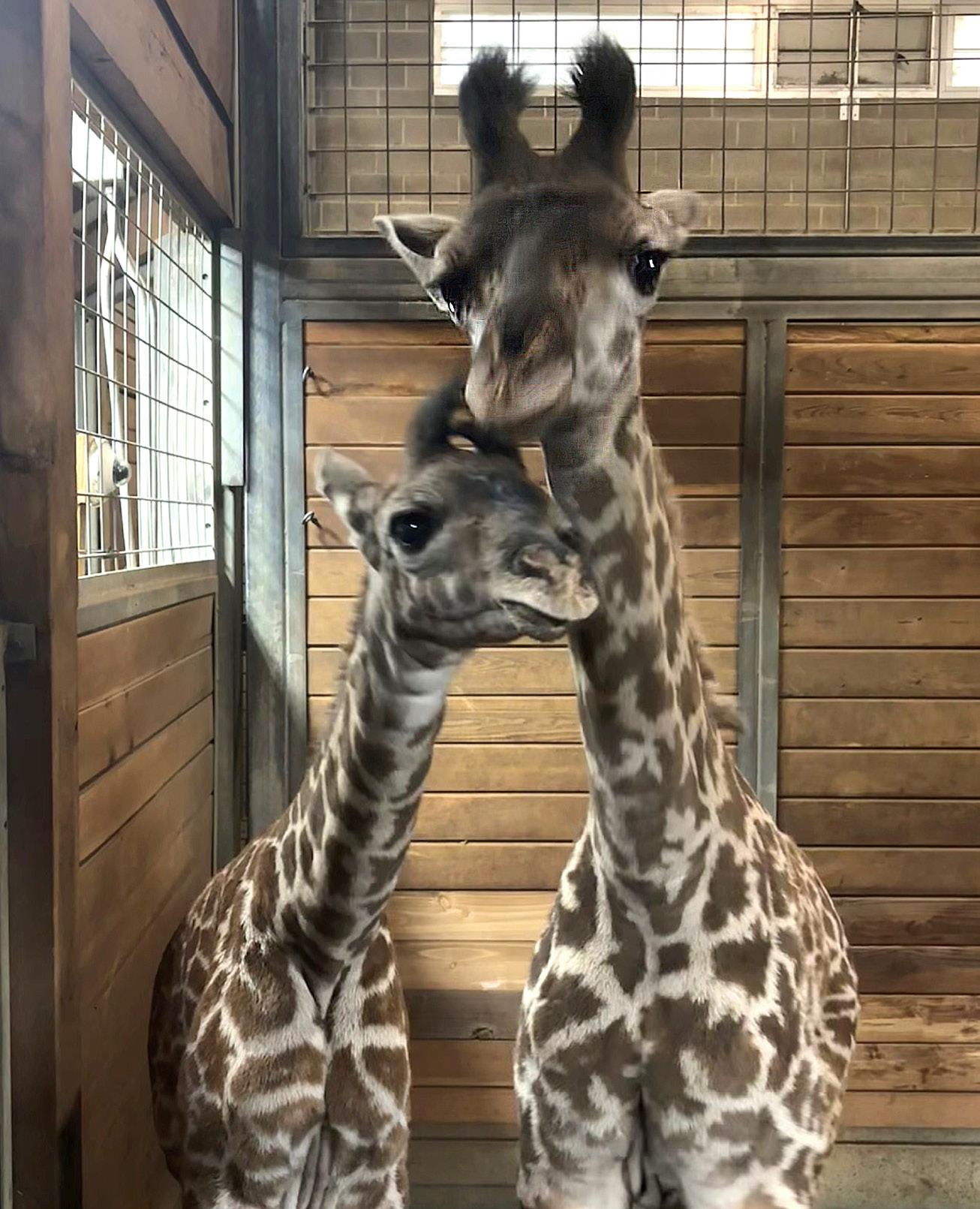
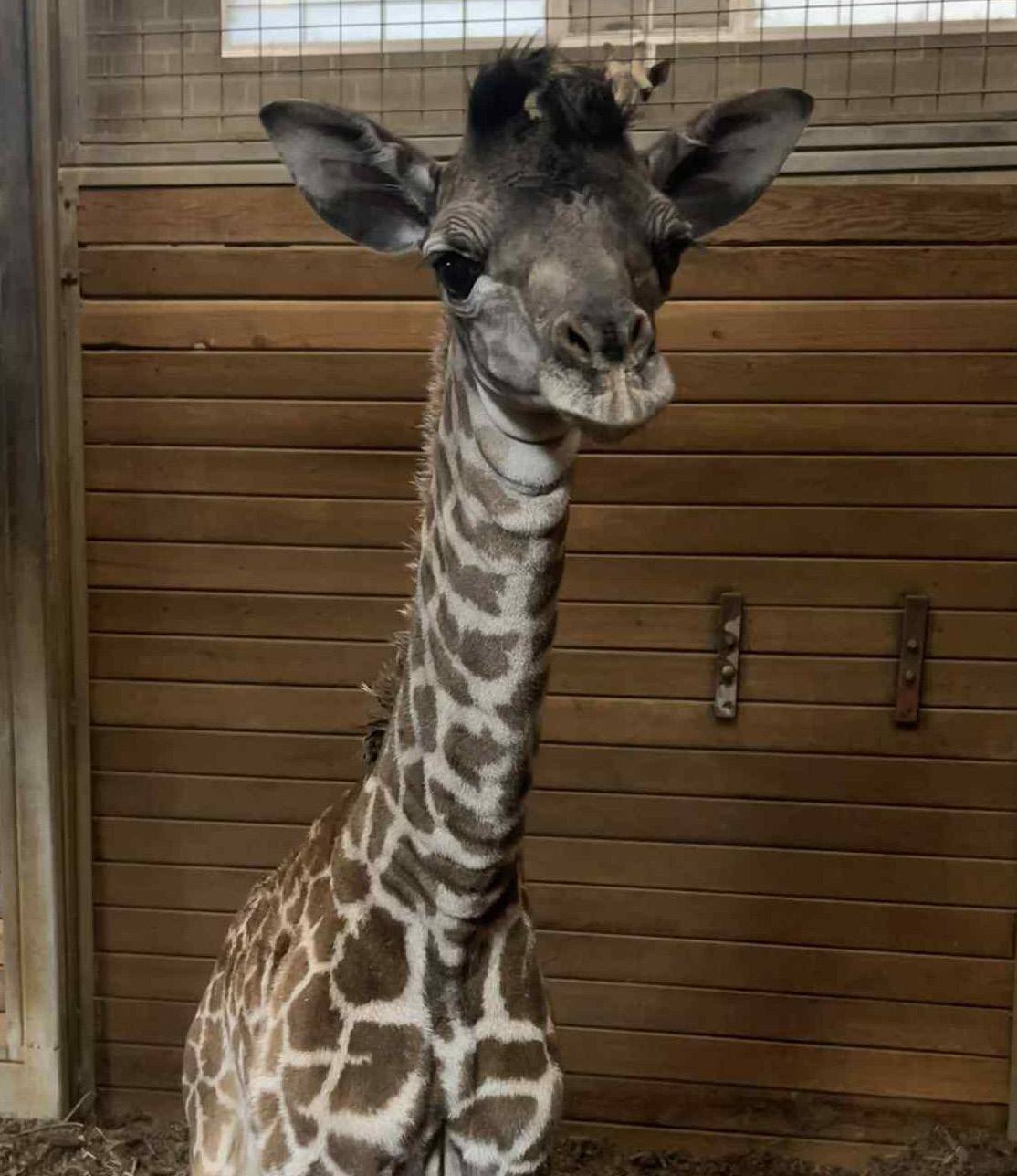
The Kansas City Zoo & Aquarium staff is thrilled to share the birth of three new Masai giraffe calves in late 2025 and early 2026.
On November 4, first-time mom Chandy gave birth to a male that has been named Beni. On December 29, a female calf named Aspen was born to another first-time mom, 4-year-old Alika. The third addition, a female calf named Nora, arrived on February 7 to mom Makali. Six-year-old Aidan is the father to all three, and we are happy to report the young calves are in excellent health!
Due to construction currently underway on a new giraffe complex, the entire giraffe herd (which is rounded out by 1½-year-old Willow) will remain behind the scenes until the new habitat opens but may be seen on a live video feed available only at the Zoo. Learn more about this exciting new complex at kansascityzoo.org/giraffe-habitat.
Masai giraffes are listed as endangered by the International Union for Conservation of Nature (IUCN). The KCZoo is partnering with Save Giraffes Now on coexistence projects in the Athi-Kapiti region of Kenya, a heavily populated region where human and wildlife conflict is a constant struggle. In addition, the Zoo participates in the Association of Zoos & Aquariums’ Species Survival Plan to ensure a genetically diverse and stable giraffe population in accredited facilities.
These exciting new arrivals are part of our Wild Beginnings program presented by Saint Luke's, part of BJC Health, that celebrates “zooborns” at the KCZoo. Saint Luke’s commitment to innovative, patientcentered maternity care has helped local families flourish for more than 140 years and is a perfect sponsor for the Zoo’s growing animal families.
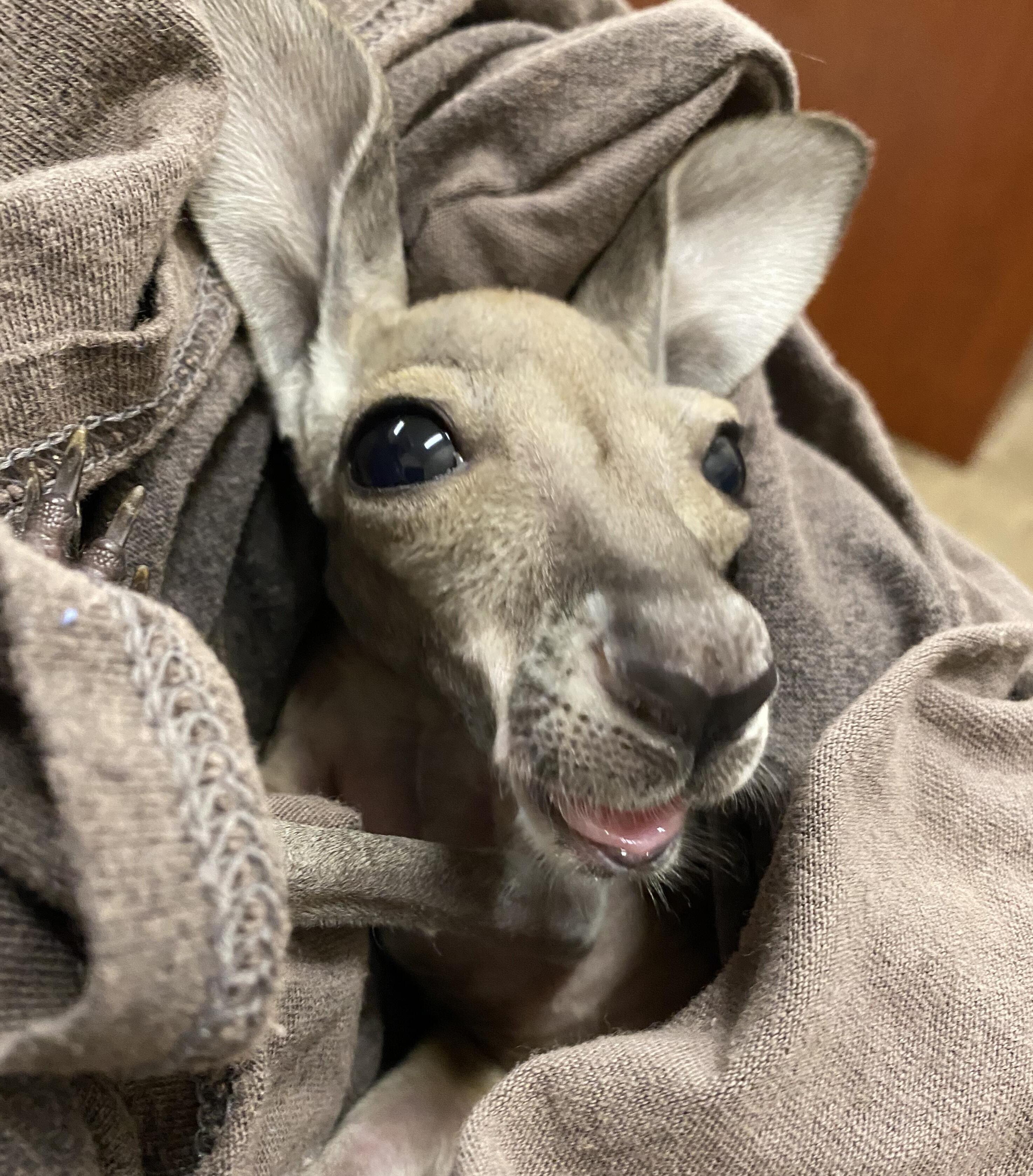
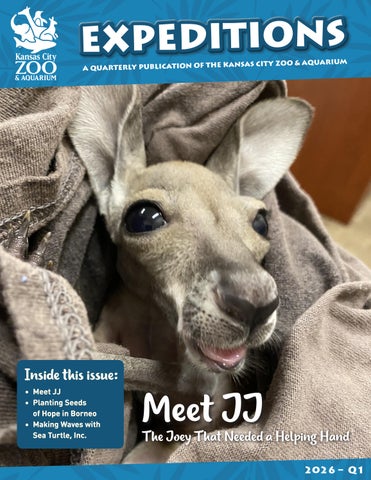
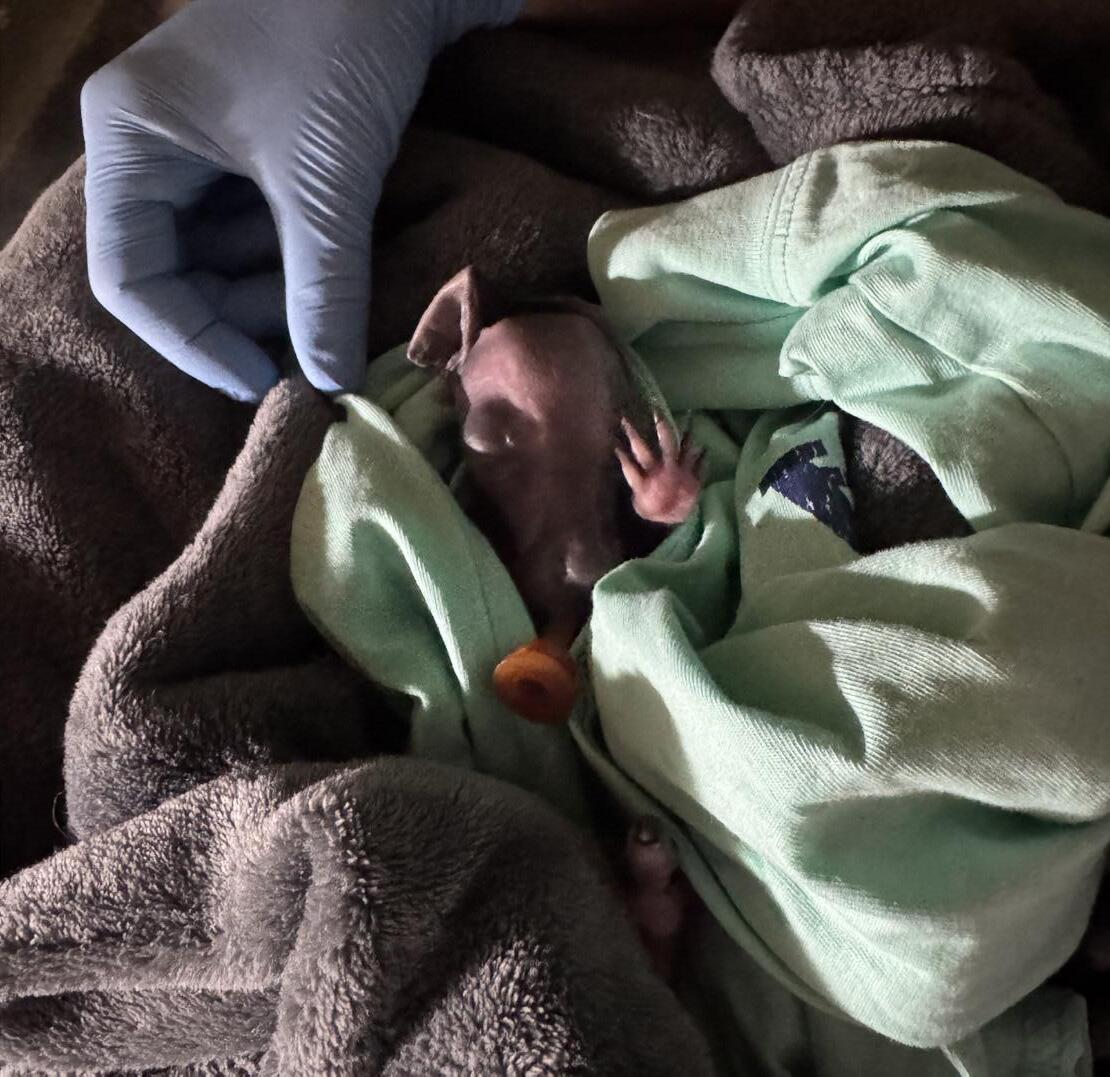
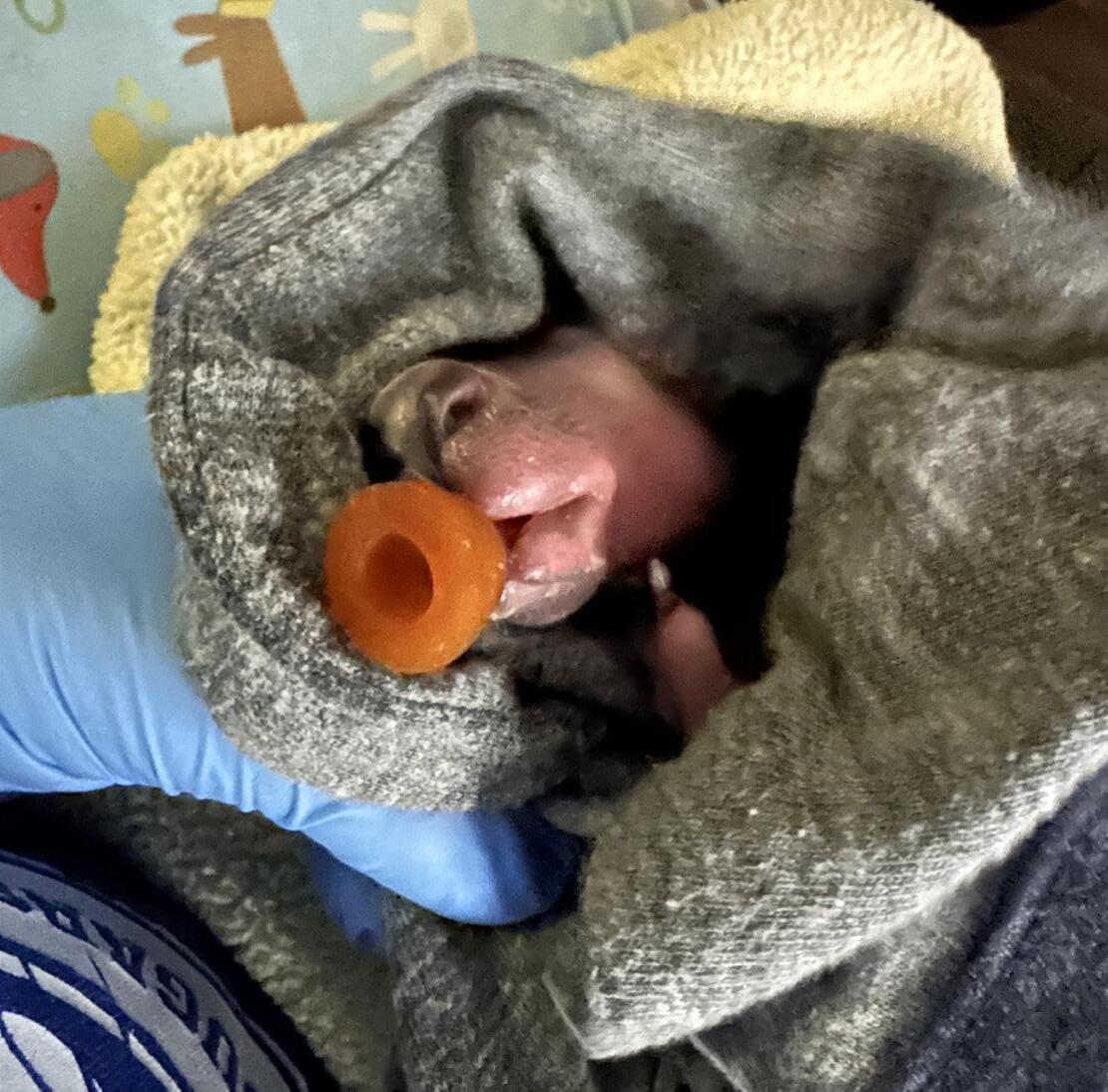
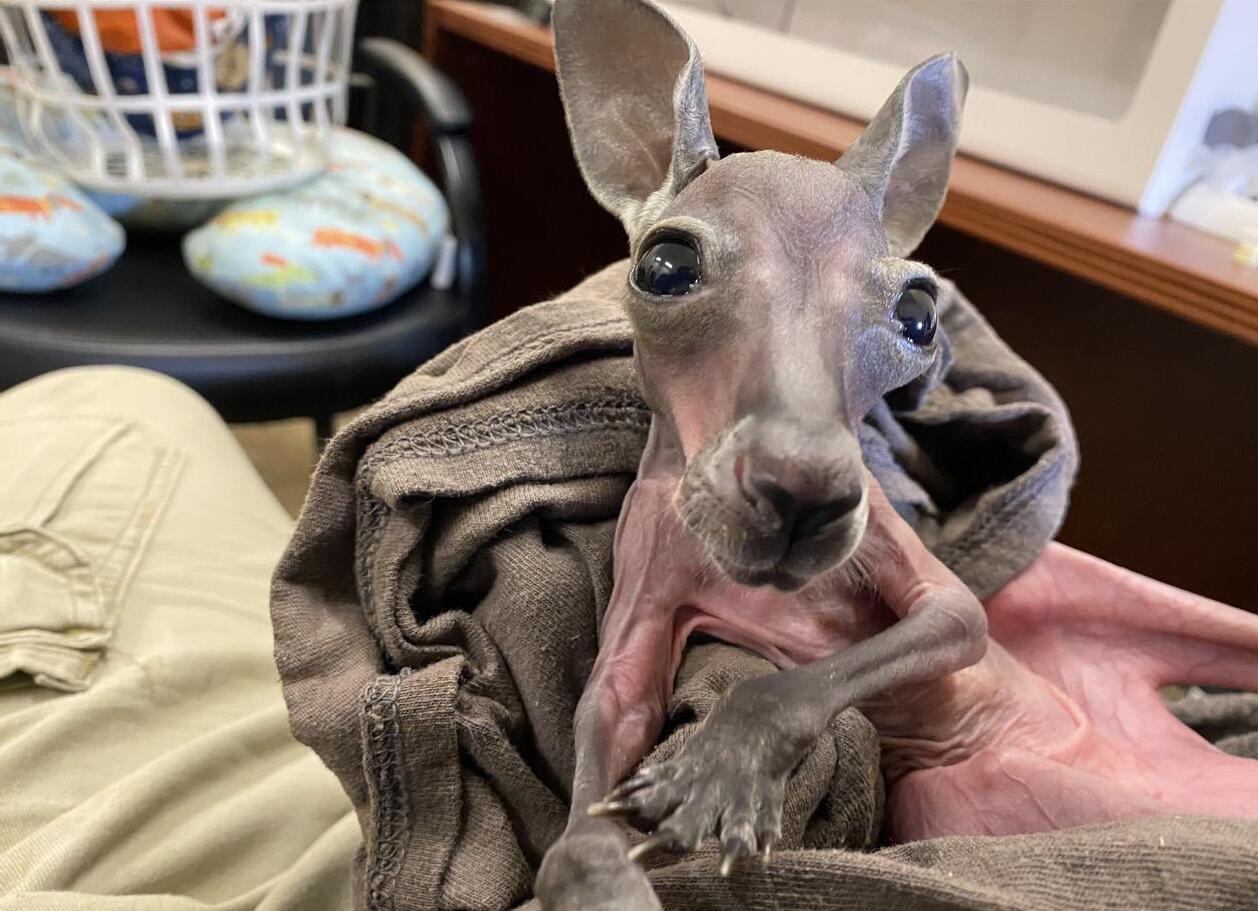
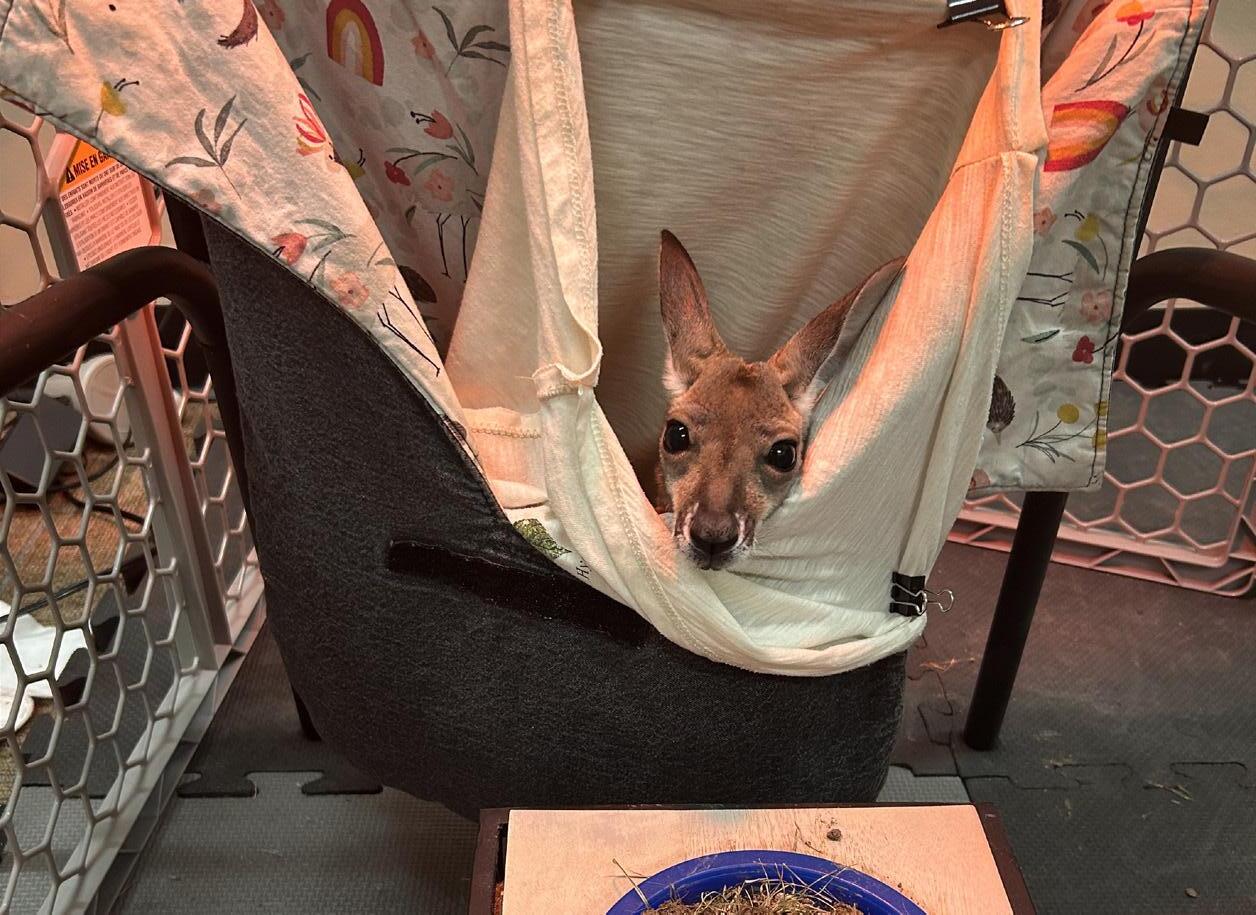
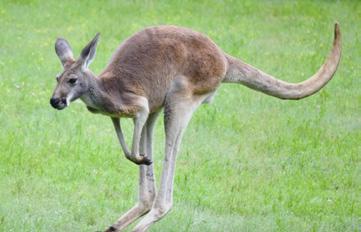
Thanks to the dedication of the Zoo’s animal care and veterinary health staff, a 7-month-old female red kangaroo named JJ has overcome the odds. In late 2025, JJ’s mother, Jiggi, suffered unexpected health complications and the difficult decision was made to euthanize her. At the time of Jiggi’s passing, JJ was only 4½ months old, 12½ ounces, and the animal care team quickly made the decision to hand-raise the young joey.
Jared Ikner, advanced animal care specialist, led this important process based on his previous experience with hand-raising joeys. The first step was to place JJ in a warm, humid incubator to mimic the conditions of a kangaroo pouch, as the joey had no fur and could not thermoregulate. To simulate a natural environment, a small pouch was attached to a laundry basket in the incubator but the growing joey would eventually need a much larger support stand. Her care team reached out to the Zoo’s maintenance team, who constructed a stand that would be the proper strength for holding JJ.
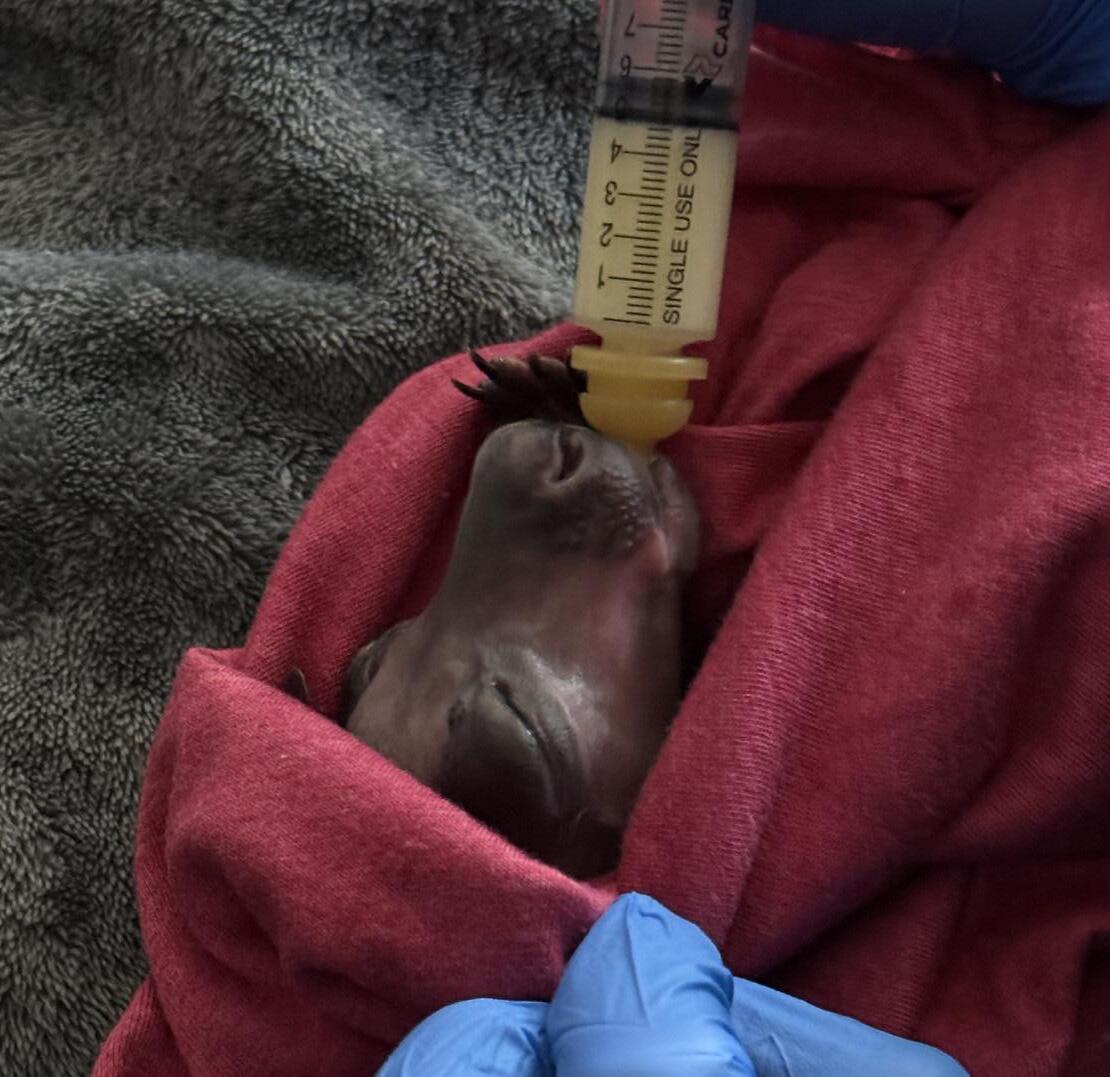
During this time, rehydration with additional fluids in JJ’s formula was essential, and the animal care specialists were ready to provide bottles at all hours.
“JJ has required constant care since we started the hand-raising process,” Jared said. “We have been staying with her overnight, every day – even making sure we had an animal care specialist ready to stay longer at the Zoo in case winter weather kept the next shift from safely driving in.”
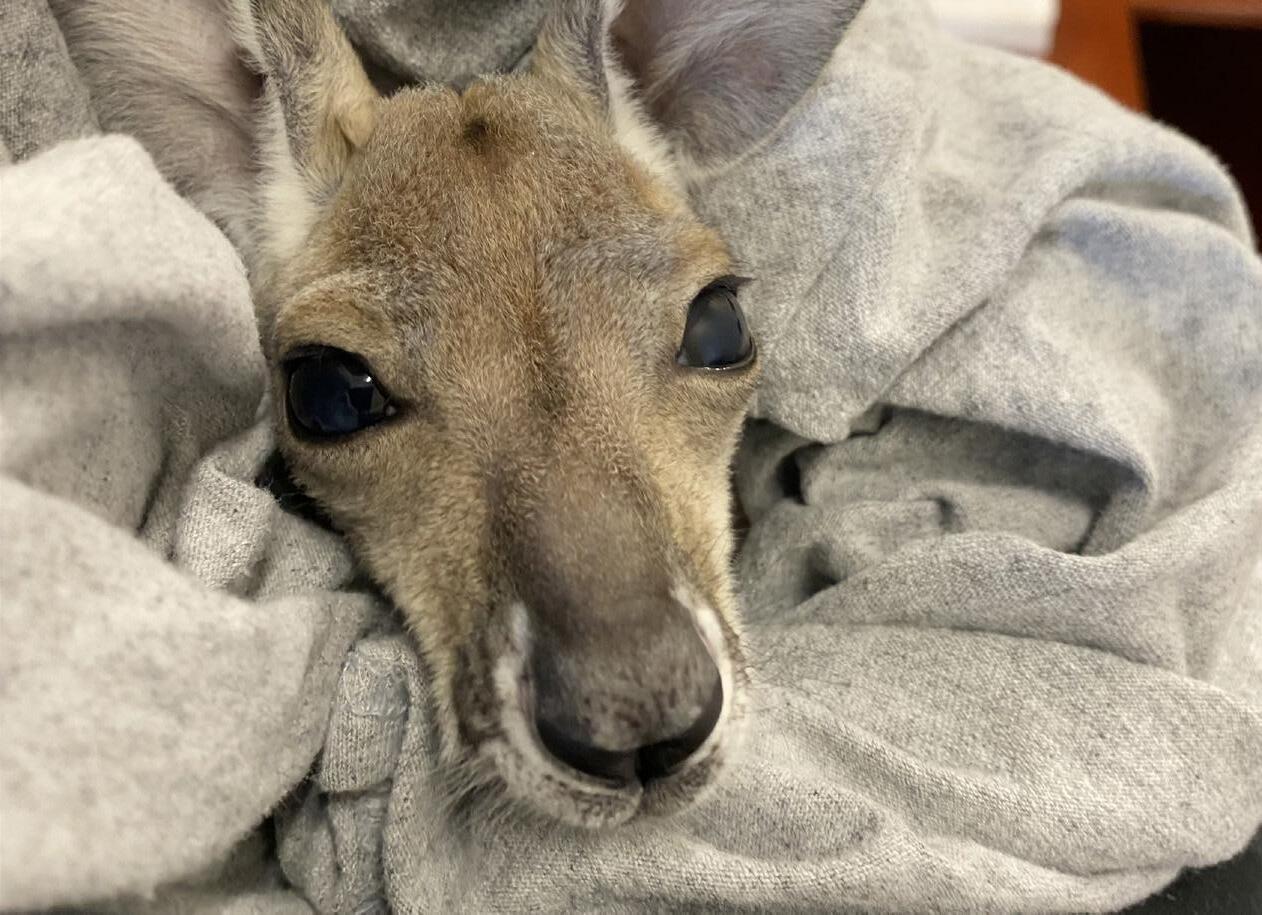
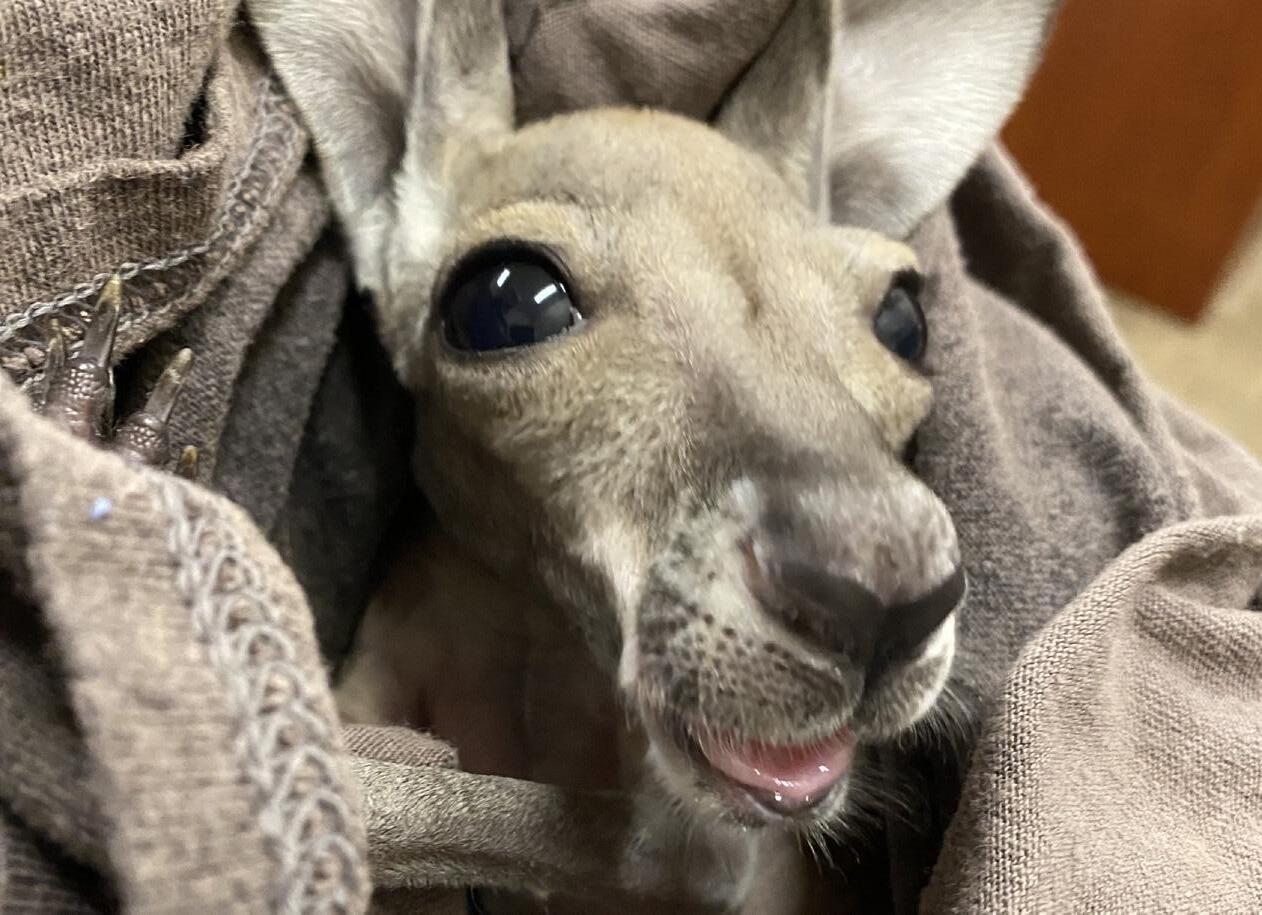
In December, the team felt that JJ had begun to thrive. JJ hit several developmental milestones, including her eyes opening, fur growing, and taking 100% of her formula. By this time, JJ had also doubled in size.
Now seven months old, JJ is still on a formula diet and receives six feedings a day. However, she is starting to sample parts of a normal kangaroo diet such as grass, dirt, and hay just as she would if she stuck her head out of her mother’s pouch.
JJ no longer needs the incubator, but is still carried by her caregivers in a pouch to mimic what she would be experiencing naturally with a kangaroo mom.
While she has turned an important corner in development, JJ is now being slowly introduced to the rest of the kangaroo mob, who will help the joey learn normal behaviors of the species. This introduction process could take several weeks up to a few months, but the team will go at JJ’s own pace and ensure all kangaroos are comfortable.
“It’s really easy for a kangaroo joey that is handraised to actually imprint on the humans, so it’s going to be really essential to have her observing kangaroos,” said Sara Salter, animal care team lead. “We started taking her down to the barn to watch them. What success looks like for her is being introduced to the kangaroo mob, being able to learn normal kangaroo behaviors, and understand that she is a kangaroo and not a human.”
A joey will typically be 9-10 months old when it leaves the pouch entirely. JJ’s care team is excited to see the joey continue to flourish and eventually join the rest of the mob in the Zoo's Australia habitat. In the meantime, watching JJ develop
into a healthy and unique red kangaroo has been extremely fulfilling.
“My favorite part of caring for JJ is seeing her grow, develop, and really see her personality emerge as she has gotten bigger,” Jared shared. “She’s become a very curious roo!”
When the Zoo hand-raises any animal, our goal is reunite the offspring with its family or species as soon and as safely as possible. While these babies look cute, it’s important to remember that JJ and other exotic species are #NotAPet and require significant and very specialized care. Learn more about this important campaign that seeks to eliminate the illegal pet trade at notapet.net.
Each birth announcement this year is part of our Wild Beginnings program, which is sponsored by Saint Luke’s, part of BJC Health, and celebrates the “zooborns” at the KCZoo. And special thanks to the other roos at UMKC for sponsoring the red kangaroo habitat!
Onsite composting program diverts animal waste which is then used throughout the Zoo’s landscaping to improve soil structure and absorption qualities
Installed rooftop solar panel chargers on 35 golf carts to date
12 buildings are on a management system to reduce energy usage and increase performance of HVAC systems
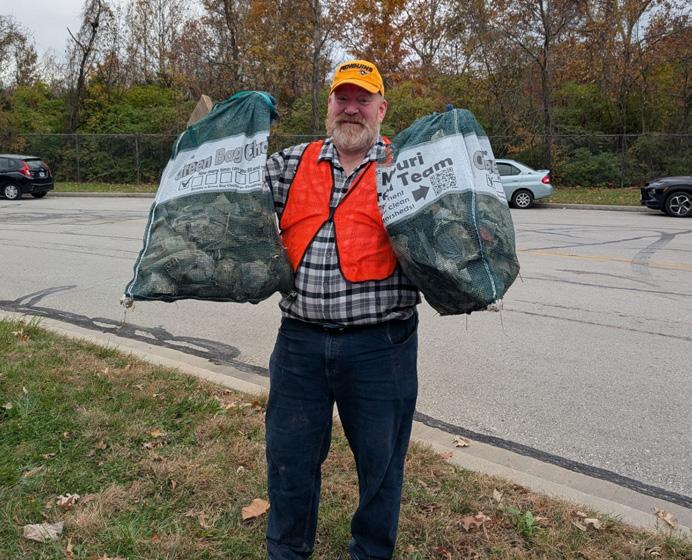
6,673 lbs. of trash removed from local waterways by Kansas City Zoo Stream Team cleanups
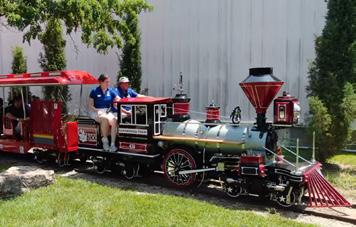
Added a second electric train to double our impact, eliminating 6,480 gallons of gasoline annually
The Zoo consistently assesses its product procurement to assure they are only purchasing certified sustainable palm oil products
288 cellphones and
Introduced 14 guest-facing compost bins for use during Zoo operating hours
31,015 lbs. of food waste was diverted from the landfill by composting at our 2025 events and back-of-house food service
Processed 62,500 pounds of compost for the Zoo Manoo program
33 water refill stations diverted over 166,000 plastic bottles from the landfill
Reusable trays at Tuxedo Grill eliminated 6,797 pounds of paper trays
38 snuffle mats for animal enrichment were made from discontinued uniforms
Solar panels on 9 buildings produced 203,790 kWh in 2025 That’s equivalent to the electrical use in 34 homes for 1 year
Our cities are filled with wildlife that we need to better understand now more than ever. The Kansas City Zoo & Aquarium, the City of Kansas City, and the Heartland Conservation Alliance are inviting citizen scientists of all ages from across the KC metro area to participate in the 2026 City Nature Challenge.
We can’t fully protect nature without studying what is living in cities. Each year, thousands of people join in this global challenge to see just how many observations of wildlife we can gather together. Every photo you take contributes to vital wildlife research. The international database helps scientists and naturalists better understand the type of wildlife living in our cities and works to make them better places for humans and wildlife to live.
Participation is easy:
1. Download the iNaturalist App on your device.
2. Search for and join the 2026 Greater Kansas City Metro Area City Nature Challenge project.
3. From April 24 until April 27, take pictures of wild plants and animals using the iNaturalist app.
4. Share your photo with the iNaturalist community.
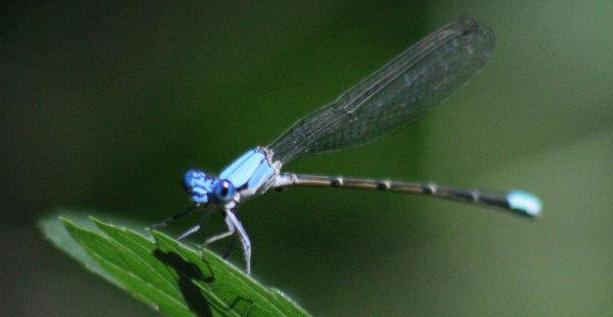
Any wildlife pictures you share through the iNaturalist app during this time will automatically count towards the challenge. And don’t worry if you aren’t sure what you just took a picture of because the app will help you identify it. Scientists all over the world will work to verify the species you upload as well.
We are looking for photos of plants, birds, insects, and other animals that are in their natural habitat. Go out and hike your local trails, visit a nearby park or nature center, or check out a lake or river you’ve been wanting to explore. Any wildlife in the Greater KC Metro area is eligible.
Join us in discovering the nature of your neighborhood and help change the world one observation at a time. You can find out more about the challenge, including helpful videos and observation tips, at www.citynaturechallenge.org
For more information, call 816-595-1765 or email education@fotzkc.org.
School's out! Join us at the Kansas City Zoo & Aquarium for an exciting day filled with activities to learn about your favorite animals. These single-day and multiple-day camps are available for ages 5-12.
Single-day cost: $65 per camp (FOTZ members get a 10% discount) kansascityzoo.org/camp/schools-out-camp
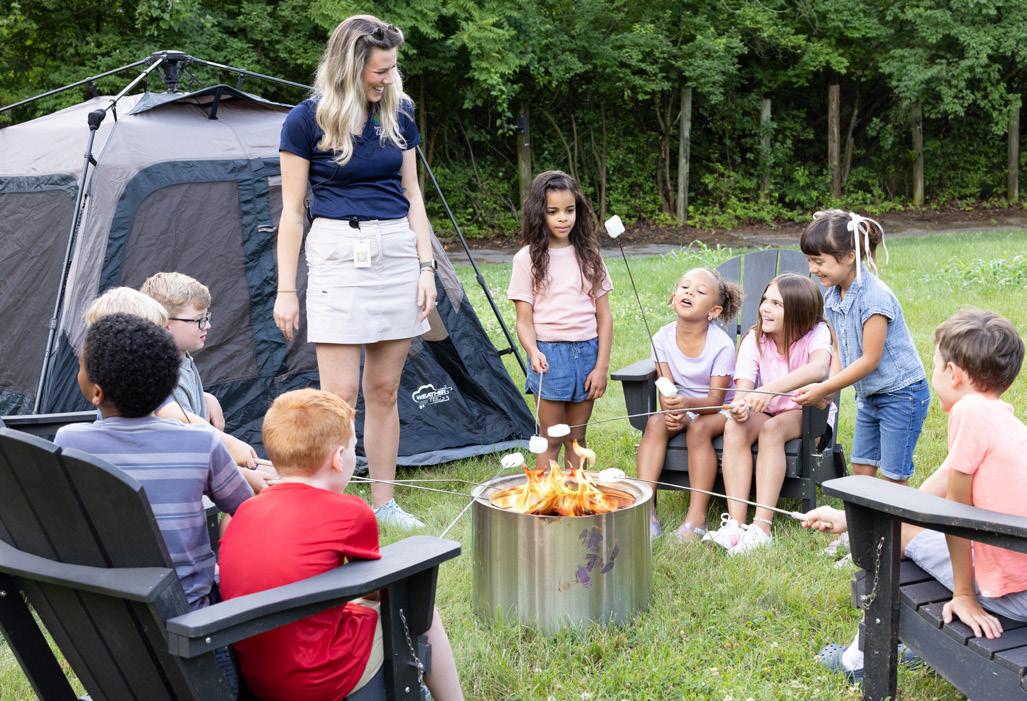
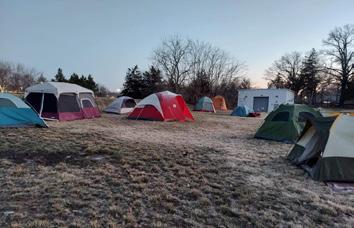
Spend the night at the Zoo! It is the WILDEST place in town for an overnight adventure! Stay in Helzberg Penguin Plaza, Sobela Ocean Aquarium, or Polar Bear Passage, then take a night hike through the Zoo and enjoy a movie. Feeling more adventurous? Pitch your tent for one-of-a-kind camping in our Outback or African campgrounds! Overnights are scheduled for Friday or Saturday nights only. kansascityzoo.org/overnights
Sponsored by



Scan the code or visit
for more information on each event.
Interested in being a vendor or sponsor at one of these events? Email askthezoo@fotzkc.org
Saturday, February 28 | 10:00am-3:00pm
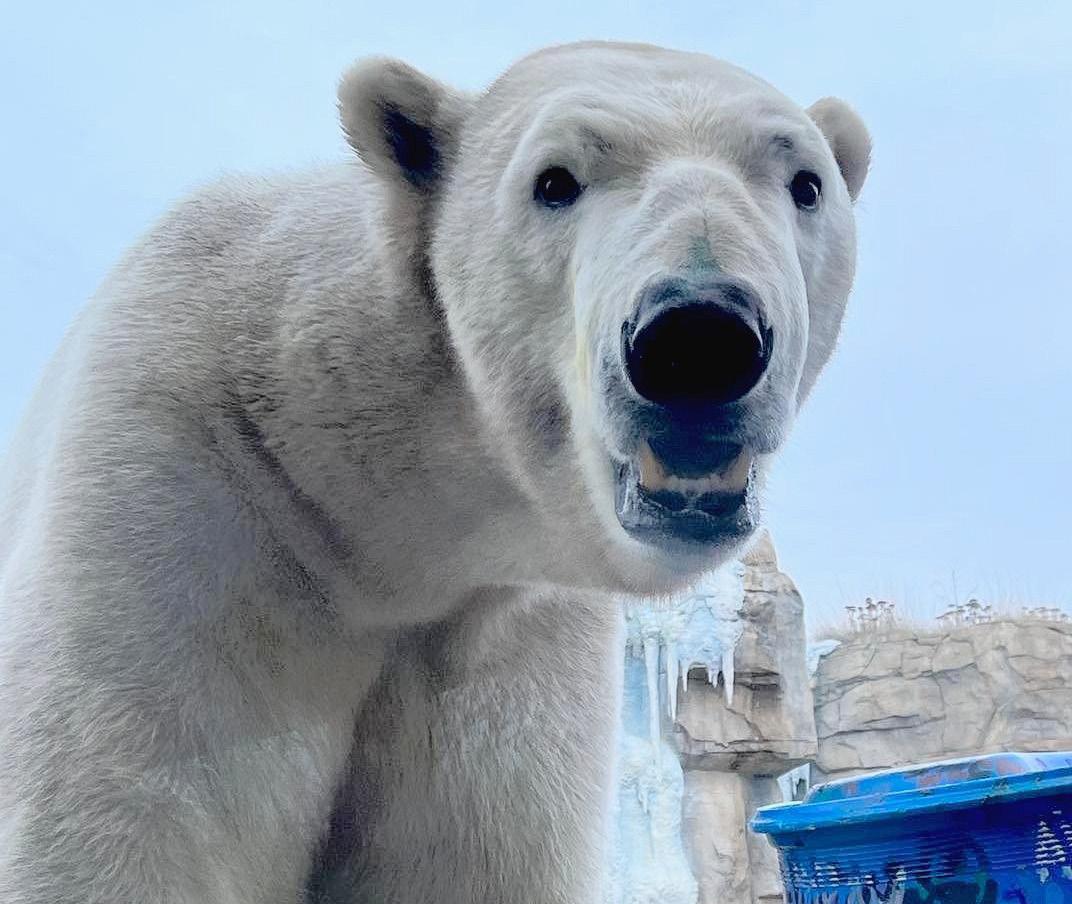
Join us in celebrating Polar Bear Day with pawsome activities hosted by our docents inside Polar Bear Passage.
Polar Bear Day was founded by the Zoo’s partner, Polar Bears International, to coincide with the time period when polar bear moms and cubs are snug in their dens. The day aims to bring awareness to the need to protect denning families across the Arctic.
Saturday, February 28 | 10:00am-2:00pm
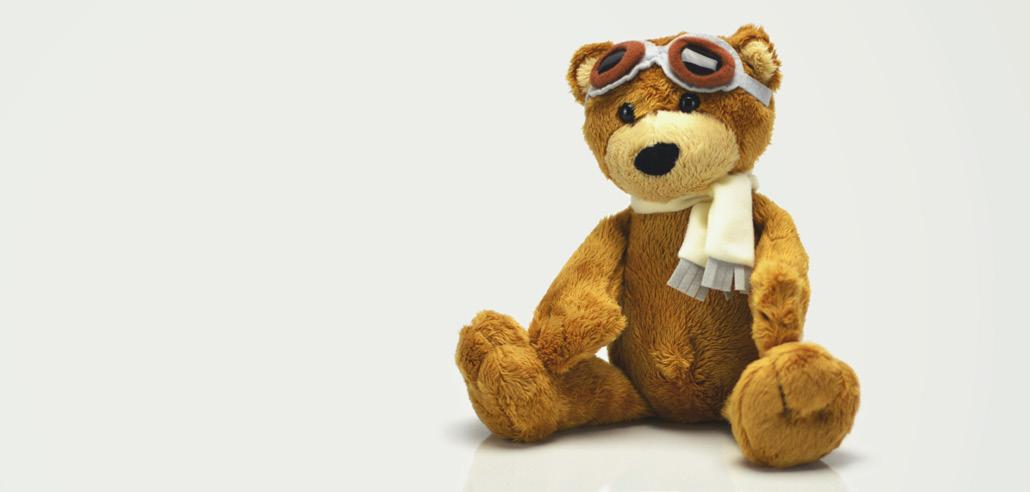
Do you have a teddy bear or stuffed animal in need of some TLC? Bring your favorite stuffed friends to the Teddy Bear Clinic and let the volunteers from Kansas City Young Matrons nurse them back to health. We will fix rips, tears, and holes – and give them a good fluff! Once they are back in tip-top shape, they will receive a clean bill of health. Final patients accepted no later than 1:30pm.
Sunday, February 22 | 4:00pm-7:00pm
Chicken N Pickle - Overland Park & North Kansas City
The Kansas City Zoo is proud to partner with Polar Bears International (PBI) in its efforts to conserve polar bears and the sea ice on which they depend. Funds raised from the Pickleball for Polar Bears tournament go directly toward our efforts with PBI. While the tournament is sold out, spectators are welcome!
Saturday, April 25 - Sunday, April 26
It's a Party - for the planet! Join us as we celebrate Mother Earth. Guests can decorate a bird house to take home, make their mark on our Party for the Planet map, and receive seed bombs to use at home in their gardens. Meet with members of the Little Blue River Society, Missouri Conservation Alliance, and more as they host activity tables at the event to share how we can make a different in our community.
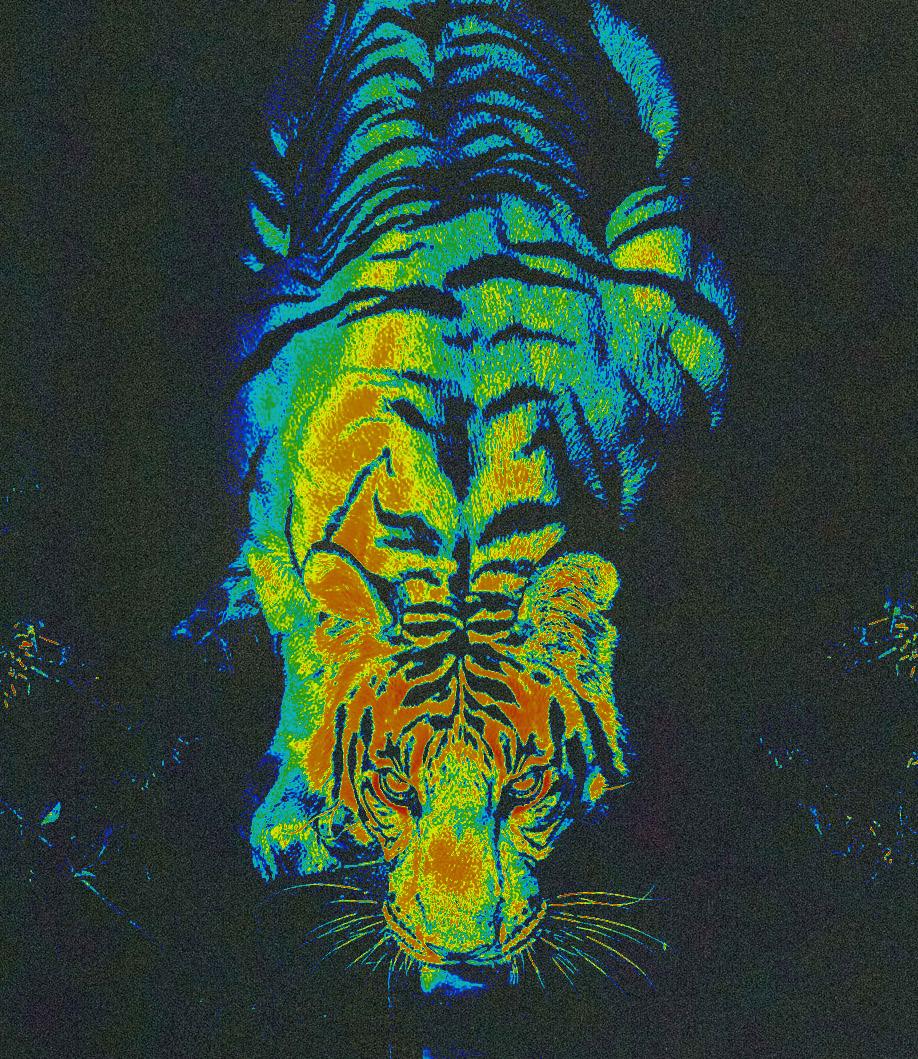
Channel your wild side at HABITAT! As the sun drops, the Zoo transforms into a space to cut loose and tap into something a little more primal. Featuring a curated lineup of local, national, and international DJs, don’t miss this unique evening of house music delivering vibes that keep the crowd moving all night.
Explore the Sobela Ocean Aquarium, keep the momentum going with rides on the train, zipline and carousel. Local food trucks and cash bars will be available.
The event experience will take place within a select area of the Zoo and does not include access to all Zoo grounds.
Bring your people. Bring your energy. This isn’t your typical night out.
Saturday, May 9, 2026 | 7pm-midnight | 21+ event
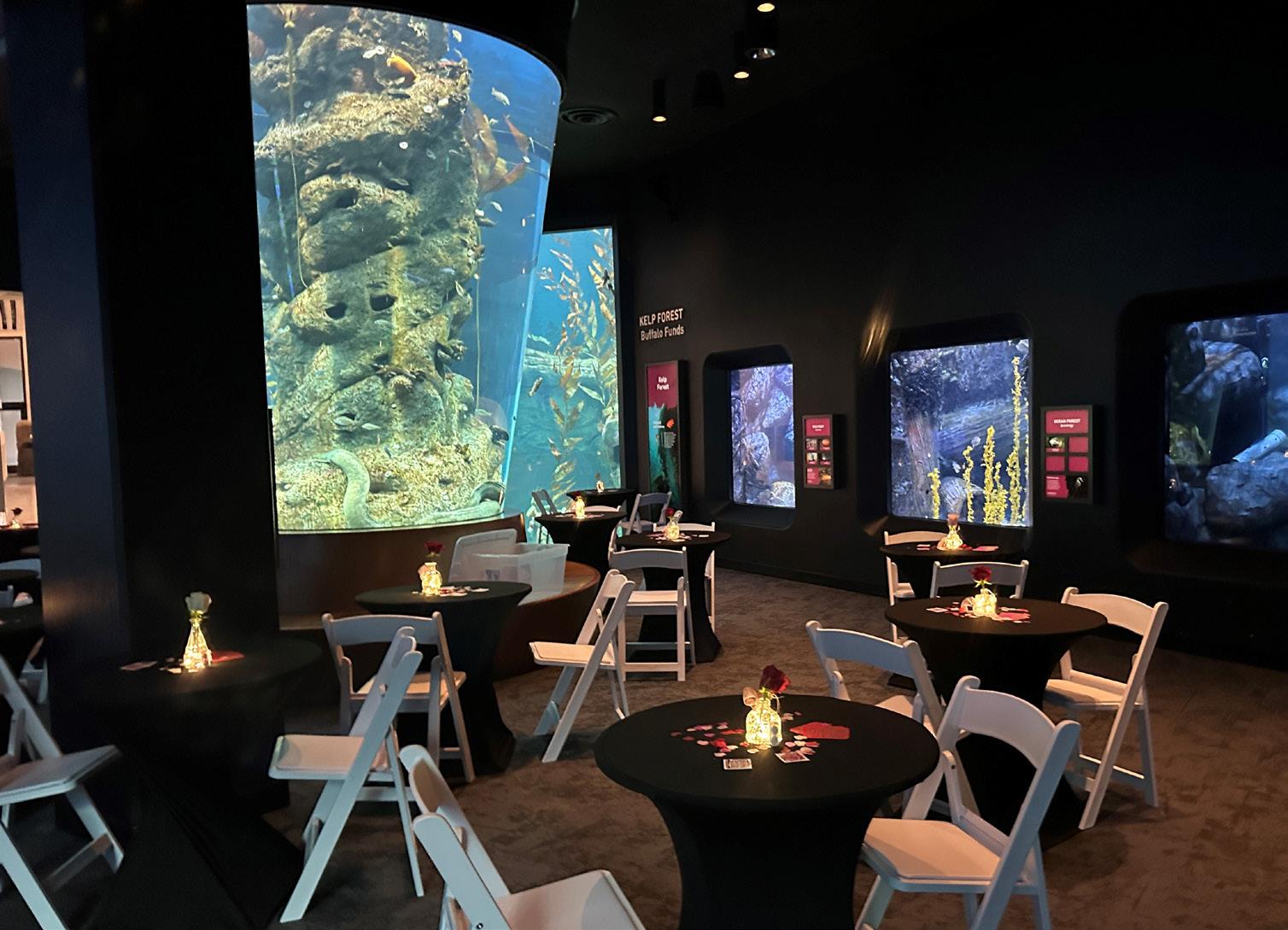
The Kansas City Zoo & Aquarium is the purrfect location for your next event. See the Rent the Zoo section at kansascityzoo.org to learn more about company outings, evening rentals, birthday parties, and more.
Contact Group Sales at 816-595-1210 or at groupsales@fotzkc.org for all event options.
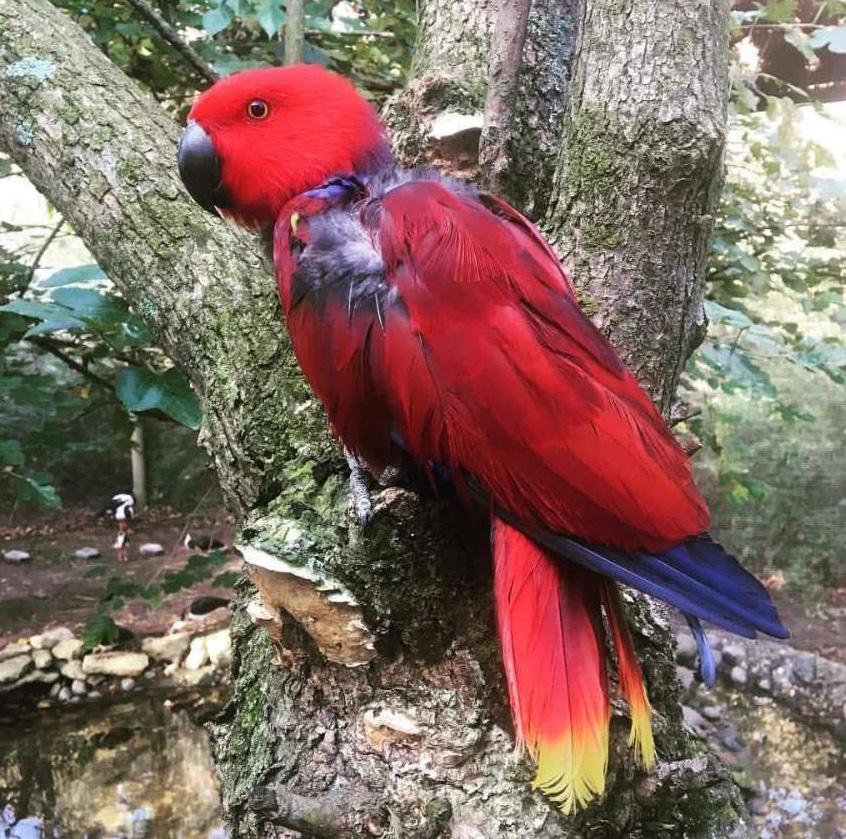
We are saddened to share the passing of Bea, a 33-year-old eclectus parrot who resided in the Birds of Australasia aviary. Bea was diagnosed with an aneurism at the base of her brainstem, and the difficult decision was made to euthanize her when she no longer responded to treatment. Bea arrived at the KCZoo in 1992, which was when the aviary opened. Known for her ornery personality, Bea had a talent for mimicking radio beeps and would select a favored few on her care team to preen hard-to-reach areas on her back. Her later years were spent with male eclectus parrot, Soloman. She will be fondly remembered for her vibrant personality and love of nesting in cozy places. Bea will be dearly missed at the aviary.
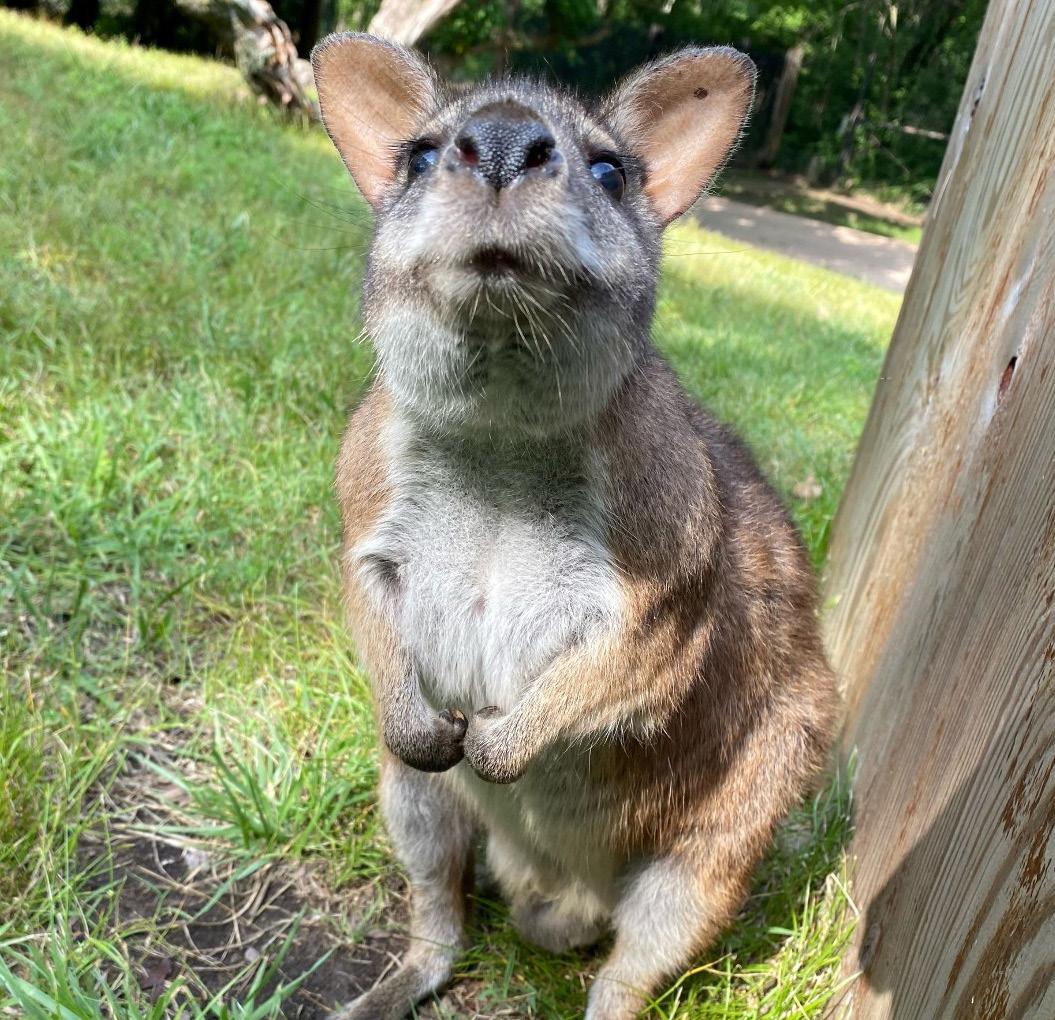
Zoo staff are mourning the passing of Gosford, a 7-year-old parma wallaby. The difficult decision was made to euthanize Gosford due to gastrointestinal issues that no longer responded to treatment. The parma wallaby species is known for its petite size, but Gosford made up for his small stature with a confident attitude. He enjoyed relaxing and playing with younger wallaby Bubba Blue and could be found hiding under a log when it rained, as he did not care for getting wet. Gosford was an important ambassador for his species and will be dearly missed by guests and staff.
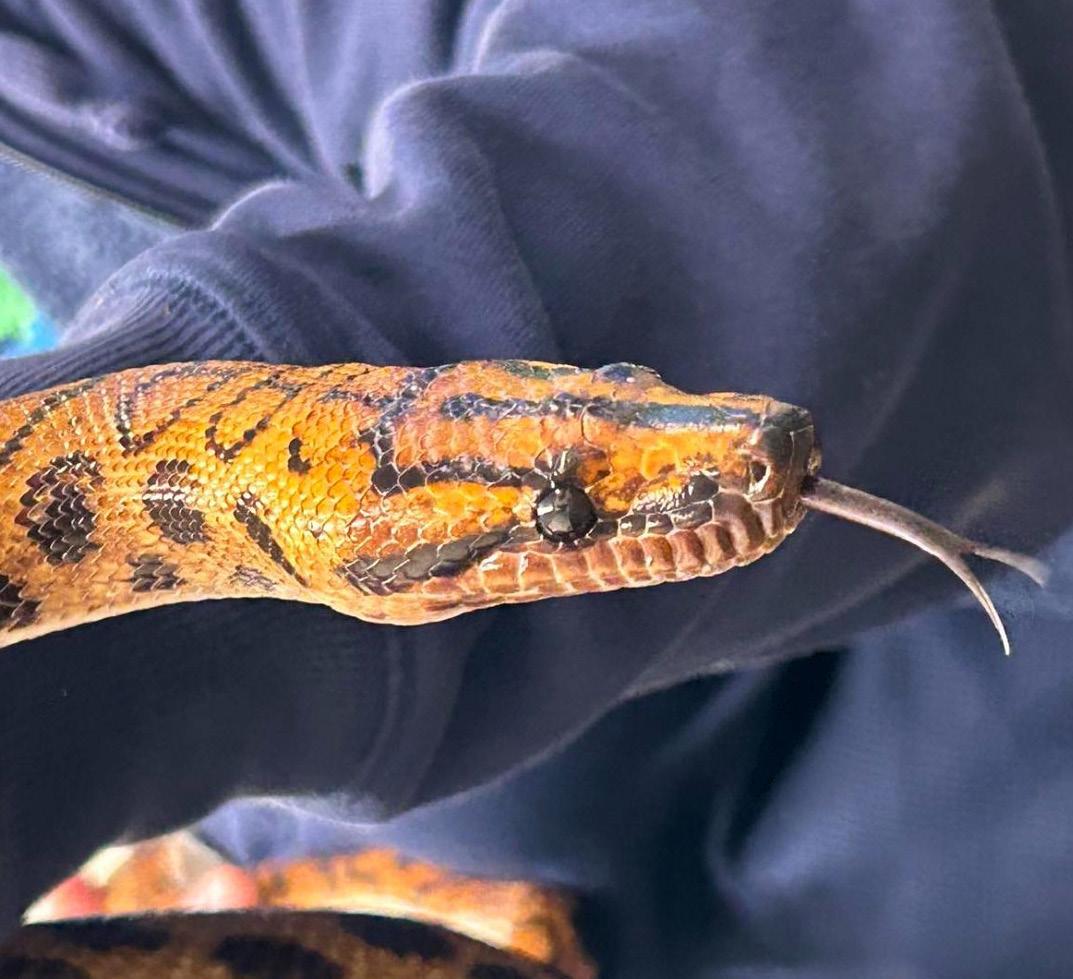
The Zoo is sad to announce the passing of 27-year-old Brazilian rainbow boa Pongo. The difficult decision to euthanize Pongo was made on December 18 following a decline in health due to his advanced age. Born on September 18, 1998, Pongo came to the Kansas City Zoo & Aquarium from the Maryland Zoo in 1999. During his time here, Pongo participated in outreach programs at schools, libraries, nursing homes, and more, contributing to wildlife education. He even would appear at homeschool programs and events, TV stations, and the Zoo's Animal Adventures LIVE programs. His care team will remember him for his beautiful, iridescent skin, as well as his calm, friendly personality that helped inspire a greater appreciation for snakes. Pongo will be deeply missed by the staff who cared for him.
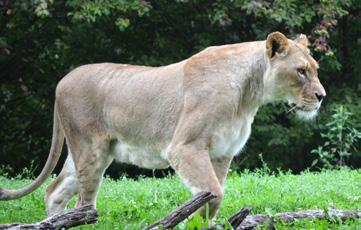
The 1909 Lion's Pride Society was founded in 2011 to recognize and honor the valuable contributions of friends who express their commitment to our mission by including the Kansas City Zoo & Aquarium in their estate plans. Over the years, the "pride" has grown strong. We invite you to join us!
Our benefits include:
Introduction at the Friends of the Zoo (FOTZ) Annual Meeting
Invitations to sneak previews and exhibit openings
Invitations to estate-planning seminars
Prominent recognition on Zoo Grounds
With a little planning, you have the opportunity to ensure that future generations are able to experience the adventure and wonder of the Kansas City Zoo & Aquarium. By including a charitable gift within your overall estate and financial plans, you can provide support far into the future.
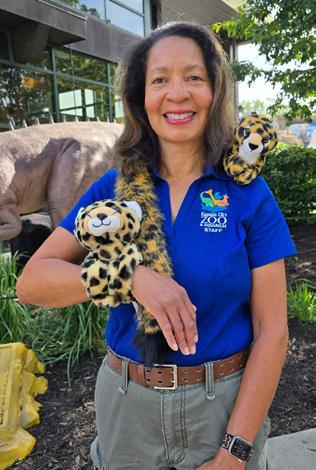
"Our Zoo is a lifeline to animals that are endangered due to habitat loss, poaching, and pollution. I want to contribute towards the future of the Zoo to continue creating habitat environments that will promote natural animal behaviors and their quality of life, inspire conservation action, provide specialized animal healthcare, and educate our community."
– Lisa Jane Kern, Lion’s Pride Society member
Thank you to all of our 1909 Lion’s Pride Society members for their continued support.
Anonymous
Jan Armstrong
Raymond & Nancy Benoist
Dee & Joe Carlisle
Marlee Carroll
Erin Channell
Jim & Linda Cole
Thomas M. Denardo
Debbie & Jim Eads
Jeanne Hays
Betty & Leonard Hershman
Louise & Gary Hicks
Les & Patricia Holy
Sarah Hopkins
Harold Hudson
Julie Hull
Joanna Ioannidis
Richard Jensen
Audrey Keairnes
Patricia Keairnes
Lisa Jane Kern
Gayle & Bruce Krigel
Judith Layton
Kay Lippincott
Leslie & John Martin
Kentucky McDaniel
& Carol Murphy
Patrick & Amy McHenry
Mary & Michael McNiel
Anne & Sam Mollet
Kathryn Morgan
Elizabeth Norton
Sean & Cyndie Putney
Pamela Ratliff
Brad Redburn
Marjorie Roberts
Terry Rusconi
Debra & Michael Ryder
Dianne Schmidt
Don Shanks
Barb Sherer
Kathy Smith
Linda & Harlan Smith
T.J. Snyder
Juston & Christine Taylor
Grace Thornton
Sandie & John Valentine
Frank & Gerry Victor
Jean & Don Wagner
Barb & Randy Wisthoff
Contact Richard Wells, donor relations manager, at richardwells@fotzkc.org or 816-595-1217 or visit kansascityzoo.org/planned-giving to explore the many ways you can extend your legacy at the Kansas City Zoo & Aquarium for years to come.
We are grateful for the continued generosity of our sponsors. Thank you for your steadfast support that helps make our world-class Zoo & Aquarium possible.
If your company would be interested in sponsoring an animal or area of the Zoo, please contact lisafickenscher@fotzkc.org. Kansas City Zoo & Aquarium sponsorship is a great way to increase visibility for your business and support the incredible work that our Zoo does year-round.



6800 Zoo Drive | Kansas City, MO 64132 816-595-1234 | KansasCityZoo.org
Through February 27 9:30am – 4pm Daily February 28 - October 31 9:30am – 4pm Mon-Fri 9:30am – 5pm Sat-Sun

page 6
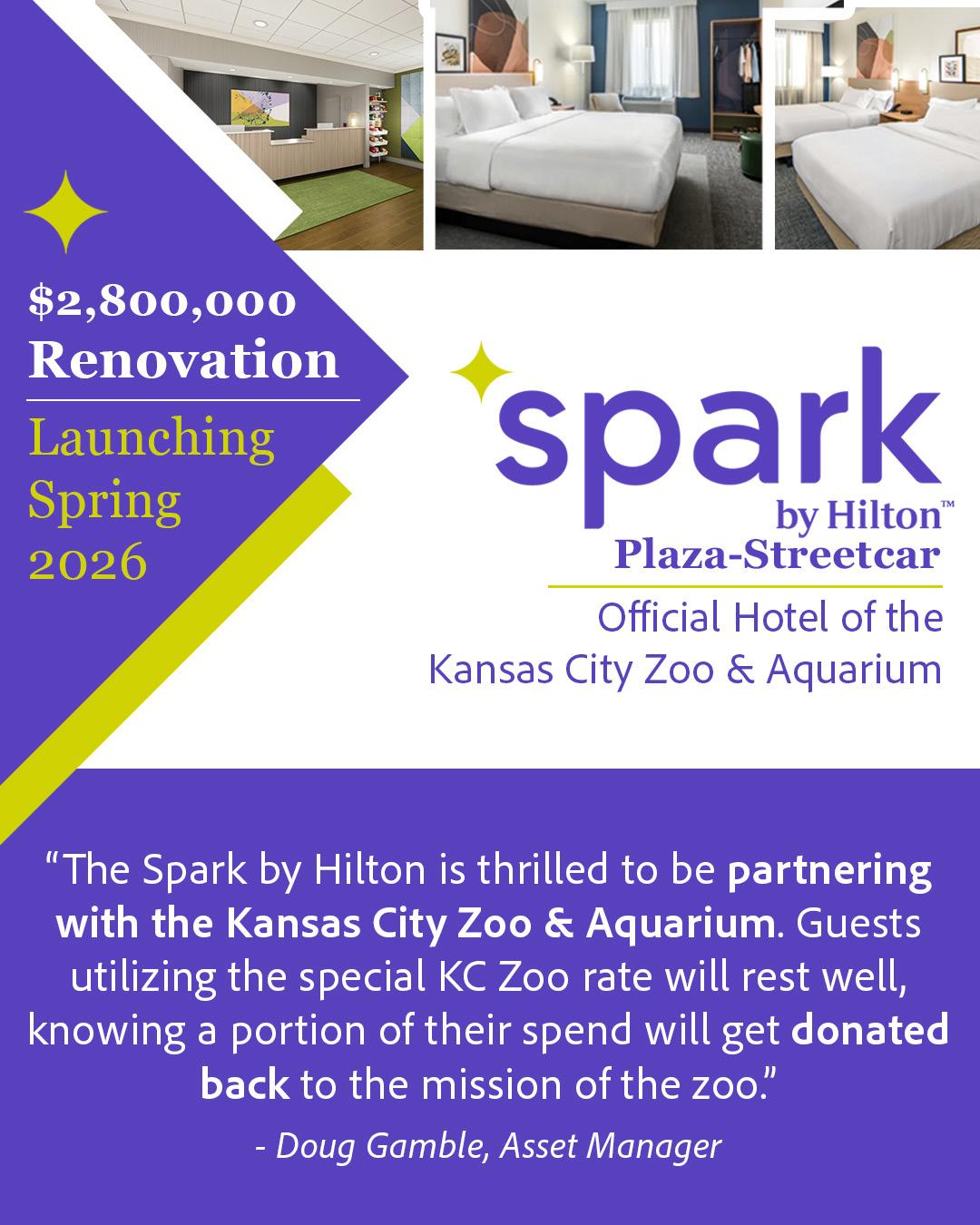
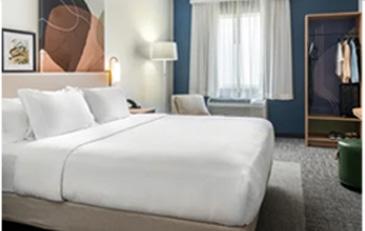
We are excited to share that the Spark by Hilton will be the Official Hotel Partner of the Kansas City Zoo & Aquarium! A portion of the hotel's revenue generated by Zoo guests will be donated back to the KCZoo to support the care of nearly 10,000 animals.
Located at 43rd and Main on the KC Streetcar South Extension, the property, formerly the Seville Plaza Hotel, is undergoing significant renovation to its guestrooms, public space, and exterior/landscape prior to joining the Hilton portfolio. The hotel is expected to welcome guests in March 2026.
“We are excited to work with Spark by Hilton,” said Sean Putney, Executive Director/CEO of the KCZoo. “We aim to provide every Zoo guest a quality experience and this partnership expands our ability to do that. We appreciate that the hotel is not only conveniently located and affordably priced, but that they are committed to giving back to their local community.”
The Spark by Hilton will be one of only a handful of properties located directly on the KC Streetcar line, providing guests with exceptional maneuverability from the Plaza to downtown all the way north to the River Market. When Spark begins taking reservations, we will be sure to update you on how you can give back to the Zoo with a stay at this exciting new hotel!